




Abstract
There has been a conspicuous growth in the height and extent of luxury urban development in the 21st century. This has been accompanied by important critical analyses exploring how this upward construction has created new vertical social divides and landscapes of power. This article argues, however, that there are spatial and methodological limitations to the way luxury urban skies have tended to be framed and pursued. Through a focus on the decisions taken in producing the 2017 meditative film Vertical Horizons by Tom Wolseley, the paper offers an expanded agenda for engagements with elite vertical development. This film juxtaposes views of London and Western Europe’s tallest skyscraper, the Shard, from different vantage points, with contrasting narratives about the building. Vertical Horizons seeks to use its focus on the Shard to open up more imaginative experiments with high-rise landscapes, and better recognition of the potential complicities in responses to the gleaming façades of contemporary urbanisation. The paper posits that more multi-sited, creative and reflective approaches, such as those pursued in Vertical Horizons, are required in efforts at levelling with the social and symbolic power of urban vertical luxification.
Introduction
The skylines of most major cities have undergone significant transformation in the 21st century. Compare and contrast panoramic images from the turn of the millennium to today and you are likely to observe skyscrapers reaching unprecedented heights, new digitally-designed architectural silhouettes appearing and a greater concentration of high-rises in clusters beyond the downtown (Drozdz et al., 2018; Evans, 2019). Constructing tall buildings has proved seemingly an unquenchable pursuit this century. This is despite severe uncertainties raised around skyscraper safety and security brought about by the destruction of the former World Trade Center in New York in 2001 (e.g. Kunstler and Salingaros, 2001), and horrific disasters such as the Grenfell Tower fire in London in 2016 and the collapse of the Champlain Towers South in Miami in 2021. The financial logic of skyscrapers has also been seemingly unaffected by the Great Recession of 2007–2008 (see Craggs, 2018) or, apparently, by the Covid-19 pandemic (see Smith, 2021).
What might be understood as a vertical ‘urban age’ comprises a wide variety of high-rise building types. There are new commercial office blocks (e.g. Grubbauer (2014) on Vienna), condo towers such as those in Toronto (Rosen and Walks, 2015), self-consciously iconic skyscrapers by globally-recognisable architects (Dyckhoff, 2017), vertical trophy homes such as the Antillia tower in Mumbai, multi-story car parks refreshed as leisure and retail destinations (Jackson et al., 2021), extraordinary ‘mega-tall’ skyscrapers over 600 m such as the Burj Khalifa, and high-rise housing blocks built as part of efforts at ‘regenerating’ or ‘rehabilitating’ lower-income or squatter settlement urban areas. New non-occupied structures such as viewing towers and observation wheels (Smith, 2019; Yap, 2012) and projected visions of the skyline-to-come, particularly those shaping contemporary African urbanism (Watson, 2014), can also be understood as part of this new vertical urban age. But what unites this new widespread upward flurry of construction, realised or otherwise, is an emphasis on the lifestyles and priorities of urban elites. As Graham (2015: 641) surmises, ‘the last few decades have seen a striking colonisation of the urban skies by the world’s super-rich’.
These socio-spatial divides created and accentuated by what Graham (2015) calls a ‘luxification’ of contemporary urban skies has been critically understood in three intersecting ways. First, an important emphasis has been made on how building upwards acts as an increasingly key repository or ‘fix’ for surplus capital, often funnelled through international investors or sovereign wealth funds (Nethercote, 2018). High-rise construction has accordingly been indexed through speculative returns and capital security rather than social function, with many spaces left conspicuously empty of actual regular residents or users (Atkinson, 2019; Lauermann, 2022). Secondly, luxury skies have been seen as a means for urban elites, in an analogous manner to the growth of gated, up-market suburban enclaves, to rescind their social connections and responsibilities and create new cossetted, carefully environmentally regulated and securitised islands of wealth up above the city (Graham, 2015). The resulting vertical gated communities often contrast sharply with forms of impoverishment, pollution and congestion experienced at ground-level. Thirdly, luxified skies, as indicated through the ‘luxury’ framing, have been understood as a new and heightened means to flaunt power, prestige and status. Working beyond simply the financial calculus of vertical asset-building, penthouse suites, private amenities and privileged views across the city have been used to present and perform individual social superiority and class distinction (Dorignon and Wiesel, 2022). Meanwhile spectacular skylines and iconic architecture have been deployed to convey and assert the internationally competitive aspirations of metropolitan and national state actors (Acuto, 2010; Kaika, 2010).
In the attention drawn and critique generated around a new gilded era of vertical urban development, however, there is a risk, albeit inadvertent, of reinforcing and validating the elite characteristics and luxury credentials of recent high-end high-rise construction. This paper instead encourages approaches that seek not only to critically assess the investment rationales, socio-spatial divides and status games that accompany luxury urban skies but also to reflect more fully on how and why these contemporary landscapes of elite vertical urbanism are brought into view. It argues that greater efforts are required in opening up more multi-sited, creative and reflexive approaches to research on vertical urban spaces. Urban scholarship has certainly got ‘off the ground’ in the last decade but there remains scope for enhancing the suite of methods and interventions involved, particularly to better chart and present possibilities for reimagining the role and function of our contemporary skylines.
The article details a particular creative response that its authors collaborated on as one means to begin exploring how to deal more roundly with luxury urban skies. This is Tom Wolseley’s 70-minute film, Vertical Horizons (2017), created while he was an Artist in Residence at University College London’s Urban Laboratory. Vertical Horizons took as its focus the Shard located above London Bridge Station in the London Borough of Southwark (Figure 1). Inaugurated in 2012, the Shard has become a defining landmark of London over the last decade. Tapering up to a jutting apex, this slender pyramidal glazed structure, 310 m high with 72 floors, is, at the time of writing, the tallest building in London and the highest occupied structure in Western Europe. The building was conceived by its developer, Irvine Sellar, and architect, Renzo Piano, as a ‘vertical city’, and contains, moving upwards: offices for a range of businesses and services, six restaurants and bars, the five-star Shangri-La Hotel, private apartments, and a viewing gallery on the 69th and 72nd floors.
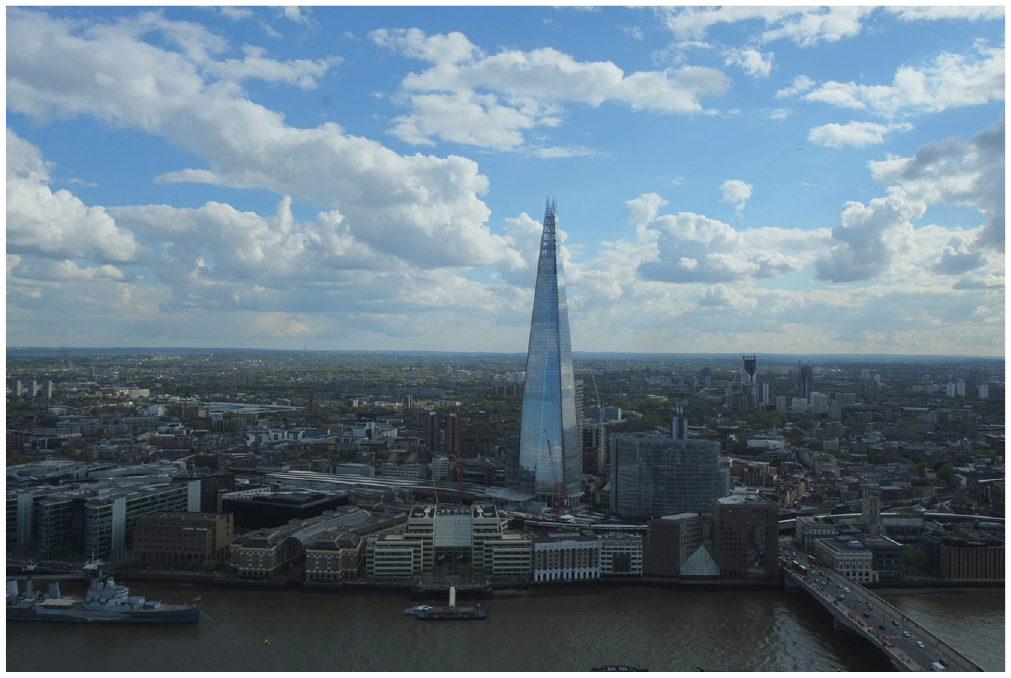
The Shard pictured in 2015 from the Walkie Talkie skyscraper in the City of London.
In choosing to focus on this particular building, the film aligns with many other accounts of neoliberalism and iconic architecture in 21st-century Britain (e.g. Chakrabortty, 2012; Hatherley, 2012: 346; Atkinson, 2020: 22; Grindrod, 2022: 339–340; Knowles, 2022: 5) and scholarly writing on vertical urbanism (Graham, 2016: 164–167; Dobraszczyk, 2019: 113–114) that use vignettes and details around the Shard to develop their critical analyses. In its insular characteristics, upmarket branding and domineering presence, the Shard can be understood as an exemplary London-specific instance of the global surge in high-end, vertical construction over the last two decades. But Vertical Horizons sought not only to place the Shard centrally but also to try to respond to and problematise this centrality. The film juxtaposes views of the Shard around South London with contrasting narratives about the building and Tom Wolseley’s own response to living nearby. The film’s conceptualisation, production and content not only looked to explore aspects of the Shard’s relationship with contemporary, global London, but sought to stimulate more multi-dimensional and reflective perspectives to dealing with its social and symbolic power (Wolseley, 2020).
The paper starts by identifying key critical themes – around secession, branding and power – through which luxury urban skies have been analysed, before sketching spatial and methodological limitations to how these themes have tended to be framed and pursued. The paper then uses a focus on the making of Vertical Horizons to show how efforts can be made at developing a more expansive and self-reflective critical analytical agenda around elite urban verticality. This, we argue, includes the need to range beyond explicitly vertical spaces in engaging with luxury urban skies, the possibilities of more ordinary or creatively disruptive approaches that can recalibrate the appeal of contemporary skylines, and the ability to keep open alternative high-rise visions and recognise potential complicities and limitations in our personal responses to the gleaming façades of contemporary urbanisation.
Assessing luxury urban skies
A central and consistent theme to the analysis of luxury urban skies has been their apparent disconnection or secession from the surrounding city. This can manifest in physical forms of separation including gating, concierges, security guards or so-called ‘poor doors’ for less prosperous building inhabitants (Osborne, 2014; Wang and Lau, 2013), as well as in more nuanced filtering of the less able-bodied or those less resourced with cultural capital (Jackson et al., 2021). But it can also be evident in a lack of efforts to connect or align new high-rise spaces with existing local social or cultural landscapes; as Nethercote (2018: 670) details: Elevated apartments engage minimally with local topography or the streets below, lessening the buyer’s perceived need for once paramount fine-grain local knowledge about adjacent properties, a property’s ‘street appeal’, or even its local neighbourhood.
In contrast to the interplay between above and below central to modernist visions of ‘streets in the sky’ (Murphy, 2016), this vertical social splintering or insularisation continues and magnifies a trend within late 20th-century corporate architecture to turn inwards (e.g. Jameson, 1991) or, in the case of the former World Trade Center in New York, achieve what Beal (2021: 229) describes as ‘a more exquisite solipsism by doubling its own form and thereby eliminating any external point of reference other than itself’. As Kaika (2011: 977) argues in relation to her work on the new iconic corporate architecture of the City of London, these are ‘islands of development that do not have, and perhaps do not wish to have, any relationship with the city that surrounds them’.
A second analytical approach to dealing with new luxury urban skies, beyond their often-fractured relationship with the surrounding city, is to assess the way their actual luxury characteristics and credentials have been formed and fashioned. This has necessitated exploring how verticality resonates as a sign and symbol of prestige and superiority. This can involve practices of height benchmarking and comparative claim-making (Hemphill et al., 2009); forms of marketing and promotion through advertising and product placement (e.g. Bunnell, 1999); but also more performative events such as inauguration ceremonies and cultural festivals. These activities, orchestrated by developers with the media, architects, advertising and PR agencies, local authorities and even board game designers (e.g. Skyline Chess, n.d), can be understood as efforts at what Maria Kaika (2011) calls, drawing on Žižek, forms of ‘phantasmic seduction’. This is part of a process by which, Kaika (2011: 984–986) argues, contemporary corporate buildings, increasingly secluded from most urban-dwellers’ direct experience, become iconised through ‘the imposition of levels of abstract ritualisation’ and a ‘spirit of make believe’, even before they have necessarily finished construction.
As well as engaging with the socio-spatial divides and promotional strategies that comprise and define new luxury urban skies, analytical work also importantly examines their imbrication with mechanisms of financial speculation and state policymaking, and their accompanying role in potentially reshaping how cities have been (re)developed. High-rise construction, especially with the emergence of skyscrapers in Chicago and New York from the late 19th century, has always been closely connected to the monetisation of air by speculators (Hoyt, 1933). But the more recent epoch of urban verticalisation can be understood as an effect of new globalised flows of investment capital, new forms of financial instruments, and, perhaps most significantly, the increasing centrality in urban asset-building of massive speculative, debt-fuelled investment in property development (Moreno, 2011). Crucially, this vertical mode of surplus absorption has involved more than simply heightened new property investment. The state has often been actively involved, across local, municipal and national levels, in promoting the intensification of vertical development to enhance value extraction (see, e.g. Robinson and Attuyer, 2020). Intersections between the state and the real estate industry have included the development and trading of urban air rights (see Chen (2020) on Taipei and Wainwright (2019) on New York) and the reworking and manipulation of floor area ratio policies (see Liong et al. (2020) on Jakarta and Jose (2017) on Mumbai).
As well as recognising new ways planning policy, regulatory frameworks and legal instruments have been reshaped by developers, state actors and other market intermediaries, luxury urban skies have also been seen as helping establish, mark out and normalise new understandings of built fabric and urban space. As Sklair (2017: 3) argues in his work on contemporary corporate iconic architecture, elite towers can cast a hegemonic grip on contemporary urban development thinking and reinforce ‘transnational capitalist control of where we live, what we consume, and how we think’ (see also Zukin, 1992). Even if vertical structures do not directly displace or disrupt existing functions and activities, they can overshadow existing buildings and be used to squeeze and squash the heterogeneity, dynamism and plurality of streets and neighbourhoods below (Rao, 2007).
Luxury vertical city limits
All of these approaches are important in identifying and understanding the way new luxury towers have become an increasingly central feature of contemporary urban life. However there remain several ways that their spatial framing, methodological approach and critical scope might be expanded and complicated. First, despite the clearly restricted and selective relationship these buildings have with the city, there is a possibility of reprising isolating tendencies within the spatial frameworks adopted in their analysis. There can be a cataloguing, as with Graham’s (2016: 88–123) Vertical book, of examples in the recent global construction of skyscrapers and luxury high-rise housing, particularly the more spectacular and extreme, without much in-depth consideration of their surrounds and relationship to the rest of the city (although see O’Neill and Fogarty-Valenzuela, 2013). Likewise, close attention to stratified and hierarchical aspects of particular vertical sites with multiple floors and functions has yielded some rich recent research, such as Lam and Graddol’s (2017) semiotic landscape focus on the International Finance Centre in Hong Kong and Shilon and Eizenberg’s (2021) exploration of new affective residential experiences in Israeli high-rise complexes. But without analytical juxtaposition and intermeshing with other urban spaces there is the risk of replicating these buildings’ disconnections and distancing from the surrounding city. Similarly, within the realm of visual representations of vertical spaces, there can be a tendency simply to ‘crop’ to particular buildings, rather than, as Lindner (2013: 80) notes in his survey of early New York high-rise photography and film, ‘widen . . . [the] scope to include adjacent buildings, traffic, crowds, streets and lampposts’.
Secondly, although new luxury and spectacular additions to the urban skyline may prove seductive and be deemed desirable, the hold of these new urban totems is not necessarily supreme nor is their ‘phantasmic’ power implacable (see, also, Rossetto and Andrigo, 2018). Urban dwellers’ response to and engagement with promotional and branding efforts and activities around tall buildings may spark affection and aspiration but can also conjure disquiet, ridicule and indifference: as work on polyvocal or prismic aspects to architectural symbolic production has attested (Humphrey, 2005; Llewellyn, 2003). This means the same high-rise building or typology can have multiple interpretations. This is clear in Roast’s (2024: 649) paper in this issue on ‘weird’ verticality in Chongqing, which he argues ‘illustrates the multivalent nature of the vertical city, with spaces of vertical density appearing as sites of communality, restructuring, everyday life, as well as spectacle, luxification and accumulation’. Rather than only collecting and presenting promotional details of what Graham (2016: 163) refers to as the ‘boosterist media and architectural commentary’ that accompanies new luxury towers, there needs to be better recognition and assessment of the diverse ways these branding and marketing efforts are actually received, understood and, on occasion, reorientated.
In this relatively superficial detailing of the manufactured dreamworlds of new urban skylines, there are parallels to be drawn with Jackman and Squire’s (2021: 493) critique of the ‘limited methodological toolkit’ in recent ‘volumetric’ scholarship. This, they argue, is ‘often tied to elite interviews, archives, and cartographies while providing little discussion of methodological practice’. Work on luxury urban skies could also similarly expand its research agenda along lines recommended by Jackman and Squire (2021) and experiment with more embodied, participatory and multi-sensorial approaches that better engage with everyday dimensions to vertical urban life. This could also include fuller acknowledgement around the positionality and standpoint of the analyst, proponent or critic – that what is said about a towering edifice may reveal as much about the speaker or writer and their own priorities than necessarily the building under review; and how certain researchers are able to access or visit particular elite vertical locations not necessarily available easily or directly to all.
Thirdly, despite the clear hold new luxury towers may exert over planning and regeneration policy and their impact in transforming urban fabric that falls within their long shadows, it is important not to close off alternative political, social and architectural visions for the role of tall buildings in contemporary urbanisation. Counter possibilities offered up to the elite vertical urban age tend to be limited to the continued role for mass high-rise social housing in democratically-restricted settings such as Singapore and Hong Kong (e.g. Graham, 2015: 627) or even an emphasis on the violent erasure wrought by the terrorist attacks on New York’s World Trade Center (Graham, 2016: 97–100). But there remain routes for (re)imagining 21st-century urban skylines otherwise even if current political and economic conjunctures often largely limit their realisation. One example relevant to the London focus of this paper is a seven-storey building, Marklake Court, that was completed in 2018 just beyond the new ‘Shard Quarter’, and near the concrete tower of Guy’s Hospital (Jones, 2018). This is a product of a community land trust, the Leathermarket Community Benefit Society, and an extensive participatory design process with the local community, providing 27 new homes for social rent constructed on former garages. Not only do its funding, planning mechanisms and social function contrast with the Shard but a brick facade was chosen to give ‘a feeling of weightiness, durability and security that participants had sensed to be missing in the glass and steel materiality of the Shard’ (Davis, 2022: 150).
One significant way to keep open alternative visions for contemporary urban skylines is the role of artists, writers, filmmakers and other creative practitioners in more speculative engagements with vertical urban life. There has been plenty of acknowledgement and exploration by urban scholars of how science-fiction books and films reflect, shape, critique and anticipate vertical dimensions of cities, but these are generally framed around 20th-century Western examples and veer towards dystopian themes (e.g. Graham, 2021; Hewitt and Graham, 2015). There remains further scope to consider more critical urban utopias in sci-fi (e.g. Butt, 2021), and more recent literary imaginations particularly those centring around African high-rises (e.g. Cane, 2021; Gastrow, 2020; Mututa, 2018). There also remain possibilities, as with recent work developing explicitly interdisciplinary, practice-driven approaches to the subsurface (Royal Holloway, n.d), for collaborations between scholars and creative practitioners in experimenting with urban life above ground. We will now turn to our collaborative project that sought to develop a more creative and reflective response to London’s luxury urban skies.
Vertical Horizons
Tom Wolseley is a London-based artist specialising in multi-media installations utilising photography, sculpture, sound and film. His 2015–2016 residency project at University College London (UCL) working with urban geographer, Andrew Harris, titled ‘Shardology: New Visions of Vertical London’, sought to extend the collaborative nature of his artistic investigations into London life. This included Sentient City (2013), a 30-minute video-piece featuring one continuous tracking shot taken from a journey through London by car at night alongside Tom’s spoken narrative reflecting on multiple processes at work in the city, from banking and property to personal experience, sparked by the changing scenes visible along this urban transect. Sentient City took the viewer from Hackney, from where Tom had a temporary workspace, south into the City of London, then across the Thames past the recently completed Shard and ending on the Walworth Road, close to where Tom has lived since the mid-1990s.
The Shardology project was importantly framed by how we were both residents in the borough of Southwark, where the Shard is located. It was inspired not only by our longstanding interest in new landscapes of power in contemporary London, particularly in relation to high-rise urbanism (e.g. Harris, 2008), but also from how the Shard was a regular presence in our everyday lives. For Tom Wolseley, the project provided the chance to produce an essay film that took some of Sentient City’s horizontal engagement with London in a more vertical direction: integrating analysis of the Shard’s cultural and material impact on urban and global experiences alongside his own reflections on the building and its role in his life. For Andrew Harris, the residency provided an opportunity to explore alternative ways of assembling, presenting and teaching research material around urban verticality, especially through the use of story-boarding and film-making. It also created opportunities, many unanticipated, to better recognise and assess how, living close to this building since it first emerged, he had developed an ambivalent relationship with this new London landmark.
Tom Wolseley began the residency with a period of open exploration around what the subject could hold. He met and interviewed various academics with expertise on key aspects of the Shard, whether with regards to real estate, urban planning, London politics or energy. We also amassed a large amount of information around the Shard including media coverage, film shots, promotional material and planning reports. As experiments began with the format and content of the film, it became clear that it needed to better respond to some of the challenges we had encountered in dealing with the Shard as the object of our focus. As Tom Wolseley explains in a statement he subsequently wrote on completion of the film: In a city I have lived in for 30 years a transformation is occurring. It is at once obvious, in its massive demolition and construction, yet beyond my experience and understanding. It is all too easy to simply identify this change with a new sublime of global capital. Vertical Horizons tries to expand how the Shard, as an event, is grounded in the complexity of the city, our experience and lives within it.
Dealing with the Shard required not only exploring and understanding international property investment and changing London planning regimes, as well as ways the building had been marketed and represented, but also our decision to pursue a project with the Shard placed front and centre.
Although the Shard is the organising principle of Vertical Horizons, and justification for the film’s initial production, efforts were made to break down and disrupt the Shard’s centrality through the perspectives used in featuring it. The camera does not remain fixed on the building, as was initially proposed by Tom Wolseley. Instead, in a series of thirteen 360° circuit shots, each lasting 3–5 minutes, a wide-angle architectural camera is used to steadily pan across a series of London landscapes, albeit with the Shard coming into view at some point during each circuit (Figure 2). The locations themselves describe a circle around the Shard beginning at the Tate Modern art gallery, moving along the Thames and circling further south and around the Shard before again re-joining the river in the last circuit.
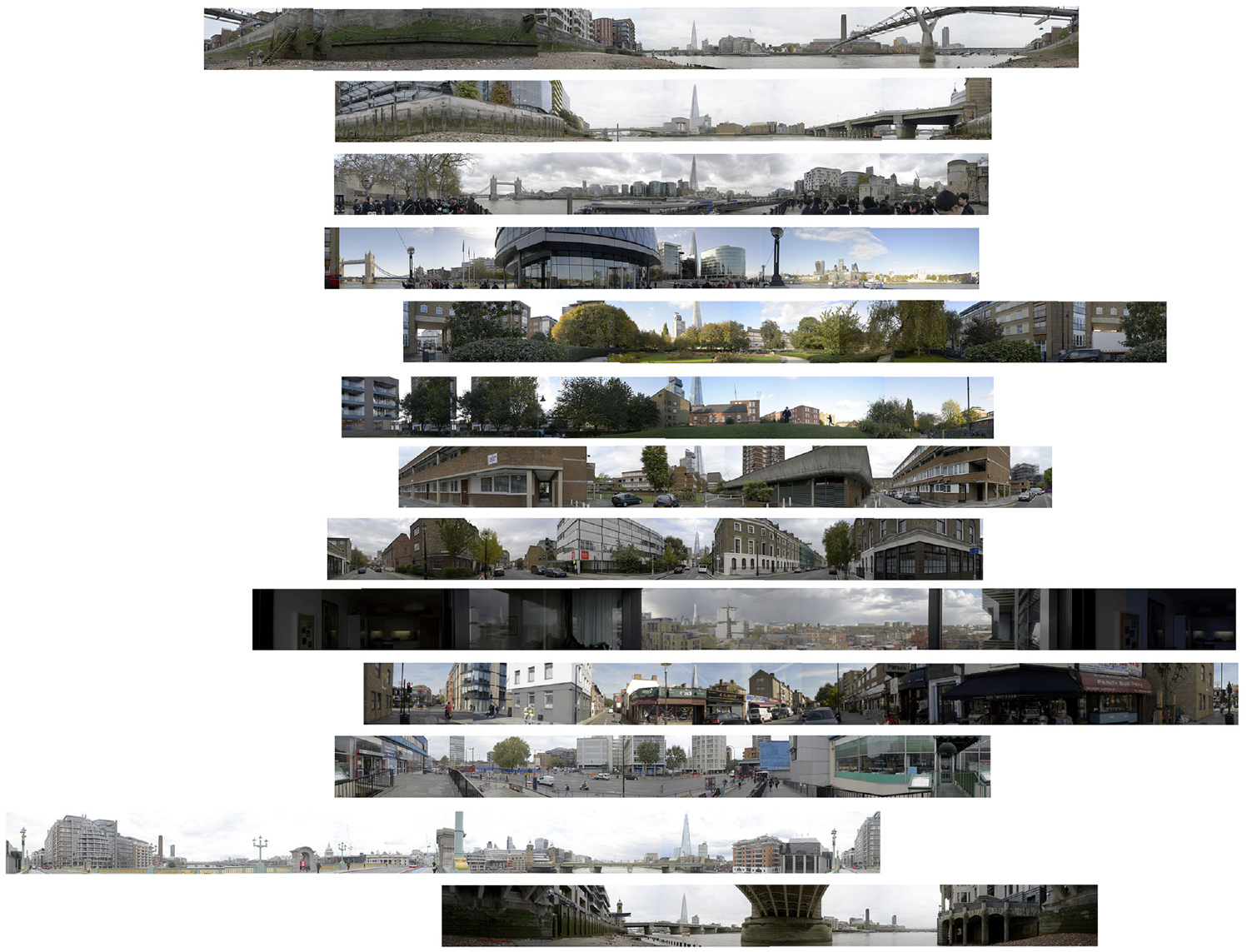
Sequential 360° viewing circuits from Vertical Horizons.
In adopting this visual approach, particularly in moving slowly across the landscape, the film became increasingly horizontal; this was a film as much about horizons as verticality, as much about South London as the Shard itself – yet still recognising the Shard’s new centrality within this part of the city. In producing a multiple series of skyline circuits, from both common and unorthodox vantage points, the film was able to develop a set of alternative ‘compositional wholes’. This usefully contrasted with the way, with a recent spate of new towers and accompanying planning contestations, London’s cityscape has often been reduced in photographs and digital renders to a singular skyline of either skyscrapers or heritage structures such as St Paul’s Cathedral (Gassner, 2017). In Vertical Horizons, blocks of social housing, playgrounds and shopping centres loom as large as the Shard itself, disrupting the primacy often given to the Shard, and other vertical features, in representations of contemporary London.
Centrally featuring these more ordinary components to the Shard’s surrounds was, furthermore, particularly crucial to seek to counter some of the stigmatising discourses that have been used to help justify the arrival of the Shard in this part of South London. Its architect, Renzo Piano, for instance, states: The Shard, in that location, was about bringing the attention of London to that deleted part, a part that was right in front of the rich City but was badly treated and a bad environment I used to call ‘the kingdom of darkness’. (quoted in Watson, 2017)
Locations were selected for filming, many familiar to us from our own everyday experiences, that involved school kids hanging out, tourists milling about, commuters rushing by and mudlarkers scavenging. This was an explicit rejection of the starkly depopulated urban settings that have characterised an anti-vernacular turn in recent art photography, such as the work of Jeff Wall or Thomas Struth (Hawker, 2013). Moreover, the bustling and lively social scenes featured in Vertical Horizons– places such as Leathermarket Gardens, Great Suffolk Street and Elephant and Castle – were an effort to problematise the misguided misreading of a historically less affluent part of London. These are locations that have, in the construction of the Shard, been literally and figuratively overlooked yet still play a role in producing and reproducing the Shard in the city.
In conceiving the Vertical Horizons film, efforts were made not only to create more interchange with the Shard’s surrounds but to feature contrasting and more everyday perspectives on the building. The way the film’s 360° visual circuits seeped into one another and moved across different vantage points around the Shard, including across the interior window of someone’s flat, sought to indicate the multiplicity of views that can be taken up towards this one building. The film’s voice-over featured details from interviews undertaken with professionals associated with the Shard and people with more ordinary relationships with the building, from both inside and out. This included the story of an employee of Al Jazeera (the Qatari state broadcaster) on the Shard’s 16th floor and how his only opportunity to interact with other members of this ‘vertical city’ is in the basement where Shard employees can shower and get changed after cycling in. It also included details from a café owner near Borough tube station. He associates the Shard closely with his late father as its opening ceremony was the day after he passed away in Guy’s Hospital directly opposite; he explains that he sees the Shard as a monument to his father.
In making Vertical Horizons, efforts were also sought to recognise our complicity in this new object of spectacle in London and channel the indirect power this brings. Central to the voice-over are regular details of Tom Wolseley’s own relationship with the Shard and London, and the way particular conceptual and technical decisions were taken in creating the film – lighting and camera panning choices, thoughts on how the footage wobbles slightly with gusts of wind, and how the image is subject at certain moments to over-exposure and moiré interference. Rather than authoritative judgements being made on the Shard in this commentary, the inclusion of these more personal perspectives and technical notes was an attempt to remind the viewer of the partiality and inherently constructed nature of the film. This was also one reason why Tom Wolseley – against the common convention of using talking heads in documentary film-making – deployed only his own voice to avoid giving the illusion of a multiplicity of people shaping the narrative.
Nonetheless, despite these efforts to undermine a view-from-above or view-from-nowhere perspective on the Shard, it remained difficult to untether the film-making from its own implications of authority and control. These were particularly highlighted when sharing and discussing draft versions of Vertical Horizons with a Southwark-based psychotherapy practice, Number 42. One moment from midway in the film was especially noted; as narrated in Tom Wolseley’s voiceover, The young boy has been coming closer for a while, responding to the gaze of the camera with stunts down the grassy bank. He comes to ask me what I am doing. I am so carried away with the formal structures of sound, exposure and achieving my goal, that before I realise the spontaneous contribution of the city to what I am doing, I tell him to be quiet. As I watch this, again and again, editing the film, my feelings for him, move from sympathy to empathy, and, from empathy to shame, as I place myself in his shoes, as a young boy, looking for the attention of an adult, my father. I seek a relationship, through this film, to the monolithic authority of the Shard. I am ashamed of the way I re-enact authority itself, to this young boy.
What this moment helped reveal was the way a sustained focus on a towering building like the Shard could act to replicate aspects of its domineering and powerful presence in the surrounding city. The encounter with this young boy threw up important tensions around our own power and positionality. This involved not only our role as middle-class, white men observing and documenting vertical London, but our accompanying privileges in being able to talk to relevant experts, access certain floors in the Shard, and prepare, present and share a sustained creative engagement with the building. Tom Wolseley took the decision to use this interaction with the boy as an inflexion point in the Vertical Horizons narrative: shifting after this encounter away from attending to the larger institutions that frame the emergence of the Shard to more reflective accounts of how his own experience could be perceived as complicit in the events in question. Such efforts to recognise and disrupt, if not dismantle, authoritative approaches and statements around vertical urbanism, we contend, will be crucial to more genuine radical engagement with the contemporary vertical urban age.
Conclusions
Many urban skies of the 21st century have not only been filled with new towers and vertical landmarks but have become the repository, play-thing and cocoon for the wealthy. Not only do many of these new high-rises luxuriate in their amenities, security and speculative value but they indicate how it has become increasingly a luxury to be able to occupy or visit spaces at height. This paper drew on the creation of the Vertical Horizons film in efforts at reflecting more fully on ways of analytically, methodologically and critically approaching luxury urban skies. Rather than necessarily aiming to disavow, confront or negate the Shard as a spectacle-fuelled venture, indicative of what Graham (2016: 11–12) describes as ‘tiny cabals of the super-rich inhabiting vertical archipelagos of protected spaces’, our response aimed to face head-on the complexities and contradictions that emerge when a skyscraper such as the Shard is enmeshed into the fabric of a city like London. This, we contend, involves pursuing what might be understood as an expanded field of verticality. We would encourage, as with the visual presentation of Vertical Horizons, more multi-sited engagements that range beyond simply a focus on attention-hungry vertical buildings and incorporate and contrast elements of surrounding everyday urban life. In parallel, we would also posit the need for recognising how luxified towers are not only the product of financial speculation, political decisions, architectural design and engineering calculations, but also the responses, experiences and interpretations of a broader range of people, from both inside and outside these buildings. This points to a methodological agenda for iconic and luxury verticality, including further research on the Shard, that requires not only elite interviews and discourse analysis (e.g. Sklair, 2017) but surveys (e.g. Murawski, 2019), multi-sensory ethnographic work (e.g. Jackson et al., 2021) and social media visual analysis (e.g. Roast, 2024).
As well as seeking to expand where and who features in engagements with luxury urban skies, our experiences with Vertical Horizons suggest there could be more sustained and reflexive efforts at identifying key assumptions and standpoints brought into analyses of urban verticality. Ideally there would be more reflection as to how some academics are able to access particular vertical sites, elevated floors or aerial views not necessarily available to all (see, e.g. Jackson et al. (2021: 511)), and more assessment of how certain professional groups’ statements and opinions are often bound into sustaining the success of a tall building culture. There might also be more personal reflections on the ambivalent feelings some elite vertical built structures can inspire: for example, Massey (2007: 29) in World City, her account of the unequal geographies shaping contemporary London at the start of the 21st century, states how ‘even the disputed skyscrapers and the maligned Canary Wharf [in London’s former docklands] give a thrill . . . a guilty delight’.
In dealing with luxury urban skies, what Vertical Horizons shows overall is the critical possibilities for pursuing verticality not only through academic scholarship but through, and with, creative practice. This provides opportunities for more accessible, multi-media presentations of vertical urban themes (e.g. the National Film Board of Canada’s Highrise project) but also for more activist-inclined or satirical responses to the hold and power these buildings seemingly exert. Working across urban research and creative practice, as with our experiences developing the Vertical Horizons film, can offer not only another route for critiquing the inequalities of new elite urban skylines, but important ways of actually developing ‘alternative imaginaries’ (Kaika, 2011: 989) around the role of verticality in contemporary urbanisation. It is these cultural reimaginings, socially and spatially rescaling and re-orientating buildings such as the Shard, that we suggest will be crucial in radical new horizons for vertical cities yet to come.
Footnotes
Acknowledgements
Many thanks to colleagues in the UCL Urban Laboratory and UCL Department of Geography for supporting this residency. The paper benefitted enormously from the comments of its anonymous reviewers and editorial guidance from Casper Ebbensgaard. Thank you too to Sidra Ahmed and Martine Drozdz for their suggestions on earlier drafts, and to Sandie Macrae at Roaming ROOM for exhibiting the finished project.
Declaration of conflicting interests
The author(s) declared no potential conflicts of interest with respect to the research, authorship, and/or publication of this article.
Funding
The author(s) disclosed receipt of the following financial support for the research, authorship, and/or publication of this article: This project was enabled by a Leverhulme Artist-in-Residency award (2014-AIR-064).
