



Abstract
Although horses and humans can be clearly observed in a landscape, why are they so hard to represent visually in a two-dimensional form? How can artists respond to and approach these subjects? Traditionally artists have directly observed from nature and studied the anatomy of horses and humans, to then make further artworks. Could artists use even more approaches, to bring about a deeper understanding of the relationships between horses, humans and landscape? In this practitioner reflection piece, I will look at how experimenting with many processes, starting with direct observations from nature, then adding memories of senses such as sound, touch, smell and bringing in an understanding of archaeology and biology, art history and literature, could help artists in trying to understand these complex and connected subjects, to create visual work.
It is very good to copy what one sees; it is much better to draw what you can’t see any more, but in your memory. It is a transformation in which imagination and memory work together’ Edward Degas
Introduction
Over 2 years (2023–2025), I have worked on a series of oil paintings and works on paper, looking into the connection between humans, horses and landscape (Kendall, 1987).
The subject matters felt hard to tackle, complex and yet connected, in order to make sense of them, it felt necessary to use several ways to investigate, to try and produce unified work embracing these complexities.
Anatomy
To make sense of how a horse moves within the landscape, I started by trying to understand how the horse’s main muscles work beneath the epidermis.
These observations came not by looking at a horse cadaver, but by copying an anatomy diagram in a veterinary book (Raynor, 2006), repeatedly, over the space of 3 weeks.
What became clear with this way of drawing, is that at its simplest, the horse has two main sets of powerful muscular structures (the muscles around the neck and shoulders and the muscles around the hindquarters). These muscles are bonded on top of four legs, whose thin tendons, end up with hooves. These hooves are small in contrast to the structure they support; the average weight, depending on the breed and height is between 500 and 700 kilos. A horse can gallop at a maximum speed of 71 mph across land of different terrain, using this structure. Different breeds of horses have various lengths of leg, height of back, length of neck. However, when drawing a horse, there is a recognised cohesion and horse structure, uniting all breeds. Crucially when drawing a horse out of scale, even within a small detail, the drawing seems not to work to an observer, even one with little knowledge of horses (Figure 1). Studio drawing of a horse, main muscles Miranda Creswell 2023.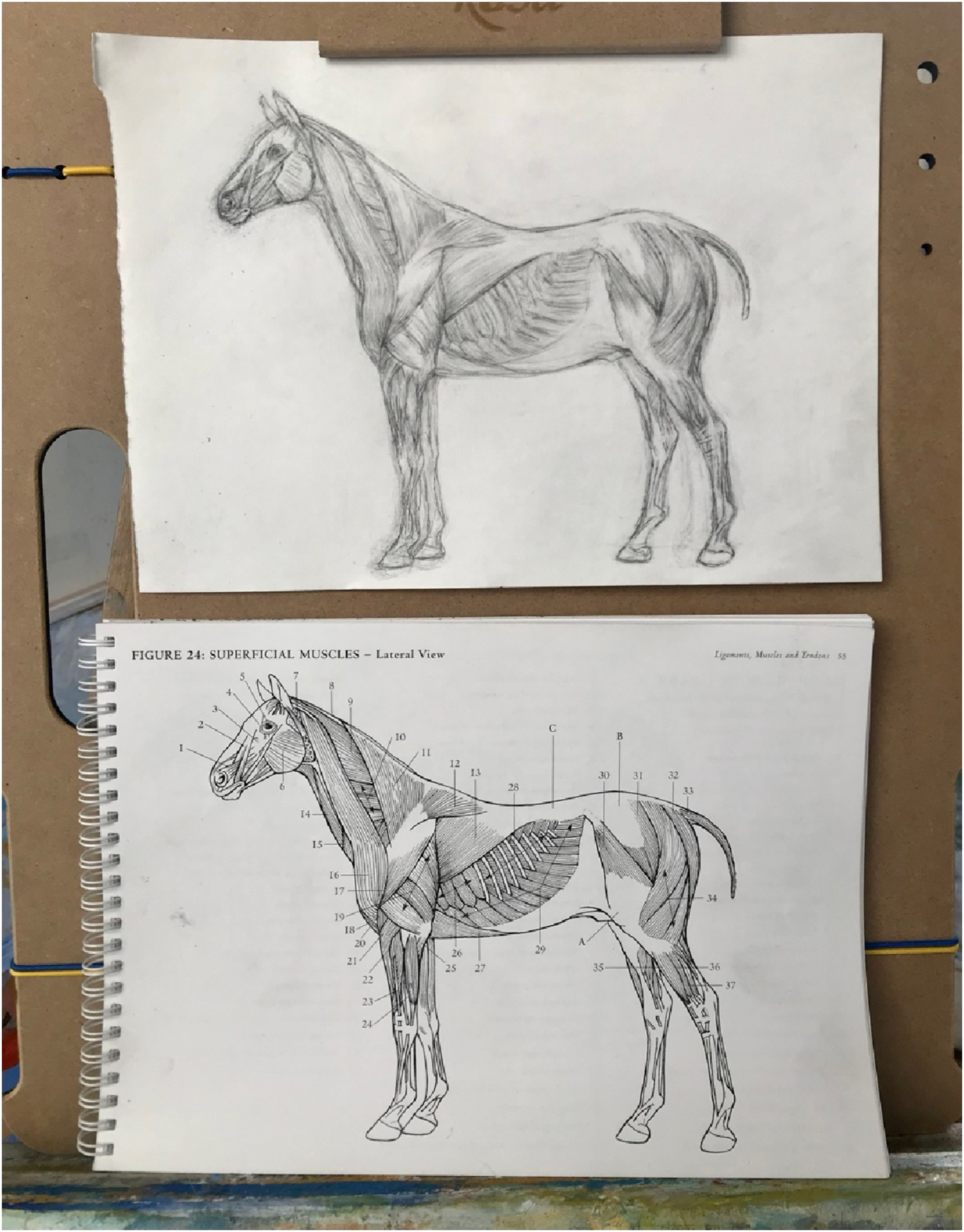
When the artist George Stubbs (1724–1806) was a young man in York, he worked with a medical surgeon learning to draw from human anatomy, it was then that he came up with the idea of visual research, via the anatomy of a horse, to inform artists.
In 1756, he found a patron and spent 18 months, in large studio barns, in Lincolnshire. These were conveniently close to tanneries and together with his partner Mary Spencer, they stripped layers of muscle from horse cadavers, until they came to the skeleton. He drew carefully from many angles, publishing forty-one drawings and notes in a book: Anatomy of the Horse, in 1758. These original drawings were used for teaching Royal Academy students to draw horses.
The Royal Academy still own all the drawings (Gallery, 1984).
These ways of looking at horse muscles in such depth were valuable, Stubbs’ subsequent oil paintings, show an incredible knowledge of the skeletal and muscle structures, his famous paintings Whistleblower 1762, a vast painting (292 × 246.4 cm) and Mares and Foals 1762 (90 × 190.5 cm) are examples of this.
The horses are shown with a simple clear background devoid of landscape, unconnected to human beings, with no horse tackle. These paintings allow the viewer to admire the detail and the complicated structure that is the horse, but show no connection to the landscape.
Archaeology
Stubb’s paintings show a powerful single focus, but my interest was also with the human and the landscape that connects the horse. Recently these interests together with their links to the past, has led me to be part of a research group called Horsepower.
https://www.horsepowerproject.org
Horsepower is a research project made up of archaeologists, scientists and a creative team, who are looking to why two immense powers, were connected with each other and with horses 2000 years ago: the powers being China and Mongolia. The project is exploring the relationship between the Mongolian steppe and inland China, two very different landscapes, and also the relationships between horses and humans, two different beings, in life and in death. Excavations and research will focus on why and how some humans, were buried in the landscape, alongside sometimes hundreds of horse skeletons.
My role as a contemporary artist working alongside the group, has been to use many visual approaches. I have observed horses, humans and landscape in the steppe of Mongolia and landscape of the Gansu in rural China, then worked in the studio using different media; silver point, charcoal, oil paint, silver and gold leaf, all the while responding to new archaeological and biological research.
The aim is to produce work that does not recreate the past or the research directly, but as a response in the paintings, partly by referencing the deep connectivity of horses and humans, within Mongolian and Chinese landscapes (Figures 2–4). Miranda Creswell painting Horse herd, Mongolia 2023 Photo: Rory Carnegie. Across the land, oil on canvas, 2024 Miranda Creswell. Moving horse herd, watercolour, Mongolia 2023 Miranda Creswell.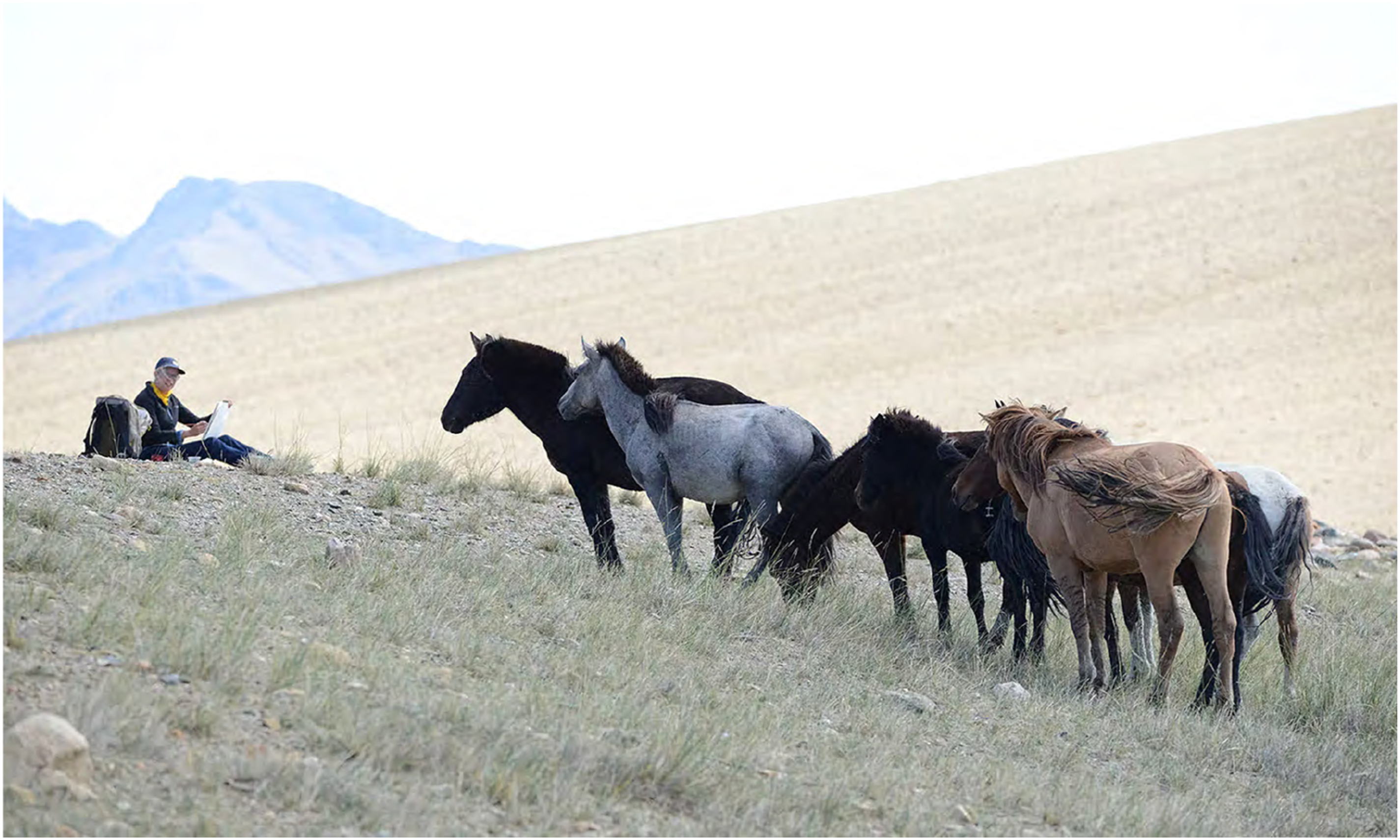
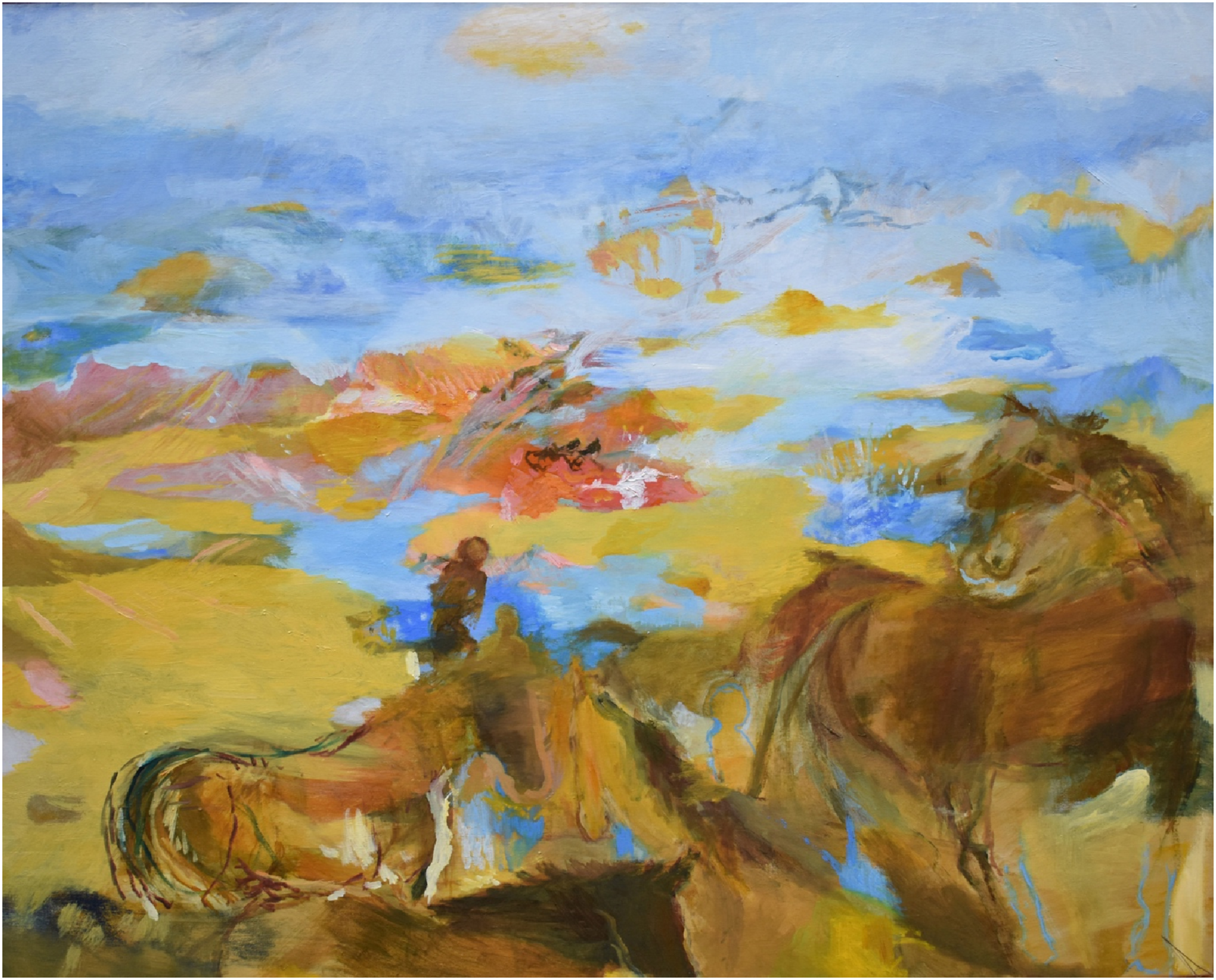
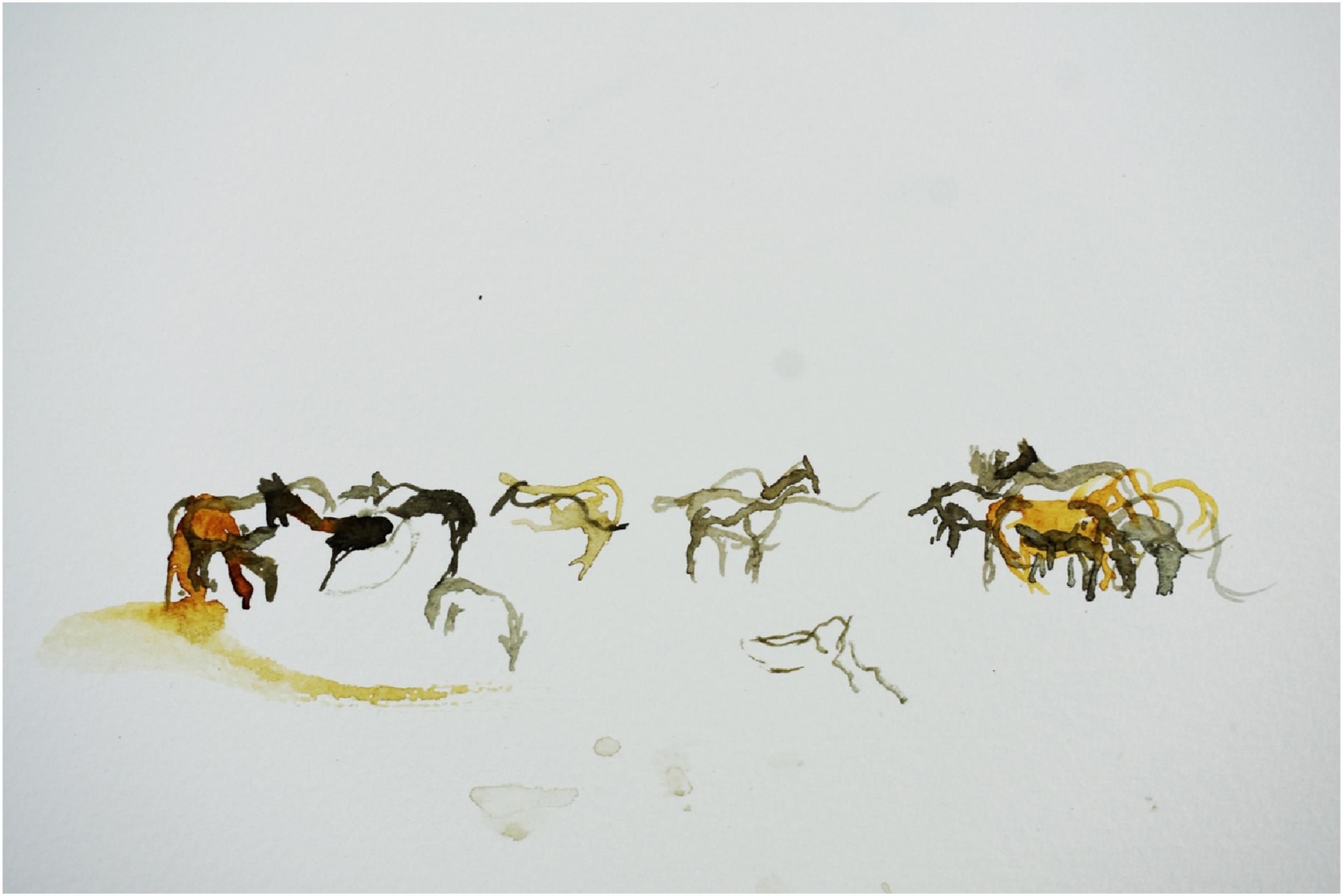
Movement in landscape
Part of working with the Horsepower research group meant that I was able to physically be in the landscapes of rural China and in the steppe of Western Mongolia. The latter being a remote region, where the landscape has no human made obvious boundaries. An observer can immediately see a herd of animals or human, within this vast space, yet these do not feel cut out of the landscape but immersed in it, and yet clearly visible.
When I was close to a herd of horses, the marks made on paper became almost instinctive, reacting to the moment of seeing horses moving and approaching.
It allowed me to observe the hierarchy within a horse herd, the noises that the horses made to each other in communication, to smell the horses and the trampled grass, intermingled with herbs such as artemisia.
The horses were feeding with their muzzles in the grass, the grass was being digested, almost like parts of the landscape entering the horse, the air breathed.
The landscape and the horse did not look or feel separated.
Movement
The artist Theodore Gericault (1791–1824) often depicted horses moving, as a vibrant muscular animal. He seemed to use the tension of a human being riding or holding the horse to show the horse’s immense power (see below Figures 5 and 6). Frightened Horse attributed to Gericault, pen and ink, Penta Springs Limited/Alamy Stock Photo. Gericault, groom holding four Horses 1816-1817. Credit: Thaw collection. The Morgan library and Museum. 2017.91.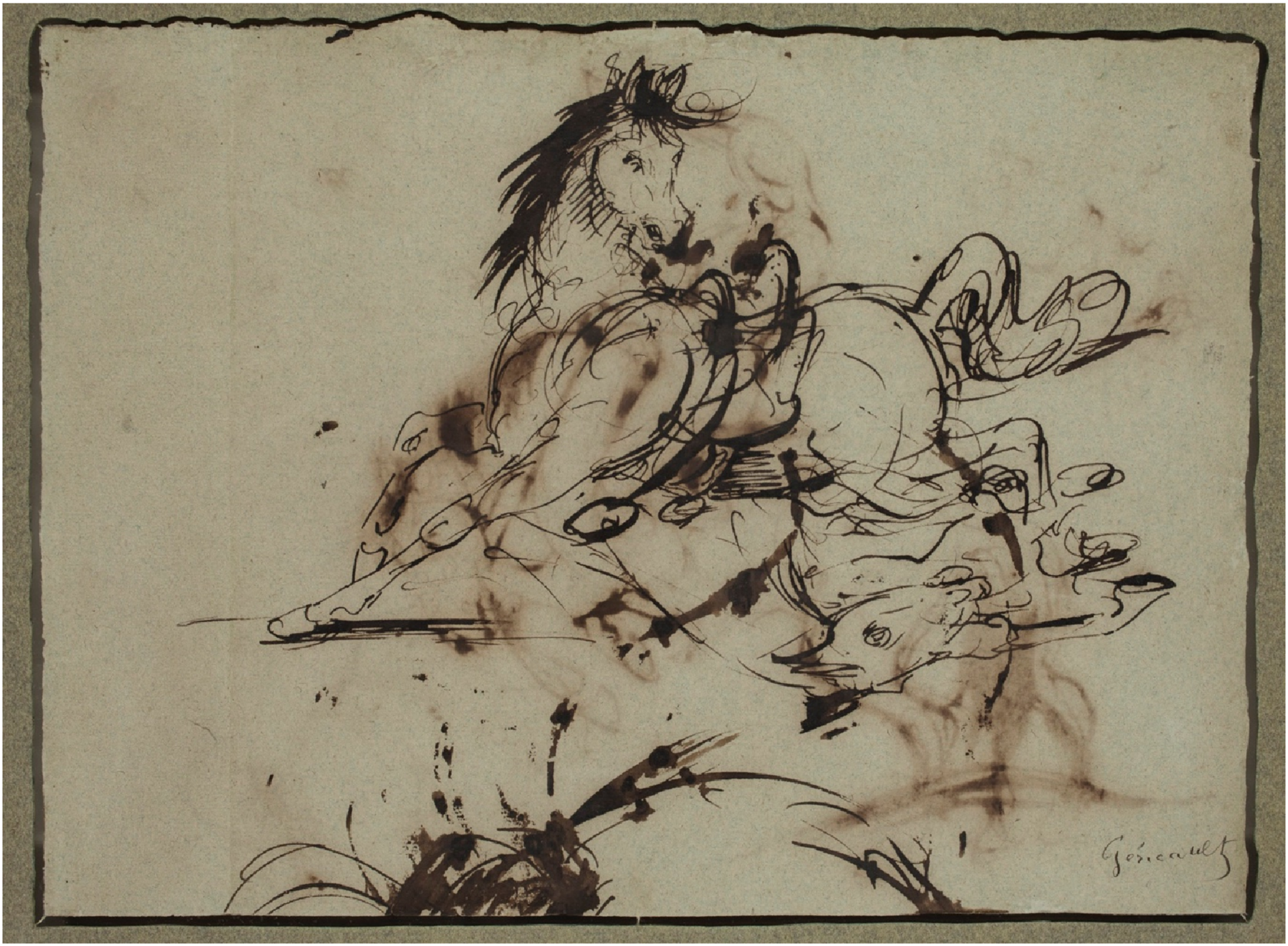
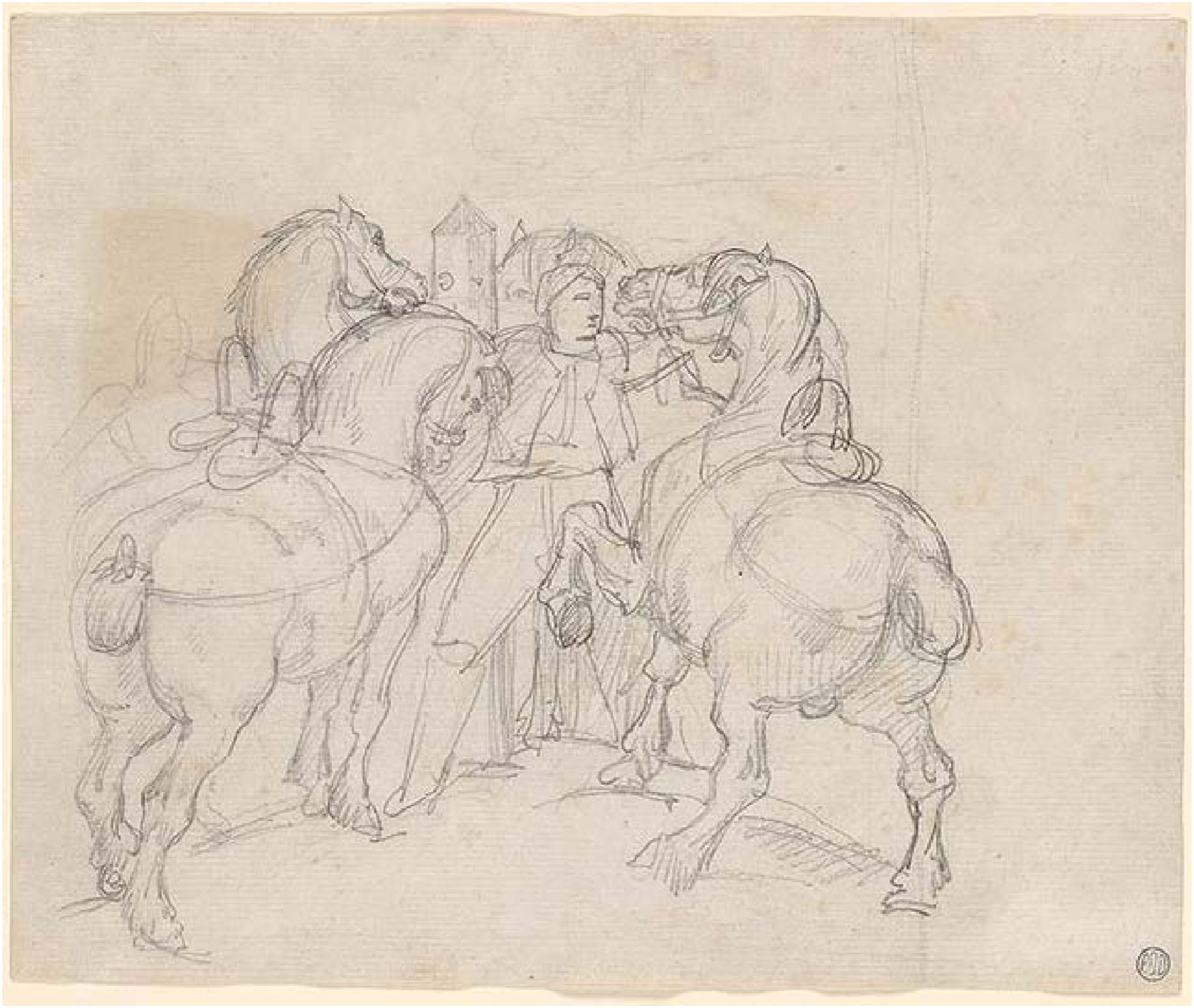
The landscape is at times part of the painting, but not wholly part of the connection between the human and the horse. Gericault drew from everyday scenes which may have informed his painting of horses in action, in his oil paintings.
While thinking about the movement of horses, I was aware that it is not simply a horse moving from one place to another; each part of the horse moves at a different rate: muscles twitch, legs jolts, ears point in different directions, nostrils and manes move and so on. For an artist it becomes important to grasp the general flow, which is not defined just by muscle, but by some kind of intent, without negating the other smaller movements that are happening. The challenge is to develop a visual way of describing this.
The writer Franz Kafka (1883–1924) used his prose to refer to horses that almost become the landscape, Carolin Duttinger describes (Franz, 2009), in her forthcoming book on Kafka, in a chapter on Kafka and Horses. As he writes in a micro story, ‘Wish to Become a Red Indian’, published in 1912: ‘Oh to be a Red Indian, ready in an instant, riding a swift horse, aslant in the air, thundering again and again over the thundering earth, until you let the spurs go, for there weren’t any spurs, until you cast off the reins, for there weren’t any reins, and you scarcely saw the land ahead of you as close-cropped scrub, being already without horse’s neck and horse’s head!
Duttinger goes on to describe:
‘Wish to Become a Red Indian’ is one revealing example. This micro-story, one of Kafka’s earliest, revels in movement – the movement of the rider on horseback racing across the American plains. The rider seems at one with his surroundings – with the animal body and the ‘thundering earth’, but as the story wears on, these tangible features are discarded one by one as this exhilarating ride turns into something more abstract and self-reflexive: the movement of the pen across the page.’
The idea of the movement of a rider on a horse being intertwined with the ‘thundering earth’ is in part describing the connection of the land and the horse and rider until Kafka makes everything disappear… Kafka seems to be describing the amalgamation of horse, rider and land, which is of interest for me in marks of paint, but also as a way of remembering what it is to ride. Kafka’s writing allows for the sound to be described, which the painting cannot do. However, thoughts on sound seem to inform my work in the studio (Figure 7). Full Speed, pastel on paper, 2024 Miranda Creswell.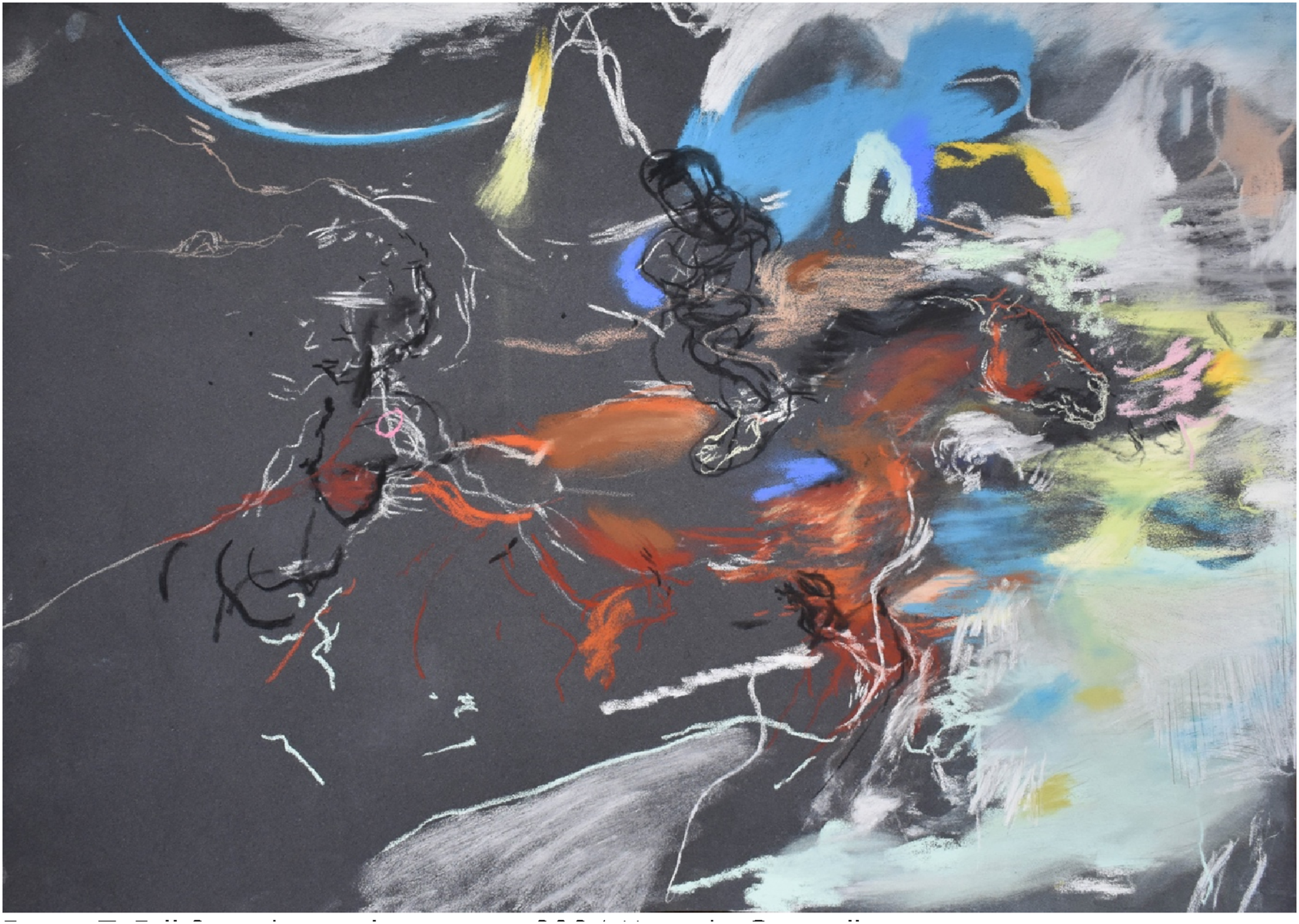
Sense of touch
When I was a young girl, my grandmother advised me to approach a nervous horse by going in sideways, blowing softly into its nostrils and stroking the muzzle gently downwards, in the direction of the hair growth. Small details such as these, did came to mind, making the first pencil marks on a sheet of white paper, almost like stroking the horse, but in a drawing.
I was using memories of Mongolian horses and the steppe landscape, but also memories of riding as a child, the feeling of riding with the horse moving between your legs, your hands resting on the base of the neck of the horse, the feeling of a warm fur.
I encouraged these memories to resurface while drawing different parts of the horse, to get closer into an imagined painting but also the understand the flow of horses.
The painting below (Figure 8) shows a rider melting into a horse and the horses emerging out of the landscape, not cut out of the land. The edges between horse, rider and landscape are not entirely defined and emerge from layers of oil painted marks. Views from a horse, oil on canvas 2024 Miranda Creswell.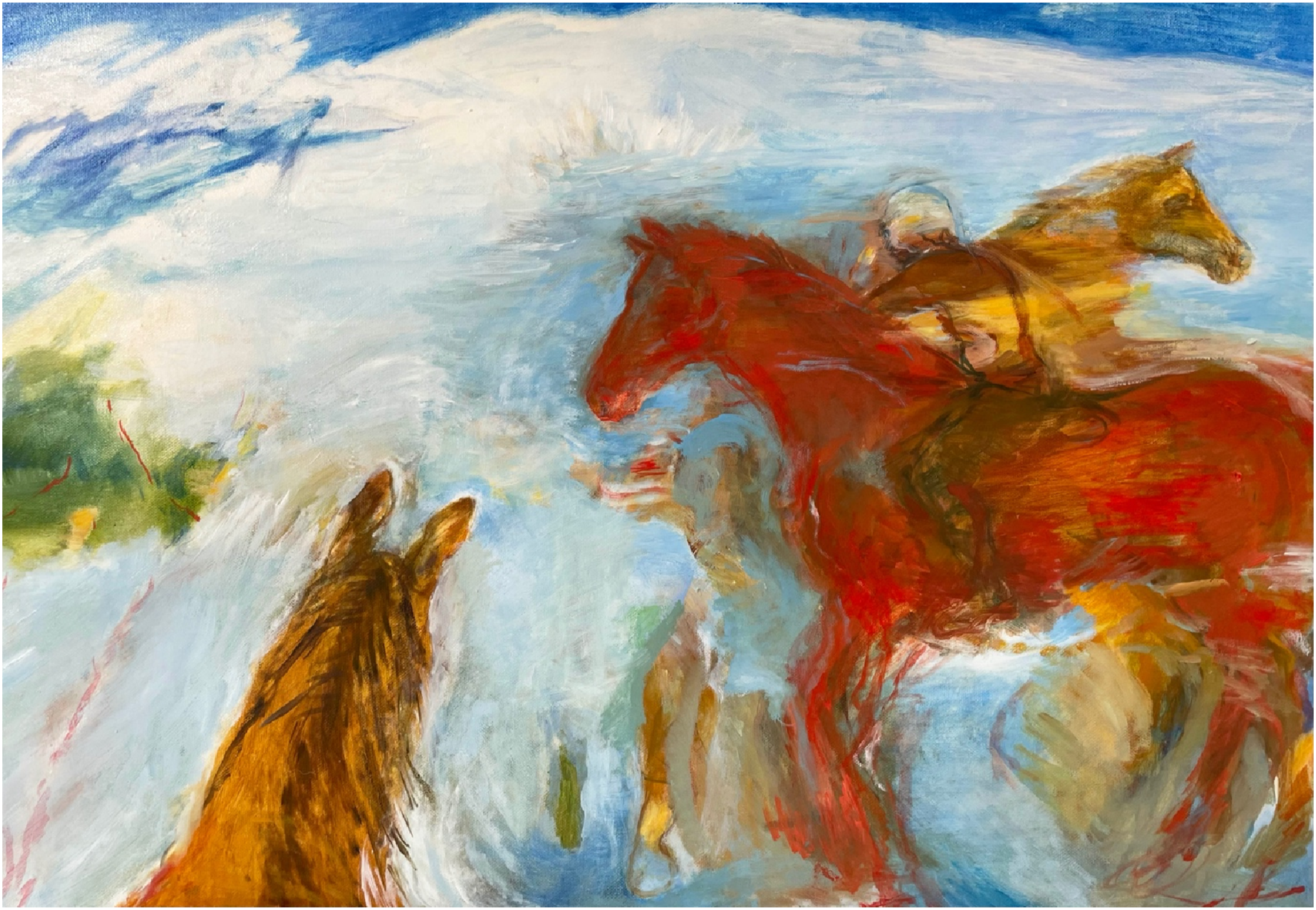
In trying to look at the complexity of a horse moving, there seems to be a need to push specific muscular knowledge aside and just describe the flow. In this recent work, I have sought to describe the essence of the connections between horse human and landscape, that are not encased in a particular time period or moment.
The horse to the left of the Figure is seen from an elevated point of view, much like what could be seen from a rider’s perspective. The landscape in this painting, is referring to the Mongolian steppe and the many snow mountains, often described as holy mountains in Mongolia.
The overall painting is not a way of describing past archaeological occurrence in the landscape, or to a specific location, but rather is a response to the complexity of the Mongolian Steppe.
Conclusion
The use of a multimodal approach has become a way of work for me to tackle ideas on essence and connectedness. I am interested in representing connected beings, in a connected landscape, where nothing is still or separated.
Although this multimodal approach is a constant challenge and more complicated than using one methodology, such as direct observational work, it is perhaps more aligned with how life is experienced and therefore for artists, feels more of an open approach in the creative process.
Footnotes
Acknowledgements
Thank you to all The Horsepower team and for the ERC-Synergy Horsepower. Thank you to Carolin Duttlinger, Chris Gosden, Rory Carnegie for great discussions and support with the work.
Declaration of Conflicting Interests
The author(s) declared no potential conflicts of interest with respect to the research, authorship, and/or publication of this article.
Funding
The author(s) disclosed receipt of the following financial support for the research, authorship, and/or publication of this article: Grant (no 10171707) for their support and encouragement and to Tsagaan Turbat and Ursula Brosseder for their help in Mongolia and to Ruilang Liu and Xiuzhen Li for their help in rural China.
