



Abstract
This paper explores the plasticity of represented space in film by focusing on how space in film can be constructed out of fragments. Motivated by previous research suggesting that the fragmentation of space in film can be hidden from viewers, we propose a framework for analysing core features of space construction in terms of three main dimensions: 1. Explicitness, or whether a space is shown visually and explicit, or only implied through sound; 2. Event orientation, whether space fragments are combined to describe a setting or to connect narrative events, and 3. Fragmentation, whether space fragments and their boundaries are overtly highlighted or hidden. Using extracts from Tokyo Story (1957), Un Chien Andalou (1929) and Wild Strawberries (1961), we illustrate how the framework can support the analysis of space fragmentation, and not only unravel the plasticity of space in film but also filmmakers’ styles and the role of space construction in narrative complexities. Finally, we apply the framework to a news video. Our analysis suggests that the plasticity of space in film is a double-edged sword in contemporary society— although it opens possibilities for creativity in storytelling, it may contribute to the misrepresentation of information and manipulation of audiences in news videos.
Keywords
Introduction
Film analysis is recognised as fruitful ground for extending our understanding of multimodality, as it combines multiple modes and sensory channels (Bateman and Schmidt 2012; Tseng 2013, 2017; Tseng and Djonov 2023; Wildfeuer 2014). Despite numerous multimodal studies of film, the representation and organisation of space in film remains an understudied dimension. In this paper, we examine different ways in which space can be represented through the assembly of disparate spatial elements in film. We demonstrate how this assembly of spatial fragments affords plasticity, namely, how even when the fragmentation of represented space in film is highly visible, a film can nevertheless support a coherent narrative interpretation.
Space has attracted some interest in the studies in film cognition and film history. Cognitive studies have suggested that the disruption of the visual continuity of space in film can be easily concealed from viewers. For instance, studies on film editing show that spatial discontinuity does not disrupt viewers’ capacity for coherent interpretation of narrative events, as long as there is continuity in actions, audio and temporal relations (Magliano et al., 2001; Magliano and Zacks 2011). Empirical research on multimodality also reveals that film viewers are led by verbal and audio cues much more than visual background when interpreting the overall spatial relations in film (Tseng et al., 2021). Despite empirical evidence pointing to its plasticity and storytelling potential, the construction of space in film has received limited attention. In this paper, we offer a framework for systematically analysing space represented through fragments in film. We demonstrate how the framework can be applied to uncover the relation between spatial configurations, styles and genres and to explore the role of spatial plasticity in shaping viewers’ interpretation of audio-visual narratives, including ones that involve narrative complexities such as flashbacks or parallel storylines.
The design of ‘filmic spaces’ has long fascinated filmmakers. While the earliest films maintained the unity of time and space characteristic of theatre, with the camera in a fixed position in front of the stage, film directors such as D.W. Griffith soon began to experiment with space, and to film the action from different points of view, seeking to place viewers in the middle of the action, and presenting actions occurring simultaneously in different spaces in consecutive shots. An example is found in Griffith’s Enoch Arden (1906), where a shot of the character Annie on a beach, waiting for her sailor husband’s return, is followed by one of the husband cast away on a desert island. Burch (1969) has compared such editing to the manipulation of space and the disruption of its unity by cubist painters such as Juan Gris: If we examine a painting such as ‘Violin and Guitar’ (1913) we find that what may be regarded as the central motif is made up of three tightly framed representations of the fingerboard and between two of these a “close up” of the sounding board …a premonitory illustration of the aesthetic strategy of cutting together shots of the same subject from different angles (p. 37).
But while this cubist practice has never become standard and representations of this kind are still considered deviations from the perspectival unity of the picture space, strategies for disguising the fragmentation of space in film are well established. These strategies give viewers a sense of orientation and direction rather than of abrupt shifts to different viewpoints. Some of the principal strategies are (1) matching the direction of an actor’s gaze with the angle from which the object of the gaze is filmed; (2) matching reverse angles, as in dialogue scenes, where a shot of one actor looking slightly to the left of the frame is followed by a shot of another looking equally slightly to the right; (3) matched action, in which, for instance, the whole of the action of entering a house through the front door is shot twice, once from each side of the door, with the edit placed at exactly the same moment in the unfolding action, without hiatus or overlap; and (4) matching screen direction, in which actors or objects move in the same direction in subsequent shots with no or hardly any time gap between them (cf Reisz and Millar 1968: p213–226). These strategies also of course include continuities in the appearance and dress of actors (e.g. showing a jacket’s buttons closed in the same way in subsequent shots), the positioning of objects, lighting and tone. These continuities not only help render the fragmentation of space in film invisible to viewers – but can support the construction of spaces that do not exist in reality, as famously demonstrated by one of Kuleshov’s less often quoted editing experiments of the early 1920s): A few years later I made a more complex experiment: we shot a complete scene. Khokhlova and Obolensky acted in it. We filmed them in the following way: Khokhlova is walking along Petrov Street in Moscow near the ‘Mostorg’ street. Obolensky is walking along the embankment of the Moscow River – at a distance of about two miles away. They see each other, smile, and begin to walk towards one another. Their meeting is filmed at the Boulevard Prechistensk. This boulevard is in an entirely different section of the city. They clasp hands, with Gogol’s monument as background and look – at the White House – for at this point, we cut in a segment from an American [USA] film, The White House in Washington. (Kuleshov 1974: p52).
What is not spelled out here is that this illusion was realised by the continuity techniques we have just described – opposed but matched directions of walking and matching reverse angle shots as the two actors meet and smile, continued direction of walking as they leave the shot and begin to climb the stairs, and so on. These principles apply not only to this somewhat extreme case of what Kuleshov termed ‘artificial landscape’ or ‘creative geography’ (ibid.), but remain standard practice in narrative film, as documented by Bordwell (2006). A less extreme example may be an actor entering a house through the front door, where that door need not belong to the house the actor enters, so long as the rule of matched action is adhered to.
In this paper, we propose a framework for systematically describing represented space constructed out of fragments in narrative film. This system uncovers the affordances of the filmic medium that allow a high degree of plastic spatial constructions, which in turn, as we will also argue, is the basis for the risks of information misplacement and manipulation in our time replete with digital misinformation.
Construction of space in film: insights from film theory, film practice and semiotics research
Scholars of film theory, practice, and semiotics have recognised the plasticity of space representation in film. While some studies have concentrated on techniques used to disguise the fragmentation of space in film and support viewers’ comprehension of narrative sequences, others have pointed out the power of this fragmentation to disrupt the viewing experience and invite reflection in the audience.
In his short book on the organisation of space in Murnau’s Faust, the filmmaker and critic Eric Rohmer (1977) distinguished three kinds of filmic space, picture space, that is, the rectangle of the frame as a dynamic spatial composition, architectural space, that is the space that is being filmed, whether pre-existing (natural or built) or designed for a film production, and filmic space, that is the space viewers must reconstruct from the fragments of space shown in different shots. According to Branigan (1976), “through editing the space of a film develops as a flow of spatial fragments which interact to reveal (and imply) larger physical spaces” (p. 74). Hence, it is the observable geometrical relations which “serve to anchor and re-anchor space within a scene” (ibid. p. 91).
In semiotic approaches to film, the construction of space from fragments is considered in Metz (1964) Grande Syntagmatique, where the relationship between consecutive shots that show different fragments of a scene’s location is categorised as ‘description’. Extending Metz’s system and adopting Burch (1973: p3–16)’s shot articulations allowed Bateman (2007) to further categorise the relationship between spaces represented across shots as “contiguous space” or “non-contiguous space”. Tseng (2013) discussed how fragments of space can be combined cohesively through continuity editing in film, while Tseng (2017) proposed a framework for analysing space in narrative film in general, including non-fragmented representations of space (e.g. mise-en-scene). This framework highlights the important role that embedded space (e.g. in a dream sequence) and implied space (invisible space represented through sound, e.g. the sound of a waterfall not shown on the screen) play in both constructing and supporting viewers to interpret narrative complexities such as flashback, dream sequences or parallel events.
In Theory of Film Practice, originally written in the late 1960s, Burch regards ‘invisible’ filmic space construction, where fragmentation is hidden, as the ‘zero point of cinematic style’ and commends films that instead deliberately breach the rules of continuity, such as those of Godard’s early period. “Film”, he says, “will attain its formal autonomy only when these new ‘open’ forms begin to be used organically” and when film “gives as important a place to the viewer’s disorientation as to his orientation” (Burch 1969: p15).
Today, video editing software significantly facilitates the use of formats such as split screen, which make the fragmentation of space more prominent, not only in narrative cinema or video art, but also, for instance, in broadcast news, amateur online videos, and web video conferencing applications like Zoom. Although it has never been mainstream, split screen has in fact been used throughout the history of cinema. Suspense, a 1913 film by Lois Weber and Phillip Small, had a scene which divided the frame in three triangles. The left triangle showed a ‘tramp’ breaking into a house where the ‘wife’, seen in the right triangle, is phoning her husband in panic. The central triangle shows the husband at work, then picking up the phone and reacting to his wife’s panic. Able Gance’s Napoleon (1927) even had scenes in which the screen was divided into six or more simultaneous actions. Gance planned a further film, to be called Polyvision, but it was never completed. Split screen would continue to be occasionally used, particularly in telephone scenes. (The telephone was, of course, one of the technologies which disrupted the traditional unity of time and space in everyday life in the period in which the cinema developed.) In the late 1960s and early 1970s, split screen was in fashion for some time, featuring in celebrated film title sequences by Saul Bass and Pablo Ferro, in feature films like The Thomas Crown Affair (Norman Jewison, 1968) and in documentaries like Woodstock (Michael Wadley, 1969). But the technology was still complex and expensive. Today i.e. no longer the case, and split screen has become ubiquitous. This means not only that spatial fragmentation, filmic ‘cubism’, is visible rather than disguised. It also means that spatial relations are now realised in what Rohmer called the ‘picture space’, through the visual resources of layout (e.g. diptychs and triptychs), which have been described, for instance, by Kress and van Leeuwen (2021), rather than through filmic resources such as mise-en-scène and continuity editing.
Integrating insights from film theory and semiotics, in this article we introduce a system for analysing the representation of fragmented space in film. We illustrate how the system can shed light on changes in the representation of space in the age of the split screen and the potential these changes afford to guide or manipulate narrative comprehension. We then consider why the ‘open’ construction of space is, today, no longer considered disorienting and gradually becoming mainstream in many genres of audio-visual communication.
Framework for analysing space construction in film
This section introduces a framework for describing the construction of space in film. The framework builds on previous research on space in film (Bateman 2007; Tseng 2017), with a focus on the construction of space out of fragments (i.e. it excludes single-shot representations). The framework can support researchers to systematically analyse how spaces are multimodally constructed in film, through various semiotic resources (exemplified in Section 4), and to empirically investigate the impact of different spatial constructions on viewers’ comprehension and interpretation of narrative events in audiovisual texts.
The framework, shown in Figure 1, is presented as a system network, a convention adopted from systemic functional linguistics (Halliday and Matthiessen 2014) for representing the choices for making meaning in a given context. The network presents three main options, or systems of choices, for constructing spaces in film: EXPLICITNESS, EVENT ORIENTATION and FRAGMENTATION. The curly bracket signals that these systems are parallel, that is, they represent simultaneously available options for constructing and describing fragmented space in film. Simultaneous options of this kind can give rise to extensive cross-classification. That means, all combinations from the systems within the curly bracket should be possible. For example, [implied] space represented through sound alone could be combined with the [overt] fragmentation through a splitscreen composition. System network of space construction in film.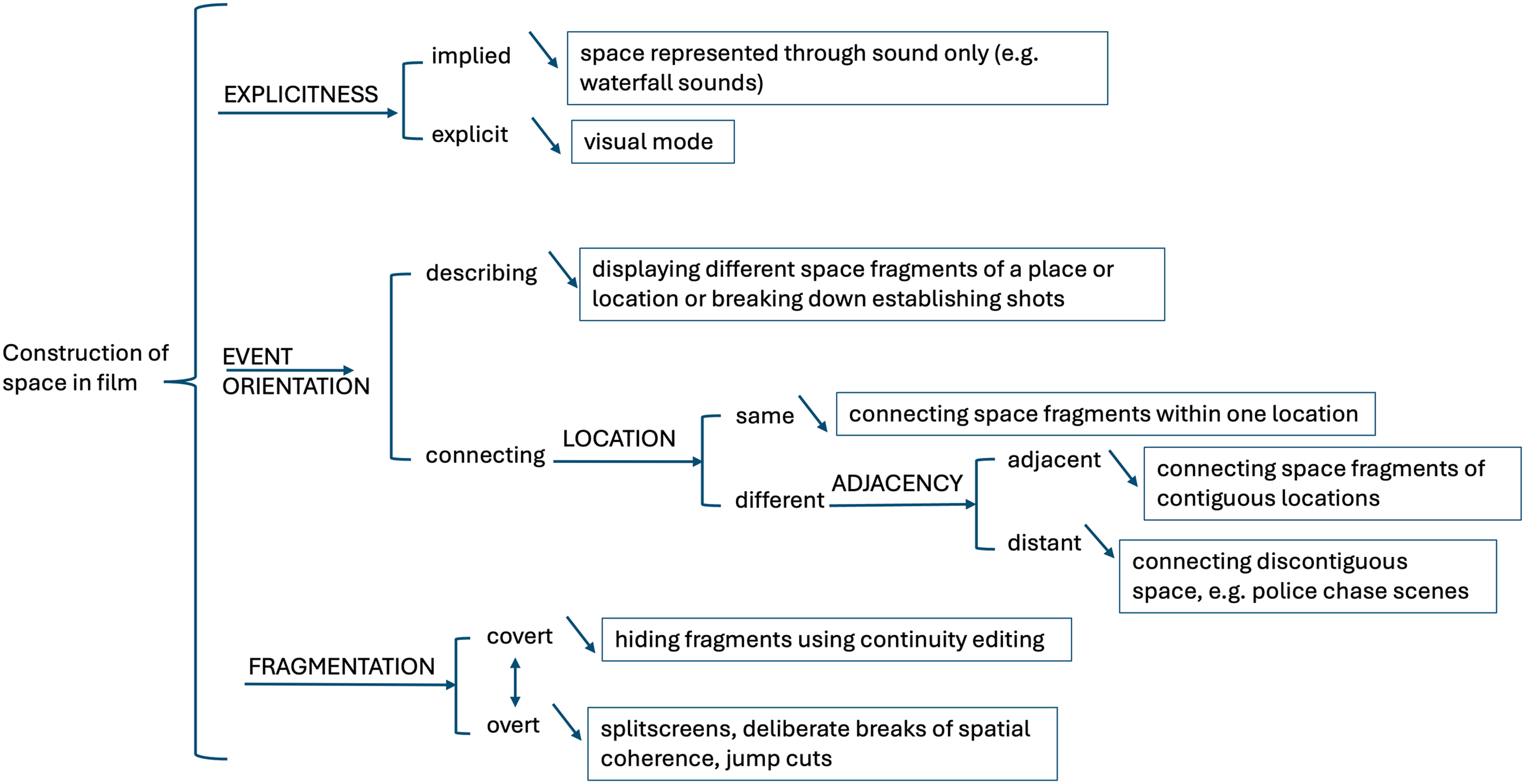
Subcategories, or more delicate descriptions, for each of these options are presented as the system network unfolds from left to right, where square brackets represent mutually exclusive choices. For example, the system of EXPLICITNESS comprises two choices [implied] or [explicit]. The boxes following the slanted arrows after each choice are realisation statements, which function to suggest how the choice can be realised through various semiotic resources, or formal properties, in film.
In the following subsections, we elucidate each system and choice using film scenes from Tokyo Story (1953) and Un Chien Andalou (1929), before applying the framework to unravel the construction of space and examine its role in guiding narrative comprehension in an extended analysis of excerpts from Wild Strawberries (1961) in Section 4.
EXPLICITNESS: Implied vs explicit
The spaces constructed in film can be explicit, when they are visually and possibly also aurally represented, or implied, when they are represented only through audible elements, such as the sound of a waterfall or of trains that cannot be seen. While [explicit space] is represented on the screen, the audio cues that construct [implied space] direct the audience’s attention to the existence of spaces off-screen. This is evident in the example from Wild Strawberry that we analyse in detail in Section 4 below. In Segment 4 (S4) displayed in Figure 4, the main character Isak is seen walking in a dark hallway (the first image of S4). Nevertheless the viewers can already hear sounds of piano music and people chatting, before he approaches the dining room where the sounds come from (the second image of S4).
EVENT ORIENTATION: Describing vs connecting
The system of EVENT ORIENTATION comprises two types of relation between constructed space and unfolding narrative events. The choice of [describing] supports the observation and description of different parts of a place or a location, without or before the representation of narrative events in that space. A nonfragmented representation of space that serves the same function is the establishing shot employed to introduce the setting of narrative scenes. This function is similar to the ‘descriptive syntagma’ defined by Metz (1976). The other feature in this system, [connecting] describes space fragments that carry or connect narrative events.
Figure 2 exemplifies the contrast of the two choices with scenes from Tokyo Story (Ozu, 1953). The first scene shows a family sitting alongside their ill, dying mother (shot 1) and then the father and one of the daughters crying at the other side of the room (shot 2), after talking to the doctor and realising that the mother will soon pass away. In shot 3, the father walks towards the family members sitting next to the dying mother. Shot four shows a close-up of the grieving father. Shots 1–4 thus represent fragments that coherently construct a space where story events unfold. The next five shots (shots 5–9) do not present events. Rather, they describe a setting, the village where the story is set. They are followed by the same indoor space, shown after the mother has died. Shots 10–12 present fragments of the same space and coherently connect that back to shots 1–4. Describing and connecting space fragments: an extract from Tokyo Story (1953).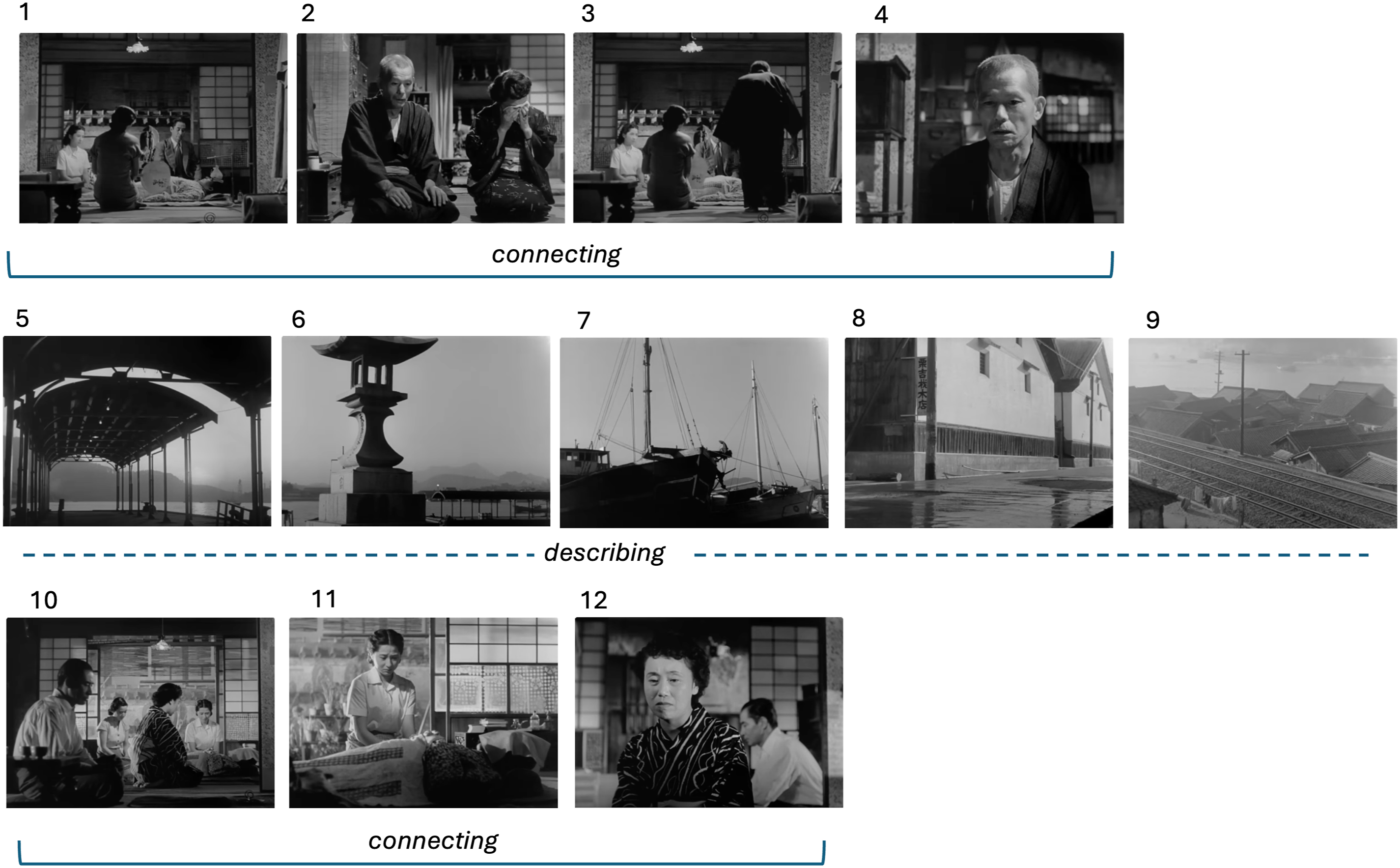
Such intertwining of “intermediate scenes” (Bordwell 2005) is an auteur feature of Ozu as a master of film space construction— namely, the scene space that describes surrounding locations disconnected from or peripheral to the event actions, is inserted between fragments that connect events taking place within a single closed space.
The choice of [connecting] has a sub-system LOCATION which distinguishes whether the connected actions occur in the [same] location or [different] locations. The above example (shots 1–3 and 9–10) connects space fragments (shots 2-3, 10) that belong to the same location, the room (shot 1 and 9).
When [different] locations are represented, the relationship between these shots can be more finely described in terms of whether they connect narrative events that take place in [adjacent] or [distant] locations. A common example of connected space fragments in distant locations is a police chase scene in which alternating close-ups conventionally show two sets of characters (i.e. police and the villain) in two distant locations. Another is showing the two people and locations that a phone conversation connects to.
Examples of shots constructing [adjacent] locations are found in sequences that show a character moving from one location to another that is represented as contiguous through matching actions or point-of-view shots. Consider the scene from Un Chien Andalou (Buñuel, 1929) shown in Figure 3. Towards the end of the film, Simone Mareuil (the female character) walks out through the door of a room (shots 1-3) and a point of view shot suggests that she sees a man who is on the beach (shot 3–4) and then waves at him (shot 5). In shot 6, she walks towards him, now herself on the beach. The scene thus employs point-of view shots alongside matching actions to represent different yet adjacent locations— inside the room, outside of it and the beach. Example of adjacent space fragments – selected shots from a final scene in Un Chien Andalou (1929).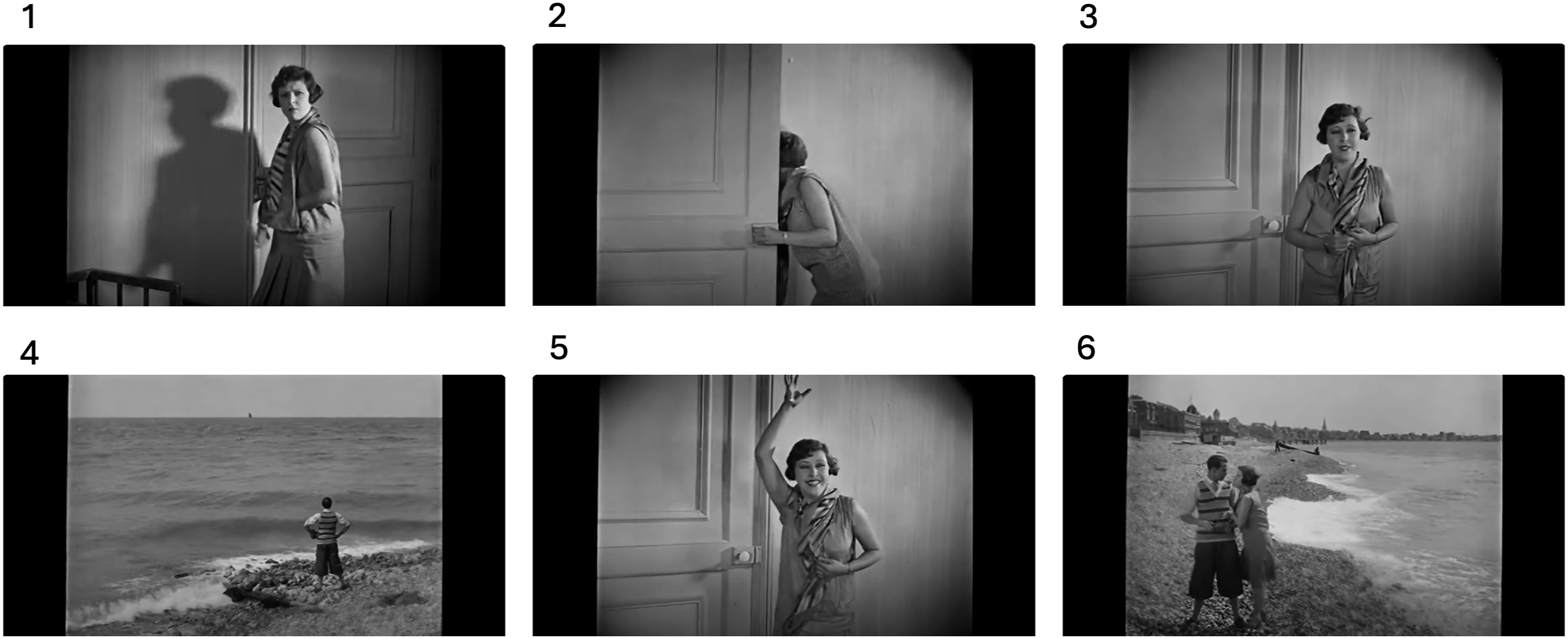
FRAGMENTATION: Covert vs overt
The system of FRAGMENTATION captures the extent to which the construction of space is visible or hidden from the audience. In the scene from Un Chien Andalou shown in Figure 3, the choice of [adjacent locations] is combined with the choice of [overt] in the system of FRAGMENTATION. In this 20-min film, the room is the setting for most of the events in the narrative. Previous scenes have explicitly shown that the adjacent locations surrounding the room are streets, but also that the room is not on the ground floor, for example, by showing the woman looking out of the window and down at the street. The connecting spaces represented in Figure 3, and the action of walking from the same room directly onto the beach, work against establishing a coherent narrative space.
The presentation of visible cues that make the construction and manipulation of space [overt] breaks the illusion of a unified space. In contrast to the choice of [covert] fragmentation, which hides space construction with continuity editing, several films from the French New Wave, such as Godard’s Breathless (1970) and Pierrot le fou (1965), employ a variety of [overt] space construction cues, such as jump cuts, to challenge what Godard (1986) critiqued as ‘bourgeois’ illusionistic classic Hollywood narrative.
As indicated by the double headed arrow in Figure 1, the system of FRAGMENTATION is a continuum. The construction of space and the boundaries of the fragments in it may be disguised to achieve a sense of strong spatial unity, through highly calibrated continuity editing, or conspicuously displayed.
In the sequence from Ozu’s Tokyo Story shown in Figure 2, for example, the two scenes with connecting spatial fragments (shots 1–4 and shots 10–12) violate the 180-degree rule. The 180-degree rule is a continuity editing convention that requires the camera to always stay on one side of the axis created by the actors’ gazes (i.e. the camera may not be moved 180-degrees from one set-up to another). As Figure 2 shows, Ozu overturned this rule as the father was filmed from behind, walking towards his family and sitting down, in shot 3, but in shot four the camera had crossed the 180-degree axis to show the father from the other side of the room. Similarly, in shot 10 we see the daughter with the black kimono in the middle of the frame and there is a man on her left-hand side, closer to the camera. In shot 12, the daughter is filmed from the opposite side of the room, with the same man now on her right, farther away from the camera. Overturning the 180-degree rule is one of Ozu’s auteur features. Although Ozu has ignored conventional editing principles, which were developed to make cuts invisible to viewers, the overt space fragmentation in these scenes is unlikely to interfere with viewers’ narrative comprehension, which is supported by the continuity in characters and actions as well as sound across these shots. This illustrates the plasticity of space in film – to a certain degree, space fragmentation can be flexibly configured without negatively impacting on viewers’ ability to develop a coherent interpretation of the narrative.
Spatial plasticity and narrative complexity in Wild Strawberries (1961)
In this section, we illustrate how the framework presented above can be applied to the analysis of film by using scenes from Bergman’s Wild Strawberries (1961). The analysis aims to highlight the value of spatial plasticity in complex narrative films. Specifically, we examine how Bergman exploits space to construct scenes that blend a flashback with an old man’s focalisation.
Our analysis focuses on a scene that features a series of flashbacks by the main character Isak Borg, an old, lonely and cold professor, who is taking a long drive with his daughter-in-law from his home in Stockholm to Lund to accept an honorary degree. In this particular scene, Isak stops at his family’s summer home, where he spent summer with his family in the first 20 years of his life. The stopover makes him reminisce about his romance with Sara, his former lover who eventually married his brother Sigbrid. Throughout the flashbacks, everyone around Isak is young, while Isak remains looking like his current, older self, fully inhabiting his own memories.
Figure 4 shows our analysis of the five main flashback segments in the scene. Segment 1 (S1) opens with a point-of-view shot depicting the old Isak standing in the woods and looking at his family summer house, while his offscreen narration suggests that he is reminiscing about his life as a young boy in this house. Drawing on our framework, we can describe this representation of space as [explicit] and combined through a point-of-view (POV) shot to [connect] the [adjacent] locations of the woods and the house. The POV shot renders this connection [covert], and is a well known continuity technique for hiding a cut and enhancing cohesion across events taking place in different locations. The structure of space construction in the flashback scenes from Wild Strawberries.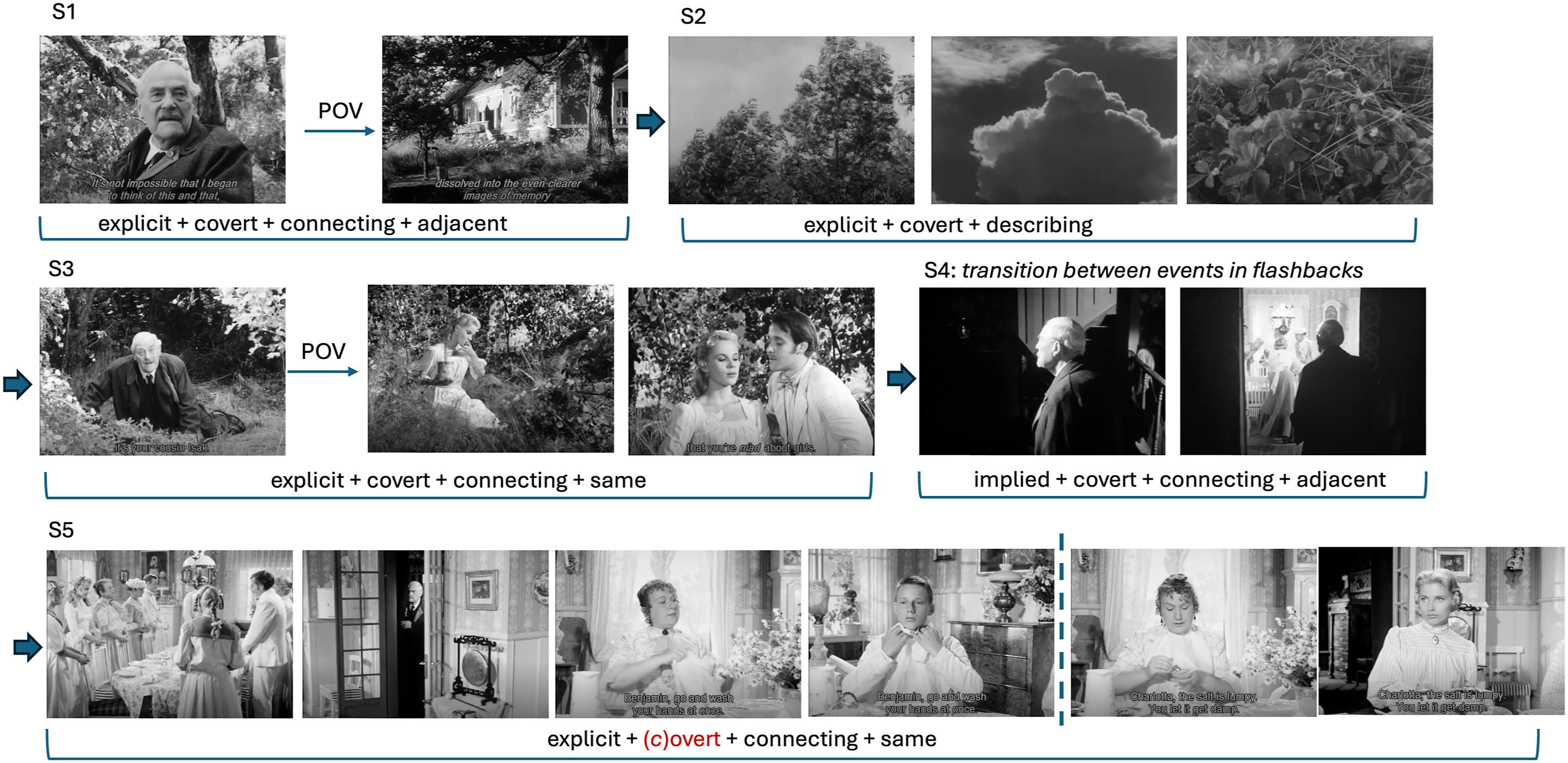
Segment 2 comprises three shots showing [explicit] spaces with fragments of trees, clouds and some strawberry plants. Like the intermediate sequence in Ozu’s film (e.g. shots 5–9 in Figure 2), S2 here pauses the sequence of narrative actions to [describe] the story space. The cuts are hidden with transitions through match-cut, dissolving in the same shape of the different objects, i.e. trees to clouds, clouds to strawberry plants). This [covert] fragmentation can be seen as a departure from the conventional use of a long or very long establishing shot, and instead presents fragments of the atmosphere and setting of the narrative in a sequence of shots.
After the pause in S2, Isak’s flashback resumes in Segment 3. A POV shot shows Isak observing how Sara is picking strawberries, before his brother Sigfrid appears and starts flirting with her. The space construction is similar to the one in S1 except that S3 is within the [same] location in the woods. In the end of Segment 3, Aunt calls everyone to enter the house for brunch.
In Segment 4, the camera follows Isak as he enters the dark hallway of the house. As described in Section 3.1 above, this transition scene suggests an [implied] space, cued through loud sounds and music from, but not visually showing, the dining room on the other side of the hallway. The camera follows Isak to the open door of the dining room, where he is now seen from behind, a dark silhouette looking into the [adjacent] busy dining room, which is now visually represented, or [explicit].
Segment 5 depicts the whole family in the dining room, preparing and having brunch. This scene is designed to carefully disguise the fragmentation of space, yet unavoidably reveals it. Below we provide an extensive analysis of this elusive violation of continuity features in S5. The analysis draws attention to the plasticity of spatial fragmentation in film — although the segment compromises spatial continuity, the foregrounding of matching eyelines during continuous dialogue allows the space fragments to be configured flexibly, without disrupting the coherent flow of the narrative.
As shown in Figure 4, the scene opens with medium long shots following various characters around the room. These shots allow the visual reconstruction of the dining room. It can be drawn more or less to scale by taking into account the size of dining room chairs, and other items of furniture, such as the piano. In the English translation of the script (Bergman 1960), the set is described in Isak’s voiceover: “From there I had a good view into the large, sunlit dining-room with its white table already set for breakfast, the light furniture, the wallpaper, the figurines, the palms, the airy summer curtains, the scoured white wooden floor with its broad planks and blue rag rugs, the pictures and the samplers, the large crownlike chandelier.” (p. 43)
The floor plan in Figure 5 depicts the position of the furniture based on the space construction in the beginning of the scene. Another complementary view in S4 also supports the reconstruction. In S4, when Isak looks at the room from the darkened hall, we can see the grandfather clock in the background. Floor plan and furniture positions in the dining room scene.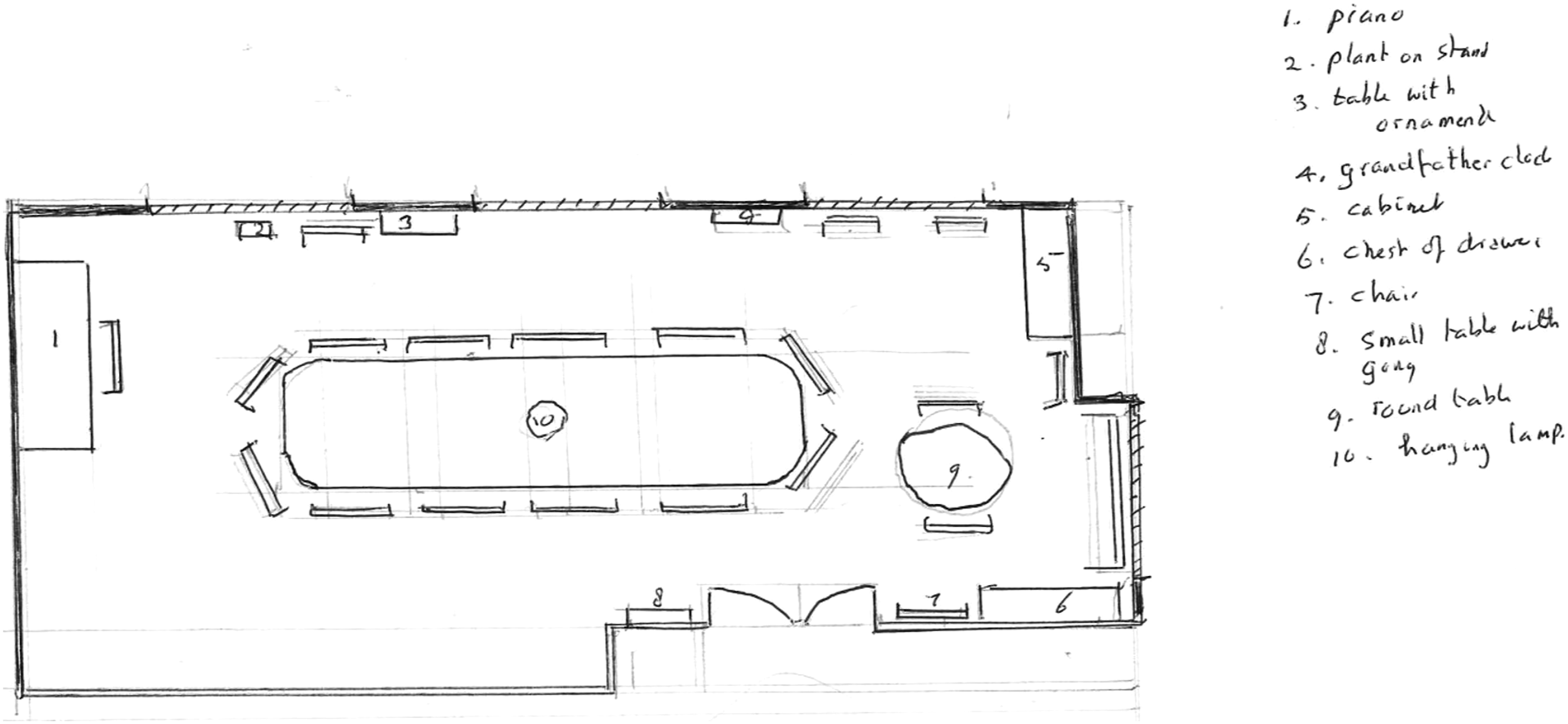
As the family sits down at the table, the camera pans round the room and then across to reveal Isak in the doorway (second image in S5 in Figure 4). This last shot shows fairly clearly where everyone is sitting. The sitting plan is reconstructed in Figure 6. Seating plan in the dining room scene.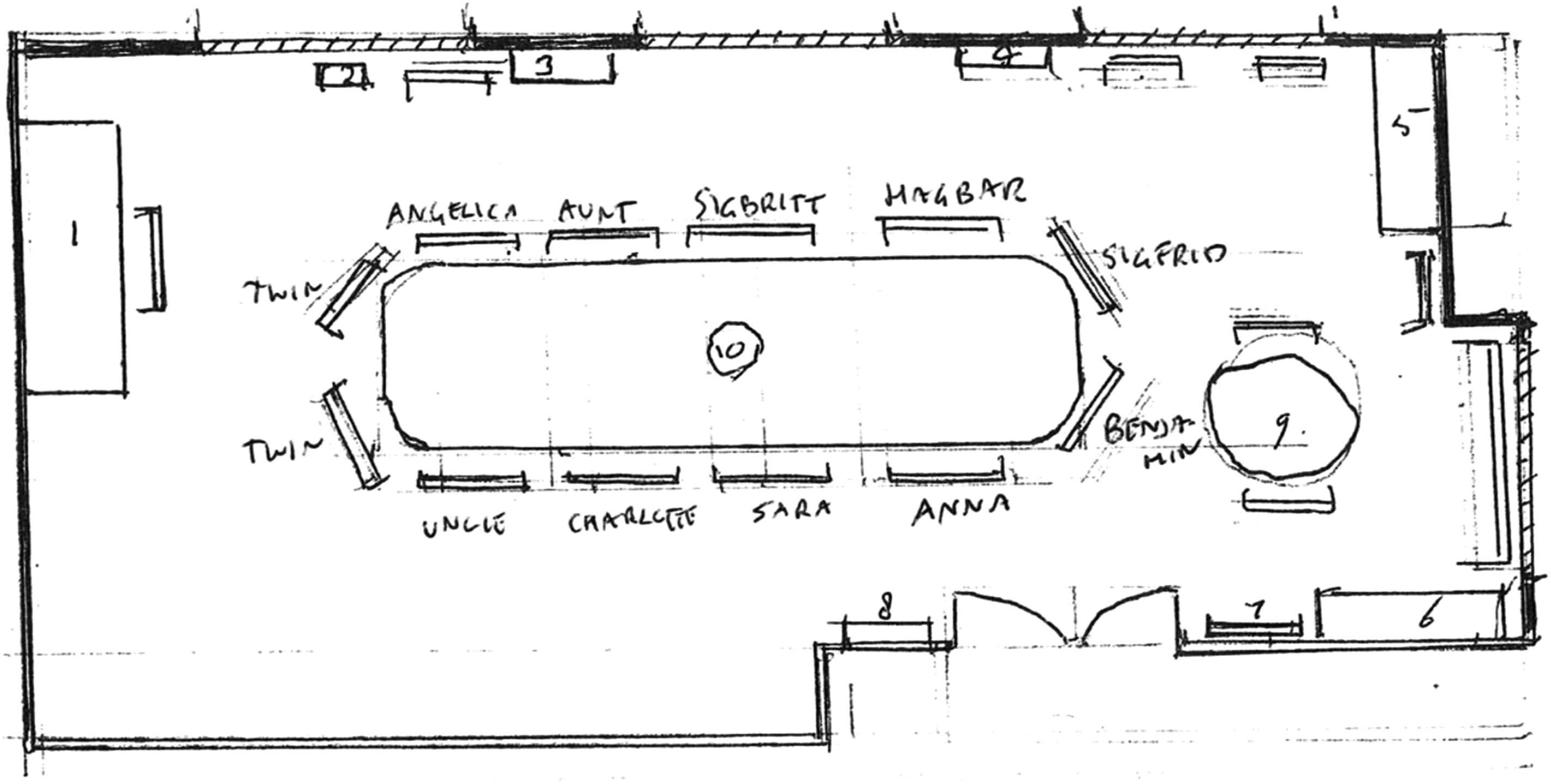
After the whole family sits down and Aunt starts to talk to some of them, the series of closer shots that follow reveal interesting mismatches that disrupt the spatial unity. Below we analyse two sets of these mismatches.
(1) Camera position, furniture and eyelines in the conversation between Aunt and Benjamin
The third and fourth images in Segment 5 shown in Figure 4 depict the conversation between Aunt and Benjamin in medium close shots. Their dialogue starts as follows:
Behind Benjamin, we see what we more or less expect, given where he is sitting: the chest of drawers to his right, and part of the window and the bench underneath it to his left (see Camera position (CP) 1 in Figure 7). To get this shot (given that a wide-angle lens has clearly not been used) the foreground objects seen previously (item 7 chair and item 9 round table in Figure 5) must have been removed. Camera position of the conversation scene between Aunt and Benjamin in the dining room.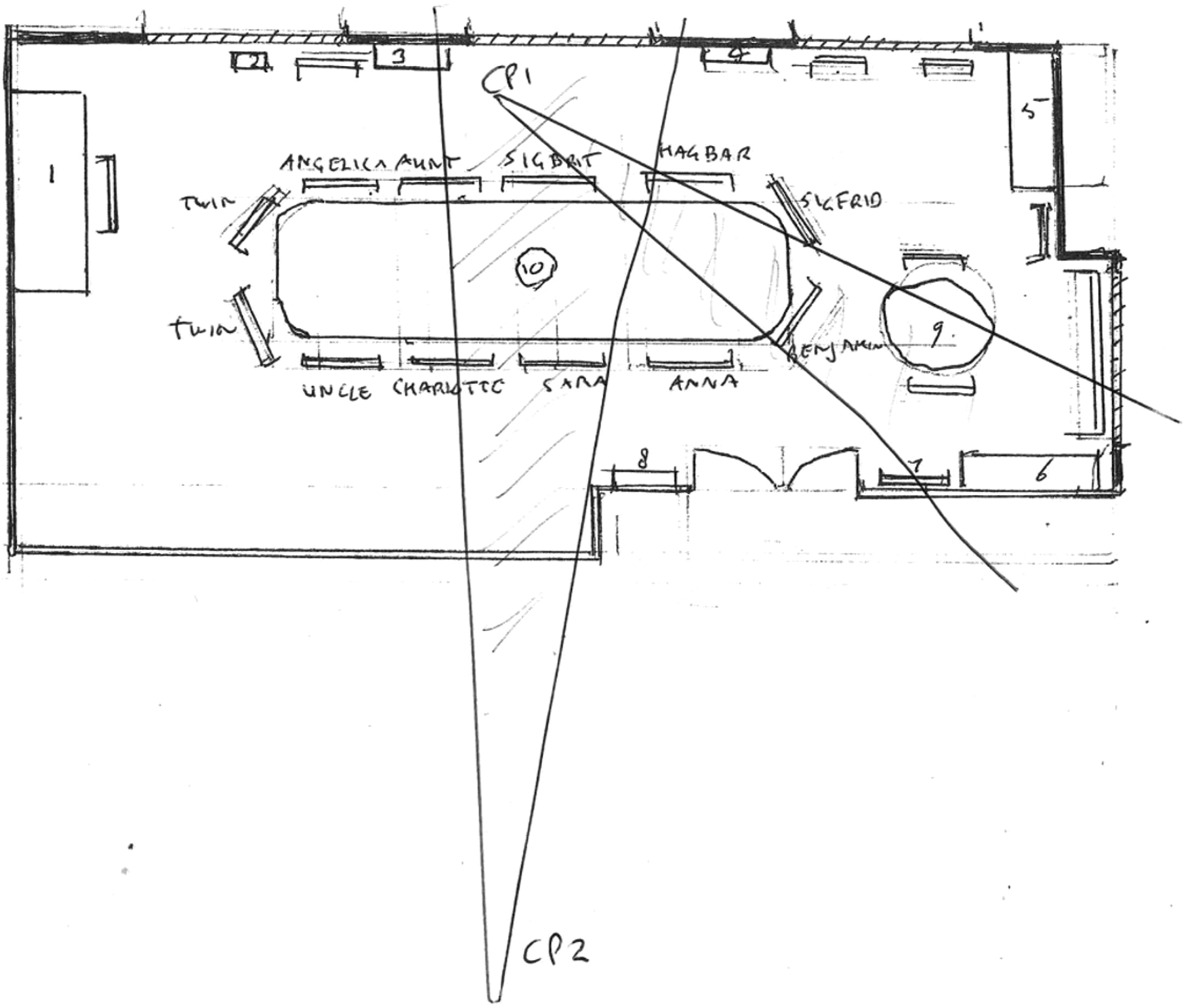
Behind Aunt, seen in a very frontal shot, we see one of the windows, with, on the right, part of the grandfather clock and, on the left, part of the table with ornaments. She has shifted position (CP 2 in Figure 7) and is where we would have expected Sigbrit. Again, foreground objects (and also the wall) must have been removed.
Even from this position, given how frontal the shot is, her eyeline to Benjamin would have been further to her left (and to the right in the image) as in Figure 8-(c). But in fact she looks only slightly to her left, and from that angle would have looked at Sara (Figure 8(b)). There is some difference in the angle of Aunt’s eyeline between the two shots of her. For Benjamin to look at Aunt (in her position in front of the window, i.e. from where Sigbrit was originally sitting), he would have to look slightly to his right (to the left in the image) (Figure 8(a)). In other words, the eyeline match is prioritised but at the expense of continuity in the characters’ seating positions. Eyeline match and mismatch of Aunt and Benjamin in the dining room conversation scene.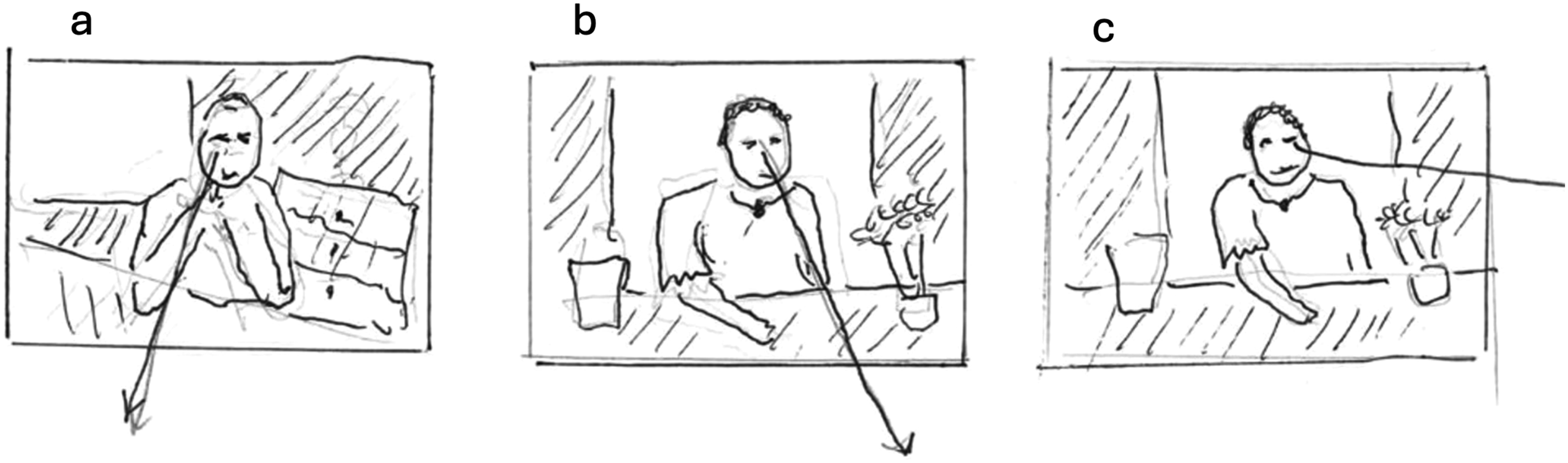
(2) Eyelines and camera positions in the conversation between Aunt and Charlotta
Another example that reveals a subtle compromise in spatial continuity can be found during the conversation between Aunt and Charlotta (shown in the last two images in Figure 4). The conversation starts as follows:
The shot of Aunt is the same as before (CP 2 in Figure 7). But behind Charlotta we see the door (behind which Isak was standing) and the dark hallway, as well as the table with the gong. It looks like she has been moved to Sara’s place (CP 3, Figure 9). The eyeline angles are about 45° in each case, however, which corresponds to Aunt (from ‘Sigbrit’s’ place) looking at Charlotta. Camera position of the conversation scene between Aunt and Charlotta in the dining room scene.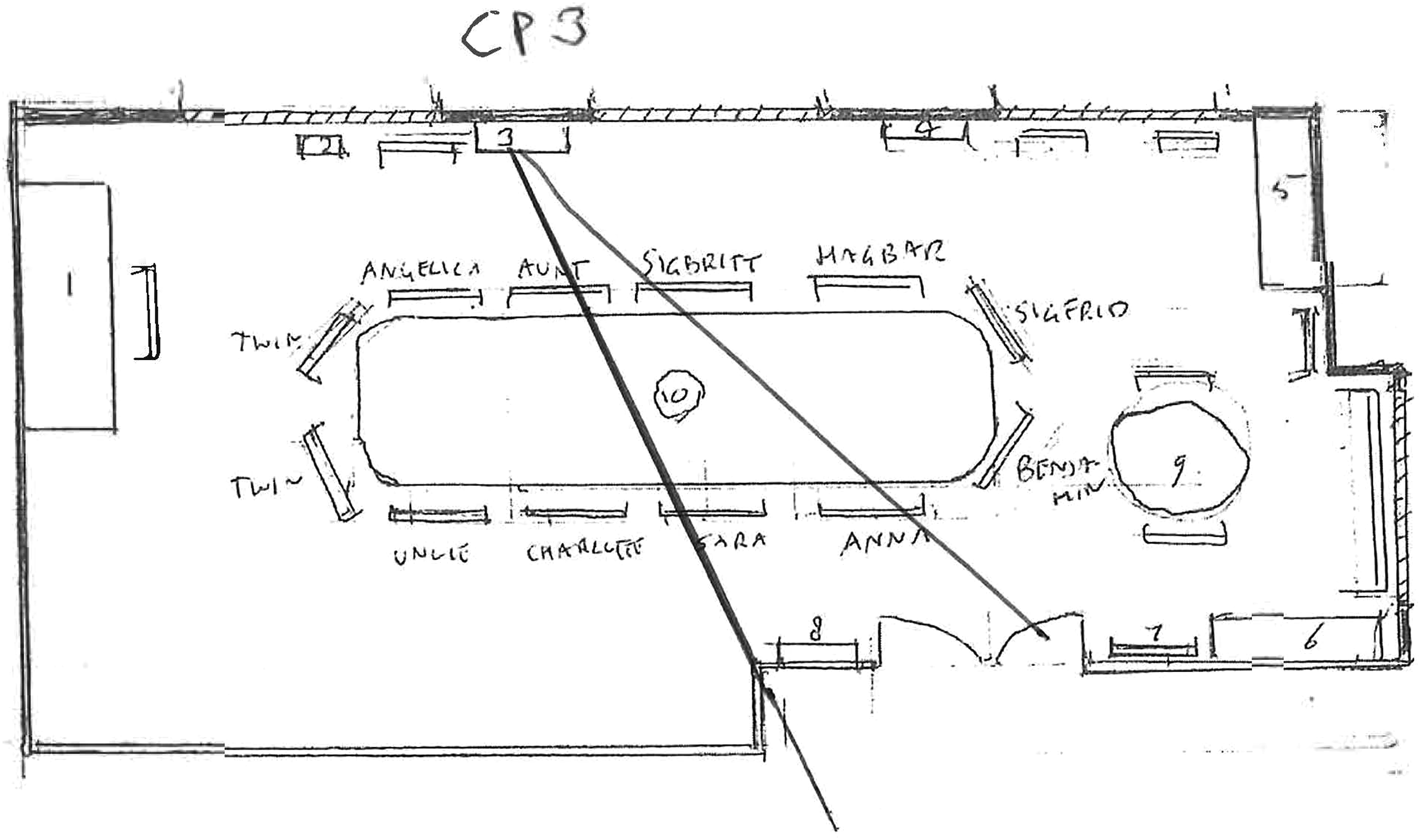
These two examples uncover how subtle violation of spatial unity can co-exist with relatively covert fragmentation of space construction. These unavoidable disruptions in spatial unity were partly due to technical constraints. For instance, in the late 1950s when a wide angle lens was not easily available, the depth of field offered by a standard lens would leave foreground objects such as those on the table or people sitting opposite the person(s) in the shot out of focus. Compromising spatial unity here also supports a coherent shot composition, for example framing the shot so Aunt is in front of the window, and making sure that objects such as vases with flowers are positioned where they help achieve a nicely balanced composition.
These examples uncover one core feature of filmmaking that involves a lot of ‘cheating’ and judgements as to whether or not the audience will notice. This is explicitly discussed in Francois Truffaut (1968)’s book of interviews with Hitchcock.
Our analysis of spatial fragmentation in S5 highlights the affordance of spatial plasticity in film – to a large degree, disrupting spatial unity does not interfere with viewers’ coherent interpretation of a narrative unless spatial cohesion (Tseng 2013) is broken. An example is the break in the cohesive link in the identity chain of the setting in Un Chien Andalou, where the room is presented as adjacent to and above the street in one segment and adjacent to and on the same level as the beach in another.
The framework we presented in this section allows us to more thoroughly understand and compare how a complex spatial construction is related to styles and narrative complexities of audiovisual storytelling. For example, our analyses uncovered two recurring signature features of Ozu’s style. One is fragmentation by using of 360° space, where the camera may (and often does) rotate across the imaginary 180-degree axis often completely circling the diegetic space. The second auteur trait of Ozu is describing space fragments between narrative events. Its fragmenting effect is also noted in Bordwell and Thompson (1976): “Again and again in Ozu’s films we find a short series of shots of landscapes, empty rooms, or other actionless spaces, usually between scenes of characters’ actions”. According to Bordwell and Thompson, Ozu’s description of space fragments renders the space open and autonomous, and adds narrative complexity because it “impedes causal continuity…drives wedges into the cause/effect chain…breaks the narrative flow” (p46). As our analysis in Figure 4 (S2) shows, Bergman’s Wild Strawberries employs a similar fragmentation style. Both Ozu’s and Bergman’s films also subtly violate continuity editing in the construction of space.
Space fragmentation in news videos
This section extends our framework to examine spatial fragmentation in audiovisual news reports.
Since the late 1980s and early 1990s, news reports have been considered a form of “storytelling” (Baym 2004) and audiovisual news videos have widely adopted editing conventions similar to those of cinematic storytelling (Schaefer 1997), in order to attract audiences via what is sometimes termed ‘engaged journalism’ (Dunn 2005: 144). Ever since then, news videos differ from the traditional news reporting model of the ‘inverted pyramid’ (Ytreberg 2001) which focuses on reporting facts ordered by metrics of newsworthiness, from most to increasingly less newsworthy. Instead, in news videos the reporter, or news agency, play a major role in telling an engaging story.
As space plays an important role in storytelling, analysing its construction in TV news can help understand how news information is presented and perceived.
Since the emergence of online news videos, there has been an increase in news sensationalism, an infotainment-oriented, lower-quality style of news, responding to the market-driven need to ‘sell’ the news (Manning 2001). Informed by Kleemans and Vettehen (2009), who present a thorough overview of the ‘sensationalist’ features of audiovisual news broadcasts, Bateman and Tseng (2023) propose a multimodal framework for comparing problematic patterns that could overly emotionalise, evaluate and individualise a news story.
Here we will illustrate that the framework for analysing the construction of space in film introduced in this article can also be a useful tool for revealing one of the crucial dimensions of problematic storytelling strategies in news videos. Figure 10 provides an example analysis of a news report from the German news channel Bild TV, well-known for their sensationalist reporting styles. Fragmentation using splitscreen in news video.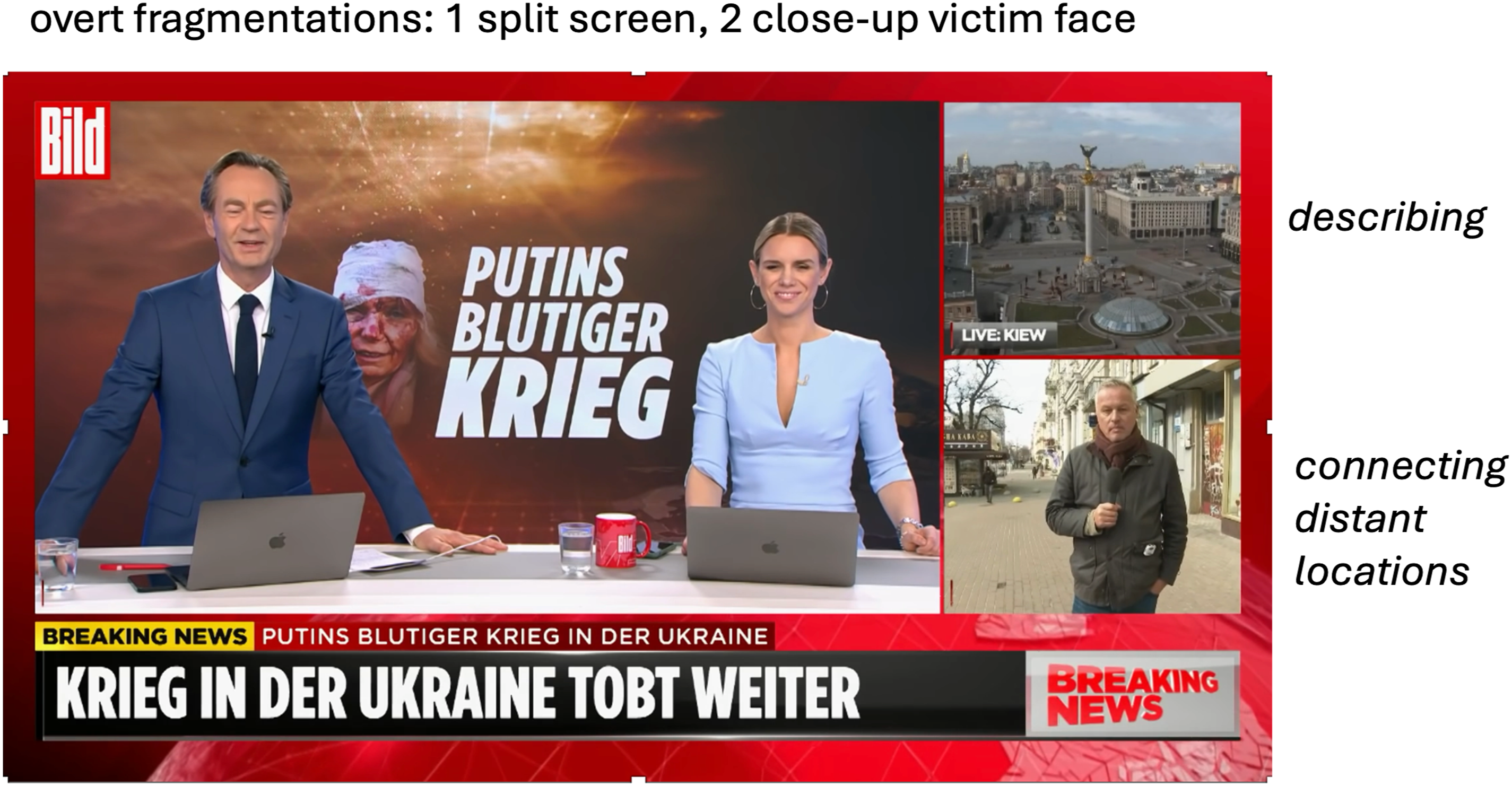
Figure 10 is a screenshot from a 2022 report on the Ukraine conflict. The screen is composed of three filmic frames and multiple text banners. This fragmentation of the picture space is overt due to the use of splitscreen, a common technique in contemporary audiovisual news reports. For instance, a splitscreen can present interviews that connect interviewees from distant locations. In the current example, the dialogues take place between the anchors in studio and a reporter in south Kiev, who is presented in a separate frame, reporting about his experience in a bunker from the previous night. In this screenshot, the anchors are smiling at a joke the reporter is making during his report. A large white caption between the anchors reads “PUTINS BLUTIGER KRIEG” (Putin’s bloody war).
The spatial fragments in the top right frame describe different Ukrainian street views, which are not directly related to the content of the news report. Moreover, in the background of the studio frame we see a close-up shot of a bleeding face of a war victim. This exemplifies the classic practice of wallpapering in news reports, where background images unrelated to the contents of the news report are shown as ‘generic’ indications of the topic, objects or places concerned (Griffin 1992: 136).
While our analyses of film segments in the previous sections show how filmmakers strive to achieve a coherent narrative, despite stylistically deliberate or unavoidably compromised spatial construction, news videos such as the one analysed here maximise space fragmentation to combine multiple information sources. Fragmentation is no longer concealed, and temporal and spatial continuity no longer suggested. Rather than employing overt fragmentation to create a Brechtian Verfremdungseffekt, and “give as important a place to the viewer’s disorientation as to his orientation” (Burch 1969: p15) , the construction of space in the news video analysed here brings together highly emotional but disparate fragments. It juxtaposes the close-up of a bleeding victim with lighthearted conversations between anchors and reporters and with an overly evaluative caption (e.g. Putin’s bloody war’). Presenting information in such highly fragmented fashion could significantly jeopardise viewers’ ability to focus on the story’s content and any one of the spaces represented in it, but may appeal to audiences with diverse expectations. News reports with such overt fragmentation could attract attention from viewers who enjoy casual conversations about traumatic events as well as ones who appreciate being vicariously transported to the places where these events have taken or are taking place. As fragmentation is recognised as potentially problematic in news videos (Bateman and Tseng 2023; Ben-Porah 2007), our framework unravels different ways that audiovisual news reports are made fragmented and shed light on the relation between fragmentation and news sensationalisation (Kleemans and Vettehen 2009).
Conclusion
In this paper, we proposed a framework for identifying and analyzing how represented spaces in film and audiovisual narratives are constructed from fragments. We explored how this fragmentation can be concealed through film editing and other multimodal conventions or, conversely, foregrounded and exploited in both cinematic storytelling and audiovisual news reporting. Our analyses emphasized the plasticity of space in audiovisual narratives and how techniques such as establishing continuity in sound and visual representation can support narrative coherence.
When applied to the analysis of audiovisual news storytelling, our framework reveals significant social implications of the fragmentations of space. The spatial construction in television news often employs strategies that influence audience perception, prioritize particular issues, and evoke emotional responses. However, as demonstrated in our analyses of spatial fragmentation in Buñuel’s Un Chien Andalou, Ozu’s Tokyo Story, Bergman’s Wild Strawberries, and a news video from Bild TV, this plasticity is a double-edged sword. While it can foster creativity and invite critical engagement from viewers in cinematic storytelling, it may also be used in news contexts to fragment representations of events. For instance, the use of split-screen techniques in news videos enables the presentation of multiple perspectives or simultaneous events but risks undermining viewer comprehension, creating emotional overload, and diminishing the overall quality of journalistic reporting.
Split screens often inundate viewers with fragmented streams of information—live footage, commentary, captions, and scrolling text—simultaneously. This can lead to cognitive overload, reducing the audience’s ability to process information cohesively and resulting in a fragmented understanding of events. Moreover, juxtaposing unrelated visual narratives on split screens may unintentionally create misleading associations. For example, displaying footage of peaceful protest alongside commentary on violent incidents can imply causation or correlation where none exists, thereby distorting audience perceptions. This kind of spatial manipulation, as discussed by Eisenstein (1949), illustrates how the construction of fragmented space can subtly influence meaning.
As we highlighted in the final section, fragmented space in news storytelling can amplify sensationalism by blending factual reporting with evaluative and emotional visual-verbal elements. While such techniques can enhance audience engagement, they often compromise the objectivity and clarity of the news. The overuse or misuse of space fragmentation in news risks diluting the ethical and journalistic standards of reporting.
Ultimately, while space fragmentation is a powerful tool for presenting dynamic and multifaceted narratives, its application requires careful consideration. We hope that our proposed framework for analyzing spatial construction in audiovisual storytelling will contribute to both film studies and multimodality research, deepening understanding of how audiences interpret the plasticity of space in audiovisual narratives. In the specific context of audiovisual news, it is imperative for creators to judiciously employ fragmented spaces to ensure that these techniques enhance, rather than detract from, the clarity, depth, and ethical integrity of their reporting.
Footnotes
Declaration of conflicting interests
Authors Chiao-I Tseng, Theo van Leeuwen, and Emilia Djonov are members of the Editorial Advisory Board of Multimodality & Society. The authors did not take part in the peer review or decision-making process for this submission and have no further conflicts to declare.
Funding
The author(s) received no financial support for the research, authorship, and/or publication of this article.
Correction (January 2026):
Author disclosure statements have been updated.
