



Abstract
This article explores how critical literacy can be developed through multimodal text production. The study was conducted with lower secondary school students in Norway, who in a school task were asked to reconstruct the identities of gods from Old Norse mythology in fictitious Instagram posts. The purpose of this task was to improve the students’ critical literacy especially concerning social media, and to increase their understanding of how all representations are constructed. The students' texts were analysed for traces of how they have remade and transformed meaning through reproduction of Instagram’s technical functions and literacy practices, and how they have built on knowledge from both Old Norse mythology and present-day culture. The findings suggest that reproducing social media texts challenged the students to be critical producers of text and to demonstrate linguistic, visual and technological awareness, without using digital technologies.
Keywords
Introduction
Adolescents today grow up surrounded by multimodal texts from algorithm-driven social media. In educational research, there is a growing interest in what skills adolescents need to navigate in the complex digital contexts of our time, and to be prepared for their future (Mills et al., 2023). In a digital society it is important to be aware that neither texts nor technologies are neutral (Djonov and Van Leeuwen, 2018; Janks, 2010; Poulsen et al., 2018). Moreover, in a participatory culture where consumers of media also are producers of media (Jenkins et al., 2013), this awareness is important not only when consuming texts, but also when producing texts (Mills et al., 2023). This study will explore how multimodal text production can be used to practice and enhance students’ critical awareness of social media texts.
Critical literacy education involves supporting learners to challenge texts’ naturalized assumptions and to suggest possible alternative representations (Janks, 2010; Kress and Van Leeuwen, 2021; Veum et al., 2022, p. 16), often by drawing on insights and approaches from critical discourse analysis (Fairclough, 2010). In this paper, we present an analysis of students’ texts from a multimodal critical discourse perspective (Machin, 2013). The texts we analyse were created as a response to a school task in the subject Norwegian as L1 with students in year 8 (age 13). The topic of the task was identity construction in social media, and the aim was to increase students’ awareness of how identity is constructed on social media platforms. The students were asked to make analogue reproductions of posts on the social media platform Instagram. Instead of performing the more traditional task of moving “old media” into new software media by digitalization (Poulsen and Kvåle, 2018, p. 706), the students in this task imitated digital software media on paper, and instead of producing personal self-representational texts, they were asked to create texts on behalf of deities from Old Norse mythology.
In the analysis of the student texts, we explore the possibilities that multimodal reproductions of social media texts have for developing critical literacy and awareness of semiotic practices on social media. The choices students make in their text production, speak about their learning processes, and the texts carry traces of learning (Selander and Kress, 2010, p.34). When analysing the texts, we therefore look for traces of the students’ awareness of identity construction in social media, leading up to a discussion of this kind of multimodal text production’s potential for critical literacy education. In the analysis, we ask: How do students construct Norse gods’ identities in multimodal text production through a) reproduction of technical functions and literacy practices from Instagram, and b) intertextual references to Old Norse mythology and present-day culture?
Critical literacy, multimodality and social media
Critical thinking and critical literacy are emphasised as significant issues in the latest revision of the Norwegian National Curriculum for primary and secondary education (The Norwegian Directorate for Education and Training, 2017). The study presented in this paper, is part of a Norwegian design-based research project. Critical literacy in a digital and global textual world (CritLit) (USN, 2020), that aims to advance new learning models for critical literacy 1 . The field of critical literacy contains several approaches. In European educational contexts, critical literacy is often understood as critical thinking, referring to the German Bildung tradition and higher-order thinking. In Anglo American countries, it is more frequently connected to critical text analysis and critical pedagogy (see Louloudi, 2022; Veum et al., 2022). Both the CritLit project and this study draws on a text-oriented approach to critical literacy, as defined by among others Hillary Janks (2010, 2014) and Allan Luke (2014), and on social semiotic approaches to multimodality, primarily as defined by Gunther Kress and Theo van Leeuwen (Kress and Van Leeuwen, 2021; Van Leeuwen, 2021). Luke defines critical literacy as the ability to “analyze, critique, and transform the norms, rule systems, and practices governing the social fields of everyday life” (2014, p. 21). This definition encompasses both having critical awareness of and being able to challenge and recreate the social practices and texts with which we structure everyday life. Our daily practices of meaning-making are generally multimodal and carried out through various types of media and technology (Mills, 2016, p. 19). In the literacy research in this study, we therefore apply a social semiotic approach, which entails emphasizing the meaning potential of semiotic modes used in texts, and of “the social contexts and practices in which texts are made, read and responded to” (Kvåle, 2021, p. 60; cf. Halliday and Hasan, 1989).
Critical literacy entails being aware of how different modes of meaning (linguistic, visual etc.) express underlying ideologies, construct world views and represent people in certain ways (Janks, 2010; Kress and van Leeuwen, 2021). In a society dominated by digital media, it moreover involves being aware that the technologies used to produce and distribute digital texts, are also meaning-making resources (Poulsen et al., 2018). Social media platforms such as Instagram offer their users several technological resources that shape their identity construction and interaction with others (Leaver et al., 2020; Poulsen et al., 2018). Technological resources provided by social media platforms are both regulated by social practices and regulating social practices (Poulsen and Kvåle, 2018, p. 701). They modulate how users communicate and affect ways of making meaning in our society (Jovanovic and Van Leeuwen, 2018). Knowledge of how these semiotic technologies work, is therefore essential when navigating social media. As a result, technological awareness is increasingly emphasized in the tradition of critical literacy (Veum et al., 2023) and the importance of criticality is emphasized in different definitions of literacy, such as digital literacy (Nichols et al., 2022), media literacy (Valtonen et al., 2019) and social media literacy (Cho et al., 2022).
Multimodal text production as a way of developing critical literacy
International critical literacy studies emphasize that there are several ways of practicing critical literacy in different contexts (Comber, 2016; Vasquez et al., 2013). A fundamental theoretical perspective in the CritLit project originates from the tradition of Critical Literacy theories (Luke, 2014), New Literacies and Multiliteracies (Cope and Kalantzis, 2009, 2015). Within this paradigm researchers argue that being active and critical designers of texts are crucial skills in an increasingly multimodal society (Cope and Kalantzis 2009, p. 166). The importance of letting students not only analyse but also design and produce texts, is consequently emphasized. Janks (2010, p. 183) understands critical work with texts as a cyclical process, where texts should be both analysed and (re)designed. Designing texts can help students become aware of how text producers use semiotic modes to create and establish social structures and challenges (Stewart et al., 2022, p. 111). Text production is seen as a way of enabling students to act in the world, to become “agents” rather than “victims” of text (Morrell, 2003). Social action can take the form of e.g. “parody, satire and caricature” in text production (Janks, 2010, p. 220).
Previous research suggests that providing opportunities for multimodal meaning-making can have positive effects on students’ “learning of criticality” (Lim et al., 2021, p. 741). There is a rich body of works on students' multimodal text production and use of digital tools in the classroom (Mills et al., 2016; Nagle and Stooke, 2016; Veum et al., 2021), but still few on multimodal text production in critical literacy education (Stewart et al., 2022). The focus in our study, however, is not on digital tools but on the array of semiotic choices which are available when producing multimodal texts in social media, as part of critical literacy education. The overall aim of this paper is to bring forward increased knowledge about how critical literacy can be practiced through multimodal text production.
Identity construction in social media
Identity can be described as a communication of the self, and the self can be seen as an understanding one has of oneself which again stems from verbally or visually communicating with others (Jackson and Hogg, 2010). However, the idea of self is also rooted in the cognition of the individual, and thus the way we construct our identity can be said to be shaped both by our own reflective consciousness and by our social goals and objects (Giddens, 1991; Goffman, 1969). It is possible to construct identity in many different ways. We use several multimodal resources to express individual style and uniqueness, lifestyle choices, social identities and roles (Van Leeuwen, 2021). Social media has fostered new forms of expressing identity (Bouvier, 2012, p. 55), and we are self-documenting and exposing ourselves to a larger audience than ever before (Rettberg, 2017, p. 1). As Zappavigna (2016) puts it: “The essential principle behind a user’s Instagram stream is an ongoing display of self to the ambient audience” (p. 277). In the following, we will describe some features of identity construction in social media, particularly on Instagram.
Technical functions
Social media platforms such as Instagram encourage users to share information about themselves by creating and sharing content on their accounts. Identity construction in social media is closely connected to the use of the platforms’ technical functions that are both enabling and constraining users’ meaning-making (Jovanovic and Van Leeuwen, 2018).
One technical function embedded in social media platforms is the username. Usernames help other users search for and recognize accounts and can conjure certain images of users. Users are also encouraged to engage in other users’ representations, by leaving likes or comments on posts (Cotter, 2019), high numbers of likes indicating popularity and success (Bouvier and Machin, 2018, p. 187). Hashtags are used to label and make posts searchable, while location tags give information about where pictures are taken, and these functions can work as part of identity construction (cf. Zappavigna, 2021).
Social media platforms are owned by global technology corporations and primarily financed by advertising revenues (Gillespie, 2010). Through algorithms, targeted advertising is provided based on users’ activity on the platforms (Van Dijck, 2013). Engagement by users is consequently beneficial to the platforms and the advertisers that are financing them (Khosravinik and Unger, 2016; Nichols et al., 2022). Algorithms have great power because they affect how the world appears for the users. They decide the nature and succession of the content being represented in each user’s individual user interface (Bucher, 2018), and affect the users’ behaviour (Cotter, 2019). Instagram’s news feed algorithm is based on social interaction (Poulsen and Kvåle, 2018). Popular posts are highlighted in the news feed and the system encourages users to take part in the social activities that determine the popularity of posts and users (p. 705). The more users participate in these activities, the easier it is for the algorithms to function. This emphasizes the importance of technological awareness when using social media.
Literacy practices
The term literacy practices refers to socially established ways to use texts (Barton and Hamilton, 2000). On Instagram, users create, post and interact with texts, by for instance editing images and commenting on posts, in certain ways. Instagram enables the performance of various literacy practices through the different tools available. When performing these practices, users reproduce several discourses, i.e. “socially constructed knowledges of (some aspect of) reality” (Kress and Van Leeuwen, 2001, s. 24). In this study, we call attention to some commenting practices and posting practices from Instagram, and discourses reproduced through these practices.
When commenting, users reproduce discourses which are often loaded with social values and judgement. Comments about looks and appearances are prevalent in social media, and studies have shown that appearance-related comments can have negative effects on adolescent users’ self- and body image (Tiggemann and Barbato, 2018). Hostile comments and hate speech have furthermore become a common feature and a “major social issue” in social media communication (Inwood and Zappavigna, 2023), which again underlines the importance of critical awareness of social media literacy practices.
Emphasizing visual appearances, often through edited and idealized images, is a distinctive feature of Instagram representations. Smart-devices and photo apps have made tools for digital image manipulation common and accessible (Boeriis, 2021). The outcome of this is an “omnipresence of highly edited and unrealistic appearance images” (Paxton et al., 2021, p. 158) on social media platforms, where an appearance-focused discourse has become prominent. Posting sponsored content and promoting sponsors, has also become an established practice (Leaver et al., 2020). The identities that influencers and public figures display in social media, are of great importance for brand value and therefore often purposefully constructed (Abidin, 2016). This emphasizes why identity construction in social media must be understood in relation to the interests of commercial actors.
Research design
The texts in our analysis are made by 31 students in year 8 (age 13) in the spring semester of 2021. The texts were produced as responses to a task in the subject Norwegian as L1. The task was designed by two subject teachers in Norwegian, in participation with researchers in the CritLit project. It was part of a lesson plan aiming to teach critical awareness in social media identity construction. The lesson plan was organized in two main parts. In the first part, the students analysed self-representational texts from social media. In the second part, they designed their own texts through the task in focus in the present study. The teachers introduced the task by asking the students to imagine how Norse gods would represent themselves on Instagram if they had access to the platform. The students chose one Norse god each and constructed self-representations on behalf of them in analogue texts that resembled Instagram posts. Premade paper templates (Figure 1) were handed out. The template mimicked the format of an Instagram post, with the Instagram logo on the top left, below it a circle for the users’ profile picture, and three dots (the hamburger menu) at the top right. In the middle there was an empty square for the image, and below the square icons for likes, comments, sharing and saving. The students were given freedom to choose both how to construct the image and the written part of the text. They could draw by hand or find images online and print and glue them onto the template. Due to covid restrictions, the researchers were not allowed to do observations in the classroom, but the teachers explained how they implemented the lesson plan in a semi-structured interview. The teachers’ premade template for an analogue text that resembles an Instagram post.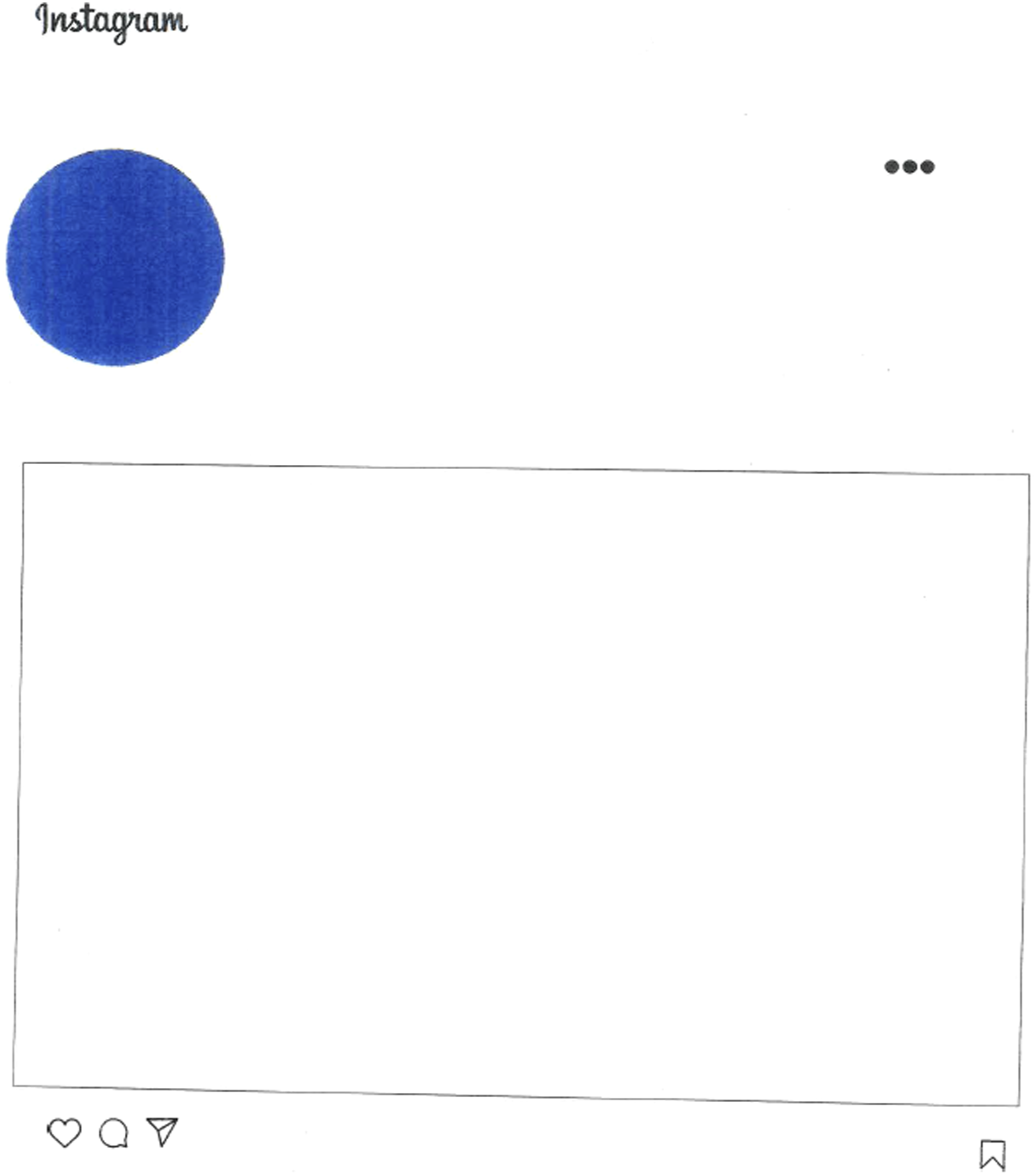
Why Norse gods on Instagram?
There were educational as well as practical reasons for the task design. Firstly, by making the task analogue, ethical and practical issues that come with bringing social media into the classroom, such as institutional constraints (Aguilera et al., 2019) and important ethical considerations concerning age limits and protection of personal data (Stewart et al., 2022, p. 111), are avoided. Secondly, working with mythological figures from a historical period is a way of achieving distance to the literacy practices of everyday life, as achieving distance is necessary to approach texts critically (Janks, 2010, p. 185). The task activates the students’ prior experiences with social media and builds on their knowledge of Old Norse mythology and culture that they have from school, as well as from literature and films. 2 Building on students’ background knowledge can support their learning by enabling them to “relate new information to what they already know” (Cummins and Early, 2010, p. 36).
Old Norse mythology contains a catalogue of characters, social identity markers and mythological artefacts with embedded values and symbolism, and students will have certain associations to main characters and objects of Old Norse mythology, such as Tor, the god of strength, and his hammer Mjølner, Frøya, the goddess of love, and her necklace Brisingamen. It is important to keep in mind that the identity markers and cultural symbolism connected to Old Norse mythology are no less viewed from a present-day perspective than identity markers and cultural symbolism from present-day media or current films, literature or discourses. There is no such thing as an authentic or neutral perspective, so that when we describe something as “from Old Norse mythology”, it is really from present-day society’s interpretations of that mythology. All referencences to Old Norse mythology used in this article are from the older and newer Edda collections, recorded by unknown authors and Snorre Sturlason in the 12- and 1300s (Mortensson-Egnund and Eggen, 2008).
Data
The 31 student texts in the dataset consist of a combination of linguistic and visual resources and vary in complexity and type of representation. Some contain little more than an image and others have extensive written sections. Some of the images are solely hand drawn and others are compounded by cut-outs printed from the Internet: letters, images, emoji-stickers etc. The deities represented in the texts are Tor, Frøya, Heimdall, Odin, Loke, Njord, Frigg and Frøy 3 . Tor is the most frequently chosen deity, with 14 out of 31 texts portraying this particular god. The second most common choice is the goddess Frøya (5/31 texts), three texts show the god Heimdall, Odin and Loke are represented in two texts each, and Njord, Frigg and Frøy are represented once each. In the remaining three texts we are unsure which god is represented, as this is not stated and does not come clearly across.
Analytical approach
When examining the student texts, we have performed a multimodal critical discourse analysis. Critical discourse analysis is interested in how ideological meaning is expressed in texts, and we include all the different semiotic modes used in the analysis (Djonov and Zhao, 2014; Machin, 2013; Van Leeuwen, 2013). Language, images and other semiotic modes can be used to represent participants and concepts in certain ways. For instance the visual representations of actions can express something about the identity of the people performing them (Machin and Mayr, 2023, s. 12). In our analysis, we look for which ideological values the students embed in their identity constructions by analysing the utilisation of semiotic modes (cf. Van Leeuwen, 2021, p. 5–6). Instagram’s format involves the integration of the linguistic and the visual, with the visual carrying the main weight and the linguistic augmenting the visual (as well as the audiovisual) (Leaver et al., 2020). So rather than separating the modes, we look at the texts as linguistic-visual complexes.
The analytical process is inspired by Grounded Theory methodology (Glaser and Strauss, 1967) and consists of movement between material and analyses. We have looked for patterns in the material and developed analytic categories based on what we found (Wodak and Meyer, 2009). Initially, we examined the student texts with open research questions such as: What characterizes the visual and verbal representations? What functions do the students reproduce? and What social relationships do the students reproduce? Based on what we found, we constructed three categories to structure the analysis, and as shown in Figure 2 we divided each category into subcategories. All categories are inductively inspired, grounded in the content of the text material. The analysis firstly explores how technical functions and literacy practices from Instagram are reproduced in the analogue texts. By shifting the medium of production from an app to paper and pencil, some affordances of the digital platform, such as the possibility to integrate music, create animations, movies and other audiovisual elements, are lost. The task challenges the students to reproduce technical functions that are possible to mimic on paper. By doing so, the students move meaning across modes, and we are interested in how meaning in this way is remade or transformed (Poulsen, 2017). Finally, we explore how textual traditions and discourses from both Old Norse and present-day culture are transformed and restructured in the texts (cf. Fairclough, 1992, p. 102). The task combines the historical theme Old Norse mythology with semiotic practices from present-day culture, so we can expect the students to draw on intertextual references and markers of cultural identity from both dimensions. Overview of the analysis. The figure shows analytic categories, sub-categories of findings and six student texts that exemplify the main tendencies in the material.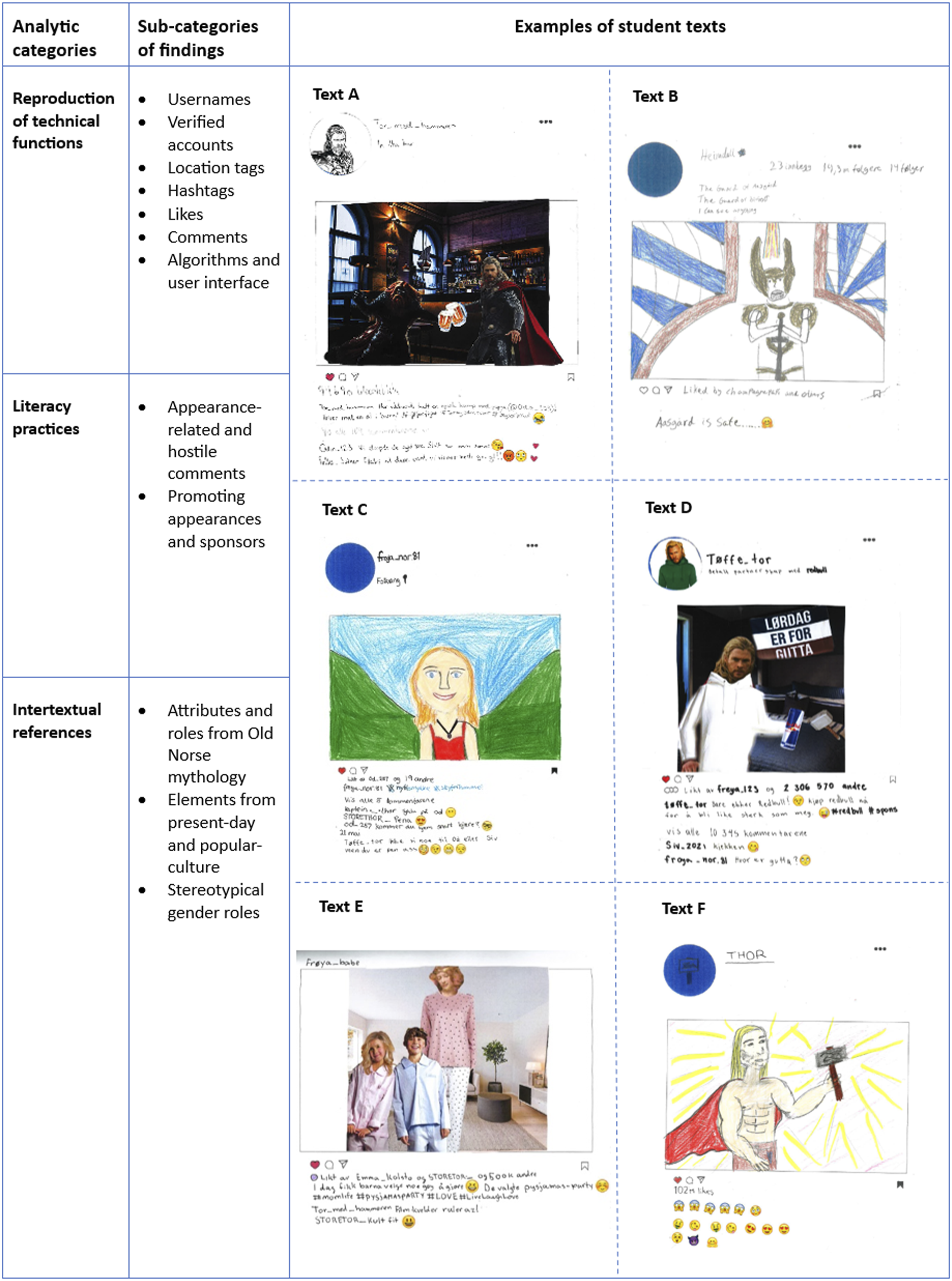
The aim of the study is to explore what potential multimodal text production can have in developing critical literacy, and we examine this by identifying traces of critical awareness (cf. Selander and Kress, 2010, p.34). We search for traces of both linguistic, visual and technological awareness in the texts, looking for signs of whether the students are aware of how social media users commonly construct identity in social media. Text production can be a starting point for discussing certain challenges or social problems (Stewart et al., 2022). Accordingly, we also explore if the dataset suggests any such challenges. Figure 3 shows how a student is performing the task by reproducing technical functions, literacy practices and intertextual references, and how traces of linguistic, visual and technological awareness can be found in the text. Identity construction in multimodal text production. The model shows a student (in the middle) constructing identity through reproduction of technical functions and literacy practices from Instagram, and through intertextual references, when producing a multimodal text. When analysing the student texts, we look for traces of linguistic, visual and technological awareness.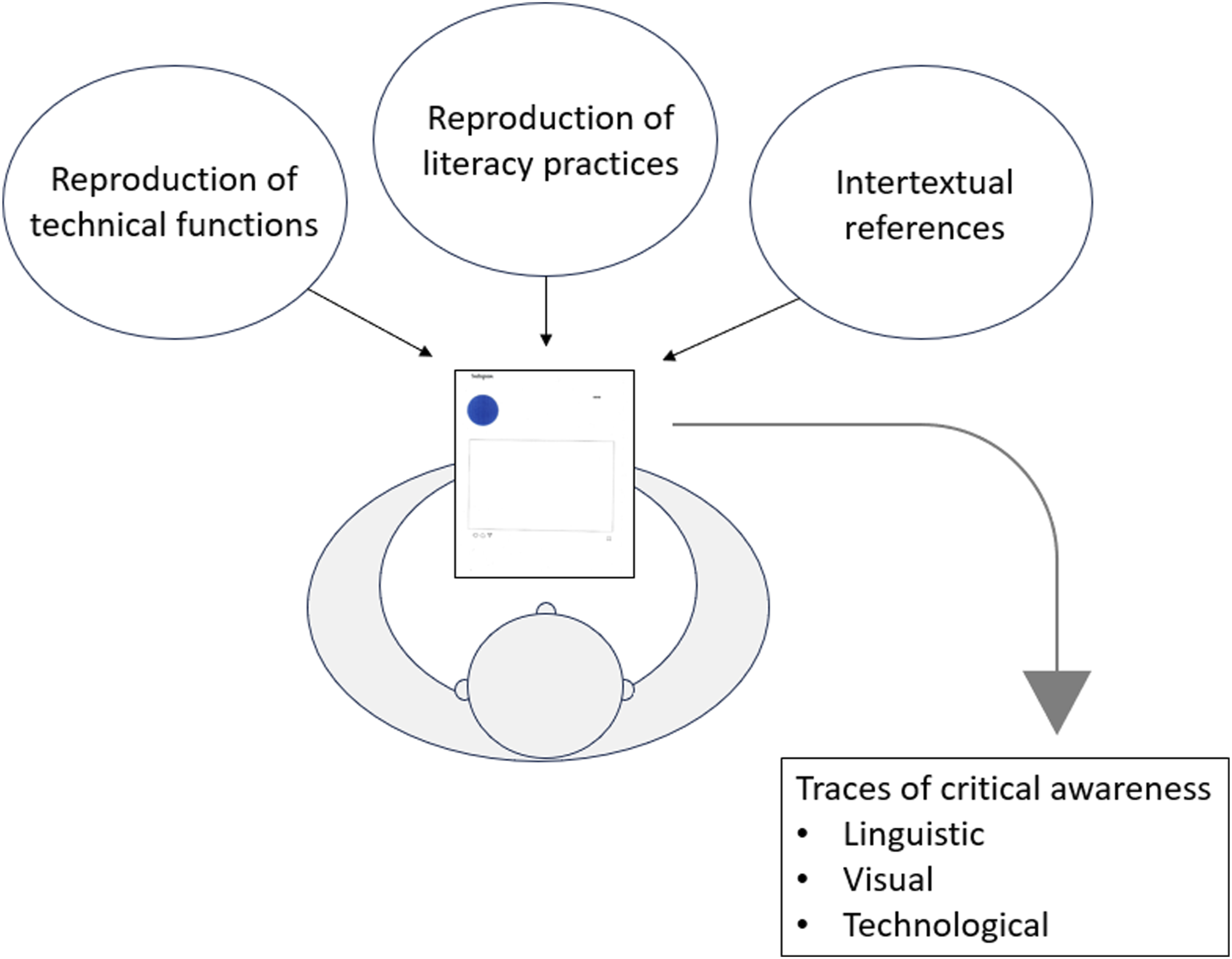
Findings
To present the findings from the analysis, we will first look at how the students are reproducing technical functions and literacy practices from Instagram in their identity constructions. Secondly, we will show how identity is constructed through references to Old Norse mythology and present-day culture. Our analysis is summarized in Figure 2, with examples from the material. The examples are chosen because they represent the material as a whole, through the ways they reproduce technical functions and literacy practices. Thus they are useful references as we explain and discuss the nature of our findings in the following.
Reproduction of technical functions
Although the student texts are not produced digitally, they include several elements that typically appear in social media. The students make analogue reproductions of many of Instagram’s technical functions for identity construction in their fictive Instagram posts.
Usernames, verified accounts, hashtags and location tags
One function that the students reproduce through linguistic resources, is creating usernames. The dataset contains several examples of how the Norse gods’ accounts have usernames that serve as identity markers. Tøffe_tor (“Tor the tough”, text D, cf. Figure 2) and Frøya_babe (text E) are e.g. used to signify something about the gods’ appearances. Tor’s identity is constructed as tough or brave, whereas beauty is used to identity the goddess Frøya. Next to some of the usernames (as in text B), we see a blue tick, which is an imitation of the badge that Instagram uses to signal that an account is “verified”, i.e. confirmed as the authentic presence of a public figure”. In other words, the students are representing the Norse gods as celebrities.
Many posts have location tags and hashtags. Examples of location tags are “Folkvang” 4 (text C) and “In the bar” (text A). These help construct the users’ identities, as they portray the gods as respectively home-centred (as the Frøya user in text C), or out drinking (as Tor and Odin in text A). Hashtags can have ideational functions and work as discourse markers. One example of hashtags is #momlife in the caption to frøya_babe’s post (text E). This hashtag catalogues the post amongst other Instagram posts with the same hashtag. On the real platform, a search for this hashtag results in millions of posts about motherhood and domestic life, often posted by influencers who construct their online identities around their social role as mothers (cf. Zappavigna and Zhao, 2017). The student’s use of this hashtag serves to identify the god Frøya with this group.
Likes and comments
Below most of the images in the dataset we can see a number of (made-up) likes. Most of the posts have several million likes (as with the user Thor (text F) with 102 million likes), which suggests the gods have celebrity statuses. On Instagram, responses to the posts are structured in comment threads (Jovanovic and Van Leeuwen, 2018, p. 688). In the dataset we find that the students have reproduced Instagram’s comment threads beneath the fictive posts. Most of the posts have high numbers of comments. One example is Tøffe_tor’s post (text D) with 10,345 comments. This confirms how the deities are constructed as popular Instagram users, and the students are demonstrating knowledge of how popularity is defined in social media. At the same time, the exaggerated numbers of likes and comments signalises that the students might have been humorous or ironic when producing the texts. Elements of humour are found throughout the dataset.
Algorithms and user interface
The students also imitate the platform’s algorithms and user interface. One example can be seen in the comments section for text A, where we, similarly to the user interface on the real platform, can see the text “Show all 109 comments”. Furthermore, Instagram’s algorithm enables users to see posts that are liked by other users that they follow, based on previous activity and preferences. One example appears in text D. Under the image, a caption says that the post is “liked by freya_123 and 2,306,570 others”. Here, the student has placed the viewers of the text in the position as followers of the Instagram user. This shows that the students have knowledge of Instagram’s algorithms and user interface.
When the students give the fictive users high numbers of likes to construct their celebrity statuses, they also reproduce visual manifestations of Instagram’s algorithms. A post that gets many views and likes, gets spread more easily, which leads to even more views and likes and to highlighting in the news feed (Poulsen and Kvåle, 2018). The students are demonstrating technological awareness by reproducing these manifestations of algorithms.
Reproduction of literacy practices
In the following, we will show how the students also reproduce several literacy practices established on Instagram.
Commenting practices: appearance-related and hostile comments
As mentioned, a high number of comments are attached to many of the posts in the dataset. However, looking more closely at the comments we see that the students reproduce the practice of posting appearance-related or hostile remarks in the comment threads. Some of the fictive users complement each other’s looks with comments like “pretty” (text C) and “handsome” (text D). Others leave hostile comments (like “Loser haha” and “Don’t show off”). This is recognizable from social media communication, where discourses that focus on looks and hostile comments are prevalent.
Posting practices: promoting appearances and sponsors
The students reproduce the common practice of promoting appearances in social media. The Norse gods are represented as good-looking, and their best characteristics are highlighted in the greater part of the dataset. In particular the male gods flex muscles in the images and brag about winning battles in the captions. All the images representing Tor show him to be handsome and muscular (e.g. text A, D and F). Correspondingly, all the images representing the goddess Frøya show her to be beautiful. As we see in text C and E, Frøya appears as good-looking. In text E, she is portrayed together with her children in a nice home. These idealized representations reproduce an appearance-focused discourse we can recognize from social media confirming the gods’ influencer or celebrity-like identities.
Another literacy practice which is reproduced in the material is that of posting sponsored content. Text D shows an image of Tor, holding a can of the energy drink Red Bull. The caption says: “Simply loving Red Bull! Buy Red Bull now to get as strong as me”, with the hashtags #redbull and #spons (meaning sponsored). Above the image a label says “Paid Partnership with Red Bull”. This label declares that the user is being paid by a commercial collaborator to publish the post, and is commonly seen on Instagram (Leaver et al., 2020, p. 32). This establishes the Norse god Tor as a powerful influencer with enough followers for the social status and fame to be sponsored by a large brand like Red Bull. Through this literacy practice, the text expresses values linked to consumer capitalism, saying that being strong is important, and that to be strong you need to purchase this product.
Intertextual references to Old Norse mythology and present-day culture
We will now show how identity is constructed through intertextual references to identity markers from Old Norse mythology and present-day culture.
Attributes and roles from Old Norse mythology
The most common example of visual references to Old Norse mythology are the representations of the hammer Mjølner and of big muscles to signify the god Tor. Tor is a god of enormous physical strength in Old Norse mythology, and he uses the hammer Mjølner, which has many magical attributes, in battle against forces of evil. While the hammer signifies battle power, the big muscles signify physical strength, and these traits seem to be the minimum needed to identify Tor. The simplest renditions in the dataset represent a stick figure holding a hammer and a drawing of a man with bulging arms. As mentioned, all representations of the goddess Frøya show her to be beautiful, and Frøya’s beauty is a reference to her being the goddess of love and attraction. Most images of Frøya show her to be wearing a necklace (as in text C), which is a reference to the necklace Brisingamen in Old Norse mythology. The necklace is central in the myth of the reclaiming of Tor’s stolen hammer, which is told in “Trymskvida”, an epic poem from the older Edda (Mortensson-Egnund, 2008).
The captions added to the posts show that the students have knowledge about the gods’ roles and relationships. Some examples are the recurring references to Tor being the god of strength. Another example occurs in Heimdall’s post (text B), where the caption says: “Åsgård is safe”, a reference to Heimdall’s role in Norse mythology as the guardian of the bridge Bivrǫst that leads to Åsgård. The students also show knowledge about the gods’ social structures, for example that Tor is son of Odin ( in text A, where the caption says that Tor is celebrating winning a battle with his father, Odin_123)In the comment section below froya_nor.81’s post (text C), the user kaptein._thor has left the comment: “Jealous of Od”. The user Od_287 has commented: “Will you be coming home soon dear?”, followed by a comment from Tøffe_Tor: “Don’t tell Od or Siv, but you’re pretty”. In Old Norse mythology, Od is Frøya’s husband and Siv is Tor’s wife. The students have created a romantic drama in the comments section, demonstrating both comedic humour, knowledge of Norse mythology, and mastering of communicative practices in social media.
Present-day popular-culture
The posts also include various elements that we can recognize from present-day culture. The gods are depicted wearing modern clothes and are placed in modern surroundings. In the captions and comments, there are many instances of slang, modern language and use of emojis. This resembles current social media texts (Veum and Undrum, 2017). References to popular culture are prominent in the texts, and the students’ representations are clearly influenced by the way Norse gods are represented in modern franchises. Marvel Entertainment has made several films, comics etc. based on Old Norse mythology and many of the students that have found images on the Internet, have selected images of characters from Marvel’s movies. Images of the actor Chris Hemsworth who plays the character “Thor” in several Marvel movies, is frequently used to represent Tor (e.g. in text A and D). The students that have made drawings of the gods, particularly the male gods, have represented them as cartoon-like superheroes. The hand-drawn male gods have capes, armours and big muscles and even these often resemble characters from Marvel. The drawing in text F has for instance great similarities to Chris Hemsworth character Thor. Other students have made drawings that resemble how the god Heimdall is represented by Marvel (e.g. text B). The way Tor’s hammer is depicted also resemble the hammer from the Marvel movies, as we see in text D and F.
Stereotypical gender roles
As mentioned, we see a tendency towards a traditional and somewhat stereotypical representation of gender roles in the material, both in terms of visual and linguistic representation. Many male deities are portrayed doing social out-of-home activities such as partying with the boys, fighting or performing their role as god, while the females are performing home centred activities, being with children or focusing on their appearances. In text D the male god Tor’s tough image is established through the banner in the picture saying “Saturday is for the boys”. The Norwegian word used is “gutta” which is colloquial and corresponds roughly to “lads” in British English or “guys” in American English. The activity indirectly referred to here is partying, and this reference occurs in many of the representations of Tor. The representations of the female god Frøya, however, refer to rather different activities. Some texts depict her posing for a selfie outside (i.e. text C) and others as spending time at home with her children (i.e. text E). The hashtag “#momlife” in text E also holds connotations that are constructing Frøya’s identity as a woman whose life is dedicated to being a mother.
One reason for this gender differentiation could be that the students perceive such a division in what they know about Old Norse mythology, where Tor is known for fighting and Frøya is known for her beauty. This could be meant as references to Old Norse mythology as seen through the eyes of the present. In historical sources, Frøya is rarely represented as home centred. She travels, is considered wise, has many liaisons with other gods – romantic and platonic – and she kills the man who slays her husband. So, it may be more likely that the stereotypical gendered division stems from gender portrayals in popular culture. Present-day culture is no less reliant on character tropes than Old Norse mythology, and stereotypical portrayals of gender roles are often conveyed in entertainment for children, such as cartoons and children’s’ books (Moya- Guijarro and Ventola, 2022). A review of children’s literature has for instance showed that male characters in cartoons rarely are featured in household activities, but female characters are (Monk-Turner and Poarch, 2001, p. 75).
Summary of analysis
One main finding in the examination of how students construct identity in multimodal text production, concerns the students’ creative and playful constructions of Norse gods’ fictive online identities as Instagram influencers. This serves as a way to enact awareness towards social media literacy practices and characters. The Norse gods are portrayed as influencers, who in today’s digital society have great power. This shows how the students have transformed meaning when they have “moved” the Norse gods across media and contexts, making them role models and idols of the present day rather than deities of the past. Another main finding is that the students represent the gods through idealized images and reproduce well-known social media discourses that emphasize looks and consumerism. The students use visual attributes and physical traits described in Old Norse mythology to identify the gods, such as referring to mythical objects and the consistent portrayal of Tor as strong and of Frøya as beautiful. At the same time, these elements can be interpreted as references to the students’ present-day context. The dynamic representations of the male gods and the more static representations of the female gods seems to be influenced by gender representations in popular culture.
Traces of awareness
When analysing the student texts, we have looked for traces of the students’ awareness of how identity is constructed. In the last part of this paper, these traces, and some challenges, will be discussed. To conclude, we will discuss the potential of this kind of multimodal text production for critical literacy education.
Traces of linguistic, visual and technological awareness
In the analysis, we found indications that the students are aware of both linguistic and visual practices on Instagram, and of the platform’s semiotic technology. When reproducing literacy practices from Instagram, such as posting appearance-related comments or representing the Norse gods as good-looking, the students show awareness of how semiotic resources in social media representations often are used to promote a discourse that emphasizes physical appearances. The students also show awareness of how identity construction in social media is affected by the interests of commercial actors, when reproducing the social practice of posting sponsored content. The analysis of how the students reproduce Instagram’s technical functions makes it clear that they are highly aware of how to use these for identity construction and interaction. Not only do they show knowledge of how popularity is defined in social media when giving the fictive Instagram accounts many likes and comments, they also demonstrate technological awareness by reproducing verbal and visual manifestations of Instagram’s algorithms and user interface. Understanding how technology works and affects the world views that are represented to the users, is crucial for being a critical user of social media.
We argue that when we identify traces of awareness in the students’ texts, this involves a potential for critical awareness. The students are clearly aware of how identity is constructed on Instagram, as they are able to reproduce technical functions and literacy practices, and by encouraging them to ask the right questions, like why it is done in this way and whose interests it might serve, their awareness can be raised to critical awareness. In many cases we find that there are already clear traces of critical awareness in the students’ texts, and this is most of all detectable through their use of ironic distance.
Ironic distance as critical awareness
Both teachers in the study reported that the students were motivated when working on this task and that they enjoyed it. This is reflected in the dataset, where humour and creativity are prominent features. The students have used their knowledge about both Old Norse mythology and social media communication to make almost parodic characters that show off in their Instagram accounts and use their good looks to promote products. They have played around with social roles in comments sections, and they have exaggerated the Norse gods’ celebrity statuses. This can be interpreted as making fun of literacy practices and types of self-representation on Instagram. According to Janks (2010), making jokes and humour can be a way of taking social action, as it “allows us to rebel against authority, to attack powerful institutions or views of life” (p. 220). The students demonstrate an ironic distance to the practices they are reproducing, which can mean that when performing the school task, they have managed to distance themselves from them. Achieving distance is necessary to approach texts critically (Janks, 2010). We argue that this combined with the use of humour indicate critical awareness among the students.
Raising challenges in the classroom
Classroom text production can raise students’ awareness of how text producers construct and maintain social structures and problems (Stewart et al., 2022). In literacy education, text production can therefore be a starting point for discussing certain challenges or social problems. When the students reproduce literacy practices such as leaving negative appearance related comments or making stereotypical representations of gender, it can be hard to know whether this is humorous, critical text production, or if the literacy practices are internalised so that they are unaware of the values they are expressing.
We have seen how the Marvel franchise has considerable power over how the students perceive and represent elements from Norse mythology. 5 Being able to imagine alternative representations, is essential for critical literacy (Janks, 201, p. 186). Still, we don’t consider the rather unbalanced depictions in the text material a sign of lacking critical competence. The students had seen the movie “Thor” in class, which might have influenced their impression of how they were meant to represent the Norse gods. Their perceptions are also a result of the media landscape that they navigate in. When adolescents look up Norse gods on the Internet, it’s likely that popular culture’s portrayals are presented. Lemke has pointed out that “today, we, especially the youngest of us, increasingly live our lives across institutions and media”, which shapes our interpretations (Lemke, 2006, p. 579).
Both the naturalisation of biased or potentially harmful literacy practices and the way online representations are limited by algorithms, are potential challenges for critical text production in the classroom. We argue that these should be made into topics of discussions and explicitly addressed with students both before and after the text production, to help them become aware of how texts, also the texts that they produce themselves, are linked to ideology and power. This will be revisited in the last part of the paper.
Discussion and conclusion: A method for developing critical literacy?
Although there is consensus within the research field that being able to design texts critically is essential in a society dominated by multimodal and digital media (cf. Cope and Kalantzis 2009; Stewart et al., 2022), we still have little research on how multimodal text production can be used to help develop students’ critical literacy. In this paper, we have brought forward findings that show how critical literacy can be developed through multimodal text production. Even though this study has certain limitations, such as the researchers only having access to the students' texts and not having insight into their reflections on the text creation process, or on how contextual factors in the classroom might have affected their choices, findings suggest that the task we have studied enabled the students to practice several competences that are crucial in the complex digital contexts of our time.
By making analogue reproductions of Instagram posts, the students got to practice awareness as producers of social media texts and to demonstrate linguistic, visual and technological awareness, without needing to use a social media platform. As mentioned earlier, the affordances of the digital medium are obviously lost when fictitious Instagram posts are designed in an analogue medium. When students are asked to mimic social media practices with pen and paper, the analogue medium will in some ways restrict what they can multimodally demonstrate. The tools available will have an impact on how the students reconstruct the identities of Old Norse gods, as well as their possibility to express critical awareness. If the research design had allowed the students to use the Instagram app in their text production, they would have been able to make even more complex multimodal texts, using i.e. audiovisual features, and to demonstrate critical literacy capabilities in a different manner. At the same time, it could have been more difficult to find traces of the students' awareness if they had completed the task using the app. Had the students used the app, they would simply have utilized the features available, which would not have revealed what they are consciously aware of or not. However, when students create a text where they imitate an Instagram post, the functions and practices they chose to reproduce will reflect their values and what they see as important. Working on paper also takes more time, which can provide the opportunity to make more deliberate choices.
Findings in the analysis furthermore indicate that the task of mimicking social media practices on paper allowed the students to play with literacy practices that they are familiar with, while providing the required distance to social media communication to be able to approach it critically. Janks finishes her book “Literacy and Power” (2010) with the words: “Critical literacy work in classrooms can be simultaneously serious and playful. We should teach it with a subversive attitude, self-irony and a sense of humour” (p. 224). We therefore argue that working on such a creative task could motivate the students and contribute to increasing their critical awareness of the semiotic practices and technologies that influence them in everyday life, and accordingly become critical consumers and producers of social media. Designing texts can help empower students and make them aware of how semiotic modes are used to create social structures and changes (Morrell, 2003; Stewart et al., 2022). Still, as Stewart et al. emphasize: “just creating media is not enough; it must be done with critical analysis that challenges hierarchies of power” (2021, p. 105). A general finding from the CritLit project is that text production should always be followed by discussions scaffolded by the teachers that encourage students’ critical reflections. Because of the limitations in the present study, partly caused by covid restrictions (cf. section 4), we have no indications that such a discussion took place in these classrooms, and our analysis does not reveal how the students reflected on the choices they made. But as we pointed out in the previous section, topics of discussions could in this case have involved the naturalisation of potentially harmful literacy practices and the ideological nature of the echo chambers algorithms carve out for us online.
Despite the study’s limitations, the findings suggests that the type of multimodal text production task that we have looked at is a good starting point for developing critical literacy amongst lower secondary school students. We do, however, propose that an explicit discussion of the challenges we have pointed out is necessary in order to achieve critical awareness and reflection in the students. Identity construction can help students gain new perspectives on practices they are participating in (Janks et al., 2014, p. 33). By taking a step back from their own texts, and asking questions like why did I make this choice? and what would be an alternative representation?, the students could also achieve distance to their own constructions and increased critical awareness of how all identity is constructed.
Footnotes
Acknowledgements
The authors would like to thank the teachers and students who took part in this study. We would also like to thank our colleagues for helpful inputs on the article. Ethical clearance for the study was obtained from Norwegian Centre for Research Data, reference number 320785.
Declaration of conflicting interests
The author(s) declared no potential conflicts of interest with respect to the research, authorship, and/or publication of this article.
Funding
The author(s) disclosed receipt of the following financial support for the research, authorship, and/or publication of this article: This work was supported by the Norges Forskningsråd; 301347.
