




Abstract
Older female celebrities are increasingly visible in popular media culture, but what kinds of representations are being offered? By deploying a feminist intersectional perspective and adopting Multimodal Critical Discourse Analysis (MCDA), this article interrogates how British Vogue’s Non-Issue communicates ideas and values about ageing and how the magazine constructs discourses through which women’s ageing is understood. The analysis shows that the Non-Issue represents older women as radical and empowered subjects. The rhetoric of freedom and choice, central to postfeminism, is prominent in the magazine and aligns with neoliberal discourses of successful ageing. Such discourses encourage women to confine themselves to never-ending, rigid forms of self-surveillance, self-monitoring and self-disciplining that ultimately subject the older female body to a ‘new’ set of bodily inscriptions and prescriptions that reinforce patriarchal standards of beauty. These standards of beauty are, however, challenged in the magazine through a recuperated do-it-yourself discourse of punk spirit rebellion that works to commodify women’s empowerment, yet still reduces women to how they look.
Keywords
Introduction
For decades, a central theme in feminist studies and in the media has been the invisibility of older female subjects and their negative representations when they do appear (Sandberg and Marshall, 2017). Older female celebrities, who were once relatively invisible in the media, now regularly appear in film, on television, in fashion and beauty magazines and ads (e.g. Jerslev, 2017; Twigg, 2018; Van Bauwel, 2018). This new and celebrated visibility of older female stars such as Helen Mirren, Jane Fonda, Cher and Joanna Lumley reflects the idea of ‘successful ageing’ (Rowe and Kahn, 1997; see also, Jerslev, 2017). While heavily criticised, successful ageing promotes the idea that older people can be active, productive and autonomous – terms associated with the neoliberal imperative of a capitalist subjectivity (Sandberg, 2013: 13). These terms also correspond highly with youth and midlife, which ultimately translates into ‘not aging, not being “old” or, at the very least, not looking old’ (Calasanti and Slevin, 2006: 3). In this sense, successful ageing presupposes agelessness (Sandberg, 2013). For women, this has resulted in the need for them to preserve the youthful appearance of the body, and especially the face (see, e.g. Fairclough-Isaacs, 2014; Kenalemang, 2022; LaWare and Moutsatsos, 2013). Within a neoliberal postfeminist culture, the demand for women to work on and perfect the body (and face) has both intensified and extensified (Gill, 2021; Lazar, 2017). Women’s appearances are subjected to heightened surveillance within magazines and cosmetic advertisements that mobilise fear and anxiety about ageing, which as Lazar (2017) argues, corresponds with the denigration of ageing.
Against this backdrop, the aim of this article is to interrogate the kinds of ideas and representations of older women circulating in women’s lifestyle magazines. I adopt a feminist intersectional perspective to interrogate current ‘common-sense’ ideas about older women and how these ideas reproduce inequalities of age, gender, race and class. This article uses the British Vogue Non-Issue (April 2019) as an interesting case to study the wider ideas and discourses about women’s ageing. The Non-Issue is an intertextual reference to the use of ‘issue’ by Vogue to mean something about fashion and to mean an item of contention. The issue (as a contention) is referred to as a ‘movement’ that was produced by Vogue through their partnership with L’Oréal in response to a youth obsessed culture where older women still feel/are invisible (British Vogue, 2019: 2). Dedicated to women over 50, the issue formed part of L’Oréal’s Age Perfect campaign to democratise beauty and ensure that ‘age should no longer be an issue’ (British Vogue, 2019: 2). The feature included fashion and beauty, fitness and wellness, travel, food and lifestyle content, highlighting the lives and perspectives of women all over the age of 50. While the aim of the issue was to ‘challenge age stereotypes and positively shape people’s perceptions of age’ (British Vogue, 2019, my italics) through images and messages that normalise ageing, the broader goal of the issue appears to be to sell anti-ageing products to older women. Nonetheless, Vogue seemingly empowers older women through the ‘do-it-yourself’ (DIY) ethos of the feminist punk movement that emerged in the late-1970s and later manifested in what became known as the ‘riot grrrl’ movement in the 1990s (e.g. Dunn and Farnsworth, 2012; see also Lazar, 2009) to challenge and resist gender power relations in society to produce their own self-presentations. By analysing representations of older women in the Non-Issue, the article highlights assumptions about women’s ageing and how they are understood within an increasingly neoliberal postfeminist context.
I adopt a multimodal critical discourse analytical approach (e.g. Ledin and Machin, 2018, 2020) to reveal the wider ideas and discourses of women’s ageing carried in the Non-Issue, as well as carry out detailed observations on the visual content and style of the magazine. The following questions are posed: How are older women represented in the Non-Issue? Do representations of older women in the Non-Issue reproduce inequalities of age, gender, class and/or race? To respond to these questions, I employ a feminist intersectional perspective combined with MCDA to contribute to the ongoing research in this area. This perspective is useful for deconstructing the complex ways in which hegemonic relations of power are (re)produced in magazines to establish an idealised version of successful ageing. Moreover, through such a perspective, this study can interrogate how Vogue uses discourses of successful ageing to promote the inclusiveness and visibility (or lack thereof) of older women in the magazine and in society. Consequently, this article seeks to contribute knowledge on the inclusiveness of older women, traditionally rendered invisible in marketing and media images as well as in feminist literature. Such knowledge is important in showing the different ways that women are marginalised in society, even when they are included.
Literature review
Postfeminist representations of older women in magazines and advertisements
Postfeminist representations of (older) women in various media such as magazines and advertisements are extensively debated in academic literature (e.g. Jermyn, 2016; Lazar, 2009; Windell et al., 2019). The strong emphasis placed on older women to self-monitor and improve the self is underlined (Jermyn, 2016; see also, Gill, 2007), which extends into the neoliberal pursuit of successful ageing. Whether the representations reflect empowerment and liberty, or reproduce traditional gendered and intersectional inequalities, is contested. However, as pointed out by some scholars, achieving successful ageing is out of the economic reach of most women (e.g. Calasanti and Giles, 2018; Calasanti and Slevin, 2006; Jermyn, 2016). Nonetheless, (all) women, celebrities alike, are encouraged to construct a youthful feminine appearance (Lazar, 2009, 2017; Fairclough-Isaacs, 2014, 2015) that shows a commitment towards successfully resisting ageing (Kenalemang, 2022). As Fairclough-Isaacs (2015) argues, in celebrity culture, failure to age well is often seen as a failure of femininity. Any visible signs of ageing (i.e. wrinkled skin, grey hair, age spots) thus reflects a lack of correct attitude and more problematically a lack of morality (Calasanti, 2007).
Consequently, the individual woman is charged with a moral imperative to mask visible signs of ageing either by colouring her hair, using cosmetic products and sometimes undergoing cosmetic surgery to avoid being perceived as unhealthy, immoral or irresponsible (e.g. Calasanti et al., 2018; Hurd Clarke and Griffin, 2008). Older women who fail to meet the normative expectations of successful ageing become perceived as having ‘let themselves go’, although they hold control in their hands (Calasanti and Slevin, 2006). Moreover, the consumption of these anti-ageing products and services is understood as a self-empowering choice (e.g. Gill, 2007; Lazar, 2006; Windell et al., 2019), which attests to women’s ‘liberation and freedom from their self-restrictions’ (Lazar, 2011: 39). Still, older women’s looks are restricted to normative standards of (aged) femininity, defined in terms of what they can and cannot do and wear as well as how much of their body should be seen (e.g. Bouvier, 2018).
As highlighted by Twigg (2010: 15) in her examination of Vogue magazine, this includes wearing clothes that are not too bright, too young, too showy, or too blatantly sexy. Such clothing choices allow women to present themselves as ‘put together’, which encourages others to see them as competent, reliable and independent (Hurd Clarke and Bundon, 2009). There is, hence, a pressure placed on women (often over the age of 40) to behave and dress in ways which are considered age-appropriate (Alderson, 2016). Maintaining an age-appropriate appearance thus appears to be an important goal for older women, whose social power and visibility is tied to how they look (e.g. Kenalemang, 2022). Failure to work on the self or dress in a certain manner can be seen as a way of symbolically resisting the age-appropriate rules of society (cf. Jermyn, 2016; Way, 2020), as witnessed through pioneers such as Vivienne Westwood and Siouxsie Sioux who used their punk styles in the 1970s to challenge norms of beauty. Punk fashion aesthetics include, for example, the colour black, jeans, t-shirts, leather jackets or boots, heavy accessories, metal stud earrings, tattered clothing, multiple piercings, tattoos, spiked hair and unnatural hair colours (Sklar et al., 2021). Such forms of resistance or subversion relate to a discourse of punk DIY rebelliousness (cf. Jermyn, 2016; Way, 2020).
The DIY ethic of the feminist punk movement is grounded in the values of autonomy and community and encourages women to create alternative representations of femininity that collectively challenge dominant ideologies of capitalism and consumer culture (Way, 2020). Celebrities ‘represent the ideological centre of capitalist culture’ (Marshall, 1997: 17) and are employed in the media to promote desire and provide consumers with ‘compelling standards of emulation’ (Rojek, 2001: 187). Given their high culture connotations of beauty, glamour and transcendence, celebrities thus embody certain values and lifestyles as ‘part of a politics of identification’ (Genz, 2006: 346), that consumers can admire and emulate. As Jones (2008) suggests, however, the high visibility of female celebrities in the public sphere is only tolerated insofar as they allow men, whether cosmetic surgeons or fashion photographers, to remake/remodel their bodies. In this sense, women are subjected to the postfeminist ‘makeover’ of ageing to make themselves more visible to others through engaging in cosmeceutical interventions and beauty practices (see, e.g. Fairclough-Isaacs, 2015; Jermyn, 2016). Fairclough-Isaacs (2015) argues that a feminist voice in magazines is largely absent, in favour of a postfeminist discourse that encourages women to endlessly work on and improve the self.
In contrast, Favaro and Gill (2018) show that in the last few years, feminism has become popular, and such popularity manifests in women’s magazines (see also Banet-Weiser, 2018). Nonetheless, as the scholars highlight, the neoliberalisation of feminism promotes an entrepreneurial spirit of self-transformation (Favaro and Gill, 2018), that may be aligned with a DIY ethic. Based on this literature review, this article interrogates the ideas and representations of older women in the Non-Issue. I examine how the magazine uses images of ‘successfully aged’ celebrities to promote (post)feminist ideas of self-transformation underlined by a DIY ethic that encourages women to become entrepreneurs of their own images and how this works to challenge or reinforce hegemonic standards of beauty.
Theoretical framework
Feminism, postfeminism and intersectionality
Feminism is diverse and defined in many different ways: as an ideology, a social or political movement, or as a knowledge production and theory about gendered and intersectional relations (Banet-Weiser, 2018). Here, feminism is used inclusively to capture ‘people and projects that pursue the goal of reducing gender inequality’ (Walby, 2011: 3), and gender in turn is understood as intersectional, that is, as always intersected by other inequalities. This article thus employs a feminist intersectional perspective to analyse representations of older women in the Non-Issue.
The concept of postfeminism is highly contested and has sparked several debates among feminist scholars (see, e.g. Gill, 2016, 2017; Litosseliti et al., 2018). Although scholars employ postfeminism itself in multiple and even opposing ways, the notion is often used to signal an epistemological break within feminist thought, advocating an alignment with other ‘post’ movements; signify a historical shift, that is, a time ‘after’ second wave feminism; and denote a backlash against feminism (Litosseliti et al., 2018). In this article, postfeminism is understood as a sensibility shaped by intersecting inequalities and neoliberalism (Gill, 2007). As stated by Gill (2007: 163), a postfeminist sensibility is distinctive because it is a ‘response to feminism’, which makes it more complex than a backlash – ‘feminist ideas are both articulated and repudiated, expressed and disavowed’. Gill (2007) argues that a postfeminist sensibility is made up of several interrelated themes that place a strong emphasis on women’s bodies as key sites of self-identity, which must constantly be self-surveilled, self-monitored and self-disciplined.
This is framed within an individualistic discourse wherein women are ‘empowered’ and ‘free’ to make their own choices. Such ‘choices’ highlight the tensions between how women (often young) are constructed in the media as ‘free’, yet can only achieve their freedom through consumption practices and bodywork. Gill’s discussion about women in a postfeminist culture can easily be extended to older women, who, on the one hand, are asked to embrace ageing but, on the other hand, are bombarded with images and messages that construct ageing as something to be resisted (Marshall and Rahman, 2015). This demand to work on the self extends to all aspects of life and forms the basis of new femininities that constitute a discourse of sexual freedom. These sexualised representations are intended to position women as sexually desiring, knowing and active subjects who are no longer victimised objects of the male gaze (Genz, 2006; Gill, 2007).
In this way, women are empowered to (individually) liberate themselves from the system of patriarchy through their free exercise of personal choice to form a new disciplinary regime of the body. This new disciplinary regime has been labelled a ‘postfeminist gaze’ (Riley et al., 2016), or what some scholars refer to as the girlfriend gaze (Winch, 2012), which folds into neoliberal ideas of the self as a project that must continually be constructed and transformed; it promotes the idea that all women can transform the self through self-scrutiny and bodywork. Women are, thus, encouraged to become ‘entrepreneurs of their own lives, managing choices with a highly volatile world and taking individual responsibility for their own failures’ (Bockman, 2013: 15). The strong focus on individualism that informs neoliberalism and postfeminism decollectivises the feminist movement and translates feminist goals and political ideas into matters of individual choice and agency (e.g. Genz, 2006; McRobbie, 2009).
Focusing on the individual’s choice results in a ‘double entanglement’ – the doing and undoing of feminism that offers women personal freedoms and pleasures while reducing their basis of a collectivised struggle (McRobbie, 2009). Postfeminism can, thus, be seen as an opposition to feminism (e.g. Walby, 2011). Consequently, postfeminist individualism’s tendency to frame women’s issues in exclusively personal terms, which disregard structural understandings or collective solutions, redefines oppression and structural disadvantage as personal suffering and reframes success as an individual accomplishment. Such a focus on the rhetoric of tokenism obscures the collective nature of oppression and the need for organised action to remedy social injustice (Genz, 2006; cf. Walby, 2011). Moreover, postfeminism’s individualism points to its exclusivity; it is accused of appealing distinctively to white, Western, middle-class and heterosexual young women (Gill, 2016, 2017; McRobbie, 2009; Litosseliti et al., 2018). In this sense, postfeminism reinforces existing hierarchies and inequalities of age, class, gender, race and sexuality (e.g. Genz, 2006; Gill, 2007; Gill and Scharff, 2011). It is therefore key to study postfeminism from an intersectional perspective. As Gill (2016: 620) notes, ‘postfeminism, then, is increasingly theorised in intersectional terms, and seems to be growing in importance as part of a critical lexicon for understanding contemporary culture’.
Intersectionality, a term coined by Crenshaw (1989, 1991), (although the concept it denotes is much older), is based on the premise that systems of inequality such as age, gender, class and race mutually shape or constitute one another and work together to reinforce and defend privilege and oppression (see, e.g. Ferber, 2012; Walby et al., 2012). An intersectional approach provides a way to think about axes of power and difference non-reductively; that is, it acknowledges individuals’ multiple social identities, which cannot be examined and understood in isolation (Gill, 2017). Hence, intersectionality not only regards inequality or oppression as additive and mutually constitutive (Cho et al., 2013), but also considers how structural relations of power related to age, gender, class and race intersect to form a range of inequalities in specific contexts (Gill, 2017). Interrogating ideas and representations of older women in lifestyle magazines such as British Vogue offers a critical reading of how such messages and images (re)produce intersecting inequalities of age, class, gender and race, through an examination of the forms of in/visibility they make possible through a discourse of punk rebelliousness. I argue that a feminist intersectional analysis can demonstrate how (post)feminism contributes to a neoliberal form of governance as well as their interconnectedness to one another.
Material and method
This study analyses the 2019 British Vogue Non-Issue, which can be considered as a ‘critical’ case (Danermark et al., 2001). The Non-Issue comes with claims to challenge perceptions of ageing, in strong contrast to the standard issues normally produced by Vogue and other women’s lifestyle magazines that tend to feature and focus on younger women. These issues are often seen as damaging to women’s self-image because they offer women a distorted view of themselves and the world (e.g. Machin and Thornborrow, 2003). Although Vogue’s target readership has traditionally concentrated on the 20–44 demographic group (Twigg, 2018), the Non-Issue can be seen to represent the expanding segment of magazines aimed at older people, over 50 years of age (cf. Lumme-Sandt, 2011). Older people, particularly older women, constitute an important segment of the ‘grey/silver market’ due to their increased spending power (e.g. Ylänne, 2021). This market segment, targeted at wealthy people 50 or 55 years and above, thus creates an opportunity for a lucrative market for anti-ageing products and services (cf. Kenalemang-Palm and Eriksson, 2021). I, therefore, intend to examine and critically question the kinds of representations offered in the magazine from a feminist intersectional perspective within MCDA to help uncover the ideas about older women circulated in the Non-Issue and how or if they work to (re)produce inequalities of age, gender, class and race. Focusing on one issue allows for a detailed empirical analysis of the magazine and leads to a deeper understanding of the case and how such publications convey specific ideas and values about ageing.
The analysis of the content of the Non-Issue is informed by the method of Multimodal Critical Discourse Analysis (MCDA) (e.g. Ledin and Machin, 2018, 2020), which provides a toolkit for analysing both text and images, and how these are integrated or combined to communicate meaning. MCDA is a Social Semiotic approach to visual communication grounded in the work of Kress and Van Leeuwen (2006) and now mainly progressed by Machin and others (Ledin and Machin, 2018, 2020). This method of analysis allows us to break down compositions into their most basic components and then understand how these work together to create meaning (Ledin and Machin, 2018, 2020). Through the individual semiotic choices they make, the producers of Vogue connote complex ideas about the nature of the world and ageing. These complex ideas are thought of as ‘discourses’ (e.g. Foucault, 1980). Discourse is used to refer to the ‘different ways of structuring forms of knowledge and social practice’ (Fairclough, 1992: 3). In this sense, discourses can be thought of as accepted understandings of how the world works (Ledin and Machin, 2018, 2020); for example, how communication choices made by the editors of the Non-Issue embed taken-for-granted assumptions regarding women’s ageing and favour a neoliberal ideology of successful ageing.
A key concept used in this study is ‘new writing’ (Van Leeuwen, 2008), which Ledin and Machin (2018, 2020) call ‘integrated design’. Integrated design refers to the visual design afforded by the combination of elements such as text, icons, colours, and images found, for instance, in magazines, designed to intertwine and communicate certain meanings. The communicative choices used in the design of the magazine by the producers thus work together to communicate something about the liberating effects of anti-ageing products and why older female subjects should consume these products. However, such designs do not clearly communicate what such elements mean or how these parts interrelate. Hence, analysing how such elements are used, the different ways that people, objects, places and actions are represented, as well as how the readers are positioned, offers more detailed ways to observe how women are represented in the Non-Issue. This helps me reveal both the overt and hidden meanings embedded in the images found in the magazine. The focus of the analysis is therefore on how the different elements, that is, positioning of the viewer (gaze, distance), participants (individuals), settings, colour (saturation, range, brightness, coordination), actions and indexical links, grammatical and lexical choices – as well as all these elements in combination – work to communicate ideas and values circulating in society.
Another key concept used in this study is modality. This study uses the concept of ‘visual modality’, as used by Machin and Van Leeuwen (2007) in their study of Cosmopolitan, to analyse the images found in Vogue. Modality refers to how true or real images are meant to be seen (Van Leeuwen, 2005). For example, this means analysing images to see if details of the objects and background are represented in fine focus or if they have been reduced, and if aspects of colour such as saturation and modulation appear naturalistic or if they are exaggerated. Advertising images serve as examples of photographs that have reduced naturalistic modality. Normally, the details of the background in such images are slightly out of focus, the modulation of light on the models’ clothing and skin are reduced to make it appear rounder and softer, and the colours are saturated and coordinate across the image and with fonts, borders and even with the product itself. Such images are said to be idealised and help create a fantasy world, well removed from reality. For instance, the producers of the Non-Issue can use the modality of images to represent an idealised version of ageing femininity.
After examining the whole issue, I identified three examples typical of the discourses occurring in the Non-Issue, which make up the following analysis. A closer look at these examples helps demonstrate the ‘hidden’ discourses of women’s ageing in the Non-Issue. The analysis is organised around the following themes: self-managing the ageing body (and face), which looks at how older women are subjected to a self-disciplinary gaze that subjects them to rigid forms of surveillance; the self-confident older woman, which focuses on how women’s age-related ‘problems’ are individualised as confidence issues; and representing older women though a discourse of punk rebelliousness, which shows ‘new’ ways of representing older women so that their visibility is increased.
Analysis
Self-managing the ageing body (and face)
In the Non-Issue, women’s success is explicitly tied to how well they manage their ageing appearances through consumerist imperatives (see, e.g. Dolan, 2017; Fairclough, 2012). In Figure 1, which is the front cover of the issue, we see well-respected and successful celebrity actor, activist, feminist, author and brand ambassador of L’Oréal, Jane Fonda. Since the early 1980s, Fonda has developed a long-standing career as a health and fitness persona and often appears as an expert on successful ageing (Marshall and Rahman, 2015). In more recent years, Fonda’s appearance in the Netflix series Grace and Frankie has promoted her public persona as an exemplar of successful ageing. Fonda, who is white, thin, heterosexual and upper-middle-class, is represented in a close-up shot, indicating a closer social proximity to the reader, which allows the reader to closely scrutinise her ageing face and body for ‘problems’. This scrutiny of Fonda prompted by the postfeminist gaze allows other women (the readers) to assess how well, or not, Fonda appears to manage her ageing appearances (e.g. Fairclough, 2012; Riley et al., 2016).
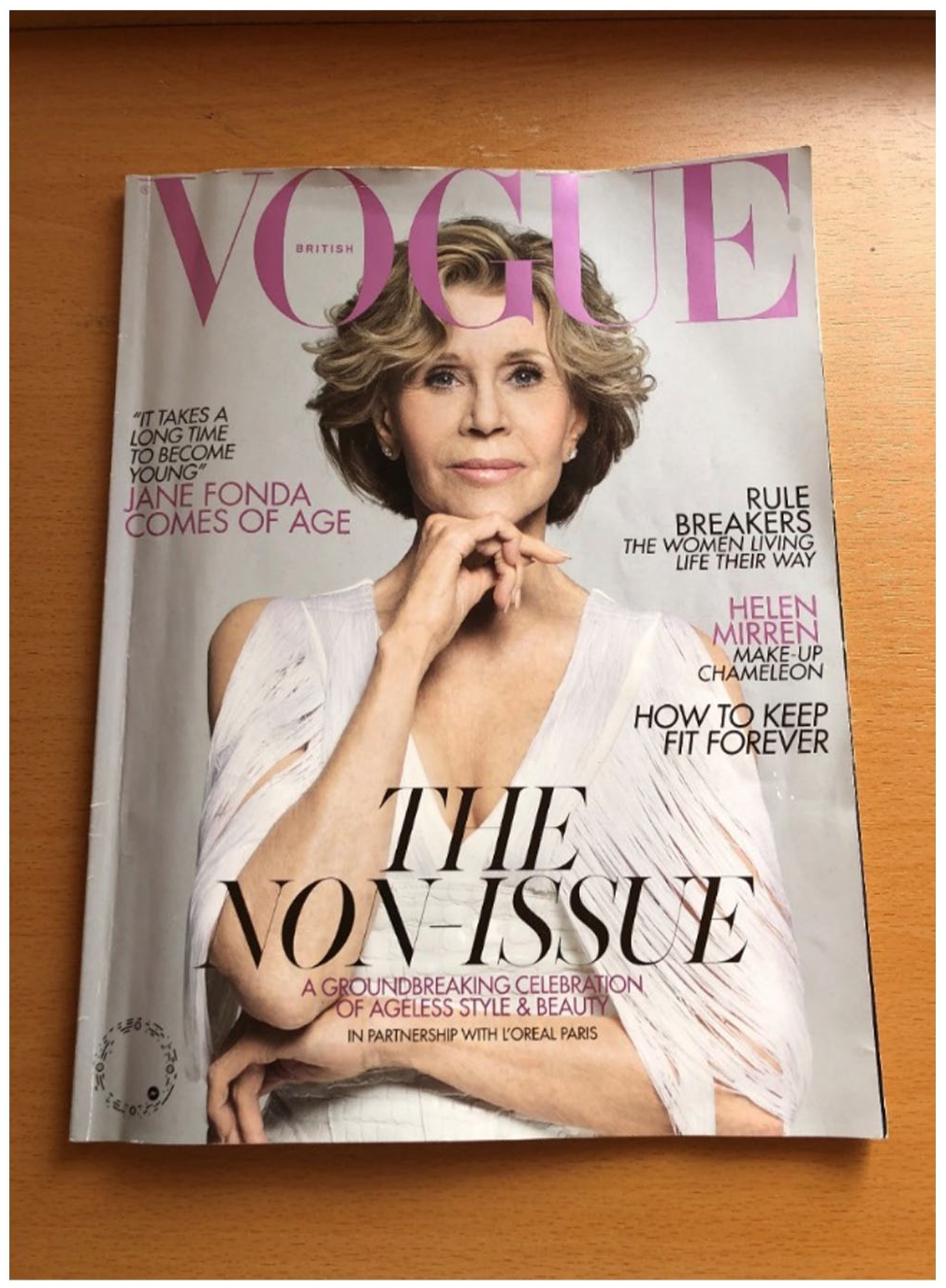
British Vogue Non-Issue cover 2019 featuring cover star Jane Fonda.
Taking a closer look at Fonda’s face in Figure 1, for instance, shows that her signs of ageing (no wrinkles or grey hair) have been reduced to make her appear less blemished or more idealised and thus, youthful-looking (Ledin and Machin, 2018). Her direct gaze suggests that she has been given the power to address the reader, promoting her ageing image (slim, well-shaped body, glamour, voluptuous hair, wrinkle-free face and neck), as something consumers should desire. Fonda, who is in her 80s, opens up in her interview in the magazine about the several cosmetic surgeries she has had over the years. She sees these surgeries as a ‘form of moral weakness’ because she is not ‘brave enough’ to embrace her own ageing (British Vogue, 2019: 69). From politics of respectability, by working on her face (and body), Fonda’s upper-middle-class and older white body is inscribed with ‘value’, and constructed as a body that signals self-governance (Skeggs, 2004, 2005; Woods, 2021). Given Fonda’s high cultural capital, her ageing image thus becomes used to appropriate ‘other’ women, defined either by age, class or race. This construction is further emphasised in her interview, where she is hailed for her ‘unrelenting dedication of self-maintenance, which would make a lesser soul of any age crumble’ (British Vogue, 2019: 69, emphasis added).
In this way, Fonda’s body, that has been worked upon, is legitimised and promoted as an ideal, normal and respectable/moral way of growing older. In contrast, bodies that do not conform to this ideal are frowned upon, as witnessed by their near absence in the issue. Respectability then becomes a ‘mechanism through which some bodies are normalised and others pathologised’ (Dolan, 2012: 76). The body that has not been worked on and shows visible signs of ageing is, thus, pathologised, ‘dis-respected’ and comes to represent ‘otherness’, which works to reinforce negative perceptions of ageing. Paradoxically, in the Non-Issue, dis-respected bodies (e.g. ‘fat’, untoned bodies) are excluded from the magazine, seemingly promoting the idea that age is an issue (a problem) for women. As such, Fonda’s body is used to symbolise upper/middle-class bodies that display a commitment towards self-governance and control over one’s body and life (cf. LaWare and Moutsatsos, 2013). In turn, ‘other’ bodies are used to signal a lack of self-governance and become associated with working-class/lower-class bodies, which by default are racialised (cf. Skeggs, 2005). Ultimately, this contributes to the marginalisation and invisibility of women who do not have enough financial (and racial) resources to engage in practices of self-work, allowing power and privilege to remain intact. Working on the body thus becomes a way for thin, white upper/middle-class women to maintain their superior authority in society. In contrast, fat black women (almost invisible in the issue) remain largely absent because their bodies fall outside categories of beauty and desirability. Black women who appear in the magazine, for example, 57-year-old fitness influencer Angelique Miles and 71-year-old model Valerie Campbell, are however allowed to do so because of their successful careers, which lends them visibility.
Interestingly, Fonda views growing older as ‘an internal battle’ that prompts self-work (British Vogue, 2019: 69), which if we look at Fonda’s image closely relates to hegemonic beauty ideals (white, thin and upper-middle-class). In this way, Fonda internalises the objectifying male gaze to form a self-disciplinary gaze, which encourages the consumption of anti-ageing products and services to become a successful entrepreneurial subject, in charge of her own image, underlined by a DIY ethic of self-transformation. Implicitly, the phrase ‘it takes a long time to be young, Jane Fonda comes of age’ (Figure 1) here emphasises the intensity of time, money and effort needed to work on and perfect the body (and face) (Lazar, 2017). Although not explicitly, women are, thereby, encouraged to invest resources (e.g. time, money) into managing their own bodies to take care of their own well-being and closely emulate the white, upper-middle-class subject in Figure 1. Paradoxically, the idea that Fonda has ‘come of age’ (see magazine cover page) or, as she puts it, she is ‘fond of age’ (British Vogue, 2019: 64), which implies that she is happy with age and has begun to accept it, is contradicted by her youthful-looking image which is used to reinforce a resistance to old age (Marshall and Rahman, 2015).
Furthermore, Fonda looks out of the frame directly towards the reader, slightly smiling and engaging. Fonda’s direct gaze and frontal posture helps creates a visual form of address that acknowledges the reader (Ledin and Machin, 2020), typical of the women of Cosmopolitan described by Machin and Van Leeuwen (2007), who look either out of the frame or out at the reader. This is known as a ‘demand image’ (Kress and Van Leeuwen, 2006), which asks something of the readers in an imaginary relationship that readers can either accept or deny (Ledin and Machin, 2020). Although not explicitly mentioned, Fonda’s image in Figure 1 invites the reader into her thoughts on ‘how to keep fit forever’ (see, cover page, Figure 1). Looking at the reader, thus, gives Fonda the power to address the reader (Ledin and Machin, 2020) and makes her appear as an expert on fitness.
In the magazine, this is further emphasised by the content on fitness that urges older women to maintain an ‘active lifestyle’ through, for instance, physical exercise (see, e.g. British Vogue, 2019: 50–55). And as Fonda asserts in her interview, physical strength is important for older people as ‘it’s the difference between being independent and not independent any more’ (British Vogue, 2019: 69). The emphasis placed on the neoliberal value of independence here positively operates to encourage women to work on the physical fitness of the body. In so doing, women can achieve the ‘embodied firmness’ of successful ageing, which allows ageing and agedness to become less easily ‘read off’ the body (see Jerslev, 2017). In this case, other women can gaze at Fonda’s image and use it as a means to assess/judge themselves on how well they appear to manage their own signs of ageing.
Vogue thus uses Fonda’s public persona as a fitness expert to conform women to a particular image of ageing, in which agelessness is implied by their slim, well-toned bodies and wrinkle-free faces (see, e.g. Marshall and Rahman, 2015). At the same time, the scrutiny of Fonda by other women subjects her to new prescriptions of acceptability that allow her to self-enterprise and (re)construct herself into her best and most ‘successful’ version.
The self-confident older woman
Women’s lifestyle magazines are founded on a shared set of core values that relate to representations of women (e.g. Favaro and Gill, 2018; Machin and Thornborrow, 2003). In Western societies, women are often portrayed through the value of individualism rather than collectively as a group. This is a way for magazines to promote women’s exercise of self-determination and agency. The women in the Non-Issue are mainly represented as individuals (see, e.g. Figure 1). In Figure 1, for instance, Fonda is clearly individualised as specific person through being named in the text as ‘Jane Fonda’ and appearing alone in the shot. The close-up shot is important for displaying Fonda’s confident facial expression. Fonda appears to be standing upright, her arms are folded and one of her hands is gently placed beneath her chin, in a posture that supports the facial confidence. Here, Fonda’s confidence supports the idea that she is indeed ‘happy’ with her ageing body and face. Through her positive feeling towards her own ageing appearance, readers are called to also ‘act upon themselves’ through a culture of confidence (e.g. Banet-Weiser, 2018; Favaro, 2017; Gill and Orgad, 2017).
Confidence, which is often attached to cosmetic products through a ‘self-help’ discourse that promises to boost women’s self-esteem, e.g. L’Oréal’s slogan ‘Because you’re worth it’, is here extended to Fonda’s identity as a ‘true feminist’ (British Vogue, 2019: 69). In her interview, Fonda explains that her marriage (considered a traditional practice) to activist Tom Hayden gave her confidence to be herself. She goes on to state that the more she gained self-confidence, the more she noticed that her confidence did not sit well with Hayden’s ‘chauvinistic’ attitude, which conditioned her to ‘identify with men in every possible way’ (British Vogue, 2019: 69). Fonda pinpoints this conditioning as part of the reason why she could not show people, especially men, that she ‘could not be pretty’, because it did not fit men’s narrative of how women should be/behave (British Vogue, 2019: 69). In this way, Fonda implies that her choice to engage in cosmetic surgeries was to ‘please men’. It was only after her divorce from Hayden that she gained her ‘own narrative’ and truly became a feminist, that is, she gained confidence in her own ageing appearance, showing her anti-authoritarian activism to do as she pleases.
In this way, Fonda conceives of feminism as a matter of confidence and personal choice, wherein individual women can liberate themselves from patriarchy through their ‘freedom’ to make their own ‘cosmetic choices’. Crucial here is the neoliberal idea of choice. Paradoxically, while Fonda states that her choice to perform various cosmetic surgeries was because of a lack of self-confidence, she simultaneously suggests that she was coerced by men to do it. Still, even with her newfound freedom from men, Fonda, through her endorsement of L’Oréal anti-ageing products, for instance, continues to consume products that tie her to patriarchal standards of beauty. Fonda’s ‘freedom’ thus becomes attached to her consumption of anti-ageing products.
Attaching women’s freedom to their individual acts of consumption operates to reinscribe women to patriarchy, which does nothing to challenge prevailing gender norms and allows men’s privilege to remain intact and unexamined in society. Furthermore, the almost invisibility of ‘other’ models (defined either by race, class, or sexuality) in the issue reinforces white femininity as the normative standard of beauty. The ‘double entanglement’ that affords women personal freedoms to work on the self instead decollectivises the feminist movement by reinforcing the idea that of women’s ‘freedom’ is an individual choice accomplishment and not something that can be achieved collectively, on a feminist level. This contributes to a power imbalance that persists among women and in society in general. The emphasis on the postfeminist neoliberal tropes of freedom and choice contributes to an ‘oppression-blindness’, wherein the victim is ultimately blamed for their own oppression (Ferber, 2012). As such, older women, for example women of lower-class backgrounds, who traditionally do not have enough resources to engage in beauty and bodywork practices, are blamed for ‘letting themselves go’ when they hold control in their hands. Subsequently, this works to (re)produce intersecting inequalities of class that marginalise the women.
Individualisation is also realised in the ads found in the magazine through quotes such as ‘My eyes say who I am’, ‘Because you’re worth it’, ‘Your silver? Never second best’ (British Vogue, 2019). The strong emphasis on the individual is a way for Vogue to indicate that women act alone and strategically, with no responsibility for anyone other than themselves; there is no collective (Lazar, 2006; Machin and Van Leeuwen, 2007). This aligns with neoliberal postfeminist ideas that stress individualism. Here, this means that any age-related problems are construed of as an individual problem, in which the individual woman must take their own responsibility to ‘fix’, exemplified, for instance, in the L’Oréal Elvive Color Protect Purple Shampoo. The ad (Figure 2) features well-respected and successful celebrity actor, feminist and brand ambassador of L’Oréal, Helen Mirren (again, white, thin, heterosexual and upper-middle-class).
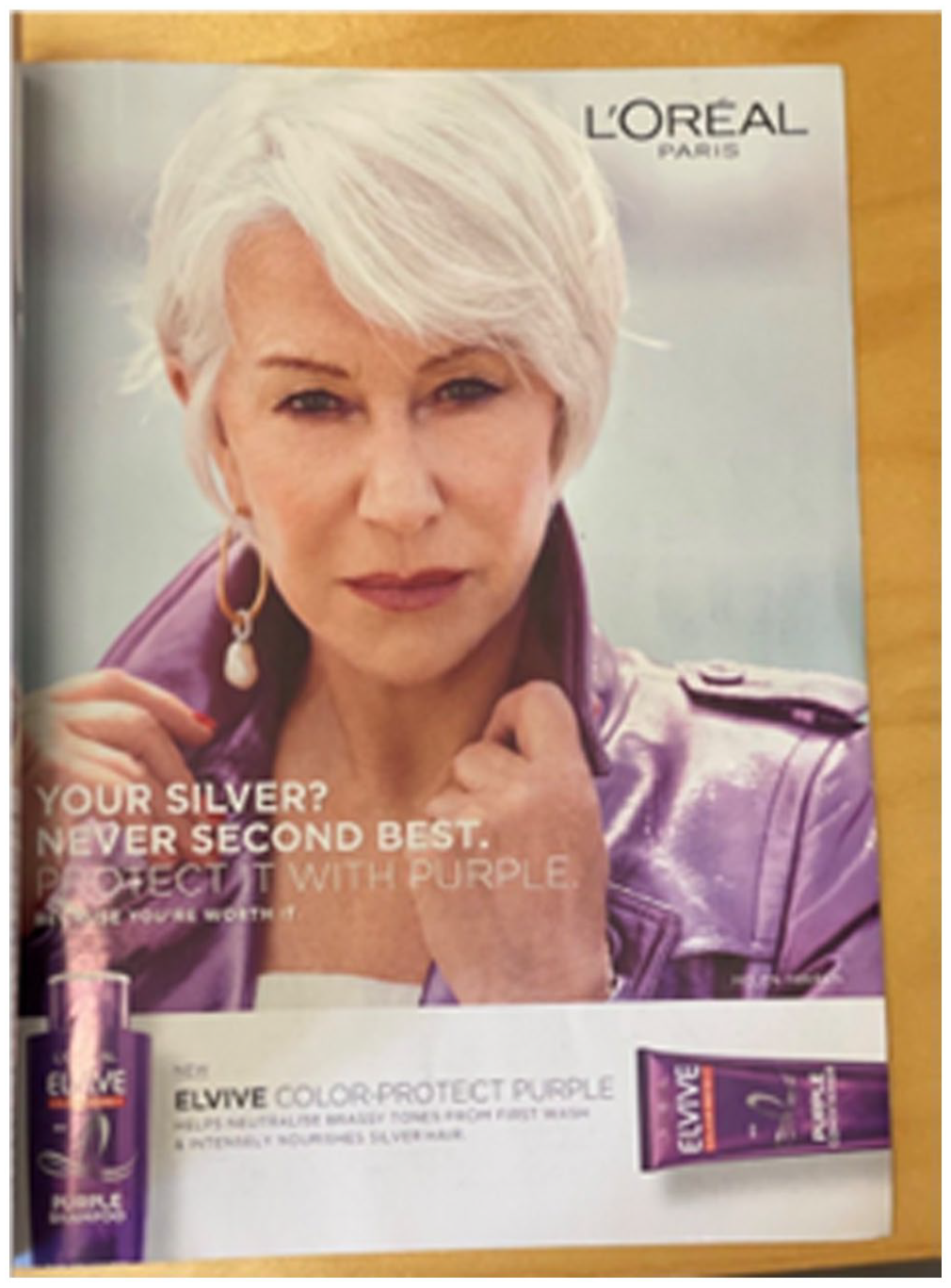
Example of individualisation featuring Helen Mirren.
Mirren appears in a close-up shot which fills most of the page and is pictured against a light bluish-grey decontextualised background, with no concrete indicator of where she is. She is shown wearing a shiny purple leather jacket, with a turned-up collar that she holds up with both her hands, revealing her décolleté and a white top underneath. Mirren also appears to wear one loop earring. Her hair is silver-grey, and her face shows visible signs of ageing. Dressing Mirren in a leather jacket and one earring, as well as displaying her signs of ageing, is used to symbolically show her resistance to age-appropriate forms of appearance. Furthermore, she looks directly out at the reader, with a confident, foxy-looking expression that attests to her ‘self-assurance’ as ‘a woman who is comfortable in her own skin’ (British Vogue, 2019: 43). The magazine draws on Mirren’s established status as an older female celebrity who symbolises appropriate glamorous sexiness to defy culturally defined ideas of women’s beauty (e.g. Anderson, 2019; cf. Kenalemang, 2022). Mirren’s look of ageing is, thus, used by Vogue to suggest to readers that they do not need to look young to be attractive, but can cultivate their own image unique to them. This idea allows Vogue to present visible signs of ageing as not only glamorous, but natural and acceptable, granting Mirren power as someone to desire and emulate. Vogue, thereby, uses Mirren’s established authority and autonomy to challenge dominant ideologies of consumer culture and essentially create an ‘alternative’ image of ageing, where ageing is a ‘non-issue’.
The accompanying text in the ad reads: ‘Your silver? Never second best. Protect it with purple’. The text begins with a rhetorical question ‘Your silver?’ Although it is unclear of whose voice is ‘speaking’ (Coupland, 2003), the use of ‘synthetic personalization’ (Fairclough, 1989: 62), ‘your’, directly and personally addresses the reader as though they should be concerned with their silver-grey hair. In the answer that follows, ‘Never second best’, it is implied that silver-grey hair, which is often used as a signifier of old age and the motif of invisibility (see, e.g. Ward and Holland, 2011), does not have to make older women feel insecure or less confident about their greying hair. The ad, instead, seems to empower women through the image of Mirren to ‘protect’ their hair ‘with purple’ (the shampoo).
In a well-known poem, ‘Warning’, by English poet Jenny Joseph, the colour purple is used as a symbol of rebelliousness and ageing. The use of the word purple here, which matches Mirren’s purple lips and leather jacket (also considering its association with feminism, see, e.g. Lazar, 2006), implicitly suggests that older women should do what they want. The shampoo (purple), hence, becomes an act of rebellion and empowerment that women can use to ‘protect’ their rights to age as they wish. The emphasis on individualism portrayed in the ad, however, individualises this ‘fight’. Women’s rights, as such, seem to rely on their beauty choices as something that can be bought and sold, which as highlighted by different scholars such as Craig (2006), helps maintain racial and gender inequalities. There is, however, no information on what exactly the reader is protecting herself from or how the use of the purple shampoo protects her.
The decontextualised setting of the image lowers modality and moves the image to a more idealised and abstract representation (Kress and Van Leeuwen, 2006). Unconfined by real-life issues, this setting allows for issues surrounding women’s ageing to be freely explored without their normal consequences. Vogue thus, uses Mirren and her feminist status to defend her right, and every woman’s right, to grow older in a society where women’s visible signs of ageing (i.e. grey hair, wrinkles) are welcomed and even considered ‘sexy’ and ‘beautiful’. Such individual representations of older women challenge the idea that ageing is an issue (a problem), reflecting punk’s autonomous spirit of rebellion. This ad, however, ignores the inequalities, such as of race and class and other privileges, that enable successful ageing.
Representing older women through a discourse of punk rebelliousness
There is a long history of expressing rebellion through dress and style. Sub-cultural movements such as punk and Goth were used to articulate a resistance against the commodification of style and the massification of taste (Langman, 2008). In the late-1970s, for example, early female pioneers of punk such as Vivienne Westwood, Siouxsie Sioux and The Slits adapted a DIY attitude of fashion to resist consumerism and create an authentic style that is impossible to copy. Punk fashion thus became a way to break away from conventional norms of dress and society. In the magazine, the producers use the visual images of well-established and successful older female celebrities to challenge gender power relations through forms of resistance or subversion, achieved through their individual styles and dress. In Figure 3, for example, Mirren and Fonda are named and pictured together, back-to-back, to show their solidarity against patriarchal standards of beauty, in a decontextualised setting. Both Mirren and Fonda look out of the frame, smiling and engaging with the reader. In the figure, Mirren is pictured wearing a golden leather jacket, while Fonda is wearing a black jacket with leather details and a white top. Both Mirren and Fonda have short, voluptuous hair (Fonda’s is blonde, while Mirren’s is grey-silver) and appear to be wearing lipstick and makeup; their eyes are highlighted with a black eyeliner. In the image, Mirren and Fonda are ‘homogenised’ through similar styles of clothing, hairstyles and poses to make the two very different women appear as the same, showing their authenticity. This is a way for the magazine to highlight Mirren and Fonda’s own points of difference and uniqueness as individuals, to set them apart from other women who do not have the same privilege or cultural capital to age successfully. Paradoxically, Mirren and Fonda also appear to be individualised by being named as specific persons in the text. This individualisation mobilises older women through the DIY punk value of autonomy (cf. Way, 2020). The magazine thus encourages consumers to align themselves with such values through acts of consumption. In this sense, women are empowered to stand up for themselves through a defiant ‘grrrl’ style that growls back at the dominant culture, giving them the feminine power to visibly age (however they wish to) in public spaces.
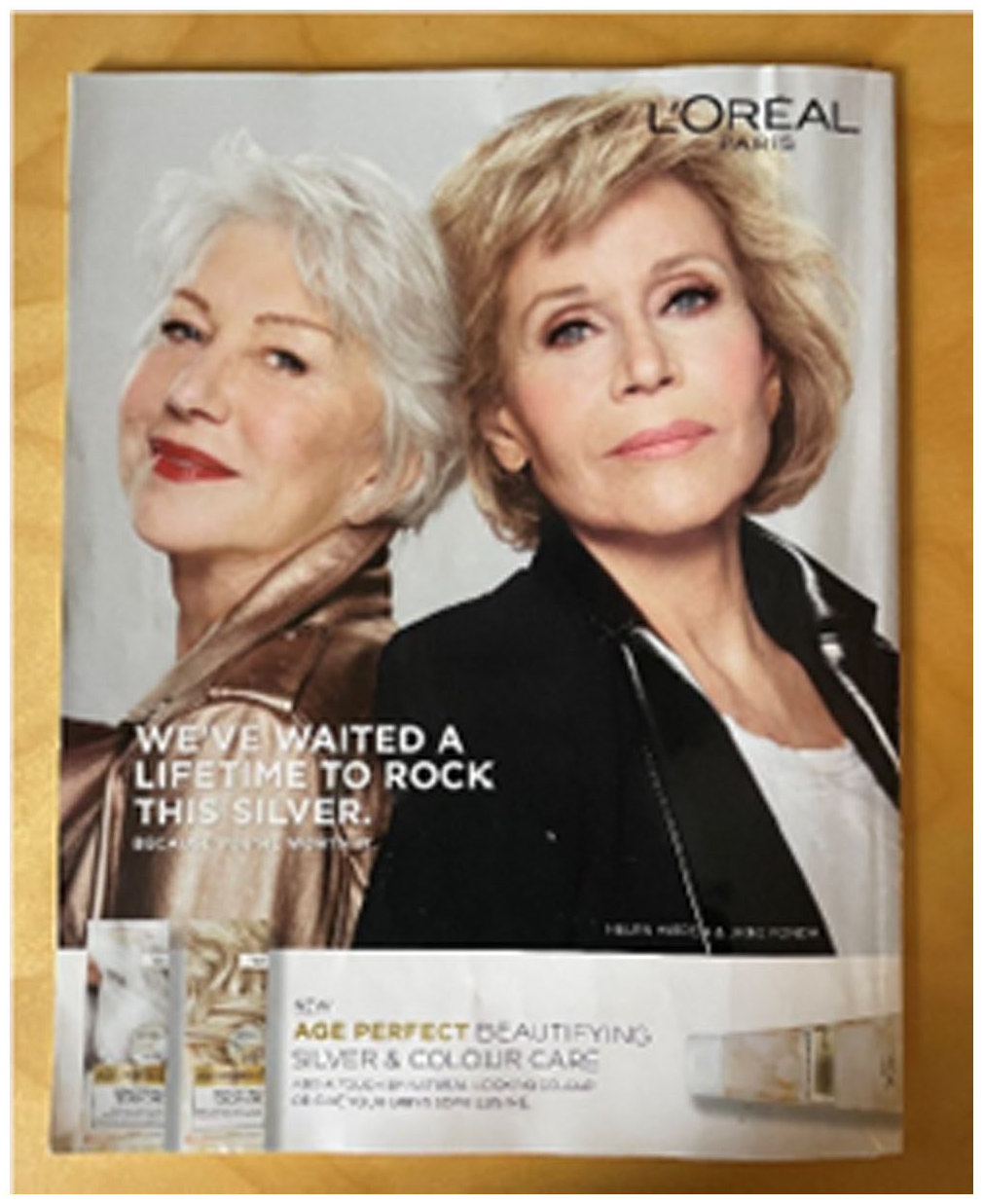
Example of subversive style featuring Helen Mirren and Jane Fonda.
Moreover, in a short interview with Mirren in the magazine, her made-up looks are described as ‘punk spirit’ (British Vogue, 2019: 43). Although this ‘punk spirit’ is not explicitly explained in the interview, or in what way her made-up looks are ‘punk’, it suggests that she uses her different looks in the magazine to show her resistance or subversion from age-appropriate styles. There is also no explanation of how her made-up looks, central to a postfeminist sensibility, help challenge gendered power relations that exist in society. Instead, Mirren’s made-up looks reconstitute the wearing of makeup and bright red lipstick as a key signifier of femininity (e.g. Gurrieri and Drenten, 2021; Hurd Clarke and Bundon, 2009). Historically, the wearing of red lipstick was used as an act of defiance by the suffragettes in their fight for women’s rights (Gurrieri and Drenten, 2021). When worn with harder touches such as leather jackets and heavy makeup (see, e.g. Mirren’s image in Figure 3), bright red lipstick indicates a look of rebellion, as witnessed by the looks of famous female punks such as Poly Styrene, Patti Smith, Chrissie Hynde, Joan Jett and Siouxsie Sioux.
Subsequently, by wearing bright makeup and brightly coloured clothes in the magazine (see, e.g. British Vogue, 2019: 42–47), Vogue uses Mirren’s style as a punk spirit of rebellion to erase any normative standard of aged femininity, defined by what women can and cannot do and wear, to signal her power. Such power is supposedly given through the ‘staying power’ of lipstick (see lipstick ad, British Vogue, 2019: 55). While not explicitly mentioned, the phrase ‘staying power’ implies that women now have the power to fight for their right to age visibly, thereby suggesting that wearing lipstick/makeup is a way for women to achieve equality, overlooking the structures of inequality embedded in such beauty practices and thus confining resistance to superficial forms of political expression. There is, also, no information on how exactly wearing lipstick can empower women. Nonetheless, Mirren is positioned through a ‘new’ self-construction via DIY style and visual appearances, indicative of her self-rule.
In so doing, Vogue uses a discourse of punk rebelliousness to create a space that gives women ‘a voice’ where they can construct new ways of ageing, ‘rule breakers, the women living life their way’ (British Vog, 2019). The phrase ‘rule breakers’ relates to the basic tenets of punk, characterised by no rules and no expectations. Here, it implies a resistance towards hegemonic beauty ideals by ‘women’ who no longer want to be tied to traditional patriarchal standards of feminine beauty. The text, however, does not provide any information on what exactly has changed or what has been done to enable women to ‘live life their way’. Instead, the text works to explicitly suggest that gender inequality has been reduced and that both men and women, have equal opportunities, access and privilege to successfully age. The type of subversion implied by the text puts the celebrities in a position of power and allows them to effectively display the ‘successfully’ aged female face, but one that still objectifies women to the male gaze. Although the magazine appears to use the punk spirit of rebellion to allow the celebrities to deconstruct the normative representation of an ideal ageing femininity, simultaneously, however, women’s agency is still reduced to how they look, reinforcing inequalities of gender that denigrate women’s liberation. More problematically, Vogue appears to recuperate the punk spirit of rebellion and commodify women’s empowerment as though it is something that can simply be bought and sold. This is ironic as early punk movements were about making your own clothing and were non-commercial. In this sense, Vogue contributes to making punk mainstream, which goes against its roots as an alternative movement.
Furthermore, Mirren and Fonda seem to be ‘collectivised’, which clashes with their individual identities, but here adds to the idea of punk as a movement, a force made up of many. By using the pronoun ‘we’: ‘we’ve waited a lifetime to rock this silver’, Vogue suggests that women have struggled for a very long time, a ‘lifetime’, to be able to confidently ‘rock’, that is, wear their looks of ageing well. The term ‘rock’, when linked to the genre of punk/music is especially significant and further draws on the punk attitude of rebelliousness that challenges the status quo. Thus, through its self-description as a ‘movement’ that ‘encourages a future where we (women) can look forward to growing older’, the Non-Issue advocates for positive change in how older women are perceived in the media and in society (British Vogue, 2019: 2). To achieve this change, the issue promotes the idea of ‘collectivised’ agency by grouping together a team of women all aged 50+ who share a vision that ‘age should no longer be an issue’ (British Vogue, 2019: 2). This vision, together with the name of the issue, the Non-Issue, suggests that age is a problem for women, but it no longer has to be. Hence, by using the word ‘silver’, the magazine draws on the cultural construction of the ‘silver vixen’ in opposition to ‘grey’ and its negative associations with ageing, suggesting that women’s ageing is indeed no longer an issue and should be seen as something positive and attractive. As Dolan (2017) argues, silvered female stars such as Mirren, who seemingly appear untouched by old age, are held up as successful agers and embodiments of later-life style and glamour. Their authentic styles are here used as a symbol of opposition against socially accepted norms of dress, to make them more visible. The magazine thus opens up the space for older women who are often invisible and marginalised in the media and in society, to come to the forefront.
Conclusion
The analysis shows that the Non-Issue represents older women as radically empowered subjects whose images are used as a celebration of freedom from youth/youthful ideals. However, this is brought into question by the postfeminist neoliberal context, which encourages a conformity to youthful ideals of agelessness that not only privilege the thin, white, middle-class subject, but reinscribes women to patriarchy. Thus, while the Non-Issue hoped to achieve a vision where age is no longer an issue, it somehow does the opposite by making age an issue and suggesting that women must stay youthful. Women are, as such, confined by a ‘double entanglement’ of a neoliberal consumer culture that offers them both freedom and enslavement (McRobbie, 2009). As shown by the analysis, presenting women as individuals allows for inequalities to be constructed not as political problems but as matters of individual choice, which allows for privilege to remain intact and unexamined, contributing to the power imbalances that exist in society (Genz, 2006; Gill, 2007). Women’s (consumption) choices are, however, restricted to how well they manage to (re)construct themselves into acceptable forms of ageing femininity which subject older women to another set of bodily inscriptions and prescriptions.
Thus, the so-called ‘freedom’ afforded to women is only a fantasy if the new forms of self-governance are simply new prescriptions of a ‘successful ageing’ acceptability. The magazine, however, uses the images of the celebrities through a discourse of punk rebelliousness to communicate a resistance by women towards ideal hegemonic standards of beauty, showing their individual rebellion against traditional norms of toned-down age-appropriateness (Twigg, 2018). The use of a DIY punk spirit rebellion is certainly not new and has been used since the 1970s by leading characters such as Vivienne Westwood and Siouxsie Sioux to challenge norms of beauty. What is problematic here is that Vogue seems to recuperate the punk spirit rebellion to commodify women’s empowerment. Just as once one could buy punk fashion, so too can women’s empowerment be bought and sold. Ironically, punk was about DIY and alternativeness, yet here it has been co-opted, commercialised and mainstreamed to promote rebelliousness which somehow makes the act less rebellious. Older women’s visibility, however, still appears to be tied to how they look, confining them to continued self-surveillance, monitoring and discipline (Gill, 2007, 2021). This self-disciplinary gaze, that requires women to work on the self, reinforces traditional patriarchal standards of feminine beauty, and does nothing to challenge prevailing gender norms and other inequalities based on class, race and age. Subsequently, patriarchal standards of beauty become internalised by women, who are framed in the magazine as self-authenticating and self-enterprising, in strong contrast to punk notions which were linked to non-conformity, anti-authoritarianism, anti-corporatism, a DIY ethic, anti-consumerism and not ‘selling out’.
This allows the magazine to recontextualise women’s ageing as a choice that can be resisted through body/beauty work practices used to inscribe the ageing body with value, and by extension the self-confidence needed to positively embrace ageing. The magazine, however, ignores the structural inequalities and exclusions of beauty ideals and practices that relate to age, gender, class and race. This helps breed new forms of power and privilege in society, making it more difficult to achieve equality. Future studies should consider interrogating more closely how (post)feminism, ageism and ableism work together to reproduce social inequalities and relations of power that continue to marginalise women in society.
Footnotes
Funding
The author(s) received no financial support for the research, authorship, and/or publication of this article.
