




Abstract
Five years after the murder of British MP, Jo Cox, during the European Union referendum campaign in 2016, this article examines the More In Common initiative through two sites of participatory practice: on Twitter via two related hashtags–#MoreInCommon and #LoveLikeJo–and the ‘More In Common’ exhibition (2021–2022) at the People’s History Museum in Manchester. We consider how both spaces help to organise public feeling and consider the ways in which these sites draw on Cox’s identity politics and values to curate her political legacy. We identify three emergent logics through our thematic analysis of the tweets posted with the hashtags in the month following her death: connected, visual and resistant. Considering the political legacy of ‘more in common’ 5 years later, we then trace the movement of the campaign from the digital to the physical and assess the ways in which Cox’s values are crystalized through co-created participatory artistic projects displayed in public gallery space.
Keywords
Introduction
The tragic murder of the Labour MP, Jo Cox, in June 2016 stands as an example of the damaging nature of inimical political feelings. The power of emotion in everyday politics can arguably be best understood through the lens of social media. But while social media platforms, particularly Twitter, can function as networks of negativity and hate (Poole and Giraud, 2019), they also provide a space for the formulation of networks of hope and political positivity. As expressed by Karin Wahl-Jorgensen (2019), ‘emotions are central to our social and political lives, and to the ways in which we make sense of ourselves and the collectivities and communities we inhabit – a process which increasingly takes place through the media’ (p. 1). The mediation of political feelings projects the personal into public space, bringing with it the risk of emotionally difficult encounters, as the impulse to connect and find moments of collective solidarity rubs up against the threat of also finding animosity.
Assessing the Twitter hashtags that emerged following the murder of British MP Jo Cox during the highly charged Brexit campaign, we argue that hashtags afford expression to and stimulate social and political emotions, mobilising a symbolic impression of public feeling. Drawing on Ben Highmore’s (2017) work, we understand public feeling as patterns of participation in public social spheres anchored to and by emotional frames, practices, and values.
The first section of this article analyses how #MoreInCommon and #LoveLikeJo operated in mediated public life following the murder of Jo Cox. This is a hashtag-led analysis on the Twitter platform and so forefronts the hashtag’s performative role in constructing discursive frames (Geboers and Van De Wiele, 2020) while also recognising that hashtag-based searches can miss sections of conversations. The temporal logic of Twitter encourages immediacy to signal inclusion in the ‘ad hoc public’ (Bruns and Burgess, 2015) forming around an issue, and yet the hashtag also provides a categorising and archiving mechanism for events, issues or topics. We argue that hashtags work to organise a public feeling in a significant and traceable manner, ranging from superficial expression to more deliberative posts. Drawing on #MoreInCommon and #LoveLikeJo in an interconnected case study, we examine how emotion is harnessed on Twitter as a resource for civic attachment and political mobilisation. How can the coordination of public feeling be traced through hashtag analysis on Twitter following the murder of Jo Cox during a period of intense political campaigning on Brexit? What forms of language and images are shared and amplified in this performance of public feeling? And finally, how does a museum exhibition 5 years later curate and commemorate the ideals of #MoreinCommon through participatory creative practices?
The next section briefly introduces Jo Cox to give a short overview of her career and the specific political vision she became associated with following her death. We then present some theoretical context on politics, emotions and the notion of a ‘public feeling’, before turning to the role of digital social media in shaping affective communities and political culture. Next, the article applies these theoretical ideas to the case study, thematically analysing a corpus of tweets collated using the hashtags #MoreinCommon and #LoveLikeJo. Finally, we examine the ‘More In Common’ exhibition, housed at the People’s History Museum in Manchester (2021–2022), examining the curatorial role of public institutions and the ways in which this public memorial, including the physical siting of the Cox memorial wall, can be understood as continuing to shape the affective political and public values of ‘more in common’.
Who was Jo Cox?
On 16 June 2016, the British Labour MP, Jo Cox, was shot and stabbed to death in the street in Birstall, West Yorkshire, on the way to conduct her constituency surgery meetings. The murder occurred during the European Union referendum campaign (otherwise known as the Brexit campaign, in which Cox was a decisive ‘Remainer’) and was a shocking tragedy for UK politics. Moreover, her murder, carried out by a terrorist and Nazi sympathiser, was also a personal tragedy – for her family, and for those who were touched by her connective labour – a labour framed by an understanding that, on the whole, human beings have ‘more in common than that which separates them’. This notion of ‘more in common’ was taken from Cox’s maiden speech in the House of Commons in June 2015. Speaking of her own Northern English consistency, Batley and Spen, Cox declared, Batley and Spen is a gathering of typically independent, no-nonsense and proud Yorkshire towns and villages. Our communities have been deeply enhanced by immigration, be it Irish Catholics across the constituency or Muslims from Indian Gujarat or from Pakistan, principally from Kashmir. While we celebrate our diversity, the thing that surprises me time and time again as I travel around the constituency, is that we are far more united and have far more in common than that which divides us.
This emotive speech by Cox set the stage for her strand of politics – one built on the importance of ‘commonality’ while simultaneously valuing difference. Cox’s own storytelling style in the speech evokes a ‘no-nonsense’ Yorkshire enhanced by immigrant communities. Her relation to divergent and connected publics and politics was then, from the beginning of her political career, framed as a politics of inclusion and positivity. Following her death, we shall see how Cox’s earlier words were deployed as a rallying cry for unity in diversity at a time when the Brexit campaign had brought divisive rhetoric to the fore of British politics.
In terms of comprehending Cox’s particular strand of political identity, it is useful to consider the foundations of her career prior to election. Jo Cox (nee Leadbeater) grew up in the town of Heckmondwike, West Yorkshire, attending state school before winning a place at Cambridge, where she studied Social and Political Sciences. Cox’s career involved working for Labour MPs and MEPs and Oxfam, before putting herself forward for political selection in her birth constituency, Batley and Spen. Selected as an AWS (all women shortlist) candidate by the Labour Party, she was elected on 7 May 2015, with a majority vote of 21,826. During her time in parliament, Cox established and chaired the all-party parliamentary group Friends of Syria, was involved in a number of cross-party alliances and worked with the charity Tell MAMA, monitoring anti-Muslim incidents in the United Kingdom.
The brief biography of Jo Cox sketched out above works to demonstrate some of the ways in which Cox was and continues to be understood as a political figure able to bridge class, gender, cultural, racial and party divides. As an MP emotionally invested in a multitude of social issues, her focus on inequalities was and is her legacy work, associated with her identity and brand of politics. This ‘branding’ of Cox’s political identity only really emerged to a broader public following her murder. The hashtags #MoreInCommon and #LoveLikeJo shape a collective emotional and moral register that specifically draws from Jo Cox’s past, but also from a sense of her lost potential, in order to mobilise for a politics of hope and solidarity envisioned as her life’s work.
Theorising public feeling
Emotion has been conceptualised and theorised in a number of ways across disciplines – psychologically (James, 1884), in evolutionary terms (Plutchik, 2002), as a neurology (LeDoux, 1998), from a sociological perspective (Hochschild, 1975; Turner, 2000), from a feminist perspective (Gorton, 2009; Ngai, 2007) and as a form of cultural politics (Ahmed, 2004, 2014), to name but a few. Although we acknowledge the importance of these understandings of emotion, the purpose of this paper is not to synthesise such work. Instead, we make a case for hashtags as a means of mobilising a symbolic impression of public feeling, thinking through the place of emotion in an emergent, socially networked politics of positivity.
As argued by Jeff Goodwin et al. (2001), the subject and significance of emotion was, at the turn of the 21st century, a frequently neglected topic in studies of social movements as well as in political studies more generally. There were, the authors note, a multitude of reasons for this, including ‘the rationalistic, structural, and organizational models that dominate academic political analysis’ (Goodwin et al., 2001: 1). In the political studies sphere, the influence of this turn to emotion (or the ‘affective turn’) can be seen in publications across four interlinked areas relevant to this study: politics and emotions (Ahmed, 2014; Wahl-Jorgensen, 2019); emotions and protest (Jasper, 2018); online emotions (Garde-Hansen and Gorton, 2013; Papacharissi, 2014, 2015); and feelings involved in being a citizen (Coleman, 2013). A notion of ‘public feeling’ is of course indebted to Raymond Williams’ writing on ‘structures of feeling’ and the many scholars who have developed this work (Highmore, 2017; Papacharissi, 2014). Williams’ ‘deliberately contradictory phrase’ was originally conceived as an analytical procedure for defining the ‘consciousness of an epoch’; the forms and conventions of a literary period, but also ‘a pattern of impulses, restraints, tones’ in cultural work that defines an era (Williams, 2015 (1979) 159). In understanding ‘collaborative discourses organised by hashtags on Twitter as structures of feeling’, Papacharissi (2016) is interested in how social media amplify voice, visibility and expectations in their ‘soft and networked architectures’ (pp. 320, 311). Returning to Williams’ influence, in his book on ‘Cultural Feelings’, Ben Highmore (2017: 3) argues that ‘the shape and texture of social experience is often best grasped as a pattern of feeling and mood’. Public feeling as we understand it here concerns connective feelings and affective conditions and speaks to the ways in which patterns of participation (however fleeting) in public social spheres are anchored to and by emotional frames, practices and values. It is in the collective mediation and orientation of shared emotions that a ‘public feeling’ emerges and becomes politically meaningful.
The resurgence of the study of emotion across social sciences and humanities has been accompanied by a post-millennial revolution in media technologies, with rapid developments in social media platforms and mobile phones especially generating an abundance of scholarly interest in online emotionality. More specifically, a growing body of work engages with online commemoration and mourning practices, whether for family members, celebrities, or following events such as terror attacks or environmental disasters (Döveling et al., 2018; Merrill, 2019).
Karin Wahl-Jorgensen (2019) notes: ‘we need not only to understand what emotions are, but also to acknowledge that their mediated construction is distinctive from emotions as they circulate through individual bodies’ (p. 5, emphasis in original). This recognition of the difference between individual emotions as felt in and on the body, and those constructed through a mediated collective, is a crucial tenet of comprehension, opening-up in the context of public discourse an ‘understanding of emotion as a potentially politicized or politicizing interpretation of bodily affect’ (Wahl-Jorgensen, 2019: 7). Sara Ahmed also stresses the relational quality of feelings and emotions, arguing that they are not a ‘private matter’ because they ‘define the contours of the multiple worlds that are inhabited by different subjects’, and so bridge the private and public (Ahmed, 2004: 25). Merrill et al. (2020: 547) have recently drawn upon the work of Ahmed and others to propose the concept of ‘public atmospheres’ to observe how commemorative events are mutually constituted in the spaces of the city and those of digital technology and media, emphasising ‘how these events help assemble public atmospheres of togetherness that engender shared modes and moods of belonging’. Cultural geographers have approached the ‘strange reality’ of affective atmospheres by looking for ‘thresholds and tipping points’ as a method for understanding atmospheric change and the possible new affective relations produced (Anderson and Ash, 2015). Our study focuses on both how a shared public feeling manifested digitally on Twitter following the ‘tipping point’ of Cox’s murder, as well as on affective relations as performed and curated in gallery space where the Jo Cox memorial wall was exhibited 5 years after her death.
Social media provide a space for ephemeral feelings of belonging to be captured and, in the process, a sense of who we are and how we want to be seen by others is also captured. Performances of emotion online are intrinsically tied up with performances of self and attempts to identify with others. This takes on political dimensions because, as Zizi Papacharissi (2014) argues, ‘performances of the self are indicative of the shapes individuals take on as they claim agency and negotiate power within social structures and imaginaries. In this manner, they acquire or imply political meaning’ (p. 96). The mediated self on Twitter acquires political meaning when individual emotions and bodily effects are interpreted (through the act of tweeting) into narratives for social action and mobilisation.
The notion of ‘public feeling’ therefore recognises how private individual emotions become ‘public’ through the technological processes of mediation but that political identities and social relationships are formed and nurtured whenever such emotions become collectively mediated. In capturing the fleeting moment of shock, grief, despair, joy, love and hope that users have chosen to share, social media provides a space for that sentiment to linger and to cohere into a political movement when a certain threshold is met. As such, the coordination of tweets under the hashtags #MoreInCommon and #LoveLikeJo relay both the story of Cox and the mobility of the ‘more in common’ campaign.
Mobilising public feeling on Twitter
As Jean Burgess and Nancy Baym (2020: 61) write in their ‘biography’ of Twitter: ‘Perhaps no single character has been as iconic a symbol of Twitter as the now-ubiquitous hashtag’. In their chapter dedicated to the hashtag, Burgess and Baym outline how the hashtag has evolved, with its functions becoming more varied, especially as creative, ritualised and humorous forms of participatory practices have become more familiar. First proposed by technologist Chris Messina in 2007 as a tool for coordinating crisis communication (Burgess and Baym, 2020: 64), the hashtag has become an essential element for Twitter communities as a means by which to coordinate, inform and choreograph publics. In the particular instance of #MoreInCommon, the choreography was centred on a politics of positivity and compassion.
Hashtags operate on a double logic of organisation and emotion. In this sense, hashtags not only provide a platform for public feeling but also work to shape it, providing a theme, event or topic that other global users can choose to interact with. As Dhiraj Murthy (2018) notes, Twitter and hashtags ‘afford a unique opportunity to re-evaluate how communication and culture can be individualistic and communal simultaneously’ (p. xiii). As a medium encouraging association, hashtags function most effectively through relational engagement; but more than that, hashtags can, in line with the work of Bennett and Segerberg (2012), be understood to amplify a form of connective rather than only collective action. In relation to #MoreInCommon and #LoveLikeJo, the ethos of the hashtags was based around a narrative of Jo Cox’s life and work that provided an impetus for solidarity and acted as digital and visual imprints of Jo’s connective, positive politics. Accommodating a stream of public feeling, #MoreInCommon can be understood as both anticipating, orientating and organising a wave of positive feeling in relation to Jo’s politics.
Method
This article takes a thematic, inductive approach to ascertaining how hashtags help to organise public feeling, using three interconnected elements – connected, visual and resistant logics – to explore the role of hashtags in organising public feeling (Papacharissi, 2016). The logics operate as a suggestive typology, working to structure and think through the mediated journey of #MoreInCommon and #LoveLikeJo in the month following her death. The corpus of tweets was collected using the Mecodify tool, available open source on GitHub (al Saqaf, 2016), searching for #MoreInCommon, which emerged on 16 June 2016, and #LoveLikeJo, first evidenced on 22 June 2016. Mecodify uses the Twitter search application programme interface, and its interface allows the researcher to filter the results, for example, to focus on tweets containing images or links. The search captured 21,129 tweets (137,397 with retweets) between 16 June to 31 December 2016. Here we concentrate analysis on the first week of tweets.
Beyond the initial capturing of tweets using the Mecodify analytics tool, our approach is qualitative and manual, as we believe this close, interpretative reading of the tweets is most effective in assessing the markers of emotion and their political meaningfulness as well as for identifying patterns of discursive framing over time. This thematic interpretation allows for consideration of both the motivations behind the initial inception of the hashtags and then the collective shaping of their meanings, performing public feeling across time and via users as they become emotionally invested in it.
We were given the opportunity to return to the ‘More In Common’ campaign through its ‘less digital’ (Merrill et al., 2020) manifestations, via the People’s History Museum exhibition in June 2021. Our second method allowed us to explore how Cox’s legacy had been interpreted through the participatory workshops with Mancunians (including refugees), who collectively produced creative writing, costumes and other artwork stimulated by the ‘more in common’ message. Here we are inspired by the anthropological approach to museums, which examine how museums organise, display and contextualise objects as a form of public culture (Bouquet, 2012) and the ‘museum walk’ as a research tool (Thobo-Carlsen, 2016), which emphasises how affectivity operates in an exhibition environment. In walking through the exhibition, we considered how the ethos of ‘more in common’ was conceptualised by the various groups involved and how the participatory processes of production (rather than the finished objects) were highlighted to constitute and encourage a collective public feeling.
Connected logic: #MoreInCommon
The hashtag ‘MoreInCommon’ was created by the advocacy group HOPE Not Hate, founded in 2004 to ‘provide a positive antidote to the politics of hate’ and as a reaction to the British National Party winning ‘substantial votes and local council[l]ors in our Northern towns’. In opposition to the remaking of fascism as popular, the mission of HOPE was to ‘offer a more positive and engaged way of doing anti-fascism’, and to work with communities to recognise ‘a wider mood of alienation and hardship’ that the BNP had tapped in to (HOPE Not Hate, 2004). In acknowledging the alienation and hardship experienced by many, and expressing a desire to address issues of concern, HOPE advocates both a recognition of and response to political feeling. Akin to the politics of Cox – a politics arguably based on making a difference through positive action – HOPE’s mission was to engage with a wide spectrum of voices and experiences to facilitate a politics of positivity to defeat fascism. In addition, HOPE Not Hate utilised their extensive networks drawing on support from US charity The Freedom Fund as well as Oxfam to promote the #MoreInCommon hashtag and movement.
While Twitter as a platform operates via a pattern of homophily (boyd and Ellison, 2008; Murthy, 2018), Papacharissi (2016) argues that ‘structures of feeling invite affective attunement with thoughts as feeling and feeling as thought, thus not prioritizing one over the other but striving toward a meaningful balance between the two that is specific to a certain era’ (p. 134).
The first recorded #MoreInCommon tweet was posted in the early hours of 17 June 2016 (figure 1). It read: Lives can be cut short but words can last a lifetime – “We have far more in common than that which divides us”. rip @Jo_Cox1 #moreincommon This tweet, the first to use the ‘more in common’ hashtag, is interesting to consider in its acknowledgement of the potency of words, and more broadly, the telling of emotional stories to connect, affect and ‘move’ publics.
1
As Carolyn Kitch (2003) has rightly noted, emotional storytelling is both salient and central to practices of public mourning. Moreover, as Wahl-Jorgensen (2019) argues, emotional storytelling online is seen as ‘a guarantor of authenticity, and, relatedly, as a means of cultivating compassion [. . .] Rather than being the preserve of award-winning journalism, [. . .] such storytelling is, in fact, part and parcel of all the most important conversations that constitute mediated politics’ (2019: 66-7). In tagging Jo Cox’s Twitter account, the tweet performs an emotional connection to Jo’s politics that is both spontaneous (in that the user is the first to deploy the hashtag), and deliberate (in that the user connects to Cox’s Twitter handle, directing others toward it). Speaking as an everyday citizen seemingly driven by an emotional impulse, the tweet is imbued with a sense of emotional authenticity. While the tweet is constructed in line with the brevity required of the platform, the multiple elements of it – the initial statement, the quotation, the mourning acronym, the link to Jo’s official Twitter account and the hashtag – function in their amalgam as powerful, emotional markers. Such a construction points toward an understanding of emotion as a site of both representation and mobilisation, offering up the hashtag as a resource for attachment and connection. The political potency of the tweet can thus be understood through its harnessing of emotion to not only reflect on the present of Jo’s murder, but to mobilise a congregation of others to connect and share feeling to provide a common and developing picture of public feeling on Twitter.
The second tweet made under the hashtag was a call to ‘get the rose by Bette Midler to number on[e] for Jo!! Let’s show the power of the Internet #MoreInCommon’ [sic]. While indeed brief and less complex in its construction, this tweet evidences a belief in the power of digital publics to create change. While the change noted – that of attempting to galvanise publics to get a song to number one in the UK music charts – can be understood as a memorial act, the lyrics of the song itself, which speak of a seed growing against adversity into a symbol of love, can be understood as having political and civic dimensions. The equating of Jo with a rose of course also operates to imply a gendered and arguably regional and political understanding of Cox’s identity (the rose is the county flower of Yorkshire and the primary pictorial symbol of the Labour party). While of course such readings of the tweet’s content are subjective, the tweeter’s use of the hashtag and call to other publics to act implies a knowledge of and contribution to a moving media landscape in which feelings on one media platform can, through action, move to others. Again, the ordinariness of the tweet foregrounds a sense of authenticity that appears more popular than political. Avoiding political rhetoric, the tweet offers up both the hashtag and music as forms of common ground (the bands Portishead and U2 also contributed musical tributes during this time). This link between positivity and popular culture chimes with van Zoonen’s (2005) point that ‘articulations between politics and entertainment should be seen as inviting the affective intelligence that is vital to keep political involvement and activity going’ (p. 66).
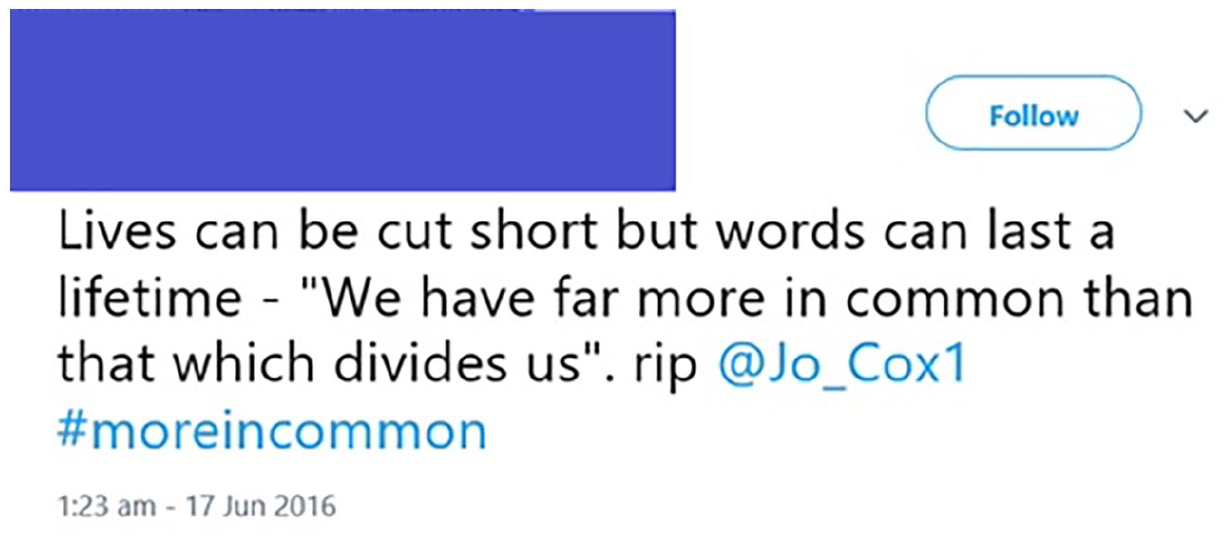
Tweet - #moreincommon. Public tweet - citation details not provided to protect anonymity.
The third tweet to employ the hashtag (and the first to use it in line with HOPE Not Hate’s inception) was again concerned with connective and collective action (figure 2). Tweeted by the CEO of The Freedom Fund, Nick Grono, it read:
This Wed would have been #JoCox’s 42nd birthday. To celebrate her life we’re holding events globally theguardian.com/uk-news/2016/j… #MoreInCommon As well as pointing to the tragedy that Cox would not be able to celebrate her 42nd Birthday, Grono provided a link to positive action in the form of a Guardian newspaper article. The doubling up of a personal, emotive tweet – storytelling in relation to Jo’s birthday–with a link to a more traditional news organisation story, speaks to the ways in which Twitter shapes emotional practices. In addition, it offers a clear example of method in which personal, professional and traditional stories are conflated through the platform to engage and connect audiences across news ecologies. The linked Guardian article authored by Anushka Asthana and Rowena Mason (2016), highlighted a positive and organised move forward in Cox’s story and legacy, noting the forthcoming national and international events that were to take place to honour Cox, linking these directly to three of the charities that Cox supported. This national coverage, and the international mobilisation that it promoted, was arguably the first large-scale hashtagged tweet to begin to publicly shape Cox’s ‘more in common’ legacy.
On the same date, Jo Cox’s husband, Brendan Cox, tweeted using the hashtag, noting his pride at his sister-in-law’s (Kim Leadbeater’s) speech about Jo which he noted ‘did her sister proud’. The connective qualities and logic of these linked tweets and stories articulate both an intimate and a proximate personalisation of emotion and, simultaneously, connect to forms of political movement and action. Such tweets make visible what Wahl-Jorgensen (2019) notes to be: ‘the power of emerging forms to bring compassionate communities into existence by telling stories that ground audiences in the lived experience of actual human beings’ (pp. 83–84). Offering up a range of emotions, experiences and actions under a single tag, reanimates its orientated solidarity. The multiple connections evidenced in this group of tweets not only encourage but also perform public connectivity.
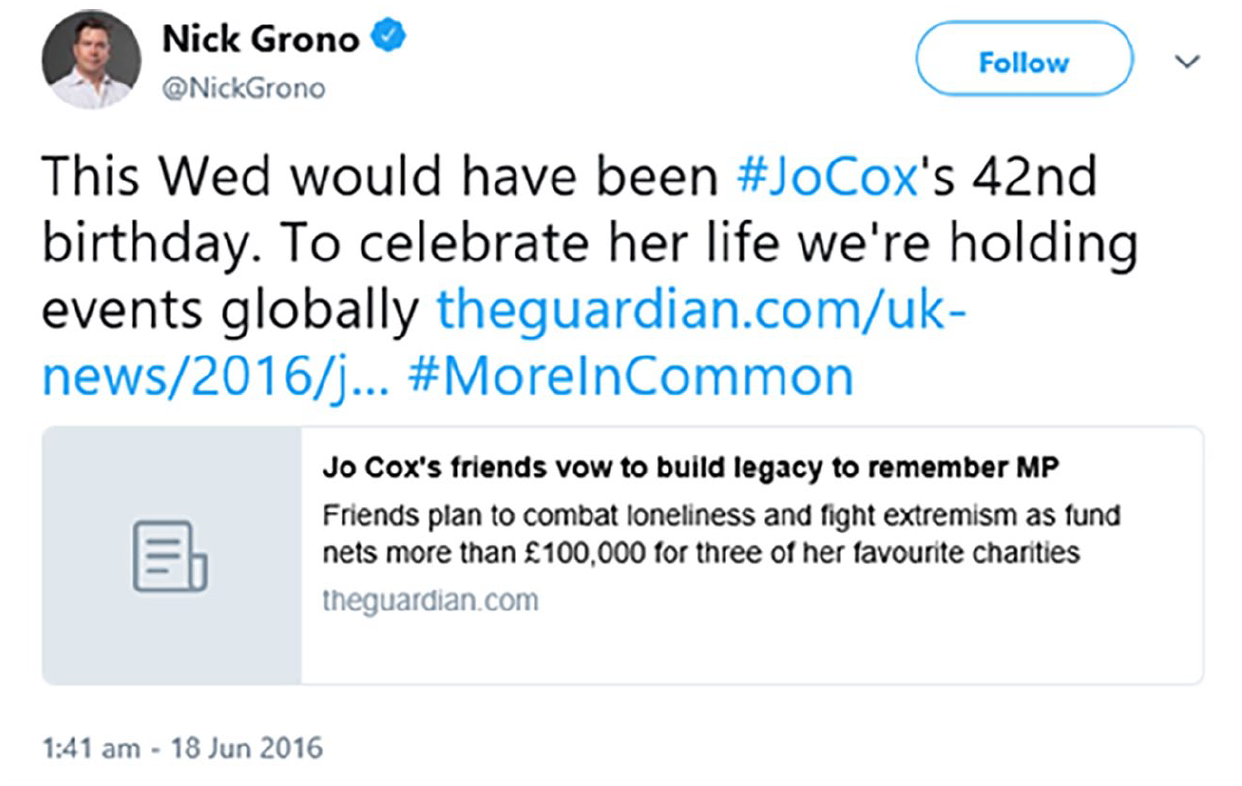
Nick Grono tweet #moreincommon. Grono (2016).
A further 126 tweets, all positive in ethos, followed on the 18th June, suggesting that the hashtag had been successful in organising positive public feeling. In the week following Cox’s death (which included a short suspension in referendum campaigning as well as the funeral of Jo Cox), #MoreInCommon became fully established, trending on Twitter as the tenth most popular hashtag in the United Kingdom. 2 While many Tweets, such as that of Ross Mullan (below), linked to further official news stories and noted the ‘moving’ nature of family tributes, other tweeters chose to represent public feeling pictorially.
Visual logic
Dan Berkowitz (2017) notes the significance of visual culture in social media responses to the terror attack. Following such events, photographs and cartoons serve as ‘facilitators of healing and solidarity in both the local and the global media arena’ (p. 740). The pictorial impressions of unity in the #MoreInCommon tweets below can be understood to lead to what Döveling et al. (2018) call a ‘digital affect culture’, characterised by discourses of alignment and belonging.
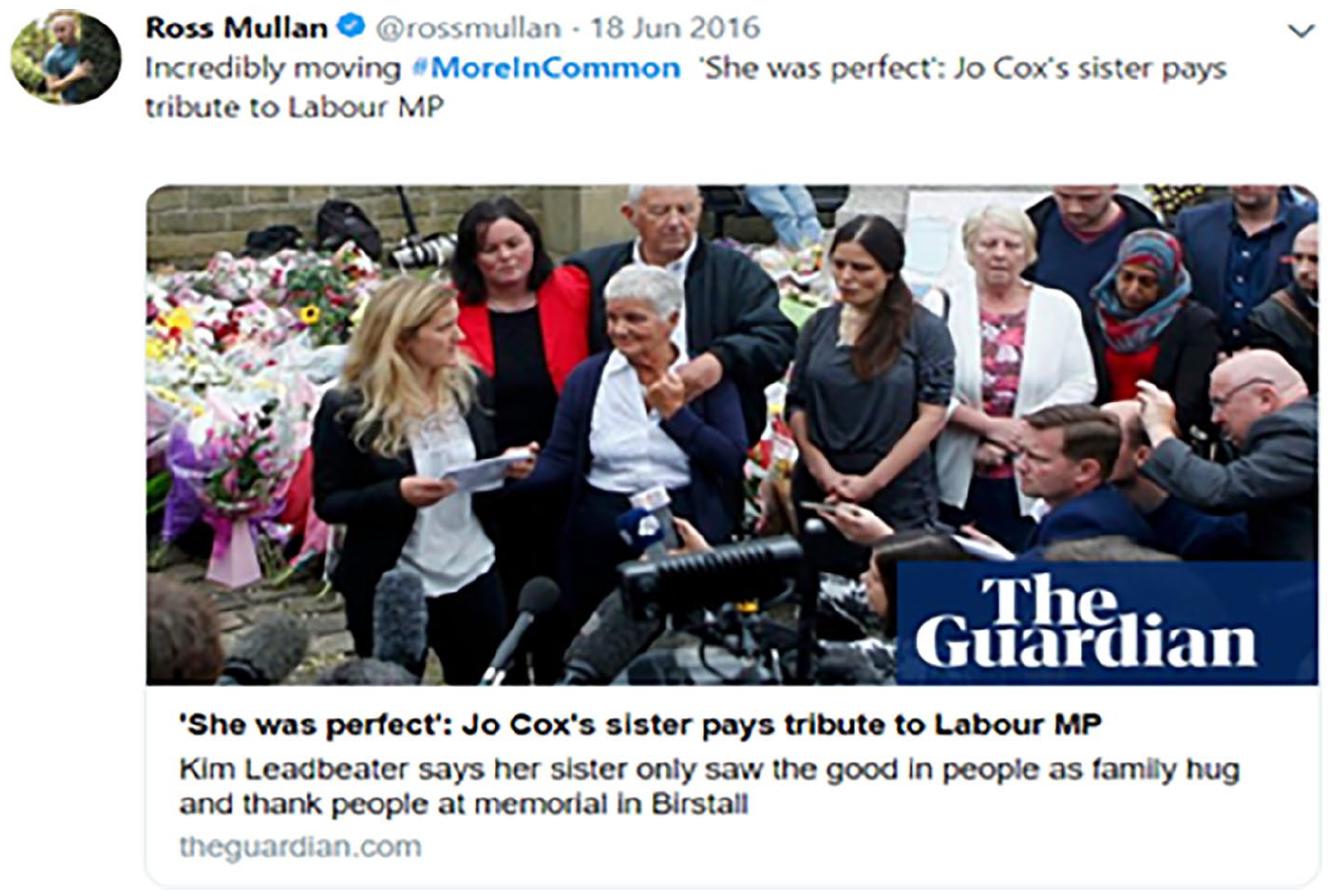
Ross Mullan tweet #moreincommon. Mullan (2016).
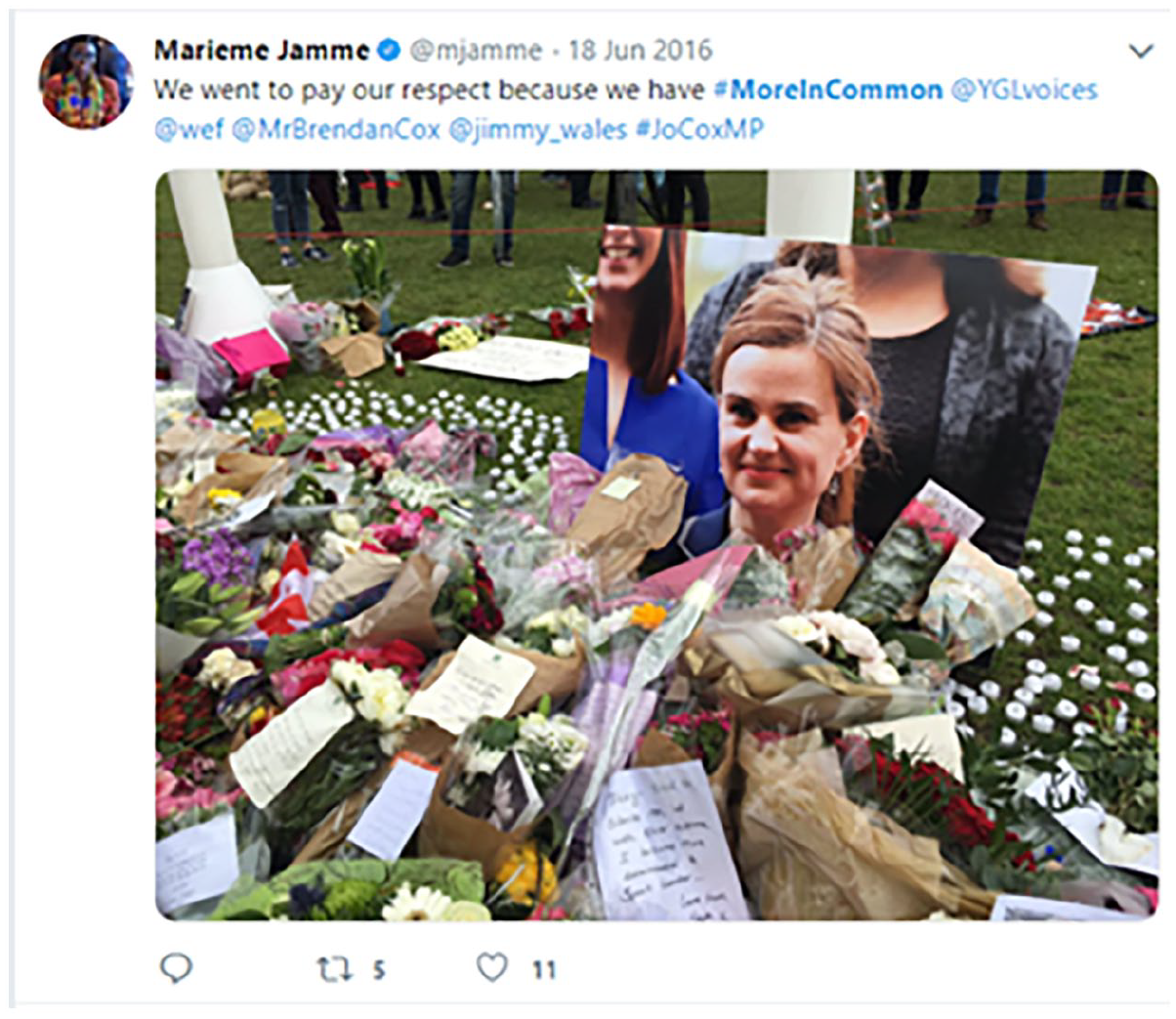
Marieme Jamme tweet #morein common. Jamme (2016).
The symbolic dimensions of emotion production are important to consider here as emotion is understood as both the ‘property of an individual [and] a socio-historical performance that spans not only the individual but also time and space as it invites new participants as it travels the digital terrains’ (Döveling et al., 2018: 3). The empathetic alignments evoked by memorial photographs such as Jamme’s are powerful in that they are digitally durable, remaining affective both at the time of their posting and in later years, especially anniversaries. In addition, such visual materials are increasingly understood as significant tenets of Tweets, despite the platform being initially designed to privilege written text. As Berkowitz (2017) notes, the amalgam of text and images on Twitter operates to ground preferred meanings and, in so doing, also increases connective capacities.
In her analytical work on the visual images included in #MoreInCommon tweets in the month following Cox’s murder, Parry (2019) discusses the emergence of the hashtag #LoveLikeJo on 22 June 2016, noting its orientation around an image of Jo, drawn by artist Drue Kataoka. As Parry (2019) observes, this second hashtag changed the narrative position of tweeters, evidencing a ‘shift in the function of the image-tweet [. . .] to a commitment to ‘love like Jo’ and so becomes attached to social action, expressed through the emotion of love’ (p. 234). While this shift from ‘more in common’ to social action in pledging to ‘love like Jo’ can be recognised as positive through its orientation towards connection, it can also be understood as a marker of political tension, drawing away from the common and re-orientating towards an idealised likeness to Jo.
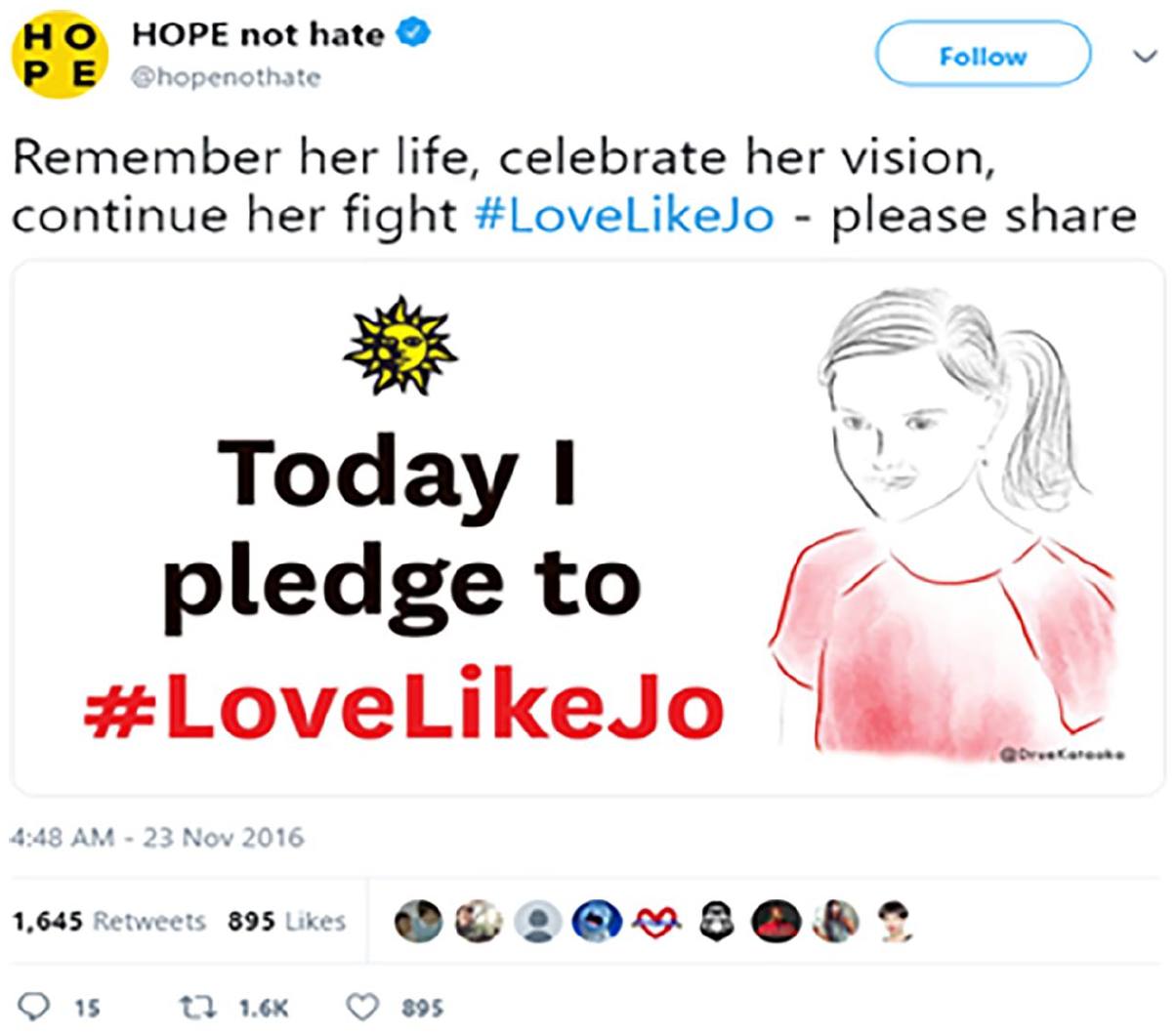
HOPE not hate tweet #LoveLikeJo. HOPE not hate (2016).
The emotion of love, as Sara Ahmed (2014) notes, is problematic in that ‘it is out of love that group[s] seek to defend the nation against others, whose presence then becomes defined as the origin of hate’ (pp. 122–123). In this sense, the community ‘for’ loving like Jo, sits in opposition to those who are ‘against’ it. Often deployed in tweets as a pledge against Nigel Farage (who, for many was understood to be at the forefront of the Brexit campaign), and for Jo, here love is, in Ahmed’s (2014) words idealised, a ‘fantasy of making likeness’ (p. 128). Instead of love, it is, according to Ahmed, political hope that is essential: Politics without hope is impossible, and hope without politics is a reification of possibility (and becomes merely religious). Indeed, it is hope that makes involvement in direct forms of political activism enjoyable [. . .] Hope is crucial to the act of protest: hope is what allows us to feel that what angers us is not inevitable. (Ahmed, 2014: 184)
While many Twitter users took up the pledge to #LoveLikeJo, often utilising accompanying images showing the holding of ‘Love Like Jo’ banners, photographs, collages and drawings of Jo (Including that by Kataoka), the movement from #MoreInCommon to #LoveLikeJo also drew out those ‘against’ Jo’s logic of inclusion. This resistant logic is where we turn next.
Resistant logic
While ‘love’ and ‘hope’ are clearly dominant in these hashtag pairings, #MoreInCommon was also used by those who wanted to point towards what they saw as the hypocrisy of the developing ‘more in common’ movement. One tweeter, for example, posted:
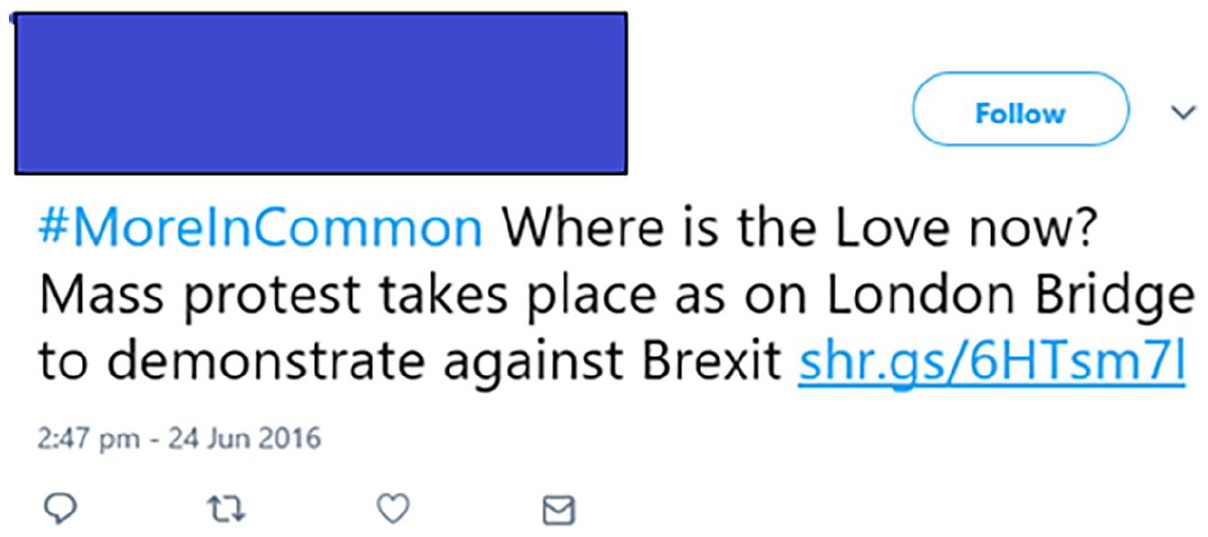
#moreincommon resistant tweet. Public tweet - citation details not provided to protect anonymity.
This tweet flags up several issues regarding the expression of public feeling on Twitter. First, it is difficult to assess whether this comment is a genuine questioning of the mass protests against the Brexit vote – and a reminder for those that are part of the movement to protest peacefully – or if it is a tweet that employs irony to work divisively, against the notion of ‘more in common’. The specific nomination of ‘love’ in the tweet can be interpreted as the tweeter’s performed resistance to ‘loving like Jo’. While visual images in particular were used to express solidarity and to establish a public or common ‘we’, tweets such as that above use text and alternative images to resist such a collective identity. In questioning the ‘love’ pledged and attaching it directly to ‘Remain’ supporters, as well as linking to an image showing the social action of those against Brexit, the tweeter draws out the tensions of ‘love’ in accordance with Ahmed’s concerns above.
A further example of resistant logic can be seen in the below tweet (figure 7): Again, the hashtag #LoveLikeJo is used here to contest the notion of a collective ‘we’. In employing both resistant and connective logics by tagging the Guardian, the tweet works to situate the narrative around #LoveLikeJo as anti-democratic. Accusing Remain voters of using Jo’s murder as political propaganda to further their cause, this tweet expresses bad feeling in relation to the ways in which the appeal to love ‘like’ Jo forms ‘in’ and ‘out’ groups. It is perhaps in this sense that drawing on hope rather than on love can be understood as a more inclusive political logic, one that enables movement beyond divisive discourse. As Wahl-Jorgensen (2018: 768) notes, citing Anthony Oberschall (1973: 298), ‘grievances and disaffection should rightly be understood as permanent features of political life’. Indeed, it is crucial given the scope of this study that resistant logics, albeit representing a very small percentage of the communications studied, are included here and given voice. These tweeters’ contestations of #MoreInCommon and #LoveLikeJo are essential in attaining a more complete understanding of how public feeling was organised in the weeks following Cox’s murder.
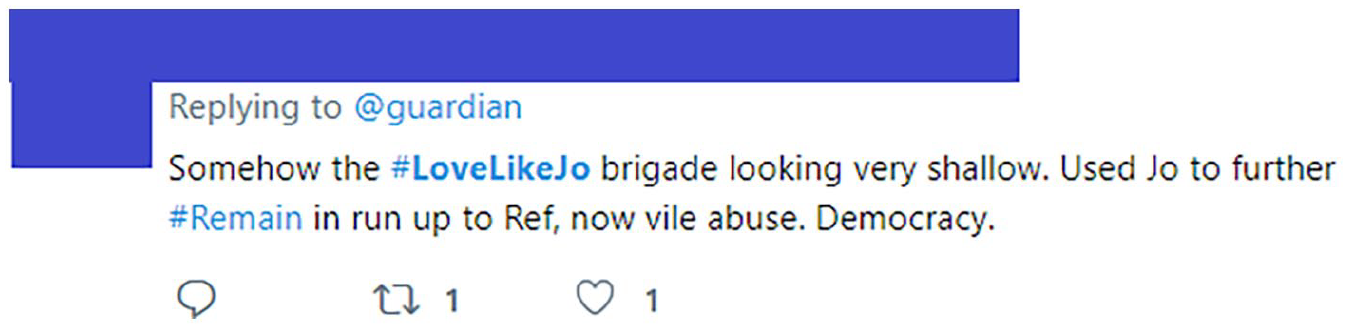
#moreincommon resistant tweet 2. Public tweet - citation details not provided to protect anonymity.
Public feeling curated through public institutions
On 19 May 2021, the People’s History Museum in Manchester United Kingdom opened the exhibition ‘More in Common: In memory of Jo Cox’. Coinciding with the 5-year anniversary of Jo’s death, the exhibition is described as representing: the culmination of a comprehensive community led project inspired by the legacy of Jo Cox MP, together with an exploration of Jo’s life, work and values. PHM’s More in Common project involves a group of over 30 people from different backgrounds who made Manchester their home, coming together to share knowledge, experiences, and conversations. Co-created by the project group, this exhibition explores Jo’s life and legacy and follows the group on their journey in celebrating our commonality and challenging discrimination.
This public exhibition, aiming to memorialise the legacy of Cox, is built around the authenticity and perpetuation of her values. Situated as both an official restaging of her memory and work, and as a public site for re-engagement and new reflections on political hope, it speaks to the mobility of the ‘more in common’ campaign, moving the affective register from the digital to the physical. Presented as ‘one of the people’ and as an icon of democracy, the exhibition draws attention to Cox’s working-class, Northern upbringing, her personal and professional commitments to inclusive diversity, and augments common frames to create a shared Cox-ian identity and vision around the notion of ‘more in common’. Images of Cox – still and moving – starting from childhood photographs and progressing through key stages in her life (University, Oxfam, motherhood, MP maiden speech, in memorium drawings) place her centre-stage, structuring and resituating her iconicity 5 years after her (political) murder. The exhibition is not however limited to images of Cox but, in line with the museum’s community project, includes the exhibition of participant testimonies, creative writing pieces, photographic displays, collages, costumes made to represent Manchester’s heritage and diverse population, physical memorial placards, letters of tribute, and an ‘Our Yorkshire Rose 2016’ trade union style banner, created by artists who shared Cox’s London mooring (her London residence was on a houseboat).
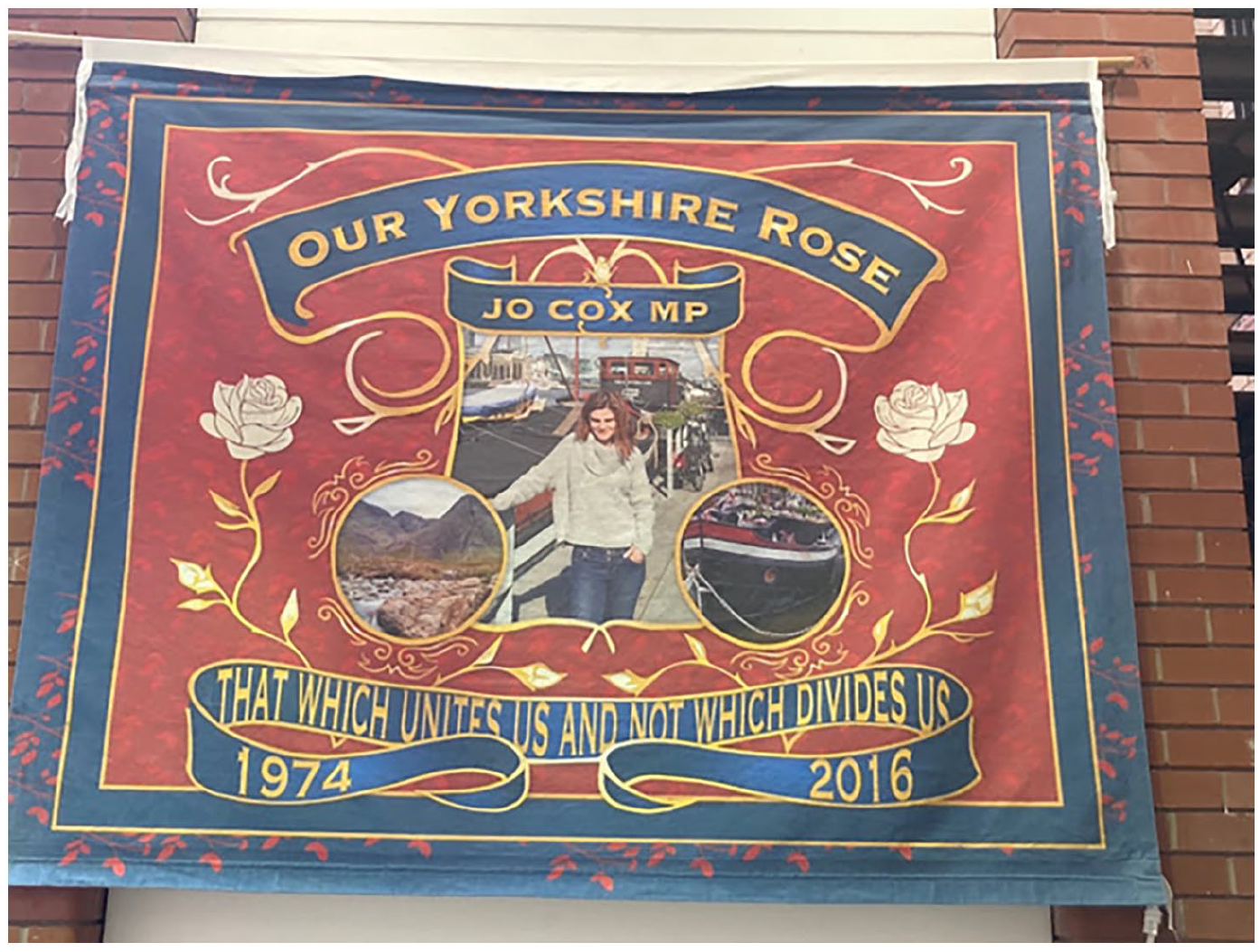
‘Our Yorkshire Rose’ banner. Parry (2021).
The banner, seen above, works via its stylisation, bold colours and physical materiality to place Cox’s values as proximate to other sources of mobilisation. The museum houses many protest banners, from Chartists, to suffragettes and mining towns, and so the location is crucial, placing the Cox banner in dialogue with the rich visual history of mutuality and solidarity on display throughout the museum. It is Cox who is centred in memorium here, positioned as an elevated, uniting force, and it is this banner under which attendees must move to enter and exit the exhibition. As a key exhibit framing and directing public engagement with the exhibition, the visual of Cox situates her firmly as a figure with whom we are invited to feel and find common ground.
Common ground is curated further in the exhibition space both through its status as a public museum and via the ways in which artefacts, images and the showcasing of the collective, creative work of the project team highlight participatory practices. Artist John Priestly created a mixed media ‘jigsaw’, representing those involved in the ‘More In Common’ project which is exhibited, and visually echoes in size and shape the ‘Our Yorkshire Rose’ banner.
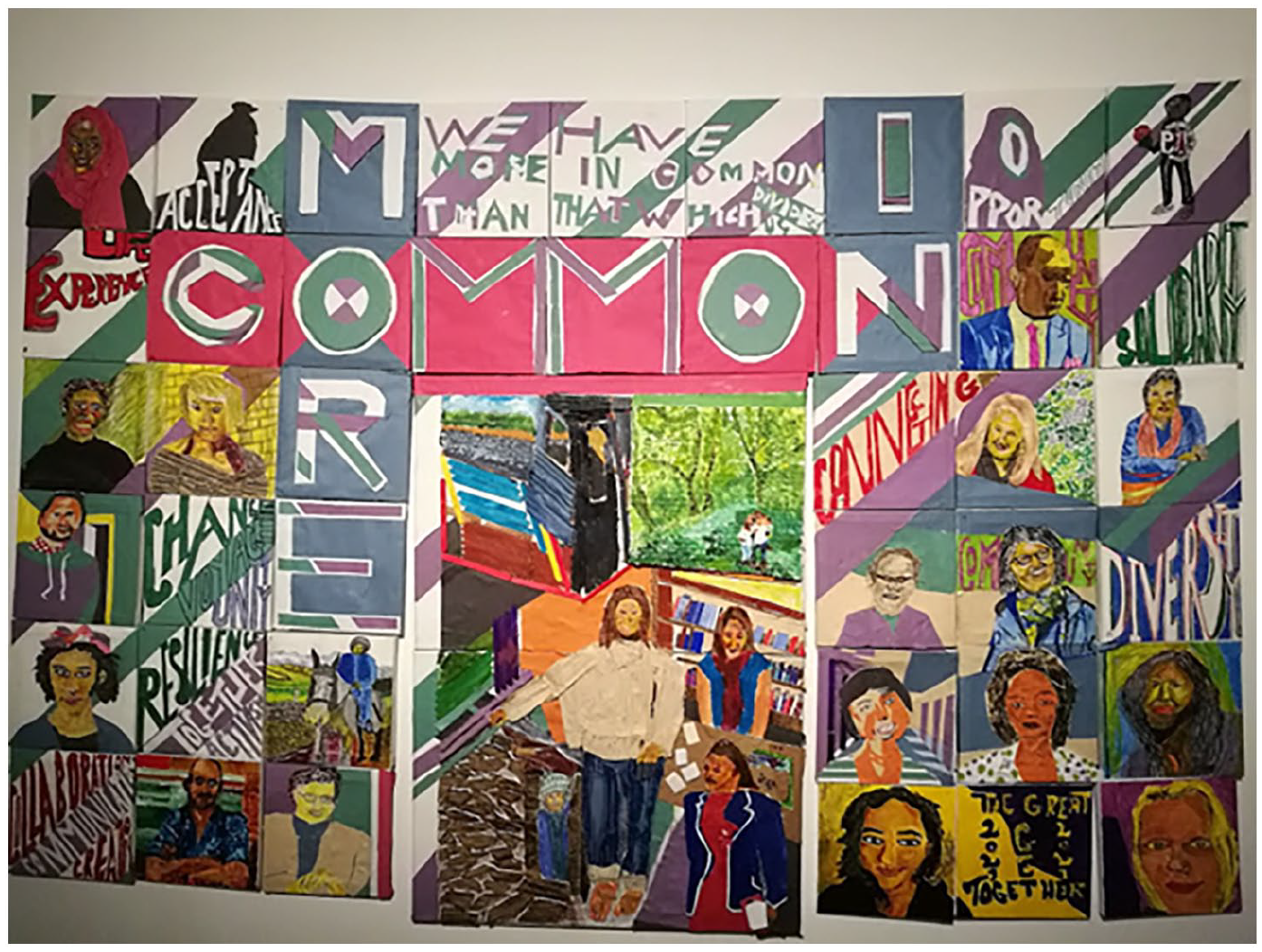
Artist John Priestly mixed media ‘jigsaw’ banner–more in common. Parry (2021).
Priestly’s own story is noted alongside his artwork, specifically: I have created a jigsaw puzzle to illustrate how we have ‘more in common’. 42 small squares with 21 portraits of the More in Common participants, grouped around a large Jo Cox portrait showing stages of her life. I was an amateur artist who used art creation to fight mental wellbeing issues while combating homelessness. I got an art project grant and created ‘Home street home’ for the Museum of Homelessness. I also helped on homeless art sessions in Rochdale before the Covid lockdowns. The More in Common project is the largest artwork I have ever created. Mixing portraits, keywords and inspirational Jo Cox images, it’s been an honour to create this work.
This statement works to align Cox’s ‘more in common’ values with Priestly’s own story of struggle and his inspiration for contributing to the project. However, in addition, Priestly’s reference to the Museum of Homelessness and their work in providing grants for creative expression highlights the standing of museums as sites for public change, and how they can be transformed ‘into a collaborative space of agency and possibility’ (Thobo-Carlsen, 2016). This points to the importance of understanding the ways in which affectivity and public feeling are curated through public institutions. The physical housing of the Jo Cox memorial wall, originally erected outside the Houses of Parliament following Jo’s murder in 2016, provides a particularly transformative and sensorially powerful use of the exhibition space.
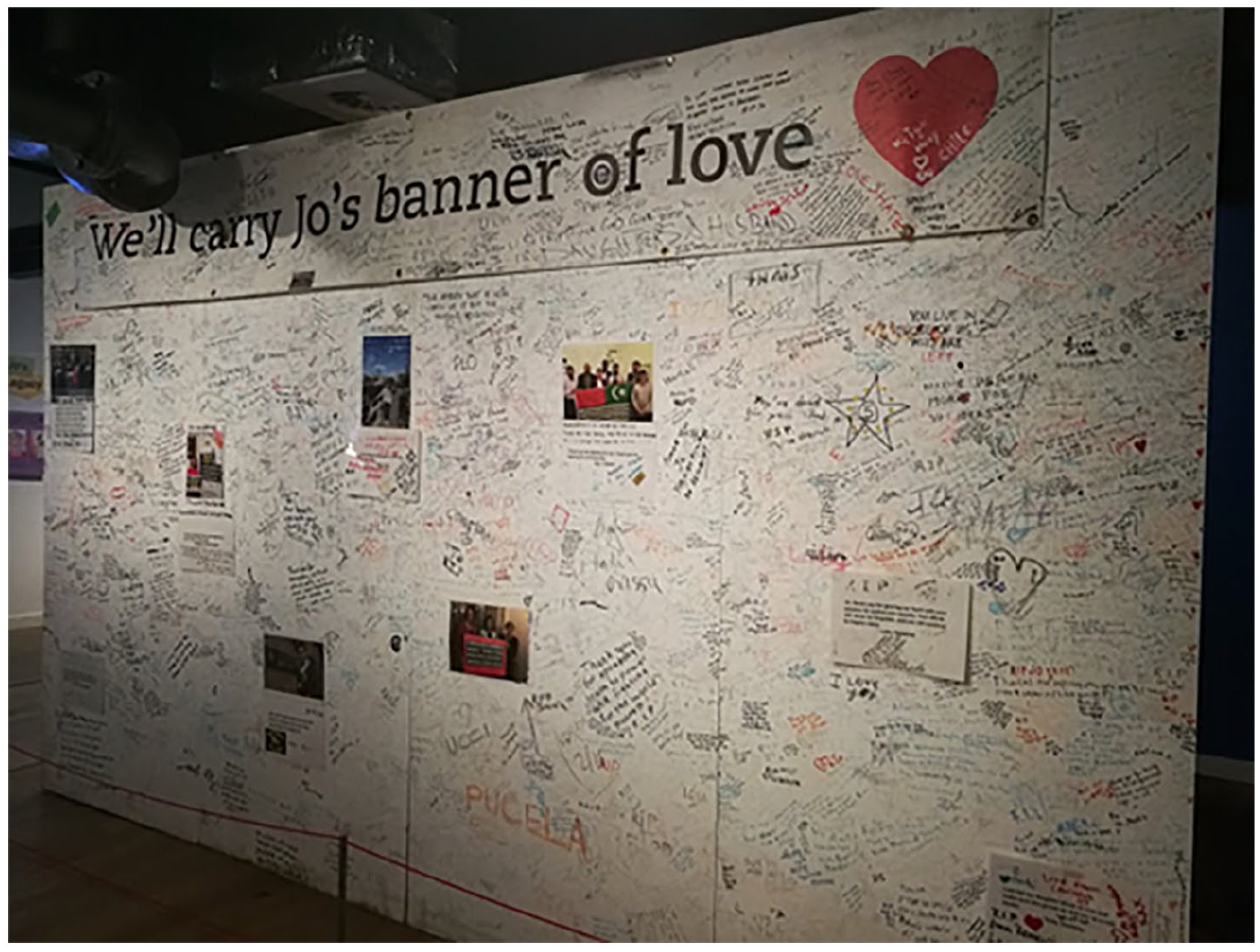
Jo Cox memorial wall. Johnson (2021).
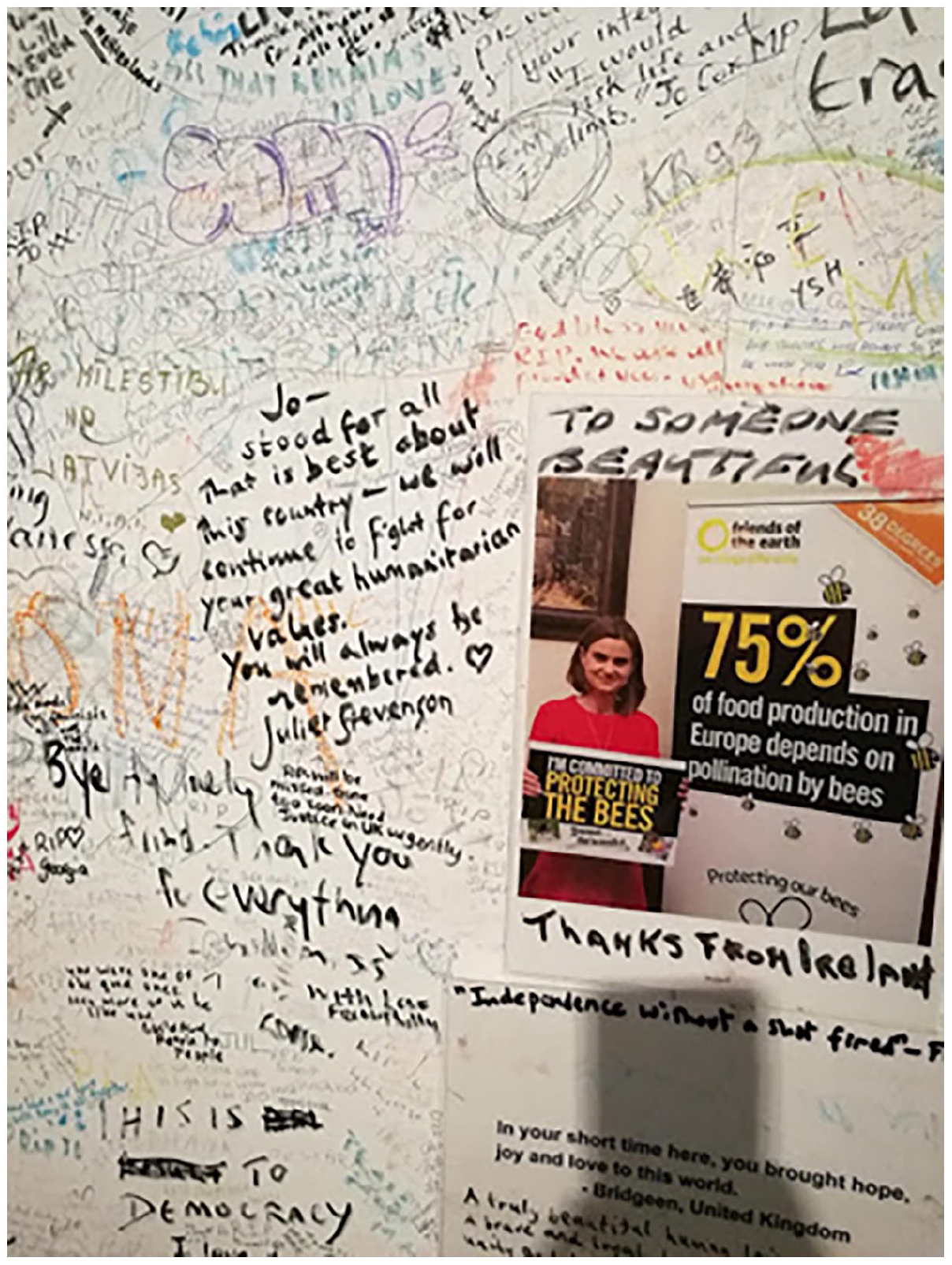
Close-up, Jo Cox memorial wall. Johnson (2021).
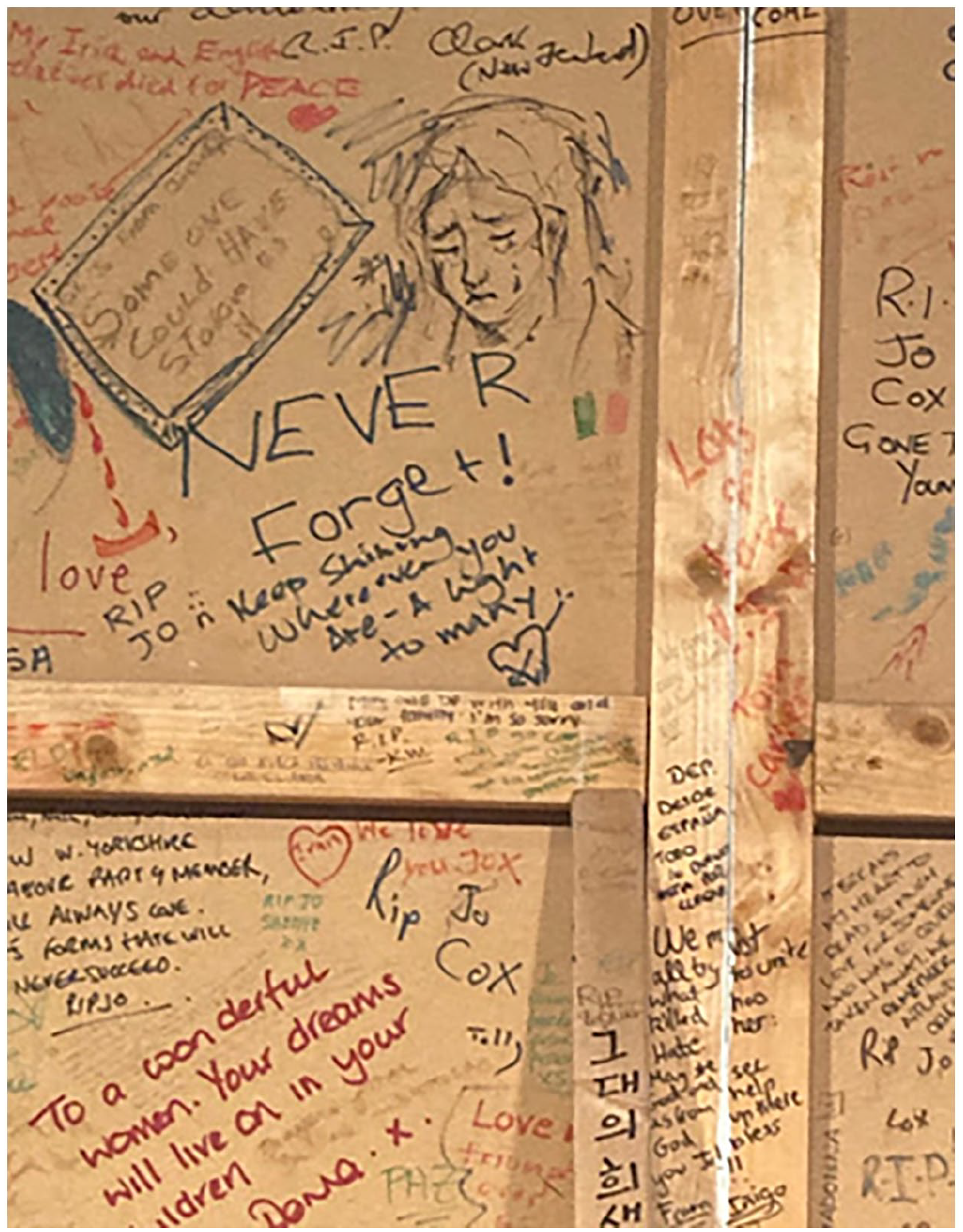
Close-up, back of Jo Cox memorial wall. Johnson (2021).
The exhibition of the 2016 memorial wall, and the invitation to walk around and look at the memorial messages closely, operates as an extension of the type of public feeling choreography seen in the hashtag analysis. As Sara Ahmed (2010) argues, affect is relational in that ‘we are touched by what we are near’ (p. 30). That the wall, packed with feeling and emotion, is understood to be of political value and placed as the centrepiece of the exhibition, speaks to the ways in which public institutions are taking on the role of curating public feeling in new ways, understanding affective engagement as central to politics – a sensation through which political feeling surfaces. Situated in this way, with visitors able to walk around it and read messages on both the front and back, the wall demonstrates how the outpouring of emotions could not be contained on a single prepared side. In this space, the inclusion of the memorial wall can be understood as a way of continuing and crystallising Cox’s values.
Beyond its physical dimensions, the exhibition is also available virtually, allowing access to those who are unable to visit or who live beyond regional or national borders. Supported by Jo Cox’s family, the Jo Cox Foundation and European Union’s Horizon 2020 Framework Programme (Project CultureLabs), the intimate, national and international scope of the project is also represented in synchronicity with the group collaborations displayed. Housing not only memorial artefacts from the time of her death, but inviting and curating new affective engagements and communities, the exhibition also showcases a digital Wall of Hope, on which citizens can, either in person or digitally, add messages about ‘what Jo Cox means to you’. Presented as a giant wall of hope showcasing multiple messages, the digital architecture of this virtual wall is based on the flow between the museum curators and visiting citizens, mediating current public feeling to encourage constructive, social change. Despite physical and temporal distance, then, the act of writing a message on the Wall of Hope operates as an action in and for a common world, allowing for both personalisation and difference, and an emotional identification with Cox’s core, common values. Such a participatory practice not only elicits recollections of Cox but prompts those engaging in writing to think about what a shared affective experience might mean, bringing public feelings of hope to the fore, anew. The walls then – both of memorial and of hope – are not restrictive borders but sites that bring to bear the importance of everyday interactions for how events become meaningful in public culture and commemoration practices.
While such emotions may be fleeting, the exhibition itself and the capturing of public feeling on the Wall of Hope is an important aspect of the architecture, not only in its encouragement to think about meanings through feeling (‘what Jo Cox means to you’) but in its shaping of collective memory through visitors’ responses. Ongoing negotiations of affect and meaning are encouraged in the exhibition’s participatory and pluralistic ethos. We can note then that the connective and visual logics are intensified in the museum exhibition space, through the tactile and immersive nature of the textiles, the Memorial Wall and artwork. The messiness of the handwriting on the Wall and the vibrant colours of the banner and costumes, even sensing the emotions of others walking past, assemble within the space to build a ‘public atmosphere of togetherness’ (Merrill et al., 2020). In such a space, dedicated quite explicitly to the ‘More in Common’ values of multiculturalism and bringing strangers together in conversation and creativity, the resistant logic found online is omitted.
Conclusion
In June 2021, Samuel Kasumu, Boris Johnson’s former race adviser, gave his first interview since resigning, giving a stark warning about the consequences of the culture wars being stoked by the government to exploit division: ‘I worry about that. It seems like people have very short memories and they’ve already forgotten Jo Cox’ (cited in Mohdin, 2021). Kasumu evokes Cox’s name more than once in the interview, and the reference works to reaffirm the symbolic and political value associated with Cox, and the dangers of forgetting the commonality forged in the shock of her death.
In thinking through connective, visual and resistant logics, this article aims to understand how a public feeling is organised both in the immediate aftermath of a tragedy and 5 years later in an exhibition designed to look forward as well as commemorate Jo Cox’s life and political legacy. As Stephen Coleman (2013) argues: ‘Political events are remembered best when they are the subject of shared emotions’ (p. 82). The wave of public feeling expressed following Jo’s murder was both acute and deeply politicised. As the first British MP to be murdered in public office in 36 years, the creation of #MoreInCommon clearly drew on and harnessed Jo’s politics of positivity to organise a public feeling.
As a social media platform, the agility of Twitter and its connective logic were paramount in achieving and facilitating a strategic and anticipatory network of support and sharing. Organising public feeling (or at least a symbolic impression of it) through this network, #MoreInCommon was a critical component of the movement, laying the way for the connective narrative and political project that followed. As Papacharissi (2014) notes: ‘Technologies network us but it is narratives that connect us to each other’ (p. 5). What is also made visible in these tweets however is the development of #MoreInCommon, both as a movement and as a digital, political archive.
Although #MoreInCommon has resulted in the creation and connective appropriation of a deeply human, emotional space and movement, it is important to be aware that such positive politics may also have a downside. Although #MoreInCommon works to construct a sheen of commonality, resistant logics demonstrate inefficacy, pointing to real social and economic inequalities. Affective publics are always contested. It is, therefore, crucial to recognise that resistant logics, particularly those identified in relation to #LoveLikeJo, occupy an important cultural place in contemporary society, where grievances can be aired.
Five years on from the Brexit vote and Jo Cox’s murder, the tenets of ‘More in Common’ have momentarily aligned with other initiatives hoping to place the notion of care and compassion at the centre of politics (Chatzidakis et al., 2020). The Covid-19 crisis has further exposed fractures and inequalities in society, while the Black Lives Matter movement has forced many to think about, and act on, racial injustices. The ‘More in Common’ exhibition embraces positivity and diversity while also engaging with the colonial legacy of Manchester’s textile industry (in the costume project, ‘Threads that bind us’). Public institutions play a role in constituting cultural memory and what societies value: here the participatory ethos speaks to the value, not within the artefacts per se, but in the sociability and learning from others which recurs as a theme in the voices and messages throughout the exhibition. It is only a single exhibition, but it is part of a growing movement to forge new practices and institutions which build affective communities specifically with people who are different from each other, fostering inclusive social change, even in the smallest ‘gestures of concern’ (Ingraham, 2020; Yates, 2021).
Footnotes
Acknowledgements
We offer our sincere thanks to Professor Stephen Coleman and to the journal reviewers for their helpful feedback on this paper. We’d also like to thank Professor Liz Poole and Dr Eva Giraud for their feedback on an early draft. Any errors are our own.
Funding
The author(s) received no financial support for the research, authorship, and/or publication of this article.
