




Abstract
Digital ‘flythroughs’ are increasingly being used by museums to promote themselves to their publics and to extend their spatial and experiential boundaries. These complex, multimodal artefacts use 3D animation, AI imagery, drone footage, sound, music and other modes to construct a parallel museum experience. Such an experience is markedly dissimilar from an ‘ordinary’ embodied relationship to architectural space, and instead constructs an experience of elevated velocity, height and glissade. These movement style choices construct a ‘non-naturalistic’ experience of moving through space that differs considerably from the embodied experience constructed by digital walkthroughs, augmented and virtual reality and ordinary corporeal movement through a museum. Instead, they offer a potential imaginary, a supernatural or ’extracorporeal’ embodiment of a kind typically associated with fantasy films, video games, amusement rides and dreams. This paper analyses 10 flythroughs from a variety of museums and locations through the lens of multimodal social semiotics. The systems of movement styles and visual validity are used to explore how meanings are made in the flythroughs and how they may be understood in terms of the ‘fantasy’ coding orientation. The implications for how museums construct their respective identities and relate to their publics are also unpacked.
Keywords
Introduction
Museum flythroughs are complex digital multimodal ensembles that use elevated camera angles, 3D animation, AI imagery and drone footage to ‘fly’ the viewer over and through a museum or exhibition. This constructs an experience unlike other embodied relationships with the museum and its spaces. Instead of constructing ordinary, corporeal movement, as is typical of walkthroughs and other augmented and virtual reality artefacts, flythroughs choose unusual movement styles, such as swooping, gliding and spinning. This is markedly dissimilar from physical, embodied relationships to museum spaces and instead constructs an embodiment that is ‘unnatural’ or even ‘supernatural’. These movement style choices invite the viewer into a fantastical relationship with their bodies and into an imaginary material relationship with the museums depicted, constructing an experience of embodiment that has few semiotic equivalents outside of fantasy films, video games, extreme sports, amusement parks and dreams (Figure 1). A screen capture of the flythrough for New Palmer Museum of Art, where the viewer levitates above the museum. Courtesy Palmer Museum of Art at Penn State. https://www.youtube.com/watch?v=ni9K9xTGr4c.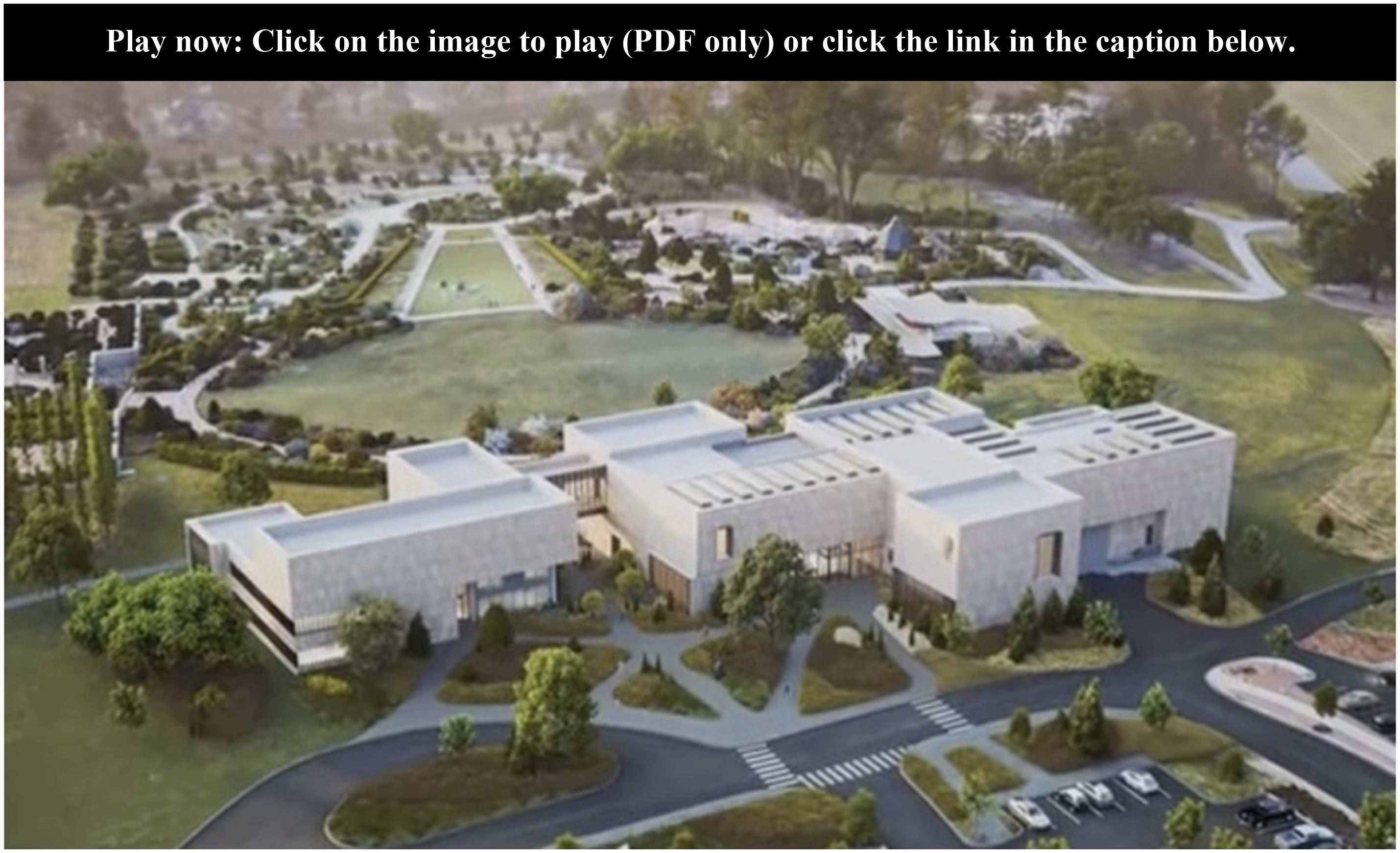
In order to better understand these unusual choices, this paper analyses 10 flythroughs from a variety of museums and locations through the lens of multimodal social semiotics. The systems of movement styles (Van Leeuwen, 2022) and visual validity (Kress and Van Leeuwen, 2021) are used to explore how meanings are made in the flythroughs and how they may be understood in terms of the ‘fantasy’ coding orientation (Ravelli and McMurtrie, 2016; Unsworth, 1997). A clearer understanding of how museums are using flythroughs to construct a different kind of identity is explored, along with the interpersonal implications of this emergent practice for their relationships with their publics.
Flythroughs
The creation of flythroughs, although a largely incipient practice, is relatively common in the property and construction industries. Here, flythroughs are often used by architects or developers to persuade clients to invest or by real estate agents to convince buyers to purchase existing homes (Yoder, 2022). Although their movement style choices differ considerably, flythroughs are akin to other immersive digital museum experiences, such as walkthroughs and virtual reality tours, in that they “are similarly geared towards multi-modal and multi-sensorial forms of heritage interpretation” (Sterling, 2020: 105). They also bear similarity to the types of flythroughs used in solo-player sports and hobbies, such as video gaming and golfing, where they often serve as instructional texts. Indeed, the uses and social purposes of flythroughs are continuing to expand as their affordability and accessibility increase: Google Earth, for example, offers a form of flythrough functionality allowing users to construct ‘extreme zoom’ videos that take the viewer from the stratosphere to their desired location in a matter of seconds. Similarly, new software such as Luma AI offers users the ability to create flythroughs of their daily lives on their handheld devices.
Such “drone afforded aesthetics” (Zuev and Bratchford, 2020: 442) are also increasingly being used by museums to attract potential visitors and promote new exhibitions, a burgeoning practice which invites a closer examination of its social implications. While scholars have shown that flythroughs can make museums more accessible (Zidianakis et al., 2021), preserve cultural heritage (Wei et al., 2019) and broaden cultural dissemination (Meier et al., 2021), more work is needed on the social and semiotic meanings made by these complex, multimodal artefacts.
Museums and flythroughs
Flythroughs form part of a larger suite of digital artefacts that museums can employ to construct their identities, interpret their collections and guide publics to understand heritage buildings and cultural history as “visitable experiences” (Dicks, cited in Sterling, 2020: 101). Indeed, in addition to the physical museum space, located in a fixed place and open for a limited time-period, there is often also a ‘shadow’ or ‘virtual museum’. A virtual museum is “a set of digital objects built in a variety of media” (Doukianou et al., 2020: 283) which visitors can access remotely and asynchronously. These include augmented reality or ‘serious games’, where “the real environment can be intertwined with the simulated environment”, as well as fully immersive virtual reality experiences created to deepen and extend visitors understandings of cultural heritage (Wilhelmsson and Backlund, 2020, 265). They also include ‘walkthroughs’, which use binocular panoramic video or head-mounted video cameras (Allen et al., 2014) to construct “realistic scenes and comfortable stereoscopic visual effects” (Zhang and Wang, 2020: 79), closely aligned with the familiar corporeal experience of walking through a museum space. Flythroughs, in contrast, typically select atypical movement choices and extra-corporeal behaviour, representing the viewer as occupying space in ways that are often not possible outside of fictional narrative or dreams. Viewers can fly, glide, swoop, billow and move with a sinuousness and viscosity not typically associated with ‘ordinary’ corporeality. It appears that museums are increasingly constructing alternative embodied relationships to the museum space by encouraging an imaginary relationship between the visitor/viewer and the museum through the use of fantastical movement style choices (Figure 2). A screen capture of the flythrough of the Eli and Edythe Broad Art Museum, where the viewer is constructed as flying through the space. Courtesy Eli and Edythe Broad Art Museum, Michigan State University. https://www.youtube.com/watch?v=8wa8VMbUJh0.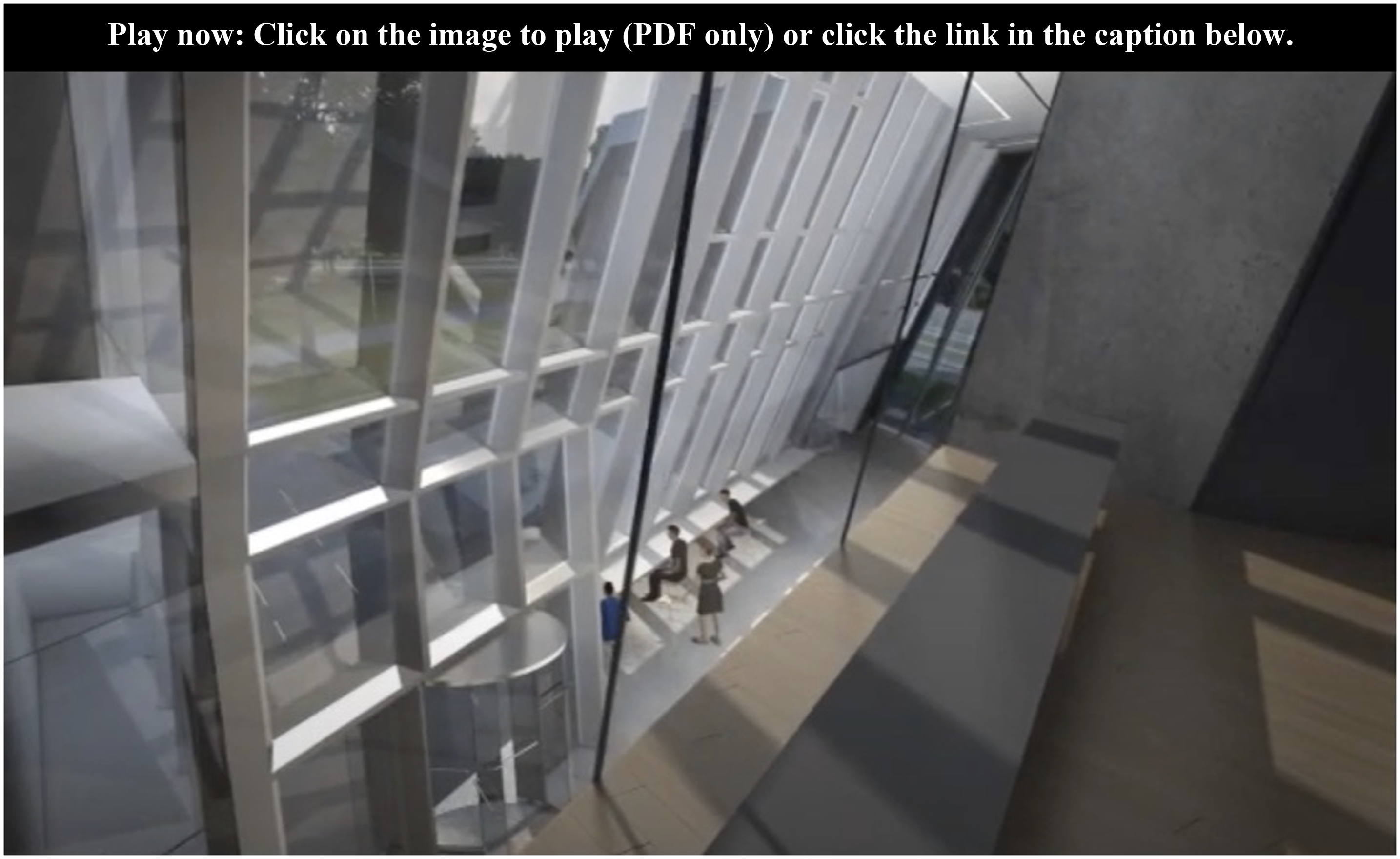
The choice of such non-corporeal movement choices problematises the ‘validity’ (Kress and Van Leeuwen, 2021) of flythroughs. Such a concept is useful here, as it shows how images “produc[e] shared truths … [and] create an imaginary ‘we’” (Kress and Van Leeuwen, 2021: 155). In so doing, the notion of validity could potentially illuminate how flythroughs construct a shared community of museumgoers, as well as how the interpersonal relationships between museums and their publics may have shifted over time. The concept of validity, although developed for still images, can usefully be applied to moving images as well. It refers to how ‘credible’ an image is considered to be within a certain community of viewers, which is of course dependent on “culturally and historically determined standards” (Kress and Van Leeuwen, 2021: 163). Such credibility is expressed by multiple clines of ‘validity markers’, or “sets of abstract principles” (Kress and Van Leeuwen, 2021: 165) such as colour saturation, depth, detail and so on. Together, these principles comprise ‘coding orientations’, each informing the way images “are coded by specific groups” (Kress and Van Leeuwen, 2021: 165). For example, an image which appears to show the ‘pragmatic’ or ‘scientific’ truth, such as a black-and-white floor plan of a museum, often has low depth, low detail, and low colour saturation. As a consequence, it may appear more ‘empirical’, and therefore more valid in terms of a ‘technological coding orientation’ than an image with higher depth, higher detail and higher colour saturation, such as a full-colour rendering (a 2D image of a 3D model) of the museum. A rendering such as this may instead be attempting to show the ‘truth’ of the emotions or of the senses – what it may feel like to gaze upon or stand inside the museum – and as such, would have higher validity according to a ‘sensory coding orientation’. The idea of validity draws upon Halliday and Matthiessen’s (2014) concept of ‘modality’, which is concerned with how ‘true’ a linguistic statement is represented to be. Kress and Van Leeuwen (2021) posit four coding orientations – naturalistic, technological, abstract and sensory – while acknowledging that “digital technology facilitates a move in directions that deviate from photographic naturalism” (Kress and Van Leeuwen, 2021: 178). Drawing on Baudrillard (1994), they suggest that if “high modality means something is considered as being true; low modality that it is less than true – not real … ‘hyper-real’ is modality that is ‘more than real’, and therefore ‘off the scale’” (Kress and van Leeuwen, 2021; cited Ravelli and McMurtrie, 2016: 73).
It is important to reiterate that this framework was developed for still rather than moving images, and as such was not designed to incorporate different movement style choices. However, if the naturalistic coding orientation is taken as a point of comparison, it is possible to identify what makes the movement style choices in flythroughs so unusual and indeed ‘more than real’. The naturalistic coding orientation is “the dominant one in our society” shared by all members of a culture regardless of education or group allegiance (Kress and Van Leeuwen, 2021: 165). It is the ‘truth’ of the everyday, grounded in lived experience where people are “just being themselves” (Kress and Van Leeuwen, 2021: 166). Movement styles that would be valid according to a naturalistic coding orientation, then, would be characterised by the embodied experience of moving through space in corporeal form. As outlined, museum walkthroughs construct such an embodied experience, as do virtual and augmented reality experiences of museums which aim to “bridg[e] the relation of the self to its surrounding environment … with the relation of the self to the body” (Bertrand et al., 2021: 3). In contrast, flythroughs differ considerably in terms of their movement style choices. As described above and suggested by their name, they construct a ‘non-naturalistic’ experience of moving through space, a supernatural or ’extracorporeal’ embodiment that can usually only be experienced in fiction, video games and dreams.
Indeed, they might be read as more convincingly credible to a fifth kind of coding orientation: the ‘fantasy coding orientation’ (Unsworth, 1997). First identified in the interpretation of images in science textbooks (1997) and expanded to spatial texts such as the Guggenheim building in Bilbao (Almeida and Ravelli, 2013), the fantasy coding orientation is a “‘make believe version of reality” (Ravelli and McMurtrie, 2016: 74). Although Unsworth considers it “inappropriate” for science communication, this “magical” (Unsworth, 1997: 37) coding orientation is pertinent to the interpretation of flythroughs, which are persuasive texts constructing a potential imaginary. They do this by appearing to position the museums they construct as broadly accessible, offering opportunities on public platforms such as YouTube to move freely through spaces in ways usually subject to corporeal, financial or geographical constraints. However, the embodied flythrough experience is also an individualised ‘imaginary’ one: a “person-centered” fantasy not grounded in material conditions (Strauss, 2006: 323). Flythroughs construct an embodiment of the museum space that is non-corporeal, which not only “expand[s] and democratize[s] public access to Cultural Heritage” (Bertrand et al., 2021: 1), but invites viewers to build a ‘magical’ or ‘fantastical’ relationship to the museums represented (Figure 3) A screen capture of the flythrough of the Eli and Edythe Broad Art Museum, where the sketch and the rendering overlap in a fantastical manner. Courtesy Eli and Edythe Broad Art Museum, Michigan State University.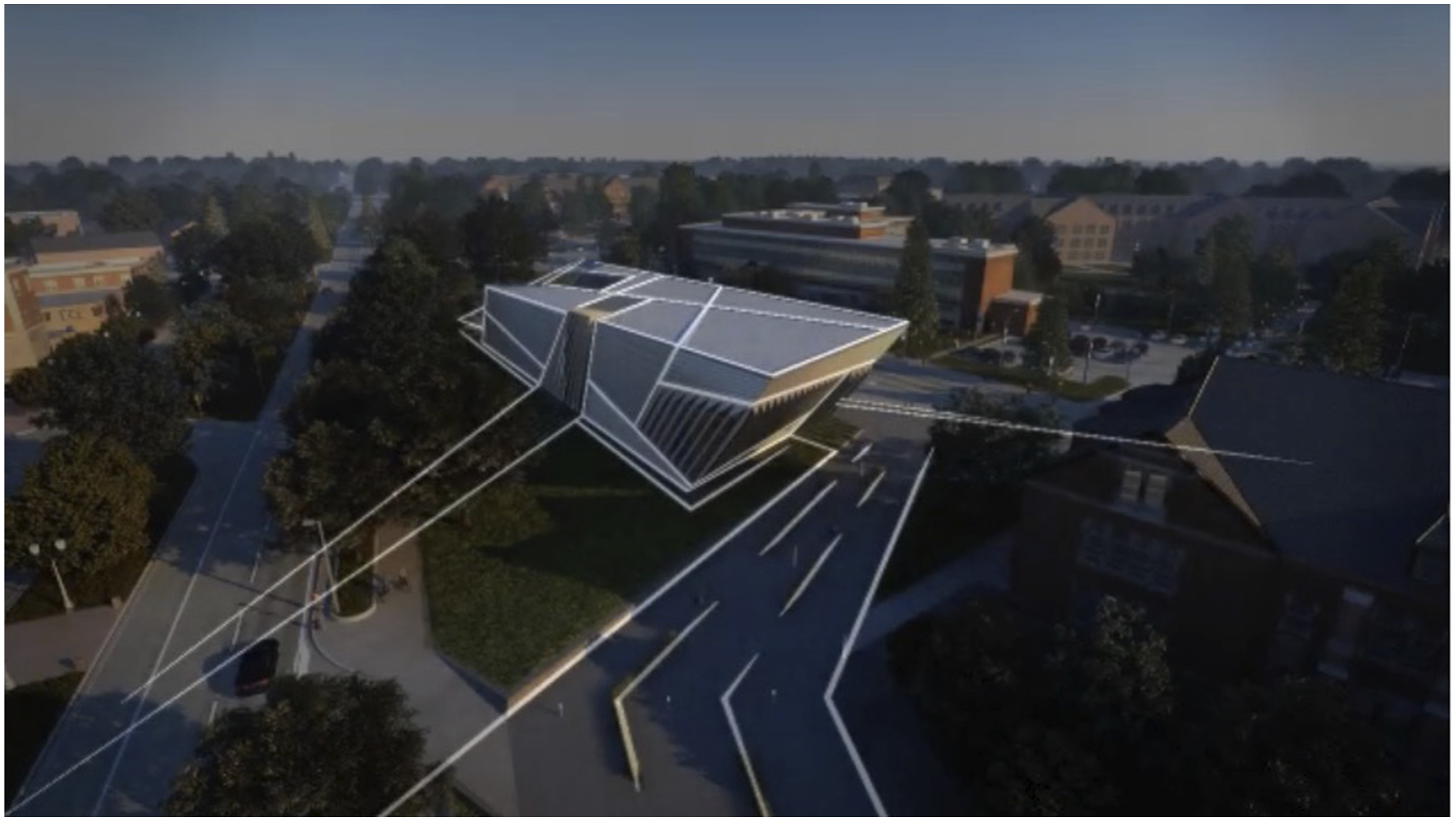
A closer look through movement styles
The present paper does not permit an exploration of flythroughs in terms of each validity marker, or a detailed elaboration of the multiple semiotic modes and resources at work in these complex artefacts. Instead, it examines how these artefacts construct the fantasy coding orientation by exploring one of their most salient elements: their movement styles. This analytical approach has been selected because movement styles as a semiotic resource contribute considerably to how a moving image is perceived to be valid according to the fantasy coding orientation, or to what could be seen as the ‘truth’ of the imaginary. Such an approach also permits an unpacking of the particularities of the ‘naturalistic’ or everyday embodiment of moving through the museum space, whether physically, or in walkthroughs, augmented or virtual reality – in contrast to the fantastical embodied experience constructed in flythroughs.
In particular, flythroughs are examined through the lens of Van Leeuwen’s (2022) system of movement styles, or “distinctive features of movement” (p. 131) in order to better understand the identity and interpersonal meanings being constructed in these multimodal texts. Van Leeuwen’s system comprises eight subsystems, each of which are clines, suggestive of a degree between two extremes rather than the existence or non-existence of certain choices. These subsystems are: Direction (left
Exploring movement style choices
Flythroughs in the data set.
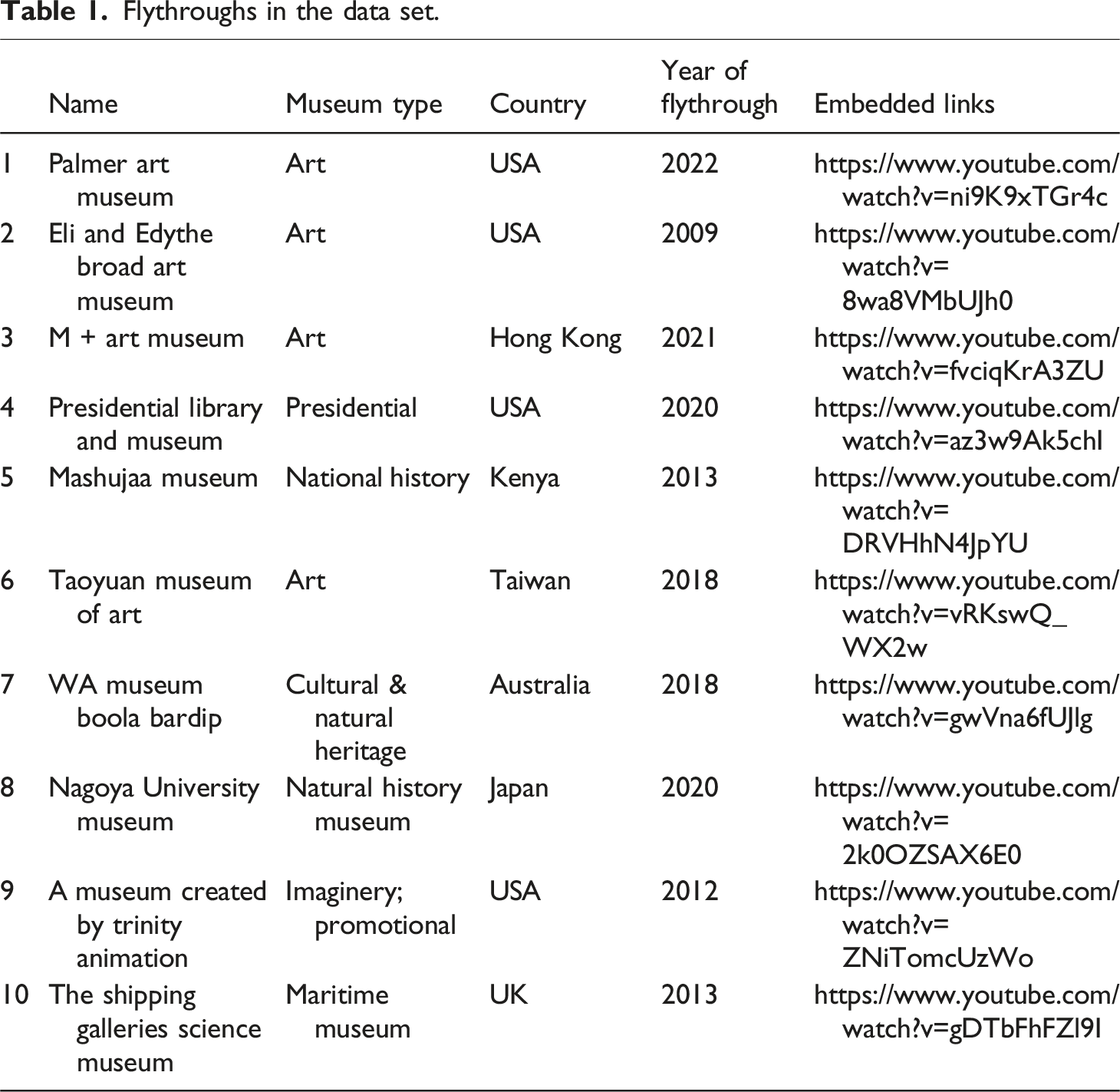
Common movement styles selected across the flythroughs include floating, flying, hovering and spinning, along with a rapid gliding motion that is frequently in a surprising direction, such as backwards or diagonal. These work together to construct a movement style that is preternatural and often non-corporeal. For example, at 1:07 s in the flythrough for the Palmer Art Museum (https://www.youtube.com/watch?v=ni9K9xTGr4c) the viewer floats upwards, ascending through the atrium to the floor above in a gentle spiral that parallels the rising notes in the accompanying musical piece by classical composer Ehren Ebbage. A sliding motion through a doorway 0.53 s into the flythrough for the Eli and Edythe Broad Art Museum in (https://www.youtube.com/watch?v=8wa8VMbUJh0 A screen capture of the flythrough for New Palmer Museum of Art, where the viewer hovers between floors. Courtesy the Palmer Museum of Art at Penn State. A screen capture of the flythrough of the Eli and Edythe Broad Art Museum, flying towards Jeff Koons blue Balloon Dog. Courtesy the Eli and Edythe Broad Art Museum, Michigan State University.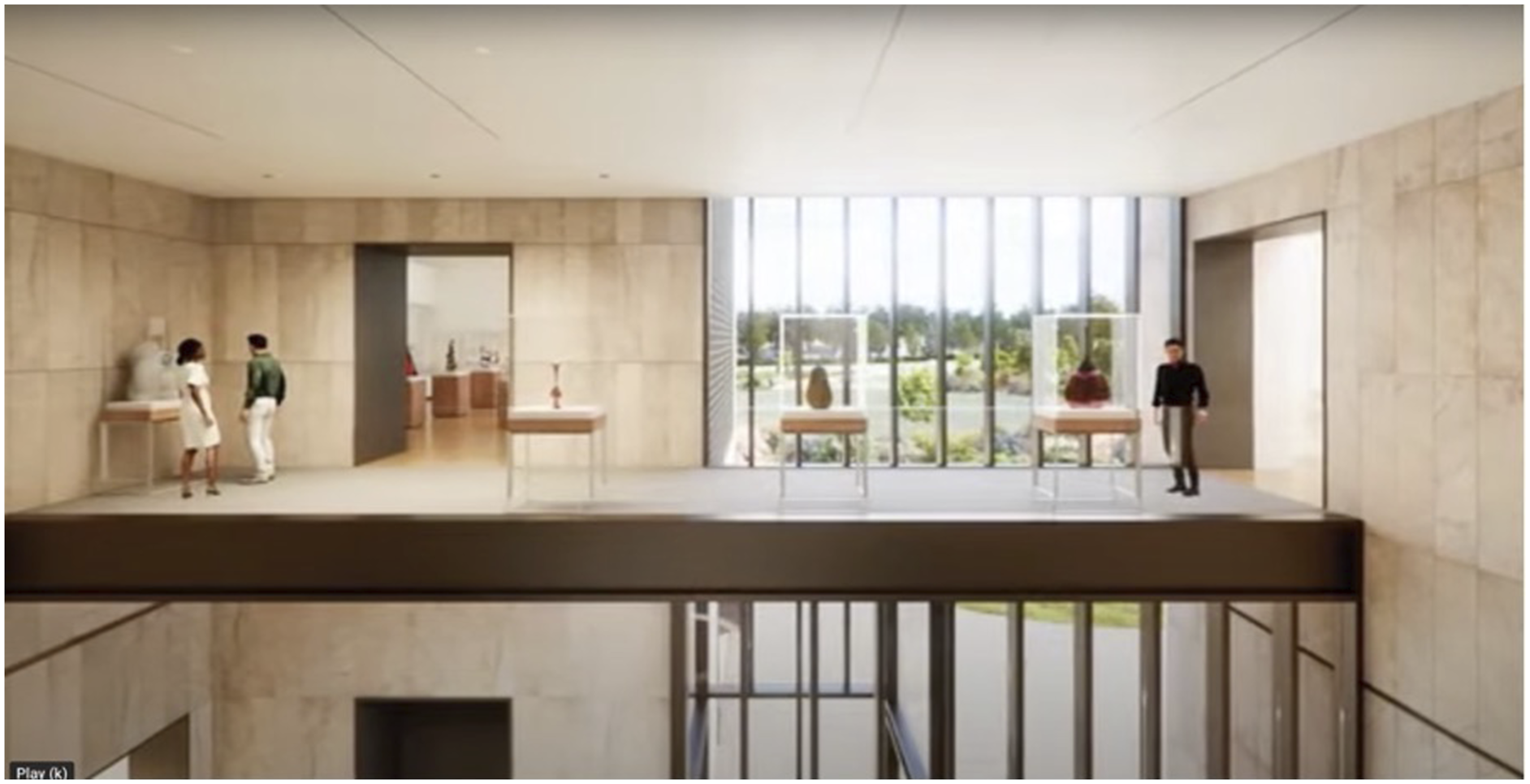
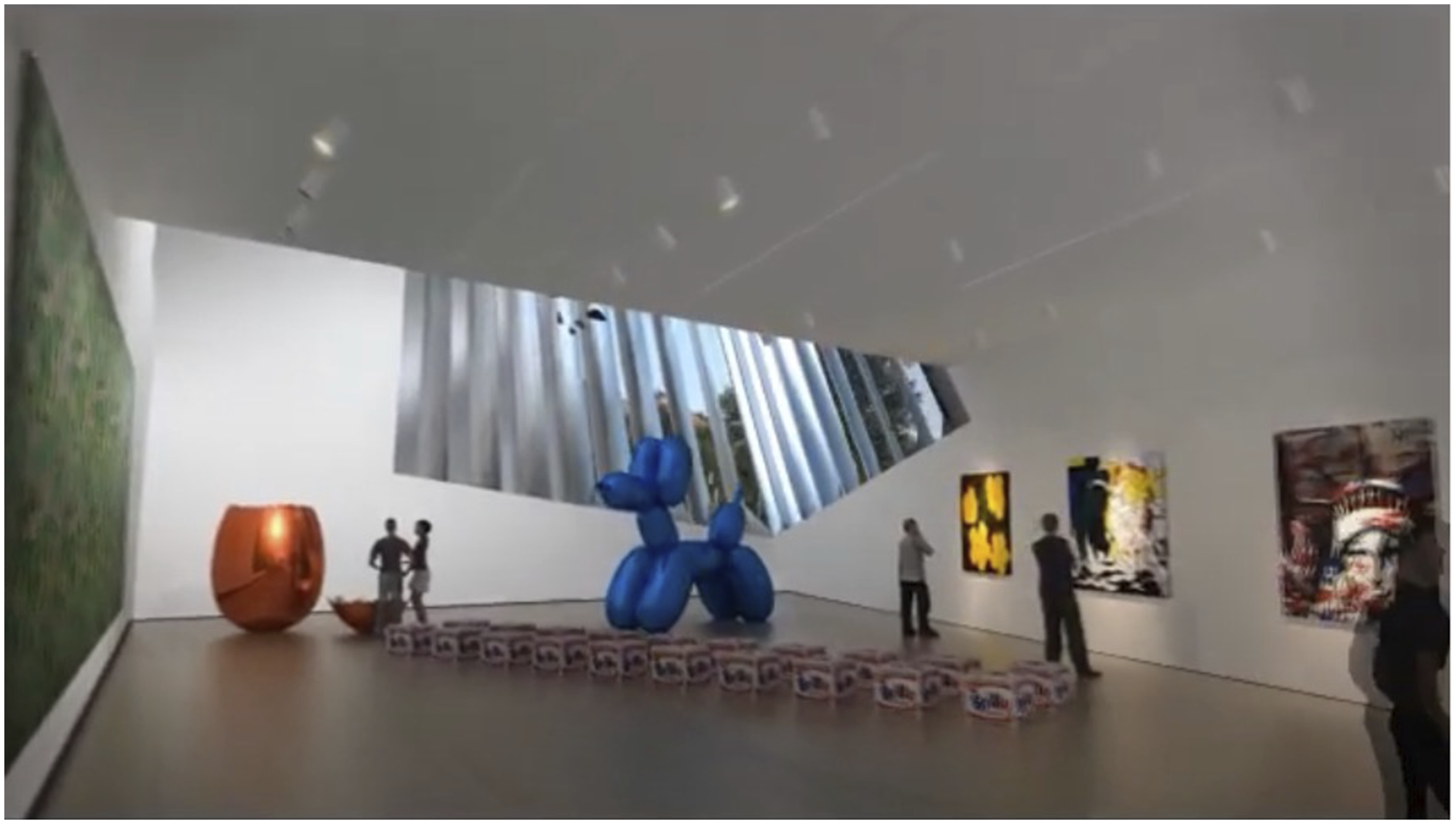
These are not the only unearthly movements produced in museum flythroughs. Viewers are constructed as floating outside of their own aeroplane (above the Taoyuan Museum of Art, 0:10 s, https://www.youtube.com/watch?v=vRKswQ_WX2w), jetting backwards through the skeleton of a horse (at the Nagoya University Museum, 0:18 s, https://www.youtube.com/watch?v=2k0OZSAX6E0), gliding frictionlessly down stairs (the Eli and Edythe Broad Art Museum,1.38 s, https://www.youtube.com/watch?v=8wa8VMbUJh0) and disappearing through floors (in the WA Museum Boola Bardip, 2:00 s, https://www.youtube.com/watch?app=desktop&v=gwVna6fUJlg) and rooftop pools (atop the M + Art Museum, 1:43 s, https://www.youtube.com/watch?v=fvciqKrA3ZU).
By far the most popular movement choice, however, is positioning the viewer as if they were gliding backwards out of the entrance at a rapid speed, before flying up into the air and either levitating or spinning around the museum at a great height. This typically occurs at the end of the artefact, as a form of narrative ‘flourish’. Contemplating the museum from such an impersonal social distance and vertical elevation has interesting implications for the interpersonal relationships being constructed between the museums and their (potential) visitors. Kress and Van Leeuwen (2021) suggest that when “we can see a building from the distance … include[ing] the space around the building” the public are constructed as being kept at a ‘respectful’ distance, metaphorically fenced off” (p. 128–129). Something different appears to be happening, however, when the viewer floats above the museum in the manner of a supernatural being. Although the space around the buildings are clearly represented, and the viewer is at a public social distance (Kress and Van Leeuwen, 2021), the social power constructed by their elevation along the vertical axis, combined with their ‘supernatural’ ability to hover and jet, constructs a relationship that is more proprietary than respectful. The viewer is represented as ‘god-like’, ‘superhuman’ or at the very least granted a perspective analogous to nobility surveying their estate from an elevated turret or balcony. Indeed, such a view, argue Klauser and Pedrozo (2017), “break[s] off the long-standing monopoly and privilege of the “powerful” to look on space from above … spanning from the ancient emperors’ city walls and towers to the modern state’s satellites” (p. 232–233) and offers it to the general public through the open-access video sharing platform, YouTube (see Figures 1, 3 and 6). A screen capture of the flythrough for the Taoyuan Museum of Art. Courtesy MVRDV and Taoyuan Museum of Art, Taiwan. https://www.youtube.com/watch?v=vRKswQ_WX2w.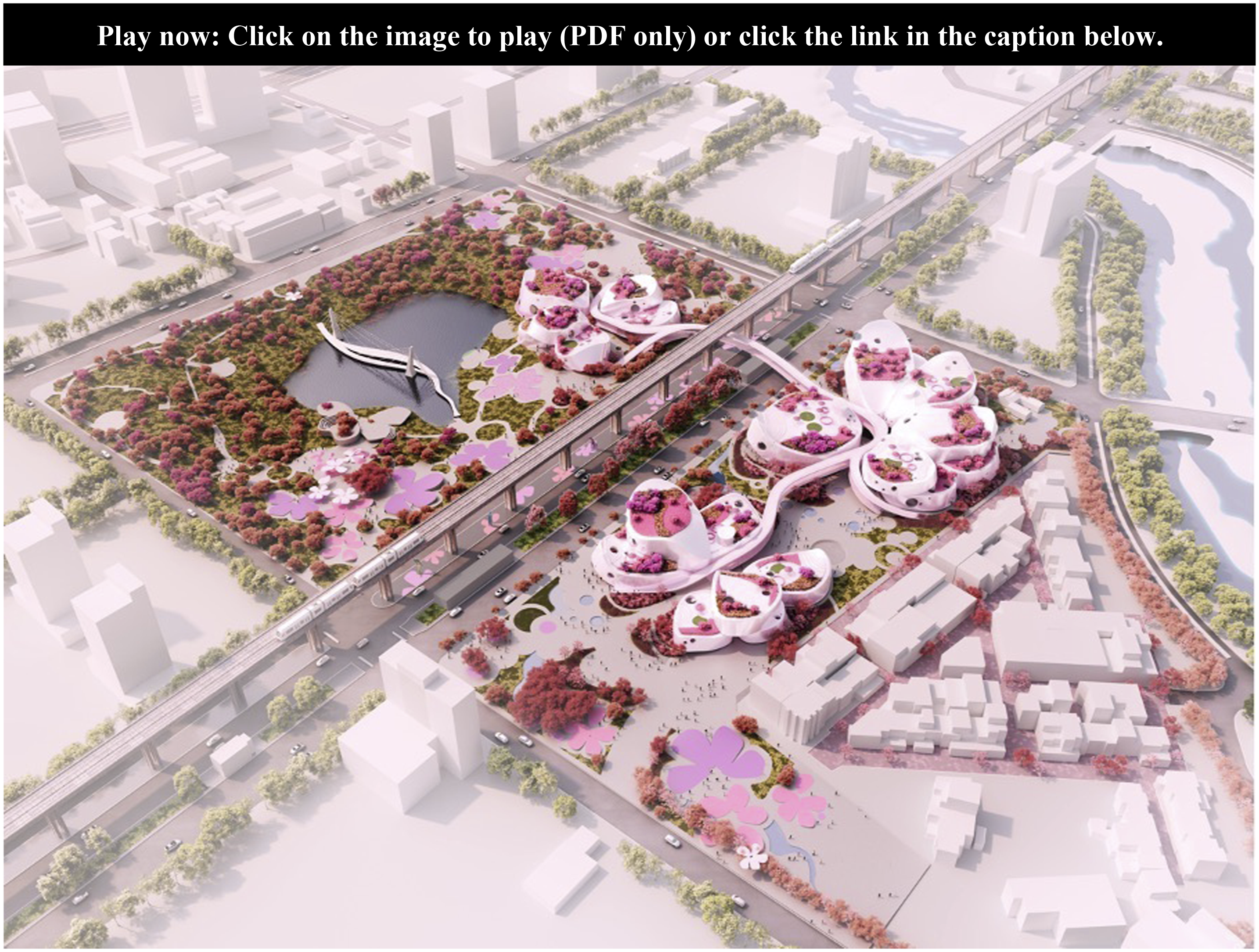
Movement styles and identity
“Style is essentially identity design”, argues van Leeuwen (2021: 99–100), and movement style is expressive of the kinds of identities these museums want to project to their publics. In light of how conspicuously unconventional many of the movement choices in flythroughs are, it is worthwhile considering them in closer detail in terms of the eight clines of Van Leeuwen (2022)’s system of movement styles outlined above (see Figure 7). Firstly, the (1) Directions chosen in the majority of these flythroughs are multiple, although, as mentioned above, there is a pattern of moving upwards until the audience is positioned at a great aerial height at the end of the artefact. There are frequently also other unusual direction choices, such as diagonals, which are not typically associated with ordinary corporeal activity. Such movement is, however, analogous to some of the experiences offered by extreme sports, such as paragliding or flyboard riding (involving a water-propelled jetpack), as well as fictional narrative, such as the movement of superheroes through the sky as popularised by the ubiquitous Marvel and DC film franchises. Van Leeuwen’s system of distinctive features of movement (2022: 131).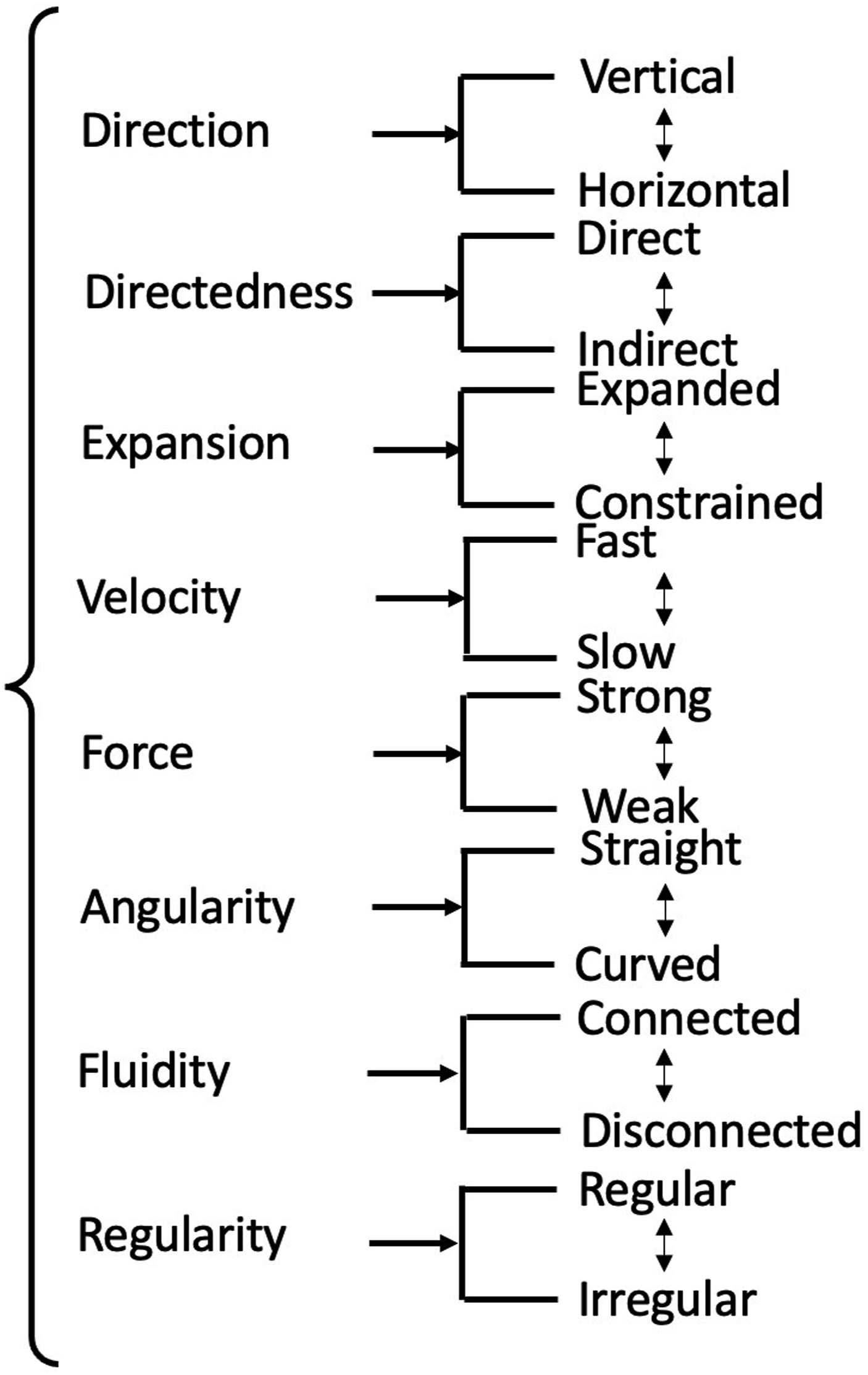
Further, there is often, but not always, a clear (2) Directedness in the flythroughs, although the goal is frequently uncertain. Occasionally, flythroughs reverse the directedness unexpectedly, or the directedness is reversed from start to finish, as in the case of the Nagoya University Museum. Those that create a clearer sense of direction typically progress upwards through the building before hovering above it. In this way, the traditional left to right, or ‘Given’ and ‘New’, 2 of Western texts (Halliday, 1985, cited in Van Leeuwen, 2022: 127) is replaced by a forward-moving directedness common to sports like marathon running, for example, or first-person role-player computer games. In flythroughs, then, the Given could be seen as the museum space and the New is the extraordinary aerial view offered in the final moments of the flythrough.
The (3) Expansion of movements in many of the flythroughs is also typically pronounced and similarly extraordinary. Space is swallowed by the viewer’s movements in effortless, gliding bounds, allowing them to move through the rooms and out above the roof very swiftly. “Degrees of expansiveness can be associated with different kinds of activity and different moods and emotions” (Van Leeuwen, 2022: 128), and the mood that is constructed by these choices is one of extreme liberty; it is unrestrained, imperious and grandly exuberant.
By representing the viewer ‘as if’ they were roaming freely, the museum is constructing a highly intimate relationship with their (potential) visitors. This relationship is, of course, an imaginary one: as the ’reading path’ (Kress and Van Leeuwen, 2021) of the flythrough is in actuality very highly constrained and non-negotiable. However, it is worth drawing attention to the fact that this is the relationship these museums are choosing to construct with their publics; the identities they wish to project. Highly expansive movement styles are also closely related to (4) Velocity and (5) Force, which are also often dramatically heightened in flythroughs. Elevated speed is suggestive of ‘energy’ and strong force of ‘vigour’ (Van Leeuwen, 2022), and such semiotic choices may have been selected to construct identities associated with dynamism and future-orientation. However, “too much speed can overwhelm and confuse” (Van Leeuwen, 2022: 128), as is arguably the case for the M + Museum, for example, wherein the velocity is so exaggerated as to be somewhat dizzying.
The (6) Angularity and (7) Fluidity of flythroughs are perhaps two of their most distinctive movement style choices, with many of the artefacts in this data set displaying a marked tendency towards curved, flowing, balletic movements. Van Leeuwen suggests that “our experience of our natural and cultural environment tells us that curved forms and curved movements dominate the natural world and rectilinear forms and movements the world created by humans” (Van Leeuwen, 2022: 129), however this is once again problematised by the flythrough. These computer-generated movements, although inarguably mechanical in origin, are overwhelmingly fluid, viscous, sinuous. This is a notable departure from commonly accepted notions of mechanical movement in popular culture, such as the staccato movement styles of Barbin.ili, a Chinese dancer and influencer with 1.3 million followers who performs as a robot, or the stilted grace of the robot protagonist in 2023 film M3gan, whose eerily rigid movement is occasionally interspersed with a horrifyingly mechanical quadrupedalism. It can also be observed in the viral TikTok trend of moving like an ‘NPC’, or non-player character, where thousands of content creators emulate the juddering movements of video game characters for millions of views. 3 In the flythroughs, however, it is the consistently fluid movements that are most suggestive of their mechanical origins, and which seem most at odds with the natural world of organically-occurring imperfections. This is connected to the final cline of (8) Regularity. Why such fluidity feels unsettling and unnatural is partly because of its unerring regularity, which, however smooth, can only be mechanical in origin. Such movements contain within them a sense of insecurity and the threat of spinning ‘out of control’, such as is arguably felt in the Eli and Edythe Broad Art Museum, for example.
Discussion
Museum flythroughs are complex multimodal ensembles involving such semiotic modes as 3D animation, film, images, diagrams, music and sound. Although they showcase museums as three-dimensional ‘spatial texts’ (Ravelli and McMurtrie, 2016), they are themselves two-dimensional, dynamic, transient artefacts mediated through the material ‘canvas’ of the screen (Bateman et al., 2017). It is also important to note that flythroughs are not necessarily additional or secondary to the real-world museum space: many of them were designed before their ‘brick and mortar’ counterparts as a method of promoting the museum to potential investors and visitors. As such, they occupy a strange space: not an imitation, but the originating idea which the museum itself attempts to emulate. In this way, they differ markedly from walkthroughs, augmented reality and other virtual tours, which trace existing, prescribed or encouraged paths and simulate the embodiment of physical, human movement through a museum. Further, flythroughs contain not only 3D architectural renderings – and, in the case of the Eli and Edythe Broad Art Museum for example, also the architect’s own hand-drawn sketches (see Figure 3) – but also an idealised projection of how the space will be used. Human avatars are animated into the space, depicted as reading books, engaging with art, participating in discussions with other visitors, and so on. The artefact is constructing not only the space but the museum experience, and in this way, the flythrough is much more than a model, “merely an idea” (Baudrillard, 1996: 167). Instead, it could arguably be said to have “no relation to any reality whatsoever; it is its own pure simulacrum” (Baudrillard, 1994: 6). The cultural artefact of the flythrough pre-exists the material reality of the museum. Instead, it is constructing a potential imaginary, and as such is not emulating but simulating, ‘producing’ a relationship to the museum, a “‘work’ of the unconscious” Baudrillard likens to dreaming (1994: 3) (Figure 8) A screen capture of the flythrough for New Palmer Museum of Art, depicting human avatars engaging with the museum. Courtesy Palmer Museum of Art at Penn State.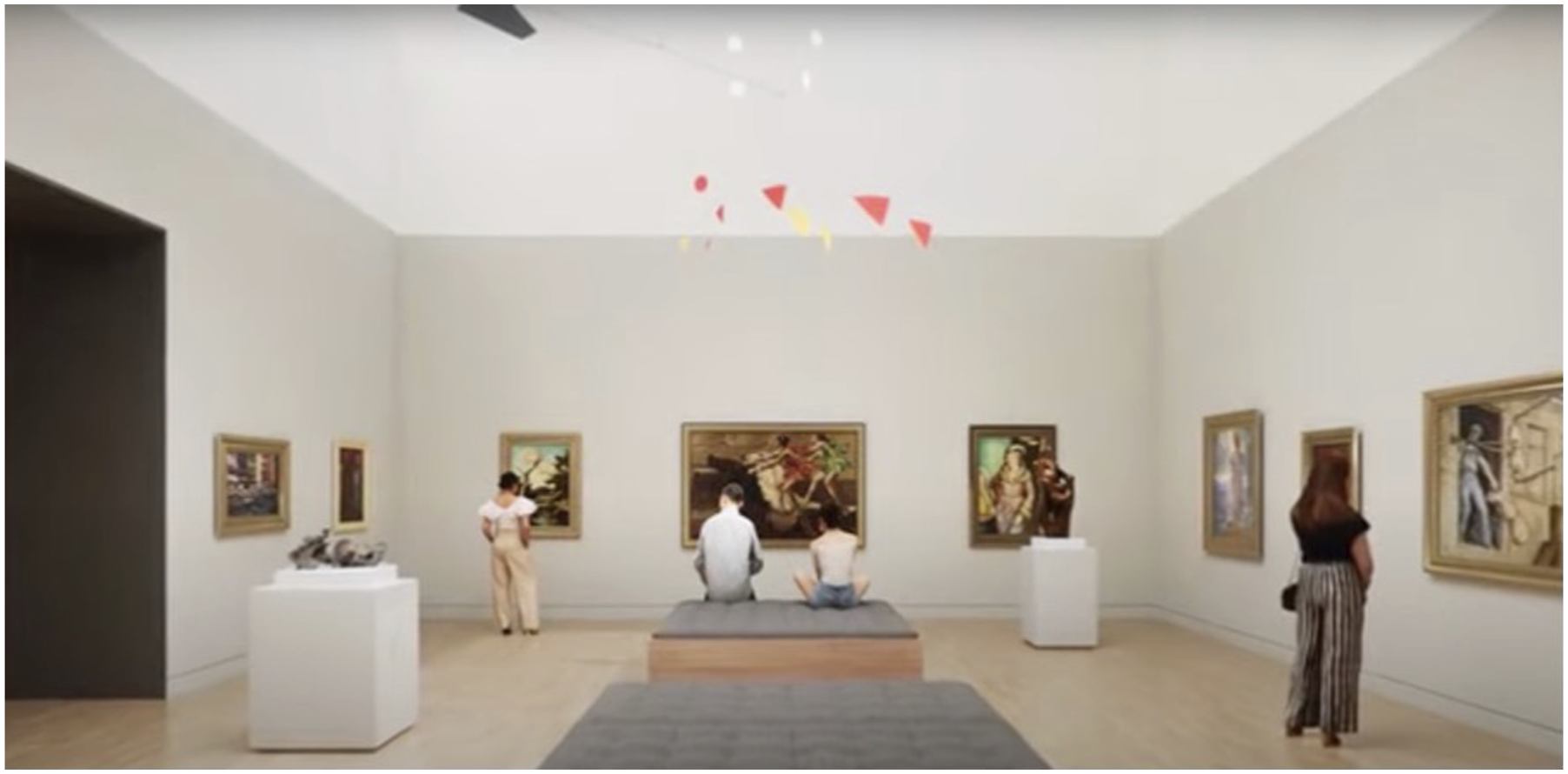
Although there is typically a relationship between a flythrough of a museum and a museum in the real word, this is not always the case. Indeed, there are flythroughs offering the viewer a relatively plausible tour of a museum that has no real-world equivalent. For example, the Science Museum’s old Shipping Galleries in London closed in 2012, but the flythrough of the museum space, reconstructed in a 3D point-cloud model from 275 laser scans (The Science Museum, 2023), offers potential ‘visitors’ the opportunity to explore the galleries today (https://www.youtube.com/watch?v=gDTbFhFZl9I). Here also, the viewer is constructed as gliding through the rooms, and although they move at a gentler pace than many of the flythroughs in this study, they are able to fly between floors and move through walls in a fantastical manner. Further, 3D Animation company Trinity Animation have created a virtual museum tour for a museum that has not and will not exist. The flythrough was instead designed to promote the company and showcase their services, and viewers can move around an entirely virtual museum with no real-world correlate. Again, in this purely imaginary ‘museum’, similar movement choices to the other artefacts in this dataset are being made, including spinning and gliding with elevated velocity and fluidity. It appears that given the limitless freedoms of a purely imaginary museum, museums are nevertheless commissioning flythroughs of remarkable similarity to others of their ilk, even with the infinite potential of imaginary digital space and time. There is a notable homogeneity in the identities and relationships being constructed in museum flythroughs around the world, across different museum types and over a decade-long period.
The claim could be made that 3D animations are merely emulating drone footage. Indeed, 3D animation technology has improved so dramatically that the two are occasionally indistinguishable. The flythrough of Hong Kong’s new M + Art Museum, for example, was reported as being ‘drone footage’ of the real museum by the South China Morning Post when they uploaded the flythrough to their news channel. Although very convincingly realistic in its rendering of artists, curators and maintenance staff preparing the museum for its imminent opening, close observation reveals this to be an entirely fictional 3D animation (note how the ‘drone’ moves through a rooftop pool at 1:43 s). The rest of the flythrough is characterised by the usual swooping, spinning and gliding through the spaces of the building, albeit at a velocity that is so amplified, the effect is one of dizziness and disorientation. The viewer is then launched into the sky and spun around to contemplate the building in its entirety at the end of the artefact, in what appears to be becoming a relatively stable stage of the flythrough genre (Derewianka and Jones, 2023).
However, the data shows that museum flythroughs are doing more than merely emulating drone footage. As outlined above, there are also choices being made that are atypical of a drone, such as passing through floors (as in the flythrough from the WA Museum Boola Bardip, at 2:00 s, https://www.youtube.com/watch?app=desktop&v=gwVna6fUJlg) or sitting stationary in an aeroplane seat as the Taoyuan Museum of Art becomes visible through the window (at 0:08 min, https://www.youtube.com/watch?v=vRKswQ_WX2w). This is where the analytical resources offered by the system of movement styles (Van Leeuwen, 2022) can deepen understandings of museum flythroughs. Firstly, this approach makes visible the marked difference between the movement style choices associated with ordinary embodied experience and the unusual, extracorporeal choices being made in museum flythroughs. Secondly, by allowing Van Leeuwen’s (2022) claim that movement style choices form part of identity design, it is possible to argue that the museum representatives behind these flythroughs are deliberately constructing fantastical identities for their respective museums and attempting to build extraordinary relationships with their potential visitors. 3D animations can be produced at any velocity, fluidity, force, and so on, so the decision to represent the museums and their potential visitors in such extraordinary styles is a ‘motivated’ choice (Kress, 2010), reflective of the museums’ interests and their intentions as to how they would like to be perceived by their publics.
In order to better understand such choices, the system of visual validity (Kress and Van Leeuwen, 2021) can help illuminate the museums’ interests and intentions. Rather than simply seeming unreal, flythroughs could be understood as reflecting the ‘truth of the imagination’, interpretable through the lens of the fantasy coding orientation (Unsworth, 1997). Such a lens is useful because although the movement style choices in flythroughs appear unusual in comparison to ordinary corporeality, they “have developed out of the central values, beliefs and social needs of specialised domains and of society more generally” (Kress and Van Leeuwen, 2021: 150), been made possible by recent improvements in digital technologies and are broadly discernible across various domains of popular culture, such as video games, superhero films and immersive virtual reality.
The question then becomes why museums are increasingly making these fantastical choices in their flythroughs. There appears to be two factors at work here. Firstly, by constructing the visitors as ‘honoured guests’, with privileged, even supernatural access, the museums are making themselves accessible to publics of a markedly different social status to those of previous eras. Rather than being the preserve of a predominantly aristocratic ‘cultural elite’ (Griffiths et al., 2008) accessed by the privileged few, these museum flythroughs construct their museums as ‘belonging’ to the broader public in a much more intimate manner. Visitors are represented as being able to penetrate through museum floors and ceilings, effortlessly glide through their inner sanctums and contemplate them from far on high in the manner of nobility or gods. This is indeed a profound shift in the way these museums are representing themselves and in the social relationships they are forging with their publics, and flythroughs could be seen as playing a role in a broader impetus towards the democratisation and expansion of these museums’ accessibility and impact.
Secondly, the movement style choices in flythroughs are so made because they are able to aptly convey something fundamental about the museum experience. Certainly, individual visitors will not be able to swoop, glide and fly through museum floors when they visit the real-world correlates of these digital artefacts. However, the way in which the movement style selections in flythroughs are suggestive of linking rooms and exhibitions through rapid, viscous movements invites the viewer to contemplate the contours of the museum space itself and constructs the museum visit as a collection of experiences. As Tzortzi (2016) argues, museum experiences comprise three elements: the exhibitions contained in the space (the ‘informational dimension’), interactions with other people in the museum (the ‘social dimension’) and “the experience of space itself: the spatial dimension” (p. 239). The movement style choices of flythroughs make viewers conscious of the museum space by moving swiftly through and around it, and the fantastical movements of gliding and pirouetting are suggestive of the transformative potential of the museum experience, and the potential imaginary they construct. Metaphorically at least, many of the movement choices in flythroughs are in keeping with the notion of museums as “thirdspace environments … places of passing through … transitional spaces of leisure and commerce resulting in a profound alteration of awareness” (Bøe et al., 2019: 148).
Flythroughs are persuasive texts, and they are designed to attract potential visitors to the museum space as an end in and of itself rather than to convince them to achieve a particular goal within that space. In this way they construct a fantastical relationship to their publics not dissimilar to the feeling an architect aims to produce when designing to “induce a sense of freedom of movement, a milieu for strolling, a mood that had less to do with directing people than seducing them” (Zumthor, 2022: 43). 4 It could be argued, then, that the fantastical movement choices in museum flythroughs are designed to bring awareness to the spatiality of the museums represented and in so doing construct democratising, liberating and seductive museum experiences.
Footnotes
Declaration of conflicting interests
The author(s) declared no potential conflicts of interest with respect to the research, authorship, and/or publication of this article.
Funding
The author(s) received no financial support for the research, authorship, and/or publication of this article.