



Abstract
This article is about using participatory research and multimodal discourse analysis to scaffold theory-building, with a focus on how children draw on their lifeworlds, folkloric imagination, and media experiences to generate meanings in, and through, their play. It draws on a tradition of research which employs a multimodal semiotic lens to analyse interaction and communication between social actors in combination with sociocultural theory to generate hypotheses about a phenomenon. The focus is on how multimodal discourse analysis operates when partnered in research designs with other interpretive constructs, drawn from sociocultural, socio-material and postdigital frames. Examples are featured from two research projects centred on children’s play, and the central argument here is that play, with its reference points in media, popular culture and traditional folkloric forms is a particular location for theory-building on the postdigital nature of contemporary lived experience.
Terms and conditions: A starting point
This article is based partly on an online keynote presentation made at the ICOM11 conference in London in September 2023. It draws on the work of two projects which investigated children’s play in the context of archival collections, albeit in quite different circumstances, which will be described in more detail in later sections. It adds a further dimension through the consideration of video representations of play by a well-known artist in a range of social and cultural contexts, making comparisons between directly theorised knowledge and analytical frames drawn around arts practice. Key among the terms which can be assigned to this work are: ‘multimodal discourse analysis’ and ‘participatory research’. Each of these requires definition and in the case of any conceptual use of ‘multimodality’, Jewitt et al. insist on a degree of precision from the outset, arguing that ‘…it is very difficult and potentially problematic to talk about multimodality without making explicit one’s theoretical and methodological stance.’ (2016: 1) With this in mind, I will use the opening sections to discuss the stance on multimodality employed in the work and to focus further on ideas and concepts which will recur in the discussion which follows, including the notion of ‘examples’ which help not only to describe a phenomenon but also to build further theory about it.
Multimodality in the world: Moving on from ‘The City and the City’
In one of the sections in Digital Media, Culture and Education (Potter and McDougall, 2017) I used a work of fiction called ‘The City and The City’ (Mieville, 2011) as a metaphorical depiction of how theories about meaning-making with digital media arguably occupy the same or similar territory without seeing each other. I put forward this metaphor in the context of the study of visual culture as the primary location of meaning-making in the present day and the emergent future. In the book, two cities co-exist in the same physical space but the citizens of each learn how to un-see each other. They dwell in a place in which the same streets and buildings are part of two different cities but they never actually acknowledge the existence of each other. The un-seeing is enforced by an overarching shadowy, policing force. Theories which explore meaning-making can be said to co-exist in this way, exploring the same phenomena from different traditions. Examples of two such traditions might broadly be described as ‘socio-cultural’ and ‘semiotic’, the one focused on the detail of the context in which digital media are produced and consumed, and the other paying attention to how meaning-making is designed and takes place at a granular level. Both are invaluable perspectives. The ‘unseeing’ only becomes problematic when it prevents certain kinds of interdisciplinary work from gaining depth and traction in theory-building in the particular circumstances of digital media, with its changing entanglements of texts, practices and artefacts. In discussing within the context of media education, how theories of signification need theories of production, identity and more, Burn (2009) put it like this a few years ago: ‘… the multimodal model is closely related to a semiotic theory which tracks into the detail of textual structure at the most minute level of sign production (but is not structurally associated with a theory of culture); while the Cultural Studies model is closely related to a theory of the cultural politics of production and consumption (but not structurally related to any theory of signification).’ (Burn, 2009: 6)
In other words, there are particular kinds of digital media phenomena which demand structural work that brings together forms of multimodal discourse analysis into an alignment with new and emergent sociocultural theory, appropriate to the changing nature of meaning-making. There are examples of recent research which are adopting the strategic use of ‘partner theories’ alongside multimodal analysis to build new knowledge from explorations of particular phenomena. In doing this, they enlarge the sociocultural domain at the same time as pushing forward the field of multimodality itself, making it available as a resource for postdigital times. I am thinking here, for example, of work on digital touch which brings together multimodality with ethnography and HCI design in ways which enlarge all of the relevant fields (Jewitt et al., 2023). The authors write that: ‘Understanding bodily knowing through research on and with the body is a founding feature of the project, which combines a multimodal (Jewitt et al., 2016) and multisensory ethnographic (Barker, 2022) in collaboration with design methods in Human-Computer Interaction (HCI)…’ (Jewitt et al., 2023: 516)
This way of working responds to Bateman (2021) who takes a macro view of social semiotics in the context of digital media by approaching the field and its definitions from first principles. He suggests that there is insufficient attention paid to how ‘unhelpful boundaries’ between definitions could be overcome to ‘help articulate notions of digital media that are more supportive of productive engagements with research and issues of literacy.’ (Bateman, 2021: 1)
In Digital Media, Culture and Education (Potter and McDougall, 2017) we proposed a model which moved beyond ‘The City and the City’ metaphor and addressed the boundaries and ‘dichotomies’ that Bateman identifies by seeing digital media (texts, practices and artefacts) as located either side of the same line exerting push and pull on definitions of ‘literacy’ and, in the sphere of education, on enactments of ‘pedagogy’. This is related to our specific context but has a much wider application in the context of the social worlds of digital media. Figure 1 shows an updated version of the original diagram in the book which adds the ‘mess’ of the social world (Law, 2004) and emergent postdigital thinking (Jandrić et al., 2018) to the existing social and cultural frames and which places the interests of the signmakers and designers on the other side of the line. The argument here is that in certain contexts, such as the one in this article on children’s play and participatory research, you cannot have one without the other. In analysing lived experience, the sociocultural and the semiotic are part of the same continuum. Socio-cultural – semiotic multimodal theories (Adapted from Potter and McDougall, 2017).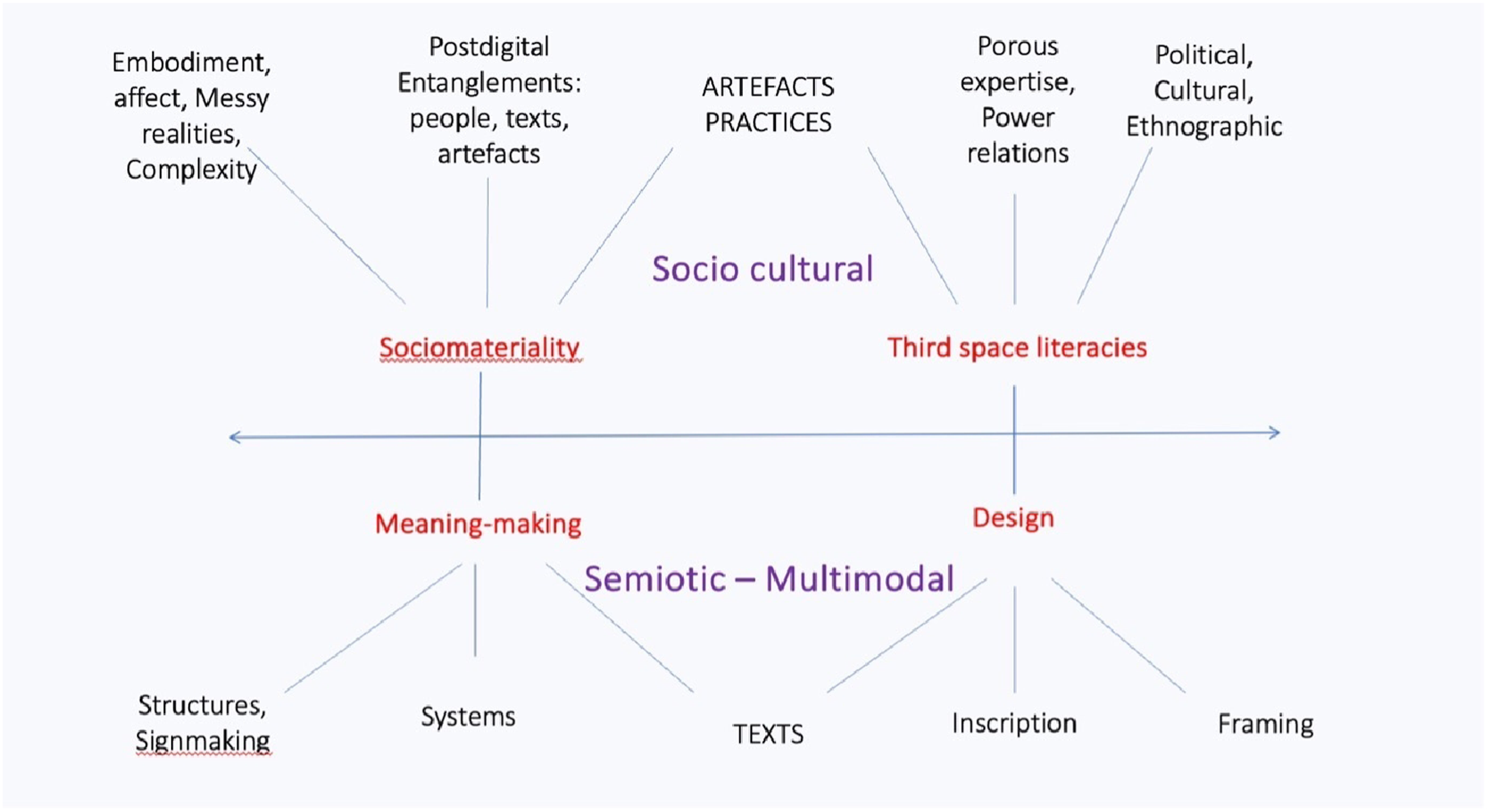
Kress proposes that ‘modes shape our encounter with the world and our means of re-making the world in semiotic entities of any kind’ (2011: 46). For him, ‘social semiotics’ is the prime theory of meaning-making for which ‘multimodality’ identifies the ‘field of work’ in a given context, and which requires that attention is paid to modes other than language in specific settings, communities and sites of meaning-making. The socio-cultural, in particular the turn towards materiality, is a partner in this process in the context of the digital, in which texts, practices and artefacts are constantly changing and adopting new readings and new ways of seeing and being in the world.
As we will see in the sections which follow, these ‘partnerships’ become important when we are working with children’s play, situated very much in the material world, and yet imbricated with the digital, even when there are no screens present. Its connection to community and past forms suggests not only consideration of the complex conditions around its production but also of space-time, emotional affect, and the notion of ‘placemaking’ (Strydom et al., 2018). This last concept can frame how children’s play potentially moves the locus of control closer to the child, by taking agentive control of space, in playgrounds perhaps, but also in homes, and we will see both in the examples which follow in later sections.
Without a form of analysis which accounts for the ‘more than language’ status of particular social phenomena, in this case, play and games, we cannot easily account for how the structures work to support or circumscribe their effect. Other work seeks to do this ‘partnering work’ with multimodality in other specific spaces, including that of social media, in the case of selfies (Zhao and Zappavigna, 2018), ‘tik-tok’ videos (Han and Zappavigna, 2023) or food blogs (Adami, 2018). In each case, there are questions raised about hegemonic practices with digital media which speak back to both power and advocates of participatory culture (Jenkins et al., 2006). The arguments that they make are enabled by entering a ‘field of work’ with an analytical frame drawn from multimodality, operationalising social semiotics, but with due regard for platforms, interfaces and the material circumstances of production.
Hackett’s work (2015) is of further importance and use here, in showing another way to draw on complementary lenses in analytical work, bringing sensory ethnography together with multimodality. In doing so, she simultaneously problematises the merger of social practice forms of analysis with more structural ways of describing communication which was previously called for by Pahl and Rowsell (2006). In work which is perhaps even closer to the playworlds in this study, this coming-together is addressed and operationalised by Wohlwend. Her research into the improvisatory nature of performance and composition in everyday play and creativity describes one version of the sought-after theoretical merger in the making of new meanings from the resources of media and popular culture (Wohlwend, 2015).
It is important to align the studies in this article with these newer paradigms derived from researchers who have answered Leander and Boldt’s previous criticism of multimodal methods as lacking a way to pay attention to affect and embodiment (2013). This means drawing further on the recent work of Rowsell who connects these issues to ‘making’ in the context of living literacies where there is time and space for children and young people to consider the ‘what if’ of everyday practices (Rowsell et al., 2020: 157). In the work in both projects, described below, we will see examples where, in the context of children’s games, as performed in living literacies, there is scope for this to take place and, in the context of the pandemic, where it further becomes a necessity in children’s play (Potter et al., 2024).
A note on ‘Examples’
Before moving into the project components and describing how the theory and method work in each of them, it is worth looking at the relationship between ‘examples’ and hypotheses. I am thinking here of how Gunther Kress employed examples in theory building with colleagues. Theo Van Leeuwen remembering his use of ‘knock-out examples’ wrote: ‘…‘example’ is not the right word … because these images were not examples of some ideas we had previously identified, they were the very source of our ideas and would, in time, continue to express these ideas better, more immediately, more visually, than the various paraphrases, or as Gunther liked to say, transductions, we would eventually produce.’ (Bezemer et al., 2019: 4, my emphasis in italics)
This idea of an ‘example’ directing attention and interest towards finding new ways of thinking about meaning-making in the social world is important. These are the images and videos to which we keep returning in our work because they establish the origin story of a way of thinking. This was true of how Kress worked in his theory-building and knowledge claims around multimodal analysis in much of his work. See, for example, the recapitulation of work on science textbooks which encapsulates how ‘examples’ can lead to theoretical and methodological origin stories and at the same time, provide an operational example which can be taken into the social world (Kress, 2011). In the sections which follow I will show how analysing meaning-making in children’s play by reference to both ‘in the moment’ multimodal analysis, together with ‘diachronic’ social theories around games, can produce work which speaks back to power and asserts the rights of children to be agentic authorities on their own lives. The projects are different, one from another, in the circumstances of the data collection but there are commonalities in outcomes around the complex nature of the ephemeral ‘play’ in question which allows us to raise hypotheses about the agentive meaning-making taking place.
Methodology and analysis: ‘Participatory Research’ in the context of play and multimodality
Having considered the role of multimodality in exploring the social world, and working in partnership with other framings, it is worth pausing to think about appropriate research methods. In the projects described later, ‘participatory research’ with children is the stated approach. This form of research engages children in an agentive way in exploring their own lives and draws on a tradition of empowerment and democratisation of the research process which connects to their wider expertise and interests (Fielding, 2004; Flewitt et al., 2017).
A question worth asking is: ‘How does participatory research work in practice? Or perhaps even: ‘ How participatory is it really?’ In earlier work in which children were reporting on their lived experience, in that case with technology in the home and school, researchers proposed, after Fielding (2004), that there were four levels of participation by children, ranging from minimal input to full agentive participation in the research design (Selwyn et al., 2010). At the lowest level, ‘Children as data source’, raw numerical data about children is added to a dataset without consultation or context. Examples of this would be assessment data gathered from the tests that children take which are subsequently used to create educational policy, without necessarily considering context. Children’s agency in the process is most restricted at this level, and they are absent from the process or the uses to which such information is put, though arguably they certainly experience its effects. In the second stage, ‘Children as active respondents’, they contribute to a dataset in which they are interviewed by researchers in a semi-structured way. They are more agentive in this process but still restricted in their freedom to design the process. In the third stage, ‘Children as co-producers’ they take part in the data-gathering process alongside the researchers, in roles as interviewers or filmmakers, but not yet overall project designers. In the final stage, ‘Children as co-researchers’, they can set the overarching question and the agenda for data collection. Figure 2 sets out the stages and locates the ‘Playing the Archive’ project on the scale of participatory research. Four levels of participatory research with children (Selwyn et al., 2010, after Fielding, 2004).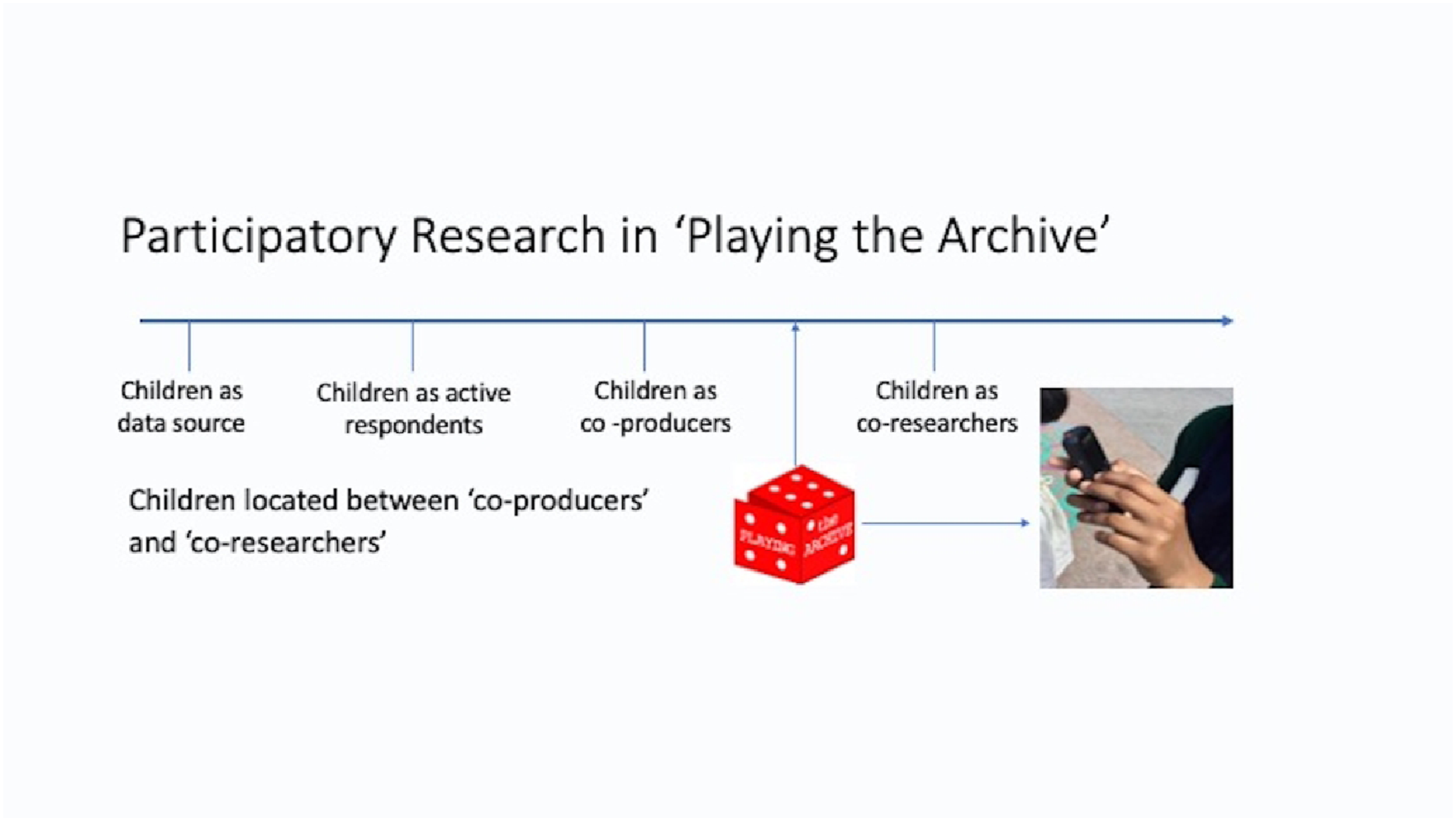
The concern we had in the projects in this article was not to overstate the level of participation which the children had. A systematic review of participatory research with children has established that there is exaggeration in some projects, along with a tokenistic approach to their involvement (Montreuil et al., 2021). Clearly, in our work, the research agenda was set by the project team and not by the children. They had little input into the overall research design or overarching questions. However, it differed from exclusionary academic modes of data collection in the engagement of children as ‘co-producers’ of research. In ‘Playing the Archive’ we trained volunteer groups of ten-year-olds in various data collection methods in their playgrounds in London and Sheffield, including the use of voice recorders for audio, and GoPro cameras and iPads for video. Using these devices, they could take the investigation into their own playground spaces with free rein to explore the games being played.
Having established the working parameters of the project, we were still leading the design of the overall research questions and methods. However, our child researchers had agency in how they carried out the work alongside the adult researchers, choosing their focus of interest, the duration of the recording, the style of interviewing, the ages of the subjects they worked with, and so on. The uses of these tools in these ways meant they could be located somewhere between co-producers and co-researchers, between stages 3 and 4 in Figure 2 in our characterisation of research participation (see also Potter and Cowan, 2020). In the later project, ‘The Play Observatory’ (Cowan et al., 2021) the situation was quite different, in the changed circumstances of play during the pandemic in which, due to lockdown restrictions, we could no longer directly observe children at play. As will be seen in later examples from that project, there were ways in which we attempted to mitigate the relative lack of child agency in data collection.
Turning to analysis strategies: in each case, we drew on the kinds of examples that became salient as we viewed and re-viewed the data, a form of ‘saturation’ which is more usually associated with transcriptional analysis. The rationale for our subsequent close viewing and multimodal analysis was that the meaning-making inherent in the play at a micro-level was dependent on a range of modes, including those of gesture and speech and that the rituals and rules of the social actors were best analysed by methods which allowed us to pay close attention to them. In drawing on multimodality as one of our key analysis tools, we were respecting the agency of the children as meaning-makers in and about their play. As we have outlined previously. In doing this we… ‘…recognised play as a socially situated sign-making activity in which players draw upon the many modes available to them for representing the meaning they want to express at a particular moment. As they play, children create ‘a momentary condensation’ (Jewitt et al., 2016) of their social experiences including family practices, local folklore, school curricula, global media and the traditions of the playground. Traces of these experiences and interests become apparent as children draw moment-to-moment, rapidly and readily, on the multiple resources available to them in their play.’
Working in tandem with conventional thematic analysis of transcripts, our coding enabled us to further refine our detailed analysis of key episodes of play which would, in turn, become our theory-building ‘examples’. Although circumstances were inevitably very different in ‘The Play Observatory’, the working methods of exploring content using fine-grained multimodal analysis on key contributions in combination with thematic coding still sustained the overall analysis. In both cases, they enabled us to provide a ‘thick description’ (Geertz, 1973) of their play which respected children’s place as agentive social actors (James, 2009). The following section presents an overview of ‘Playing the Archive’ and its contribution to theory-building around play and agency, drawing on multimodal analysis and forms of participatory research.
‘Playing the Archive’ 2017-2019: Community and belonging
‘Playing the Archive’ was a 2-year research project in the UK, between 2017-19, directed by Prof Andrew Burn in London at the UCL Institute of Education, and Prof Jackie Marsh at The University of Sheffield. The ‘archive’ in question was the collection of children’s games assembled by Peter and Iona Opie over many decades, from the end of the Second World War until the end of the 20th century (Opie, 1994; Opie and Opie, 1959). It was funded by the Engineering and Physical Sciences Research Council (EPSRC) with three key objectives: digitising parts of the archive, aligning them with new technologies and contemporary playground ethnographies, and representing the games of the past and present using new technology, including augmented reality. In one of the work packages, Kate Cowan and I explored children’s contemporary play and games in two London playgrounds, alongside child researchers who had been recruited to carry out the work in ways described in the previous section. We have written about some of the examples from this project in previous work which highlighted the sophisticated meaning-making practices of the children and drew on multimodal analysis of key incidents (Potter and Cowan, 2020).
Data Collection in ‘Playing the Archive’ (see also Potter and Cowan, 2020).
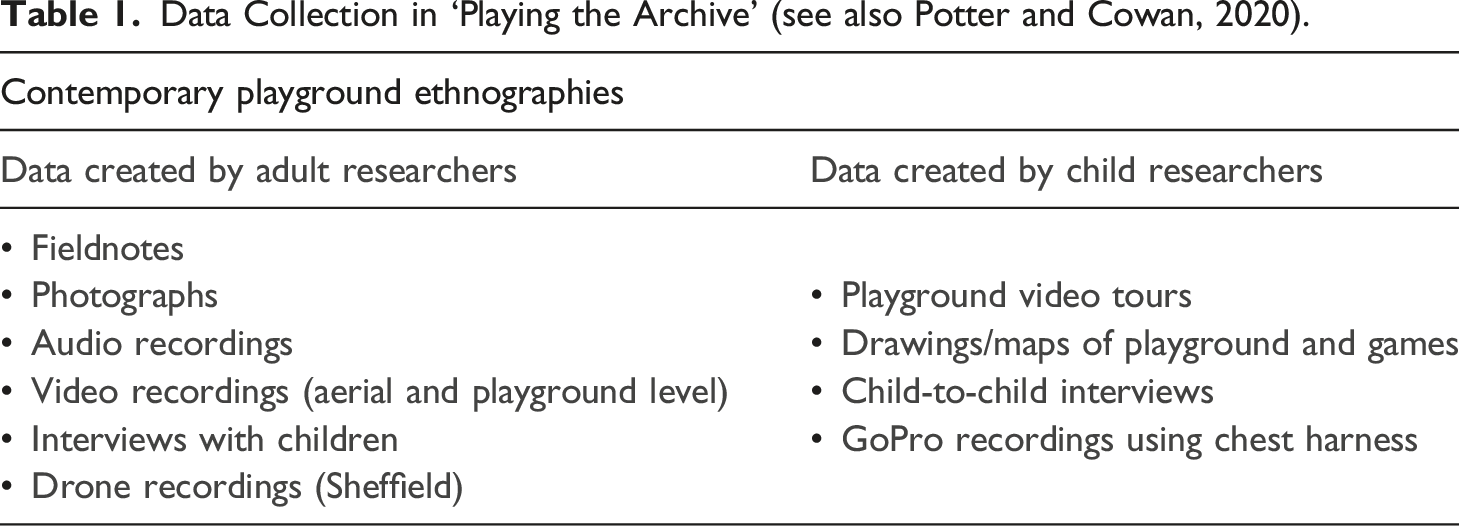
During the project we regularly visited the London schools, enabling child-recorded videos and audio interviews live in the playground, alongside our data collection. In this, we were practising a form of ‘focused ethnography’ proposed by Knoblauch (2005) in which shorter-term, frequent, highly focused visits to research sites generated alterity, particularly in the use of audio-visual recording. One of our earliest explorations was of the empty playground space, surveyed by child-led filmmaking. iPads were provided for members of the child research team to record the space and outline the use of space in pairs, accompanied by an adult researcher who prompted but did not direct the activity. These videos represent a form of live placemaking in the space, detailing the spaces of the playground and their uses of playground equipment, the quiet area, the football pitch, the games area, the pirate ship and more. The children provided us with initial expert knowledge of the space and guided us into what we would be looking at and for when we began playtime observations: quiet play areas, clapping areas, running games, organised games and more.
Examples of specific pieces of data which enabled ‘theory-building’, in the sense outlined earlier in the article, were subsequently drawn from all of the available kinds of data. These were explored, where appropriate, using multimodal discourse analysis, paying attention to specific and varied modes of meaning-making between participants. The sections below provide some illustrative examples of combinations of multimodal analysis and theorising about the social worlds of play.
Example 1: Modes of gesture and gaze
Clapping games provided us with a great deal of material which substantiated earlier research into the Opie archive and hypotheses around the transmission of traditional rhyming forms. One example in particular concerned the appropriation of the structure and form of an older clapping rhyme (a rhyme called ‘Lemonade’) into a new form in which the words were changed to practices of chatting and phoning, with an iPhone eventually running out of charge (‘my battery’s dead/FREEZE’).
We have written about how digital media technologies, in this case, the iPhone became imbricated in the performance of the play, and how they… ‘…demonstrate children’s making and re-making of clapping rhymes in the playground. The children took the core elements of a traditional, well-known clapping game and re-mixed it by adding referents to the global popular culture they were familiar with outside the playground. This re-making shows traces of their interest in new media and their readiness to create and invent with what is readily to hand.’
In this example in addition to the analysis of the speech and rhyming patterns provided in earlier analysis, we can add exploration of the modes of gesture and gaze to uncover moments of learning of the new game. Figure 3 (above) shows the combinations of modes of gesture and gaze in the performance of ‘iPhone Rhyme’ and the positions and gaze of the children learning and transmitting the game. Aisha, on the left, is teaching Zara on the right. The girl in the centre is concentrating hard on Zara’s hands and her gaze is fixed on this aspect of the game. A new viewer steps into the frame and completely blocks the view of the girl who is watching. She moves to the right of the frame and adopts a new viewing position with her gaze only momentarily broken by the obstruction Figure 3. Gesture and Gaze in the iPhone Rhyme ‘Playing the Archive’ Dataset HPKC2018-05-17v002.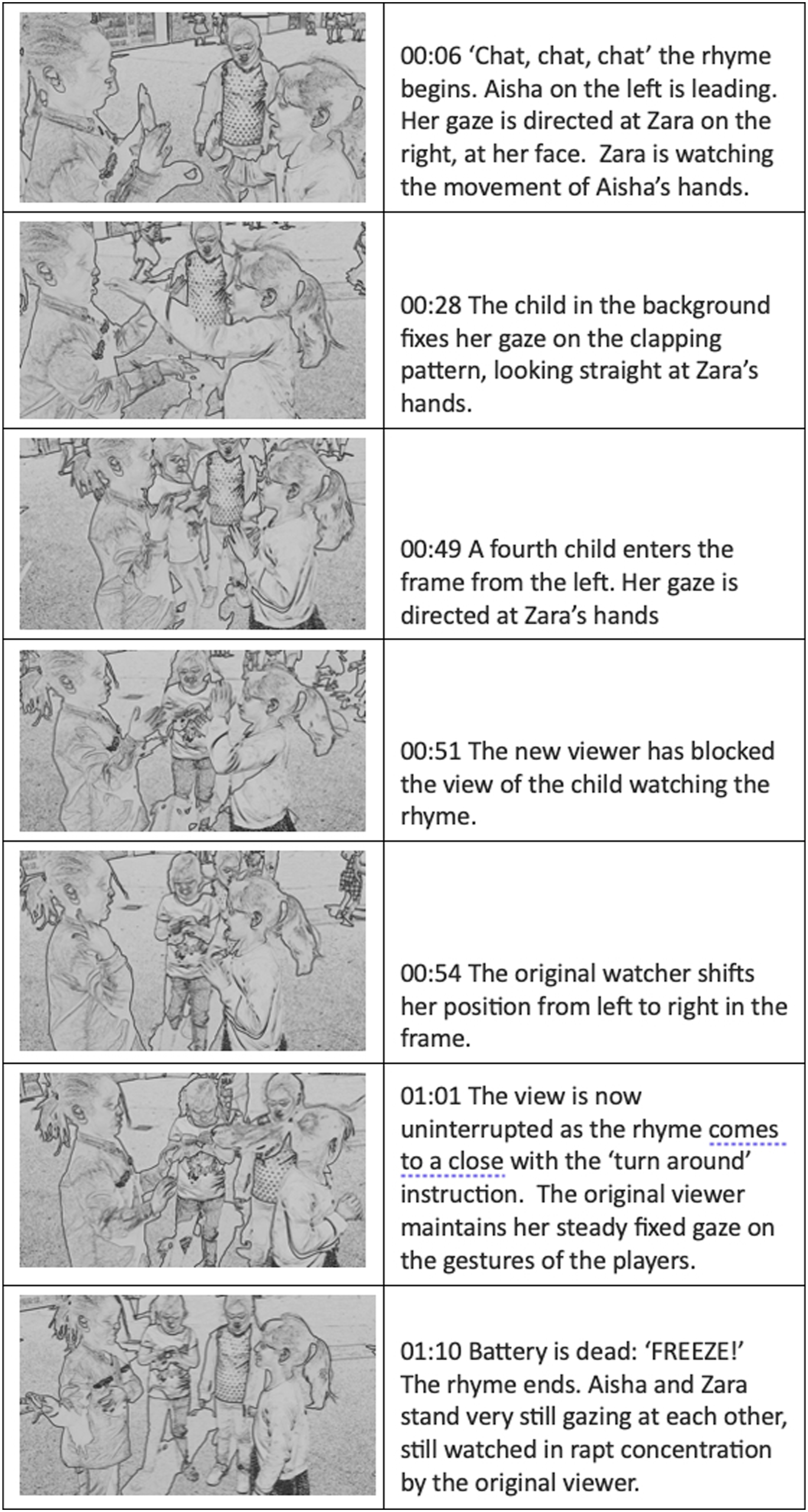
The patterns are established from rhyming games through many decades in playgrounds, and we know from earlier studies of playground games (Burn and Richards, 2014; Marsh and Bishop, 2013; Opie, 1994) that children learn them from each other in a process of cultural transmission. Multimodal analysis, focusing on the modes of gesture and gaze, has enabled us to see into the moment-to-moment transmission of a newly composed game from the resource and structure of an older rhyme. This one is inflected by a media artefact and learned through studied concentration on gesture and performance by audience members.
This theory of transmission was further supported by our multimodal analysis of a game in an earlier stage of composition, in which children were improvising within the rhyming pattern. This one, ‘Bluetooth’ named a series of technologies and artefacts alongside TV shows and mentions a friend doing a cartwheel just out of view. This new rhyme is not yet fixed but it is evolving in the performance of the play. The child doing the composing and designing of the new rhyme is Aisha, this time with a different partner, Saleha. In the sequence in the table below we follow her gestures as before but this time because she is composing and drawing on resources from her immediate surroundings and the vitality of events around her, she breaks her gaze momentarily and the game starts to collapse under the weight of the invented words and seemingly random associations with TV shows Figure 4. Gesture and gaze in ‘Bluetooth’ ‘Playing the Archive’ dataset HPKC2018-05-24v013.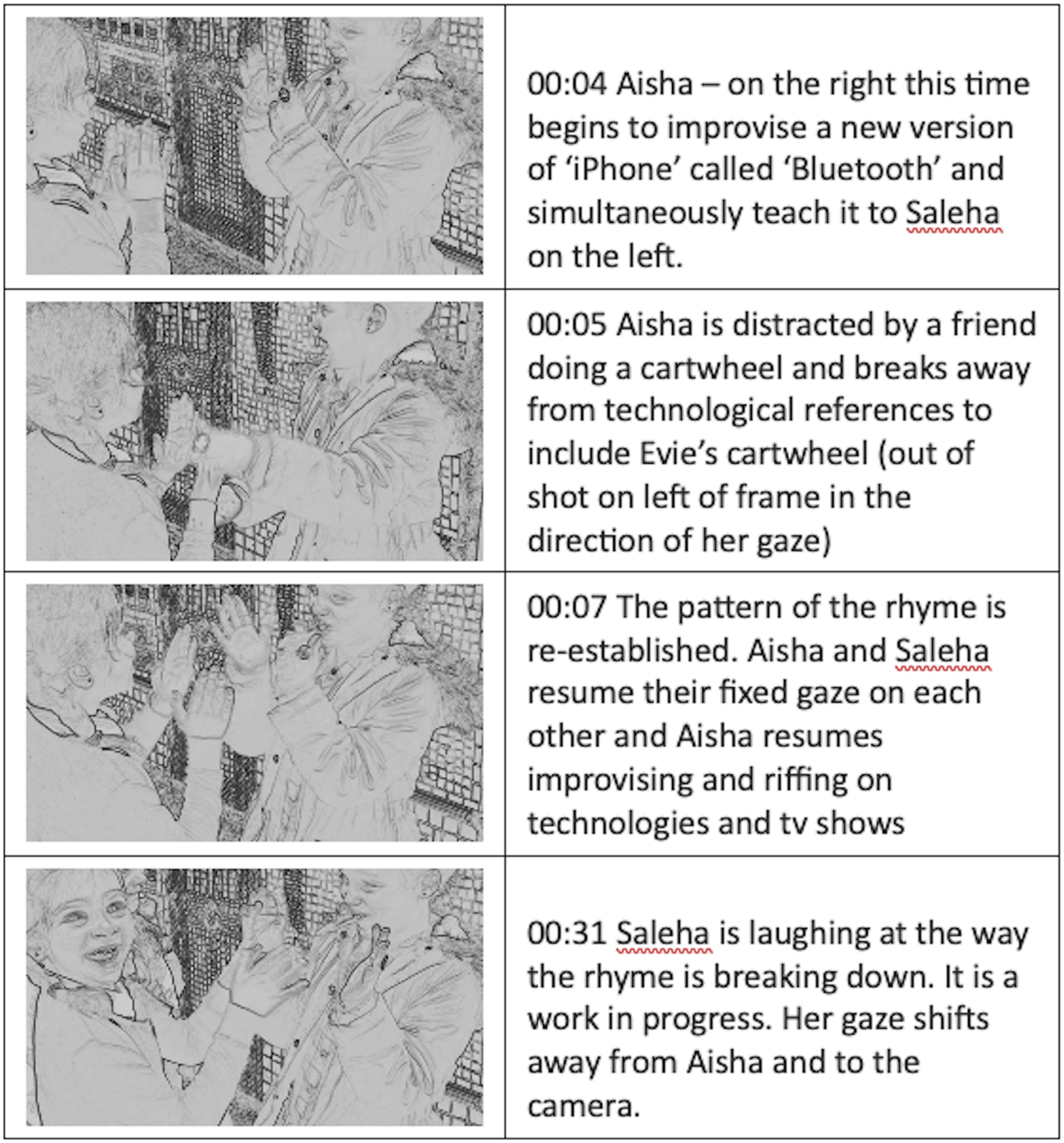
Kate Cowan coded all three of the lyric sets side by side in the following image, in Figure 5, with the earlier form of the rhyme, ‘Lemonade’ on the left, the iPhone version in the centre, and the emergent version, ‘Bluetooth’ on the right. Coded comparison of rhyming structures in three clapping games (from Potter and Cowan, 2020: 7).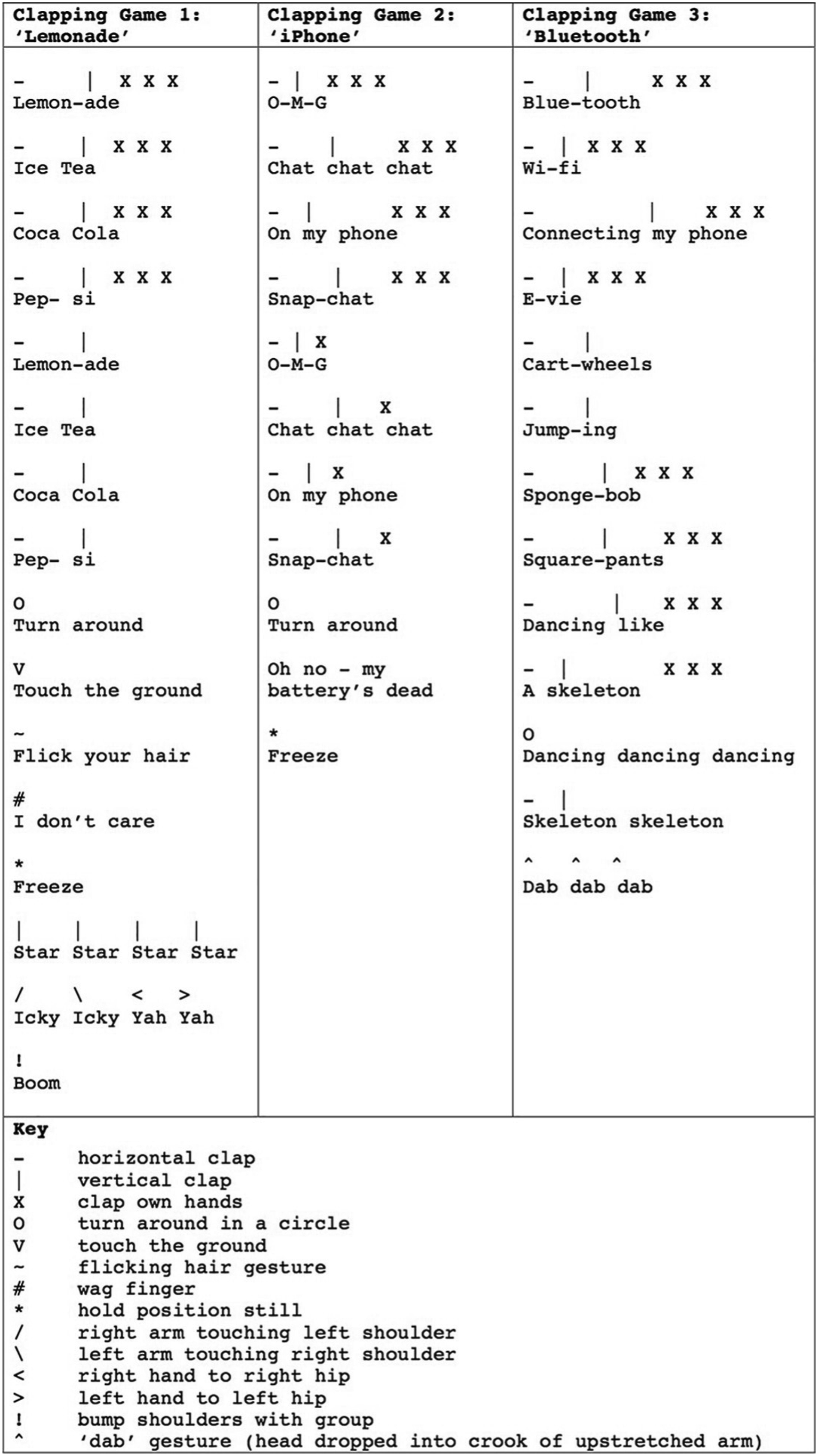
Unpacking these structures in the learning of the new game allows us, on one level, as outlined above, to explore how games are transmitted in children’s play. At another level the granular analysis provided by multimodality allows us to see specific meaning-making resources work intertextually with one another, speech, gesture and gaze, to create new resources drawn from everyday technology (Bluetooth, wifi), the immediate environment and relationships (the naming of the friend doing the cartwheel next to the rhyming game), combined with the popular cultural reference points of broadcast media (Spongebob Squarepants), ending with the positive affect and ephemerality of play itself (Dancing, dancing). We came to theorise these parts of play drawing on ‘laminates of experience’ and a further example below underlines this with a focus on another mode, that of speech.
Example 2: Dynamic changes in modes of speech
The mode of speech in performance in the data provides a further example of paying attention to meaning-making in the ‘Playing the Archive’ data. One of our key areas of exploration with children was around what Sutton-Smith (1997) characterised as phantasmagorical or ‘dark play’. Like many old school buildings, the London school was haunted by the figure of a ‘Green Lady’. This was a matter of folkloric imagination drawing as much on the resource of the spaces and affordances of the dark school staircases as on the shared history in the place, handed down over many decades. ‘The Green Lady’ despite the colourful name was a character of indeterminate appearance, a shapeshifter defined entirely through imaginative discourse and phantasmagorical play, and created anew each time the story was told. With their voice recorders in hand, our child researchers were unfettered by the need to carefully frame videos and could move freely around, pointing voice recorders in the faces of their peers and asking questions about the ghost. As we listened back to these recordings, we detected speech inflexions, changes in accent and intonations redolent of TV reporters, YouTubers and/or investigative podcasters. This short passage from one of the child-led interviews, improvised without an explicit schedule by the children themselves, is italicised where the accent changes from a more formal TV interview style to a social media reporter… ‘C1: Today we want to interview with the Green Lady. Hello Green Lady C2: Hello C1: Oh, I paused it (laughs) Tell me Green Lady, what did you do today? C2: Er, I don’t really know C1: (Quietly) You say, ‘Oh, what I had for lunch – blood’ C2: OK, you asked what I had for lunch? Blood C1: What! I didn’t ask her- Ah! She’s running away. We have to get the Green Lady. We’ve even found the actual Green Lady and today we are gonna meet her. You’re gonna be so excited everybody to see the Green Lady…’ (‘Playing the Archive’ dataset interview HPHC2018-06-14a008)
The screenshot below in Figure 6 shows partial coding of the transcript in NVivo with categories related to our exploration of ‘dark play’: Blood, colour, emotion and more…The thematic analysis runs alongside the multimodal analysis and provides us with valuable additional interpretive evidence with which to take our analysis forward. Nvivo coding map for ‘Playing the Archive’ Dark Play dataset interview HPHC2018-06-14a008.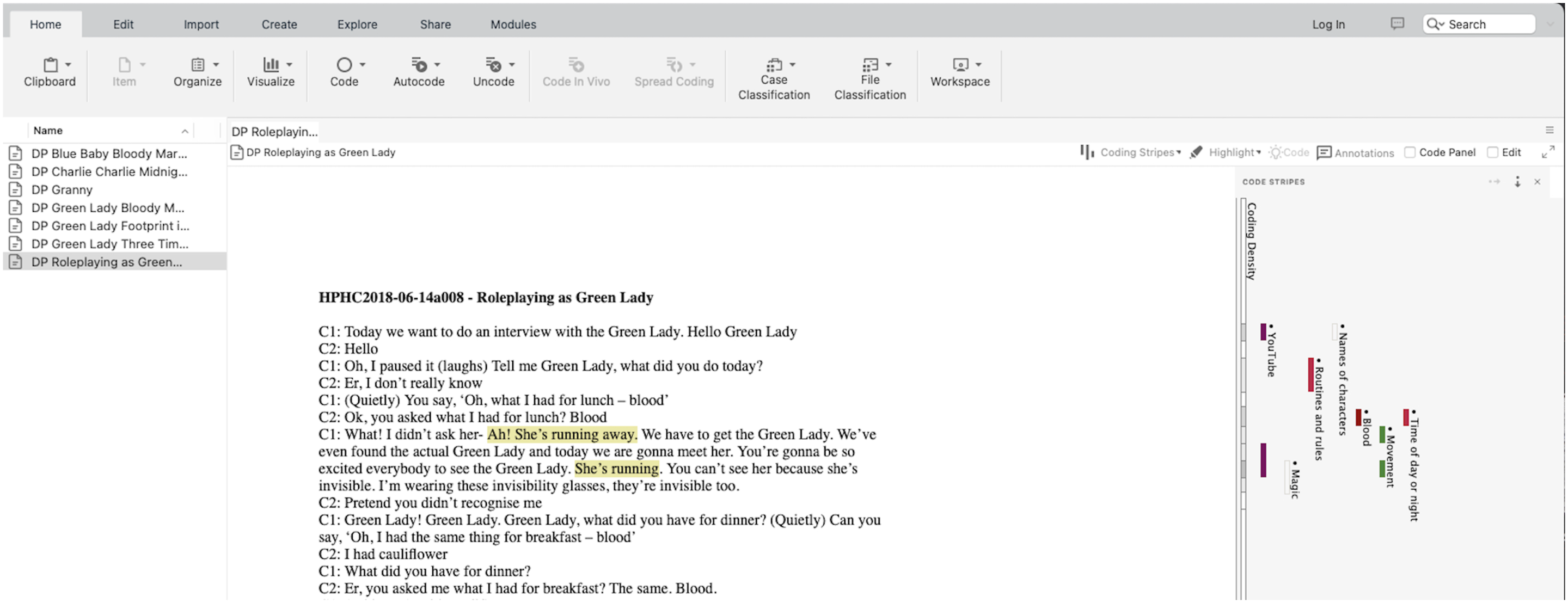
Once again, media plays a role and is imbricated in the social worlds of the children at play. His role only becomes apparent by paying attention to emphasis, intonation and expressive emphasis in the mode of speech. The social media role reporter roleplay is embedded in the play, a cultural touchstone on which to draw when listening back, with the research itself becoming part of the play, flattening the hierarchies between researcher and researched, generating a ‘third space’ of meaning-making between them (see also Hawley and Potter, 2022).
In the ‘Playing the Archive’ dataset there are many hours of video and audio recordings of similar incidents from which these examples are drawn. Together with drawn images, still images and playground maps they provide a rich repository, demonstrating the inherent vitality and invention evident in contemporary playground games. As noted above, we came to view these instances as evidence of children’s ability to draw moment-to-moment in their play on different ‘laminates of experience’ as resources for meaning-making… ‘…’ Lifeworlds’, ‘Folkloric imagination’, ‘Play as media remix’, ‘Community and belonging’ (operating) in the space of the playground in different ways at different times but …frequently co-present in the production of meaning therein. They operate in a process of ‘lamination’ in which the laminates retain ‘some of their original distinctiveness, although in a different configuration’ in the words of Holland and Leander, who were writing about ethnographic studies of hybridity and subjectivity (2004: 131). Each contributes in different proportion in different situations to the creation of meaning in the moment of play.’ (Potter and Cowan, 2020: 13)
Our next project aimed to collect more evidence about children’s agentive activity in the ephemeral worlds of play, but in changed circumstances in the years immediately following ‘Playing the Archive’.
The play observatory: Placemaking and agency during the pandemic
Inevitably, the lockdowns which were mandated during the COVID-19 pandemic in the UK and in other parts of the world had an impact on children’s play. With play enshrined in Article 31 of the United Nations Convention on the Rights of the Child (1989) and extensively linked to well-being in the research literature (Cowan, 2020), the study which became known as ‘The Play Observatory’ was funded by the Economic and Social Research Council (ESRC) under the UKRI Rapid Response with a key objective to explore this impact further. Once again, as in the previous project, the research team was made up of staff from the UCL Institute of Education, and Sheffield University and led by Author. On this occasion, however, there were two important changes to the focus and methods of data collection. Firstly, with the team in Sheffield led by Dr Yinka Olusoga, a historian of childhood, the emphasis on the creation of an archive for use by future generations was a major driver. Secondly, in terms of data collection, there could be no site visits due to lockdown restrictions. All the data had to be collected remotely and the team itself had to work in this way. Whilst I led and had an overview of the whole project, team members in both universities took on different parts of the work. The Sheffield team led the creation of the main online data collection instrument (Olusoga et al., 2022) attending carefully to child-friendly prompts and graphics, whilst at the same time creating the infrastructure for the archive of pandemic play. In constructing this they worked closely with Dr Valerio Signorelli of the UCL Centre for Spatial Analysis (CASA). To deepen our understanding of what emerged in the survey the UCL team designed follow-up online interviews with participant families, sampled to represent a range of ages and locations from among those who indicated a willingness to participate (Cowan et al., 2022). Dr Michelle Cannon also organised online workshops for any participants who wished to make further filmed responses to their lived experience of the pandemic (Cannon et al., 2023).
Throughout, we were guided by the following research questions: • How have children been playing during the COVID-19 pandemic (both online and offline, analogue and digital) from the initial outbreak of the virus, throughout lockdown and during ongoing social distancing? • How has the COVID-19 pandemic featured as a point of reference in play and peer culture, and what insights does this give into children’s unique experiences of it? • What continuities and discontinuities does this play and peer culture have compared to those of the past, and between different communities? • How can interdisciplinary perspectives help us better understand the role and value of play for wellbeing during times of crisis?
The survey collected almost a thousand instances of images, videos, drawings, and text commentaries of play during the pandemic, mainly from the UK, but also from Australia, Singapore, Cyprus and Germany. This was supported by 10 in-depth interviews over Zoom with different families and a video workshop which produced a further four examples of children’s video productions based on their experiences. We have analysed many of these and work is ongoing (Bishop, 2023; Cannon et al., 2023; Cowan et al., 2021; Olusoga, 2024; Olusoga et al., 2022, 2024; Potter and Cannon, 2023; Potter et al., 2024). Bearing in mind the earlier definition of ‘example’ as a key piece of data redolent with ‘theory-building’ potential (Bezemer et al., 2019) I want to link a key piece of data with the findings from ‘Playing the Archive’.
Example 3 Covid Gone – high modalities and intertextuality
‘Covid Gone’ was a 2-min long film submitted by a 10-year-old boy and his parents to the Play Observatory. It was filmed during the first lockdown in the UK in the summer of 2020.
It works on many levels and has produced a marked emotional affect on audiences at conferences and in seminars where it has been screened. The boy uses the film to explore his emotions around lockdown by juxtaposing images of locked playspaces and schools outside the home as well as empty streets with text appearing on screen. The visual design of the film is drawn from ‘lyric videos’ in which = song or rap lyrics appear over images as highly stylised subtitles. Underlining or undermining the images through intertextual meaning-making from the resources of the chosen image and the words he speaks. A full second-by-second analysis of the whole film is outside the scope of this paper, but selected shots in Figure 7 sample both lyrics, directed gaze and framing of the shots. As we have noted previously: ‘Two sets of repeated phrases run through the rap. The first of these is the couplet of ‘Worse than Terminator / Corona the new Exterminator’ and the second is ‘It’s not a rap / It’s not a rhyme/ It’s just things happening over time’. Explicit reference to naming the havoc wreaked at that point by the virus, by reference to popular culture, is in the first couplet, and the attempt to get to grips with the production and purpose of the piece is encoded in the second.’ (Cannon et al., 2023: 4) Sample gaze, text and exterior frames in Covid gone https://youtu.be/yolGe6UT3_w © play observatory. 2023. PL56C1/S001.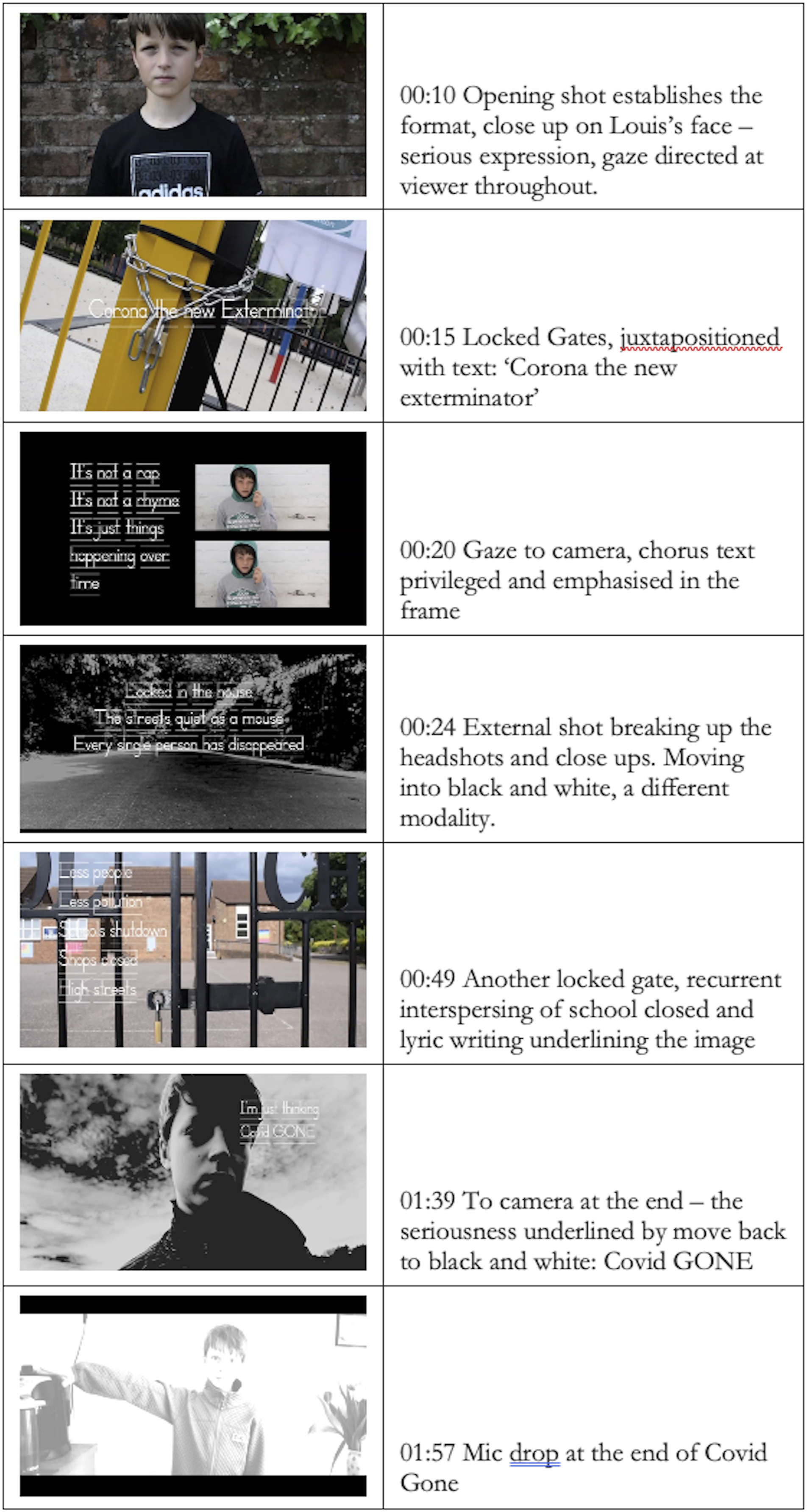
The way the images work with the text draws attention to the states of confusion and disruption to the daily life of the experience of pandemic play, the jarring nature of the silent streets and locked gates, the loss of amenities and, for him, the ability to play football with his local team. The boy gazes straight at the camera/viewer in almost all the shots where he is onscreen, speaking the verses to the camera or in voiceover, his expression serious and his concerns lie beyond his immediate situation, thinking of people who are sick and dying, whilst at the same time representing all the things he used to do.
If we look at the shots in the context of the previously identified ‘laminates of experience’ we can find them in how this expressive content is presented. The repeated motif of the face-to-camera draws attention to the creator of the rap as a thread running through the whole thing. This is the ‘lifeworld’ as it is currently experienced. The ‘folkloric imagination’ he draws on is contemporary culture, ‘worse than Terminator/Corona the new exterminator’. ‘Play as media remix’ is evident throughout as he draws on the form and function of the rap video, from the lyric video itself to the ‘mic drop at the close of the piece in the final frame in the table in Figure 7, bottom left. ‘Community and belonging’ are referenced throughout in the images of family in the main video and the inclusion of street scenes, and school gates underlines in their intertextual juxtaposition with the lyrics, the sense of disruption and loss. Some continuing thoughts follow on how multimodal frames of analysis and sociocultural theorising about play work together in these research projects.
Multimodal analysis and sociocultural theory in researching the social worlds of play
In many ways, Playing the Archive provided us with a template, a lens through which to explore children’s play which, in the tradition of the Opies, we carried forward into the Play Observatory, despite the reduced opportunities for interaction during periods of lockdown. The research process itself may have become necessarily distant from the participants but we still had the figured worlds of childhood front and centre in the construction of the dataset, whether it was through the survey, the interviews, or our analysis of the filmed data.
In thinking, then, about how multimodal analysis has allowed us to hypothesise about the process of meaning-making in these differing circumstances of play, what theories are important to build partnerships between multimodal discourse analysis? A provisional list would arguably need to take in the new sociology of childhood, children as agentive beings and not simply developmental ‘becomings’ (James, 2009), along with studies of play and agency derived from detailed play research reviews as well as well-known theories in the field (Cowan, 2020; Sutton-Smith, 1997; Whitebread et al., 2017). We have also seen how earlier socio-cultural studies of children’s play, of children as producers of culture connecting past, present and future forms of play are relevant to understanding what we see, as well as in directing our research designs and interests (Burn and Richards, 2014; Marsh and Bishop, 2013; Potter and Cowan, 2020). The originators of valuing children’s contributions to play are arguably the Opies (Opie, 1994; Opie and Opie, 1959) and these are joined by researchers who seek to value children as makers and producers of popular culture in their own right (Cannon, 2018). Moving further in this direction we would need to consider theories of media effect, production and representation (Buckingham, 2003; Hall et al., 2013) but for these projects, it has also been important to consider how children are part of a network of relations between bodies, texts, practices and artefacts (Burnett and Merchant, 2020). We have arguably demonstrated children’s imbrication with media resources and technological artefacts, in their postdigital relations to knowledge and experience (Jandric et al., 2018), in this case, their commonly held knowledge of play and we have begun to see how these episodes of play in the pandemic provide us with new methodological and theoretical directions, combinations of affect and embodiment which we are now exploring further (Olusoga, 2024; Potter et al., 2024). These place analyses of episodes in alignment with both posthumanist and postdigital thinking, building on the calls of Pahl and Rowsell (2006) and Burn (2009) for mergers of both structural and sociocultural theories.
Finally, the approaches in these projects are further aligned with resistance to disciplinary silos. When faced with the kinds of data we collected, and given the relevant positionings of the researchers, maintaining discrete forms of analysis would not have enabled us to work in an interdisciplinary way, to engage in what we are doing now, seeing episodes from multiple viewpoints, ‘stacking stories’, to borrow a further concept from Burnett and Merchant (2019). In the work of both projects, we positioned multimodal discourse analysis not only as a tool for approaching the ‘mess’ of the social world (Law, 2004) but as a tool to think with, to allow us to dwell in a position of ‘unknowing’ in a ‘third space’ (Hawley and Potter, 2022; Vasudevan, 2011). Arguably this is what is needed in ongoing learning from the kaleidoscopic vitality of children’s play (Opie, 1994) and in their participation as researchers in both ‘Playing the Archive’ and ‘The Play Observatory’. Multimodal discourse analysis, partnered with emergent sociocultural theory arguably opens the door for theory building in apparently simple play episodes which are complex social settings in which social actors of all kinds are imbricated and entangled with the digital, with media and popular culture, and with the contemporary modes of meaning-making.
Footnotes
Acknowledgements
I would like to thank the co-researchers and collaborators on both projects for their expertise, insights and good company in the field (the playground), and online. At UCL: Dr Kate Cowan, Dr Michelle Cannon, Dr Valerio Signorelli, Prof Andrew Burn, Prof Andy Hudson-Smith, Dr Duncan Hay. At Sheffield: Prof Jackie Marsh, Dr Yinka Olusoga, Dr Julia Bishop, Dr Catherine Bannister, Prof Helen Woolley. In both projects, I would like to thank the children, parents and carers for their insights into play and their active participation in the research.
Declaration of conflicting interests
The author(s) declared no potential conflicts of interest with respect to the research, authorship, and/or publication of this article.
Funding
The author(s) disclosed receipt of the following financial support for the research, authorship, and/or publication of this article: The author acknowledges the following source of funding for these projects: For Playing the Archive: UKRI EPSRC Award number EP/P025730/1 and For The Play Observatory: UKRI ESRC Award number ES/V015451/1.