



Abstract
People’s experience of interacting with the built environment, such as entering a building, varies depending on how the environment is designed. For instance, a set of steps may be tackled without conscious thought by one person while they may prevent another person from entering altogether. Such processes mean that people are being categorised in different ways. The aim of this article is to add to our knowledge of how the built and designed environment, as semiotic resources with social meanings, variously constrains and enables individuals’ participation in society, based on categorisation. Data is collected using a citizen science approach, whereby people have been invited to submit photos and comments about their experiences of the physical environment. This data is analysed using Spatial Discourse Analysis and theories of embodiment. The analysis shows how equivalence, marginalisation, and hegemonic negotiation variously inform people’s sense-making of the physical environment as a multimodal resource. The article uses this analysis to expose unspoken norms in the physical environment and to extend Spatial Discourse Analysis. It argues that multimodal analyses of the physical environment need to further consider the situated materiality of the interaction between people and the environment by accounting for individual variance.
Introduction
Entering a building such as the one depicted in Figure 1 involves taking a few steps and opening the door to the right. This might be something that you have done many times before and, apart from perhaps a brief thought about the red carpet – such as thinking that it adds a glamorous touch to your entrance or that its slightly scruffy look makes you apprehensive – you may not think twice about your act of entrance. Picture of an entrance to a hotel. Submitted anonymously to the research project.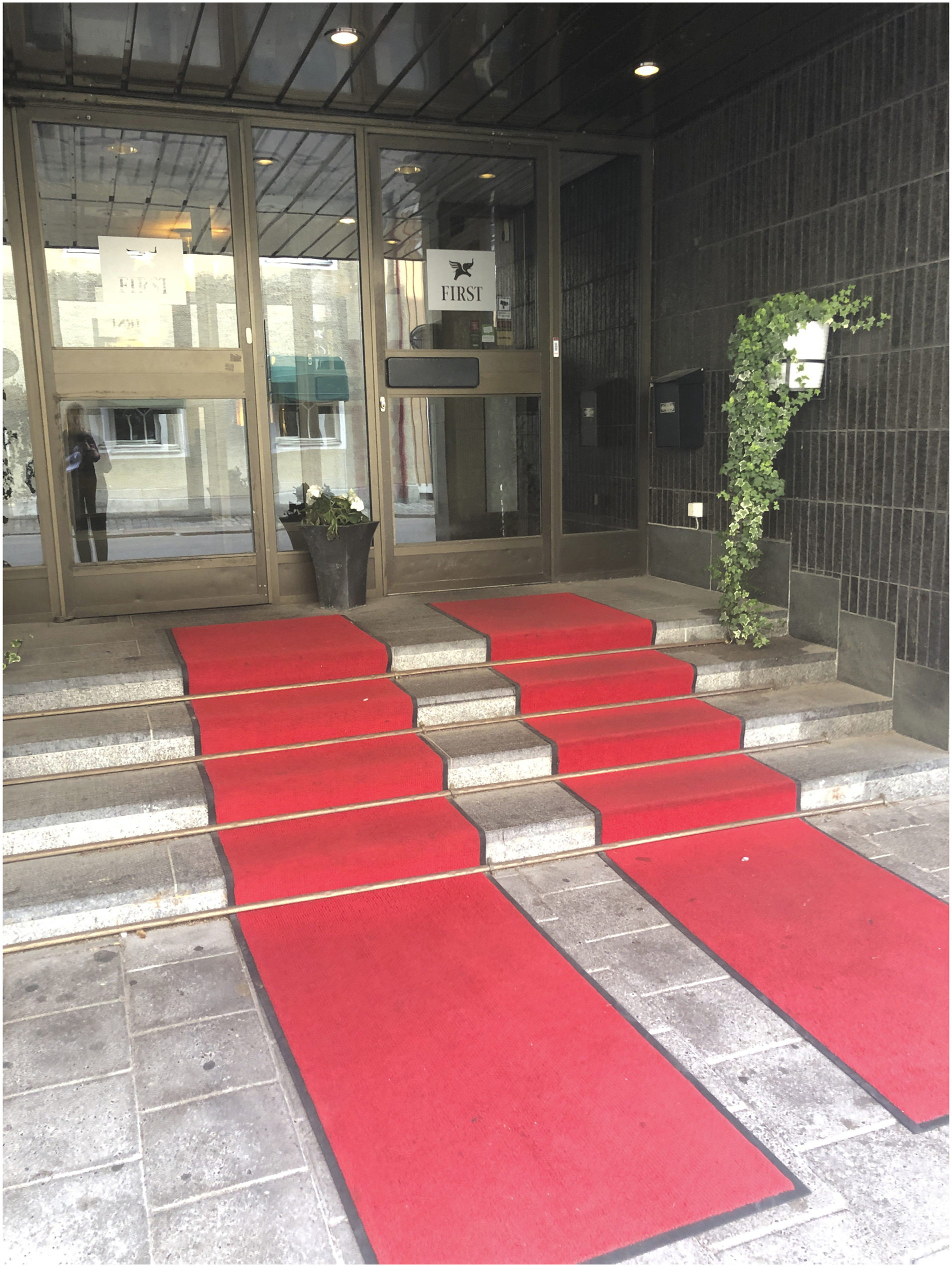
However, if you are dragging along a heavy wheelie bag or pushing your child in a pram, entering the building might make you flustered and mutter something like “apparently parents aren’t supposed to stay in hotels” while attempting to manoeuvre the pram up the steps. In the words of Teju Cole, “we can feel the way architecture acts on the body” (Cole, 2021: 204). Even more so, if you are using a walker or a wheelchair, you will realise that it is actually impossible for you to enter this building.
The designed and built environment – that is, anything from entrances and zebra crossings to playgrounds and office blocks – is constructed based on ideas about who is going to use a particular environment and how. As part of this, norms about people heavily influence design and building processes and the finished results (Imrie, 1996). This, in turn, will form part of very different experiences for individuals who are attempting to go about their daily lives. Categorisations (such as “a parent”, “a wheel chair user” or “someone not actually welcome here”) are a crucial aspect of these experiences. This includes the feeling of not being categorised at all (as in the opening paragraph of this article), which can be seen as a privileged position, or, conversely, as something that ought to be everyone’s experience. In this article, categorisations are seen as multimodal and social-semiotic (Kress, 2010), that is, as involving people’s meaning-making of multiple built and designed resources.
Against this backdrop, the aim of this article is to add to our knowledge of how the built and designed environment, as semiotic resources with social meanings, variously constrains and enables individuals’ participation in society (Denvall and Iwarsson, 2022), with Sweden as a case in point. In doing so, the article acknowledges the importance of the body (e.g., Bucholtz and Hall, 2016), to extend the framework of Spatial Discourse Analysis (SpDA) (Ravelli and McMurtrie, 2016) in order to more intently account for embodiment. Thus, a more specific aim of the article is to extend SpDA with theories of embodiment as a way of accounting for human variation in relation to the built and designed environment. SpDA has been chosen precisely because of its fine-grained approach to the built environment, allowing a social-semiotic analysis of “how the built-environment means, and how we are affected by and respond to the built-environment” (McMurtrie, 2020: 67). This is of particular importance to the present study as it emanates from a transdisciplinary collaboration between Linguistics, Design Sciences, and Architecture (Ericsson et al., 2020; Müller et al., 2021).
The aim is achieved through an investigation of people’s meaning-making of multimodal resources in the form of built and designed elements in everyday settings. Data is collected through a citizen science approach, whereby people have been invited to share their experiences of the physical environment. The research questions are: How do people read the built and designed environment as categorising themselves and others? How can such categorisations be understood?
The article argues that multimodal analyses of the built and designed environment need to further consider the situated materiality of the interaction between people and the environment, which, in turn, means accounting for individual variance and exposing normative assumptions in the designed and built environment.
Embodied understandings of the built environment
This section develops a theoretical frame based on categorisation, normativity, and space and embodiment.
Categorisation
In this article I use categorisation as a meaning-making lens through which I approach people’s understanding of the designed and built environment. At its most basic, categorisation means the sorting of people into different groups, based on some criterion. In relation to the built environment, categorisation is one way in which people are invited to engage with the environment in varying ways.
The analytical use of “categorisation” rather than “category” highlights the active processes that are involved (Hornscheidt, 2009). As part of such processes, categorisations are always made to and by someone, as opposed to already existing prior to social interaction. In the case of the designed and built environment, categorisations occur in a complex web of choices made by architects and builders, the characteristics of a particular individual and the specific circumstances of an individual’s encounter with the environment (see the example of the hotel entrance in the introduction).
Another aspect of categorisations as active processes is that multiple categorisations are possible in any given situation. For instance, experiments in social-cognitive neuroscience indicate that people seem to be able to categorise each other in different ways depending on the kind of information they take into consideration (Wheeler and Fiske, 2005).
In addition to being active and multiple, categorisations value certain perspectives and silence others, which means that some individuals are advantaged by certain categorisations while others are disadvantaged (Bowker and Star, 1999). Finally, categorisations are often being made in an invisible way (Bowker and Star, 1999), which is what justifies an analytical uncovering of categorisations in actual settings.
Normativity
Human beings share certain traits but also differ from each other. Ideas about similarities and differences form the basis of categorisations of people. However, human variation can be conceived of in starkly different ways. A prevailing way is to assume a norm. With the idea of a norm comes the notion that “the majority of the population must or should somehow be part of the norm” (Davis, 2017: 3), which attaches positive values to the norm and renders it desirable. With regard to categorisations, in the Global North context of Sweden, norms have been attached to gender (a male norm, a cisgender norm), sexuality (a heteronorm), bodily measurements and abilities (a norm of ablebodiedness), race (a whiteness norm), and so on.
Within architecture, Le Corbusier’s (1948) modulor is perhaps the most clear-cut example of normative thinking, whereby the modulor is a representation of an assumed human universal norm in the form of a man whose measurements, in turn, determine the measurements of the built environment. Such a norm becomes particularly problematic in that it conceals all actual human variation. As Sandström (2019: 34) succinctly puts it, “Although the ‘user’ was conceptualized as a universal urban dweller without age, gender, ethnicity and belonging to no social class, it was however often depicted with the particularities of the male, adult, physically able body, which became universal”.
Now, the assumption of a norm simultaneously creates an assumption of deviation. That is, the norm and the deviation are co-constitutive. As Goodley puts it, “entrenched cultural un/conscious ideals around normality … always exist alongside any naming of ab/normality” (Goodley, 2014: 85). In the case of Le Corbusier’s modulor, there is an unmentioned majority who do not conform to the assumed norm – women, anyone whose movement does not involve standing up, anyone whose bodily measurements differ from the modulor, etc.
At the same time, demarcations of norms and deviations – of normality and ab/normality – are unstable (Goodley, 2014) and subject to hegemonic negotiation. With Gramsci, “hegemony” is here seen as the organisation of consent (Ives, 2004), that is, how particular understandings of the world are upheld. Importantly, hegemony organises people’s everyday lives, including our ideas and feelings (Ives, 2004: 71). In this way, the very idea of categorising people into those who adhere to an assumed norm and those who deviate from it can be seen as a current and prevailing hegemony.
In recent decades, critical approaches have exposed and challenged the hegemony of norm-deviation patterns, in relation to several different types of categorisation, including compulsory heterosexuality and heteronormativity, masculinities, whiteness, cisnormativity, and compulsory able-bodiedness (Ericsson, 2018; Hearn, 2004; Hornscheidt, 2012, 2015; Hunter and Van der Westhuizen, 2021; Kitzinger, 2005; McIntosh, 1988; McRuer, 2017; Rich, 1980). In relation to human body measurements, Rose (2015) elegantly exposes that the average human body does not exist. Importantly, as Davis (2017: 2) argues, the idea of a norm is not universally given in human history, but rather “a feature of a certain kind of society”. This means that although difficult, it is quite possible to think of human variation in other ways, and the hegemony of norm-deviation patterns can be negotiated.
Space and embodiment
The built and designed environment broadly construed as space is here understood as constituted through interactions, as allowing for multiple simultaneous understandings and as always under construction (Massey, 2005). This means that the built and designed environment is not seen as having fixed and stable meanings, but rather that multiple and varying meanings are created through individuals’ interactions with the environment and with each other in the environment.
Seen from the perspective of the individual, “the human body is always emplaced” (Imrie, 2015: 171). That is, embodiment is always situated, spatially and temporally. Embodiment is here seen as “multiple, intersectional, and interdependent” (Wilkerson, 2015: 68). The multiplicity of embodiment is, in this article, taken to cover embodied variation both within and between individuals. Intersectional embodiment will here be construed based on potential categorisations in any given situation. For instance, an individual may be variously categorised as “a library user”, “a tall person” or “a middle-aged woman” depending on the circumstances. The notion of interdependent embodiment recognises that the individual’s experience of being embodied does not limit itself to the individual, but rather that the body is always in interaction with other beings and with the world (Weiss, 1999; Wilkerson, 2015).
In order to fully account for people’s meaning-making of the designed and built environment, analytical approaches need to reckon with the multiplicity, intersectionality, and interdependence of embodiment. Extrapolating from Imrie (2006: 746), whose study is focused on the home, there is an urgent need to “corporealise” the meaning of the designed and built environment, which means a need to study how “specific bodily or physiological phenomena” (Imrie, 2006: 747) interact with the designed and built environment. It should also be emphasised that “we come to understand our bodies in the social realm” (Goodley, 2014: 84). That is, any analysis needs to incorporate both the variation of human embodiment and the social significance of such variation.
Considering the designed and built environment, Imrie (1996, 2015) argues that the failure of architects and designers to engage with “the complexities of corporeal form and performance” is what “shapes the creation and maintenance of spaces of demarcation and exclusion as ‘natural’” (Imrie, 2015: 171). That is, to the extent that designers and architects fail to consider human variation, the designed and built environment will perpetuate experiences and ideas about norms and deviation, or, to put it bluntly, ideas about desirable and undesirable people, all the while portraying this as the natural order of things.
In opposition to this, together with approaches such as Design for all and Inclusive design, Universal Design (UD) has developed within architecture and design as a way of recognising and anticipating human variation (Steinfeld and Maisel, 2012). As Hamraie (2017) explains, UD means designing for a range of users, rather than for the “normate template”, that is, an assumed average body, which, in turn, means a radically different way of thinking about users. For instance, instead of adding a ramp as an after-thought to the entrance in Figure 1, a UD solution would consider the varying needs of hotel guests before the building of the hotel, creating an entrance that would be easy to use for everyone and without demarcating certain hotel guests as undesired and deviant. Thus, approaches such as UD point towards a way of conceptualising human variation without positing a norm.
Several SpDA studies do include considerations of human variation. For instance, with reference to McMurtrie (2012, 2017), Björkvall et al. (2020) mention that individual bodily characteristics influence experiences of space, although the investigation of this is not the main purpose of their study. As another example, McMurtrie (2017) considers both adults’ and children’s perspectives. The argumentation of the present article can be seen as a development of such articulations, by engaging more directly with embodiment and normativities.
Method and material
The material used in this article is a multimodal dataset collected through a citizen science approach using a purpose-designed app. It is analysed using SpDA, with a crucial extension, as explained below.
Data collection: citizen science
As part of a larger research project on the categorisation of people through language and the designed and built environment (Ericsson et al., 2020; Müller et al., 2021), an app called Indelaren (‘The Divider') was developed to invite the public to explore categorisation of people in and by public space. A citizen science approach (Riesch and Potter, 2014) was adopted, whereby the general public were invited to explore a research problem by submitting data of their own experiences.
The app was designed to give easily understandable research information and instructions, with eight pages each containing a small amount of text. The first four pages inform participants about the goal of the app and the research project (to investigate how public buildings and spaces sort people) and ask them to “take pictures of what you find to be good and bad examples of places for everyone or for only some people, such as signs, entrances or stairs” (a translation of the Swedish text). The participants are also informed that no information about themselves will be collected. Thus, informed consent was obtained from participants via the app. The subsequent three pages enable participants to submit material (photos, emotions, written comments), as shown in Figure 2. The final and eighth page is a confirmation. (a) “Take a picture! Click on the camera.” (b) “This image makes me Happy Sad Angry”. (c) “Tell us about the image, the place and your experience! Write here: I want to submit the picture because”.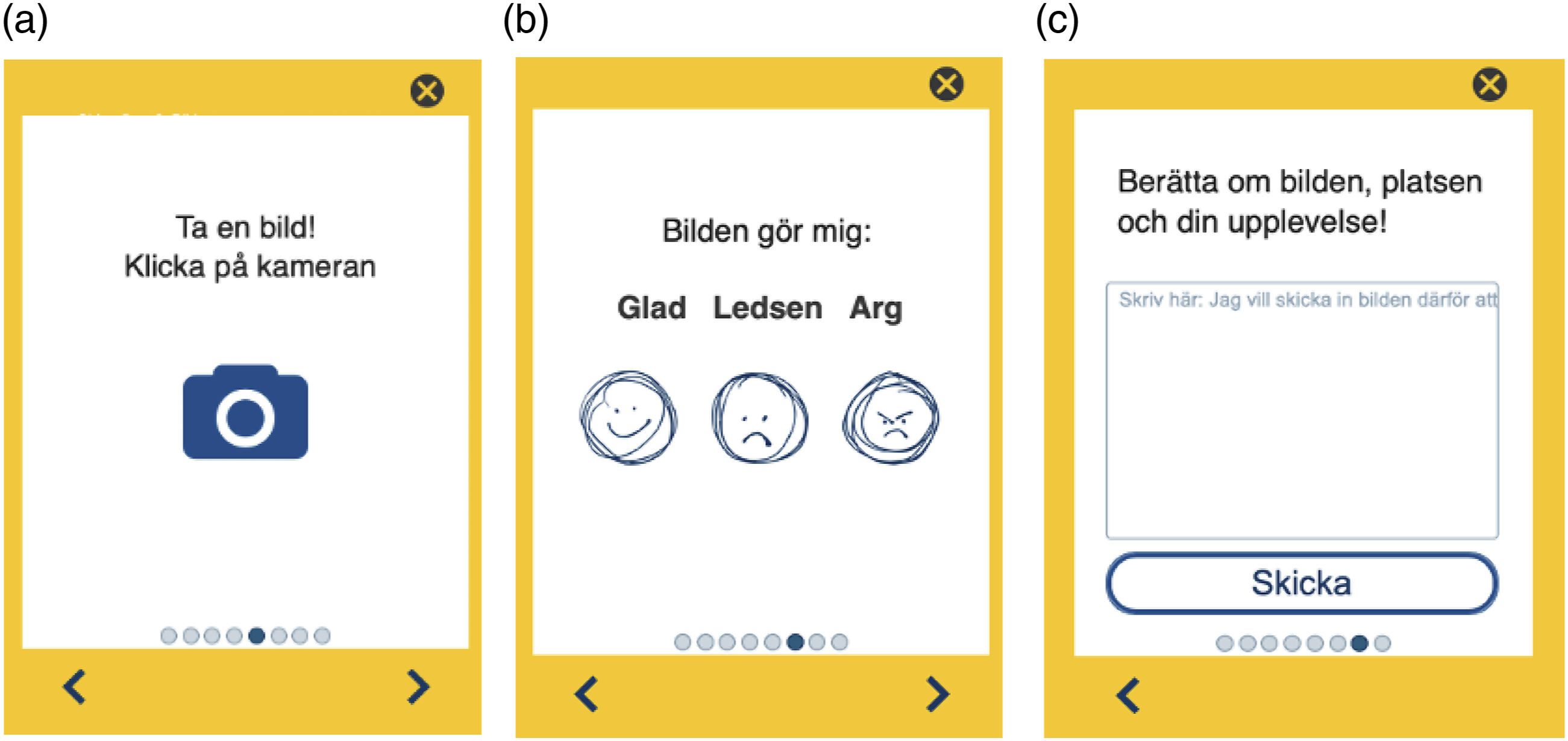
Data collection took place during a period of 6 months from September 2019 to February 2020. Announcements were made through a number of channels, including university online news, interest organisations, business cards placed in various physical locations, and social media, as well as orally to students and audiences at various seminars and public events held by the research team.
A time stamp recording the date and time of each submission was noted but no personal data regarding the people who used Indelaren was collected. Time stamps, photos, emotions, and written comments were stored on a Filemaker server.
The research project was ethically approved by the Swedish Ethical Review Authority, approval number 2019-03704.
Material and selection
The total number of submissions collected through Indelaren amounted to 92. All of these submissions include a photo, 88 of them include a selected emotion, and 87 a written comment. The written comments are typically short, from one word to two or three short sentences. Only one submission is longer and contains 123 words across 10 sentences. The vast majority of the written comments are in Swedish with a few in English.
In order to answer the research question of how the built and designed environment is seen as categorising people in this material, a subset of the submissions have been qualitatively selected for analysis. This subset consists of all submissions which explicitly concern categorisations or separations of people, including (i) specific categories being mentioned (such as “damernas” (‘the ladies’’) and “herrarnas” (‘the gents’’), “synskadade” (‘visually impaired people’), “kortare personer” (‘shorter people’)), (ii) references to “all” or “some” (“Information för alla” (‘Information for everyone’)), and (iii) where processes of divisions or categorisations are named (“Kategoriserar genom skilja på människor” (‘Categorises by differentiating between people’)). This resulted in 38 submissions.
Data analysis: spatial discourse analysis
The selected submissions are analysed using Spatial Discourse Analysis (SpDA) (Ravelli and McMurtrie, 2016), a framework for investigating the meaning-making potential of the built environment, with SpDA originally coined by McMurtrie (2011). SpDA has been applied to, for instance, interactional meaning and history in museums, aesthetics of residential high-rises, and affect at international airports (Björkvall et al., 2020; McMurtrie, 2020; Ravelli and Heberle, 2016; Ravelli and Wu, 2022).
SpDA is a social-semiotic approach building on Systemic Functional Linguistics (Halliday, 1978) and work by Kress and van Leeuwen (2006). SpDA includes the fundamental assumption that “spatial texts” are multimodal, meaning that they are “made up of a multiplicity of communicative resources” (Ravelli and McMurtrie, 2016: 2). In the present study, a multimodal social-semiotic approach gives the distinct advantage of allowing a fine-grained and comprehensive account of people’s meaning-making in social environments involving multiple built and designed resources (see also Kress, 2010). This differs from e.g., an approach such as wayfinding in architecture (Passini, 1984), which, while having contributed a rich body of knowledge of people’s movements in built environments, does not primarily concern how such environments come to mean something for people. Additionally, while studies of wayfinding do consider a range of people (e.g., Ahmed et al., 2022), their focus is not on investigating people’s sense-making of being categorised as particular kinds of people by the environment, which is the concern of the present study.
As a social-semiotic approach, SpDA sees (i) meanings as composed of several different meaning types, and (ii) meanings and social and cultural contexts as co-constitutive (Ravelli and McMurtrie, 2016: 3). The meaning types of SpDA are in the form of three fundamental types: representational, interactional, and organisational meaning (a fourth, “interrelated type”, called relational, will not be used in this article).
Representational meaning concerns “what something is, what it is about, what it is for” (Ravelli and McMurtrie, 2016: 6), e.g., a school is for teaching and learning. Central to identifying representational meaning are Processes and Participants, which construe events. Crucially, representational meaning concerns what can be done in a particular space, and how users can particate in that space. For instance, a bench enables a Process of sitting and Participants to be Behavers of a particular kind, ones who sit.
Interactional meaning refers to how the built environment feels (e.g., welcoming, intimidating, calming) and how interactants behave in relation to each other and to the physical space. Important aspects of interactional meaning are e.g., systems of control (the extent to which a user’s movement and behaviour is controlled, through e.g., surveillance, signage, or regulations) and power (feelings of dominance).
Organisational meaning is based on the way in which the parts of the built environment are put together (e.g., how the rooms in a house are organised), creating cohesion or fragmentation/separation, or similarity or difference.
In the analysis presented below representational meaning will be investigated in terms of Processes and Participants. With regard to interactional meaning feelings will be identified using the emotions selected by participants (happy, sad, or angry) and the photos and written comments will primarily be investigated using the system of control, with some additional observations regarding power. Organisational meaning will be analysed based on which categorisations of people the submissions address, and how. This analysis of the three fundamental meaning types are here seen as together constituting how people are being categorised by the built and designed environment, as conveyed by the empirical data in this study.
While a “spatial text” in SpDA is explained to be “the synthesis of building, space, content, and user” (Ravelli and McMurtrie, 2016: 1), the meaning types are firmly anchored in the built environment. In order to allow for variation in individuals’ sense-making of the environment, that is, “how the ‘same’ element … can ‘mean’ different things” (Ravelli and McMurtrie, 2016: 13), Ravelli and McMurtrie add (i) intertextuality in the form of an individual’s prior experience of a type of built environment, and (ii) the individual’s access to and understanding of broader discursive frameworks.
This article explores what the addition of another factor would mean for SpDA and for understanding people’s meaning-making of the built and designed environment. This factor will be added here as (iii) the situated materiality of the individual and the environment. This means a recognition of that it is not only the individual’s prior experiences and discursive understandings that contribute to their sense-making of a particular built environment but also the material and embodied stuff of any situated interaction. Such material stuff may include the weather, the time of day, a person’s mood, illness, impairment, present or absent artefacts such as heavy suitcases, glasses, wheelchairs, prams, etc. As an example, entering a building via a steep set of icy stairs on a windy day while carrying a large suitcase, is probably an entirely different experience from entering a building with a level entrance and automatic doors on a dry and sunny day using a walker. Indeed, McMurtrie (2012: 525) includes considerations along these lines by hypothesising that “buildings are felt differently during the night”, in this case based on an absence of incoming light.
Analysis
The analysis of how the designed and built environment is seen as categorising people will be presented in three sections: categorisations of (1) all as equivalence, followed by (2) some (and not others) as marginalisation, and finally (3) particular groups through naming and hegemonic negotiation.
For each of these, representational meaning is analysed in terms of Processes and Participants, interactional meaning through feelings and the system of control, and organisational meaning is analysed based on the function of the categorisations being portrayed in the submissions. The addition of (iii), the situated materiality of the individual and the environment, will be analysed with an understanding of embodiment as multiple, intersectional, and interdependent (Wilkerson, 2015). Translations into English of people’s written comments are kept close to the original Swedish formulations which means that they are not always fully idiomatic.
“For all” – categorising through equivalence
The submissions analysed in this section all involve a written comment that states that something in the accompanying picture is for all, that is, the categorisation involves the whole population. In all cases, the accompanying feeling (one aspect of interactional meaning) is happiness, indicating a positive evaluation of those parts of the designed and built environment that are seen as for everyone. The organisational meaning of for all can be characterised as equivalence, and appears in three different ways in the material: (1) one and the same categorisation of everyone, (2) clearly distinct but equivalent categorisations, and (3) multiple and variable categorisations.
The first organisational meaning of for all – one and the same categorisation of everyone – is illustrated by Figure 3. The photo shows an automatic door and a level ground. The written comment highlights equivalence, by stating that everyone can use the same door. In terms of representational meaning the Process of entering can here involve walking as well as rolling. Furthermore, this entrance requires no movement up or down steps, nor the manual handling of a heavy door or the identification of a door handle or a button – which would have introduced difficulties for someone, for example, using a walker or having muscular dystrophy or arthritis. Thus, in Figure 3 everyone can be said to be enabled to be a Participant in the form of an Actor who enters. Written comment: “Samma dörr för alla” (‘The same door for everyone’). Emotion: Happy.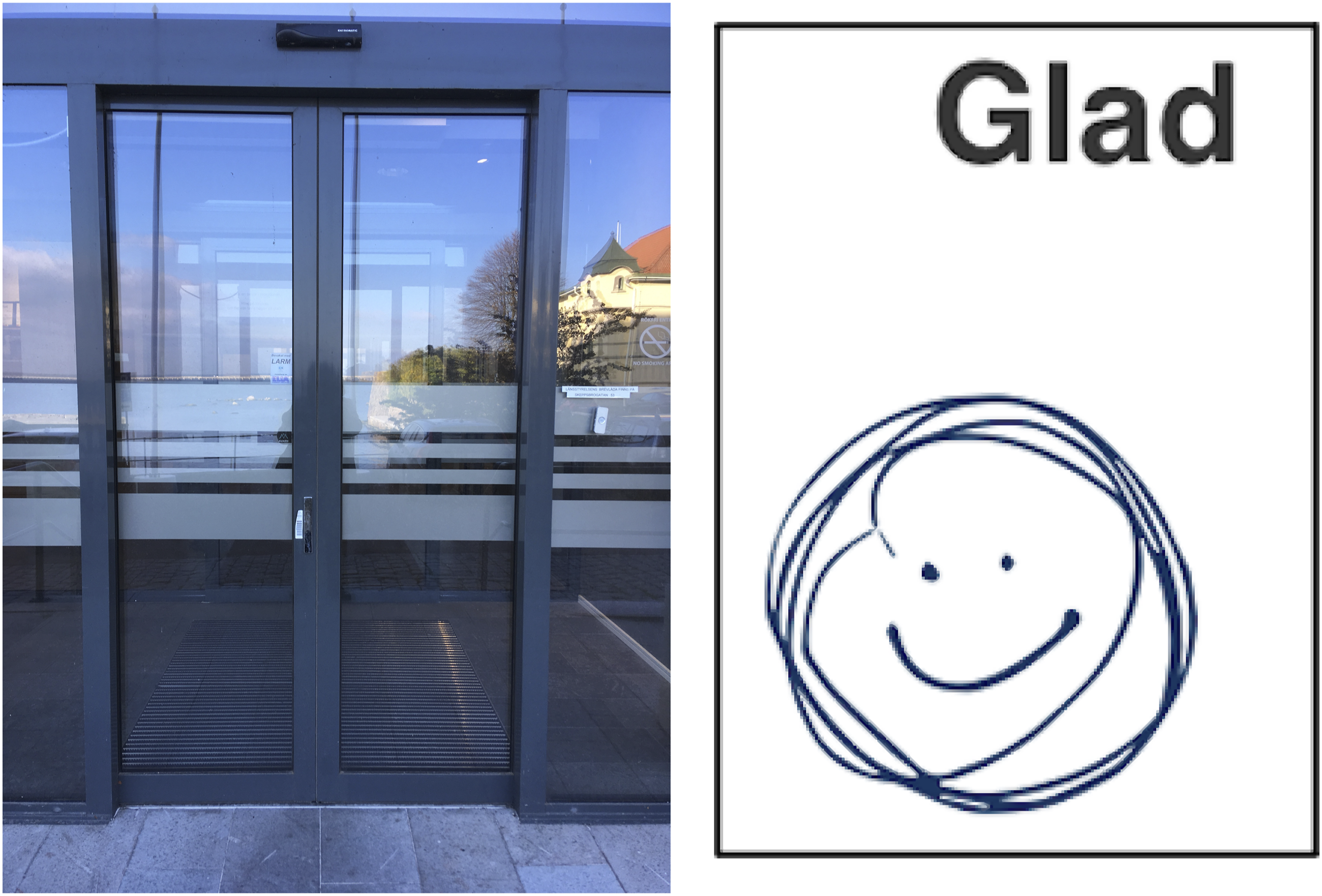
With regard to interactional meaning, control is minimised, as there is nothing regulating a user’s entrance. Power is also minimised, as the level entrance positions the institution and the user at the same point vertically, which conveys equality. Overall the analysis of the meaning types indicates that everyone would here be able to take up roles such as a “visitor” or “employee”. A similar example in the material is the submission of a photo of a toilet door saying “WC” and the written comment “En toalett för alla” (‘A toilet for all’). Here, the entrance can be seen to relevantly exert minimised control regarding the gender of the user (cf. the common separation into “ladies” and “gents”) and the Process of entering enables everyone to be a “toilet user”.
The second organisational meaning of for all – clearly distinct but equivalent categorisations – is shown in Figure 4. A photo taken of library computers enabling Processes of seeking information, people are here categorised as having a tall or a short height. In terms of control, there is no signage or other regulation in place requiring a user to choose one computer over the other – in this sense, control is minimised and the user is free to choose either computer. Power also comes across as minimised in this setting – no dominance is enacted. As the same functionality is offered by both computers, and as there is no discernible difference in how to physically approach the desks, the two categorisations offered here are distinct but equivalent. Written comment: “Här finns möjlighet att använda datorn för alla, i både hög höjd och låg höjd” (‘Here’s a possibility for all to use the computer, with both a high height and a low height’). Emotion: Happy.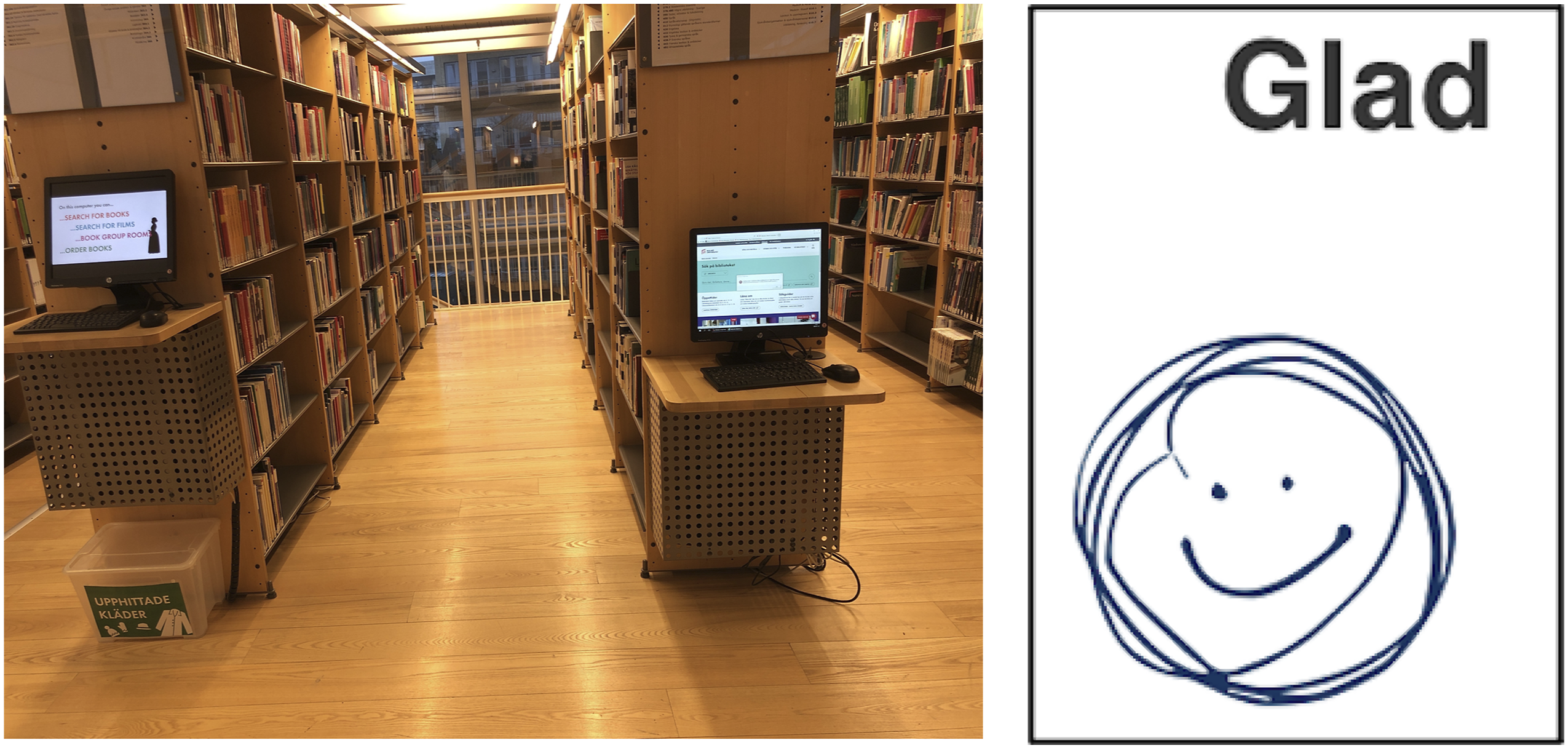
The third and final organisational meaning of for all – multiple and variable categorisations – can be found in Figure 5. The photo shows an outdoor seating arrangement with a table and various possibilities for Processes such as sitting, standing or lying by the table: a wide or a narrow seat, with or without a backrest, an opening where a walker, a wheelchair, a pram, etc. can be placed. Correspondingly, this enables users to be Participants of different kinds, such as Behavers when sitting, Sayers when talking to others at the table, and so on. As in Figure 4 both control and power are minimised. Written comment: “En bänk för alla” (‘A bench for all’). Emotion: Happy.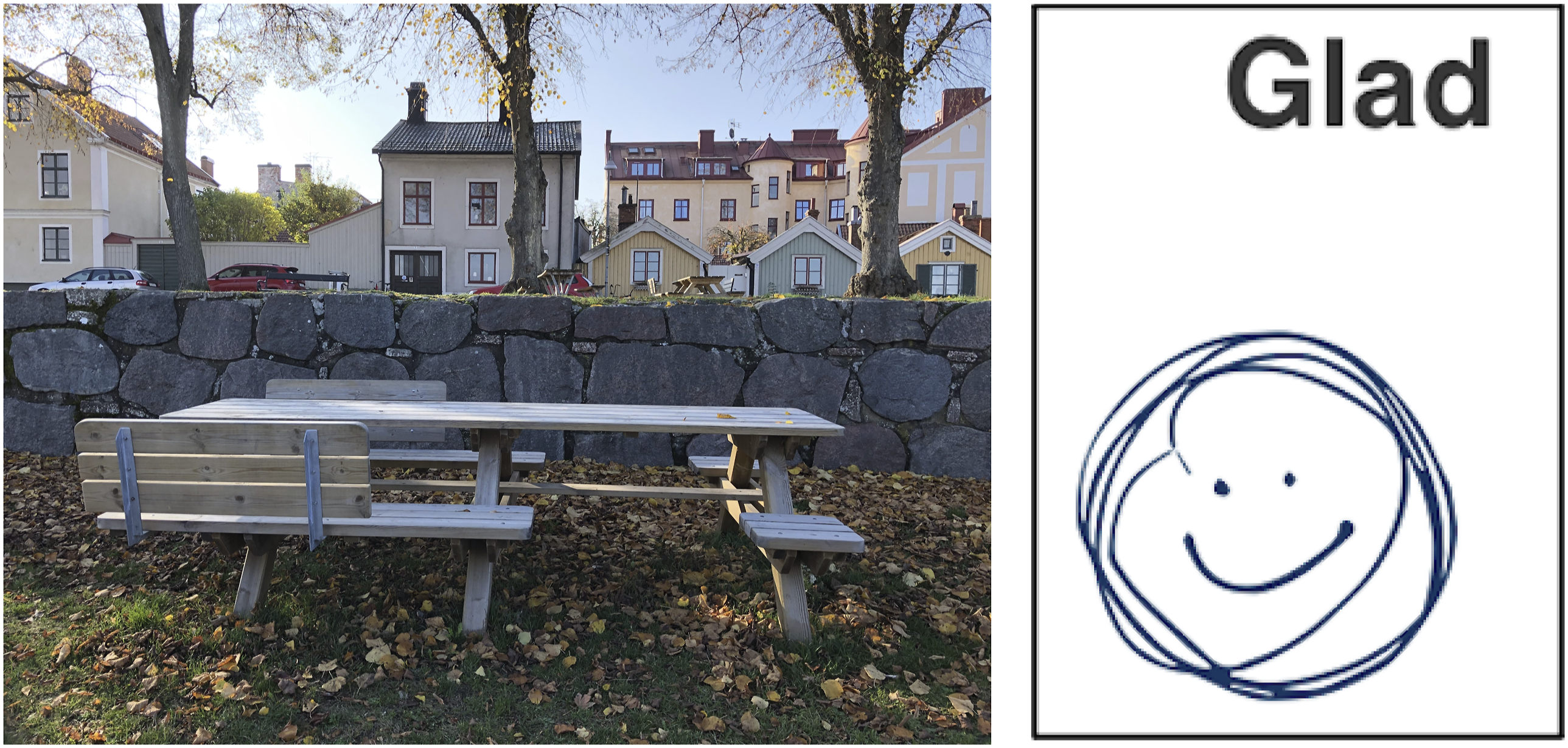
Categorisation of people in Figure 5 can possibly either be thought of in terms of multiple categorisations – anything from “an outdoor coffee drinker” to “a one-year-old climber eyeing the table top” – or as categorisation itself becoming irrelevant, dissolved into variation. As with the other two organisational meanings of for all, the design solution is here seen as enabling the same roles for everyone.
Multiple and variable categorisations, as illustrated by Figure 5, can also be used to consider Figure 4 in a different way. As it is presented in the photo and the written comment, Figure 4 involves a two-way choice, hence two different categorisations. If the desks were instead fully adjustable, allowing any position, categorisation could either be seen as multiple (“a fairly tall but not extremely tall library visitor” etc.) or as rendered irrelevant. In the latter case, the rationale would be that in situations allowing for multiple and flexible choices, the very act of categorising people loses its meaning.
In summary, categorisations of the built and designed environment as “for all” are understood positively, whether this involves the same solution for everyone (Figure 3) or different solutions (Figures 4 and 5). The Processes enabled by this kind of environment for all Participants, together with minimised control and power, contribute to an understanding of these spaces as characterised by equivalence. Importantly, the materiality of the environment supports a multitude of embodiments.
“For some” – categorising through marginalisation
Some submissions involve a categorisation whereby only some people can partake in a given activity etc. and where some people cannot do so, that is, where a contrast is created between some people and other people. In terms of interactional meaning, the accompanying emotion in all cases is either sadness or anger, conveying that separation of people in these cases is seen as something negative. The organisational meaning of for some can be characterised as marginalisation. It appears in two different ways in the material: (1) in the form of categorisational inclusion and exclusion, where one group of people can enter, partake, etc. and another cannot, and (2) as separation, which involves distinct and nonequivalent categorisations.
The first organisational meaning of for some, categorisation through inclusion and exclusion, is illustrated by Figure 6. The photo shows an entrance with a steep set of stairs, no rail for stability and, at the top of the stairs, a narrow double door. The written comment states that the entrance excludes many people from making a museum visit. The Processes enabled by this entrance are climbing (stairs) and opening (a door). However, by taking into account the situated materiality of the individual and the environment, it becomes clear that not all users can participate in those Processes. By placing high demands on individuals’ mobility, this entrance categorises people into an included group of those who can enter the museum and an excluded and marginalised group of those who cannot. The roles of “museum visitor” or “museum employee” can only be taken up by a subset of people. This differs significantly from the for all categorisation in Figure 3. Written comment: “Exkluderar många till museumbesök” (‘Excludes many from a museum visit’). Emotion: Sad.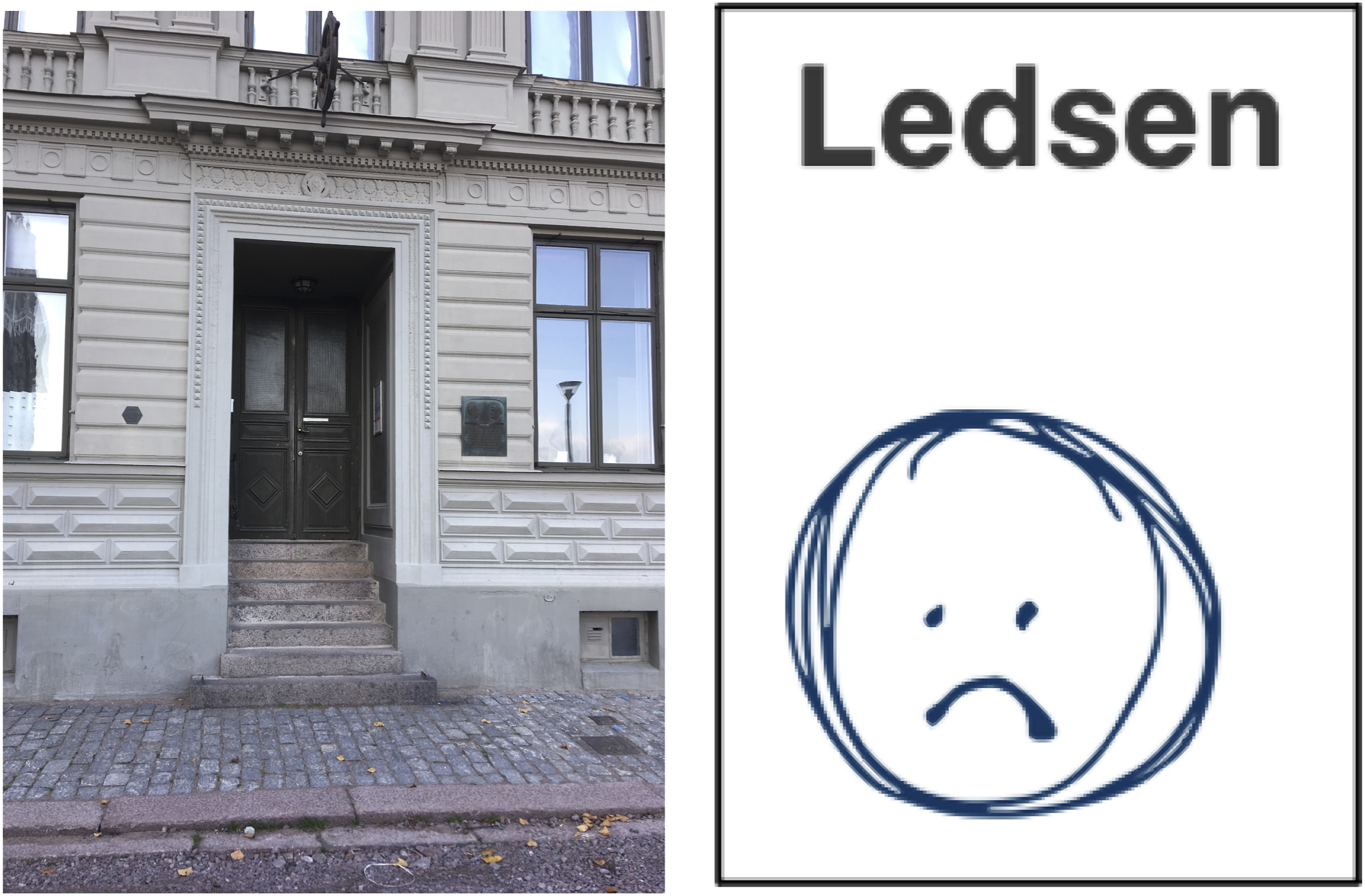
In terms of control there is no explicit regulation or signage in Figure 6. However, control is strongly suggested by the steep set of stairs, and this control will be experienced highly differently by different users – so much so that some users are required to stay at the bottom of the stairs. Power can be seen as enacted through the verticality of the stairs, which may furthermore be experienced differently depending on the relative height of the user.
The second organisational meaning of for some, separation involving distinct and nonequivalent categorisations, is shown in Figure 7. This is an entrance that involves two distinct ways of entering, either using steps or using a ramp. The steps enable a Process of walking whereas the ramp enables both the Processes of walking and rolling. When considering the situated materiality of the individual and the environment, some users, i.e., those who can take up the Participant role of walker, will be enabled to use both the steps and the ramp. Other users, i.e., those who can only participate as rollers, will only be enabled to use the ramp. Written comment: “Kategoriserar genom skilja på människor.” (‘Categorises by separating people.’). Emotion: Sad.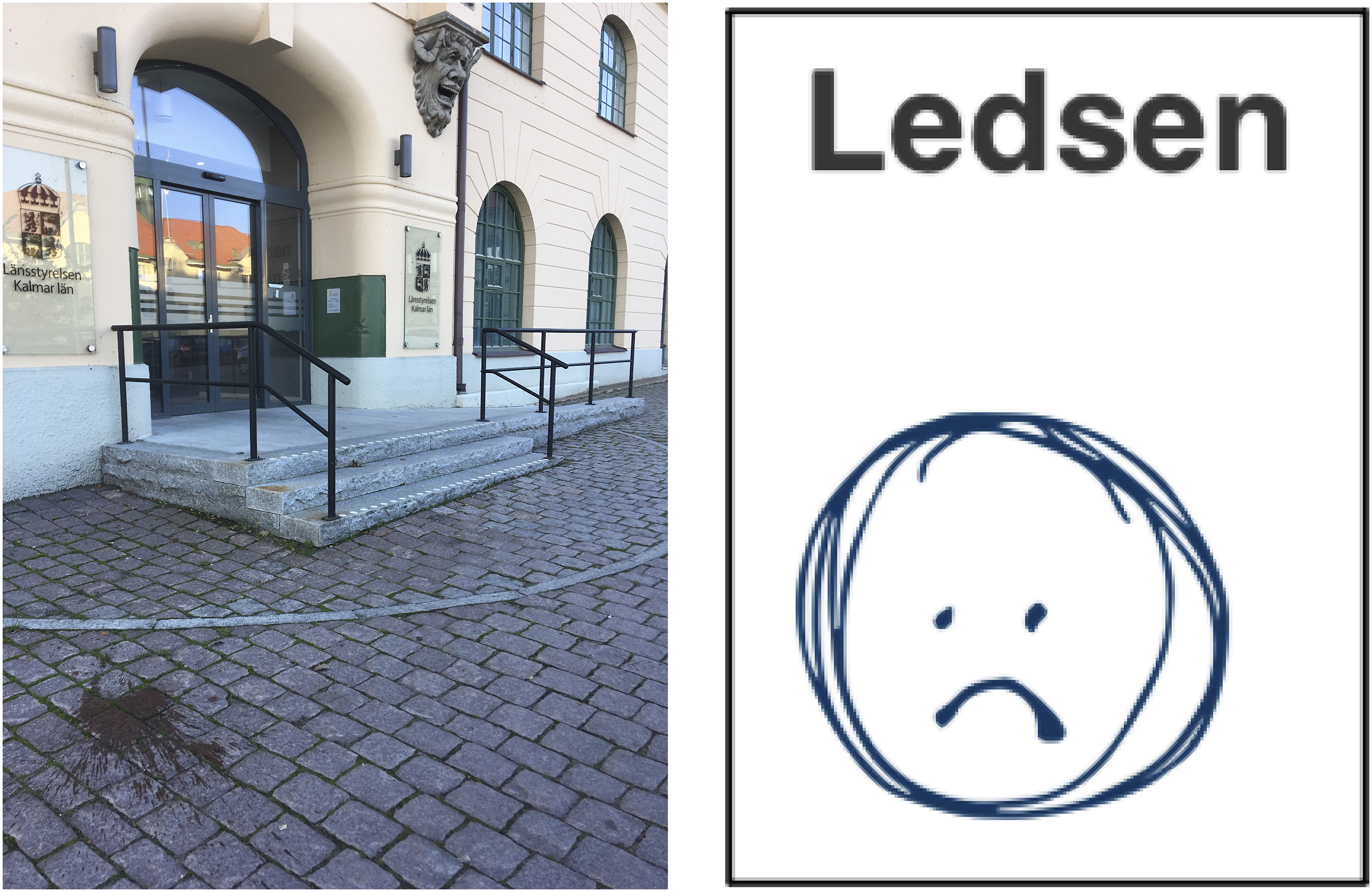
The written comment explicitly mentions categorisation, by stating that the entrance categorises people by separating them. That is, this entrance categorises people into those who can take the short and quick route up the steps and those who have to take the longer and more time-consuming ramp. As McMurtrie (2012: 530) states, “spatial texts are experienced temporally”. As an example, for a group of colleagues approaching the building from the viewpoint of the photographer, someone who has to take extra time to use the ramp may have missed a vital part of the conversation while the rest of the group have already moved into the building. While roles such as “visitor” or “employee” can here be taken up by anyone, in contrast with the excluding categorisation illustrated by Figure 6, categorisation during the entering of the building in Figure 7 creates nonequivalent experiences. This can be compared with a for all categorisation such as the one with the computers at different heights in Figure 4. Whereas for all in Figure 4 involves different but basically equivalent experiences, the separation in Figure 7 does not.
Control in Figure 7 is enacted through the choice of the two distinct ways of entering, which enables behavioural freedom for users who can enter using either of the steps or the ramp, whereas it limits behavioural freedom for users who can only enter via the ramp.
In summary, categorisations of the built and designed environment as “for some”, but not others, are evaluated negatively, both when the “others” cannot participate at all (Figure 6) and when people can only participate in nonequivalent ways (Figure 7). Control is clearly suggested in these cases and may involve highly different experiences for different users. Put differently, the situated materiality of the individual and the environment leads to marginalisation.
“For particular groups” – categorising through naming and hegemonic negotiation
The categorisations so far in the analysis, as seen in Figures 3–7 and in the example of the “WC” sign, are vague regarding which linguistic labels are involved. This is different for categorisations of particular groups of people through naming. In the material, such categorisations occur either through pictograms, such as a stylised image of a person with a dress or trousers on a toilet door, or the International Symbol of Access (ISA), or through words, giving a particular linguistic label. Categorisations of particular groups of people through naming are accompanied by both positive and negative feelings in the material. Categorisations of particular groups will here be analysed as (1) categorisations according to “hegemonic” (Ives, 2004) understandings, and (2) categorisations that challenge hegemonic understandings. By way of contrast, these two organisational meanings will finally be compared with cases of non-naming.
The first organisational meaning of for particular groups, categorisations according to hegemonic understandings, is illustrated by Figure 8. The photo shows a toilet door with three pictograms: the ISA, a family, and a person changing nappies. The written comment states that the toilet is for all, but also that different signs are used to indicate gender, social roles, and (dis)ability. The accompanying emotion is a negatively valued one, namely anger. I read the anger as concerning the clash between all and the different categorisations being made, that is, that the person sees it as unnecessary or offensive to separate all through several different subcategorisations. Written comment (in English in the original): “1 toilet for all, yes, 4 different signs to indicate gender, social roles, and (dis)ability”. Emotion: Angry.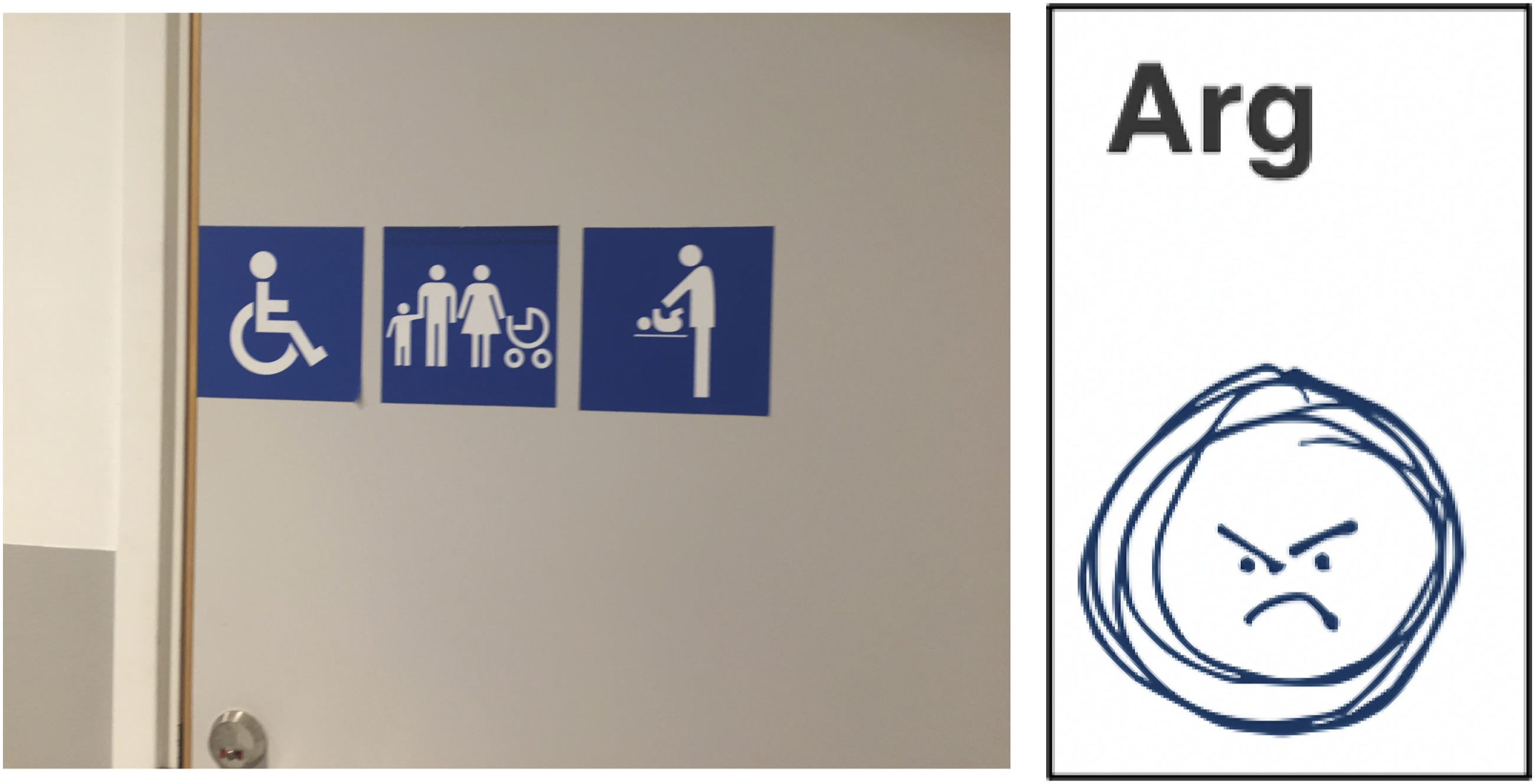
For instance, a closer look at the family pictogram reveals a child, two adults of which one male and one female, and a pram that presumably contains a baby. Such an image can be seen as a normative realisation of gender, sexuality, reproduction, able-bodiedness, etc. (Hornscheidt, 2012, 2015), as hinted at by the written comment. Thus, the Process of going to the toilet can here be seen as constrained to particular kinds of Actor, such as toilet-goer-as-a-wheelchair-user, or as being compared to a specific norm, such as toilet-goer-not-matching-a-normative-family, etc. In terms of interactional meaning, control is here exerted through the signage, by regulating who can enter this particular space. Furthermore, this control rests on the institution’s claimed right to define users. The user’s behavioural freedom and experience of this space will partly depend on their embodied experience in the given situation and in relation to normative discourses.
Another example of categorisation according to hegemonic understandings involves a sign with the word “toalett” (‘toilet’) and an image of a male figure. The written comment is “Ofta kö till damernas, men pissoar på herrarnas. Förstår skyltningen, men det känns förlegat med denna uppdelning.” (‘Often a queue to the ladies’, but a urinal in the gents’. I understand the signage, but this division feels obsolete.’). The accompanying emotion is anger, as in Figure 8. The writer here points to an important aspect of signage in general, that it needs to be legible and understandable, but the naming of, and separation into, genders, is negatively valued and seen as something no longer desirable, at least in the context of toilet signage. This separation into “ladies” and “gents” can be seen as maximised control, both in terms of the regulation of who goes where and the imposition of a binary categorisation that does not match the reality of gender.
The second organisational meaning of for particular groups, categorisations that challenge hegemonic understandings, is shown in Figure 9. Here, too, the Process of toilet going involves a binary choice between two toilets, but this is positively evaluated through the emotion of happiness. One toilet, as explained by the written comment, is indicated by the sign “WC”, and the other toilet, as shown by the photo, carries a longer description. This is a bilingual sign in French and English, proclaiming “urinoirs” (‘urinals’) and “toilet”, respectively. These are further qualified by a description of who they are to be used by: “tous.tes qui pissent debout” and “everybody who pees standing up”, respectively. The categorisation involved in the English-language version says nothing about gender, thereby allowing for any kind of, and any number of, genders, which is presumably what is being evaluated positively here. As in Figure 8, control is exerted through signage, regulating who can go where. The French version in Figure 9 uses “tous.tes”, an example of écriture inclusive (‘inclusive writing’) which combines the masculine/neutral and feminine forms of the French “everybody” (other alternatives that have been proposed include such forms as “tous·x·e”, “touxe”, and “toustes” (Van der Meer, 2020), which more decisively do away with a gender binary). Written comment (in English in the original): “At a private karaoke club in [Place] in [Time]. The other toilet signage just said “WC””. Emotion: Happy.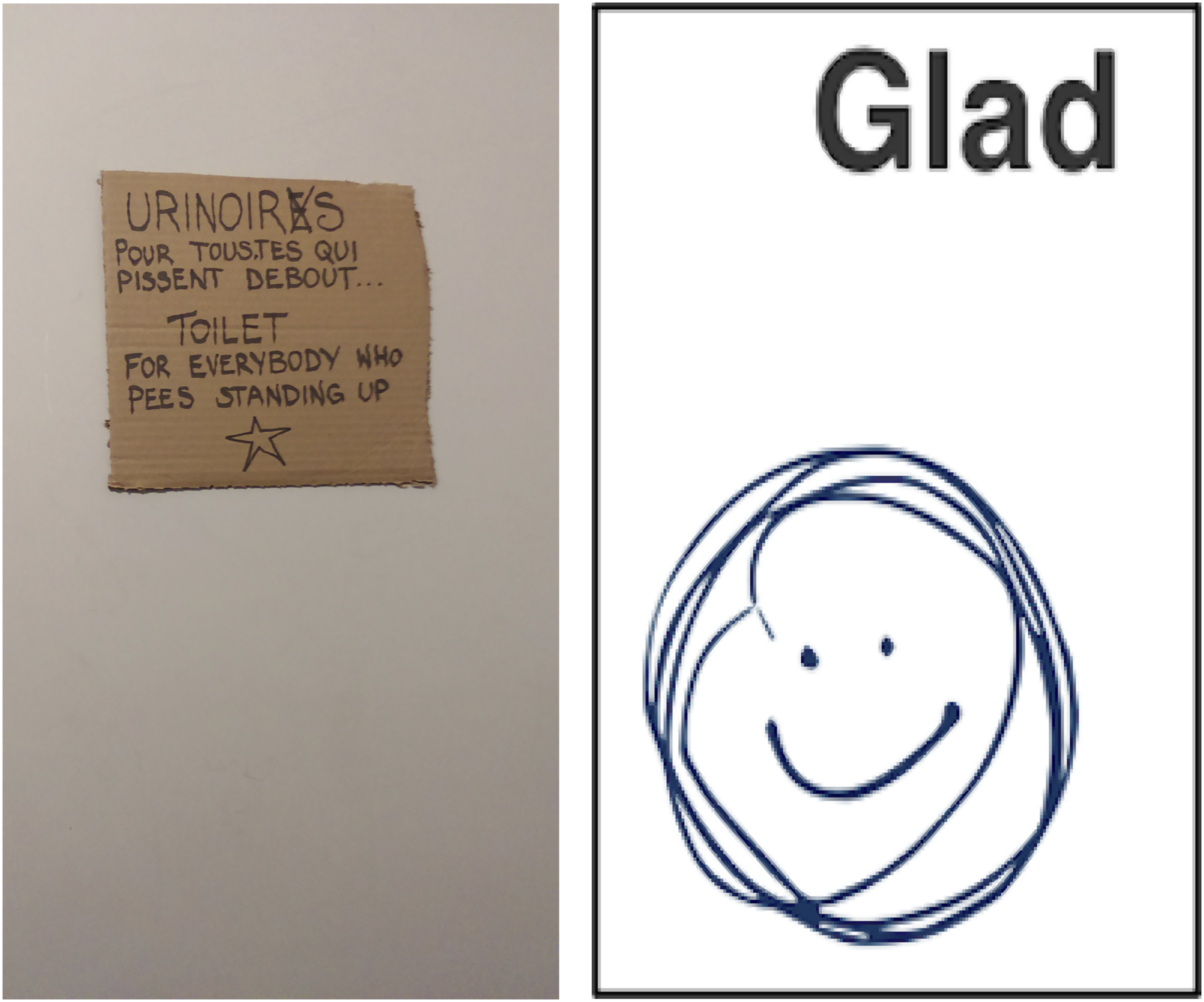
In contrast with hegemonic “ladies” and “gents” signage, control through signage in Figure 9 is exerted through challenging hegemony: an alternative understanding of embodiment and gender is being proposed. However, the categorisation into an explicit “pees standing up” and an implicit “pees sitting down” (the “WC”) still maintains an able-bodied norm.
Finally, these two kinds of organisational meaning of particular groups, that is, naming that categorises in accordance with or in opposition to hegemonic understandings, will be contrasted with cases of non-naming, that is, signage that does not categorise people. See Figures 10 and 11. Written comment: “Toaletten på [Place] talar inte om vilket kön som ska nyttja toaletten och förmedlar bara en funktion inte att den är till för en speciell person.” (‘The toilet at [Place] doesn’t say which gender is to use the toilet and only conveys a function not that it’s for a particular person.’). Emotion: Happy. Written comment: “Ingen kategorisering, visar med storlek var man ska.” (‘No categorisation, shows using size where to go.’). Emotion: Happy.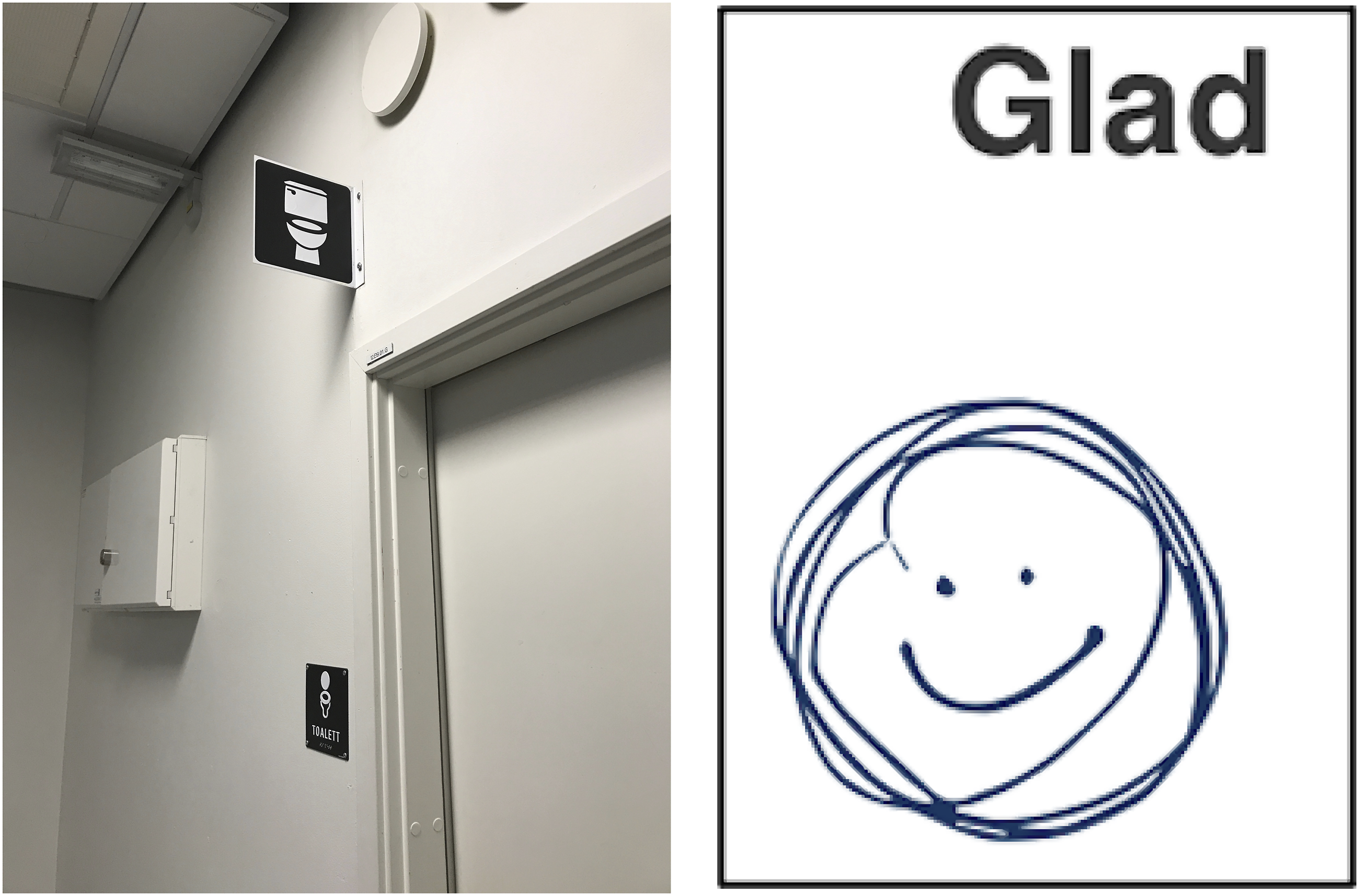
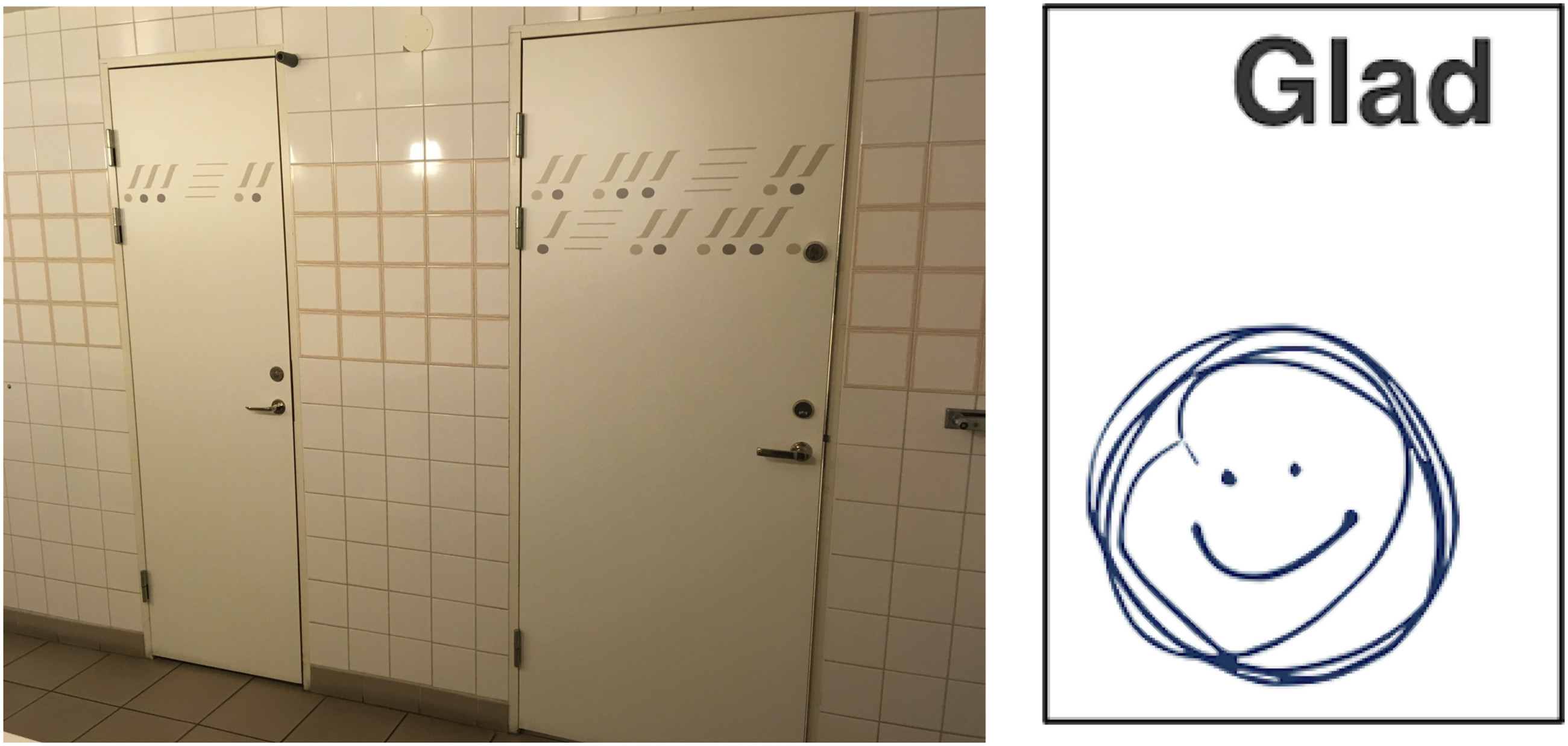
In Figure 10, no categorisation of people is offered by the sign. Specifically, the writer identifies gender as what is not being categorised here and instead of categorising people the pictogram represents what is behind the door, that is, a toilet. Figure 11 shows another variant of people not being categorised. Here the writer indirectly identifies dis/ability as what is not being categorised (cf. the ISA). The width of the doors is indicated using the number of lines and dots on the door, and this, in turn, can be taken as saying something about the amount of space behind the door, that is, whether it is a narrow toilet space or a wide toilet space. Both of these examples of non-naming and non-categorisation, where Participants in the Process of using the toilet are not categorised according to gender or dis/ability, are evaluated positively. In a sense, Figures 10 and 11 closely resemble the for all categorisations through equivalence in Figures 3 and 4, and control can be seen as minimised. Figures 10 and 11 can also be seen as examples of a hegemonic negotiation whereby the very idea of categorising people is being challenged.
In summary, categorisations of the built and designed environment “for particular groups” through naming appear in the material as either in accordance with hegemonic understandings (Figure 8) or as challenges to hegemonic understandings (Figure 9). In hegemonic cases, control is suggested by institutions claiming the right to define users and through their maintenance of norms, whereas challenges to hegemonic understandings can be understood as attempts to enact control based on alternative understandings of embodiment and gender. The situated materiality of the individual and the environment can be taken to involve highly varying understandings, depending on the individual’s own degree of alignment with hegemonic views. This is contrasted with signage that does not categorise people (Figures 10 and 11), which resembles “for all” categorisations, and where the materiality of the environment supports a multitude of embodiments.
Conclusion
This article has suggested an extension of Spatial Discourse Analysis (SpDA) as formulated by Ravelli and McMurtrie (2016), with regard to how people’s experiences of the “same” built and designed environment can vary widely. In addition to an individual’s prior experiences and discursive understanding, which SpDA already includes, the suggested extension involves the situated materiality of the individual and the environment. This is in line with various observations elsewhere in SpDA research, and it acknowledges the significance of the body and embodiment (e.g., Bucholtz and Hall, 2016; Imrie, 2006, 2015).
In this article, the situated materiality of the individual and the environment has been explored in relation to a material collected using a citizen science approach, whereby the public were invited to share their experiences of buildings and spaces. Using an analytical lens of categorisations of people, the SpDA analysis has shown people’s meaning-making of the physical environment in terms of equivalence, marginalisation and hegemonic negotiation. In cases involving equivalence, the materiality of the environment supports a multitude of individual materialities, whereas cases of marginalisation emphatically do not, or only in nonequivalent ways, and cases of hegemonic negotiation involve variable understandings.
The significance of this is perhaps most clearly evidenced by cases such as a single entrance consisting of a steep set of stairs, where the Process of climbing enabled by the stairs is not available to everyone, thus excluding a large number of people from participating. This recognition of human embodied variation in multimodal analyses yields a more comprehensive understanding of people’s meaning-making of the built and designed environment, and enables the uncovering of naturalised norm-deviation assumptions in the built and designed environment itself. This article has attempted to avoid norm-deviation understandings of human variation, by investigating people’s own experiences of categorisations in and by the designed and built environment.
Relatedly, two points of methodological and theoretical concern can be emphasised. Firstly, this article is based on participants’ understandings, as evidenced by their submitted contributions of photos, emotions and written texts. These do not necessarily coincide with ideals or best practice regarding participation and inclusion in the built and designed environment, such as Universal Design (Steinfeld and Maisel, 2012; see also Hedvall et al., 2022). At the very least, other understandings of the cases presented here are possible. For instance, an entrance or a toilet sign which is positively evaluated in the submitted contributions need not be positively evaluated by someone else or under different circumstances. This is part of the multiplicity and interdependence of embodiment.
Secondly, the submissions cannot be taken as representative of Swedish citizens on the whole, and the submissions cannot be seen as giving an exhaustive view of people’s understanding of how public space categorises us. Even more strongly, the material shows an alignment with the research projects and its goals, as, for instance, shown by the examples of environments for all always being evaluated positively and exclusion being evaluated negatively. Quite conceivably, given the data collection method and process, the project did not elicit wide and contrary positions. The analysis presented above should be viewed with this in mind. However, this limitation does not detract from the overarching argument of the article, of the need for exposing norm-deviation biases in the built and designed environment and for including human variation in multimodal research.
Footnotes
Acknowledgements
The author wishes to thank all members of the public who contributed observations and reflections, and all colleagues in the KatUU and SYNTAX projects, as well as the Text and Context group at the University of Gothenburg and research seminar participants at Södertörn University for invaluable discussions. Thank you also to Lars Malmsten and Nina Romanus for developing Indelaren.
Declaration of conflicting interests
The author(s) declared no potential conflicts of interest with respect to the research, authorship, and/or publication of this article.
Funding
The author(s) disclosed receipt of the following financial support for the research, authorship, and/or publication of this article: This work was supported by VINNOVA, the Swedish Governmental Agency for Innovation Systems [grant numbers 2018-05232, 2021-02810].