




Abstract
This paper explores the issues of vaccine hesitancy and shaming which arose in response to the implementation of World Health Organization COVID-19 recommendations, on the social media platform of TikTok. By extending Appraisal theory to include the use of visual attitudinal appraisals, the study examines how TikTok users employ the semiotic resources at their disposal within the overarching context of the pandemic. A total of 254 videos expressing pro- and anti-vaccination viewpoints, predominantly posted by American and Australian users, between 1 January 2021 and 31 January 2022, were extracted from the social media application and subjected to a computer-assisted multimodal appraisal analysis. It is shown how speakers from both groups primarily aim to elicit a strong emotional response from like-minded users, promoting polarisation. The findings further reveal an ideological clash between the objective structure of governmental healthcare protocols and the subjective orientation of the anti-vaccination group’s habitus. Since the pro-vaccination group’s own subjectivities hinder the effective sharing of information on COVID-19 via TikTok, the paper recommends the use of non-judgemental language and gestures in videos targeting a vaccine-hesitant audience.
Introduction
The COVID-19 outbreak changed the lives of numerous individuals worldwide. A large number of countries initially focused on a combination of measures to control the spread of the disease, such as physical distancing, screening, and lockdowns, but, eventually, most governments switched to the use of targeted vaccinations (World Health Organization, 2020). In October 2022, more than 617 million confirmed cases were reported and a total of nearly 13 billion vaccine doses had been administered (World Health Organization, 2022). However, vaccine hesitancy further problematised the situation. Negative vaccine attitudes are, of course, nothing new. For example, in 2016, the Australian government decided to introduce a ‘no jab, no pay’ policy to counter the refusal of some parents to have their children vaccinated (Australian Government and Department of Health and Aged Care, 2022). The legislation stipulated that vaccine refusal based on personal beliefs was no longer a reason for legal exemption and would lead to family and childcare payments being withheld. As of 10 October 2022, COVID-19 vaccine hesitancy showed an ongoing downward tendency in Australia, with 84% of its total population having received two doses (Nicholas et al., 2022). In contrast, hesitancy rates in the United States remained relatively strong across eight states in February 2022 (Institute for Health Metrics and Evaluation, 2022). The phenomenon also elicited a response of vaccine shaming, which is the purposeful act of shaming people for refusing vaccines, in Australia, the US and elsewhere (Golafshani, 2022).
Several attempts have been made by scholars to determine individual motivations for partaking in vaccination efforts through self-report questionnaires, a research tool which may generate unreliable findings due to its subjective nature and the fact that vaccine attitudes tend to be dynamic and highly changeable (Bernstein et al., 2001). A large number of these studies claim that both mass media and social media play a significant role in the formation of trends regarding vaccines, including those targeting the COVID-19 virus and its variants. For example, Hernandez et al.’s (2021) research demonstrated a clear link between social media participation and COVID-19 vaccine hesitancy in the US. The concomitant spread of misinformation about COVID-19 vaccines on SNSs was mentioned as the main cause of unwillingness among American citizens to get vaccinated (Clark et al., 2022; Muric et al., 2021). Fridman et al. (2021) further discovered a connection between vaccine hesitancy and Republicans’ plummeting trust in the US media.
Apart from misinformation shared by social media influencers (SMIs) or the government, American attitudes towards COVID-19 vaccines appeared to be negatively coloured by a shared mistrust in political leaders, an apparent lack of knowledge due to impoverished economic circumstances, and religious or political affiliations (Diaz et al., 2022; Riad et al., 2021). In Australia, some individuals turned out to experience worse side effects after being exposed to social media narratives about possible consequences of exposure to COVID-19 vaccines (Tan et al., 2022). Hamilton et al.’s (2022) investigation of older Australians’ motivations regarding COVID-19 vaccination showed that perceived negative consequences of receiving the vaccine were among the main concerns in the rural areas as well. Similarly, Kwok et al. (2021) studied the overall sentiment on COVID-19 vaccinations expressed by Australian Twitterers and found that one third of tweets showed a negative attitude based on fear about possible side effects, engendered by conspiracy theories. Attwell et al. (2022), on the other hand, point to the neglect of the Australian government to clearly explain the vaccine mandate, especially in relation to marginalised and economically disadvantaged sections of society. A perceived minimal risk of contamination and disease severity, lack of trust in the government, and the pervasiveness of misinformation were all important factors contributing to the Australian public’s hesitancy to obtain a vaccine, according to Kaufman et al. (2022). Subsequently, it is worthwhile to look into communal feelings and the discursive practices of opposing movements on SNSs where these emotions are being materialised.
Social media users are continuously engaged in the process of construing and tweaking their own reality and social selves, not only through the exchange of text but also through visuals or audio, which recently turned scholarly attention to videos on platforms such as YouTube, Blibli, TikTok and Douyin, its Chinese version (Chen et al., 2021; Darvin, 2022; Hautea et al., 2021; Kaye et al., 2022; Litzinger and Ni, 2021). Since social networking services (SNSs) may provide insight into how individuals use language as members of virtual communities, the investigation of online behaviour has also piqued the interest of functional linguists (Bouvier, 2015; Hyland et al., 2021; Jewitt et al., 2016; Logi and Zappavigna, 2021; O’Halloran et al., 2021; Wignell et al., 2021; Zappavigna, 2016). Systemic functional linguistics (SFL) is a model of language as a socio-semiotic system of metafunctions used by social actors to represent concrete or abstract reality, to interact with others while negotiating power and social relations, and to ensure textual or discursive coherence and cohesion (Halliday and Matthiessen, 2014). As a meaning-making potential, the system allows for the selection of resources within a given context of situation. By building further on Halliday’s concept of TENOR and Bernstein’s (2000) theory of individuation, which pertains to “how semiotic resources are distributed among users (allocation) and how these resources are deployed to commune (affiliation)” (Knight, 2010; Martin et al., 2013), appraisal analysis aims to shed light on interindividual bonding over shared values and beliefs (Martin and White, 2005). The appraisal framework (Macken-Horarik and Martin, 2005; Martin, 2000) describes the totality of resources used by speakers or writers when interacting with others in an intertextual environment. When two collectivities of TikTok users holding opposing views on COVID-19 vaccines affiliate within their own groups, however, the result is polarisation, a common phenomenon on SNSs these days.
Whilst actively bonding with other like-minded users through the combination of both verbal and visual semiotic resources, individuals on either side of the debate primarily aim to conform other users to their own ideological stance, resulting in a vaccine war. Except for research conducted by Martinec (2001, 2004), Zappavigna and Martin (2018) or Hood (2011), barely any studies have examined the use of gestures in moving images as visual appraisal resources 1 to support such discursive exchanges. This paper examines how two disparate groups of primarily Australian and American TikTok (TT) users evaluate one another’s discourse and behaviour regarding COVID-19 vaccine acceptance. Its primary objective is to describe the attitudinal meanings which emerge from the content creators’ use of verbal and visual appraisal resources in 254 videos uploaded to the SNS between 1 January 2021 and 31 January 2022, within the overarching context of the pandemic, focusing on their evaluative functionality. As White (2006: 38) argues, “a key aspect of this rhetorical and ultimately ideological functionality is evaluation––the text’s positioning of its audience to take either negative or positive views.” The multimodal appraisal analysis demonstrates how, through their use of evaluative language, the anti-vaccination community constructs a social persona of victimisation, in contrast with the pro-vaccination group, which constructs a collective self of the good citizen. It is further shown that the objective structure of the vaccine mandate jars with the subjective world of TT users who, based on their community’s social practice and ideological system, mistakenly perceive vaccinations as tools of discrimination which impede on their individual freedom of choice.
Section 2 describes TT as an influential social media platform. A brief overview of previous research conducted on the SNS can be found in section 3. Section 4 pertains to multimodal analysis in SFL. Section 5 explains the methodology used for the study. A computer-assisted appraisal analysis, using the Natural Language Toolkit (NLTK, 2022), a standard Python library, and Notepad++ (2022), was performed to explore attitudinal meanings in two TikTok corpora, which is explained in the same section. The findings of the verbal appraisal analysis are presented in section 6 and the results of the visual appraisal analysis have been included in section 7. Section 8 concludes the paper.
TikTok as a trendsetting virtual space
TT forms a good example of a social media platform that perfectly lends itself to the construal of one’s virtual identity. Boasting more than 130 million active users in the US (Statista, 2022a) and more than one million in Australia (Statista, 2022b), the increasingly popular SNS was designed to provide users with a global public platform that allows them to be seen and to set new trends. TT’s parent company, ByteDance Ltd., founded by Yiming Zhang in March 2012, created TikTok after acquiring Musical.ly (Stokel-Walker, 2021). Viewers can upload videos of themselves dancing, applying make-up, dressing up, or performing everyday routines, with the purpose of entertaining a highly diverse audience consisting of viewers who usually share a common language.
Based on the number of hashtag views in 2020, some of the most popular content categories on TT in the US included entertainment, dance, pranks, fitness or sports, and home renovation (Statista, 2022b). Interaction on the platform occurs through ‘liking’ videos, providing comments, or posting video responses. Despite children being its original audience (Kaye et al., 2022), an increasing number of adult users discovered the SNS as a space which may serve as a virtual soapbox from where they can freely spout their views on a wide range of topics and issues that affect the personal sphere, such as disease, politics, war, or religion (Litzinger and Ni, 2021). By doing so, they are actively changing the genre of TT videos, since they no longer follow previously established exchange patterns on the SNS (Jovanovic and van Leeuwen, 2018). This form of creativity has negative consequences as well, with users constantly finding new ways to avoid the platform’s intensified suppression of the spread of misinformation, such as recycling ‘sounds’ (audio) from deleted videos containing anti-vaccination narratives (Darvin, 2022). Despite such issues, it appears that any false beliefs that are being propagated on the SNS are not caused by misinformation but are based on the users’ political or religious affiliations (Chen et al., 2021) and their strong emotional response to the content (Hautea et al., 2021). Guess et al. (2019) confirm this in their study of online behaviour during the 2016 election, which discovered that Republicans over 65 were far more inclined to share fake news on SNSs than any other group between the ages of 18 and 29.
TT’s highly potent algorithm constitutes a recommendation system that thrives on the emotional response of its user population, which is based on the personal preferences of individuals interacting with the application (Cervi et al., 2021). At first sight, TT does not seem to encourage the formation of online communities, unlike other SNSs, such as Facebook, instead creating an incessant flow of videos. However, one is still able to seek out specific content by conducting a hashtag or keyword search, which encourages recurring group interactions and increases the risk of polarisation. Research conducted by Andersen (2021) confirmed the existence of political ‘echo chambers’ on the SNS and documented their negative effect in the high school classroom. Correspondingly, Cinelli et al. (2021) emphasise that political attitudes and beliefs are reinforced in echo chambers as users continuously interact with other users who share similar opinions or, as Bourdieu (1990: 64) puts it, the interlocutors “shape their aspirations according to concrete indices of the accessible and the inaccessible, of what is and is not ‘for us’.”
TT’s ‘For you’ interface makes personalised suggestions to users based on their interactions with other videos, whether they watch TT videos on a mobile device or laptop, their language preference, their country of residence, as well as specific information contained within the videos themselves (e.g., hashtags, sounds, or captions). The result is a highly targeted and continuous stream of videos which are hard to resist, and which may inadvertently coerce viewers to consume similar content, even if it propagates negative attitudes or misinformation.
Nguyen (2020) argues that echo chambers may have a greater impact on SNS users than epistemic bubbles. The main difference between the two lies in the fact that the latter do not purposefully exclude other viewpoints, whereas this is exactly what happens in echo chambers which, when populated with white supremacists, for example, can become powerful tools that may encourage systematic ignorance. By intentionally excluding any external viewpoints, users inevitably condemn themselves to a self-perpetuating loop of homogeneous ideas while creating a specific ‘habitus’ (Bourdieu, 1990).
Over the past few years, TT has proven to be somewhat of a poisoned gift worldwide. In 2019, a US national security investigation was launched on the suspicions of censorship and the storage of personal data (Liu, 2021), which were subsequently dismissed by TT executive Alex Zhu. Similar concerns were uttered in Australia, where mounting geopolitical tensions between the US and China raised doubts about the SNS’s apparent depoliticised nature (Ryan et al., 2021). Using the walkthrough method, based on Actor-Network Theory (ANT), Nazaruk (2021) studied TT as a socio-cultural artefact and found that the application’s interface effectively conceals the software application’s Chinese identity, simultaneously aiding its own commercial interests and the Chinese Communist Party’s soft power, while its de-politicised design seems to reflect China’s foreign policy favouring diplomacy and good neighbourliness. In September 2022, the saga seemed to come to a close, when President Biden achieved a preliminary agreement with the SNS regarding changes in data security regulation, with the planned storage of US data by Oracle (Hutton, 2022). This wider context of contestation indirectly shapes the heteroglossic practices which inform any discursive interactions among American and Australian TT users.
Research on TikTok
Since the onset of the COVID-19 outbreak, social media analysis has become more pertinent than ever, especially following the accompanying infodemic. In 2020-21, worldwide lockdowns relegated a large number of people to their homes, with online interactions becoming a safer way to communicate with others. This led to a shift in research focus within various scholarly subdisciplines. Even though the study of TT as a medium of communication is still in its infancy, it is rapidly gaining interest within several different fields of inquiry, as mentioned earlier. Specific topics of interest within the field of communication include racial or social discrimination (Krutrok and Akerlund, 2022; Weimann and Masri, 2021), political conflict (Darvin, 2022; Mishra et al., 2022; Sadler, 2022), movements and campaigns (Gamir-Ríos and Sánchez-Castillo, 2022), US politics (Becker, 2021), the spread of health (mis/dis)information (Southerton, 2021), advocacy and awareness raising (Herrick et al., 2021; Krutrok, 2021; Vizcaino-Verdu and Aguaded, 2022), memes (Zeng and Abidin, 2021; Zeng et al., 2021), or climate change (Hautea et al., 2021).
A highly common research method for exploring TT data is content analysis (Jaramillo-Dent et al., 2022; Kim et al., 2022; Zulli and Zulli, 2022), often through a search of hashtags, keywords (Krutrok, 2021; Vizcaino-Verdu and Aguaded, 2022), or accounts (Jaramillo-Dent et al., 2022), a type of analysis which is defined by Krippendorff (1969: 103) as the use of “replicable and valid method[s] for making specific inferences from text to other states or properties of its source.” Linguistic features in the text are linked to individual attitudes or states of mind expressed by individuals or groups. An example of how the method is being applied to the analysis of TT data may be found in Zhang et al.’s (2021) investigation of TT content created by Chinese public hospitals. A total of 100 popular videos shared by 40 hospitals in the period between October 2018 to July 2019 was collected by conducting a search of official TT accounts on the keywords ‘hospital’ and ‘healthcare.’ Coding was undertaken for public engagement, sensation value of the message, as well as video content and format based on various statistics such as the number of likes, reposts and comments, or type of music used. The results showed that quite a few public hospitals embraced TT as a way of engaging with the public and that short engaging videos accompanied with background music were most effective in doing so. Nonetheless, content analysis has several limitations, such as its disregard of contextual factors and time-consuming nature, the subjective selection of keywords, and broad conclusions drawn from the results. Instead, according to Schellewald (2021), a longitudinal, ethnographic approach ought to be applied to the study of meaningful expressions and user response to content posted on the TT platform to captivate its dynamic character more adequately. A similar digital ethnography approach is used in Southerton’s (2021) study of TT posts sharing health information, which focuses on the use of memes and the videos’ communicative style. However, rather than being discourse-centred, the technique largely depends on the extent of the researcher’s knowledge of the topic under investigation. Some TT studies have attempted to remedy this lacuna by including interviews (Mishra et al., 2022) or questionnaires (Cuesta-Valino et al., 2022).
When it comes to the linguistic analysis of TT data, the focus tends to be on specific themes or topics and multimodality. Krutrok and Akerlund (2022), for example, analysed a set of videos on police brutality and racial bias by performing a search on the hashtag #BlackLivesMatter. Their study may be situated within the field of Multimodal Critical Discourse Analysis (MCDA), a research method developed by Machin and Mayr (2012: 15), who posit that one “should see all communication, whether through language, images, or sounds, as accomplished through a set of semiotic resources, options and choices.” A similar standpoint is taken by Jewitt (2009: 33) who points out that multimodal discourse analysis concentrates on "understanding and describing semiotic resources and principles of their systems of meaning in order to understand how people use these resources in social contexts for specific purposes.”
All meaning-making on TT occurs on a social platform, producing various pragmatic effects on the viewers, within a wider socio-cultural context. This totality of contexts or habitus is described by Kress and Mavers (2005: 346) as “the whole socio-cultural environment in which individuals or groups live and by which their social persona are constructed.” The original concept of habitus was defined by Bourdieu (1990: 53) as “systems of durable, transposable dispositions, structured structures predisposed to function as structuring structures.” When the result of the historical process of organising these objective and subjective structures, namely ‘taken-for-grantedness’ (Martin and White, 2005), is disrupted, and individual expectations are not met, societal norms are being questioned and challenged by its members (Bourdieu, 1990). As an SNS, TT may also be seen as a ‘community of practice’ (Lave and Wenger, 1991), which entails the socialisation of individuals into a community. Both notions are relevant here, as they do not only comprise discourse but also gestures and appearance.
Multimodal appraisal analysis in SFL
There is an increased emphasis on the inclusion of visual data in SFL as well. For example, He and Caple (2020) conducted a multimodal investigation of the selection of positive and negative attitudinal resources in online English-language news discourse published in China through a combination of Appraisal theory and Discursive News Value Analysis. A large variety of semiotic tools and modes can be used to look at specific issues in society from different angles. As Kress and van Leeuwen (2020, Introduction section) remark, “multimodality entails multidisciplinarity.” Van Leeuwen’s (2022) multimodal approach to social media analysis, which may also be situated in the field of social semiotics, is partially text-based, as both his framework and Martin and White’s (2005) approach build further upon the linguistic foundation laid by Halliday (Halliday and Matthiessen, 2014). In contrast to Van Leeuwen’s approach, however, which encompasses the ideational, interpersonal, and textual metafunctions of language, Appraisal theory is concerned with the negotiation of interpersonal meanings between interactants at the discourse semantics level. Even so, the interpersonal and ideational are closely intertwined, as one’s individual views on a topic are inevitably linked to their experiential representations of reality. Martin and White (2005) agree with this view, seeing that their approach focuses on the evaluative language employed by speakers or writers as they exchange viewpoints and not only respond to the behaviour and discourse of the individuals they interact with but also to concrete and abstract reality (Figure 1). The appraisal approach can be employed to investigate attitudinal evaluations, which may provide insight into shared values and beliefs and how individuals socially and ideologically position themselves while discursively engaging with others (White, 2006). It also encompasses a rhetorical dimension, since the interlocutors aim to build rapport with one another, either agreeing or disagreeing with other users’ propositions, and attempting to persuade them to adopt a positive or negative viewpoint. Overview of appraisal resources (Martin and White, 2005).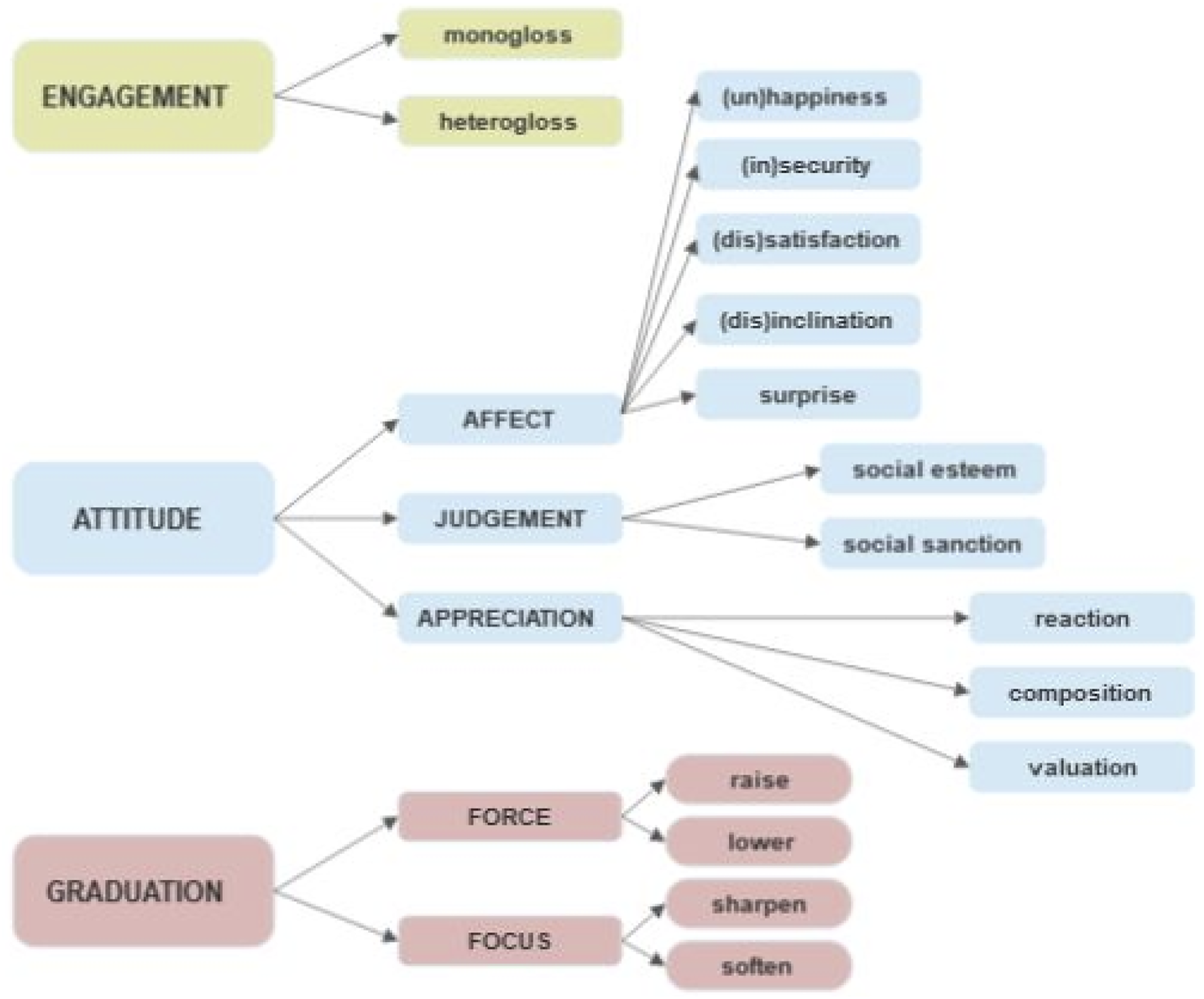
The appraisal system includes the domains of ATTITUDE, ENGAGEMENT, and GRADUATION (Figure 1). However, the present study only focuses on the first category. While interacting with one another, TT users display a wide range of reactions and feelings in response to other speakers’ discursive acts, behaviour, and various entities. This is covered under ATTITUDE, which is further divided into AFFECT, JUDGEMENT, and APPRECIATION. The speakers employ several verbal attitudinal resources to express emotion, which is included under AFFECT: (1) But I’m
The TT users also use various JUDGEMENT resources to evaluate the other speakers’ behaviour, based on their own norms, values and beliefs: (2) We all think you look very
Finally, the users select APPRECIATION resources to assess various concrete or abstract entities or phenomena: (3) Freedom, sister! Show off those
TT users employ the ideational metafunction of language to create a virtual world while negotiating interpersonal meanings through the use of spoken narrative (Halliday and Matthiessen, 2014). This may only reveal part of the picture, however. Multimodality accounts for the fact that meaning is realised through multiple modes (Van Leeuwen, 2022) and may subsequently provide a more holistic insight into the totality of semiotic resources employed by social actors. A multimodal approach may elucidate the users’ emotional expression through specific gestures or facial expressions, as well as uncover some of the putative motivations which guide them ideologically. TT users especially create meaning using a combination of language, gestures, image, artefacts, and audio. They employ attitudinal resources to evaluate other users’ statements, behaviour, or the entities that surround them, but also use appraisals to anticipate evaluation by the audience while interacting with other users. This paper only focuses on ATTITUDE because emotional responses are highly characteristic of interactions between TT users and construe both solidarity and contention around the topic of COVID-19 vaccine hesitancy.
Gestures, their effects, and the types of emotion associated with the movements, are all of significance to the meaning-making process, especially when examining digital discourse (Van Leeuwen, 2005). Hence, Martin and White’s (2005) Appraisal framework may be extended to include visual appraisals, linked to the interpersonal meta function of language of TENOR and referring to a speaker’s salient movements performed using either the hands or face. Each of the resources may be linked to one of the subcategories within the system of ATTITUDE. Firstly, TT users employ gestures to express various emotions in their videos. As such, within the AFFECT system, the speaker may show happiness by smiling, unhappiness by crying (Figure 2(a)), security by bringing both hands together in an embracing gesture, insecurity by anxiously looking around, satisfaction by licking the lips, dissatisfaction by frowning deeply, inclination by nodding, disinclination by shaking ‘no’ with the head, or surprise by raising the eyebrows, for example. As for JUDGEMENT, the speaker may show capacity through the use of meaningful hand gestures during explanations, tenacity by making a hammering hand gesture, or veracity by holding the hands with the palms turned upward. An example of the expression of propriety is finger-pointing (Figure 2(b)). Finally, in terms of APPRECIATION, the video creators may show reaction by rolling their eyes, composition by making a numbering gesture using their hands (Figure 2(c)), or valuation by making a thumbs-up gesture, anticipating the imaginary viewer to readily understand and accept these - highly culture-specific - movements. Examples of visual appraisals: (a) unhappiness: misery (doodlegirl, 2 August 2021), (b) social sanction: propriety (johncolbert29, 16 October 2021), (c) composition: complexity (mrs.b.tv [@mrs.b.tv] (2021, June 25)).
It further needs to be added that, in the selected videos, there is little social distance between speaker and viewer, nearly always showing the former’s head and upper body, which increases engagement with the audience (Figure 2(a)–(c)). Additionally, the speaker is usually positioned at a horizontal angle or equal level (Kress and van Leeuwen, 2020).
Sentiment is a notion that has been variably defined in the literature as the totality of opinions, feelings, and attitudes contained in text (Park et al., 2021). In Appraisal theory, however, opinion is an attitudinal resource that has been classified as belonging to the ATTITUDE system and the subcategory of JUDGEMENT, which pertains to the evaluation of human behaviour (Martin and White, 2005). Emotion is expressed using resources from the same system and the subcategory of AFFECT, whereas intersubjective positioning pertains to ENGAGEMENT, which is defined by Martin and White (2005) as utterances made by the author to position themselves in dialogical interactions with others. Affect is a rather multifarious term which has “gradually accrued a sweeping assortment of philosophical/psychological/physiological underpinnings” (Seighworth and Gregg, 2010: 9). Within the appraisal framework, the system of AFFECT is concerned with the evaluation of people’s emotions (Martin and Rose, 2007). 2 The task of a detailed interpretive appraisal analysis of social media corpora can be adequately fulfilled using Martin and White’s (2005) framework, the NLTK, and a customisable editor such as Notepad++, as explained in the next section.
Research method
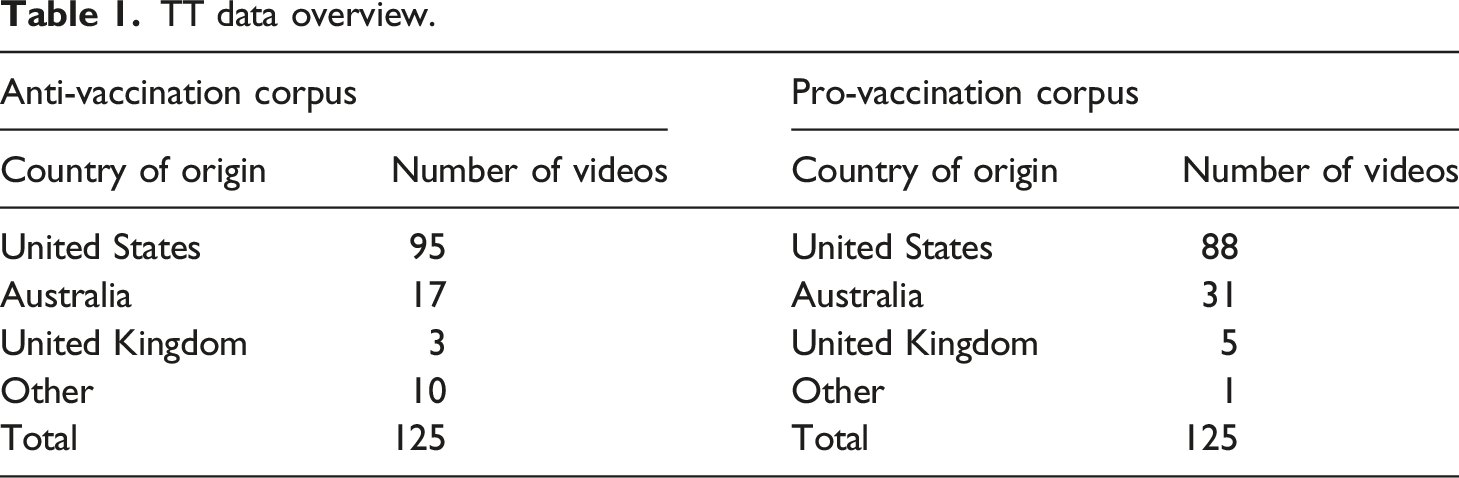
TT users tend to tag their own discourse to allow other users to find it, turning it into metadata (Zappavigna, 2018). They add hashtags such as #provaccine or #novaccineforme to their videos to connect with other users who hold similar views and, subsequently, create communities around the topics of COVID-19 vaccines and vaccination. Since the main research focus was on how TT users construe solidarity or contention with other users (Martin and White, 2005), a total of 254 videos were retrieved for the analysis via the TT interface, divided into two samples, based on relevant hashtags indicating an overt stance towards the topic of interest. First, 127 videos, uploaded to TT between 1 January 2021 and 20 January 2022, were selected for analysis, without opening an account on the SNS. Only videos of users discussing COVID-19 vaccines and vaccination were downloaded, after performing an informed search on the following hashtags: #stopthemandate, #medicalfreedom, #unvaccinated, #religiousexemption, #endmedicaltyranny, #novaccineforme, #novaccineformeaustralia, and #novaccine. Then, another 127 videos uploaded to TT between 1 January 2021 and 31 January 2022 with the hashtags #getvaccinated, #provaccine, #provax, #vaccine, #provaxcovid, #getvaccinatedplease, #getvaccinatedaustralia, #getvaccinatedtoday, and #letsgetvaccinated were retrieved.
TT data overview.
The Word documents with the transcripts were merged into two separate text files, which were uploaded to Notepad++. After this, the texts were run through a Part-of-speech (POS) tagger using Python 3 and the NLTK. All adjectives, nouns, verbs, and adverbs were extracted from the corpora, organised into separate text files, and double-checked manually. Any duplicates were removed from the lists. Multiple searches were then conducted to retrieve and check all relevant adjectives, nouns, verbs and adverbs and a more detailed appraisal analysis was performed on the samples, while closely considering the immediate textual environment of each of the tokens on Notepad++.
The investigation of attitudinal meaning-making on social media platforms requires the use of larger corpora and computational tools which allow for the analysis of discursive patterns within context. Using corpus-based methods may lead to analyses which are “more representative than small-scale and case studies” (Martin and Bednarek, 2010: 249). Notepad++, which is an open-source software package, may assist with the investigation of the use of evaluative language on SNSs through simultaneous document searches based on POS-tagged lists, considerably accelerating and facilitating the analytical process (Figure 3). No arduous pre-analytical manual coding is required, since the searches can be performed directly on the data. Example analysis of AFFECT resources (anti-vaccination corpus).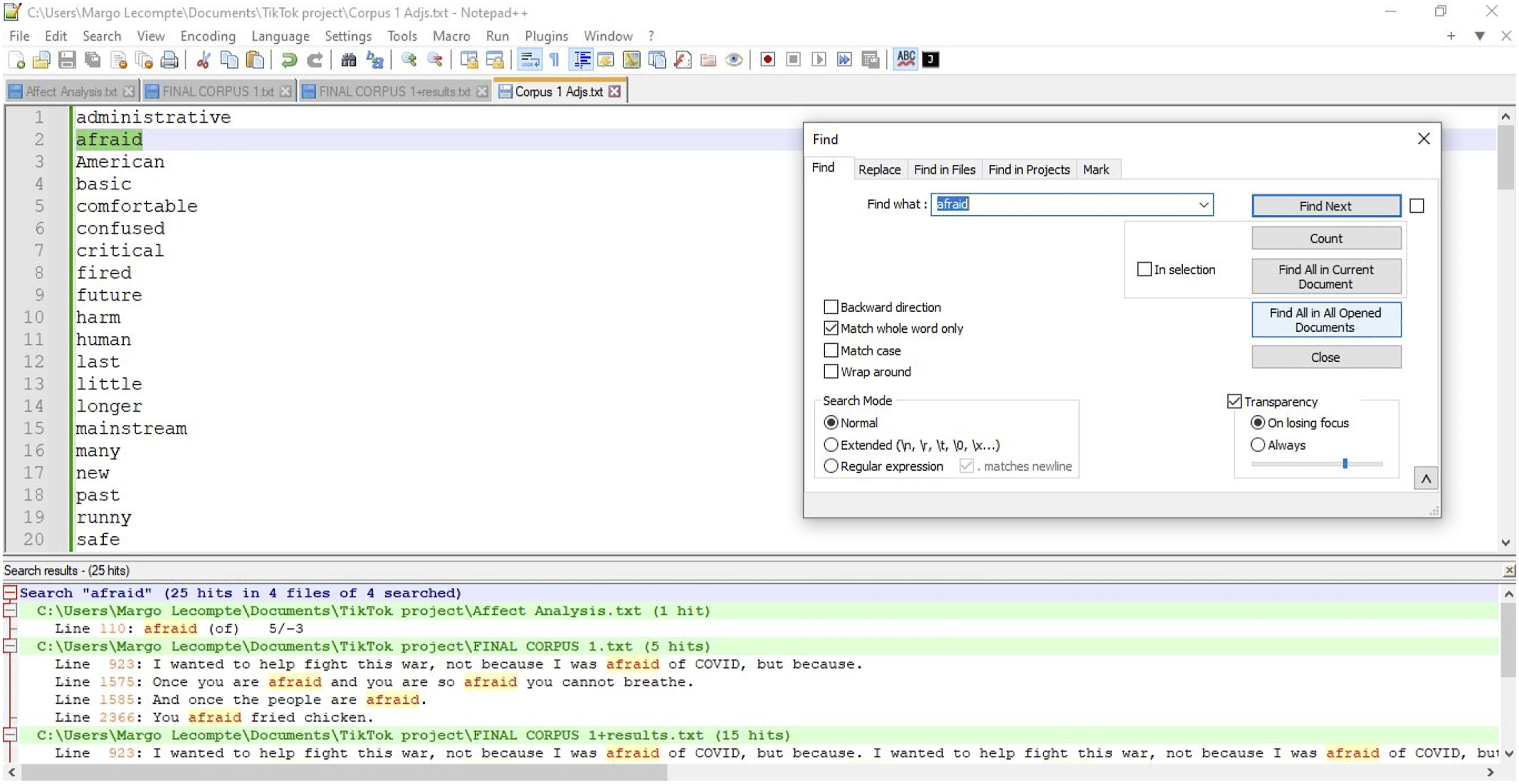
The data were organised into tables and percentages were calculated for each of the appraisal categories, after which the tables were evaluated, interpreted based on the relevant context, and explained. For the analysis of the non-verbal communication, the data were coded as follows. First, it was determined whether the hand gesture (e.g., finger-pointing) or facial expression (e.g., frowning) in the video was semantically relevant with regard to the associated discourse and context. If so, a score of 1 was attributed to the entity. If not, it was disregarded. Then, the movement was linked to one of the subcategories of the system of ATTITUDE: AFFECT, JUDGEMENT, or APPRECIATION and interpreted, both within the immediate digital and wider context of the video. The same process was repeated for all the visual data. All emojis and superimposed text in the videos were included in the analysis as well. Finally, the visual appraisals were quantified according to whether they were positive or negative and the two distinct types of semiotic resources employed by the speakers were compared.
Verbal appraisal analysis
Verbal appraisal analysis: ATTITUDE
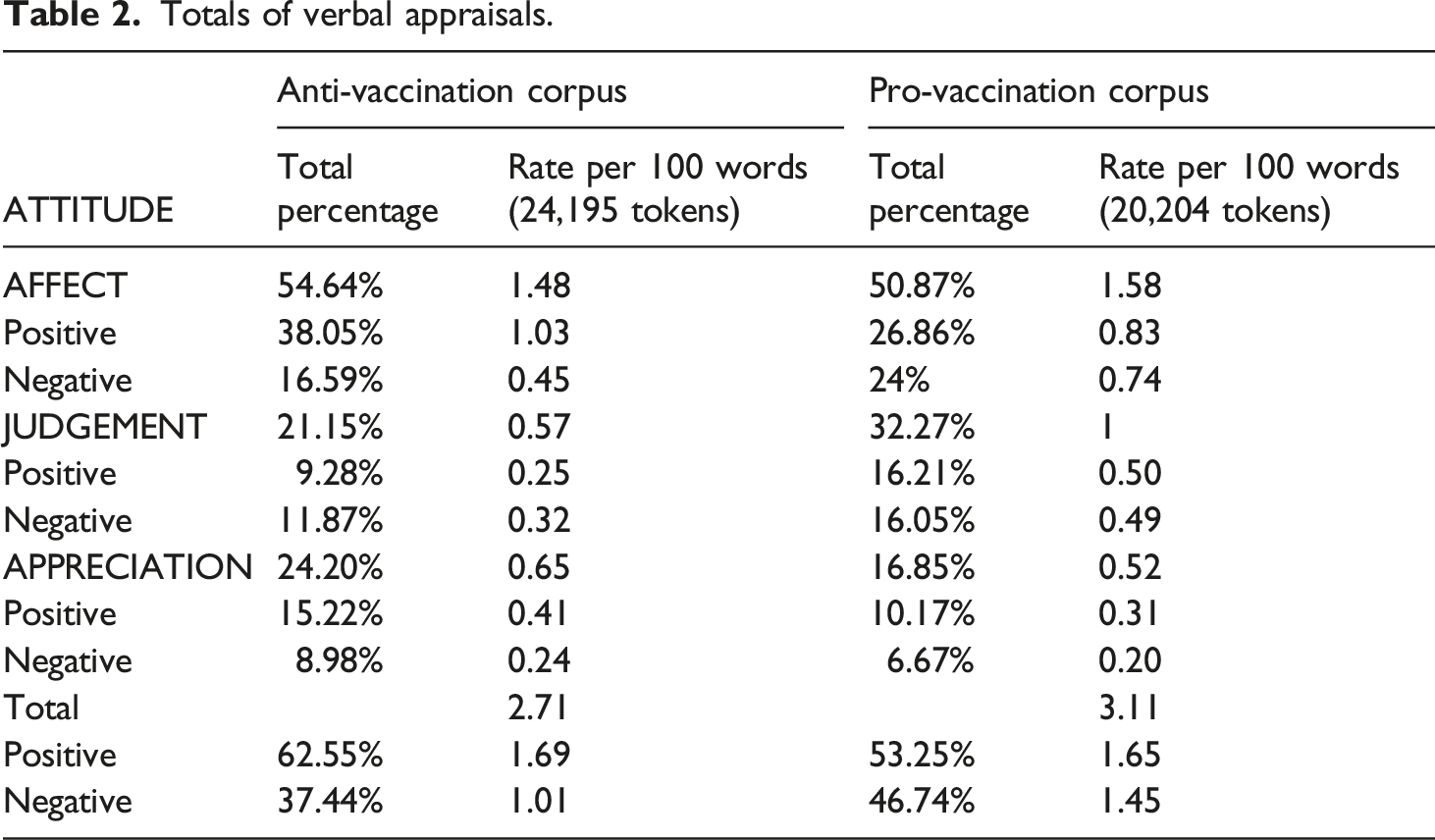
The analysis revealed that AFFECT was the dominant verbal appraisal for both groups (Table 2), representing the users’ emotions, such as happiness, fear, or anger. In the anti-vaccination corpus, the total percentage of AFFECT appraisals amounted to 55%, with a relative frequency of 1.48. Similarly, the pro-vaccination corpus AFFECT resources constituted 51% of the sample, with a relative frequency of 1.58. Both groups expressed positive feelings towards the entities they valued most. For the anti-vaxxers (38%) these included individual choice, their jobs, themselves, or their stories. The pro-vaxxers (27%) attached positive sentiment to COVID-19 vaccines, vaccinations, scientists, or medical professionals. The latter also expressed negative emotion (24%) towards individuals refusing the vaccines, the virus, or misinformation. They even uttered negative feelings on behalf of the other group: (4) But they are Totals of verbal appraisals.
Detailed examples are provided later on.
JUDGEMENT is concerned with individual attitude towards other speakers or their behaviour based on the judger’s own values and norms (Martin and White, 2005). As Table 2 shows, the pro-vaxxers used a higher percentage of JUDGEMENT appraisals than the anti-vaxxers (32% versus 21%).
Finally, APPRECIATION concerns the evaluation of abstract and concrete entities or natural phenomena (Martin and White, 2005). The anti-vaxxers employed more APPRECIATION resources than the pro-vaxxers (24% versus 17%) and these were predominantly positive. They expressed positive emotions towards religious exemptions, or antibodies.
When considering the relative frequencies in Table 2, it can be seen that, in both corpora, AFFECT resources were used more often than JUDGEMENT and APPRECIATION resources. Overall, positive appraisals were dominant in both corpora (63% versus 53%). Appraisal analysis fully considers the context in which emotions or opinions are expressed, as opposed to unsupervised sentiment analysis. For example, the speakers’ selection of the word ‘vaccine’ constitutes an ideational choice made by TT users on both sides of the debate. Whereas the pro-vaxxers position their audience to share a positive attitude towards COVID-19 vaccines by positively evaluating the entity, the anti-vaxxers endeavour to do the opposite. Both parties combine experiential and interpersonal meanings to persuade imaginary viewers to either get vaccinated or to abstain from doing so, which is referred to as coupling (Martin, 2000). Here is an example from the pro-vaccination corpus: (5) I’m going to say here once and for all that the
The pro-vaxxers establish a positive semantic prosody to achieve their rhetorical goal by projecting positive APPRECIATION when using the word ‘vaccine’, while the anti-vaxxers construe negative JUDGEMENT, as seen in the example below: (6) The
The corpora further contain numerous expletives. Such instances may lead to an erroneous negative interpretation and should therefore be interpreted based on the immediate context in which they occur. For example, the context of the swearword ‘f***’ in the following example reveals that the sentence actually carries a positive sentiment: (7) I’ll still, you know, eat pancakes with you at breakfast.
According to Martin and White (2005), expletives constitute resources signalling involvement, which complement appraisal through the negotiation of interpersonal relations between interlocutors.
AFFECT
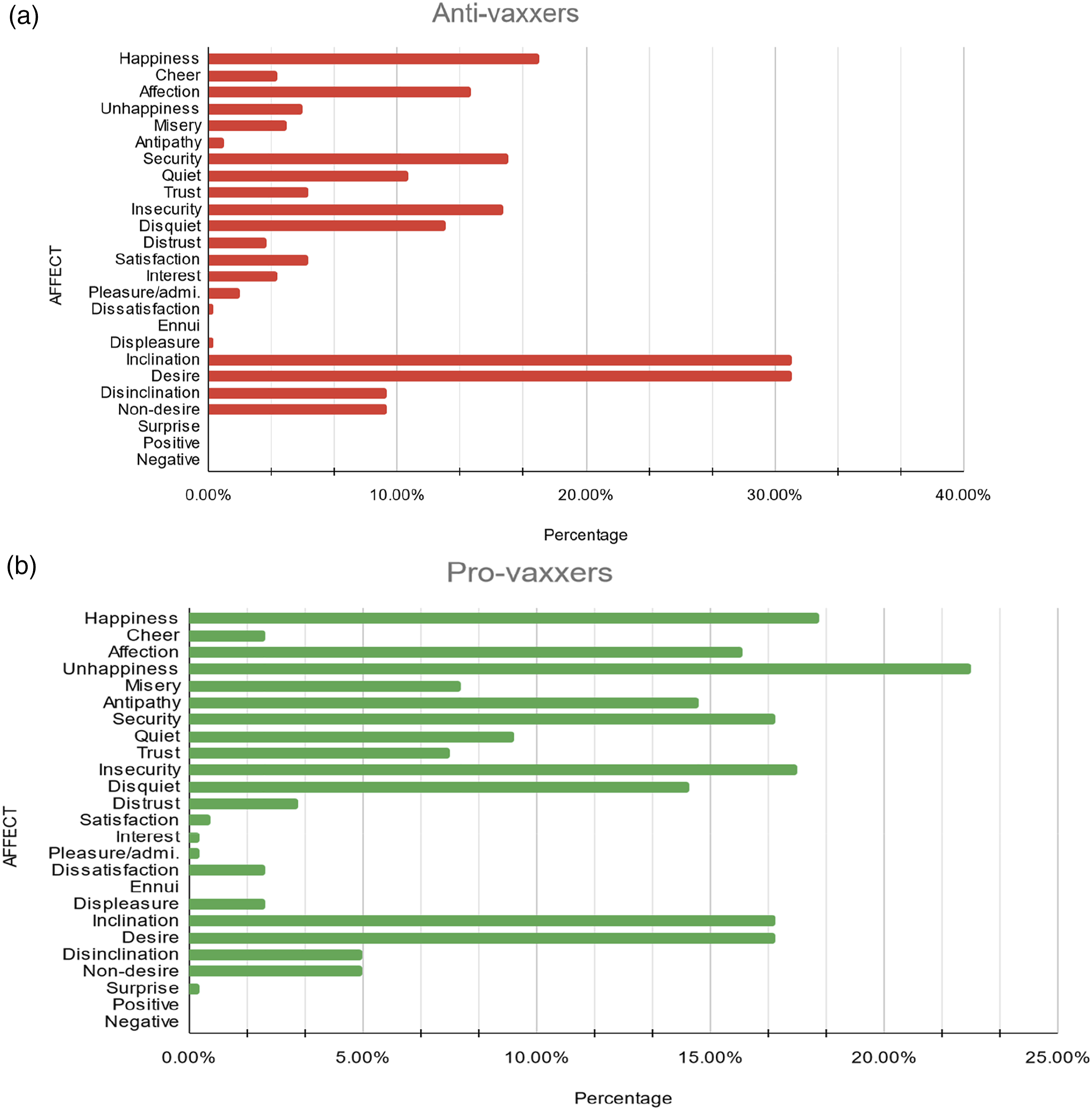
It has already been established that both groups favour the use of AFFECT attitudinal resources (55% versus 51%). When taking a closer look at Figure 4(a), it becomes clear that the anti-vaxxers mostly used tokens taken from the component of inclination: desire (31%). They express various desires which are focused on the protection of their homes and families, against perceived medical tyranny, uniting them in a “relationship of homology” (Bourdieu, 1990: 60): (8) I’ (9) I (10) Understand that I am perfectly (a) AFFECT (anti-vaxxers). (b) AFFECT (pro-vaxxers).
The anti-vaxxers also wish for others to understand the reasons for their vaccine hesitancy: (11) I
In contrast, the pro-vaxxers mostly used tokens from the negative subcategory of unhappiness (23%), more specifically antipathy appraisals (14%) (Figure 4(b)). They express unhappiness through the use of sarcasm and irony while mocking the other group: (12) I got the vaccine for selfish reasons because I
Their antipathy mainly extends towards unvaccinated people. Words that include the prefix anti- and expletives (in italics) further signal antipathy or up-scale the process (14 and 17): (13) See this kind of stuff (14) [Those people] are being permitted to walk around with the rest of us and spread it to whoever they damn [unhappiness: antipathy] well please. (15) So here’s something (16) The anti-vax (17) It’s f***ing
Similar to the other group of users, the pro-vaxxers used a high percentage of verbal appraisals of the inclination-desire component (16%), mainly expressing the desire for people to accept COVID-19 vaccines, as such aligning themselves with the “objective structures” or common sense knowledge (Bourdieu, 1990: 160): (18) (19) I do
Along the same lines, they also want to educate people and provide them with an explanation as to why they should follow the WHO guidelines: (20) I (21) I
JUDGEMENT
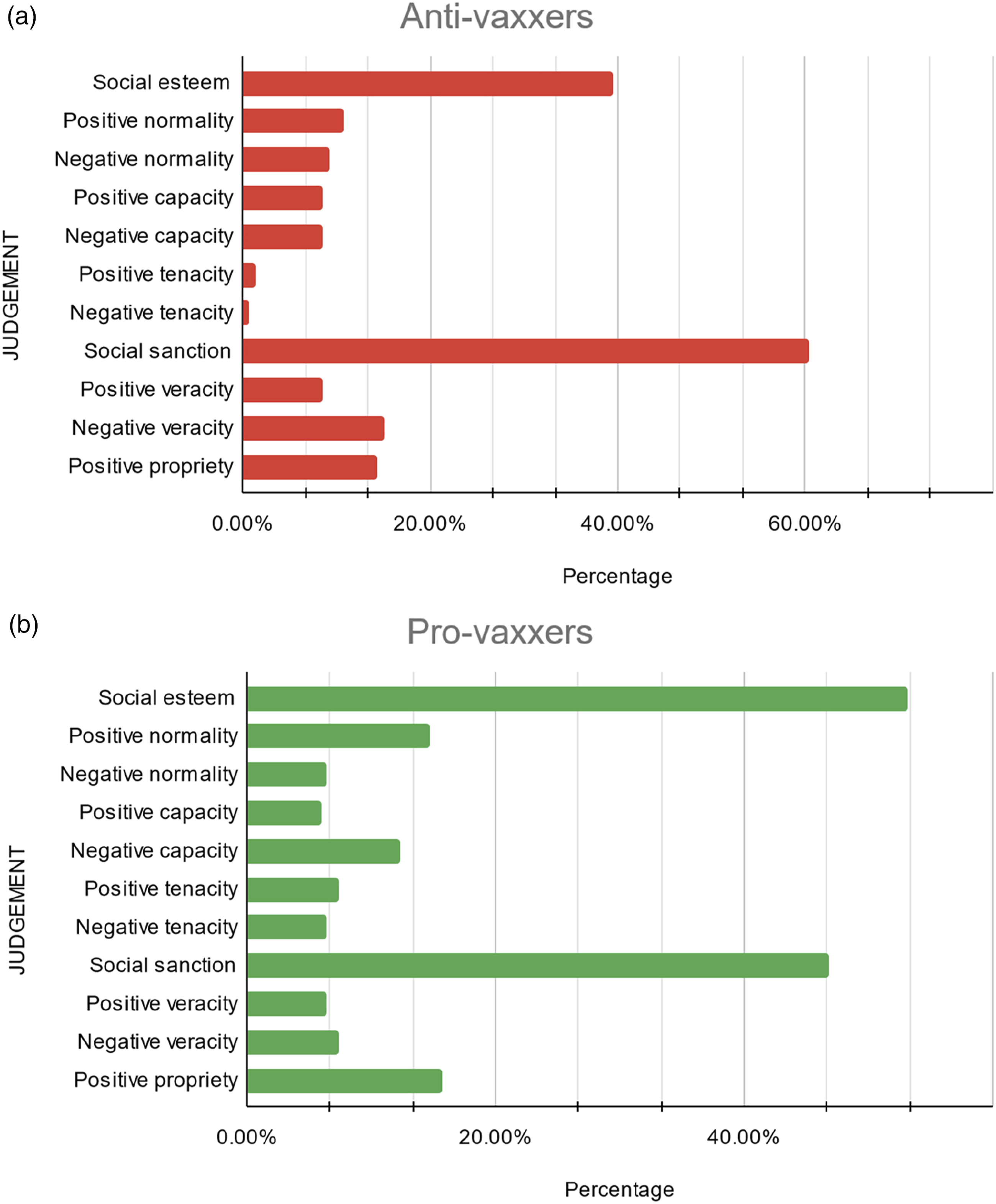
The pro-vaxxers used a higher number of JUDGEMENT resources than the anti-vaxxers (32% versus 21%) but there was only a slight difference between the number of positive and negative resources they employed. The anti-vaxxers selected more negative than positive verbal JUDGEMENT appraisals (Table 2). A closer look at this type of appraisals in both corpora reveals that the anti-vaccination group favours resources belonging to the social sanction subcategory (60%), especially those linked to negative veracity and positive propriety (Figure 5(a)), referring to scientific evidence as misinformation and warning pro-vaxxers against it: (22) The reason they’re giving you to vaccinate your child is a (23) Oh, you should be a little more (a) JUDGEMENT (anti-vaxxers). (b) JUDGEMENT (pro-vaxxers).
As mentioned by Martin and White (2005), these judgements concern truth and ethics. The anti-vaxxers claim that the other group’s attitude is to be condemned because it is based on lies and unethical behaviour. They seem to interpret the pro-vaxxers’ behaviour as a public and personal act of discrimination while rejecting any vaccine recommendations or mandates. In their view, every appeal to the public to get vaccinated is linked to totalitarianism: (24) [The Biden administration is literally paying hospitals to kill you. That’s what’s happening.] It’s (25) This (mandatory vaccination) was struck down very recently over this past weekend by the appeals court and declared
Directives (modals of obligation) (in italics) and values of social sanction are intricately linked in terms of meaning (Martin and White, 2005), as shown in the following example: (26) I don’t want to put this injection in my body. What’s
In contrast, the pro-vaxxers used more tokens from the social esteem subcategory (53%) (Figure 5(b)). Their stance mostly relates to positive normality, associating COVID-19 vaccinations with being lucky or special: (27) They [vaccinations] will make you
Their viewpoint also seems concerned with negative capacity, as they label anti-vaxxers as weak, stupid, fragile, selfish, or crazy and their behaviour as insane or dumb: (28) We all think you look very (29) You see, what I would deem as scared and (30) I truly don’t know why are you so (31) They (32) The (33) For some reason, this is (34) So
Together with the previously discussed expressions of antipathy, the use of this type of resources is related to the social phenomenon of vaccine shaming.
APPRECIATION
In both corpora, composition appraisals (38% versus 46%) were preferred over reaction or valuation appraisals (Figure 6(a) and (b)). Composition is concerned with how individuals perceive various entities or natural phenomena and is therefore intricately linked with mental processes (Eggins and Slade, 2006). Both groups are evaluating their counterparts’ discourse and movements through a critical lens. The anti-vaxxers are continuously endorsing their own beliefs. Subsequently, their habitus functions as “the principle of a selective perception of the indices tending to confirm and reinforce it rather than transform it” (Bourdieu, 1990: 64). Some examples of the anti-vaxxers’ positive evaluation of how entities are composed combined with mental processes: (35) And I think there’s probably a legally (36) I’m sharing with you what I believe to be an (a) APPRECIATION (anti-vaxxers). (b) APPRECIATION (pro-vaxxers).
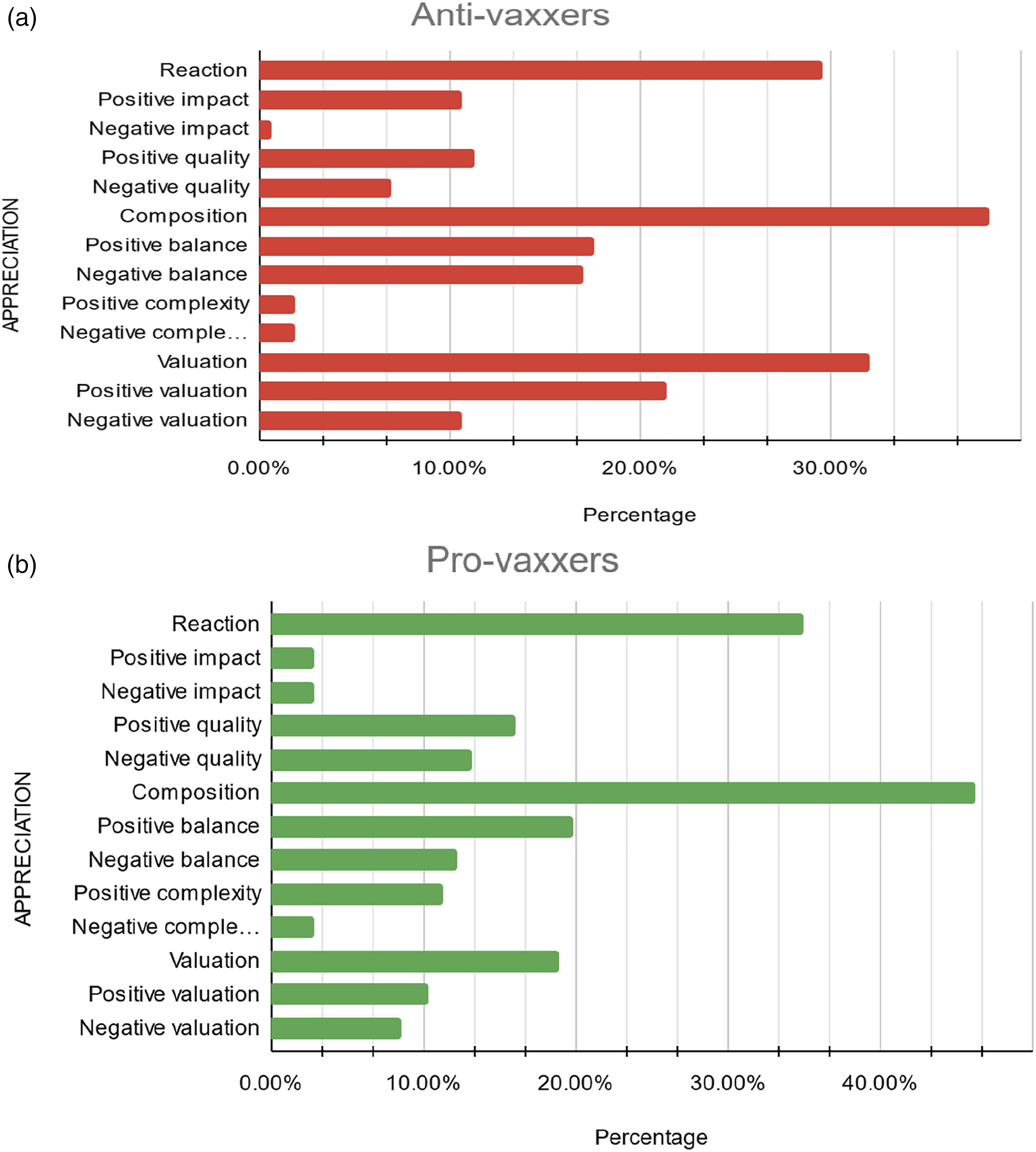
In contrast, the pro-vaxxers positively evaluate entities like science or instructional videos (Figure 6(b)), which relate to the objective structure of society (Bourdieu, 1990): (37) I think the science is (38) I hope you find this video
Visual appraisal analysis
Multimodal appraisal analysis.
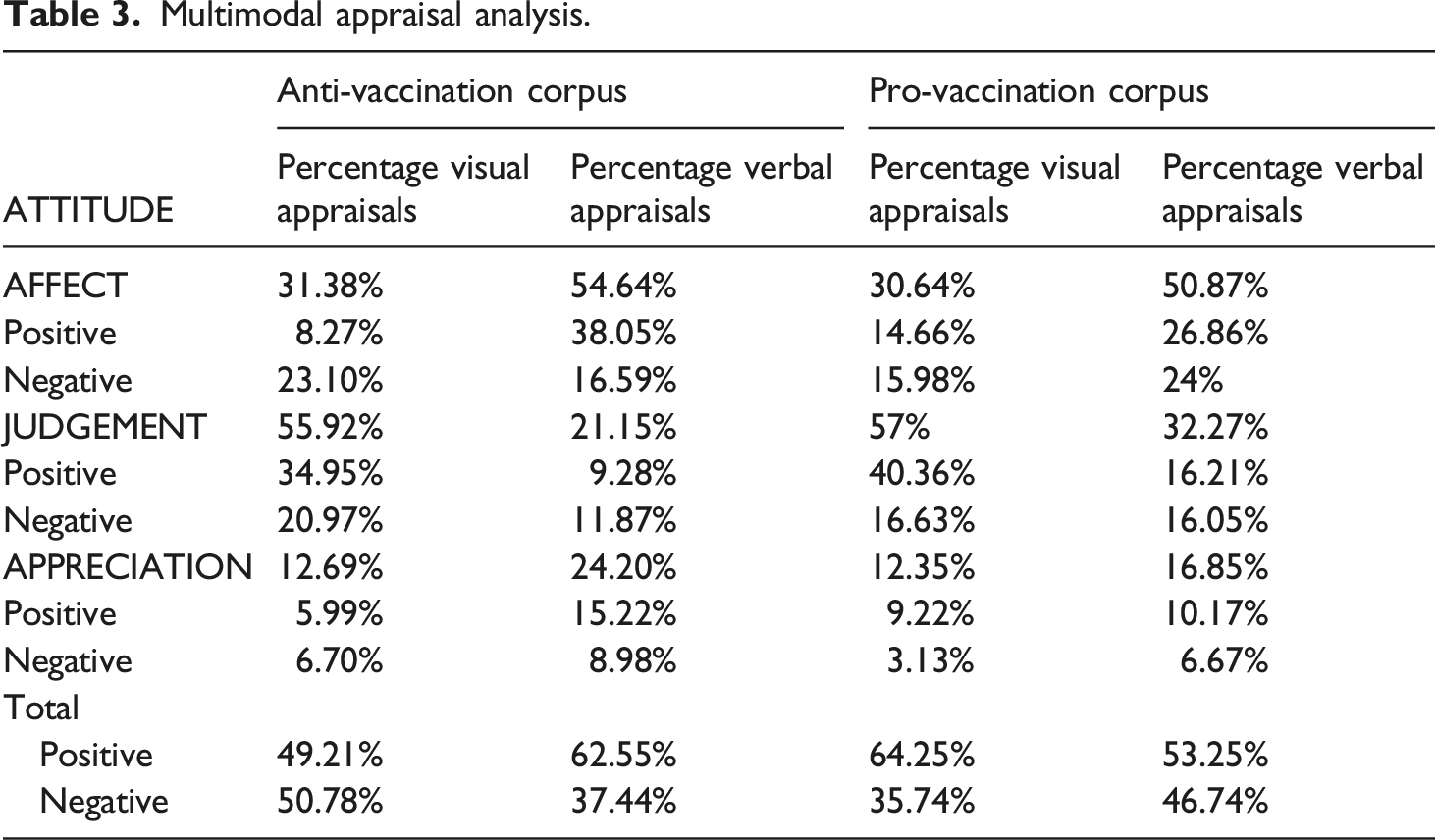
In contrast, the pro-vaxxers’ use of visual appraisals was mostly positive (64%), which equally aligned with their preferred choice of positive verbal resources (53%). Their frequent selection of non-verbal JUDGEMENT resources (57%) primarily targets anti-vaxxers. Most of the appraisals are positive (40%), as they are attuned to institutional rules and objectives (Bourdieu, 1990) (Table 3).
The anti-vaxxers mainly used visual JUDGEMENT appraisals (56%) from the subcategory of positive social sanction: veracity (19%) and positive social sanction: propriety (14%). Since their message primarily concentrates on revealing the ‘truth’ about COVID-19 vaccines, the behaviour they display underlines their shared belief that what the media presents as truth is fake. The result is a “two-fold objective truth”, as the anti-vaxxers play a game “through which the group, the source of all objectivity, in a sense lies to itself, by producing a truth whose sole function and meaning are to deny a truth known and recognized by all” (Bourdieu, 1990: 234).
The anti-vaxxers’ most frequently used gesture to evoke positive veracity was wide-open or rounded eyes, which, according to Lee and Anderson (2017), aims to convey trust and sincerity (Figure 7(a)).
3
As Donath (2020: 54) points out, robots are often designed with large childlike eyes to come across as more persuasive. The anti-vaxxers further invoke positive veracity by placing one hand on the chest, eliciting honesty (Parzuchowski and Wojciszke, 2014) (Figure 7(b)). They expressed positive propriety using highly symbolic hand gestures, such as holding up three fingers of the left hand while holding the thumb to the little finger (Figure 7(c)). The three-finger salute was often accompanied by verbal messages such as ‘Looking for my soul tribe’ or the sound of the mocking jay call borrowed from a movie titled ‘The Hunger Games’ (2015). This tune, known as Rue’s song, consists of four notes and is a salute to other rebel fighters. As a symbol of resistance, the hand gesture is employed by the anti-vaccination group to protest against the presumed totalitarian powers of the government. Their use of visual appraisals corresponds with their preference for verbal resources from the same two subcategories. Most frequently used visual appraisals by anti-vaxxers: (a) judgement: positive veracity (Kubica, 28 July 2021), (b) judgement: positive veracity (Misty, 18 October 2021), (c) judgement: positive propriety (Meagan DeSart, June 15 Calling, 2021).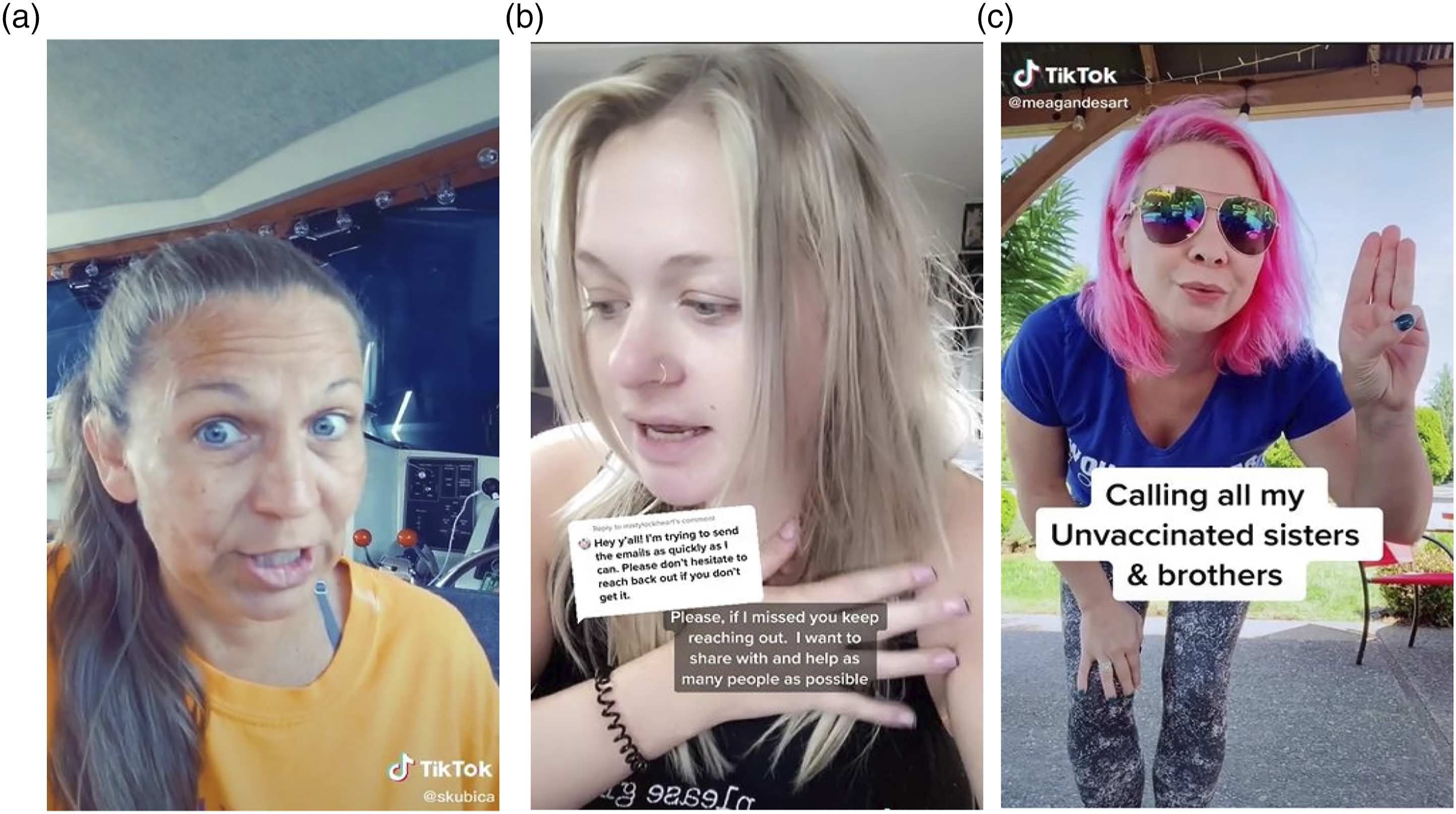
Conversely, the pro-vaxxers mainly selected visual JUDGEMENT appraisals (57%) from the subcategories of positive capacity (12%) and positive normality (14%). They too establish a specific prosody through their use of visual appraisals by positioning themselves as powerful individuals who are highly knowledgeable about the development and administration of COVID-19 vaccines, which may be linked to TT’s goal of self-promotion. To achieve this goal, they primarily use deictic and iconic hand gestures. Both types of gesture are often used by teachers when communicating with children in the classroom (McNeil et al., 2000). McNeill (2005: 39–40) explains that deixis “entails locating entities and actions in space vis-a-vis a reference point”, while iconic gestures “present images of concrete entities and/or actions.” The pro-vaxxers frequently used the hand gestures to simplify and reinforce their message. Some examples of deictic hand gestures signalling positive capacity, employed by this group of TT users, were pointing to the arm in which they received their vaccination (Figure 8(a)) or holding up several syringes (Figure 8(b)). An example of an iconic gesture enacting positive normality was closed eyes, with the head tilted backwards, while releasing air with the mouth, to depict the action of relaxing at home (Figure 8(c)). Despite their presumed positive intention, deictic and iconic hand gestures are both highly dominant movements which reinforce the negative judgement contained in the pro-vaxxers’ verbal appraisals by labelling the unvaccinated users as unintelligent. The pro-vaxxers further frequently used rhytmic gestures by continuously moving the hands up and down. These so-called ‘beat gestures’ may come across as exaggerated and as lacking warmth (Gnisci and Pace, 2014). Most frequently used visual appraisals by pro-vaxxers: (a) judgement: positive capacity (LawrenceBing, 6 June 2021), (b) judgement: positive capacity (Docsnooze, 8 March 2021) and (c) judgement: positive normality (vickichanmd, 30 November 2021).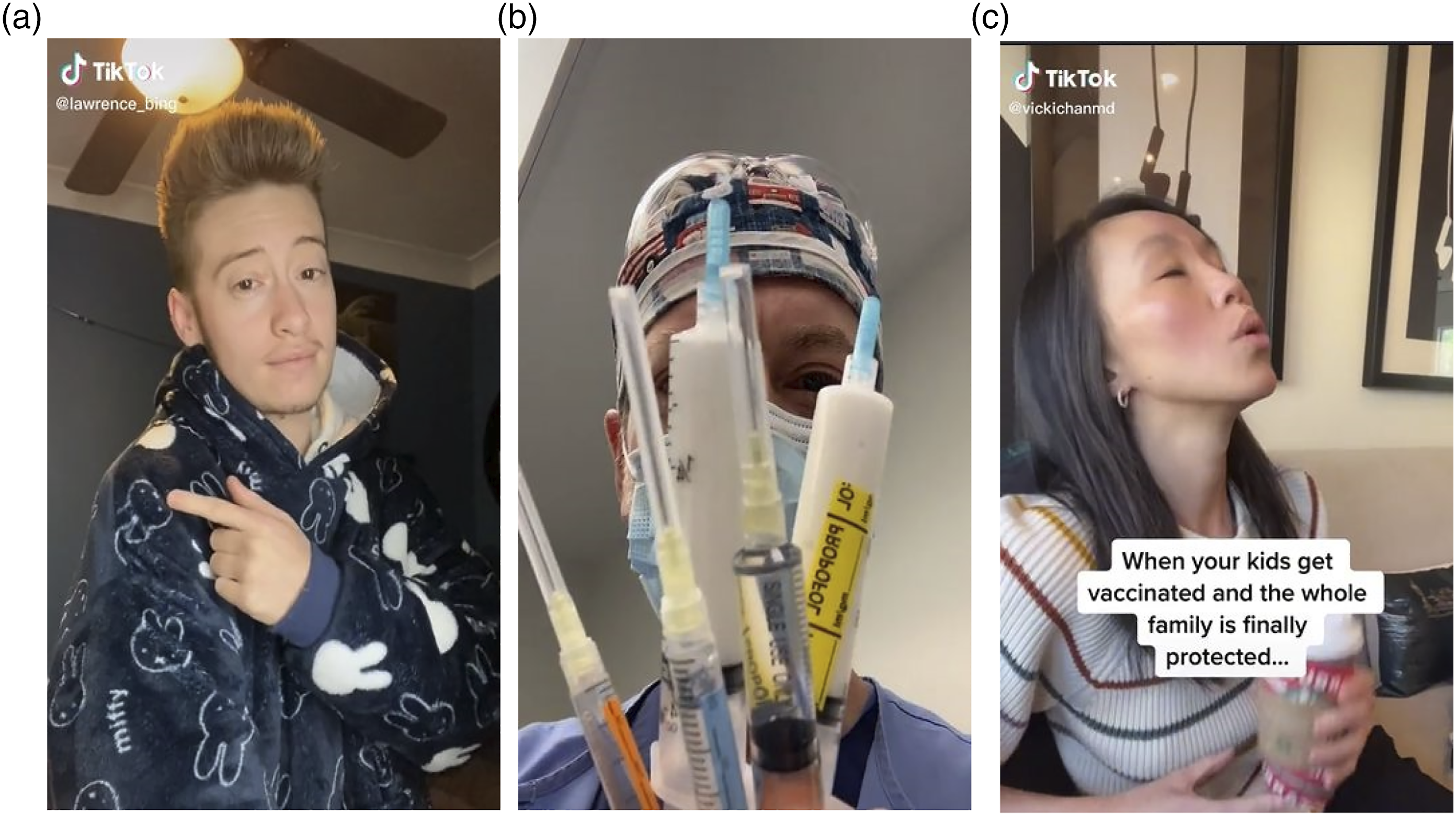
The anti-vaxxers mainly expressed various wishes using positive verbal inclination-desire appraisals, as discussed in section 6.2.1. Their physical movements, however, indicated a high degree of disinclination betrayed by gestures such as shaking ‘no’ with the head or index finger (Figure 9(a)). The pro-vaxxers favoured negative verbal appraisals from the subcategory of unhappiness: antipathy, as shown in section 6.2.1, which were mostly accompanied by deictic or iconic hand gestures with a possible negative connotation, establishing dominance, such as showing the viewer a filled syringe (Figure 9(b)). (a) disinclination: non-desire (Kim is the name, 17 August 2021), (b) social sanction: propriety (Nye, 2021; Docsnooze, 8 March 2021).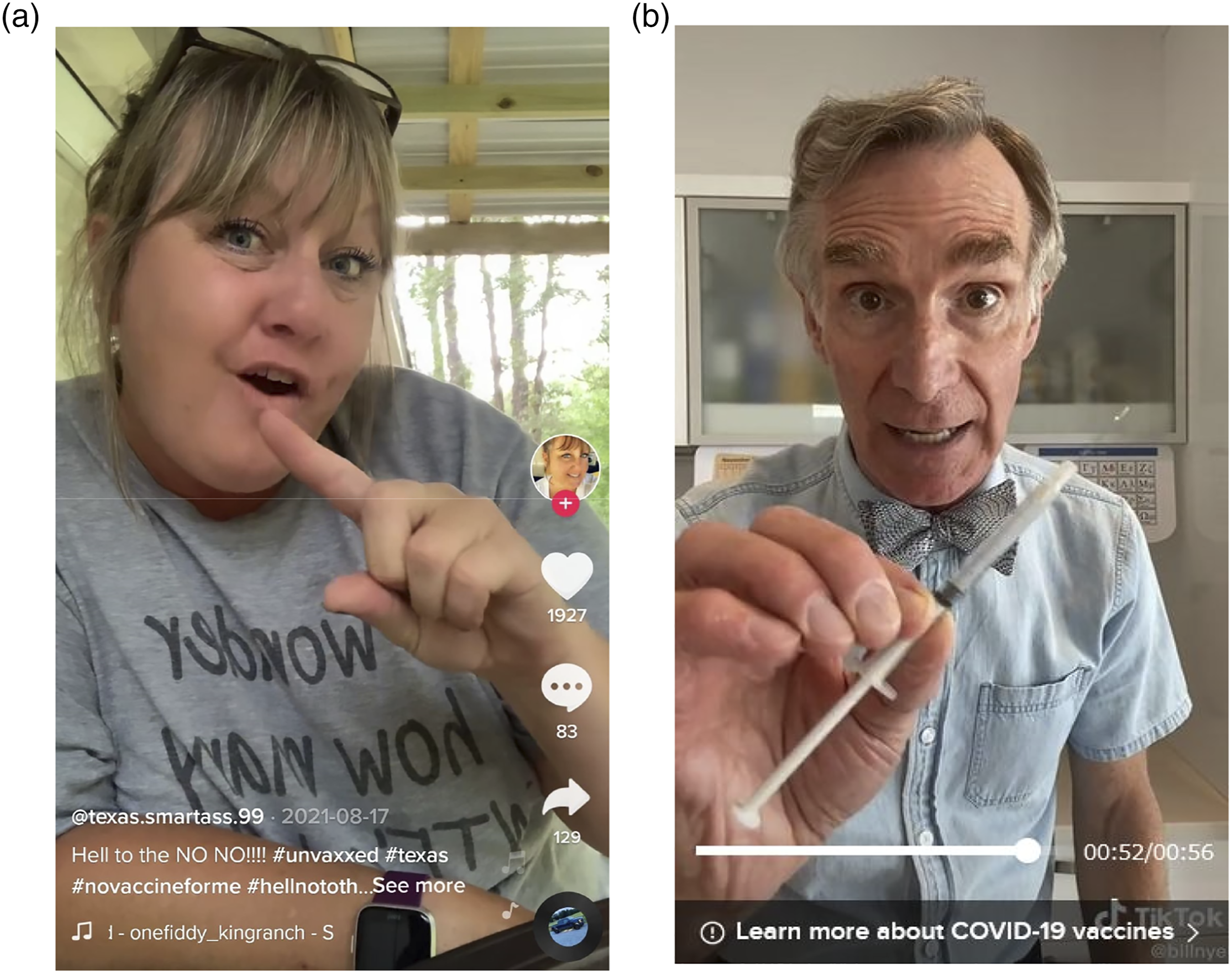
Further discussion and conclusion
In the light of the view of ideology as a semiotic system, all interactants engaged in the vaccine war not only make linguistic selections from the English language system when using evaluative language, but also emblematic choices, which are defined by Lecompte-Van Poucke (2016) as “selections made by people in order to affiliate themselves with various entities and categories that are meaningful to them, as a form of self-identification.” Even though these choices are not inherently negative, they may lead to ideological clashes due to the context in which they are being made. Through their interactions with other groups adhering to divergent systems of thought and based on learned behaviour (Lave and Wenger, 1991), the TT users construct a distinct social persona which envelops a total of resources, including discourse and gesture. They continuously position themselves in relation to what is being said and done on the SNS, since the habitus is “constituted in practice” (Bourdieu, 1990: 52), being a dynamic notion. By engaging in ‘hashtag rebellion’ against the institutionalised practice of vaccinations, the anti-vaxxers construe a persona of victimisation, whereas the pro-vaxxers attempt to elicit trust in objective structures by modelling behaviour which is in line with government recommendations (Bourdieu, 1990: 59), as such creating a dominant persona of the model citizen doing the right thing. The more conscious objectives of both parties remain to trigger a strong emotional response and to gain more followers, which perfectly aligns with TikTok’s goal of keeping users engaged with the SNS. However, since the users’ behaviour may lead to the formation and further entrenchment of aberrant political attitudes and beliefs, it may not be as innocent as initially believed and can have considerable repercussions on social structure in the form of organised protests and riots, for example.
Lindeman et al. (2022) explain how highly emotionally charged accounts can easily lead to the formation of cognitive biases and a distrust of objective scientific facts. To counter the spread of disinformation and denialism, TikTok added an information hub, where users can find objective evidence about COVID-19 vaccines (TikTok, 2022c, 2022d). Nevertheless, as Hornsey (2020) shows, vaccine skeptics tend to adhere to attitudes which openly disagree with the scientific view on the pandemic and which are mostly based on psychological motivations, such as fears, conspiracist ideation, or political ideology. The result is a more inward-oriented community, centred around its own beliefs and based on shared feelings of anxiety and discrimination, eager to perpetuate its habitus.
It has become evident that the TT users, as SMIs, use emotive language in an attempt to shape their viewers’ behaviour, hoping for other users to align with the fictitious persona of the ideal citizen. The anti-vaxxers mostly used AFFECT verbal appraisals from the inclination component to express their desire for others to adhere to the same ideological stance, while the pro-vaxxers expressed their unhappiness regarding their counterparts’ fears and ignorance regarding COVID-19 vaccines. The anti-vaxxers further negatively judged the pro-vaxxers’ behaviour in terms of veracity and propriety, accusing them of spreading misinformation and condemning their perceived discriminatory behaviour, whereas the pro-vaxxers positively judged their own behaviour against the other party’s selfishness and ignorance. Both groups also positively appreciated content retrieved from other SNSs. In terms of visual appraisal, positive JUDGEMENT resources were favoured by both groups. The anti-vaxxers’ gestures emphasise the veracity of their utterances, whereas the pro-vaxxers’ focus appears to be on sharing their own expertise, whichever way is most effective.
As a successful Chinese technology company, TT’s main desire is for content creators to produce videos which are highly engaging and which may eventually reach memetic status, at which point the SNS can use their viral content and following for commercial purposes. This form of technological soft power remains concealed by TT’s apparent de-politicised focus on lifestyle and entertainment; yet, it still carries China’s broader objectives of global expansion and impact. The pro-vaxxers’ efforts, on the other hand, are likely to be hampered by TT’s capitalist logic, which encourages the mere consumption of video content without acting upon it. This might render the dissemination of accurate health information on the SNS useless. As reducing or eliminating vaccine hesitancy is bound to involve a long-term commitment to the creation of epistemic trust on SNSs, TikTok may not be the most effective channel to achieve this.
A possible limitation of the paper might be the retrieval of skewed data, due to the SNS still catering for the researcher as residing in Australia. To fully avoid this, data could be extracted from random user accounts rather than based on hashtags in the future. Quantifying gestures and other body movements remains linked to subjective interpretation as well and the meanings of visual appraisals are diverse and context-dependent. Subsequently, any conclusions drawn in this paper are not to be seen as universal, as they neither apply to all members of the two groups nor to the totality of individuals who express themselves in favour of or against COVID-19 vaccines.
The anti-vaxxers’ expression of shared fears on TT appears to create bonding within the group itself sharing the same habitus. Nonetheless, this selective avoidance precludes any form of non-antagonistic dialogue with the pro-vaccination group and inevitably amounts to polarisation. An ideological clash between the anti-vaxxers’ negative subjective dispositions towards COVID-19 measures, shaping their vaccine hesitancy or refusal, and the objective structure of governmental healthcare protocols thus becomes apparent. Even though the pro-vaxxers’ ideological positioning is better aligned with the official norms, their own subjectivities complicate the dissemination of correct information on TT and hinder the anti-vaccination audience’s approval of the generally accepted fact that vaccines are an effective tool in combatting viruses. The use of non-judgemental language and gestures when sharing health information in videos might be a more useful rhetorical strategy. It is hoped that the study has created a more holistic picture, albeit a momentary one, of the complex multimodal meaning-making surrounding the COVID-19 vaccination debate.
Footnotes
Declaration of conflicting interests
The author(s) declared no potential conflicts of interest with respect to the research, authorship, and/or publication of this article.
Funding
The author(s) received no financial support for the research, authorship, and/or publication of this article.
Notes
Detailed visual appraisal analysis.
Visual appraisals
Anti-vaxxers
Percentage
Pro-vaxxers
Percentage
AFFECT
220
31.38
186
30.64
Positive
58
8.27
89
14.66
Negative
162
23.1
97
15.98
Happiness
18
2.56
8
1.31
Unhappiness
9
1.28
1
0.16
Security
9
1.28
7
1.15
Insecurity
36
5.13
22
3.62
Satisfaction
30
4.27
65
10.7
Dissatisfaction
56
7.98
64
10.54
Inclination
1
0.14
9
1.48
Disinclination
59
8.41
6
0.98
Surprise
2
0.28
2
0.32
JUDGEMENT
392
55.92
346
57
Positive
245
34.95
245
40.36
Negative
147
20.97
101
16.63
Normality
95
13.55
87
14.33
Capacity
39
5.56
101
16.63
Tenacity
35
4.99
2
0.32
Veracity
135
19.25
76
12.52
Propriety
99
14.12
78
12.85
APPRECIATION
89
12.69
75
12.35
Positive
42
5.99
56
9.22
Negative
47
6.7
19
3.13
Reaction
59
8.41
32
5.27
Composition
28
3.99
39
6.42
Valuation
2
0.28
4
0.65
Overall total
701
607
Positive
345
49.21
390
64.25
Negative
356
50.78
217
35.74