




Abstract
This study adopts a longitudinal approach to analyse the attribution of blame in online comments for the emergence, continuation and consequences of COVID-19. It uses an innovative approach to distil a specialised corpus of readers’ comments in response to UK online news articles about COVID-19, before applying corpus linguistic techniques to identify the principal actors attributed as blame agents. The research found that both internal (the government and the prime minister) and external actors (China and the World Health Organization) were identified as blame agents in comments. The analysis also indicates the presence of blame attribution towards people, their own actions and behaviours, which, in part, may be a consequence of government and public health messaging that emphasised individual responsibility to reduce transmission of the virus. This is distinctive, with significance for public understanding of COVID-19 and for future pandemic communication planning.
Introduction
During health crises, the news media are a key agent in mediating the crisis but also in communicating health policy and information (Pieri, 2019). It is known that through the initial waves of COVID-19 there was a substantial increase in news consumption and social media use publics attempted to make sense of this crisis and its impacts (Broersma & Swart, 2022; Tsao et al., 2021). It has also been established that while information found online and on social media was often used by those seeking health information, it also contributed to the spread of COVID-19-related conspiracy, disinformation and hate speech (Tsao et al., 2021). These online discursive spaces, nevertheless, can also be valuable for gauging public knowledge, opinion and understanding of important issues and events (Baek et al., 2012).
One of the consequences of crises is a tendency for individuals, organisations and institutions to allocate blame, for example, to the government for failures in their policy responses (Malhotra & Kuo, 2008). Blame dynamics have also been shown to be a common feature of pandemics. This has included the othering and scapegoating of social groups (Eichelberger, 2007), assigning blame to agencies that have failed in their crisis response (Mayor et al., 2013; Roy et al., 2020) and blame avoidance strategies, such as those implemented by political actors to avoid culpability (Schlipphak et al., 2022). Existing empirical research has adopted experimental methods to understand the consequences of scapegoating for COVID-19 (Porumbescu et al., 2023) and developed proposed frameworks to understand the mechanics of blame in the context of COVID-19, drawing on social and cognitive psychological theories (Bouguettaya et al., 2022). Yet, there are only a limited number of studies that have examined blame dynamics that circulated around COVID-19. Research thus far has focused exclusively on the initial phases of the pandemic (Choli & Kuss, 2021), identifying how blame was attributed to China for the emergence and spread of SARS-CoV-2, evident in the rhetoric of political elites, and concluding that this contributed to xenophobia, racism and violence towards people of Asian descent (Roberto et al., 2020).
This study seeks to build on this body of knowledge by using corpus linguistic approaches to examine the evaluative attribution of blame to different actors, defined as an individual, group or collective of people, institution or organisation that are assigned responsibility for actions, inactions or failings, within a specialised corpus of online readers’ comments in response to articles published by three online news outlets (BBC News, The Guardian and MailOnline). Exploring the actors to whom the public attribute blame for the pandemic, its continuation and impacts is important for providing insights into public understanding of the pandemic but also planning responses to future health emergencies. It is known, for example, that blame can have a detrimental impact on public health responses and in the management of disease outbreaks (Goldin, 1994). Blame contributes to fear, stigma and perceived discrimination, which can influence public actions and health behaviours (Hardy et al., 2021). It can also be disruptive to the dissemination of timely and evidence-based information (Kumar & Nayar, 2021) and in building trust and support for interventions designed to mitigate the effects of a pandemic, for example, by failing to cultivate empathy, resilience and collective bonds that are important to overcome a crisis (Jakovljevic et al., 2020).
Blame dynamics
Periods of instability and uncertainty create a situation where actions, decisions or events that may have contributed to a crisis are debated. Within this environment, there may be attempts to attribute blame for a perceived negative outcome to different organisations, groups or individuals, who in turn may engage in strategies to deflect or avoid blame (Matthews & Heesambee, 2024). These processes can be defined as blame dynamics.
Scholars have drawn a distinction between causal blame, where blame is assigned to someone or something that has happened, and interpersonal blame, characterised by an individuals’ reaction to negative outcomes, attitudes and emotions (Tognazzini & Coates, 2021). Some, therefore, argue that blame is more appropriately understood as a ‘psychological construct’ (Alicke, 2000).
Theories and approaches to understanding blame are varied, encompassing cognitive, emotional, social and moral perspectives. Cognitive theories centre on the idea that blame is to evaluate someone’s actions, inaction or decisions as a failure and to hold them responsible for their failings (Tognazzini & Coates, 2021). Others suggest that blame can also be an emotional response, grounded in resentment, anger and guilt (Wallace, 1994). The types and strengths of emotions that characterise blame are disputed. Sher (2008) critiques the view that a negative emotional response is necessary to blame and that we may still attribute blame without feeling resentment or anger. From a moral perspective, blame may be understood as a ‘social tool’ that governs the behaviours of others (Monroe & Malle, 2018). Moreover, functional theories of blame focus on what may cause an individual to develop attitudinal or emotional states that constitute blame, for example, to express disapproval, encourage cooperation or seek compensation (DeScioli & Bokemper, 2014).
Blaming is not homogeneous; if an actor is perceived to have been negligent or acted intentionally, then there may be a greater acceptance that blame attribution is justified. If, however, an event is perceived to not have not been preventable or the role of the actor is limited, then a lower level of blame may be ascribed (Malle et al., 2022). It is known, for instance, that political actors will often try to deflect blame when policies are contested (Heinkelmann-Wild & Zangl, 2020) and that citizens will use relevant information to mitigate partisan bias to determine responsibility among different political actors (Malhotra & Kuo, 2008). Shifting blame has, for example, been demonstrated to be successful for governments in sustaining support for their policies (Schlipphak et al., 2022).
It is also important to recognise that there is a distinction between self-blame and where blame is externalised. Johnson et al. (2002) suggest that people will attribute their own failures to external factors but will tend to blame the individual when judging others. This is illustrated by the notion of victim blaming where ‘individuals who suffer are held responsible for their own predicaments’ rather than society (Mulford et al., 1996, p. 1324).
The dynamics of blame are common to health crises as publics attempt to understand the antecedent conditions that contributed to the spread of disease (Farmer, 2006), attribute or deflect responsibility to different actors and to provide self-preservation strategies that enable individuals to protect themselves from infection (Hewlett & Hewlett, 2007). A recurring pattern in previous health crises is the othering of social groups blamed for the emergence of a disease (Eichelberger, 2007; Joffe, 2011). Research examining the 2014–2015 Ebola epidemic found that blame was often directed to external actors and in particular general figures of otherness, which was evident through international media coverage of the epidemic that represented Ebola as an ‘African disease’ and as a consequence of ‘African cultural practices’ (Broom & Broom, 2017; Joffe & Haarhoff, 2002). Some maintain that the externalising forces of blame are more pronounced during the early phases of an epidemic and where a crisis is perceived to be distant (Sontag, 1978 cited in Logie & Turan, 2020). These discourses on health crises are a legacy of the historical, economic and political factors that have stigmatised communities that experience disease outbreaks (Eichelberger, 2007). When a health crisis and the reality of its impacts become closer, blame shifts towards other actors, frequently those with responsibility for responding to a crisis (Mayor et al., 2013; Roy et al., 2020).
The emerging research on the dynamics of blame around COVID-19 has thus far focused on the early stages of the pandemic. Studies show that responsibility for the pandemic was attributed to China and that this contributed to prejudice, stigmatisation and racism towards individuals of Asian descent (Nguyen et al., 2021). Moreover, as the pandemic progressed blame shifted from conspiracy theories towards political leaders as the media and public questioned their governments’ handling of the crisis (Choli & Kuss, 2021). Analyses of news media coverage of COVID-19 have also considered how reporting constructed blame and responsibility for the pandemic. A study examining news coverage of the behavioural phenomenon of panic buying found that it was disproportionately blamed on lower socio-economic groups and ethnically diverse consumers, evident in the use of dehumanising language (Phillips et al., 2021).
It is unclear how blame was attributed past the initial waves of the virus and as COVID-19 evolved beyond its pandemic phase. For the United Kingdom’s experience of COVID-19, there were also particular issues, events and consequences of the pandemic that may have contributed to blame dynamics. Through 2020 and 2021, it was, for example, reported that the United Kingdom had the highest mortality rates from COVID-19 of any country (Iacobucci, 2021). The United Kingdom was also one of the first countries to identify the Omicron variant of COVID-19 and to implement a COVID-19 vaccination programme. There were also notable stories that concerned the UK government’s failures in pandemic planning and its crisis response.
Readers’ comments, social media and online discourses
This study focuses on comment spaces in response to UK news articles about COVID-19. These can be understood as virtual discursive communities ‘within which commentators articulate their interpretation of a response to focal articles and other readers’ comments’ (Mitchell, 2022, p. 108). It is well established that online comment spaces represent a valuable deliberative space to examine public discourse due to the nature of online environments, which overcome some of the limitations to participation that restrict face-to-face deliberation and for enabling a diversity of perspectives (Baek et al., 2012). Readers’ comments are evidence of the participatory nature of online journalism. They are found as below-the-line comment spaces, directly accessed beneath a news article (Wright et al., 2020), but also in response to news outlets’ social media posts. While some have noted the incivility that is characteristic of these spaces (Coe et al., 2014), they enable audience participation in journalism, can enhance public understanding of news (Lee et al., 2021) and provide insights into personal opinions (Lee & Jang, 2010). User comments may also serve as a barometer of public opinion on issues and events in the news (Lee & Tandoc, 2017). Social media, despite concerns about its representativeness, are also a valuable tool for understanding public opinion (McGregor, 2020) and for journalists to present online trends and sentiments (McGregor, 2019).
Research has shown that the comment sections of news sites, in particular those in Anglo-American countries, align with the normative approach of Habermas’ discursive ethics, with constructive discussions between different points of view and contributions that are more homogeneous and less argumentative (Ruiz et al., 2011). Online comment sections can also act as counterpublic spaces, evident in the way readers present arguments that challenge consensus in the mainstream public sphere (Toepfl & Piwoni, 2015). One limitation is that these forums are invigorated by the newsworthiness, notably the characteristics of relevance, proximity or impact, or controversy of a particular story. News articles demonstrating these elements will often receive greater engagement and participation from readers. It has also been demonstrated how news events with a higher social impact will also attract more comments from readers (Weber, 2014).
Researchers have used social media to examine the characteristics of blame during health crises. Roy et al. (2020, p. 56) studied the attribution of blame within tweets and Facebook comments posted during the 2014–2015 Ebola epidemic, identifying a ‘proximate blame tendency’ with blame attributed to national governments rather than distant figures. Research surveying comments posted in reaction to news reports about the 2015 H1N1 pandemic found that accusations of blame were directed towards certain groups, including the scapegoating of social groups associated with past epidemics, evident through a discourse about the origins and objectives of the virus (Atlani-Duault et al., 2015).
Several studies have examined the online public opinion dynamics related to COVID-19, exploring public perceptions of government interventions (Saleh et al., 2021), sentiment towards COVID-19 and the risks it posed (Eachempati et al., 2021; Fernandez et al., 2021), how the pandemic affected populist opinions (Thiele, 2022), the prevalence of conspiracy beliefs (Prichard & Christman, 2020; Šrol et al., 2022) and attitudes towards public health messaging and interventions (Shah et al., 2022). Limited attention thus far, however, has been paid to whom and how the public attributed blame during the pandemic. This is surprising given the significance of this health crisis and the importance of blame dynamics to public understanding of the pandemic and its consequences. Choli and Kuss (2021) examined blame attribution in the initial phases of the pandemic from January through to March 2020 by isolating keywords and phrases within a multilingual Twitter data set. Their research found initially people blamed conspiracy theories but as the pandemic progressed blame was directed towards political leaders, a consequence of public mistrust towards governments and their responses to the crisis. Another study using Twitter data also examined the attribution of crisis responsibility concerning the initial spread of COVID-19, identifying how users were more likely to share negative messages from the US federal government due to perceptions about the government’s failures in managing the crisis (Chon & Kim, 2022).
Research questions
This study examines the evaluative attribution of blame during the COVID-19 pandemic in UK online discourse through 2020 to 2022. It seeks to identify the actors that emerged across the period of this crisis and encompass its social, economic and political impacts. The study is guided by two overarching research questions.
Since it aims to uncover the principal actors attributed as blame agents in readers’ comments in response to UK online news stories about COVID-19, the first research question the study asks is the following:
RQ1: Who are the principal actors identified as blame agents in readers’ comments in response to online news?
Studies that have thus far examined blame dynamics for COVID-19 have conducted keyword analyses on a consolidated sample of comments extracted from social media (Choli & Kuss, 2021). This study employs a combination of three techniques of corpus linguistic analysis to identify actors and their significance within the corpus of comments. In addition to keyness and collocation analysis, concordance analysis, a qualitative technique, is employed to further understand the context through which actors are attributed as blame agents. It therefore also asks the following:
RQ2: What are the different issues, events and themes related to the COVID-19 pandemic and its impacts through which actors are identified as blame agents?
Methodology
The study analyses readers’ comments in response to news articles published in three online news outlets: BBC News, The Guardian and MailOnline. These outlets were selected as they are among the most accessed news sites by UK audiences, reflecting a balance of political orientations, including the left leaning Guardian and right of centre MailOnline, and style, encompassing both tabloid and quality news titles. It also includes a publicly funded (BBC), commercial (MailOnline) and trust owned (The Guardian) media organisation (Newman et al., 2021). Distilled from a larger sample of news articles published by the three news outlets, which captured prominent news and comment pieces published between February 2020 and February 2022, 150 articles were selected to represent a composite sample of domestic news stories about COVID-19. Of these 150 news articles, 72 were open for comments (either as below-the-line comments or shared as story summaries on Facebook). Rather than representing continuous or repeated measurements, this longitudinal approach captured comments in response to news stories reporting key events and issues that reflected the United Kingdom’s experience of the COVID-19 pandemic. News stories covered by the timeframe for the study include the identification of the United Kingdom’s first cases of COVID-19 (28 February 2020), the implementation of the United Kingdom’s first national lockdown (23 March 2020), the announcement of the United Kingdom’s first local lockdown in Leicester (29 June 2020), the introduction of the United Kingdom’s second lockdown in November 2020 (5 November 2020), the roll out of the United Kingdom’s vaccine programme (8 December 2020), subsequent Delta (12 June 2021) and Omicron (18 December 2021) waves of COVID-19 and allegations of a series of lockdown breaches involving senior government ministers (7 December 2021).
To extract comments from the selected articles, a web scraping tool was developed using Python. In total 78,095 comments were extracted from comment spaces or Facebook posts. Initial text pre-processing of comments was conducted to remove urls, emojis/emoticons and special characters. To facilitate filtering, extraction and analysis comments were then given a unique id and imported into a MySQL database.
This study focuses only on direct expressions of blame demonstrated through its use as either a noun or a verb within comments. This approach was made possible by the database to enable querying of individual and composite lexical items within the sample of comments. A limitation of this method is that it is only capturing one type of blame marker present in text and does not include other lexical and syntactic functions that may reveal blame, for example, grammatical and syntactic structures that indicate foreseeability, suggest knowledge of an adverse outcome or language that evaluates an actor by using a negative trait (Hansson et al., 2022). The breadth of possible blame markers would, however, necessitate a qualitative approach and is more valuable to examining the discursive strategies of blaming rather than identifying actors and their use in context. This study, therefore, utilises direct expressions of blame, as one type of blame marker to produce a specialised corpus of comments to address the two guiding research questions.
To isolate direct attributions of blame, the database was queried to identify comments containing a reference to the stem blam, which captured all comments that contained blame, blaming, blamed, blameless and blameworthy. This produced a specialised corpus of 1187 comments, comprising 6195 words and 56,685 tokens.
To answer the research questions, three techniques of corpus linguistic analysis were employed. To understand patterns of language use and identify specific actors, keyness analysis was first used to detect words occurring more frequently in the corpus in comparison with the British National Corpus (BNC), a ‘100-million-word collection of samples of written and spoken language’ that is representative of British English (BNC, 2023). Keyness analysis is presented through a comparison of normalised frequencies ordered by log-likelihood outcomes, a measure of statistical significance for determining the difference between two corpora (Gabrielatos, 2018). The greater the log-likelihood ratio, the more significant the difference between the target corpus of readers’ comments and the BNC reference corpus, with a score of 10.83 or higher significant at p 0.01 (Anthony, 2023).
In addition, collocation analysis was used to provide insights into actors or subjects associated with the keywords of blame, blaming, blamed, blameless and blameworthy. Collocation analysis presents collocated terms that appear within proximity to the selected search terms, in this analysis by searching terms within five words to the left or right of the selected terms, ranked by (log)likelihood ratio, with a score of 10.83 or higher significant at p.0.01 (Anthony, 2023). A mutual information (MI) effect size, a measure of collocational strength, is also included for comparison. The final procedure used in this study is a concordance analysis of keywords in context (KWIC). As a qualitative technique, it enables the analysis of occurrences of keywords identified from the corpus to explore nuances in their use, emerging themes and context in which actors are referenced in comments as blame agents. The value of this approach is that it enables insights into discourse orientations not revealed by the other analytical techniques, for example, how blame is attributed to an actor, how actors are connected to others and whether actors are exculpated rather than blamed within a comment. The keywords selected for analysis were those identified as significant terms, and indicative of actors, derived from the keyness and collocation analysis, in line with corpus-driven approaches to studying discourse (Chandra, 2017; Rayson, 2008). A randomised selection of 40 comment examples is presented and analysed for each actor. These extracts, in line with other qualitative approaches to analysis, are indicative rather than representative of all comments that include references to these selected keywords. This is, however, in line with approaches to saturation in a specialised corpus, where the addition of further extracts will not reveal further lexical items or themes (Belica, 1996).
To support these three analytical procedures, AntConc software, a toolkit for conducting quantitative ‘concordancing and text analysis’, was used (Anthony, 2023). Prior to analysis, the Onix text retrieval stopword list was applied to the target corpus to filter commonly occurring words. In addition, references to the three publications (BBC, The Guardian and MailOnline) were also excluded.
Results
Keyness analysis
Table 1 identifies words that occur more frequently in the sample of readers’ comments (target corpus) in comparison with a selected reference corpus (BNC). Words are ordered by keyness, a comparison of normalised frequencies ordered by log-likelihood test outcomes (Gabrielatos, 2018). COVID (968.18, p < 0.01), as a new term, is the most prominent word in the corpus, occurring with greater frequency than expected. Government (837.24, p < 0.01) and the shorthand of govt (205.29, p < 0.01) also occur more often than expected, indicating that as an actor the government may feature more prominently as readers respond to news about COVID-19. The proper nouns of Boris (742.95, p < 0.01) and Johnson (335.54, p < 0.01), the first and surname of the UK prime minister, are also overused in the corpus. This indicates that in the sample of comments readers were talking about the prime minister and his actions/inactions. Other words that we may also classify as actors, denoted as the person, group, institution or organisation that may be assigned responsibility for action or inaction, include China (509.75, p < 0.01), NHS (366.25, p < 0.01), Tories (246.69, p < 0.01) and Tory (191.09, p < 0.01), in reference to a member or supporter of the Conservative Party.
Top 20 keywords ordered by (log)likelihood.
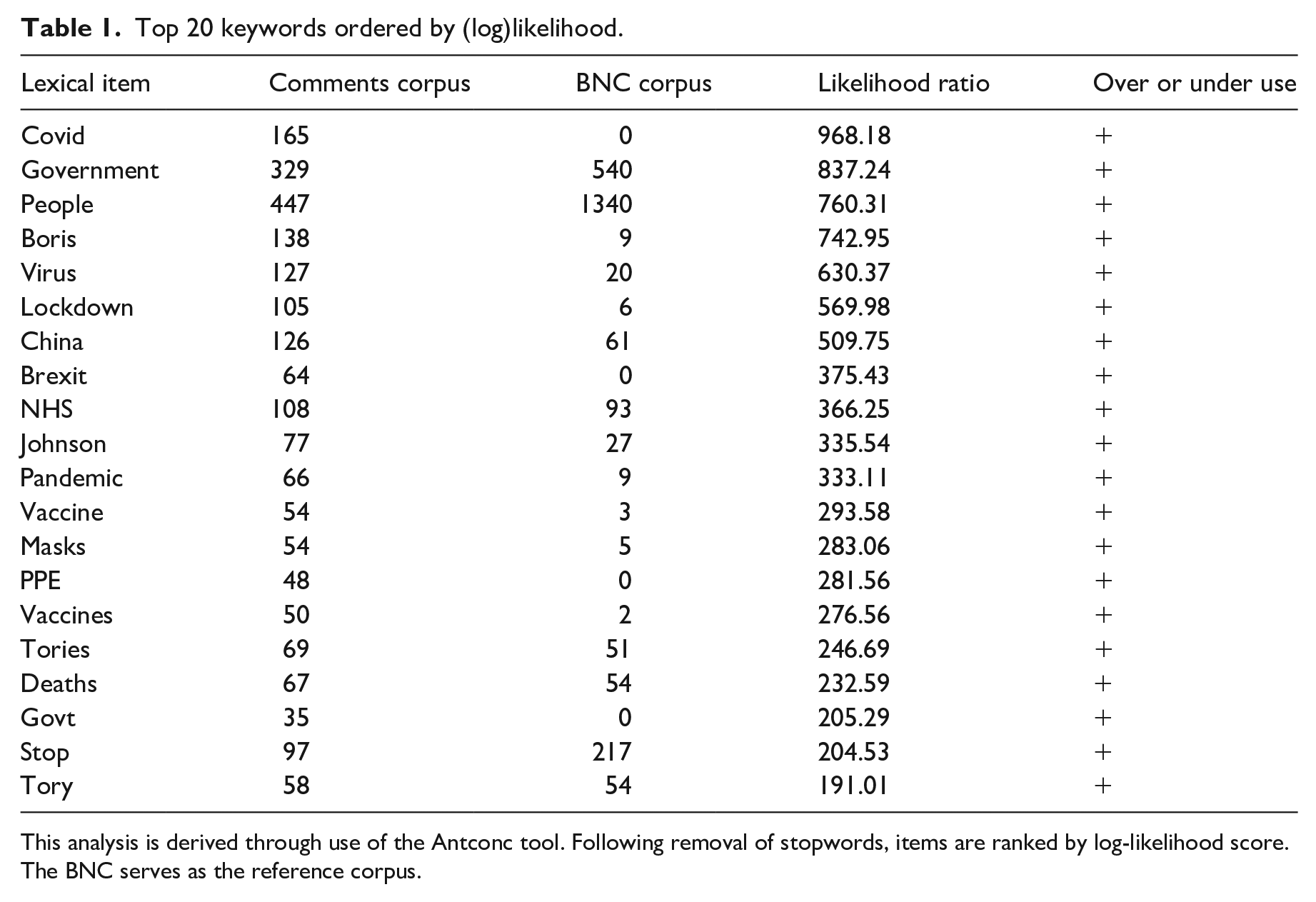
This analysis is derived through use of the Antconc tool. Following removal of stopwords, items are ranked by log-likelihood score. The BNC serves as the reference corpus.
There are also lexical items whose overuse aligns with topics, issues and themes that were prominent during the sample period. Lockdown (569.98, p < 0.01) was a word that described restrictions on the movements of people to reduce transmission of COVID-19. It also came into wider usage to reflect limitations on social contact, travel and access to public spaces (Flood, 2020). The development of a COVID-19 vaccine and the United Kingdom’s subsequent vaccine programme in late 2020 were also important topics, which is echoed by the overuse of vaccine (293.58, p < 0.01) in the corpus. In a similar vein, masks (283.06, p < 0.01) and PPE (276.56, p < 0.01) were also overused in the corpus, both issues that were significant during the United Kingdom’s experience of COVID-19. Despite mixed messaging early in the crisis, face coverings in shops and other public spaces were made a legal requirement in England and the devolved nations in July 2020. Their use was relaxed later in 2020 but reintroduced in November 2021 in response to the Omicron wave of the virus. Insufficient supplies of PPE for frontline health and care workers were also an important issue during the early phases of the pandemic. There were global supply issues but it was also attributed to poor pandemic planning and underfunding (Mehlmann-Wicks, 2023). Later, concerns were raised about government procurement of PPE for the inflated prices, inadequate quality controls and allegations of corruption in the awarding of priority contracts (Committee of Public Accounts, 2022).
Collocation analysis
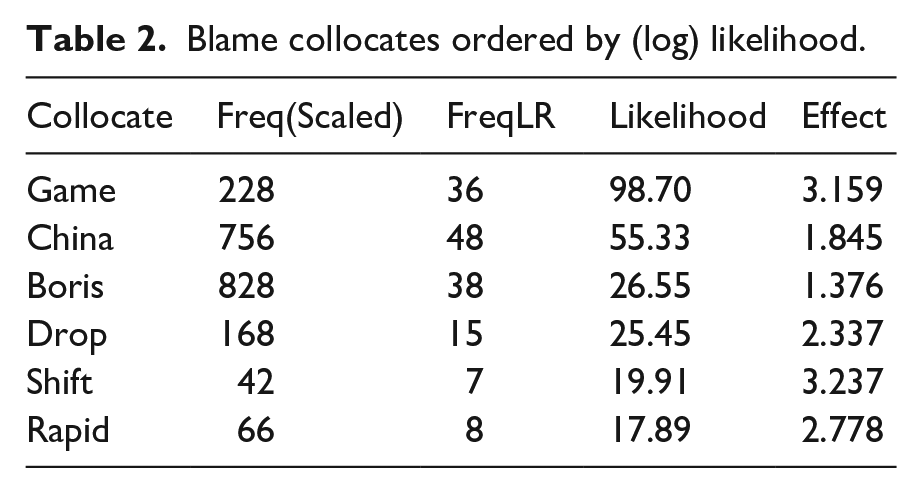
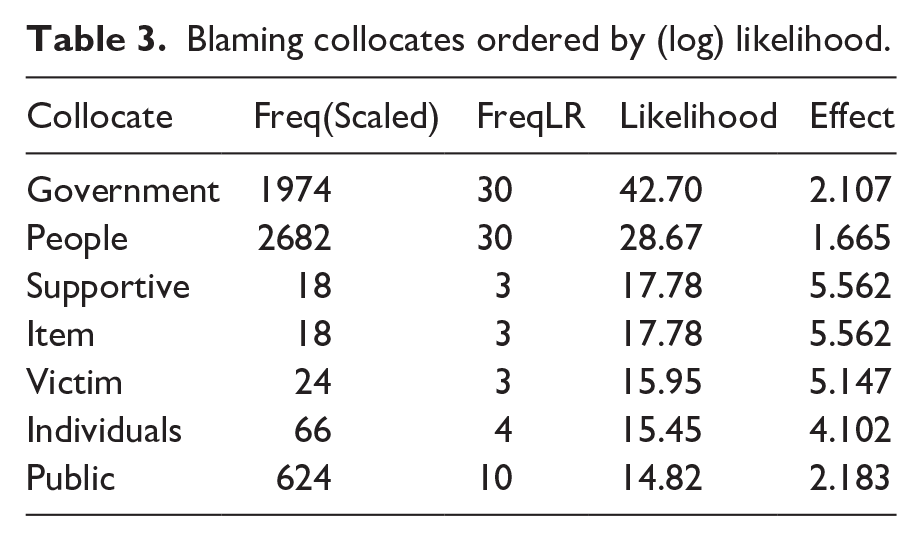
Tables 2 and 3 show the significant collocates occurring with the word blame and suffix of blaming, ordered by strength of log-likelihood measure. Other words including blamed, blameless and blameworthy were also tested for collocated terms, but returned fewer than four collocated terms and were, therefore, excluded from the analysis.
Blame collocates ordered by (log) likelihood.
Blaming collocates ordered by (log) likelihood.
The data show strong log-likelihood measures for the words game, China and Boris as collocates with blame. Game is strongly associated with blame due to the use of the idiomatic expression blame game, which describes an attempt by an actor to attribute responsibility to another party. The significance of game, at 98.67, p < 0.01, and by extension this idiom shows that comments made references to actors attempting to shift or deflect blame. The significance of China (98,70, p < 0.01) and Boris (26.55, p < 0.01) as collocates indicates the strength of probability of references to blame appearing alongside these two actors. The latter is a colloquial reference to the incumbent prime minister Boris Johnson.
Government (42.70, p < 0.01) is the most strongly associated word with blaming in the corpus, as shown in Table 3. This, taken together with references to the prime minister collocated with blame above, shows that within the corpus direct references to blame were strongly associated with the UK government or the prime minister during the COVID-19 crisis. This follows from what we know in other crisis context concerning blame dynamics; when the significance of a crisis and its impacts persists, then blame is appropriated to the perceived action, inaction or failure by those institutions or organisations tasked with responding to a crisis (Mayor et al., 2013; Roy et al., 2020).
The word people (28.67, p < 0.01) is also strongly associated with blaming. Individual (15.45, p < 0.01) and public (14.82, p < 0.01) are also significant collocated words with blaming and are indicative of blame attribution to people, as a collective actor, or the individual and their actions. Appeals to the individual and personal responsibility were a key characteristic of public health messaging during COVID-19 (Haberer et al., 2021), with the transmission and impacts of COVID-19 a consequence of both coercive restrictions and an emphasis on individual behaviours that would limit the spread of COVID-19. While the strength of association is lower than the external actor (China) and the internal actor with responsibility for managing the pandemic (the government and prime minister), the significance of these collocates with blaming suggest that comments were articulating or discussing blame expressed towards people and their own actions and behaviours.
Concordance analysis
To further explore the corpus data, the final procedure was to conduct a KWIC analysis of prominent words identified from the keyness and collocation analysis that are indicative of actors.
By distilling a randomised selection of 40 comments, the first actor that is explored in context is China, as shown in Figure 1. Examining the extracts presented below illustrates the presence of direct blame attribution towards China for the pandemic, with China described in comments as enabling transmission by ‘allowing the virus to propagate’ and for restricting access to information. There are also examples that illuminate common misinformation, disinformation and conspiracy views that were shared online. There are examples that blame China for creating the virus, describing COVID-19 as ‘biological warfare’, descriptions of ‘people collapsing on the street; and accusations that the virus was ‘deliberately’ spread. This has been documented in other studies but is evident here in online readers’ comments in response to UK news about COVID-19 (Choli & Kuss, 2021). There are also comments that emphasise a strength of feeling towards China that is beyond criticism, illustrative of hostility, discrimination and stereotypes that may serve to stigmatise (Rega et al., 2023).
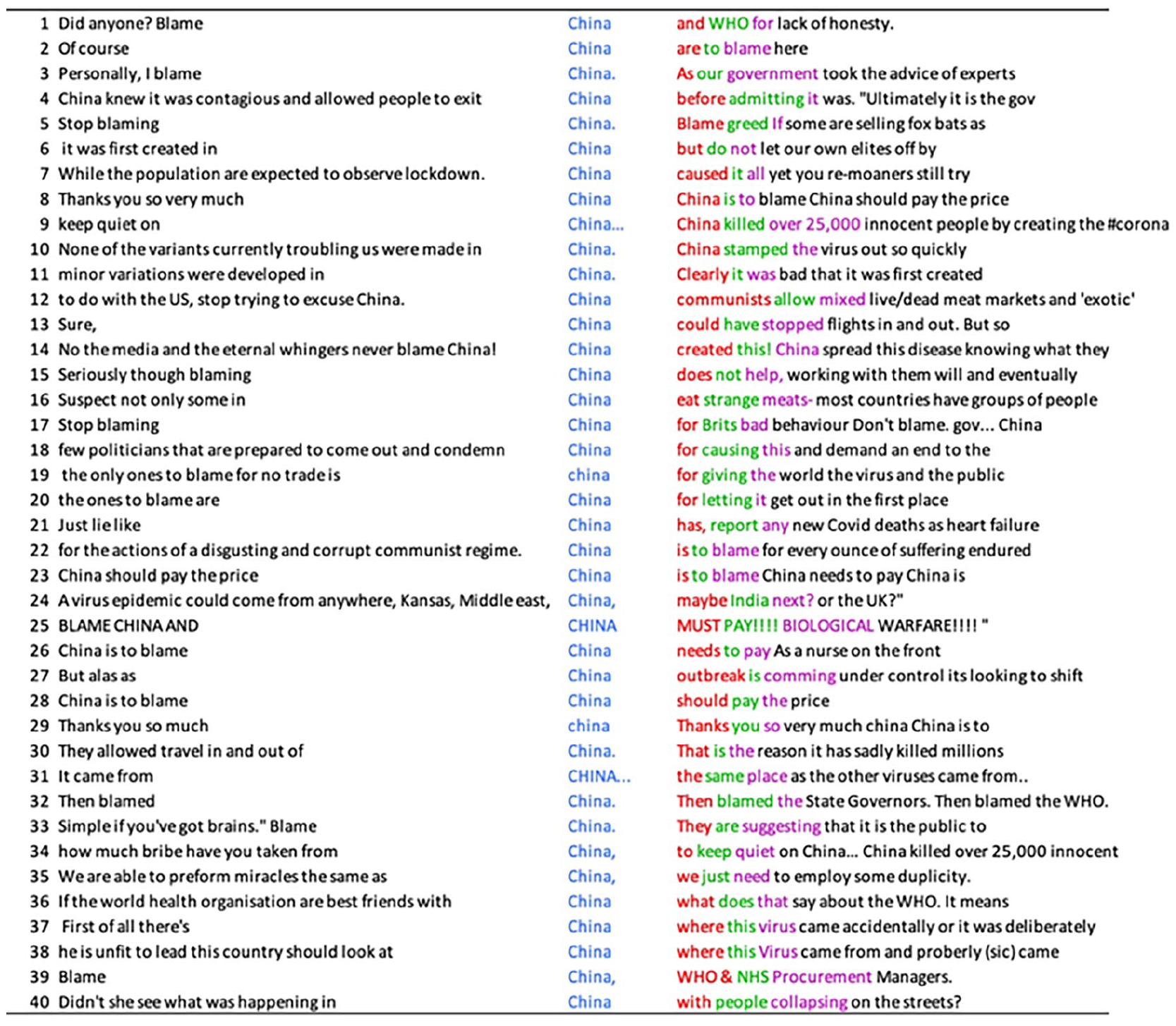
China, keywords in context.
The KWIC also shows how discussions note and associate China with other actors. The most significant emerging from the extracts presented below is the World Health Organization (WHO), with comments blaming both China and the WHO for the emergence of the pandemic and their failures to limit its wider international consequences. While the WHO is not identified as a significant collocated term with blame, this qualitative analysis suggests that when discussed alongside China and its actions, the WHO is a further potential actor identified by the public as a figure of blame. One of the limitations of corpus-based methods is that institutions or organisations that have more than one-word names or are commonly referred to by acronyms may be missed by isolated lexical search queries. In this example, the WHO comprises three separate words, world, health and organisation, none of which was found to be significant in the corpus. The NHS, denoting the National Health Service, is a further example evident in the extracts. The NHS, however, among UK publics is an acronym that is commonly used and understood, and this may explain why it features prominently in the corpus. This is illustrated by the keyness analysis above and its overuse in the corpus.
The second actor explored in context is government. The 40 randomised comments shown in Figure 2 reveal how blame was attributed towards the government for increasing rates of COVID-19, described in one example as bearing ‘responsibility for rising infection rates’, for failing to ‘close the borders’, its policy failures and ‘poor governance’. In the extracts, blame is almost exclusively articulated towards China for the emergence of the SARS-CoV-2 virus, while the government is blamed for its perceived mismanagement of the United Kingdom’s response to the crisis. There are also examples of comments that absolve the government of blame for the pandemic and its consequences. One comment, for instance, describes how COVID-19 is ‘an excuse for government bashing’, highlighting the challenges faced by other countries and calling for people to avoid blaming the government. There is also direct criticism of those that support the Conservative Party, the main governing party in the United Kingdom since 2010, with one comment highlighted below describing Tory sheep and lemmings as bearing the responsibility for the mismanagement and difficulties the country has faced through the pandemic.
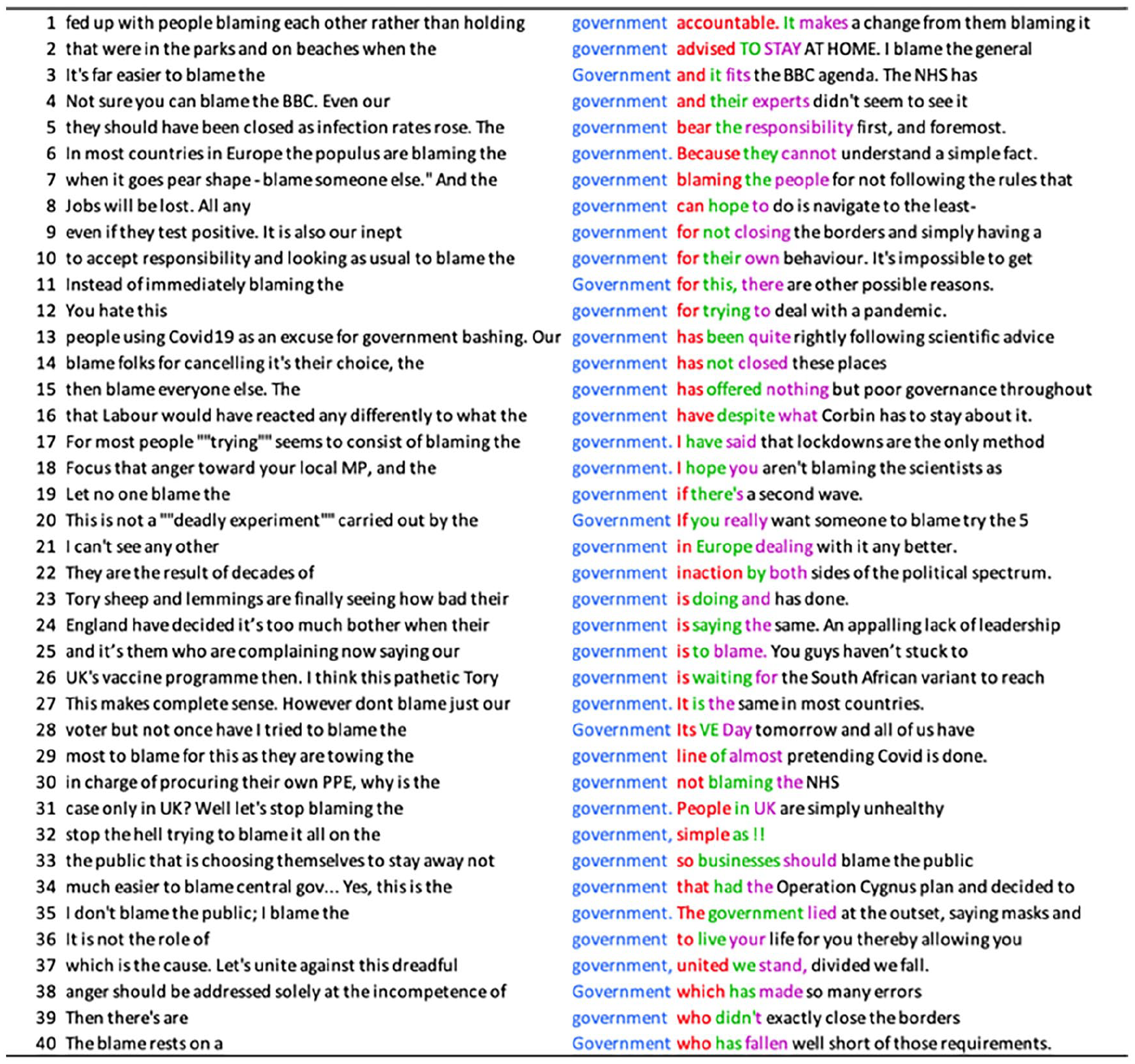
Government, keywords in context.
There are also examples of blame attribution that evidence how other actors alongside the government either share responsibility or are also culpable for the pandemic and its impacts. This includes the NHS but comments also identify how individuals’ health, responsibilities and behaviours may shoulder blame for the continued spread of the virus. The KWIC analysis of government also reveals the presence of partisanship and polarised political views as blame is appropriated to the government. This is reflected in comments that make claims or present counter arguments about the government, its record and actions. There are comments, for example, that outline the perceived ineffectiveness of pandemic planning (under previous administrations) and questioning whether a Labour government would have fared better in its pandemic response. There are also extracts that are indicative of conspiratorial viewpoints, such as those that identify how blaming the government is a consequence of media agendas.
It is important to note that the qualitative analysis of comments demonstrates how the government is both an actor blamed for the impacts of COVID-19 but also a topic of discussion within comment threads. There are comments, for example, that refer to ‘government-issued’ COVID-19 advice and to government policies and interventions in response to the crisis. While these represent only a handful of comments, without examining references to government in context it is not possible to examine nuances in usage in this way.
The third actor derived from the collocation analysis that is explored in context is people. While there are other similar words that indicate the public and individuals, people was the prominent term identified from the keyness and collocation analysis. A randomised selection of 40 comments referencing people is presented in context in Figure 3.
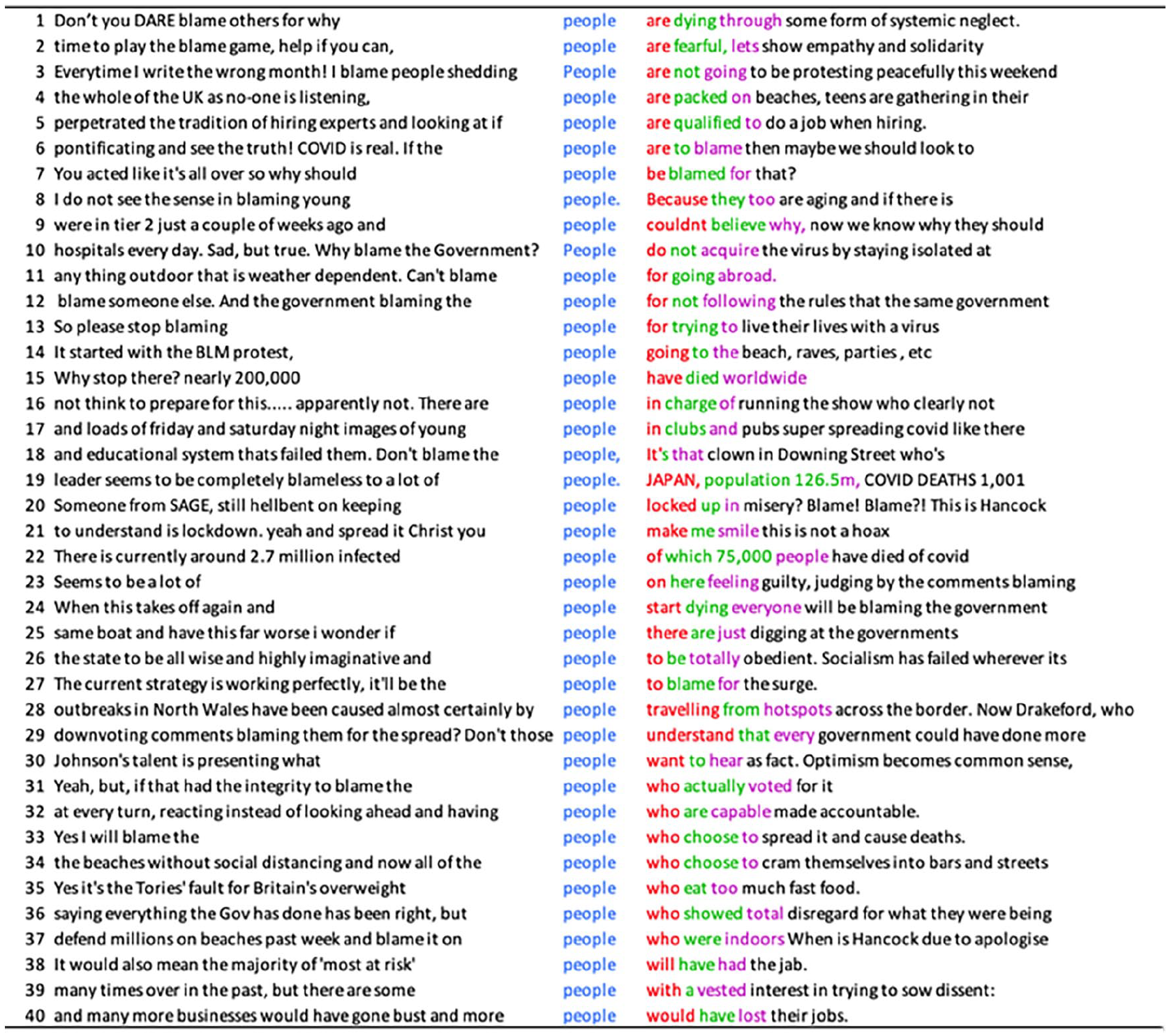
People, keywords in context.
In comparison with the previous two actors, there are more examples of comments that reference people as a topic within conversations, in addition to those attributing blame to people as an actor. Examining people in context shows that comments describe how ‘people are dying’, people are fearful, how people acquire the virus, that people who have lost their jobs (due to the pandemic) and when rereferring to epidemiological data quantifying the number of people infected or who have died from COVID-19.
The KWIC analysis also reveals the nuances in blame attribution when ascribing blame to people. There are references to how people will be to blame if there are further increases in transmission, the people who chose to ‘cram into bars’ and people travelling between different areas of the country. There is also implicit attribution of blame to people for their diets (that place them at greater risk from severe COVID), behaviours that risk spreading the virus and the wider societal and policy implications of further waves of COVID-19. Equally, however, there are examples of comments that suggest people are being unfairly blamed for spreading the virus and the consequences, such as further restrictions, that may follow. Comments question whether people are to blame and ‘why people should be blamed’. One comment, for example, states ‘please stop blaming people for trying to live their lives’. There are also comments that argue that blame should be shifted away from people, and their behaviours, towards other actors, the most significant actor being the government arising from their failures in their pandemic response. There are also indirect references to the prime minister, underlining his responsibility for responding to the health crisis.
Exploring KWIC for people also illustrates how other social actors associated with this plural noun are referenced as figures of blame. Within the examples, blame is attributed to young people, describing the images of ‘young people in clubs and pubs’ and the consequence of these behaviours for increasing rates of COVID-19. There are also comments that absolve young people of blame, challenging the view that young people and their behaviours can be blamed for disregarding guidelines on social mixing and the consequences for further increases in infection rates.
Further discussion and conclusion
This study has examined the attributions of blame for COVID-19 and its impacts on the United Kingdom through 2020–2022 by focusing on a specialised corpus of readers’ comments that made direct reference to blame. The corpus was analysed by employing a sequential approach that aggregates the findings from a keyness, collocation and concordance analysis to identify actors attributed as blame agents and understand the different events, issues and actions/inactions through which they are articulated as blame agents.
At the first level, the findings from the keyness and collocation analysis indicate that the principal actors were China, the government and people. The presence of the first two actors corresponds with previous research on blame dynamics in crisis contexts, including pandemics, which identified a tendency to externalise blame, here attributed to China and its national government, but also towards the government as the institution with overall responsibility for coordinating the response to the crisis (Mayor et al., 2013; Roy et al., 2020). The analysis also shows, however, that blame was personalised through attribution to the prime minister, evident in the prominence of references to Boris Johnson. From the early stages of the COVID-19 pandemic, the prime minister faced criticism for his handling of the pandemic due to policy decisions, communications and his own actions (Seargeant, 2023). One significant example was the prime minister asserting in March 2020, and on the same day that the United Kingdom’s scientific advisory board for emergencies (SAGE) issued advice for people to consider a replacement greeting, that he would continue to shake hands (Mason, 2020). Through 2021–2022, the prime minister’s approval ratings fell significantly as he became engulfed in a series of scandals (Skinner et al., 2022). Arguably the most significant for public perception of his government’s response to COVID-19 were allegations that emerged in December 2021 that the prime minister, senior government ministers and advisors had attended informal gatherings that had breached coronavirus restrictions in place at the time.
While not as clearly identified as other actors, with the concordance analysis showing some comments challenging the attribution of blame, the expression of blame towards people is a departure from existing research. During the COVID-19 pandemic, mandated restrictions on social contact and public health messaging served to emphasise the responsibility of individuals and their behaviours (Haberer et al., 2021). This framed compliance with COVID-19 restrictions and guidance as determined by individual accountability, negating the social, structural and cultural factors that influence the individual and their behaviours (Haberer et al., 2021). This, it may be argued, is therefore reflected in discourses around COVID-19, with comments noting how or when individuals or particular social groups, such as young people, were flouting guidelines and attributing blame for the consequences that may follow.
The findings from the first level of analysis, surprisingly, do not reveal the presence of other prominent actors, for example, senior ministers, government scientific advisers and other significant political figures. Matt Hancock, as Secretary of State for Health and Social Care until 26 June 2021, was front and centre of the United Kingdom’s response to COVID-19, prominent in daily public briefings and policy responses to the pandemic. Yet, the evidence from this study is that he, alongside other scientific and political figures, were not identified as blameworthy actors during the period of analysis. This study focused on direct references to blame. It is possible, therefore, if the analysis was to consider other linguistic and discursive features of comments that attribute blame, for example, allocating responsibility, expressions of anger for failures or inaction, other actors may emerge as significant within the corpus of comments. An avenue for further research would be to examine other blame markers in text, focusing on a smaller sample of comments, for example, to identify actors using negative traits and that may also indicate blame.
Combining the three different levels of analysis offers additional insights into how blame is attributed to actors. It reveals where comments may reference blame but are absolving an actor of blame. The qualitative concordance analysis also indicates how other actors are connected to the principal figures of blame. Importantly, it demonstrates that externalised blame was not only attributed to China but also to the WHO. The WHO faced criticism for its failures to avert a global pandemic but also for its deference to China and its politics (Peters et al., 2022). President Trump accused the WHO of mismanaging and attempting to conceal COVID-19, which many have acknowledged reflected the rhetoric of scapegoating to deflect attention away from his domestic problems, enhance his own popularity and amplify divisions between the United States and China (Horton, 2020; Saltzman, 2024). This discourse was reflected in the corpus of comments, with several examples claiming that blame (for the pandemic) should be attributed to both China and the WHO.
In summary, this study contributes to the literature on blame dynamics during pandemics and health crises. It shows the blame was expressed to both external and internal actors by those commenting online in response to UK news articles about COVID-19. What was distinctive about public attribution of blame for COVID-19 is that there is indication that the public attributed blame or acknowledged how blame had been articulated towards people and their own actions.
One of the consequences of blame is declining trust and confidence in those actors responding to a crisis (Holland & Blood, 2013). This study suggests that the attribution of blame towards individuals, institutions or organisations coordinating the response to the pandemic could detract from efforts to build trust and support for policies to mitigate its impacts (Jakovljevic et al., 2020). In contrast, it may be valuable in holding these actors to account for their decisions and actions. Blame may also need to be considered alongside other communication dynamics, including the need for high-quality information, challenging disinformation and conspiracy beliefs, that can be detrimental to attempts to mitigate the impacts of new and emerging infectious diseases. Moreover, this study suggests that it may be necessary to recognise the consequences of messaging during a public health crisis that emphasises personal accountability (Roy et al., 2020). While an established feature of health communication, messages that appeal to the individual and the consequences of their own behaviours can place undue emphasis on individuals and their actions. During a period of crisis, this, therefore, may reduce the effectiveness of health messaging or social cohesion (Worthington, 2017). An additional question for research would be to examine how the framing of personal responsibility in public messaging during health crises intersects with the attribution of blame to individuals, the public and their actions.
Finally, this study further demonstrates the potential of readers’ comments in examining public discourse on significant issues and events. As deliberative spaces, below-the-line comments or social media can offer insights into how the public perceive a health crisis, attempts to mitigate its impacts and the attribution of responsibility. It would, therefore, be valuable for future crises to consider how these online comment spaces can be utilised in real time to map emerging opinion dynamics and to inform the development of messaging in an evolving health crisis.
Footnotes
Acknowledgements
The author would like to thank Billy Wassell for supporting the data extraction and collection processes.
Funding
The author(s) disclosed receipt of the following financial support for the research, authorship, and/or publication of this article: This research was funded by a British Academy/Leverhulme Trust small research grant (SG2122\210436).
