




Abstract
Postdevelopmental approaches to childhood art aim to go beyond the constraining parameters and trajectories of the dominant paradigm of developmentalism. Postdevelopmental researchers embrace methods that enable us to engage more fully with children’s art-making by actively turning towards aspects of the experience that may be uncomfortable or disruptive. Multimodal mediated discourse analysis (MMDA) is a methodological tool that can be used as a way to tune into ‘pivots’ in the action of children’s art-making. In doing this, MMDA can be used as a means to provoke a wider and richer discussion of children’s art-making. In this article, I show how working with MMDA can deepen our dialogues about taboo, disgust, mess, cleanliness, waste and scarcity in relation to children’s art-making.
Introduction
Postdevelopmental approaches to childhood art attempt to move beyond the dominant paradigm of developmental psychology in the context of art-making. Rather than seeing children’s art in terms of ages and stages, postdevelopmental perspectives aim to engage with the full richness and complexity of childhood art-making (Sakr and Osgood, 2019a). As part of this approach, researchers have begun to actively turn towards what is uncomfortable, disruptive or disturbing for them as part of observations of children’s art-making. Diverse theoretical frameworks and methodological tools have been used to support with this shift. While many have found posthumanist conceptualisations of entanglement, and related concepts of intra-action and knot-knowing, useful (e.g. Sherbine, in press; Shillitoe et al., in press; Osgood, 2019; Murris, 2019), others including myself have attempted to use multimodal interaction analysis as a way to draw more attention to what might be uncomfortable for the adult researcher when observing children’s art-making (Hackett et al., 2017; Sakr, 2019b, 2021, Wohlwend et al., 2017, 2019). In this article, I further these explorations through the application of multimodal mediated discourse analysis (MMDA; particularly as practised by Karen Wohlwend) to an episode of children’s art-making in the family home. I consider how pivots in action and interaction can work as provocations for the postdevelopmental childhood art researcher so that the ‘shadow’ aspects of children’s art-making are more fully integrated into our understanding and practice.
The following background sections offer an overview of postdevelopmentalism as it has been applied to childhood art and what it means to ‘turn towards discomfort’ in relation to childhood art-making and how others have done this in recent research. MMDA is then introduced and explained as the primary methodological tool featured in this research. I work through the example of three pivots in action, as identified through the MMDA, and the discussions these provoke around taboo, disgust, mess, cleanliness, waste and scarcity. I argue that MMDA is a useful methodological tool for the postdevelopmental childhood art researcher as it encourages us to pay close attention to the minutiae that undo our status quo thinking about what childhood art and art-making is and what it mean to be with children as they engage in art-making.
Postdevelopmental approaches to childhood art
Postdevelopmentalism is an umbrella term for a wide range of theoretical orientations that have in common the aspiration to move beyond dominant developmentalist discourses that surround the child in Western thought (Murris, 2019; Sakr and Osgood, 2019a). Developmentalism is underpinned by the dominant paradigm of developmental psychology, which encourages us to see the child as a ‘becoming-adult’ who, by passing through a series of linear stages, will reach the destination of adulthood. Postdevelopmentalism is both a rejection of this focus on the grounds of social justice, but it is also a movement to go beyond the limitations of developmentalism so that we can more fully engage with children and childhood.
As a rejection of developmentalism, postdevelopmentalism avoids the prescriptive norms that can be used relentlessly to document, capture and judge the development of children. Beginning with Erica Burman’s deconstruction of developmental psychology (Burman, 2017), postdevelopmental researchers have shown how developmental norms are used against children and families that do not meet the prescribed standards. Such children are viewed as ‘deviant’. Race and class play a significant part in who is seen as successful in relation to the normative trajectories of developmental psychology. Murris (2019) explores developmentalism as a colonizing force and considers the possibilities that a postcolonial approach to childhood involves a postdevelopmental approach to childhood. Thus, postdevelopmental researchers actively protest the classification of children on the basis of developmental norms.
While postdevelopmental researchers reject developmentalism on the grounds of social justice, there is also an active pull within the movement towards a richer view of childhood. Thus, it is not simply about working against developmental norms, but asking the question of what might emerge when we do not see children through the lens of development. In the context of childhood art-making for example, the dominance of developmental psychology as a lens to look at children’s art-making has led to a blinkered focus on ‘reading’ children’s drawings in order to gauge information about the psychological states or trait of the individual child. As a result, a relatively small body of research (though dynamic and growing) has engaged with childhood art as rich site of experience where children learn about themselves and the world, and we too – as adults, learn about children, ourselves and the world. We can see this skewed perception through the fact that searches for literature on childhood art in major databases identify a majority of articles that focus on children’s drawings, rather than engage with children’s painting, junk modelling, collage, digital art-making and so on, as it unfolds in the moment. Thompson (2019) has highlighted for example the difference between focusing on ‘children’s drawings’ and ‘children drawing’; a postdevleopmental approach is supported by focusing on the intense experience and interaction of the latter, rather than a classification or interpretation of the former. Developmentalism has stunted our perspective while postdevelopmentalism commits to opening up our explorations of childhood art.
Turning towards discomfort in children’s art-making
Within the efforts to engage more fully in the richness of children’s art-making, there has been a focus on actively turning towards uncomfortable or disruptive aspects of observations of children as they make art. There are various bodies of research that contribute to the development of this turn including first, art therapy and psychoanalysis which have explicitly focused on what might be difficult, fraught and charged in exchanges between children and adults when making art (e.g. Sholt and Gavron, 2006; Isserow, 2008; Zago, 2008). Second, a group of researcher-practitioners in childhood art studies have been focusing more on children’s art in domestic spaces and building on Lenka Clayton’s Artist Residency in Motherhood (ARIM) initiative, whereby mother-artists practice art in the constraints and opportunities afforded by motherhood. In this movement, mothers use their mothering practices as the vehicle for artistic exploration and this in turn has revealed the uncomfortable spaces that exist for children and mothers in the context of art-making. McClure (in press) argues for example that on beginning her ARIM in January 2021, her intention was to:
make unfamiliar the achingly mundane cadence of domestic life and to re-enter the processes of arts-based research with young children that had been on hiatus since the concurrent birth of my youngest child and the arrival of the COVID-19 Pandemic.
Trafi-Prats (2019) has also taken inspiration from ARIM in her research on childhood art, reconceptualising mothering as an aesthetic that can enable us to open up how we think about children, childhood, but also care, motherhood, parenthood, and so on.
Turning towards discomfort in how we carry out and analyse observations of at-home art-making is difficult, particularly when we are in large part analysing ourselves and our interactions with others. We need methodological tools that help us to notice and stay with the moments or characteristics of children’s art-making that trouble us. Schulte (in press) talks about the power of the question ‘What’s happening here?’ as a way to challenge student-teachers’ perceptions of children’s art-making and what it should look like. In repeatedly asking ourselves this question, we can turn attention towards the parts of an encounter that we might otherwise fail to notice or wilfully ignore because it does not fit with our expectations and assumptions of what is important. In a similar vein, I have used Barthes’ concept of punctum as a way to engage with small video fragments of children’s art-making, as a means to delve into what intrigues us but also what is uncomfortable. Barthes uses the term punctum to describe the elements of the visual image that affect us on an unconscious level. We find ourselves compelled to look at these elements in a photograph because they trouble something we think we know about the world. Without punctum, a photograph will be uninteresting to us. Using the idea of the punctum, I have suggested that in video fragments of children’s art-making, there are moments or spatial elements in the frame that seem to draw us in involuntarily (Author, in press). In this article, building on this possibility, I experiment with the potentials of MMDA as a way to engage with and turn towards discomfort in children’s art-making. The next section offers a detailed account of MMDA, particularly as practised in the work of Karen Wohlwend.
Multimodal mediated discourse analysis
Karen Wohlwend has advocated using MMDA as a way to attend more thoroughly to children’s nonverbal actions, particularly those involving objects. She describes MMDA as a ‘hybrid ethnographic/sociolinguistic approach’ (Wohlwend, 2009: p. 228) rooted in cultural-historical activity theory. It involves understanding the cultural and social trajectories of children’s actions in the moment as they unfold, the social and cultural meanings of actions and an interrogation of the social and cultural meanings of children’s actions with objects. MMDA is based on a Vygotskian interpretation of mediation where actions with tools and objects carry cultural and social meanings, and reproduce and transform culture and society. Cultural learning happens in these actions with objects so that children’s mediational interactions constitute an apprenticeship. There are similarities here with the approach taken by Charles Goodwin to interaction analysis, where ‘apprenticeship’ is conceptualised as the interactions that unfold between two people and an object or tool that sits between them (Goodwin, 2000, 2007). The triangular structure to the interaction is vital. A mediational means represents an abstract way of making meaning – a cultural tool – that people use to participate in a set of social practices (e.g. writing, drawing, playing) with material instruments (e.g. pencil, crayons, puppets) and surfaces (e.g. paper, puppet stage) for crafting messages. (Wohlwend, 2009: p. 230)
In practice, MMDA applies a series of filters to ethnographic data to support with identifying specific interaction sequences that constitute what Wohlwend describes as a ‘nexus of key practices’. This is a moment in the interaction where there is a transition between two social practices, for example, when children move from the ‘what is’ realm in their activity to the ‘what if’ potentials of imaginative play. In later work, Wohlwend describes these moments as ‘pivots’ (Wohlwend et al., 2017) which is the term I prefer to work with in this article.
Once a pivot has been identified, it can be subjected to a fine-grained multimodal transcription, logging a range of modes in the interaction such as gaze, gesture, manipulation and movement, as well as any verbal communication. Following this, an annotation of the transcript supports an interpretation of the social and cultural meaning-making that occurs in those moments of mediated action. In this way, the researcher accesses a deeper understanding of how the cultural and social nature of mediated action emerges in the moment: Possibilities for new imaginings happen in the slippages among discourses, people, practices and interaction patterns that circulate through trajectories that run on different scales, both temporal and spatial, with historical and imagined, global and local, coming together in a here-and-now experienced mediated action. (Wohlwend et al., 2017: p. 449)
MMDA as practised by Wohlwend seems to hold particular promise for attempting to turn towards discomfort in postdevelopmental observations of children’s art-making. When there is a pivot from one social practice to another, we may be more likely to find that there is friction and tension that has compelled the transition from one practice to another. In the field of childhood art studies, we have tended to focus on the immersive pleasure states that are available in art-making – what Denmead and Hickman (2012) call ‘slowliness’ and what others more broadly describe as ‘flow’. When we turn towards pivots instead, we are orientating to the opposite of flow and immersion by looking at moments when actions, interactions and practices shift. Following points of change might in turn help us to engage with the potentials for disruption, difficulty, discomfort and disturbance in children’s art-making. Finally, through the follow-up fine-grained analysis of the pivot moment, MMDA offers a framework for staying with these moments and engaging with a wider range of modes of communication at work in the interaction. This might mean noticing and exploring uncomfortable facial expressions, gestures or movements - all of which might be glossed over if the analysis were less fine-grained.
Context: childhood art in the family home
To explore turning towards discomfort in postdevelopmental observations of childhood art-making, I now consider a particular observation of childhood art that took place in my own family home. The observation was of my own three children (Layal aged 5, Isa aged 4 and Rafi aged 18 months), two of my sister’s children (Ali aged 4 and Safiya aged 8), myself and my sister. Pseudonyms have been used throughout when describing the children’s actions, though the pseudonyms match the cultural heritage of the children’s actual names. The observation happened on a Sunday afternoon at the end of the Summer 2021. Although the observation was set up with the purpose of video recording (and everyone was aware of this), the situation was a familiar one to all of us. We regularly come together around the kitchen table to engage in art-making; the environment and set-up of the activity were familiar to everyone involved. The children showed a brief interest in the tripod videocamera, sitting above the washing machine, but soon seemed to forget that it was there. The photographs and videos I made on my phone also prompted little interest, given that I often use my phone in this way.
What it means to do research with your own family is an ongoing question and line of inquiry for me (Sakr, 2019b). In recent years, alongside researcher-practitioners such as McClure (in press) and Trafi-Prats (2019), I have shifted more attention to the informal environment of the family home and the art-making that occurs in this space. In reconceptualising childhood art as entanglement, I have embraced the physical, ethical and emotional clutter as a valid aspect of research and exploration. The concept of entanglement, developed by Karen Barad (2007), highlights the way in which everything is interconnected all of the time. While observational research often seeks to parse the various aspects of an interaction, to isolate and identify, the concept of entanglement asks us to keep on returning to the messiness of interaction. For a multimodal researcher, this might mean looking at specific aspects of the interaction – such as materials being used or particular modes of communication – but returning to see these as part of a whole that, in reality, cannot be atomised. In my own research for example, rather than seeing my relationships with my children or my sister’s children as ‘noise’ that needs to be removed from the observation, I have made an intentional effort to orientate towards the ways in which these connections configure and reconfigure the interaction. This is part of paying attention to the ‘ethics of care’ that surrounds children’s art-making, often a space held by women, and trying to tune into this rather than ignore it (Sakr, 2019b;). McClure (in press) talks about the shift from ‘hidden mothering’ (where we pretend that we are neutral vehicles for children’s art-making) in informal home art spaces to ‘mutated modest witnessing’ as suggested by Haraway and developed by Osgood. According to Osgood (2020), mutated modest witnessing involves being ‘open to the queerness that resides in spaces’ and open to your own partiality: as ‘implicated and invested’ (p. 126).
This particular episode of art-making involved a session of free-flow art-making with various resources including A4 white paper, a roll of thick brown paper, acrylic paint in red, blue and yellow, remnants of white cotton cloth, some large yellow sponges, a palette knife, paint brushes, scissors and chalk pastels. All of the resources were available on the kitchen table. A static videocamera recorded the episode from a work surface nearby and I used my smartphone to take 8 photographs during the activity and make a series of brief videos, ranging in length from 8 s to 2 min and 23 s.
The following analysis was informed by repeated viewing of all of the photographs and videos (both static and roaming). However, in order to develop the MMDA, I found it necessary to focus attention on a particular video and narrow the analytical gaze. I chose the segment from my phone, lasting 2 min and 23 s for this more in-depth analysis. While this seemed to offer a good opportunity to open up the analysis and find pivots in the action, it was still frustrating to work with this footage and what it did or did not manage to show. Since the footage is from a roaming camera, the frame moves based on what I think might be interesting in the moment of observation. This often conflicted with what I thought might be interesting in the moment of analysis. That is, in the observation I turned towards what I thought to be ‘the action’ but in the analysis, these in-the-moment assumptions and expectations often came undone and I was left wanting to see more of what in the moment had appeared to be less interesting.
Excerpt from multimodal transcription.
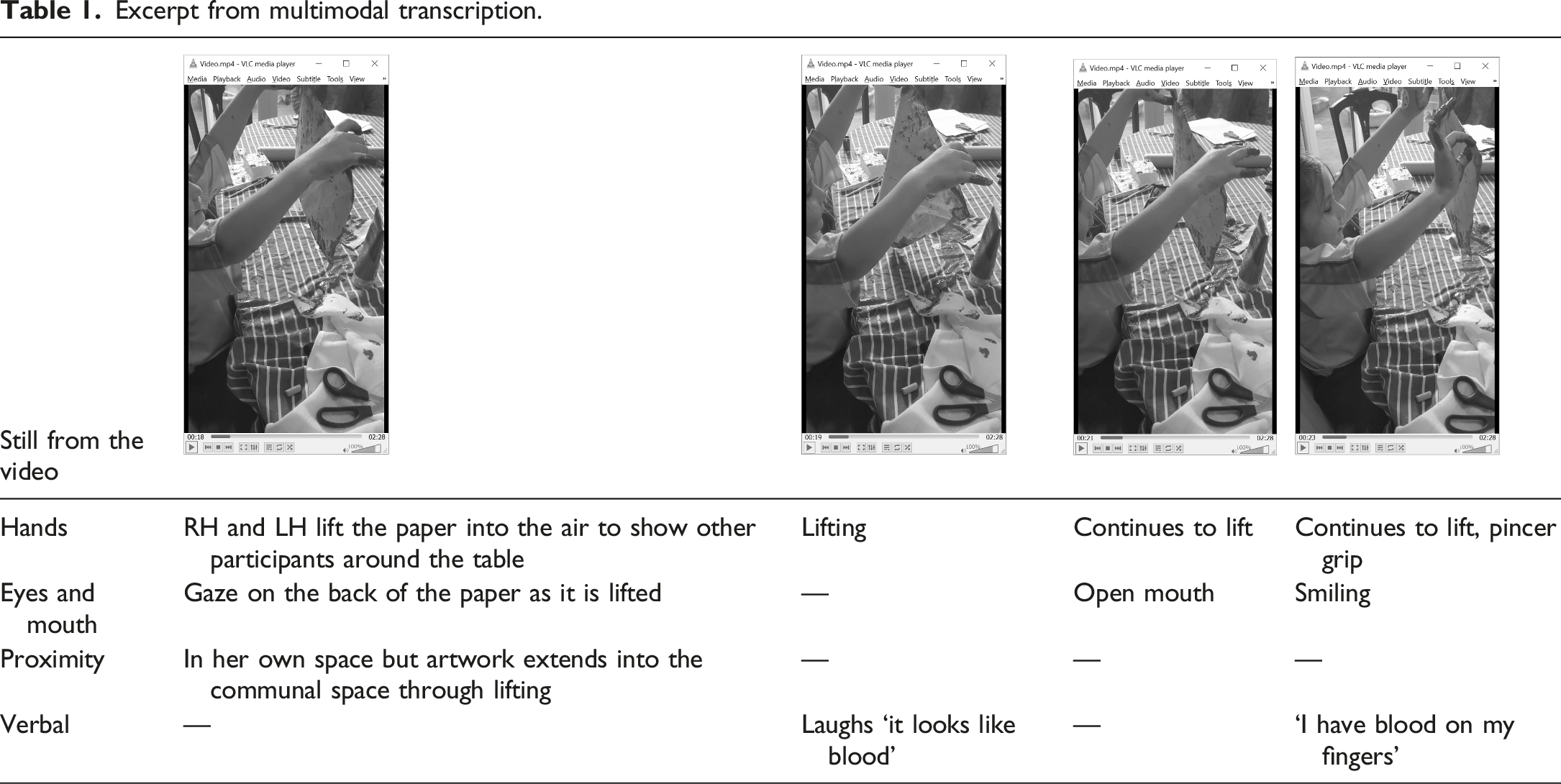
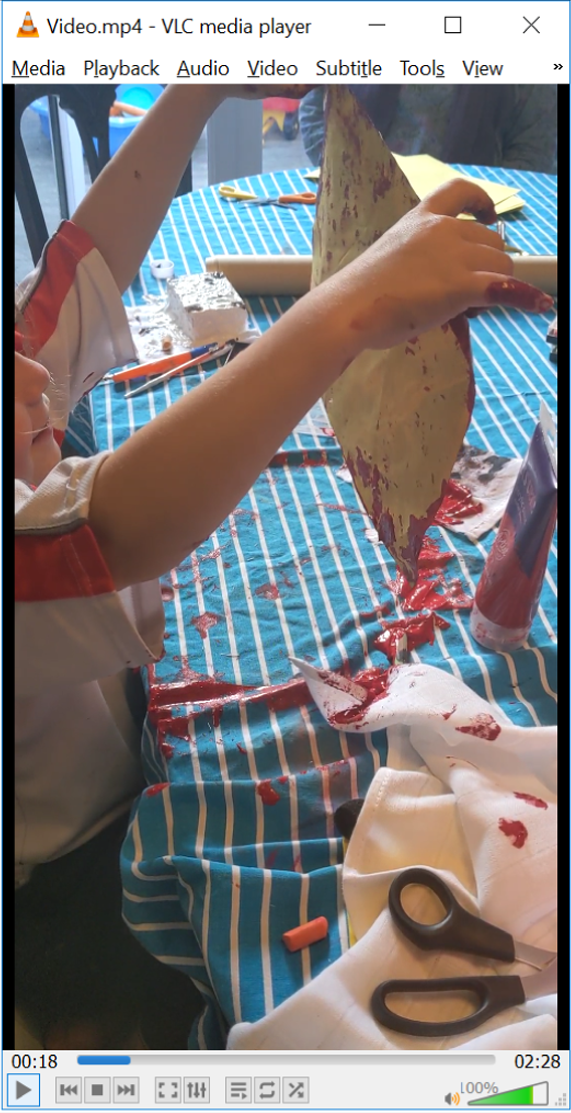
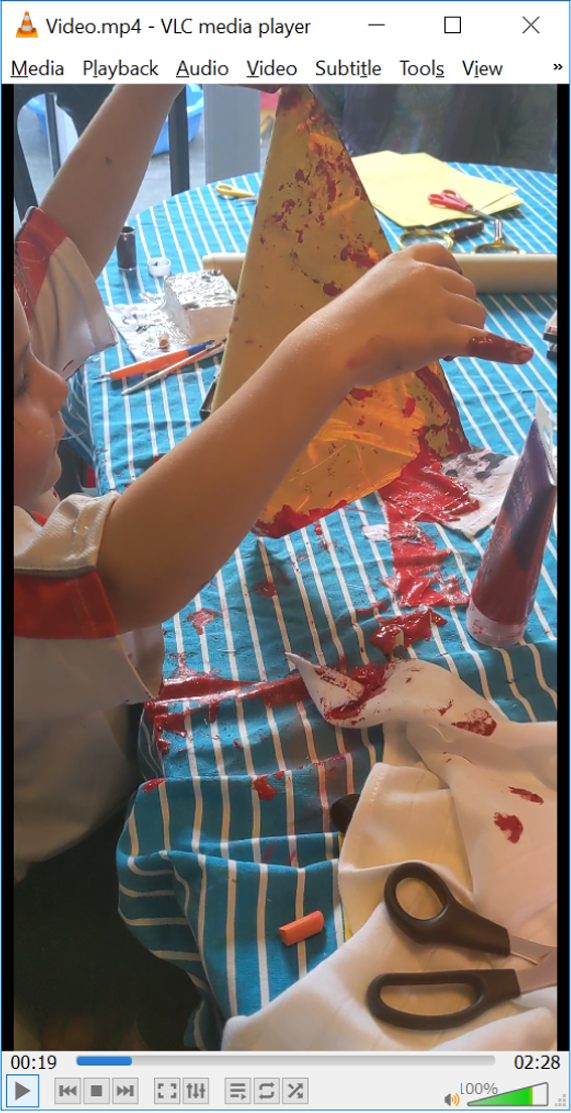
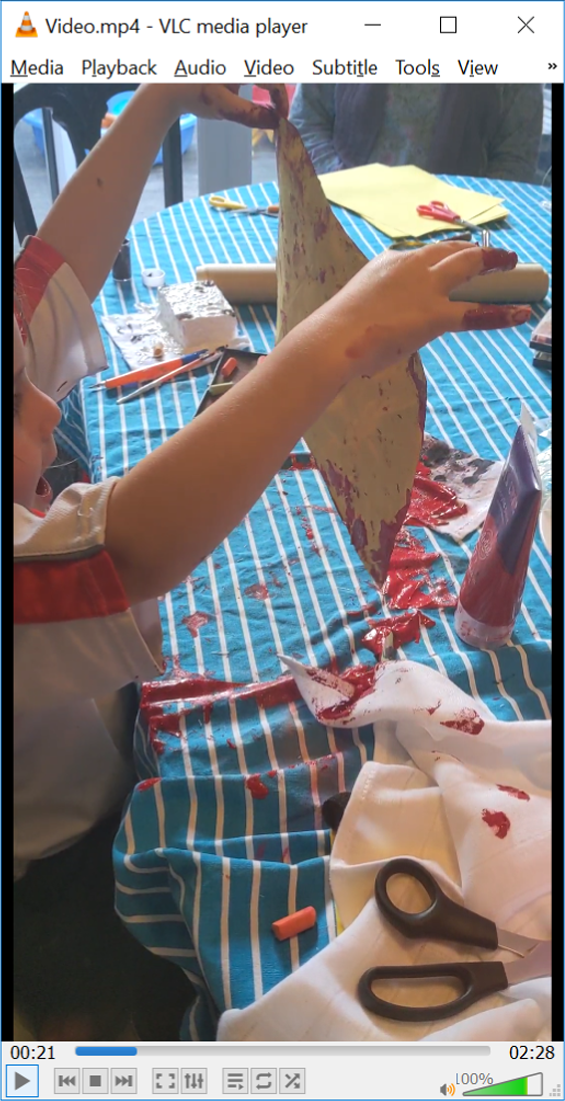
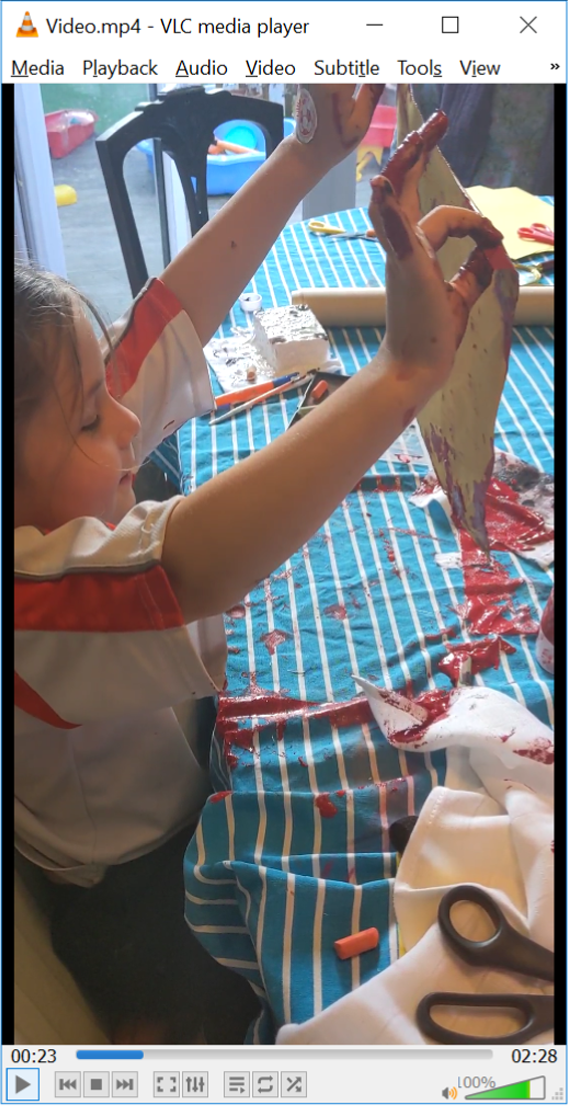
The process of multimodal transcription is important for coming to know the data and beginning to see the patterns and points of further exploration. As Maggie MacLure has said about the practice of analytical coding, this kind of careful and methodical analysis can be a way of luxuriating in the data, creating a space for analytical thinking and a launch pad for further development of ideas (MacLure, 2010).
The fine-grained multimodal analysis drew my attention to three segments of the video that seemed to constitute pivots in action. These were: • Layal’s pivot from making to showing. In the multimodal transcription, this is apparent through a shift in manipulation (lifting), gaze (from downwards to upwards) and verbal communication (explaining to others). • Ali’s pivot from making to cleaning. In the multimodal transcription, this appears as repetitive pattern of action in the hands, moving quickly between touching the artwork and wiping. • Layal’s pivot from making to negotiating resources. In the multimodal transcription, this is apparent through a significant shift in gaze, action and facial expression, so that the focus is no longer on the artwork on the table but on a conversation with me.
This is not an exhaustive list of pivots and others completing the multimodal transcription, with a different set of interests and theoretical concerns, would identify alternative pivots in action. However, the three pivots identified are a starting point for a more in-depth analysis, which supports us to turn towards discomfort in children’s art-making.
From making to showing
Layal has covered the paper with thick red acrylic paint. With her right hand, she picks up a small sharp tool. Looking at the tool, she puts it down again. She looks at her right hand, now covered in paint and smiles. With her right hand fingers spread out, she dabs the fingers on a nearby piece of white cloth, all the time looking at her hand as she does this. Carefully, with a pincer grip, she picks up both edges of the paper using her left and right hand. Her gaze shifts away from her hands and the paper and towards another person sitting around the table. Returning her gaze to the paper, she begins to lift up the edges and peels it upwards. She holds the paper up and out in front of her, her arms raised as high as they will stretch. Laughing, she says ‘it looks like blood’ and then ‘I have blood on my fingers’.
In this segment of action, Layal pivots from making and exploring with the paint, paper and cloth, to showing others what she has made and engaging them in the construction of a narrative around the making. In this case, she engages others, and particularly her cousin Ali who sits across from her at the table, by saying that the red paint on the paper and on her fingers looks like blood. Her smiles and laughter suggest that she anticipates others’ engagement and possibly even their shock about what she has created and the accompanying narrative. Describing the paint as blood is provocative. She moves from saying that it looks like blood to saying that she has blood on her fingers.
By focusing on this pivot, which comes to the fore through multimodal cues such as the shift in gaze and manipulation, we are reminded of the potential within children’s art-making to intentionally provoke an uncomfortable reaction among others. Children can make art that is designed to be off-putting or even disgusting. They experiment with provoking a reaction from those around them. They engage in art-making which they anticipate will provoke a distinct reaction from different people around them, for example, constructing narratives that might bring them closer to other children but distance them from adults. In this situation, Layal’s blood painting was met with enthusiasm from both adults and children in the room, but her gaze and manipulation orientate themselves towards the other child at the table and not towards the adults. This reminds us that children can use art-making as a means to distance themselves from adults or even antagonise adults around them while co-constructing narratives with other children.
In the early 2000s, Dyson’s observations of children’s art-making have highlighted how what children want to represent in their art-making can clash with what adults would prefer to see (Dyson, 2003). Often, children make art in dialogue with popular culture, even when adults actively discourage this because they would prefer to see innocent depictions of ‘real’ life (Park, 2019, 2021). However, by focusing on this particular pivot and the development of the ‘blood’ narrative, we turn towards the possible disconnections between children and adults in art-making that happen when children draw off-putting or taboo subject matter into the art-making. Children draw things into their art-making designed to provoke a visceral reaction in those around them and to explore their own and others’ feelings of disgust. Whether it is blood, spit, faeces, urine or vomit, these substances can appear in children’s art-making through the guise of narrative or can be directly introduced (i.e. the substance itself) into the art-making experience Figure 1. Layal pivots from making to showing.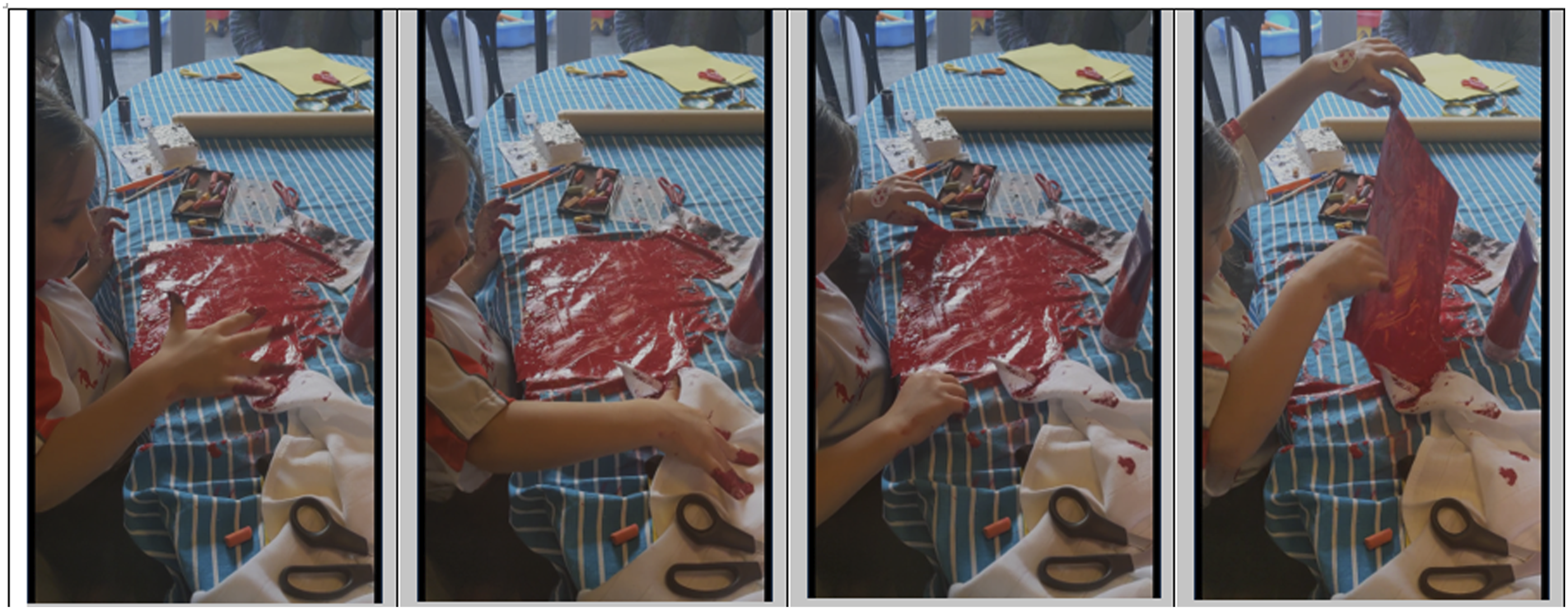
From making to cleaning
Ali has covered a sponge in thick blue acrylic paint and has then layered on top of this a small piece of white cotton cloth. After doing this, he sits for a while with his hands clasped in his lap watching his cousin Layal as she engages in the ‘blood’ narrative described in the previous section.
At one point while sitting, Ali’s gaze shifts down to his hands which come up from his lap. The left hand extends and picks up a nearby wet wipe, which Ali has used previously to clean his hands. He spreads out the fingers of his right hand and the left hand rubs these fingers with the wipe. His gaze is fixed on his hands.
The left hand replaces the wipe on the table, the right hand is held up, away from the table, with the fingers curled around as though the hand is ‘out of use’. Ali picks up the wipe again and, stretching out the fingers on his right hand and holding the palm up, he begins to wipe again. His gaze is fixed on his right hand. Ali’s wiping and rubbing of the hand – both fingers and palm - continues for a few seconds. After replacing the wipe on the table, his hands are held out and up in front of him, fingers curled around on themselves so that the hands are fists. His gaze is focused on the materials in front of him.
In this segment of action, which mirrors multiple other segments seen in other video fragments of the art-making episode, Ali’s attention is on cleaning himself and in particular, removing the paint from his right hand using a wipe. The right hand becomes a source of consternation as he repeatedly returns to wipe it. We see a repetitive ‘dance’ whereby Ali enters into the activity of art-making but then seconds later pivots back towards cleaning his hand. Remnants of blue paint on the right hand are such an issue for Ali that the hand often appears to be ‘out of use’, held aloft and away from the action with the fingers curled around.
This multimodal ‘dance’ suggests a need to explore perceptions and experiences of mess and cleanliness in the context of children’s art-making. We are far more aware of children’s concerns around cleanliness following the pandemic, given the focus on ‘germs’ and hand-washing during the pandemic. Cleanliness and cleaning within children’s play has been highlighted by projects such as The Play Observatory, led by John Potter, which have offered insights into how pandemic experiences are shaping everyday play among young children. We are yet to see a parallel study on children’s art-making, but turning towards the cleaning pivots in this episode of art-making highlight just how ripe children’s art-making is as a rich site for learning about children’s pandemic experiences.
Of course, there is no way to know the extent to which Ali’s repetitive cleaning actions have been shaped by the pandemic or to disentangle the other psychological, social and material factors at play. However, Ali’s cleaning prompts research on art-making to turn towards the potential discomfort of mess for those involved in art-making. Cleaning is therefore not something that sits outside of or beyond children’s art-making but rather an integral element of the art-making experience. In other work, following in the footsteps of artist-mother-researchers such as Trafi-Prats (2019) and McClure (in press), I have suggested a need to turn towards the carers’ responsibilities in relation to children’s art-making rather than positioning these responsibilities as background noise (Sakr, 2019b). Here though we see that the responsibility of ‘cleaning up’ is not just the adults but penetrates the experience of the children as they engage in art-making. It is not something that is done by adults after the art-making experience has happened, but something children are grappling with as part of the art-making experience itself. MMDA has a particular capacity to turn us towards the issues of mess and cleaning within children’s art-making because when we focus on the verbal exchange alone, these actions can be hidden. Ali’s repetitive dance played out through the particular manipulations and movements of his hand, as well as through his gaze. He did not talk about cleaning at any point during the art-making episode even though this dominated so much of his activity. It was not until taking a closer look at particular video fragments and engaging in the process of multimodal transcription that I noticed just how dominant this strand of action was Figure 2. Ali pivots from making to cleaning.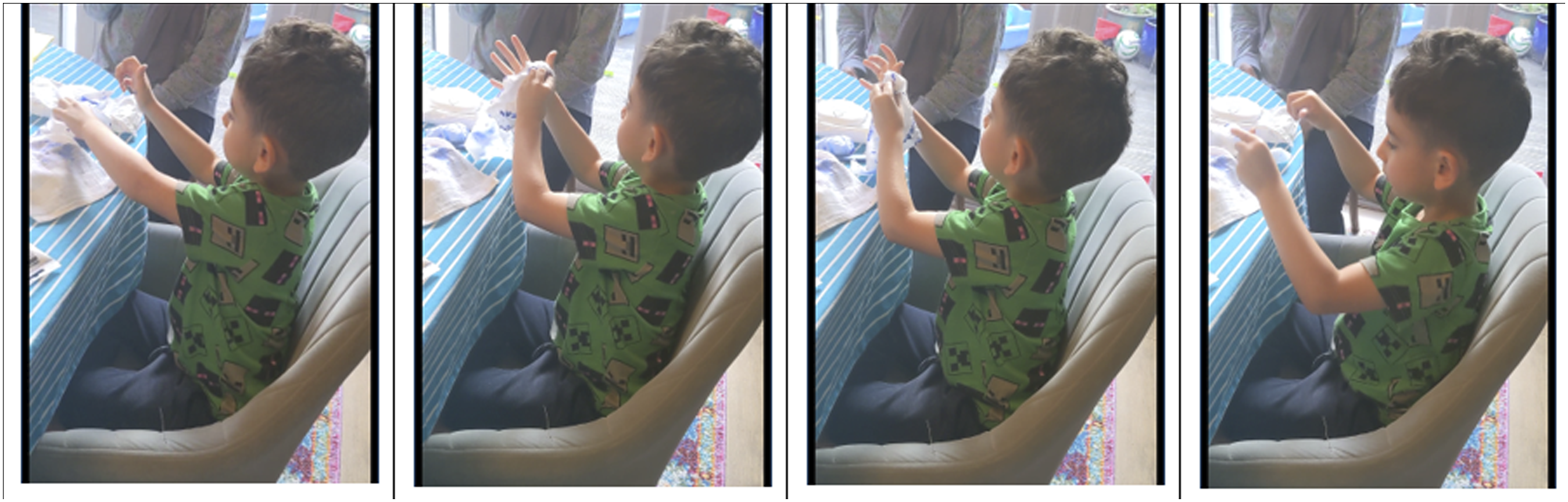
From making to negotiating resources.
Layal’s gaze is on something beyond her reach on the table, possibly Ali’s action with the blue acrylic paint which he is squeezing onto the sponge in front of him. Layal lets go of the chalk pastel she has been moving around the paper and her left hand hovers above her painting.
Her gaze shifts from the table to me, behind the camera. Her brow is slightly furrowed. She asks ‘mummy, can you get another sponge for me?’. I reply: ‘That’s all the sponges done sweetheart’. She replies ‘oohhhh’ and asks ‘big sponges?’. I respond with ‘mmm’. Her gaze shifts back onto the paper, and her right hand reaches forward. Her lips are pushed outwards into a pout. At intervals, her gaze returns to the sponge used by Ali.
In this segment of action, the pivot is a shift from action involved in making with resources to a negotiation of the resources themselves. Inspired by actions around the table, Layal would like to use resources that she can see others using. In this case, she wants to use a big sponge as part of her art-making as Ali has done. She turns to me as the provider and arbiter of the resources for art-making and I decline her request on the basis that we have no more sponges.
Material resources and their properties make a fundamental contribution to children’s art-making. Artists interviewed by Denmead and Hickman (2012) about their approach to resources for art-making workshops with children were clear about the kinds of materials they preferred to use and their approach to managing these resources. Artists looked for materials that had high ‘slippage’, in that they could be used in many different ways. For example, glue could be used for sticking but could also be poured or spread across a surface to make it dry shiny. They also looked for materials which evoked ‘slowliness’ in the actions of the children engaged in the workshops, in that the materials invited a rich sensory exploration that was pleasurable in themselves. The artists also recommended using just a small range of materials but providing these materials in abundance. This achieved a balance between freedom and constraint, which in turn can be seen as supportive of children’s creative engagement (Sakr, 2021).
In this episode of domestic art-making though, resources are limited. There are only two sponges and they have already been used by others. There is also only one long piece of cloth, which can be shared, but only if it is cut up (something which another child, Safiya, requests soon after Layal’s request for the sponge). These resource constraints are an important part of the art-making experience, not just in how they influence what the children make, but also in feeding into the social interactions that play out around the table. Layal’s request for another sponge positions me as ‘the provider’ with the capacity to accept or decline resource requests. I can no longer engage in the pretence of ‘hidden mothering’ (McClure, in press) and instead have to accept my entanglement. While the artists interviewed by Denmead and Hickman (2012) avoided this dynamic by providing particular materials in abundance, negotiations about resources in art-making highlight the involvement and agendas of the adults in the art-making experience. Children’s art-making is not simply a dialogue between themselves and the material environment. Adult art educators may find themselves uncomfortably drawn into the interaction, playing a role that they had not intended for themselves. In turn, this provokes us to re-imagine and problematise both a) the identity of the art educator and b) the control of resources by adults and the nuanced conscious and unconscious dynamics underpinning this control Figure 3. Layal pivots from making to negotiating resources.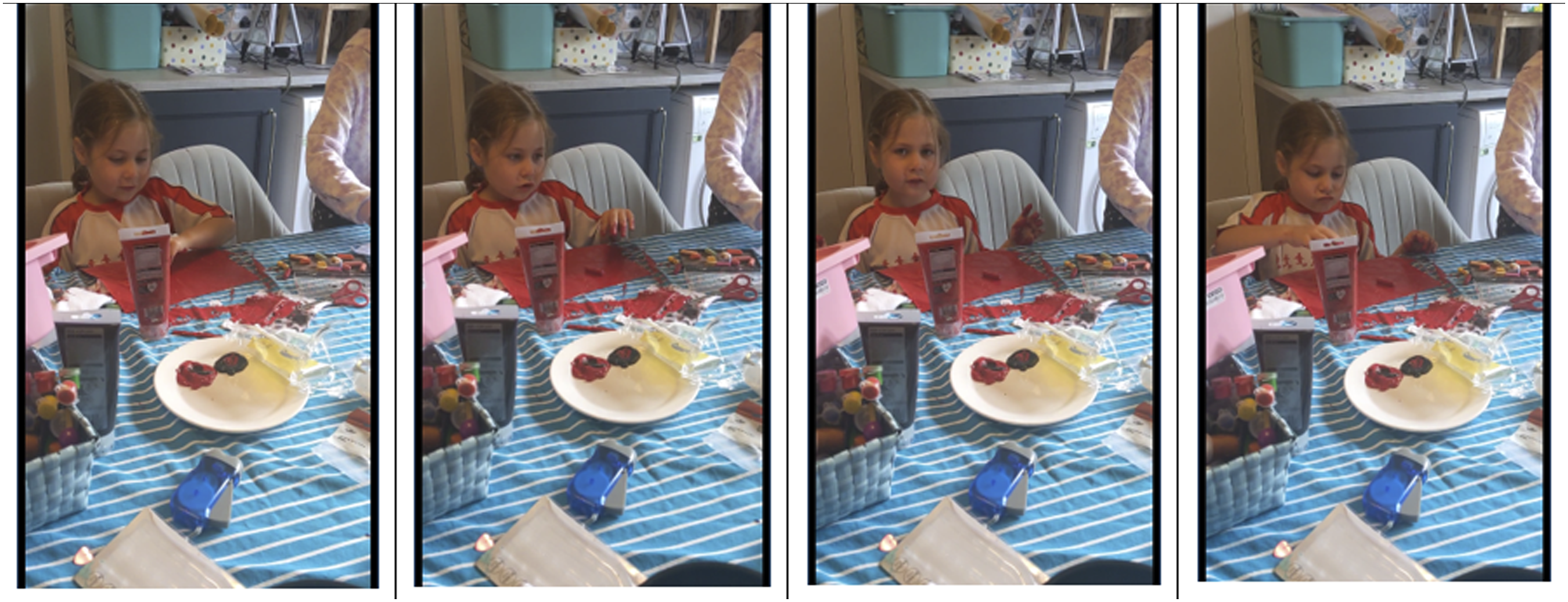
Discussion
Focusing on pivots in action, via MMDA, supports us to turn towards discomfort in the context of children’s art-making. In the examples above, pivots provoke us to discuss the ways in which children’s art-making can be intentionally unsettling or even disgusting for adults and the importance of understanding and probing mess, cleanliness and the negotiation of resources as part of the art-making experience. Too much literature on children’s art-making focuses on developmental classifications or understanding the supposed developmental benefits of this experience. In this article, as a contribution to a postdevelopmental exploration of childhood art-making, I have instead tried to open up the possibilities of looking towards the aspects of children’s art-making that can unsettle us. I have used MMDA as a tool intended to help me go beyond my comfort zone by looking more closely at what is unfolding through an interaction. For example, in the second pivot considered above, the child’s ‘dance’ around mess and cleanliness and the repetitive wiping of the hands is something that surfaced in the analysis only as a result of the fine-grained multimodal transcription process. This challenges us to look more closely at what is going on, to go further with Schulte’s (in press) fundamental question of ‘What’s happening here?‘.
Postdevelopmental approaches to childhood art are needed in order to expand and deepen our explorations of both childhood and art, as well as asking what we can learn from childhood art about the world around us. Dominant developmentalist paradigms, when applied to childhood art, have focused exclusively on milestones, stages and ‘reading’ children’s drawings for information on psychological states and traits. A postdevelopmental lens instead challenges us to see the social, cultural and material connections that resonate through childhood art experiences. In thinking beyond the dominant developmentalist paradigms, we need to also think creatively with robust methodologies that support us to engage with this richness. The fine-grained focus of multimodal transcription and analysis is well-suited to engaging with the complexities of the experience, action and communication involved in children’s art-making. In this study, the idea of pivots in action, suggested in Karen Wohlwend’s explanation of MMDA, helps us to consider the way in which multiple social, cultural and material phenomena of interest are playing out through children’s art-making.
The provocations that emerge in the analysis presented in this article suggest various avenues for further research in the field of childhood art. Childhood art researchers are well-placed to explore children’s experiences of mess and cleanliness, which is particularly needed given the influence of the pandemic on children’s experiences. Understanding the ‘burden’ of mess and how it is carried by different participants in the art-making experience, both child and adult, is a vital component of art-making. A growing body of literature has focused on the carers’ burden in relation to children’s art-making (e.g. Trafi-Prats, 2019; McClure, in press) but we can push these explorations further by looking at how interactions unfold, and burdens of care are or are not shared, in the moment between children and adult in the context of art-making. Research focused on material resources in children’s art-making has tended to celebrate the affordances of different resources and children’s creative engagement with them, particularly when they are abundant (e.g. Denmead and Hickman, 2012). Given that resources, sustainability and scarcity are at the centre of our thoughts about the future, we need to think about and with scarcity in relation to children’s art-making. This is bound up with the discussions around mess through the concept of ‘waste’, which is another significant topic for future explorations in the field.
This article focuses on a single episode of children’s art-making conducted in the researcher’s family home and there are therefore no claims for generalisability. MMDA of other episodes of children’s art-making will no doubt prompt other lines of inquiry and other types of discomfort that as childhood art researchers we can turn towards. Indeed, others’ multimodal analysis of the video fragments presented in this article may draw out alternative pivots in the action. What counts as a ‘pivot’ in multimodal action and communication is a subjective interpretation based on the theoretical conceptualisations, interests and assumptions of the analyst. Having accepted these caveats, this article is an invitation to cultivate and develop emergent dialogues about childhood art with focus more on disgust, taboo, mess, cleanliness, scarcity, waste and so on. Working with the concept of the pivot, as identified through a thorough multimodal analysis, is an opportunity to turn towards discomfort as part of a postdevelopmental approach to childhood art.
Conclusion
In this article, I have explored how MMDA can support postdevelopmental childhood art researchers to identify the pivots in action that double as provocations for engaging more fully with children’s art-making experiences, and in particular, what is uncomfortable or disruptive within these experiences. Through MMDA, pivots in action were indicated in this particular episode of children’s art-making through concrete cues such as shifts in gaze and repetitive movements. Methodically tracing these cues through the process of multimodal transcription supports researchers to tune into details that might otherwise be ignored or avoided. Tuning into these details enables us to contribute to emergent dialogues around what we might call the ‘shadow’ aspects of children’s art-making, including taboo, disgust, mess, cleanliness, waste and scarcity.
Footnotes
Declaration of Conflicting Interests
The author(s) declared no potential conflicts of interest with respect to the research, authorship, and/or publication of this article.
Funding
The author(s) received no financial support for the research, authorship, and/or publication of this article.