




Abstract
This article examines how app stores construct children’s software audiences through platform governance strategies and industry practices. Drawing on platform studies, critical childhood studies, and the concept of audience commodity, we use the critical walkthrough method and textual analysis to investigate the material choices of Google Play and Apple App Store. Our comparative analysis of their children-focused stores and developer submission platforms highlights tensions between the data-driven construction of children audiences and regulatory requirements to protect children’s privacy. We argue that children’s audiences are shaped by the discursive practices of app marketplaces, governance strategies specific to children’s apps, and industry lore about children’s audiences. Together, these strategies create what we term “platformized childhood.”
Introduction
Young users have become an increasingly attractive market segment for the tech industry. Globally, it is estimated that one-third of internet users are children (UNICEF, 2017). Mobile applications (“apps”) for gaming and education—part of the “Apps for Kids” market segment—dominate this space (Statista, 2024). As a result, companies are actively constructing children as a target audience, similar to what was observed in the past with traditional media industries such as network television and children’s animation (Havens, 2007). The primary mechanism for constructing children’s audiences today relies on the large-scale collection of children’s data (Coulter, 2021), enabled by apps, games, virtual worlds, and the “internet of toys.” Together, these technologies drive the ongoing datafication of children’s lives (Barassi, 2020). For example, the children-oriented video app YouTube Kids has been accused of creating “algorithmic infants” by collecting data from children to profile them for advertisers (Burroughs, 2017).
The datafication of children is far from a straightforward or uniform process; it is intricate and shaped by technological capabilities, design choices, and organizational intentions (Barassi, 2020). Within digital media, “there are multiple perspectives, structures, and institutions that discursively construct the child” (Coulter, 2021: 22). Understanding how the industry turns children into an audience requires examining the unique characteristics of the markets driving this process. Extant literature has examined the commercialization of children’s virtual spaces (Grimes, 2015), children and infants as subjects of datafication through the analysis of specific apps (Lupton and Williamson, 2017), and marketing strategies directed at children on free apps (Shin et al., 2021). Yet, to date, app stores have remained in the blind spot. We argue that they deserve our attention if we are to tease out the dynamics of an increasingly platformized childhood.
This article foregrounds app stores as central cogs in how we access computer software in a mobile context today. App stores serve as digital storefronts that facilitate and automate the search, review, electronic purchase, and installation of software. They provide developers with the computational infrastructure to create, publish, and sell apps tailored to distinct operating systems. In Western markets, the app stores Google Play and Apple’s App Store hold a duopoly (Nieborg et al., 2020). They are virtually the only avenues for getting an app onto customers’ smartphones, effectively serving as the gateway to a digital childhood for children, caregivers, and teachers alike.
Unsurprisingly, over the last decade, both Apple and Google have created dedicated sections for children-oriented products on their app stores. In 2013, Apple introduced the “Kids” category, subjecting products in this category to a dedicated review process. In 2015, Google launched the “Design for Families” program, which also required additional review for apps to be labeled as “family friendly.” In 2020, Google replaced this program with the “Kids” tab on Google Play and the “Teacher Approved” badge. The creation of children-dedicated sections on app stores represents an attempt to frame this demographic within the app development industry and is part of the governance toolbox of platforms (Poell et al., 2022). Yet, these developments have received remarkably little attention from scholars of childhood and digital media.
This article addresses this gap by drawing on platform studies and critical childhood studies to examine how app stores construct children as audiences. It investigates how app stores—conceptualized as platforms that serve as a foundation “upon which further computing can be done” (Bogost and Montfort, 2009: 3)—shape the production and consumption of children’s apps and the strategic decisions involved in defining and targeting children as an audience. These strategic decisions are framed as part of “platform governance,” to indicate the ways platform owners orchestrate roles and dynamics within app stores. Specifically, we focus on the material choices made by app stores as they reveal how children are envisioned and enacted as both an audience and a distinct market segment. User interfaces, which translate governance choices into design and affordances for interaction among market actors, are central to this process. They serve as key sites for exploring the construction of children’s audiences.
We conduct a comparative analysis of Google Play and Apple’s App Store to understand how these platforms discursively shape children as a software audience. Our analysis focuses on four user interfaces tailored to different platform-defined users, corresponding to two distinct material layers within the app stores’ infrastructure: (i) the app submission platforms App Store Connect and Play Console, where developers submit apps for review to ensure compliance with governance and legal frameworks; and (ii) the “Kids” sections in the app stores, designed for end-users. The analysis is supported by qualitative data generated using the “critical walkthrough” method (Light et al., 2018), which enables researchers to “trace an app or platform’s technological mechanisms and cultural references to understand how it guides users” (Duguay and Gold-Apel, 2023: 1). The resulting empirical material was then analyzed through textual analysis.
Our analysis identifies two key mechanisms. First, app stores expand platform governance—shaping everything from user interaction design to app review guidelines, ultimately controlling “every aspect of the exchange” between developers and end-users (Gillespie, 2018: 22)—by segmenting the market for children and framing them as a distinct audience commodity. Second, app stores employ specific discursive strategies to market children’s apps globally. Building on Havens’s (2007) concept of “universal childhoold” —which describes how trade publications and business practices construct a universalized interpretation of childhood and children’s preferences—we propose the concept of “platformized childhood.” This concept captures the combined effect of these two mechanisms, highlighting how platform governance and global marketing practices shape contemporary constructions of childhood.
The article is structured into five sections. First, we review dynamics and literature on business models, platform governance, and audience construction, providing the conceptual scaffolding for our empirical analysis. Second, we detail our methodology. Third, we present a comparative analysis of developer-oriented interfaces and the “Kids” section of app stores. Fourth, the discussion highlights how app stores play a central role in constructing children as an audience commodity. Finally, we situate our contribution within the broader study of critical childhood studies, emphasizing its intersection with platform governance.
Theoretical framework
The business of apps for kids: audiences as commodity versus regulatory constraints
App stores offer developers an integrated billing system, development tools, and Application Programming Interface (API) services that enable the collection of user data and the integration of analytics for ad targeting and user tracking (Nieborg, 2016). Molded on the rigid pricing standards established by the Apple/Google duopoly, app stores encourage app developers to rely on advertising for user acquisition and revenue. Apps employ various monetization strategies, such as paid downloads, free apps with in-app purchases (IAP), “freemium” models (i.e. free with advertising), and subscription plans. Platform owners typically operate on a revenue-sharing model, retaining 30% of every transaction as fees (Cuadrado and Dueñas, 2012). The freemium model—offering basic functionality for free—is the most prevalent on app stores, generating revenue through ads, selling non-personally identifiable data, and network effects, where a larger user base increases advertising revenues (Nieborg et al., 2020). Apps categorized as “Kids” hold a unique position in app stores regarding monetization strategies and the role of platform owners in organizing them. This section explores this distinctiveness.
Empirical research indicates that parents tend to prioritize free apps, selecting content later based on expectations of entertainment value, ease of use, or educational merit (Marsh et al., 2015). However, while children’s apps generally align with standard app pricing strategies (Shin et al., 2021), they diverge from typical freemium dynamics due to stricter data protection regulations, such as the US Children’s Online Privacy Protection Act (COPPA) and the European Union’s General Data Protection Regulation (GDPR), which govern Western markets. Despite minimal variations in age thresholds, children’s data privacy laws share common provisions regulating the collection of Personal Identifiable Information (PII), such as names, home addresses, online contact details, or geolocation data. These laws require verifiable parental or caregiver consent before collecting any PII from children. Their overarching goal is to restrict data collection from children by mandating platforms to clearly disclose their data practices, including the type and purpose of the data being collected. US media regulations are particularly influential, as the App Store and Google Play are operated by US-based companies. For instance, compliance with COPPA led Apple to introduce its “Kids” section in 2013 (Apple, 2013).
By requiring platforms to protect children’s privacy and limit data collection about them, these regulatory frameworks disrupt freemium pricing models, making it more difficult to monetize apps targeting children. In response, compliance with children’s media regulations has encouraged the emergence of children-safe ad networks, known as kidtech, such as SuperAwesome and Kidoz. These networks specialize in third-party Software Developer Kits (SDKs) with “contextual targeting technology,” enabling developers to comply with legislation and app store guidelines that restrict ad sales in children’s apps—for instance, preventing behavioral targeting by blocking the collection of personal identifiers.
Smythe’s (1977, in Smythe, 2001) concept of “audience commodity” offers a lens to understand advertiser-supported monetization strategies of freemium apps and the revenue-sharing model of app stores. According to Smythe, audiences become commodities broadcasters (and, by extension, app stores) sell to advertisers. Meehan (1984) complements this perspective by highlighting the need to measure audiences to facilitate such trade. With advancements in data collection techniques, media scholars have theorized different forms of audience commodities as they are evoked by search engines (Bermejo, 2009), social media platforms (Fuchs, 2012), and more recently, revenue-sharing platforms (Joseph and Bishop, 2024; Miller and Hogg, 2023; Ørmen and Gregersen, 2023).
Nieborg (2016) introduced the concept of the “player commodity” within gaming apps, explaining how “app developers capture players; ad intermediaries and social media platforms measure (i.e. track and target) players, and demand-side platforms ‘deliver’ installs or engagements for app developers” (Nieborg, 2016: 36). While these insights are valuable to understand the markets of apps for children, little is known about how app stores—operating under revenue-sharing models—shape audiences as commodities. Ørmen and Gregersen’s (2023) analysis of YouTube advances this discussion by showing that commodification processes extend beyond audiences to encompass all market participants. This framework is particularly relevant to our study, as it reconceptualizes the audience commodity from a singular focus on content consumption to a multifaceted process, where market relations between producers and advertisers themselves become subjects of commodification.
We thus ask: how do app stores navigate and govern children’s apps while ensuring the operation of the freemium business model? Is there a form of audience commodity specific to children’s audiences in app stores? In addressing these questions, we navigate the tension between the construction of digital media audiences through data-driven technologies on the one hand and regulations mandating platforms to safeguard children’s privacy by preventing market actors from constructing audiences in this way on the other.
Platform governance on and by app stores
App stores serve as intermediaries or brokers, enabling interaction between developers and end-users. Platform governance concerns “who decides what in a platform’s system” (Tiwana, 2014: 46). It balances control and openness, incentivizing participants to engage and generate value. Poell et al. (2022) emphasized the negotiated character of platform governance, describing it not as “unilateral” but as the result of negotiations among the many actors that partake in the market.
It is worth noting that governance of platforms differs from governance by platforms (referred to as “platform governance” in this article). In the former, global institutions, states, and intergovernmental organizations establish the scope and the limits of exchanges within platforms; in the latter, platform owners enact these parameters through private or “self-directed” governance (DeNardis and Hackl, 2015). Our primary focus is on governance by platforms, which is in turn informed by national and regional children’s media regulations such as COPPA and GDPR. We can see the architectural choices exerted by platform owners (governance by platforms) as “a special form of design-based governance, with power exercised ex ante via choice architectures defined through protocols, requiring lower levels of commitment from governing actors” (Gritsenko and Wood, 2020: 1).
From the vantage point of internet governance, DeNardis and Hackl (2015) observed that platform policies “take place in various ways outside of what most view as policy role of terms of service and other user agreements” (p. 769). This includes technical, design choices, and business models. From a management of information systems approach, Tiwana (2014) observed that platform governance is essentially material and influences how online spaces are structured, designed, and managed. Tiwana identified three dimensions of platform governance distributed across the computational infrastructure: decision rights, control mechanisms, and pricing structures. From a political economy perspective, Poell et al. (2022) distinguished three distinct instruments where platforms enact governance: interfaces, algorithms, and policies, which point to the distributed nature of platform governance. The authors also suggest three transversal governing strategies that characterize cultural industries, of which apps for Kids are one: (a) regulation, (b) curation, and (c) moderation. (a) Regulation involves traditional forms of governance, such as guidelines, policies, and standards: it “sets the formal, technical framework in which cultural production takes shape” (Poell et al., 2022: 84). This is particularly relevant for children apps: for example, the “Teacher’s Approved” program on Google Play requires that apps meet data protection regulations and limit ads (Watson, 2020). (b) Moderation refers to reviewing, rejecting, removing, or banning content and accounts. It modulates content availability and occurs either before or after the content has been published. In app stores, moderation usually takes place before publication and is streamlined through developer-oriented interfaces like App Store Connect and Play Console. The mandatory app review process assesses technological compatibility, regulatory compliance, and appropriateness (Gillespie, 2018). (c) Curation through editorial lists, search and recommendation algorithms, and app categories, pertains to the organization and categorization of content and services. These activities relate to increasing revenue, audience reach, and “appeasing” advertisers (Poell et al., 2022). Importantly, the desires of advertisers shape the governance of revenue-sharing platforms, as Joseph and Bishop’s (2024) analysis of YouTube’s monetization practices reveals.
As these analyses expose, platform governance strategies can manifest in various forms. In this article, rather than concentrating on traditional forms of governance, we examine the material choices of app stores through the analysis of interfaces. In a device or app, the user interface constitutes the point of human-computer interaction and communication. It can be viewed as a subtle form of governance. Its components are typically considered “natural” on the platform, yet they “serve as a strong influence of action” (Postigo, 2016: 4).
A fruitful entry point to investigate user interfaces is through the concept of affordances—specific prompts and constraints presented by a technology that shape the relationship between the user with, which “captures the relationship between the materiality of media and human agency” (Bucher and Helmond, 2018: 11). We can distinguish between high- and low-level affordances: the former, known as abstract affordances, center on “the kinds of dynamics and conditions enabled by technical devices, platforms and media” (Bucher and Helmond, 2018: 12), while the latter refer to media materiality, such as buttons and screens. Building on this distinction, we approach the abstract level of affordances as platform governance strategies, which materialize through interface features (or low-level affordances).
Childhood amidst the platformization of cultural production
The way childhood is defined helps shape the app market (Coulter, 2021). From a critical childhood studies perspective, childhood is “not a natural category of being, determined by biological stages of development” (Coulter, 2021: 20). Instead, it is a socially constructed concept that is inherently political, marked by inequalities in opportunities and resources, such as access to education and care, and shaped by both global and local forces (Woodhead, 2010). Children’s media industries are key players within these global forces, exporting specific constructions of Western childhood as the global standard (Woodhead, 2010).
App stores are both affected by and contribute to the “platformization of cultural production” (Nieborg and Poell, 2018). This process, driven by a small group of US-based platforms, reconfigures markets, infrastructures, and governance, thereby influencing the production, distribution, and advertising of cultural products. Situating the definition of childhood within the context of platformization and the global media industries underscores the economic imperatives associated with addressing children across cultural boundaries. Market pressures to distribute content globally have led to the decontextualization of children’s texts to appeal to child audiences anywhere (Chan et al., 2013: 213). Specific notions of childhood underpin the trade and distribution of such content.
Havens (2007) attributes those notions to industry lore, wherein interpretations and visions of children’s audiences, tastes, and global markets are construed and circulated through trade publications and business exchanges. In his study on animated children’s programming, he exposed an industry lore surrounding universal childhood, which facilitates the distribution and circulation of children’s animation by relying on “a perception of children around the world as sharing some sort of universalized experience of ‘childhood’” (Hogan and Sienkiewicz, 2013: 224). This universal childhood depicts “predominantly a Western, middle-class boy whose tastes are thought to derive from his developmental stage, rather than the influence of his culture” (Hogan and Sienkiewicz, 2013: 244). The concept leverages children’s developmental stages to construct a discourse promoting a universal, shared experience that transcends cultural differences, enabling products to be sold across markets. Ultimately, it provides “merchants the essential conceptual tools necessary for smooth operations of trade” (Havens, 2007: 4), shaping business and production practices.
The notions of industry lore and universal childhood serve as valuable entry points for investigating how app stores construct “Kids” as an audience through platform governance, particularly given the app stores’ interest in catering to a global audience (Nieborg et al., 2020).
Methods and data
For this study, we analyzed the English version of the “Kids” sections in app stores within the Netherlands, reflecting both our positionality and the location of the devices used for empirical analysis. While variations in children’s media regulations across regions may influence the composition of the “Kids” sections in different countries—and Google and Apple do maintain country-specific versions of their app stores to comply with local regulations—we observed that the developer submission interfaces remain consistent across regions, aside from language localization. We found no evidence of country-specific variations in the developer documentation or user manuals that suggest regional differences in the submission interface. We believe our findings can be generalized beyond this country case for two reasons. First, app stores operate as global platforms, with their design and modus operandi largely standardized across markets. Second, the strategies and mechanisms used to construct children as audiences are shaped by overarching business models and platform logics that transcend specific regulatory contexts.
To explore platform governance within app stores, we combined the walkthrough method (Light et al., 2018) with textual analysis. The walkthrough method enabled us to examine software applications by focusing on how their interfaces guide and shape user experiences. Affordances—key to understanding the relations between users and the platform—served as our analytical point of entry. Additionally, the walkthrough method allows researchers to adopt platform-afforded research personas, providing different perspectives on user interactions (Dieter et al., 2019). We argue that this approach offers unique advantages in scrutinizing the practical implementation of app store guidelines rather than limiting the analysis to a comparison of the guidelines themselves.
However, the scripted technical walkthrough method for apps proposed by Light et al. (2018) is not well-suited for analyzing complex systems designed for app developers. To address this, we adapted the method by focusing on the abstract level of affordances and employing research personas to perform a goal-oriented walkthrough (Figure 1). These adaptations enabled us to perform a comparative analysis of how platforms define children’s audiences to developers. Our approach was further informed by Bucher and Helmond’s (2018) “platform-sensitive approach” to studying interface affordances, which highlights that affordances are relational and multi-layered. Drawing on this perspective, we conceptualize users as “platform-defined users,” a category that, in this context, also includes app developers.
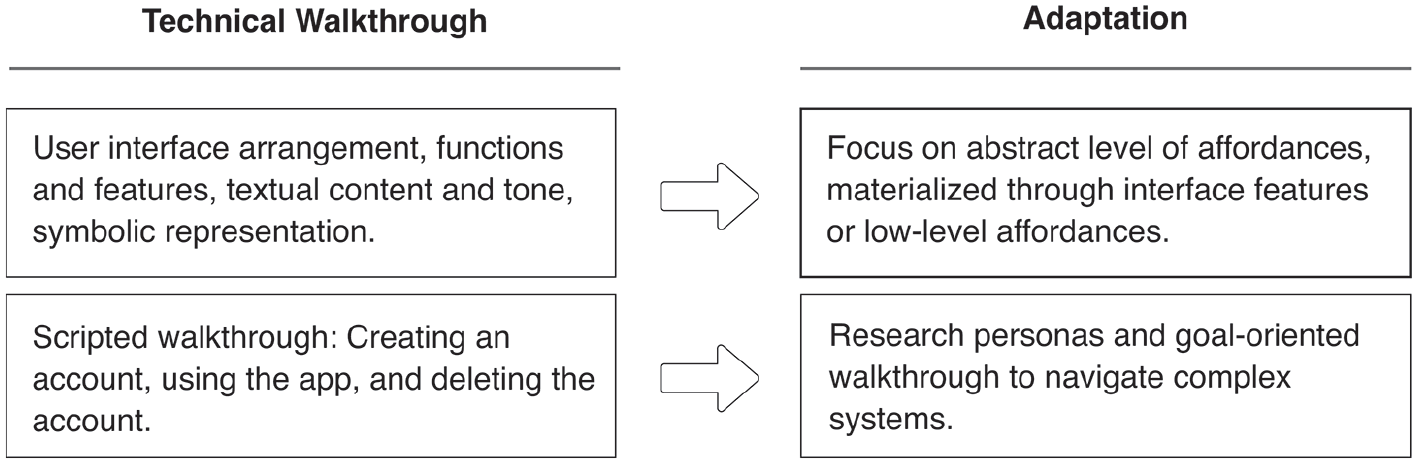
Walkthrough method adaptation.
The data collection involved two phases (Figure 2). First, we identified the environment of expected use and the vision for the selected interfaces by conducting a textual analysis of related secondary sources (Table 1).
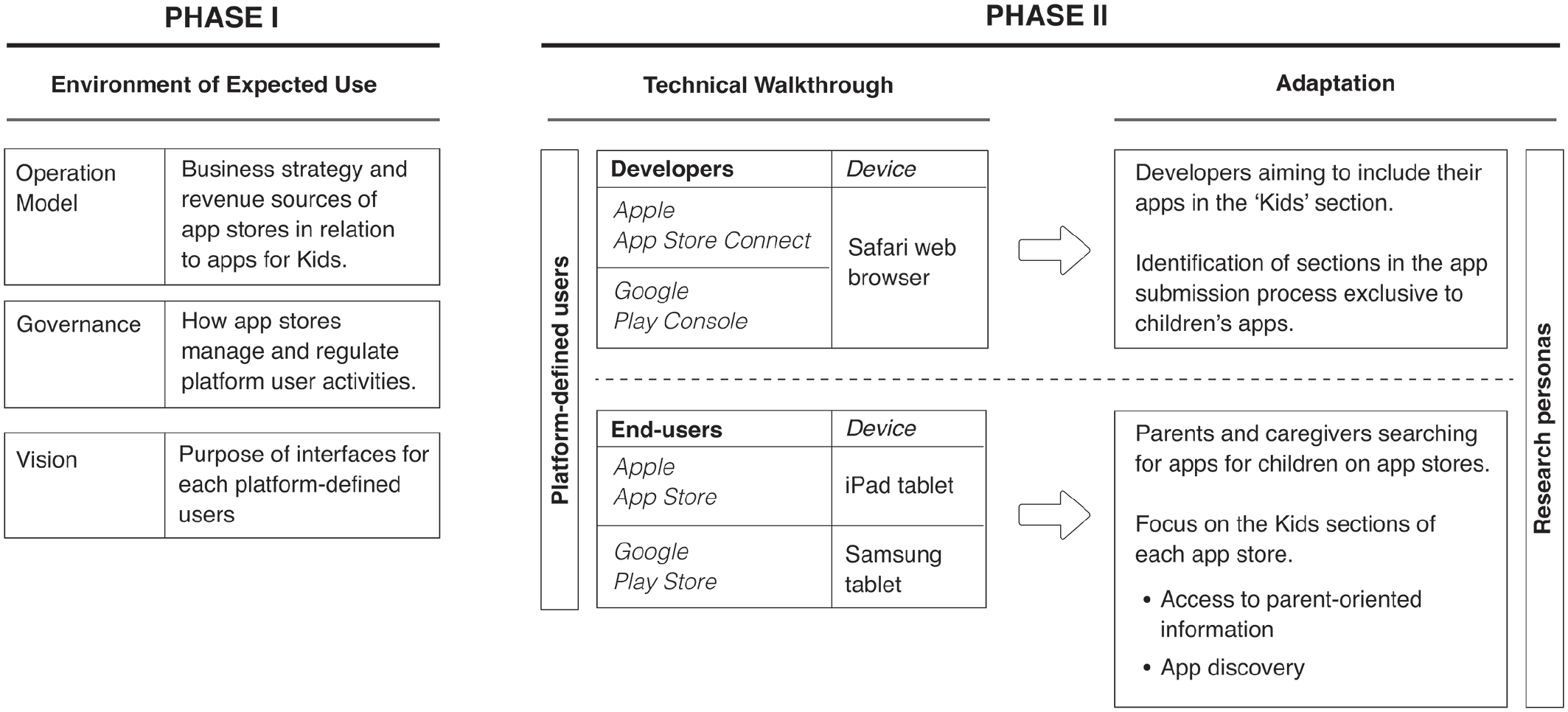
Data collection phases.
List of secondary sources.

The second phase involved conducting adapted technical interface walkthroughs between April and July 2023, using three devices to observe both developer and user interfaces. This dual focus reflects the distinct interfaces provided by Apple and Google for each side of the market: the developer-oriented App Store Connect and Play Console for app submission, and the user-facing app stores are Apple’s App Store and Google Play. These interfaces script and mediate the interactions between developers and end-users. We also examined how app stores structure their Kids sections and package apps for consumption, focusing on the “cultural discourses that shape and are perpetuated by interface elements” (Light et al., 2018: 888) that contribute to the construction of children’s audiences. We analyze the “Kids” sections as spaces where platforms actively construct and script children as audiences for software consumption. This analysis is approached through three angles: (1) “Kids” as a “category,” (2) parent-oriented information, and (3) app discovery mechanisms.
Defining apps for kids
Our analysis identified three main governance strategies employed at the interface level to define apps for children to developers: (I) industry self-regulation, (II) target audience selection, and (III) data collection and monetization practices. As Poell et al. (2022) observed, these strategies frequently intersect.
Industry self-regulation
A critical aspect of the app submission process involves the mandatory completion of content rating forms to regulate and moderate children’s apps. This self-regulation practice, inherited from digital games, involves oversight by regional authorities such as the Entertainment Software Rating Board (ESBR) and the Pan-European Game Information (PEGI). These authorities monitor games and app ratings and collaborate within the International Age Rating Coalition (IARC).
The forms assess the frequency of objectionable content such as violence, profanity, alcohol and drug references, simulated gambling, sexual content, and interactive elements, including users’ location, in-game purchases, interactions, and unrestricted internet access. App stores justify the use of content rating forms in the submission process as a means to ensure a safe environment for children by providing users with information to understand an app’s content (Apple, 2024; Google, 2022). Furthermore, parental control options rely on the form’s results to filter content for supervised accounts (Apple, 2023; Google, 2023c).
Although both platforms share a similar web interface and divide the age rating form into three sections, their approach differs substantially. The App Store Connect “Age Rating” form prioritizes simplicity, urging apps to declare their content through 12 categories and a three-scale system. Conversely, the Play Console “Content Ratings” form depends on whether the “downloaded app” includes content requiring ratings. Google adopts a granular approach to the rating form, which can involve up to 75 nested questions.
Both platforms feature a dedicated section after the content descriptors focusing on two interactive elements: unrestricted web access and gambling-like features. These elements override the form’s initial assessment and classify an app as inappropriate for children. The third section of the forms displays the results. Play Console presents them with the conversion to regional rating authorities, while Apple uses its own age ratings system, divided into four groups: 4+, 9+, 12+, and 17+.
Target audience selection
The outcome of the content rating form triggers the target audience selection process. For Apple, if an app contains none or mild objectionable content, an additional section titled “Advanced” is presented. Developers can voluntarily choose between “Made for Kids” or “Restrict to 17+.” Selecting the first option activates the selection of a target group. A brief explanation notes that choosing a target audience involves inclusion in the App Store’s “Kids” category, with subsequent updates required to comply with the category guidelines. The selection is irreversible.
Google’s “Target audience and content” section includes five sections, accessible after completing the “Content rating” form. The first question focuses on selecting target age groups, allowing developers to choose multiple consecutive groups. If any of the first three groups are selected, a system message indicates that the target audience includes children and should comply with Google Play Family Policies. Both platforms categorize child audiences into three groups (Figure 3), with the two groups—“ages 5 and under” and “6-8”—remaining consistent. Interestingly, these age groups do not align with those established by regulatory bodies and rating authorities. For instance, in Apple’s case, the first two groups correspond to the content rating “4+.”
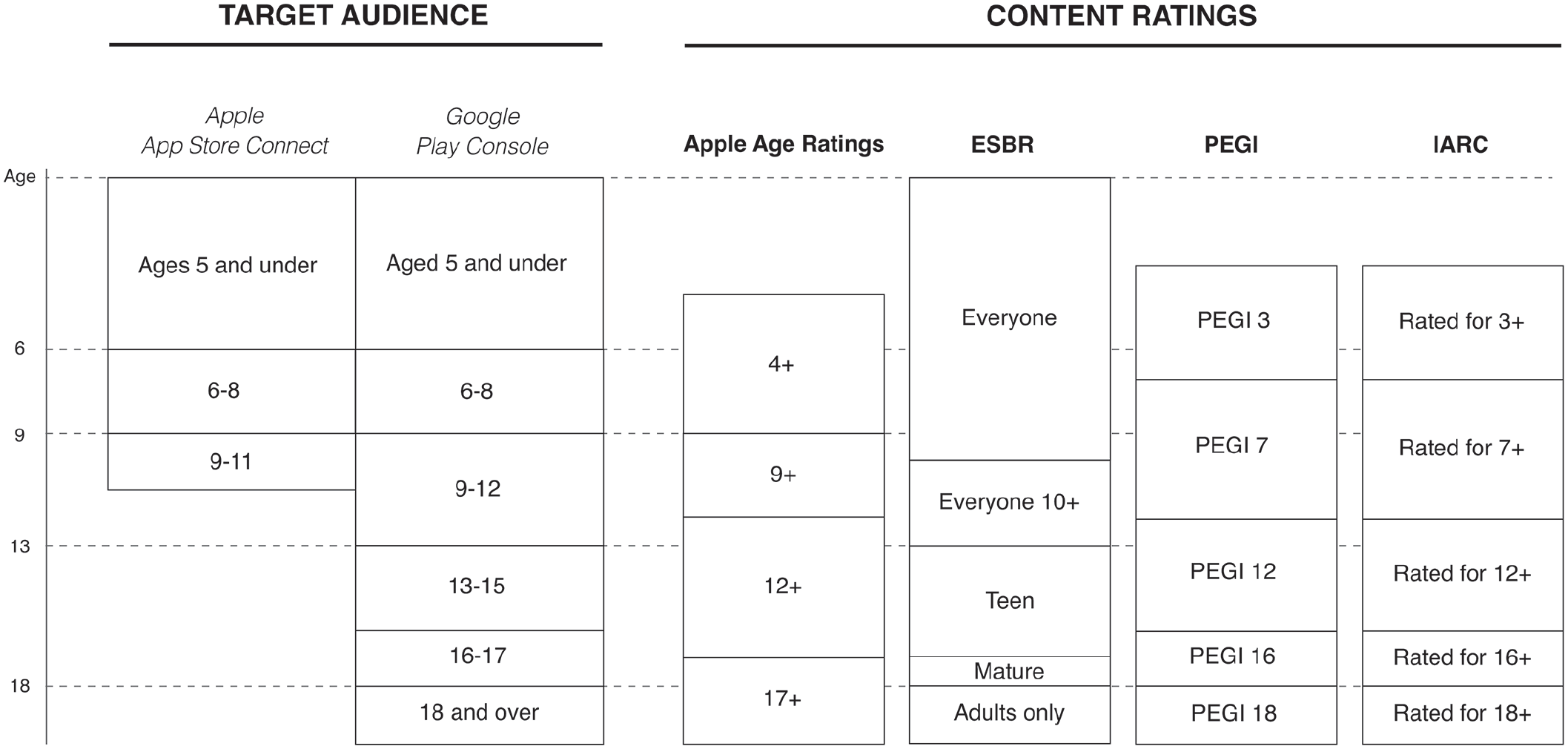
Comparison of target audience grouping and content ratings.
In sum, the target audience determines an app’s placement. This means an app is assigned to the “Kids” section not because developers select that category, but because they indicate children as the target audience. In both platforms, the “Kids” is curiously absent from the dropdown menu that invites developers to select the “app category.” Three criteria are used to determine the eligibility of apps to the “Kids” section: the outcome of the age rating form, the inclusion of restricted interactive elements, and the deliberate choice of children as a target audience.
Data collection and monetization
The third mechanism involves moderating data collection and monetization practices. After developers complete the submission process described above, platforms review the app’s features and components (APIs and SDKs). App stores deploy alert windows and reminders within developer-oriented interfaces to emphasize compliance requirements, which are triggered when children are selected as the target audience.
Apple includes a warning message in the “Age Rating” form as its sole reminder mechanism. In contrast, Google deploys a more comprehensive approach, introducing two supplementary sections –“App details” and “Ads”– within the “Target audience and content” section. These sections reiterate Google Play Family Policies, requiring developers to acknowledge compliance via a checkbox. Lastly, the “Store presence” section invites developers to opt into the “Expert Approved” program for additional quality and age appropriateness review.
Regarding the moderation of data collection practices, app stores focus on ensuring compliance with COPPA and GDPR, particularly app features and data sharing with third-party services. If an app can share information such as images, video, or chat, developers must provide a privacy policy (Apple, 2021). In cases where the app requires personal data to function, developers must establish mechanisms for verified parental consent.
Data collection practices also extend to advertising networks and services. Apple’s guidelines for ads targeted at children prohibit external analytics and the collection of children’s data for behavioral advertising, with an exception for third-party contextual advertising, provided the services adhere to publicly documented practices and feature exclusively “human-reviewed” ads. Google again takes a more comprehensive approach, specifying that ads on apps intended for children should be sourced exclusively from third-party services that have gone through the “Families Self-Certified Ads SDK Program” (Google, 2023b).
To regulate monetization strategies on apps for children, both app stores require the implementation of “age gating,” an industry-initiated standard designed to restrict access to areas not intended for children, including ad campaigns and IAP. Google employs a “neutral age screen” (Google, 2024) that verifies the user’s age without encouraging falsification. Apple’s “parental gates” (Apple, 2021) recommend the use of “adult-level” tasks, such as written text prompts for parents and audio cues for children, to notify parents of IAP or outbound links.
Selling apps for kids
Kids as a “category”
To find apps designed for children on the App Store, users must first select the “Apps” tab, and scroll through approximately 57 lists to reach the bottom. Here, users will encounter “Kids” within the “Top Categories” list. Like Apple’s approach, “Kids” is also itemized in the App/Categories tab on Google Play.
Despite the efforts of both platforms to differentiate between “apps” and “games” in their bottom menus, the relationship between these software “macro-categories” is far from clear-cut. Each platform offers 17 game genres, but only the App Store includes “Kids” as one of them. However, this option redirects users to the “Kids” apps section. Conversely, the game genres in Google Play do not feature “Kids” but include a games tab within the “Kids” section. The content in the games and apps tabs significantly overlaps on Google Play.
Based on the analysis of the developer-oriented interfaces and the explicit framing of “Kids” as not a standalone category, one could argue that “Kids” operates as a scaled-down version of a store within app stores. However, the consistent interface design between “Kids,” other app categories, and game sub-genres leaves little room for nuance or distinctiveness.
Parent-oriented information
The “Kids” sections on app stores primarily cater to parents and caregivers rather than children. We base this observation on the information available in both stores and interface design, which lacks adaptation for younger users. As such, app stores do not directly address children as consumers.
Upon entering Google Play’s “Kids” section, the “Teacher Approved” program stands out with its distinctive badge and a prominent green button that invites users to “Learn more” about the program. Interestingly, the program’s name differs in the developer-oriented interfaces, where it is referred to as “Expert Approved.” While the name emphasizes teachers as the expert reviewers for apps featured in this section, children and media specialists are also part of the review team, as evidenced by the tab. The criteria for assessment are publicly available and include design quality, appeal to children, enrichment potential, ads and IAP, and age appropriateness (Google, 2023a).
Conversely, Apple provides information for parents at the bottom of the “Kids” section. “Parents’ Guide to the App Store” recommends ensuring age-appropriate content for children by focusing on device settings—such as screen time and parental control tools—and parents assessing suitability through the age rating of each app.
In broader terms, parent-oriented information emphasizes content ratings and industry-initiated standards as the primary value proposition of the “Kids” section. This rhetoric echoes Holloway et al.’s (2021) study of preschool app descriptions, where developers promote a concept referred to as “parental responsibilization.” This discursive mechanism addresses parental concerns about screen time, privacy, and content rating, ultimately placing the onus on parents to review and verify the information of each app.
App discovery
The “Kids” sections on app stores exhibit similar pathways to navigate and discover apps. Users can navigate through curated app collections, which come in two main types: editor-curated and algorithmically generated. Apple editors curate two formats: app collections and featured apps, but the process for inclusion in these lists remains opaque.
On the App Store, the “Kids” section offers a few collections covering various themes, with a focus on educational topics including literacy, numeracy, and coding. In contrast, Google Play offers a relatively larger number of lists, categorized based on the software’s purpose, including movies, apps, or games. Interestingly, educational themes are prevalent.
Age filters are the second shared app discovery pathway within the “Kids” sections. Our comparative analysis showed several limitations to the browsing by age feature, where developers’ target audience selection functions as metadata to curate content based on age groups. Apple markets this feature as “age bands,” accessible as links at the bottom of the “Kids” tab, remaining hidden unless users explore the entirety of the section. Clicking on these links opens age-specific sub-sections, yet the absence of a distinctive design and its discreet location may indicate a reduced interest in highlighting this app discover option. Furthermore, the content featured in the age group sections is limited, with only three lists made available per section.
Similarly, Google Play presents the navigation as buttons at the top of the page under the “Teacher Approved” banner. Each age page features distinct visual elements for its specific age group. However, the option to select consecutive age groups during the app submission process undermines the objective of the feature, resulting in significant content overlap between different age groups.
Discussion
Children as audience commodity
Our comparative analysis shed light on how app stores governance strategies and emerging industry standards construct children’s audiences. App stores strive to support the commercial aspect of children’s apps while enforcing regulations on children’s data collection. This role responds to the platforms’ revenue-sharing models and economic priorities, which support monetization activities, especially for free apps targeting children, albeit on a smaller scale. Extending Joseph and Bishop’s (2024) critical intervention on platform governance and advertising, we highlight the commercial nature of app store governance of the “Kids” demographics. Our examination demonstrates how app stores embrace a business-oriented approach to governing children’s apps on app stores over the educational or developmental aspects that the “Kids” section discursively promotes with developer programs such as “Teacher Approved.”
In addition to the purposes described above, content ratings activate the target audience selection. One could argue that this action only aids the “age filters” on the “Kids” sections. However, we contend that target audience selection goes beyond the modulation of an app’s visibility on an app store. Thus, if the primary objective of target audience selection in both app stores is not curation, what does this option aim to govern? The answer lies in market segmentation as a platform governance strategy exclusive to children’s apps. This established business strategy takes on a unique form in the context of children’s audience. Traditionally, market segmentation relies on geography, demographics, and psychographics to simplify consumer complexities and divide the market into manageable groups (Amine and Alexander Smith, 2009). App stores leverage this strategy to organize children’s audiences based solely on one demographic factor: age. Put differently, app stores actively frame children’s audiences using market segmentation techniques. However, as Lien (1997) cautions, market definitions are always positioned. Through this lens, app stores’ target audience groups reflect market imperatives and regulatory pressures around children’s media.
Market segmentation as a governance strategy is distinct from the ones outlined by Poell et al. (2022). While the commodification of audiences in digital media depends on data collection and data-driven technologies (Miller and Hogg, 2023), shielding children from data collection prevents platform owners, app developers, and ad networks from employing those methods. Consequently, app stores resort to classic business strategies to define and secure children’s audiences for software production and consumption. Therefore, this governance strategy can be understood not only as a response to digital media regulations and restrictions to data collection but as a driver for further monetization of apps for children.
App stores frame children as audience commodity through mandatory target audience segmentation. Building on Ørmen and Gregersen’s (2023) insights into commodification processes engaging all market participants to monetize various relationships among producers, users, and advertisers, we propose that the commodification of any actor can serve multiple targeted purposes. In app stores, target audience segmentation organizes children’s audiences not only for data collection but also to package and distribute third-party content aimed at attracting end-users (children) and securing a growing online audience for ad networks, particularly in the kidtech sector. This is significant, as it underpins the primary leading monetization strategy for the dominant business model in app stores and apps for “Kids,” namely freemium pricing. In this context, children, as audience commodity, amplify commercial engagement across market actors.
By enforcing the selection of target age groups and presenting it along with regulatory and moderation governance strategies toward apps for children, app stores contribute to normalizing these age-based classifications in the software development sector and children’s digital media industries at large. Instead of creating “algorithmic infants” (Burroughs, 2017), app stores base their target age groups on social constructions, specifically industry lore about childhood.
Platformized childhood
The similarity in the structure of age groups on both app stores is not coincidental. We suggest it is a strategic attempt to organize children’s audiences based on pseudo-developmental stages. Buckingham and Willet (2022) observed that “children are conceptualized principally in terms of development” (p. 53) as a progression toward adult maturity. This approach to the construction of childhood directly relates to Havens (2007) universal childhood concept. The authors argue that “[t]he primary interest is in the internal mental processes or cognition or emotion: the social context is predominantly understood as an external variable or influence” (Buckingham and Willet, 2022: 53). Consequently, grouping children’s audiences through “developmental” stages implies the children within those groups share similar needs, transcending cultural differences.
The specific arrangement by age group facilitates global trade and circulation of children’s apps and benefits the platform owners’ economic interests. Havens (2007) observations regarding children’s animation distribution bear interesting parallels to the distribution of children’s apps. The perception of childhood as being universal persists today, allowing content to circulate across markets.
While similarities exist between children’s animation distribution and app stores’ “Kids” sections, they differ in how the notion of universal childhood operates on platforms. Havens (2014) referred to industry lore, defined as “taken-for-granted assumptions” or “organizational common sense” (p. 40) among industry insiders. However, app stores enforce this discourse through platform governance strategies on software production and consumption. This convergence between platform governance and the reliance on industry lore creates what we term “platformized childhood.” The term highlights the role of platform governance in constructing children’s global audiences for software while leveraging industry lore of childhood.
Furthermore, while universal childhood facilitated the trade of content across diverse markets, platformized childhood not only aids app downloads but sells an audience for third-party developers and advertisers by providing a segmented audience to design content for and serve ads. In this iteration, the construction of childhood outlined by Havens (2007) equally supports the framing of children as audience commodity on app stores.
Situating app stores’ industry lore within the broader context of the platformization of cultural production emphasizes their significant role in framing children’s audiences beyond mere content categorization or navigation. The dominance of platforms like the App Store and Google Play in Western markets provides fertile ground for spreading and amplifying the reach of industry lore supporting universal childhood. As Havens (2014) noted, “industry lore is specific to the cultural industries and arises from unique features of those industries—namely the unknowability of audience preferences, exorbitant costs of production, and highly unpredictable success of cultural commodities” (p. 40). Expanding on this, platformized childhood as an extension of universal childhood lore emerges from the pivotal role of app stores as intermediaries between app developers and end-users, the regulatory pressure of children’s privacy, and the need to organize the rapidly growing online children’s audiences through platform governance. Platformized childhood captures these dynamics, yielding distinct value for each participant in app stores’ ecosystem. For app developers, “Kids” is an organized market niche that provides global reach to a self-renewing audience that extends their apps’ “shelf life.” For advertisers and kidtech sector, this audience comprises one-third of internet users, attracting significant market investments. For parents, industry lore recasts app stores’ “Kids” sections as educational and safe spaces, appealing to their concerns while securing an audience for both advertisers and app developers.
Conclusions
By considering the distinct characteristics of platforms as programmable computing systems, this article analyzed how app stores shape children, who represent one-third of the global population online, as audiences for software production and consumption. Our comparative analysis of Apple’s and Google’s interfaces for platform-defined users aimed to trace the definition of children’s audiences to developers and end users. We focused on the material aspects of platform governance, particularly the interfaces as a governance instrument, to examine how platform owners construct children as global audiences through target audience selection.
The revenue-sharing model of app stores informs platform governance on children’s apps, which prioritizes monetization strategies, particularly for freemium apps, the most popular model on apps for children. The freemium model depends on expanding its audience and generating revenue through advertisement, with children’s audience becoming a valuable demographic to reach and monetize.
We proposed that market segmentation serves as a governance strategy different from those delineated by Poell et al. (2022). This strategy organizes children as an audience commodity within app stores. Here, the audience commodification relies not on data collection but on industry lore that has previously aided the trade of content aimed at children under the assumption of universal children’s needs and preferences.
The convergence of platform governance and industry lore around universal or shared children’s tastes profoundly shapes how children are imagined as software audiences. These combined approaches inform our conceptualization of platformized childhood within app stores, a term that encompasses how platform governance is inscribed in the construction of children’s audiences. Platformized childhood, as a new iteration of universal childhood, underscores the production and consumption of children’s content within digital commercial environments. Moreover, it highlights how platforms wield a powerful position to define childhood by prioritizing industry lore that facilitates trade.
Our methods offer insights into one aspect of constructing children’s audiences for the software industry. Future research could incorporate interviews with developers and advertisers to examine the prevalence, circulation and “translation” of the industry lore we observed. Additionally, investigating the platform governance of kidtech services through SDK certification, alongside exploring the advertising models of these services, can provide valuable insights into how industry lore shapes children’s audiences online.
Footnotes
Funding
The author(s) disclosed receipt of the following financial support for the research, authorship, and/or publication of this article: This work was supported by the European Union’s Horizon 2020 research and innovation program under the Marie Skłodowska-Curie Actions [grant number 857897].
