



Abstract
Background:
Esophageal manometry (EM) remains the gold standard for assessing esophageal motility. However, interpreting manometric findings can be difficult even for experts. This study aimed to determine the challenges expert esophagologists face when interpreting EM.
Methods:
We conducted a survey to seek opinions on EM interpretation among expert esophagologists whose names were obtained from the International High-Resolution Esophageal Manometry Working Group and American Neurogastroenterology and Motility Society Registry of Gastrointestinal Motility Units. The survey underwent content validation through literature review, item generation, and group discussions. Invitations were emailed to 52 American, European, and Australian physicians. An anonymous survey was conducted using SurveyMonkey©.
Results:
Twenty-eight expert esophagologists responded (response rate: 54%). Most respondents (92.9%) had more than 10 years of experience interpreting EM. More than one-third of the experts used both high-resolution manometry (HRM) and conventional manometry (CM). Ninety-three percent encountered a difficult-to-interpret study at least 10% of the time, with 53.6% reporting difficulties with both HRM and CM, 10.7% with HRM, and 7.1% with CM alone. Achalasia and ineffective esophageal motility were challenging to diagnose (50%), followed by distal esophageal spasm (42.9%), and hypercontractile esophagus (35.7%). Twenty-one percent reported difficulty diagnosing esophagogastric junction outflow obstruction versus achalasia. Most participants (57.1%) indicated that a barium esophagram was helpful when encountering a difficult-to-interpret study. Subgroup analysis showed no significant difference in encountering a difficult-to-interpret manometry study with years of experience (>10 vs >20 years) (P = .305).
Conclusions:
Even among experts, interpreting EM studies can be challenging at times, despite advanced technology and years of experience.
This is a visual representation of the abstract.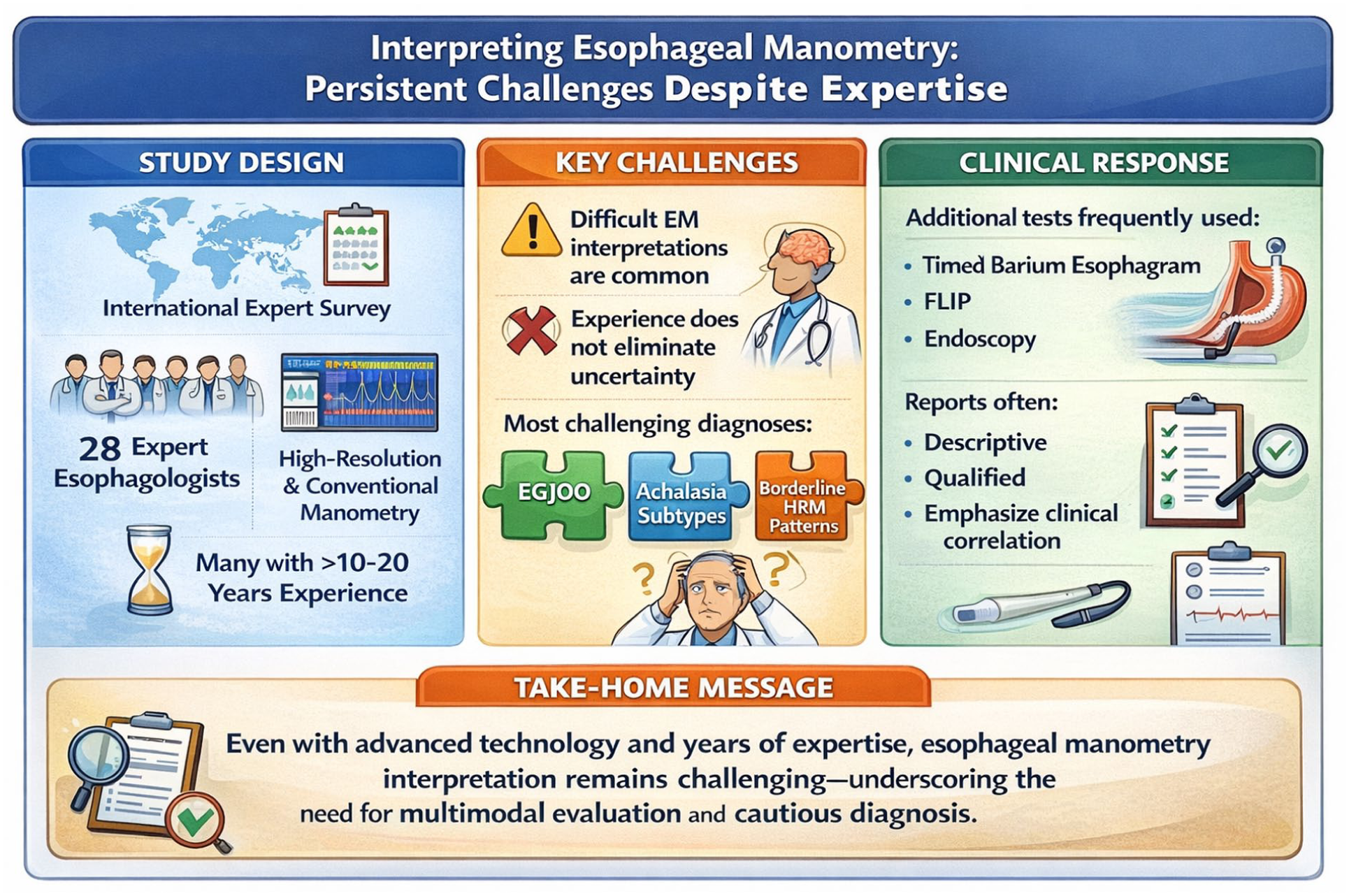
Get full access to this article
View all access options for this article.
References
Supplementary Material
Please find the following supplemental material available below.
For Open Access articles published under a Creative Commons License, all supplemental material carries the same license as the article it is associated with.
For non-Open Access articles published, all supplemental material carries a non-exclusive license, and permission requests for re-use of supplemental material or any part of supplemental material shall be sent directly to the copyright owner as specified in the copyright notice associated with the article.
