




Abstract
Background:
Dysphagia is common following cervical spinal surgery (CSS) yet reported incidence and risk factors are highly heterogeneous. This case-control study aimed to determine the incidence of dysphagia after CSS and identify its predisposing factors.
Methods:
Records of 1199 patients who underwent CSS over a 2-year period at our center were reviewed. Patients with postoperative dysphagia and an equal number of randomly selected patients without dysphagia were included for analysis. Demographic, clinical, intraoperative, and perioperative factors were compared using univariate followed by multivariable logistic regression analysis.
Results:
The study population consisted of 94 (7.8%) patients with dysphagia and 94 controls. Patients with postoperative dysphagia were older [mean (SD) 60.7(12) vs 54.7(12), P = .002] and more likely to have preoperative dysphagia (16% vs 0%, P < .001). No other demographic or clinical factors were significant. Mid-level (C3-4, C4-5) (66% vs 48%, P = .018) and multilevel surgeries (67% vs 50%, P = .026) were associated with dysphagia. No other intraoperative factors were significant. The presence of any (abscess, dehiscence, hematoma, CSF leak, prevertebral edema, esophageal, or vocal cord injury) perioperative complication (20% vs 3.2%, P < .001) was associated with dysphagia, with dehiscence (6.5% vs 0%, P = .029) and hematoma (6.5% vs 0%, P = .029) showing the strongest association. Multivariable analysis identified age ≥70 [OR (95% CI): 2.8 (1-7), P = .031] and any perioperative complication [OR (95% CI): 6.7 (2-25), P = .004] as independent predictors of dysphagia.
Conclusion:
The incidence of dysphagia after cervical spine surgery is 7.8%. The risk of postoperative dysphagia is 6.7-times higher in those with perioperative complications and 2.8-times higher in patients over 70.
This is a visual representation of the abstract.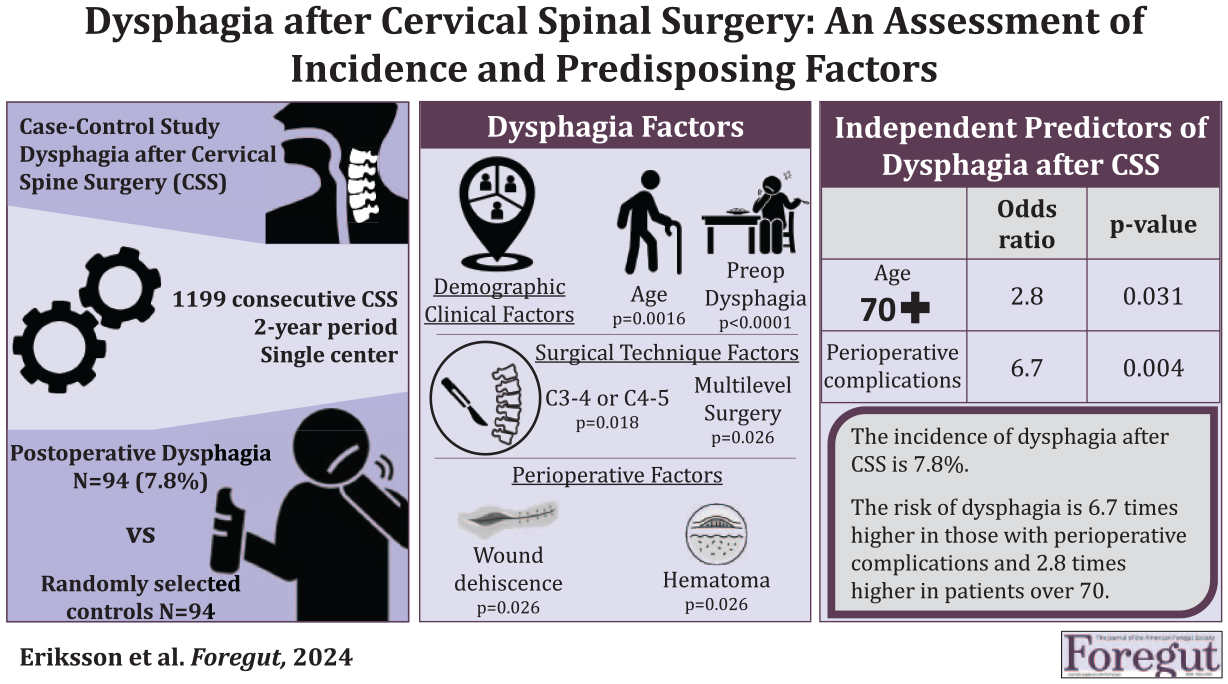
Get full access to this article
View all access options for this article.