




Abstract
Background:
The water siphon maneuver (WSM) is performed during barium swallow test (BST) to elicit gastroesophageal reflux (GERD) in patients without identifiable spontaneous reflux. The objective of this study was to measure the correlation between WSM-induced reflux with pathologic GERD as determined by gold standard ambulatory pH testing.
Methods:
A retrospective review of consecutive adult patients that underwent both BST with WSM and pH testing at our institution from 2015 to 2019 (n = 228). Pathologic GERD was defined as total esophageal acid exposure time >6% on pH testing (Lyon consensus). Exclusion criteria included history of foregut procedures and pH testing on proton pump inhibitors. Correlation between WSM-induced reflux and GERD by pH testing was assessed using Fisher’s exact test.
Results:
A total of 116 patients were included. Pathologic GERD was diagnosed on 28.4% (n = 33) of pH tests while reflux was observed in 69.8% (n = 81) of WSM. There was no correlation between positive WSM and pH test-detected pathologic GERD (P = .415). The sensitivity and specificity of WSM for GERD relative to pH testing were 63.6% and 27.7% while positive and negative predictive values were 25.9% and 65.7%, respectively. Accuracy of the WSM was consistently low across both wireless or impedance pH testing and for the entire cohort (n = 228).
Conclusion:
This is the largest study to date comparing WSM during BST to ambulatory pH testing in the evaluation of GERD. WSM has limited sensitivity and negative predictive value for pathologic GERD, and therefore cannot reliably confirm or discard this diagnosis.
This is a visual representation of the abstract.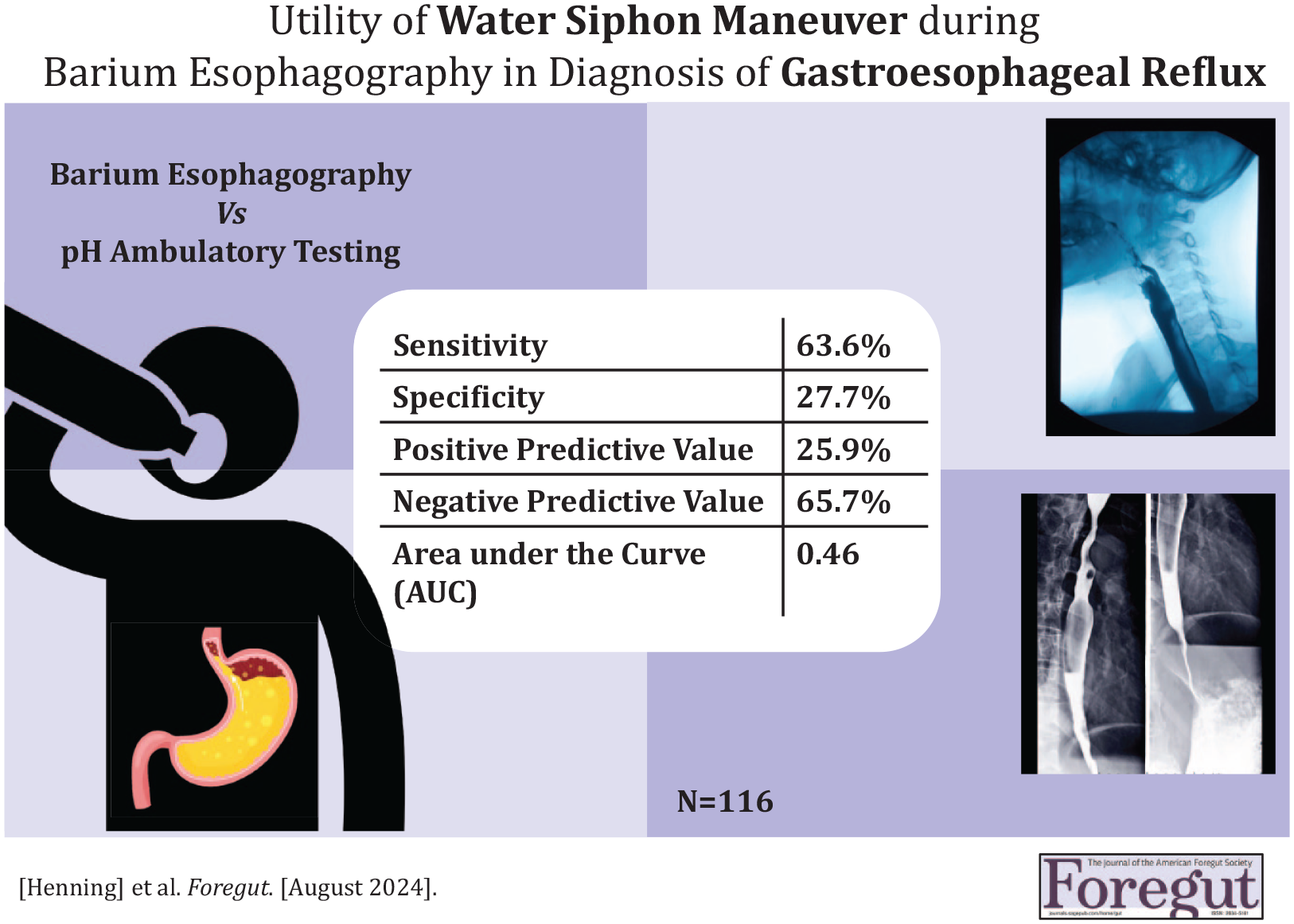
Keywords
Get full access to this article
View all access options for this article.
References
Supplementary Material
Please find the following supplemental material available below.
For Open Access articles published under a Creative Commons License, all supplemental material carries the same license as the article it is associated with.
For non-Open Access articles published, all supplemental material carries a non-exclusive license, and permission requests for re-use of supplemental material or any part of supplemental material shall be sent directly to the copyright owner as specified in the copyright notice associated with the article.
