



Abstract
This paper re-visits a familiar family therapy technique, ‘tracking’ which is often regarded to be part of the first phase of family therapy and associated especially with strategic approaches. We suggest that it is consistent with constructivist approaches to family therapy and can be employed in a collaborative way to co-construct and enrich relational narratives. Ideas from attachment theory and neurobiology are integrated to show that circularities are also influenced by the emotional states and physiological arousal of family members. An attachment narrative therapy (ANT) approach is employed to describe how tracking can be understood and employed to promote changes at multiple levels, including attachment relationships. Families are encouraged to adopt an ‘observer’ position on their relationships and in turn to become authors of their interactions in contemplating ways they can chose new avenues of actions. Details of the procedure of engaging in tracking with individuals and families are described with clinical examples.
People think about, think about, think about … People have endless ways to explain their existence. If you want to understand human behaviour, watch what they do, not what they say (Bowen, 1972, p. 306).
Families often describe feeling stuck, that they are going around in circles or feeling trapped in repetitive patterns of arguments, conflicts and escalations. This is often associated with feelings of helplessness and hopelessness, Likewise, this feeling of ‘stuckness’ also applies to the therapists in that we may feel ‘stuck’ in our work with a couple or family and feel incapable of helping them to shift out of these distressing and painful repeating patterns of actions. Thinking about families’ difficulties in terms of such repetitive cycles of actions – circularities was a core feature of early systemic therapies (Breunlin and Schwartz, 1986; Errington, 2022; Burnham, 2006; Haley and Richeport-Haley, 2004). These circularities were conceptualised as self-perpetuating patterns which operated on the basis of mutual feedback from each family members’ actions. A ‘circularity’ can be regarded as a description rather than a ‘real’ entity and all circularities are unique, however, as therapists we may perceive some overall similarities to other families (Bowen, 1978; Dallos and Draper, 2025). Likewise, families draw comparisons to other families, their own families of origin, and culturally shaped expectations. We employ tracking to explore circularities as part of an invitation to families to adopt an ‘observer position’ on their own relationships. We invite them to be able to make choices, become authors rather than spectators of their relational patterns (Errington, 2022).
Tracking sequences which originated in early first-order family therapy to describe circularities from the ‘outside’ can be employed in a collaborative second-order approach (Bowen, 1978). Rather than something we do to families it becomes an invitation to engage in a mutual exploration with us and as helping to ‘thicken narratives’ of alternatives to problems (White and Epston, 1990), employing relational reflexivity and mentalisation (Fonagy and Luyten, 2018).
An observer position: creating new understandings and emotions
At the outset of therapy, we often hear stories from family members of events in their lives as having an inevitability, as if they are spectators of events and have little choice over them. As we have seen this may partly be a consequence of a sense that trying to change things has not worked and has been futile. What we are encouraging therefore is a systemic observer position that involves looking for relational patterns and reflecting on our own contributions to maintaining patterns. Tracking involves thinking about multiple layers of analysis: Current patterns of actions, dynamics of current relationships, historical factors, including trans- generational attachments and how all of these are in turn shaped by wider cultural/social contexts. Typically, things happen fast in families and relationships.
Edwin and Suzy
Edwin (17) was living with his mother, Suzy, younger brother, half-brother and step-father Dave. Edwin’s father and his mother Suzy had separated 4 years earlier and Edwin attempted to maintain contact with him in contrast to his younger brother who had bonded more with their step-father, Dave. Edwin had a diagnosis of autism and was educationally very able and had some close friends. Suzy described experiencing escalating interactions which Suzy described as ‘meltdowns’, which appeared to involve Suzy anticipating an angry outburst and Edwin feeling ignored, or misunderstood by his mother. These had a quality of pursuing – distancing which has been described in work with families and also with couples (Johnson, 2018; Watzlawick et al., 1974) and in which they can be seen to be caught up in a mutually maintaining cycle of beliefs actions and feeling (Figure 1): An escalating cycle: Pursuing – Distancing cycle.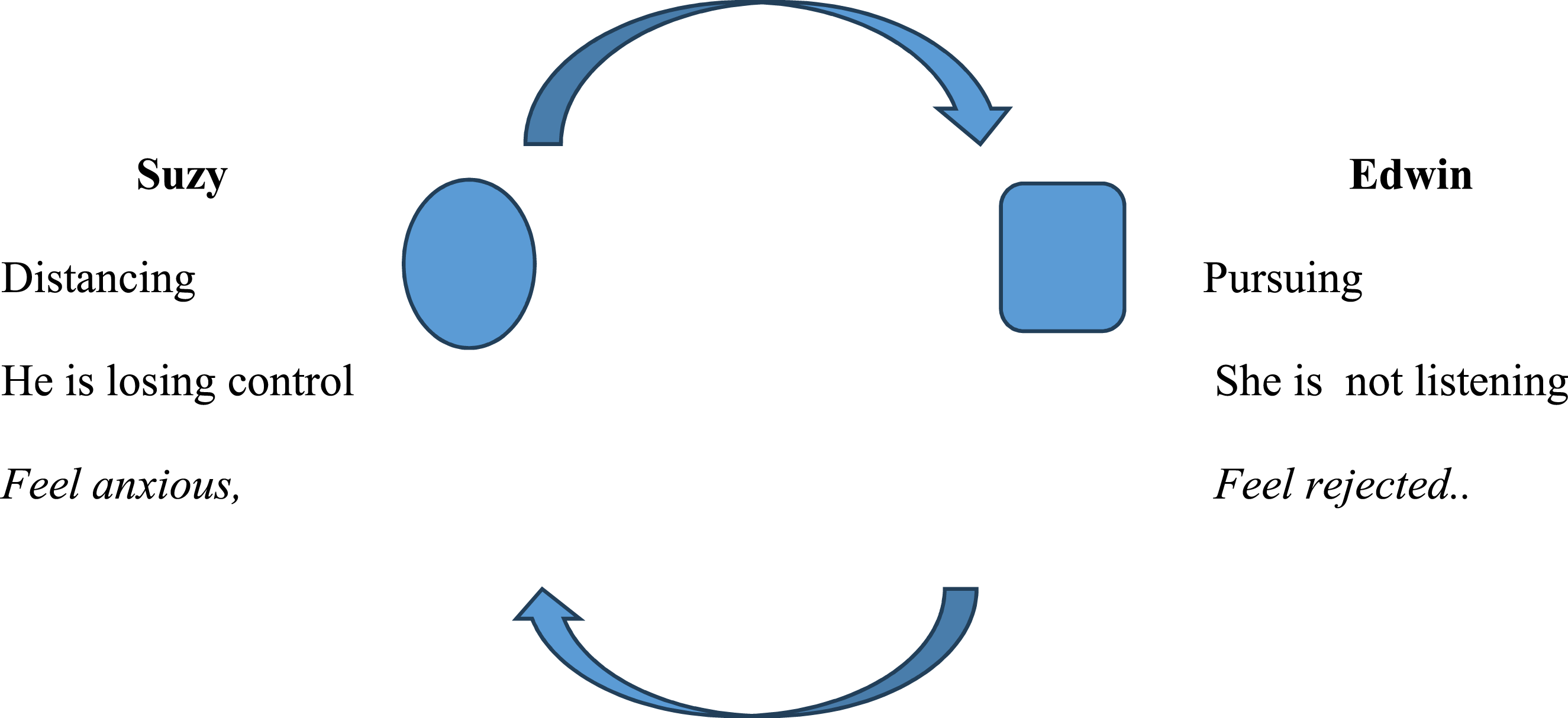
Watzlawick et al. (1974) suggested the idea of these patterns involving a ‘punctuation’ of the events - that such cycles are fuelled by mutually inter-locking and self-maintaining patterns of beliefs and actions. The narrative therapies added that they are creating stories that position each other in constrained ways. Tracking involves encouraging people to step back, slow down and start to see the patterns they are in and importantly to move away from reactive and contingent thinking such as – ‘I have to withdraw because Edwin will lose it’, ‘Mum winds me up by not listening’.
Emotions and circularities
As well as inter-locking perceptions, such relational patterns are also suffused with and maintained by emotion. A significant reason why it is so difficult to move out of such patterns is that, both Edwin and Suzy are both becoming highly negatively emotionally aroused - retreating into ‘fight-flight’ (Van der Kolk, 2014). In these physiological states people become less able to think, to mentalise, to be curious and to try to understand each other’s perspectives (Porges, 2009). Suzy described that she lived in fear of the meltdowns and felt frozen when they started. Edwin was less able to articulate how he felt but showed it by becoming angry and upset when his mother would ask him to go to his room to calm down. Central to our use of tracking is to assist people to slow down, start to feel safe and to reduce their negative arousal. This is also a fundamental aspect of establishing a positive therapeutic relationship or secure base (Bowlby, 2005; Wampold, 2015).
Co creating a secure base and self-protective attachment strategies
Attachment theory suggests that we develop characteristic patterns from our childhood experiences with or parents/carers for trying to meet our attachment needs (Ainsworth et al., 1978; Crittenden, 2006; Dallos, 2006; Wampold, 2015). This can be seen to show two core patterns: de-activating (avoidant), hyper-activating (anxious-ambivalent) or a balanced mixture of these. However, there are many variations on these patterns, including unbalanced mixed patterns and each of these can also be seen as continuums rather that typologies. Rather than considering these strategies as fixed entities they can be seen as patterns of adaptions in the form of emotionally laden intentions with implications for our current and future ‘choices’ (Crittenden and Dallos, 2009; Dallos, 2006, Vetere and Dallos, 2008). In the example earlier Suzy had developed a de-activating strategy from her childhood of attempting to shut down and conceal her feelings. Edwin’s appeared to be responding with a more hyper-activating strategy to get his mother’s attention (Dallos and Vetere, 2009). These strategies appeared to contribute to Edwin feeling abandoned and ignored and for Suzy of feeling overwhelmed and attacked. Their actions unfortunately appeared to aggravate each other’s patterns so that the more Suzy tried to establish some distance the more abandoned Edwin felt and the more he protested the more overwhelmed Suzy felt. These interactions are also fuelled by our memories, for example, Suzy was sensitive to expressions of anger because it reminded her of her authoritarian father who used to shout at her when she was a child. Edwin’s parents had divorced, and he was possibly reminded that his father had left them, when arguments with his mum occurred.
Relationship/family working models
Attachment theory though helpful has a restricted focus on the dyadic relationships we have had with our parents to form our ‘internal working models’. But we are also influenced by triadic relationships in our families (Dallos, 2023): The roles we played between our parents and also by what we observed of our parents, step-parents, etc., in terms of how they spent time together, made decisions, showed each other affection and importantly how they resolved difficulties and times of conflicts in their relationship. For example, Suzy may have remembered that she felt danger and anxiety when her own parents argued and also wanted to avoid that now with her husband David who disagreed with her about how to manage Edwin. Some children develop a role of trying to mediate in their parents’ conflicts, or of withdrawing and becoming self-reliant. Edwin may have been triggered by memories of his father and Suzy arguing and his father leaving. They may develop corrective and replicative scripts about what ways they wish their current relationship to be similar or different to what they have observed (Byng-Hall, 1985; Dallos, 2019). In Suzy’ case possibly this was a wish to avoid conflicts at all cost in her current family. For Edwin to protest rather than stay silent at the threat of abandonment.
Matching the process of tracking to preferred attachment strategies: warming up or cooling down
Families differ in how they are able to engage with and make use of tracking, some families give details of events, deliberate over the exact times and places things have happened, who was there in a relatively unemotional and intellectual style (Ainsworth et al., 1978). What people were feeling is largely absent from their accounts. In contrast some families start to discuss an event in a highly emotionally charged way, jump from event to event, find it hard to stay focussed on the episode they have chosen and engage in rapid mutual blaming and accusations. In fact, enabling them to focus on one rather a blurring of many episodes is often an initial challenge and requires gentle persistence. For the first group, who can be broadly described as having de-activating patterns our approach is, once the steps in an episode are delineated, to invite reflections on what each person and others were or may have been feeling to ‘warm up’ their narrative. In contrast the hyper-activating patterns benefit from a ‘cooling’ down’ with a focus on understanding, explanations, clarification of the order and causes of events (Crittenden et al., 2014; Dallos, 2006). Instead, if we focus on feelings there may an escalation, like ‘pouring petrol on a fire’ so that they may not even be able to finish describing a sequence before they digress to describe other grievances.
The process of tracking
The overall format for tracking is broadly as below: • Identify with the person, couple, family, etc.,… a positive and/or a difficult event, episode, pattern. • Locate a recent example of this pattern….. Keep the focus specifically on this episode • Ask one member of the family to volunteer to describe the pattern • Start with ACTIONS … keep the focus on this to complete the description of the episode • Invite other family members to comment on the pattern…. Discuss differences/agreements • AS THERAPIST Formulat ⃝ Feelings – de-activating pattern Cognitions – hyper-activating stfrategies • Discuss / Identify the THOUGHTS and FEELINGS involved. • Direct focus to the critical and difficult part of the pattern, for example the outburst of anger, conflict, criticism etc. • Explore trans-generational connections… similar or different patterns in their family histories. • Consider alternative patterns of actions, thoughts and feelings that might be possible? • Enact - perform/experiment with different possible ways of managing critical moments
Starting to track episodes
Framing the activity
We ask if family members would be willing to engage in an exploration together with us about what actually happens in their lives together. We may say that we are not looking to blame or to make judgements just to get a fuller picture with them of what happens and once we get a clear picture of what happens in one situation, we can go on to look at others later. We also explain that often they may already be doing positive and helpful things in such sequences, but they become invisible, so slowing the process down and focussing on a specific incident can reveal what they are ‘doing right’ not just things that they may want to change.
Many families are very distressed and anxious to get to the problems, but we may also ask if it would be acceptable to start with an enjoyable example or a time where they have been able to avert a difficulty escalating. This ‘positive tracking’ is important especially, where a child is regarded to be a focus of the difficulties since starting with a problematic episode can be experienced as blaming and shaming for them. The spotlight becomes fixed on them with the inference that they are largely the cause of the difficulties; hence, the situation can start to become aversive for them (Dallos, 2005, 2019). Starting with a positive example can also serve to reduce the risk of setting up a ‘problem saturated’ framework where the discussion can become focussed on problems and a listing of other difficulties. Also, research from attribution theory (Kelley, 1973) and conversational analysis (O’Reilly, and Lester, 2019) reveals that when we are discussing our problems people tend to adopt a defensive external focus. We try and blame what has happened on external events, other people and so on. In contrast we are more likely to accept or even claim responsibility when something has gone well. A focus on positive events can act to ‘prime’ a sense of self agency – an internal locus of control which can encourage a discussion of how family members had been able to exert influence to make positive events occur. Once a sense of agency has become established families are more likely to be willing to think about how to exert influence to change what happens in more problematic sequences. Also, a focus on positive events can be experienced as validating and can serve to calm family members emotional arousal so they are more able to think, and problems solve (Porges, 2009; Siegel and Solomon, 2003). This also in turn relates to helping to build a positive therapeutic relationship or the secure base (Dallos, 2006).
However, for some families starting with a success may not feel appropriate and may lead to a feeling that we are not listening. This may especially be the case for families with hyper-activating attachment strategies. They may be desperate for us to understand how bad the situation is. If we appear to avoid this, they may become more aroused and agitated in an attempt to convince us. Hearing their distress can help regulate and soothe the negative emotion so that more thinking and reflection is possible.
Identifying the episode?
A key part of tracking is to focus on a specific episode or incident. This can be challenging as often people are highly aroused, upset, angry and so on and their accounts of the problems flit from one incident to another. This means that they are not able to develop a coherent story regarding the problems in terms of being able to understand the sequence of events and how these unfolded over time. Often, they are not able to hold a relational/systemic narrative to see the difficulties in terms of their responses to each other. People may also feel somewhat irritated if we keep the focus on one incident because they want us to understand how bad it is generally and in different contexts.
Locate a recent example of this pattern….. Keep the focus specifically on this episode
It is usually more manageable to ask one member of the family to volunteer to describe how they see the pattern. Again, it is important to seek permission for the other members and reassure them everyone will get a chance to give their version of the events. It is important to keep the focus on actions at this stage, again clarifying that we will look at everyone’s feelings, thoughts and intentions later. This focus on actions is necessary because the activity can spin off, for example, into statement and accusations about negative intentions and blame.
Tracking is a multi-sensory activity. It is essential that the tracking is drawn out and shared visually with the family. There are various ways we can do this, for example, on a flip chart, white board, computer screen and so on. Children are often helpful as the artists and the tracking can be depicted in various ways.
Example: Edwin and Suzy
They described a circularity where Edwin had had a friend, Jack who had stayed overnight and after a good day skateboarding and swimming Edwin expected his friend to stay another night. Unfortunately, his friend’s mother called to explain to Suzy that there had been a family bereavement so he could not stay. When Edwin and his friend came back Suzy had to explain this to him, and she perceived that he was becoming agitated and sent him upstairs to have a shower. He subsequently slammed the door and banged around – which was described as a meltdown.
As Suzy described this sequence, she spontaneously commented that, ‘I realise that just in the moment when Edwin needs me to help him understand his feelings I sent him away’. She went on to say that a clinical psychologist had advised her that it was very important for parents of children with autism to help them understand and name their emotions. This risked her blaming herself at this point and we took care to discuss the various factors that were influencing her and the family’s understanding. Key to this was the ‘autism discourse’ that children find understanding emotions difficult. Despite the advice that she had received in the heat of the moment she responded in a way that was not so helpful. It was also revealed later that other factors influenced this critical part of the cycle. For example, she was sensitive to conflict from her own childhood and wanted to avoid being harsh with her own children especially Edwin because she saw him as vulnerable. She also felt that Dave (Edwin’s step-father) was critical of her ‘softness’ with Edwin and she wanted to avoid conflict with Dave (Figure 2). A circularity describing a ‘Meltdown’.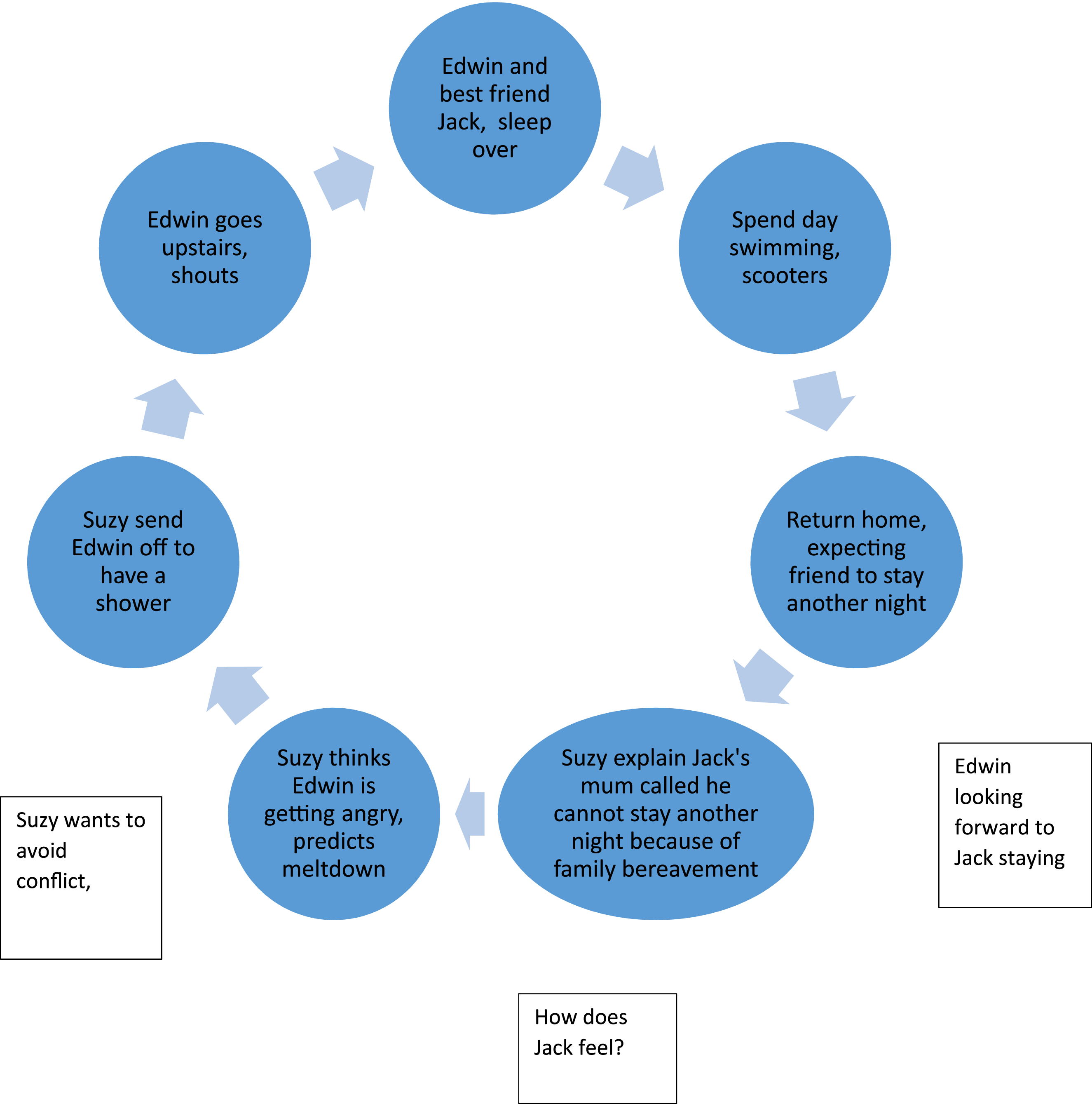
Identifying critical aspects of the pattern
Once the series of actions have been visually mapped we can think with the family about what stands out as critical moments. These are often points in the cycle where the process starts to move towards a negative escalation. In fact, sometimes someone in the family may comment even before we have finished mapping the pattern that this is where it starts to go ‘wrong’, or that they could have done something differently. It is tempting once we have mapped a sequence to become drawn into making assumptions about what we think the critical aspects of a sequence are. The purpose of tracking is not to point out to families their mistakes or where they are going wrong but to invite them to reflect with us and for them to make their own discoveries. We need to reflect on how helpful it may or may not be for the family if we offer some guidance. In some cases, family members may be very stressed, anxious, angry and convinced that they are failing. Offering suggestions may inhibit their abilities to reflect and there is a risk that the tracking can become a confusing and aversive process. It may start to set up a sense from them that this is an exercise of assessing their competence and finding blame.
Our input and expertise is an important component in assisting them. It is useful to approach this in two ways: One is to ask if they would like any comments from us or advice about what we see as some of the key or critical moments in their pattern. Not infrequently insights are made spontaneously, as by Suzy above in that she immediately reflected that she had ‘sent him away’.
Identifying the cognitions and feelings underlying each of the actions
Once the patterns of actions have been described we can look together at underlying thoughts, explanations and feelings that each member of the family holds. This can be promoted by asking about what each member thought and felt at the various steps in the cycle and also what they thought and felt about the actions of the others’. For example, when we asked what Edwin might have been feeling, Suzy commented that he was probably disappointed. She turned to Edwin in our session to ask him and he confirmed that ‘Yes, he was disappointed’. But we also discussed how she was anxious about meltdowns, and also sensitive to conflict from her own childhood history of having had an authoritarian father. This can bring in wider beliefs about parenting and family life and also trans-generational conversations including how expectations are being shaped by childhood experiences.
Intentions
What also emerges as we engage in this analysis is the assumptions that family members make about each other’s internal states and intentions. These are often primary in that people construe themselves as having to react to the other’s intentions. Suzy viewed Edwin as not being able to cope with his feelings due to his autism diagnosis. Frequently, the assumptions about each other’s intentions have become negative such as ‘trying to bully me’, ‘get one over on me’ and ‘manipulate me’ (or others in the family). Another variant is the attribution that the person is being thoughtless and inconsiderate in that they are not taking my feelings into account. A common accusation we hear from teenagers is that their parents do not listen to them. Nested in such a statement can be the assumption that their parents do not care about them enough to listen, or that they are pre-occupied with their own needs.
As these accusations emerge it is likely that people will engage in offering justifications and also to make counter-accusations. This can elicit some new information but there is a risk of it escalating into negative cycles of counter accusations. It can be helpful to utilise aspects of circular questioning or invitations to mentalisation. For example, what do you think your daughter would say, how would she explain what she is doing and what her intentions were? This can pre-empt these assumptions and allow other members of the family to state their ideas and feelings in a less reactive and more productive way.
Invariably this analysis will also become personally reflexive for us. For example, as we heard from Suzy it reminded RD of times that he had been insensitive towards his own children and times that he had been disappointed and let down by parents as a child. He also remembered missing his own father who had left and whether Edwin was upset and angry that he had lost his father and had little contact with him. It is possible to utilise and to share such personal reflections with families. We sometimes ask families if they would like to hear anything about our own experiences. Sometimes they welcome this but also there can be times when they are clearly so overwhelmed with their own distress that to hear about other people can feel like a distraction for them.
Exploring emotions and their links with attachment strategies
The patterns are also loaded with emotional content and we can explore how people were feeling at particular points in the cycle. The initial responses may be quite restricted, for example, that they felt angry, or bullied, humiliated and so on. In attachment terms these are the protest aspects of our emotional response. As we discuss the emotions it can be possible to expand and thicken this discussion to consider the ‘softer’ more vulnerable emotions that may also have been in place. For example, a sadness that things are difficult or a sense of loss of how close and warm the relationship used to be in the past. This can allow new narratives about the relationship to emerge and present a less destructive picture of their relationships. For example, Edwin was able to share with his mother that he was disappointed at his friend not staying over rather than just angry with her for sending him upstairs. Likewise, Suzy was able to explain that she was sorry that he was disappointed and went on suggest that perhaps she could organise another time for his friend to come over.
Corrective and replicative scripts
John Byng-Hall (1985) described that we not only develop attachment strategies from our childhood experience but that we also develop a set of intentions about what we want to repeat and change from these experiences. For example, Suzy in relation to Edwin appeared to have a corrective script not to show anger to Edwin in the way that she had experienced from her authoritarian military parents Sometimes it can be helpful to bring out these scripts in the presence of the family while we are talking. Byng-Hall (1985) also suggested that we need to improvise and adapt our scripts to meet current circumstances. Work with teenagers and parents can illustrate the importance of this in that teenagers will often comment that ‘Oh that was in your day mum, its different for our generation….’. The details discussed can be very meaningful but the positive intention behind the parents’ actions can helpfully remain in focus.
A detailed discussion of corrective and replicative scripts can form a separate, though connected activity with parents.
Attempts at repair
Secure or ‘balanced’ attachment can be seen as an implicit confidence that things will get sorted out. In insecure family systems two processes appear to occur: conflict is avoided and if it does occur various defensive processes interfere with repair. It may be denied, dismissed, the topic changed or a slow agonising distance takes place without an eventual resolution. In extreme cases ‘symptoms’ may emerge as a way of communicating what is implicitly forbidden. In contract in hyper-activating systems strong emotions may be expressed but with such a force and a chaotic meandering from one topic to the next that no clarity emerges about what went wrong and what will help in the future. Again, in extreme cases there may be excessive shouting, tears and so on until people stop due to exhaustion. Or, more dangerously that it leads to physical conflict or violence.
In tracking it is important to examine what attempts to repair if any there have been and what happened. Was it noticed, accepted, acknowledged, dismissed and so on. Explicit attempts may be signalled by people saying they had offered apologies, said ‘sorry’ but these may also be more indirect for example by offering to help, make a ‘cup of tea’ or speak in a softer tone. It is important to explore possible attempts that have gone unrecognised but also to enquire what would have helped or been acceptable. Frequently, a problem can be that the repair was not the ‘right’ sort or even that an apology, such as saying sorry was seen as insincere. When people feel they have attempted a repair and offered an apology but been rebuffed this can be very destructive in eliciting feelings of hurt, humiliation and sometimes a withdrawal or a wish to retaliate and hurt back (Johnson, 1998; Vetere and Dallos, 2003).
With tracking we move in and out of discussions of the past with a focus on the dynamic being played out in the process of the tracking. So, it is also possible to reflect on what might be helpful to assist in repair – now, in the session.
Considering alternative courses of action
As tracking proceeds families can start to contemplate different ways of relating, they might respond, connect with previous or perhaps forgotten experiences of where things had gone well. As we proceed we use opportunities to validate and support them and to positively connote their intentions, especially a focus on corrective and replicative scripts. Whether and how much families can do this relates also to how safe they are feeling in the session with us and with each other. Considering alternatives is a delicate process and imbued with some risk that families may feel blamed. One approach that can be helpful is to ask if they would like any thoughts or advice from us about what they might try changing. This can be framed as an experiment and that it is not about ‘correcting’ them but trying something different to see what if any difference it can make. If it is apparent that the family is still highly aroused it may be best to explain that we can come back to making any suggestions for them, and that we will think about things between now and the next time we see them. One of the dangers to avoid is getting drawn in to becoming too urgent. Tracking is helpful to give some space for thought and reflection.
However, if the family members ask for suggestions and/or make their own suggestions, we can discuss these. Sometimes there is a response that, ’we have already tried that’ which can be explored in terms of becoming clearer about what does not work or exploring why it didn’t.
Enactment
Considering change from the problematic pattern can be used as ‘homework’ tasks so that the family tries something new at home, or in a situation such as going out together. It is useful to invite them to keep notes on what happens and discuss who might be the observer and note taker. It is also possible to attempt to enact a circularity or focus on a part of it in the session. We used enactment in the earlier example with Edwin and Suzy where they engaged in a brief role play in which Suzy acknowledged his feelings of ‘disappointment’ and Edwin was able to say that this made him feel better. Experimenting with changing aspects of the pattern is extremely important. There is a risk that otherwise tracking can remain a somewhat abstract and intellectual activity. The circularities in families are imbued with feelings and are embodied reactions to each other. When we engage in an enactment also can also feel how different it is to do it differently. Zimmerman (2018) describes the importance of helping people to experience ‘unique outcome moments’ in sessions to allow movement from an abstract concept to an embodied experience of exceptions to problems. It is also likely that more information may be revealed, for example, that saying ‘sorry’ can feel false and that physical contact or some humour might feel better. For example, Edwin appreciated Suzy saying she understood his disappointment but appreciated her offer for his friend to come over again soon even more! When we conduct an enactment with the family it also offers a mutual witnessing of how things can be different. For example, Dave was able to witness a difference in how Edwin’s behaviour was responded to, and agreed that acknowledging his feelings was very helpful.
Case example
A further example, is a composite drawn from experiences of working with young people with eating disorders and demonstrates the use of tracking both problems and exceptions and the use of replicative and corrective scripts (Figure 3). Sarah and her family.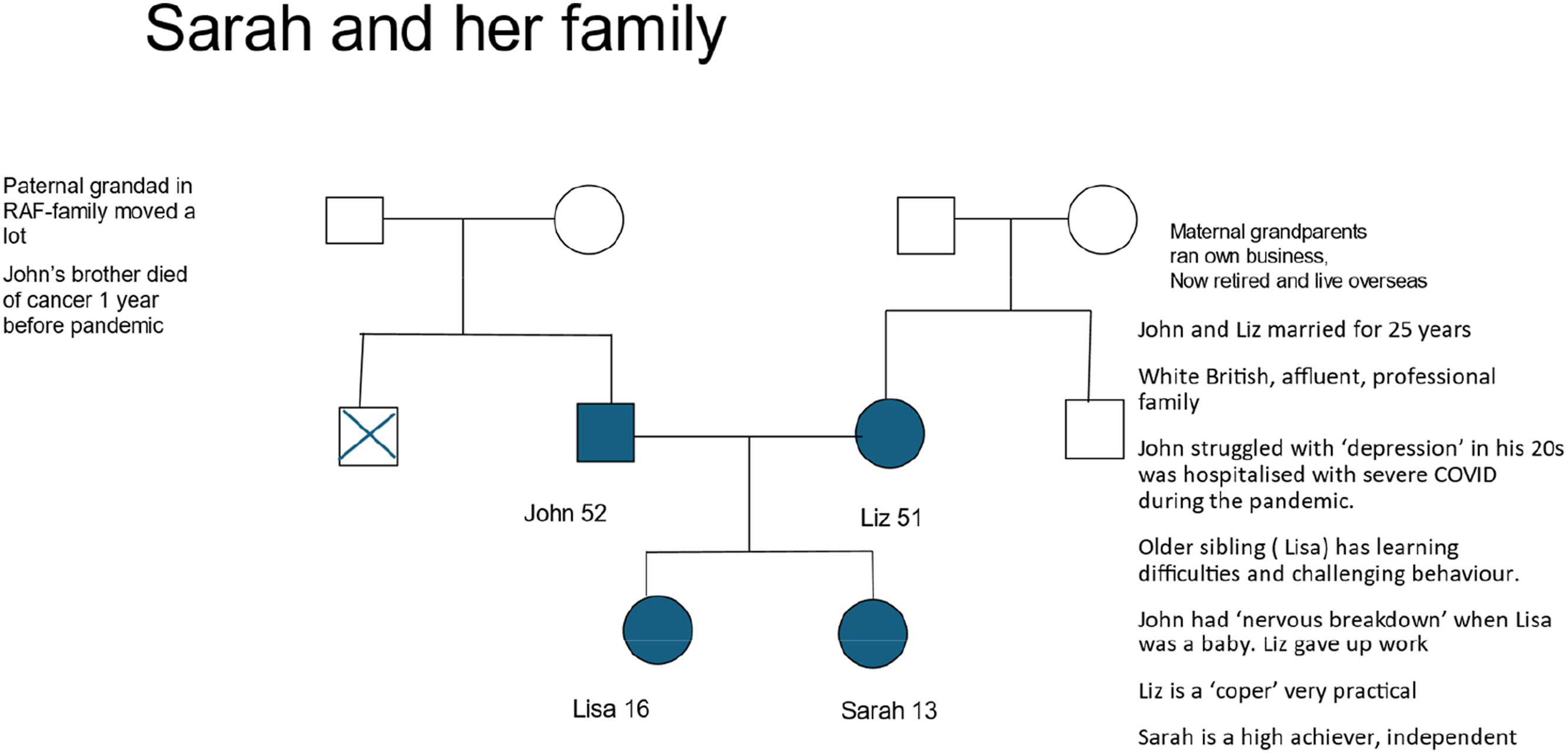
Sarah began restricting food after returning to school following the COVID lockdowns. She had been competing in dance at a high level and initially parents thought her change in eating was linked to her fitness pursuit in the run up to a competition. Sarah was quickly admitted to an inpatient unit after starting to severely restrict her eating and drinking. Parents were ‘blindsided’ by this as Sarah was a high achiever and had always appeared capable and independent. Sarah’s hospital treatment lasted several months and hospital visits by family were limited due to COVID restrictions. Sarah regained weight and family therapy began shortly after her discharge from hospital. Initial sessions with both parents explored their own upbringing using aspects of the Parent Development Interview (Dallos and Grey, 2024). These sessions and therapeutic letters summarising them, helped to establish a trusting relationship with the family therapy team, where parent’s good intentions and competence was affirmed, and the family’s multiple recent stressful life events were acknowledged and honoured. ‘De-activating attachment patterns’ seemed a useful way to conceptualise both parent’s predominant attachment style. John had been at boarding school from a young age and described how a ‘stiff upper lip’ attitude to emotion characterised his childhood. Liz had experienced her parents as having a ‘practical’ approach to difficulties and described herself as ‘not a tea and sympathy person’. Both parents remembered ‘being good’ as children, to avoid burdening parents. A ‘corrective script’ of wanting to ‘be there’ for their own children was important to both.
Further family sessions included the children and began tracking the patterns around eating that felt to them like ‘going round in circles’. The critical moment of one of the typical patterns was when Liz became distressed about Sarah hiding then refusing food (Figure 4). Sarah and Liz: Tracking and corrective and replicative scripts.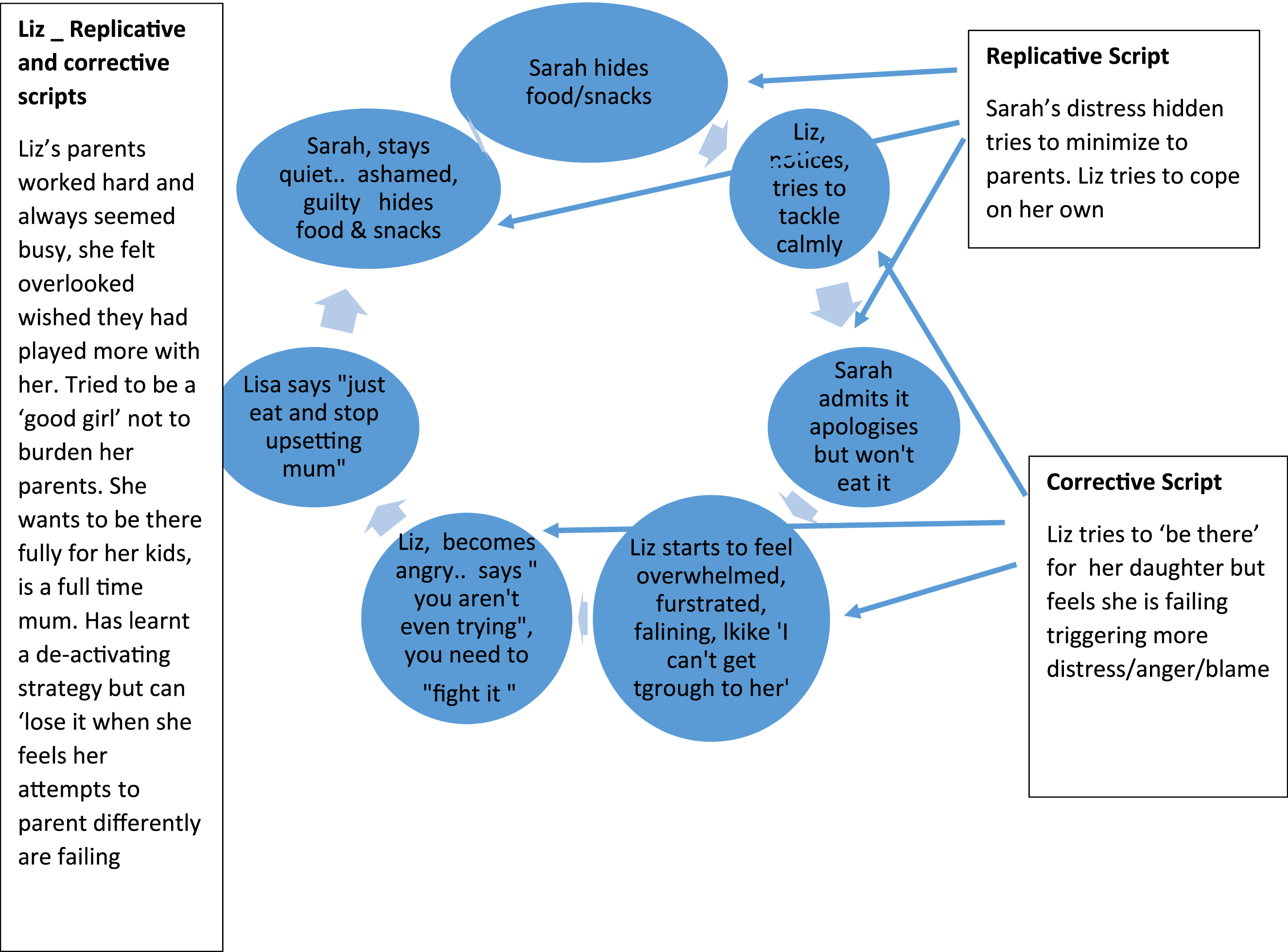
In a family therapy session with the whole family the circularity above emerged from the tracking. In the cycle Liz identified how she initially tried very hard to remain calm and supportive when Sarah struggled with eating. Hiding food seemed a way that Sarah was signalling distress but not overtly. ‘Coping on your own’ had been ‘adaptive’ for parents in their childhood, and for Sarah in the context of multiple family stressors (having a sibling with challenging behaviour, bereavement of an uncle and a life-threatening experience with Covid for John during the pandemic). Parents could see that ‘coping on your own’ had its limits in the face of the amount of stress they had experienced as a family. Liz reported feeling overwhelmed and thinking ‘I can’t get through to her, I’m failing as a Mum’ and would become angry with Sarah. Lisa would become involved and tell Sarah to ‘just eat and stop upsetting mum.’ Her Mum and sister’s anger and distress reinforced Sarah’s tendency to hide her own distress/eating difficulty and feel a burden. John worked long hours and believed in Liz as ‘capable and having a handle on things’, so wasn’t present when this cycle occurred. Liz had tried to protect him from her struggles as she viewed homemaking and parenting as her main responsibility in their marriage. Parents had become quite exhausted, distant and a little resentful towards each other and John felt increasingly hopeless and helpless. Both parents could see how this pattern was a vicious circle and helped the eating disorder.
Slowing down and enquiring about feelings, intentions and meanings or ‘warming up’ whilst tracking, allowed Liz’s and Sarah escalating distress to be more clearly articulated and understood. John and Liz began prioritising time and conversations as a couple by taking time for walks together and John ‘took charge’ of food fully at times to support Sarah with eating so Liz could recharge/take a break. The family therapy team shared ideas about how anorexia tests the most loving and dedicated parents, hoping to support Liz to reclaim her sense of being a capable Mum and the legitimacy of not just ‘coping on your own’ and allowing John to feel like he was contributing. John and Liz found words to empathise more with Sarah’s struggle (‘it’s not you it’s the eating disorder’) and this created an opportunity for the family to begin to reflect on the experience that a safer, calmer atmosphere could be more conducive to eating, illustrated below (Figure 5). Changes in the family relationships following tracking and further family sessions.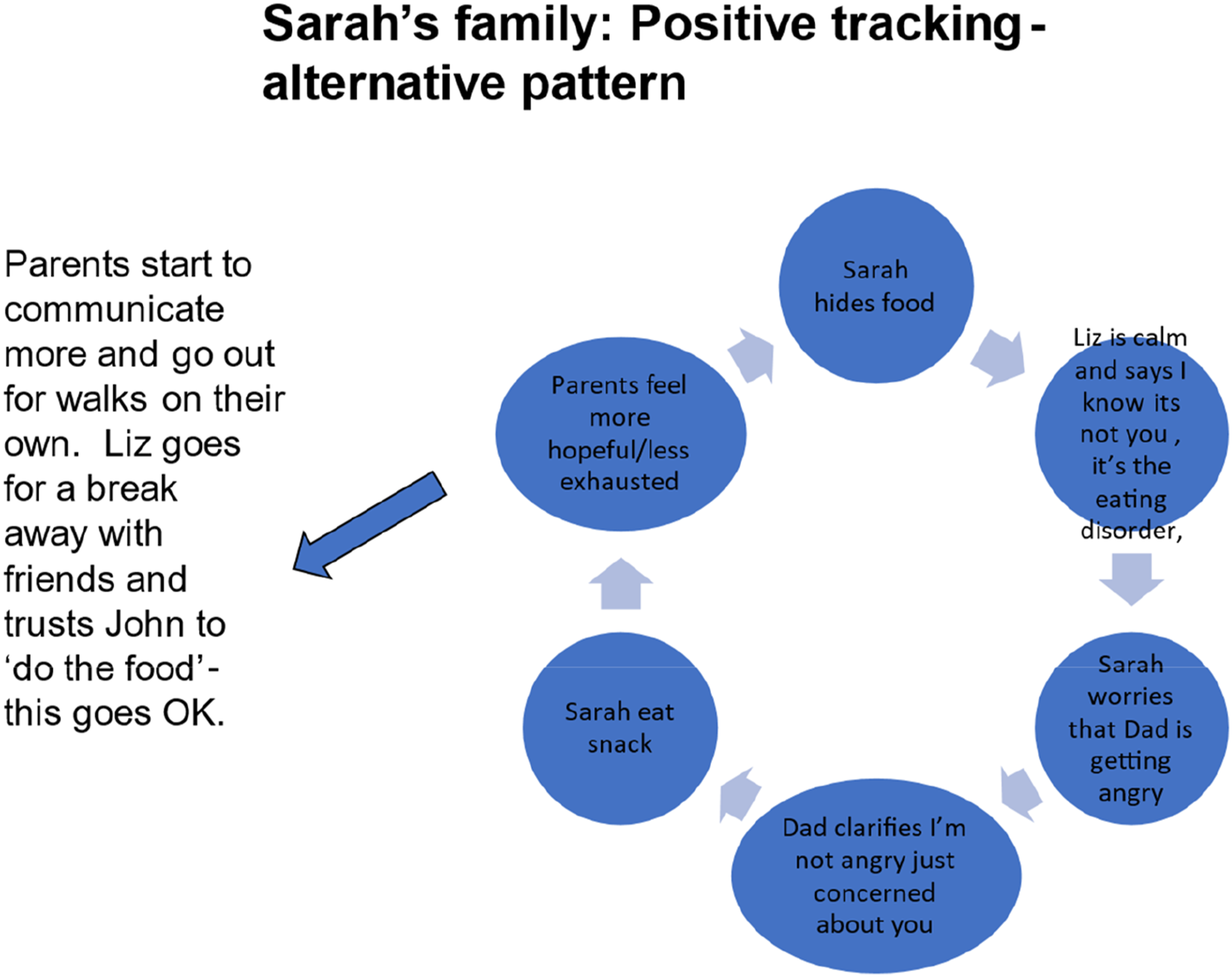
This work occurred in a multi-disciplinary context which included individual therapy for Sarah. The family’s journey with anorexia continued to have its ups and downs and tracking of both problematic cycles and positive interactions was repeated over many sessions, gradually building the families experience and awareness of how their interactions were an important part of this journey.
Discussion
This process of tracking difficult moments and encounters in our closest relationships can be layered and attuned to fit the developmental and strategic needs of family members at different phases of the therapeutic work. For example, we can begin with a more behavioural action-oriented exploration of the sequence of interactions. Sometimes this is sufficient for effective problem solving. The very act of ‘externalising’ a sequence of behaviours by drawing the circularity on a large sheet of paper can be enough for people to ‘see’ what they might do differently to achieve a different and more desirable outcome. Such exploration can promote co-operation and recognition of shared goals and wishes. We explore the explicit and implicit meanings embedded within the sequence of acts and actions. For those family members who favour semantic understandings, this can be a good place in which to build trust in the therapeutic process. For those family members who struggle to think about their own actions in difficult moments, it can provide a calmer context in which to focus and be present in the discussions.
Tracking is not simply a one-off activity to gather information. We use it over repeated sessions and come back to it as a visual aide – memoir with families to reflect on their dynamics, discuss changes they have attempted to make. We suggest that it can be a rich and flexible and approach which can incorporate a variety of systemic approaches, including narrative therapies and also attachment theory. It can be employed to help to elaborate families’ narratives not just semantically in terms of the meanings that are ascribed to family members ‘actions but a reflection on the emotional dynamics that are also shaping actions and understanding. This also connects with contemporary neuroscience and trauma theories that tracking can help people start to integrate fragmented and disconnected aspects of their experience. Finally, we can see tracking as helping families to reflect on and develop more constructive ways of managing conflicts – engaging in repair. How do we repair misunderstanding and miscommunication in families.
Tracking is only one part of work with a family. There are always many other important avenues that it may be relevant to explore. However, frequently we can see in an example of tracking a microcosm of the most significant parts of a family’s experiences. In the fleeting moments of interactions, we can start to understand and witness how they are shaped by deep undercurrents of the families’ history. For example, Edwin’s ‘disappointment’ may not only have been about his friend not staying for another night but a sense of being ‘let down’, once again as he had by his father leaving. Furthermore, he had not really been able to talk about this since his mother needed to establish her new relationship with his step-father Dave. It is not always necessary to explore these possibilities to promote some positive changes but sometimes they can assist family members to better understand what may be shaping the moment-to-moment actions between them. The pattern in a specific episode can reflect the pattern of the wider family pattern (Bateson, 1980).
Footnotes
Declaration of conflicting interests
The author(s) declared no potential conflicts of interest with respect to the research, authorship, and/or publication of this article.
Funding
The author(s) received no financial support for the research, authorship, and/or publication of this article.
