




Abstract
Identity development is often viewed as co-constructed within social contexts. Much research focuses on older childhood, despite early childhood being considered critical in the formation of ‘self’. Creative methodologies (i.e., those that might utilise creative mediums and the senses such as audio-visual stimuli or play), drawing upon attachment, narrative and systemic theory, and interpretative, observational thematic analysis were utilised to explore child meaning-making in the context of autism. Participant understanding of self often related to a sense of ‘difference’ and desire for belonging and acceptance. Development of creative, sensitive, applied methods has advanced methodological approaches for working with vulnerable populations. This study demonstrates that experiences of parental perspectives and interactions are connected to children contextualising their experiences of self, other, and the world around them in some capacity. As such, it is important to provide parents with the tools, knowledge, and understanding to aid the development of positive narratives to provide the best support for their children
Keywords
Introduction
Terminologies and Approach
This research deliberately utilises identity-first language as preferred by many of the autistic community, although is notably not a universal standpoint (Brown, 2011).
The medical model, defining autism as a ‘disorder’, is considered pathologising by many, perpetuating autism stigma (O’Reilly et al., 2015). The ‘neurodiversity paradigm’ (Den Houting, 2019) rejects this deficit-lens, viewing autism as within the diversity of human experience. This research adheres to a social constructionist model of autism, aiming to deconstruct ableist discourses (Bottema-Beutel et al., 2021), prevalent within the medical model. It looks to acknowledge variations in perspectives across autistic experiences, valuing the expertise of participants in their own truth (Lincoln and Guba, 2013).
Positionality
As an autistic researcher and clinician, it is important for me to recognise and represent marginalised communities where possible. I strive to maintain a social constructivist ontological position (Adams, 2006), whilst acknowledging my positionality and framework through a neurodiversity paradigm (Den Houting, 2019). Viewing autism as inherent to an individual’s identity enables a broader acceptance of difference. Continuous personal and supervisory reflection has been accessed through the form of bracketing interviews and journalling to limit interpretation of the data in relation to personal biases and assumptions.
Identity and Sense of Self
Generally, the term ‘identity’ refers to an amalgamation of self-descriptors (Widick et al., 1978) and categorisations conforming to social groupings (Turner et al., 1987) with shared attitudes, beliefs, and values (Stets and Burke, 2000). Identity development is a life-long undertaking, incorporating increasingly nuanced layering of private and social selves (McEwen, 2003). Critical periods in identity development occur within adolescence (Erikson, 1959) with puberty increasing consideration of the ‘self’ (McLean, 2016). Physical maturation is associated with cultural and psychological meanings, thus tying in with social identity theory (Tajfel et al., 1971) where group-based identities and social stereotypes are formed contextually.
Identity is an idiographic representation of an individual, influenced by context (Josselson and Flum, 2014), the negotiation of which is considered developmentally significant for gaining a sense of stability and control within uncertainty (Swann, 2005). McLean (2008, 2016) described identity formation as collaboratively constructed through use of narratives within social contexts. Proximal processes of interaction, such as storytelling, are developmentally effective for sharing values that shape personal narratives of self (McLean, 2016), providing a sense of coherence within ever-shifting contexts (McLean, 2008) and scaffolding social existence (Peterson and McCabe, 2013). Similarly, master narratives communicate social expectations and standards (Schiff, 2014) and represent dynamic positionality within a greater cultural narrative. Using systemic concepts, families can be viewed as having unique cultural belief systems, influenced by intergenerational patterns of values and experiences (Harkness and Super, 1996), co-constructing identity through narrative ecology.
Childhood Identity Development
Navigation of the world is considered through interaction with others and integral to a child’s sense of self (Schachter and Ventura, 2008). Within the initial stages of identity development, children appropriate parental or family narratives to create relational connections and understand the world (McLean, 2016). Where experiences are silenced or remain unvoiced, parts of identities may become internalised or suppressed due to fear of stigma and shame (McLean, 2008).
Much research into identity focuses on development from older childhood (age 12) (Syed and McLean, 2015; Branje, 2022). However, a sense of self is present earlier on (Reese et al., 2010); indeed, self-awareness is documented in early childhood (ages 3–4 years; Nelson et al., 2003). Meaningful experiences and stories contribute to an understanding of self, according to societal categorisations (Pasupathi et al., 2007). The process of rejecting or accommodating social classifications is theorised as an adaptive strategy for personal understanding and self-verification of identity (Swann and Buhrmester, 2012). Childhood self-conceptualisation (James, 1993) according to societal labelling has been researched in areas of gender (Perry et al., 2019), ethnicity (Rogers et al., 2012), and illness (Posa et al., 2021). There is limited research on neurodiverse identities; the existing research is predominantly on adolescents and utilises a medicalised, pathologising framework (Bagatell, 2007; Parsloe, 2015).
Autism Identity
The medical model determines autism as a ‘disorder’ (O’Reilly et al., 2015) due to findings associated with neurological and genetic components, indicating a possible biological basis of autism (Parellada et al., 2014). Social constructivists consider this perspective as overly focused on deficit and loss (Kapp, 2019) rather than individual diversity and difference (Den Houting, 2019), in line with personality trait theory (McAdams, 1992). Within a diagnostic society, negotiation of self occurs within the context of labels (Jutel, 2014). Autistic individuals engage in complex negotiations of ‘the autism label’ (Bagatell, 2007). This concept of self as autistic is influenced by prevalent social narratives and discourses (Baines, 2012), revealing an element of social positioning (Wantzen et al., 2021). As such it is important to consider the content of social narratives of autism surrounding individuals.
Research into meaning-making highlights the importance of holding perspectives of multiple social discourses in mind when working with the autistic community (Bagatell, 2007), yet research predominantly focuses on deficit-based models (Woods, 2017). Embedded in these negative discourses are the concept of social deficit which exacerbates the pathologising of symptomology (Kapp, 2019). Traits such as ‘extreme’ introversion can be perceived as ‘a difficult temperament’ (Grimes, 2010: p.10). Mirroring societal use of hierarchical power within systems of care portrays diagnosis as a negative identity perpetuated by undesirable stereotypes (Bagatell, 2007).
Global prevalence of autism diagnosis has increased in recent years (Roman-Urrestarazu et al., 2021; Zeidan et al., 2022), with marked early-identification in children (Mazurek et al., 2019). Whilst early diagnosis facilitates the accessing of earlier interventions (Pasco, 2018), how young people perceive diagnosis is not well understood (Preece and Jordan, 2010); research has focused on later autism diagnosis (Leedham et al., 2020) or individuals in transitional life stages (Anderson et al., 2018). These accounts identify entrenched schemas and beliefs about impairment and loss associated with the acquisition of diagnosis (Bottema-Beutel et al., 2021). Here, verbal communication abilities are privileged and a wider representation of autism as a spectrum condition, therefore, is lacking.
Public perceptions of autism as a disability are pervasive and negatively impact the psyche of individuals with a diagnosis (Holton et al., 2014). Similarly, parents of autistic children experience societal stigma (Liao et al., 2019), often associated with their parenting which can lead to a sense of self-stigma (Chan and Lam, 2018) or internalisation of societal narratives. Parental response to perceived and/or actual stigma is multifarious (Ransley, 2020) and the impact of this may be shared consciously or unconsciously with their child (McLean, 2016). Research has indicated that some parents find a medicalised view of autism valuable as they feel supported against a sense of blame (and subsequent shame) associated with some negatively perceived autism symptomology (Russell and Norwich, 2012; Kapp, 2022). Yet, this perpetuates an individualised problem-based ideology which can be experienced as stigmatising and pathologising (O’Reilly et al., 2015). Interactions within and between family and/or societal systems can maintain a sense of stigma and increases marginalisation, contributing to the increasing need for mental health services to provide support for individuals with comorbid diagnoses (Cage et al., 2018). It seems evident that how we talk about autism is learnt through social discourses and by giving marginalised voices a platform, we amplify and diversify alternative narratives of neurodiversity, shifting away from a medicalised, deficit model of impairment.
Methodological Approaches
Researching ‘identity’ as a concept is methodologically complex (Gill, 2020) without specific recommendation for one given approach. When reviewing identity, as co-constructed in relation to others and based upon socio-cultural practices, such as storytelling (McLean, 2016), it is reasonable to employ a dynamic, integrative approach. Much qualitative identity research employs a narrative framework to explore sense of self in context (Ergün, 2020; McAdams and McLean, 2013). However, research with children predominantly explores social identity (Bennett, 2011), referencing systemic influences. Where minoritised identities are considered, research principally addresses adolescent development (Miller, 2017). This was also true for autistic identity research (Mesa and Hamilton, 2022). Very little is documented regarding identity research with young children. Cooper (2017) references the use of visual methods to explore identity and notes collaborative approaches to be flexible, engaging, and experiential for participants.
Attachment Narrative Therapy (ANT; Dallos and Vetere, 2014) is an integrative model focussing on communication and external dynamics on a child’s construction of their internal world. It is an ecological, multilevelled perspective allowing for flexibility and adaptation of personal meaning-making within systemic contexts (Dallos, 2023). The core principles of ANT have been developed therapeutically for engagement with autistic children and their families (Stancer, 2023) through Systemic Autism-related Family Enabling (SAFE; McKenzie et al., 2019). This approach, developed from ANT, acknowledges the relational aspect of sense of self and draws upon known strengths and preferences of autistic individuals, promoting a sense of understanding and connection. SAFE provides a flexible framework for creative exploration through use of systemic approaches such as sculpting and role play. Use of non-verbal interactive activities also enables alternative communication and expression (McKenzie et al., 2021). The principles of ANT as a communicational approach will be drawn on as a research tool and selected SAFE techniques used methodologically to promote safe exploration of research questions. Consequently, the research is grounded in attachment, systemic, and narrative theories to adequately consider early sense of self in the context of autism whilst utilising a play-based approach.
Research Aims
The purpose of the study is to provide an in-depth exploration of how autistic children experience and understand themselves in the context of their diagnosis. This research aims to gain insight into the formation of self through interactions with others and experience of the world using a social constructivist lens. It is recognised that parents will influence a child’s perspective of self and their understanding of their diagnosis. Therefore, a secondary aim of the study is to explore how children construct their sense of self, and how this relates to parental perspectives.
It is hoped that gaining these insights will aid the development of knowledge and psychologically inform the way services engage with children in the context of an autism diagnosis and any subsequent intervention. The experiences of professionals may have life-long implications for individuals and their ability to seek help and support in the future; the way services interact with children from a young age, therefore, is of utmost importance.
Methodology
Research Approach and Design
The research uses an interpretivist, qualitative methodology aiming to understand lived experience and meaning-making. Creative methodologies were developed according to literature around engaging young participants in research (Johnson et al., 2014). A dynamic, multilevelled perspective was employed to provide child participants with choice and ownership throughout the research. Use of Attachment Narrative approaches (Dallos and Vetere, 2014) with therapeutic adaptations (Stancer, 2023; Vassallo, 2023) allowed for relational flexibility within interview spaces.
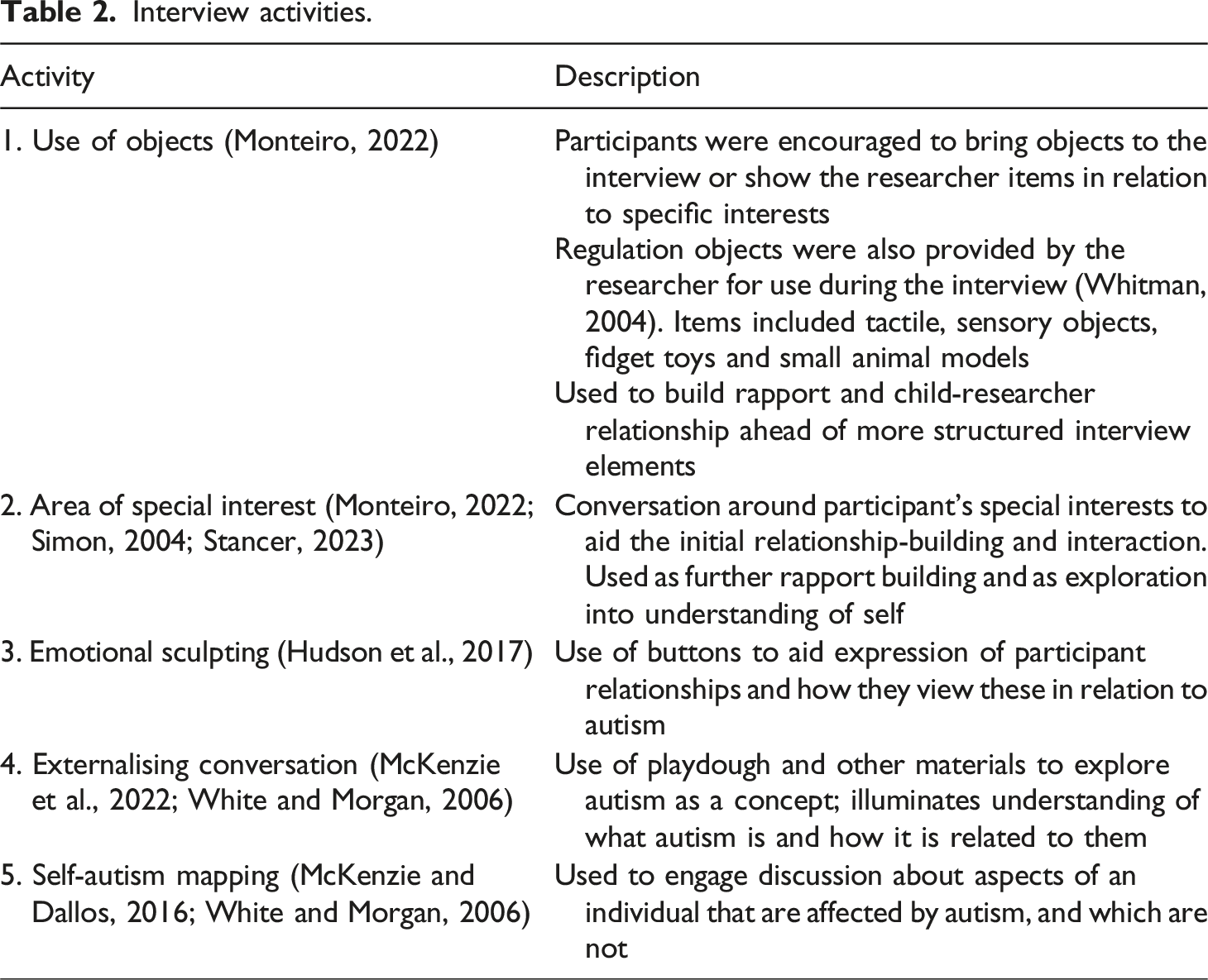
SAFE techniques were drawn upon to create a safe and secure space to better allow children to explore themselves and the world around them. The purposeful creation of these spaces aimed to promote a sense of safety and containment for child participants. Various modes of engagement were employed including use of differential media (such as playdough and buttons), mutual play (Johnson et al., 2014), and encouragement of storytelling (McLean, 2016). Further, positioning parents in a co-researcher role (Shen et al., 2017) during the interview enabled safe engagement with the research for child participants alongside their trusted adult. All participants were provided with the option to attend the interview without parental support. However, all declined this.
Great methodological concern and sensitivity was taken to ensure that participants were provided with appropriate support and accommodations throughout the research process. Methods were constructed to be applied in situ allowing for a flexible, secure, comfortable, and neutral environment according to individual needs (Johnson et al., 2014). Use of sensory integration tasks permitted self-regulation (Whitman, 2004), allowing participants to remain engaged without feeling constrained by their environment. Pilot interviews and elements of co-production with neurodiverse individuals enabled the researcher to obtain feedback from children and parents on interview schedule, methods, and depth of engagement.
Appropriate forms of communication are considered essential when working with children in research (Johnson et al., 2014) and is especially the case when encouraging social communication with the autistic population (Kim et al., 2014). As such, alternative communication methods and visual support aids (Harrington et al., 2014), including easy-read documents (Yaneva et al., 2015), were provided. Interviews were audio and video recorded, with explicit permission, to allow for observational data to be transcribed. Thus, interpersonal engagement and non-verbal data were obtained.
An observational approach to data transcription was applied to fully contextualise information (Hamo, 2004) and enrich verbal data (Ashmore and Reed, 2005). Information captured by video recording was subject to observational transcription, focussing on sequential interactions (Pearce et al., 2010), capturing layers of engagement. Observational data was complementary, and transcription appropriately structured to reduce observer bias and maintain conceptual validity.
Considerable attempts to ensure the rigour and integrity of the research were made throughout; the researcher utilised reflexive journalling (Meyer and Willis, 2019), maintaining awareness of their own positionality, biases, and assumptions. Use of bracketing interviews (Fischer, 2009) permitted further introspection in relation to the researcher’s own experiences, commitment to critical reflection, and engagement in challenging discourse. A peer reflexive study group (Whiteley, 2012) and individual research supervision were also accessed to adequately ensure research reliability and validity.
Participants
Participant demographics.
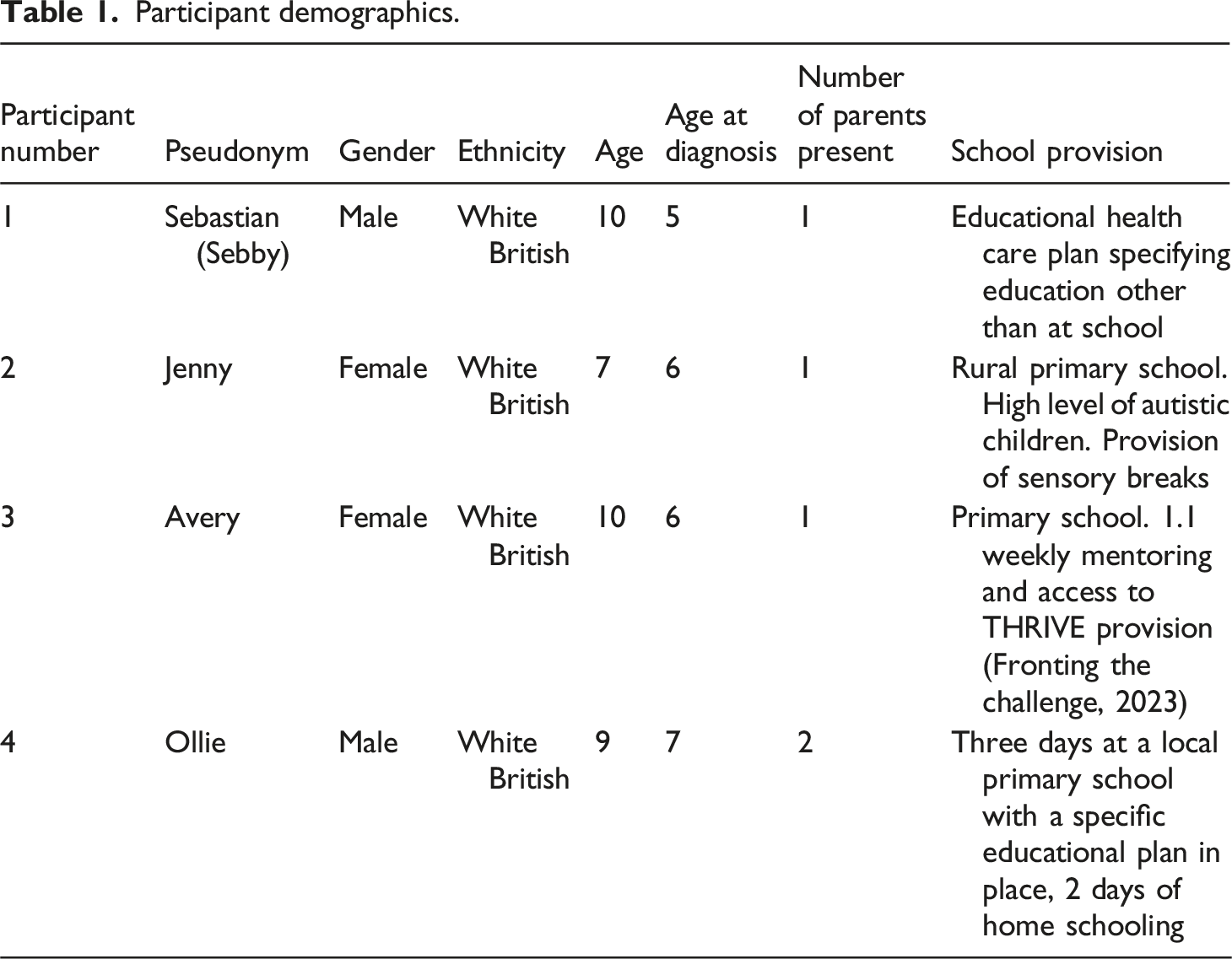
Parents were required as assistants to their child throughout the process of research; at times they engaged as partial participants within child interviews, according to their children’s needs. Parents were also invited to provide additional, contextual, and information separately regarding their child, autism, and family perceptions. In all, one child–parent triad and three dyads were recruited for this study (see Table 1).
Malterud, Siersma and Guassora’s (2016) information power decision-making tool was utilised to inform viability of research sample size. Creative methodologies, in combination with observational and interpretational approaches, used within this study support the assumption that in-depth analysis was achievable with a small dataset.
Data Collection
Research information was shared with participants upon expressed interest. Further information was provided through initial parent contact and subsequent interaction with children. Consent was obtained through parents before meeting with the researcher where child participants were provided with easy-read, visually stimulating copies of information and consent paperwork (Harrington et al., 2014). Consent forms were provided ahead of initial child–parent–researcher familiarisation meetings; consent was viewed as a continuous process (Ramcharan, 2006) and secondary indicators of consent (Preece and Jordan, 2010) were discussed prior to interview. Family members, considered experts on their child’s communication preferences and expressive acts (Girli, 2018), were present during child interviews. Participants were also provided with communication tools for indicating ‘stop’ to the researcher.
Interview activities.
Data Treatment
Integrative data analysis (Curran and Hussong, 2009) was used initially to combine independent datasets. Physical data collated from interviews (i.e. playdough model) was not interpreted but used rather to elicit verbal data from participants; however, the use of symbolic representations (i.e. descriptors of buttons used within the sculpt) was used and recorded. Transcription was separated into distinct phases: full verbatim audio transcription; verification and editing according to established transcription key; observational data integrated contextually into transcriptions; and review and verification of transcript excerpts with peer study group, promoting accuracy and inter-rater reliability. To further encourage reliability, voice-to-text software and human transcription was employed, reducing subjective researcher bias (Davidson, 2009). Denaturalised (or full verbatim) transcription was selected to uphold clarity and in alignment with researcher epistemological position and theoretical framework, resulting in all utterances, repetitions, and errors being recorded (McMullin, 2023). Non-verbal cues were also included and crosschecked against observational transcription. Use of punctuation was not included to deter from making judgement on meaning.
The research used a form of inductive thematic analysis (TA), which acknowledges the active role of the researcher in the research process; is supportive of constructivist approaches; allows for rich data analysis; and is sufficiently flexible to accommodate creative methodologies, and invites a narrative lens (Braun and Clarke, 2021a, 2021). This puts the participant first, allowing for the exploration of wider meaning-making within the socio-cultural context (Lainson et al., 2019).
Parent and child data was analysed separately but presented jointly in the findings. In this paper, only the parent themes that were in alignment with the child data are presented. Parent data is employed to elaborate the child’s data which formed the core of the analysis. In alignment with Braun and Clarke, 2021a, data was individually coded in a non-linear, inductive manner; secondary coding focused on specific language use, whereas tertiary coding was undertaken deductively and reflexively. Full datasets were coded within the same phase, keeping children and parent data separate. Secondary analysis of a subset of interview transcripts was conducted with a supervisory qualitative researcher, and a peer reflective group, prior to theme generation. Initial themes were drawn through code refinement during the final stage of coding. These were added to as each transcript was systematically coded within specified data sets. Themes were developed, reviewed, and refined before datasets synthesised, using child themes to frame parent data relevant to the research aims.
Ethical Considerations
Care was taken to ensure that a supportive, creative space was created, based on the needs of young autistic children. Location of the research interview was discussed with families and selected based on child comfort and sense of safety. All participants were offered familiarisation visits to build child–researcher relationship and gauge consent. Participants were made aware of confidentiality protocols during these visits, in writing and prior to interview. Debriefing was also provided. All participants were made aware of anonymisation procedures. Ethical approval from the University of Plymouth (UoP) was granted in April 2022. The UoP’s Research Ethics Policy and Code of Good Research Practice accord with the protocol and principles of the Declaration of Helsinki and International Conference of Harmonisation - Good Clinical Practice (ICH GCP).
Findings
Presentation of transcribed data has been considered according to researcher positionality; accurate and respectful representation of participants is integral and, as a silenced community, the researcher has an ethical obligation to ensure accurate depiction of them. As such, full verbatim text within the findings is equitable and justifiable. In some instances, researcher or parent voice has been removed as indicated with […].
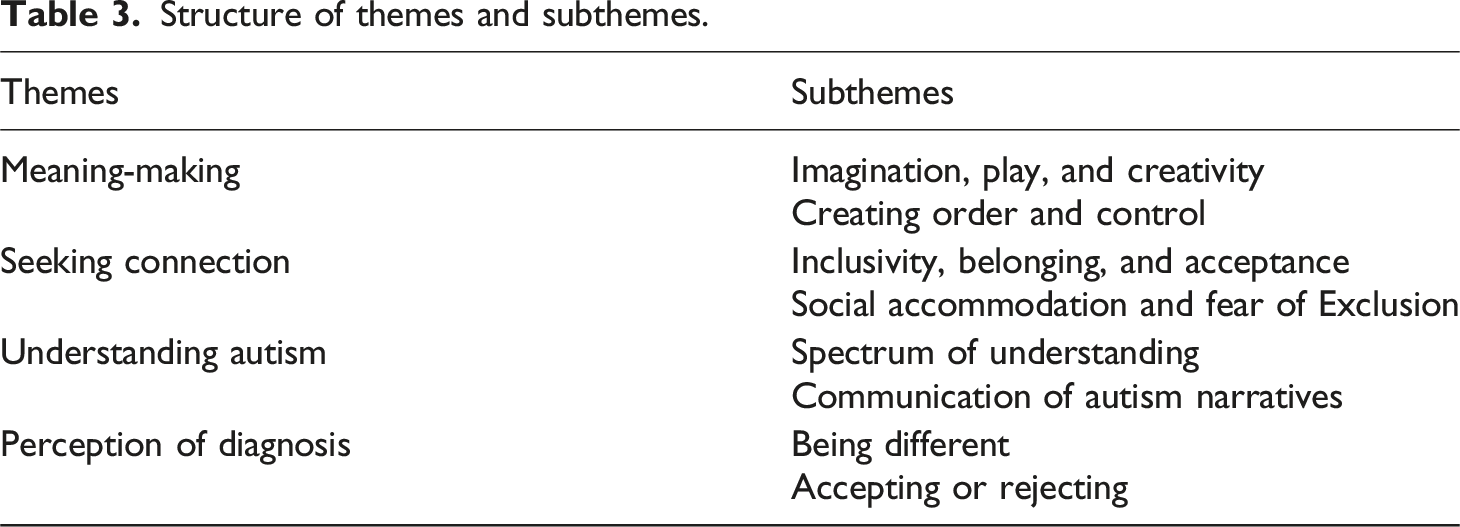
Structure of themes and subthemes.
Visual Representation of Findings
Figure 1 is presented as a visual representation of the findings in an accessible manner for dissemination purposes. Theme names have been adjusted to correspond with known terminology, ideas, and understandings within the autism community. The figure is not indicative of a theoretical model but instead used to highlight a pattern of relating between individuals. The researcher has opted to present this figure within the findings section as although the diagram was not a direct product of the data analysis, it acts as a conceptual map to demonstrate how the themes fit together. Visual representation of factors impacting on understanding autism and self.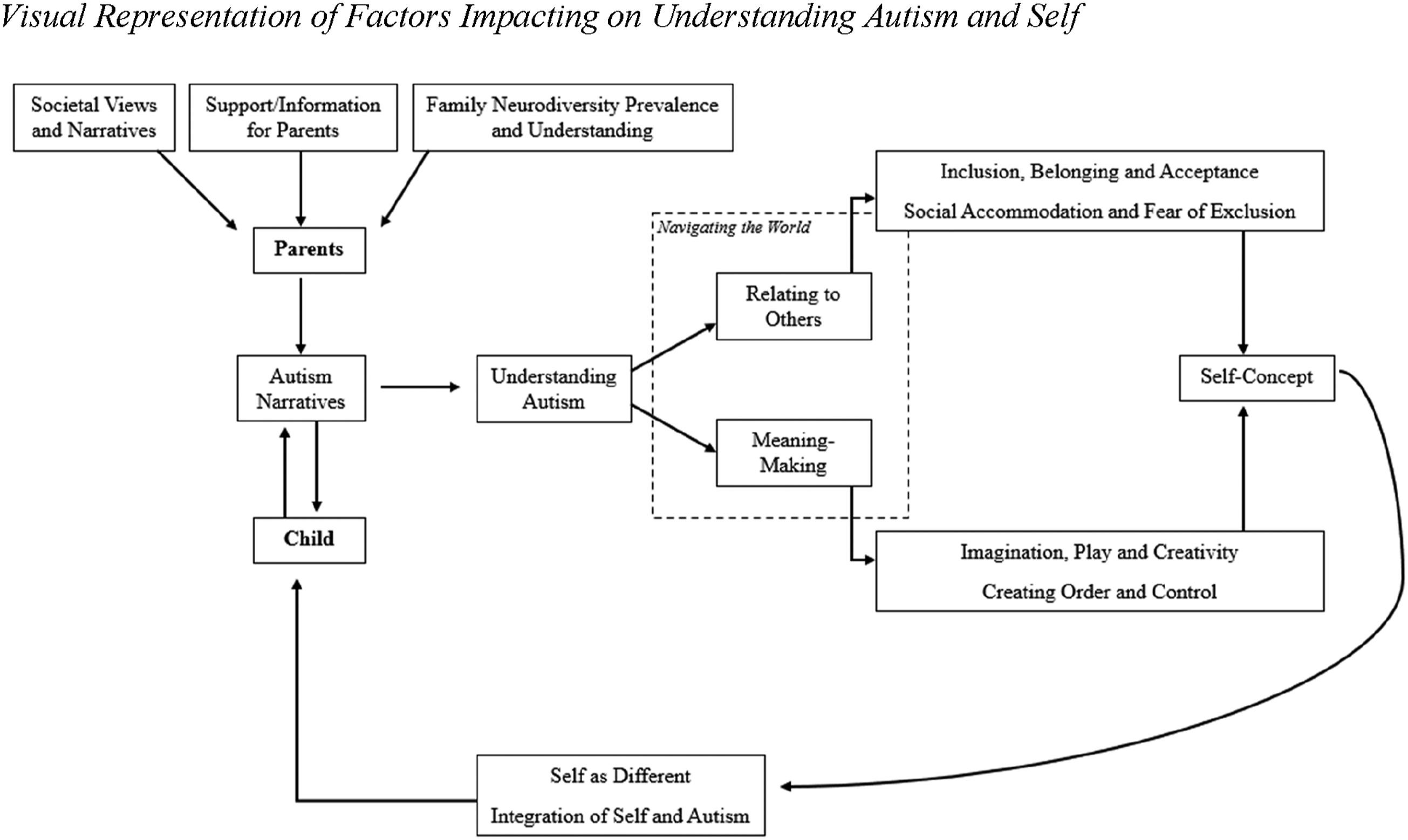
Theme 1: Meaning-Making
Autistic children in this study appeared to make sense of their world in terms of what was important and understandable to them. Children varied in the ways in which they made meaning from experiences, utilising imagination, and categorisation. As such, the term ‘meaning-making’ has been used to refer to the way children contextualise their various experiences.
Participant worldview does not appear to have been framed by diagnosis. Instead, there was a noted oscillation between a need for escapism, exploration and creative communication, and a sense of ownership and control over environment and acceptance from others.
Subtheme 1: Imagination, Play, and Creativity
All child participants referenced play within their interviews. Whilst some, like Jenny, enjoyed predictability and organisational elements, others engaged in more flexible forms of play. Use of imagination was prominent in the data with children creating a sense of safety and security for themselves. This was especially evident when Sebby demonstrated a regulating technique whereby, he was able to redirect conversation away from a distressing subject that arose within the interview. Sebby became non-verbal and expressed his upset by throwing a pen when a word he did not like was used. He was encouraged to change the subject and responded with: ‘Birds in the magic industry (.) Harry Pigeon (.) kinda like (.) but a pigeon’, challenging the researcher and his parent to join in a word game. Similarly, Avery communicated her need for practicality and predictability through creating ‘the massive map […] Well (.) it’s about the size of this table but it’s square’ specifically referring to the amenities. ‘There’s lots of beds (.) um-lots of toilets (3) There’s so many things’. This interaction resulted in some discussion around her distress at sharing toilets in her school.
Imagination and creativity were used by most children as a means of communicating a desire for control in some capacity. Ollie engaged the researcher in imaginative play throughout his interview enabling him to create a sense of relational safety.
Do you want to be a secret agent […] I’m a secret agent […] I’ll just tell you something (.) The secret entrance […] Is under the trampoline (.) Don’t go inside room 64 because that’s where I keep all the dangerous stuff
This self-expression was encouraged by his parents as a safe way for Ollie to get his needs met: [his] ‘strong and vivid imagination which has not been dampened by a desire to grow up more quickly than is necessary’.
Imagination, play, and creativity also allowed participants to have flexibility in boundaries providing themselves inclusivity and acceptance with which to explore; ‘Well it actually takes and it’s actually the everything noodle [Ollie waves it around in the air] (.) It can be whatever you want’ and ‘You can get a white bunny (.) mum and cover it in hair dye (.) Pink hair dye’ (Jenny). Most parents spoke of the importance of nurturing abilities and aspirations with a belief that ‘intense special interests allow a depth of engagement with hobbies that can really enrich her life’ (Avery). Positive parental views of creativity appear to enable children to feel more comfortable in exploring their difference and use these tools to provide themselves with a safe, accepting, and accommodating space internally.
Subtheme 2: Creating Order and Control
Most children used imaginative play to create \safety through flexible boundaries and self-created predictability. Another way children engaged in creating a sense of order and control within their environment was through use of systems and organisation. All children referenced colour as a highly influential means of relating to themselves and others; ‘I basically I just choose the colours that represent and each member of my family and then just for the animals (.) the colours that they are’ (Sebby). All four participants demonstrated an interest in subjective categorisations, placing importance on these ‘facts’ about others and the world. When Jenny struggled to relate to her grandmother, she used colour to make sense of this: ‘I don’t know what her favourite colour is… probably purple mum… Purple’s my teachers favourite colour’. One parent noted the importance of colour within the lives of their children: Both my children navigate the world by colour…It's been very important to them all the way through (.) It's like how they choose things (.) how they rate things (.) how they organise things (.) Everything is by colour. It's how they know what's good and what's bad (Sebby).
Categorisation was not always referenced subjectively, however. All children referenced making sense of the world through predictable routines, rules, systems, and organisation. Many participants mentioned age ‘Mum (.) one of my youngest cousins would probably be like Charlotte (.) She’s my youngest’ (Jenny) and calendar events ‘yesterday was dad’s birthday’ (Ollie) as important navigational factors in their lives. Others focused on binary justice models and categories such as safe and dangerous, good and bad, adhering to strict rules to enable a sense of containment: ‘wait actually cou-can we rub that out and st- [indicates rubbing out with fingers] […] Start again (.) | Not cross it out and write’ (Ollie). Some parents made sense of these behaviours as a ‘need to predict and control her surroundings’ (Avery’s parent) and ‘He doesn’t like anything that’s not completely in his control’ (Sebby’s parent).
Theme 2: Seeking Connection
Autistic children have an awareness of their difference from others but differ in their relationship with their diagnosis. Many find comfort in acceptance and connection through friendships. Others find representation through fiction and popular culture to be important as this normalises their experiences. There is a sense of shame around difference and autistic children all speak of social masking or camouflaging to fit in and be seen as ‘normal’. Moreover, parents seemed aware and conscious of protecting their child’s emotional vulnerability whilst nurturing their social relationships: ‘We have to mediate and keep an eye on things when he is among his peers/friends because he is susceptible to manipulation and bullying, or just being ignored’ (Ollie’s parent). This recognition of difficulties associated with child social connection was reported more explicitly by parents than child participants.
Subtheme 1: Inclusivity, Belonging, and Acceptance
Most participants expressed a desire to ‘fit in’ and not be seen as different from their peers. When discussing school accommodations, Jenny ensured that the researcher knew her sensory breaks were ‘only with my friends’ and not due to autism. Friendships were spoken of as being special for most participants, with two choosing for their friends to be included within their button sculpt: ‘Probably he’d a button that is both creepy (.) scary (.) silly and funny (.) That does sound like Kyle […] I think this one really screams Kyle’ (Ollie). Others found friendships difficult ‘I don’t I don’t really have any (.) actual friends’ (Sebby). All parents raised concerns about their children experiencing loneliness and isolation: ‘He sees everyone as his friend and does not bear grudges on peers that might manipulate or bully him’ (Ollie It was important for parents that their child would ‘find [their] tribe of peers who share enjoyment in each other’s interests and support their differences’ (Avery), most, themselves, also seeking support from the ‘neurodivergent community’ (Ollie’s parent).
Whilst young people looked for similarities between themselves and others, most also presented themselves as accepting and inclusive of difference. Sebby spoke of his sibling’s gender fluidity: ‘Their pronouns are rapidly shifting to a point where not even I know’. This was more prominent in children who highlighted autism as positive within fiction and popular culture ‘Like (.) you’d be hard pressed to find a non-autistic character that show’ (Sebby), connecting elements of themselves within this: ‘the Warden tries it’s best to be gen-gentle when it hugs’ (Ollie). Parents noted that representation of identity was important to their children, either in fictional characters or within the family: ‘When we told our daughter we thought she might be autistic like Ollie she was overjoyed and said that she always wanted to be autistic like Ollie’.
Subtheme 2: Social Accommodation and Fear of Exclusion
There is an awareness of difference in autistic children and a desire to ‘fit in’. At times, there is observed avoidance of autism language and use phrases such as ‘I guess people who never hesitated to admit if they’re PDA’ (Sebby) and referring to themselves as ‘weird’ (Ollie) perpetuating a sense of shame around diagnosis: [she says] ‘she can’t get angry and lash out at school’ because she doesn’t want to be ‘one of THOSE kids who people have to be scared around’ (Avery’s parent).
Societal avoidance and ‘fear of saying “autism”’ (Ollie’s parent) highlighted a fear in parents that their child ‘won’t succeed or will be walked over/taken advantage of’ (Jenny) and that they ‘will be vulnerable to manipulation in relationships’ (Avery). Whilst these concerns were raised away from the children, within the interviews, participants were observed engaging in self-suppressing and editing behaviours. Within the interview, all children looked to their parents for reassurance, acceptance, and understanding. Ollie referred to his home as ‘the most safe dimension’ and Avery’s parent reported that ‘she has said if she can’t let it out with me, where can she? So I know I am her safe place’.
The concept of social accommodation was expressed by Avery when she explained why her autism model had spikes: ‘Er- (.) because er- (.) like- [fiddles with spikes] er-it’s a bit like if you’re speaking you didn’t want to (.) like (.) make someone else feel upset (.) so you have soft spikes instead of hard spikes’. Ollie communicated the confusion and overwhelmed, associated with the world outside of his home, that leads to such behaviours: ‘the back rooms are an infinite yellow maze and there’s a monster that chases you around in them’.
Theme 3: Understanding Autism
The concept of ‘autism’ is unclear and uncertain; all children viewed it as a form of difference but often struggled to verbalise this. The ambiguity experienced by children somewhat parallelled parental perspectives. Whilst parents present themselves as being strengths-based and positive in their autism conversations with children, experiences communicated oscillation between views of autism as a difference and as a disability.
We have always been it's just the way your brain works. It’s not, yeah, it’s, it’s value neutral. It’s gifts and deficits. Yeah, like everything. And like everybody. It’s just a bit extreme sometimes […] He’s autistic (Sebby’s parent).
Subtheme 1: Spectrum of Understanding
Most of the child participants were able to describe autism on a semantic level but struggled to verbalise complexities on a conceptual level: Parent: Sebby (.) what flavour of autism have you got? Sebby: PDA
Whilst some participants were able to express their view of autism: ‘[PDA is when] you try to uh you rather try to enjoy the thing-s-ing (.) But if you can’t find a way to enjoy it (.) then you won’t want to do it’ (Sebby), use of playdough sculpting enabled others to explore their understanding more effectively. Erm so it's (2) gots (.) these little er-s-sort of feet on it [turns model upside-down and points to the feet] […] Here (.) (2) Um and (1) then it's got these massive ears [points to ears] […] And a few like not very sharp spikes down the back [turns model around to show the back to Int] [points to each spike in turn] (Avery)
Depth of cognisance was variable, and many engaged in attribution of ‘things’ to autism rather than relate it to themselves specifically: ‘On this diagram (.) where should we put Lego should we put in autism (.) Jenny (.) both or don’t know [Jenny points to autism on diagram] In autism (.) What makes Lego autism [Jenny shrugs]’.
Parents reported speaking to their children about autism at different stages in the assessment, diagnosis, and post-diagnostic journey ‘we talk more about autism now than we did in that first year after diagnosis’ (Sebby), using language tailored to the child’s age and comprehension: ‘We talked about her having a “special brain” after her diagnosis at 6. We talked more frankly about autism around age 9 after some of her peers were diagnosed’ (Avery). Whilst some parents ‘are very positive about autism and celebrate it as a strength’ (Ollie), describing autism ‘in terms of a superpower, or a shining light, very positive language’ (Ollie), others engaged in less conversation: ‘Actual diagnosis has never been explained to Jenny’. This protection by omission may well impact on the child’s understanding of autism: ‘I’m not sure if Jenny is aware or not’. How and to what extent autism is discussed within the family may influence the child’s confidence and comfort speaking about autism and what it means to them. We do use the word autism. So we'll often say things like, Oh, I think we've just had a fight because our autism wasn't playing nicely. Or I think you just did an autism. Or that's because I is autistic. We might say something like that. When something's gone a bit wrong (Sebby’s parent).
Subtheme 2: Communication of Autism Narratives
Children speak about autism in very different ways, some refer to autism directly and what it means to them: ‘I think autism is that your mind is different and unique-ique-iquer than most people’ (Ollie). Others are more indirect in their communication, using examples from popular culture to express their views. Sebby spoke of becoming non-verbal at times and how this related to his favourite television show character.
Like I can do quite-ite a good impression mainly as they’re non-verbal […] I just- In other words, I just don’t talk when- and I don’t like the answer to a question and meaning even if I didn’t want to I constantly do a teardrop impression (Sebby).
Whilst Ollie and Sebby fervently highlighted a sense of pride in autism difference ‘There’s sort of like (.) no way to describe autism (.) because different because autism is different… Different’ (Ollie), Avery viewed autism as an external representation of difficulties: ‘Little feet because (.) er-sometimes it’s like (.) (.) feels like- (.) feels like I’m freezing instead of being able to (.) like move at school (.) Like can’t move freeze’.
These contrasting views were in line with parental perspectives. All parents presented themselves as being strengths-based when asked how they spoke to their children about autism: ‘Each autistic person is different and can be affected in different ways’ (Jenny). Despite this positive presentation, some parents did reference a more deficit model of autism in front of their children ‘No (.) it was more to try and like do the-not the missing bits of brain (.) because I know it isn’t that way but the little bits that she struggles with connecting the dots occasionally’ (Jenny). Others considered the medical model within their individual interviews: ‘We are very positive about autism and celebrate it as a strength, not a disability (although we recognise that it can be very disabling)’ (Ollie).
Theme 4: Perception of Diagnosis
Autistic children vary in their view towards themselves and difference. Some shy away from being perceived as different from others whereas others embrace it. Those that embrace difference tend to be proud of being autistic and view it in a positive light, integrating autism into their perception of self. Others view autism as an external concept and separate the more difficult experiences away from themselves. Children varied in their response and relationship to autism, as did parents. Where children were more confident with their autistic identity, their understanding of autism appeared greater. Other children preferred to separate autism from themselves and presented with a more negative view of associated feelings and behaviours.
Subtheme 1: Being Different
All child participants had a view of themselves as different in some way, although this difference was not necessarily attributed to autism. ‘Er- (4) she likes wearing dark clothes (points to mum and indicates downwards) and I like wearing bright clothes’ (Avery). Whilst some had an affiliation with and interest in difference ‘I’m a secret agent… I’m Agent O and I’m also Head Agent’ (Ollie), others presented as unsure and avoidant of ‘specialness’: ‘Does that make you special (Jenny shrugs)’. Parents were also contrasting in their perceptions of difference: ‘I still find it incredibly difficult to see Jenny’s behaviours from the autism point of view, we fall out regularly and it’s not until afterwards that I see things as a product of her unique brain’ (Jenny’s parent). This was especially evident when the parent was, themselves autistic: ‘The ability to think differently has given me an interesting, varied, and happy life’ (Ollie’s parent). This neurodivergent lens on parenting was an indicator in whether a young person was more confident in their personal difference: ‘I’m weird and I’m proud’ (Sebby).
Subtheme 2: Accepting or Rejecting
The final subtheme references contextual information provided, predominantly by parent participants, in relation to child views of themselves and autism. It is important to consider parents as somewhat experts of their children and the way they relate to autism is, in part, related to how their child conceptualises and responds to diagnosis. In essence, whether their child is accepting or rejecting of autism.
All parents identified their child recognising differences between themselves and peers ‘Jenny had started to notice she was a little different’, most using autism as a relatable concept to explore this in a positive way: ‘It gave him a sense of who he was, some pride, and ownership of the differences he had noticed about himself’ (Ollie’s parent). Whilst all parents recognised the impact of being seen as different on their children, not all explored autistic identity narratives with them. Instead, some parents found it difficult to reconcile preconceived autism beliefs and assumptions. Daddy doesn’t have so much understanding of the condition so sees a lot of behaviour as naughtiness. I’ve done a lot of training around understanding autism, but I still struggle with the regular outbursts and the fact a lot of it can seem very personal (Jenny).
Despite parental efforts to remain non-judgemental and reframe behaviours in an accepting manner ‘to be able to find better ways of helping manage […] [the] coping mechanisms she was using’ (Avery’s parent), children may still internalise adverse autism perceptions: ‘unfortunately, she increasingly uses other autistic kids in her year as a negative comparison’ (Avery’s parent). As a result, the integration of autism as an identity in children differed from ‘all of me - pretty much all of me is autism’ (Ollie) to separating autism from themselves: [autism is] ‘feeling like I needs to fidgets all the time’ (Avery).
Parental development of autism knowledge and language use over time may influence child affiliation with autism as a part of themselves. Some parents highlighted diagnosis as validating for themselves ‘diagnosis has meant I don’t feel like I’m imagining it’ (Jenny’s parent) whereas others valued self-discovery as significant for the child. Here Sebby’s parent references the tautological dilemma of an autism label or diagnosis. Much more a constant conversation about that constellation, learning yourself, mapping yourself. It's what the kids job is, is kind of working out that information […] It's so hard because it comes back to that fundamental problem of autism not being a very useful word […] because it's like saying how being Sebby influences being Sebby. It's like, well, that everything about it influences it because everything is Sebby.
This sense of autism as an identity was also viewed as important by Ollie’s parents who viewed it as important for aiding understanding of themselves in the world, instilling this in their children: ‘we believe that any people go through their whole lives struggling and suffering through not knowing this about themselves or their loved ones’.
Discussion
Themes were constructed primarily based on the child data set and then synthesised with parent themes. Individual case-study comparisons have not been made; however, it is important to note that parallels between parent and child dyads/triads have been identified. The insight a child has into themselves, autism and the world generally imitated parental autism perceptions whether observed within the child interview or expressed independently. These associations also appeared to directly relate to parental support, family neurodiversity prevalence and conversation and alignment with medical and neurodiversity paradigms (see Figure 1).
Parents experience autism-related societal stigma (Liao et al., 2019) and their response to this may have an impact on their child’s developing sense of identity (McLean, 2016). The neurodiverse community is noted to be important for most parents of participants within this research in accessing specific support and appears to be as a direct result of feeling harmed by assessment services who cannot provide further provision past diagnosis. Acceptance of a neurodiversity lens (Den Houting, 2019), and conformity to this social grouping (Turner et al., 1987), seemed to further influence whether a parent presented as strengths-based and positive towards difference and consequently, whether their child was. This is in line with a collaboratively constructed notion of identity (McLean 2008, 2016), navigated initially through parent–child interaction (Schachter and Ventura, 2008). Although the extent of this is not known, acceptance and celebration of difference seems to influence confidence in child sense of self as autistic, reflective of literature in autistic adolescents and adults (Cohen et al., 2022; Cooper et al., 2021).
The social dichotomy of self as autistic or autism as separate to self (Anderson-Chavarria, 2022) is evident within this research. Parental theoretical understanding and use of medicalised perceptions and language appeared to distance a child from their understanding of autism and result in more externalised views. This may relate to the extent of social accommodation a child may engage in. It was observed that female participants were more active in masking behaviours (Dean et al., 2017; Kirkovski et al., 2013) and engaged less in spontaneous imaginative play, choosing to interact in a more structured way, providing order and structure to their environment. Whilst imaginative play is documented as more prevalent in autistic girls (Kirkovski et al., 2013; Knickmeyer et al., 2008), lesser expression may be a consequence of social adaptation and camouflaging in this instance.
Reflections on Overall Findings and Contributions
This research highlights the value of utilising applied methodology creatively. Development of this, alongside adherence to specific ethical sensitivity standards, has advanced methodological approaches for working with vulnerable populations. Further, data has potential for re-analysis of individualised narratives considering the contextual picture derived from this research.
Implications for Research
The research demonstrates an effective, appropriate, and sensitive approach to working with autistic children. It demonstrates how deliberate positioning of parents as co-researchers allows for research with younger participants. It further encourages a broader relevance when considering collaborative research with minoritised, vulnerable populations.
Clinical Implications
This research demonstrates the importance of access to alternative, neurodiversity-affirming intervention, and support for family’s post-diagnosis. The methodological approach draws on narrative and systemic family therapies. Exploring emotional, theoretical, and different understandings of autism appears to be beneficial for children developing a positive view of themselves in relation to the world. A helpful focus on differences and strengths, not deficits, is rooted in the data and self-identified as helpful by parents. The research design has allowed for the boundary from theorised positionality to practice-based evidence to be crossed.
The development of a safe, supportive space in which to explore diagnosis and what it means may provide children safety in which to develop their sense of self, minimising later associated difficulties (Cage et al., 2018). Specific neurodiversity training and knowledge within school environments for staff and students may also be beneficial, fuelling a sense of pride in difference, which many parents had started to establish for their child.
Study Limitations
Qualitative methodologies are limited in generalisability; the research participant sample demographics may have influenced this further. Participants were using identity-first language, affecting sample selection attracting parents who adopt a neurodiverse rhetoric or present with a neutral viewpoint. This self-selecting sample (Fox, 2010) of participants will have influenced the data in favour of a less medicalised view of autism. It also overlooks children awaiting diagnosis and the undiagnosed population. As such, interpretations are situated within the context of the child and not generalisable.
As child interviews were conducted with parents present, elements of conversation may have been somewhat performative (Labov, 1982), owing to child anticipation of parental expectations of them. Parental protectiveness of child vulnerability also generated barriers with redirection away from or answering for the child. Where this was the case, interview style and researcher/child relational connection were also impacted.
Lastly, use of the Self-Autism Mapping task (McKenzie and Dallos, 2016) may have guided child participants to view autism in a way they might not ordinarily, that is, externalising autism as separate from themselves. Both female participants displayed elevated social accommodation (Dean et al., 2017; Kirkovski et al., 2013) within the interviews and adhered to the concept of externalising autism. Future research might consider developing a further task to account for this effect.
Research Recommendations
Future research would be warranted to explore direct correlations between child views of autism and parental perspectives, and whether this impacts on the level of social accommodation and shame experienced within family systems. Perspectives of autistic parents and their attitude towards parenting an autistic child considering corrective scripts (Dallos, 2019) and familial narratives may also be beneficial. Similarly, the development of beliefs and understanding over time would warrant further research, exploring the impact of other factors in co-authoring a sense of self as autistic children transition through puberty and experience the world in different ways. Finally, further research would be required to explore whether child and parent constructions of autism are adaptive and occur as a direct result of stigmatising experiences and how this is influenced by attachment.
Conclusion
Children make sense of the world through use of resources available to them. Their internal worlds are influenced by interaction with others and the world around them (Schachter and Ventura, 2008). This study demonstrates that experiences of parental perspectives and interactions are connected to child contextualisation of their experience (meaning-making) of self, other, and the world around them in some capacity. Use of creative communication demonstrates that although children may not have the language to describe autism, their understanding is more nuanced than might have been previously presumed. Representations and positive narratives of difference enable a strengths-based approach, providing autistic children with a sense of control over themselves and the world around them. This is important for nurturing their development of self. As such, it is important to provide parents with the tools, knowledge, and understanding to aid the development of positive narratives to provide the best support for their children.
Footnotes
Declaration of conflicting interests
The author(s) declared no potential conflicts of interest with respect to the research, authorship, and/or publication of this article.
Funding
The author(s) received no financial support for the research, authorship, and/or publication of this article.