




Abstract
A narrative longitudinal study of experiences and lessons learnt by an English academic research group during the COVID-19 pandemic. Members of the research group acted as both participants and researchers. Each member of the group wrote their own accounts of academic and personal experiences during the pandemic at two timepoints. Key lessons learnt included, Resilience, Redemption, Self-Discovery, Personal strategies, Academic skills, Realisation, Acceptance, and Resignation. At timepoint one, the stories were generally progressive and were best described as accounts of a journey. Performative aspects of the stories were found to include defended elements experienced as ‘holes’ in the narratives. At timepoint two, narratives were characterised by a sense of heaviness and ‘stuckness’ but a developing openness in the accounts and group discussions emerged. The research process was found to be therapeutic in supporting participants to create shared and personal meaning of events related to the pandemic, but also in developing a group identity, openness and shared bond.
This study used a narrative longitudinal research framework focusing on change that occurred for academics as a result of a shared event, the COVID-19 pandemic over two time points. This research builds on and adds to previous studies in other contexts (Levine et al., 2021; McGaughey et al., 2021; Nash and Churchill, 2020), specifically the paper ‘Voices from the Field: The Impact of COVID-19 on Early Career Scholars and Doctoral Students’ (Levine et al., 2021). The work was carried out collaboratively by ten members of a well-established research group within an English University which included international students. The group were all members of the same School within the academic organisation and comprised doctoral students, lecturers and researchers. Membership of the group was voluntary and informal. There was a power difference between academic staff and students in that the research forum had developed over time as a space for staff to support and mentor doctoral students. Members of the group acted as both participants and researchers (henceforth referred to as participant researchers).
COVID-19 has had a seismic impact on the entire world including multiple aspects of our lives. One specific effect has been on changing working life, for example, many people have had to ‘work from home’ in order to avoid infecting others or being infected by the illness. Existing reviews also suggest that the pandemic had a major negative impact on mental health (Charul et al., 2023), particularly among the young and the financially disadvantaged (Zhao et al., 2022). Events like COVID-19 present ‘Super Wicked Problems’ (Lazarus, 2008) which are intractable in their hugely complex inter-related uncertainties and far-ranging multifaceted impact. Narrative research has been used to cut through such complexity by focusing on human narratives which have intrinsic resonance and meaning for all of us and facilitate our ability to make sense of very complex situations. Examples include narrative research on AIDS (Mailula, 2009) and Climate Change (Arnold, 2018). Such events can be seen to represent naturalistic experiments where external events provoke huge changes. Hence, this research is an attempt to explore specifically the impact of the COVID pandemic on academic life within a University department but also with reference to what it can tell us more generally about people’s lives in times of huge crisis and upheaval.
Research questions
The aim of the research exploration was to contribute to understanding the experience of COVID-19 on academics working within an educational system.
The research questions were as follows:
1. As an academic/researcher, what has your experience of COVID-19 been over the past year?
2. What lessons have you learnt relevant to academic life over the past year?
Method
A form of shared narrative analysis was chosen in order to explore people’s experiences of the threat over a period of time, namely, the COVID-19 pandemic. In part, the choice of methods reflected the desire of the group to learn more about this particular research approach and for more experienced researchers to mentor others. Narrative research is based on the premise that the most significant way that we make sense of our experiences is in the form of narratives or stories. Narrative researchers, such as Reissman (2005) and McAdams (1993) suggest that our narratives and correspondingly narrative research is comprised of three inter-related components: 1) The content or story theme – what happened, facts, events and key actors. This component also contains the idea of types of stories, for example, stories of loss and tragedy as opposed to stories of hope and resilience, discovery, adventure and excitement. This incorporates the idea that we draw from a repertoire of culturally shared stories which shape these themes, such as stories of redemption, enlightenment, and so on. 2) Story structure and coherence – how well the story holds together, whether it is, for example, clear or rambling. Most importantly, a narrative has a resolution, the meanings associated with what we have learnt from the experience – the ‘point’ of the story. 3) Stories can also be seen in terms of a performance in which the story is adapted in how it is told and how the actors are presented to audiences. Bridging these three aspects of narrative is also the fundamental feature of key characters in the story. For autobiographical narrative research, this is the person telling the story, and an important component of this is whether the teller positions themselves as active in negotiating key events and crafting how the story is told or acts more like a passive observer or by-stander of their own life, watching events unfold. These two aspects highlight the sense of control and agency that is presented within the narrative.
The study grew from the COVID lockdowns in England which began in March 2020. Members of the group had met regularly online during the first year of the pandemic in research seminars and methodology training sessions. These meetings had offered a virtual space for doctoral students to share their work and discuss methodological issues. The study began in January 2021. Methods of engagement with the study were discussed by the group and arrived at collaboratively through a series of online meetings. Despite the power differences in the group, COVID itself was seen as a levelling experience shared in various ways by all. Each participant researcher wrote their personal story, and all stories were then shared for others to read. The participants developed a shared analytical framework, which was fostered by attending sessions where visiting speakers offered presentations on narrative analysis and contributed to group discussions. Relevant literature was also circulated and discussed. In these ways, the team worked together to develop a shared understanding of analysis based on existing knowledge, literature and advice from external experts. The members engaged in shared analysis of extracts of published narratives of people’s experiences, for example, stories regarding other significant momentous examples of change such as of the fall of the Berlin Wall. They discussed their different interpretations in how they used the three aspects of narrative analysis described. Through such activities, a collectively agreed analytical framework was established. All meetings were conducted online, both during and after restrictions were lifted.
Broadly speaking, the analytical framework acknowledged that a deep understanding of the stories was required, and that analysis would include both descriptive and interpretive elements (Bamberg, 2012; Murray, 2003). It was recognised that this was a collaborative process of co-construction of interpretations. Shared narratives also emerged as a means to build resilience, communication and support within the research group during a time of uncertainty (Saltzman et al., 2013).
Individuals wrote and shared their stories with the group. This was followed by a period of detailed reading of the stories, participant researchers worked in pairs to analyse each other’s stories and collaboratively validate meanings and interpretations. These initial findings were then shared and discussed within the wider group. Further meetings consolidated descriptive and interpretive analysis of the stories in an iterative process of curious wondering and checking back.
Narrative themes
Early steps featured an analysis of spatial and temporal aspects of the narratives which were summarised in terms of who the key characters were, whether they were main or secondary actors, the temporal flow of the narrative and what the context and setting of the story was. The agency of the characters was also considered and how they were relationally positioned with regard to one another (Bamberg, 2012). A broad framework suggested by Gergen and Gergen (1986) was adopted to look at the overall types of themes or ‘meta’ themes as falling within a categorisation of progressive, regressive and stable.
Coherence and structure
The group moved to an exploration of coherence, plots and themes within the stories. This included summarising the structure and key content (beginning, middle and end). Plots and sub-plots within the narratives were discussed including how the content linked to the plot and specific examples of phrases used and their function. Story themes and genres were identified collaboratively with reference to how the language crafted the theme. The exploration here also connected with the meta themes specifically related to the resolution part of the story. This was particularly important in that it indicated whether the accounts of experiences had a sense of resolution with indications of growth and learning as opposed to having instilled a sense of despair and futility. This part of the analysis also included consideration of the possible ‘defended’ aspects of the stories (McAdams, 2005) This relates to parts that are harder to tell or are painful to remember.
Performance and audiences
The analysis also focused on the integrative and performative aspects of the narratives. In some ways, this was a complex and challenging endeavour as the authors were also co-researchers. The analytical framework included reference to ideas around member validation (Bygstad and Munkvold, 2007). This was particularly relevant to the performative aspects of the narratives in that the author was invited to reflect on what the story meant to them and what they wished the reader to take from the story. This initiated collaborative discussion between the author and wider group regarding story meaning, what the author wanted the reader to understand, how the characters were presented and how what was presented related to both the story context but also the nature of the group itself. Following this, discussions of coherence, structure and themes were inter-woven and summarised. This aspect of the analysis also relates to defended processes in terms of what aspects of self we wish to keep hidden from others, details of our experience and actions that we might be ashamed or embarrassed to tell in that we might anticipate negative reactions from our listener.
In the final phase of analysis, the group considered the stories as a body of work. This was approached by re-reading all of the stories, noticing similarities and differences, but also considering the stories as making up a collective narrative. The following group discussions explored what collectively was being communicated and where sub-themes might link to specific configurations of authors such as staff members, students, those who were experiencing the pandemic in their home country and those who were not etc. In this phase, it was also acknowledged that the stories could be deconstructed into elements and also formed elements themselves in the collective work, but that the analysis strived to see the collective work as more than the sum of its parts and that the collection had meaning over and above the constituent stories (Labov, 1972). There was also ongoing discussion around what the reader brought to the analytic process and a recognition that the significance of the body of work emerged from the intersection between the members of the group as both authors and researchers (Ricoeur, 1991). Through these processes, tangible themes and meanings for the group as a whole emerged, which spoke to the research questions.
As the group neared the end of analysing the original stories and working towards publication a consensus emerged that experience and understandings of living and working during a pandemic had changed substantially over the course of a year and the stories no longer fully reflected what we wanted to say. This led to the development of the study as a longitudinal exploration of the evolution of narratives across two time points. In the second exploration, early in 2022, England was no longer in Lockdown. People were back at work, travel was possible, vaccines were available and all legal restrictions related to COVID-19 were removed. The restrictions were replaced with recommendations for people to practice ‘safe and responsible behaviours’.
Participant researchers wrote an epilogue to the stories they had written a year ago, of up to one A4 page, in response to the question: ‘What has changed for us as academics since the first story?’ Analysis involved writing and sharing the epilogues, meeting in small groups to discuss the epilogues with a focus on the following questions: • How does the epilogue differ from or continue the tone and themes of the original story? • Do the contexts/characters of the epilogues differ or reflect the original story and what role does context play if any in the epilogues? • Does the author feel they are presenting themselves in a different or similar way in the epilogue and original story?
This was followed by whole group meetings where initial analyses were shared and the group explored how we might collaboratively respond to the questions above. Further to this, the group explored not only how the stories and epilogues intersected, but also how sense could be made of the shared works as a meaningful collective oeuvre. This included reflection on the research process itself and how this fed into the group’s narratives, dynamics and understandings.
Findings
The original stories
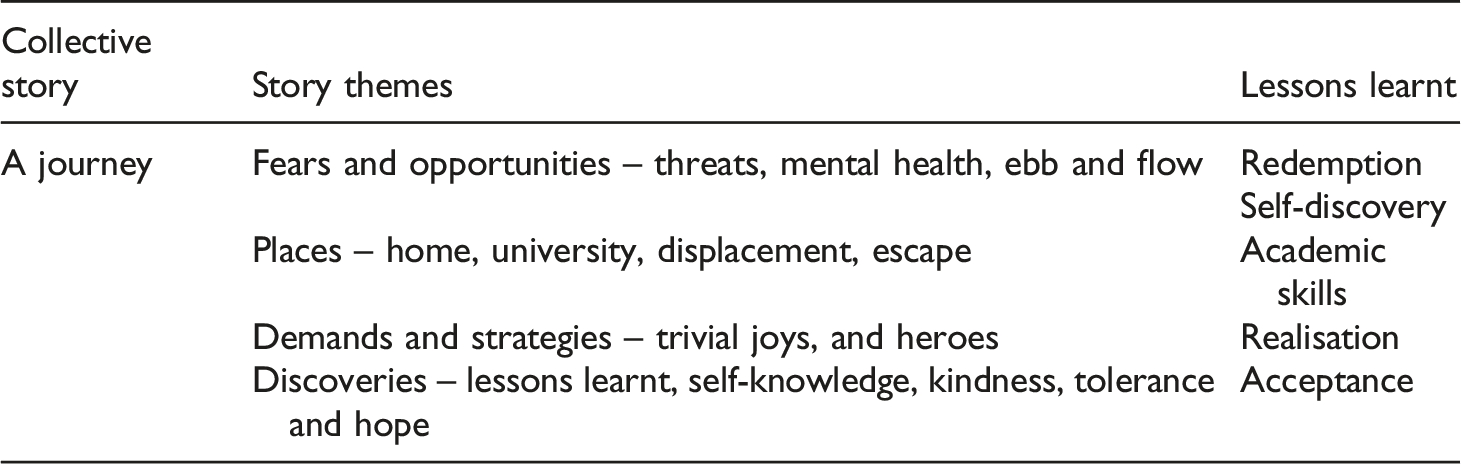
Collectively the stories gave the sense of a bumpy but coherent journey; the stories included physical journeys or psychological journeys or both. Plots featured both journeys of self-discovery and sub-plots of journeys of escape. In many cases, the physical journeys acted as metaphors for psychological change. Key story themes included fears and opportunities, places, demands and strategies and discoveries.
Fears and opportunities
In reflecting on the presence of important shifts in the narratives, the pandemic moved at key points from being a fearful event to one of opportunity. Some saw the lockdown as an opportunity from the start, whereas others came to the realisation of opportunities later. In some cases, opportunities were anticipated yet dissolved. Many of the journeys included times of mental distress related to fears and demands. Although there were times in all of the stories where threats seemed overwhelming, predominantly the stories featured a striving to overcome COVID-19 despite the numerous challenges that it presented. S4 described his initial fear and realisation of the gravity of the situation: ‘Everyone was in awe. The worst part was that humanity had never encountered this virus before. Most people, therefore, began to wait for a solution with their hands tied. There is no doubt that I was one of these people. A great fear came over me. The first thing that came to my mind was how deadly this virus was.’ (S4).
For some, the fears weighed very heavily and were particularly tangible. S7 described her fraught family life: ‘What everyone saw on television was real in my house. I could see the deep impression of the mask on my husband’s face caused due to prolonged working periods wearing the PPE. Special masks were ordered for him as he soon got allergic reactions from the mask straps. It was particularly difficult to console my “not-so-young” children as they were very much aware of the unprecedented situation listening to the news. This caused tremendous anxiety not only inside the home but also among friends and family, near and far.’ (S7).
In the stories, the COVID-19 virus was presented as a key character, instilling fear, psychological distress, loss of meaning, separation, boredom, incarceration and obstruction, but also increasing academic work that needed to be done. The actions of COVID varied in intensity and perception, being a malevolent intruder into ‘home’ or a distant fear which allowed characters to avoid stressful aspects of their work and life, indeed, as S1 and S9 described, COVID was seen to present opportunities: ‘The prospect of a new way of working was a welcome relief for me and this aspect of my life was less anxiety provoking and more successful than it had been previously. My fears meant that I was very resistant to leaving the house and I had always found travelling to work and lecturing face-to-face stressful. I embraced the zoom alternative modes of delivery with some enthusiasm and found that it improved my experience dramatically.’ (S1). ‘I am totally happy in here on my computer, as I like to think, pontificating over all the new ideas that I am cramming into my head. I am normally emotionally frenetic as well as physically, so lockdown has enabled my brain to calm down. Lots of studying has been great for this and carries on into the rest of the week as things are a lot more manageable and stimulation isn’t coming in from all sides. This has been the most peaceful time of my whole life in which I have been so much calmer, and I really don’t want to lose this again.’ (S9).
The promise of opportunities and relief from daily stresses were not always realised however as S3 found: ‘Finally I would get a chance to catch up on all the writing that I been unable to do because of other duties and responsibilities. And indeed the first couple of weeks were quiet… No actual writing yet but decks were starting to get cleared. Except the decks never were cleared. Soon Zoom meetings filled the 9-5 working day and emailing and admin filled the evenings.’ (S3).
The journeys portrayed an ‘ebb and flow’ of perceived successes and failures, distress and acceptance, a struggle to carry on and to maintain one’s role in keeping personal and academic life alive whilst under threat. There was a sense of striving to do what was necessary to help students cope and learn effectively, to continue with important research and to develop professionally: ‘Overall I made a choice during the early stages of the pandemic to undertake a PhD and for me this has been overly positive, it has been not without challenges and some low points but actually I took the opportunity of being stuck at home to focus on a real change of trajectory for my career.’ (S6).
Places
Places were an important metaphorical element of the stories, being used to reflect key points in the journeys as a process of change. Key themes related to places involved moving to a different location as reflecting changing mental states or sub-plots of changing locations as related to escape from fears, concerns and boredom. S2 described that: ‘So much of my memories of Lockdown can be reduced to where I was living. Suddenly, it was the most important part of my life.’ (S2).
In her story, she experienced life in her ‘mouldy room’ and her descent into depression: ‘I started to retreat into an empty, lonely shell. No longer talking, eating, or enjoying things, and unable to recognise myself in the mirror.’ (S2).
Her move to a new home reflected her improved mental state: ‘I could fill my windowsill with seedlings and watch as the garden transformed with sweet peas, courgette and tomato plants. A blanket of poppies at the bottom of the garden surrounded my home-made Hedgehog house. Although I missed my regular dance classes, I had never had so many new hobbies!’ (S2).
S10 described a ‘missing year’ a time of confinement and despair: ‘My life fitted in my bedroom. Actually, the world seemed a prison. In normal life, we always meet each other, and drink tea. According to rules, no one could visit each other. This rule affected my mood.’ (S10).
His story included an exciting sub-plot of escape: ‘I decided to travel to the middle of England because it was not possible to travel abroad. However, we should give a reason to travel even to the countryside. I took a risk, I visited my friends. I spent two weeks in different cities. Luckily, no one asked me anything.’ (S10).
A key and re-occurring theme within the collective narrative was that of home. This concept was used in various ways to convey a sense of safety from external dangers, as a haven from the world, as a place where dangers intruded, of containment – a prison, or as a distant place far away which one was exiled from.
As we have seen descriptions of home served as metaphorical tools to convey the psychological connection/disconnection, sense of safety/danger, peace/distress. The concept of home also related to the setting of the stories and sub-plots within them. For many, there was an oscillation between the contained space and the wide world. Some stories were situated in just one room, for others the setting was presented more globally in the spaces between the authors current location and a distant ‘home’ in a faraway place: ‘I still miss my family in my country of origin, especially my ailing mother. This is the longest stretch that I have not paid a trip there. It is strange as we gladly miss out on exotic holidays but never on the trips to our country of origin.’ (S7).
International doctoral students presented themselves as global citizens in exile with many of their concerns situated very far away and tended to situate stories within a global crisis in a way which UK researchers and academics did not. Physically they were removed from their home, but their stories spanned this gap. S4 was an international student and his story moved between various places incorporating the whole globe: ‘We were all worried about the family members we left behind. As we live far away from them, it made us feel sad that we could not be with them during this time.’ (S4). ‘I was terribly upset on behalf of the people living there [Wuhan, China] and infected with this virus. I was constantly following the news and sending good wishes to the people in Wuhan. But later, I realised that it was much bigger than I had imagined. The virus suddenly spread all over the world. As humanity, everyone was in awe.’ (S4).
The University itself was generally portrayed as a distant place which made sometimes challenging demands on characters, but was also the site of things missed: ‘I missed my colleagues and the stability and structure of the university, where I knew where I was, and what I was doing. Adjusting to a ‘life interrupted’, was an uncomfortable place to be.’ (S8). ‘My relationship with the library had to be cut for a long time. This reality was enough to overwhelm me because when I went to the library, I felt much more motivated to study. Touching the books there, feeling the unique smell of the book pages and the pleasure I got while reading those books in that atmosphere was priceless. In addition, the quietness of the place and the presence of a lot of equipment there were factors that encouraged me to study, such as computers, group, or individual study rooms. The library was not only a place for study but also a place for socialising for me. In the cafeteria of the library, I had the opportunity to meet new people and share our experiences with each other. Thus, I made many new friends.’ (S4).
Demands and strategies
Academic and personal life during the pandemic presented demands which were sometimes overwhelming. New realisations emerged about the perceptions and challenges of others and collectively the stories reflected a shared commitment, sometimes at high personal cost, to continue with research, and to support the learning of students who were also often facing various difficulties. For S5, fighting to meet the demands and ‘losing the ability to contemplate, incubate and think deeply’ formed an important part of the downward curve of her story: ‘Work slipped further into night time, or early in the morning before others rose. The candle burnt at both ends to juggle additional commitments and responsibilities. I became so very tired ... I wished I could give more but had no time to spare. I was fielding more emails coming in from students expressing anxieties than in a normal year. International students were asking whether they should go home, some students were still in schools working harder than ever, whilst others had time and isolation on their hands in furlough. Comparative anxieties were passed on to me and to other tutors, who did what we could to hold and contain the varied student emotions. My own anxiety levels were rising – I explained to my partner that I felt like a pressure cooker, a high scream inside ready to be explosively released if someone were to just knock the catch.’ (S5).
A shared demand was the need to develop new ways of working remotely and become familiar with the online systems involved, this was seen as both challenging, but necessary and also, by many, as a strength: ‘My confidence in working online and various technology became a significant strength and integral part of day-to-day life. As my confidence increased, I began to believe more in myself.’ (S2).
The stories also included sub-plots related to secondary characters such as participants or students who were dependent on the main characters for their learning and aspects of their wellbeing. Supporting them necessitated the acquisition of new skills, and the need to do more, even when the narrators were facing quite substantial psychological distress or ill health: ‘I have to be constantly mindful that I must carefully and sensitively deal with each of the participants in the research sites so that it does not put any additional burden on them. But then, how could I ensure all this when I was myself going through a lot of emotional turmoil?’ (S7).
This drive to support others extended to communities where research took place: ‘The impact of Covid on the SEND community, required an immediate call to action for their protection. My first task was to join the challenge to DNRs being applied without consultation to otherwise healthy autistic and learning-disabled people.’ (S8).
and to close and distant family members ‘I could draw an analogy between a soldier’s wife and myself. Just like a soldier is sent-off by their family to the battleground, I felt my husband was in a war against this dastardly virus where there was no guarantee that he would come back to me.’ (S7).
During these pressurised times, the stories collectively revealed the importance of supportive others, heroes, hobbies and trivial joys in helping central characters to manage demands. In many stories, these emerged as part of an evolving realisation of what mattered in times of threat. Appreciation of academic heroes and those working in the frontline fight against COVID were often prominent characters in the stories: ‘I have been able to include early career colleagues in project work and have benefitted so much from sharing thoughts and ideas (as well as sharing the work). It’s been good to feel gratitude to those who have helped me in the last few months in particular and this helps to stem the tide of resentment that has built up over injustices in the system. I listened to an inspiring talk by one of my heroes Lois Holzman… last week. Without sentimentality she spoke about love - Love in the Time of Corona, Love and Consciousness (and Activism) – and the need not only to be appreciated but to appreciate ‘Healthcare workers worked and have been working amazingly, they have been fighting against the viruses like soldiers.’ (S10).
As well as the support of others, the body of work also showed a reliance on and a need for trivial joys – gardening, silliness, gossip, playing with pets, baking and creative hobbies: ‘At a personal level, I have learnt to let things go which are beyond my control and be kind to myself amidst the unpredictability. In the ongoing pandemic, gardening has proved to be highly therapeutic for me. I also take refuge in dance and music, the two eternal bonds of my life.’ (S7).
Discoveries
Although there were times in all of the stories where threats and demands seemed overwhelming, predominantly the stories featured a striving to overcome COVID-19 despite the numerous challenges that it presented: ‘COVID-19 has taught us lessons that encompass our lives beyond the academic arena. For me, I think I have gone through tougher times in comparison to many others whom I know. One primary lesson I learnt from the pandemic is to be thankful that we are still surviving.’ (S7).
The stories focused on lessons learnt, reflecting the research questions, but could better be described as journeys of redemption, self-discovery, realisation and acceptance. Narratives contained progressive and regressive features and aspects of agency and passive experience. In general, however, the body of work presented a progressive narrative of growing and learning from adversity (Gergen and Gergen 1986; Murray; 2003). Alongside reflections on the importance of others, new skills acquired and the importance of trivial joys, the collective narrative showed a variety of realisations, discoveries and self-knowledge applicable to academic spheres and life in general. Often visions of acceptance and hope formed conclusions to the stories – a happy ending, albeit with aspects of resignation. In many cases, this involved the main character understanding themselves better: ‘My conscious competence gradually rose again as I learnt to let go of my perfectionism. Things began to settle into a pattern… I decided to apply positive appreciation as a way of being and adopted a Pomodoro approach (Cirillo and Borgeaud, 2020) I realised how important small affirmations of competence and alignment are.’ (S5). ‘Part of the effortfulness of the last 18 months has been a striving for a different kind of relationality; when you are not in someone else’s presence you miss some of the subtle clues that drive the anticipatory responding that John Shotter describes so eloquently, so it’s harder to make meaning…This is hard (intellectual) work, which I think it has helped me as an analyser of talk and words. But more important than that, it has made me appreciate others for the ‘intelligent caring’ that they have shown me, and the act of appreciating in itself feels good.’ (S3).
In the narrative literature, this finding might best be viewed in the light of the work of researchers such as Illouz (2008) who explore narratives as a vehicle for self-realisation and a necessary part of the reflexive journey towards understanding self and healing or escape from problems encountered: ‘I am reminded I have no right to feel so disrupted in the relative safety of England in such a troubled world... the baby smiles… a dog barks… a bee still buzzes in a flower… a text tells me food is delivered to those who need it… the sea calmly hushes in the bay… the sun rises and falls… I hear a chough,... can smell the earth… smile at my neighbour… and carry on… this is a life.’ (S5).
Defended aspects of narratives
The analysis and associated discussions resulted in an appreciation that the stories had significant gaps, excluded and defended aspects to the stories, which were experienced as ‘holes’ in the narratives. For example, none of the stories included financial difficulties or complete loss of academic competence. Group reflection on these ‘holes’ revealed that they were related to performative aspects of the narrative – of wanting to present the main characters as maintaining a professional ethos (Reissman, 2008). In considering defended aspects of the narratives, we borrow from psychoanalytic theory (Klein, 2016) in acknowledging that threats to the ‘self’ can result in defensive action which may be largely unconscious. In this case, we collectively experienced anxiety about being open about aspects of our lives particularly our personal and professional competence. Our defences against such anxieties were, as Klein described, intersubjective and came into play in our shared stories and the discussions surrounding those narratives. As we became more familiar and comfortable with each other, we were able to reflect on the ‘holes’. Defended aspects of narratives have been presented as pertinent in allowing narrative analysis to go beyond what is said, and may be explored through free association, open-ended discussion, and a holistic view of what constitutes the data (Holloway and Jefferson, 2000). In this instance, such a process was strengthened and supported by the unusual situation of participants also being the researchers, adding a level of open-ended discussion and validation of interpretations not always available. In our collective explorations of the stories, reading beyond the narratives together reflected a growing sense of group awareness, reflexivity, openness and compassion towards self and others which contributed to professional and personal development.
The epilogues
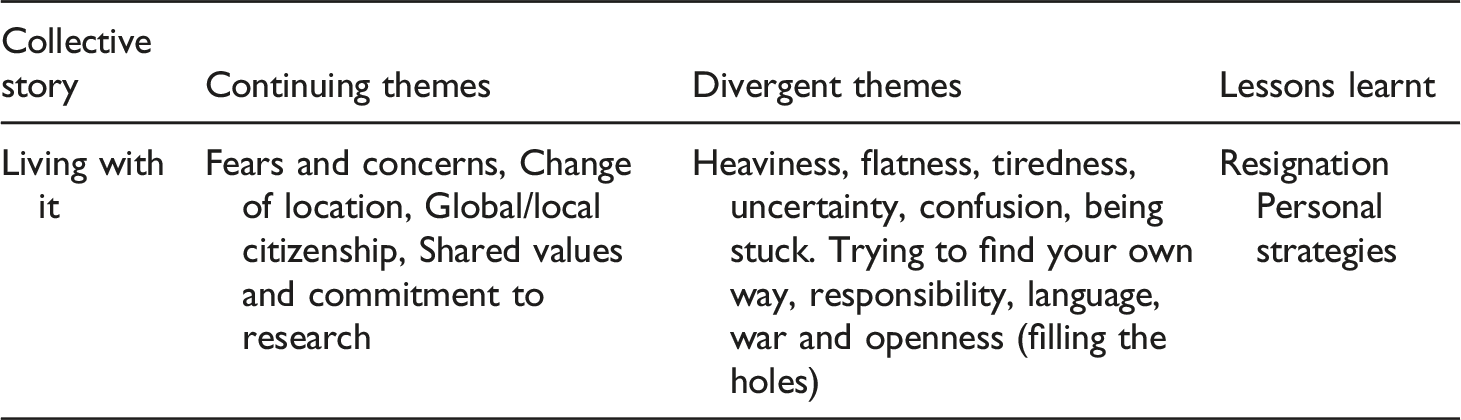
The epilogues continued the stories in some ways, but themes were often presented differently, and new themes emerged. The epilogues were shorter than the stories and this may have contributed to the truncated structure which generally did not show the same sense of journeying through the beginning, middle and end of a story. Collectively the epilogues showed various strategies and barriers to ‘sorting out’ how to live with COVID-19 and convey a somewhat regressive sense of being stuck in a situation that was unlikely to change, rather than moving forward (Gergen and Gergen 1986): ‘As I push on, I reflect that like it or not, I am altered, I feel perpetually ‘unsettled’, and I don’t know why. Unable to shake it, I reluctantly settle down and share my space with a new sense of unease in my small corner of the world.’ (S8).
This was in stark contrast to the original stories, implicit in which was the possibility that ultimately the story would end with release from the threat of COVID and the characters were biding their time. Fears and concerns were still very apparent in the epilogues, but here there was a feeling of heaviness, flatness and being tired with the situation: ‘The CV will show building resilience and adaptability to change, whereas I feel fed up and irritated. My Niece's christening is cancelled on the same morning as Covid sweeps through my brother’s family. I try not to listen to the news, my ears pricked at signs of an Announcement…We are constantly testing negative, waiting for the line to show up. It is spreading around my partner’s work again, and we worry for all the young people with vulnerable chest health. We keep going, and that’s all we can do.” (S2). ‘When I go to visit my elderly relative I am still tested, sanitised, gowned, gloved, escorted and hug limited. I am frustrated so many appear numb to the figures as group Christmas events are planned. It is not all over. I am still working in an uncertain world – still teaching roomers and zoomers simultaneously and asynchronously at student requests. My own research is still not finished, though in final throes of being birthed from this very affective assemblage. I have a long list of undone tasks. I am stiff from sitting with my anxieties. Perhaps this is a bad time to write this addendum, I am tired.” (S5).
The ebb and flow of the original stories with moments of escape, joy and self-realisation were absent. This was very apparent in the lack of trivial joys mentioned previously. With the exception of one account, trivial joys such as gardening, dancing and comfort from pets were missing.
Location continued to be a strong component in the epilogues but again this was conceptualised differently. The previous focus on home was less pronounced and, in some cases, home was portrayed as fragmented or invaded. New characters emerged as maskless threats or those suffering or needing protection, but the supportive figures and heroes of the stories had faded away. The epilogues portrayed a repetitive uncertainty, confusion and at times anger associated with moving between home and the academic institution and having to learn the ‘new language’ of COVID-19: ‘Now COVID doesn’t feel like a distant threat it feels like a surrounding enemy, whose den I have to travel into daily. The return to campus has taken a toll on me as I have become used to teaching from home. The journey seems longer, and the demands seem greater. I feel that I have become old during the pandemic and that I no longer enjoy my job as I once did.’ (S1).
This threat was reflected in the theme of responsibility which emerged in various guises, confusion about what one’s responsibility was, anger about the irresponsibility of the ‘naked faces’ of others: ‘they are naked-faced crowds, openly coughing and sneezing.’ (S8).
There was a lack of control and personal agency over the work environment despite the ongoing threat of new COVID variants. An interesting exception to the recursive uncertain ‘stuckness’ between locations was presented, however, by the group members who were able to travel to their countries of origin to ‘go home’. Although this journey was not always easy, it provided a chance to ‘re-focus’ to become unstuck and these accounts were progressively hopeful and conveyed a newfound freedom, appreciation and ability to cope with challenges: ‘I travelled to my country after two years. I spent almost two months there. Through my holiday, I still felt covid restrictions. I wore the mask in the closed areas and public transports. I need to learn how to live with covid. it seems that it will survive for a long time. Besides covid effects, I finished data collection. I can start my thesis. I made a plan with my supervisor.’ (S10).
One of these epilogues was also the only account which mentioned the trivial joys found in the original stories: ‘I was delighted to come back to my indoor plants, all of which were alive and thriving when I was away. Some have even given pups! I am currently nurturing my indoor plants. I have developed good practice lately. I have started doing yoga which was initially aimed at improving my breathing. Now I simply love it. I hope and wish that yoga will stay in my life longer than Covid will stay in this world.’ (S7).
Fears and concerns about other characters at family, local and global levels were restated in the epilogues and at times this was linked to both personal responsibility and the irresponsibility of others who may put those to be protected at risk. This included students and a shared commitment as academics with a duty to provide for both those who needed protection but also those who behaved irresponsibly. Academic experiences were both liberating for some, being finally free to collect data and conduct research, but overall, this was marred by the realisation that the world was changed and the possibility that others might place their colleagues and teachers at risk: ‘There is the added pressure of managing personal fears about Covid in enclosed spaces where few of those around me seem share this fear. The extra workload of covering for absent colleagues and coping with a hybrid pattern of working is beginning to tell. I never reached the space for catching up and my personal and professional responsibilities continue to increase. We have been ‘managing’ for so long but muddling through until things get better does not lead to job satisfaction. It is hard to see a way forward, and I have started to see the academic future as belonging to others, not myself,’ (S3).
Responsibility was also connected to a strong theme of needing to find a personal resigned resolution to ‘living with COVID’ and the lesson learnt that this uninvited visitor was here to stay. In some cases, this was articulated in the focus on everyday life challenges, in others COVID was explicitly included as an invasive and unwelcome character. This ‘working out for oneself’ gave an evaluative tone to the current understandings and was in contrast to the sense of facing a threat together seen in the original stories: ‘Although the effect of Covid decreased a lot with the vaccination at first, the new virus variant that came from Africa has started to affect the entire world. Therefore, panic surrounded me, just like many other people. The reason is that people were so tired of taking the measures required by the pandemic process that they were no longer caring about anything. I kept on fighting every day to not be like them. I kept reminding myself not to be selfish and to think about other vulnerable people.’ (S4). ‘I don’t want to be in crowded spaces, I worry about catching Covid and passing it on to vulnerable, older people. I am reluctant to see many of the older people that I normally would. So, the thought of attending events back at university doesn’t appeal. Some things had just moved back to the classroom, but I have avoided them.’ (S9).
Despite the emphasis on ‘sorting things out’ for oneself, the epilogues revealed a marked change in performative aspects of the narratives. Some members of the group continued to worry about presenting themselves as incompetent or unprofessional, but they shared their thoughts more openly despite these concerns. In this way, the epilogues were characterised by a growing feeling of trust within the group. This openness served to fill ‘the holes’ that the original stories were characterised by. ‘Since the 4
th
of October when we received notice on our home everything has been a challenge, I wholeheartedly want to keep moving forward but feel that as time ticks on my progress is more lacking and I am not keeping up. I have recently taken on more research related tasks at the university that has helped to keep me focused on working and trying to progress my PhD. I still have days when I begin to crumble, as a lot of the work sometimes becomes hard to justify when our housing situation is so fragile.’ (S6).
At a meta level, the research process itself was experienced as therapeutic. This is well documented, for example, Illouz (2008) describes how narratives can elicit healing from the negative effects of difficult experiences. Similarly, Seligman et al. (2005) describe how the writing of a personal narrative can promote wellbeing and optimism. The very act of writing the stories and epilogues and sharing those narratives with others positively influenced both people’s life experience and their willingness to document and discuss events which they believed put them in a bad light. Taken further these two outcomes are likely to be complementary. As writing about difficult events aids integration of the event into our personal narrative which allows us to contextualise and make sense of what has happened to us and thereby potentially retain a sense of temporal continuity, coherence of self, efficacy and self-worth (McAdams, 2001, 2019; Tomasulo and Pawelski, 2012). The therapeutic attributes of the process go beyond the writing of the stories. Sharing stories within a group encourages social cohesion (Gabriel and Young, 2011) an ability to coordinate activity in increasingly complex ways (Kesibir, 2012) and a shared group identity and bond (McAdams, 2019) ‘in my previous story, I said if I finish my PhD, I will never come back here. My view is changed, If I have a chance to do a post doctorate, I would like to come here because I could not find an academic family like the one at this university.’ (S10 Epilogue).
In short, the group recognised that a sense of trust, connection and enhanced ability to work together had emerged through the research process.
Discussion
In the initial stories, the key themes identified were ‘Fears and Opportunities’, ‘Places’, ‘Demands and Strategies’ and ‘Discoveries’. Although there were substantial fears articulated in our narratives regarding the pandemic, the lockdown was also perceived to be an opportunity. Lockdown was seen as potentially a time to reflect, make changes and focus on things which we had neglected. However, these early goals were often not realised. Most found that their priorities changed; for some, academic work took a less important place as responsibilities such as caring for others and home schooling took precedence, but for others, their academic life was suddenly all-encompassing with additional contact needed to support students – time on academic work ‘mushroomed’. The experience of COVID was different for each participant researcher and this had a lot to do with ‘place’. For example, their home situation. Academic work was inextricably muddled in with home life. For others, the inability to go ‘home’ to their loved ones was a major concern and they yearned for escape. One lesson learnt from COVID was that people matter most, whether that was experienced through increased student contact and related empathy for students, or through caring for family, or missing those we were separated from. For international students who were trapped, far from their loved ones this was particularly poignant. There was also an appreciation of others who provided inspiration and helped us to move forward hopefully.
Our failure to realise many initial plans during lockdown was associated with other demands. For example, increased requests for student support, the need to learn new forms of virtual communication and family commitments. These factors were further compounded for many by a sense of foreboding and threat. Nevertheless, new demands brought new opportunities and ways of coping. For example, people were often surprised by their ability to manage the situation and their resourcefulness. Coping involved drawing inspiration from others, ‘heroes’ who gave us new ideas and motivation and also through new hobbies and interests such as gardening, baking and dancing, which had a positive impact on mental health.
The study itself included aspects of demand and opportunity. In the initial stories, participant researchers felt a pressure to appear professional and capable. People tended to present themselves as key characters in a positive light and in our discussions we acknowledged the perceived performative need to stay strong for others, including those in the group. The performative characteristics of the stories led to discussions about the defended nature of the narratives and the ‘holes’ in the initial stories that appeared as a result. In some ways, this phenomenon was linked to methodology, specifically the novel position of researchers also being participants and the potential power differences between lecturer and student roles within the group.
The initial narratives were infused with a sense of hope that COVID restrictions would end, and we would return to normality. Participant researchers made discoveries about themselves, learnt new skills and reflected on their identity and resilience. Overall, the study itself was an opportunity to try new research approaches and experiment with what was possible in terms of methodology, as a result novel insights emerged, particularly regarding self-discovery of personal resources and the potential for a depth of understanding through group work of this kind. Systemically, the project enhanced interaction between members of the group allowing for successful collaborative working. We experienced a high degree of mutuality, underpinned by a shared vision and value and the process of co-constructing the analysis of our stories. The project was felt to hold therapeutic and academic benefits for all involved. We all came to this from the non-expert position of never having experienced a pandemic before and not being familiar with narrative analysis. Experienced and new academics all undertook relevant training together, learning about narrative analysis, with each having a unique contribution to the research that was valuable. It was noteworthy, for example, that some of the richest stories came from the least experienced academics in the group.
Other discoveries centred around the use of new technology for communication. The use of video conferencing necessitated a sharp learning curve for available technologies, and most found they were impressed and surprised by how quickly these new methods were learned and adopted. The ease of video meetings enabled people to meet up for many months without the time taken to travel to a physical location. People began to realise, however, that this reductionist method of communication needed increased sensitivity and consideration, so that meaning was accurately conveyed, and not lost in translation due to the absence of non-verbal cues. As a group, we adapted to this new-normal and as we all had a common interest, we eventually relaxed into our virtual space.
In the epilogues, many of the themes from the initial stories continued but there was also a sense of ‘heaviness’, ‘flatness’, as well as feeling tired and resigned. There was tension that at any point things could take a turn for the worst and we would all be back to square one. The narratives also reflected a positive change, however, in the nature of interactions between participant researchers. A growing sense of cohesion and equitable friendship within the group allowed for more open narratives, and the subsequent discussions revealed a therapeutic element to the experience of sharing personal stories as part of the study. Returning to a key finding from the initial stories that ‘people matter most’ the participant researchers began to feel that being part of the group contributed to their wellbeing. This was a welcome discovery related to methodology. Although our roles as both researchers and participants and our collaborative research design were in some ways thrust upon us, this way of working encouraged the development over time of a safe forum for sharing difficult information. Our virtual meetings may have contributed to lessoning of power imbalances due to seeing into each other’s homes and daily lives rather than meeting in the ‘office’ environment, but the ongoing sharing of written stories was also powerful in allowing us to be our ‘authentic’ selves. Sharing and discussing our stories allowed for a greater depth of understanding which supported cohesion and ‘knowing’ among the group and enabled previously hidden and difficult aspects of our lives with COVID to be revealed. This finding adds to research literature employing narrative approaches which highlight the impact of major crises such as the pandemic on academics, but also the positive potential of sharing stories in a group setting. It is unfortunately likely that human beings will have to face further ‘Super Wicked Problems’ in the future. Narrative research during the pandemic has identified key aspects of academic experience including a renewed sense of purpose and increased empathy alongside isolation, high levels of stress, financial concerns, barriers to study, poor mental health and diminished access to educational resources (Gogoi et al., 2022; Kelly et al., 2021). Other studies highlight the beneficial educational and therapeutic outcomes of sharing narratives during the COVD-19 crisis. For example, Vaz (2022) found that shared narratives alongside group discussion helped students to become more self-aware, more empathetic and connected to others and better able to manage stress. Similarly, research exploring the experience of medical students suggested that narrative writing could foster resilience and discovery of ‘silver linings’ despite fears and stresses associated with COVID-19 (Heilferty et al., 2021). We contribute to this literature by demonstrating the potential benefits, especially in times of crisis, of having well-established supportive forums within universities, where staff and students can share and discuss both their academic and personal stories.
Afterthoughts
We have stepped away from the COVID stories research now, and seldom meet as a group as work patterns and seminar arrangements have changed. We have reflected on the experience from initial conception to analysis of the epilogues with a view to understanding more about what happened from an academic and personal perspective.
The purpose of this research was twofold; when we started out, we were immersed in strangeness but wanting to find ways to carry on doing what academics do. We wanted both to explore the impact of COVID on academics and researchers and to engage in a collaborative study including both lecturers and doctoral students which could provide the experience of being part of a research project from the beginning, through conception, planning, data generation, analysis and reporting. The idea for the project grew therefore from a group of researchers with different levels of experience who shared an interest in inclusive practice and responses to adversity. Members of the group also had experience of pastoral support, counselling, therapeutic practice, or care and for some of us these roles were ongoing during the time of the project. Values of inclusion and ‘intelligent caring’ (Arnold, 2005) therefore shaped our approach. We wanted everyone to be able to participate in a supportive environment.
The stories became more than records of events; they prompted interaction about sensitive topics between a group of people who were struggling to make sense of how the pandemic had changed their lives. In the course of our stories and discussions, we uncovered aspects of ourselves and others living through a time of crisis and what matters to us as human beings. We made discoveries about ourselves as academics and how we relate to others in similar or different roles, and we also benefitted from the process. As Frank (2010) comments: Stories animate human life; that is their work. Stories work with people, for people, and always stories work on people, affecting what people are able to see as real, as possible, and as worth doing or best avoided. What is it about stories - what are their particularities - that enables them to work as they do? More than mere curiosity is at stake in this question, because human life depends on the stories we tell: the sense of self that those stories impart, the relationships constructed around shared stories, and the sense of purpose that stories both propose and foreclose. (Frank, 2010: p. 3).
Footnotes
Declaration of conflicting interests
The author(s) declared no potential conflicts of interest with respect to the research, authorship, and/or publication of this article.
Funding
The author(s) received no financial support for the research, authorship, and/or publication of this article.