



Abstract
Compelling evidence suggests that majority of young men who engaged in harmful sexual behaviour (HSB) were subjected to various forms of trauma and adverse childhood experiences. This research explores lived experience of a group of young men who engaged in HSB, what sense they made of it and how their positioned themselves towards these events including HSB, so they are able to maintain their self-integrity. It also explores impact of lived experience with consideration for broader family and cultural discourses. Transition to Adulthood Attachment Interview and Semi-structured interview were employed and Dynamic- Maturation Model of attachment were utilised for this research since it differentiates for dismissed and pre-occupied trauma spectrums. Findings highlighted that all of the young men presented mainly with complex unresolved dismissed trauma or loss and some with both types of trauma. Furthermore, they employed dominant hegemonic culturally shared discourses of masculinity to make sense of their lived experience. The ways in which experiences of trauma shaped the HSB pathway that developed is discussed.
Introduction
Harmful sexual behaviour (HSB) is defined as ‘sexual behaviours expressed by children and young people under the age of 18 that are developmentally inappropriate, may be harmful towards self or others, or be abusive towards another child, young person or adult’ (Hackett et al., 2013: 130). An accurate figure regarding HSB prevalence in United Kingdom is unknown (Scott and McNeish, 2018). Hackett et al. (2013) estimated that from one-fifth to two-third of child sexual abuse is committed by young people. National Society for Prevention Child Cruelty (NSPCC) uses a statistic ‘around a third of child sexual abuse is committed by young people’ (NSPCC, 2021).
It has been recognised young people who displayed HSB come from diverse background, however majority of them have experienced higher level of childhood trauma and adverse childhood experiences than general population of adolescence and similar or slightly higher level of adversity than non-sexually offending peers (Levenson et al., 2017). Many of them have been brought up in a home environment where they witnessed domestic abuse or were subjected to various form of maltreatment including physical, sexual or emotional abuse (Barra et al., 2018; Hackett et al., 2013; Tougas et al., 2016). Subsequent meta-analysis and systematic literature review identified childhood trauma as a variable contributing to sexual violence (Dillard and Beaujolais, 2019; Seto and Lalumière, 2010).
Research regarding an intervention for young people who displayed HSB suggests approach that encompasses family environment and highlights benefits of Cognitive – Behavioural Therapy based interventions, multi-systemic therapy approach or adventure-based interventions (Scott and McNeish, 2018).
Trauma
Allen (2001) proposed a spectrum of trauma in order to enhance understanding of its impact on victims and related later difficulties. This includes impersonal trauma such as a large disaster, through interpersonal trauma, for example, assault or rape by stranger, to attachment trauma whereby trauma is embedded in attachment relationship such as parent–child or husband–wife. He argued that attachment trauma is likely to have more devastating effects compared with other types of traumas. This corresponds with a classification suggested by Terr (1991) who distinguished between Type I and Type II trauma. Type I trauma may involve a single event such as a car accident or a natural disaster while Type II refers to interpersonal and repetitive incidents of domestic abuse or physical violence. It has been proposed that prolonged and repeated experience of abuse within interpersonal domain leads to complex trauma which results in more sever outcomes (Cook et al., 2003; Van der Kolk et al., 2005). More current research has begun to differentiate between an impact of direct experience of maltreatment, for example, sexual abuse, physical violence or emotional abuse and witnessing dysfunctional household dynamics such as domestic abuse or substance misuse on children’s development and functioning (Ohashi et al., 2019). Furthermore, impact of broader, environmental, social and community-based experiences such as racism, poverty or bullying and contextual safeguarding have also been considered (Firmin, 2015, 2017a). Therefore, although there is no clear definition of trauma, a cumulative effect of wide range of experiences, in particular experience of various forms of dangers and responses to dangers have to be taken in consideration when trauma is discussed.
Trauma and attachment
Given that trauma develops from interface between danger and responses to it, it is helpful to consider trauma within a framework of attachment theory. This is because a fundamental role of attachment behaviours is to ensure protection from danger and survival (Bowlby, 1973, 1980). These attachment behaviours develop overtime into three main self-protective strategies, for example, Type A – dismissive, Type B – secure and Type C – pre-occupied. These strategies echo infants – parents/carers interactions in context of protection and comfort and subsequently contribute to information processing strategies (Ainsworth, 1979; Bowlby, 1980). Arguably trauma indicators may manifest differently depending on self-protective mechanisms, for example, trauma indicators could be less obvious in dismissive strategies. Furthermore, various ways of responding to danger and processing danger may help to understand how in some cases Adverse Childhood Experiences (ACEs) develop into trauma strategies, and in turn how an impact of trauma and recovery process may differ depending on attachment and trauma style.
There are several attachment models which build on Ainsworth’s strategies to adulthood. In this paper, Dynamic Maturation Model (DMM) has been utilised (Crittenden, 2006; Crittenden and Landini, 2011). Figure 1 shows details of DMM model. The Dynamic-Maturational Model (DMM) of strategies of attachment and adaptation and transformations of cognitive and affective information associated with each strategy.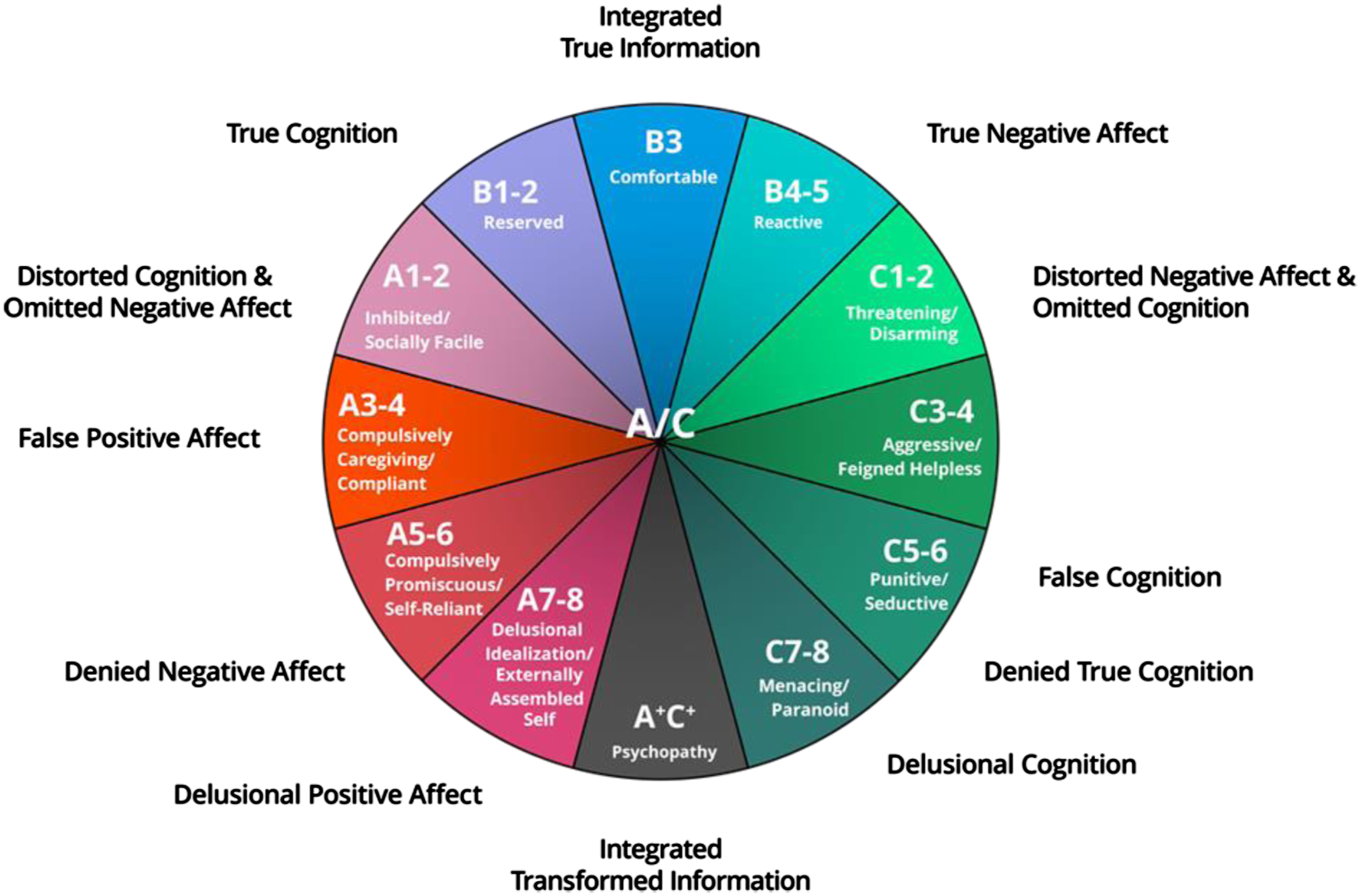
Impact of trauma
Impact of trauma on neurodevelopment and cognitive and emotional functioning and subsequent implications have been widely discussed in literature (Perry, 2001; Teicher, 2008). Childhood trauma exposure has been identified as a significant transdiagnostic risk factor related to deficits in biological, emotional, cognitive and social development (McLaughlin et al., 2020). Young people who were exposed to trauma are likely to have difficulties with executive functioning related to emotion regulation and impulse control which subsequently results in inappropriate emotional and behavioural response and problems in interpersonal relationships (Creeden, 2009; Hart and Rubia, 2012; Teicher and Samson, 2016). They are more likely to display violent and aggressive behaviours, engage in substance misuse or withdraw from social relationship and become socially isolated (D’Andrea et al., 2012). Furthermore, trauma elevates risk for mental and physical health problems including anxiety and depression, suicidal ideations and attempts, self-harm as well as it has been linked with psychiatric disorders (Citak and Erten, 2021; Kalmakis and Chandler, 2015; McLaughlin et al., 2012). Lewis et al. (2021) concluded that the severity of psychopathology, cognitive deficits and pre-existing vulnerabilities are linked with complex trauma.
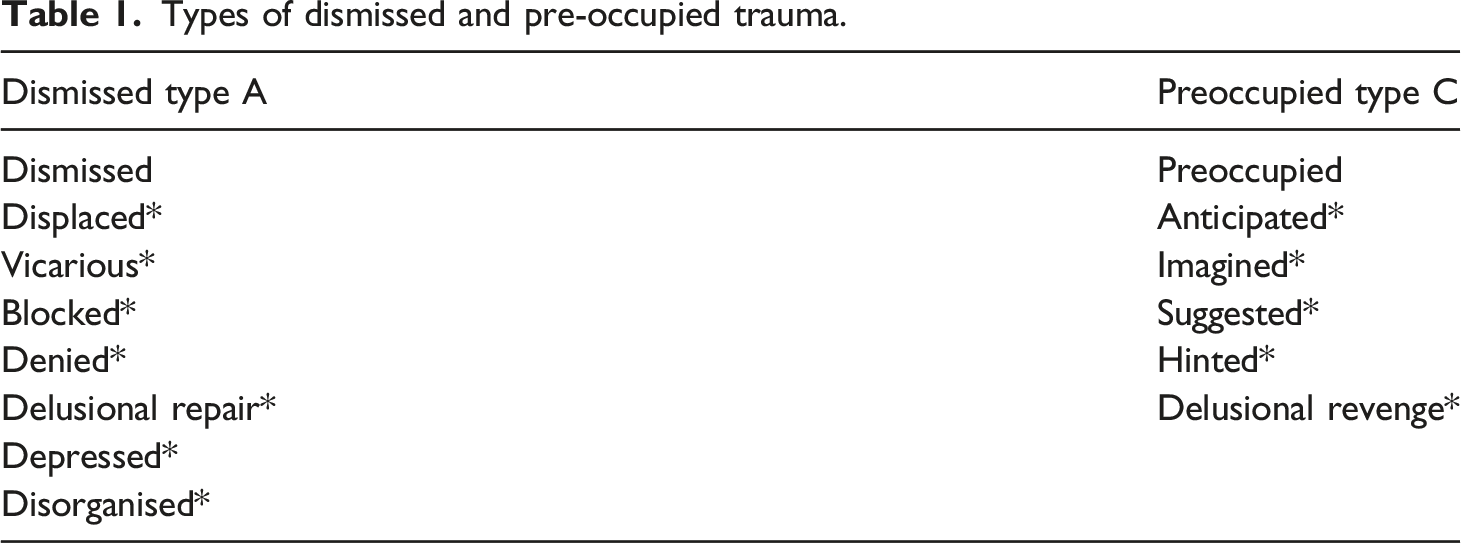
Types of dismissed and pre-occupied trauma.
Trauma and masculine practices
Practices related to power and authority based on personal prowess, status, emotional toughness and strengths including physical and sexual competence are core gender practices of hegemonic, or dominant masculine identity, which is a normative standard against which adolescence boys measure themselves (Connell, 1995; Frosh et al., 2002). Frosh and colleagues claimed that young males aspire to achieve hegemonic (conventional) masculinity but with an acknowledgment that they are likely to fail to meet the standards required by it. However, if they attained enough attributes to identify as ‘not feminine’, then this endorsed their status as males. It has also been argued that males compete with other men to attain power and status through masculine practices which often involved the marginalisation of females or other subordinate groups (Pepper and Fahlberg, 2016). Another type of masculine identity discussed in literature is hypermasculinity which is characterised by holding calloused sexual attitudes, considering violence and danger excitement as manly (Mosher and Sirkin, 1984). Since the majority of HSB is displayed by young males (Hackett et al., 2013; NSPCC, 2021), it is relevant to consider possible correlation between trauma, adolescence masculine identity and HSB. In particular that, Brown and Burton (2010) claims that in most researched cultures, the helplessness experience of being a victim of a physical or sexual trauma in early life is one of the greatest threats to a male child’s sense of masculine agency. Furthermore, masculine practices influence recovery from trauma. For example, in order to recover from sexual abuse trauma, young males need to act against cultural values associated with masculinity and engage with their vulnerability and difficult emotions (Kia-Keating et al., 2005). This usually requires personal strengths and often supportive and caring network. Inversely, in face of ongoing sense of powerlessness being experienced in home environment and peer relationships, youth who has experienced trauma may attempt to regain their sense of agency and power through HSB (Cossins and Plummer, 2018). Beliefs related to dominant hypermasculinity have been correlated with violent non-sexual delinquency among young people (Honkatukia et al., 2007; Hunter, 2004). However, such correlation with regard to HSB is less tangible. For example, Hunter (2004) found a lack of any predictive value of dominant masculine traits in sexual harming, while other research identified that a deficit of such traits may account for HSB (Farr et al., 2004; Zakireh et al., 2008).
One of issues influencing masculine practice that requires highlighting in context of this paper is access to pornography. Pornography use among adolescence seems to be high. Data collected over a decade suggests that between 60% and 93% of young people access pornography (Braun-Courville and Rojas, 2009; Carroll et al., 2008; Sabina et al., 2008). Recent, UK based study by Martellozzo et al. (2020) identified that nearly 60% boys in her sample, intentionally sought pornography. Other research suggest that men are more likely to report regular viewing of pornography then women, that is, 50% of casually dating men versus 1.2% of casually dating female (Carroll et al., 2017). Relevance of pornography is based on findings that pornographic material promotes skewed and unhealthy sexual scripts portraying objectifications, male dominance and violence (Klaassen and Peter, 2015; Sun et al., 2016). Females are portrayed as instruments to satisfy males sexually. Males are presented as more powerful with a higher status. Violence ranges from spanking, slapping and gagging, often involving group sex including several males and a female. It has been recognised that mainstream pornography has become much more violent and aggressive, and arguably sexualised violence (Bridges et al., 2010; Crabbe, 2016). Overall, Klaassen and Peter (2015) summarised the depicted narratives in modern pornography as being ones in which ‘women are usually powerless, without agency and subject to dehumanization’ (p. 731).
This paper explores trauma and discourses employed by young people who engaged in harmful sexual behaviour to construct their childhood experiences and family context in such way as to maintain self-integrity. It examines how trauma shaped their narratives applied to give meaning to their life experiences and their agency in context of broader family and social discourses.
Aims of the study
This study is a part of a broader research which explored trauma and attachment strategies among eight young people who engaged in harmful sexual behaviour. Findings regarding attachment strategies identified that all young people presented with complex insecure attachment strategies, that is, mixed strategies and extreme avoidant strategies. Detailed finding regarding attachment strategies have been discussed elsewhere (Zaniewski et al., 2019). This paper will focus on the prevalence of traumatic events in the childhoods of these young people, how this sample of young people make sense of their own experiences, actions and sexual behaviours and how ACE developed into trauma strategies.
Methods and methodology
Semi-structured interviews
These drew on ideas for bibliographical and conversational interviews (Gall et al., 2007; Rosenthal, 1993) and were carried out with eight young people. The interview was designed to gather: (a) information on the young persons’ family and social background/history and self-perceptions of participants; (b) young people’s perceptions of key events in their lives; (c) young people’s accounts of their harmful sexual behaviour and young people’s self-perceptions.
The transition to adulthood attachment interview
This is based on the Adult Attachment Interview (AAI), modified by Crittenden (2006) for use with young adults to include questions regarding peer relationships.
Participants
Participants’ names, age, family composition, lived experience, HSB and trauma.
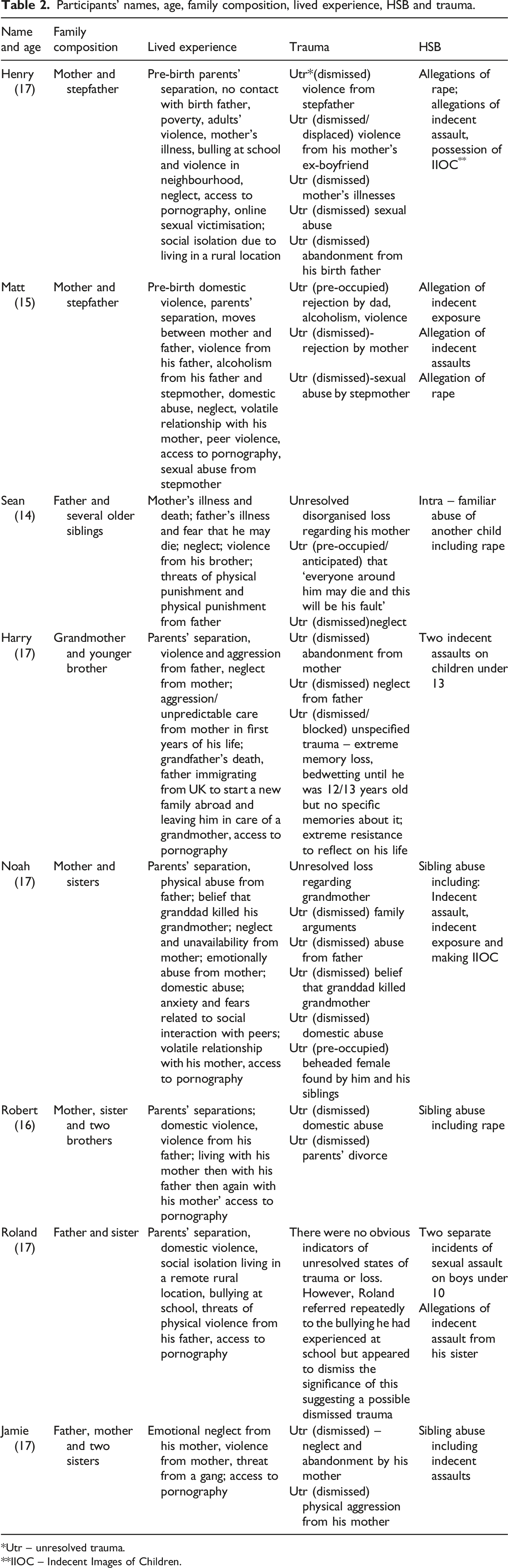
Utr – unresolved trauma.
IIOC – Indecent Images of Children.
Ethics
The project has been approved by the local University and relevant Social Care and NSPCC Ethics Committees. Informed consent was obtained from participants.
Analysis
Critical Discourse Analysis (CDA) was chosen as the primary method of analysis of the semi-structured interviews. CDA is well established approach within a field of humanities and social sciences (Breeze, 2011; Billig, 2002). It specifically focuses on examining relationships between dominant cultural discourse and their relationship to power and dominance (Van Dijk, 2001). CDA permits an exploration of how people offer their accounts to manage the presentation of themselves, including justifications for their actions and their relational dynamics.
Analysis of the TAAI used the discourse markers developed for analysis developed for the Adult Attachment Interview (AAI) by George et al. (1985) and adopted to the Dynamic- Maturation Model of Attachment and Adaptation by Crittenden (Crittenden and Landini, 2011). The Dynamic Maturation Model Adult Attachment Interview (DMM AAI) upon which TAAI is based, have been validated in several empirical studies (Crittenden et al., 2017; Crittenden and Heller, 2017; Hughes et al., 2000; Landini et al., 2016; Worley et al., 2004). The DMM AAI analysis is a deductive form of analysis which consists of identification of specific patterns of discursive processes, for example, dismissal of attachment needs, idealisation of others or angry derogation of others and so on. The second author has full coding reliability for the DMM AAI and has done TAAI training. The DMM AAI analysis also enables to differentiate various forms of trauma on dismissed and pre-occupied traumas form continuum (Black et al., 2000; Crittenden and Landini, 2011). Table 1 presents types of psychological traumas.
The analyses of the TAAIs were conducted independently by the first and second authors. The second author is fully trained and has attained full reliability in the analysis and coding of the AAI and the first author has received training but does not have formal reliability. Both the TAAI and the interviews also offered ‘facts’ about the young people’s lives, especially the dangerous and potentially traumatic events they had experienced. The themes were inductively derived and complemented the analysis employing the discourse markers employed in the deductive analysis process of the TAAI. These were also evident in their TAAI data and it was also possible to see the presence of the TAAI markers in the Semi-structured interviews.
Findings
The findings are presented in three stages. Firstly, the overall results with regard to trauma will be presented. This will differentiate for two subgroups: simple trauma and complex trauma as per DMM AAI classification. Secondly, discursive themes employed by young people to make sense of their experiences. And finally, findings regarding masculinity, intimacy and HSB.
Trauma
The analysis of the TAAI and Semi-structured interviews data revealed that all but one participant showed indicators of unresolved trauma including one young person showing symptoms of significant unresolved loss (Table 2). Among the young people who showed evidence of unresolved trauma or loss, all presented symptoms of multiple unresolved traumas. The range of traumas was related to: parental abandonment/rejection, neglect, emotional neglect and emotional abuse, physical abuse, sexual abuse, domestic violence, bullying, parental separation or a parent’s illness. In the case without obvious indicators, there was a strong possibility of trauma related to bullying and domestic violence, but its significance was denied, which would be consistent with his highly idealising defensive strategies. All of the participants showed indicators of dismissing trauma forms and three participants presented with markers for both pre-occupied and dismissed types including one participant with indicators for disorganised loss.
Dismissed trauma forms
All participants showed some forms of dismissed trauma ranging from dismissed to blocked one, for example, in referring to violence and abuse, which they had experienced or witnessed.
Dismissed
Young people often dismissed the importance of event or its impact on them and showed no protest or sadness about it. For example, Jamie repeatedly described violence from his mother but in a ‘journalistic’ style with little emotion or resentment at his beatings: …Well, she (mother) just like she grabs me by the hair and drags me upstairs (…) They wouldn’t do it violently like just a clip across the head and stuff… (Jamie)
Another example is Matt’s trauma regarding rejection from his mother. Initially, Matt described his ‘childhood with his mum as very good’ and her as ‘reliable, but there were indicators of suppressed feelings of rejection related to his mother’s decision leaving him in care of his father where experience physical and sexual abuse: …I was about 3, I moved away from my mum because she was ill and what not and she was, couldn’t handle me because of her illness, she couldn’t take proper care of me, so she gave me away to my dad, well not that she gave me away, but you know she still handed me over to my dad…
In this paragraph, Matt started to develop a potentially sympathetic account of his mum not coping because of her epilepsy but appeared to diminish this by trivialising it as ‘what not’. He also indicated a slip from suggesting that he was partly responsible in saying ‘she couldn’t handle me’ to reducing his potential responsibility to ‘she couldn’t take proper care of me’ putting the emphasis back on to his mother. The passage then becomes more emotive as he changes the phrase ‘gave me away’ to a softer ‘well… handed me over to my dad’. Matt showed some inside to his ‘complicated’ relationship with is mother: …. most sons and mothers shouldn’t have a relation like my mum and like me have you know, we have big monthly fights thought out the year we have big monthly fights you know where there’s been arguing, and I’d call her a fucking whore and shit like this. She’s called me all sorts of names and referred me to my dad and… (Matt)
Journalistic and dry narrative was also evident in Noah description of domestic abuse and physical abuse from his father. … I tried to open the door, caught a seat-belt half undone and he grabbed it around my neck and pulled me back to the car. And that’s why I hate him for that for what he is like and what he’s done. But we had ups and downs say. And we do have laugh and giggles… (Noah)
Displaced
Some participants not only dismissed impact or importance of an event but also transferred it on others. For example, Henry described actions that could be construed as physical abuse from his mother’s ex-boyfriend but did not display consistent negative affect, such as anger in relation to this. He shows some preoccupation with violence from his mother’s ex-boyfriend, but he blamed himself for the abuse and displaced negative effects regarding physical abuse onto his mother. …I don’t know. I was, well I just I was, well I just I must have had a firm counter move or whatever and hum he beat me across, across the backside but apart from that well I well I can’t really remember, such a long time really (…) I think I think it happened more than once. My mum was fed up with this... (Henry)
In this account, describing a domestic incident between his parents, Robert showed some emotional arousal immediately followed by a very strong denial (gratuitous denial of negative, GDN) of physical violence between parents (although he was not specifically asked about physical violence), and he displaced impact on his younger siblings. … They were just like those two were like arguing and like I seen I like witnessed my brothers and sisters crying, so I erm like was there comforting them and then like I shouted at them to stop cause they, cause they were crying (…) it was just basically a disagreement and then it turned into an argument and then like they sort of I dunno like they wasn’t, I don’t think, I can’t remember if there was any violence but erm yeah I, I can’t remember if there was any violence … I was just switched off from it and just comforted my little brothers…
Another example of displaced trauma and loss is provided in Noah’s narrative about his grandmother. He opened a paragraph about her from rather confusing statement that he only had some ‘blurred images’ and ‘flashbacks’ and apart from that he ‘didn’t remember much like he had amnesia’ but other than that he ‘remembered his Gran quite well’. He then went on listing her various illnesses and recalled a day when he was told she had died. Immediately after that he went on talking about several Grandmother’s dogs which died one by one.
Blocked
For some young people, the overall narrative style, presentation and available life history strongly suggest traumatic experience, but this was not acknowledged by them. They were unable to recall any details and had no specific memories, although there were frequent indicators of unresolved trauma. For example, Harry was bedwetting until he was 12/13 years old. He presented with extreme memory loss and extreme resistance to reflect on his life. He would frequently state that his ‘memory was poor’ that he ‘can’t remember’ or that he had ‘no memories’.
Similarly, Roland, at the very beginning of the interview, he instantly recalled that his parents separated when he was about 9–10 years old. However, his account was dry and cut very short. …My parents split up about 6–7 years ago emm. more than that. 9 years ago actually, cause I was 8 at that time. What do you remember about it? Not much really. All I remember is coming back from school one night and saying to my mum, I only got back at 6 o’clock, dad was normally back at 6 o’clock every night, he didn’t come home that night. I was like ‘where’s dad’ and she was just like me and your dad had a big argument, and he is not living here anymore. That was it.
He was unable to recall any memories about this period of his life or circumstances surrounding this event: What was happening at home that days? I don’t know. I don’t really remember anything Any memories, any picture that is in your mind from that time? No
Roland would frequently answer ‘I don’t know’, ‘I can’t remember’ when he was asked about his childhood experiences. … well if I have any problems at school, my mum all would say ‘you got in all this trouble, you got to deal with it yourself’, or if I was being bullied, she wouldn’t give a shit. But dad would be instantly at school and would sort it all out. Can you think about a specific time when he went to school to sort things out? Not really Or any specific time when you were bullied and... Not really. And he went to help you? Not really.
Pre-occupied forms of trauma
Pre-occupied
Three participants presented with pre-occupied trauma forms. For example, pre-occupying reference were made to violent images, evocative language (swearing), strong emotions and recalled speech as if acting out the events in the present were evident in Matt’s interview when he talked about his early relationship with his mother: Erm, my childhood has been very good with my mother (…) she took my dad to court again for more contact so my mum ended up with Tuesdays and every other weekend which was pretty kind of like staying every other weekend, you know it was a change of scene I wasn’t bored, erm and then erm yeah one night out of the blue my dad got pissed out his face and you know he was an alcoholic apparently he’s been off the drink now for 9 months but I just really can’t believe him because I’ve heard it so many times erm yeah apparently out of the blue, well not apparently I remember this very clearly he and my brother had had a fight in the pub and pushed him up against the bar erm threw him onto the pool table, basically just man handled him around the room and my dad got so pissed off he was like ‘enough that’s it you’re going home and you’re going to bed, in fact no you, I’m going to ring your fucking mother and she can come pick you up cos I’m too pissed off with you.’ And basically, from that moment it felt like a choice, he was making a choice from his marriage or his own flesh and blood and he picked his marriage, I went ‘you’re a fucking cunt you realise that don’t you?’
Noah also displayed indicators of unresolved pre-occupied trauma when he recalled an event of finding a body of beheaded female in his neighbourhood. His narrative was characterised by vivid images and emotional arousal.
Pre-occupied anticipated
Intrusion of more complex, anticipated pre-occupied trauma was evident in Sean’s account. His trauma stemmed from disorganised loss related to the death of his mother, which subsequently lead to a fear that ‘everyone may die, and it will be his fault’. …. cause if all my family starts passing away, I’d just feel like it’s my fault again. Cause, everybody’s dying…. (Sean)
Sean talked about his fear that his father may die because he ‘gives him troubles’. During an interview, he also became concerned about his father that he may die because he ‘cooked him (father) a dinner and could have given him a food poison and he might die’. In addition, Sean was worried that he may get stabbed and die at college as he had heard about such incidents on news.
Disorganised loss
There were strong indicators that Sean experienced unresolved disorganised loss regarding his mother’s death. In various points in the interview transcript, there was evidence of preoccupied, dismissed or displaced responses to this event. For example, Sean would recall vivid images such as ‘black ambulance’ or her ‘shut eyes’. His speech would become erratic, and he would often go into a dialogue with himself as he was re-living the event but at the same time mocking his responses. He showed extreme sense of guilt and responsibility for her death. But he also said that it was his sister who lost a mother and claimed that he was not affected by this. Furthermore, he would frequently conclude with a phrase ‘it was well funny’.
Pre-occupied and dismissed from of trauma
Three participants showed both, dismissed and pre-occupied forms of trauma related to different events. For example, Matt presented with dismissed trauma regarding a rejection from his mother and pre-occupied trauma in relation to his father’s alcohol misuse and violence. Analysis of transcript for Sean’s interviews revealed indicator of dismissed trauma related to neglect and pre-occupied trauma that ‘everyone may die’. Similarly, data from Noah’s interviews provided evidence of dismissed trauma associated with domestic abuse and abuse from his father but pre-occupied trauma regarding finding a body of beheaded female.
Discursive themes
The young people employed a range of discourses to construct their childhood experience and family context in a way to maintain self-integrity. An overarching picture encompasses discourses related to themes such as: • Life is hard – violence is acceptable/normal and is an integral part of life. • Powerlessness manifested in an inability to affect a change. • Normalising abuse and acceptance of victimisation but denial of an impact and getting on with life. • Power to disrupt and get self into trouble conveys an experience of being empowered. • Power discourses encompassing entitlement, male superiority, toughness, bravado and denial of vulnerability. • An acceptance that ‘truth’ was fragile and slippery, that people could not be trusted or relied upon and that people lied.
Life is hard – violence is acceptable/normal and is an integral part of life
The young people employed a discourse of hardship, for example, in referring to violence and abuse, which they had experienced or witnessed but also in context of day-to-day struggles. They often described their relationship with parents as difficult or volatile and their family life as characterised by conflicts. There was a strong implication of such events as inevitable and a passive stance towards them.
Powerlessness manifested in an inability to affect a change
There was strong sense of powerlessness expressed by these young people. They did not feel they had ability or enough agency to effect a change. For example, Henry talked about his experience of being frequently bullied at school … I used to get bullied quite often cause in school, hum I was big (…) I used to be the quiet one sat in the corner. And that’s probably why he picked on me so much… (Henry)
He ends this excerpt by offering some general exoneration for his being bullied as if being quiet makes one a legitimate target for bullying.
Noah presented an account in which he seemed to have possessed few sources of power. He struggled at school and appeared to have experience humiliation and was frequently overtaken by a loss of control regarding anger and violence and marginalised as a ‘nutter’.
Normalising abuse and acceptance of victimisation but denial of an impact and getting on with life
This lack of an ability to affect change led to normalisation of abuse but denial of any impact. For example, Henry minimised the physical violence by indicating that a lack of memories of it, meant it was not important or significant. Using speculation, Henry lightened the possible influence the abuse had on him. The comparative strength of the term ‘beat’ is softened by ‘I think it happened’ suggesting that it was not that memorable or traumatic. He then appears to displace the negative effects onto his mother.
Robert accepted domestic abuse between his parents and excepted to just go on with life denying any impact. …it didn’t really affect me to much cause like mum and dad told me at an early age not to get involved (…) I just been learnt to take it on the chin and just go on with life…(Robert)
Same young people employed dismissive bravado to deny an impact. For example, Roland to dealt with a rejection from his mother: …Tough, I didn’t care… (Roland)
Noah talked about volatile relationship with his mother and a physical abuse from his father, but he concluded: …they never hurt my feeling… (Noah)
Power to disrupt and get self into trouble conveys an experience of being empowered
For this group of male adolescence getting in trouble gave them a sense of empowerment, agency and control. They would position themselves in a way that conveys their responsibility for abuse or violence. For example, Matt described that he was in his ‘father face’ so he hit him in self-defence. Henry believed that he must have had a ‘firm counter’ in response to which his mother’s boyfriend beat him. Others would take on negative and self-blaming perspective, and described themselves as ‘tough nut’, ‘outsider and nutcase’ or as James – a ‘gambler’ and ‘being bad’.
Power discourses encompassing entitlement, male superiority, toughness, bravado and denial of vulnerability
Toughness, bravado and denial of vulnerability were recurring themes in context of various experiences, for example, abuse, rejection or peer relationships. Participants also demonstrated a sense of entitlement and superiority as males. For example, Henry talked about being ‘older and handsome’ which gave him rights to befriend much younger females. He also portrayed himself as having lots of heterosexual sex, which seems to be a response to rumours that he was gay. In addition, he talked about showing ‘his big collection’ of indecent images of young girls to his mates who told him that ‘they were good’.
Sean demonstrated a conventional account of being a protective male: …I’m overprotective of my girlfriend. If she’s got a boyfriend and I don’t like that I tell her. But it’s up to her at the end of the day, but if he did hurt her, he would have too much to lose, because I’m a security guard, not guard I’m a urmmm… a boss of security and a SWAT… (Sean)
Furthermore, he appears to subscribe to a conventional discourse of males as expecting to have more power and to be tough. In his case, he displays a striking use of delusional ideation in creating a fantasy of being a ‘boss of security’ and he employs various symbols of power, such as handcuffs, batons, rights to stop, search and arrest people. …we were basically like a police officer, police and security base, cause we got SWAT what all the police officers do, we have security watch, security normally does anyway and when I’m in charge of SWAT and we need basically back up I have to carry my batten, search people… (Sean)
In Matt’s transcript included a very strong gender polarisation which contained an emphasis on males as needing to show physical strength, aggression and sex. A male was seen as needing to be strong and aggressive therefore respected as opposed to females who are ‘too soft which is not as scary as men’. Harry talked about his dad ‘having murderer’s look in his eyes’ when he was angry and headbutting another male in a pub because ‘was doing his step-mother’s head in’. All young people in this sample accepted violence and aggression and male dominance through power.
An acceptance that ‘truth’ was fragile and slippery, that people could not be trusted or relied upon and that people lied
This theme had a range of strands. For some young people there was an overarching difficulty to distinguish between what was real and factual and what was their fantasy or indeed delusional beliefs. For example, Sean who developed an elaborate delusion that he was a ‘boss of security’ with powers to stop and search people and worked alongside Police. Or Noah who talked about ‘not believing his mind’ and ‘manipulating with his memories’ so he didn’t know anymore what ‘was true or not’. For others this was related to inability to develop trusting relationship as result of abuse or rejection they have experienced from their parents/carers, but which was not validated. Furthermore, some of them would present idealised views of their life, parents and cares. However, these were not corroborated by ‘factual’ memories. For example, Ronald when he was asked about range of aspects of his family life he frequently would say ‘things were fine’ without elaborating on this or alternatively he would say ‘I don’t know’, ‘I can’t remember’. For others, these idealised views were contradicted by memories and frequent experience of disappointment and rejection, which were often minimised or dismissed. As result they were unable to trust others or rely on them but accepted that they are likely to experience abuse and violence from people that they should be able to trust.
Masculine practice, intimacy, harmful sexual behaviour
Masculine practice and intimacy
Young males from this sample found it difficult to balance their intimacy and emotional connection needs with their belief about masculine practices. This illustrates a quote from Henry: …I fell in love with her and I like I suppose I got obsessed with her (…) Like I well I walk into my room and I think about her (…) because I’d look at a piece of clothing and think of her because I’ve worn it or it smelt like her or anything like that. I was like really obsessed with her. Hum If I couldn’t go and see her or like if there was a reason why couldn’t she why she couldn’t see me I would like get a bit stroppy… One day, she well we had she asked me asked me to rape her like in a sexual play kind of way. We had sex and then she went around and say I raped her. I: How did it come about that she asked you to rape her? H: like we, like have foreplay and then I was like oh like we was outside and hum I was like would it be good if I rape you? And she was like oh let me take you somewhere, she took me somewhere and she was like oh you’re gonna rape me then. I was like oh yeah’ (Henry)
This passage can be seen to indicate a justificatory distortion of the events. However, Henry in supplying details, such as wearing and the smell of her clothes he indicates that there was an underlying need for intimacy. He then develops this account by describing that not being able to see her, which could indicate his emotional need for her. His emphasis then on the ‘rape’ can be seen as a defence of this vulnerability, that is, this could be interpreted as rape means that the perpetrator is no longer at risk of being needy and rejected – as he felt he was. Of course, this passage can also be seen as an elaborate deceptive cover up of a vicious attack, but the insertion of details such as wearing her clothes and missing her and so on appears some way beyond the ability to mentalise and deceptive manipulation throughout his interviews.
Matt showed some insight to dilemmas created by masculine practices: …I’m all soft and fluffy with her (…) but I wouldn’t say stuff bad like, ‘oh, me and her had a romantic dinner’ and shit like that, cos then you’d be like ‘I’m fucking losing my marbles mate cos he knows me as the hard nut taking on everything. What would you say? That we were fucking like animals… (Matt)
In this passage, Matt was telling that he would not tell his mates about having romantic dinner with his girlfriend but would say that they ‘fucked like animals’ as he was a ‘hard nut’. He also described himself as a ‘man whore having thousands of girlfriends’.
Some of the participants described their romantic relationship stripped from emotional but also sexual dimension and denied any need for these. Furthermore, they did not demonstrate any impact when their girlfriends left. Not that important …emmm… Uh…it just to get a girlfriend and that’s about it; just to meet up and that’s about it really… (Roland) …I did not care, was not into it anyway… (Jamie)
Masculine practices and HSB
There are several discourses contributing to HSB which reflect masculine practices. Viewing pornography was a regular feature for all young people in this sample. Noah described himself as ‘being obsessed’ with watching pornography. Robert commented that his mother had told him that it was normal for boys to watch pornography, but he also made a link between watching pornography and engaging in HSB: …Well we were like just playing this game and cause I was like watching porn and everything (…) yeah it was just I had like mixed emotions plus I seen her run across the landing to go in to the bath or shower like naked just like hormones where like starting to come from like kicking in more so… (Robert)
Seeing his sister walking naked could have been seen by him as an invitation to engage in sexual activity with disregard for his sister’s needs and conveys a sense of entitlement and distorted view on consent. This could have been modelled by watching pornography. To some extend, it is reflected in another quote from Robert when he talked about a strategy that several of the young men employed was to frame the sexual offending as a ‘game’ but in this instance it could easily be acting out a script from a pornographic movie: …The school games, and erm basically what we were doing like she was the teacher, and I was the teacher’s boyfriend like head teacher, and it just spiralled from that… (Robert)
This sense of entitlement was also evident in other participants: …Erm well I thought of it as an excuse to touch her really I think (…) Well I think of it as pleasurable and good and stuff (…) For both of us well, well of course it wasn’t as pleasurable for her (…) Well I couldn’t do it to anyone else so… (Jamie)
Robert also alluded to a dominant gendered discourse that women may say ‘NO’ but in fact this means ‘Yes’. Further this contains the idea that a man doesn’t take ‘no’ for answer. …Like me asking- wanna do that thing again? Blunt and asking (…) she said no at first and I said oh come on and she said yeah alright then… (Robert)
Another example of masculine practice was using sexual behaviours to regain a sense of power. Matt described that just before his indecent exposure he felt ‘small and angry’ because he thought that a group of girls was laughing at him. He recourse to bravado and engaged in discourse of a ‘tough guy’: I walked by them and what not and they were like ‘Ahh Matt you’re a fucking prick and you’re fucking this and’ and I turned round and went yeah? You’re a fucking whore (…) you’re a whore, you’re a whore and you’re a fucking slut
Another discourse was related to wanting to be accepted and to be party to peer group and to prove himself ‘to be one of them’, hard one – arguably a ‘real man’: …Cause my mates saying I done it I done it, c’mon Sean you ain’t done it, go and do it (…) I just done it cause they said do it. ‘They just said it because they think they’re hard, but then, now I think they’d go ahh Sean’s the hard one now ... (Sean)
Discussion
The aim of this paper was to explore trauma, trauma narrative and masculine practices among young male who engaged in HSB. All participants presented with indicators though in Roland’s case this had to be inferred, of more than one unresolved trauma or loss. Unresolved trauma was related to various forms of abuse such as physical, sexual or neglect but also less obvious events such as parental rejection or parental illness. Young people often described violent and volatile relationships with or between attachment figures, with siblings or peers, danger and threats in community or significant loss or fear of loss. However, significantly, they denied any impact. Findings highlighted that most common forms of unresolved trauma were on the dismissed trauma spectrum. Arguably this is less detectable type as importance of an event and its implications are minimised or denied. Subsequently, young people with dismissed trauma are more likely to slip through the net in terms of trauma focused intervention. This, in turn, will result in not treating underlying psychological and emotional need which is a significant variable contributing to sexual violence but also impacts overall psycho-social functioning. Interestingly, there is evidence suggesting they young men show lower lever of trauma symptoms on self-reported measures (Wamser-Nanney and Cherry, 2018) Another implication of dismissed trauma is that this may lead to further vulnerability as future indicators of danger may be dismissed or conversely that one’s own behaviour may not be recognised as posing threat to others.
Three young people presented with pre-occupied trauma alongside unresolved dismissed one. This type of trauma seems to be easier to identify as young people presented with more obvious indicators. However, this also makes other forms of dismissed trauma more likely to be missed.
The research also contributes to a better understanding about how some adverse childhood experiences result in trauma. This is that some of ACE created danger which was beyond young people’s capacity to understand, process and learn from it due to their developmental stage but also that because they didn’t not experience an attachment figure who was able to comfort them and help to process it. Furthermore, impact of some ACEs may have not been identified timely due to dismissed strategies and family discourses related to them.
This group of young people employed a range of discourses to make sense of their lived experience and to present their self-integrity. One of the significant findings was a normalisation of violence and denial of impact. This appeared to fit with a general discourse of a dominant masculine identity as requiring toughness and invulnerability. Yet as a result of this stance, they were unable to process their trauma since they had not engaged with their vulnerabilities as this would be seen as a weakness. Instead, it re-enforces dismissed strategies related to unresolved trauma as they employed discourse of physical prowess, bravado and a lack of impact. This normalisation is seen as a strategy in the DMM relating to dismissing attachment patterns in that it serves to dismiss the significance of the events. However, in this population it also appeared to serve part of a pre-occupied strategy of avoiding thinking and taking responsibility about the effects of their actions, such as their HSB on others.
Not only this dialogue position them as ‘no - victims’ but also contained an implication of such events as inevitable and a passive stance towards them. This lack of a discourse of complaint interconnected with a dialogue which normalised their life experience including abuse, and minimised or dismissed vulnerability. They tended to take responsibility and blamed themselves for the abuse they had suffered and the way they had been treated by their parents. This discourse therefore appeared to position both what had happened to them as normal and inevitable aspects of life but by implication also that their ‘victims’ as not victims.
This sense of powerlessness often led to employing a discourse of their own agency in presenting themselves ostensibly with a negative and blaming perspectives of themselves, for example, as a troublemaker, outsider or ‘mental’. It seems that by getting in trouble they regain some sense of agency and control. In justifying their behaviours, they would draw on wider cultural discourses regarding masculinity related to violence and aggression. They would employ power discourses to compensate for their fragile sense of self, low self-esteem and vulnerability. This appears to have further consequences for their intimacy and emotional connection needs. By implication, showing a need for emotional connection and affection could be seen as a sign of weakness, therefore falling outside dominant masculine practices. It seems that young male in this sample were unsecured about their sense of masculinity; therefore, they were unable to express and manage their needs for closeness and emotional connection. Subsequently these emotional needs would remain unmet. Instead, young males would be drawn into competing with other males to prove their maleness. Especially when they are emerging into the adult world, the young people are under pressure to meet social demands and to conform to dominant ideas of maleness.
For this group of young people, the family discourse about sexuality, intimacy, female and male roles, and family functioning were characterised by various forms of abuse. This discourse validated violence towards children and females, and normalisation of power abuse and victimisation but also drew on a sense of entitlement. The research demonstrated how these discourses were employed to justify harmful sexual behaviour. This was also compounded by discourse of maleness which saw sexual availability of women as an entitlement. Further, there appeared to be a wider discourse regarding power in which the young people having themselves been victims appeared to come to see the use, or abuse of power as legitimate. They had come to accept it and this victim status and tacit acceptance of power could be transferred into coercing a younger child into sex. Furthermore, a self-blame conferred a sense of power to them but also fitted with the how the victim status of the children they had sexually acted towards could likewise be neutralised. This ‘neutralisation’ of the victim status could be re-enforced by the finding that ‘truth’ is fragile and subjected to negotiation subsequently by implication what constitutes abuse and victim is also negotiable.
The research highlighted tension between dominant social discourse and intra-family discourses. This is that the intra-family discourses exist within broader social discourses. For example, in this research the family discourse regarding relationships and intimacy, tended to normalise violence. In main societal discourses, violence is not seen as legitimate. However, there are also competing discourses, which challenge the main societal discourse, for example, pornography. The young person lived experience of violence abuse, dysfunctional sexuality, may make them more attentive and perceptive of the contradiction of the narrative façade of cultural discourse. For example, despite a dominate rhetoric of respectful and intimate relationships and sexuality, they are sensitive to perceiving pornography and many available examples of negative and dysfunctional sexual script. Moreover, given their family context, they would have very limited access to references about healthy sexual script that can balance exposure to violence and unhealthy messages from pornography.
The discrepancy between family and main social discourse further contributes to the young people’s sense of social inadequacy and psychosocial difficulties and in turn leads to emotional dysregulation. The young people employ avoidant strategies in order to self-regulate under pressure from social discourses. However, social expectations combined with poor self-regulations skill and lack of suitable intimacy script can, in emotionally charged situations, overwhelm the young person and trigger a cycle of maladaptive behaviours based on intra-family discourses and lead to abusive behaviours.
Clinical implication
This study provided further evidence that this group of young people requires trauma focused intervention and family therapy type approach. This would enable them to process their own trauma and in turn recognise impact of their abusive behaviour on others. However, this needs to take in consideration a mitigating role of masculine identity and masculine practice in accepting and processing trauma. In addition, dismissed and pre-occupied trauma could require different assessment and intervention approaches. For example, dismissed trauma may not be easily detected by self-reported measure but may require more sensitive tools e.g. narrative tools such as attachment style interview. Furthermore, dismissed strategies minimised affect and relay on cognition while pre-occupied strategies dismissed cognition. However, in order to process unresolved trauma a right balance between these two information processing paths needs to be elicited.
This group of young people would also benefit from support in developing more balanced masculine identity and help with developing and accepting balanced masculine practices. In addition, an intervention should help them developing skills to manage expectations and pressures related to discourses about maleness. An intervention needs to help young people to develop a stronger sense of agency and control in their live.
There are also implications for prevention based on this research. An approach to prevention of HSB should encompass strategies tackling messages normalising misogyny, sexual entitlement and violence. Young people need to be helped to develop more critical attitude to pornography, so it prevents pornography becoming a ‘main sex educator’ for adolescence. Furthermore, values such as empathy, consent and emotional awareness should be promoted alongside endorsement of balanced masculinity as opposed to hegemonic one as a reference point for young males.
Importantly the clinical implications are also that there is a need to understand how young people ‘select’ from the available hegemonic discourses to fit with their dominant attempts self-protective attachment strategies. Hence, ‘educating’ them about their ‘distorted’ thinking misses the point that they need to align with these discourses to maintain their attachment adaptations. Helping them to abandon these strategies needs to recognise the potential cost for them of removal from these strategies that they experience as having helped them in the past. For example, the alternative to hegemonic masculinity may be not that their father was just like other men but really wanted to hurt and humiliate them. Or that the victims they coerced into sex is not an example of what most men do but that the young man is unattractive and is to be rejected like their parents rejected them.
Research limitation
This was a small sample study therefore generalisations are limited. However, this is a very difficult population to access and involve directly in research. The study employed multifaceted analysis, which provided valuable insight into this group of young people’ understanding of their lived experience including harmful sexual behaviour but also how they dealt with trauma and adversities. Given that common themes have been identified, we believe that findings from this research should be critically applied in work with this population.
Footnotes
Declaration of conflicting interests
The author(s) declared no potential conflicts of interest with respect to the research, authorship, and/or publication of this article.
Funding
The author(s) received no financial support for the research, authorship, and/or publication of this article.