




Abstract
Society is characterized by the presence of a variety of social norms: collective patterns of sanctioning that can prevent miscoordination and free-riding. Inspired by this, we aim to construct learning dynamics where potentially beneficial social norms can emerge. Since social norms are underpinned by sanctioning, we introduce a training regime where agents can access all sanctioning events but learning is otherwise decentralized. This setting is technologically interesting because sanctioning events may be the only available public signal in decentralized multi-agent systems where reward or policy-sharing is infeasible or undesirable. To achieve collective action in this setting, we construct an agent architecture containing a classifier module that categorizes observed behaviors as approved or disapproved, and a motivation to punish in accord with the group. We show that social norms emerge in multi-agent systems containing this agent and investigate the conditions under which this helps them achieve socially beneficial outcomes.
It is difficult to achieve collective action when groups of individuals have conflicting interests and complex coordination is required. Humans often resolve real-world problems of this kind using social norms, that is, collective patterns of sanctioning underpinned by a classification of behavior into approved versus disapproved categories. We study a setting where agents are collectively aware of which behaviors are actively sanctioned by the group. The reinforcement learning agent we construct has two important features. First, it tracks the group’s assessment of which behaviors are approved versus disapproved by classifying which behaviors are or are not sanctioned. Second, it is motivated to sanction others in accord with the group’s evaluation. We see that social norms quickly emerge in these simulations through a “bandwagon effect” wherein initially weak patterns of sanctioning become magnified through reproduction. This is an interesting platform to study the emergence of social norms in silico because it allows the content of the norm to emerge in parallel with the learning of enforcement and compliance behaviors.Significance Statement
Autonomously operating learning agents are becoming more common and this trend is likely to continue accelerating for a variety of reasons. First, cheap sensors, actuators, and high-speed wireless internet have drastically lowered the barrier to deploy an autonomous system. Second, autonomy creates the possibility of learning “on device,” keeping experience local and off of any central servers. This makes it easier to comply with privacy requirements (Kairouz et al., 2019) and increases robustness by removing a single point of failure. Third, the autonomous approach is a potentially better fit for never-ending life-long learning (Platanios et al., 2020) since it does not require periodic syncing with updated centralized models. Indeed fully autonomous agents do not require any train-test separation at all, a property thought to be important for establishing open-ended autocurricula (Leibo et al., 2019; Stanley, 2019).
However, the presence of multiple interacting autonomous systems raises a host of new challenges. Autonomously operating learning agents must be robust to the presence of other learning agents in their environment (e.g. (Carroll et al., 2019; Crandall et al., 2018)). A significant issue that arises in the case of autonomous and decentralized learning agents is how to align their incentives. Working together is often difficult when agents all may prefer to maximize their own rewards at one another’s expense. For instance, autonomous vehicles from multiple competing technology companies must share the road with one another and with human drivers (e.g. Liang et al., 2019). Each car (company) “wants” to “selfishly” transport its users as quickly as possible. However, road congestion emerging from poor coordination negatively affects everyone. Human users also participate in these multi-agent systems, with even more autonomy. For instance, city neighborhoods compete with each other to reshape their roadways to incentivize driving apps to route traffic to other neighborhoods (Çolak et al., 2016). Fundamentally, in collective action problems, letting agents egoistically optimize their own reward leads to a worse outcome for everyone than if all cooperate. This problem is particularly difficult if different ways to cooperate exist and agents have divergent preferences over the outcomes. In this case, uncoordinated cooperation may be no better than mutual defection. In these cases, it is difficult for a consensus to emerge.
To address such social dilemmas, we take inspiration from a mechanism that human societies use to resolve some of the collective action problems they face: social norms—group behavior patterns that are underpinned by decentralized social sanctioning (approval and disapproval: equivalently, reward and punishment) (Balafoutas et al., 2014; Fehr and Fischbacher, 2004; Wiessner, 2005). Social norms enable cooperative behavior in a wide variety of collective action problems which otherwise would fail due to free-riding and defection. Human civilization is thick with social norms (Henrich and Muthukrishna, 2021; Tomasello and Vaish, 2013; Young, 2015). They are critical to our welfare because they discourage harmful behaviors (e.g. smoking in public places) and encourage beneficial behaviors (e.g. charitable donation and voting) (Bicchieri, 2016; Nyborg et al., 2016). Social norms are also important components in institutional solutions to small community scale natural resource management problems (Hadfield and Weingast, 2013; Ostrom, 2009) and aid large-scale collective actions like labor negotiations and democratic elections (Granovetter, 1978; Marwell and Oliver, 1993; Olson, 1965; Ostrom, 1998).
The critical assumption that will enable our agents to learn social norms by decentralized multi-agent reinforcement learning is that of public sanctioning. In this paradigm, there are discrete events when agent i makes their disapproval of agent j known, an event that is typically punishing to the recipient in the sense of reinforcement learning. These events are considered to be public so learning may be conditioned on knowledge of all sanctioning events from any agent to any other agent. This paradigm has several positive features. For instance, it allows for the possibility of human participants sanctioning autonomous machines through the same ‘API’ that the machines use to sanction one another. For instance, human drivers and self-driving cars could honk at each other or leave 1-star reviews. As sanctions occur and are stored, databases of sanctioning events could enable agents to adapt to local customs like differing driving patterns between cities.
We construct an agent architecture that can use public sanctions to spark the emergence of social norms in a multi-agent reinforcement learning system. Our approach, which we call Classifier Norm Model (
We show that
Related work
Significant progress in multi-agent reinforcement learning has occurred over the last few years driven by rapid innovation in a paradigm where researchers assume that even though policies must ultimately be executed in a decentralized manner (without communication at run time), they can be trained offline beforehand in a centralized fashion. This paradigm is called centralized training with decentralized execution (CTDE) (Baker, 2020; Foerster et al., 2018a; Iqbal and Sha, 2019; Lowe et al., 2017; Sunehag et al., 2018; Rashid et al., 2018). Many algorithms in this class (Baker, 2020; Lowe et al., 2017) take an actor-critic approach and employ a centralized critic that takes in observations from all agents to produce a single joint value. One algorithm called OPRE maintains the division between training and test phases but does not learn a centralized critic. Instead in OPRE each agent learns its own critic but all critics are conditioned on the observations of the other players. This is interpreted as information available in “hindsight” (Vezhnevets et al., 2020). Other techniques make extensive use of the centralized regime by expanding and pruning the support of policies in each rollout; this includes algorithms like PSRO (Lanctot et al., 2017) and XDO (McAleer et al., 2021).
A rather different class of models takes the approach of constraining the kind of information that can be communicated between agents, instead of constraining the time (training time versus test time) of its communication. These models avoid the need for explicit training and testing phases. They can be executed online and maintain full decentralization except for the specific data they need to communicate. Some researchers have studied the case where no information at all is communicated between agents. However this approach cannot usually resolve social dilemmas or coordinate on beneficial equilibria when multiple equilibria exist unless special environmental circumstances prevail (Köster et al., 2020; Leibo et al., 2017; Pérolat et al., 2017). A few algorithms eschew training/testing but still cannot be considered fully decentralized since they require each player to be able to access the policies of other players (Foerster et al., 2018b; Jaques et al., 2019). Most algorithms in this class that can robustly find socially beneficial equilibria in collective action problems require public rewards (Eccles et al., 2019; Gemp et al., 2020; Hughes et al., 2018; McKee et al., 2020; Peysakhovich and Lerer, 2018; Wang et al., 2018) or the ability to redistribute rewards amongst agents’ (Lupu and Precup, 2020; Wang et al., 2021). This class of algorithms assumes that while they are learning all agents will have real-time access to one another’s rewards.
However, making reward data public is undesirable for several reasons. (A) Agent designers may want to alter reward functions without affecting the larger multi-agent system. (B) Agent designers may be prohibited from sharing their agents’ reward function on privacy grounds, for instance, if they constructed it from individual user data (Kairouz et al., 2019), or their reward functions may be proprietary. (C) Humans may inhabit the same multi-agent system as artificial agents. This is most apparent in autonomous vehicle applications. Humans cannot publicize their instantaneous reward signals, but both human-driven and self-driven cars can honk their horn to admonish others for bad driving.
In the real world, social norms need not be beneficial. For example they may ossify inefficient economic systems or unfairly discriminate against classes of people (Akerlof, 1976; Bicchieri, 2016; Mackie, 1996). In other cases, social norms can be “silly rules” that are neither directly harmful nor helpful (Hadfield-Menell et al., 2019; Köster et al., 2022). Yet some social norms are clearly helpful, like those that discourage harmful behavior. There are two main mechanisms through which beneficial social norms function: (A) stabilizing cooperation in social dilemma situations as the sanctioning can transform the payoffs into a game with new equilibria (Kelley et al., 2003; Ullmann-Margalit, 1977-2015) and (B) equilibrium selection. Here the question is how it can be predicted which equilibrium a society will select, given that multiple equilibria exist for the social situation in question (e.g. (Lewis, 1969)). In this case, the norm is a piece of public knowledge on which individuals may condition their behavior to rationally coordinate their actions with one another (Gintis, 2010; Vanderschraaf, 1995). Naturally, these two functions are often intertwined (e.g. (Bicchieri, 2006; Hadfield and Weingast, 2012)). In this spirit, social norms have been treated in AI research as equilibria of repeated normal form games (Sen and Airiau, 1507; Shoham and Tennenholtz, 1997).
Recent work has aimed to study social norms in more complex models of human societies. One line of research has represented social norms with classifiers that label a behavior’s social approval or disapproval. For instance, (Boyd and Mathew, 2021) studied how such a classifier can interact positively with a reputation-based account of cooperation in iterated matrix games and (Köster et al., 2022) demonstrated the potential benefits of a “hand-crafted” (ie not learned) classifier on the learning dynamics of enforcement and compliance behavior in multi-agent reinforcement learning.
Multi-agent reinforcement learning with sanctions
The formal setting for multi-agent reinforcement learning with sanctions is an N-player partially observed general-sum Markov game (e.g. (Littman, 1994; Shapley, 1953)) augmented with a concept of sanctioning and a public observation function that indicates when a player has sanctioned another player and with what valence (approval or disapproval).
Definition: Markov game
At each state
We extend this standard definition to include the additional concept of sanctioning. Sanctioning is assumed to be something that one player does to another player (it is dyadic). All players are assumed to have common knowledge of which events are sanctioning events and their valence (whether they are approval or disapproval).
Definition: Markov game with sanctions
We define a sanctioning opportunity as a situation where one agent can sanction another agent by taking an action that causes them a reward or punishment. The reward implications may be indirect. Sanctioning may not produce any instantaneous reward. For instance, an action may be punishing if it causes its recipient’s future rewards to be less probable or delayed. There may be many different ways for agents to cause each other reward and punishment. Not all actions that cause reward or punishment are sanctioning actions. The Markov game with sanctions model stipulates that certain specific events are sanctioning events. It assumes all the agents have common knowledge of which events are sanctioning events.
If agent i has an opportunity to sanction agent j and chooses to punish them with its next action we call this a disapproval event. If agent i has a sanctioning opportunity but does not choose to punish agent j with its next action we call this an approval event 1 . Sanctioning opportunities are often situations where agent i and agent j are physically near one another, but in general they need not be. For instance, a user of a decentralized restaurant recommendation platform may leave a 1-star review to show their disapproval of a restaurant they visited several days prior.
Formally, for any given state
In this work, agents show their disapproval by emitting a zapping beam that has a punishing effect on any agent hit by it. A sanctioning opportunity (i, j) therefore exists only if agent i is physically in range to zap agent j.
Definition: Markov game with public sanctions
A Markov game with public sanctions is a Markov game with sanctions that has been additionally augmented with a sanctioning observation that is shared by all players. At each state, in addition to their individual observation o
i
, each player i also receives a sanctioning observation
It is natural to regard the public sanctioning observation as arising from a process of gossip whereby knowledge of who transgressed rapidly diffuses through a community. This interpretation may be useful for research that applies the Markov game with public sanctions model to study social-behavioral phenomena. On the other hand, when we think of modern technology like autonomous vehicles through this lens then we usually envision the public sanctioning observation as a kind of database to which all cars may read and write.
Let
Finally, let
Putting everything together, we get a sanction-observation function that, at time t, returns a view of the sanctioning opportunities at time t − 1, the sanctioning decisions made at those opportunities, and the context for those decisions

Note that this depends on the previous state st−1 and actions taken
Interpretation of the definitions
To build intuition for what constitutes sanctioning, consider a human driving along the highway. We assume that humans dislike having a car horn honked at them. This attitude may only partly depend on the intrinsically aversive nature of the honking sound itself. Most of the negative experience of being honked at derives from understanding the sound’s cultural context. Drivers honk when they want to admonish other drivers for their bad behavior. Thus being honked at may be aversive through a guilt mechanism (“I am sorry I transgressed”) or through an anger/reciprocity mechanism (“how dare you say I transgressed!”). No matter the cause, the important thing is common knowledge on the part of the whole driving community that honking is meant to be admonishing.
Of course drivers do not always honk to sanction one another. For instance, they also honk to alert one another of danger. There is plenty of scope for disagreement concerning whether a given honk was intended as sanctioning or alerting. In this, sanctioning is no different from any other form of communication where ambiguity is pervasive but humans are nevertheless able to recover their partner’s intent. In the case of honking it is usually obvious from context that a given honk was intended as sanctioning. Sometimes, if worried the current context may not make their meaning clear, individuals may seek to resolve ambiguity by adding an extra “flourish” to their honk such as a rude gesture. However, for the driver who was honked at to feel punished, it is not always necessary for the driver who honked at them to have intended to sanction them. The driver who was honked at, even if it was just to alert them, may still feel punished by the interaction. The critical point is that the overall pattern of honking exerts its influence on collective driving behavior via its inducement of individuals to change how they drive.
As you drive along, any time another driver is in hearing range of your horn constitutes a sanctioning opportunity; you have an opportunity to honk your horn at a nearby driver and either chooses to do so or not to do so. Each time you honk the horn, this constitutes a disapproval event and each time-step when you do not honk is an approval event. The context of the sanctioning opportunity could be the current time at the point of sanctioning, or it could also optionally include some number of time-steps that preceded the sanctioning opportunity. While the sanction opportunities only occur if agents are within hearing distance, the sanction-observation function
Learning to classify transgression
In this work we are concerned with developing a multi-agent simulation model where social norms emerge as the system self-organizes by learning. As such, the things the agents do in their world do not have any objective normative status. The classification of whether or not a given behavior constitutes a transgression is determined entirely by whether the group has sanctioned similar behavior in the past.
Each Classifier Norm Model (

There are some potential challenges with learning this classifier. One key issue arises because the classification is learned from the stream produced by an ongoing simulation. The data distribution may not be stationary. For example, when a particular behavior becomes effectively suppressed, perhaps because it was being punished so all agents learned to stop doing it, then the classifier will no longer receive training samples of it being approved or disapproved. This shift in the data distribution violates a stationarity assumption underpinning the classifier’s training procedure and as a result, may cause catastrophic forgetting (McClelland et al., 1995), a phenomenon where a neural network unlearns its prior pattern of behavior. To avoid this problem, we stop the classifier from continuing to learn after some fixed number of time-steps by setting its learning rate to zero. This freezes at that point in time each agents’ representation of how context determines whether one has or has not transgressed, but it does not prevent subsequent drift in their sanctioning behavior or compliance behavior.
Learning how to enforce and comply
The core idea of the
The motivation to sanction consistently with the group is created by a pseudoreward term in the agent’s reward function (ie an intrinsic motivation in the sense of (Singh et al., 2004)) that encourages each reinforcement learning agent to disapprove in contexts that their classifier assesses as likely to provoke disapproval from others in the group

A
Each agent i learns a parameterized behavior policy that is conditioned solely only the history of its own individual observations and actions and its estimate of the collective sanctioning pattern
Both classifier and policy consist of a convolutional backbone attached to a multi-layer perceptron (MLP). The classifier MLP directly outputs the predictions whereas the policy MLP feeds into a recurrent network (an LSTM (Hochreiter and Schmidhuber, 1997)) whose outputs are the action probabilities. The classifier network takes the prior frame to make its prediction (context length is one, see Section 2), whereas the policy takes the current frame to get an action. The classifier and policy do not share any layers in this architecture. The overall architecture, including the manner in which predictions are passed to the policy and the pseudoreward computation, is illustrated in Figure 1. Visual depiction of how the classification is done and how the pseudoreward for aligning with the classifier is generated. The frame at which disapproval occurs and the frame before are stacked together; the frame before the disapproval is fed into the classifier to generate a prediction. If the agent chooses to disapprove, then a reward or penalty is generated based on whether its choice aligns with its classifier prediction.
Each agent’s policy is implemented using a private neural network, with no parameter sharing between agents. Each agent’s policy parameters are independently trained to maximize the policy’s long-term γ-discounted payoff

The reinforcement learning algorithm used for each agent is A3C (Mnih et al., 2016) with a V-Trace loss for computing the advantage (Espeholt et al., 2019). To the standard A3C loss, we add a contrastive predictive coding loss (A.v.d et al., 2018) in the manner of an auxiliary objective (Jaderberg et al., 2017), which promotes discrimination between nearby timepoints via LSTM state representations. For more details, please refer to the Appendix.
Environments
We study two complex collective action problems implemented in Melting Pot (Leibo et al., 2021). The two games are depicted in Figure 2, Allelopathic Harvest (AH)
2
and Clean Up with Startup Problem (CSP). Both games have the flavor of bargaining problems in the sense that several different Pareto-optimal outcomes are possible but individuals’ preferences over said outcomes conflict with one another. Both games contain several different equilibria, each associated with a distinct type of “work” and superior to other uncoordinated equilibria. Thus, both games contain start-up and free-rider sub-problems (terminology from (Marwell and Oliver, 1993)). This means that in order to achieve high rewards the agents must distribute some amount of work among themselves (cooperate) and most of that work should advance the same unified goal (coordinate). Learning in both games may be decomposed loosely into two phases. First, before much learning has occurred, very few individuals work consistently toward any goal so defection is motivated by fear that too few others will contribute to successfully establish any norm (the start-up problem). In the later phase of learning, when most individuals are engaged, then the motivation to defect is greed since one can free-ride on the efforts of others (Heckathorn, 1996). Games with this kind of bargaining-like collective action problem structure were previously studied with MARL in (Köster et al., 2020). (
In Allelopathic Harvest (adapted from (Köster et al., 2020)), agents are presented with an environment that contains three different varieties of berry (red, green, and blue) and a fixed number of berry patches, which can be replanted to grow any color variety of berry. The growth rate of each berry variety depends linearly on the fraction that variety (color) comprises of the total. As depicted in Figure 2, agents have three planting actions with which they can replant berries in front of themselves in their chosen color. Agents in AH have heterogeneous tastes. Specifically, half the agents receive twice as much reward from eating red berries relative to other berries and the other half have preferences of the same form except that they favor green. Agents can achieve higher return by selecting just one single color of berry to plant, but which one to pick is difficult to coordinate (start-up problem). They also always prefer to eat berries over spending time planting (free-rider problem).
In Clean Up with Startup Problem (adapted from (Hughes et al., 2018)), the agents need to coordinate on a specific type of pollution to clean out of two pollution types as is shown in Figure 2. The environment contains apples that the agents are rewarded for eating, but the apple spawn rate increases monotonically with the ratio between the two pollution types. If the agents clean both pollution types equally, then apples will not spawn at all. Agents thus need to coordinate on a particular pollution type to clean (start-up problem) while also incentivizing enough agents to do the work of cleaning (free-rider problem).
Both environments have a rule with an effect similar to the cookie example from Section 2. Individuals can see which kind of work (or free riding) other individuals have recently been engaged in. They change color to reflect this information. This makes it easier for agents to identify free-riders and those planting prohibited berry varieties (AH) or cleaning the wrong kind of pollution (CSP). In both environments, the agents are colored according to their most recent planting or cleaning action. For example, successful planting of a red berry (AH) or successful cleaning of red pollution (CSP) causes the agent itself to become red. Similarly, agents that eat fruit are colored gray to indicate that they have not recently planted or cleaned. Thus, gray colored agents are typically free riding.
In both environments agents can zap one another at short-range with a beam. This serves as the punishment mechanism. Importantly, in both games there are also instrumental reasons for agents to zap one another, especially to compete for berries/apples. Getting zapped once freezes the zapped agent for 25 steps and applies a mark that indicates that the agent did something that was disapproved of (similar to (Köster et al., 2022)). If a second zap is received while the agent is marked, the agent is removed for 25 steps and receives a penalty of −10. If no zap is received for 50 steps, the mark fades. For full details on the environment please refer to Appendix Sec B.
Experiments
Existence and beneficial effects of the emergent social norms
In order to align themselves with the social norm, agents must first learn to represent it accurately. Figure 3 shows the balanced accuracy of the classifier in two cases where pseudorewards are on and one where the classifier is left on but has no influence in the environment. We observe three features. First, we are able to rapidly learn a classifier that achieves high balanced accuracy. Our ability to achieve high accuracy despite using only a single frame suggests that the initial normative behavior is something simple like “zap an agent if it might compete with you over a visible berry” or “zap agents of a particular color.” Second, we note that the pseudorewards from the classifier in turn cause the accuracy of the classifier to rapidly converge; the agents adjust their behavior to be in accord with the classifier. Finally, we freeze the classifier after 5e7 steps, but despite this the balanced accuracy remains relatively high for the duration of training, suggesting that there is not too much drift in the norm after the freeze. Similar behavior is observed in CSP. The classifier achieves high balanced accuracy (the average accuracy over both positive and negative samples) in predicting approval versus disapproval events.
Next, we investigate whether the use of The effect of norms on avoiding start-up problems and overcoming free-rider problems. The thick lines represent the mean across seeds while thin, transparent lines represent individual seeds; the standard deviation is not displayed for visual clarity. (a) Collective return in AH. (b) Fraction of total berries constituted by the dominant berry in the second half of the episode. (c) Collective return in CSP. (d) Average fraction of total pollution constituted by the dominant pollution type.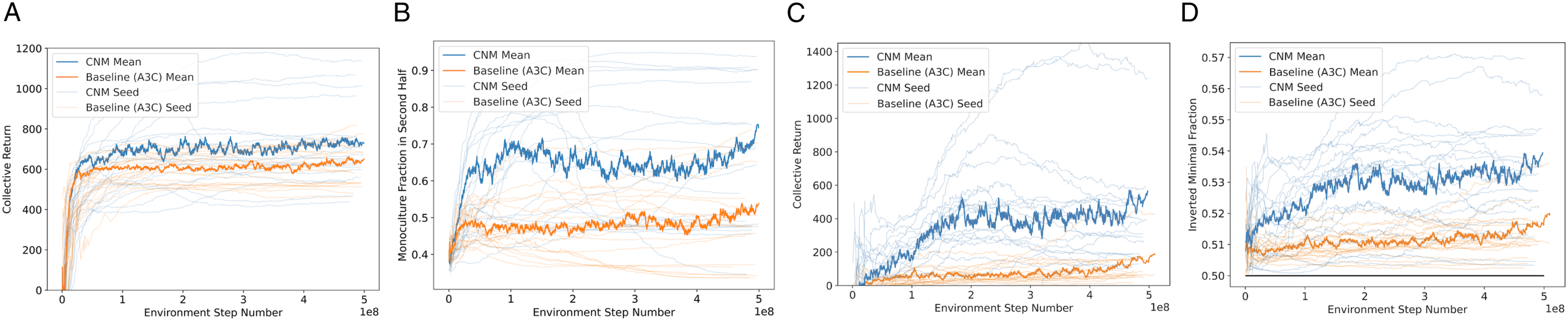
Groups of
Finally, we confirm that the improvement in reward is not somehow occurring due to a suppression of the penalty action and a consequent decrease in penalty from zap events; rather, the total amount of punishment events actually stays the same or even increases with Effect of CNM on total number of zaps averaged across seeds in (a) AH (b) CSP.
How does CNM establish social norms?
Here, we show that Evidence of stable planting behavior after 2e8 steps of training. Individual dots are samples over a run where darker dots represent later points. (a) First 2e8 steps with 
The second criterion to check concerning the establishment of a social norm is that deviations from the equilibrium should be disapproved (sanctioned). We can calculate for each color
Figure 7 demonstrates this effect for two different potential switches. Figure 7(a) measures the difference of punishment likelihood between free-riding and planting the dominant color which we call teaching signal 1. If the magnitude of this signal is large and positive, it is easier for the learning algorithm to identify that switching from free-riding to planting in that color will decrease the amount that it gets punished. Measurements of the strength of disapproving sanctions applied to deviating agents in allelopathic harvest: (a) difference between zap likelihood for being the free-rider color versus being the dominant color (b) difference of zap likelihood for being the second most dominant color to being the dominant color.
Figure 7(b) measures the relative likelihood of getting punished when we plant the color corresponding to high monoculture versus if we were to switch to plant the second most abundant berry color which we refer to as teaching signal 2. If this signal is large, it is easier for the learning algorithm to identify that sticking to the dominant color will allow it to decrease how often it gets disapproved of which in turn will help stabilize the choice of equilibrium.
Ablations on architecture components
To understand
Here we study CSP as the smaller number of agents in this environment decreases environment step time and allows us to perform more rapid experimentation. We run each ablation over 10 seeds. For point (1), we allow the classifier to continue learning throughout training. For (2) we train the classifier using only the sanctioning events directly observed by each agent. Finally, for (3), we note that in all prior experiments we have scaled the pseudorewards so that the penalty for punishing discordantly with the classifier (β) is twice the reward for punishing in accord with it (α). We aim to establish whether our results are sensitive to this particular ratio.
Figure 8 demonstrates the outcome of all of these ablations; each curve is the average across 10 seeds with std. deviations removed for visual clarity. In Figure 8(a), we can see that in the absence of a frozen classifier the collective return experiences a large early spike but then decays quickly down. While we are unable to definitively establish the mechanism that forces us to freeze the classifier, there are a few plausible ones. The move away from free-riding occurs rapidly in the first 1e8 steps of training (see Appendix Sec C). If the punishment behavior is not correspondingly suppressed quickly enough, agents performing cooperative behavior will still get punished due to exploratory noise and the classifier will consequently learn to recommend punishment of cooperative agents. Alternately, the classifier could simply experience catastrophic forgetting once a particular color is effectively suppressed: it’s difficult to remember how to sanction a behavior that no longer occurs. Consequently, the suppressed behavior is able to re-emerge. Ablations of key components of the agent architecture. (a) The classifier is not frozen during training. (b) The classifier is learned solely from sanctions experienced by the agent, that is, sanctions are private. (c) Effect of pseudoreward scale; both α and β are set to 0.9.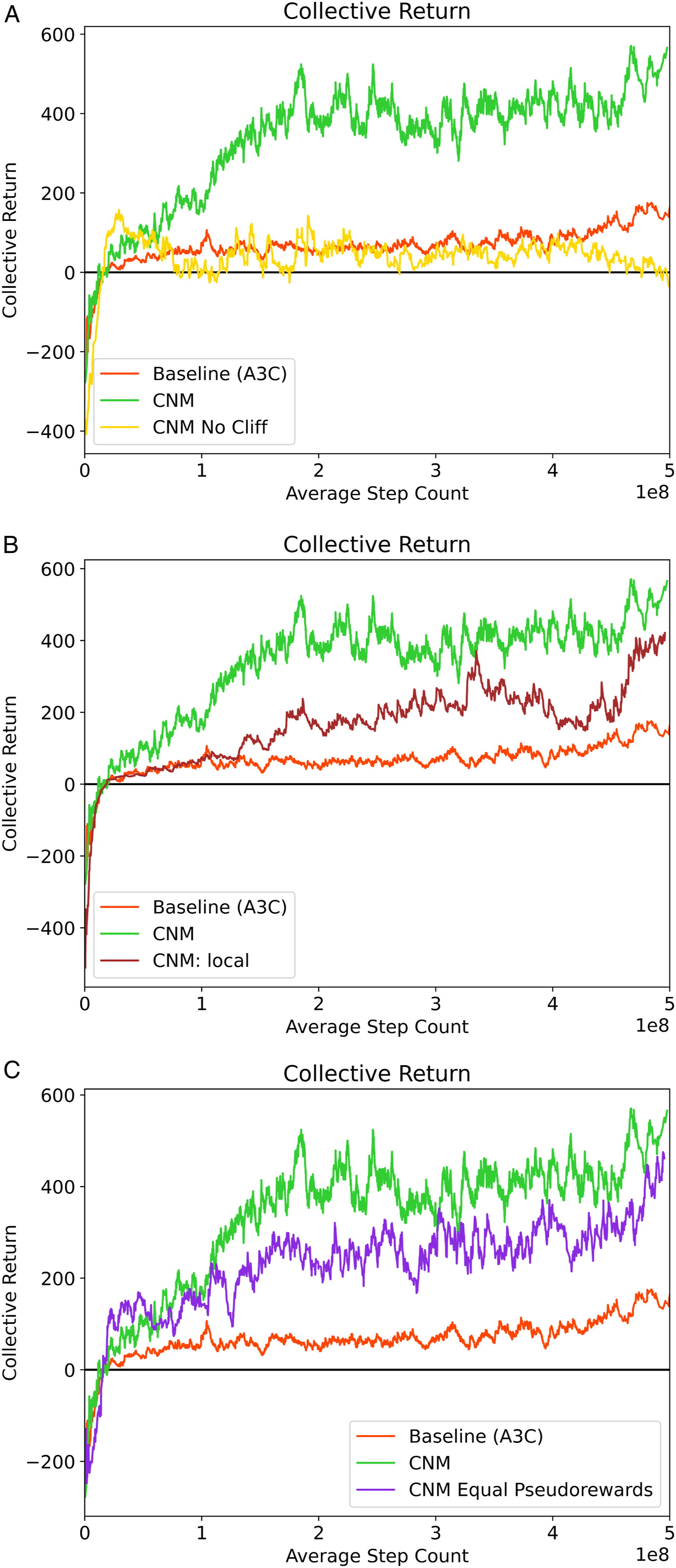
In Figure 8(b), we observe that learning solely from local sanctions does improve over the baseline but does not completely match the performance of fully public sanctions. Since the agents have to infer the norm solely through agents they happen to interact with, the number of samples available for each classifier update decreases sharply which may make the subsequent learned norm noisier and harder to learn. Finally, in Figure 8(c), we set the pseudorewards to a magnitude of 0.9 for both approval and disapproval. We note that this is less than the potential reward of consuming an apple, making it feasible for an agent to zap discordantly to the recommendation of the classifier if doing so nets them an additional apple. We see that there is a slight reduction in the collective return but there remains an improvement over the A3C baseline.
Discussion and future work
Motivated by emerging challenges in deploying multi-agent systems, we introduce and formalize a new training regime for decentralized multi-agent systems in which all sanctions are publicly observable. In contrast to centralized training methods, this approach can be trained fully online without needing access to a simulator. It also may make it easier to satisfy privacy constraints since essential proprietary data like rewards and policies do not need to be shared to achieve coordination.
We observe that in this setting decentralized agents struggle to achieve cooperative behavior in the collective action problems posed by two environments that broadly model challenges of free-riding and equilibrium selection. Inspired by social norms, which humans communities often use to overcome such dilemmas, we introduce an agent architecture
However, many open questions remain. The architecture used for the classifier, a convolutional network, relies on there being an identifiable visual cue that correlates with the behavior to be made normative. Thus, it is restricted in the types of norms it can identify. An extended
Furthermore, while we observe the appearance of seemingly stable, beneficial norms, we do not provide a complete mechanistic explanation of how this architecture selects and stabilizes equilibria. It is possible that there exist games where this architecture would exclusively select harmful norms or deeply unfair norms. From the standpoint of using
Supplemental Material
Supplemental Material - A learning agent that acquires social norms from public sanctions in decentralized multi-agent settings
Supplemental Material for A learning agent that acquires social norms from public sanctions in decentralized multi-agent settings by Eugene Vinitsky, Raphael Köster, John P Agapiou, Edgar A Duéñez-Guzmán, Alexander S Vezhnevets and Joel Z Leibo in Collective Intelligence
Footnotes
Declaration of conflicting interests
The author(s) declared no potential conflicts of interest with respect to the research, authorship, and/or publication of this article.
Funding
The author(s) received no financial support for the research, authorship, and/or publication of this article.

Supplemental Material
Supplemental material for this article is available online.
Notes
References
Supplementary Material
Please find the following supplemental material available below.
For Open Access articles published under a Creative Commons License, all supplemental material carries the same license as the article it is associated with.
For non-Open Access articles published, all supplemental material carries a non-exclusive license, and permission requests for re-use of supplemental material or any part of supplemental material shall be sent directly to the copyright owner as specified in the copyright notice associated with the article.
