



Abstract
This study examines the association between perceived school climate and self-reported youth offending among adolescents in Queensland, Australia. Drawing on social control theory, we investigate whether students’ perceptions of fairness, support, and respect within their school environment are linked to lower levels of delinquent behaviour. Using previously collected survey data from 540 Year 9 students and using Ordinary Least Squares (OLS) regression analysis, we find that more positive perceptions of school climate are significantly associated with lower youth offending scores, even after accounting for gender, cultural background, family structure, parental employment, and family attachment. The strength of the school climate-youth offending association compares in magnitude to other strong predictors of youth crime such as gender. Attachment to both mother and father also emerged as strong independent correlates of youth offending and partially attenuated the school climate/youth offending association, suggesting overlapping influences. These findings contribute to a growing body of research identifying school climate as a modifiable context for youth development. While the cross-sectional nature of the data limits causal inference, the results underscore the importance of school and family environments in shaping adolescent behaviour. Implications for theory and educational policy are discussed.
Introduction
Youth offending remains a persistent concern in criminological and educational research, with increasing attention being paid to the role of schools in shaping young people's behaviour. As children transition from early childhood to adolescence, the time spent at school increases significantly, positioning schools as critical contexts for social development (Aldridge et al., 2018; Chen et al., 2016; Sampson & Laub, 1993). This shift underscores the relevance of institutional settings, such as schools, in reinforcing or weakening pro-social bonds.
A substantial body of international research has explored how school climate, the collective perceptions of relationships, fairness, support, and engagement within school environments, shapes student outcomes, including youth offending (Cohen et al., 2009; Zullig et al., 2011). Much of this work, however, is situated in the United States and Europe. While contextually rich, these studies may not fully capture how school climate interacts with youth behaviour in other national settings, particularly those with different social structures and educational systems.
Using secondary data analysis, this study examines the link between school climate and self-reported youth offending using data from a sample of adolescents in Queensland, Australia. Rather than focusing on the geographic uniqueness of this sample, however, the contribution of this project lies in its application of social control theory—specifically, the role of school attachment as a correlate of, and possibly as a mechanism for, reducing youth offending. More specifically, Hirschi's (1969) theory posits that bonds to conventional institutions, such as schools and families, inhibit deviant behaviour. These bonds are multidimensional, encompassing attachment, commitment, involvement, and belief. While prior research often emphasises peer influences or structural strain, this paper foregrounds the relational dynamics between students and school personnel, positioning school climate as a proxy for school attachment.
This study addresses two key gaps in the literature: First, it empirically assesses whether students’ perceptions of school climate are associated with variations in self-reported youth offending. Second, it contributes to the theoretical refinement of social control theory by highlighting school climate as a contextual expression of attachment. In doing so, the research extends current understandings of how institutional relationships may operate as protective factors in adolescent development.
Conceptualising school climate: Theoretical and empirical approaches
School climate is generally defined as the social, physical, and educational environment that fosters a safe and inclusive learning setting for students and teachers (Moran, 2016; Preble & Gordon, 2011). As noted by Kuperminc et al. (1997) and Zullig et al. (2010), however, the definition and operationalisation of school climate vary considerably across the literature.
Two broad approaches are commonly used to conceptualise school climate. The first, often referred to as the administrative perspective, emphasises formal institutional features such as rule enforcement, discipline structures, and policy frameworks. This view is exemplified by Gottfredson (1986), who defined school climate in terms of “orderliness” and a school's ability to control misconduct through effective administrative strategies (Gottfredson et al., 2000). In this framework, school climate is often evaluated by how staff respond to misbehaviour and whether institutional procedures maintain safety and order.
In contrast, the student-centred perspective focuses on students’ subjective experiences within the school environment. This approach emphasises perceptions of fairness, support, inclusiveness, and quality of interpersonal relationships (Cohen et al., 2009). Student-centred models may also incorporate views from other school participants, such as teachers and parents, and sometimes include attention to learning structures and classroom practices (National School Climate Council, 2007). Recent research has increasingly favoured this approach, particularly in studies examining student engagement, school connectedness, and behavioural outcomes (Aldridge et al., 2018; Keppens & Spruyt, 2019; Mitchell & Bradshaw, 2013; Sprott, 2004).
While the distinction between administrative and student-centred perspectives has been useful in organising school climate research, it is not without critique. Voight and Nation (2016), for example, argue that both perspectives often overlook how school climate is shaped by broader structural inequalities and how it is experienced differently across racial, cultural, and socioeconomic lines. They call for a more equity-oriented and systemic approach that incorporates institutional factors such as exclusionary discipline practices, cultural responsiveness, and power dynamics within schools. These critiques suggest that research should move beyond individual perceptions and administrative structures to consider how school climate is embedded within larger social and institutional contexts.
Despite these critiques, student perceptions remain a central focus in much of the empirical literature, particularly in relation to behavioural outcomes. For instance, Ginevra and colleagues (2015) found that students’ perceived access to support services, rather than the objective availability of services, was more strongly associated with positive outcomes.
Similarly, Quin (2017) and Ryan et al. (2019) identified strong teacher–student relationships as important predictors of student engagement, academic performance, and reduced disruptive behaviour. These findings suggest that the way students experience school life, and particularly their interactions with teachers and peers, plays a crucial role in shaping behavioural trajectories (Konishi et al., 2017).
This emphasis on interpersonal relationships, particularly those involving teachers and students, forms a conceptual bridge to the criminological literature, where informal social bonds are considered protective factors against deviant behaviour. The next section explores this theoretical connection in more depth, focusing on the role of school attachment in established criminological theories of youth offending.
Theoretical frameworks and youth offending
Much of the existing literature on school climate and student behaviour highlights the importance of teacher support, fairness, and peer relationships in promoting pro-social conduct (Welsh, 2000; Wentzel, 1998). These interpersonal dynamics have been emphasised in both educational and criminological research for their role in reinforcing normative behaviour. Within education, scholars have pointed to the teacher's role not only in academic instruction but also in shaping students’ social values and expectations for adulthood (Preble & Gordon, 2011). Approachable, credible, and fair teachers are consistently associated with improved classroom engagement and fewer behavioural disruptions (Croninger & Lee, 2001; Ryan et al., 2019; Wentzel, 1998).
From a criminological perspective, this study adopts Hirschi's (1969) social control theory, which shifts the analytic focus from why individuals commit delinquent acts to what prevents them from doing so. Hirschi argued that strong bonds to conventional institutions; family, school, and community, deter individuals from violating norms. These bonds consist of four components: attachment, commitment, involvement, and belief. As children age and their engagement with the school environment increases, schools become central to sustaining these social bonds, particularly in the form of attachment to teachers and commitment to schoolwork (Payne, 2008).
The school setting is especially influential in the domains of involvement and commitment, as students spend a significant portion of their time engaged in academic and extracurricular activities. Prior studies suggest that participation in school-sponsored sports, academic pursuits, and structured routines can reduce delinquent behaviour, albeit with modest effects (Hart & Mueller, 2013; Sandahl, 2016). It is attachment, however, particularly to teachers and the school, that has shown the strongest relationship to reductions in antisocial behaviour (Laurito et al., 2019; Preble & Gordon, 2011). When students perceive their environment as fair, inclusive, and responsive, they are more likely to internalise school values and norms (Keppens & Spruyt, 2019; Nickerson et al., 2014).
Although this study is grounded in social control theory, other frameworks also offer valuable insights. Differential association theory, for example, emphasises the role of peer influence and learned behaviour in shaping youth offending. From this perspective, the social climate of a school may affect the types of interactions students have with peers, thereby influencing behavioural outcomes. Strain theory proposes that stressors, such as academic failure or perceived injustice, may prompt students to engage in youth offending as a coping mechanism. While these alternative frameworks are not the central focus of the present study, they provide complementary explanations that underscore the multifaceted relationship between school climate and youth behaviour.
Family context also plays an important role in shaping adolescent behaviour, particularly through the strength and stability of family bonds. Situations such as parental separation or unemployment can undermine these bonds by introducing emotional strain, reducing supervision, or disrupting household routines. From a social control perspective, such disruptions may weaken attachment to family as a conventional institution, increasing the likelihood of deviance. Similarly, strain-based theories would view these circumstances as stressors that may contribute to maladaptive coping behaviours. Recognising the influence of family circumstances provides a more comprehensive understanding of the social environments that affect youth behaviour, alongside the climate of the school.
By emphasising student perceptions of fairness, support, and attachment within the school setting, this study builds on the social control tradition while acknowledging the complex, overlapping mechanisms that may connect school climate to youth offending.
School climate and youth offending: Empirical findings
A growing body of research has explored how school climate relates to student behaviour, although most of this research focuses upon in-school misconduct (e.g., Aldridge et al., 2020; Hemphill et al., 2014; Petrie, 2014) rather than more general forms of youth offending. Much of this work has focused on the quality of student-teacher relationships and students’ perceptions of fairness, support, and inclusivity. Positive perceptions of teacher support and rule clarity have been linked to decreased engagement in antisocial behaviour, truancy (Hamlin, 2021), gang membership (Thompson et al., 2020), and violence (Aldridge et al., 2018; Keppens & Spruyt, 2019; Kutsyuruba et al., 2015; Sandahl, 2016).
In the criminological literature, the interpersonal dimensions of school climate are often examined through the lens of informal social control (Cernkovich & Giordano, 1992). Teachers who are approachable, credible, and fair are more likely to foster positive attachment among students, which in turn, reduces the appeal of norm-violating behaviour (Laurito et al., 2019; Preble & Gordon, 2011). Studies have shown that this attachment can be particularly powerful when combined with meaningful schoolwork, classroom order, and consistent disciplinary practices (Hart & Mueller, 2013; Nickerson et al., 2014).
Empirical findings from the United States and Europe generally support these associations. For example, Lo and colleagues (2011) found that prosocial attachments to churches, schools, and families were inversely related to general delinquency among public school students in Alabama. In Sweden, Sandahl (2016) examined multiple dimensions of school climate across 76 public schools and found that student perceptions of encouragement, communication, and academic engagement were linked to lower delinquency rates. While effect sizes sometimes varied by gender or other demographic factors, the overall pattern supported the view that a supportive school climate plays a protective role.
Findings from Australia have been more limited in scope but point in similar directions. Aldridge et al. (2018), for instance, reported that teacher support, school connectedness, and rule clarity were negatively associated with bullying and self-reported delinquent behaviour in a sample of over 6,000 high school students. Other Australian studies have examined links between school climate and academic achievement (Beatton et al., 2016; Carroll et al., 2009; Riele, 2006), mental health (Cumming et al., 2014), and social inclusion (Goldstein & Heaven, 2000), though fewer have focused explicitly on general youth offending.
Notably, much of the international literature focuses on behaviours that occur within the school setting such as truancy, in-class aggression, or bullying, rather than broader delinquent acts that may occur outside of school. Some research also suggests that not all dimensions of school climate exert equal influence. Zaykowski and Gunter (2012), for example, found that while fairness and teacher-student respect predicted serious youth offending (e.g., assault), these factors had less impact on more minor infractions. These variations in operationalisation and outcome measures complicate cross-study comparisons and highlight the need for more consistent conceptual and methodological frameworks.
Despite these nuances, the literature generally supports the idea that students’ perceptions of the school environment influence their behavioural choices. At the same time, important gaps remain, underscoring the need to extend this line of inquiry by incorporating a different national context, a broader behavioural outcome, and an explicit theoretical framework.
Research focus
Building on existing literature, this study investigates whether students’ perceptions of school climate are associated with self-reported youth offending among adolescents in Queensland, Australia. Drawing on social control theory, the analysis emphasises the role of school attachment, operationalised as student perceptions of fairness, support, and relational trust, as a potential protective factor against delinquent behaviour. While the study is grounded in this theoretical tradition, it also acknowledges that other mechanisms, such as peer influence and strain, may intersect with school climate to shape youth outcomes. By focusing on general youth offending rather than school-specific infractions, and using a non-United States. sample, this research addresses several gaps in the literature and contributes to a more diverse understanding of how school environments may influence adolescent behaviour.
Methods
Study design and sample
The data for this study were drawn from a survey of Year 9 students (mean age = 13.4 years) across five Queensland secondary schools, selected based on socio-economic representation and reported levels of elevated behavioural issues. This purposive sampling approach was designed to increase variability in delinquent behaviour, following a strategy like the Rochester Youth Development Study (Smith et al., 1995). All Year 9 students (N = 977) enrolled in the selected schools were invited to participate. Of these, 69% (n = 674) returned parental consent forms. On the day of administration, 540 students (79% of those with consent) were present and completed the questionnaire, yielding a final response rate of 55.3%.
Although a 21% absentee rate on the day of data collection may appear high, it is consistent with national trends, particularly for Year 9 students. A recent study from Victoria, Australia reported that Year 9 students missed an average of 6.5 weeks of school in 2023, which equates to approximately 16.5% of the school year (Hudson & Ambrosy, 2024). Given that absenteeism tends to be higher in schools with elevated behavioural challenges, such as those in our sample, the observed rate is not unexpected.
Considering these contextual factors, it is important to consider the demographic characteristics of the sample. A key criterion for selecting schools in the original study was the socio-economic profile of their geographically proximate Local Statistical Areas (LSAs), as measured by the Index of Relative Socio-Economic Disadvantage (IRSED), using the state median as a benchmark (Buckley et al., 2010). Of the 10 schools initially approached, five agreed to participate. Two were in areas with IRSED scores above the state median of 998 (Australian Bureau of Statistics, 2001, 2021), two were below the median, and one was close to the median.
Census data available at the time of the study indicated that minority students were modestly overrepresented across the sample, though representation varied between schools. One school had a notably high proportion of minority students (27.4%), while another had only one minority student (2.3%). The remaining three schools had minority representation rates comparable to the national average for minority students (15.6%, 13.5%, and 17.4%, respectively).
Rather than attempting to average out demographic and family-level differences through a purportedly representative sample, our analytic strategy incorporates these characteristics directly as control variables. This approach allows us to assess whether observed associations between school climate and youth offending persist after accounting for these demographic factors. In accordance with the original study agreement, the participating schools cannot be identified by name.
Measures
Dependent variable
Youth offending was measured using a composite scale adapted from the Australian Self-Report Delinquency Scale (Mak, 1993). The scale includes 26 dichotomous items asking students whether they had engaged in various delinquent behaviours over the past three months (e.g., theft, vandalism, truancy). Each item was coded as 1 (yes) or 0 (no), and responses were summed to create an additive offending score, with higher values indicating greater involvement in delinquent behaviour. Items were not weighted by severity, consistent with a large portion of the prior self-report delinquency research. The scale demonstrated high internal consistency (Cronbach's α = .899). In the analytic sample, scores ranged from 0 to 23 (M = 2.91, SD = 4.07). A full list of items is provided in Appendix A, and descriptive statistics for all continuous variables are presented in Table 1.
Summary statistics for continuous variables (n = 540).
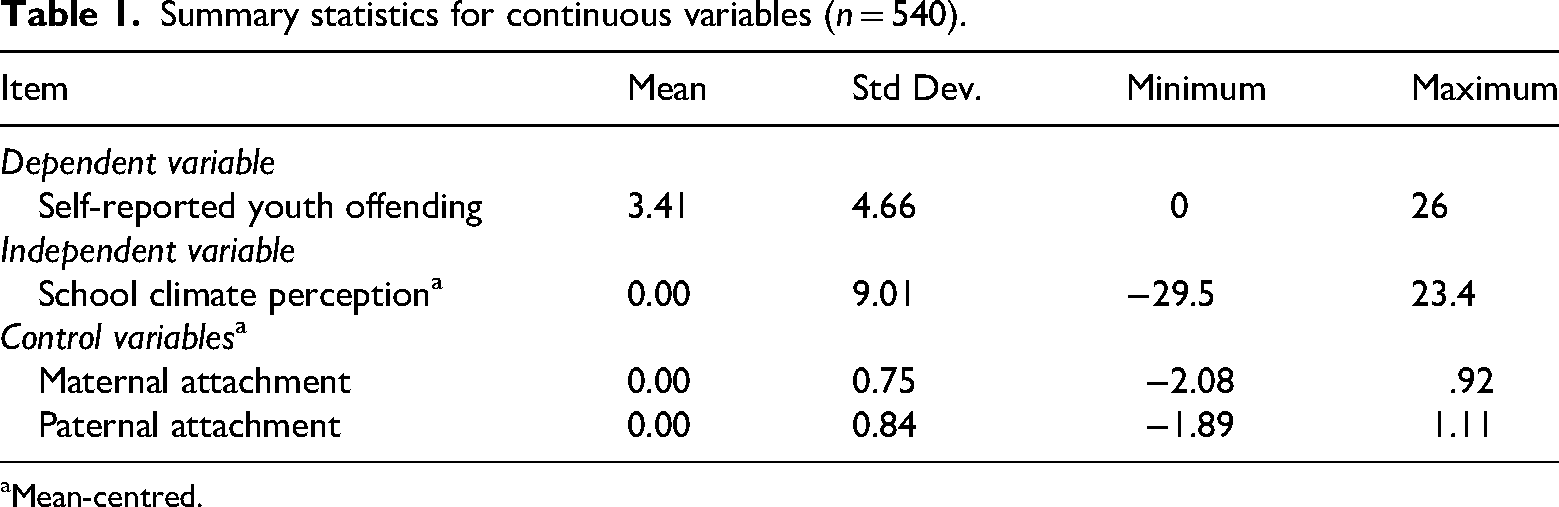
Mean-centred.
Independent variable
School climate was measured using eight items adapted from a scale developed by Western and colleagues (Western et al., 2003). All items asked students to report on the quality of relationships between teachers and students, as well as among students themselves. Example statements include “Students treat classmates with respect” and “Students can talk to their teachers about problems”. Students responded to each item on a 10-point Likert-type scale ranging from 1 (strongly disagree) to 10 (strongly agree). Two items were removed during preliminary analysis to improve internal consistency, resulting in a six-item scale with acceptable reliability (Cronbach's α = .734). Higher scores indicated more positive perceptions of school climate. To aid interpretation, the scale was mean-centred, so the regression model's intercept reflects the expected level of youth offending for participants with average school climate scores. In models with control variables, the intercept represents expected offending for participants with average school climate scores and zero values on all other predictors. School climate means for the five schools ranged from 35.23 to 38.93 (F = 1.63; p = .164). Descriptive statistics for the school climate scale are presented in Table 1. A list of all eight questions is shown in our Appendix.
Control variables
Several control variables were included in the analysis to account for individual and family level factors. Their inclusion is grounded in prior research and supported by relevant criminological theories, including social control theory, and, where appropriate, general strain theory (Agnew, 1992). These variables were also included in recognition of the likelihood that demographic and background characteristics may influence not only youth offending, but also students’ perceptions of school climate.
Gender was coded as a binary variable (1 = male, 0 = female), based on consistent findings that males report higher levels of youth offending across a variety of contexts.
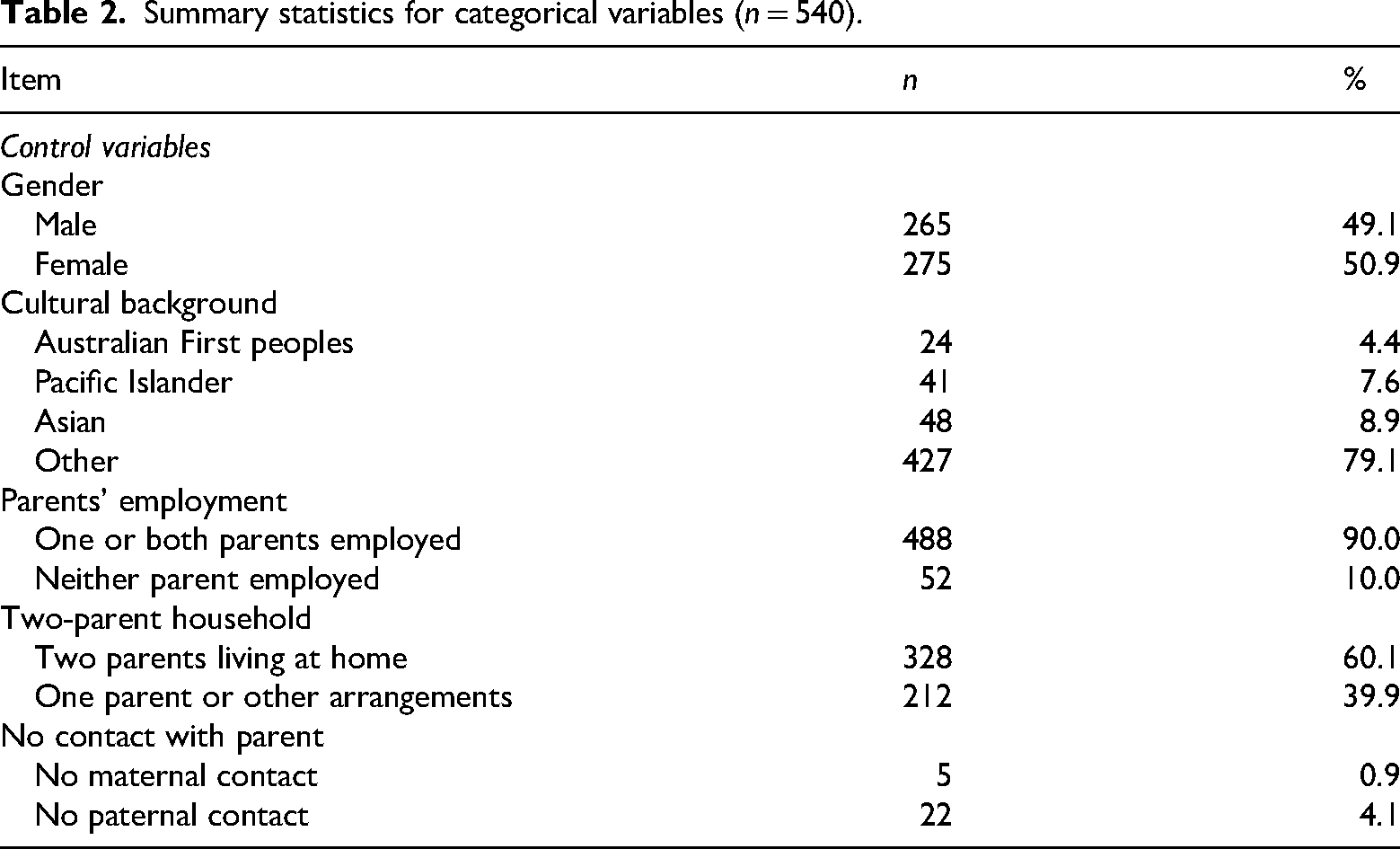
Cultural background was measured using a set of categorical variables based on students’ self-identification. Participants identified as being of Asian descent (8.9%, n = 48), Pacific Islander descent (7.6%, n = 41), Aboriginal descent (3.7%, n = 20) or Torres Strait Islander background (0.7%, n = 4) or Other (79.1%, n = 427). Due to small subsample sizes, Aboriginal and Torres Strait Islander students were combined into a single First-peoples category. These variables were entered into our regression models as a set of dummy variables, with Anglo-Australian/Other students serving as the excluded reference group. Including these background measures allows for the examination of potential differences linked to culture, socialisation, structural disadvantage, or experiences of marginalisation.
Parental employment was recorded as a binary variable indicating whether at least one parent was employed full-time (1 = yes, 0 = no). As identified by Western and colleagues (2003), parental employment serves as a broad proxy for socioeconomic status that early adolescents can report. From a theoretical standpoint, lower parental employment may also contribute to economic strain in the household, a stressor that, under General Strain Theory (Agnew, 1992), could increase the likelihood of delinquent behaviour by creating negative emotional states and reducing legitimate coping resources.
Two-parent household was coded as a binary variable (1 = lives with two parents, 0 = otherwise). This measure reflects the degree of family structure and stability, a key construct in social control theory, but may also be seen as a potential indicator of family disruption or instability, which could act as a strain-inducing factor in line with strain theory.
Measuring family attachment presents challenges due to the diversity of contemporary family structures, yet it remains a vital component in our models. Consistent with social control theory, family attachment represents internal bonds that foster conformity and discourage deviant behaviour. To capture this construct, we employed four variables: separate maternal and paternal attachment scores, and two binary indicators denoting whether attachment items for each parent were left unanswered.
Assessing maternal and paternal attachment independently allows for recognition of differing emotional closeness or contact levels with each parent, which may uniquely influence adolescent behaviour. This approach avoids assuming a uniform family experience and supports a more nuanced analysis of parental relationships and youth outcomes.
Attachment was measured using an eight-item scale adapted from Lynch et al. (2003), capturing emotional closeness and communication. Items such as “she/he speaks to me in a warm and friendly tone” and “she/he gives me praise” were included, with the full list provided in the Appendix. Scores were summed and centred separately for each parent (e.g., maternal_attachment, paternal_attachment), with both scales showing high internal consistency (Cronbach's α = .868 and .879, respectively).
Nonresponse to all attachment items for a parent, whether due to skip patterns or lack of contact with that parent, typically signals insufficient interaction to provide meaningful data. For example, a participant living with their mother but lacking contact with their father would likely omit paternal attachment items. Importantly, co-residence does not reliably indicate emotional attachment, as strong bonds may exist with non-resident parents. Thus, such nonresponse should not be treated as conventional missing data. In cases of parental absence, the attachment measure should be considered inapplicable rather than missing.
For this reason, participants who did not respond to a parent's attachment items were assigned a value of 1 on a binary indicator reflecting lack of meaningful contact (e.g., No_Dad, No_Mum), and 0 otherwise. Those flagged as having no meaningful attachment to either parent were assigned the sample mean (i.e., zero after centring) for the corresponding attachment score.
In the regression models, the two continuous attachment variables for maternal and paternal attachment represent the expected change in juvenile offending for each unit increase in perceived attachment to a parent. The two binary indicators reflect the difference in juvenile offending between those without meaningful contact with a parent and those with average levels of attachment to the parent. Descriptive statistics for the categorical control variables are presented in Table 2.
Summary statistics for categorical variables (n = 540).
Missing data
Of the 540 students in our sample, varying levels of missingness were observed across key measures. Six students did not respond to any of the youth crime items, and four did not answer any of the school climate questions. Five students did not provide responses to any maternal attachment items, while 22 did not answer any paternal attachment items. Additional missing data were recorded for parental employment (n = 15), two-parent household status (n = 5), and gender (n = 2). While the proportion of missing values for any individual variable was relatively small, the cumulative effect across all variables resulted in 124 cases with incomplete data for the full regression model.
We addressed the missing data using two different approaches. The first and most basic was listwise deletion, in which only participants with complete data across all variables in the final model were retained. This approach reduced the analytic sample to 416 students.
Listwise deletion, however, may yield inaccurate results unless the missing data are “mpa#ldquo;Missing Completely At Random” (MCAR), meaning the complete cases are equivalent to a random subsample of the full sample (Little & Rubin, 1987). Even when data are MCAR, listwise deletion reduces statistical power by discarding otherwise useful observations.
The second approach we used was Multiple Imputation (MI), a more robust method developed by Donald Rubin and made more accessible through its more recent integration into modern statistical software (Rubin, 1996; Schafer, 1999; Schafer & Graham, 2002). Unlike older methods that replace missing values with a single estimate (e.g., the mean), multiple imputation creates several versions of the dataset, each with slightly different imputed values based on observed data patterns. Each version is analysed separately, and results are combined to produce estimates that reflect both within- and between-imputation variability. This method reduces bias and improves accuracy compared to single imputation methods or listwise deletion.
One common area of confusion is determining when multiple imputation is appropriate. Much of this confusion may stem from Rubin's technical terminology describing missing data mechanisms. Rubin (1987) distinguished between MCAR, Missing At Random (MAR), and Missing Not At Random (MNAR). In MCAR situations, missingness is unrelated to any observed or unobserved variable. In MAR cases, missingness is systematically related to observed variables, those already included in the dataset and available for use during imputation. For example, if older students are less likely to answer a question about delinquency, and age is included in the model, the data are likely MAR.
By contrast, MNAR refers to cases where the probability of missingness is related to unobserved values, those not captured in the dataset or not included in the imputation model (e.g., students with higher levels of offending choosing not to report their behaviour, and no available variable can account for this). In such cases, plausible imputation becomes much more difficult.
MI is unnecessary under MCAR conditions except to preserve sample size. Under MAR conditions, however, it yields near-unbiased parameter estimates, permitting MAR (or MCAR) conditions to produce extremely accurate results. Researchers can improve the plausibility of MAR by including variables that are likely related to both missingness and the outcome of interest.
In practice, MAR cannot be empirically verified without follow-up data from nonrespondents or by imposing unverifiable modelling assumptions (Glynn et al., 1993; Little & Rubin, 1987). Departures from MAR are common, but usually inconsequential. As Graham and colleagues (1997) point out, modest violations often have minimal effects on estimates. Similarly, Collins and colleagues (2001) found that even when relevant predictors of missingness are omitted, the resulting bias in parameter estimates and standard errors is often small in realistic applications. In sum, despite some uncertainty around the missing data mechanism, multiple imputation consistently outperforms listwise deletion and single imputation, and nearly always produces more accurate and less biased results.
Some scholars mistakenly cite the results of Little's MCAR test as evidence that the missing data mechanism meets the MAR (or MCAR) condition required for multiple imputation. This reflects a common misunderstanding. As noted earlier, the MAR assumption cannot be empirically verified under typical research conditions. Little's MCAR test does not confirm MAR or MCAR; rather, it only tests whether the MCAR assumption is statistically untenable. A significant result suggests that MCAR is unlikely but does not distinguish between MAR and MNAR. In our case, the test produced a p-value of .902, indicating no substantive evidence against the MCAR hypothesis. This result does not confirm that the data are MCAR, only that we lack evidence to reject that possibility. Therefore, we cannot conclude that listwise deletion is inappropriate for any reason beyond the expected loss of statistical power.
One common issue arises when using MI with questionnaire data at times where item responses are combined into scales. Researchers must choose between item-level imputation (imputing missing responses before computing scale scores) and scale-level imputation (imputing missing scale scores directly). Item-level imputation is generally preferred because it provides more accurate and efficient estimates. By preserving the granular structure of the data, it allows the imputation model to draw on correlations among individual items, such as the tendency for individuals who report one form of misbehaviour (e.g., theft) to also report another (e.g., vandalism). In contrast, imputing scale scores directly can obscure these relationships and artificially inflate internal consistency or reduce variance, potentially overstating effect sizes. Research shows that while both methods may yield similar parameter estimates, item-level imputation typically results in greater statistical power and efficiency, especially when sample sizes are adequate to support it (Gottschall et al., 2012). In this study, item-level imputation was used for both the delinquency and school climate measures.
We used the MI procedure in SPSS version 30 to generate five imputed datasets. The imputation model included all variables used in the analysis, including the two-way interaction terms described in the results section. Both the delinquency and school climate measures were imputed at the item level to preserve the internal structure of the scales. For each of the four regression models reported, analyses were run separately on the five imputed datasets, and the results were combined using Rubin's rules, a process implemented automatically by SPSS's multiple imputation procedure. SPSS, however, does not automatically compute pooled standardised regression coefficients. To obtain these, we standardised the relevant variables prior to imputation in a parallel set of models and calculated the standardised coefficients manually (Van Ginkel, 2020).
Analytic strategy
We used Ordinary Least Squares (OLS) regression to estimate the association between perceived school climate and self-reported youth offending. While the dependent variable is an additive index ranging from 0 to 26 and may be considered count-like in form, we judged OLS to be an acceptable approach given the approximately continuous distribution of scores in our sample. To assess robustness, we also estimated negative binomial models (Gardner et al., 1995), which are more appropriate for over-dispersed count data. These alternative models produced substantively similar results, particularly with respect to the direction and significance of key relationships.
In addition, we conducted parallel analyses using both listwise deletion and MI to address missing data as mentioned earlier. Across these approaches, we found consistent results in terms of the direction and strength of associations and the general pattern of correlations among variables. Given our primary focus on the direction and magnitude of relationships rather than precise prediction, we present the more parsimonious OLS estimates based on the imputed datasets.
Results
Association between school climate and youth offending
Model 1 in Table 3 shows that perceived school climate is significantly and negatively associated with self-reported youth offending (b = –0.096, p < .001). For each unit increase in the school climate scale, the predicted youth offending score decreases by approximately 0.096 units. While this unstandardised coefficient may appear modest, the school climate scale ranges from 8 to 69, meaning that larger differences in perceived climate could be associated with more substantial variation in youth offending scores.
OLS regression of youth crime on school climate (n = 540).
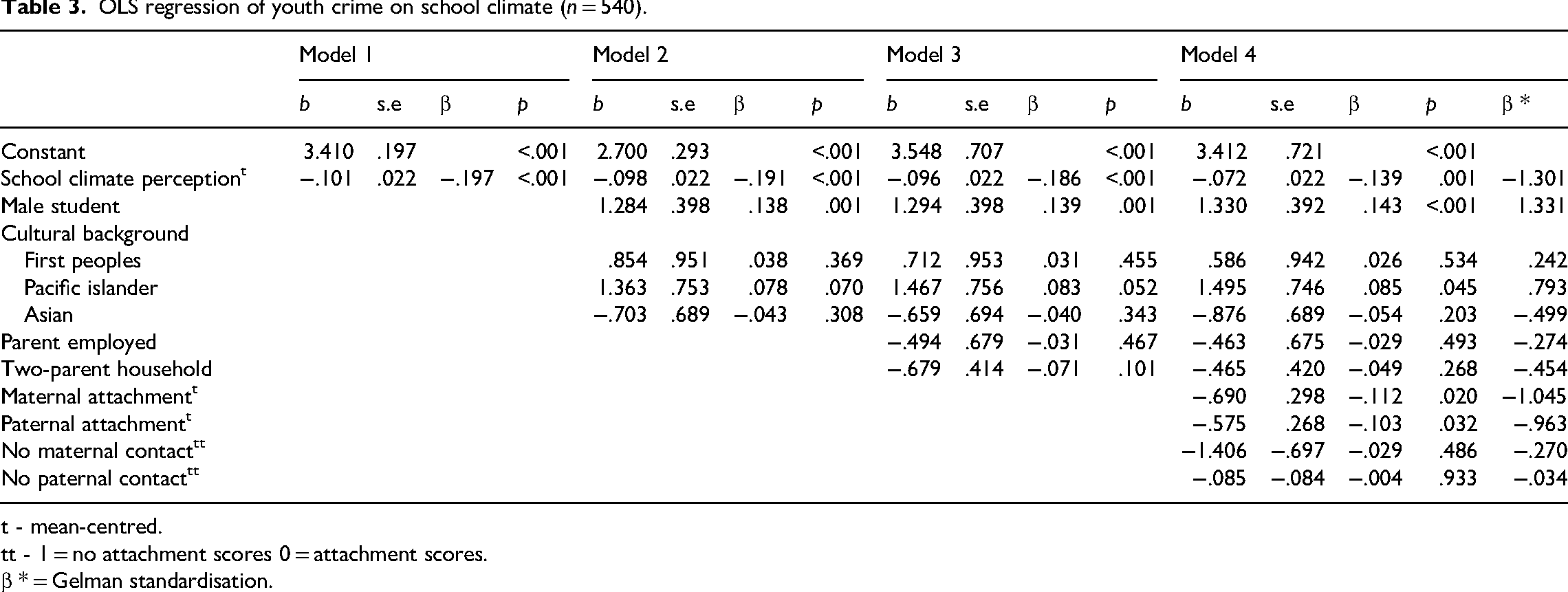
t - mean-centred.
tt - 1 = no attachment scores 0 = attachment scores.
β * = Gelman standardisation.
To better understand the relative strength of this relationship, we will turn at a later point to standardised coefficients, which allow for comparison across predictors measured on different scales. These are discussed in more detail in Model 4, where all key predictors are included and comparative interpretation becomes more meaningful.
The standard error for the school climate coefficient in Model 1 indicates that, with approximately 68% confidence, the population slope falls within ±.021 of the observed estimate. Because the school climate variable was centred on its mean, such that students with average perceptions of school climate are coded as zero, the intercept (or constant term) represents the expected number of self-reported youth offences for an average student in the sample. This expected value is 3.41 offences. Students with more positive perceptions of school climate report lower levels of youth offending than this average.
Demographic predictors of youth offending
Model 2 introduces demographic controls for gender and cultural background. Gender is significantly associated with youth offending, with males reporting youth offending scores that are, on average, 1.037 points higher than those of females (p = .008). None of the cultural background variables are statistically significant, indicating no meaningful differences in youth offending based on students’ self-identified background.
Importantly, the inclusion of these demographic controls does not substantially alter the strength or direction of the school climate/youth offending association observed in Model 1. This suggests that the observed relationship between school climate and youth offending cannot be explained by differences in gender or cultural background. In other words, the association is not simply the result of males or minority students both reporting more youth offending while perceiving school climate more negatively. Rather, it reflects a relationship that persists after adjusting for demographic composition. This finding also highlights a broader issue in social research: efforts to construct what some survey companies term “representative” samples often focus narrowly on demographic quotas such as gender balance or proportional representation of minority groups and age categories while overlooking the structural and experiential factors that may be more consequential for understanding social outcomes. Our results illustrate that meaningful patterns can emerge independently of these surface-level demographic distributions in research samples when demographic control variables are included in regression models, underscoring the importance of looking beyond demographic representativeness as a proxy for external validity.
As in Model 1, because the school climate variable was centred on its mean and the demographic variables were coded as binary indicators (0 or 1), the intercept represents the expected number of self-reported youth offences for an average student who is female and not part of a minority group. This expected value is 2.70 offences.
Family structure and youth offending
Model 3 introduces two family context variables: parental employment and two-parent household status. Parental employment is not significantly associated with youth offending, suggesting no meaningful difference in offending scores between adolescents with at least one employed parent and those with none.
While students living with two parents reported slightly lower average offending scores than those in other family arrangements, this difference did not reach statistical significance (p = .101). This suggests that the protective influence often attributed to two-parent households may be more complex or context-dependent than commonly assumed, and that other factors such as school climate may play a more central role in shaping youth behaviour.
Importantly, the inclusion of these family structure variables does not substantially change the strength or direction of the association between school climate and youth offending observed in earlier models. Stated in another way, this suggests that the relationship between school climate and youth offending is not explained away by differences in household composition or employment context.
As in prior models, because the school climate and parental attachment variables were centred on their mean and all others variables were coded as binary indicators (0 or 1), the intercept represents the expected number of self-reported youth offences for an average student who is female, not part of a minority group, who has unemployed parents and who does not live in a two-parent household. This expected value is 3.55 offences.
Family attachment
Model 4 adds our four family attachment variables to the regression analysis. After accounting for all previously introduced variables, both maternal and paternal attachment are significantly associated with lower levels of youth offending. A one-unit increase on the maternal attachment scale is associated with a reduction of 0.690 offences, while a one-unit increase in paternal attachment corresponds to a reduction of 0.575 offences. Both coefficients are statistically significant at the .05 level.
In contrast, the binary indicators for having no meaningful contact with one or both parents are not statistically significant. For illustrative purposes, however, the coefficients for these variables (–1.406 for no maternal contact and −0.085 for no paternal contact) suggest that students without contact with a mother or father report lower levels of youth crime than those who do have contact but feel less than average attachment to that parent. Given their lack of statistical significance, though, it would be unwise to generalise these findings to the broader population.
We clarified the relative strength of predictors in Model 4 through both conventional and alternative standardisation techniques. Traditionally standardised coefficients indicate that a one standard deviation increase in maternal attachment is associated with a 0.112 standard deviation decrease in youth offending, while a similar increase in paternal attachment corresponds to a 0.103 standard deviation decrease.
To improve interpretability, especially when comparing binary and continuous variables, we also applied the standardisation method proposed by Gelman (2008), which scales all predictors by two standard deviations (indicated by β*). This approach offers a more intuitive comparison across different types of variables. Based on these Gelman-standardised coefficients, gender shows the strongest association with youth offending (β* = 1.331), followed closely by school climate (β* = –1.301), maternal attachment (β* = –1.045), and paternal attachment (β* = –0.963).
It is worth noting that maternal and paternal attachment are moderately correlated (r = .48), indicating that strong attachment to both parents jointly contribute to lower levels of youth crime, more so than attachment to just one parent. Overall, these findings underscore that both family attachment and school climate are substantial and independent predictors of adolescent offending, with associations comparable in magnitude to traditionally robust demographic predictors like gender.
Importantly, unlike the control variables introduced in Models 2 and 3, the inclusion of family attachment variables in Model 4 appears to meaningfully attenuate the association between school climate and youth offending. The coefficient for school climate decreases in magnitude from −0.096 in Model 3 to −0.072 in Model 4 (a 25% reduction), though it remains statistically significant (p = .001). While a comprehensive exploration of the mechanisms linking parental attachment to youth offending is beyond the scope of this article, a test using the process macro for SPSS (Hayes, 2013) confirms that this reduction in the school climate coefficient is unlikely due to chance alone. Given the cross-sectional nature of our data, we cannot determine the temporal ordering or causal pathways underlying these associations. It is evident, however, that adolescents’ perceptions of school climate and parental attachment are each associated with youth offending and are themselves meaningfully interrelated.
As in the previous models, because the interval-level variables were centred on their means, and all other variables were coded as binary indicators (0 or 1), the intercept (3.412) represents the expected number of self-reported youth offences for a female student, not from a minority background, who has unemployed parents, does not live in a two-parent household, and reports average levels of attachment to both mother and father, and has not been flagged as having no meaningful maternal or paternal contact.
Interactions
Although we are not aware of prior research predicting statistical interactions between our key independent variables and youth offending, we conducted exploratory analyses to examine several theoretically plausible two-way interactions. Specifically, we tested interactions between school climate and (a) gender, (b) maternal attachment, (c) paternal attachment, and (d) parental employment, as well as interactions between gender and two-parent household status. We also examined for a possible interaction between maternal and paternal attachment. None of these interaction terms were statistically significant, with all associated p-values exceeding .20.
Summary of findings
In sum, the results indicate that both school climate and family attachment are significantly and independently associated with self-reported youth offending among adolescents. These associations remain robust even after accounting for demographic background and family structure factors. Based on the Gelman-scaled beta coefficients (β*), gender stands out as the strongest predictor of youth offending in the model. School climate follows closely, with maternal attachment showing a similarly strong association, and paternal attachment contributing a slightly smaller but still meaningful relationship. While some control variables, such as two-parent household status, do not reach statistical significance, the overall pattern underscores the central role of adolescents’ social environments, particularly school and family, in shaping behavioural outcomes. These findings provide a foundation for the discussion of theoretical and policy implications in the next section.
Discussion
Before turning to the theoretical and policy implications of our findings, it is important to address two potential concerns: the non-representativeness of our sample and our choice of analytic strategy. First, while our sample was drawn from schools with known behavioural challenges and is not intended to be representative of the broader student population, this design was intentional and theoretically motivated. Our aim was not to estimate population-level rates of youth offending, but to test whether theoretically grounded associations, particularly those derived from social control theory, hold in a context where variability in the outcome of interest is likely to be observed. The inclusion of key demographic and family-level controls further supports the robustness of the observed associations, suggesting that the school climate/youth offending relationship is not merely a reflection of sample composition.
Second, if we were interested in more precisely predicting the number of youth offences that students in our sample might commit, a count-based modelling approach such as Poisson or negative binomial regression would likely be more appropriate. However, our primary objective was not prediction per se, but rather to examine the associations between theoretically relevant constructs such as school climate and family attachment and self-reported youth offending. OLS regression was selected because it offers greater interpretability, particularly when comparing the relative strength and direction of associations across multiple predictors. This is especially important in the context of theory testing, where our goal is to assess the applicability of social control theory and related frameworks in explaining adolescent behaviour. OLS also facilitates clearer communication of findings to nontechnical audiences, including educators and policymakers, for whom interpretability is often more valuable than predictive precision, particularly when designing interventions or evaluating programme impact. While we conducted robustness checks using negative binomial models, which produced substantively similar patterns, we retained OLS to support our emphasis on inference and theoretical clarity.
The results of this study reinforce the theoretical proposition that adolescents’ bonds to school and family are meaningfully associated with their involvement in youth offending. Our analysis was designed to assess whether these associations align with expectations derived from social control theory, rather than to optimise predictive accuracy. The persistence of the school climate/youth offending relationship across multiple models, even after adjusting for demographic and family structure variables, supports the idea that relational dynamics within institutional settings matter. These findings also highlight the value of using interpretable models to test theoretical claims, particularly when the goal is to inform both scholarly understanding and practical interventions.
Among the various predictors examined, family attachment emerged as particularly influential. When family attachment was introduced into the model, the strength of the school climate coefficient declined more than with any other set of variables. This attenuation may indicate a partial overlap in what these constructs capture since both relate to adolescents’ sense of connectedness, supervision, and emotional support. While our cross-sectional data do not permit the best forms of formal mediation testing (Baron & Kenny, 1986), the pattern is consistent with the possibility that family attachment may influence how students perceive and engage with their school environment, which in turn may be associated with youth offending. That is, adolescents with weaker family bonds may be more likely to experience school as alienating or unsupportive, which may increase their likelihood of engaging in delinquent behaviour. This interpretation aligns with prior research suggesting that norms of behaviour and emotional regulation learned at home can shape students’ relationships with peers and school staff (Laurito et al., 2019). Although we do not claim to have identified a definitive causal pathway, the observed attenuation underscores the importance of considering how family and school environments may be intertwined in shaping adolescent outcomes, a dynamic that warrants further investigation using longitudinal or mixed-method designs.
Importantly, no other demographic or family environment variables such as parental employment or household structure substantially altered the association between school climate and youth offending. This provides further support for the robustness of the observed pattern. To better understand the relative importance of each predictor, we compared the strength of associations using both standardised coefficients and Gelman's (2008) scaled β* estimates. These comparisons revealed that school climate is associated with youth offending to a degree comparable to gender, typically considered to be the strongest correlate of offending (Steffensmeier et al., 2005) and family attachment variables, also well-known as strong correlates to youth crime (Hoeve et al., 2012). Such effect size comparisons are rarely reported in studies of school climate and youth offending, yet they offer valuable context for interpreting the practical significance of school experiences.
Beyond these direct findings, the results have implications for theoretical frameworks. The strength of the associations observed for both school climate and family attachment are consistent with social control theory, which posits that the weakening of prosocial bonds in school or in the family increases the likelihood of delinquent behaviour. In this study, adolescents who reported stronger attachment to school and to family were less likely to report involvement in youth offending. Our findings, however, could also be interpreted through the lens of strain theory. Adolescents who experience weak attachment at home or alienation within school may encounter psychological strain or frustration, potentially increasing their motivation to engage in rule-breaking behaviour. While our data do not directly measure strain or coping responses, the theoretical implication remains relevant.
Additionally, differential association theory would suggest that school climate may influence the likelihood of associating with peers who endorse or model delinquent behaviour. A negative school environment could facilitate peer clustering around antisocial norms, while a more positive climate may reinforce prosocial peer influences. While these possibilities align with differential association theory, it is important to note that peer dynamics were not directly modelled in this study. Our discussion of peer influence is therefore theoretical and intended to suggest directions for future research.
Finally, while we interpret these associations cautiously, they do underscore the importance of school climate as a modifiable feature of young people's environments. In contrast to fixed characteristics such as gender or household structure, school climate represents a domain where educational policy and school leadership might intervene. Improvements in perceived safety, respect, and support within schools may have meaningful associations with adolescent outcomes, including youth offending.
While the cross-sectional nature of this study limits our ability to draw causal conclusions, the observed associations suggest that school climate may be a promising target for intervention. If future research confirms a directional relationship, targeted strategies could help reduce youth offending. For instance, professional development programmes that enhance teacher-student relationships, promote fairness in disciplinary practices, and foster inclusive peer interactions may strengthen students’ attachment to school. School-wide initiatives such as restorative justice practices or peer mentoring programmes could also contribute to a more supportive climate. These approaches align with the interpersonal dimensions of school climate identified in this study and represent feasible avenues for educational policy and practice.
Limitations and future research
Several limitations should be acknowledged when interpreting the findings of this study. First, the cross-sectional design limits our ability to make definitive claims about the directionality or temporal ordering of the observed associations. While some predictors, such as gender and family structure, are temporally antecedent to adolescent youth offending, the temporal relationship between constructs like school climate, family attachment, and youth offending cannot be directly tested within the current data. Nevertheless, theoretical frameworks such as social control theory and prior empirical research provide strong justification for treating school climate and family attachment as likely antecedents to delinquent behaviour.
Another important limitation concerns the construction of the self-reported youth offending scale. While the measure includes a broad range of behaviours, all items were treated with equal weight in calculating the total score. This additive approach does not account for variation in the severity of different offences, which could potentially influence the interpretation of the findings. However, this limitation is shared by many self-report measures in criminology, where equal weighting is commonly used for both practical and psychometric reasons. The issue of how to weight offences by severity remains complex and not well-resolved in the literature, with studies showing that severity-weighted indices do not necessarily improve scale performance (Osgood et al., 2002a, 2002b). As such, our approach reflects common practice, though future work might consider alternative scoring strategies or item response theory approaches.
Second, to elaborate upon our prior mention of the cross-sectional nature of our data, it remains unclear whether family attachment shapes students’ perceptions of school climate, whether school experiences influence family dynamics, or whether both are shaped by broader contextual factors. Future research using longitudinal or panel designs could more rigorously assess these possibilities and explore whether family attachment functions as a pathway through which school climate influences youth behaviour.
Third, although our models controlled for several demographic and family-related variables, some relevant constructs were not available in the dataset. For example, we lacked direct measures of socioeconomic status beyond parental employment, and we did not have indicators of academic performance or school disciplinary policies. These unmeasured variables could be important confounders or mediators of the school climate/youth offending association and should be explored in future work.
Fourth, the operationalisation of key variables, particularly school climate, was shaped by the items available in the original survey. While the resulting scale showed internal consistency, it does not capture all potential dimensions of school climate. We encourage future research to use or develop more comprehensive measures that align more closely with multi-dimensional school climate frameworks.
Fifth, while the sample was drawn from a moderately-large and diverse group of students, the study was conducted in a single Australian state and may not generalise to all contexts. Future work could benefit from multi-site or nationally representative samples, particularly those that include variation in school type, region, and policy environment.
Sixth, our sample does not include institutionalised youth, such as those in detention or alternative care settings. While this exclusion limits the generalisability of our findings to the broader population of adolescents, including those with more serious or chronic offending histories, it does not necessarily bias the estimated associations between school climate and youth offending within the sampled population. As a reminder, our analytic goal was not to estimate population-level prevalence or to model outcomes across all youth subgroups, but rather to test theoretically grounded associations within a school-based sample. Nonetheless, it is possible that the school climate/youth offending relationship may operate differently among institutionalised youth, who may have experienced more severe disruptions in both school and family contexts. Future research should explore whether the patterns observed here hold across more diverse or high-risk populations.
Finally, the purposive selection of schools with elevated behavioural concerns may further limit the generalisability of our findings to broader student populations. This sampling strategy, however, was intentional and theoretically driven. Our aim was to examine whether theoretically grounded associations, particularly those derived from social control theory, would hold in a context where variability in the outcome of interest was likely to be observed. While this limits external validity in a statistical sense, it enhances the study's capacity to detect meaningful relationships among key constructs. Future research using more representative or multi-site samples could assess the extent to which these associations generalise across different educational settings and subpopulations. Additionally, future studies could benefit from multi-level modelling approaches that incorporate school-level data, allowing for the simultaneous examination of individual and contextual influences on youth offending. This would help clarify whether school climate effects are driven by individual perceptions, broader institutional characteristics, or both.
Despite these limitations, the present study contributes to the growing body of research highlighting the importance of school climate as a correlate of adolescent youth offending. It also opens the door to more nuanced examinations of how different social environments; family, school, and peer, interact to shape youth outcomes. Future research could build on these findings by testing the impact of specific school-based interventions, such as teacher training in relational pedagogy, peer mediation programmes, or restorative justice initiatives, to determine whether improvements in school climate lead to measurable reductions in youth offending.
Conclusion
This study contributes to the growing literature on school climate by examining its association with self-reported youth offending among adolescents. In doing so, we addressed the conceptual challenges of defining school climate and drew on social control theory to help frame its potential relevance to delinquent behaviour. Our operationalisation focused on students’ relationships with both teachers and peers, in line with prior research identifying these as core components of the broader school climate construct.
Our findings indicate that school climate is a substantial correlate of youth offending. Across two forms of standardised coefficients, traditional and Gelman-scaled estimates, gender emerged as the strongest predictor in the model, with school climate following closely behind. Maternal attachment showed a similarly strong association, with paternal attachment contributing a slightly smaller but still meaningful relationship. Moreover, family attachment was strongly associated with students’ perceptions of school climate, suggesting that the quality of familial relationships may shape how young people experience school. These findings imply that attachments to parents, teachers, and schools may be interrelated in shaping adolescent outcomes, dynamics that warrant further exploration.
Although the cross-sectional nature of the data limits our ability to draw causal conclusions, the consistency of the observed associations after accounting for multiple demographic and family factors suggests that school climate warrants further attention as a potential influence on youth offending. While our findings are not intended to be generalised to all adolescent populations, they reinforce the idea that school environments are meaningful contexts in the lives of young people and may be linked to behavioural outcomes.
Supplemental Material
sj-docx-1-anj-10.1177_26338076251391460 - Supplemental material for Examining the relationship between student perceptions of school climate and self-reported general delinquency
Supplemental material, sj-docx-1-anj-10.1177_26338076251391460 for Examining the relationship between student perceptions of school climate and self-reported general delinquency by Isaac Zavelsky, Jeffrey Ackerman and Christine Bond in Journal of Criminology
Footnotes

Ethical Approval and Informed Consent Statements
Ethics approval for data collection and informed consent details were obtained in 2005 through the University of Queensland.
Funding
The authors disclosed receipt of the following financial support for the research, authorship, and/or publication of this article: This research relies on data collected as part of an Australian Research Council Linkage grant (LP0455384). We acknowledge the investigators on this grant (John Western, Christine Bond, Mary Sheehan, Vic Siskind, and Paul Mazerolle).
Declaration of Conflicting Interests
The authors declared no potential conflicts of interest with respect to the research, authorship, and/or publication of this article.
Data Availability Statement
Enquiries regarding access to the data used in this paper should be done through the first author.
Supplemental Material
Supplemental material for this article is available online.
References
Supplementary Material
Please find the following supplemental material available below.
For Open Access articles published under a Creative Commons License, all supplemental material carries the same license as the article it is associated with.
For non-Open Access articles published, all supplemental material carries a non-exclusive license, and permission requests for re-use of supplemental material or any part of supplemental material shall be sent directly to the copyright owner as specified in the copyright notice associated with the article.
