



Abstract
Indigenous research and methodologies challenge the assumptions and practices that Western research has on Indigenous communities. However, criminology continues to be a fraught space. Disparities across justice system outcomes continue and widen between Indigenous and non-Indigenous populations around the world; these outcomes are reinforced and justified with Western criminological research—perpetuating a lack of data justice for Indigenous peoples. In this article, I draw forth these tensions, focusing on the role of administrative data in justice research—articulating the issues but also considering pathways forward through centring principles of Indigenous research. Firstly, I outline how justice research using administrative data has significant methodological, ethical, and practical limitations that subjugate Indigenous knowledges and experiences and perpetuate deficit discourses. However, Indigenous research principles and practices—that are grounded in Indigenous values—can provide a framework to weave administrative data into Indigenous justice research. In this vein, I outline six key principles, with Australian and international examples, that address many of the underlying challenges with using administrative data in research. These include (i) reframing data collection; (ii) community-led research; (iii) strengths-based statistical analyses; (iv) strengths-based theorising; (v) Indigenous governance and nation building; and (vi) Indigenous data sovereignty. This framework exemplifies how, in prioritising Indigenous methodologies and research principles, administrative data can support impactful, culturally grounded, and evidence-informed Indigenous justice research.
And some say “Shame” when we’re talkin’ up
And “Shame” for the way we are
And “Shame” cause we ain’t got a big flash house
Or a steady job and a car.
Some call it “Shame” when our kids they die
From colds or from sheer neglect
“Shame” when we live on the river banks
While collectin’ our welfare cheques
“Shame” when we’re blind from trachoma
“Shame” when we’re crippled from blights
But I reckon the worstest shame is yours
You deny us human rights
Kevin Gilbert (1990), Wiradjuri
Introduction
Kevin Gilbert (1933–1992) was a passionate and influential activist, writer, visual artist, poet, and playwright whose creative works vividly conveyed the realities of living Black in Australia. His works shone a light on the impacts of racism and settler colonial violence on Indigenous 1 peoples, whilst—in contrast—showing how the strengths of resistance and asserting sovereignty are empowering. In Shame, Gilbert conveys the frustration of deficit racial narratives that stem from surveillance of Indigenous peoples and the denigration of Indigenous worldviews and “the way we are.” The defiant concluding lines hold a mirror up towards settler states, exposing the role of colonial systems in creating and perpetuating disadvantage. In doing so, Gilbert exposes how settler colonial practices attempt to subjugate Indigenous people and communities. Here, Indigenous lifeworlds are constantly surveilled, objectified, and constructed into deficit racial stereotypes. Then colonial constructions perpetuate negative outcomes for individuals and communities. Yet political and economic contexts of dispossession are divorced from contributing to poor life outcomes.
The objectification and portrayal of settler-colonialism as apolitical is embedded and perpetuated by settler colonial institutions and systems (Andersen & Kukutai, 2016; Walter & Andersen, 2013). Western research institutions exemplify this process—particularly research that utilises positivist and quantitative methodologies. Western research has aided colonial activities by dehumanising and othering First Nations peoples, knowledges, and worldviews (Moreton-Robinson, 2021; Smith, 2021). These concerns, as well as the themes reflected in Shame, are conveyed by Yawru scholar Mick Dodson, who illustrated how the continual surveillance, classification, and scrutiny involuntarily place Indigenous people in “The Prison knowledge built,” explaining how: Since their first intrusive gaze, colonising cultures have had a pre-occupation with observing, analysing, studying, classifying and labelling ‘Aborigines’ and Aboriginality. Under that gaze Aboriginality changed from being a daily practice to being ‘a problem to be solved.’ (Dodson, 1994)
In this article, Gilbert's “Shame” provides an analytical framework that reflects the impact of how methodological approaches using administrative data impact Indigenous communities. Specifically, themes on surveillance, mechanisms that subjugate Indigenous knowledges, objectification, and constructions of deficit discourse are framed within the analysis. I draw primarily from Australian experiences, with additional work from Aotearoa, Canada, and the United States. Throughout these countries, administrative data has been used as surveillance without the consideration of Indigenous worldviews (Andersen & Kukutai, 2016; Walter, 2016; Walter & Andersen, 2013). However, as a pragmatic endeavour, I propose a six-part Indigenous data justice framework built on Indigenous research principles that can provide an ethical and political framework for using administrative data. This framework includes (i) reframing data collection; (ii) community-led research; (iii) strengths-based statistical analyses; (iv) strengths-based theorising; (v) Indigenous governance and nation building; and (vi) Indigenous Data Sovereignty (IDS). Although there will always be inherent limitations of using government data, I identify how Indigenous communities have woven together administrative and Indigenous data threads to support Indigenous justice projects.
What is linked administrative data, and why do researchers use it?
Administrative data is the “by-product of service provision” (Lynch, 2018, p. 439). In the day-to-day operation of government administrative systems, personal data is recorded. From birth to death, and all points of contact in-between—from doctor appointments, school registration, engagement in social support—at multiple points information is recorded. Arguably, this data surveillance is amplified within carceral systems—including police, court, and prison contact—driven by the need for a form of accountability for government and service providers operating closed systems that base decisions on risk management, and where employees are transferred power over other citizens (Pierson, 2024).
Data custodians have the legal responsibility for administrative datasets. Data custodians are guided by policies and legislation in the collection, management, and use of the data, while privacy laws have been developed to protect people's confidentiality. This protection extends to how data is shared and linked between datasets. Therefore, data custodians are the guards between researchers and the personal information held in administrative data (Adams et al., 2018).
Technology advancements have changed the collection, reporting, and research opportunities of administrative data. There have been substantial shifts in data governance capabilities, including storing information into large, digitised datasets. Simultaneously, researchers’ tools also advanced where software is used to harness and analyse this information (Chikwava et al., 2021; Lynch, 2018). Notably, these techniques have allowed for the linking of information of individuals in how they move through different points in systems across their lifetime.
Consequently, there has been a rise in the use of administrative data in research, particularly in social science and health (Connelly et al., 2016). Advocates assert that administrative data is unparalleled in sample size and—because of its encompassing nature—includes hard-to-reach populations in datasets or can be used in place of datasets with known disparities of engagement by the target population (e.g., datasets reliant on electoral rolls) (Chikwava et al., 2021; Connelly et al., 2016; DeHart & Shapiro, 2017; Stewart et al., 2015). Larger sample sizes lead to more sophisticated analyses, including the use of longitudinal techniques. Overall, the information has become available in what would otherwise be too timely, costly, and inaccessible to researchers and policy makers. These strengths are proposed to offer insight into social inequality, human behaviour, and social policies.
Criminological researchers have also sought the benefits of administrative data. This has allowed researchers to monitor people's movement throughout carceral systems, with linked administrative data expanding observations to identify how people move through other systems, including health, education, and social services (Chikwava et al., 2021; DeHart & Shapiro, 2017; Stewart et al., 2015).
“But I reckon the worstest shame is yours
Challenges and ethical considerations of linked administrative data: Considerations for Indigenous Peoples and criminological research
Although research with administrative data has gained traction, there are considerable challenges and ethical considerations. Many of these concerns are inherent to the methodologies themselves, with impacts not exclusive to Indigenous communities. Lynch (2018) outlined some of these overarching concerns and their impact in criminology. Firstly, researchers have no control over the data, variables, and quality control of data collection. People collecting the data prioritise service provision—not research—which limits researchers’ ability to control quality, accuracy, and reliability. Lynch (2018) also noted the limited confidentiality and informed consent. People are not always aware that the information they provide in service delivery can be used in research, as the processes for informed consent are non-existent or in the conditions of receiving essential services (such as information collected from patients of an emergency department). Moreover, Lynch (2018) noted stringent access requirements. Accessing administrative data is difficult, the process is lengthy, and there is significant oversight on what researchers can access, analyse, and report on. These barriers call into question the practicality of research timelines, the ability for replication studies, but, more concerning, the impartiality that is required by researchers in examining government systems—particularly carceral systems.
Additionally, there are substantial concerns for the use of administrative data in criminology that impacts Indigenous peoples. The brief descriptions of five primary challenges below highlight how these concerns limit the validity and reliability of the research and the ethics of the research itself.
(i) And some say “shame” on using methods without meaning
Methodological limitations
The predominant issues for using big data and administrative datasets in analysing Indigenous populations are captured in Walter et al. (2021) acronym BADDR—Blaming, Aggregate, Decontextualised, Deficit, and Restricted. As described in Table 1, big data (BADDR) has stark contrasts with Indigenous data and research needs across types of variables, analysis, intent, and accessibility. The concepts of BADDR expose how administrative data subjugates Indigenous knowledges and experiences through the assumptions and methods inherent to data collection and analysis.
BADDR data versus Aboriginal and Torres Strait Islander data needs (Walter et al., 2021, p. 145).
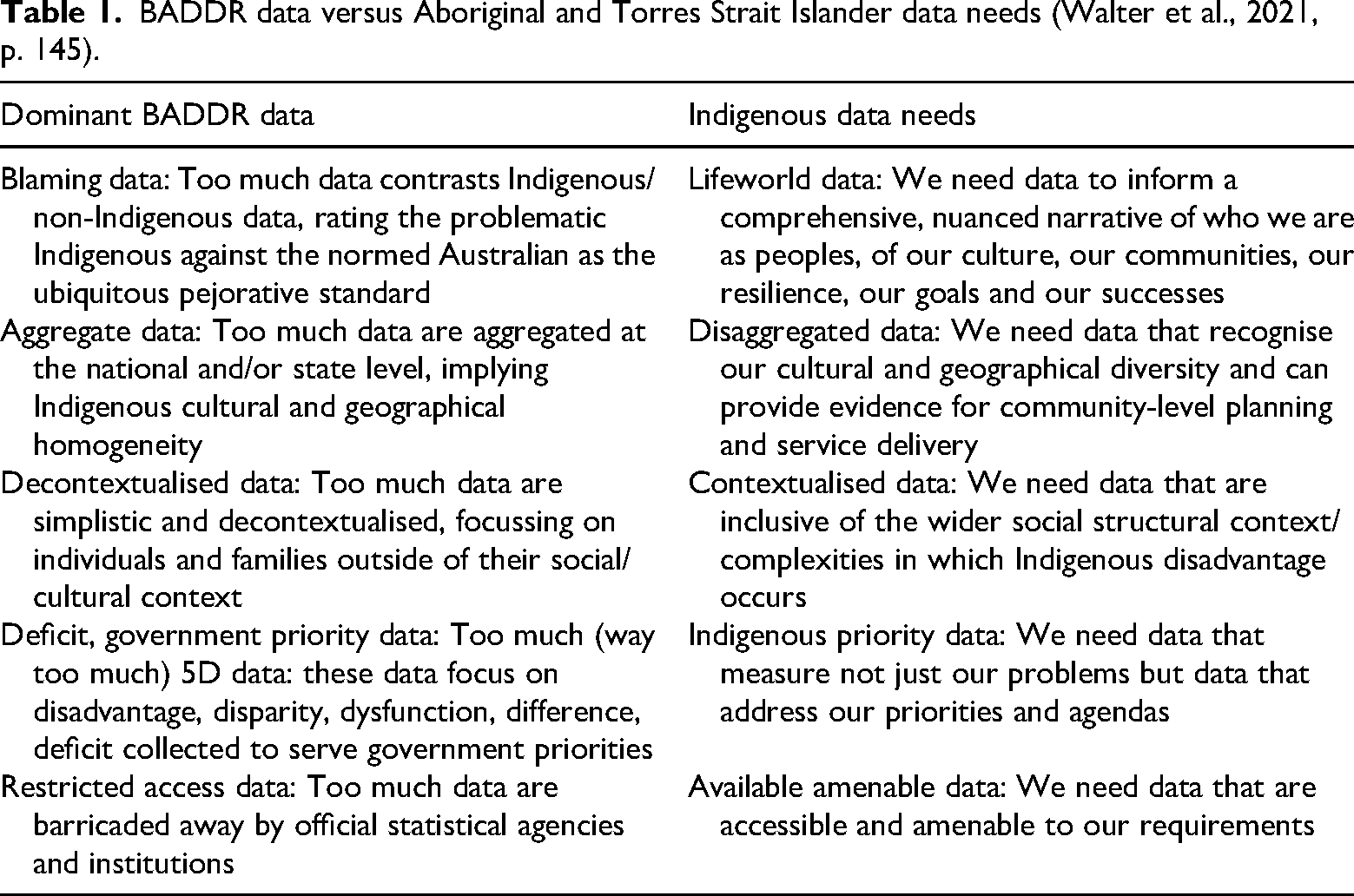
Methodological manoeuvres refer to the strategies used by researchers to manipulate their research design to achieve specific goals. The continual assertion of prioritising research and outcomes with administrative data is a form of methodological manoeuvrers that continues to subjugate Indigenous knowledges. The limitations identified with BADDR data—including administrative data—exacerbates negative stereotypes of Indigenous communities in criminology—and in research more broadly. The methods and methodologies adapted in analyses using administrative data tend to perpetuate negative characteristics and deficit-orientated approaches of minority groups who are overtly criminalised, prioritising individualistic determinants of justice over the impacts of systems and systemic biases. In a field such as criminology that is increasingly recognising the importance of context, administrative data is restricted and limited in analysis, outcomes, and translation, particularly in datasets void of culturally specific domains.
(ii) And “shame” when your numbers hide our truths
Perception of objectivity and apolitical data
Research using administrative data is perceived as objective and apolitical, holding an innate truth of behaviour. The perceived apolitical nature of data and research has been widely challenged and exposed through the work of critical Indigenous scholars (Moreton-Robinson, 2021; Nakata, 1997; Smith, 2021). When statistics are separated from historical context, communities become further marginalised and problematised, with negative racial stereotypes reinforced. Hokowhitu et al. (2022) demonstrated this in the creation and ongoing perception of the poor Māori health statistic. Using Foucault's triad of power, they demonstrated how colonial practices aimed to dismantle Māori communities and knowledge systems through exertion of sovereign power (denying Indigenous humanity to legitimise imperial power), disciplinary power (institutionalised discipline of brown bodies), and biopolitics (political powers shaping biological outcomes). The ongoing impact of these practices is not considered to impact health—rather, poor health statistics are portrayed as a function of ethnicity rather than functions of power, privilege, and systemic racism.
Notably, Hokowhitu et al. (2022) proposed that this can be addressed through culturally grounded research that asserts mana motuhake (Māori political self-governance; autonomy; sovereignty). This would not only reassert Māori agency but also centre Indigenous health as political and acknowledges the role of colonialism in research.
Arguably, the power dynamics and perception of ahistorical statistics described by Hokowhitu et al. are amplified in criminal justice reporting and research—and, moreover—administrative data is used to report and reinforce “apolitical” data. Administrative data strips reported crime rates of historical context—reinforcing Dodson's observation of Indigenous people being portrayed as a problem to be solved (1994)—rather than their being problems of power, privilege, and systemic racism. This is reinforced when methodologies “silence” the voices of the researched population, which continues to be widespread in criminology (Deckert, 2024). This has several consequences. Firstly, there is a misrepresentation of the “crime rates.” For example, oversurveillance or racial profiling cannot be measured, police contact can be interpreted as crime rates, and the impact of biased policies can skew recorded crime rates (Porter et al., 2022). Second, wrongdoing that is not codified is excluded from analyses, from colonisation to destruction of sacred sites to negligence by organisations (see (iii) below). Finally, the administrative data gives no indication on how to address the issues. When culturally dependent variables and experiences—including racism—are excluded from analyses, they are also excluded from any conclusions drawn from the research. Overall, research without a clear and specific role for Indigenous sovereignty, agency, and political governance will lack sustained and meaningful outcomes. This is particularly difficult with research reliant on government administrative data.
(iii) “Shame” when your numbers speak for us, not with us
Lacking Indigenous worldviews and experiences
An inherent limitation of research using administrative data is the lack of control over what data is collected. The lack and exclusion of data representing Indigenous worldviews has been a major limitation to justice research using administrative data—and has been directly identified, such as First Nations scholars Guthrie's (2015) and William’s (2016) critique of Weatherburn's positivist approach in Arresting incarceration. The data points that become variables in research projects are not theoretically informed or derived to advance knowledges—they are points of information to support service provision. Information collected by governments about Indigenous people has and continues to be used for surveillance, and control, and to justify paternalistic policies (Andersen & Kukutai, 2016). The holistic worldviews of Indigenous peoples are not considered in determining what information is collected, and moreover, in analyses, the role of culturally dependent variables and lived experiences are disregarded, or at best lost by “cultural blindness” (Guthrie, 2015, p. 133). As a result, methodologies using administrative datasets report on generalised trends, which leads to grand theorising rather than contextualising issues or seeking the multitudes of experiences required for meaningful outcomes between Indigenous populations.
This tension is amplified when variables are incorrectly operationalised and conceptualised to fit the data rather than Indigenous worldviews. Nakata (2007) has framed this tension between Indigenous and non-Indigenous knowledge systems as working at the cultural interface. The cultural interface when conducting research with administrative data tends to be a site of tension. These tensions range from perceptions of “place-based” analyses, with administrative datasets reliance on postcodes compared to Indigenous perspectives of place (Clapham et al., 2024; Tuck & McKenzie, 2014), and divergence between government bodies and First Nations scholars on the impact of racism (Bodkin-Andrews et al., 2024), to the absence of culturally specific information in administrative data. This subjugation is further perpetuated with assessment tools and their lack of validation with Indigenous populations (Westerman & Dear, 2023). For example, in justice practice and research, Tamatea (2017) critiqued how forensic psychology dismisses the role of culture, severely impacting how Indigenous peoples in Australia and Aotearoa move through the justice system. Tamatea demonstrated this with the use of risk assessment tools, such as the Level of Service Inventory, which is standardised across Australian Corrective Services. He showed how these tools over-predict the risk of Indigenous men and women and lack inclusion of cultural responsivity. Such findings undermine research outcomes that have incorporated these tools within administrative data sets. Inevitably, the wilful or naive oversight of incorporating the holistic worldviews and experiences of Indigenous peoples lead to research results that do not reflect Indigenous peoples’ lived experiences, infer the impact of variables that may not be accurate, and exclude variables that are important to making changes in the lives of the people the study is targeting.
(iv) And “shame” when your categories misname
Inconsistency of recorded Indigenous status
Researchers using administrative data also deliberate on the inconsistencies in the recording of Indigenous status that are found within an individual's record. Inconsistencies are found both within one dataset (e.g., a person is recorded as Indigenous at one point by the police, but non-Indigenous at another) and once linked to other datasets (Hunter & Ayyar, 2011; Gialamas et al., 2016; Thompson et al., 2012). Techniques that have been adapted each come with their own errors. Most commonly, researchers count a person as Indigenous only if the individual has always been identified across the dataset (likely to underestimate in the sample); those who identify most of the time; or those who have ever been identified in a dataset (likely to overestimate). Notably, some criminological researchers have argued that the inconsistencies are so tenuous that they opt out of including Indigenous status as a variable in analyses.
Although researchers accept a rule and note this in their limitations, it is important to acknowledge why these inconsistencies occur. Some errors are attributed to human error. Records are kept as one aspect of peoples’ work (with employees from a wide range of positions, from administrative officers to police officers or nurses). Multiple aspects impact recording decisions, including time-poor environments, a lack of accuracy or interest in noting Indigenous status, or personal biases. Additionally, some Indigenous people deliberately withhold their status for certain services or engagements (New South Wales Aboriginal Affairs, 2015; Office of the Victorian Information Commissioner, 2021). The reasons are wide-ranging and include concerns of sharing data and then it being used for purposes other than its primary intention, concerns of cultural safety, lack of trust in government, and concerns of racism, discrimination and stereotyping. This, in turn, can question the informed consent of Indigenous peoples and their data, and how data has been used to perpetuate policies that marginalise Indigenous peoples.
These practices also need to be tied to the historical context of government surveillance. Administrative data is commonly used for the identification of disproportionate contact between key social groups, including gender, socio-economic status, age, and race. In Australia, one of the primary markers tracked within administrative systems is Aboriginal and Torres Strait Islander status. First Nations peoples have continually brought to light the negative impact of criminal justice systems on their communities for many years. However, it was not until major federal inquires identified the negative effects of systems on First Nations communities that the recording of Indigenous status became mandated. In Australia, the Royal Commission into Aboriginal Deaths in Custody was released in 1991 (Commonwealth of Australia, 1991). One of the barriers identified in the inquiry was the lack of record keeping. This led to a section of the 339 recommendations on “Adequacy of Information” (recommendations 41–47) with further recommendations on not only improving justice data collection, but also social, demographic, health and economic data. In part, this was meant to give a level of transparency and accountability to disproportionate and negative outcomes across systems, including criminal justice systems (e.g., Australian Institute of Criminology [AIC], n.d.). This context calls into question the reliability of status prior to the practice of routinely recording Indigenous status, as well as questioning whether administrative data is holding government policies and practices to account considering continued disparities.
(v) And “shame” when your evidence always ends in control
Reinforces criminal legal responses
Finally, administrative data and the methodologies that tend to be used have strong affiliations with administrative criminology. Jock Young (1986) coined the term “administrative criminology” to denote the growing trend in criminological research to increase the efficacy of the criminal justice system. This outcome is reinforced by the stringent and restrictive gate-keeping practices in accessing administrative data (Mario & Kilty, 2024). As noted, scholars who propose critiques of practices of the criminal justice system tend to be denied access to closed-system data (Watson, 2015). Moreover, for the applied criminologists that use administrative data, there are oversights by the government data custodians that determine what types of research questions get proposed, the type of analyses, and having input on the results and outcomes that can be derived. As a result, the research aims and outcomes tend to reinforce and validate the continual use of the criminal justice responses. Moreover, administrative data is descriptive. While statistical analyses can identify bottlenecks in the system—which is necessary for accountability—why and how they occur, and how to address these issues cannot be inferred from administrative data itself. The typical methodological approaches used with administrative data are “silencing” (Deckert, 2024) the people affected who are in the best position to inform these gaps. Unfortunately, decision-makers infer details, which leads to poor policy decisions, incorrect media reporting, and community panic.
Reinforcing criminal justice responses is the antithesis of research from the majority of Indigenous and critical scholars and the goals of community members and advocates (e.g., Deslandes et al., 2022; Loney-Howes et al., 2024). Indigenous and critical scholars foreground the ongoing use of carceral systems to perpetuate settler colonial practices (Cunneen & Tauri, 2016; Deslandes et al., 2022; Porter et al., 2022). This includes addressing not only the individual but also the social and political determinants that increase contact with carceral systems—including carceral systems themselves.
And some say “justice”…
Indigenous data justice and linked administrative data
Lynch (2018) noted that there was a long way to go to consider and mandate the robustness of using administrative data in criminology. Additionally, there are major limitations, challenges, and ethical concerns of using administrative data in examining, understanding, and addressing Indigenous justice outcomes. However, it is inevitable that researchers and policy makers will continue to use administrative data for research and decision-making. Therefore, principles and frameworks that reinforce ethical research when using administrative data are necessary; and central to this is how data justice can be achieved through Indigenous methodologies and Indigenous research principles.
Data justice applies a social justice framework to the increased focus on a data-driven society, recognising that power dynamics impact the collection, use, and governance of data. Consequently, the application of data justice ensures that human rights, equity, and community agency are considered in the use of data (Dencik et al., 2019). In the context of research using administrative data, data justice would challenge the deficit-focused and bureaucratic framing of “the numbers” and ask instead: whose stories are counted, whose knowledge guides interpretation, and who controls access to the information? These are core questions that have contributed to the development of Indigenous methodologies and Indigenous research principles. In drawing from established principles of Indigenous research (e.g., Australian Institute of Aboriginal and Torres Strait Islander Studies [AIATSIS], 2020), an “Indigenous data justice” framework would centre Indigenous governance, cultural knowledge, and community-led oversight to ensure that administrative data becomes a tool for understanding, advocacy, and systemic change—rather than a mechanism that reinforces historical harms or erases lived experiences.
Gilbert's poem “Shame,” shared in the introduction to this paper, reflected themes of surveillance, objectification, and exclusion. Throughout Gilbert's career he also focused on asserting Indigenous justice (Gilbert & Williams, 1996). For the remainder of this paper, six notions of justice are drawn from Indigenous research principles and practices that can be used to address the challenges of using administrative data in moving towards Indigenous data justice.
(i) Justice when our voices are at the table
Reframe data collection
One approach to address the limitations of administrative data has been to instigate systemic change at the point of data collection. Outside of government data collections, Indigenous organisations have developed longitudinal surveys that incorporate variables that reflect Indigenous worldviews (see, e.g., “Our Surveys,” First Nations Information Governance Centre, n.d.). There have also been longitudinal surveys administered by government departments. In Australia, Footprints in Time has been administered annually since 2008. This longitudinal study of Indigenous children was developed to inform government policies and programmes by collecting data across multiple domains to further understand Aboriginal and Torres Strait Islander children, their families and communities. Although this was a pivotal project with oversight by Indigenous scholars, government representatives continued to be influential decision-makers in the process and hindered the conceptualisation and operationalisation of variables that had theoretical and practical groundings, such as the impact of systemic racism (Bodkin-Andrews et al., 2024). These surveys—whether administered by government or Indigenous organisations—cannot be linked to other service provision; however, the outcomes from studies stemming from these datasets can be utilised to contextualise, guide, triangulate, or inform studies that rely on administrative data.
There have also been initiatives that have proposed changes to the collection and management of government administrative data. Theodore et al. (2023) outlined the initial stages of Aotearoa's novel data infrastructure initiative, Te Hao Nui. Te Hao Nui is an Indigenous-led project that aims to privilege Māori worldviews and inform the aspirations of Māori communities. The process brought together three existing datasets administered and held by the government department and data custodians Stats NZ, to create the world's largest Indigenous longitudinal study. The first dataset was the Longitudinal Census Database, which includes six population censuses since 1981. The information contained in the censuses provides key influencing factors, including household income, socio-economic measures, and household information. The second dataset included Aotearoa's Integrated Data Infrastructure, which holds the national linked administrative data across multiple social domains, including health, justice, housing, income and education. The third dataset includes the two Te Kupenga surveys held in 2013 and 2018. Te Kupenga were nationally representative surveys that used culturally informed variables to assess Māori well-being. Variables included social, cultural, and economic well-being including questions ranging from knowing one's Iwi, to whanau well-being, and experienced discrimination. Te Kupenga is pivotal for Te Hao Nui, as the culturally grounded variables allow for meaningful and culturally specific research focus. Overall, it is anticipated that Te Hao Nui will increase Indigenous governance and stakeholder involvement with official resources, while strengthening mechanisms that inform and monitor policy and services.
In Australia, data sovereignty principles have been incorporated into the leading federal Indigenous policy, Closing the Gap. Closing the Gap was initiated in 2008 to track and drive policy decisions to address the disparities across social outcomes between Indigenous and non-Indigenous populations. From 2020, a significant change occurred for Closing the Gap that saw the policy framework re-designed and led by First Nations people. Four priorities were established, one of which was “shared access to data and information at a regional level.” In 2024 (at the time of writing this article), a framework was developed to provide practical guidance on operationalising IDS principles in the Australian public service (Commonwealth of Australia, 2024). The four guidelines proposed how to build strong governance over Indigenous data and include (i) partner with Aboriginal and Torres Strait Islander people; (ii) building data-related capabilities; (iii) providing knowledge of data assets; and (iv) building an inclusive data system. These are basic and foundational principles that provide a starting point. The uptake and implementation of the framework will need to be encouraged considering Australia's poor track record in implementing recommendations from formal reviews (Stark et al., 2023), particularly in risk-averse sectors like criminal justice (Anthony et al., 2021).
(ii) Justice when bias is broken in the count
Community-led research
Community- and Indigenous-led research is the gold standard methodology of any research that affects Indigenous peoples and communities (AIATSIS, 2020; National Health and Medical Research Council [NHMRC], 2018). Impactful and informed research affecting Indigenous peoples requires full engagement with communities, starting from identifying research areas, to designing the project, to data collection and analysis through to dissemination. This is at the core of IDS as well as guidelines that have been developed to guide ethical research affecting Indigenous peoples (AIATSIS, 2020; NHMRC, 2018). However, there are significant barriers in using linked administrative data within community-driven research—particularly Indigenous justice research. The lengthy processing timeframes, strict access, limited First Nations informed datapoints, and conditional terms around publication of findings all create significant barriers.
However, some Indigenous communities have led impactful projects that aim to overcome these barriers, and consequently, have developed and showcased models of how administrative data can benefit Indigenous research. These projects rely on meaningful and respectful partnerships between communities and research bodies to facilitate access to government-held data. Within the Australian justice sector, community-led justice reinvestment initiatives have sought government data to embed data-driven approaches. For example, Bourke partnered with New South Wales Bureau of Crime Statistics And Research (BOCSAR) to access justice data to report on specific justice outcomes (KPMG, 2016). There are also several projects in early stages that have proposed sharing of administrative data to Aboriginal community-controlled organisations, including in the child protection sector (Australian Institute of Criminology [AIC], n.d.).
A promising Indigenous justice project that specifically uses linked administrative data arose from the Yuwaya Ngarra-li partnership. The steps and journey in establishing this partnership are detailed in Reeve et al. (2024). Yuwaya Ngarra-li is a long-term community-led partnership between the University of New South Wales and the Aboriginal community-controlled Association Dharriwaa Elders Group (DEG). The partnership is underpinned by five core principles: being community led, culturally connected, strengths-focused, holistic, and rights-based. DEG brings together Elders living in the town of Walgett—a remote town in New South Wales, Australia, with a population of around 2,000 people. Among other projects (Dharriwaa Elders Group, n.d.), DEG identified a need to support young people in Walgett to avoid contact with the justice system. Through the support of the Yuwaya Ngarra-li partnership, there was significant community engagement in developing the Baulaarr Bagay Warruwi Burranba-li-gu youth diversion model and further research to support children and young people in Walgett. The Elders of DEG identified the informative role that linked administrative data could contribute to developing and evaluating the model. The importance of the partnership and role of linked administrative data was expressed by Gamilaraay Elder and Secretary of DEG Virgina Robinson, explaining how: Using linked data brings the two minds together that of the Dharriwaa Elders Group and that of the University of New South Wales. So they can bring something to us and we can say, well, let me tell you about this. You know, you might be reading that data the way it is, but let's listen to what we’ve got to say… The Dharriwaa Elders Group have taken upon themselves to get the best and brightest and the experts in, to help us, to help us achieve the things we want to achieve. (Reeve et al., 2024, Appendix A, 2:30–3:13)
Overall, numerous barriers remain in using linked administrative data in community-led research. Accessibility, governance models, relevant variables, and the establishment of respectful partnerships are key mechanisms that require considerable attention in such projects. Notwithstanding, innovative projects that centre Indigenous self-determination and IDS principles show promising steps to supporting communities.
(iii) Justice when analysis amplifies thrivance
Strengths-based statistical methods
Quantitative research has been shown to subjugate Indigenous knowledges and experiences, proposing deficit analyses of Indigenous peoples and communities. In Australia, this has been significantly heightened, including within contemporary policy development and discourse. Since 2008, the predominant federal policy for Indigenous affairs—Closing the Gap—was designed to report on progress across multiple social domains; however, reporting mechanisms retain a deficit discourse through quantitatively comparing Indigenous to non-Indigenous outcomes. Notably, these comparative analyses have been derived from predominately administrative data to inform Closing the Gap reports and government decisions. Moreover, Closing the Gap influences research, as most funded research involving Indigenous peoples in Australia stems from or addresses these policies. Unsurprisingly, comparative and deficit-focused research is common.
Indigenous and other marginalised communities have addressed these shortcomings by critically analysing statistical methods themselves and proposing alternatives. The deficit-focus of quantitative research has been a pervasive and ongoing issue in Indigenous research. Thurber et al. (2020) proposed a strengths-based approach for quantitative data analysis in health research using the longitudinal survey data from the Footprints In Time Study (see (i) above). They aimed to compare analytic approaches to identify if the statistical rigour of a standard deficit approach would hold across two alternative strengths-based approaches. The first alternate model was the protective factors approach, which proposes in moving beyond individual risk factors and determinants to capture social determinants of health (such as housing and education) as well as considers Indigenous worldviews of health (including cultural connection and identity). The second alternate model was the positive outcome approach, which includes the protective factors approach as well as focus on understanding participants who are doing well rather than those who are not. In conducting sensitivity analyses across the three approaches, Thurber et al. (2020) found the statistical analyses retained statistical rigour but led to significant differences in how the results were interpreted, notably in promoting how strengths-based variables lead to positive change rather than promoting deficit variables that lead to negative life outcomes.
Moreover, researchers are employing approaches to address the comparative statistical methods that focus on gaps between Indigenous (or other minoritised) and non-Indigenous populations. For example, in education, Anderson et al. (2024) identified how education studies in Australia used deficit-based comparisons in comparing national test outcomes between Indigenous and non-Indigenous students. In proposing an alternative approach, they used within-cohort and peer-matching techniques. This technique compared Indigenous students to Indigenous students stratified by variables common in administrative data, including state/territory and remoteness. This allowed to identify areas where there were strong outcomes for Indigenous students in comparative locations, set the groundwork in identifying the local contexts that could be attributed to drive this change, and understand how areas that needed extra support could adapt to the mechanisms.
The use of these techniques for Indigenous justice research with administrative data is limited. There will inevitably be some limitations when considering how administrative data can adapt these techniques—particularly in the limited availability of culturally dependent variables in administrative datasets that can be used to establish holistic analytical frameworks. Using mixed-methods in community-led research may aid this. Moreover, there are promising signs in noting the growing interest in using different levels of analysis—such as within-person processes, which measure any changes that happen within a person over time (Allen & Williams, 2024). Within-person techniques may be helpful in Indigenous research where community-level variables are also available, and, moreover, the interest may also indicate willingness to adapt within-group analyses. Overall, however, there are opportunities for quantitative researchers to explore new analytical approaches when considering the place of linked administrative data.
(iv) Justice when strength speaks louder than deficit
Contributions to strength-based theorising
Theory has an influential role in research and policy. However, the predominant theories applied in criminology have excluded Indigenous worldviews. Nêhiyaw and Saulteaux Professor Margaret Kovach warns how “(t)heory unexamined, valorized through research and manifested in policy, poses, indeed has posed, great risk for Indigenous people” (Kovach, 2014, p.93). Kovach continues to examine how deficit theorising that focuses on “gaps” tends to be perpetuated by non-Indigenous one-eyed seeing theorising, which refers to the process that excludes Indigenous voices and perspectives. These characteristics are inherent to administrative data methodologies. Administrative data does not capture Indigenous voices, cultural values, or anti-racist and culturally responsive approaches. In criminology, methodologies using administrative data near exclusively report on individual-level risk and protective factors—not on the role of policies, systemic bias, and systems theory that have contributed to the levels of risk reported.
This is not to say that administrative data cannot contribute to Indigenous justice approaches. Kovach proposes how strengths-based theorising can counter-pose deficit theorising. Strength-based theorising focuses on Indigenous cultural values and cultural responsivity. Administrative data can be a piece of a puzzle in strengths-based theorising. As noted in this paper, Indigenous communities are weaving data threads by creating mixed-methods projects with administrative data in re-framing data collection processes, community-led research, and strengths-based statistical methods. As Aunty Robinson from the Yuwaya Ngarra-li partnership describes, this sharing of data allows communities to “…counteract what this data is saying…” (0:28–0:33). However, these approaches would need to be embedded in theoretical frameworks that have been derived from or reflect Indigenous communities and accurately portray holistic perspectives.
Moreover, reports based on administrative data provide an important accountability role in monitoring carceral systems. Statistics on policing, child protection systems, sentencing, incarceration, deaths in custody, and probation shine a light on the perpetual failure of government policies to address Indigenous contact with justice systems.
Administrative data can only convey how people are pushed through systems. The reporting of individual-level risk and protective factors conveys a sense of an apolitical and atheoretical dataset. However, the biases and marginalisation of people and communities—particularly Indigenous communities—are well established. The impact of systematic biases cannot be accurately captured in the “by-product of service provision” (Lynch, 2018, p. 439). In focusing on analyses of systems, methodologies have been developed to critique systems. For example, critical race scholars initially exposed and examined the impact of race, racism, and power in legal systems which used qualitative interpretive methodologies (Gillborn et al., 2023). As critical race studies expanded, methodologies were developed, including QuanitCrit. QuantCrit includes quantitative methods employed to investigate critical race principles, including acknowledging the subjectivity of quantitative approaches, and ensuring historical, social, political, and economic power relations are explicitly identified and addressed in statistical methods.
(v) Justice when decision-making rests with communities
Indigenous governance structures
Reforming and redefining governance structures has been another mechanism proposed and implemented to address poor access and inaccurate interpretations of administrative data for Indigenous communities. This includes governance of the data itself, with structures guided by Indigenous Data Governance (IDG) frameworks (Carroll et al., 2020). The primary aim for data governance is to not only have Indigenous communities in decision-making roles, but to have structures that reflect Indigenous worldviews and prioritise Indigenous outcomes. However, reforms to data governance are largely determined by context, particularly bureaucratic restrictions. Consequently, proposed or implemented governance structures vary. Drawing from examples from this paper, the Te Hao Nui project in Aotearoa aimed to have people in decision-making roles in government agencies with capacity-building opportunities to increase Māori engagement (Theodore et al., 2023). Whereas, in Australia, where access to administrative data has more barriers, the Yuwaya Ngarra-li partnership holds local administrative data in a secure facility at a university with decisions governed by the local community (Reeve et al., 2024). Comparatively, the social and political structures in Ontario, Canada, have led to other opportunities. The Chiefs of Ontario represent 133 First Nations communities, and through this decision-making process made a partnership with the leading linked health data across the state (Ontario Registered Persons Database). This was linked to the Indian Register, which once linked has established the largest First Nations health research study cohort in Canada (Walker et al., 2018).
A brief note is warranted here on the role of administrative data in community-level Indigenous governance models. There is limited space for analysis; however, Indigenous Nation Building (INB) has been a significant movement for Indigenous communities around the world since the 1990s (Cornell & Kalt, 1998; Jorgensen et al., 2023). INB strengthens Indigenous futures by reshaping community governance through social, community, and political development. Administrative data will only be relevant for INB if there are significant shifts in government policies that allow Indigenous communities to gain control on the collection, use, and storage of data that impacts Indigenous communities. INB complements IDG structures and aims.
(vi) Justice when sovereignty governs the record
Indigenous Data Sovereignty
A final reference is necessary to the role of IDS and IDG frameworks in the use of administrative data in Indigenous justice research. A full analysis is beyond the scope of this paper; however, the rise and impact of these frameworks has had significant impacts on Indigenous research. IDS is the right of Indigenous peoples to control data that are by, about, or for Indigenous peoples—from collection to ownership to end-use. Whilst IDG refers to the mechanisms and enactment of IDS (Kukutai & Taylor, 2016), IDS and IDG are woven throughout the United Nations Declaration on the Rights of Indigenous Peoples (UNDRIP) (United Nations, 2008) to resist the misuse of Indigenous data and establish structures where Indigenous peoples are primary beneficiaries—both areas that need to be addressed with the use of linked administrative data in criminology. The IDS movement has been led by a dedicated network of activists, advocates, and scholars across the world (First Nations Information Governance Centre, n.d.; GIDA, n.d.; Indigenous Data Network, n.d.; Maiam nayri Wingara, n.d.; Pacific Data Sovereignty, n.d.; Te Mana Raraunga, n.d.; United States Indigenous Data Sovereignty Network, n.d.).
IDS and IDG can assist in the ethical use of administrative data in criminology (e.g. Brown & Stephens, 2022; Deen, 2022; Maher, 2022; Trudgett, 2022); however, the application of IDS to administrative data—and specifically for criminological research—will have its limitations. These limitations are epitomised in Kukutai's (2021) reflection of her years of work in the field, where she notes that: …the fullness of Indigenous data sovereignty can’t ever truly be recognised within the architecture of the colonial-settler state … the approach to Indigenous policy has long been to contain and manage rather than to enable genuine forms of Indigenous self-determination or autonomy. So why would it be different for data?… [It] requires a level of Indigenous power and autonomy that does not currently exist within state systems. (50:52–51.39 Kukutai)
However, the key principles from IDS and IDG can provide a framework for the use of administrative data in Indigenous justice research. The previous five Indigenous research principles align to IDS and IDG frameworks, and some of the case studies discussed throughout explicitly apply these frameworks in their research design. Undoubtedly, the literature on IDS provides a foundation for communities and researchers using administrative data in their work.
Conclusion
The realities of living Black in Australia are woven with brunt of settler colonialism. Gilbert conveyed this in his poem “Shame,” conveying the denial of human rights. The themes of this poem provided an analytical framework to contextualise the impact of linked administrative data and consider what role, if any, this specific type of data can contribute to Indigenous justice. Administrative data has played a contentious role in the colonisation of Indigenous peoples and communities around the world. Government bodies have used record keeping as a process to assert power and monitor and control Indigenous communities. However, this relationship has been challenged on multiple fronts. Indigenous methodologies and research principles target and re-frames how we contextualise, manage, and use data that can impact Indigenous peoples’ life outcomes. These movements, when operationalised, have challenged and exposed how government bodies have monitored, recorded, and used official government records to surveil and control Indigenous peoples and communities. However, statistics continue to be reported with a perceived objectivity and continue to be used to subjugate Indigenous peoples and perpetuate deficit-discourse and policy-making decisions.
These considerations may lead to questioning whether administrative data has a role in Indigenous justice research. Certainly, there are still heavy caveats around the role administrative data can contribute. The absence of culturally relevant variables, in addition to the limitations of capturing lived experiences such as over-policing, systemic bias and intergenerational trauma, places severe limitations on the process and outcomes that are derived from administrative data.
However, Indigenous communities and researchers have made significant contributions in addressing these challenges. Indigenous methodologies and research principles provide key mechanisms that can guide research practices—foremost with the privileging of Indigenous priorities and community-led research. Moreover, mixed-methods, strengths-based approaches, and contextualised research can re-frame what data is “saying.” This is also recognising that administrative data tells more of system mechanisms than of Indigenous communities and peoples. Weaving data threads is powerful—yet the strength of the linked administrative data thread depends on the Indigenous-led threads and governance structures that hold it together.
Footnotes
Author’s note
This article is dedicated to Emeritus Professor Anna Stewart. I can confirm; it is still a rich tapestry.

Ethical approval
This article does not contain any studies with human or animal participants.
Informed consent
There are no human participants in this article, and informed consent is not required.
Funding
The authors disclosed receipt of the following financial support for the research, authorship, and/or publication of this article: Krystal Lockwood is a Research Fellow with the ARC Centre of Excellence for Indigenous Futures. Lockwood acknowledges the funding support from the Australian Research Council for the ARC Centre of Excellence for Indigenous Futures (Project ID: CE230100027).
Declaration of conflicting interests
The author declared no potential conflicts of interest with respect to the research, authorship, and/or publication of this article.
Data availability statement
Not applicable.
Indigenous research statement
Krystal Lockwood is a Gumbaynggirr and Dunghutti scholar. The current submission is a critical review article. First Nations’ scholarship and ways of knowing, being, and doing have been privileged within the review and the scholarship provided. This includes reference to the AIATSIS Code of Ethics for Aboriginal and Torres Strait Islander Research, and the NHMRC Australian Code for the Responsible Conduct of Research, and how both guides should be used in research.