




Abstract
We leveraged administrative and self-report data to compare male youth who were involved in the juvenile justice system (Juvenile-Justice-only (JJ) youth) and who were additionally involved with the child welfare system (Dual-System (DS) youth) in Orange County, California. Data were available for 532 youth (346 JJ youth, 186 DS youth). Analyses examined differences in individual factors, contextual factors, and offending behaviour before and at age 18. Although DS youth had more arrests before age 18 compared to JJ youth, the groups did not differ on self-reported offending and other factors (i.e., mental health, substance use, neighbourhood disadvantage, peer delinquency). Moreover, these higher arrest rates were significant even after controlling for self-reported offending and exposure to violence. Thus, results isolate child welfare involvement as uniquely linked to a greater risk for arrest. Data expands existing knowledge on high-risk youth populations who have involvement in one or more systems of care. Discussion includes implications for researchers and practitioners, including the importance of combining self-report and administrative data to distinguish between the detection of behaviour within a system (e.g., arrest) from the behaviour itself (e.g., offending).
Introduction
Youth involved in the juvenile justice system have been extensively investigated, with various longitudinal studies over the last 20 years highlighting risk and protective factors and developmental markers associated with criminal offending and desistance (Cauffman et al., 2023; Gubbels et al., 2023; Scott & Brown, 2018). Justice-involved youth may also be embedded within other social systems, including child welfare services. Youth impacted by both the juvenile justice and child welfare systems are often referred to as “dually-involved”, “dual-contact”, or “dual-system” youth as a means of distinguishing their unique risks and needs from other justice-involved youth (Herz & Dierkhising, 2019). They are also distinguished from “crossover youth” who have a history of maltreatment but not necessarily child welfare system involvement. Although some research has compared youth involved in one system to those impacted by multiple systems (Modrowski et al., 2023), few studies have incorporated administrative and self-report data when examining these groups across the entire period of childhood and adolescence. Importantly, no study has clearly distinguished system involvement and detection from behaviour and experiences reported by the youth themselves, either with respect to child welfare involvement (i.e., self-reported exposure to violence) or to justice system contact (i.e., self-reported offending) while controlling for confounding factors (e.g., lifetime exposure to violence).
Of note, we focus our literature review predominantly on studies that have been conducted with Dual-System (DS) youth in the United States given the sample used in the present investigation and the systemic factors that may differentiate youth experiences and outcomes in other jurisdictions (e.g., laws and policies). A comparison of these factors is beyond the scope of the current paper, but significant contributions to the field regarding DS youths’ experiences in other countries (e.g., Australia) can be found elsewhere (e.g., Baidawi & Ball, 2023; Malvaso et al., 2019).
Dual system youth
Youth who have contact with the child welfare system are more likely to engage in delinquency and have supplemental contact with the juvenile justice system than youth without system contact (Halemba et al., 2004; Herz et al., 2010; Vidal et al., 2019). Up to 70% of youth involved in the child welfare system may cross over the two systems, although rates vary widely across jurisdictions (Herz & Dierkhising, 2019; Kelley & Haskins, 2021; Vidal et al., 2019). DS youth have been observed to have different life experiences and more complex needs than youth who are only involved in the Juvenile Justice system (JJ youth) (Chuang & Wells, 2010; Herz & Dierkhising, 2019). Although beyond the scope of the current study, it is important to note that it remains unclear whether these differences characterise these youth before they become involved in both systems or whether they result from being involved in both systems.
In either case, DS youth are recognised as a uniquely vulnerable population at risk of long-term developmental, behavioural, and mental health problems (Herz et al., 2012). Rather than benefiting from the services that both systems can provide, lack of multisystem collaboration may leave them with insufficient, inappropriate, duplicative, or even contradictory services (Herz et al., 2012; Siegel & Lord, 2005; Vidal et al., 2019). For example, they may have to navigate interactions with multiple professionals (e.g., attorneys, social workers) who have disparate goals and priorities (e.g., securing the best legal outcome, focusing on the youth's mental health), and who may not communicate or know of the existence of one another (Siegel & Lord, 2005). Accordingly, scholars have called for more research on this unique population of youth that can be used to guide policies that improve the way they are served by both systems. Specifically, work is needed to elucidate the unique risks of single versus DS involvement to support providers in identifying appropriate and effective services (Cutuli et al., 2016). Therefore, it is important to understand if and how these high-risk youth differ on individual-level and contextual-level factors throughout childhood and adolescence. Moreover, it would be useful to identify whether DS youth are more vulnerable to re-arrest and reoffending compared to their JJ counterparts, after taking into consideration factors that are linked with recidivism (e.g., age, exposure to violence, substance use). In the following sections, we provide an overview of existing literature on these factors (i.e., offending, individual-level factors, contextual-level factors) that may differentiate DS youth from JJ youth before presenting the current investigation.
Offending
According to existing research, DS youth may have distinct patterns of offending compared to JJ youth. In a large-scale study of system-involved youth in Arizona (Halemba et al., 2004), DS youth tended to have contact with the juvenile justice system at an earlier age (13 years old) compared to JJ youth (14 years old). Therefore, DS youth were also younger when first petitioned in court, placed in detention, and/or placed on probation. This earlier contact with the justice system can have cascading consequences for these youth later in life, such as increasing the likelihood that they will drop out of school or be unemployed by adulthood (Cauffman et al., 2021). DS youth also tend to have more extensive experiences with the juvenile justice system, being more than twice as likely to be referred back to the court on another delinquency matter than their JJ peers in the Arizona study (Halemba et al., 2004), with similar trends observed in Ohio and Illinois (Herz & Dierkhising, 2019).
Although patterns of offending appear different for DS youth compared to JJ youth, one important limitation of the existing research is sole reliance on administrative data that only speaks to the detection of offending behaviour. It is possible that offending actually looks similar across DS and JJ youth, but is just more detectable for those with more supervision (i.e., by being involved in both systems). Therefore, while it is certainly important to assess differences in official justice system contact between these groups of youth, it is also crucial to examine self-reported offending when possible, to distinguish between differences in detection from true differences in behaviour. Moreover, it is also important to identify potential precursors to these antisocial behaviours, including individual- and contextual-level factors.
Individual-level factors
Mental health. Justice-involved youth exhibit higher rates of mental health problems compared to community youth (Fazel et al., 2008; Teplin et al., 2021b; Thompson & Morris, 2016). Indeed, up to three-quarters of youth involved in the juvenile justice system meet criteria for at least one psychiatric disorder, with the most common being substance use disorders (Shufelt & Cocozza, 2006). Additionally, almost half of justice-involved youth in a national database reported clinical levels of internalising problems such as anxiety or depression (Dierkhising et al., 2013).
Similarly, DS youth also exhibit significant mental health problems, with studies reporting rates of clinically significant symptoms between 61% (Halemba et al., 2004) and 83% (Herz et al., 2010). However, few studies compare mental health problems between JJ and DS youth within the same sample and those that do tend to use a combination of information (e.g., administrative data and self-report) to identify mental health problems as lifetime diagnosis rather than current symptoms (Dannerbeck & Yan, 2011). Still, the existing research suggests that DS youth may exhibit higher rates of mental health problems compared to JJ youth which may also contribute to their recidivism risk. Indeed, youth who continue to offend into adulthood are almost three times more likely to experience depression and anxiety compared to youth who desist (Reising et al., 2019). Additionally, decreases in offending bidirectionally coincide with decreases in internalising problems (Baker et al., 2023). Therefore, differences in mental health between JJ and DS youth warrants further investigation to help better understand observed differences in offending behaviour.
Substance use. Substance use is especially prevalent among justice-involved youth, with many entering the system due to drug-related charges or exhibiting associated problematic behaviours (Teplin et al., 2002). Justice-involved youth are also more likely to meet criteria for substance use disorders than youth in the community (Winkelman et al., 2017). The consequences of substance use are vast for youth who have already been in contact with law enforcement, co-occurring with greater mental health problems (Holzer et al., 2018; Hussey et al., 2007) and predicting greater recidivism (Stoolmiller & Blechman, 2005).
DS youth may exhibit notable differences in substance use as well. In a study comparing justice-involved youth with and without a history of maltreatment (Dannerbeck & Yan, 2011), those with a history were more likely to have a moderate or severe substance use problem. Moreover, in an Arizona-based study (Halemba et al., 2004), 80% of DS youth were noted to have substance use related problems. However, such high rates have not always been observed, with Herz et al. (2010) reporting that only 19% of DS youth in their multi-state cohorts presented with substance use issues. Compounding these differences, other research has shown that male JJ youth had significantly greater protective factors against problematic substance use behaviours but not greater risk factors compared to male DS youth (Lee & Villagrana, 2015). As substance use is one of the strongest predictors of recidivism among justice-involved youth, more data would be helpful in identifying difference among JJ and DS youth (Chassin et al., 2016; Dierkhising et al., 2018).
Contextual-level factors
Exposure to violence. Justice-involved youth are also more likely to report lifetime exposure to violence, trauma, and adversity compared to youth with no system contact (Shulman et al., 2021; Teplin et al., 2021a). In a nationwide sample of over 9,000 justice-involved youth, 80% reported being exposed to violence in their childhood, including witnessing a person being badly hurt or killed (Wasserman & McReynolds, 2011). Similarly high rates can be found in the Northwestern Juvenile Project's longitudinal investigation of over 2,000 justice-involved youth (Teplin et al., 2021b), with 10% of male participants reporting being shot prior to age 18. Moreover, their data shows a link between such violence exposure and violent behaviour, with youth who had been threatened or injured by a weapon being three times more likely to perpetrate violence in adulthood (Teplin et al., 2021b).
Although the link between violence exposure and future violent behaviours has been explored and observed across all youth impacted by one or more systems (Myers et al., 2018; Snyder & Merritt, 2014), the cycle of violence is far from a simple and direct link. Rather, it is a complex web of interconnected factors beyond the scope of the current paper (e.g., see Gaylord-Harden et al., 2017 for Pathological Adaptation Model). Still, it is important to understand if and how JJ and DS youth experience violence exposure differently. Although experiences with child abuse, neglect, and trauma are well documented within studies of those involved in the child welfare system (e.g., Herz et al., 2010), to the best of our knowledge, no published studies have compared JJ and DS youth on exposure to violence more broadly (e.g., witnessing and experiencing community, domestic, and other types of violence) within the same sample. Moreover, it may be important to compare these two groups on offending while accounting for self-reported exposure to violence to isolate the unique influence of child welfare system contact.
Peer delinquency. For all youth, peers are instrumental in both encouraging and discouraging engagement in antisocial behaviours (Brown et al., 1986). Though low levels of peer delinquency function as a protective factor for youth at-risk of legal system involvement (Pardini et al., 2012), engagement with deviant peer groups is associated with risky or delinquent acts, such as substance use and offending. Among justice-involved youth, the prevalence of such associations is exacerbated, with youth who already have a history of police contact reporting greater rates of peer deviance compared to community samples (Asscher et al., 2014).
For youth involved in both the juvenile justice and child welfare systems, these relationships may be further compounded (Cheng & Li, 2017). The relationship between deviant peer associations and other disadvantaged outcomes may be both a response to and an indicator of diminished protective factors, such as low parental monitoring, which are associated with a greater likelihood of legal system involvement (Gatti et al., 2009). Considering the additive effects of maltreatment and low parental monitoring, there may be an increased risk for opportunities to engage with deviant peers among DS youth compared to JJ youth (Ryan & Testa, 2005). Additionally, DS youth placed in group homes who have compounded exposure to justice-involved peers in detention settings may be more vulnerable to antisocial peer influence compared to JJ youth (Ryan et al., 2008). Therefore, comparing JJ and DS youth on association with deviant peers can help to further explain the role that peers may have in offending trajectories for both groups.
Neighbourhood disadvantage. Youth from disadvantaged neighbourhoods may be more exposed to risky behaviours, such as substance use, delinquency, and violence (Trucco et al., 2014). Indeed, neighbourhoods with fewer financial resources and less social control experience greater neighbourhood disorder and increased risk of crime (Huang & Ryan, 2014; Wojciechowski, 2021). Therefore, the physical environment and social context in which justice-involved youth are embedded may be important for understanding their offending behaviour. For example, Mennis and Harris (2011) found that youth recidivism increased as rates of similar offences by neighbourhood youth increased, even after accounting for individual characteristics.
Again, these effects may be different for JJ and DS youth. In a study conducted on Maryland youth, DS youth lived in neighbourhoods with more safety risks compared to JJ youth (Young et al., 2014). Further, another study found an 11% increase in official arrests when individuals with histories of child maltreatment lived in more disadvantaged environments (Schuck & Widom, 2005). Considering the potential for repeated exposure to negative social contexts with both in-home and out-of-home placements, it makes sense that many scholars have hypothesised worsened outcomes for youth in the foster care system. However, while research has afforded nuanced insights about the influence of neighbourhood characteristics for details like out-of-home placement for youth involved in the child welfare system, less is known about whether these contexts may exacerbate disadvantaged outcomes, such as future offending, for DS youth relative to JJ youth.
Present study
This investigation leveraged administrative data from the Department of Social Services, Probation, and the Superior Court of Orange County, California to compare male youth involved in the juvenile justice system (JJ youth) and youth involved in the juvenile justice system who also had contact with the child welfare system at some point prior to age 18 (DS youth). First, we constructed descriptive profiles of these groups including individual-level (i.e., mental health, substance use) and contextual-level (i.e., exposure to violence, peer delinquency, neighbourhood disadvantage) factors at age 18. We hypothesised that DS youth would exhibit a greater disadvantage across all domains compared to JJ youth. Second, we examined whether DS youth engaged in more offending or had more arrests in their lifetime than JJ youth. Importantly, we complemented administrative data with self-report data to examine differences in offending and arrests. Specifically, we examined whether DS youth experienced more lifetime official arrests and self-reported more offending, even after controlling for various individual-level, contextual-level, and demographic factors. We hypothesised that DS youth would have more official arrests, but not necessarily more self-reported offending compared to JJ youth.
Method
Participants
Participants were 532 male youth recruited after their first arrest as part of the Crossroads Study (Cauffman et al., 2021, 2024). Although the Crossroads Study includes a larger sample across multiple states, child welfare system data were only collected at the California site; therefore, this investigation relied on data from this subsample. All youth were between 13 and 17 years old when recruited (M = 15.49, SD = 1.22) and arrested for low- to moderate-level offences, including vandalism, theft, possession of marijuana, and assault. At recruitment, all youth had only been arrested once. Their racial and ethnic demographics were consistent with the Southern California region and the overrepresentation of minority youth in the juvenile justice system: 78% identified as Hispanic or Latino; 18% as non-Hispanic White, 1% as non-Hispanic Black; and 3% as another race or ethnicity.
Procedure
Data were collected through interviews with youth and official administrative records. Interviews were conducted by a trained research assistant within six weeks of the disposition hearing for the youth's first arrest and then periodically for nine years (11 measurement occasions; baseline, every 6 months for 3 years, a 4 year follow up, a 5 year follow up, a 7 year follow up, and a 9 year follow up). Sample retention was high in the Crossroads Study, with an average of 87% of youth completing each interview. Interviews typically took place at the youth's home or a location in the community. Incarcerated youth were interviewed in custody. Information collected during the interviews was covered by a Privacy Certificate from the Department of Justice, allowing extensive protections from legal system subpoena. Youth provided assent and their parents or guardians provided consent before interviews were conducted. Official administrative records about the youth's arrest records and involvement in the Orange County, California child welfare system were collected by the research team. The Institutional Review Board at the University of California, Irvine approved the procedures.
Data used in this investigation were aligned by age instead of interview wave. Only data collected through age 18 were used in the present analyses because we were interested in comparing JJ and DS youth on factors occurring throughout their childhood up until they became legal adults. Most variables were measured at the interview when the youth was 18 years old. If a youth was 18 years on more than one occasion (e.g., 18 at the 6-month follow-up, 18.5 at the 12-month follow-up), we used the maximum observed score (e.g., self-reported offending, exposure to violence) or mean of the observed scores (e.g., mental health, substance use, peer delinquency) depending on the type of variable. Some additional variables captured lifetime experiences by using all data up until age 18 (i.e., lifetime prior to age 18 exposure to violence and self-reported offending).
Measures
System involvement
All youth were recruited after their first arrest. Thus, 100% of our sample had contact with the juvenile justice system. To identify DS youth, the Orange County Department of Social Services provided official administrative records for those whose family was involved with the child welfare system at any point before the youth turned 18 years old. The data was pulled in 2021, ensuring that all study participants had turned 18 and we would be capturing the full period of childhood. Therefore, in this investigation, DS youth are defined as a youth who had a case or referral made to the Department of Social Services on behalf of them or another child in their home. No other information (e.g., whether a report was substantiated; date of the report) was available to provide additional context to these analyses. Through these records, we observed that 65% (n = 346) were JJ youth and 35% (n = 186) were DS youth. In comparison, it should be noted that approximately 4% of Orange County residents under age 18 were referred to the Department of Social Services with referrals for abuse and neglect allegations, and this rate has stayed consistent over the last 10 years (Orange County Social Service Agency, 2024).
Individual-level factors
Mental health. Youth self-reported their mental health symptoms using 16 items from the Revised Children Anxiety and Depression Scale (RCADS; Beck et al., 1988) which assessed how often they experienced common symptoms of anxiety (six items) and depression (ten items). Examples of specific symptoms include “I worry that bad things will happen to me” (anxiety symptom) and “I feel sad or empty” (depressive symptom). Youth reported that they experienced each symptom never, sometimes, often, or always on a scale ranging from 0 to 3. Depression and anxiety index scales were created by summing responses across all symptoms in each respective category. Both scales had acceptable reliability in the Crossroads Study (anxiety average α = 0.83, depression average α = 0.85).
Substance use. Youth self-reported their typical substance use patterns using a modified version of the substance use/abuse inventory (Chassin et al., 1991) which assessed how often the youth used alcohol, marijuana, and cigarettes during the recall period (which was either 6 or 12 months depending on the timing of the follow-up interview). Youth reported that they used each substance not at all, one or two times, less than once a month, once per month, two to three times per month, once per week, two to three times per week, four to five times per week, or every day using a scale that ranged from 0 to 8. Sum scores were calculated for each substance.
Contextual-level factors
Exposure to violence. Youth self-reported their exposure to violence using 13 items from the Exposure to Violence Inventory (ETV; Selner-O'Hagan et al., 1998) which assessed whether they were the victim or witness of specific violent events during the recall period or ever in their lifetime (only measured at baseline). Examples include “Have you seen someone else be attacked with a weapon…?” and “Have you been beaten up, mugged, or seriously threatened by another person?” Youth reported that they either had or had not witnessed or experienced each type of violence (0 = no, 1 = yes). An index of lifetime ETV before age 18 was created by combining the “ever” items from baseline and the recall period items during the follow-up interviews that occurred before the youth turned 18. Therefore, the lifetime ETV before age 18 variable represents the sum of the types of violent incidents that the youth ever reported experiencing or witnessing before age 18.
Peer delinquency. Youth also self-reported the degree of delinquent activity among their peers using 13 items (Thornberry et al., 1994) which assessed how many of their friends have done various antisocial activities during the recall period. Examples include “How many of your friends have gotten into a physical fight?” and “How many of your friends have sold drugs?” Youth reported that none of their friends, very few of their friends, some of their friends, most of their friends, or all of their friends had engaged in each behaviour using a scale that ranged from 1 to 5. An index of peer delinquency was created by averaging responses across all 13 items. The peer delinquency scale had acceptable reliability in the Crossroads study (average α = 0.90).
Neighbourhood disadvantage. Youth also self-reported their neighbourhood disadvantage using 21 items (Sampson & Raudenbush, 1999) that assessed the physical and social disorder in their neighbourhood. For youth interviewed in custody, they were asked to answer based on the neighbourhood in which they lived prior to that incarceration. Example items include how often in their neighbourhood there are “empty beer bottles on the streets or sidewalks” or “adults fighting or arguing loudly.” Youth reported that these things happen never, rarely, sometimes, or often using a scale that ranged from 1 to 4. An index of neighbourhood disadvantage was created by averaging responses across all 21 items. The total neighbourhood disadvantage scale had acceptable reliability in the Crossroads Study (α = 0.96).
Control variables
Race and ethnicity. Youth self-reported their race and ethnicity at the baseline interview. Based on the demographic distribution of the sample, this variable was coded into three categories: non-Hispanic White, Hispanic, and non-Hispanic Other.
Age at first arrest. Youth's age at baseline was used as a marker for their age at first arrest. It was calculated using the youth's date of birth and date of the baseline interview.
Antisocial behaviour and rearrest outcome variables
Official arrests. To identify additional arrests beyond the one that made youth eligible for the study, the Department of Probation and the Superior Court of Orange County, California provided official administrative records for youth's official system contact. We used this data to create a variable that represented the total number of times that the youth was arrested before turning 18. Observed values ranged from 1 to 12.
Self-reported offending. To capture offences beyond those for which youth were detected (i.e., arrested), youth self-reported their offending behaviour during each interview using the Self-Report of Offending Scale (SRO; Huizinga et al., 1991) which assessed whether they engaged in 24 different illegal behaviours ever in their lifetime (only measured at baseline) or during the recall period. Examples of the specific behaviours include “driven while you were drunk or high?” and “destroyed or damaged property that did not belong to you?” Youth reported whether they either had or had not engaged in each behaviour (0 = no, 1 = yes). An index of total self-reported offending before age 18 was computed by using the lifetime questions from baseline and the recall period questions from each interview that was conducted before age 18. Therefore, the lifetime SRO before age 18 variable represents the sum of the types of illegal behaviours that the youth ever reported engaging in before age 18.
Analytic plan
The present investigation was intended to be a first step in understanding the general background and behavioural differences between JJ and DS youth. Therefore, the analyses were designed to be more descriptive than inferential. Our first aim was to compare JJ and DS youth descriptively at age 18. A series of regressions were conducted to understand whether these youth differed on individual-level factors (mental health, substance use) and contextual-level factors (exposure to violence, peer delinquency, neighbourhood disadvantage) at age 18. The specific regression model used depended on the distribution of the outcome variable. For example, we used poisson regression for exposure to violence and linear regression for anxiety and depressive symptoms. Our second aim was to explore differences between JJ and DS youth on lifetime offending and arrests before age 18 after controlling for lifetime exposure to violence, demographic variables, and the aforementioned individual and contextual level factors in our first aim. Because of the count nature of both outcomes, we used negative binomial regressions to estimate both lifetime offending and lifetime arrests. All analyses were conducted in Stata Version 16.
Missing data
The analytic sample ranged from 506 to 532 participants, with neighbourhood disadvantage having the most missing data. Ninety-five percent of youth were not missing data on any variable. Five youth were missing data on one variable, one youth was missing data on two variables, and 20 youth were missing data on ten variables. All participants had official arrest data and child welfare system data. Given these low rates, it is unlikely that missing data impacted the findings in the direction of the observed results.
Results
Descriptive statistics
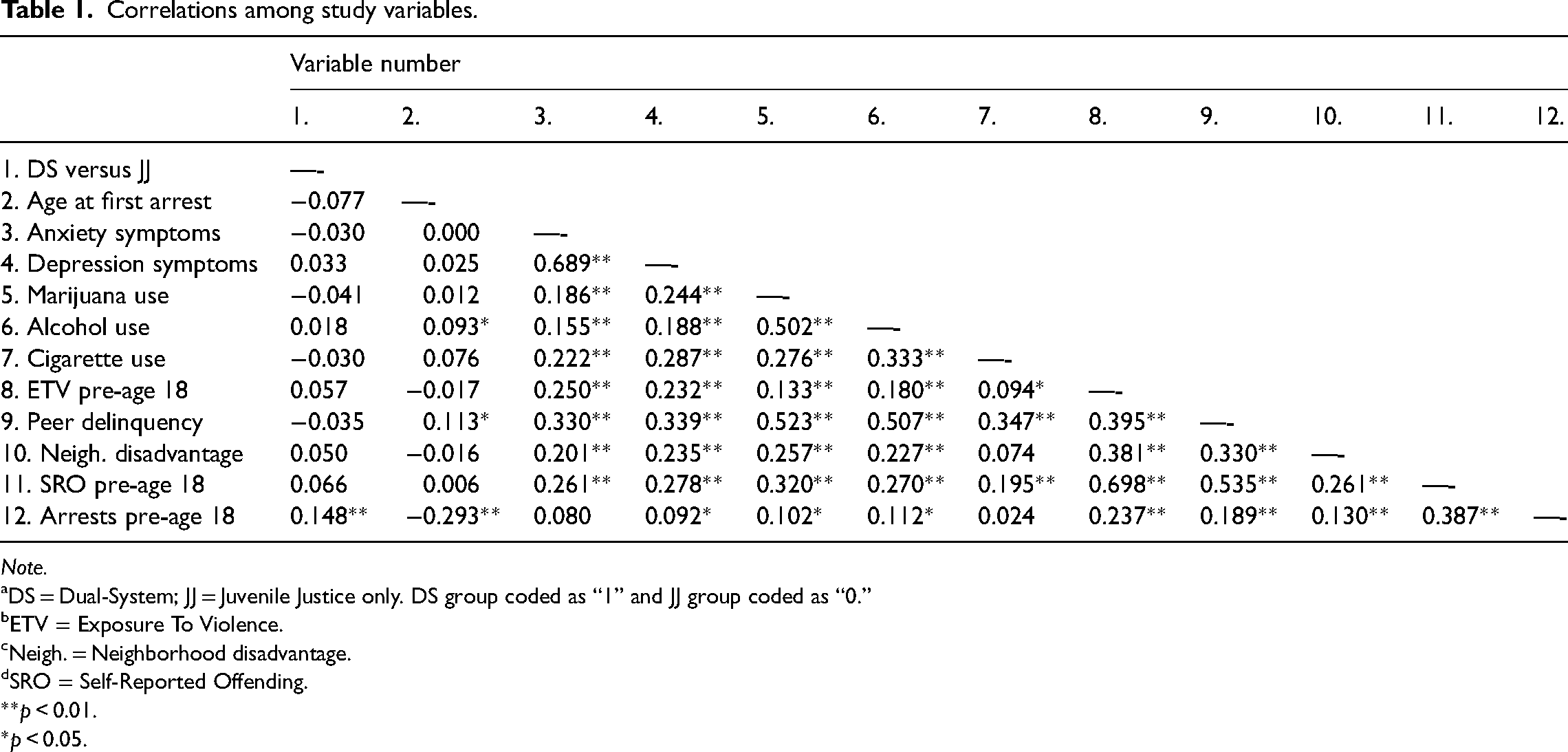
Table 1 contains bivariate correlations among all study variables. As shown, being a DS youth (compared to JJ youth) was only correlated with lifetime arrests before age 18.
Correlations among study variables.
Note.
DS = Dual-System; JJ = Juvenile Justice only. DS group coded as “1” and JJ group coded as “0.”
ETV = Exposure To Violence.
Neigh. = Neighborhood disadvantage.
SRO = Self-Reported Offending.
p < 0.01.
p < 0.05.
Individual-level factors
We next examined whether JJ and DS youth significantly differed on mental health or substance use using regressions that were appropriate for the distribution of the outcome variables. Results showed no significant differences on anxiety symptoms, depressive symptoms, marijuana use, alcohol use, or cigarette use at age 18 (see Table 2).
Background variable descriptive statistics by child welfare and juvenile justice system contact.
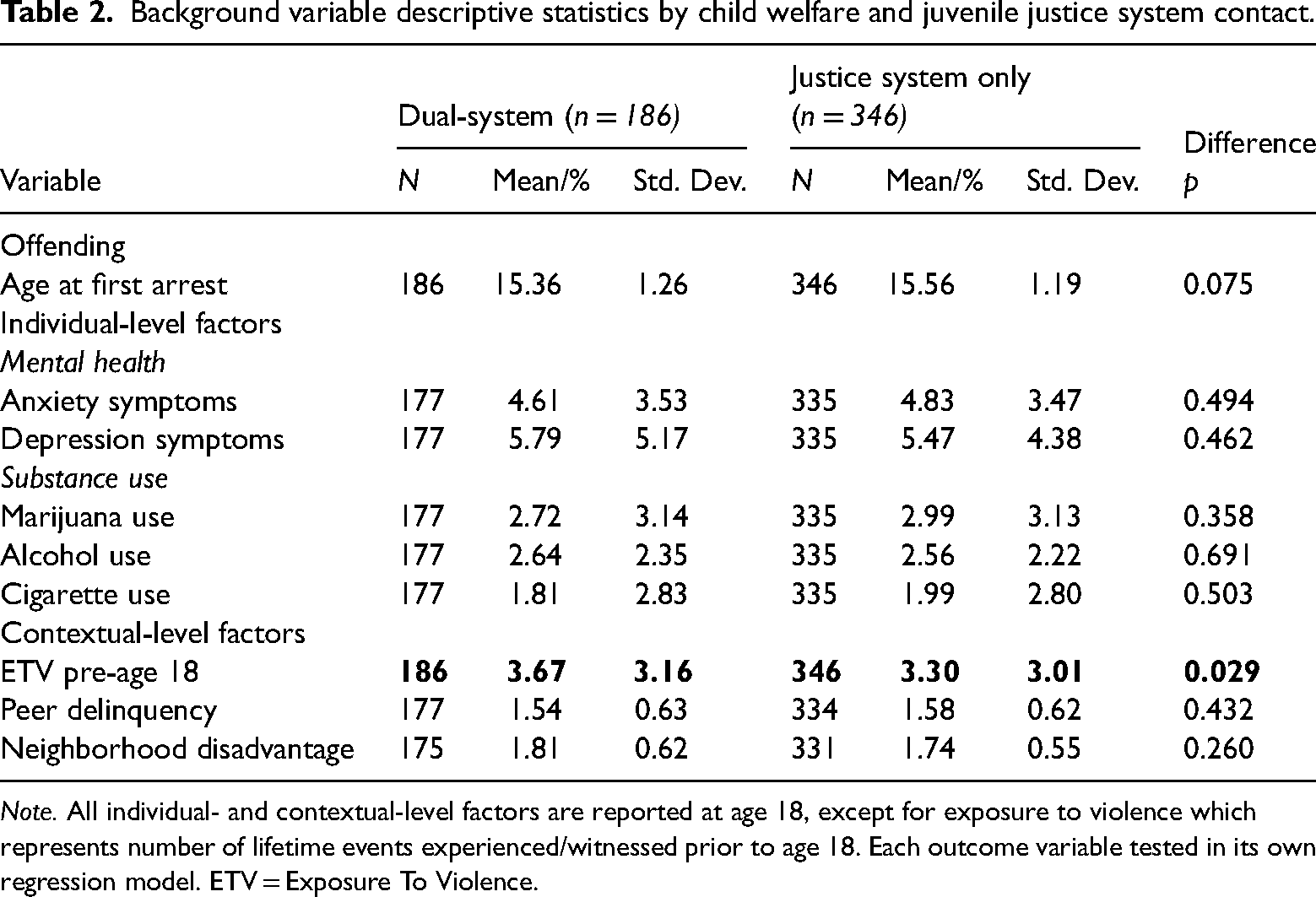
Note. All individual- and contextual-level factors are reported at age 18, except for exposure to violence which represents number of lifetime events experienced/witnessed prior to age 18. Each outcome variable tested in its own regression model. ETV = Exposure To Violence.
Contextual-level factors
Next, we examined whether JJ and DS youth differed on lifetime exposure to violence through age 18, association with deviant peers at age 18, and neighbourhood disadvantage at age 18. Results showed that DS youth were exposed to slightly more violence before age 18 than JJ youth (see Table 2). Notably, the number of violent events to which youth were exposed was high for both groups (i.e., each group reported witnessing or experiencing more than three forms of violence before age 18) and the magnitude of the difference between JJ and DS youth on this outcome may not be clinically meaningful (3.67 events versus 3.30 events). Results also showed no differences on peer delinquency or neighbourhood disadvantage at age 18 (see Table 2).
Lifetime self-reported offending and official arrests
Finally, we examined whether DS youth compared to JJ youth were arrested more often or reported more self-reported offending in their lifetime before age 18, controlling for all individual- and contextual-factors described in the previous step as well as race/ethnicity and age at first arrest. Results showed that DS youth were arrested significantly more often than JJ youth before turning 18 (M = 2.11 arrests versus 1.62 arrests; B = 0.20, 95% CI [0.06, 0.34], see Table 3). Interestingly, even if we repeat the model predicting lifetime juvenile arrests and additionally control for lifetime SRO, DS youth still report a greater number of arrests than JJ youth only (B = 0.15, 95% CI [0.01, 0.29]). In contrast, there were no differences between JJ and DS youth on lifetime self-reported offending at age 18 (see Table 3).
Lifetime self-reported offending and arrests by child welfare and juvenile justice system contact.
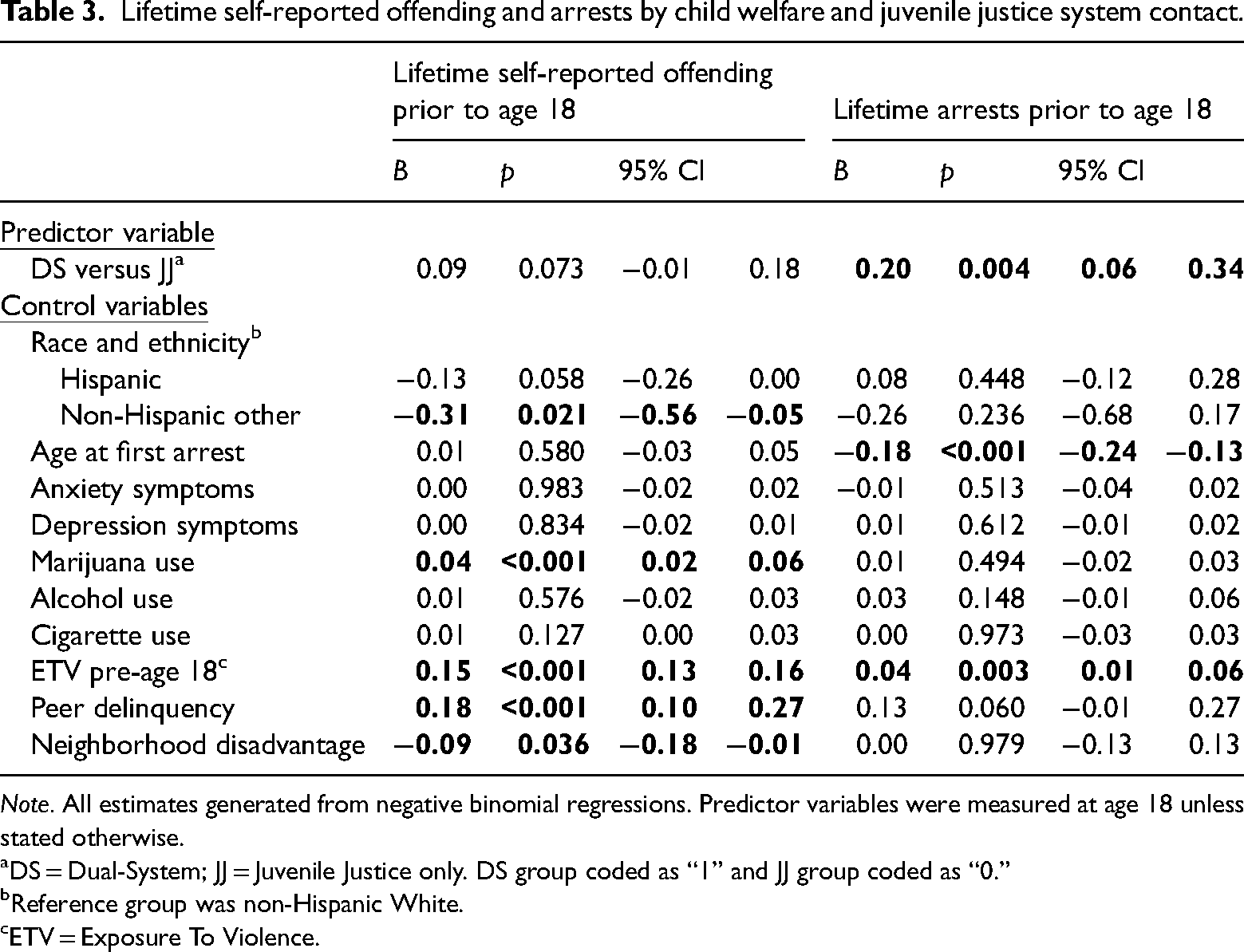
Note. All estimates generated from negative binomial regressions. Predictor variables were measured at age 18 unless stated otherwise.
DS = Dual-System; JJ = Juvenile Justice only. DS group coded as “1” and JJ group coded as “0.”
Reference group was non-Hispanic White.
ETV = Exposure To Violence.
Discussion
The present investigation compared 346 youth involved in the juvenile justice system (JJ youth) to 186 youth dually involved in both the juvenile justice and child welfare systems (DS youth) in Orange County, California. Contrary to our hypotheses, both groups exhibited similar levels of mental health symptoms, peer delinquency, and neighbourhood disadvantage. Notably, neither group reported particularly high average levels of any of the individual- and contextual-level factors. However, both groups reported being exposed to an average of more than three different types of violence before turning 18. Additionally, DS youth reported slightly more violence exposure compared to JJ youth.
Our findings largely aligned with some of the results recently reported by Modrowski et al. (2023), in which DS youth were not different from JJ youth on broad mental health symptoms and trauma exposure. Although their study found that DS youth had both more recidivism and self-reported offending, they did not control for the individual- or contextual-level variables that we did here which could account for the discrepancies. It is also important to note that the present study operationalised dual-system contact differently with respect to social service involvement (i.e., presence of an Orange County social service referral) compared to how Modrowski et al. (2023) defined “dual-contact” (i.e., substantiated referral in Utah's child welfare system). Nonetheless, the Modrowski et al. (2023) investigation of boys and girls in a Utah detention centre at 16 years old and our investigation of boys in California at age 18 demonstrate the importance of using both self-report and administrative data to identify patterns of behaviour in these high-risk groups.
Our findings also showed no differences between JJ and DS youth on mental health symptoms, marijuana use, alcohol use, or cigarette use. These findings are somewhat consistent with past work. For example, Lee and Villagrana (2015) found no greater differences in risk factors for substance use between JJ and DS male youth. They did, however, observe differences in the presence of protective factors against substance use, suggesting that while rates of use may not differ amongst these populations, DS youth may lack the protective factors necessary to deter problematic use should their use escalate. In other ways, our findings slightly deviate from prior work on their face, but these differences may reflect differences in measurement. For example, Dannerbeck and Yan (2011) compared youth based on historical indication of mental health and substance use problems in clients’ case files rather than directly measuring their clients’ symptomology and self-reported use.
As consistent with past work, DS youth in our sample were re-arrested more often (2.11 times) compared to JJ youth (1.62 times) when total arrest counts were summed through age 18. This finding is in contrast to their similar levels of self-reported offending. Moreover, it remained a significant difference after accounting for SRO in the model. Importantly, arrest differences also remained significant when controlling for lifetime exposure to violence, isolating the singular influence of child welfare system contact in our sample from several other risk factors that have been historically associated with arrest (age, mental health and substance use problems, peer delinquency, neighbourhood disadvantage). Of note, exposure to violence was significantly associated with both arrest count before age 18 and self-reported offending before age 18 for all youth in the fully adjusted models. In fact, it was the only factor that was associated with both official arrest data as well as self-reported data. Interestingly, exposure to violence before age 18 was also correlated with all of the mental health, substance use, and contextual factors in the bivariate correlation analysis. In summary, dual involvement in the child welfare and juvenile justice system appeared to increase vulnerability for the detection of antisocial behaviour in our sample, regardless of actual offending behaviour. Further, exposure to violence was associated with greater disadvantage for all youth in our sample.
Research implications
These findings have implications for researchers working on similar topics to the present investigation. First, they highlight the importance of incorporating multiple sources of data when studying outcomes in high-risk youth. Had our results only relied on self-reported offending data, we may have concluded that JJ and DS youth are not different on outcomes related to recidivism. Yet, had our results only relied on administrative arrest data, we may have concluded that DS youth are more likely to recidivate than are JJ youth – a result that has been observed in other studies (e.g., Halemba et al., 2004; Herz & Dierkhising, 2019). However, including both types of data allowed us to uncover that differences between JJ and DS youth may reflect differences in detection by the system rather than differences in behaviour. Although each of these sources of information have their own inherent limitations (e.g., self-report data may not reflect reality, administrative data may be difficult to access or incomplete), they allowed us to answer questions in nuanced ways that can then be used to construct interventions, target services, or guide future research aimed at identifying ways to best serve these youth.
Second, our investigation also highlighted that “imperfect” data can still represent a useful puzzle piece and researchers should not be discouraged when administrative data is difficult to acquire, incomplete, or basic in nature. Although we only had access to a dichotomous variable about contact with the child welfare system, results still provided important data on justice-involved youth. Researchers should continue to foster strong collaborations with community partners and government organisations to deepen perspectives on youth protective and risk factors.
Practical and clinical implications
Although not fully observed in our sample, prior studies have found that DS youth demonstrate greater criminogenic needs and require more robust support to reduce future offending. Indeed, our results showed that boys who had contact with both the juvenile justice and the child welfare system exhibited unique risk for future re-arrest, despite similar levels of self-reported offending. It may therefore be especially important to reduce the likelihood of multiple system involvement (i.e., crossover) in childhood and adolescence. Of note, the Crossover Youth Practice Model (CYPM) developed by Georgetown University was designed with a goal of working with both systems to reduce crossover and minimise disparities in servicing youth with dual-system contact. This is achieved through proactive and responsive collaborative case management between the two systems and considers factors from both systems’ perspectives, including past offending and environmental factors that promote or inhibit prosocial behaviour. For example, scholars and practitioners have called upon child-serving or behavioural health agencies to improve screening of mental health and substance use disorders in an effort to ensure appropriate servicing of youth to mitigate likelihood of becoming dually involved (Herz et al., 2010). As such, this model works to overcome previously identified limitations of insufficient multisystem collaboration (Good et al., 2023; Haight et al., 2016). In doing so, CYPM also helps to dispel concerns that DS youth present greater risk to public safety. Indeed, our results support that DS youth are no more likely to engage in offending behaviour than JJ youth, but are in fact being detected at higher rates by law enforcement.
Empirical evaluations have shown that youths receiving services guided by CYPM have experienced more frequent diversion from traditional court processing (Center for Juvenile Justice Reform, n.d.; Wright et al., 2020) and decreased future delinquency (Haight et al., 2016). Though no differences were observed in individual-level risks between JJ and DS youth in the current study, these approaches may help to mitigate potential risk for youth more generally. More specifically, despite equivalent levels of offending between JJ and DS youth, our present results certainly support the need for programmes that would decrease re-arrest risk for DS youth, especially given the host of disadvantaged outcome trajectories associated with criminal justice processing in adolescence (Cauffman et al., 2021, 2024). By building on past findings and adopting contextually responsive models to servicing DS youth (Herz et al., 2012), providers stand to improve factors such as prosocial peer affiliation, mental health and substance use problems, and recidivism to change these trajectories and promote positive youth outcomes.
Limitations and future directions
The present investigation had several notable limitations. First, we used a sample of justice-involved boys who were arrested for the first time for lower-level offences in Southern California, thereby limiting the generalisability of findings with respect to gender, location, and offending severity. Indeed, a female sample may have yielded different results, especially as mental health symptoms and exposure to violence tend to be higher for justice-involved girls compared to boys (de Vogel, 2022). As criminogenic risk factors across juvenile populations likely manifest differently for females in relation to offending behaviour (Lee & Villagrana, 2015; Scott & Brown, 2018), this area of research would be important to explore in justice-involved girls.
Second, analyses were predominantly descriptive in nature and did not assess causality or directionality in relationships. For example, we focused on individual-level and contextual-level factors which were measured at age 18, and our research questions regarding offending behaviour and DS involvement are therefore not explored temporally. Moreover, because Social Service administrative data was provided on a dichotomous level (i.e., whether or not youth had a case or referral), we were unable to capture the timing of justice contact in relation to child welfare contact. Although we have plans to collect more in-depth data for future investigations, we did not have information regarding the substantiation of reports made, outcomes of investigations, or details regarding dates, perpetrators, type of report made, or perpetration itself (on the participant or on another family member). Furthermore, the administration's method of providing data to the research team did not include a way to confirm that the youth himself was involved in the allegation, as the case or referral could have been initiated on behalf of another child (i.e., sibling) in his home. Additionally, our measure of arrest was based on whether an arrest was made and filed but did not take case dispositions into consideration. Despite these limitations, differences were found in the present study with respect to social service contact – regardless of the nature of that contact in the youth's family.
Further, we were able to leverage important administrative data to complement the nuanced self-report information which yielded important implications. For example, several studies exclusively examining administrative data for DS youth have reported greater mental health problems, without specificity as to what those problems or diagnoses may be (Dierkhising et al., 2018; Herz & Ryan, 2008). In the present investigation, we found no differences between JJ and DS youth in regard to depressive and anxious symptoms. Although there were technically statistical differences in exposure to violence, DS youth only reported a fractionally higher number of experiences suggesting that differences may not be clinically meaningful. Given the extensive histories of maltreatment and trauma which DS youth often report (Baglivio et al., 2015; Modrowski et al., 2021) even relative to those only in the justice system (Modrowski et al., 2023), examining differences in post-traumatic stress symptoms or diagnoses, for example, may be where DS youth experience greater mental health problems. Lastly, variations in study findings may be due to how DS contact is defined across the literature regarding both justice-system involvement (e.g., official arrests versus self-reported police involvement) and child welfare system involvement (e.g., maltreatment allegations versus substantiated referrals in state systems versus placement in foster care). Future studies should incorporate different forms of data collection across the period of childhood and adolescence when examining these two high-risk groups and should control for confounding variables when exploring research questions. Such specificity and integration can be useful for both practitioners who engage these youth and researchers continuing to understand their experiences.
Conclusion
The present investigation highlights the usefulness of supplementing self-report data with administrative information when examining differences between two sub-populations of high-risk youth who are vulnerable to continued system contact. Our results were, therefore, able to distinguish between detection of behaviour (e.g., arrest) from the behaviour itself (e.g., self-reported offending) in a male sample of justice-involved youth in Southern California. We found that youth dually impacted by the child welfare and juvenile justice system had significantly higher numbers of re-arrests compared to youth only involved in the juvenile justice system, even after controlling for self-reported offending, exposure to violence, and other demographic factors. Thus, our results add to the literature on the unique risks and needs of DS youth and promote the implementation of evidence-based models aiming to decrease the disadvantaged lifelong impacts of system involvement.
Footnotes
Acknowledgment
The authors are grateful to the study participants and their families, and the many other individuals who made this study possible, including the research assistants, project coordinators, and graduate students in the Development, Disorder, and Delinquency Laboratory.
Author contributions
M.G. co-led data collection for the social service data, co-led the study design/framing of research aims, interpretation of study results, and manuscript preparation; M.F. contributed to the study design/framing of research aims, interpretation of study results, and manuscript preparation; J.B. co-led data collection for the social service data, co-led the study design and developed the analytical plan, conducted the analyses, and contributed to interpretation of study results and manuscript preparation; I.R and C.S. assisted with the study design, interpretation of study results, and manuscript preparation; E.C. is the Principal Investigator on the Crossroads Study and oversaw all aspects of data collection, study design, analysis plan, interpretation of study results, and manuscript preparation. All authors read and approved the final manuscript.
Declaration of conflicting interests
The authors declared no potential conflicts of interest with respect to the research, authorship, and/or publication of this article.
Funding
The authors disclosed receipt of the following financial support for the research, authorship, and/or publication of this article: The Crossroads Study is supported by funding from the John D. and Catherine T. MacArthur Foundation, the Office of Juvenile Justice and Delinquency Prevention, the Fudge Family Foundation, the William T. Grant Foundation, the County of Orange, and the National Institute of Justice.
Ethical approval
All study procedures were approved by the Institutional Review Board at the University of California, Irvine.
Informed consent
Written informed parental consent and verbal youth assent were obtained for all participants in the study.
Data sharing declaration
De-identified data will be archived and available for use when data collection for the Crossroads Study is completed.
