




Abstract
The high representation of children involved across both child protection and youth justice systems remains a pressing concern. Contributing factors include unnecessary police intervention for behavioural difficulties in residential care, and deficient systems integration particularly between child protection and youth justice. Policy reforms in the past 15–20 years have aimed to prevent and address this concern across jurisdictions such as Australia, New Zealand, Canada, the United Kingdom, and the United States of America. The study offers an updated review and analysis of these policies, targeting researchers, policymakers, and practitioners in the field. Examination of selected available policies identified four main strategies utilised: joint practice protocols, policies aimed at reducing the criminalisation of children in out-of-home care, crossover court lists, and specialised practice models like the Crossover Youth Practice Model (CYPM). There is promising evidence for some approaches, notably the CYPM, however, most suffer from a lack of implementation and outcomes evaluation, insufficient diversity considerations, and minimal inclusion of lived experience in design and implementation. Findings suggest future policy reforms should prioritise the development of whole-of-government strategies, involve children's perspectives, emphasise prevention, restorative and diversionary responses, multi-agency collaboration, ongoing support for implementation, and rigorous evaluation.
Keywords
Background
The justice system contact of children from child protection backgrounds presents a significant and long-standing concern, with such children being seven to nine times more likely to become involved with youth justice systems (Australian Institute of Health and Welfare [AIHW], 2019; Jonson-Reid, 2002; Malvaso et al., 2017a; Reil et al., 2022). Given that differing terminology exists between jurisdictions, for consistency “child protection” is used in the current study to reference child welfare (including out-of-home care) systems, while “youth justice” is used to reference police, court, and youth justice systems (including youth detention). There is considerable variability in systems contact among dual system youth who experience contact with both child protection and youth justice systems. For example, their child protection contact can encompass notifications of risk of maltreatment, substantiated maltreatment incidents, or being subject to statutory protection orders, which may involve children's placement in out-of-home care settings with kinship (family), foster (nonfamily), or residential carers in group homes (Baidawi & Sheehan, 2020a; Herz et al., 2019). Likewise, justice system involvement of dual system youth encompasses everything from police arrests to convictions with accompanying community or custodial youth justice sentences (Baidawi & Piquero, 2020). Finally, the timing of children's systems involvement across child protection and youth justice systems may be concurrent (termed dually involved youth), or non-concurrent (termed dual contact youth) (Herz et al., 2019, 2021).
Overall, evidence indicates that the deeper a child progresses through each of the child protection and youth justice systems, the greater their likelihood of experiencing dual system involvement, with children at the most restrictive end of these systems (in out-of-home care and youth detention) being most likely to experience dual system contact. For example, 60% of Australian children in youth detention during 2020–2021 had some form of child protection contact, and 23.8% had been placed in out-of-home care, in the previous five years (AIHW, 2022). Likewise, 13% of children in out-of-home care in Australia from 2014 to 2018 were found to be under youth justice supervision in this period, compared to 7.2% of those who had solely been the subject of a child protection investigation (AIHW, 2019). Similar over-representation of child protection contact among youth justice populations is also evident in New Zealand, the United States of America, and Canada (Baglivio et al., 2016; Bala et al., 2015; Ministry of Justice, 2023). For example, in 2016–2017, over one-third of children in custody in England, Wales, and Northern Ireland were noted to have been in local authority (out-of-home) care (Criminal Justice Inspection Northern Ireland, 2018; Taflan, 2017).
Increasing research, policy and practice attention to dual system youth
In recent years, dual system youth have drawn increasing research, policy and practice attention in jurisdictions with separate statutory child protection and youth justice systems, including in the United States of America (e.g., Herz et al., 2019), the United Kingdom (e.g., Shaw, 2016), New Zealand (e.g., FitzGerald, 2018; New Zealand Police vs [JV], 2021), Canada (e.g., Bala et al., 2015) and Australia (e.g., Baidawi & Sheehan, 2020a; McFarlane et al., 2019) among others. Underpinning this is firstly a recognition of the need to improve children's outcomes, particularly those removed from family, and for whom the state is the legal guardian (Baidawi & Sheehan, 2020a). Second, it reflects the need to address the considerably poorer justice system outcomes among dual system youth, including their earlier justice system contact, and greater likelihood of violent offending, recidivism, and progression to adult criminal justice systems (Baglivio et al., 2016; Malvaso et al., 2018; Matthews et al., 2022). Third, there is a growing understanding of the concentrated vulnerability and complexity of need among the crossover group, relative to other justice-involved youth. For instance, research has not only identified greater prevalence of child maltreatment among dual system youth, but also that this cohort is disproportionately comprised of ethnic and racial minorities (including First Nations children in Canada and Australia, and African American children in the United States of America), females, and children with complex needs related to neurodisability, emotional and behavioural difficulties (Baidawi & Ball, 2023a; Cutuli et al., 2016; Dierkhising et al., 2018; Malvaso et al., 2019; Ministry of Justice, 2023).
Preventing and responding to the criminalisation of dual system youth
While child protection-involved children are over-represented in youth justice populations, developmental/life-course evidence indicates that only a minority of child protection-involved children will go on to experience youth justice contact (up to 10%) (Malvaso et al., 2017a; Vidal et al., 2017). Several factors are associated with an increased risk of this outcome. These include sociodemographic predictors such as male gender, racial minority status, and household poverty; maltreatment-related factors including experiences of physical abuse and neglect, maltreatment recurrence and persistence into adolescence; care system-related factors including placement in out-of-home care settings (particularly residential care), older age of entry into care, and care placement instability; and individual factors such as emotional and behavioural regulation difficulties (Baskin & Sommers, 2011; Cho et al., 2019; Cutuli et al., 2016; Malvaso et al., 2017a; Vidal et al., 2017).
Two policy and practice concerns are also identified as key contributors to the criminalisation of dual system youth. First is the unnecessary use of criminal justice system responses to children's harmful behaviour, effectively criminalising children's welfare needs (Colvin et al., 2020; McFarlane, 2018; New Zealand Police vs [JV], 2021), and second is deficiencies in systems integration particularly between child protection and youth justice systems (Herz et al., 2021). The “care criminalisation” of children's welfare needs is most clearly seen in the adoption of police responses to children's behavioural difficulties in residential care. Otherwise known as “group homes”, “congregate care” or “children's homes”, residential care refers to out-of-home care settings run by government, non-government or private agencies, and which accommodate children unable to be looked after by their parents. Several children often reside in one residential care placement at a given time, which are typically staffed by a rostered system of paid staff, and often funded by government to be delivered by non-government organisations. Research from Australia (Baidawi & Ball, 2023b; Gerard et al., 2019), the United Kingdom (Shaw, 2016), the United States of America (Ryan et al., 2008), and Canada (e.g., Bala et al., 2015) consistently identifies children who are placed in residential out-of-home care as a key subgroup of dual system youth. While not all children who enter residential care become dually involved, children in these placements face comparatively higher risk of being criminalised, even relative to children in other out-of-home care placement types (Ryan et al., 2008). For example, in 2017, children in residential care only comprised 10% of the 4,230 children in out-of-home care in one Australian state but comprised 58% of the 213 children in out-of-home care who came before the state's youth criminal court during 2016–2017 (Sentencing Advisory Council, 2019). Evidence from Australia and the United States of America also suggests that the impact of placement in residential care on children's risk of justice system involvement is not uniform, but rather that such environments most greatly increase the risk of justice involvement for females, certain racial and ethnic groups, and children with a neurodisability (Baidawi & Piquero, 2020; Jonson-Reid & Barth, 2000; Malvaso et al., 2017b).
The phenomenon of care criminalisation of children in residential care has received extensive attention, which describes the unnecessary exposure of young people in residential care to the criminal justice system, particularly when behaviours of young people in residential care are unnecessarily treated as criminal (McFarlane, 2018). The use of police responses in these environments is seen to result in residential care-placed children often being criminally charged for behaviour unlikely to receive such responses in a family home (Baidawi & Sheehan, 2020b; Colvin et al., 2020; Shaw, 2016). This phenomenon is raised in literature from Australia, New Zealand, the United Kingdom, and the United States of America, suggesting that police are at times utilised as a “behavioural management tool” by residential care providers (Gerard et al., 2019; Stanley, 2017). These processes tend to result in children being charged with property offences (typically criminal damage or theft) or offences against the person (assault or threats) (Baidawi & Sheehan, 2019), propelling their involvement in youth justice systems.
A lack of systems integration particularly between child protection and youth justice systems has also been highlighted as disadvantageous to dually involved youth for some time (Herz et al., 2021). For example, fragmentation in court processes has been seen to extend the time on remand for dually involved children awaiting child protection placements, to require children to deal with multiple legal representatives, and to impede or delay access to necessary information to inform assessments to, and dispositions made by, youth criminal courts (Baidawi & Sheehan, 2020a). Fragmentation of child protection and justice system processes extends from court systems which often hear these children's welfare/family and criminal matters separately (see New Zealand Police vs [JV], 2021 for a case example), through to the statutory services which typically supervise separate court orders for dually involved youth. Structural barriers which impede systems collaboration include a lack of clarity around roles and responsibilities, tensions between different approaches and agency ideologies, and a lack of clear understanding or protocols for information sharing, assessment processes, and joint case management (Baidawi & Sheehan, 2020a; Herz et al., 2021; Mendes et al., 2014).
The last 15–20 years have seen various policies being implemented across several jurisdictions which aim to address these policy and practice concerns, to both prevent and address the trajectories of dually involved youth. The current study aims to review these diverse policies for the purpose of updating researchers, policymakers and practitioners, as well as to critically analyse these policies to identify strengths and limitations that can inform future policy, practice and evaluation in the field.
Methods
The current study aims to identify and critically analyse policies aiming to support dually involved youth – those aged under 18 years who experience concurrent (or simultaneous) involvement with child protection and youth justice systems (Herz et al., 2019, 2021). The article also canvasses policies aimed at preventing the criminalisation of at-risk child protection-involved youth (e.g., those in residential care). This study addresses three interrelated research questions:
What publicly available policies are aimed at supporting dually involved youth? What is the evidence supporting the effectiveness of these policies? To what extent does each policy align with social values and human rights principles?
Policies currently implemented in Australian, New Zealand, U.K., U.S., and Canadian jurisdictions were included. These countries were selected due to similarities between the structures of their child protection and youth justice systems, alongside references in the literature to policies from these countries aimed at supporting dually involved youth. Therapeutic interventions which may be provided to dually involved youth on a voluntary basis were excluded from this study, as these do not reflect standard care for dually involved youth.
Policy identification
This study involved searching for publicly available policies aimed at supporting dually involved youth in the selected jurisdictions, and subsequently critically analysing these to ascertain their effectiveness for supporting better outcomes for dually involved youth. The search strategy involved two stages, conducted from July to September 2021. First, the authors utilised a Google search to identify policies by combining names of countries and their jurisdictions, and key terms: “crossover children”, “dually involved children”, “child protection” and “youth justice”, “juvenile justice”, “criminalisation of children in residential care”, “care criminalisation”, “policy”, “memorandum of understanding” (MOU), “practice framework”, “practice guidelines” and “practice manual”. A second search for evidence on the effectiveness of each identified relevant policy was undertaken via another Google search, comprising the policy's name and key terms: “review”, “study” and “effectiveness”. A final search via the Social Services Abstracts database located peer-reviewed literature related to implementation and effectiveness of each policy. While the approach was not systematic, it was sufficient to identify broad policy approaches in this area. These steps led to identification of 29 policies which were categorised into four overall approaches:
Joint practice policies between statutory child protection and youth justice services Policies aimed at reducing the criminalisation of children in residential care Crossover court lists Specialised practice models (the CYPM)
Comparative policy content analysis
A Comparative Policy Content Analysis approach was adopted, which involves describing, explaining, and comparing the content of various government decisions (Schmitt, 2013). Comparative content analysis of social policy is useful for policy makers when considering diverse approaches to address a social problem or need (Karger & Stoesz, 2010).
The study involved analysis and comparison of content within each policy approach, described by Ranney (1968, p. 8) as the specific set of goals or objectives within a policy, and the declarations and actions chosen by governments outlined within the policy. A modified version of Karger and Stoesz's (2010) policy analysis model was then applied, which also incorporates elements of Gabel's Right's Based Approach to Social Policy Analysis (2016). The amalgamation of elements of both models intended to meet the aims of this policy review most effectively.
Using both frameworks, a set of questions are asked of each policy approach. Karger and Stoesz's (2010) policy analysis model poses four sections of questions, namely the historical background of the policy, a description of the problem that necessitated the policy, a description of the policy, and the policy analysis. The historical background and a description of the problem that necessitated the policy will not be explored for each individual policy approach, as the background of the current article has provided a brief description of dual system youth and the literature surrounding their current systems-related needs.
A description of each policy is included using Karger and Stoesz's (2010) model, which asks the following questions of each policy approach:
When was the policy created? What are the aims and key objectives of the policy? At what stage of youth justice involvement is this policy aimed at? (Police charge, court involvement, or post-sentence) Which service sectors are impacted/involved? How has the policy been implemented? Has there been an evaluation of the policy? Formally or informally? What's the level of evidence? (Formal evaluation, anecdotal) Is there evidence of lived experience consultation in the writing or implementation of the policy? Is there evidence of attention to the needs of diverse youth within the policy including gender, racial or ethnic diversity, or neurodiversity?
Finally, policy analysis questions are asked using both Karger and Stoesz's (2010) model and Gabel's (2016) model to explore the extent to which each policy aligns with both social values and human rights principles. The following questions are therefore also asked of each policy approach or model:
Findings
Table 1 summarises the 29 identified policies by category and allocates a brief code to each policy which is used in the presentation of findings. While 32 policies were retrieved, they included updated versions of the same policy (n = 2) and documents referencing the same policy in a single jurisdiction (n = 1).
Identified public policies aiming to support dually involved youth.
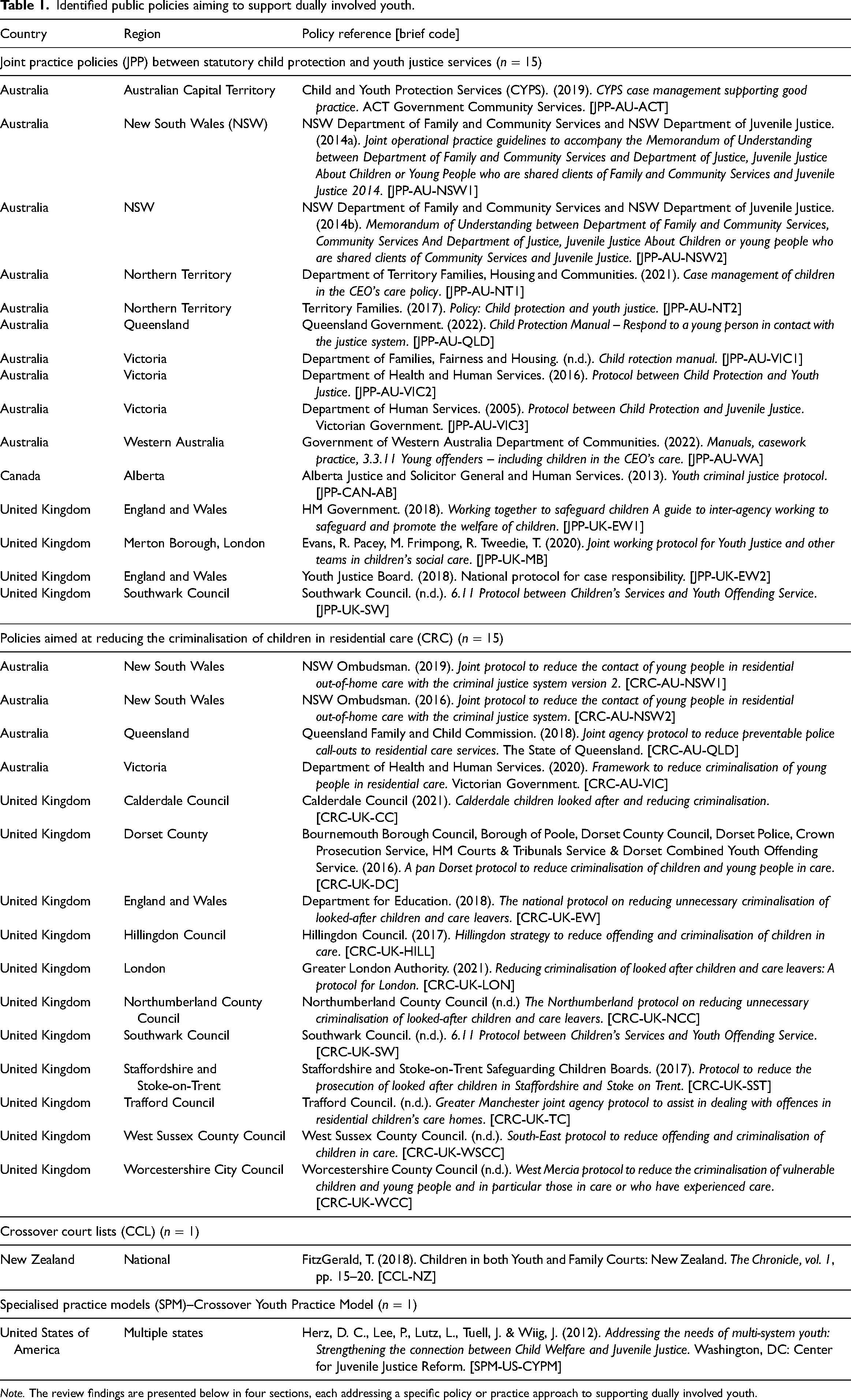
Note. The review findings are presented below in four sections, each addressing a specific policy or practice approach to supporting dually involved youth.
Joint practice policies between statutory child protection and youth justice services
Australia, Canada and the United Kingdom have each implemented joint child protection and youth justice practice policies for working with dually involved youth (e.g., JPP-CAN-AB; JPP-AU-VIC2; JPP-AU-NSW1; JPP-UK-EW1). These include Joint Protocols (JPP-AU-VIC2; JPP-UK-EW1, JPP-UK-MB; JPP-UK-SW), sections within jurisdictional child protection manuals focusing on dually involved youth (JPP-AU-VIC1; JPP-AU-WA; JPP-AU-QLD), or in the case of the Australian Capital Territory (ACT) Government in Australia, a unified case management policy framework for child protection and youth justice (JPP-AU-ACT). There is wide variability in how long ago these policies were first introduced, from 2005 in Australia (JPP-AU-VIC3), to 2013 in Canada (JPP-CAN-AB), and 2014 in the United Kingdom (JPP-UK-EW2). While joint practice across these systems is also a component of the CYPM (the United States of America), this is discussed separately in the findings as a component of a specialist practice model (SPM-US-CYPM).
Joint practice policies aim to support collaboration and coordinated care across these child protection and youth justice systems (e.g., JPP-AU-VIC2). The more detailed joint policies outline the key roles and responsibilities of each service, information sharing and collaborative case planning guidelines, and issue directions for commonplace practice issues related to dually involved children (e.g., JPP-AU-NSW2; JPP-AU-QLD; JPP-AU-VIC2; JPP-AU-WA; JPP-CAN-AB). However, two of the least detailed joint policies simply state that case planning must be “collaborative” together with illustrative examples (JPP-AU-NT1 and JPP-AU-NT2). Perhaps the most unique joint policy is from the ACT in Australia which created a joint case management framework for both child protection and youth justice. Both services are provided with a complete outline of their specific roles and responsibilities, alongside shared responsibilities, with detailed reference to assessment, information sharing, case planning, and governing legislation (JPP-AU-ACT).
All joint practice policies are aimed at dually involved young people with concurrent case management from child protection and youth justice. An exception is the Southwark London protocol, which includes a section on early intervention for child protection-involved children without justice system contact (JPP-UK-SW). Child protection and youth justice services are primarily impacted by joint policies, however, disability, cultural and education services are acknowledged as services with whom collaboration may be necessary (JPP-AU-ACT; JPP-AU-NSW2; JPP-AU-VIC2). Only New South Wales’ (Australia) MOU discusses their policy implementation strategy which includes Community Services and Juvenile Justice committing to develop internal procedures to support the MOU, provision of staff training, and periodic review of MOU implementation (JPP-AU-NSW2, p. 8).
The only joint practice policy for which assessment or evaluation was located was in Victoria, Australia (JPP-AU-VIC2). This policy was referenced in a statewide Youth Justice Review (Ogloff & Armytage, 2017) which noted that “current approaches to information sharing and service integration for these young people are ad hoc at best and non-existent at worst, despite the existence of a protocol between the two” (p. 24). Qualitative research with professionals in this jurisdiction similarly suggested a lack of “on the ground” adherence to the policy (Mendes et al., 2014).
Finally, none of the joint practice policies mentioned lived experience consultation in policy writing or implementation. In relation to diversity, some policies stated that child protection and youth justice services should respond to the cultural needs of Aboriginal dually involved youth from Australia or Canada, the cultural needs of culturally and linguistically diverse communities, the health needs of children and young people by collaborating with disability services, and respect the cultural, ethnic, gender and sexual identity of children and young people (JPP-AU-ACT; JPP-AU-NSW2; JPP-CAN-AB). Most policies did not provide detail or advice as to how practitioners may respond to the needs of diverse children and young people, except for the ACT, Australian government. The ACT policy outlined the importance of utilising cultural support plans, Family Group Conferencing, and the Cultural Services Team when working with Aboriginal and Torres Strait Islander children, and being mindful of literacy and language barriers, using culturally sensitive, strength-based dialogue, and utilising interpreters and/or support persons when working with culturally and linguistically diverse children and young people or their families (JPP-AU-ACT).
Policies aimed at reducing the criminalisation of children in out-of-home care
Joint protocols aimed at reducing the criminalisation of children and young people in residential care exist in Australia and the United Kingdom (CRC-AU-NSW1; CRC-AU-QLD; CRC-AU-VIC; CRC-UK-EW). Such protocols were first developed in England, with the Surrey Southeast protocol being the most widely recognised (Prison Reform Trust, 2016). In 2018, the National Protocol on Reducing Unnecessary Criminalisation of Looked-After Children and Care Leavers was released to provide a framework for practice with looked after children throughout England (CRC-UK-EW).
England's 2018 policy was created to ensure national consistency in responses to looked after children and care leavers (CRC-UK-EW). The protocol aims to avoid unnecessary criminalisation of looked after children and care leavers by training and supporting agencies to provide trauma informed care, improving collaborative practice and information sharing, providing clear protocols for de-escalation, restorative responses, and early intervention strategies to prevent justice system involvement (CRC-UK-EW). The English protocols encourage agencies to pose the question “would such behaviour lead to an arrest if the child had been living with their family?” (CRC-UK-EW, p. 7). Following this national guidance, similar protocols were implemented throughout England including in London, West Mercia, Calderdale, Northumberland, Staffordshire and Stoke, Hillingdon, Pan Dorset, and Greater Manchester (e.g., CRC-UK-SW; CRC-UK-TC; CRC-UK-WSCC).
Likewise, three Australian states have produced policies aimed at reducing the criminalisation of children in residential care. NSW first released such a protocol in 2016 (CRC-AU-NSW2), followed by Queensland in 2018 (CRC-AU-QLD), an updated NSW protocol was released in 2019 (CRC-AU-NSW1), and a Victorian protocol was released in 2020 (CRC-AU-VIC). The Australian polices contain the same key objectives as England's national protocol, however, one difference is that Australian polices only apply to children in residential care, rather than all “looked after” children in care. Furthermore, Australian policies mention culturally responsive practice with Aboriginal and Torres Strait Islander children and young people, and provide more detail regarding individual agency roles, as well as shared responsibilities between agencies to reduce criminalisation of children in residential care.
English and Australian policies aim to prevent the criminalisation of children in care, while also supporting children in care who are already dually involved. All of the protocols impact police, youth justice, child protection, residential care (Australia)/children's homes (England), courts, Magistrates, and relevant community services (CRC-AU-VIC; CRC-UK-EW). Protocols from England also affect foster care, and other alternative care providers given their protocols cover all looked after children (CRC-UK-EW).
Most of the protocols describe governance bodies responsible for monitoring and managing the policy's implementation (e.g., Advisory Group, Steering Committee, Board, or State-wide group) (CRC-AU-NSW1; CRC-AU-VIC; CRC-UK-LON; CRC-UK-NCC). Furthermore, many protocols acknowledge the need for collaboration in planning and implementation amongst agencies impacted by the policy, including the need for data collection to evaluate implementation and effectiveness (CRC-AU-VIC; CRC-UK-EW; CRC-UK-LON). The 2020 protocol from Victoria, Australia contains the most detailed implementation plan, comprising tasks that the state-wide implementation group was to complete (e.g., developing an 18-month action plan, communication and promotion strategy to support implementation, risk mitigation strategy, and sector-specific or joint agency training and resources) (CRC-AU-VIC). Many of the protocols also set timeframes for formal review (see, e.g., CRC-AU-NSW1; CRC-AU-VIC; CRC-UK-LON).
There is both formal and informal evidence of the effectiveness of the English protocols. The 2018 National Protocol from England stated that the South East protocol in Surrey “resulted in a 92% decrease in first time entrants to the youth justice system (1,499 first-time entrants to youth justice system in 2007/8 compared with 113 in 2017/18) and an 18% decrease in reoffending between 2007/08 and 2017/18” (p. 6). Other anecdotal evidence exists regarding the effectiveness of the Pan Dorset Protocol, the Norfolk Protocol, and England's 2018 National Protocol for reducing the rate of criminal justice involvement for children in care (Horne, 2019; Sands & Sandell, 2020; Social Work Today, 2021). For example, Norfolk Police reported that in the five years following the introduction of their policy in 2014, past-year formal criminalisation of children in residential care reduced from 15% to 7% (Sands & Sandell, 2020). At the same time, research in the United Kingdom and Australia presents a more critical view of these policies, highlighting the inconsistency in their implementation and adherence, and the need for associated training and support to shift attitudes (e.g., of police, residential care staff and the broader public) towards children in residential care, and to encourage interagency collaboration which can easily remain unaddressed by “just another policy document” (Colvin et al., 2020; McFarlane et al., 2019; Shaw, 2016).
Three of the policies involved or intended to involve children with lived experience of residential care in the policy's development or implementation. The Victorian protocol states that care experienced youth consultants were involved in developing the framework (CRC-AU-VIC), England's 2018 National Protocol states that they will be “seeking looked-after children and care leavers’ input into the implementation of local arrangements for delivering this protocol” (CRC-UK-EW, p. 12), and London's 2021 protocol states that ensuring professionals “engage with, hear, and act on the voice of children in care” is a key component of implementation, while some Boroughs have used “Young People's Commissioning Groups” to achieve this aim (CRC-UK-LON, p. 19).
The Australian policies each mention the importance of culturally respectful and responsive practice with Aboriginal and Torres Strait Islander children and young people, with Victorian and NSW policies providing detailed exploration of the impact of intergenerational trauma, the importance of working collaboratively with community and Aboriginal Community Controlled Organisations and developing cultural support plans (CRC-AU-NSW1; CRC-AU-QLD; CRC-AU-VIC). The NSW policy also mentions the rights of children from culturally and linguistically diverse backgrounds and states that police should be notified if a child has disability (CRC-AU-NSW1). The Victorian policy aligns itself with the UN Convention on the Rights of the Child's guiding principles including that: “Children must not be discriminated against, no matter their religion, race, capabilities; whatever they think or say; or what their culture and gender identity is” (p. 18). The Victorian policy also states that “Aboriginal young people, young people from culturally diverse backgrounds, and young people with disabilities” are particularly vulnerable to criminalisation and should be considered by all staff including police, and also encourages staff to consider the needs of same-sex-attracted and intersex young people (p. 10).
Both the National Protocol from England and London's protocol identify Black, Asian and Minority Ethnic looked-after children as particularly vulnerable and over-represented in both the care and youth justice systems (CRC-UK-EW; CRC-UK-LON). Furthermore, the National Protocol also highlights the risk of exploitation and mistreatment of unaccompanied asylum-seeking and migrant children who are looked after (CRC-UK-EW). In regards to conducting restorative processes, the U.K. National Protocol mentions that “the age of children, their ethnicity, whether they are unaccompanied migrant children, their gender, religion and other protected characteristics are all factors which must be taken into account” and that “practitioners must be mindful of any inherent biases that could affect their ability to offer a neutral restorative process to any person on the basis of their particular status or background e.g., their race, nationality or country of origin, gender, offending history, disability, socio-economic or political background” (CRC-UK-EW, pp. 41–42).
Crossover court lists
Crossover court lists began to be implemented throughout courts in metropolitan Auckland in 2011 to better support children and young people who have matters in both criminal and family courts (CCL-NZ). The Crossover Lists aim to identify dually involved children and young people early in their court involvement and then provide a space for information sharing and coordination between services to occur such that a consistent response is provided by both the Family and Youth courts regarding a child's protection and youth justice matters (CCL-NZ). One aim of the Crossover Lists is to prevent unnecessary use of criminal justice powers and facilities to manage and monitor ongoing welfare needs for the young person (CCL-NZ). Crossover Lists were created to address issues that were arising from the Family and Youth courts operating separately including that “when a young person with care and protection status entered the Youth Court, that was taken as a signal that the care and protection involvement was at an end” resulting in social workers and many lawyers recommending that “the care and protection proceedings be closed” simply because the Youth Court was involved. As a result, the Youth Court often stayed involved longer with a young person to address their welfare needs, even after their criminal matters had been addressed (CCL-NZ, p. 19).
With the implementation of Crossover Lists in Auckland, when a child with Family Court involvement is charged and enters the Youth Court for criminal matters, court officers can utilise an information-sharing protocol to identify care and protection involvement with the Family Court. After a child has made their first appearance in the Youth Court, their next appearance can be scheduled by the court registrar in the Crossover List where the Judge will have access to both the Family and Youth (criminal) court files (CCL-NZ). Once a child or young person is before a Judge in the Crossover List, both their Family and Youth Court matters are considered simultaneously, such that integrated care and support can be provided from both child protection and youth justice services (CCL-NZ).
Auckland's Crossover Court List has the capacity to involve and impact many services including court staff, Judges, Oranga Tamariki Ministry for Children (Child Protection), Ministry of Education, Tū Māia (the Youth Forensic Service), police, youth advocates (lawyers), lay advocates, and communication assistants, when necessary, all of which are able to be involved in crossover list proceedings (CCL-NZ, p. 20). In the crossover courtroom, all parties work together in a “non-adversarial, coordinated way” (CCL-NZ, p. 20).
Formal evidence available speaks to the efficacy of the New Zealand Crossover Court Lists in a research article authored by Judge Tony FitzGerald (CCL-NZ) and a research report by Magistrate Jennifer Bowles (2014). The evidence indicates that Crossover Lists are able to bring together justice and protection services in multiple contexts which have the capacity to benefit the young person including: in a bail context, when discussing appropriate placements for children and young people, avoiding children and young people from being disadvantaged from the order in which their matters are resolved in the two separate courts, reducing the number of court appearances for a young person, and in some circumstances allowing a young person to have one lawyer instead of two to represent them for both criminal and protective matters (Bowles, 2014). FitzGerald's article outlines the manner in which the Crossover Lists have helped to address the criminalisation of welfare issues, helped “inform forensic assessments”, “synchronised what is happening for a young person in both the Family and Youth Court” and provided “necessary information for making dispositions in the youth court” (CCL-NZ, p. 19).
Specialised practice models – CYPM
In 2010, the Center for Juvenile Justice Reform at Georgetown University, Washington DC created the CYPM (SPM-US-CYPM), which was the only identified whole-of-government holistic policy approach involving the young person and their family, police, courts, statutory services, other support services. The model has been progressively implemented throughout numerous jurisdictions in the United States of America and in 2023 is operating in more than 120 counties in 23 states (Center for Juvenile Justice Reform, n.d.). The CYPM was created to support “crossover children”, defined in the initial model as “any youth who has experienced maltreatment and engaged in delinquency” (Center for Juvenile Justice Reform, 2015, p. 4). Within this cohort, “dually involved” youth are those simultaneously involved in youth justice and child protection systems at any level, and “dually adjudicated youth” are those concurrently adjudicated by both statutory systems (Center for Juvenile Justice Reform, 2015, p. 4).
The CYPM was generated as a blueprint for practice with crossover children throughout U.S. jurisdictions. The model contains an “organisational ideology” and provides directions for service providers, families, and young people on how services can be most effectively delivered to this cohort (Center for Juvenile Justice Reform, n.d., para. 2). The CYPM aims to minimise crossover young people's justice system involvement by utilising evidence-based practice, interagency collaboration, early intervention, and family engagement (Haight et al., 2014). To achieve this, the CYPM aspires towards reducing the number of young people in out-of-home care, reducing the use of congregate care, reducing the disproportionate number of children of colour, particularly dually involved youth, and reducing the number of crossover youth transitioning into becoming dually involved youth (SPM-US-CYPM). Implementing the model throughout U.S. jurisdictions aims to support greater consistency in the approach of child protection and youth justice agencies, specific policies and practices created for dually involved youth, improved cross-systems engagement particularly in relation to case management, cross-systems data tracking and research to improve service delivery, and cross-systems training to improve agencies' reciprocal understanding (SPM-US-CYPM, p. 6).
The model, which is implemented in three phases, aims to support young people throughout the trajectory of justice system involvement, from arrest through to final case closure, however, there is particular emphasis on supporting dually involved youth (Haight et al., 2014). Phase I of the model is concerned with supporting children through arrest processes, identifying crossover children as early as possible in their involvement with the justice system, and considering a young person's crossover status when making decisions regarding charges and detention (Haight et al., 2016). Important goals within phase I include the early identification of crossover children (ideally at arrest or youth justice intake), joint justice and child protection assessment processes, utilising opportunities for diversion, staff to include families through all processes, both child protection and youth justice case workers to attend all court appearances, and for services to possibly develop a MOU to support information sharing (Center for Juvenile Justice Reform, 2015). Following prosecution, phase II of the CYPM requires systems to engage in joint assessment and planning (Center for Juvenile Justice Reform, 2015). Key components of phase II include collaborative child protection and youth justice assessments, case plans, and referrals to community services, all of which are to involve the young person and their family. Other key elements of this phase include a commitment to reduce the use of group/residential care when possible, consolidated court processing of youth justice and child protection court matters, and increased use of pre-court coordination (Center for Juvenile Justice Reform, 2015). Finally, phase III is focussed on ongoing coordinated case management and supervision across services, prioritising information sharing, coordinated updating of assessments, and planning for the eventual case closure of both youth justice and child protection through making necessary community referrals such as mental health, employment, housing, health care, and educational supports (Haight et al., 2016).
The CYPM contains a detailed implementation process, with a multitude of services related to child protection and youth justice systems are involved to varying degrees across each phase. The Center for Juvenile Justice Reform at the Georgetown University McCourt School of Public Policy and Casey Family Programs have been leading the CYPM implementation process throughout U.S. jurisdictions that have chosen to implement the model (Center for Juvenile Justice Reform, 2015). Jurisdictions can receive training and technical assistance through site visits, monthly calls, targeted guidance from experienced consultants, and peer learning to support their implementation process (Center for Juvenile Justice Reform, 2015). Furthermore, each site implementing the model creates an “Implementation Team” who are involved from the beginning stages in supporting the initiative, particularly throughout day-to-day tasks (Center for Juvenile Justice Reform, 2015, p. 8). Team membership, where possible, should include individuals or organisations from the judiciary, youth justice, child protection, education, mental health and substance use treatment providers, youth, parents, law enforcement, attorneys, Court Appointed Special Advocates and guardian ad litem (Center for Juvenile Justice Reform, 2015, p. 8).
The CYPM has been formally evaluated both externally and internally. Internal evaluations found that the model resulted in a reduction of youth recidivism and pre-adjudicated detention (remand); increased diversion, home placement and reunification, pro-social engagement; and improved educational outcomes (Center for Juvenile Justice Reform, n.d.). External peer-reviewed evaluations of the CYPM have also been conducted (Haight et al., 2014, 2016; Wright et al., 2020). An ethnographic study by social work researchers from the University of Minnesota examined the CYPM implementation process in five counties within a Midwestern state (Haight et al., 2014). The study involved interviewing professionals who were involved in implementing the CYPM in each jurisdiction. The findings revealed that professionals experienced “specific, positive structural changes”, “new procedures and legal mandates for sharing information across departments”, and positive psychosocial shifts in professional thinking when working with youth and their families throughout implementing the CYPM, in addition to some challenges such as inadequate support and training for front line workers and experiencing some difficulty with complex core components of the model (Haight et al., 2014).
Another external evaluation of the CYPM was conducted in Oak County using a quasi-experimental, post-test-only design (Haight et al., 2016). The findings revealed that youth who received CYPM services were less likely to recidivate than propensity score-matched youth receiving services as usual, after controlling for location, time and other key covariates (Haight et al., 2016). Lastly, Wright et al. (2020) conducted a study examining outcome data from a Midwestern State in the United States of America which had implemented the CYPM. The study compared data from youths in a comparison group who received support prior to the implementation of the CYPM, and youths who had received full CYPM intervention (Wright et al., 2020). Study findings revealed that children who received support under the CYPM were more likely to have their criminal matters dismissed or diverted, leading to more regular closure of delinquency cases, and greater use of home placements than prior to CYPM implementation in the jurisdiction. At the same time, the study did not find a reduction in recidivism through the CYPM implementation (Wright et al., 2020, p. 391). Overall, all the evaluations of the CYPM indicate positive and promising results for crossover youth.
There is no indication that the CYPM incorporated lived experience consultation in the writing or implementation of the policy, however, it does recognise that females and people of colour (particularly African Americans) are over-represented among crossover youth in the U.S. context (Center for Juvenile Justice Reform, 2015). A key goal of the model is to reduce the disproportionate representation of youth of colour in the justice system, particularly among crossover youth (Center for Juvenile Justice Reform, 2015). The model advises service providers when working with female young people and/or youth of colour, to consider key decision points to assess the trend in their jurisdiction, and to focusing on alternatives to detention (Center for Juvenile Justice Reform, 2015, p. 6).
Discussion
This study sought to identify policies in Australia, New Zealand, Canada, the United Kingdom and the United States that aim to support youth dually involved in child protection and youth justice systems, and those which seek to prevent their criminalisation in the first instance. It also aimed to identify any evidence of the effectiveness of these policies, and to critically analyse the extent to which each approach aligned with social values and human rights principles, particularly attention to diversity and lived experience in their content and implementation. Four key policy approaches were identified, namely: joint practice protocols between statutory child protection and youth justice services, policies aimed at reducing the criminalisation of children in out-of-home care, crossover court lists, and specialised practice models such as the CYPM. While the CYPM contains elements of the other policy approaches (e.g., joint practice protocols and crossover court lists), it presents the only example of a broader practice model identified in the policy analysis.
Common across all policy approaches is the intention to enhance interagency and multi-disciplinary collaboration, including information-sharing and decision-making, to reduce children's justice system contact. While these strategies respond to the more than decade-old call for improved systems collaboration (e.g., Herz et al., 2021), the available evidence suggests that multi-disciplinary and interagency cooperation requires ongoing support to be implemented and sustained (Haight et al., 2014; McFarlane, 2018; Shaw, 2016). Additionally, with the exception of the CYPM, the strategies are mostly fragmented, targeting a specific aspect of the criminalisation pathway (e.g., residential care criminalisation, court involvement, or case management), rather than presenting an overarching plan to disrupt these well-documented trajectories. This is not to detract from the importance and potential usefulness of the identified policies, however, in the absence of a broader strategic plan such fragmented elements are unlikely to hold sufficient power to effect the systems change required.
The available policies also take a primarily responsive approach, targeting children who are already dually involved, though residential care protocols and the CYPM each contain preventative elements such as decision-making processes to determine whether police involvement is in fact necessary. While the need for and efficacy of restorative and diversionary approaches are emphasised in the available research (see, e.g., Baidawi & Sheehan, 2019; Colvin et al., 2020), there remains minimal guidance for families and practitioners as to how to work with and respond to child protection-involved youth with early offending or harmful behaviours (Colvin et al., 2020; McFarlane et al., 2019).
This study also identified minimal rigorous evaluation of many of the identified policies, some of which have been implemented for nearly 20 years. This is a concerning systems failure given the available anecdotal and qualitative evidence of a lack of implementation, adherence, and in some cases, knowledge of the policies’ existence by professionals working with dually involved children and those at risk of dual systems involvement (McFarlane et al., 2019; Mendes et al., 2014; Shaw, 2016). While there are some indications of attention to diversity across the policies, particularly ethnicity and race, this did not often extend to other forms of diversity, including gender and neurodiversity. Finally, there remains little evidence of lived experience consultation informing the development or implementation of the models, except for some policies aiming to reduce criminalisation in residential care.
There are implications of the study's findings for future policy development and reform in the area of dual system youth. While recommended over a decade ago (e.g., Herz et al., 2021; NACRO, 2012) the vision of coordinated, overarching, strategic commitments to reducing the over-representation of child protection-involved children in youth justice systems remains unrealised in most jurisdictions. At the same time, a key feature differentiating some policies is the availability of national policy guidance which informs local developments. Examples in the United Kingdom include joint practice protocols (Youth Justice Board, 2018), and protocols to reduce the criminalisation of children in residential care (Department for Education, 2018). Similarly, crossover court lists were adopted uniformly across Youth Courts in New Zealand (FitzGerald, 2018). This presents a sharp distinction from other countries (e.g., Australia and the United States of America), where states and territories have been free to implement (or not) similar measures due to an absence of national policy guidance. While such distinctions may flow from variations in responsibility (state vs. national) for child protection and youth justice across different countries, national policy examples exist in both the United States of America (e.g., federal child welfare provisions for extending foster care beyond 18 years (Child Welfare Information Gateway, 2022)) and Australia (e.g., National Framework for Protecting Australia's Children (Commonwealth of Australia, 2021)), demonstrating that national policy guidance in child protection is not without precedent in these countries. More nationally consistent approaches have progressed in the United Kingdom, with initiatives adopted emphasising “children's voices, multi-agency cooperation, restorative justice and a whole-systems approach” (Colvin et al., 2020, p. 66). These promising developments highlight several of the required features, to which the need for consideration of prevention, diversity, ongoing implementation support, collaboration with other services (e.g., disability, education), and rigorous publicly available evaluation should be added. Consideration of diversity is particularly important in countries such as Australia and Canada, where First Nations children are so disproportionately represented among dually involved children (Bala et al., 2015; Ball & Baidawi, 2021).
Despite these important findings, this review is not without limitations. Foremost among these is that the search strategy was not systematic in nature and may therefore have overlooked relevant policies or evaluations. Additionally, the review examined policies and evaluations in the Global North, with limited applicability to Global South contexts. Yet given the lack of any extant literature in this area, the review findings represent an important exploratory contribution to addressing a critical evidence gap. Future research could include a more detailed review, either systematic in nature and/or which includes contacting jurisdictions to comprehensively ascertain current policy provisions and available evaluations.
Footnotes
Acknowledgements
The authors wish to thank Professor Denise Herz who provided feedback on a previous version of this manuscript.
Declaration of conflicting interests
The authors declared no potential conflicts of interest with respect to the research, authorship, and/or publication of this article.
Funding
The authors disclosed receipt of the following financial support for the research, authorship, and/or publication of this article: This study was supported by funding from the Australian Research Council [DE190101104].
