




Abstract
As many universities strive to decolonise their curricula, understanding how criminologists in Australia and Aotearoa New Zealand are incorporating First Nations Knowledges, perspectives and experiences becomes crucial. Drawing on a survey of 176 criminology educators working in these countries, this study examined how First Nations’ insights are embedded in their teaching. The findings indicate that educators across the two countries are embedding a variety of approaches within their curricula but there is still much work to do. Educators from Aotearoa New Zealand utilise more approaches in their teaching than their Australian counterparts, which may speak to the more advanced policy positions regarding embedment of First Nations perspectives. Sustainable, long-term approaches require a whole-of-university approach so that the practice of embedment reflects the policy and intentions.
Introduction
The alliance between criminology and colonialism has been “concealed” (Agozino, 2018, p. 6) as many criminologists ignore the role and impacts of colonialism in understanding and responding to crime, violence, and harm. However, with many universities striving to decolonise their curricula, understanding if and how criminologists in Australia and Aotearoa New Zealand are incorporating First Nations Knowledges, perspectives, and experiences is crucial. This study aimed to examine the extent to which criminology educators embed Indigenous insights and explore factors influencing this practice.
Throughout this paper, we use the terms First Nations Knowledges and Indigenous Knowledges to refer to the specific knowledges of the Aboriginal and Torres Strait Islander Peoples of Australia, and the mātauranga Māori (Māori Knowledges) of the Māori of Aotearoa New Zealand. The terms “Indigenous Knowledges” and “First Nations Knowledges”, alongside the broader terms of “Indigenous” and “First Nations” are not perfect descriptors, and can generalise specific ontologies and axiologies. We recognise the complexity and challenges of how the application of these terms can encapsulate and obfuscate varying histories, perspectives, cultures, peoples, and nations. Wherever possible, we have sought to be as specific as possible, and acknowledge that these terms can never encompass the diversity and cultures of so many different peoples. We use these terms with respect.
The findings from this study are derived from a survey of 176 criminology university educators working in Australia and Aotearoa New Zealand. The findings showed that participants utilised a range of approaches to embed First Nations Knowledges in their curricula, with educators working in universities in Aotearoa New Zealand implementing more approaches when compared to their Australian colleagues. The findings showed that while university policy documents across the two countries generally included the intention to embed First Nations Knowledges throughout their institution and courses, the support and resources provided to individual educators to implement the embedment was mixed.
We reflect on the need for a “whole-of-university approach” to ensure Aboriginal and Torres Strait Islander and Māori perspectives are included in curricula in systematic, sustainable, and long-term approaches and are not included in limited or tokenistic ways. Criminology educators must address the broader challenges for embedding First Nations perspectives in criminology curricula. Further, the cultural load experienced by Aboriginal and Torres Strait Islander and Māori colleagues needs to be addressed at an institutional level. We conclude by considering how the findings from this study can assist in shaping continued efforts to decolonise criminology curricula in Australia and Aotearoa New Zealand.
Background
Criminology has a “colonial problem” (Moore, 2020, p. 492), and while some spaces within the discipline have been “reclaimed” by critical race and feminist theorists, criminology curricula remain dominated by the voices of White men (Stockdale & Sweeney, 2022). Thus, calls to decolonise criminology—and by extension, the criminology curriculum—have gathered momentum in recent years. Decolonising the curriculum refers to more than simply reviewing course reading lists and replacing knowledge produced by White male scholars. While traditional criminological curricula reinforce “white, male and Western theoretical standpoints as the archetype” (Wicks, 2023, p. 1), limiting conversations about decolonisation in this way “risks addressing what racism produces without shortening its institutional shelf-life” (Fatsis, 2021, p. 4). Conceptually, decolonisation can capture a variety of purposes and interpretations, from opportunities to re-claim and re-write histories (Smith, 1999) to something that seeks to unsettle and disturb (Tuck & Yang, 2012). Writing from an Australian perspective, Hughes and Fricker (2024) note the distinction between decolonising and Indigenising curriculum: Indigenising curriculum requires “meaningful engagement with First Nations peoples and engaging with First Nations academics, communities, and organisations with the goal to valorise First Nations Knowledges, pedagogies, and epistemologies”—a process that has Aboriginal and Torres Strait Islander leadership at its core (Hughes & Fricker, 2024, p. 13). The related concept of decolonisation is a process that requires non-Indigenous people to undertake critical reflection, followed by the centring and recognition of First Nations voices (as a part of Indigenisation), and the resulting operationalisation of decolonisation through labour and leadership of non-Indigenous stakeholders. More broadly, Linda Tuhiwai Smith, writing from a Māori perspective, reminds us that decolonisation was initially intended to describe the process of handing over instruments of governance to the Indigenous peoples within a colony. In this article, we use decolonisation to refer to the necessary steps of reflection, labour, and the centring of Aboriginal and Torres Strait Islander and Māori leadership undertaken as a part of authentic curriculum design. Decolonisation is, in this sense, a holistic model that speaks to the emancipation of “colonised peoples and [the] reinstating [of] Indigenous world views” (Nakata et al., 2012, p. 132) within curricula.
As part of foregrounding First Nations Knowledges in curricula, existing literature often speaks to the practice of “embedding”. To “embed” knowledge is to fix it—firmly and deeply—within a pre-existing set of materials. In higher education, embedment of principles, philosophies, practices, skills, or knowledges may be operationalised in a variety of modes such through graduate attributes (Jones & Killick, 2013); discipline curriculum design (Williams et al., 2016); stand-alone units or classes (Clughen & Connell, 2012); or through the structure of a degree or programme (Winfield & Ndlovu, 2019) among others. However, structural embedment does not guarantee that educators know how to “fulfil the requirement or are confident with the knowledge” (Paige et al., 2024, p. 29). Although the term embedding is often used, it does not always capture the extent to which curricula must shift and grow alongside the First Nations Knowledges we seek to incorporate. In the case of curriculum change, a more accurate description may be to weave First Nations Knowledges into the existing material: to undertake a layered, multi-step process of transformation across many months or years, rather than an embedment that is added on in a brief period, and applied with a broad brush. The weaving of First Nations Knowledges into curricula can lead to decolonisation: this ensures that the voices, values, practices, and Knowledges of Aboriginal and Torres Strait Islander peoples and Māori are prioritised across all aspects of the curriculum. Writing from Aotearoa New Zealand, Hoskins and Jones (2022, p. 307) observe that the decolonisation of the university—and by extension, curricula—is an important step towards the “normalisation of Indigenous ways of being and knowing”.
Hogarth (2022, p. 5) notes that the centring of First Nations Knowledges must simultaneously encompass top-down and bottom-up approaches, and that universities should include First Nations Knowledges within strategic plans to ensure they remain a core priority. These Knowledges speak to Aboriginal and Torres Strait Islander ways of Knowing, Being, and Doing, and mātauranga Māori—each draw upon contextual ontologies and relationalities in which purposeful information is stored and shared as-needed (Martin-Booran Mirraboopa, 2003; Mead, 2022). In this article, Indigenous perspectives refer to the articulation of these specific Knowledges, and the surrounding experiences that inform them. In seeking to centre these Knowledges, universities must grapple with the understanding that not all Knowledges can be shared, and that work must be done to ensure that students learn from Aboriginal and Torres Strait Islander peoples and Māori, instead of simply learning about them (Walter & Guerzoni, 2020). Decolonisation of the curriculum is not a one-off, tick-box exercise that embedment may indicate; rather, it is a long-term commitment to prioritising the voices of Aboriginal and Torres Strait Islander and Māori scholars and activists, and that requires ongoing reflexivity and openness to change across the whole of the university.
Inclusive curricula encompassing Aboriginal and Torres Strait Islander and Māori perspectives and approaches to teaching and learning have been foregrounded in other disciplines and fields of study (Bennett et al., 2018; Came et al., 2020; Moodie et al., 2019). More broadly, recommendations for inclusive curriculum practices that can be applied across disciplines have also been noted (Gleeson & Fletcher, 2022; Biermann & Townsend-Cross, 2008; Williamson & Dalal, 2007) with a further emphasis on avoiding an overreliance on existing Aboriginal and Torres Strait Islander and Māori staff (Asmar & Page, 2018; Haar & Martin, 2022; Thunig & Jones, 2021). The importance of centring the voices of Aboriginal and Torres Strait Islander peoples and Māori across the curriculum cannot be underestimated. Indeed, positive “place-making” in and beyond the curriculum can help to counter the racial microaggressions experienced by non-White students (Carter et al., 2018). This is an especially important undertaking for criminology, given the discipline's complicity in colonial projects and policies that have served to criminalise Aboriginal and Torres Strait Islander peoples and Māori, and silence First Nations Knowledges and perspectives (Cunneen & Tauri, 2016, pp. 28–29).
The role of criminology and the law as an accompaniment to the process of colonisation is twofold: firstly, what Cunneen (2009, p. 209) has termed the violence of neglect through the inadequate duty of care by police and prison officials; and secondly, through the silencing of Indigenous perspectives within the discipline to instead emphasise individual offenders and street crime (Cunneen & Tauri, 2016, p. 28; 2019). Recently, efforts have been made by counter-colonial, post-colonial, and Indigenous criminologies to examine the continuing impact of slavery, imperialism, and colonisation on issues including the policing of Black and First Nations communities globally (Agozino, 2003; Choak, 2020; Cripps, 2023; Cunneen & Tauri, 2016; Porter, 2019). Decolonisation efforts within criminology call for a “deeper understanding of the historical, repressive role of penal institutions in settler colonial societies” (Blagg & Anthony, 2018, pp. 84–85). Such efforts avoid ahistorical explanations of Aboriginal and Torres Strait Islander peoples and Māori overrepresentation within Australian and Aotearoa New Zealand criminal justice systems, which fail to situate this overrepresentation within the historical context of settler colonial violence and dispossession (see Cunneen & Tauri, 2019). Colonisation is criminogenic and marginalising; dispossessing and culturally dislocating Indigenous peoples across the globe further reinforces social and economic disadvantage (Cunneen & Tauri, 2019, p. 370).
In seeking to decolonise the curriculum, we must further recognise that it is “expensive real estate” (Rose, 2012, p. 77). What educators teach their students will influence student views on any given topic. This has profound implications for criminology students who may end up in criminal justice or government careers, influencing policy and practice. Although decolonisation has been discussed for many years in criminology, meaningful changes to curricula have been scarce (Sadiki & Steyn, 2022). For example, analyses of criminology reading lists reveal that Black and female voices were marginalised for predominantly White and male ones (Stockdale & Sweeney, 2022). While diverse voices might be included in criminology curricula in specific weeks focusing on gender or race, they are otherwise absent (Stockdale & Sweeney, 2022; Wicks, 2023).
Institutional approaches and cultural labour across Australia and Aotearoa New Zealand
Universities across Australia and Aotearoa New Zealand have outlined institutional-wide or whole-of-university strategies to embedding First Nations Knowledges. The question of how true “inclusion” or embedding of First Nations Knowledges into a curriculum is undertaken across the whole university (not just individual classes) is imperative. However, we need to be cautious not to equate the acknowledgement of First Nations perspectives in university policies and public-facing documents as markers of commitment to meaningful change. Creating policies that reference First Nations perspectives can represent simply a tick-the-box compliance exercise, or as Taiaiake Alfred (2004, p. 93) puts it, “tokenistic posturing”. Like some other forms of intellectual decolonisation, such documents exemplify “decolonisation without decolonising”—universities jumping on the “decolonial bandbagon” (Moosavi, 2020, p. 332).
In Australia, the current approach is framed by Universities Australia's Indigenous Strategy 2022–2025, the second iteration of the strategy following the initial 2017–2020 strategy (Universities Australia, 2022). The initial Indigenous Strategy 2017–2020 aimed to increase the number of Aboriginal and Torres Strait Islander peoples participating in Australian universities as students and staff, and to increase the engagement of non-Indigenous people with First Nations Knowledges and cultures (Universities Australia, 2017). The second iteration of the strategy seeks to extend these goals, with a shift in focus from student participation to student completion and success, and for staff, a focus on advancement—not just participation (Universities Australia, 2022). These include a recognition of Aboriginal and Torres Strait Islander staff workloads via adjustments in human resource policies and practices and a guarantee that Indigenous content is meaningfully and appropriately developed (Universities Australia, 2022). The strategy also notes that Aboriginal and Torres Strait Islander people “should lead efforts to develop, implement, monitor and evaluate the embedding of Indigenous value systems and knowledges into university structures…[t]his includes embedding these knowledges into curricula” (Universities Australia, 2022, p. 54). However, the strategy does not recommend how this implementation should occur—it only notes that it should be “meaningful, appropriately developed and appropriately resourced” (Universities Australia, 2022, p. 55), resulting in each university having different approaches and requirements to address decolonisation across their institution.
The approach in Aotearoa New Zealand is more established, with several overarching frameworks for Māori learner success. In Aotearoa New Zealand, Te Pōkai Tara/Universities New Zealand formed the Te Kāhui Amokura sub-committee in 2004, which comprises senior Māori academics in leadership positions from each university (Te Pōkai Tara/Universities New Zealand, 2024). In addition, Komiti Pasifika was established as another sub-committee under Te Pōkai Tara/Universities New Zealand in 2018 to support Pasifika peoples enrolled and working in Aotearoa New Zealand universities. Although our focus in this article is contained to strategies inclusive of Māori, we wish to acknowledge the intersecting and overlapping ways in which Pasifika peoples are often subsumed into these strategies: the work of the Komiti Pasifika sub-committee is significant in ensuring continued differentiation, and an emphasis on Pasifika peoples within Aotearoa New Zealand's universities.
The work of Te Kāhui Amokura is divided across several areas: strategic work plans, internationalisation of curricula, Māori staff development and research plan development, and tools to guide ethical and culturally appropriate data use (Te Pōkai Tara/Universities New Zealand, 2024). Alongside this work are several other important frameworks that support the success of Māori learners. Ka Hikitia—the Māori Education Strategy—is a learner-centred, cross-agency strategy for the education sector at all levels, from early childhood education through to tertiary. Ka Hikitia envisions a 30-year plan that will promote structural and system shifts within education to ensure that Māori are able to excel in education, and to ensure equitable education outcomes (Ministry of Education, 2024). In conjunction, the Tertiary Education Commission's Tertiary Education Strategy and Statement of National Education and Learning Priorities identified key policy areas, with objective three of this plan speaking to quality teaching and leadership, with priorities of meaningfully incorporating te reo Māori (Māori language) and tikanga Māori (culturally appropriate behaviour) into universities and developing staff to strengthen teaching, leadership, and learner support (Tertiary Education Strategy, 2020). These priorities are then further divided into actions for Tertiary Education Organisations and actions for government. Universities are asked to enact six steps—and although these six steps are broad, they hold a level of detail not present in the Universities Australia's 2022–2025 equivalent strategy.
Accompanying the tertiary education strategy and the national statement is the Ōritetanga Learner Success strategy. Ōritetanga centres on the need for equity in the development of a robust, responsive education system that works for Māori learners and their whānau (Tertiary Education Commission, 2022). By putting learners at the centre of what they do, tertiary organisations in Aotearoa New Zealand will be guided towards systemic and structural change to address the disparities and biases that have plagued the education system for decades.
However, these strategies scarcely demonstrate how curriculum can be scaffolded and First Nations Knowledges embedded in a culturally responsive and appropriate manner. University policy documents call for decolonisation but rarely give academics the practical tools or the understanding to operationalise change (Mooney & Moore, 2013, p. 316). Some academics may seek to “fit” Indigenous Knowledges within their existing content and curriculum (Hogarth, 2022, p. 4), but by doing so, these Knowledges are positioned as an addition or one-off. However, if Indigenous Knowledges are “tacked on” to existing content, they become superficial and decontextualised (Tuck & Yang, 2012). This leads to the question of how this embedment is currently taking place and what the experiences of Aboriginal and Torres Strait Islander peoples, Māori, and non-Indigenous staff are as a part of this process.
The underrepresentation of Aboriginal and Torres Strait Islander peoples and Māori in academia
In 2021, 121,364 people were employed at Australian universities, with only 1.4% identifying as Aboriginal and/or Torres Strait Islander (DESE, 2022b). Of the 1,691 Aboriginal and Torres Strait Islander people working at Australian universities, only 628 were in academic positions (DESE, 2022a). This compares to the 52,867 non-Indigenous academics in Australia (DESE, 2022b). In Aotearoa New Zealand, Māori staff are estimated to comprise between 5 and 6% of the academic workforce (McAllister et al., 2019; Sutherland et al., 2013), despite making up 17.3% of the overall population (Statistics New Zealand, 2023).
Moreton-Robinson et al. (2011, p. 40) have argued that the low rates of Indigenous academic employment within Australian universities “reflects a poor business model … that is not designed for building highly skilled Indigenous human capital”. Additionally, the low number of Aboriginal and Torres Strait Islander academic staff has been connected to the relatively small number of students progressing from undergraduate to postgraduate/higher research degrees (Moreton-Robinson et al., 2011; Theodore et al., 2016). In 2019, only 1.46% of domestic students enrolled in Australian research higher degrees identified as Aboriginal and/or Torres Strait Islander (Universities Australia, 2021). In comparison, in Aotearoa New Zealand, 13% of domestic doctoral degree enrolments were held by Māori students (New Zealand Government, 2023). While there has been a dramatic increase in Māori doctoral students over the last 30 years (McKinley et al., 2009; Naepi et al., 2019), they are still underrepresented in doctoral enrolments at a population level (Theodore et al., 2016), and enrolment drops have been noted for Maori in higher education degrees in some fields (Naepi et al., 2021).
The percentage of Māori staff has remained low, with little progress made despite “outward declarations by universities about the importance of acknowledging the Treaty of Waitangi and enhancing diversity” (McAllister et al., 2019, p. 242). Not only are Māori staff low in numbers in Aotearoa New Zealand universities, Māori staff are also heavily underrepresented in senior academic and leadership roles (McAllister et al., 2019, 2020). Research has highlighted that Māori staff begin their academic careers later (Kidman & Chu, 2017; Nana et al., 2010), and many report feeling that they struggle to fit within the academy (Staniland et al., 2020), especially one that has been rooted in Pākehā principles (Povey et al., 2023).
With so few Aboriginal and Torres Strait Islander and Māori academic staff currently working in universities in Australia and Aotearoa New Zealand, there is a risk that when non-Indigenous educators embed First Nations Knowledges within their curricula, Western ideologies “are perpetuated and supported” (Hogarth, 2022, p. 3). An increase in Aboriginal and Torres Strait Islander and Māori academic staff at all levels is vital to support structural and cultural change at these institutions and to ensure that “Western” viewpoints are not privileged across the institutions (Hogarth, 2022; Moreton-Robinson et al., 2011; Waitoki et al., 2024). For Aboriginal and Torres Strait Islander and Māori staff, the labour of embedding these Knowledges—often described as cultural labour or cultural load—is viewed as a consistent source of stress (Asmar & Page, 2009; Mercier et al., 2011). This work often falls to Aboriginal and Torres Strait Islander and Māori scholars because of a hesitancy or reluctance on behalf of their non-Indigenous colleagues to engage in these curriculum changes. This work has previously been referred to as acting the role of the “black performer” or “house n*****” by Aboriginal and Torres Strait Islander scholars (Thunig & Jones, 2021, p. 404). Notably, these cultural labour expectations are also not unique to Australia, Aotearoa New Zealand or the academic space more broadly (Diversity Council Australia/Jumbunna Institute, 2020; Haar & Martin, 2022).
The role as the “go-to” person for First Nations Knowledges places Aboriginal and Torres Strait Islander scholars in a difficult position: if this work is then accepted and undertaken, it is rarely recognised in their formal workload; and if the work is declined, the person then risks being isolated (Thunig & Jones, 2021). Similarly, in Aotearoa New Zealand, Māori staff are frequently called upon to tick off the “Māori part” of research proposals and projects, without their personal research and career aspirations being considered (Naepi et al., 2019, p. 149). Some Māori staff also report a “cultural double-shift”, performing twice the workload of other staff, and working twice as hard to progress their careers (Haar & Martin, 2022, p. 1015). These factors, undoubtedly, are contributing to the low numbers of Māori staff in senior academic or leadership roles in universities across Australia and Aotearoa New Zealand.
Aboriginal and Torres Strait Islander, Māori, and non-Indigenous criminology educators (whether or not they identify as criminologists) have the power to teach students about “Indigenous truths by upholding and supporting Indigenous voices and perspectives” (Monchalin, 2020, p. 206). This call to action, in part, inspires the current study. Our study examines the experiences of criminologists in undertaking the wider process of embedment within Australian and Aotearoa New Zealand university spaces. The research questions and methods that consider this are outlined below.
The current study
Universities have increasingly been encouraged to decolonise criminology curricula (McGuire & Murdoch, 2022b). But what does this look like in practice? To date, no study has examined the extent to which criminologists in Australia and Aotearoa New Zealand are embedding First Nations Knowledges, perspectives, and experiences into their curricula. To better understand how criminology educators in Australia and Aotearoa New Zealand embed and utilise First Nations Knowledges, this study addressed the following research questions:
RQ1: How are criminologists based in Australia and Aotearoa New Zealand embedding First Nations Knowledges, perspectives, and experiences into their curricula? RQ2: To what extent are criminologists based in Australia and Aotearoa New Zealand embedding First Nations Knowledges, perspectives, and experiences into their curricula? RQ3: Do criminology educators who report higher levels of institutional support for embedding First Nations Knowledges, perspectives and experiences into the curriculum, incorporate a larger number of approaches to embed First Nations Knowledges, perspectives and experiences in their criminology curriculum? RQ4: Are criminology educators who report higher levels of institutional support for embedding First Nations Knowledges, perspectives and experiences into the curriculum, more likely to incorporate readings by Indigenous authors in their criminology curriculum?
Methods
Recruitment and survey instrument
Ethics approval to conduct this study was granted by Deakin University HREC (project no. 2022-293). We created a sampling frame by collecting contact information for faculty members in criminology and criminal justice programmes at universities in Australia and Aotearoa New Zealand. Universities in these countries offered a combined total of 36 criminology and/or criminal justice programmes, with 30 in Australia and six in Aotearoa New Zealand (n = 30 Australia, n = 6 Aotearoa New Zealand). These programmes encompassed undergraduate degrees specialising in criminology, criminal justice, legal studies, and justice, as well as generalist degrees (e.g., Bachelor of Arts or Social Sciences) that featured majors and minors in criminology, criminal justice, or justice.
We sent a link to a Qualtrics questionnaire via email directly to these people and posted recruitment ads on social media for casual/sessional teaching staff. The survey was open from May to June 2023. Our survey instrument contained 36 questions with four sections. Section one asked participants about their most recent teaching load, their teaching practices in these subjects, and their university's teaching practices more broadly. Section two asked questions about participants’ teaching practices, curriculum, and the extent to which work-integrated learning, sensitive subjects, and First Nations Knowledges were embedded in the subjects they most recently taught. Section three asked participants about the challenges they have faced in teaching criminology. Finally, section four contained demographic questions about age, gender, sexuality, disability status, academic role, and career stage.
Sample
Our sample comprised of sessional (n = 76), and ongoing and contract (n = 100) educators teaching criminology at one or more universities located in Australia or Aotearoa New Zealand (see Table 1). This represents a response rate of 30%, an expected response rate for a list-based email survey concerning a salient topic for participants (Callegaro et al., 2015, p. 137). A survey completeness benchmark of 60% was used to determine the minimum response rate required for inclusion in the final sample. In total, 94.3% (n = 166) of participants returned completed survey questionnaires, 1.7% (n = 3) returned surveys 96% complete, and the remaining participants included in the sample (n = 6) returned usable partially completed surveys that responded to between 60% and 78% of survey items.
Sample demographics.
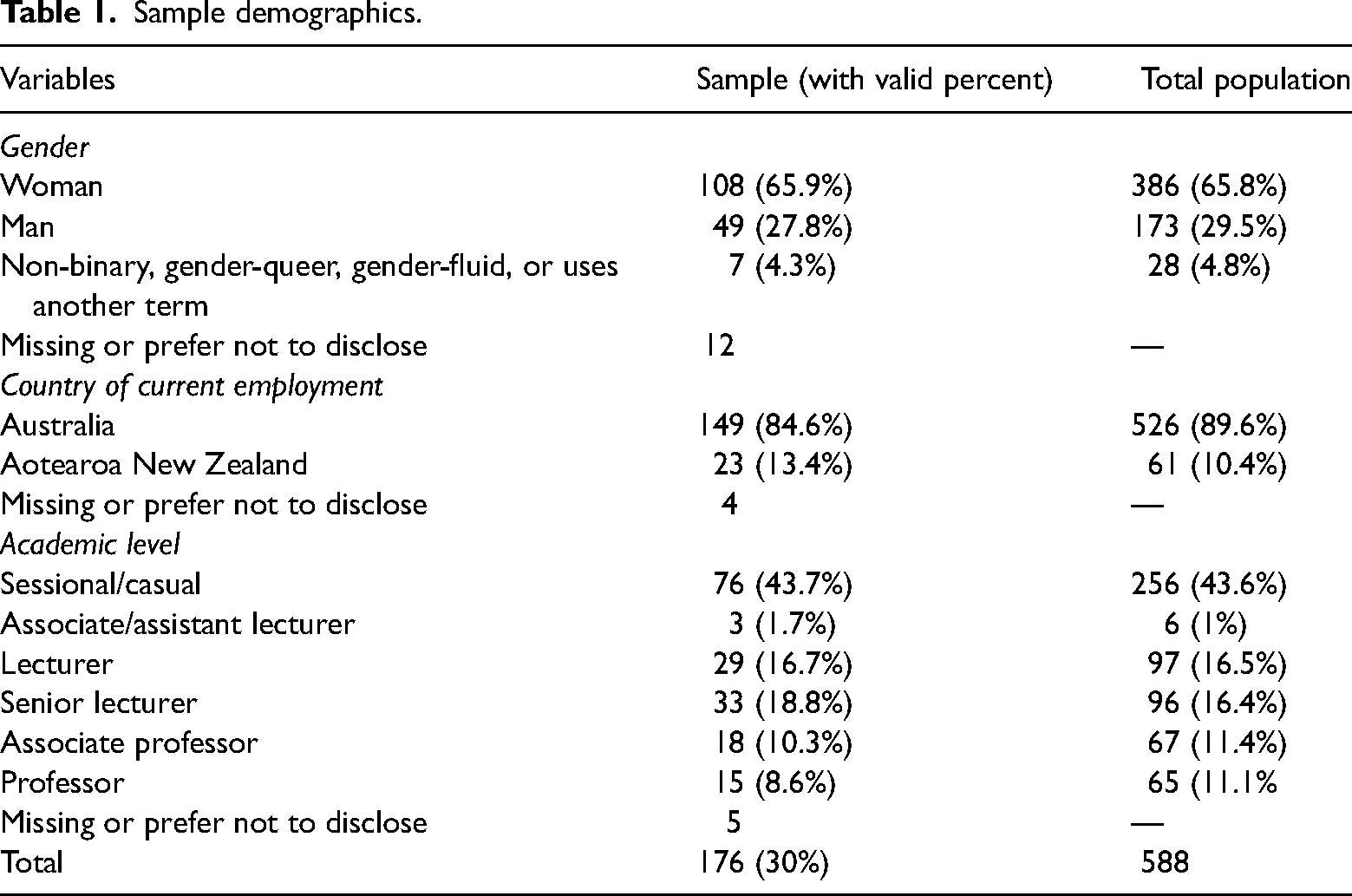
To assess the representativeness of our sample, we conducted one-sample chi-square tests on the distribution of gender, country, and academic rank among criminology educators in Australia and Aotearoa New Zealand. The country test (χ2(df = 1) = 1.641, p = .200) indicated that the distribution was representative of the countries that educators resided in, as there were no significant deviations between the observed and expected frequencies of participants from Aotearoa New Zealand and Australia. Similarly, the gender test (χ2(df = 2) = 0.096, p = .953) indicated that the distribution of women (108), men (49), and non-binary/genderqueer/gender-fluid individuals (7) in the sample was not significantly different from the expected frequencies. Finally, the academic level test (χ2(df = 4) = 1.852, p = .763) showed that the composition of lecturers, senior lecturers, associate professors/readers, professors, and sessional positions in the sample aligned reasonably well with the expected frequencies. These findings suggest that our sample was generally representative regarding country, gender, and academic level.
The survey only received responses from two people who identified as Māori and one who identified as Aboriginal. These low response rates should be considered in interpreting the findings of our survey. More importantly, they should also be read as a symptom of a broader issue within criminology: that there are currently very few Aboriginal and Torres Strait Islander and Māori criminologists employed in universities in Australia and Aotearoa New Zealand (see Cunneen & Tauri, 2016, p. 155). This dearth of Aboriginal and Torres Strait Islander and Māori criminologists is not simply a symptom of an underrepresentation within Australia and Aotearoa New Zealand's university sectors (Andersen et al., 2008). Rather, it also implicates criminology's complicity in harms perpetrated by colonial criminal justice systems, the marginalisation of First Nations Knowledges and perspectives within the field, and the continued alienation and ostracism that Aboriginal and Torres Strait Islander and Māori scholars in Australia and Aotearoa New Zealand have been subjected to by colleagues in the discipline (Cunneen & Tauri, 2016; Porter, 2019; Tauri, 2017).
Analysis and measures
Survey data were analysed using the Statistical Package for the Social Sciences (SPSS v.25). To address RQ1 and RQ2, descriptive statistics on the types and number of approaches participants used to embed First Nations Knowledges, perspectives, and experiences into their curricula were generated, including the mean number of approaches utilised by participants. To accommodate the negative binomial distribution of our RQ3 count variable, we employed negative binomial regression for our analysis. To address RQ4, binary logistic regression was employed.
Dependent variables
The dichotomous dependent variable for RQ4 was derived from the “First Nations authors in reading lists” item of the same survey question. The dependent variable for RQ3 analysed in this study was constructed based on participants’ responses to a specific multiple-select survey question: What First Nations Knowledges, experiences, or perspectives were embedded in these subjects/courses/papers? This question aimed to capture how, and the extent to which, criminology educators were embedding First Nations Knowledges, perspectives, and experiences into their curricula. We derived the dependent variable for RQ3 by identifying and tallying various strategies that educators reported using, such as including readings authored by First Nations scholars, consulting with Indigenous colleagues in designing units, or incorporating First Nations guest speakers. Importantly, while this variable enables us to quantify the number of approaches participants used to embed First Nations Knowledges, perspectives, and experiences into their curriculum, it has some significant limitations. While our variable captures the breadth of participants’ engagement with approaches to embedding First Nations Knowledges it does not capture the depth or extent of their engagement with each approach. A participant may, for example, indicate that they have included First Nations authors in their reading lists but the extent of this inclusion can range from a single author on a single article to the majority of their reading list being authored by Indigenous scholars. Despite this, capturing the breadth of participants’ approaches to embedding First Nations Knowledges, perspectives, and experiences remains important. Employing a variety of approaches provides students with different ways to learn about and from First Nations Knowledges, perspectives, and experiences. Such an approach aligns with inclusive pedagogies that support diverse processes of learning, and the corresponding need to employ a variety of teaching and learning practices and strategies (El-Ayoubi, 2008, pp. 45–46).
Predictor variables
Country was coded as a dummy variable (Australia 1, Aotearoa New Zealand 0). Educating students to foster social and political change was measured through a Likert scale question, in which participants were asked to what extent they agreed that it is the purpose of criminology degrees to “encourage students to become agents of social, political or institutional change”. Reported levels of institutional support for the embedding of First Nations Knowledges was similarly measured through a Likert scale question, in which participants were asked to what extent they agreed that “my institution provides support or advice on how to embed First Nations Knowledges, perspectives and experiences in curricula”. Self-reported time constraints in implementing curriculum changes was measured by a Likert scale question, in which participants were asked to what extent they agreed that “I would like to update my curriculum and teaching practices but lack the time to do so”. Each of these Likert scale questions were coded as ordinal variables: Agree strongly (5), agree somewhat (4), neither agree nor disagree (3), disagree somewhat (2), disagree strongly (1). Acknowledging the potential problems related to multicollinearity in regression analyses, we conducted diagnostic evaluations using the Variance Inflation Factor (VIF) in SPSS. The highest observed VIF value was 1.032, while the lowest tolerance value was 0.969. These findings indicate that multicollinearity did not pose a concern in our model (Freedman, 2009).
Limitations
There are limitations to this study. The first concerns the measurement of approaches utilised to embed First Nations Knowledges into curricula. As noted above, our data does not allow us to analyse the extent to which participants utilised a particular measure in embedding First Nations Knowledges, perspectives, and experiences in their curriculum. Consequently, our data does not enable us to distinguish between participants who, for example, included one reading authored by a First Nations scholar and participants who included significantly more First Nations-authored readings. Secondly, the response rate of 30% may introduce sampling bias, as participants who chose to respond might have different perspectives or experiences compared to those who did not participate. This potential bias affects the generalisability of the findings to all criminology educators in Australia and Aotearoa New Zealand. Thirdly, the sampling strategy could have missed educators identifying as criminologists and teaching criminology subjects in other disciplines, particularly sessional academics. Fourthly, while the study aimed to explore the embedding of First Nations Knowledges, perspectives, and experiences, the selection of predictor variables could have been more extensive. Other relevant factors, such as previous training or professional development in decolonising curricula and political beliefs, were not included in the analysis, potentially leaving out important influences on the embedding practices.
Findings
How Australian and Aotearoa New Zealand-based criminologists are embedding First Nations Knowledges, perspectives, and experiences into their curricula
Participants were asked about the integration of First Nations Knowledges, experiences, or perspectives in the curriculum of the criminology subjects/courses/papers they most recently taught in the previous 2 years (2021–2023). The findings in Table 2 provide insights into the integration approaches and institutional support for incorporating Aboriginal and Torres Strait Islander and Māori perspectives. The most reported integration approach was the inclusion of First Nations Knowledges, experiences, or perspectives as part of the subject learning outcomes, with 36.9% of participants incorporating them into their courses. Similarly, 26.7% of participants indicated that their units explicitly included Indigenous perspectives in the graduate learning outcomes. An additional 22.2% of participants reported that their units included First Nations Knowledges, perspectives, and/or experiences, but did not reference these in the units’ subject or graduate learning outcomes. Only 14.2% of participants reported that First Nations Knowledges, experiences, or perspectives were not integrated into their curriculum.
Prevalence of integration approaches.
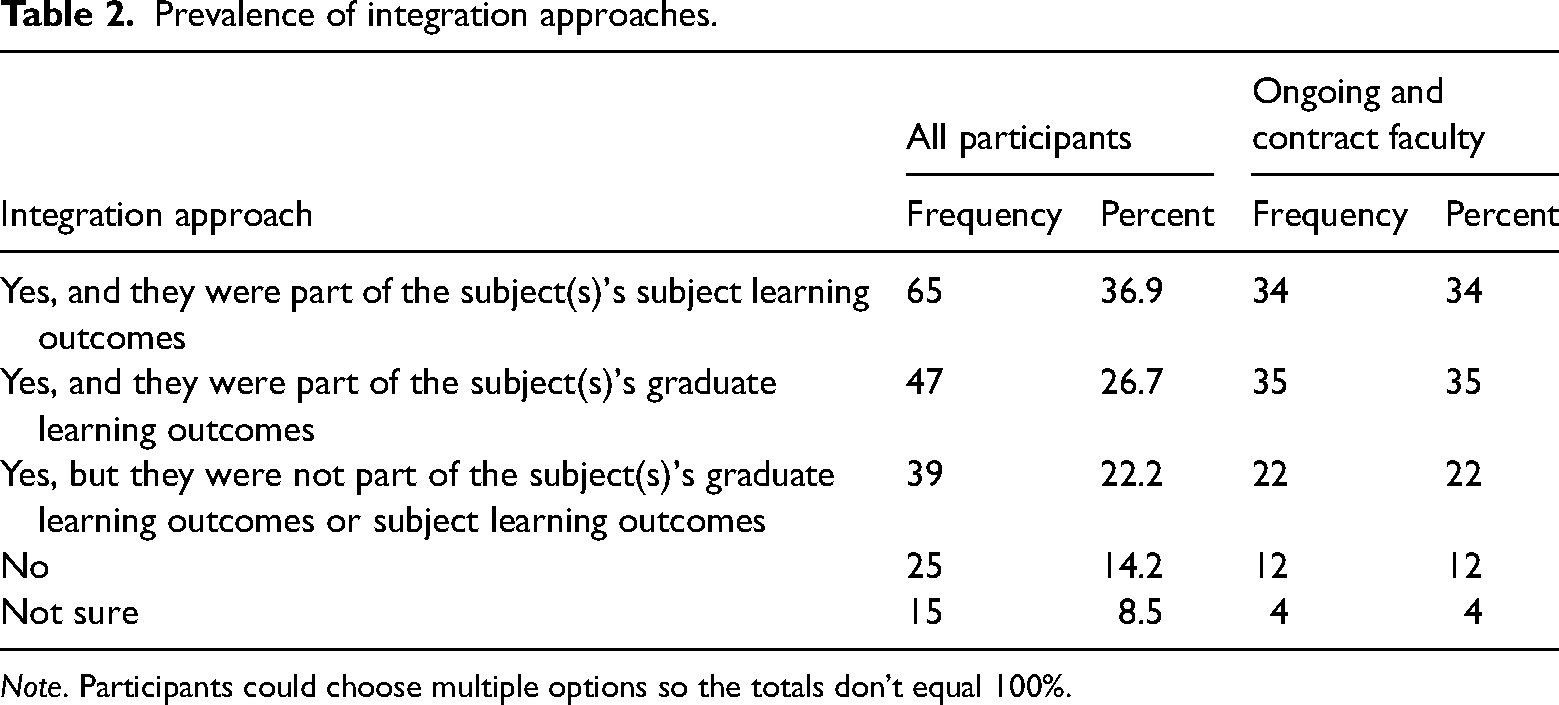
Note. Participants could choose multiple options so the totals don’t equal 100%.
These findings are encouraging. A unit's subject learning outcomes should be constructively aligned with its assessments and course content, and in completing assessments students must demonstrate proficiency in each of the unit's learning outcomes. By including First Nations Knowledges, experiences, or perspectives within a unit's subject learning outcomes, educators are requiring their students to demonstrate proficiency in understanding and applying First Nations Knowledges and perspectives. This means that students in a unit cannot “opt-out” of engaging with First Nations Knowledges and experiences through, for example, selecting an assessment question that does not require them to engage with these perspectives. It also means that educators must do more than include a guest lecture addressing the experiences of Aboriginal and Torres Strait Islander peoples or Māori, or one or two readings including these same experiences and perspectives on the criminal justice system—approaches that will not realistically enable students to achieve the learning outcome.
Approaches to integrating First Nations Knowledges, experiences, and perspectives in criminology curricula
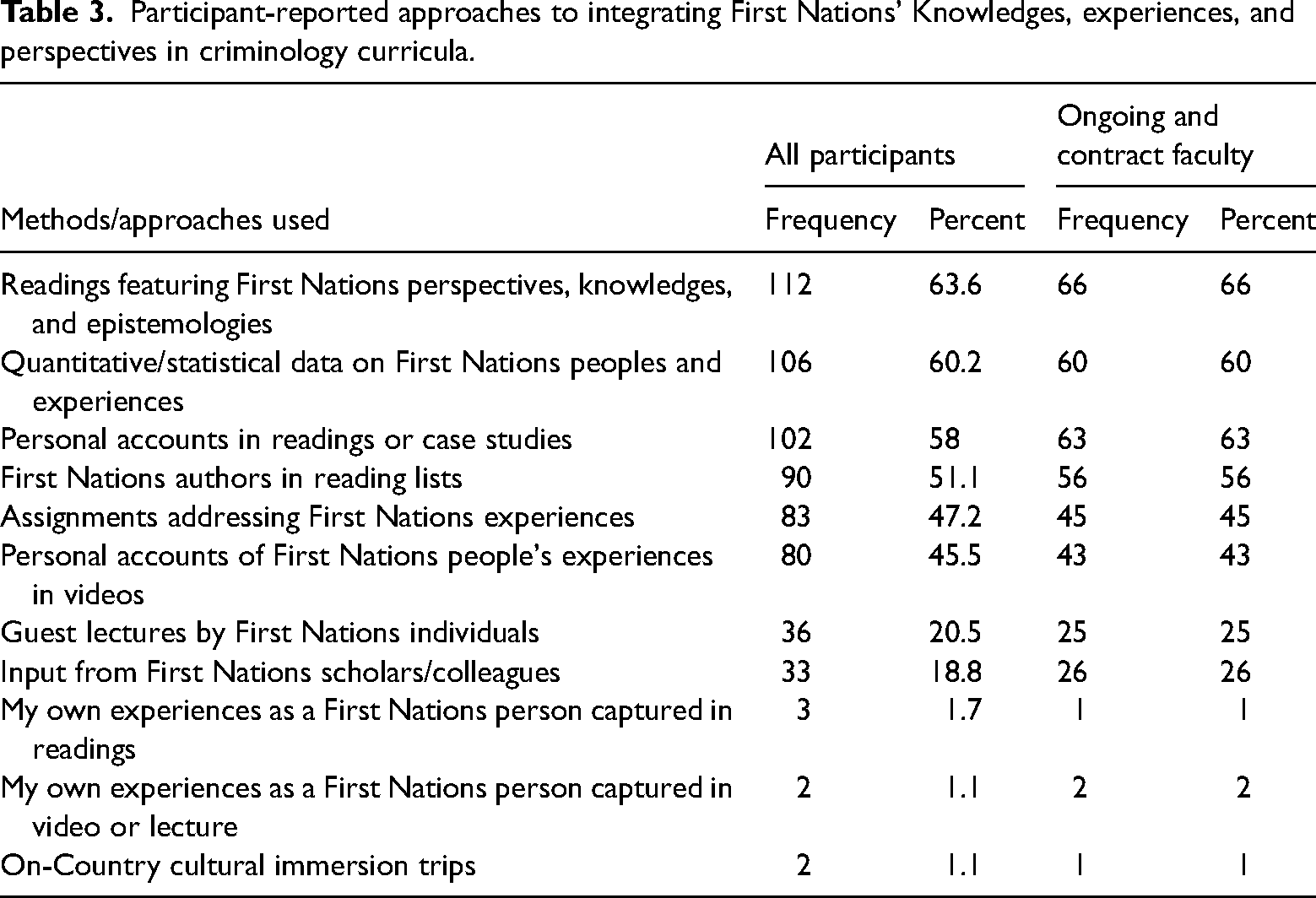
Participants were then asked about how First Nations Knowledges, experiences, or perspectives were embedded in the criminology subjects they most recently taught. As depicted in Table 3, the personal accounts and experiences of Aboriginal and Torres Strait Islander people, and Māori, as depicted in readings or case studies were incorporated into the units taught by 58% of participants. Furthermore, a significant number of educators, 63.6%, reported including readings that encompassed First Nations Knowledges, experiences, and/or epistemologies in subjects. Notably, 60.2% of educators integrated quantitative/statistical data relating to Aboriginal and Torres Strait Islander peoples, and Māori, into their curricula. However, the data collected does not allow us to gauge how the statistical and quantitative data is utilised within curricula. Statistics can be used (or misused) in ways that may present a partial or simplistic picture (Bolton, 2023). Furthermore, the use of statistics can be positive or negative and does not necessarily tell us how this information is used (strength-based or deficit). Additionally, 51.1% of educators included Aboriginal and Torres Strait Islander, and Māori, authors in the reading lists of their subjects. Assignments addressing First Nations experiences and/or perspectives were utilised by 47.2% of educators. In comparison, guest lectures delivered by First Nations people were incorporated into the units taught by 20.5% of educators. Input from First Nations scholars and colleagues in unit design was reported by 18.8% of educators. On-Country cultural immersion trips and experiences were the least commonly used method, with only 1.1% of educators reporting their engagement in such activities. These on-Country experiences can enhance educators’ knowledge and understanding of Aboriginal and Torres Strait Islander people, and Māori, histories, and cultures (Burgess, 2019). This type of educational practice should be implemented carefully with appropriate learning and scaffolding to ensure students and educators have appropriate cultural competence before an on-Country experience, and to ensure no negative impacts for First Nations people teaching or contributing to the unit. Learning on-Country can create a culturally safe space for Indigenous and non-Indigenous people to foster meaningful dialogue around the “inclusion and prioritization of Indigenous perspectives in education” (St John & Edwards-Vandenhoek, 2022, p. 105). Bird et al. (2023) argue that on-Country education provides an opportunity for First Nations peoples to be able to speak with their expertise on their own terms. Indeed, the authors further point out that on-country education can aid decolonisation as it is the way that university teaches that needs to change rather than First Nations people trying to fit into the “Eurocentric university” (Bird et al. 2023, p. 899).
Participant-reported approaches to integrating First Nations’ Knowledges, experiences, and perspectives in criminology curricula.
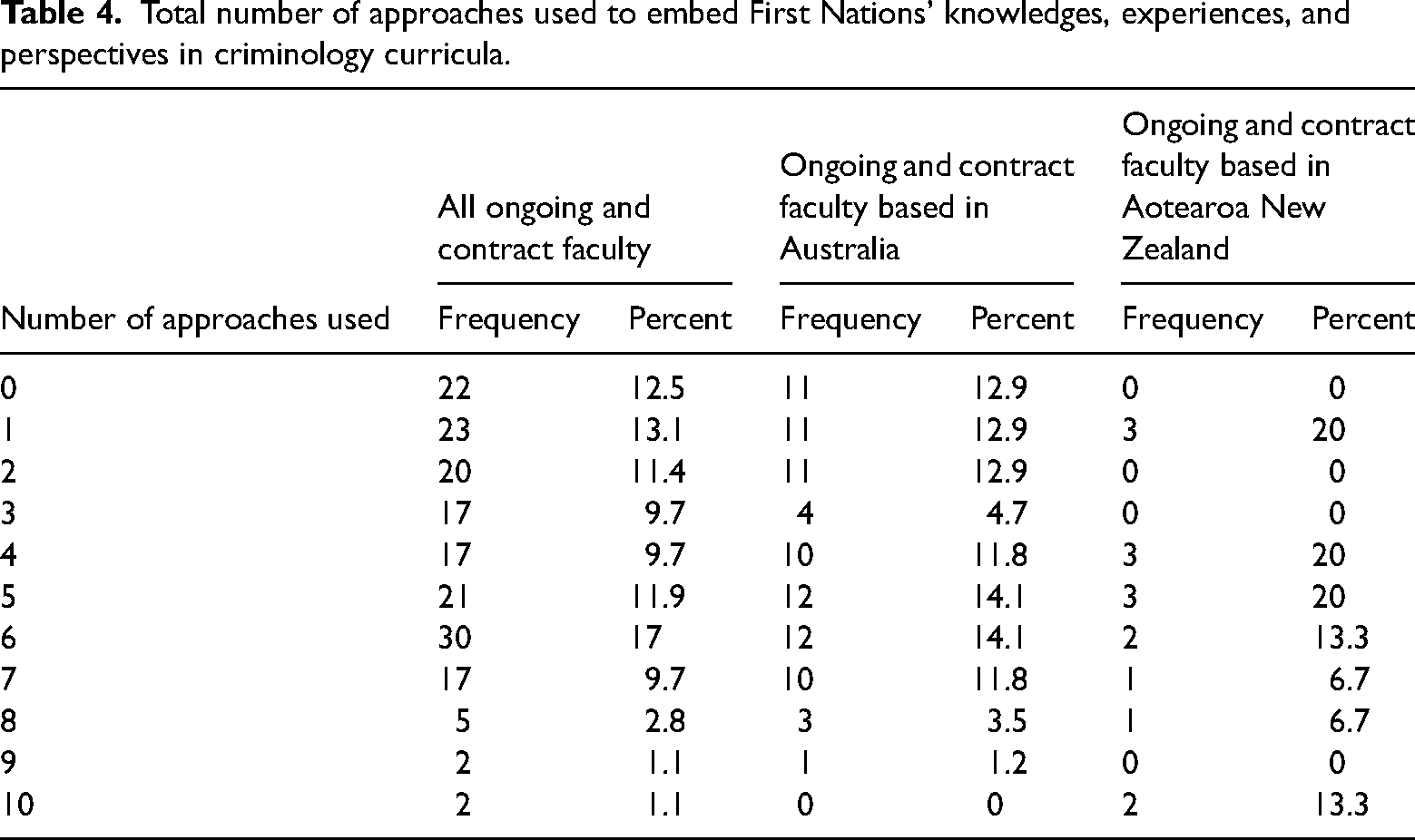
The data reveal most participants reported using multiple approaches to embed First Nations Knowledges, experiences, and perspectives in their curricula. The mean number of approaches used was found to be 3.97, indicating that, on average, participants employed approximately four different strategies. On average, educators based in Aotearoa New Zealand utilised slightly more approaches to incorporate First Nations Knowledges in their curricula than their colleagues in Australia. Criminology educators based in Australia employed an average (mean) of 3.76 approaches to embed First Nations Knowledges, experiences, and perspectives in their curriculum. By contrast, criminology educators based in Aotearoa New Zealand demonstrated a higher average (mean) of 5.13 approaches to embed First Nations Knowledges, experiences, and perspectives in their curriculum. This difference between the two countries could be explained by differing governmental and policy positions related to including First Nations perspectives, with policies in universities in Aotearoa New Zealand having been in place for nearly 15 years longer than the Australian policies (Te Pōkai Tara/Universities New Zealand, 2024; Universities Australia, 2022) (Table 4).
Total number of approaches used to embed First Nations’ knowledges, experiences, and perspectives in criminology curricula.
Do country and institutional support impact the extent to which criminology educators embed First Nations perspectives in their curricula?
The results of the negative binomial regression analysis revealed that none of the predictor variables reached statistical significance in predicting the number of approaches criminology educators use to embed First Nations Knowledges, perspectives, and experiences in their curriculum. The regression model did not find a statistically significant difference between criminology educators in Australia and Aotearoa New Zealand in terms of the number of approaches they used to embed First Nations knowledges in their curricula [Exp(B) = 1.350, p = .104]. Similarly, participants’ views on whether criminology degrees should encourage students to become agents of social, political, or institutional change did not demonstrate a statistically significant relationship with the number of approaches used to embed Indigenous knowledges, perspectives, and experiences [Exp(B) = 1.094, p = .240]. The level of institutional support for embedding First Nations Knowledges, perspectives, and experiences into the curriculum also failed to reach statistical significance as a predictor of the number of approaches employed by criminology educators [Exp(B) = 0.952, p = .295]. Finally, the perceived lack of time to update the curriculum did not exhibit a statistically significant relationship with the number of approaches to embedding First Nations Knowledges, perspectives, and experiences in criminology courses [Exp(B) = 1.068, p = .262].
Do country and institutional support impact the extent to which criminology educators include readings written by First Nations authors in their curricula?
To examine whether there was a statistically significant difference between Australian and Aotearoa New Zealand-based criminology educators in the incorporation of Aboriginal and Torres Strait Islander, and Māori, authors in their subject reading lists, we conducted a chi-square test of independence. The test revealed a statistically significant difference between criminology educators in Australia and Aotearoa New Zealand in terms of incorporating Aboriginal and Torres Strait Islander, and Māori, authors in their subject reading lists [χ2(1) = 4.299, p = .038]. Among the criminology educators based in Aotearoa New Zealand (n = 15), only three did not incorporate First Nations authors in their subject reading lists (expected count for non-incorporation: 6.7). In contrast, among the criminology educators based in Australia (n = 86), 42 did not incorporate First Nations authors in their subject reading lists (expected count for non-incorporation: 38.3).
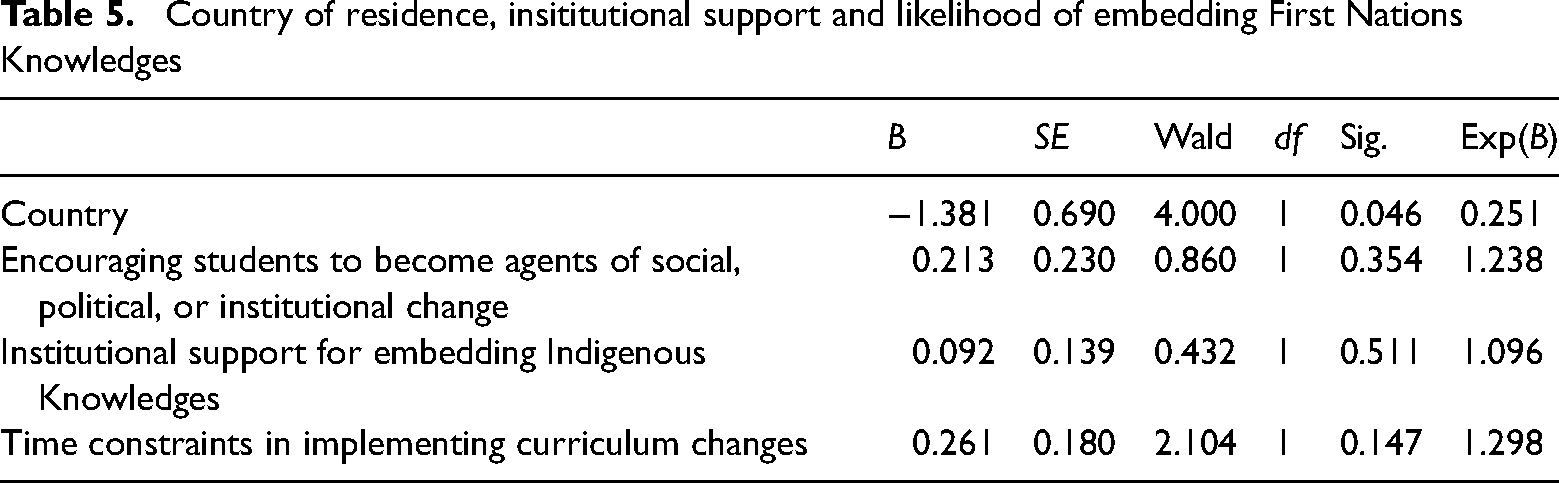
To explore whether the observed statistically significant difference in incorporating First Nations authors remained significant when accounting for other potentially influential factors, we conducted a binary logistic regression. This analysis aimed to assess whether the country of residence (Australia or Aotearoa New Zealand) remained a significant predictor of the likelihood of incorporating First Nations authors, while controlling for educators’ views on encouraging social and political change, reported levels of institutional support for embedding First Nations Knowledges in curricula, and self-reported time constraints in implementing curriculum changes. The regression indicated that country was a statistically significant predictor of the likelihood of incorporating First Nations authors (p = .046). The odds ratio [Exp(B)] of 0.251 suggests that the odds of incorporating First Nations authors in Australia were approximately 75% lower than in Aotearoa New Zealand, controlling for other factors in the model. These regression findings support and reinforce the initial chi-square test results, indicating that the difference in the incorporation of First Nations authors between the two countries remains statistically significant even when considering educators’ views, institutional support, and time constraints (Table 5).
Country of residence, insititutional support and likelihood of embedding First Nations Knowledges
Discussion
For many years, education “devalued all aspects of Indigenous knowledge” (Rose, 2012, p. 68). While there is still much work to be done in embedding First Nations Knowledges and perspectives, the results from this survey indicate that criminologists based in Australia and Aotearoa New Zealand have made some progress in integrating First Nations Knowledges, perspectives, and experiences into their curricula. Wicks (2023, p. 12) argues that we must address the colonial power structures in education. However, to do this, “[g]ood intentions and motherhood statements are not enough” (Moreton-Robinson et al., 2011, p. 36). Decolonisation requires action, including redeveloping curricula to ensure it incorporates First Nations Knowledges and perspectives (Burns et al. 2024). While decolonising pedagogy and embedding First Nations Knowledges in curricula may provoke discomfort in educators who have not undertaken this work previously (McGuire & Murdoch, 2022a), it is imperative that this work in criminology continues. Embedding First Nations Knowledges in the curriculum can contribute to the decolonisation of education and be a site of empowerment for Aboriginal and Torres Strait Islander peoples and Māori if done well (Riley et al., 2013, p. 253) and accompanied by deeper reflection at individual and institutional levels (Waitoki et al., 2024).
The simple addition of First Nations Knowledges into an existing curriculum does little to capture complexities and contradictions between Western and Indigenous epistemologies, ontologies, and axiologies (Nakata, 2007). Therefore, embedding First Nations perspectives should be considered an integral part of the development and design of curricula (Harvey & Russell-Mundine, 2019) rather than an afterthought. To meaningfully embed First Nations Knowledges means that they cannot be removed, as they become an essential part of the curriculum. While bringing in First Nations guest speakers or including a week of content on First Nations justice is important in the context of criminology, First Nations expertise must not be restricted to all things “Indigenous” (Larkin, 2013, p. 234). A deeper understanding of what effective embedment of First Nations Knowledges is needs also to be considered; a one-off guest lecture by a First Nations person or “slide” without accompanying more profound curriculum changes does little to address the ongoing impacts of colonisation within any discipline. Instead, this acts to relocate the associated work back to First Nations scholars. Calls for academics to reflect upon, and adjust, their curricula to ensure a more holistic embedding of First Nations Knowledges have been made (Wicks, 2023)—however, this work should not fall to First Nations academics as additional labour.
Adopting a whole-of-university approach
Weaving and embedding First Nations Knowledges should not only be left to individual academics to implement approaches, but rather must extend to broader institutional efforts. There must be not only signalling from universities that they support embedment (through their policies and strategies) but there must be resources and support provided to educators so that meaningful embedment can occur across all criminology curricula in a sustained way. The survey results indicate that while institutions may include the embedding of Indigenous perspectives within their policies and strategies, in practice, the embedment is left to individual academics to implement within their own courses and thus this is undertaken in an ad hoc manner. While we asked educators about embedding First Nations Knowledges within their own teaching practices, such practices should be in the context of a whole-of-university approach, and a recognition that First Nations academics are responsible not just to the university and their students, but first and foremost to their culture, and their community (Alfred, 2004). Universities should include First Nations Knowledges within their strategic and operational plans (Hogarth, 2022, p. 5), with the accompanying recognition that these inclusions alone do not guarantee change (Alfred, 2004).
The challenge for universities is to embed First Nations Knowledges throughout while also reflecting on the institutions’ “own power and privilege” (Harrison & Clarke, 2022, p. 187). Nakata (2007, p. 215) argues that this practice is “about rediscovering how certain foundations of knowledge become accepted as achieving legitimacy and authority to the detriment of other knowledge systems”. The academy also has a vested interest in this debate, and can and does seek to maintain control over “who defines knowledge, who has access to knowledge, and who produces knowledge” (Mihesuah & Wilson, 2004, p. 5).
Nevertheless, embedding First Nations Knowledges should be a core business of universities reflected in their “structures and processes of governance, administration and management” (Larkin, 2013, p. 229) as well as in their education. Embedment requires a shift in the ways universities engage with First Nations “peoples, knowledges, histories, cultures and languages” (Hogarth, 2022, p. 14). University graduate attributes can provide a useful point to commence embedding of First Nations Knowledges, but the attributes must reflect “the historical realities, lived experience, and Indigenist research” (Bodkin-Andrews et al., 2022, p. 106).
Conclusion
As a field, criminology is still coming to terms with its role in sustaining the colonial project in Australia and Aotearoa New Zealand. Decolonising and embedding Aboriginal and Torres Strait Islander, and Māori, people's Knowledges, perspectives, and histories into criminology curricula is a vital step in the reckoning process. This article has explored how criminology educators in Australia and Aotearoa New Zealand are embedding First Nations Knowledges, histories, and perspectives in their university curricula via a survey with 176 faculty members across the two countries. The findings indicate criminology educators are utilising a range of strategies to embed First Nations perspectives in their subjects. While the findings show criminologists are starting to take the process of embedding First Nations people's histories, perspectives, and Knowledges seriously, there is still significant work to do. Improving the discipline to be more welcoming and supportive of Aboriginal and Torres Strait Islander, and Māori, academics is vital to this process but cannot be achieved without addressing the “colonial problem” in criminology and the cultural load First Nations people carry. Furthermore, First Nations Knowledges, perspectives, and histories cannot be “add-ons” in curricula but must be embedded and weaved in meaningful ways, such as core objectives in subject and graduate learning outcomes. While the people working in the field of criminology must take responsibility for ensuring these changes, ultimately, reckoning with the enduring impact of colonisation and embedded First Nations Knowledges, perspectives, and histories requires a whole-of-university approach.
Footnotes
Declaration of conflicting interests
The authors declared no potential conflicts of interest with respect to the research, authorship, and/or publication of this article.
Funding
The authors disclosed receipt of the following financial support for the research, authorship, and/or publication of this article: This work was supported by the Deakin University, Monash University (Seed Funding).
