




Abstract
Justice-involved individuals convicted of crimes involving violence are often depicted as chaotic, whereas the chaos they encounter in criminal justice institutions is not commonly reported. Nonetheless, we found that chaos can be co-constituted at points where justice-involved individuals and justice institutions intersect. Our findings are drawn from qualitative research on a pharmacotherapy trial designed to reduce violence: Reducing impulsivity in repeat violent offenders using a selective serotonin reuptake inhibitor, ReINVEST. Data were analysed using a grounded inductive approach and we drew on Law and Lock and Nguyen's innovative theories of “mess” and “entanglement” respectively. Analysis and theoretical explication revealed themes of entanglement, conflicting justice cultures, unacknowledged dysfunction in justice institutions, and negative impacts of bias. We propose these aspects of the co-constitution of chaos are considered in the creation of person-centered policy, and non-discriminatory, safe criminal justice spaces.
Keywords
Introduction
Our examination of chaos and dysfunction in the criminal justice system starts with claims that this system is no longer “just” (Levin, 2023). These claims are illustrated by growing reports of racial disparity and systemic racism, police violence, the brutalities of incarceration, the incarceration of children, as young as 10, who can be detained in youth prisons or juvenile detention, the hyperincarceration of Indigenous people and those living with disability, and high rates of recidivism (Aranda-Hughes et al., 2021; DeVylder et al., 2020; Easteal, 2001; Gonzalez Van Cleve & Mayes 2015). Our focus on chaos and dysfunction starts with the way individuals, like this study's research participants who were justice-involved men who had committed crimes involving violence (Barry & McIvor, 2010; Cambridge et al., 2022) are depicted in “organized/disorganized typologies of offending” (Petherick & Brooks, 2021). Our understanding of chaos is grounded in a definition of “chaos”, “as a state of total confusion with no order” (Cambridge Dictionary, 2023, p. 1). This is further defined through justice scholars’ characterisations of justice-involved individuals who they variously describe as: impulsive, violent and risk taking (Filkin et al., 2022), volatile, negatively impacted by drug use, highly at risk of reoffending, with unstable relationships and homelife (Barry & McIvor, 2008; Wright et al., 2017), haphazard patterns of criminal behaviour, and a lack of self-control (Hochstetler & DeLisi, 2005).
The chaos and criminality of justice-involved individuals are often attributed to low self-control, articulated in Gottfredson and Hirschi’s (1990) self-control theory. Additionally, self-control and crime are linked in the cognitive versus behavioural debates regarding criminal activity (Louderback & Antonaccio, 2021; Tittle et al., 2003). These understandings of motivation or cause mean that justice-involved individuals are often presented as having distorted cognition, self-justificatory thinking, misinterpretation of social cues, and displacement of blame (Barriga et al., 2008; Lipsey et al., 2007). The psychological cure frequently employed in justice settings is Cognitive Behavioural Therapy (CBT) (Beaudry et al., 2021; Cunha et al., 2024), with its focus on challenging and changing “cognitive distortions” (Beck, 2011).
Scholars like Renehan and Henry (2022) challenge an overreliance on interventions like CBT as they can contain an underlying self-control narrative, which can increase shame and self-stigma. In contrast, Renehan and Henry (2022) propose a stigma-informed rehabilitative approach based on the “bio-psycho-social-model” that acknowledges systemic issues underpinning justice-involved individuals’ chaos and criminality. The overemphasis in justice research and practice on deficits of justice-involved individuals often means they are held solely responsible for the chaos and criminality in their lives (Polizzi, 2011; Sylvestre, 2010; Yankah, 2004). It is important to move beyond the characterisation of weak-willed justice-involved individuals who are “in need of education, and their thinking in need of restructuring or altering” (Vivian-Byrne, 2004, p.186). Their lives and criminality do not happen in a vacuum; they are profoundly influenced by disadvantages embedded in economic, political, and socio-cultural systems (Kirk & Papachristos, 2017; Rodger, 2012; Waring & Weisburd, 2018).
Despite the increasing acknowledgement of systemic factors influencing justice-involved individuals (Bonfine et al., 2020; Pettus et al., 2021), the chaotic nature of these individuals is still frequently reported (McKay, 2022; Ozturk et al., 2024). The ways criminal justice institutions can be chaotic, or how interactions between justice-involved individuals and justice institutions can co-constitute chaos, is not as clearly articulated. We elucidate these aspects of chaos in the Australian criminal justice system by foregrounding participants’ accounts of their lived experience in that system.
We employed theories of entanglement (Lock & Nguyen, 2010) and mess (Law, 2004) to elucidate participants’ stories of chaos and the co-constitution of chaos. Guided by Lock and Nguyen's (2010) theory of entanglement we explored what Lock and Nguyen term biosocial differentiation, or the entangling of individual and institution. We highlight the “punishment of character” (Yankah, 2004) participants suffered whereby discrimination, biased decision-making, and inaccurate assumptions (Mears et al., 2017), contributed to chaos, and in some cases initiated and reinforced individuals’ criminality (Marks, 2015). Further, we employ the concept of the “relations of humanness” from Psychological Jurisprudence (Sellers & Arrigo, 2022) to address the harms justice-involved participants experienced. Linking participant’s stories with Law’s theory of “mess” we foreground ways that the relations of humanness can be unrecognised, atrophied, or distorted in the criminal justice system. To further illustrate the dysfunctional relations of humanness in justice settings we present stories of miscommunication, mistaken identity, impacts of conscious or unconscious bias on professional practices, the customisation of justice practices by chaos, and the harms of performed sincerity. We conclude with propositions for an “ethics of justice” drawn from Psychological Jurisprudence. These proposals focus on the introduction, or reinvigoration, of positive relations of humanness to improve criminal justice programmes and practices (Figure 1).
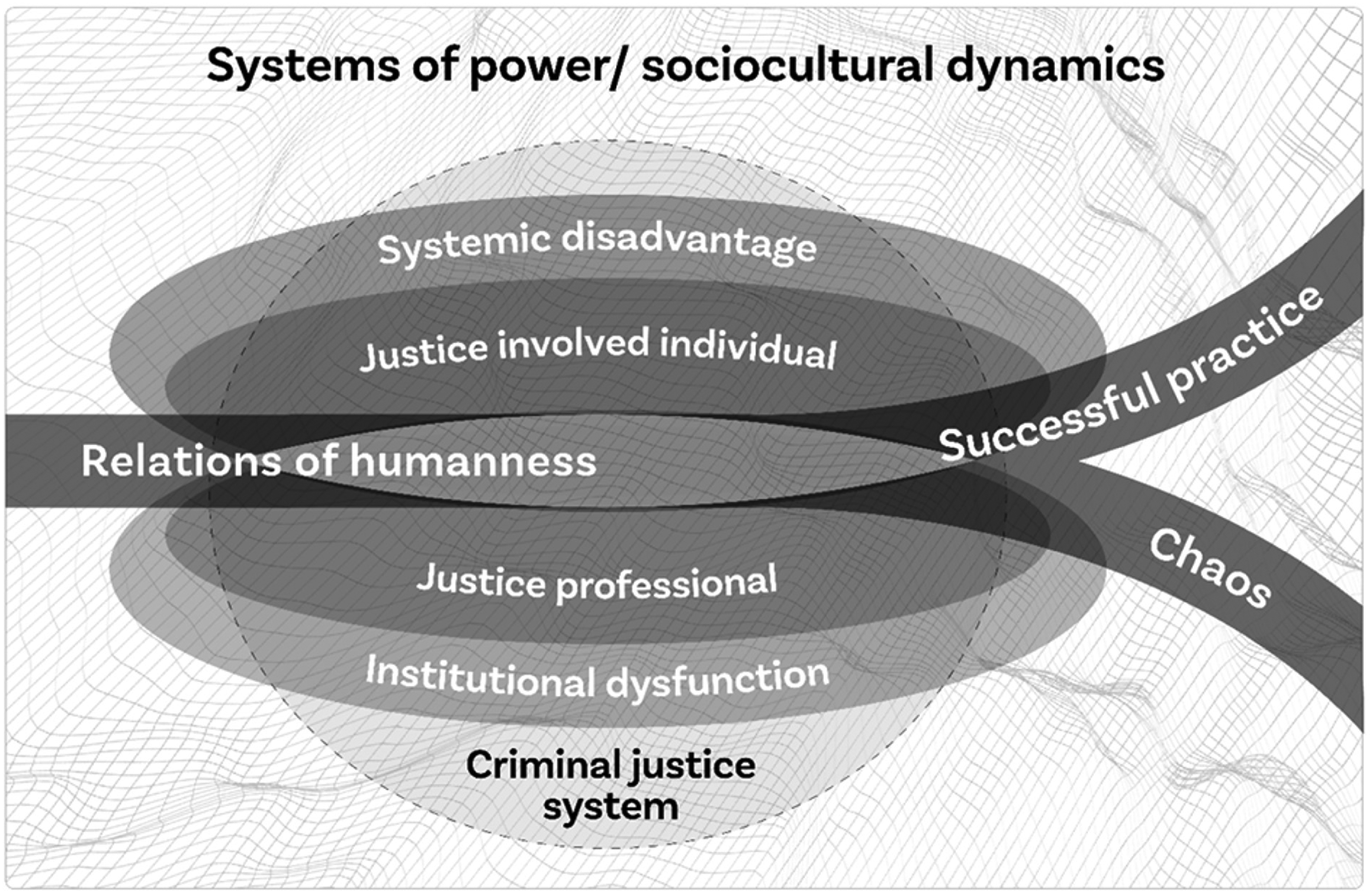
This visualisation of the co-constitution of chaos illustrates the entangled nature of the criminal justice system, from the macro to the micro. The criminal justice system is embedded in the entanglement of systems of power and sociocultural dynamics. Sitting within this system are the two intersecting aspects of systemic disadvantage and institutional dysfunction. Within these aspects are justice-involved individuals and justice professionals, their meeting point is represented by the vesica piscis shape. The long branching shape running through this shape represents the “zone of the relations of humanness”, which is a continuous potential from which successful practice or chaos can arise.
Background
While self-control theory and ideas of individual culpability linger in criminal justice practice and scholarship there is a move to understandings the “cumulative disadvantage” (Kutateladze et al., 2014) that justice-involved individuals suffer. According to McCausland and Baldry (2023) this shift has resulted from the the failure of positivist and individual risk-oriented paradigms to recognise and account for the impacts of structural inequality on the likelihood of particular population groups being incarcerated and reincarcerated and to help account for the failure of current penal approaches. (p. 40)
There are complex, entangled issues in numerous areas of justice-involved people’s lives that can result in chaotic, criminal behaviour (Chamberlain & Moore, 2002; Sommers et al., 2017). This behaviour is now often attributed to the enmeshing of various negative factors in their lives, starting in their childhood (Farrington, 2005; Moffitt, 2018). Their homes and communities have been described as “pathogenic environments” (Bonner & Miles 2020). Unsafe spaces that are chaotic, abusive, violent and criminal (Barnert et al., 2015; Jackson et al., 2017). Justice-involved individuals are said to suffer disproportionately high rates of unmet physical, developmental, social, and health needs (Favril et al., 2024; McCausland & Baldry, 2023; Peters et al., 2017; Rice et al., 2023), and higher rates of mortality than the general public (Graham et al., 2015). Additionally, justice-involved individuals often endure socioeconomic disadvantage, highly disorganised family structures (Edalati et al., 2017), family fragmentation, negative impacts of institutionalisation, now understood as a chronic health condition (Crane & Pascoe, 2020), absent or abusive parents, substance abuse (Barry & McIvor, 2008), physical and sexual abuse, and poor mental and physical health (Brewer-Smyth et al., 2015; Mateyoke-Scrivner et al., 2003; Papalia et al., 2018).
When researching depictions of the criminal justice system Levin (2023) found two primary representations of it. First, as a “broken system” with the potential to be remediated, and second, a functioning system working as it has been designed to subordinate and repress. As Herzing (2014) asserts “the prison-industrial complex is actually efficient at fulfilling its designed objectives – to control, cage, and disappear specific segments of the population” (p. 194). Incarceration, as a crime control tool (Weatherburn et al., 2006), is widely critiqued. Failures of incarceration, include its fiscal unsustainability, and ethical concerns related to the overrepresentation of racial and ethnic minorities, people living in poverty and with disability (The Disability Royal Commission, 2020). Additionally, defective practice aspects of the criminal justice system, such as those related to magistrates’ roles include what Schrever and her colleagues (2022) describe as the severity of judicial stress in Australia. The constant pressure to perform and the continual flood of emotional distress caused by excessive caseloads can lead to emotional exhaustion, depersonalisation, cynicism, and a loss of job satisfaction (Schrever et al., 2019).
Problems with diversion and recidivism have an equally debilitating impact on magistrates, who, if not convicting an individual are required to choose a diversionary option, while knowing that many do not reduce recidivism (Battams et al., 2021; Martire & Larney, 2011). Options for diversion include community corrections orders, and a range of treatment and intervention programmes that address problems such as mental illness, and drug or alcohol dependency (Local Courts New South Wales, 2023). Problems that can impact the efficacy of these programmes include a lack of support to realise programmes rehabilitative aims (Green et al., 2020); barriers to accessing programmes, particularly for Aboriginal and Torres Strait Islanders, or young people, and issues with retention in programmes (Soon et al., 2024). There are reported problems with the evaluation of these programmes related to their rigour. This includes limited comparison of programmes, the diverse nature of services and programmes, and differences in legislation, appropriate comparison groups (Lim & Day, 2014), poor methodological quality (Hayhurst et al., 2019), issues with programme design and participant diversity (Wong et al., 2016) and the lack of appropriate assessment tools (Schaefer & Beriman, 2019).
The way these problems interweave the multiplicative dimensions of inequality justice-involved individuals suffer (Henne & Troshynski, 2019) highlights issues of power and positionality. Recognising these issues, intersectional criminology theorists call for “critical reflection on the impact of interconnected identities and statuses of individuals and groups in relation to their experiences with crime” (Potter, 2013, p. 305). Intersectionality accounts for the multifarious ways that identity categories, such as the biological, economic, cultural, and social, can intersect to result in the severe disadvantage and discrimination justice-involved individuals suffer (Hester et al., 2020). In Australia, this is illustrated by the hypercriminalisation and hyperincarceration of Indigenous Australians, and those living with mental health disorders and cognitive and physical disability (McCausland & Baldry, 2023). In sum, economic disparity, structural racism, and discrimination combine to increase justice-involved individuals’ intersectional vulnerabilities and risk of criminalisation and incarceration (Baldry et al., 2015; Cunneen et al., 2013). Negative impacts of power relations, systemic disadvantage and intersectional vulnerabilities are salient in our analysis of chaos. They reveal and illustrate ways that discrimination, stereotyping, and institutional chaos are implicit in the co-constitution of chaos in the criminal justice system.
Exploring the co-creation of chaos with theories of entanglement and mess
Our focus on the ways that the entanglement of justice-involved individuals and criminal justice institutions can lead to the co-constitution of chaos directed our choice of relational theory. This congruent theoretical support consists of theories of entanglement (Lock & Nguyen, 2010) and mess (Law, 2004; Law & Mol, 1995). Lock and Nguyen’s (2010) theory of entanglement illustrated the nature and processes of chaos, while Law’s (2004) and Law and Mol’s (1995) work on mess offered both methodological and ontological support. The concept of entanglement, as developed by Lock and Nguyen (2010), is predicated on the understanding that individuals and their physical, historical, cultural, political, and social contexts are co-constituted. That is, they are continually at work on each other in a “lived” dynamic interweaving process biosocial differentiation. Lock and Nguyen (2010) use this term to characterise the way individuals and their contexts are mutually constitutive; “inextricably entangled and subject to never-ending transformations” (Lock & Nguyen, 2010, p. 1). Our use of entanglement as a defining concept is a reminder throughout this article that “culture, history, politics, and biology (environmental and individual), are inextricably entangled and subject to never-ending transformations” (Lock & Nguyen, 2010, p. 1).
Law’s (2004) theory of mess also contains a model of entanglement that is relevant for our explication of the co-constitution of chaos. Mess arises because of the relationality implicit in contact between individuals and institutions. For Law (2004) the different elements constituting the phenomenon under study cannot be thought of as disconnected “singularities” but rather what he terms fractional objects. These are the individuals, institutions, technologies and more that intersect each other when brought into the relationship. Their intersection means they “become more than one but less than many” (Law, 2004, p. 61); they are somewhere “in-between”. They contain parts of each other and exist in a complex network of relations. As Law explains they “overlap and interfere with one another. Their relations, partially coordinated, are complex and messy” (Law, 2004, p. 61). Law with Urry (2004) take this further by describing reality as a “relational effect” that is concurrently material and social.
Mess can occur at the juncture of the material and social in institutional practices, and according to Law (2004) practices generate understandings of reality (Law, 2004). However, because of the multiple fractional objects that can develop in each instance of practice, “reality” changes, while the original understanding of reality remains. Or in other words organisational practices continue, directed by an organisational understanding of the outcome of a practice that is no longer valid. Law (2004, p. 59) describes this as “reversal” and warns that “realities are not explained in practices and beliefs but are instead produced in them”. Dysfunction can arise when reversal goes unrecognised, or is actively disappeared. For Law (2004), dysfunction is rendered invisible or disappeared through “enactments” of what he terms “direct representation” or the presentation of a stable, healthy individual or institution that is in fact neither stable or healthy.
Methods
This article draws from qualitative research attached to the large placebo-controlled systematic Randomised Control Trial (RCT) ReINVEST. The trial was a pharmacotherapy-based intervention investigating the effectiveness of the Selective Serotonin Re-uptake Inhibitor (SSRI) sertraline in men with histories of violent offending. Pre-sentencing, ReINVEST diverted justice-involved individuals away from the criminal justice system into treatment on the ReINVEST trial. Because of its therapeutic aims and its location in New South Wales (NSW) criminal justice settings. ReINVEST acted as a quasi-diversionary programme. Described by a local court magistrate as the “clinic in the court”.
Recruitment and data collection
Recruitment began after an amendment to include the qualitative study in ReINVEST’s ethics (UNSW, Sydney’s Human Research Ethics Committee, HC17771) was approved. Participants were recruited from five cohorts, the first four were local court magistrates, (n = 5), community corrections officers (CCOs), (n = 5), Legal Aid lawyers, (n = 4), ReINVEST clinicians, (n = 5), all of whom had experience working with justice-involved individuals with histories of violent offences. The fifth cohort was comprised of ReINVEST clients, who were justice-involved men who had committed crimes involving violence, (n = 13). The latter were the only participants who received a $75 honorarium. This cohort ranged in age from late 20s to early 60s, three were born outside of Australia, there were no Aboriginal or Torres Strait Islander participants, most had left school by the age of 15, and all identified as male. At the time of recruitment and interviews ReINVEST clients were in the blinded stage of the trial. 1 Participants were eligible if they were over the age of 18 and could provide informed consent. Participation in the study was voluntary and confidential. All 32 participants took part in semi-structured, in-depth, one-on-one, 60–90-min interviews, which were audio-recorded and transcribed. A professional transcriber, familiar with confidential material, de-identified and transcribed the interviews and participants were given pseudonyms. Interviews were conducted in seven local government and suburban areas of Sydney, Australia.
The range of participants was chosen to gain multiple perspectives (Beitin, 2008) on the phenomenon under study. The in-depth, active interviewing (Gubrium & Holstein, 2002) was directed by our grounded approach and the “social practice orientation” (Talmy, 2010) in qualitative research. Whereby we sought to create “personal connections built on mutual trust, respect, and consent; a sensitivity to power relations and the co-construction of knowledge; and a recognition that researchers are carrying out research with their participants, not on them” (Prior, 2018, p. 2). Significant to this range of participants were implicit issues of positionality and power. The power dynamics in the hierarchal structure of the criminal justice system underpinned by wider social hierarchies (Macintyre, 2020) impacted all the participants. The negative impacts of these dynamics were undeniable for the justice-involved individuals who were affected by cumulative disadvantage (Douglas & Fitzgerald, 2018; Kurlychek & Johnson, 2019). These individuals exist in a strata of the justice system hierarchy that leaves them highly vulnerable to abuses of power, and disadvantaged in their interactions with all other actors in this system.
Data analysis
The grounded approach we took in this study can be understood as “emergent”, an approach described by Charmaz (2008) as “inductive, indeterminate, and open-ended” (p. 155). This started with our use of in-depth, semi-structured interviews focused on themes related to “participants’ lives”, including relationships, somatic and emotional awareness, and experience of the research trial. Using open-ended questions related to these themes, and accompanying prompts allowed for what Adams (2015) describes as an “elastic agenda”. This offered participants and interviewer the ability to broadly explore and expand on the themes (Adeoye-Olatunde & Olenik, 2021). Employing this flexible approach resulted in the rich and highly textured data needed to understand, and appropriately express participants’ experience.
Starting this inductive approach to collecting and analysing data supported our development of the final theoretical analysis. In the initial stage of coding, after reading the transcripts several times, aligned codes that arose from the data were collected into 10 emergent categories. This then led to the “focused stage of coding” Charmaz (2006) describes as the “nascent analyses”. It consists of a systematic comparative interaction with codes, which then underpins theory construction. There were similarities and differences in the first codes across different cohorts. Though the universality of “chaos”, described by all cohort members, led to its identification as the “substantive code” (Charmaz, 2008) for this article. Its recurrence meant it “carried the weight of the analysis” (Charmaz, 2008, p. 164). Selective coding, consisting of an interactive and comparative process followed and resulted in the series of sub-codes examined in this article. They include: ways chaos was co-constituted, miscommunication and stigmatisation, the entanglement of individuals and institutions, and the importance, but frequent absence of attention to the relations of humanness. Lastly, Lock and Nguyen’s (2010) theory of entanglement and Law’s (2004) theory of mess were identified and used to interpret the core and subthemes identified in the analysis process.
Findings
The co-constitution of chaos
In this section participants describe entanglements of systemic disadvantage, and dynamics of positionality and power implicit in the hierarchy of the criminal justice system (Roach Anleu & Mack, 2017). Their stories highlight ways that positionality and power were instrumental in the co-creation of chaos in the justice system. It is beyond the scope of this article to explore, in detail, the pervasiveness and impacts of power and positionality. However, we speak to both by foregrounding justice-involved individuals’ stories of mistreatment by justice actors in positions of power, and the pressures on these actors caused by dysfunction and chaos in the criminal justice system. Members of every participant group spoke of chaos. Justice personnel and the ReINVEST clinicians described how their clients’ chaos customised their work practices. Justice-involved men who were ReINVEST clients and participants, experienced chaos as: internal chaos or psychological fragmentation, the chaos in their daily lives, and the chaos they encountered at criminal justice institutions. In some cases, these participants’ reports of their chaos aligned with common depictions of chaotic justice-involved individuals. Their behaviours were “risky”, out of control, and antisocial (Deakin et al., 2022). Notwithstanding the common portrayal of the chaos justice-involved individuals can experience and create, we found that chaos went both ways. In other words, justice-involved participants and justice institutions could be equally chaotic, and at points where they intersected, chaos could be co-constituted. Rhett, a justice-involved participant, provided an example of this. Describing his experience at the community corrections office where he reported, he said: There was a big mix up with another Rhett on an assault charge. So, I was seeing this guy and he started threatening me and stuff. Like thinking that was me. And I said I never assaulted anyone. I haven’t had a fight since high school. He goes, well you’ve got charges … he was really nasty about it, but it got sorted out. It was a mistake. Yeah, and I started refusing to come here, and another guy was coming to see me. He was trying to stick up for him [the first Community Corrections Officer (CCO)], and he's going “oh, his last job was in the army, that’s why he’s a bit too disciplined like that”. And I said “well, that’s not my problem. If he wants to change jobs, he's got to change his attitude; he can’t be Mr Army Man somewhere that's meant to be rehabilitating people”.
Rhett's encounter with institutional chaos arose from tensions between old and new work cultures at play in the Community Corrections office he attended (Brusman Lovins & Lovins, 2021). These tensions were described by Martin a CCO working in a large busy community corrections office in Sydney, when he explained that: You have two main cultures amongst CCOs. You’ve got kind of the old school, old guard. On the ground, compliance, compliance, compliance. You know, really focused, and now you’ve got people like myself who’ve come along in the last five, six, seven years where it's more cognitive behaviour change, cognitive behaviour therapy sort of, just behaviour change discussions.
What Martin explained highlights an institutional level of chaos and injustice (Findley, 2017; Lutz et al., 2012) that abraded participants, often exacerbating any chaos they lived with. In turn, the chaos enacted by justice-involved participants when they intersected criminal justice institutions, could be corrosive, and produce or co-constitute further chaos (Goldson, 2011; McAra & McVie, 2007).
Entanglement and the co-constitution of chaos
As described earlier, Lock and Nguyen (2010) term the way individuals and institutions are entangled or continually at work on each other biosocial differentiation. Nigel, a justice-involved participant, who was in his 50s when interviewed, spoke of the way his life had been intertwined with and shaped by multiple exchanges with the criminal justice system. This started when at the age of 11, he had run away from home after years of being brutalised by his parents. At the time of Nigel’s first arrest, he was living under a bridge with a group of older men he described as the “local drunks”. Remembering his father’s abuse and his first contact with the police he said: And he’d really take to me with the shoes, the belt, whatever he could get his hands on. Like even the police knew all about it, and the first time I was ever charged was for being uncontrollable. That's what they called it back then. That's what they did with kids like me. I probably had ADHD, you know, these days that's what they called it. Back then, any child suffering that would have been called uncontrollable and locked up.
The incarceration of “uncontrollable children” that Nigel spoke of was legislated in different Australian states under child protection acts with, for example, the NSW Child Welfare Act, 1939, when Nigel was a child. At that time the act still contained the uncontrollable children terminology from the 1905 Act. That legislation was an element of the biosocial differentiation that also included Nigel’s parent’s abuse, his likely undiagnosed ADHD, the PTSD he was suffering, institutional misunderstanding of his behaviour, and the societal norms and police practices when Nigel was a child. Nigel’s story also reveals systemic issues, including a lack of political will for the reform needed to resolve the tension between punishment and rehabilitation (Burke et al., 2018; Lutz et al., 2012) at play in the criminal justice system. This tension and the entanglement of the various issues related to Nigel’s involvement with the criminal justice system informed and directed his life, and the lives of all the justice-involved participants.
Impacts of justice-involved individuals’ chaos
Magistrates, who were participants, described ways their practices were negatively impacted by justice-involved individuals’ chaos. This included both the need to quickly understand the complexity of their lives to make equitable judgements, and challenges associated with diversionary programmes. Regarding the need for quick decisions Marion, a participant, and magistrate working in a local court where ReINVEST operated, described the impact of offenders’ chaos on her decision-making saying, so, we’re dealing with a lot of chaotic people, and that chaos is brought on through mental illness or through drug abuse, which is triggering a mental condition. So, then you have to sort of unpick through when you’re considering diversionary options.
Magistrate Diane described problems with diversionary programmes that negatively impacted her judgecraft. This is related to her awareness of the high rates of recidivism from diversionary programmes but the continuing need to divert offenders to them. This has resulted in her feeling, very kind of cynical um, adoption of rehabilitation as a concept, detoxing and getting off the drugs, you know? And that it was opportunistic and if it was allowed, often we would have terrible failures. You know, and so you do become a bit jaded and cynical.
Despite the validity of Diane’s feelings and the problems she outlined, she is still required to make a decision about diversion, while knowing there are problems with diversionary programmes. In this sense the problems are disguised or what Law (2004) terms disappeared in the “appearance” of successful local courts in action.
Legal Aid lawyers also spoke of the way their clients’ chaos affected and customised their practice. For example, Theresa, a Legal Aid lawyer working in a busy local court described the complexity of her clients’ lives, and how her practice became a series of reactions. Speaking of her attempts to halt client’s free fall as they crashed through increasingly serious legal barriers, she explained that her clients may have: initially said they’re not guilty and they want a brief date. So, then we get all the evidence, and then they take a hearing date, then they miss their hearing date and they’re found guilty in their absence. And then they come back on a warrant. The matter's been going now five, six months. They accept the finding of guilty in their absence, they’d like to try drug diversion, they go to Merit.
2
And yeah. Spirals and spirals…Then they’re going for bail, then they have to go and try and get the finding of guilty taken away in their absence so they can change that. It's just, how complex our clients’ lives are. They don’t always prioritise court unfortunately.
What Theresa describes is both a reactive practice shaped by her client’s chaotic lives and a flexible approach she has developed to accommodate chaos.
Therapeutic criminal justice: Ethics of care and justice
Participants' stories contained incidents of both the co-constitution of chaos and suggested remedies. The latter are predicated on an ethics of care and justice that are articulated in therapeutic approaches in the justice system such as Psychological Jurisprudence. This approach, grounded in the intersubjectivity of shared humanity (Sellers & Arrigo, 2022), is centered on values of reciprocal consciousness, inter-subjectivity, and mutual power. Justice and related health practitioners, who draw from these values provide for interdependence and help engender well-being, and mutuality (Arrigo et al., 2011; Sellers & Arrigo, 2022). While the ground of an ethics of care and justice is human interrelatedness, it is often unrecognised (Gannon & Ward, 2014) in justice settings. Nonetheless, it is critical when working in complex, potentially chaotic justice settings to understand that care is relational (Marshall, 2019). Justice practitioners’ awareness of interdependence and interrelationality expressed through their emotional intelligence and labour, relies on an understanding of biosocial differentiation. Related to this are these practitioners’ high emotional quotation, and the flexible, nonjudgmental approach they apply in their work. This was reiterated by Daniel a psychologist working with ReINVEST who explained: This client group don’t want to ask for help. I think that's a pretty common factor, because for some clients they’ve asked for help so many times and they’ve been rejected or been hurt and dismissed, and that comes up as a problem for them. Yeah, so I think ninety percent of this role is building relationships. In terms of building a relationship that just takes time and takes finding common connections. Letting them feel like they’re able to open up to you, and essentially, you’re there to help them and validate them. Yeah, and approach them in a nonjudgmental way cos they’re going to be told that everything they’re doing is wrong, or illegal, or immoral, and that they need to change, and that the problem's a hundred percent theirs.
Daniel’s emphasis on working through an ethics of care and justice was reiterated by many of the participants. Below, justice-involved participants, starting with Jeremy, speak about the importance of reflexivity and sincerity in the relationships they have with criminal justice and aligned professionals.
“Textbook” professionals: the need for a high emotional quotation and sincere practice
When Jeremy was asked about the traits of professionals he has worked with, he spoke of “textbook” professionals. Before explaining what he meant by that, it is important to know that Jeremy’s father was often absent and very brutal when he was home. His mother suffered many physical and mental health issues including schizophrenia. By the age of fourteen Jeremy was a heroin addict and at fifteen in juvenile detention. As someone who has been entangled with the criminal justice system since he was a teenager, Jeremy has had multiple encounters with criminal justice and health personnel. Describing this he spoke about having to tell his “story” too many times. Because of these experiences, it is important for Jeremy that representatives of the institutes he engages are sincere or “real”, nonjudgmental, reflexive, kind, and professional, or in other words, they are not textbook. Jeremy also described his sensitivity to body language and being judged: I really dislike having to turn up to a new doctor or counsellor or psychologist, because it might be a new person and you have to tell the whole story again, it gets a bit much. Plus, I can tell a lot by body language. For instance, I mentioned how I was an intravenous drug user to one person, and I’d been using needles and stuff at the time, and I think they were worried to share a pen with me or something. You know what I mean? They thought I might have Hep C or something? I’m not trying to share a cup, or a kiss with them!
Henry, a justice-involved participant, also described issues with criminal justice and associated professionals. He gave the example of being interviewed by these individuals when he was at “rock bottom”. He knew why he was asked about suicidal ideation, but he became frustrated and upset when asked how he was going to die by suicide. Explaining, what in effect was his need for help he said, I’ve thought of it [suicide], I haven’t thought of you know, slitting my wrist, or doing tablets, or jumping in front of a train, I’ve just been rock bottom. I know why they ask it; I just don’t see the relevance.
Like Jeremy and Henry, David spoke about how important sincerity and care were for him. After describing how his family had taught him that only “weak people” sought help, he spoke of his surprise at being allocated a support worker, and how helpful that person had been. He said, Oh, I never thought there was a service like that out there. I thought they were just like yeah, all judgmental, you know, like I’m actually still in shock. I’ve been with him for like three or four months, and every now and again, he’ll ring me up just to make sure I’m doing alright!
In contrast, John, a justice-involved participant, described the severe anxiety he experienced because of what he felt was the arbitrary nature of parole conditions. He said, “you never know what they are going to pull out of their bag; oh, they can just say well your parole’s been altered, you’ve got to come four times a week, or three times a week, or whatever”. John's, Henry’s, David's, and Jeremy's stories reinforce the need to acknowledge and engage positive relations of humanness in criminal justice and related spaces. Prioritising and applying these relations of humanness in justice practices requires a high emotional quotient, reflexivity and a non-judgmental approach.
Slippages in understanding: The importance of non-judgmental and healthy communication
Justice-involved participants often described a slippage in understanding between them and justice and personnel. The different actors were conversing but comprehension did not occur, which then led to the co-constitution of chaos. This can happen because of unconscious bias or conscious discrimination. Speaking and acting through bias can lead to misunderstanding when the actors speak past each other. For Steve, a justice-involved participant, this related to a power dynamic with his probation officer, where he felt she was insensitive and patronising. As he said, she's too flamin pushy for my liking, I can’t stand people who are too pushy. She goes, “here's some homework to do”, and I say, ‘I’m not doing bloody homework’. Never did homework, didn’t do it when I was at school, told the teacher with his homework, ‘you can shove the homework up your arse’.
Steve also described the way this parole officer had not taken the time to understand or congratulate him on his efforts to reduce his alcohol consumption. Instead, she had suggested he see a drug and alcohol counsellor and he reacted by saying, “you want me to go see drug and alcohol, you organise it, you flamin set it up, cos I’m not gonna chase it up”. And I’m like “how can you be concerned about my drinking when I’ve gone from flamin thirty cans a day down to flamin six stubbies a fortnight!” For some participants it was not so much what was said but issues with body language, as described earlier by Jeremy. For Nigel, a justice-involved participant, awareness of the space between him and others was very important. As he emphasised, it’s big with me, when people cut that close to you when they talk. And there’s been a few people I’ve ripped into over that, saying ‘stand over there please’, I guess it’d probably be all the hidings I’ve copped.
Such slippages in understanding can then lead to the ensuing chaos that Kenneth, a justice-involved participant described. Kenneth, who was adopted when he was 3 months old, and is now 38, began stealing from local shops when he was 11 and was first arrested for theft at the age of eighteen. Here he speaks about his most recent offence: Ah, that's right. I smashed my methadone clinic's window. I got all my teeth ripped out, and the hospital said I had to take my dose with me, cos methadone's a [inaudible_03:25], so I can’t have that and have the anesthetic, cos I couldn’t drive, I’d die. The doctor had all the paperwork, my methadone doctor had all the paperwork, and he was oh, “sorry, fuck off, you’re not getting this shit. Take it back to the hospital”. So, I took it back to the hospital and they said “no, your doctor has to give you this”. So that ended up being a big argument and so I ended up smashing the window instead of smashing the doctor himself. If I didn’t break the window, I would have broken him. That's my attitude, you know. I had the right thing, I had all the information, and still I get screwed around.
Across a period of 20 years, Kenneth has been fined and jailed for stealing and drug dealing, charged with intimidation and malicious damage, he has been addicted to methamphetamines and heroin and is now on the methadone programme. Over these 20 years Kenneth has had multiple interactions with the criminal justice system. While he has at times received help, his experience can be described as the social and material relations of these twenty years not “hanging together” (Law & Mol, 1995). Or, as Kenneth explained “I’ve been fucked up my whole life”.
Discussion
Mess, dysfunction and what is disappeared or ignored
In his social science research theorising complex, messy, social phenomenon, Law has both co-developed the patchwork metaphor with Annemarie Mol (1995) and created his assemblage method (2004). Describing the latter, Law (2004) identifies three elements of this method as they relate to his mess theory. First, he explains that effective methods require practices that can cope with “a hinterland of pre-existing social and material realities” (2004, p. 13). Second, phenomena under study, or fractional objects, are enacted in different ways across different sites. Third, context is emphasised because of the specific, complex array of fractional objects in any setting. Bearing these three elements in mind it is possible to understand that the “social and the (non-social) or real are all mixed up in practice” (Law, 2004, p. 77).
In practice settings, these complexities mean that aspects of an organisation can either be highlighted or made visible, while others are hidden, ignored, or as Law (2004) terms it disappeared. Law (2004) suggests that what is disappeared can be revealed by observing “enactments” of dysfunction. This was seen with Magistrate Diane’s disclosure of issues related to diversionary programmes that she struggled with. The disappearing of problems like those described by Magistrate Diane also includes the way justice practices and programmes are dependent on changing government priorities and funding (Carl et al., 2019; Nagg et al., 2009).
Theoretical efforts to elucidate and represent the scale of dysfunction or messiness in the criminal justice system (Klingele et al., 2010; Martin, 2018; Richardson & McSherry, 2010) can be confounded, as there is frequently no direct representation or acknowledgement of the messiness (Law, 2004). This is because all representations are mediated (Law, 2004), which means that while the “representation” offers an appearance of functionality, it only does this because “most of the assemblage within which it is located has been rendered invisible” (Law, 2004, p. 88). In effect, there may be for example little magistrates can do about the dysfunction that can impact the choices they make in their day-to-day judgecraft. What is disappeared in criminal justice institutions, contributes in multiple ways to the co-constitution of individual and institutional chaos.
Chaos reveals what “doesn’t add up”, what “shivers and shakes”
Specific to our analysis of the disappearing of dysfunction and its revelation through the eruption of chaos is Law and Mol’s (1995) theorising of patchwork. This is a metaphor/theory they have developed grounded in their foundational proposition that “materials” and “socials” form themselves together, or are co-produced (Law & Mol, 1995). Patchwork offers a way to understand that while the material and social are matters of local performance, they may not “add up” to provide a fully formed practice or structure (Law & Mol, 1995). Bringing the patchwork lens to the performance of stable and fully functioning criminal justice institutions and systems offers a way to move beyond that “performance”. What may then be revealed is that multiple intersecting elements of the criminal justice system do not necessarily hang together in the prescribed manner, rather they “shiver and shake” (Law & Mol, 1995). This is because “local arrangements”, the materialities or context of each encounter, differs in every instance.
A solution Law and Mol propose is to adopt the “multiple logic” of patchwork. Drawing from the patchwork approach offers a way to remain aware of and open to local connections without the expectation of a complete or fully functioning encounter, practice, institution, or system. Because of this potential for multiple but fractional connections, attention needs to be paid to the way “local links” are formed or broken. The lack of attention to these nascent links was described earlier by justice-involved participants. Importantly they highlighted the way opportunities for equitable and useful outcomes, facilitated by respectful communication, were lost.
The co-constitution of chaos: Eruptions of chaos reveal institutional dysfunction
The rupture of chaos at the Community Corrections office that Rhett described earlier can be understood as a local or contextual issue (Lock & Nguyen, 2010) that illustrated the co-constitution of individual and institutional chaos. However, Rhett’s story contrasts with much of the reporting of chaos in justice research. Rather this research often focuses on the societal impacts of these individuals’ chaotic lives, and the proposed lack of self-control that underpins their violent impulsive behaviour (Kocsis et al., 2002; Persaud, 2021; Wright et al., 2017). But as Rhett showed chaos can be a feature of criminal justice institutions. However, despite it “going both ways”, the chaos at community corrections was disappeared due, in part, to power imbalances in the justice system (Shapland et al., 2006). An ensuing problem can then be the suppression of the dysfunction, which sets it in place so that it continues to cycle through the institution (Law, 2004; Lea, 2012).
The disappearing of dysfunction in justice spaces is further compounded by the entangled, complex nature of criminal justice spaces (Chen, 2016; Stewart, 2020). This complexity is featured in local courts and magistrates’ roles. For example, magistrates under time pressures are tasked in their decision-making with unravelling the composite of psychosocial factors that comprise offending. Additionally, they are dealing with frequent changes in contextual and task factors (Roach Anleu & Mack, 2007; Schrever et al., 2022). The organisational situatedness of judicial decision-making is another aspect of this complexity (Harris, 2008). Additionally, King et al., (2009) identify impacts on decision-making about local entanglements, such as the cultures of jurisdictions that arise from the intersection of legislative, social, and organisational contexts. These factors and the pressures of excessive caseloads negatively impacted the judgecraft of the local court magistrates we interviewed.
Addressing the co-creation of chaos: Significance of the relations of humanness
Reflecting on the stories of dysfunction and chaos in the findings section we employ Law’s (2004) theory of mess and Lock and Nguyen’s (2010) entanglement theory to explicate those stories, while focusing on relational aspects of justice practice that can accelerate or forestall chaos.
Inter-relationality
The need to recognise the importance of human relations in criminal justice settings and practice regularly appeared in participants’ interviews. Its significance in the context of entanglement and mess is articulated by Law (2004) who simply states, “all that is being said is that matters are relational” (Law, 2004, p. 146). The need for positive relationality and healthy communication across the complexity of the justice system cannot be overstated. However, despite an expectation of strong inter-personal skills and prosocial behaviour these skills and behaviours are commonly marginalised or actively discouraged at the institutional level (Beijersbergen et al., 2015; Mastracci et al., 2006).
The requirement for justice professionals skilled in interpersonal relations was emphasised by Jeremy when he spoke of his discomfort with textbook professionals. While Rhett’s story illustrated the unresolved coercion versus voluntary debate in the justice system and scholarship (Ayling & Grabosky, 2006). Scholars researching voluntariness and therapeutic interventions (Lösel, 1995; McGuire, 2002: Redlich & Han, 2014) such as Therapeutic Jurisprudence, Psychological Jurisprudence, and Restorative Justice (Arrigo & Bersot, 2016; Birgden, 2002; Braithwaite, 2002; Freiberg, 2002) emphasise their effectiveness. Nonetheless entrenched systemic problems related to the sociocultural dynamics that underpin, inform and direct criminal justice practices and programmes remain (Arrigo & Bersot, 2016).
Arrigo and Bersot (2016), detail three ways these dynamics hinder an effective and humane criminal justice system. Firstly, they can construct and limit the identities of justice stakeholder groups (Arrigo et al., 2011). They may also restrict the “form and function” of appropriate treatments (Mathews, 2016), and most importantly in this article “regulate and enforce programmatic compliance through methods of bureaucratic efficiency and/or measures of disciplinary control” (Arrigo & Bersot, 2016, p. 266). These impacts of sociocultural dynamics interfere with positive aspects of the inter-relational nature of justice practice, or in Psychological Jurisprudence terminology the relations of humanness in justice practice. Instead of relations of humanness that advance understanding, care, and cooperation, these relations of humanness reduce and repress the humanity of everyone involved. This is the case for both the “kept” or imprisoned, and the “keepers of the kept” (Arrigo & Bersot, 2016, p. 266) or justice personnel.
Potential for successful practice or chaos at the junctures or meeting points of individual and institution
The junctures or meeting points in the entanglement of individuals and institutions are fertile spaces for observing what has disappeared in institutions, and therefore what requires attention. Justice-involved participants often described issues with communication or slippages in understanding that happened at these junctures, which led to eruptions of chaos. Lock and Nguyen (2010), who use the term “micro points” to mean junctures, found that the dysfunction which occurred at these meeting points revealed larger foundational systemic issues. Similarly, Sellers and Arrigo (2022) describe “micro-level interactions” in criminal justice spaces where positive human relations are encouraged or blocked. Significant in what Lock and Nguyen (2010) term the “choreographies of associations” or the entanglement of emotional, legal, gender, environmental, health, kinship, political and financial aspects of the phenomenon under study, are what they term ontological separations. We found these separations or blockages, some accidental some deliberate, between justice-involved participants and the criminal justice system. The blockages, which had been disappeared in day-to-day justice practice, became apparent in moments of visible malfunction and chaos.
For Lock and Nguyen (2010) the problem is not the formation of numerous hybridities or the combining of multiple parts in institutional-individual interactions, but unintended or manufactured blockages at the junctures where the hybridities form. In his study of Australian magistrate’s courts, Travers (2017, p. 329) found blockages that occurred because of “a struggle for power and dominance. It also becomes possible to recognise the importance of politics at the micro level within organisations and professional groups that is often taken for granted or concealed in court ethnographies”. Drawing on the ontology of relationality that underpins Psychological Jurisprudence, Sellers and Arrigo (2022) identify micro-level interactions as important but often overlooked junctures in carceral spaces. The potential for heightened relationality or dysfunction and chaos at these meeting points hinges on choices that actors make regarding reciprocal consciousness, intersubjectivity, and mutual power. Choosing to encourage these three aspects of positive human relations supports interdependence, and engenders well-being and mutuality (Sellers & Arrigo, 2022). Problematically, when “the nature of human interrelatedness and the meaning of interdependent existence are taken for granted and rendered absent” (Sellers & Arrigo, 2022, p. 2) opportunities for successful criminal justice policy and practice are lost. To encourage positive human relations and avoid chaos there is a need to remain vigilant at junctions between individuals and institutions in the criminal justice system.
Limitations of the study
Despite our grounded approach and foregrounding of participants’ voices, the lead author who conducted research interviews and data analysis was not an insider from any of the participant groups. Notwithstanding her lack of an insider perspective and potential biases, her training as a phenomenologist, meant she applied the epoché, or bracketing of preconceptions in interviews and data analysis, which provided reflexivity in the research. Lastly, our study was limited by financial and time constraints that impacted the number of participants and length of the study. Further research would benefit from longitudinal design and larger participant numbers in each participant group.
In conclusion
In this article, we both explored the co-constitution of chaos in the Australian criminal justice system and through participants’ descriptions of chaos in this system identified elements of dysfunction. Participants’ stories illustrated central features of the co-constitution of chaos, while theories of entanglement (Lock & Nguyen, 2010) and mess (Law, 2004) explicated these features. Through our investigation of different ways chaos arose and was co-constituted, we found that chaos occurred as social and biological vulnerabilities became entangled. Also, junctures between individuals and institutions can be meeting points where blockages cause chaos. Further, eruptions of chaos may appear when dysfunction in criminal justice institutions disappears or covered up. Chaos can also occur when there are slippages of understanding between justice-involved individuals and justice and aligned personnel.
After examining these causes of chaos, participants’ experiences of negative human relations highlighted instances in justice spaces and practice that if addressed could inhibit the co-constitution of chaos. Drawing from participants stories of: the disappearing of chaos, where performances of functional institutions obfuscated institutional problems, breakdowns in communication, insincere, unprofessional, and discriminatory justice practice, we underscored the need to acknowledge and encourage positive human relations. These “relations” are based in an ethics of care and justice outlined in Psychological Jurisprudence’s key principles of reciprocal consciousness, intersubjectivity, and mutual power. Understanding how these principles are enacted through healthy communication, reflexivity, and a high emotional quotation, underpins a much-needed approach to person-centered policy and ethical and humane criminal justice practice. We suggest that our identification of factors grounding the co-constitution of chaos are considered in the creation of policy and practice that encourages non-discriminatory, safe criminal justice spaces. We also propose that those funding, managing, and working in these spaces understand and provide for entanglement, mess, complexity, and the relations of humanness. Additionally, that dysfunction is not disappeared but identified and addressed, to avoid the co-constitution of chaos. Finally, we recommend that in criminal justice spaces, interdependence is encouraged along with the flexible, nonjudgmental approaches and relationships that engender well-being, mutuality and shared understandings needed for just, healthy criminal justice institutions and practice.
Footnotes
Acknowledgements
The authors would like to express our gratitude and thanks to the former NSW Chief Magistrate, Graeme Henson, for granting permission to interview magistrates. They are very grateful to Legal Aid NSW, and Corrective Services NSW for providing access to interview legal aid lawyers and community corrections officers. They very much appreciate the support provided by Dr. Asha Persson throughout the writing of this article, and the assistance furnished by the ReINVEST team, including Ms. Bianca Ton, and ReINVEST clinicians particularly Mr. Lee Knight, ReINVEST's clinical manager. They are grateful for the teams help with recruitment, and their generosity, and backing throughout the data collection phase of this project.
Declaration of conflicting interests
The authors declared no potential conflicts of interest with respect to the research, authorship, and/or publication of this article.
Funding
The authors disclosed receipt of the following financial support for the research, authorship, and/or publication of this article: This work was supported by the NSW Department of Communities and Justice, Australian National Health and Medical Research Council (grant number: 533559).
