




Abstract
In Australia, mafia-type families connected to the Calabrian ‘ndrangheta have been successful at exploiting criminal opportunities across generations and places. These families or dynasties have existed “down under” for decades; they have exploited the Calabrian diaspora while manipulating the rich cultural heritage that migrants had brought with them. While the economic harms connected to the presence of mafia-type groups and their activities are well known, empirically, what is less known are non-material harms that originate directly or indirectly from the proximity to such families, or the construction of their “threats”. Based on life history interviews in Australia, this article will explore unintended and hidden harms of the ‘ndrangheta in Australia: on the one hand, social harms, which amount to misrecognition of culture (cultural harm), stigmatisation, and social silencing. On the other hand, “intimate wounding”, which include indirect harms to people in proximity to mafia environments, such as autonomy and relational harms, as well as exposure to violence in ‘ndrangheta families. This paper will present a theoretical framework that contributes and complements both studies on mafia mobility and zemiology, by exploring the role of ambiguity and uncertainty in mafia migrant contexts.
Introduction
Mafia-type groups are organised crime groups whose aim is not only to accumulate money (mostly illegally), but also to engage with the political, economic, and social institutions of the communities in which they live (Paoli, 2020). Mafias seek profit, like most organised crime groups, but also power and governance, through territorial control and enterprising (Sergi, 2017).
Mafia-type groups – clans – known as ‘ndrangheta, originating from Calabria, a region in Southern Italy, have been among the most successful importers of cocaine globally for decades, in part due to the exploitation of family lineages and close ties between migrants worldwide (Sergi & Lavorgna, 2016). The ‘ndrangheta clans – the ‘ndrine (pl.) – often function as cross-border entrepreneurial dynasties with diversified portfolios of illegal and legal activities, and varying degrees of attachment to the culture of origin across different generations (Ciconte, 2011; Sergi, 2021a).
The ‘ndrangheta is often described as a global phenomenon, effectively linking criminal activities in Italy with settlements in various parts of the world, especially Australia and Canada, and lately also Germany (Calderoni et al., 2016). Australia is a country where the ‘ndrangheta has been present for over 100 years (Sergi, 2022; 2019). However, criminal groups are a product of both local and global factors; they adapt to rapid changes in the economy and governance mechanisms around the world, as much as they exploit their roots, culture, ethnic, and personal connections (Lupo, 2015; Sciarrone & Storti, 2014). Stereotypes about entire ethnic groups hastily associated with organised crime and mafias are not uncommon and are linked to a misguided concept of a deterministic link between ethnicity and crime (Eski & Sergi, 2024; Morselli et al., 2011). These stereotypes should not only be avoided, but countered. This is why in this paper I apply a zemiological lens to approach the issue of harm by the ‘ndrangheta within the Calabrian community in Australia. A zemiological lens can investigate the notion of harm as being intrinsically connected with “crime” by integrating the two (Kotze, 2018). Crime is often approached as a social truth, but it is a social construct, developed through state-centric, elitist approaches that often are the result of power imbalance aimed at social control of deviance (Canning & Tombs, 2021). Focusing on harmful practices allows us to approach crimes in a much more nuanced way, by including considerations on power and inequalities.
There are two main questions guiding this research.
Research Question 1 (RQ1): What are the harms by the Australian ‘ndrangheta to Calabrian migrants and people of Calabrian descent? Research Question 2 (RQ2): How do people in hotspots associated with the ‘ndrangheta's in Australia (have) manage(d) the presence of the “mafia” dynasties around them?
This study found that there are two sets of harms, hidden and often unintended, that link to the presence and the social constructions of the ‘ndrangheta as a criminal phenomenon in Australia. First, collective harms within the Calabrian community manifested through stigmatisation, misrecognition, and social silencing. Second, intimate wounding, which includes exposure to physical violence, as well as autonomy and relational harms. Collective harms are primarily exogenous to Calabrian communities in Australia. They relate to the social construction of the phenomenon of mafias. These harms have been experienced by Italians elsewhere already (e.g. North America), primarily within migrant settings and because of the mafia “label” (Lupo, 2015). Intimate woundings, instead, are primarily endogenous to the ‘ndrangheta as a mafia-type group embedded in the most conversative cultural milieu of Calabrian migration. The latter leads to a question that is at the core of mafia research: to what extent can we draw a line between Calabrian migrant communities and ‘ndrangheta cultural (sub)values? I argue that the ‘ndrangheta, as a clandestine and parasitic portion of its own society magnifies both collective and intimate harms because of its secretive and ambiguous nature.
This paper develops a theoretical framework based on the role of ambiguity and uncertainty as tools through which mafias harm communities and individuals. This paper – for reasons of brevity – will root its framework in studies on the ‘ndrangheta's, as a mafia-type group, mobility and studies on the harms of migration through a Calabrian perspective. This moves the paper away from mafia-centric perspectives and introduces a critical Southerner outlook in mafia studies by focusing on Calabrian migration and its harms to individuals in Australia. Through the lenses of ambiguity and uncertainty placed upon migrant culture and mafia “values”, I argue, we can read the harms linked to the ‘ndrangheta presence in Calabrian communities, their narratives and their experiences in Australia. In this paper, I go beyond the established analysis of the (material) costs of the uncertainty that mafias inject in social relations (Gambetta, 2000; Varese, 2020) and extend our understanding of mafia harms to consider cultural context and individual identity in a mobility environment.
Theoretical framework
On ‘ndrangheta mobility and effects on Calabrians
Studies on mafia mobility have focused on the activities and structures of criminal groups and networks, following what is essentially a spectrum of manifestations ranging from the delocalisation of criminal activities (where groups carry out all or part of their criminal activities elsewhere/abroad) to the colonisation of territories (where groups replicate criminal structures abroad like those of origin) and their variants (Sciarrone & Storti, 2014). Recent studies have looked at Italian mafia mobility in different territories as the result of complex interactions, termed “conditioned opportunism” (Sergi & Rizzuti, 2023). Mafia mobility is conditioned by push and pull factors of repulsion and attraction (Morselli et al., 2011; Varese, 2020), which require an understanding of contexts of reference.
When it comes to the study of the ‘ndrangheta in Australia, research so far has looked primarily at institutional perceptions (Macrì & Ciconte, 2009; Sergi, 2015, 2019a) and also at the historical and archival prolegomena of such perceptions (Bennetts, 2016; Sergi, 2019b). The Australian public's understanding of mafias as a concept has been largely influenced by the media and popular culture (Leiva & Bright, 2015), to which the Italian community has also “responded” (Johansson & Battiston, 2020). In practice, this has meant the concept of mafias has had an influence in the development of narratives about Italians generally, and in some cases, about Southern Italians and Calabrians specifically. This is also why more interest into the sociological and anthropological implications of the phenomenon of the ‘ndrangheta in Australia has emerged (Sergi, 2021b, 2022).
Readers can find details on the ‘ndrangheta's presence and construction in Australia in the past century, in the work cited above. Here, suffice to say, the ‘ndrangheta is a mafia-type organisation present in Australia for over a century. It has been linked to several criminal and legal markets, and activities, and has developed strategies not to gain attentions from the authorities (Sergi, 2019a, 2022, 2024).
Moxon (2024) has pointed out that there exists an “illegitimacy” of Calabrians in the international imagery, which is also the result of the ‘ndrangheta's successes and, it can be added that its make-up as a mafia group always included different families (Sergi, 2024). This “illegitimate status” has an impact on the self-perception of Calabrians in Italy and abroad. There are “self-perpetuating cycles of prejudice” among Calabrians that trigger different narratives of victimhood (Moxon, 2024). Also, feelings of resignation and of illegitimacy echo the curses that individuals and cultures of the South of Italy have endured for centuries, especially because of mafia stereotypes. There exists a plethora of views, imbued of racism and othering, that frame Southern Italians – and Calabrians among them – as barbaric, criminals, brutes, cursed, and inferior (Teti, 2012). In some migrant settings, for example, in Canada (L’Orfano, 2009), mafia slurs and “mystique” aided by mass media have led to discrimination of Italian communities. In other migrant settings, such as the United States, the mafia label became integral to Italians’ integration in the host country (Alba, 2023).
For Calabrians, among other Southern Italians, the ‘ndrangheta has reinforced stereotypes while enhancing feelings of illegitimacy (Moxon, 2024). We can expect, therefore, such mechanisms at play also in the mobility of the ‘ndrangheta, which has embodied the example of ethnicisation of organised crime as “Italian Organised Crime” in Australia from an institutional perspective (Sergi, 2017). This creates room for discrimination of Calabrians “down under” because of the ‘ndrangheta's presence and construction, in addition to the harms of migration.
Harm of migration and the Calabrian perspective
As a complex social phenomenon, migration can lead to a set of unintentionally harmful “relations, processes, flows, practices, discourse, actions, and inactions” (Pemberton, 2015, p. 24) both before and after the migration journey. Social relations are altered (Pemberton, 2015) because of the need that some people feel to respond to perceived inequalities by moving out of their places. While arguably migration can also represent a privilege to “escape” inequalities (Schewel, 2020), it remains to be assessed, on a case-to-case basis, to what extent such escape leads to further harm or even structural social harm (Moreh, 2021).
There are some places that seem to have a destiny and a vocation to mobility and the region of Calabria, in Italy's South, is one of them (Teti, 2015). In the region, officially migration remains a voluntary choice, but it is not always experienced as such. The idea of escaping a destiny of poverty and deprivation can make Calabrians feel as if migration is a must and not a choice. And if those who leave act out of a perceived necessity, those who stay are perceived as nothing short of brave (Teti, 2022).
Teti (2015) speaks of the migration experience in/from Calabria in terms of suffering and trauma. Migrating feels like grief, both for those who stay and pine over the loss of loved ones, and for those who depart and leave behind the shadow of themselves, to whom they say goodbye forever, and the village they once called home. Notwithstanding the experiences of rebirth and innovation that migration can bring, the very existence of a homeland, far, or different from, the place of arrival, can be perceived in terms of displacement and crisis (Sanguinetti, 2017; Teti, 2018).
The process of migration has ambivalent consequences for those who leave and those who stay. Those who leave can adopt a mental strategy of assimilation to survive and navigate the “new” world. This has been studied through the concept of appaesamento (Vanni, 2005), which refers to the sense of belonging that culture (objects, but also people) creates with a particular place, to a paese (village, country).
Indeed, the process of migration brings the need to construct new identities through old traits, to forge a culture of migration (Massey et al., 1993) that is based at the same time on the old and on the new. Before appaesamento, we find also spaesamento, which addresses the sense of displacement experienced by migrants and their imperative to do well for themselves abroad, while forging a community that reflects their cultural identity. For the Calabrian experience in Australia, this has been studied by Marino (2019b, 2020b). Such processes influence the experiences, the sense of self, and the forms of cultural representation of those who have remained in addition to the migrants. Potentially this process might mirror a form of cultural harm (Canning & Tombs, 2021) through relational harm (Pemberton, 2015) manifested either as “an enforced exclusion from social networks, or the injurious nature of misrecognition” (Pemberton, 2015, p. 105).
Causes and processes of migration can have another potentially harmful effect: the creation of “doubles”. As indicated by Teti (2022:12) “the village left behind becomes a lost shadow for the emigrant and s/he himself/herself is duplicated, becomes a double, the reflection of a trans-humanised body for the people who remain”. This echoes the Alter Ego Village described by Marino (2019b, 2020a), whereby the diaspora community replicates and transforms the culture of their homeland archetypical village by constant readjustment to absence. In practice, this means that when migration involves entire communities, overtime, these can duplicate entire villages abroad (MacDonald & MacDonald, 1964); doubling can be perceived as suffering and perpetuate a sense of “missing something”. Of course, not all these effects linked to the double/alter ego village are associated with suffering for everyone. It might be the case that doubling is perceived as augmentation, not as halving (Teti, 2022). However, the potential for harm and discomfort in identity building and sense of belonging are almost always associated with the migrant experience (Bello, 2014).
In the migrant experience of Southern Italians, including Calabrians, feelings of nostalgia – at times for places never really lived and seen – and suffering for the homeland are the norm, especially when migration flows have been continuous and have the character of diaspora (Hua, 2005; Teti, 2018). In these composite forms of harm, mafias can be key because of their roles in the community, as service, protection, and order providers. Finally, the mobility of the ‘ndrangheta can contribute to perpetuate the illegitimacy of Calabrians in the international imagery, which can also increase the harmful impact of the migration process.
Theoretical innovation: Ambiguity and uncertainty as lenses to understand non-material mafia harms
Mafias harm communities and individuals, mostly by doing organised crime, and by engaging in activities that often involve violence, intimidation, and various levels of individual and collective victimisation, which go together with socio-economic harms and costs (Sergi, 2017). Studies on the socio-economic and political harms of mafias have pointed at the community interferences by mafia-type groups and activities (Champeyrache, 2018; Gambetta, 2000; Mirenda et al., 2022; Pinotti, 2015). In the classic take by Gambetta (2000), still predominant in specialised literature, mafias generate uncertainty about rights and enjoyment of such rights due to the absence of interpersonal and institutional trust. However, the demand for protection that mafias selectively offer generates distrust, that fuels more uncertainty. Distrust and uncertainty, in Gambetta's framework (Varese, 2020), are treated as economic and material costs, even if they intuitively are more than that. In addition to the already studied social, political and economic harms of mafias in a variety of communities, I argue that there are also non-material harms (social and intimate), which can be analysed starting from partly similar theoretical premises about mafias as agents playing with uncertainty.
We can start from the definition of uncertainty and introduce a distinction with ambiguity. According to classic theories of probability, widely accepted and used in political and economic sciences, uncertainty exists when situations “are too unique” to form a quantitative determination of true probability of occurrences (Knight, 1921, p. 231). To overcome this, one must form groups of cases and then proceed to assess, subjectively or by calculating frequencies, the probability of occurrence.
However, here I make use of a more specific definition of uncertainty, which Pizzorno (1986) calls “uncertainty of values” and which is linked to what he calls “circles of recognition”. Our social identity – our humanity – is the result of our interaction in different circles of recognition to which each of us belong. People have different “masks” (Pizzorno, 2008) and can hold different roles depending on which circle of recognition they are in at a given time. Uncertainty can exist about the value of what we do and how what we do would be judged by others and by our future selves. Pizzorno speaks about a plurality, a “ribbon”, of selves (of masks) that must unite, to form and sustain judgements. Uncertainty of values mirrors in the question: “who will recognise me and value what I did?” Uncertainty about one’s decisions goes together with uncertainty about the stability of one's own circle (or circles) of recognition and its values. According to Pizzorno (1986), to eliminate the anxiety and the harm caused by uncertainty of values, one can act to safeguard or form a stable circle of recognition to merge personal identity and social identity.
In this framework, ambiguity is different from uncertainty: it could be understood as a form of radical uncertainty, where individuals no longer know what possible meaning or value to give to certain facts, situations, and concepts. Ambiguity is uncertainty that cannot be resolved. Individuals no longer know how to give any value to alternative (ambivalent) states of the world, so they are in an even more complicated condition than those in uncertainty. Ambiguity arises as an information issue when there is insufficient information to construct the meaning of a situation, or to choose the most appropriate one from two or more alternatives. Also, ambiguity “can result from an apparent or real deficiency in the individual's repertoire of knowledge and experience or from a blocking of input from the social environment” (Ball-Rokeach, 1973, p. 379).
In relation to crime, ambiguity is not just about the (un)certainty of judiciary responses (Horovitz & Segal, 2006) nor is solely a strategy in mafia groups’ quest for protection (Cappellaro et al., 2021). Narrative criminology has looked at the role of ambiguity linked to perceptions to crime (including organised crime). Poppi and Sandberg (2023, p. 153) argue that ambiguity makes the “moral evaluation of organized crime inherently flexible, context-dependent, and negotiable”.
Innovating the classic take by Gambetta on the material costs at the basis of the theory of mafias, I argue that ambiguity and uncertainty are the lenses through which we can understand non-material harms connected to mafias. In the case of the ‘ndrangheta in Australia, mafia mobility partially overlaps with Calabrian migration through a limited yet significant “cultural” overlap, which needs to be scrutinised further. In the overlaps between mafia culture and migrant culture, there lie ambiguity and uncertainty. In the context of mafia mobility, ambiguity and uncertainty affect the understanding of personal choices. They alter social expectations, affect one's perception of the competence and the nature of both law enforcement's interventions and mafia power, magnify already existing harms of migration and hide other forms of intimate harm. Crucially, ambiguity and uncertainty become more relevant when they originate from those values of popular culture that people most associate with Calabrianness, intended here as the overall cultural milieu recognisable by migrants from Calabria. It is the connection with (migrant) cultural traits that makes ambiguity and uncertainty also valid to create alibis for the ‘ndrangheta.
In a migrant setting, ambiguity and uncertainty have played a role in the way the ‘ndrangheta has been narrated and then perceived by both Calabrians/Italians and the host society. This will be associated with various forms of harm. Social harms (to, and felt by, the community) include misrecognition, as a form of cultural harm, and social silencing, together with discrimination and microaggression. Additionally, what I call intimate wounding (to, felt by, individuals in proximity to ‘ndrangheta families and/or hotspots), includes relational harm and autonomy harm, but also (exposure to) physical violence. All these harms are linked to the ambiguity of social and personal relations, as well as to the uncertainty of the value to give to cultural norms. They are also linked to difficulties in understanding and identifying in one or more circles of recognition. Uncertainty and ambiguity, in mafia settings of mobility, affect social and personal perceptions and self-perceptions, especially when they touch individual reputation and family ties. The emotional consequences of ambiguity and uncertainty here are much like those of conflict, in terms of perceived disruption (Kahn et al., 1964), but which remain hidden.
Methods
This article seeks to fill a gap in research by looking specifically at the Calabrian migrant community and the harms of the ‘ndrangheta, as a migrant mafia in Australia.
This paper is part of a wider project on transnational cross-border mafia-type families for which the Australian ‘ndrangheta family clans are the case study and the context of reference. The project was funded by the British Academy and Leverhulme Trust and received ethical approval from the University of Essex. It is important to acknowledge that research on institutional perceptions of the ‘ndrangheta in Australia was prodromic for this research to unpack the phenomenon from a critical criminological perspective (Sergi, 2015, 2019a, 2019b, 2021a, 2021b, 2022, 2024). In fact, previous research has enabled this project to (a) identify the locations where fieldwork could be conducted; (b) identify the roots of social constructionism both in historical and in contemporary institutional and public depictions of the phenomenon; and (c) identify hypotheses for social harms linked to the knowledge of the ‘ndrangheta as a transnational social phenomenon, and the understanding of the specificities of the Australian context.
For this paper, I conducted 63 life-history interviews over five weeks between January and February 2024, with different durations (shortest was 25 min; longest was over 2 h). Some of the interviewees also participated in focus groups arranged around the same place of origin in Calabria (ranging from five to six participants and lasting on average 2 h). Not all participants agreed to recording and when they did not (NR), I took notes and recorded my own recollection of the meeting afterwards. Meetings lasted an average of 75 min. The interviews were open ended and seldom touched directly on the ‘ndrangheta or on its criminalisation: in this sense, a zemiological approach to the data collection was preferred, focusing on perceptions of impact and harm by people, rather than seeking out their judgement on the ‘ndrangheta as a criminally active phenomenon or organisation.
Fieldwork was carried out in the following locations: Perth, Melbourne, Canberra, Adelaide, Mildura, Griffith, and Sydney – all areas where historically the ‘ndrangheta's presence has been more documented (Sergi, 2019b, 2022). Table 1 gives basic information about the data collected.
Breakdown of the collected data.
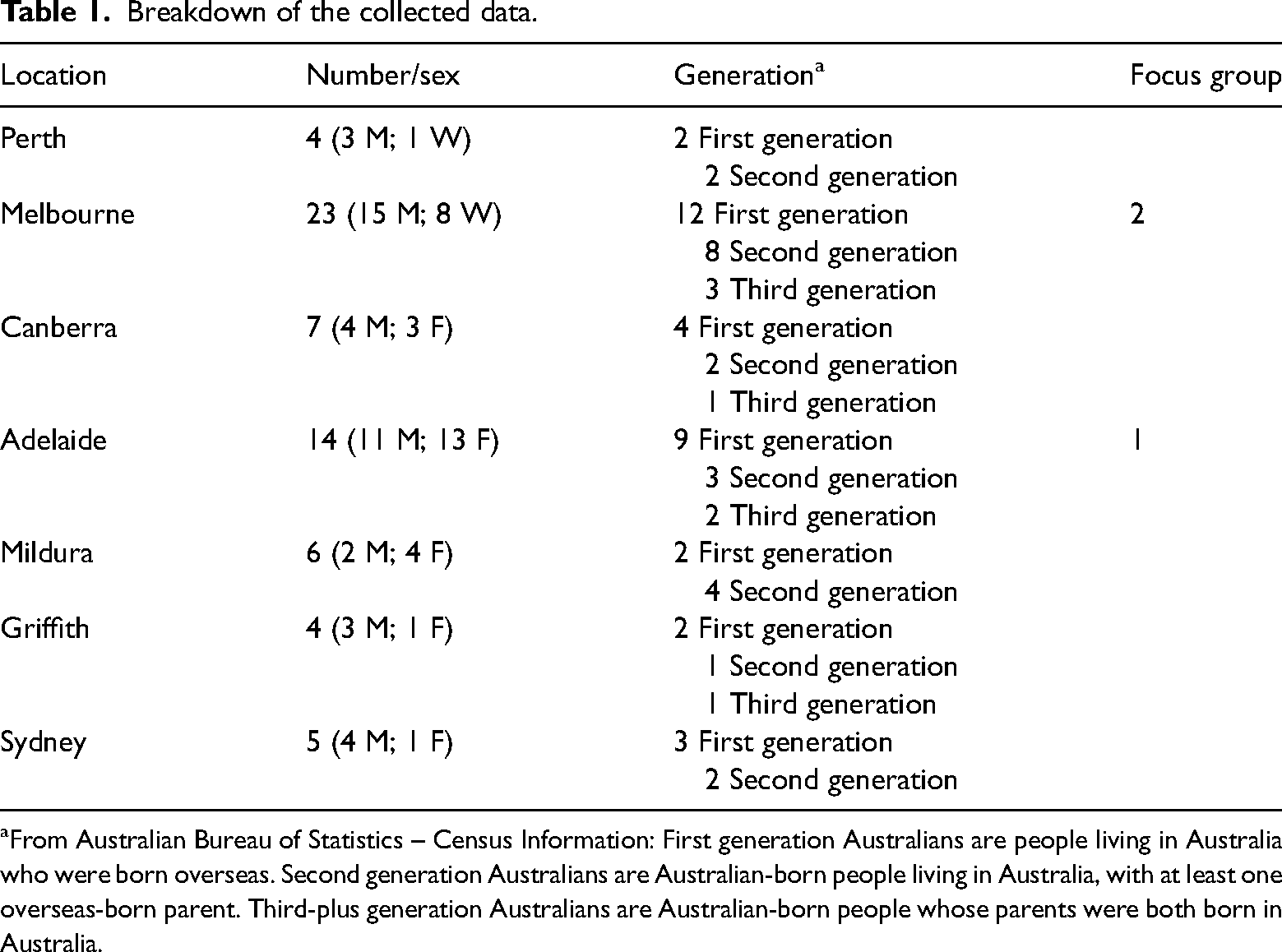
From Australian Bureau of Statistics – Census Information: First generation Australians are people living in Australia who were born overseas. Second generation Australians are Australian-born people living in Australia, with at least one overseas-born parent. Third-plus generation Australians are Australian-born people whose parents were both born in Australia.
Life-histories were mostly arranged through word of mouth and snowballing, and included three Facebook posts on open groups of Calabrians in Australia (and related comments to the post on Facebook). There were three sets of biases in this research. First, a reflexivity bias, as I am Calabrian and therefore could bring some beliefs and preconceptions about the topics at hand. This has been mitigated through active listening of participants’ experiences, which life histories facilitate, and through the open-ended nature of the questioning style. Second, a self-selection bias, which recurs when individuals self-select for participation as interested in a specific topic; this manifested in snowballing and mitigated to an extent through the Facebook posts and the focus groups. Third, a response bias, due to the topic of the ‘ndrangheta being particularly difficult to tackle “with honesty”; there is either reluctance to discuss this openly or minimisation and denial. This has been mitigated through the additional focus groups and in the analysis.
Crucially, due to the nature of the data and the topics discussed, the analysis aimed at capturing discourses more than just themes or concepts and has therefore been interpretivist. In fact, discourse analysis is of relevance when listening to people's stories and narratives, as it helps to identify the context and the sub-context, and understand how language is used for different, often implied, meanings (Jankowicz, 2005). Primarily, this discourse analysis has been carried out via analysis of narratives as constitutive and interpretative of the experiences lived by individuals. As argued by scholars using narrative criminology in the field of organised crime (Poppi & Sandberg, 2023), or mafias (Sergi, 2023), stories can shape realities and eventually build realities, notwithstanding their fact-based truth. This means that phenomena that are naturally partially hidden, like mafias, can be understood by focusing on how people narrate them, as their narratives are their experiences and the result of scripts and utterances collectively reinforced by communities. Thus, while I do not take at face value the statements of my participants, I consider their testimonies and their life histories as fundamental to understand the construction of behaviours and phenomena, their perceptions and eventually also any harm associated with that.
This paper, based on discourse and narrative analysis of life histories contributes to mafia mobility debates by reversing the observation angle. Instead of scrutinising the ‘ndrangheta, we take for granted its existence in Australia and move towards an understanding of the harms to Calabrians and their migrant culture, through the lenses of the ambiguity and the uncertainty that the ‘ndrangheta nourishes and causes.
Social harms
Zemiologists argue that “social harms are assumptions, practices, policies, processes and social arrangements which deny or inhibit the flourishing of what it is to be human” (Canning & Tombs, 2021, p. 147). However, they do not define what it means “to be human”. Pemberton (2015) defines social harm as the hindrance to human flourishing. I find it helpful to also refer to Pizzorno (2007), and argue that what makes people human is to flourish while socially included in circles of recognition that make individuals feel like they belong to their culture. Manipulating, inhibiting, or denying such recognition is indeed a social (and cultural) harm.
The main social harms that Calabrians or Calabrian-descent individuals perceive in Australia when it comes to the ‘ndrangheta are not a surprise: stigma, discrimination, embarrassment, and shame are known to be part of the migrant experience of Italians (and especially Southern Italians) (Marino, 2019a, 2020a). These are linked to the self-perception of “illegitimacy” of Calabrians also in Italy (Moxon, 2024; Teti, 2012) and part of the discrimination and victimisation experience of Southern Italians abroad (L’Orfano, 2009; Lupo, 2015).
The perceptions and the narratives about the ‘ndrangheta have two main impacts on people: first, they disturb (collective and individual) identity continuity by casting doubt on the real nature of “Calabrianness”, thus leading to cultural harm and misrecognition (Boukli & Copson, 2020). Second, they lead to external stigmatisation, which – at different times have resulted in social silencing within the community, in addition to frustration, and mortification. Sketching how participants depict Calabrianness is paramount to understand how any cultural harm emerges.
The perception of the meaning of Calabrianness is, like every culture, a very subjective and dynamic one, but common themes are built and reiterated thanks to circularity of narratives promoted within families and social circles of recognition. Participants defined Calabrianness and being Calabrian (from their position of migrants or migrants’ offspring) through some positive remarks: traditional values, such as the importance of family and culture (food and music primarily); the attachment to the land and its beauty; pride linked to the multifaced history of the region (also compared to that of Australia); and having a sense of purpose as a family, as a collective. Some remarks are ambivalent. The assumption that sacrifice is (self) worth – especially when linked to hard work and dedication to home and family, and feelings of confidence and determination in hardship: “we come from adversity, Calabria is adversity even today, but Calabrians make it anyway” (VIC17). “We are proud for the challenges we’ve overcome” (VIC9). Already behind this ambivalence of feelings, there is a recognition of harm: “what Calabrianness means to me is that we love the suffering” (VIC9).
Views about what it means to be Calabrian (in Australia) appear consolidated and homogeneous across generations. However, the existence of the ‘ndrangheta casts doubt on this cultural milieu. It forces people to scratch the surface of consolidated cultural norms. One way in which this seems to happen to people of Calabrian origin in Australia is by learning about the existence of the ‘ndrangheta as an unknown to avoid, already around, but without any specifics: [My parents] never told me not to mingle with other Calabrians out of our family; what they would say was: ‘the only thing you need to worry about is not to mingle with the malavita
1
’. And I would ask ‘what is the malavita’? And the answer was ‘don’t worry about that’. So, I was scared but I would not know how one could mingle with the malavita. (VIC5) I was told constantly to avoid boys from X [mentions a family from a specific village] because they were trouble, as their parents were in the malavita. However, we were from the next door village, and we all knew each other; my brothers and my male cousins, they all behaved more or less in the same way to the boys from X. I didn’t know how to differentiate them. … Their parents were nice to me. (SA7FG) We were from the same family, Dom
2
and I, he was the cousin of my father, we had the same name. My father had the fruit shop, he broke his back working all his life, like all people from the village those days. But when my father arrived in Australia, Dom took him out for dinner and told him that they were the same, they both worked hard and for this reason he respected my dad and let him be. … My father did respect him too, because of it; he never got involved with him in other ways, but there was mutual respect. (VIC3)
As for Calabrians, there is virtue in working hard – intrinsically linked with a Catholic idea of sacrifice as virtue. They recognise hard work as a virtue also in individuals with a criminal vocation. However enigmatic this might be, it also shows a need for mutual recognition of cultural values.
Doubt cast into the mainstream narrative of Calabrianness has also contributed to social silencing in the community, at times leading to mortification and suffering because of the prejudice, the stigma, and the discrimination against Calabrians, due to feeble ‘ndrangheta connections. This type of harm relates directly to the migrant experience of Italians (and Calabrians) in Australia, as an experience made of direct and indirect exclusion, racism, and of struggles for recognition (Marino, 2020a; Ricatti, 2018). The fact that silence can be interpreted as a “non-pathological transmission of knowledge” among Calabrians (Pipyrou, 2016, p. 45) also helps us understand why silencing is often not problematised any further by the community. Indeed, social silencing can be the result of structural exclusion through shame and stigmatisation (Canning & Tombs, 2021) – of marginalisation and “invisibilisation” deriving from processes of public communication (Herzog, 2018). In fact, an institutional apparatus (made of politicians, policymakers, law enforcement and media) has constructed the image of Calabrians as mafiosi (‘ndranghetisti) and contributed to the stigma and the discrimination (Johansson & Battiston, 2020; Leiva & Bright, 2015).
When discussing silencing, stigma, and discrimination, the common denominator among participants relates to the process of “othering” that they have been felt by the rest of Australian society. A participant connects this with anti-migrant sentiments: “the mafia stigma goes together with the fact that Italians were not welcome so in Australia; they [Australians] welcome this stigma, this mafia, as this one sticks” (VIC6). Like other Southern Italians in migrant settings (Lupo, 2015), Calabrians in Australia, faced with the stigma of being associated with the mafia – stigma also fuelled by media, police, or other Australians, felt they had two choices: ignoring or fighting the stigma. The former can amount to silencing, the latter requires identity battles. A participant talks about learning about this stigma, through acceptance of the misrecognition it led to and its “microaggressions”. Mafia wasn’t something that was on anyone's conscience, not until the 1960s … and I can’t say I have experienced any real discrimination for it. If not occasionally, a friend or the other would say ‘I suppose you are in the mafia’ and I would say ‘yes and you better watch out’. (VIC21)
However, the same person, who claimed not to be too bothered about the stigma at the beginning, as he and his family had no association with the ‘ndrangheta, felt mortified when it affected his daughter. This leads to consider the flexibility of cultural harm by misrepresentation, especially when linked to uncertainty of a cultural value. We built a new house in 1981 and our kids one day go to school and come back by bus. The bus driver – whether he was joking or not – says to my daughter ‘you live in the marijuana house?’. He thought I had got the money to build the house from marijuana. My daughter was very surprised, and she came home to tell me. I didn’t know how to react. I tried to laugh it off, but it mortified me.
The attempt to “laugh it off” or to respond with a joke could be considered a deflection mechanism to minimise the harm, a self-silencing mechanism to respond to the frustration provoked by the stigma, or rather by the uncertainty of the situation the stigma has brought to light; a response to a prejudice, which is not always felt first hand but still has consequences as it is structural and collective. As these reactions were common, especially in earlier days, they might have contributed to collective forms of social silencing. There's been a reluctance to challenge the public view that has been promulgated about the Calabrese (…) if they had tackled it in the past … look, we should not deny that some people of Calabrian origin are criminals, but the majority are not, don’t lead people to believe that there is a nexus, that someone is a criminal because he's Calabrese. This is where we, as a community, failed, we didn’t say anything. We just tried to keep quiet, laugh it off, get along with people, our own paese [village] and to be liked and accepted by other Australians. (VIC23FG)
Cultural harm, misrecognition, and social silencing are unintended consequences and social harms of the ‘ndrangheta's presence and perception in Australia, arguably also contributing to misguided institutional and public social constructions. These harms are often made up by microaggressions; if paired with other harms – direct ones as criminalisation or prosecution, for example – they could become invalidating and cumulate, thus extending processes of marginalisation and social exclusion (Friedlaender, 2018).
Intimate wounding
In a surreptitious way, there are other harms that we can find linked to the presence and the narratives of the ‘ndrangheta in Australia, which lead to ambiguity and uncertainty. These are bound to remain largely hidden, even more so than the social ones, because they relate to people in proximity to so-called “mafia families” or dynasties (Sergi, 2021a), either because of family ties or because of spatial vicinity. The ‘ndrangheta's ambiguity and uncertainty act both as a magnifier of intimate wounding and as an invisibility cloak. This means that where there are intimate harms already – both physical and emotional – these are not only magnified by the proximity to the ‘ndrangheta, but also – due to the clandestine nature of the phenomenon – they remain largely unseen.
In the empirical data, there are two sets of mafia-related intimate wounding, although they often cannot be disentangled from harms existing already in the cultural context of reference. On the one hand, there is family-related violence or exposure to violence. On the other hand, there is a set of emotional abuses, neglects, and double victimisation processes, which affect individuals at different lengths and can be grouped into autonomy and relational harms (Pemberton, 2015). I define both as intimate, using the term intimacy in its double declination: private or personal and involving very close connections. I define both as wounding, to highlight the process of harming, more than the outcome of a perfected (thus admitted and recognised) damage.
Interestingly, both participants in proximity of families involved (now or before) in ‘ndrangheta-related activities and participants from the wider community, disconnected from the ‘ndrangheta, expressed similar opinions on family-related violence. Family-related violence is often presented as collateral damage by participants, as an “unfortunate” component of traditional Calabrian family dynamics.
A participant, not connected to any ‘ndrangheta family, says: My uncle, my dad's brother, was a wife beater. One night, I was with my cousins, and we heard his mum screaming – my cousin started yelling at him ‘you touch her, I’ll kill you’, but his mum was like ‘no, shush, ora si calma [he’ll calm down now]. … She kept making excuses for him, all the time, that's what women did. (VIC17)
Violence – “hot-headedness” – is often normalised as an underlying trait of Calabrianness. Another participant notes: There's a certain ruthless in being Calabrian; it's a way of doing things. … Some Calabrese, if you cross them, they might kill you. … It's the ability to become ruthless; it's a sense of personal worth, that's honour. If you question that, if you do me or my family harm, I know as a Calabrese, that I might have it in me to react and shoot you. (ACT1)
This is where the link between ‘ndrangheta culture and Calabrian (migrant) culture of the early days appears the most controversial as it becomes more difficult to identify where one ended and the other began. Overall, data confirm that family violence among Calabrians was, at the peak of migration, not just related to the ‘ndrangheta, but a well-known issue in Calabria more generally (Ciconte, 2014). The proximity or existence of a ‘ndrangheta tie, however, increases the perception and the use of this violence. The ‘ndrangheta takes this cultural disvalue and magnifies it. A participant says that the belonging to the ‘ndrangheta augmented the perception of impunity when using violence: It was common for my mum and my auntie to help one another when dad and uncle were ‘in a mood’, which is when they used to beat them or be violent with them for whatever reason. My mum used to say that uncle was worse though, and this was perhaps because he was involved with that side of the family who would protect him in case this came out, so he was even more careless than my dad. (SA01)
The ‘ndrangheta, for many participants in this research, is seen as amplifying the most conservative and orthodox components of what they perceive as Calabrianness, as exemplified in this excerpt: There's been death in my mum's family, related to that [the ‘ndrangheta]: my uncle was killed. I was never proud of our surname … but then this happened, and it had ramifications in the family. That's when my mum and dad split up. But before that, there was some attempt to rid of … you know, the shame in the family. My father was never interested in those things [‘ndrangheta activities] but he was a very conservative man. He was a different person then, he used to get angry, domestic violence as you know is part of … it was collateral damage. … It was a societal, a community issue at that stage. I didn’t realise it was mafia-related, the death of my uncle, until I found it out in the news. (VIC11)
This excerpt helps us see the stratification of harm: on the one hand, violence is clearly linked to the ‘ndrangheta, albeit afterwards, by the participant. On the other hand, however, violence was also perceived as “collateral damage” in the culture. This leaves individuals to connect ‘ndrangheta and Calabrian culture as one amplifying the other, generating more violence than what was already there.
In addition to exposure to physical violence, double victimisation follows – in the form of victim’ blaming. In the following excerpt, we see the stratification across intimate harms. The participant refers to events happening in the family that she qualifies as ‘ndrangheta related, but the first type of harm she recalls is quite intimate, about her whole family suffering because of invasions of privacy by law enforcement. She pairs to this suffering double victimisation and victim blaming at school, while fearing that – once again – ‘ndrangheta violence would strain the precarious family balance and call for more violence. It became very evident when there were those … events … and it was in the news, but for a while I didn’t even want to see the newspapers. I had an understanding that my family was suffering, but I was only 14. You couldn’t turn the TV on without hearing something, seeing something … and I am at school, you know? You’ve got teachers asking, kids joking to you, saying ‘you marijuana growers, you druggos’, you know, we were always getting blamed. We had the police come through, a few months before the events, and they went through the property for hours. It was invasive, disrespectful. My mum was ashamed, she didn’t go out of the house for days, to avoid people's staring and I started staying out longer instead. I was afraid my father would lose it and hit her and me too just because we were in the way. (VIC9)
Harms linked to violence and to double victimisation are not the only intimate wounding that can occur in proximity to ‘ndrangheta families. There are harms linked to autonomy and relations, especially connected to uncertainty and ambiguity. Pemberton (2015, p. 105) calls “autonomy harm”, the harm which results from “situations that fundamentally disrupt our attempts to achieve self-actualisation”. For example, looking at the characteristic of such families – especially in first- and second-generation migrants – endogamy, arranged marriages. Marital decisions and interfamily marriages in the ‘ndrangheta (Catino et al., 2022) show the intertwined nature of cultural preservation and economic priorities. Although the ‘ndrangheta is today mostly based on familial units, this did not appear to be the case before the 1950s (neither in Calabria nor in Australia). However, after 1950, also because of migration in the same years, interfamily marriages became a practice when maintaining wealth meant maintaining social status, arguably even more so far from home. Sisters and daughters, in some ‘ndrangheta families also in Australia (Sergi, 2024), appear to have had little freedom to choose a partner, like in Italy (Siebert, 2007). However, this is one of those cases where intimate wounding might not have been perceived as damaging by the recipient. Arranged marriages helped reduce uncertainty and, therefore, they might have been welcome rather than being perceived as wounds to autonomy. A participant, who spoke off the record, described this as natural, considering the lifestyle of her family (a family connected by blood to a prominent ‘ndrangheta member). I took notes and recorded myself after the meeting: It was just the natural thing to do, to marry Pat. We grew up together, they were gravitating around my family, as his father had contributed to my uncle's business in the past. My uncle was Pat's godfather. All our social life was our family life back then, so it was between him and someone else, a second cousin, from the same village in Calabria. But I liked Pat more, so I agreed to marry him. (ACT3NR)
Interestingly, she is pointing out that social life may overlap with family life, which was/is all but uncommon in Calabrian societies, as shared by most participants and as implied in the theories of double or alter ego villages (Marino, 2019b; Teti, 2012); this was definitely the case a few decades ago, and – in some areas more than others – even today (Teti, 2022). Thus, agreeing to marry someone that the family approves of is important also to avoid family conflicts, which become social conflicts. Avoiding family conflicts is paramount to preserve harmony in a migrant context also to allow for appaesamento, to allow for preservation of memories and identity from home. In a ‘ndrangheta family, avoiding family conflict is also necessary to avoid violence, in the form of family feuds (Sergi, 2022). Another woman's words – close to a ‘ndrangheta family – off the record, help us understand how the overlapping of family life and social life, especially in the early days of migration, was also a reaction to spaesamento, that is, the inability or difficulty to build identities within the host community (Marino, 2020b). In her perception, we also find an interesting correlation between family identity and social acceptance, which is a strong indicator also of the ‘ndrangheta's quests for social prestige via family reputation (Ciconte, 2011; Sergi, 2022). Upon arriving in Australia, we lived for years all under the same roof, with all my brothers and sisters, uncles, and aunties, and then whoever got married moved in a property nearby: cousins grew up with cousins and neighbours were often from the same village anyway. With Australians not welcoming us, they were your only people, you didn’t want to disappoint anyone, nor wanted to be disappointed by anyone. (NSW10NR)
In a migrant setting, it might be more likely that cultural traditions are at times intensified and traditions exaggerated for appaesamento; this might help avoid family conflicts too (Marino, 2020a; Shaw, 2001; Teti, 2018). For example, preserving traditional roles for women – by influencing their marriages and resisting their choices of education – can prevent greater agency, which might lead women to leave or question their families. The unity of family, especially in families where there some individuals were or are involved with the ‘ndrangheta, is paramount, as shared by the same participant before. Her father was believed to be in the ‘ndrangheta (although she does not confirm that): “We didn’t have to leave the village; we left because my father thought that if we stayed, we would not be able to stay all together. We left because in Australia we would all stay together” (NSW10NR). Family unity resonates as both a necessity of Calabrian migrants, given the circumstances of migration and of arrival, as well as being presented as a value of Calabrianness more generally, with the usual nostalgia that accompanies tales from the past and the arrivals.
Also to avoid family conflicts and promote family unity, the threshold of autonomy (and even morality) might be distorted. For example, an uncle 3 asks one of his nieces to lie for him and it later turns out that she was asked to give a false alibi to cover up the organisation of a murder. Moreover, that niece's wedding is an occasion to exchange and launder money. A few individuals gravitating around the family and that uncle, use the wedding as an occasion to mask proceeds of crime (from drug cultivation) as donations and wedding gifts. While in the first occurrence – the lie – we find a family-based manipulation that could exist even outside of the ‘ndrangheta's system; in the second occurrence, the ‘ndrangheta's interests in the laundering of cash manipulating family and hiding behind normal family gatherings are much more visible. In both cases, some agency from the people involved is necessary, but in the second case, the extent of the manipulation is imposed on the relatives, with little understanding of what is really behind it.
These examples show how the manipulative nature of family ties in ‘ndrangheta families or in families with a ‘ndrangheta “core”, can bend autonomy of family members to protect or enrich the organisation. If a “disablement” of autonomy (Pemberton, 2015) already occurs within the family, victimisation might follow outside the family as well. The same person “disabled” of their autonomy is often considered – from people on the outside, including law enforcement – to be “part of the (mafia) family”, without “any appeal”: they will be “bunched all together, because of surname, even if we are really different families” (ACT3NR). On the one side, this “bunching” might mean official investigations, scrutiny, and suspicion from the community; on the other side, it might mean some advantages and privileges that follow the reputation of the mafia family, should a ‘ndrangheta member wish to use that. Having a reputation, good or bad, is indeed fundamental for the ‘ndrangheta (Sergi, 2024). In practice this means that various members of a family not involved with their relatives’ ‘ndrangheta-related affairs will be suffering for such proximity, for the stigma related to it, and for the scrutiny that this brings. These harms of autonomy and relations remain intimate wounding as seldom shared beyond the family itself; they do inflict further harms on identity as well. Social harms of misrecognition can emerge in all of these cases, “from the symbolic injuries which serve to misrepresent the identities of individuals belonging to specific social groups” (Pemberton, 2015, p. 31).
Discussion: Ambiguity and uncertainty as lenses for non-material mafia-related harms
In Calabrian migrant settings in Australia, the presence of the ‘ndrangheta within and around families introduces an extra social circle of recognition – as Pizzorno (1986, 2007) would call it – that intertwines and overlaps with already existing circles of recognition in the community of origin (the people from the same, double, and village) and that of the host community (Australians). The ‘ndrangheta's presence adds a further contiguous circle, partly and often invisibly superimposed on the circle of the community of origin and its Calabrianness but opposed to the circle of the host communities and its values.
In the context of (migrant) Calabrian culture, the ‘ndrangheta's presence fuels social and individual harms, which all have in common uncertainty of values or ambiguity. These dimensions of uncertainty and ambiguity have the potential for harm even if not all individuals perceive it in the same way. Echoing the argument made by Kaker (2024), here we find a form of what she calls “ordinary uncertainty”, a “routinised experiential terrain of insecurity”. Ambiguity and uncertainty, in the context of mafia (migrant) settings, are in fact everyday events, that people live, experience and come to terms with. Additionally, as reminded by Bosco and Sciarrone (2006), for some, even the instability produced by uncertainty (or ambiguity) can become itself a source of stability if protracted in time. However, mafias – and the ‘ndrangheta in Australia too – are favoured by uncertainty and ambiguity, while contributing to feeding them.
We can group the social harms and intimate wounding found in this research in four dimensions of ambiguity and uncertainty that both make the ‘ndrangheta and are encouraged by the ‘ndrangheta in Calabrian communities of Australia. In this context, there is ambiguity, thus radical uncertainty, when harms arise from the ambivalence of personal, social relations, and of cultural norms; there is uncertainty when there's a crisis in attributing value to cultural norms and social interactions, given that they partially overlap with ‘ndrangheta ones.
Ambiguity of family and community bonds
From the outside, misunderstandings of how Calabrian families work in practice can lead to ambiguity, as a participant said: “they bunch as all in the same family because of surname” (ACT3NR). On the one hand there's an expectation for Calabrian families to be tight, where sharing and participation into each other's business, should be common. On the other hand, family bonds are sacred, and individuals depend upon such bonds for survival, identity and – especially in Australia with its double/alter ego villages – protection. This can lead to a willingness to reduce family conflicts to the point of minimising sharing and participation and therefore deny, justify, and excuse some individual conducts in the family.
Ambiguity around people you know – by family or community bonds – and the meaning of their real or alleged involvement in the ‘ndrangheta, forces people to take stances or negotiate opinions of others and can seldom be resolved. Ambiguity about the plurality of masks worn by various family members (beloved uncle in the family could be a respected man in the community and a well-known mafia boss for law enforcement) undermines self-confidence and social trust. Says a participant: “At some point, because I went to school and I grew up with some of them, it became quite uncomfortable. I mean, what do you trust? I went to a wedding of a friend, and the day after I had the investigators at my door, suspicious of me, I don’t even remember why; also, the local newspapers mentioned my presence there…” (NSW5).
At the social level, this ambiguity leads to misrecognition and suspicion over family's and community's members’ (presumed/alleged) involvement in the ‘ndrangheta beyond the actual affiliated actors, beyond a ‘ndrangheta core. Ambiguity in relation to a person's or a family's conduct is often linked to missing information or action from law enforcement, and consolidated judgements across the community. This ambiguity will lead to further stigma and double victimisation, and will impede a comprehension of the phenomenon. At the individual level, this ambiguity leads to harms of autonomy, as well as relational harm deriving from denial and justification of (ambiguous) personal and social conducts. At the individual level, the impossibility to form a coherent opinion about someone or some family can also lead to confusion over a whole series of identifying characteristics of the self in respect with the community of origin and with respect to the reputation of families, including your own.
Ambiguity of reputation
Reputation, in the mind of many Calabrians and individuals of Calabrian origin in Australia is linked to success and to honour; it is synonymous with “making it”, notwithstanding the challenges of migration, notwithstanding the spaesamento (Marino, 2019b). It follows that reputation can also be linked to strong-arming and “making your voice heard, raising it if you must” (VIC18), which echoes what is said above about Calabrian “ruthlessness”. Managing to reach results without always obeying the rules (and getting away with it), or by finding shortcuts, is often considered a sign of wits and even good business acumen: “if he did something, let's say, not appropriate, it's done now, and the result clearly paid off anyway, right?” (VIC18). Reputation, in certain communities, is not just earned but is also hereditary; in certain Calabrian communities, it becomes a family's legacy (Ciconte, 2011; Ingrascì, 2022); as such, it becomes difficult to disentangle reputation from the concept of honour.
When perceptions of, or association with, or doubts about, the ‘ndrangheta emerge, ambiguity appears: “There's one guy, a counsellor, they were talking about him, there were stories, is he influential, is he in the mafia, but he did work hard for his family legacy, and his family never abandoned him, so what were we supposed to think?” (WA3). Indeed, doubts about someone's conduct, if they are considered a “good” person from a point of view of perception of honour and reputation, will make it impossible for externals to form a judgement on that person as “just” a mafioso.
At the social level, this ambiguity is seldom “resolved”, and leads to confusion over reprehensible conducts, misrecognition, and cultural harm, including social silencing linked to manipulation of ethnic solidarity (Sergi, 2019a). At the individual level, this ambiguity leads to self-doubt, crisis of confidence, and equivocality, which will then affect future actions and reactions. Indeed, at the core of the ambiguity of reputation lie the partial overlapping between Calabrian (migrant) culture and ‘ndrangheta disvalues. While this ambiguity can be tolerated at the individual level, due to family or community bonds, it becomes difficult to act upon at the social level, if not through doubt and/or distancing or through ignorance and/or condoning.
Uncertainty of the value of suffering and adversity
Among the areas where we find more overlapping between Calabrian cultural values and ‘ndrangheta disvalues, as said, is the narrative of persecution, adversity, and suffering. As seen, these narratives have come to define Calabrianness and have two opposite effects: they embellish self-perceptions of Calabrians as hardworkers and survivors, and they might contribute to communities developing antagonism to the state and to legality, masking such antagonism as disobedience, resistance, or even social uprising (Teti, 2012). In other words, the narrative of hard work as an uncertain value due to the equation of suffering and virtue, can serve as a disguise to justify a few entitled behaviours including illegal enrichment. When mixed with mainstream migrant culture in Australia, this narrative can inadvertently provide justification for underpinning ‘ndrangheta's ideologies. Indeed, the ‘ndrangheta – like other mafias (Lupo, 2015) – is supported by an ideology of persecution, oppression, and domination, which can act as a powerful justification for certain behaviours. A certain form of entitlement is still felt by the participants: “against the state's marginalisation of Calabria, or the treatment of Calabrians as inferior, which we always have endured” (VIC15FG). Depending to which circle of recognition one belongs to, and how stable that is, the value given to suffering and adversity becomes uncertain, as it can be at the same time both supporting mafias and recognising the challenges of history for Calabria. At the social level, this uncertainty leads to the perpetuation and justification of mafia behaviours, which is arguably a self-inflicted social harm on its own and a cultural harm of what “healthy” Calabrian values endorse. Additionally, it might lead to harms of recognition and autonomy, at both individual and social levels, as uncertainty over the remit and value of suffering and adversity confuses the actions that might follow, instilling a sense of entitlement as well as distorting social expectations.
Uncertainty of the value of honour
The concept of honour is a key element of pride of Calabrian migrant families, as much as it is an element of the ‘ndrangheta's set of values. It is arguably one of the elements that most triggers uncertainty of values. Honourable is the man who provides for his family and is true to his word; he who is respected by his peers and who acts as an “educated, amicable, and generous man, who never swears” (NSW5), notwithstanding any other ambivalence about his reputation. Honourable is the woman who stands by her family; she who does not antagonise her traditional or her familiar roles, and she who subjugates (Siebert, 2007).
The concept of honour is linked to a popular sense of authority and morals, and as such it can lead to recognition of authority for men who externalise arrogance and intimidation or actual violence. Honour is also linked to dignity and pride, to loyalty, but also to extreme masculinity. The concept of honour is not ambiguous, but factoring in honour in judgements can give way to uncertainty of values in personal relations. As shared by a participant in a focus group, when you try to judge someone for his honourability, you risk not seeing the rest properly: “you feel like you are making stuff up if you only trust your instincts about someone; but if you only trust your sense of decency and honour, and they are honourable to you, then you might miss out on something that goes on right under your nose” (SA2FG).
At the social level, this uncertainty leads to misrecognition and cultural harm, also in the form of manipulation of how the concept of honour can be used within families. It can also lead to social silencing and marginalisation of the community in the fear that in the name of honour revenge and privilege can be justified. At the individual level, this uncertainty leads to harms of autonomy and relational harm, when in the name of honour, bonds are expected to form among people, including bonds for protection, trademark of any mafia.
Conclusion
As the ‘ndrangheta involves a qualified minority in Australia, understanding its relations – in terms of perceptions and actual involvement – with Calabrian communities and migrant culture is a necessary step to identify individual and social harms. This paper has looked at the unintended and oftentimes hidden harms that are associated with the presence and the social constructions of the ‘ndrangheta in Australia. Crucially, these harms do not just relate to “innocent” victims, but also to people in proximity to ‘ndrangheta contexts or families, often considered guilty by association.
Through a zemiological approach, where the ‘ndrangheta's criminality remains in the background, this paper has argued that ambiguity and uncertainty constitute lenses through which we can understand social and individual harms linked to the ‘ndrangheta in a migrant setting. Indeed, social and individual harms are both magnified and hidden because of ambiguity and uncertainty. Exploring the role of ambiguity and uncertainty in social and personal relations and in the way key master cultural values are perceived and received, provides a new interpretative frame to understand the multivalent nature of the ‘ndrangheta as a social phenomenon, like in Australia, as in Calabria. Undeniably, the results of this research go beyond the migrant setting. The ultimate contribution of this paper lies in the attempt to explore the contested link between Calabrian culture and ‘ndrangheta (sub)culture; the link exists but it is neither deterministic nor straightforward.
I have argued in this paper that the ‘ndrangheta amplifies some of the harms already existing in Calabrian culture through ambiguity and uncertainty of values. However, this argument leads to an interesting counter question: can the source of harm be found in the region of Calabria, its culture, without a connection to the ‘ndrangheta? And if so, to what extent would it be even possible to assess that? In other words, wounding, victimisation, and harm that Calabrians might endure could also be independent by the ‘ndrangheta presence. In this paper, evidence points to the intrinsically connected nature of the ‘ndrangheta as a subcultural, manipulative product of Calabrianness; it is in this manipulative nature of culture – through ambiguity and uncertainty – that the ‘ndrangheta endures as a system of values, even beyond criminal activities. This does not mean that the ‘ndrangheta organisation could ever be solely dependent on Calabrian culture, but that there is a link there that needs further exploration.
By focusing on ambiguity and uncertainty, we understand how cultural harm, misrecognition, and social silencing contribute to victimisation; ambiguity and uncertainty are also part of the reason why alibis and justification of the ‘ndrangheta emerge in the same community that endures it the most. The notorious incapability of the community to react effectively against discriminatory comments based on mafia prejudices can also be a by-product of the harms endured.
Additionally, when focusing on ambiguity and uncertainty in mafia proximities, we can identify how family and community bonds are often leading to – rather than protecting from – intimate wounding. It might be expected that family members collude or protect their ‘ndrangheta associates; however, the level of support, knowledge, and involvement of family members in ‘ndrangheta business might vary and reveal ongoing victimisation, that is, intimate wounding, increasing the more someone does not wish to be involved.
Overall, while we are often led to believe that there is, in the ‘ndrangheta like in other mafia groups, a certain degree of cultural determinism, data show us a more nuanced reality. Indeed, a key contribution of this paper is that the lack of individual agency in the proximity of the Calabrian mafia (whether by family or other “location”) is not deterministic, but it might be an effect of relational and autonomy harms.
The various social and individual harms identified in this paper, magnified and hidden by ambiguity and uncertainty, are part of the experience that both Calabrians and Australians have with the ‘ndrangheta and go way beyond the criminal nature of the organisation and its illicit activities. We may conceive the ‘ndrangheta as dependent on ambiguity and uncertainty, especially abroad, due to the already existing context of migration that changes cultures, identities, and relations. The more the migrant community changes the more support to ‘ndrangheta values will depend on leveraging ambiguity and uncertainty. We might argue that this dependency exists also in Calabria, but with different underpinning contextual factors. Without ambiguity playing a role in people's (self) perceptions, both in Australia and in Italy, ambivalence could not be leveraged in favour of mafia-type behaviours and organisation.
With these propositions also comes another question: can zemiology – as a critical sociological perspective centred on harm – marshal support for the thesis that ambiguity, in addition to uncertainty, is productive of mafia-type behaviours and therefore mafia-related social and individual harms? As seen in the theoretical framework, the answer is bound to be affirmative if we consider that mafias have long been considered agents of order in highly uncertain scenarios, where they offer protection to reduce uncertainty (Gambetta, 2000; Varese, 2020). However, the answer is also affirmative if we consider that ambiguity is radical uncertainty, where values on relations, interactions, and cultural norms tend to remain ambivalent in different circles of recognition that will seek stability. Ambiguity and uncertainty produce and augment harms in Calabrian migrant settings when we factor in the ‘ndrangheta presence or perception.
It is therefore imperative that we understand where and how ambiguity and uncertainty emerge in mafia migrant settings, in personal and social relations and in cultural norms. However, factors such as migration, education, and personal goals, combined with transnational experiences of the diaspora, are reshaping cultural norms among Calabrians and among Calabrian migrants in Australia (Teti, 2022). Transculturation – the stratification of several cultures – becomes the norm for people of Calabrian/Italian extraction in Australia (Ricatti, 2018) and this affects ‘ndrangheta families too (Sergi, 2024). The ambiguity and uncertainty of values that today still sustains the ‘ndrangheta will change too, find new ground, or fade away. A zemiological lens on the ‘ndrangheta down under helps us rebalance studies on mafia mobility to comprehend how different layers of ambiguity and uncertainty mirror into cultural and behavioural manipulations as culture evolves; this will enrich our anthropological understandings of social and personal relationships within mafia migrant settings.
Footnotes
Aknowledgements
The author is thankful to Dr Adam Masters for earlier conversations about this paper; Carlo Oreglia for fieldwork support; Professor Alberto Vannucci for his comments on earlier versions of this paper; Dr Francesco Ricatti for ideas development.
Declaration of conflicting interests
The author declared no potential conflicts of interest with respect to the research, authorship, and/or publication of this article.
Funding
The author disclosed receipt of the following financial support for the research, authorship, and/or publication of this article. This work was supported by the British Academy and Leverlhulme Grant (grant number: SRG23\231199, N/A) and also by SBS Australia – Radio.
