




Abstract
In the past decade, the attention to the Calabrian mafia, the ‘ndrangheta, has been rekindled everywhere in the world. On the one hand, Italian attention to the phenomenon has increased; on the other hand, the mobility of the Calabrian clans has been the object of scrutiny in view of the clan’s wealth and ability to commit transnational criminal activities. This has also fed the presumption that (alleged) offenders of Calabrian origins around the world must belong to, and replicate the structure of, the ‘ndrangheta clans, also down under. This contribution will be a reflection on the difficulties and the complexities of a journey into researching the ‘ndrangheta in Australia from a criminological–anthropological perspective, in consideration of—but in contrast with—the mythical figures associated with the Calabrian mafia and its illicit global markets. Some of the difficulties, as well as some of the mistakes that I have made in this research, because of the involuntary (and disorganized) nature of the ethnography, directly question the narrative of the illegal global reach of this mafia and provide methodological reflections and lessons for criminological ethnographies.
Introduction
In the past decade, international media and popular culture have perpetuated the presumption that criminals of Calabrian origins around the world must belong to, and replicate the structure of, the mafia-type Calabrian ‘ndrangheta clans. This presumption has been largely circulated by Italian authorities and recently been considered in Australia, as the ‘ndrangheta is said to move cash, resources, and drugs around the globe. A few studies (mine included) have looked at different perspectives on mafia mobility based on archival sources as well as judicial documents and interviews with law enforcement agencies. These studies have had a crucial role in paving the way to understanding the social, legal, and historical background that have led policy-makers as well as scholars to indicate different courses of action and research into this mafia phenomenon.
In this article, I will share my own reflection process, which led me to research the Calabrian mafia in Australia, from 2014 until today, from a perspective that eventually differed from the intended research project. This contribution will be a reflection on the difficulties and the complexities of a journey into researching the Calabrian mafia in Australia through an epistemological and/or criminological analysis, in consideration of—but in contrast with—the mythical figures associated with the Calabrian mafia and its illicit global markets. Some of the difficulties, as well as some of the mistakes (mainly in the forms of lack of preparation when going into the field) that I have made in this research, precisely because of the involuntary, unintended and disorganized nature of the ethnography, directly question the narrative of the illegal global reach of this mafia. This paper will describe my journey into the topic, my difficulties, methodological and conceptual hiccups when carrying out a qualitative research project and an unintended ethnography. This paper will not be offering hypotheses or theses, but is one of reflexivity, between a field diary and an epistemological assessment of the complexity found during fieldwork. Indeed, I have come to question cultural differences and cultural biases more than I had done before in this stream of research and this led me to a re-definition of the concepts of culture, territory and mafia behaviors that do require a more focused anthropological approach for further research.
The ‘ndrangheta on the global stage
The Calabrian ‘ndrangheta—from Greek etymology “society of honourable men”—is, within the norms of Italian criminal code (article 416-bis), a mafia-type organization. The law defines the modus operandi of mafia-type unlawful associations as follows: the use of intimidation, and the threat of violence, reinforced through the reputation of the criminal group and the subjugation of the community around them, abused for financial, political, or other gain. Studies on mafia-type organized crime have already warned about the risks associated with the construction of the mafias as homogeneous and/or ethnic threats (Arsovska, 2016; Ianni & Ianni, 1976). One of the main assumptions in mafia studies is that the mafia phenomenon is an Italian (for origin or descent) issue. This is false from an empirical point of view, as mafia behaviors are not only found in correlation to Italian criminal organizations (Varese, 2011). More specifically, the narrative that sees mafias as ethnic criminal groups, well-structured and usually hierarchical, and that constructs the phenomenon with a glare of nostalgic references to honor, manhood and the existence of a worldwide conspiracy, is a North-American narrative (Sergi, 2017a; Withorn, 2014). With this narrative also comes the tendency to give space to the mythical figures of mafia wealth, which, as pointed out in research (Calderoni, 2014), actually are a skewed and inexact overrepresentation of criminal statistics.
In the past two decades, however, the amount of documentation on the ‘ndrangheta, made of powerful investigations in Italy as abroad, has increased. Indeed, a new, and problematic, institutional discourse on the ‘ndrangheta as the most powerful Italian mafia (DIA, 2021; Sergi & Lavorgna, 2016), has filled the vacuum left by the Sicilian mafia in public discourse and collective understanding of Italian organized crime. News and reports have presented the ‘ndrangheta as able to move millions of euros (Eurispes, 2008), and as a leader in drug trafficking being responsible for 80% of the cocaine trade in Europe (Europol, 2013), all while being present in over 25 countries in the world (DNA, 2015). The increase of scrutiny also led to an increased use of the term. Today, the term ‘ndrangheta is usually written with the capital ‘N—which is a spelling mistake as the first letter is indeed not the n but a missing a (Sergi & Sergi, 2021). Also, the use of the capital letter reflects the success in turning this phenomenon into a unified threat (Sergi, 2018a): this also happens for terrorist threats as it also happened for Cosa Nostra in the United States (Albini & McIllwain, 2012). The unity of the ‘ndrangheta is something that is still debated by critics notwithstanding recent law enforcement success in claiming that this unity is a juridical certainty (Sergi & Sergi, 2021). The singularization of the name is also an approximation of the language of security that follows repeated calls for international responses to the ‘ndrangheta. The rise of interest in globalization and the growing number of studies that fall under this label also originates the presumption that mafia mobility is an underestimated threat (Balsamo, 2016).
Studies on mafia mobility have focused on activities and structures of criminal groups and networks, following what is essentially a spectrum of manifestations from delocalization of criminal activities (when groups carry out whole or part of their criminal activities elsewhere/abroad) to colonization of territories (where groups replicate criminal structures similar to those of origin abroad) and their variations (Sciarrone & Storti, 2014). According to DNA, the Italian National Antimafia Prosecutor (DNA, 2019), the ‘ndrangheta is today present almost permanently (examples of colonization) in Canada, Australia, Germany, and Switzerland. In most of Europe, in the United States and in other African countries, the clans engage in criminal activities (delocalization) mostly for money laundering and drug trafficking, having also developed links with local criminal groups in Latin America. Recent research has confirmed that ‘ndrangheta clans, as much as other Italian mafias, have been exploiting successfully capitalist opportunities around Europe (Sergi & Rizzuti, 2021).
The difficulty that studies and reports encounter is in the collection of data due to the definition of mafias. In fact, legally speaking, mafias are criminalized only in Italian law while only parts of the phenomenon are criminalized abroad. For example, unlawful associations or criminal conspiracies might be criminalized abroad but the mafia method is not a characteristic of organized crime legislation beyond Italy (Sergi & Rizzuti, 2021): the mafia method involves doing organized crime, thus seeking profit, through use of intimidation, subjugation of communities and exploiting political connections. Data on cross-border criminal activities linked to mafia clans from Calabria, such as money laundering and drug trafficking need to be read with this legal asymmetry in mind. Nevertheless, in an attempt to generalize some of the findings, approximation of data becomes the norm. This is also justified by the awareness that investigations and intelligence on these activities are hindered by the secret and covert nature of dirty money and organized crime more generally (Von Lampe, 2016).
When it comes to Australia, I have actually argued in my previous work that there is in Australia a mafia-type organized crime group that is connected, historically but also for its organizational features, to the Calabrian mafia, but that one must go beyond the ethnicity of the phenomenon to understand how the Australian ‘ndrangheta works. The ‘ndrangheta alone, among Italian mafias, has been present for almost 100 years in different forms and manifestations down under (Sergi, 2015, 2017b, 2018a, 2019a, 2019b). Only a few other publications exist on the topic of the ‘ndrangheta in Australia. A few studies have been critical of the use of terms such as colonization in the case of the ‘ndrangheta in Australia, and have rooted the phenomenon in migration history instead (Bennetts, 2016; Macrì & Ciconte, 2009; Spagnolo, 2010; Brown, 2017). Other studies have instead privileged the mainstream narrative currently prevalent in Italy that sees the ‘ndrangheta as a criminal organization made of Calabrian/Italian actors, networks and resources, stable and rooted in Australia as elsewhere in the world (Allum & Bright, 2019). Indeed, similarities between the Australian manifestation of the ‘ndrangheta with the Calabrian clans must not be taken for granted, as there are important differences across the phenomena. In sum, the ‘ndrangheta down under has its own identity which is very hybrid in terms of ethnicity, but also very Australian in terms of markets and behaviors (Sergi, 2019a). Indeed, (alleged) members and associates of the ‘ndrangheta in Australia have fostered networks with many other groups of diverse ethnicities to carry out their activities (especially drug trafficking) (Hughes et al., 2017). They also adapted to Australian society in terms of businesses they invest in and choices they make; for example, the links with the Italian society are maintained through the investments in the prolific food sectors (Made in Italy) for laundering purposes or through political proximity to candidates of Italian descent (Sergi, 2019a). The hybridity of the ‘ndrangheta does not surprise us when we consider the diasporic trajectory of the Calabrian communities down under. In fact, within the Calabrian diaspora, individuals tend to operate within an in-betweenness state of identity, especially those from the second generation onward (Marino, 2020a). This state of in-betweenness and the hybrid nature of self-identity necessarily migrate into social identities, also of criminal nature.
A research portfolio and an involuntary ethnography
When I started working on the international presence of the Calabrian mafia in 2014, and since then, a “new wave” of literature on mafia mobility—previously on Italian-American cosa nostra, now also on the ‘ndrangheta and the camorra—already enlisted some important contributions in English (Allum, 2014, 2016; Sciarrone & Storti, 2016; Varese, 2006, 2011). Starting an academic exercise to put together all the historical sources, the judicial findings and some of the media accounts in Australia seemed not only very interesting but certainly needed. Even though there was already a publication by a historian and an Antimafia prosecutor (Macrì & Ciconte, 2009) and a short essay that summarized their findings (Spagnolo, 2010) on the Australian ‘ndrangheta, there were no academic publications in English, not because of a lack of news or lack of interest, but mostly due to problems in collecting reliable data. As a Calabrian born and an early career scholar in organized crime, specializing in mafia-type organized crime and able to speak, write and communicate in Calabrian dialect, Italian and English, I felt a strange sense of duty to conduct this research. Indeed, my positionality in the field was one of a female Italian criminologist, from Calabria, who carried out a large part of her career outside Italy and who had already felt discomfort when reading various accounts—media and institutional—that were available on the ‘ndrangheta also in Italy and that I perceived out of line and not “real.”
The first article on the Australian ‘ndrangheta I wrote and published in Italian (Sergi, 2013) and then in English (Sergi, 2015) was indeed a historical account of the “evolution” of the Calabrian mafia clans in Australia. It combined both Italian and English archival and judicial sources and media accounts. Data revealed a certain continuity of a phenomenon that was loosely a mafia phenomenon and also loosely of Calabrian origin. Certainly, the intent was to connect dots in history, which proved more challenging than expected, as I am not a historian. Although it was arguably easier to write about the judicial truth on the ‘ndrangheta in Calabria—the latest findings of the Italian Antimafia authorities are quite consistent on the structures of the clans and their activities—much more difficult was to understand what was the connection between Italian judicial truths and the Australian context: what had moved to Australia? People? Groups? Activities? Ideals? And were they still moving? The theoretical frameworks of criminal mobility, both occasional and systematic, already provided some attempts to explain such movements in terms of opportunity-based, profit-driven, market-oriented choices of criminal groups, including those with ethnic characteristics (Arsovska, 2016; Sciarrone & Storti, 2016; Varese, 2011). It proved, however, not easy to apply these frameworks to anything related more or less to “an idea” or a “historical account” of the ‘ndrangheta in Australia. If in Italy the ‘ndrangheta is already a constructed phenomenon—in the sense that constructed are necessarily the legal norms to define it—then how does this construction—and can it—cross borders?
The involvement in the production of the 90 min documentary “The Mafia in Australia” produced by Fairfax Media/ABC (McKenzie et al., 2015) saw me guiding journalist Nick McKenzie into the mountains of the Aspromonte mountain in Calabria. He intended to narrate stories of Calabrian offenders by showing where things had started and from where people had moved. The production showed, or at least convincingly implied, that the continuity across generations of Calabrian migrants is the strength of the Calabrian–Australian ‘ndrangheta; in Australia there are families of Calabrian heritage that are more or less linked with their homeland and are committing crimes both in Australia and across borders, in what seems to be a very successful global criminal enterprise.
The participation in the Fairfax Media production, which used my work as background research, opened up a number of doors for me when I first decided to travel to Australia in October 2015. I had received ethical approval to conduct qualitative interviews with law enforcement and relevant experts; I did not seek approval for anything further as I did not know that was going to be needed. During my first stay in Australia, I had the chance to talk to different people, on and off record, about stories behind the Calabrian mafia, its “myths” and its challenges. I also experienced a series of unsettling circumstances and encounters in Adelaide with some members of the Calabrian community, close to what I believed to be also mafia communities, which were not too pleased with me “poking around” the topic as it attracted bad attention to the community. I do not believe, however, that—neither at that stage nor later—I was ever in the presence of someone clearly linked to any mafia group, although I often wondered whether that could be the case. Although I did not interpret those encounters as a warning towards my own research or myself, they clearly were a reaction to the increasing publicity that the topic was gaining throughout Australian media. Indeed, that reminded me of things I read about New York city in the 1970s when the Italian community reacted fiercely against the stereotypes of Italian = mafioso, the alien conspiracy theory that has pervaded North American political and media discourses on Cosa nostra (Albini, 1971; Lupo, 2002). That a “mafia” stigma could be identified in Australia against Calabrians primarily, and in general against Southern Italians, does not surprise considering the history of discrimination that these communities endured down under (Ricatti, 2018).
Aside from some challenges linked to the legal construction of the mafia, one of the issues behind the difficulty to conceptualize the ‘ndrangheta phenomenon remained the ethnic element that is necessarily implied when identifying something/someone as ‘ndrangheta or Calabrian mafia. In addition to the understandable desire not to stir up prejudice against the community of Calabrian origin in Australia—which is vast and completely integrated into local and national contexts—there is the fear of touching upon something that still remains secret, unknown and coming from somewhere else. The risk was to create a more resilient ethnic stigma and a more problematic mismatch between a conservative policing strategy and a vague representation of the phenomenon.
On my way back from the first Australian trip, I immersed myself in the anthropological and historical literature about Calabria and Calabrian society. As argued by Bennetts (2016) it appeared clearly in my first trip to Australia, that a historical and critical approach to the Calabrian diaspora was needed as prolegomena to discuss the ‘ndrangheta down under. I attempted therefore to clarify two main points:
The conceptualization of culture in the definition of mafia methods and behaviors. The challenge of defining and using culture in the debate about mafia mobility.
Following further research and further reflection, a new project to research culture-led policing of the ‘ndrangheta in Canada and Australia, with the Australian Federal Police as the main nonacademic partner—started in April 2017. The title of the project was “Cultural differences or cultural bias? Policing the Calabrian mafia across the world.” As before, this project received ethical approval for qualitative interviewing, not for ethnographic research, because interviews were the intended data collection.
My second, third and fourth trip to Australia between 2017 and 2019 lasted longer, three months in 2017 and over a month in 2019 with a short 2-weeks trip as well in 2018. These visits included collections of documents and interviews in the form of police reports; timeline and insights into police operations; narratives of investigations by police officers; intelligence data, a number of informal and formal discussions with authorities and law enforcement in all Australian state capital cities and some more rural locations as well, where historical events linked to the “Calabrian mafia” had taken place. To me, those were potential mafia locations. However, as I traveled from Canberra to Perth, drove from Adelaide to Mildura and from Sydney to Griffith, NSW, and roamed the streets of Melbourne where I was based most of the time, I found myself increasingly immersed in a complicated world of migrant communities and cultures. I ended up observing spaces; talking to people in those spaces became part of the research routine. I visited cemeteries, café, town squares, Italian churches, and Italian supermarkets.
I stumbled upon a more participant type of research than I had anticipated, in the sense that I found myself visiting places that carried more meaning than I imagined, not simply because they were or had been locations of mafia-type or organized crime-related events but also because they represented areas of early migrant settlements or current migrant communities’ areas of activities. And I had not intended to do that, as my research was supposed to remain limited to police and institutional perceptions instead. For example, the visit to Griffith, NSW, which is well known for being, during the 1970s and 1980s home of some criminal groups of Calabrian origin, believed to be behind the murder of Donald Mackay in 1977 (Moor, 2009), was revealing in many ways. This town, also known for being one of the multicultural “experiments” of Australia (Sergi, 2019a) is quintessentially Italian in its fabric, and within this Italianness the regional character that certainly stands out the most is the Calabrian one. This mirrors in surnames across town, in the names of restaurants and their menu, in the celebration of wine and food production directly linked to Calabria, in the overwhelming presence of Calabrian families in the cemetery and involved with the church and public spaces, such as the Italian museum. Similarly, but with a less nuances Calabrianness of the territory—as opposed to a general Italianness, the town of Mildura, VIC—which shares similar experiences to Griffith. Although being there for conducting interviews with the local authorities, my interaction with the local community has been accidental, at the bar, in the church: the overlapping of spaces of mafia interests and that of migrant communities did become impossible to separate. For example, visiting an Italian social club in Mildura, was not intentionally aimed at interacting with the community, as much as it was meant to see the place where someone linked to mafia activity had been apprehended. But once there, I did find myself talking to people, Calabrians, who told me the story of the club, of the area, and that I found hard to “fit” into the narrative of the facts that I was investigating. This has also happened, in a less striking but yet significant way, in bigger cities, especially Adelaide and Melbourne, both homes of substantial portions of the migrant community of Italian and specifically Calabrian origin and also both homes of ‘ndrangheta activities within those communities.
Having in mind the literature and the theoretical inputs described above and in the course of these visits and the unfolding of the project, I was asking myself various questions in what looked like a grounded theory methodology—building theories while conducting sampling and collection. For example, I started defining “culture,” however complex this might be. And I found that Mead's (1937:46, as cited in Mathur, 2019:150) historical definition of “a culture” (as opposed to the more general “culture” term) was pointing out to the dynamic elements of this concept: Culture means the whole complex of traditional behaviour which has been developed by the human race and is successively learned by each generation. A culture is less precise. It can mean the forms of traditional behaviour which are characteristic of a given society, or of a group of societies, or of a certain race, or of certain area, or of a certain period of time
With this in mind, I asked myself whether a cultural awareness could be implemented as a tool for understanding and then eventually policing mafias outside their original territories. And also, how to do that without leading to bias, racism and ethnic labeling to understand the dynamic nature of cultures in migrant communities of Australia specifically. In order to fully answer this question or try to, further questions emerged.
Does a (re)definition of Calabrian culture support a more advanced and contemporary understanding of the ‘ndrangheta? What do Calabrians and Calabrian mafiosi share? What exactly makes the ‘ndrangheta Calabrian, especially outside of its territories? Does a dynamic cultural approach to the ‘ndrangheta, and in general mafias, help to overcome the problems posed by the rhetoric of “ethnic” organized crime?
These questions partially remained unanswered and are still at the basis of further research and reflection on the subject. I have attempted to answer both questions in a couple of my publications (Sergi, 2018a, 2019a) and in an upcoming book that I am writing for publication in 2022, but generally, the answer to both these questions cannot be found unless fieldwork in Australia is carried out with both Calabrian communities and law enforcement. On the side of the communities, it is important to understand that Calabrian culture and its preservation in Australia are not fixed notions, but rather fragmented sets of values and traditions. These set of values and traditions might differ from those in Calabria, of course, and do affect the behaviors, social and individual, of ‘ndrangheta groups down under. In essence, what I found is that when Calabrian mafiosi travel from Italy to work with Calabrian-descent mafiosi in Australia they find some elements of mutual recognition, in terms of shared culture, but also many elements of discordance. This leaves open a question about the characters of the ‘ndrangheta in Australia and the degree of correspondence between the ‘ndrangheta in Australia and that in Calabria. It becomes therefore necessary for law enforcement to dig deeper into what aspects of culture become relevant for criminal activity. Indeed, cultural aspects can either enable criminal activities or be exploited for criminal activities (e.g., family links can both enable and be exploited for criminal purposes); the important thing is to not consider culture, and ethnicity through culture, as a determinant factor for criminal activity, because that would be a conceptual trap (Morselli et al., 2011).
Methodological hiccups
I had underestimated the power that traveling from location to location and meeting people during my trip would have had and the way it could be more or less connected to the subject of research. Especially during the longest fieldwork in 2017, I kept stumbling upon things, sights, environments, perceptions, narratives that were directly or indirectly contributing to my understanding of the other data collected. This serendipity, which I understand today being intrinsic to contemporary ethnographic practice, helped me situate policing and institutional data in wider contexts, but also provided me with some critical insights to better understand the data.
There have been, during this process, methodological hiccups that eventually resulted in my attempt to make sense of this experience in a more systemic way.
First and foremost, ethical dilemmas emerged. As said, the projects had all received ethical approval for qualitative research, made of interviews with law enforcement, state and federal police forces and various other experts on the subjects in Australia, in addition to document analysis. My lack of preparation for ethnographic research meant that expectations and observations had not been rightly set. Although I started taking field notes almost immediately during these visits, my movements in the field were often clumsy. For example, I had not prepared to discuss my research aims with people other than my (institutional) participants. I recall being asked about my job and reason for traveling in a bar owned by Calabrian migrants in a suburb of Perth. I chose to hide my real research aims; this prompted me to question the integrity of the research and question whether I was manipulating trust. Whereas I had never intended to do any participant or nonparticipant observation, I ended up having informal discussions at that bar related to mafia stereotypes, migrant culture, Calabrianness, as the owners of that bar understood it. This was all unstructured and spontaneous and as such difficult, for me to process straight away. I wondered for a long-time what type of validity, ethically, could that data have, while my intents had not been made clear and the people in the environment I ended up observing were unaware of my truthful position. For the purposes of the final research outputs on that occasion, that data was excluded. But obviously, the acquired knowledge stayed with me.
Another ethical dilemma I faced had to do with my reputation in the field and that indeed changed my practice during and after the fieldwork was over, independently from the way I eventually used data. As I was featured in documentaries and had commented on news about the “Australian-Calabrian mafia” in Australia, I had effectively positioned myself in a clear space in the field. I had underestimated the weight of this positionality when talking to people about my research during informal and formal field visits. I discovered quite soon, already in 2015, that my surname—which is a Calabrian surname that refers also to a well-known mafia clan in both Calabria and Australia—attracted attention within certain communities. A google search was enough to find out who I was and what I was researching, which effectively excluded me from an honest and unbiased discussion with certain Calabrian communities. It also meant having some problems within some parts of the Calabrian communities altogether, where some people assumed that I was somehow cooperating with the police and snooping out for dirty information. In Marino (2020a) it is described how the Calabrian community would be suspicious of matters related to certain topics; there is indeed a tendency to control and maintain some shared community behaviors among its members (Marino, 2019a). Families of Calabrian-origin or descent are connected across generations, and this connectedness implies a set of obligations, expectations, religious and social visits (for baptisms, godparenthood, marriages, etc.). Certainly, I came to understand that a Calabrian, like myself, external to those communities but still internal enough to “approach” and “understand” it, would be met with suspicion. Overall, this made it—still makes it—quite difficult to also think about a follow-up ethnographic study, as that would have required either the use of an alias or a different research design altogether.
Conceptual hiccups
Most of the institutional perceptions and documentation collected since 2014 pointed out to a growing awareness of the ‘ndrangheta in Australia as linked to the discovery of the clans’ global reach in drug trafficking; the clans’ ability to move conspicuous amounts of money in the legal economy through sophisticated laundering mechanisms as well as through direct and indirect investments in certain key industries (food, wine, construction, etc.) was perceived as also valid for Australia.
The question that I kept asking my interlocutors working for various law enforcement institutions and also beyond those—and that was linked directly to my ethnographic stumbling—was about the nature of this phenomenon as mafia-type and as ‘ndrangheta more specifically. What exactly were we talking about when we mentioned the word/concept ‘ndrangheta? Assuming that the ‘ndrangheta is a Calabrian-born mafia-type phenomenon (in Italy defined in the law), how were they sure that what they observed was indeed ‘ndrangheta? The results of this discussion profoundly affect any rhetoric, both Italian and Australian, on the nature of the Australian ‘ndrangheta. In fact, the elements distinguishing these clans from other forms of organized crime seem to be two: first, the Calabrian ethnicity, either by origin or by descendance; second, the modus operandi. The modus operandi that aligns the Australian clans to the Calabrian ones, includes frequent contacts with Italian/Calabrian partners especially for drug trafficking, the effective use of the mafia method of intimidation, the use of corruption and the cultivation of political proximity, the exploitation of conditions of “omertà” resulting from intimidation. One the one hand, for purposes of drug trafficking and importations, all groups (‘ndrangheta as well as others) tend to cooperate with one another as the market is ruled mostly by opportunity and risk assessments (Calderoni, 2012; Marsh et al., 2012; Sergi, 2020b). On the other hand, any judgement on Calabrian ethnicity remains a core problematic element in policing this type of organized crime, not only in Australia (Morselli et al., 2011; Sergi, 2018a, Sergi & Rizzuti, 2021).
My approach was and still is still based on the definition of mafias as culturally relevant phenomena. However, as said, culture needs to be intended as dynamic and is specific to the territory in which its values, meanings and behaviors are shared and immediately understood and communicated. A two-fold question then emerged: is there in fact a distinct Calabrian culture within which mafias emerge as subculture? And can this culture migrate? This was the endpoint of some of my discussions during fieldwork. We could not find an answer to this question, as the ethnicity dilemma remained.
The problem with considering mafias as cultural or subcultural phenomena lies in a fixed idea of what the Southern culture is or was supposed to be. Prejudices emerging from the legacy of the “Southern Question” see the labeling of the South as culturally backward also in Australia (Marino, 2019b, 2020a); therefore making Southern communities more prone to the birth of mafias. If mafias are considered a cultural phenomenon then a better understanding of what we mean by culture and its spatial connotations need to be explored (Ferguson & Gupta, 2008). A rather static understanding of “culture” assumes a problematic correspondence between culture and territory; in this sense, if Calabrian culture is linked to the territory of Calabria and so is mafia (sub)culture. On the other hand, if we understand culture as a set of constantly evolving social behaviors within a territory, then mafias cannot be fixed and specific of a territory. In other words, the ‘ndrangheta is from Calabria and is Calabrian, but that does not mean that every Calabrian born can, has to, and will assume ‘ndrangheta behaviors even when committing serious and/or organized crimes. As there cannot be a deterministic link between culture and territory, so there cannot be a link between ethnic identity and territory abroad either. However, this is extremely difficult to unpack in the case of the Australian ‘ndrangheta.
I crafted the following argument provided that there is: (a) the systemic prevarication, exploitation and/or twisting of values and behaviors within a territory (b) by exploiting social norms for the acquisition of privileges—either financial or political or social—and (c) by feeding on local communities’ consensus, then mafias can exist in any culture and therefore territory and ethnic group. The problem with researching, discussing, explaining, and countering the ‘ndrangheta abroad, then, becomes one of understanding how the culture of origin that attributes the ‘ndrangheta label to organized crime from Calabria, mixes with the culture of arrival that assumes that organized crime with a Calabrian ethnic connotation ought to be ‘ndrangheta.
Noticing the hybrid conditions of Calabrian culture in different areas of Australia has been a constant element of the involuntary ethnographic research I found myself stumbling upon. This “accident” forced me to develop a cultural sensitivity in understanding social and criminal contexts, from Calabria and from Australia. It pushed me to consider how the behavioral constants within these settings do eventually amount to shared values also transmitted through the migration process; and how, instead, the “ethnic” stigma can be justified in light of the heterogeneity of activities and structures that emerge from investigating the so-called Australian ‘ndrangheta clans.
Australian ‘ndrangheta—a problem of ethnic organized crime
As said, one of the thorniest issues in the recognition of the ‘ndrangheta in Australia appears to be the difficulty in understanding to what extent groups of criminals of Calabrian background active in Australia do qualify as a criminal system in its own right and to what extent this system could be traced back to the ‘ndrangheta. For purposes of intelligence gathering, authorities (not just in Australia) might at times consider sufficient to equate the existence of Calabrian ethnicity and Calabrian cultural codes in committing crimes with nationality of individuals. Shared nationality often equates to the existence of an organization. This is, however, a short-sighed view of what exactly is the ‘ndrangheta—as a mafia-system—in Australia. This short sight is the product of two dangerous drives: one, the equation of nationality and ethnicity in countering ethnic organized crime; two, the successful social construction of the ‘ndrangheta as a credible threat on the global stage—a wealthy, incumbent, and pervasive mafia organization.
The problem with the ethnicity of the Australian ‘ndrangheta arises when looking at who exactly does what in terms of criminal activities and how these come about in the first place under the label of ‘ndrangheta. In previous research (Sergi, 2019a, 2019b) I have discussed the ethnic hybridization of criminal networks where Calabrian groups and individuals are active, especially when it comes to “organised crimes” including drug trafficking/importation and money laundering. However, even though the criminal dimension of any mafia-type group is the most exposed, the most visible one and the most discussed in reports and news, alone it does not show the true nature of the ‘ndrangheta as an integrated mafia phenomenon in Australia, whatever this might look like. Indeed, one must ask whether without the Calabrian connotation in criminal activities, it does even make sense to talk about the ‘ndrangheta in Australia altogether, considering that the ‘ndrangheta is, after all, a mafia-type group from Calabria and within Calabrian cultural codes (Ciconte, 2015). The short answer to this question is yes: the Australian ‘ndrangheta is Calabrian, just not in all its dimensions, as I have argued elsewhere (Sergi, 2019a). Calabrianness still plays a role when we look at political proximity and offers protection and immunity: it is within the Calabrian community that ‘ndranghetisti alliances can exploit family ties and request support. Once we separate culture from ethnic origins and from stratified and static social structures, and once we understand the culture in socio-behavioral and evolutionary terms, we also allow for a different understanding of the relationship between mafias and their territories of origin.
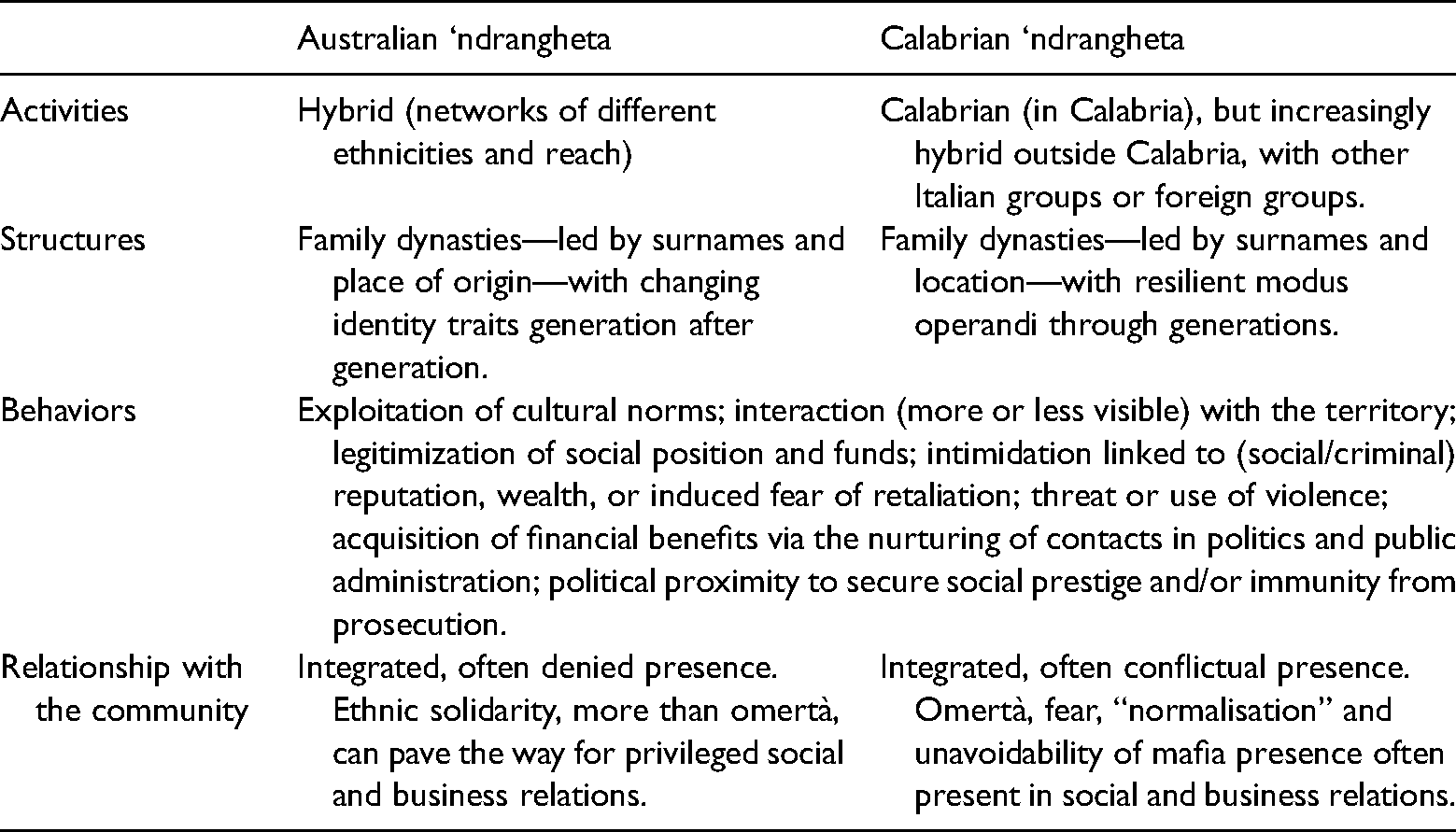
In Australia, the ‘ndrangheta’s resilience has been explained by practitioners and throughout my research as the result of the successful exploitation of the mafia method and in particular of the ‘ndrangheta’s set of behaviors by individuals and clans of Calabrian background, notwithstanding their hybridization. These behaviors necessarily are to be compared within manifestations of the ‘ndrangheta in Calabria. The Calabrian ‘ndrangheta—even with the wealth of knowledge accumulated in the past years—cannot be assumed to be a homogeneous phenomenon even in Italy. Whoever argues for the “unity” of the ‘ndrangheta as a criminal organization has done so to signify that, in legal terms, the recurrent application of mafia behaviors in certain areas (of Calabria or Italy) is paired with the existence of coordination structures in the same territories. There are some essential behaviors, which we can indicate as ‘ndranghetism that can be considered as recurring in this case (Sergi & Lavorgna, 2016). ‘Ndranghetism, also in Australia, include: family-driven criminal units (‘ndrina) with leadership via surnames; exploitation of cultural norms (e.g., omertà, endogamy, etc.); keeping of a low-key, apparently humble, profile; the importance of family ties and blood in recruitment and alliances; interaction—via economic control or through social consensus—with the territory; attempts to demonstrate a “legitimate” face; intimidation linked to (social/criminal) reputation, wealth or induced fear of retaliation; threat or use of violence; acquisition of financial benefits via the nurturing of contacts in politics and public administration; political proximity to secure social prestige and/or immunity from prosecution. These last elements related to political proximity, especially typical of the ‘ndrangheta in Calabria, are also essential to explain why the Australian ‘ndrangheta exists as an organization that transcends the ethnicity of the affiliates and their place, or their family's place of origin. There are in fact examples of such ‘ndrangheta-led political proximity throughout Australian history. The ‘ndrangheta, overall, must be understood as a set of behaviors, mafia behaviors, imbued in Calabrian culture, as a hybrid phenomenon in contemporary Italy and even more in contemporary Australia, which they exploit in different ways. ‘Ndrangheta families are often criminal dynasties (Sergi, 2020a) and as such they are perceived in their territory as unavoidable, both as social and as business actors. These dynasties develop a set of business skills linked to family values that remains in the history, reputation, and evolution of the family. These skills, family values, and the twisting of cultural norms need to be contextualized locally in Australia; without the local narrative, the global one is bound to collapse on its own approximations. It is worth reiterating here how for cultural norms to be exploited, these cultural norms must be indeed well ingrained in the community. Obligations, expectations, and behavioral dispositions across families in Calabrian and Italian communities are inherited and maintained (albeit in an integrated or hybrid Australian way) as a peculiar way of being and doing (Marino, 2019c; Marino, 2020a). Ethnic solidarity is part of the identity of Calabrians and Italians in Australia as abroad (Harney, 2006) and, as already argued elsewhere (Sergi, 2021) can become a reason why certain individuals might feel obliged to—and be exploited into—support other “co-regionals/co-nationals” and become involved into complex webs of criminal or semicriminal activities. Table 1 summarizes some of the main differences between Australian and Calabrian ‘ndrangheta, not in a prescriptive way, but as a means to visualize what said so far.
A quick comparison between Australian and Calabrian ‘ndrangheta.
Final considerations
Italian or Southern Italian or Calabrian migrant cultures are bound to evolve across generations and interact with Australian customs, norms and identities in more or less integrated systems of power, as characteristic of any migrant community (Ricatti, 2018). Scholars have researched the strong preservation of Calabrian cultural traditions through intergenerational transmission in Australia (Marino, 2020a, 2020b; Marino & Chiro, 2014; Papalia, 2008), mindful of the crystallization—even fossilization (Hortal et al., 2020)—of practices observed in migrant communities across generational changes (Logemann, 2013). Ethnographic studies on Italian identity across generations in Australia have demonstrated that the amount of cultural capital accumulated, dynamics of assimilation and the exogenous pressures from the “common sense” of the dominant society have impacted the way different generations feel towards their origins (Marino, 2019b). These intergenerational changes do not diminish attempts to preserve the culture of origin: first-generation Calabrians were attached to their Calabrian roots; the new generations are experiencing a revival of them, by choice, actively looking for these roots. This is not only the case in Australia, but also in Canada, where studies have confirmed how regional identities among Italians do shape new forms of Italianness among new generations (Harney, 2006).
In Australia, Calabrian communities appear tight and more committed than other regional Italian communities to the preservation of their identity. As said, this is indeed also the result of a history of discrimination that has affected Southern Europeans, thus Southern Italians too, since their arrival in Australia. For example, the rise of the so-called “wog-pride 1 ” among youth of Calabrian families (at fourth generations) in Griffith or Melbourne, reflects the ethnic revival among younger generations of Italian–Australian: the resistance to Anglo-Saxon domination/discrimination on one side, and the attempt to reclaim migrant culture as part of communities’ identities, on the other side.
Even more so, we could look at the ways in which newer generations of Australian-born of Calabrian origins perceived their Calabrian background in Australia because this might have a direct impact on the reasons why ‘ndrangheta behaviors are not only inherited by family blood (as it’s the case in Calabria/Italy) by might also be chosen—to a certain extent—by younger generations. Indeed, if it is true that idolization, romanticization, and ethnical revival of Calabrian roots is not uncommon among younger generations (Marino, 2019c), then these are all strong elements to explain why among these Calabrian roots also ‘ndrangheta roots persist.
A siege mentality among Calabrians and Southern Italians is not uncommon and it fosters ethnic solidarity as quintessential characteristics of belonging to the community. A resistance to change is connected not only with the ways in which older and younger generations perceive their heritage, but also the ability of younger ones to choose their own identity (as Calabrian-descent, Italian-descent, third-generation Italian or Australian-Italian and so on). However, this mentality—and the ethnic solidarity that it invokes—also provides a roof to protect criminal values and those who uphold them and reinforce the stigma and the perception around a global criminal reach and economy.
We must question the significance that the preservation of Calabrian cultural values means for affiliates and clans of mafia-type structures more or less modeled on the methods, structures and behaviors of the ‘ndrangheta. Indeed, that every ‘ndrangheta family is a Calabrian family is always true and obvious, given that the ‘ndrangheta is constructed within the boundaries of the territory of Calabria, so it cannot be any other way. But the opposite is not true of course: not every Calabrian family is or can a ‘ndrangheta family. However commonplace this statement might sound, it is fundamental to remember it firmly. This is, in fact, relevant because investigations on the ‘ndrangheta abroad dangerously tend to become a matter of “chasing” Calabrian surnames and Calabrian connections in the absence of more convincing elements that characterize the phenomenon beyond ethnicity. Furthermore, it is crucial to remember that Calabrian culture is not a static and homogenous thing, thus learning how to separate ‘ndrangheta culture from its “host” culture, whatever that might be, is paramount. The focus needs to remain on the behaviors that characterize the ‘ndrangheta rather than its territory, origin, or ethnic connotations, especially when abroad.
This challenges the notions of global (and organized) conspiracies dominating illicit trades, but also can help us understand the nature of the mafia phenomenon in the local settings of Australia. Indeed, ethnic ties, shared language and roots, can play a role in several transnational criminal activities, including drug trafficking, but the way in which this happens is opportunistic and not prescriptive: if Calabrian offenders connect from Australia to Italy for purposes of drug trafficking, their ethnicity is a facilitator but is not the determinant factor for the activity to be successful.
Mafias are different from other forms of organized crime because they do twist culture of origins; the ‘ndrangheta exists in a shared space between Calabrian cultural values and mafia values (Sergi, 2018b). This shared space facilitates criminal activities but does not of course determine any of it. In Australia, in fact, this shared space makes ‘ndrangheta affiliates able to exploit privileged pathways to power within the Italian/Calabrian community. For example, being related to someone, and knowing the set of obligations and expectations that family ties bring within Calabrian communities, can, for example, create a space for abuse of power, criminal support, and political proximity. Power relationships and structures within and around a migrant community in the recipient country, and how these affect criminal phenomena, should not be underestimated and should be further investigated.
Focusing on the power of the ‘ndrangheta as a unique bloc that homogeneously replicates its thirst for illicit capitals around the world, remains an easily exploitable item for populist propaganda looking at the presumed, and yet wrong, causality linking migration and crime. Nevertheless, observing financial and social processes in Australia and seeing them in action, in the places and among the migrant communities that live them, has confirmed to me how not only mafias are indeed behavioral models of criminal power that exploit ethnicity and cultures but are not defined by it. Also, it has become clear, by situating research into the field, even if for a short time and accidentally, that any claim of organized crime and illicit global reach that rest solely on numbers and on generalizations of particular cases, is a label rather than a claim. My methodological and conceptual hiccups during research essentially give a lesson in preparedness to enter fieldwork as much they are themselves lessons of criminological ethnography. Firstly, I had underestimated what it means to conduct itinerant qualitative interviewing. If a project has an aspect of itinerant research, it should consider reflecting also on ethnographic practices because the changes of spaces, locations and communities might prompt the researcher to make choices of data inclusion and exclusion beyond the strict interview or document data. Additionally, when it comes to criminological research whose topics are naturally embedded in different disciplines and different settings it is necessary for the researcher to embrace the principles of comparative research. This includes not only allowing descriptive comparisons of places and history to form the background of the research, but also cultural embeddedness of the researcher into the place of destination (Nelken, 2009). Indeed, the mobility of mafias is a topic embedded in migration studies in different host countries that suffer from a number of “labels,” primarily that of ethnicity; other controversial criminological inquiries along the same lines, like one on gender in organized crime activities or one of (in)security and organized crime, could benefit from both an itinerant and a comparative approach through ethnographic preparedness.
Indeed, and within the lessons learned from my methodological and conceptual hiccups, these were the lessons learned from an involuntary short ethnography into the topic of mafia mobility in Australia: (a) deconstruct social labels and go beyond them in local contexts; (b) distrust labels that “migrate”; (c) assess the local factors that facilitate the crystallization of subcultural (criminal) values; (d) question the difference between ethnicity, culture and nationality; and (e) prepare to critically approach a community with open eyes and without premade social constructions. Should I, or any other scholar, decide to go back into the field with a proper project to further engage with these problems and questions, these could and should be the starting points.
T.S. Eliot in the last poem of the Four Quartets, Little Giddins, writes: We shall not cease from exploration and the end of all our exploring will be to arrive where we began and to know the place for the first time.
Eventually, my Australian stumbling around places and cultures helped me to shape not only my knowledge of the place of destination, Australia, but also of the place of origin, Calabria.
Footnotes
Declaration of conflicting interests
The author declared no potential conflicts of interest with respect to the research, authorship, and/or publication of this article.
Funding
The author disclosed receipt of the following financial support for the research, authorship, and/or publication of this article: This work was supported by the British Academy (grant number SG162187).
Ethical Approval
This project received ethical approval for qualitative interviewing.
