




Abstract
In 2019, the New Zealand government established a Royal Commission of Inquiry into Abuse in Care to investigate the abuse and neglect of children, young people and vulnerable adults in Aotearoa/New Zealand between 1950 and 1999. The public hearings, witness statements and interim reports have charted horrific violence by state and faith-based workers including torture, sexual assaults, serious physical violence, and layers of neglect and discrimination. Māori have been especially targeted as victims of abuse and harms. This article considers the multiple layers of ignorance-making from state representatives. It shows how state agencies have navigated Commission hearings through 10 strategies that demonstrate some acknowledgement of their offending and trauma-making while simultaneously minimising their responsibility and resecuring their institutional legitimacy as protectors of the vulnerable and saviours of Te Tiriti (the Treaty of Waitangi), ethics and integrity. This careful performance stands at odds with the ongoing layers of violence and harms in state care.
Keywords
Introduction
Emerging after many years of challenge and campaigning by survivors, families, advocates, and supporters, the Royal Commission into Abuse in Care is the largest ever Commission in Aotearoa New Zealand's history. Launched in 2018, it is focused on violence and harms against children, young people and vulnerable adults in state- and faith-based care between 1950 and 1999. Releasing its final report in 2024, the Commission has already exposed devastating levels of violence, neglect and abuse through welfare, health, education, care and justice systems. In doing so, the Commission looks to reshape public understanding and counter organised ignorance-making about state- and church-led violence. It hopes to transform how care will be undertaken in the future.
At the core of any future changes will be the state agencies and related bodies that establish laws, policies, practices, monitoring, oversight or accountability mechanisms. A significant consideration for any transformation relates therefore to how these institutions narrate their involvement in abuse and how they position themselves as actors who can be trusted to provide care in the future. With that in mind, this article explores how official bodies present themselves to manage their reputational risks. Drawing upon a critical analysis of hearing transcripts and submissions to the Commission, it shows how state agencies have navigated this major Inquiry through 10 ignorance-making strategies. They demonstrate some acknowledgement of their offending and trauma-making while also minimising responsibility and resecuring institutional legitimacy as protectors of the vulnerable and as the solution to violence in care settings. It is a careful performance that re-establishes ignorance about past state-led abuse, and that stands at odds with ongoing harms.
Countering ignorance through inquiries or commissions
Organised ignorance-making (or “agnosis”) relates to how or why we don’t know (Proctor & Schiebinger, 2008). Ignorance is not just an individual pursuit. Rather, “not knowing” reflects power and politics – it is a “human-made product” that is institutionally amplified and crafted through economic, socio-cultural and political frameworks (Croissant, 2014; Pinto, 2015, p. 295; Proctor, 2008). In this, knowledge is not just absent but it is denied, neutralised, ignored, mobilised, minimised, suppressed or obstructed (Barton et al., 2018; Cohen, 2001; McGoey, 2019, 2020; Proctor, 2008; Proctor & Schiebinger, 2008; Slater, 2012; Stanley & Mihaere, 2018).
Such ignorance-making is not a modern strategy. Neutralisations, silencing, and denials have long been a feature of offenders’ attempts to minimise responsibilities (Cohen, 2001; Mathiesen, 2004; Sykes & Matza, 1957). These strategies have formed a central part of state-making. Colonisers, for example, have been propped up by ignorance-making – from the myths of land as terra nullius (Jackson, 2020) to the vigorous forgettings of Indigenous or minority cultures, humanity and ways of being (Santos, 2012). Generally, modern states provide a dizzying array of ways to propel ignorance across official and public life. Ignorance is created through attempts to deceive or mislead (writ large in “post-truth” politics), the exploitation of public fears and anxieties (such as around crime), government withdrawals of publicly available information, or state institutional support of research that only meets self-determined agendas (Barton et al., 2018). Each of these approaches, alongside others, serve to uphold knowledge according to certain political, economic or institutional interests. Some knowledge is silenced, omitted, made invisible or “spun” (Mathiesen, 2004). There is a “rational calculation” about what will be promoted and what will be ignored to buffer states from critique or alternative versions of the world (Slater, 2012, p. 960).
Commissions and inquiries promise an undoing of ignorance-making. They serve as an important break to institutional failings and harms. In moments of crisis, they are typically established to find the “truth” about a particular event or ongoing practices and processes (Scraton, 2004). Generally taking an investigative function, they challenge official cover-ups or provide a different recognition of harms and victimisation. In doing so, these bodies can educate the public, reshape our understanding, and propel recommendations for legal, policy and practice changes (Gilligan, 2004, 2019; Scraton, 2004).
These bodies are often seen as impartial or apolitical (Ashforth, 1990) but they are not unproblematic, especially as they may be used to re-establish state legitimacy after complaints, quelling crisis and managing reputational risks (Scraton, 2004; Stanley, 2005). They may even be stymied from the offset, as officials guide their terms of reference or manipulate processes to create a more favourable scope or trajectory of investigations (Scraton, 2004). Inquiries and commissions can also struggle to counter state deceptions, secrecy or misrepresentations and, as a result, take us further away from accountability (Scraton, 2004). Still, these bodies remain powerful, not least as they can be highly damaging to state agencies, among others, and demand significant changes in governments and industries.
Against this backdrop, this article reflects on the responses from state agencies to the Royal Commission into Abuse in Care. It explores how official agencies have managed the Commission, answering questions such as: What have been the stories they’ve told about the abuse, about victims, and about themselves? How do they manage the public scrutiny and the reputational risks to their institutions? And, how do they present themselves as being crucial actors to any future changes? To explore these questions, the research team collated and analysed publicly available information in which Crown and monitoring agencies engaged with the Commission.
1
These engagements revolved around three specific hearings:
Redress Hearings – October 2020. These heard evidence on the civil claims made against Crown agencies/departments (or third parties) about abuse. Lake Alice Child and Adolescent Unit Hearings – June 2021. These focused on one hospital setting that was the site of egregious violence including torture of children. State Institutional Response Hearings – August 2022. These considered how Crown agencies failed to prevent and respond to abuse.
The team collated, coded and analysed all the public documents from these hearings – this constituted 70 documents, or 3,862 typed pages (largely Briefs of Evidence, Reply Briefs, and Transcripts of Hearing Proceedings). They involved most of Aotearoa New Zealand's state departments and monitoring agencies, including Crown Law, Ministry of Justice, New Zealand Police, Department of Corrections, Ministry of Social Development, Ministry of Education, Ministry of Health, Oranga Tamariki (Ministry of Children), among others.
2
The researchers progressed a manual analysis of the data. Reflecting Braun and Clarke's (2006, 2022) guides to thematic analysis as well as Petintseva's (2022) explorations of critical discourse analysis, we approached the documents in a stepped way. First, a consideration of existing analyses on ignorance-making, as well as truth-telling through commissions of inquiry. Second, a process of deep familiarisation with the primary data – including watching all the Commission hearings (in-person or online) followed by initial readings of transcripts and associated documents. Third, coding the data (using colour codes), and fourth, generating themes from that coded data. This practice was guided by our prior research as well as an inductive approach, as we looked for patterns and meanings in content. We continually reviewed themes and maintained a separate document to mark out emerging topics across the dataset. This ensured consistent scrutiny in coding and increased reliability. It allowed us to reflect on the particularities of agencies’ engagements (such as around the acceptance of systemic forms of abuse) but, over time, it drew attention to the intense similarities in communications. And, fifth, there was a final revision and naming of the themes, undertaken by the primary author. This last process included a closing analysis of the whole dataset to ensure reliability. All documents coded in this article are listed in the Appendix.
Within this practical process, we were attuned to our guiding critical analysis. We reflected on how state workers narrated their agency's practices, including how professionals used language to minimise reputational risk, how they sought to manage their victims, as well as neutralise or cover over institutional abuse. We considered how institutional discourses reflected intersecting structural relations of power (Fairclough, 1992) such that they re-affirmed the “positional superiority” of Western bureaucracies (Smith, 2021, p. 68). Even in the seemingly benign activity of appearing before a Commission, professionals reinscribed the institutional and political order, prioritised certain “truths” and re-affirmed dominant power (Scraton, 2020). They re-legitimised the broader neoliberal, settler, racist, gendered and ableist context in which offending bureaucracies operate.
Covering reputational ruptures: 10 ignorance-making strategies
This research shows that, even in this moment of crisis and reputational rupture, state agencies have again engaged in organised ignorance-making. While providing some acknowledgement of state violence and abuse, they have neutralised complaints and reclaimed legitimacy. Ten strategies were persistently repeated across the institutional responses. These are: claiming lack of knowledge; narrowly acknowledging survivors’ identities and needs; blaming others; arguing they are constrained by bureaucratic or legal settings; presenting systemic violence as individual failings; confining abuse to the past; asserting new norms of partnership; emphasising reforms; declaring decolonising futures; and proclaiming they hold the transformative solutions. Despite the differences between the state agencies (not least within their histories, cultures and raison d’être), their strategies before the Commission were remarkably consistent, with few nuanced exceptions.
We just didn’t know – We didn’t have the data or evidence
First, is the organisational defence of not knowing. There are times when knowledge about events is innocently unavailable, but at other points, it is intentionally omitted or suppressed from the public eye (Barton & Davis, 2018; McGoey, 2012). State workers appearing at Hearings were keen to appear as cooperative and credible, but they were quick to point out that their evidence would be limited by their “not knowing” and by partial information. Disclaimers minimised expectations: “I have relied on information provided to me”, “I would like to acknowledge some limitations to my evidence” or “I just don’t have the detailed view of the history” (see MoE, 2022a, p. 5, 3.3; OT, 2020, p. 681; MSD, 2022a, p. 1, 1.6; ERO, 2022, p. 2, 3.3).
However, the main fallback lay with woeful records or data. State agencies had a duty to record all kinds of things such as punishments, the use of security, disturbances or complaints. Yet, there was an extraordinary catalogue of inept administration around such institutional activities. Workers explained:
The data was meant to be collected but individual institutions failed to do so (MoE, 2022c, p. 107). The data was collected but held in individual case files, and agencies did not have the time or resources for manual review (OT, 2022a, p. 136, 18.27–18.35; MoH, 2022a, p. 244–245). The data was collected but it is unreliable (OT, 2022a, p. 139, 18.52). The data was collected but institutions withheld it from Head Office (MoE, 2022c, p. 118–119). The data was collected but there's been a restructure so current staff know nothing (MoH, 2022b, p. 2, 1.6). The data was collected but we have lost or destroyed it (see, e.g., OT, 2022b, p. 7, 43; MSD, 2020a, p. 294). We don’t know if we collected the data or not, but we know we can’t find anything (MoE, 2022b, p. 388; MSD, 2022a, p. 11, 7.5; also see MoE, 2022c, p. 67).
It is difficult to disentangle events between the knowing or wilful destruction of records and the ill-considered losses. Time was an alibi – it was long ago, before they were around. Whether institutionally intended or not, this “not knowing” insulates (McGoey, 2019). Given the heavy reliance on documentation as evidence, any destruction or loss of reports or data operates as a cover for liability, to quell complaints and avoid blame.
Part of the remit of not knowing relates to the poverty of some investigations. Consider, for example, the four Police investigations to uncover evidence of torture, electric shocks, rape, sexual assault, the misuse of medications, seclusions, and other terrors against children at Lake Alice's Child and Adolescent Unit through the late 1970s. The final investigation ended with sufficient evidence for criminal charges against three workers, albeit that none stood trial (Williams, 2023).
3
The United Nations Committee against Torture called out the systemic failings of the police investigations (Smale, January 7, 2020), on numerous grounds that included:
The loss of statements – police lost 15 of 39 files in one investigation (Smale, September 3, 2022). A failure to contact or interview complainants – in one investigation, police only spoke to one of 35 complainants (Smale, December 19, 2021). A decision to ignore allegations of rape and other sexual abuses (Smale, September 3, 2022). A failure to follow up on expert evidence that confirmed activities (such as the disciplinary use of electric shocks) had no medical merit (Smale, September 3, 2022). A determination that cases had “difficulties” as complainants had been “suffering from psychiatric illnesses” or “fall into both victim/offender categories” (NZP, 2021b, p. 758).
Overall, state agencies led a defence that state violence and harms were unknown because they (agencies) failed to properly collate or analyse data, keep secure records, or investigate complaints. Ignorance is built, then, by knowing what not to know (McGoey, 2020). The failings are officially contained in the ever-useful bureaucratic term “gaps in data” that covers over extensive harms.
But, the brave survivors!
In front of a Royal Commission, state agencies have a careful position to tread. They need to give some acknowledgement of why the Commission was formed. State workers focused on survivors – they acknowledged their “bravery” (MSD, 2022b, pp. 2–3, 3.2; MPP, 2022, p. 1, 1.3), their “courage in the face of adversity” and in their “daily lives” (PSC, 2022a, p. 2, 3.1; OT, 2022c, p. 572; MSD, 2020b, p. 487) and their “fortitude” in sharing “their often harrowing experiences” (W-MDP, 2022, p. 5, 2.4; DoC, 2022a, p. 2, 1.9).
Of course, survivors are brave and courageous, but there was little acknowledgement about why survivors ever needed to have life-long courage (not least because abusive staff and their agencies would not stop abuse, listen to them, or investigate complaints). Nor was there much acknowledgement of other survivor attributes – that some are angry, that some want retribution, that they want proper redress, or that they still live with trauma (Stanley, 2016). Those identities and demands, among others, are largely missing from the script in this casting of survivors as plucky, honourable Kiwis. The allocated roles instead reiterated dominant mythologies of a population that is perennially self-reliant, tough, and courageous (a narrative that is nationally re-energised at vital points, from celebrating the feats of Sir Edmund Hillary to commemorating the battle of Gallipoli, or representing the play on an “All Blacks” pitch) (Belich et al., 2008). All in all, it is a narrowed identification that takes attention away from survivors’ continuing distress or anger and their demands for accountability, redress and preventative change. It neutralises the implications of state violence.
Don’t blame us, blame them
A third element of ignorance-building is to evade responsibility. Under a Royal Commission, this requires careful navigation – institutions need to accept some blame (or they could risk further criticism) but they also need to avoid unnecessary reputational damage. Different arguments came to the fore in the hearings. Neutralising language was common: the systemic failures of employing a carer with 24 allegations of abuse could be cast as “we didn’t do our best work at that time” (MSD, 2022c, p. 43). Another approach was to say “hold on, we did some good things”. Yes, we’re appearing in the largest commission in New Zealand's history on account of abusive activities, but “it is also important to acknowledge those for whom their experience of state care afforded them the love and support that all children deserve” (OT, 2022c, p. 576). It's a defence of “we are found to be torturers, sex offenders and systemic harmers but we also do good works”.
A further element focused on institutional lack of funding and resources. Oversight and monitoring bodies, in particular, argued that they had “never been adequately funded” to carry out investigations or oversight in line with their “legal mandate” (OCC, 2022a, p. 3, 7(a); OCC, 2022b, p. 4, 12). They did not “have powers to direct or enforce [agency] compliance or action” (ERO, 2022, p. 4, 4.14). They made recommendations that get ignored (OCC, 2022b, p. 4, 12). In short, monitoring bodies deflected blame by arguing they were under-powered, underfunded, and overwhelmed. And, in a circular bureaucracy, state agencies also asserted that they were committed to undertake investigations or implement recommendations, but they were also underfunded to do so. For example, faced with the question of whether police investigations for Lake Alice had been a failure, New Zealand Police agreed that there had been “unacceptable delays” that “meant that not all allegations were thoroughly investigated” (NZP, 2021a, p. 816), but this was a problem of “priority and resources” (NZP, 2021a, p. 824) and not of incompetence or discrimination (to those deemed not credible), or a failure to apply democratic policing principles to the most egregious complaints. It was just “an under-resourced investigation” (NZP, 2021b, p. 793). There was no mention from this officer of who had under-resourced it.
Another blame-shifting narrative was to direct attention to others who hindered positive attempts to implement recommendations and undermined their commitment. Workers criticised other agencies who “work in silos” or don’t take action (OT, 2022a, p. 125, 17.11). They reflected that “it's not us that's the problem, it's them”. Such deflection and distancing from responsibility was also directed to victims. Agencies complained that their attempts to provide justice were stymied by complainants who didn’t have the right evidence or credibility. For example, those coming forward with complaints about Lake Alice posed “evidential difficulties” (NZP, 2021b, p. 780, also see pp. 758–759). Their evidence didn’t match up to what could be found in official reports. New Zealand Police representatives reflected on how inconsistencies between medical records and victims’ accounts made police officers doubt credibility (NZP, 2021b, p. 761). Victims’ accounts were said to have “embellishment” but also “inconsistencies” as “a survivor … said that a certain thing happened … that is directly contradicted in the nursing notes or medical record … [This] does call into doubt or certainly caused me to doubt whether that allegation could be properly advanced” (NZP, 2021b, p. 776). For this argument, the institutional records are sustained as authority, as full and correct; there were no issues of credibility in staff statements (NZP, 2021b, p. 797).
Conversely, in 2006, New Zealand Police produced a document on the “Credibility of Complaints” which determined that a history of psychiatric treatment or “criminal history” undermined credibility for victims. But, of course, there was no consideration of why someone offended, or why someone had been treated. In hearings, the “why” was determined by police to be “not relevant frankly” (NZP, 2021b, p. 789) despite research that shows how abuse underpins trajectories of offending or that coercive psychiatric treatment is abuse (Stanley, 2016). From the police's perspective, credibility and whether investigations should progress are constructed on a perceived deficit victim identity, while simultaneously building an identity of perpetrators as credible and trustworthy.
Similarly, Crown Law started from a presumption that victims were lying or deluded in their claims. Shortly before one state abuse trial, a senior Crown Law lawyer had emailed a senior external counsellor to say that the first approach of Crown Law would “probably be that the witnesses are simply lying or could be while they might genuinely believe these events to happen, they are nonetheless false or exaggerated, highly exaggerated and extorted and looking to get expert evidence on that” (CL, 2020, p. 1151). In the understated words of the century from New Zealand's Solicitor-General, Una Jagose, “the Crown hasn’t been as survivor focused as it should have been” (CL, 2020, p. 1152). In short, the overwhelming focus of state agencies has been to reconfirm hierarchies of credibility and to provide limitations on their responsibility.
The law and bureaucracy made us do it
A fourth ignorance-building approach is to argue that abuse has occurred from the unfortunate way that bureaucracy or law is structured (as if the institutions are passive agents, with no agency over their settings and practices). One approach is to rely on law and legal process. 4 Of course, this naturalises state crimes, as the state sets laws that allow violence and harms to occur. Another option is to not offer easily accessible legal or complaints processes, or to make them so confusing that people do not engage. For example, Corrections “does not have a formal process or procedure to manage historical claims” (DoC, 2022a, p. 10, 10.6). A further approach – when people do complain – is to claim that information about abuse cannot be provided on the grounds of the privacy of those involved (TC, 2022, p. 8, 38–39). All these bureaucratic and sometimes seemingly progressive frames prevent compelling complaints from being raised or acted upon.
When state institutions are called into question, agencies often pursue an intense focus on the law and legalism – the law offers a challenge to states but it is also a place of protection. State agencies will have large legal teams. They are backed by Crown Law. And the legal process offers incredible elasticity, allowing state institutions to push victims back, wear them down, and in the end minimise complaints. In relation to the Lake Alice case, for example, the Crown was accused of hiding files and intentionally delaying processes. “[A] highly legalistic response … technical defences … [and] aggressive questioning” were regarded, by survivors taking claims, as “strategic or tactical decisions by the Crown” (CL, 2020, p. 1031). The Solicitor-General was questioned about the role of Crown Law in these “tactics”. She replied: Tactics is a word that perhaps I wouldn’t use. I would just say litigation steps. Both the Crown as defendant and … the survivors as plaintiffs, took steps in response to what the other one does, litigation kind of works like that, that you take, oh, there's a defence, have I got an answer to the defence? And the steps follow. (CL, 2020, p. 945)
Here, the state defence is that this was not an intentional delay; there was no obstruction. Rather, Crown Law have, with good intentions, bureaucratically followed neutral steps. They are just blighted by a legal process that is out of their hands. However, Crown Law and the Ministry of Social Development actively operated to shut down legal cases, including by:
Taking a focus on the Crown's exposure to financial and legal liability, and analysing claims “by reference to legal defences … with very little attention given to the underlying facts” (CL, 2021, p. 856). Withholding evidence from police investigations and claimants’ lawyers (See Smale, December 19, 2021; September 3, 2022; September 3, 2022; July 18, 2023). Destroying records relevant to legal cases, including staff files (Smale, June 16, 2023). Delaying disclosures about past convictions of offenders subject to new claims, until well into litigation (Smale, June 16, 2023). Using law students to review documents for police investigations … while arguing to the United Nations that it was doing everything possible to investigate claims (Smale, September 2, 2022). Commissioning private investigators to follow claimants for information to undermine their cases (Smale, June 16, 2023). Using technicalities (such as the Limitations Act and Accident Compensation Corporation legislation) as a defence.
5
I understand that they [survivors] will have low trust in state agencies and in the Courts and I understand that, in that context, litigation is extremely difficult and the processes can seem very harsh and cold. (CL, 2020, p. 935)
One survivor, Leonie McInroe, who spent over nine years trying to get her case heard, and whose lawyers had to take the Crown to court to access documents entitled to under discovery, summarised her interactions: “I found the Crown's behaviour appalling and indefensible. I eventually came to believe the Crown behaved in a way described best as trickery” (Smale, November 1, 2021) and “I was … faced with relentless, calculated, intentional abuse of power. For me it has been wholly inadequate, degrading, dehumanising and completely deficient of justice” (McRae, November 3, 2020). She received a two-paragraph letter of apology from Crown Law (McRae, November 3, 2020). Still, the Solicitor-General presented these activities as “litigation steps”. She went on:
For her, the litigation would be much easier if survivors purely developed trust in state agencies. All in all, the impetus is to secure the status quo of the bureaucratic frames in which survivors are blamed – “strategic efficiency” dominates and provides an organisational defence (McGoey, 2019).
Blame bad apples, not systemic failings
The fifth element to ignorance-making lies with the system. Over decades, there have been numerous reports to chart the institutionalised and systemic nature of abuse – that processes, policies and cultural working practices have fuelled violence and allowed harms to flourish (see Stanley, 2016). At the Royal Commission, some state workers noted how institutional racism, social ableism and bias contributed to the disproportionate abuse of Māori and Pacific people or people with disabilities (see OT, 2022a, p. 53, 4.39; MoH, 2022b, p. 4, 2.8; MoE, 2022a, p. 14, 6.1). No workers remarked on the sexism structured into care systems. Still, some recognised that there was “potential for the system not to work as well as it should” (TC, 2022, pp. 9, 43–44; also see OT, 2022b, pp. 5–6). After repeated questioning, Chappie Te Kani, then Acting Chief Executive of Oranga Tamariki, even moved from a comment that “over the scope period, there is a large number of instances of sexual abuse” to an agreement that “sexual abuse of children in state care in the scope period is a systemic problem” (OT, 2022d, p. 807).
Yet, most state workers were reticent to apportion abuse to systemic failures. A Lead Claims Advisor with the Historic Claims Team, for example, advised: “I don’t want to admit to stupidity, but I’m not entirely sure what is meant by “systemic” (MSD, 2020a, p. 445). For this worker, and others (including MoE, 2020, pp. 778–779; MoE, 2022b, p. 357, 370), it was not a case of the whole tree being rotten, but just the customary “bad apples”. Institutional violence and harms were largely portioned off to individual workers who “failed in their duty”, were “largely absent”, and didn’t respond with “compassion and respect”, or who just needed to upskill (ERO, 2022, p. 2, 2.2; OT, 2022b, p. 41, 183; W-MDP, 2022, p. 4, 2.3; MoE, 2022a, p. 24, 10.6). Institutional legitimacy remained intact under a veil of temporary or accidental occurrences (Scraton, 2004).
It's all in the past
Thus far, the official narrative goes: These are just individual workers. We didn’t have the data, knowledge, analysis. We’ve been trying our best with difficult people who lack credibility. And we just followed legal and bureaucratic processes. Any, yes, this did lead to some “steps”, but it is now all in the past.
The Commission's remit on the second half of the 20th century (1950–1999) provided plenty of latitude for agencies to regroup under the distance of time. For state institutions, the Commission was a time to acknowledge “the shadows of our past” (ERO, 2022, p. 2, 2.3). This is a “retelling of how some police actions were experienced in the past” (NZP, 2022, p. 1, 2.3). And, generally, these are “historic claims” (OT, 2022a, p. 82, 8.36) about “previous failings” (OT, 2022a, p. 120, 15.37) in “former facilities” (DoC, 2022a, p. 2, 1.10) that “no longer exist” (OT, 2022b, p. 45, 204). These practices in our history “would not be acceptable today” (MoH, 2022c, p. 13, 3.5). Things have “changed significantly” (OT, 2022b, p. 4, 27). Our institutions are evolving so “that the totally unacceptable circumstances of the abuse … is not able to happen in today's environment” (OT, 2022b, p. 35, 158). These “historic system issues[s]” are “no longer at play” (NZP, 2021b, p. 777).
We are partnering
Despite there being relatively limited acknowledgement of the layers of abuse or the long-term intergenerational harms that continue to unfold, state workers were at great pains to express attentiveness: “We have listened to the stories of survivors” (MoH, 2022b, p. 3, 2.3) and there will be reflection on the “lessons” (PSC, 2022a, p. 18, 13.2). Agencies will partner with survivors to influence institutional changes, “genuinely” contributing to shifts in practice (MSD, 2020a, p. 263; also see OT, 2022b, p. 68, 331).
The emphasis is on a vision of “true partnership”. State institutions will “embed the voices of children and young people into decision-making” (OT, 2022a, p. 128, 17.25). They will “co-design processes” (MPP, 2022, p. 3, 3.4) and “help transform the disability system” (W-MDP, 2022, p. 3, 1.18). They will “empower whānau, hapū and iwi” (OT, 2022b, p. 19, 96) and “ensure that the system is responsive to meet [the] needs” of Pacific communities (MPP, 2022, p. 3, 3.4). It is a benign intention of listening, partnering and co-developing good lives, and who could not get behind that?
We are reforming and strengthening
Despite agencies having “missed opportunities” to implement institutional changes from previous reviews (OT, 2022a, p. 81, 8.33), they also claimed that “Lessons have been learned and findings and recommendations from previous reports, reviews and inquiries into the care system have been accepted” (OT, 2022b, p. 4, 23) – although they do not confirm if accepted recommendations had been implemented or actioned.
Notwithstanding problems being “no longer at play” (NZP, 2021b, p. 777), reforms remain ongoing and necessary. The emphasis for the Public Service is “that we must own our mistakes, fix them and learn from them” (PSC, 2022a, p. 11, 10.7). For example, Oranga Tamariki (Ministry for Children) is now “focused on … transforming to a high-performing and trusted organisation and sector” (OT, 2022b, p. 8, 52c). State institutions have and are implementing new stocktakes and reviews to create “positive pathway[s] … for the future” (NZP, 2022, p. 2, 2.9). There are new programmes, the development of new understandings, changes in policies and practices (OT, 2022a, p. 83, 9.5; also see p. 44, 4.1; also see TC, 2022, pp. 10, 48–51), and “a range of initiatives to improve the quality of services” (NZP, 2022, p. 2, 2.4). There are (or will be): a “development of safeguarding frameworks” (W-MDP, 2022, pp. 11–12, 8.3) and reporting (TC, 2022, pp. 8–9, 42–44); “substantial changes in legislative and regulatory settings […and] a strengthening of systems and practices” (ERO, 2022, p. 6, 7.1–7.2); “increased transparency, and the sharing of insights [that] will influence change … [and] drive accountability” (ICM, 2022, p. 1, 2.3); “strengthened … quality assurance system[s]” and new “mechanisms for monitoring … practice” (OT, 2022a, p. 74, 7.23); guidelines and Action Plans to ensure people “feel valued, visible, acknowledged, respected, and enabled to live with dignity” (DoC, 2022a, p. 4, 5.5). Such reforms will “create a more equitable, accessible, cohesive and people-centred system” (MoH, 2022b, p. 7, 3.16).
The emphasis is on doing state interventions – including child removals, punishment practices or coercive mental health treatments – in a better way. The intrinsic risks and negative effects of these activities were not subject to deep consideration despite the evidence showing, for example, that incarcerating children is always damaging, detrimental and counterproductive (Stanley, 2016). In this, state responses reasserted favourable knowledge to further embed security and institutional norms (Canning, 2018; Proctor, 2008). The state systems failed but the call was for more state action.
We honour Te Tiriti
At the heart of this reformist commitment to bolster state legitimacy are narratives about incorporating Māori culture and processes (Stanley & Mihaere, 2018). There is an acceptance, at times, that colonisation, racism, ableism, and bias “has played a part” in layers of abuse (OT, 2022b, pp. 18–20, 91–100; MoE, 2022a, p. 24, 10.4), and that “the Public Service has not always had the focus … to understand Māori perspectives” (PSC, 2022a, p. 3, 3.5). Now, state institutions are “exploring possible options” to “be much more responsive to tikanga and the Treaty” (MSD, 2020c, pp. 195–196). It is an “ongoing evolution” (MoH, 2022b, p. 5, 3.1) and “a journey” (TC, 2022, p. 7, 34), but they accept they have “an obligation” (OT, 2022a, p. 38, 3.1) and are now “committed to upholding and honouring Te Tiriti o Waitangi” [the Treaty] (MoE, 2022a, p. 7, 5.1). Some mention decolonisation.
The commitment to Māori and Te Tiriti can subsequently be found in visions, principles, core values, objectives, call to actions, practice frameworks and organisational pillars (see, e.g., NZP, 2022, pp. 3–6; MSD, 2020c, p. 195). There are new offices, roles, working groups, strategies, action plans, programmes, research processes, policies, and tools to “lift cultural competency” (PSC, 2022a, 9.2–9.8; also see OT, 2022b, pp. 18–20; DoC, 2022a, p. 3; DoC, 2022b, pp. 897–899; MSD, 2020c, p. 195). To deepen relationships, there has already been a steady renaming of the state institutions and programmes that disproportionately target Māori. All of the youth justice, and care and protection, residences now have te reo Māori names. Police and Corrections liberally use te reo for their activities. Alongside, there are commitments to a diverse workforce that “consider[s] … Te Ao Māori in … recruitment” and to recruiting more Māori to “increase partnership” (DoC, 2022a, pp. 6–7, 5.18–5.20; OT, 2022b, pp. 23–24, 115–117) and be “an antidote to bias and prejudice in organisations” (PSC, 2022a, pp. 2–3, 3.4). Oranga Tamariki even claims that it is entering a “dual role as an enabler of communities and Māori” (OT, 2022a, p. 22, 1.71).
Along the way, there are little tells: narratives that show an agenda for institutional needs and success. The police, for example, note they use Iwi Liaison Officers to, among other things, “provide for a more diverse workforce” and “change Māori perceptions of police” (NZP, 2022, p. 4, 4.5). The problem of how officers have engaged in racist policing becomes redefined as “serious issues to address in relation to the way Māori and Pasifika have experienced policing in New Zealand” (NZP, 2022, p. 2, 2.10). A tweak, and the problem shifts onto their experiences rather than institutional discrimination. Elsewhere, for the Chief Executive of Corrections, “The Māori Pathways programme … supports the corrections system to be more effective” (DoC, 2022a, p. 6, 5.16). In all of this, there is a subtle reminder of colonial imaginaries of Māori as the issue, and how te ao Māori integrations will serve the needs and reproduce state settler systems.
We are the solution
To summarise, state institutions are deemed no longer violent, abusive or harmful, but positive community contributors. With their survivor and trauma-focus, they represent a transformative solution. Even Crown Law is “more sophisticated or perhaps more survivor-focused now in the litigation steps than we were” (CL, 2020, p. 951). Meanwhile, Corrections now adopts “a trauma-informed approach to the delivery of custodial services as well as an oranga [wellbeing] approach in its rehabilitative programmes” (DoC, 2022b, p. 899). Corrections are now active in the well-being business. Similarly, for Oranga Tamariki, experiences of trauma inform “everything we do, so that the circumstances which have previously led to so much hurt will never be repeated” (OT, 2022b, p. 2, 11). Their “evidence-based” shifts are “towards therapeutic care that is trauma-informed and reflects Te ao Māori principles” (OT, 2022a, p. 33, 2.16).
There is so much on offer from this better state future. Our institutions will give “a commitment to service, ethics, and integrity” (PSC, 2022a, p. 1, 1.4) and “promote … accountability and transparency” (PSC, 2022a, p. 10, 10.1). With a “higher purpose”, they will “protect and nurture” and do “everything … with humility” (PSC, 2022b, p. 1065). They will “affirm … identities, cultures and languages … [and] develop caring and inclusive cultures” (MoE, 2022a, p. 14, 6.4) that are “innovative … [and] move indigenously designed, developed, and delivered solutions” (TPK, 2022, p. 2, 10). In fact, for some institutions, like Oranga Tamariki, there is a preference that the State will no longer be involved in the lives of tamariki and rangatahi. However, this is tempered as “coercive intervention may be the only option to secure the safety of the child or children” and “this power should remain with Oranga Tamariki for the time being” (OT, 2022b, p. 9, 55). The fundamental power of state institutions is maintained.
Meanwhile…
Through the Commission, state agencies have sought to reduce reputational risk and re-secure legitimacy, bending to some acknowledgement of survivors’ stories while noting it's all in the past, we’ve learnt lessons, we’ve already changed, we’re continuing to change, we’re engaging Te Tiriti, we are the solution. Within this, there are, of course, some positive reformist developments. For example, some institutions have begun to develop practices to engage Māori whānau, hapū and iwi in useful ways. There has been further commentary of past and current failings around care practices, complaints, oversight, among many other areas, that have disproportionately harmed Māori.
Yet, states hold “both a great deal of power and inertia” (OCC, 2022c, p. 8, 33). And despite the corseting of uncomfortable truths through Royal Commission hearings, state institutions are defined by their very ability to engage violence and harmful behaviours. They are also highly accomplished in deflecting attention. For instance, amid all of this, it is difficult to see where the accountability lies for the most egregious tortures, violence and harms. Who will be held accountable? When and how will state agencies provide redress to the many thousands they have harmed? Crown Law continues to rely on legal technicalities, such as the Limitations Act, as a defence. And, the government continues to run a “fast track” payment scheme that could never be regarded as “best practice” – for low payments, it requires survivors to sign that they have received “full and final settlement” with the government not accepting liability for abuse. Alongside this, the government has established a new body, the “Crown Response Unit” (with a motto of “Listening, learning, changing”) to respond to Commission findings and recommendations. Its “strategic governance group” is chaired by a Chief Executive who, as the Royal Commission has reported, previously wrote “entirely unfounded” memos speculating that a lawyer for claimants was “behaving unethically” by influencing claimants’ memories and “deliberately targeting periods of time when records are poorest” (Royal Commission of Inquiry, 2021, p. 139).
As the Commission has operated, there have also been continuing harmful behaviours from state agencies. In the last couple of years alone, this has included:
Oranga Tamariki (2024) established that 9% of all children in care had “findings of harm” (reported as physical, sexual, emotional abuse or neglect) over a 12-month period. Following review of 2,000 complaints, the Chief Ombudsman reported that Oranga Tamariki were still not getting the basics rights, such as: listening to children when they complain, or consulting whānau about removals, or keeping adequate records, or presenting accurate and non-biased information to Court, or giving adequate remedies or apologies when things go wrong. The agency “needs to change on a scale rarely required of a government agency” (Ombudsman NZ, 2024, p. 3). The continuation of staff-organised “fight clubs” in youth residences (Checkpoint, 2023), as well as ongoing complaints of sexual misconduct and assaults by staff, and delayed agency responses to protect children (Cornish, 2020; McConnell, 2023a). Persistent reports of children not feeling safe in residences, leading several to begin a rooftop protest (Clark & Shao, 2023). The targeted recruitment of students, at rates just above the minimum wage, as residential youth workers in Korowai Manaaki Youth Justice Residence (Auckland) where children with the most complex needs will be placed (McConnell, 2023b). The recent transfer of Oranga Tamariki oversight from the Children's Commissioner to a new “Independent Children's Monitor” positioned within a government department (ie. it has lost its independence) (Young, 2022). A promised reintroduction of “boot camps” as part of a political “crackdown” on young offenders. Camps will be “military-style” but with a “trauma-informed care approach” (Children's Minister Karen Chhour, cited in 1News, 2024). Ombudsman reports that Corrections continues a “defensive”, “risk-averse and reactive culture” that lacks openness and accountability. The Department is noted to maintain “decrepit conditions” and has a “tendency to explain away the concerns and recommendations of oversight bodies” with changes occurring at “glacial pace” (Desmarais, 2023; RNZ, 2023a). An inspectorate report showed that 29% of those in prison had spent months and even over a year in conditions of solitary confinement (Almeida, 2023; Corlett, 2023), while men held in five largest prisons had not had in-person visits for over three years (Bhamidipati, 2023). The Chief Ombudsman reported on “troubling use of force incidents” at Christchurch Women's Prison. He noted the unjustified use of pepper spray and how some women were locked in showers rather than cells (RNZ, 2023b). Many reports on the use of painful restraints, traumatising spit hoods, and the inappropriate use of seclusion across many facilities (Ham & Ruru, 2022; RNZ, 2021, 2023b). Māori remain those disproportionately targeted for incarceration, including across youth justice institutions, mental health units, and prisons (Cornish, 2022; McConnell, 2022; Ministry of Justice, 2023; Te Uepū Hāpai i te Ora, 2019).
Harmful and abusive practices remain endemic to care, health, and justice institutions. Survivors do not rest easy. Tupua Urlich, an advocate from Voyce, summed it up recently: “They’re not learning from the mistakes … it's just a system that recycles – recycles trauma, recycles pain, poverty, and keep benefiting and profiting off it” (Smale, August 13, 2022).
Conclusion: Ignorance-making and impunity
States will often seek “closure” on events by denying them, presenting them as temporary aberrations or minimising truths to deflect criticism (Burton & Carlen, 1979; Gilligan, 2019). In this, inquiries and commissions can be a challenge to state bodies. They produce a different record and set an expectation for change – to reform laws, policies, and practices, or even dismantle existing structures (Stanley, 2005). Yet, commissions are also a means for state agencies to restore public confidence and reaffirm existing institutional and social structures (Gilligan, 2019). Without the right “bite”, they enable states to promote an image of legal, scientific, and administrative rationality and capability (Ashforth, 1990; Burton & Carlen, 1979). They can facilitate the management of information to deflect criticism and avoid liability (Scraton, 2004).
This research shows how state agencies have leaned-in to ignorance-making that is both past- and future-focused. They have constructed and organised narratives in complex and interactive ways to deflect criticism, re-secure impunity and ensure continuing legitimacy (despite ongoing violence and harms). Crucial to this has been the omission or suppression of unfavourable knowledge, seen through non-disclosures as well as the destruction of records, poor investigations, and claims that abuse was all in the past. Here, state agencies have not yet clearly articulated the full extent of their offending or fully acted upon opportunities for accountability. Instead, they have sought to minimise responsibility through euphemistic language and by presenting abuse as temporary or aberrational. Alongside, they have controlled identities by neutralising victims’ demands, obscuring individual culpability, and blaming others. They have minimised systemic problems and determined that people, not systems, lack credibility. In all of this, they have maximised favourable knowledges, reasserting the goodness and capability of the state. The solution is propelled as more bureaucratic reform and state enhancement for transformative (survivor-focused; trauma-led; Tiriti-engaged) futures. Yet, at the core, there remains a mythical narrative that this can be achieved through the same set of settler, patriarchal, neoliberal, ableist, and ageist institutions and practices that are violent, discriminatory, harmful and ineffective.
In campaigning for a Commission, survivors called for a body to bring redress, monetary compensation, accountability and to prevent future harms (Stanley, 2016). The final report and recommendations from the Commission are yet to emerge. However, through interactions with the Commission, state agencies have sought to reduce their blame, reaffirm their capabilities and authority, and promote themselves as solutions for future transformations. This clawback of legitimacy is a rational calculation, and one that is so effective that the current political impetus is once more towards an expansion of punitive remits and institutional powers.
Footnotes
Declaration of conflicting interests
The authors declared no potential conflicts of interest with respect to the research, authorship, and/or publication of this article.
Funding
The authors disclosed receipt of the following financial support for the research, authorship, and/or publication of this article: This work was supported by the Victoria University of Wellington Summer Research Scholarships.

Notes
Appendix: Document Codes.
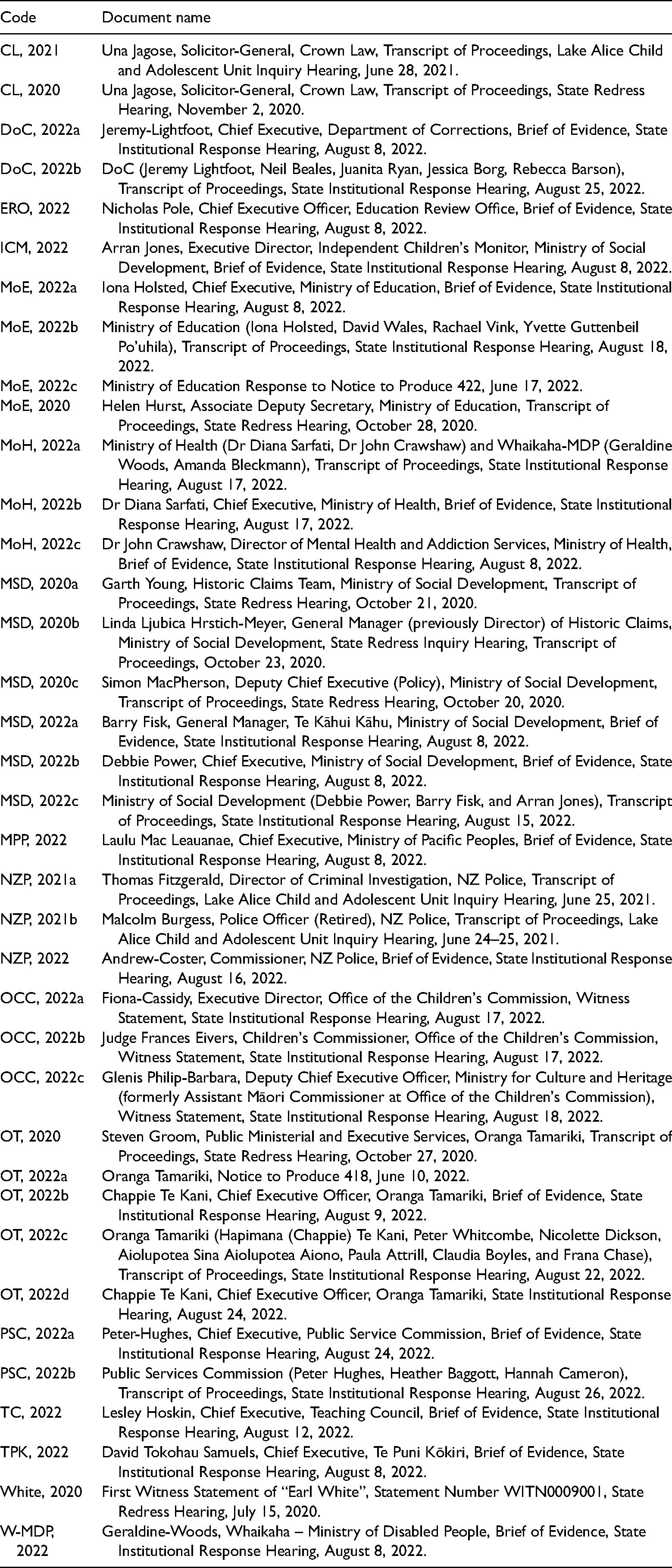
| Code | Document name |
|---|---|
| CL, 2021 | Una Jagose, Solicitor-General, Crown Law, Transcript of Proceedings, Lake Alice Child and Adolescent Unit Inquiry Hearing, June 28, 2021. |
| CL, 2020 | Una Jagose, Solicitor-General, Crown Law, Transcript of Proceedings, State Redress Hearing, November 2, 2020. |
| DoC, 2022a | Jeremy-Lightfoot, Chief Executive, Department of Corrections, Brief of Evidence, State Institutional Response Hearing, August 8, 2022. |
| DoC, 2022b | DoC (Jeremy Lightfoot, Neil Beales, Juanita Ryan, Jessica Borg, Rebecca Barson), Transcript of Proceedings, State Institutional Response Hearing, August 25, 2022. |
| ERO, 2022 | Nicholas Pole, Chief Executive Officer, Education Review Office, Brief of Evidence, State Institutional Response Hearing, August 8, 2022. |
| ICM, 2022 | Arran Jones, Executive Director, Independent Children's Monitor, Ministry of Social Development, Brief of Evidence, State Institutional Response Hearing, August 8, 2022. |
| MoE, 2022a | Iona Holsted, Chief Executive, Ministry of Education, Brief of Evidence, State Institutional Response Hearing, August 8, 2022. |
| MoE, 2022b | Ministry of Education (Iona Holsted, David Wales, Rachael Vink, Yvette Guttenbeil Po’uhila), Transcript of Proceedings, State Institutional Response Hearing, August 18, 2022. |
| MoE, 2022c | Ministry of Education Response to Notice to Produce 422, June 17, 2022. |
| MoE, 2020 | Helen Hurst, Associate Deputy Secretary, Ministry of Education, Transcript of Proceedings, State Redress Hearing, October 28, 2020. |
| MoH, 2022a | Ministry of Health (Dr Diana Sarfati, Dr John Crawshaw) and Whaikaha-MDP (Geraldine Woods, Amanda Bleckmann), Transcript of Proceedings, State Institutional Response Hearing, August 17, 2022. |
| MoH, 2022b | Dr Diana Sarfati, Chief Executive, Ministry of Health, Brief of Evidence, State Institutional Response Hearing, August 17, 2022. |
| MoH, 2022c | Dr John Crawshaw, Director of Mental Health and Addiction Services, Ministry of Health, Brief of Evidence, State Institutional Response Hearing, August 8, 2022. |
| MSD, 2020a | Garth Young, Historic Claims Team, Ministry of Social Development, Transcript of Proceedings, State Redress Hearing, October 21, 2020. |
| MSD, 2020b | Linda Ljubica Hrstich-Meyer, General Manager (previously Director) of Historic Claims, Ministry of Social Development, State Redress Inquiry Hearing, Transcript of Proceedings, October 23, 2020. |
| MSD, 2020c | Simon MacPherson, Deputy Chief Executive (Policy), Ministry of Social Development, Transcript of Proceedings, State Redress Hearing, October 20, 2020. |
| MSD, 2022a | Barry Fisk, General Manager, Te Kāhui Kāhu, Ministry of Social Development, Brief of Evidence, State Institutional Response Hearing, August 8, 2022. |
| MSD, 2022b | Debbie Power, Chief Executive, Ministry of Social Development, Brief of Evidence, State Institutional Response Hearing, August 8, 2022. |
| MSD, 2022c | Ministry of Social Development (Debbie Power, Barry Fisk, and Arran Jones), Transcript of Proceedings, State Institutional Response Hearing, August 15, 2022. |
| MPP, 2022 | Laulu Mac Leauanae, Chief Executive, Ministry of Pacific Peoples, Brief of Evidence, State Institutional Response Hearing, August 8, 2022. |
| NZP, 2021a | Thomas Fitzgerald, Director of Criminal Investigation, NZ Police, Transcript of Proceedings, Lake Alice Child and Adolescent Unit Inquiry Hearing, June 25, 2021. |
| NZP, 2021b | Malcolm Burgess, Police Officer (Retired), NZ Police, Transcript of Proceedings, Lake Alice Child and Adolescent Unit Inquiry Hearing, June 24–25, 2021. |
| NZP, 2022 | Andrew-Coster, Commissioner, NZ Police, Brief of Evidence, State Institutional Response Hearing, August 16, 2022. |
| OCC, 2022a | Fiona-Cassidy, Executive Director, Office of the Children's Commission, Witness Statement, State Institutional Response Hearing, August 17, 2022. |
| OCC, 2022b | Judge Frances Eivers, Children's Commissioner, Office of the Children's Commission, Witness Statement, State Institutional Response Hearing, August 17, 2022. |
| OCC, 2022c | Glenis Philip-Barbara, Deputy Chief Executive Officer, Ministry for Culture and Heritage (formerly Assistant Māori Commissioner at Office of the Children's Commission), Witness Statement, State Institutional Response Hearing, August 18, 2022. |
| OT, 2020 | Steven Groom, Public Ministerial and Executive Services, Oranga Tamariki, Transcript of Proceedings, State Redress Hearing, October 27, 2020. |
| OT, 2022a | Oranga Tamariki, Notice to Produce 418, June 10, 2022. |
| OT, 2022b | Chappie Te Kani, Chief Executive Officer, Oranga Tamariki, Brief of Evidence, State Institutional Response Hearing, August 9, 2022. |
| OT, 2022c | Oranga Tamariki (Hapimana (Chappie) Te Kani, Peter Whitcombe, Nicolette Dickson, Aiolupotea Sina Aiolupotea Aiono, Paula Attrill, Claudia Boyles, and Frana Chase), Transcript of Proceedings, State Institutional Response Hearing, August 22, 2022. |
| OT, 2022d | Chappie Te Kani, Chief Executive Officer, Oranga Tamariki, State Institutional Response Hearing, August 24, 2022. |
| PSC, 2022a | Peter-Hughes, Chief Executive, Public Service Commission, Brief of Evidence, State Institutional Response Hearing, August 24, 2022. |
| PSC, 2022b | Public Services Commission (Peter Hughes, Heather Baggott, Hannah Cameron), Transcript of Proceedings, State Institutional Response Hearing, August 26, 2022. |
| TC, 2022 | Lesley Hoskin, Chief Executive, Teaching Council, Brief of Evidence, State Institutional Response Hearing, August 12, 2022. |
| TPK, 2022 | David Tokohau Samuels, Chief Executive, Te Puni Kōkiri, Brief of Evidence, State Institutional Response Hearing, August 8, 2022. |
| White, 2020 | First Witness Statement of “Earl White”, Statement Number WITN0009001, State Redress Hearing, July 15, 2020. |
| W-MDP, 2022 | Geraldine-Woods, Whaikaha – Ministry of Disabled People, Brief of Evidence, State Institutional Response Hearing, August 8, 2022. |