




Abstract
The Parole Board (PB) for England and Wales is responsible for deciding whether prisoners are safe to be released into the community. Although the PB was using remote formats (teleconferencing and videoconferencing) to conduct hearings prior to 2020, the coronavirus (COVID-19) pandemic accelerated the wider application of remote hearings. Such changes in modality can have a significant impact on interactional practices, with participation in remote communication requiring a different set of skills from those normally involved in in-person interaction. We argue that this shift in modality is important because it risks impeding prisoners’ participation in hearings and may limit the legitimacy of a parole hearing decision when examined through the lens of procedural justice theory. In this article, we draw on a dataset of 30 recordings of in-person and remote oral hearings. We analyse sections in which prisoners are questioned by PB panel members to identify whether these interactions can be deemed to be as successful in remotely held hearings as compared with in-person hearings. To assess this, we compare instances of communication problems that occur in the datasets. Applying conversation analysis, we find that instances of repair work from participants are statistically more likely to be present in remote hearings when compared to in-person settings. Our analysis has implications for the operating model being used by the PB and knowledge around participation in remotely held justice contexts.
Introduction
The coronavirus (COVID-19) pandemic resulted in a swift move towards remote working (Espitia et al., 2022), with all Parole Board (PB) oral hearings in England and Wales running remotely, either via telephone link or video link (for discussions of the effects of COVID-19 on other areas of the justice system, see Kunkel & Bryant, 2022; McKay, 2022; McKay & Macintosh, 2024). Previous analysis of interviews with PB members, employees of the PB who sit on hearing panels and consider the evidence provided by witnesses and the prisoner, has pointed to the potential for remotely held oral hearings to impede participation for prisoners, creating a greater power imbalance between panel members (PMs) and prisoners, limiting prisoners’ access to legal representation, and potentially creating further participation issues for prisoners (Peplow & Phillips, 2023a). In order to explore this further, this article focuses on the similarities and differences in the interactional structures found in in-person and remotely held parole hearings. We ask whether the two modes of hearing are broadly similar and whether any differences could have implications for the efficacy and ultimately, the perceptions of fairness of the oral hearing process by the prisoner. This article focuses on recordings of parole hearings as primary data to understand the benefits and problems with the shift to remote communication as default by studying the hearings directly, seeing the “visible work done by participants in interaction” (Clift, 2016, p. 1). This builds on ongoing research that draws on interviews with participants in parole hearings (e.g., Peplow & Phillips, 2023a), in the hope that we can triangulate perceptions of different modes of hearing with analysis of the hearings.
Literature review
Parole populism and the oral hearing
The primary role of the PB is to assess whether people serving extended determinate and indeterminate sentences in England and Wales are safe to be released from prison. Created in 1967, the PB was a symbol of the consensus in contemporaneous penal policymaking that the criminal justice system (CJS) should punish and rehabilitate (Padfield, 2019). Ideals of pragmatism such as reducing the costs of the CJS were important, but the primary consideration was grounded in the rehabilitative ideal (Guiney, 2018). The PB has since become a key part of the general move towards risk-based and actuarial criminal justice which manages, rather than rehabilitates, people in the system and is now considered an institution that is almost exclusively charged with assessing the risk posed by people who are eligible for parole (Guiney, 2018; Padfield, 2019).
The serious further offence rate for people released from prison following a parole decision is just 0.5% (Parole Board, 2022), and this is often used to defend the PB's work, albeit sometimes at the expense of “a more searching dialogue with regards to the administrative cost of maintaining these headline figures” (Guiney, 2019). Interviews with PB members suggest that the move towards remote hearings results in greater efficiencies for both the organisation and its members (Peplow & Phillips, 2023a). The Board's desire to conduct around 97% of hearings remotely or in hybrid form in the coming years can therefore be understood as a continuation of this trend towards a more managerial modus operandi.
The oral hearing plays an important role in allowing prisoners to persuade PB members that they are safe to release (Guiney, 2019). They also play an important role in terms of legitimacy with “good” oral hearings giving “practical expression to the ‘respect due to persons whose rights are significantly affected by decisions taken in the exercise of administrative or judicial functions’” (Murray, 2014, p. 6) by allowing prisoners to influence and understand any decision made about them. The prisoner's role in hearings has been described as “pivotal” and “good realistic legal representation” is considered important, although they have also been described as “very difficult” and nerve-wracking (Padfield et al., 2000, p. xi).
Procedural justice theory links perceptions of fairness with responses to authority (Tyler & Lind, 2002), suggesting that people are more likely to accept and comply with decisions when they believe that these decisions are fair (Fitzalan-Howard et al., 2023). Perceptions around procedural justice have been found to influence risk of reoffending post-release (Liu et al., 2020), shape engagement in prison regimes (Bickers et al., 2019), and help prisoners to feel future-oriented (Fitzalan-Howard et al., 2023). Ensuring that prisoners feel able to participate in oral hearings should be a critical consideration, and procedural justice theory provides a useful lens through which to explore this.
Procedural justice theory comprises four key components: voice, respect, neutrality, and trustworthy motives (Fitzalan-Howard et al., 2023). “Voice” is about giving people in less powerful positions the belief that they have been able to take part in the decision-making process by being able to present arguments, be listened to, and have their views considered by those in power. Voice requires people to feel heard and understood which involves others “listening at a deeper emotional level, and … hearing the meaning behind the words” (Bickers et al., 2019, p. 478). Voice is thus particularly important, with previous research finding that when prisoners can become “apathetic about parole” when they feel like they “do not have enough ‘say’” (Bilton & Bottomley, 2012, p. 15). Direct participation in parole hearings may allow prisoners to feel a sense of ownership of the process, by providing an opportunity to put their case across (Kelly et al., 2020). By contrast, if communication is impeded, then feelings of being understood are likely to be compromised. As such, procedural justice and voice, in particular, are important concepts through which to analyse parole because if prisoners are unable to have a voice then they are less likely to experience the decision made about them as legitimate.
Remote communication in the criminal justice system
Remote communication, for our purposes, can be defined as synchronous interaction in which participants are located in different physical spaces and so rely on a form of technology to communicate, such as video call or telephone. The use of communication technology in the CJS has increased in recent years. Remote communication technologies can speed up the process of justice and decision-making (de Vocht, 2022; Peplow & Phillips, 2023a) and probation staff have suggested that remote communication can enable a more responsive and flexible approach to supervision (Dominey et al., 2021).
On the flip side, remote communication requires a different set of skills from those normally involved in in-person interaction, mainly because remote communication modes present participants with a less rich visual and physical context than in-person interaction (Licoppe, 2021). In remote communication, participants tend to have “excessive” access to others’ eye gaze but yet very limited access to others’ bodily gestures (Bailenson, 2021). Remote interactions can be “extremely fragile” and may be threatened by “various intrusions” (de Fornel, 1996, p. 53), such as technological and connectivity problems which can “quickly present problems” (Seuren et al., 2021, p. 64) such as unintentional interrupting or involuntary silences. These problems, which are woven into remote communication, are likely to be magnified in high-stakes contexts such as parole oral hearings as they risk impeding an effective defence, influencing decision-making, and affecting the legitimacy of a trial (de Vocht, 2022). Despite a general lack of evidence here, some research has substantiated these concerns. In a rapid evidence review, Byrom (2020) found that parties to remote hearings do not use procedural safeguards, that they impair a defendant's ability to communicate with their legal representatives, result in technical issues, can impact negatively on perceptions of party and witness credibility, and make it more difficult for the court to identify vulnerability and ensure participation. During a series of interviews with prisoners about their experiences of video links, McKay (2016, p. 22) found that remote communication can intrude on legal process, affect prisoners’ comprehension and participation and close off “opportunities for natural human interaction”. Prior to the pandemic, it was argued that the move towards greater use of technology was without a clear strategic rationale (McKeever, 2020). Moreover, research has found that while remote court hearings can work well for administrative hearings and where parties are well equipped to participate, they work less well in criminal hearings and with parties who present with vulnerabilities (Law Society, 2022). The Law Society (2022) suggests that relevant factors here include age, disability, Mental health problems, learning difficulties, English as a second language, experience of trauma, socio-economic background considerations, and caring responsibilities. Although this research did not shed light on why this may be the case, one might surmise that it is due to communication difficulties as well as peoples’ ability to use technology sufficiently well.
Gibbs has argued that remote parole hearings provide little benefit for participants; the main effect being diminished “personal contact between probation officers and their clients” (Gibbs, 2017, p. 14). Beyond our own research (Peplow & Phillips, 2023a, forthcoming), no other published research on remote parole hearings exists. However, studies have shown that in other CJS settings, there can be a reduction in levels of perceived legitimacy from participants in remotely held court proceedings (McKay, 2016; Rowden, 2018; see also Poulin, 2004). Remote hearings appear to make procedural justice more difficult to achieve because the spatial, corporeal, and visual demarcations noted by McKay (2016) potentially impede on interactions and prisoners’ ability to have a voice in the process. McKay (2016) also notes that prisoners “expressed a desire to be physically immersed in the courtroom for substantive procedures” and so taking this away from them may also shape the extent to which they can participate in a hearing. This raises important questions about whether these improved efficiencies are worth the potential cost to participation and legitimacy in the eyes of prisoners.
Conversation analysis and repair
Conversation analysis is an approach to the analysis of interaction that is used in this article. It considers how people “create, maintain, and negotiate ‘meaning’” through reference to the “rules” and structure of talk (Robinson, 2006, p. 138). As all talk between people unfolds in time, the role of sequence is central to these underlying rules. The most basic rule is that conversation is ordered in terms of adjacency pairs: units of turns at talk that are tied to each other (Sacks, 1995): for example, a request expects an acceptance or denial, and a question expects an answer. This ordering is particularly evident in “institutional” forms of interaction (Drew & Heritage, 1992), such as oral hearings whereby PMs pose questions and witnesses (including prisoners) are expected to provide answers. Talk is underpinned by a preference for “progressivity” (Stivers & Robinson, 2006), and participants in an interaction aim to satisfy the conditions of an initiating action by responding appropriately: for example, answers almost always follow questions (Stivers, 2010). This sequential ordering is central to the main project of talk, which is to achieve intersubjectivity: a sense of “conjoined reality” between people (Schegloff, 1992, p. 1296). If intersubjectivity is predicated on a “socially shared” understanding of how talk is conducted, then analysis of problems in talk (e.g., misunderstandings, errors, mishearings), is vital as these demonstrate how obstacles to intersubjectivity are managed. Conversation Analysts approach these acts of miscommunication in terms of “repair”.
Repair is relevant to the current study because we focus on episodes of talk in oral hearings where the progression of the interaction is impeded. Repair refers to “practices for dealing with problems or troubles in speaking, hearing, and understanding the talk in conversation” (Schegloff, 1997, p. 503). Where such problems occur in interactions the initiation of the repair and the outcome of the repair can be distinguished:
Initiation of repair = the noticing and locating of a problem in the talk Outcome of repair = the fixing, or attempt at fixing, this identified problem.
This distinction between initiation and outcome of repair is seen clearly in the following short extract of conversation. On line 4, speaker B initiates repair and on line 5, speaker A resolves the repair. The issue here is that speaker A has selected the incorrect word on line 1 (“sellin’”):
A further distinction is drawn between self and other forms of repair, where self-repair involves the speaker of the trouble-source resolving the problem and other-repair involves another participant undertaking the repair. There is a preference for speakers repairing their own errors (Schegloff, 1992). For example, in extract (1) the problem is ultimately resolved by the speaker of the trouble-source (l.5), making this an example of self-repair. However, this repair is initiated by a different speaker (l.4) and so this example is described as other-initiated-self-repair.
Other-initiated repair (OIR) usually occurs in the turn following the trouble-source (Schegloff, 1997, p. 503), “halting” the progressivity of the interaction (Robinson, 2006, p. 139). OIR begins a side sequence of talk that temporarily suspends the “main course of the interaction” (Dingemanse & Enfield, 2015). Svennevig (2008) describes the three problems addressed by OIR as hearing, understanding, and acceptability. Where we find OIR, intersubjectivity between speakers has started to slip, and OIR can provide a way in which “mutual understanding” can be recovered (Dingemanse & Enfield, 2015, p. 98). OIR can also serve as a precursor for the start of other activities, such as “complaining, accusing, ridiculing, admitting, apologizing, and forgiving, all of which threaten to delay a return to the ‘business at hand’” (Robinson, 2006, p. 141).
Study site
Thus far, we have suggested that oral hearings should adhere to the principles of procedural justice, yet evidence from elsewhere shows that interactions that take place remotely are more prone to communicational difficulties (e.g., Mlynar et al., 2018; Olbertz-Siitonen, 2015; Seuren et al., 2021), thus potentially jeopardising prisoners’ abilities to have a “voice” in oral hearings. To investigate this further, we consider three questions:
Are remotely held hearings more associated with communicational difficulties than in-person hearings? What is the nature of these communicational difficulties? To what extent may the mode of hearing impact upon the experiences of the participants when analysed through the lens of procedural justice?
This study was conducted in England and Wales where the PB is responsible for making decisions around conditional release from prison for prisoners serving indeterminate and certain determinate sentences (such as terrorist or serious child sexual offences), and those who have been recalled to prison for breach of licence conditions. The PB makes release decisions by initially examining a dossier that is compiled by His Majesty's Prison and Probation Service to determine whether the test for release is met, and whether fairness would require an oral hearing to be convened. If the prospect of a different outcome is identified, an oral hearing will be held. The oral hearing represents an important opportunity for prisoners to give their side of the story, meet those making the decision about their liberty and to take oral evidence from witnesses.
Remotely held oral hearings can involve around eight people being on screen simultaneously. Increasingly, the legal representative is allowed access to the prison to be co-located with their client. Once pandemic-related restrictions began to ease, some in-person and hybrid hearings were introduced, although in 2021/2022 just 1% of oral hearings were fully in-person, with 75% being held via video link, 22% by telephone and 2% being hybrid (a hearing in which the PB PMs are situated in different spaces; Parole Board, 2022). The PB has chosen to keep in-person hearings low in number because they deem virtual hearings to be “safe and effective” (Parole Board, 2022, p. 11).
The central aim of any oral hearing is to determine the extent to which a person currently in custody presents a risk to the public were they to be released. There are four possible outcomes: adjournment, knockback, move to an open prison (for indeterminately sentenced prisoners and where the Secretary of State for Justice seeks advice within the referral); release. Panels comprise one to three members and the length of a hearing is determined by the complexity of the case. PMs are either judicial members, independent members, or specialist members (e.g., psychologists): for a breakdown of different member types, see Parole Board (2022, pp. 70–79). Some hearings can be five to six hours long, while others can be around 90 minutes. Typically, the prisoner is questioned for 45–90 minutes. The questions posed are established by PMs ahead of the oral hearing, and are tailored to a given hearing. Barring a small number of procedural questions that occur in all hearings (e.g., “do you have any questions for us?”) and some statements from PMs at the beginning and end about the purpose of the hearing and next steps, there are no standard questions that must be asked across all hearings. Having said this, there are broad topics of discussion that occur in most hearings: questions about offences, risk factors, access to healthcare in custody, and the prisoner's plans upon release.
Methodology
To answer our research questions and in line with our conservation analytic approach, we analysed 30 oral hearings recordings 1 which were obtained from the PB having received approval from Sheffield Hallam University's Ethics Committee (ER29879416) and the PB's Research Governance Group.
Description of the data
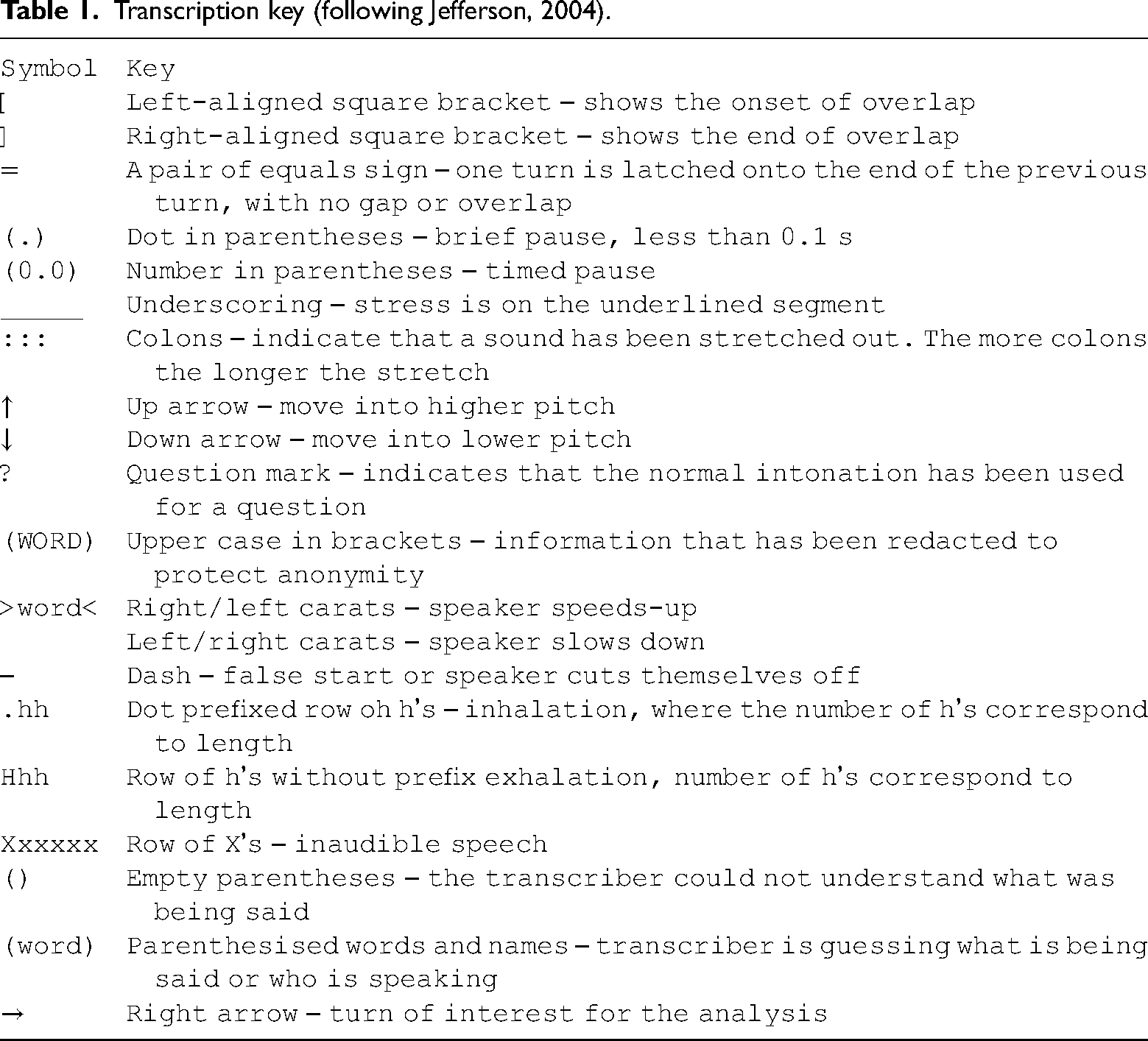
The sample of 30 hearings comprised 15 in-person hearings and 15 remote hearings that took place in prisons across England and Wales. 2 All involved three PMs to try and ensure that hearings were of similar complexity and risk, and the sample contained a mixture of male and female prisoners that is broadly representative of the prison population. The recordings were transcribed by two research assistants and the lead author using standard conversation analysis techniques of transcription (Jefferson, 2004) – see transcription key (Table 1 in the Appendix).
Analysis
Once transcribed by the research assistants, the lead author re-transcribed parts of the dataset to ensure accuracy and consistency. Following this, the data were coded to look, initially, for the management of rapport in the question/answer talk between PB PMs and prisoners. 3 We noticed that the development of rapport was affected in the remote hearings by the occurrence of breakdowns in communication and occasional, although sometimes lengthy, suspensions in the hearings. Sometimes these breakdowns in communication were caused by poor audio/audiovisual links, while on other occasions the cause was harder to pinpoint. In the latter cases, the remote mode of the hearing seemed to be a key factor, as participants more frequently reported not being able to hear others’ contributions, whether those be questions or answers. Having noticed these breakdowns in communication, particularly in the remote mode, we decided to isolate the specific occasions on which this happened, and to look for whether particular question types were more frequently causing these breakdowns in talk. The rationale for focusing on the questions as a potential cause of, or factor in, these breakdowns in intersubjectivity was driven by our desire to assist the PB in ensuring that remote hearings can run as smoothly as possible. While PB PMs cannot control what prisoners say in response to questions, members can ensure that questions are asked in ways that make allowances for the affordances of different modes of hearing. 4
Once we noticed that there were differences between the in-person and remote datasets in terms of the smooth running of the question/answer interaction, we coded the datasets for all instances of OIR coming from the prisoner side of the interaction. OIR occurs when recipients experience some problem in hearing, understanding, or acceptability (Svennevig, 2008) that creates a “barrier” to the “forward progress” of the interaction (Hayashi et al., 2013, p. 13). To that end, we looked for initiations of repair from the prisoners, such as questions (e.g., “what do you mean?”), statements showing lack of understanding and/or hearing (e.g., “I didn’t hear that”), and interjections (“huh?”). Having compiled this collection of OIRs we looked at whether these examples were more frequent depending on the mode of the hearing (remote vs. in-person). Following this, we undertook a granular analysis, investigating whether the specific structure of the question led to the prisoners experiencing problems in understanding or hearing. In other words, did the use of certain question types give rise to prisoners’ professed misunderstanding or mishearing and, if so, was this more evident in remote or in-person hearings? To do this, we used Stivers and Enfield (2010), a coding system developed from the study of thousands of question types from different languages, including varieties of English. This coding was checked and verified by one of the research assistants working on the project. 5
Findings
Identifying examples of other-initiated repair
The 30 oral hearings contained a total of 2,119 questions from PMs to prisoners, with remote hearings comprising 989 questions and in-person hearings 1,130 questions. Of these questions, 60% were in polar form and 40% were in Q-word form. Polar questions – often referred to as “closed questions” – are those that predict a “yes” or “no” answer (e.g., “did you break into the house”). Q-word questions – “open questions” – elicit a longer form answer and usually include a “wh”-question word (e.g., “where was your accomplice when you broke in?” “how did you feel about that?”). The remote and in-person datasets were almost identical in terms of percentage split between polar and Q-word questions. 6 In comparison with Stivers’s (2010) corpus of everyday conversations, the oral hearings dataset contained a higher percentage of Q-word types, perhaps because the oral hearing context functions as a specialised site where information is to be elicited in a particular way, with longer answers favoured over mere confirmation/disconfirmation. Table 1 shows that OIR (n = 85), as initiated by prisoners was more common across remote hearings (n = 51) when compared to in-person hearings (n = 34).
Instances of OIR by prisoners across remote and in-person hearings.

Across the in-person and remote datasets, 4% of PM questions led to OIR from the prisoner. 7 Q-word forms of question were more common with prisoner initiation of repair although these questions were less frequent than polar questions in the corpus. There was a marked difference between the two modes of hearing and the occurrence of OIR: in the remote hearing dataset 5% of questions were followed by OIR, while in the in-person dataset 3% of questions were followed by OIR. A chi-square test of independence was performed to examine the relation between mode of hearing and the presence of OIR. The relation between these variables was significant, χ2(1, N = 2,119) = 6.319, p = .012: OIR was more likely to occur in remote oral hearings than in-person hearings. We focus our analytical attention to this third finding as this is most relevant to our research questions.
A quantitative account of the data illuminates some elements of the overall differences between in-person and remote oral hearings, but a more detailed analysis of specific examples within the dataset can provide indications as to why this occurs. Analysis of the remote oral hearings shows that specific question types from PMs led to more problems than others, and that the same issues are not to be found in in-person hearings. When the instances of OIR in the remote hearings are isolated and the questions immediately preceding these are coded using Stivers and Enfield (2010), it is found that two similar question formats were frequently followed by OIR. These were “turn-final” polar questions, a specific question type in Stivers and Enfield (2010), and what we refer to as “appended” forms of question. In the in-person dataset, there were found six examples of these question types leading to OIR, while in the remote dataset there were 18 examples.
Turn-final polar questions in remote hearings
A “turn-final” polar question is one that takes a declarative format, with a question element (or tag) at the end of the turn: for example, “you made good progress on those, didn’t you?” Below, three examples of turn-final polar questions followed by OIR are presented. These examples all come from remote oral hearings. In the first example, the PM asks the prisoner about the victims of their offending:
In the second example, taken from the same hearing, the PM asks the prisoner about something he has said about himself in the past:
The PM's first attempt at the question is constructed as a turn-final polar, with the question element (“is that ri↑ght?” l.2) following a declarative (“you’ve talked about yourself as a paedophile”, ll. 1–2) and a pause (l.3). The prisoner's OIR at l.4 picks out an element of the question as problematic “the what > sorry<?”, which suggests that an element of the question was cut off by the remote connection. 10 The PM repairs the question by repeating almost verbatim the original question (l.5), but removing the turn-final element, and the prisoner responds immediately in the affirmative (l.6). As with extract (2), it is possible that one of the causes of the problem lies in the PM's delivery of the initial question, which contains a pause after the declarative element, and it may be the case that the prisoner assumed that the question was complete following the declarative.
In the final example of a turn-final polar question, taken from a different oral hearing, the PM asks the prisoner about courses undertaken whilst in custody:
Appended questions in remote hearings
Three further extracts are now presented from the remote oral hearing corpus. Each of these examples involves PMs designing questions in a way that, like the turn-final polar form, includes the question element at the end of the turn. The difference in the following examples is that the question element follows on from an extended turn and that, except for extract (5), the questions take Q-word form, rather than polar form.
In the below extract, the PM asks the prisoner about an incident that occurred following the prisoner's sentencing:
In the final two extracts, the prisoners’ difficulties with the questioning seem less to do with hearing issues and more with understanding quite complex questioning. In extract (6), the PM asks the prisoner about reports of their negative behaviour whilst in prison:
In the final example, the PM asks the prisoner about their offending behaviour:
The PM constructs a lengthy question turn that, like extract (6), quotes from a third party: this time a previous sentencing report (ll.4–9). The PM then makes this report relevant to the current panel's concerns over release (ll.9–14), before appending a question in Q-word “what” form (ll.14–15). Following a very lengthy pause (l.16), the prisoner expresses confusion over what is being asked (l.17), and the PM acknowledges that they are at fault for the misunderstanding (l.18). Both participants cite the question as the cause of the prisoner's difficulty, although an alternative interpretation is that the cause of the difficulty lies in the negative “valence” encoded in the PM's question (Raymond & Heritage, 2021); that is, the way in which the question builds towards a negative perspective of the prisoner's previous behaviour and his subsequent chances of release. It is possible, therefore, that prisoner's professed inability to answer, results from the challenging content of the question rather than (just) the form of the question.
It is important to highlight that, beyond the examples provided above, the instances of OIR following on from appended form and turn-final form questions were often associated with particular PMs in the remote hearings dataset. Of the 18 examples found in the remote dataset, nine different PMs were asking questions, with six PMs responsible for “causing” more than one instance of OIR. The same was not true of the in-person dataset, where all six examples of turn-final form and appended form questions leading to OIR were produced by different PMs across different hearings. Further to the general finding that these question forms were more problematic for effective communication in the remote hearings dataset, it is also the case that some PMs over-relied on a question form that posed problems for prisoners’ understandings in this context.
Discussion
In this article, we have analysed oral hearing transcripts across remote (n = 15) and in-person (n = 15) focussing on problems associated with the questioning of prisoners in oral hearings. It should be reiterated that, generally, remote and in-person hearings appear to run smoothly from an interactional perspective. Instances of prisoners expressing difficulties in understanding or hearing, as evidenced through OIR, are not very common. Given the delicate nature of some of the questioning and the high-stakes nature of the interaction, this is to be taken as a success. However, our analysis shows that remotely held hearings are more affected by communicational difficulties between PMs and prisoners. Question forms that contain the interrogative element at the end of the turn are markedly more associated with difficulties. Tellingly, these forms do not seem to be so associated with problems in the in-person dataset.
It is difficult to identify the precise cause of the difficulties with these question types in the remote hearing corpus. It seems likely that unstable links and time delays in the remote dataset accentuate the problems. In extracts (2), (3), and (5), in particular, prisoners seem to misproject the end of the question turn, perhaps assuming that the question was going to be delivered in declarative form: that is, without the turn-final or appended element. These misprojections are more problematic in remote communication because hearing and speaking are more difficult to do simultaneously in this mode. Combined with this, in remote communication, there is no absolutely shared discourse space due to time delays (e.g., Olbertz-Siitonen, 2015). Thus, what may be a well-timed contribution for one person may not be well-timed for another.
The appended collection points to a second possible explanation for communicational difficulty in remote hearings: these questions involve a relatively lengthy preface and/or declarative element which is then followed by a question. This form of question presents a problem of “cognitive load” for the recipient, requiring them to follow the argument in the preface and/or declarative element, and then answer a question pertaining to this. Remote technology places extra demands on participants (Bailenson, 2021) which, combined with a complex question type (and the possibility that elements are missed due to poor links), means that misunderstandings are likely. The extended prefaces in extracts (6) and (7) position the prisoner in a particular negative light, therefore potentially adding to the prisoners’ difficulty in responding appropriately. It was also found that in the remote hearings dataset there were differences at the level of individual PMs and/or prisoners, where turn-final and appended forms of questions resulted in OIR on more than one occasion. This further lends weight to our contention that PMs in remote hearings should be discouraged from over-reliance on these forms of questions.
It is difficult to definitively articulate the impact of remote hearings on prisoners’ abilities to feel like they have had a say in the hearing and the decisions made about them through having “voice”. However, our analysis does suggest that remote oral hearings pose some problems for a prisoner's ability to tell their side of the story. In oral hearings, prisoners’ contributions are restricted by the questions that they are asked by PMs, and if there are obstacles in the way of the prisoner's ability to answer a question fully (e.g., caused by a mishearing or misunderstanding), then this has important implications for voice. 13 Moreover, the added cognitive load that questioning in remote hearings requires of prisoners means that the hearing process is likely to be more difficult and thus – potentially – less inclusive. As Bickers et al. (2019, p. 478) note, “without understanding, people will not feel as though their opinions are being taken seriously and fully considered when authorities are making decisions” and there seems to be a real risk of this occurring in remote hearings. There is a need for further research to identify exactly how prisoners experience remote oral hearings.
Limitations
This study contains a number of limitations. Firstly, the issues we identify might be particular to a specific point in time. These hearings were from the early stages of the pandemic: it might be that things are working better now because technology has improved and people have become more used to communicating remotely. Our sample is relatively small and this poses questions about generalisability. More work can be done in this area in terms of using more recent hearings and a larger sample. Furthermore, as noted in an earlier footnote we have conflated three types of hearing into the “remote” corpus: video call, telephone link, and hybrid. We feel this is justified as our focus was on comparing remote and in-person hearings, and we would expect these different forms of remote hearing to be largely similar. Future research that compares video link/telephone link/hybrid would be welcomed.
From an analytical viewpoint, it is not possible to identify the extent to which prisoners’ use of OIR is strategic. Prisoners might use OIR to buy more time, or avoid answering a difficult question (see Footnote 12 above). However, this interpretation is speculative and, in order to be evidence-based, would require additional data, such as reports from prisoners that this is happening. We are not asserting that there is a causal link between remote hearings and problematic communication, but it is the case that remote hearings contain more examples of problematic communication, as we have defined it. Categorising instances of repair would have proved easier if we had been provided with visual data for the video call hearings, however, the PB has no plans to video record hearings as standard.
Conclusion
This study addresses the aims of this special issue by focusing on the effects of a digital transformation that has occurred within England and Wales, namely the wholesale shift from in-person to remote parole oral hearings. Although this shift in practice was not initiated by COVID-19, it was expedited by the pandemic, with the PB capitalising on the opportunities and efficiencies offered by the mass roll-out of remote technology to meet its statutory duty to speedily review cases. In our analysis, we have concentrated on interactions between PMs and prisoners in oral hearings, approaching this through consideration of problems encountered in the talk, and the potential ramifications for participation in the oral hearing process. A comparison of in-person and remote hearings demonstrates that the latter are more associated with problems in communication, seen in terms of repair, reinforcing the view from some PMs that in-person hearings are the gold standard mode (Peplow & Phillips, 2023a). There are major benefits to participants through this shift to remote-as-default (e.g., cost savings, environmental benefits, hearings being conducted in a timelier fashion – see Peplow & Phillips, 2023a); however, it is important that the Board, and PMs specifically, adapt their practices to compensate for this shift. This study found that particular ways of asking questions were associated with problems in the remote hearing dataset (turn-final and appended questions), and our recommendation is that PMs design questions to prisoners that avoid these forms (Peplow & Phillips, 2023b). There is the risk that if remote hearings contain more communication problems prisoners will feel less able to participate and have a voice, and thus may see their hearing as less legitimate. As noted in our limitations above, understanding prisoners’ experiences of this is imperative if we are to understand this fully and the authors are currently undertaking work to this effect.
Future research in this area needs to investigate the perspectives of prisoners and the professional witnesses who take part in oral hearings. So far, we know the views of a sample of PMs on different modes of oral hearing (Peplow & Phillips, 2023a), and we know some of the interactional difficulties associated with remote hearings. However, it is vital that the perspectives of others, especially prisoners, are gathered to provide a more complete picture of factors affecting participation and access to justice in oral hearings.
Footnotes
Acknowledgments
We would like to thank Kate Taylor and Glenn Gathercole from the Parole Board of England and Wales for making helpful comments on an earlier version of this article. We would also like to thank Anna Blagg and Hannah Lurcuck, our research assistants on this project.
Declaration of conflicting interests
The authors declared no potential conflicts of interest with respect to the research, authorship, and/or publication of this article.
Funding
The authors disclosed receipt of the following financial support for the research, authorship, and/or publication of this article: We would like to thank our funders: British Academy/Leverhulme Small Grants (SRG2021\210438) and Sheffield Hallam University's CKIP scheme.

Notes
Appendix
Transcription key (following Jefferson, 2004).
|
|
|
|
|
|
|
|
|
|
|
|
|
|
|
|
|
|
|
|
|
|
|
|
|
|
|
|
|
|
|
|
|
|
|
|
|
|
|
|
|
|
|
|
|
|
|
|
|
|
|
|
|
|
|
|
|
|
|
|
|
|
|