




Abstract
Drawing on interviews via letter with 64 prisoners maintaining innocence across England and Wales, this article examines the perceived institutional consequences of claiming innocence within the prison environment. A myriad of areas, ranging from everyday living conditions, risk assessment, progression to ultimately parole, are all believed to be impacted by claims of wrongful conviction. As this article illustrates, such a position is often inconsistent with Prison Service Orders and Instructions. These prisoners are thus required to engage and work within a system that is not designed for them and that they believe penalises them as a result of their claims.
My experience has taught me that to maintain my innocence is to bring hell down on myself.
Introduction
Every year approximately 1300 men and women lodge a claim with the Criminal Cases Review Commission (CCRC), seeking to challenge their conviction. Despite these numbers, we know surprisingly little about these people and how the prison, as an institution, accommodates their stance. This article examines some of the institutional consequences of maintaining innocence as perceived by those who believe themselves to be wrongfully convicted 1 and is based on the written accounts of 64 CCRC applicants who were, at the time of fieldwork, imprisoned in England and Wales.
Claiming wrongful conviction is largely an ignored experience within the prison. The institution has difficulty recognising these people and their reality; it cannot easily engage with those who do not admit guilt. By refuting the necessity of the measures they are subjected to, they are thrown into direct opposition to the goals of the institution and call into question the practices of the criminal justice system more broadly. It is thus easier to ignore these claims than to engage with them constructively. It is easier to pressure these people into processes that do not suit their situation than to devise ways to accommodate their claims. 2
The perceived institutional consequences of maintaining innocence are severe and impact all areas of prison life, from institutional privileges, to relationships with senior staff, to decisions of progression and parole. Delays and obstruction to parole and progression are the most serious possible institutional consequences to arise from maintaining innocence and such processes have implications far beyond the final decision to permit or deny progression. Indeed, although parole is the key decision, many other areas, such as risk assessment, offending behaviour programmes and classification as ‘deniers’, are factors that either feed into the progression process or flow from it, affecting prisoners both before and after progression decisions. As such, the first section of this article operates as the frame for sections that follow and provides the main policy background. Consequently, the second section considers notions of risk and the assessment of prisoners and offending behaviour programmes. Throughout I reference applicable legislation 3 and draw a distinction between law and perceived practice. 4
The study
The wider study on which this article is based focuses on prisoners maintaining innocence and examines their coping mechanisms, the relationships they form and maintain both inside the prison walls and beyond, and the perceived institutional consequences of their claims. In essence, it details the lived experiences of a set of prisoners about whom we know very little and whose voices tend to be marginalised, both within the prison and within the academic discourse.
These people are part of both the ‘prison’ and the ‘wrongfully convicted’ populations, but neither area of research gives adequate attention to their prison lives. Indeed, it is very rare for prisoners who maintain innocence to be acknowledged in prison studies, and guilt is generally assumed without much consideration of their unique experiences. 5
The majority of the wrongful conviction research focuses on the causes of these convictions and experiences post-exoneration. Such work has found that exonerees often present with severe psychological trauma, often over and above that reported in the general literature (Grounds, 2005; Westervelt and Cook, 2009; Wildeman et al., 2011). Such findings, while not unexpected, would seem to indicate that there is something unusual, something additional, in the experience of being wrongfully imprisoned that creates these extreme effects. This knowledge has, however, not led researchers to venture into the prison to examine the lived experiences of maintaining innocence.
To date, only two academic studies have specifically addressed the unique complexities of prison life for this group. Forensic psychiatrist Adrian Grounds (2004, 2005) conducted psychiatric assessments of 18 exonerees and, although he examined prison experience, his main focus related to the effects of such imprisonment post-exoneration. Kathryn Campbell and Myriam Denov (2004) similarly conducted in-depth interviews with five Canadian exonerees. 6
These studies provide powerful accounts and the insights produced are of great importance. The authors characterise claims of innocence as a ‘burden’ in the prison context and illustrate the consequences of pursuing such a claim, predominately focusing on the innovative coping strategies employed by this population while imprisoned. Importantly, they highlight how refusal to admit guilt can make it harder for many exonerees to access conventional routes of progress and cascade through the prison system, due in large part to a refusal to engage with ‘rehabilitation programmes’ (Campbell and Denov, 2004; Grounds, 2004), although there is little to no examination of the reasons why or the official policies that influence this area. Indeed, categorisation and parole decisions were not central to either author and are addressed only superficially, with little more than a few sentences devoted to this area, in both major studies.
To build upon this existing research, I conducted semi-structured interviews via the medium of letter with 64 prisoners who were claiming wrongful conviction. A large proportion of participants responded to advertisements in prison newspapers and wrongful conviction charity newsletters. I also approached representatives from campaigning groups and legal organisations, and finally, after a basic Internet search, I contacted known prisoners maintaining innocence directly (see Burtt, 2021). All were maintaining factual innocence and had applied or were in the process of applying to the CCRC. Some had made multiple applications.
Participants were given reasonably clear guidelines prior to writing their first accounts and, in the majority of cases, I replied with further questions, creating a series of letter exchanges, 7 rather than a single narrative account. Letters not only produced important narrative data but also allowed a dialogue to develop that in some senses paralleled the practice of a face-to-face interview (see Burtt, 2021). In addition to written responses, I also received various pieces of documentary evidence, which included case files, forensic evidence reports, psychological reports, Parole Board decision letters, prison leaflets and diaries. 8 These documents helped me to construct a fuller and clearer picture of prison life and acted as a partial form of data triangulation (see Yeasmin and Rahman, 2012). The data were transcribed and coded in full and analysed through an iterative approach of content analysis.
The sample included 64 individuals, 61 men and 3 women, and the age of participants ranged from 28 to 77 years and averaged 49 years. 9 Participants were drawn from across the prison estate (located in 41 prisons) and were fairly evenly distributed between Category A (34%), B (25%) and C (38%) establishments (only two participants were located in Category D prisons).
The majority were imprisoned for very serious crimes, most commonly for murder (41%) and sexual offences, both contemporary and historic (36%). Just under half (47%) were serving life sentences, with tariffs ranging from 3.5 years to natural life, and five were serving sentences of Imprisonment for Public Protection (IPP). Of the life and IPP participants, eight were ‘over tariff’, having been denied parole, often substantially and up to 20 years. Of those serving determinate sentences, only 12 were sentenced to less than 10 years. Time served varied widely, ranging from 1 to 35 years, and participants were at very different stages of their sentences. Mean average time served at the time of fieldwork was 8 years.
Progression and parole: Law and practice 10
While it is stated in prison rules that maintenance of innocence should not prevent progression and parole, 11 accounts from prisoners strongly suggest that the reality is very different.
Those responsible for decision-making regarding recategorisation vary, depending on both the type of sentence the prisoner is serving and their current category.
12
Importantly, for prisoners maintaining innocence, risk of harm assessments must inform all decisions of recategorisation (HM Prison Service, 2005: para. 4.7). The Security Categorisation Policy Framework states that the only relevant information is an assessment of the risk of escape, the risk of harm to the public, ongoing criminality in custody, the safety of others within the prison and the good order of the prison (HM Prison and Probation Service, 2020b: para. 3.5). Categorisation reviews must take into account these current risks and any ‘positive efforts made towards rehabilitation’ (para. 7.11). Similarly, when considering transfer to open conditions, the Parole Board’s emphasis . . . should be on the risk reduction aspect and, in particular, on the need for the ISP to have made significant progress in changing his/her attitudes and tackling behavioural problems in closed conditions, without which a move to open conditions will not generally be considered. (Secretary of State, 2015: para. 5)
In assessing risk, the Parole Board will consider, among other points, whether the prisoner has made ‘positive and successful efforts to address the attitudes and behavioural problems’ which led to the index offence (Secretary of State, 2015: para. 9.d), the prisoner’s awareness of the impact of the index offence (para. 9.h) and predicted risk as determined by OASys 13 (para. 9.k).
The impact of these assessments on the prisoner maintaining innocence is obvious. ‘PSO 4700 replacement chapter 4’ states that a person who ‘ . . . denies the index offence, but is willing to reduce identified risk factors CAN progress through the system and CAN be released’ (emphasis in original) (National Offender Management Service, 2010: para. 4.14.20). At least officially, therefore, maintaining innocence should not automatically prevent a prisoner from recategorisation. However, as will be illustrated below, most prisoners in the current research perceived significant difficulty in progression. All decisions are based on extensive risk assessment and most claimed it was near impossible to demonstrate a reduction in risk. Offending behaviour programmes are key to this process and many participants refused to participate (see below). Although, the Security Categorisation Policy Framework further states that recategorisation reviews should consider whether there is evidence, other than attendance at programmes, which might indicate a reduction in risk and suitability for a lower security category (HM Prison and Probation Service, 2020b: para. 7.16), many stated that they had difficulty establishing any appreciable risk reduction in practice.
Parole
In consideration of parole and release, maintenance of innocence predominately affects indeterminate sentenced prisoners. 14 For those, it is the Parole Board who has statutory authority to release on parole/life licence (HM Prison and Probation Service, 2020a: para. 3.6). The Crime (Sentences) Act 1997, s28(6)(b) states that the Board should only direct release if it is ‘satisfied that it is no longer necessary for the protection of the public that the prisoner should be confined’. Again, a key consideration for parole will be the prisoner’s engagement with risk reduction interventions and evidence that the prisoner has demonstrated positive changes in behaviour, thinking and attitudes (National Offender Management Service, 2014: para. 2.2).
When evaluating such matters, the Board is required to consider various reports relating to the prisoner, as set out in the Parole Board Rules (2019). These documents include, but are not limited to, reports on the prisoner’s risk factors and a full OASys assessment, details of interventions undertaken to reduce said risk, compliance with sentence plan and progress against objectives, an assessment of the risk of reoffending and comments regarding the prisoner’s attitude towards the index offence 15 (Schedule 1, Rule 16, Part B(4/5)).
Denial of guilt alone is not a lawful reason for the Board to refuse to release a prisoner. ‘PSO 4700 replacement chapter 4’ states, . . . it is A prisoner who takes a full and active part in the risk assessment processes, undertakes relevant interventions, addresses and reduces identified risk factors and reduces the perceived level of risk of harm they pose to the public, can potentially gain release at tariff expiry whilst still maintaining their innocence or denying full or partial guilt for the actual offence. (National Offender Management Service, 2010: para. 4.14.5–6)
Although, as stated, a claim of innocence is not a bar to release in and of itself, 16 the emphasis is again on the risk the individual may pose. Similar to progression decisions, those who refuse to attend offending behaviour programmes will struggle to demonstrate any significant reduction in their risk.
Experiences of progression practices
Most participants understood that maintaining innocence should not affect their natural progression through the prison system nor act as a bar to parole and they were able to quote prison service orders (PSOs) and prison service instructions (PSIs) to this effect. However, only a very small minority of those who wrote to me stated that they had progressed with relative ease. The vast majority claimed that maintaining innocence had, in reality, caused difficulties and delays to their progress. Many participants believed progression processes to be discriminatory and unlawful and considered refusal of advancement to be based solely on the grounds that they were claiming wrongful conviction. Such difficulty was commonly confirmed in assertions that the prison or Parole Board had refused ‘downgrades’, usually on multiple occasions, as in Stuart’s case: I have remained in High Security prison estate for nearly twenty years and never progressed to a lower security prison even though I have completed treble my tariff (6 ½ tariff). I have been overlooked for release and Open Conditions on six separate occasions by the Parole Board.
It appeared that those most affected by lack of progression were prisoners serving an indeterminate sentence in Category A establishments,
17
like Stuart. It was not uncommon to receive accounts from prisoners who had served 15–25 years and were still located in Category A prisons. Howard had served 15 years of a 25-year life tariff for murder and had not progressed at all: As you can see from my address even after 15 adjudication free years I am still Cat ‘A’ and held in a top security jail specifically designed to house fit dangerous young escape risk prisoners . . . because we won’t address our non-existent offending behaviour, one of the examples of this vindictive coercive system is to keep old men in the worst possible conditions in top security jails.
It was common for participants, like Howard, to state that they had made little progress despite being ‘adjudication free’. In the modern penal context, passivity was not sufficient to ensure progression (see Crewe, 2009, 2011a, 2011b), and instead prisoners needed to actively engage in risk reduction work. Most participants claimed to have been told, at some point during their recategorisation evaluations, that they had not provided evidence of a significant reduction in risk that would warrant a recommendation for a downgrade in their security status. It was considered that they still posed a risk of reoffending as they had not addressed or lowered their identified risk factors.
Risk, I was told, was the only factor that seemed to matter and attendance on relevant courses, despite PSOs to the contrary,
18
was deemed the sole way to reduce perceived risk, as evidenced by Greg, who had served 7 years of a life sentence (11-year tariff) for attempted murder: I have achieved many qualifications including a level 3 PTLLS teaching qualification while here and I am highly respected by the education department for my work and have been nominated for mentor of the year . . . but none of this means anything to the ‘Gods’ who control things as I have done no offending behaviour work and as a result my risk and scores have not changed in 7 years. I could do a course and stay in bed all day and be able to progress but as a ‘denier’ I am stuck.
Many, like Greg, complained that although they had achieved qualifications in numerous education, training, and work skills courses; had completed substance misuse programmes; had always worked and behaved well within the prison; had strong family support outside; and had accommodation and offers of employment on release. none of it seemed to have any bearing in recategorisation reviews – it was all about risk. 19 Understandably, participants considered this situation to be deeply unfair and frustrating.
All refused to attend offending behaviour programmes that required an admission of guilt for their index offence (see below). As Connor, who had served nearly 5 years of a 19-year sentence for rape highlights, it was believed that refusal to complete such programmes could have a significant impact on decisions of progression: I have been promised Cat C status at every annual sentence plan for the past 3 years but denied every time until I said I was willing to complete a ‘Thinking Skills Programme’ provided I could base it on previous driving convictions, as a result I am now a Cat C prisoner . . .
Connor’s claim, that it was only after offending behaviour work had been carried out that he could be recategorised, was common. As a result, some had great difficulty. Participants described themselves as being in an impossible situation – they were declined for recategorisation due to a failure to address their risk (i.e. complete specified programmes) but were barred from doing so because they refused to admit guilt. Figure 1 illustrates how progression can be denied on the sole basis that a prisoner has not addressed their offending behaviour through courses.
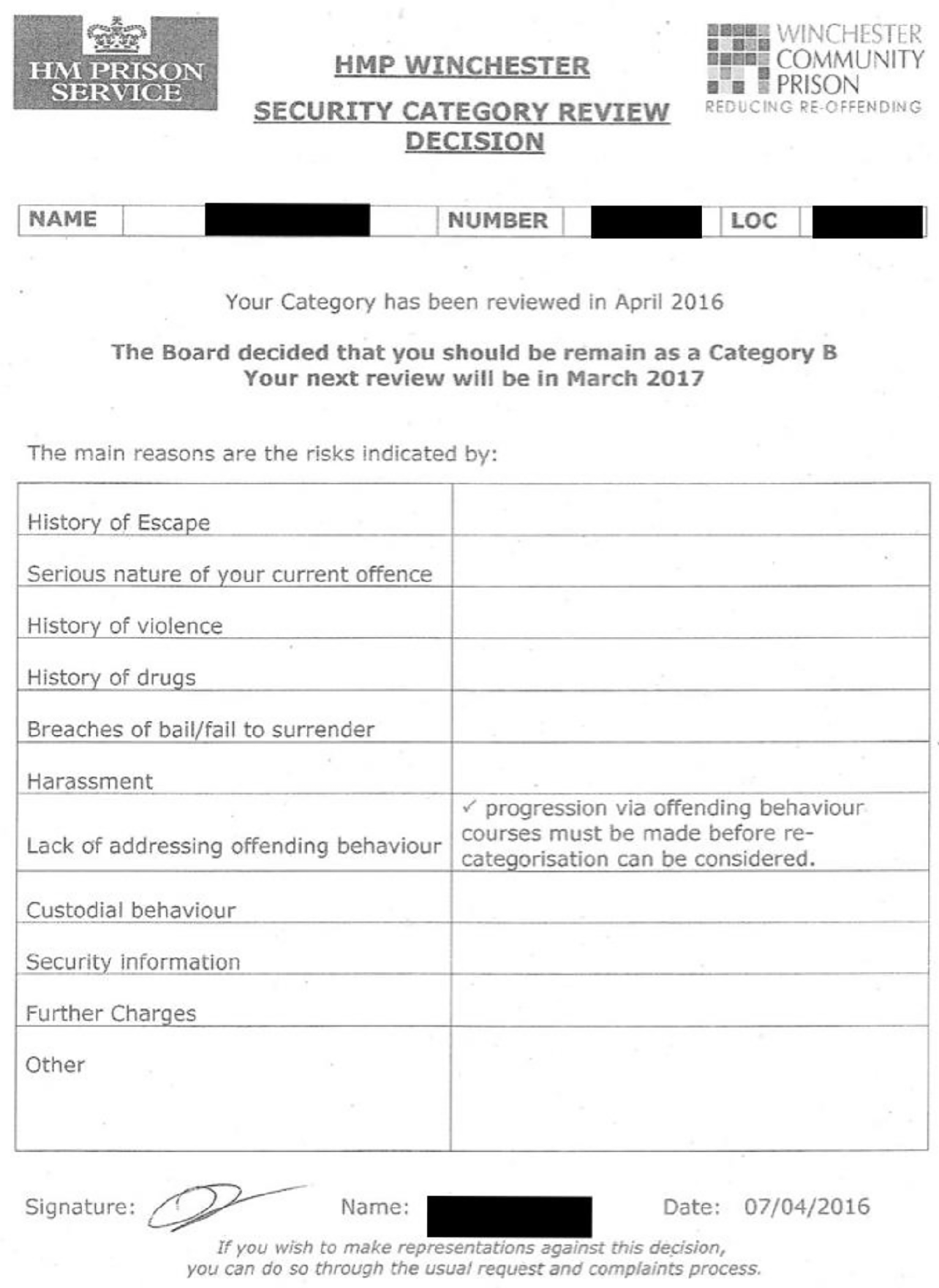
A security category review decision form (HMP Winchester, 2016).
Experience of parole practices
Concern regarding risk reduction and courses was not limited to decisions of recategorisation but extended into determinations of suitability for release on licence (for indeterminate sentenced prisoners). Again, participants noted significant difficulty in gaining release through the Parole Board, due to the aforementioned factors. 20 Such a view is supported by the wider academic literature that illustrates how ‘denial’ is an identified factor that can decrease the likelihood of a prisoner gaining parole (see Caplan, 2007; Carroll and Burke, 1990; Carroll et al., 1982; Hannah-Moffatt and Yule, 2011; Hood and Shute, 2000; Lackenby, 2018; Lindsay and Miller, 2011; Padfield and Liebling, 2000). Those in ‘denial’, particularly sex offenders, are more likely to be considered high risk by Parole Board members, prison practitioners and forensic psychologists alike, adversely impacting release eligibility (Blagden et al., 2011; Freeman et al., 2010; Hood et al., 2002).
Most participants, like Joe, who had served 16 years of a life sentence for murder, believed that they would spend far longer in prison than their tariff suggested: My tariff expires in 3 years but there is no hope of being released as an A Cat lifer PMI. This is despite having lower OASys scores and RM2000 scores than the majority of C Cat prisoners, never having had an adjudication, failed MDT or negative IEP warning. In fact, my prison record is described by staff as exemplary . . . For many Cat-A Lifers who are wrongly convicted and innocent we have little to no hope of release. Thus we are effectively given a death sentence.
Joe’s description of his imprisonment as a ‘death sentence’ is striking and was not uncommon. Most indeterminate sentenced prisoners felt that they had been ‘left to rot’ and would not be considered for release until they cooperated with the prison authorities by admitting guilt, exhibiting shame, and ‘performing’ in an institutionally desirable way. They felt denial of parole was a means of blackmail and that the prison used ‘time as a weapon to inveigle false confessions’ (Brendan). Most thought that they would have been released earlier had they not maintained innocence and this knowledge caused a significant psychological strain. Many also assumed that they would, or had, spent longer in prison than their guilty counterparts. They believed this situation to be inherently irrational and unfair and could not understand why they should, as ‘innocent’ men and women, serve longer, harder sentences than those who had committed an offence.
Furthermore, some, like Bradley, who had served 12 years of a life sentence for murder, with a tariff of 15 years, judged the decision-making of prison staff and the Parole Board to be inherently flawed. They thought that the key criteria in decisions of parole should concern risk remaining, rather than risk reduction: . . . the emphasis is on what’s changed. They look for a demonstrable reduction in risk . . . I argue that it’s not the risk reduction that’s important but the risk remaining . . . How do you make progress when there was nothing wrong to start with?
Bradley did not feel that he had problematic attitudes, behaviour, or thinking that needed to be addressed. He perceived himself to be low risk (as he was not an ‘offender’), and this belief was generally supported in his OASys assessments. He therefore questioned why he must demonstrate a reduction in risk. If his prison behaviour and reports indicated a low risk, he felt that should be enough and that it was irrational to have to demonstrate a change.
Lack of progression and difficulties gaining parole created conflict between participants and senior staff within the prison. Many felt that these staff were breaching the rules and obstructing progression to penalise prisoners for maintaining innocence. Refusal to recategorise and release were considered to be the ‘ultimate sanction’, and participants realised that they had very little control over these aspects of their life. They were at an impasse – they would not change their stance but knew that this was ultimately to their detriment.
Some wrote and complained to the prison authorities, quoting PSIs, PSOs and case law, illustrating how the decisions in their case run contrary to official instructions. These participants armed themselves with the rules and adopted the language, vernacular and goals of the criminal justice system. Although they considered the system to be inherently illegitimate, they realised that they must work with it to have any possibility of success. Ultimately, it was the prison that held all the power and no small-scale act of resistance could challenge it. These participants, like Bradley, knew that they had to ‘play the game’: All this sounds fairly positive, it’s intended to, it’s cut and pasted from my draft submission to the parole board. Whilst it is all true, it’s not the whole picture. I hate being in prison. I feel indescribably angry about what has happened to me and continues to happen.
Bradley knew what was required of him to progress, and although he acknowledged the goals of the system publicly, he failed to internalise them. There was thus a distance between how he behaved and how he felt. The dual nature of his existence caused considerable frustration; to progress, he must, to a certain extent, deny his own experience.
Although the problems outlined above were mentioned in practically all accounts, most participants did appear to progress eventually, with the exception of some prisoners serving an indeterminate sentence in Category A establishments. Nevertheless, it seemed that progression was substantially delayed as a result of maintaining innocence. It would appear that there is inconsistency in the way the rules are applied to this population. 21 The prison estate does not seem to know how to manage these people and there is a certain unpredictability as to when, and under what circumstances, these prisoners can progress and gain parole.
Risk assessment
As has been illustrated throughout this article, decisions of progression and parole rely heavily on notions of risk and its reduction. Risk assessments, principally using the Offender Assessment System (commonly referred to as OASys), are conducted regularly in the prison environment, and from these assessments, sentence plans are developed to ‘manage and reduce’ identified risks and reduce the risk of harm prisoners present to the public (HM Prison Service, 2005).
However, many participants did not understand why their risk was high and most fundamentally believed that they had no risk to reduce – they did not consider themselves criminals. As Bradley highlights, there was criticism of the actuarial nature of the assessment and the subsequent score produced.
22
Bradley had tried to amend the documents to reflect his stance as a prisoner maintaining innocence, but to little effect: All they did was amend their document adding caveats. Instead of reading ‘[Bradley] wrapped the body in a mattress protector’ it was amended to ‘prosecutors claimed that [Bradley] wrapped the body’ . . . The problem is that each statement is then used as justification to add points to the actuarial risk calculation so the text is caveated but the scores never are.
For Bradley there seemed to be no room in the system for nuance. The risk assessment tool could not adequately fit his situation nor that of the other participants. The database was not designed to accommodate those claiming innocence. Although their score could be interpreted as ‘high’ on the basis of the nature of their alleged crime, this marker did not correspond to how participants saw themselves. They thus found it difficult to engage with the system of risk reduction when they fundamentally opposed it and resisted the most basic notions of their perceived risk.
Participants also expressed annoyance that their OASys reports contained errors, inaccuracies and false entries. Staff failure to record even the simplest of facts correctly was often worrying for participants. More concerning still were claims of staff acting dishonestly (see Crewe, 2009). Participants claimed that if Offender Supervisors were lazy or vindictive, they could falsely populate the risk fields which ultimately affected their score and sentence plan recommendations, which, in turn, played a major part in their management and progression. It was regularly claimed that, due to the subjective nature of assessment, staff could lie with impunity, recording false allegations and opinion as fact.
It is impossible for me to know whether these claims are true. While malice may have been a cause of ‘inaccurate’ risk assessment reports, it is also possible that the problem was one of perception. Staff may have created reports that fit the institutional framework and correctly identified ‘problem’ behaviours and attitudes that the software was designed to highlight. However, as participants fundamentally objected to the risk process and disputed most of what was written about them, they interpreted these reports as dishonest. The difficulty is that these prisoners do not easily fit within the traditional risk assessment structure and it is likely that participants’ concerns with the content of reports were a manifestation of this difficulty, rather than deceitful staff.
Some worked tirelessly to correct these perceived errors, but there was little they could do to challenge the fundamental nature of the reports. The consequences of these errors often created conflict, as illustrated by Brendan, who had served 13 years of a life sentence (26 year tariff) for murder: I have likened it to a small snowball running downhill. Each turn it picks up more and more snow (inaccurate entries) until eventually you are left with this massive snowball which bears no resemblance to the original small ball of snow. In other words, I no longer exist. I have become a construct of their imagination. It is the ultimate act of dehumanisation.
As Brendan highlights, most participants could not see themselves reflected in what was written about them and were highly sensitive to any insinuation that they exhibited criminal tendencies. The comments on these files were not consistent with their sense of self and the majority felt that they were being unfairly assessed as a result of their stance.
Many of those who wrote to me thought that they were judged more harshly than their fellow prisoners. Their helpfulness and kindness were misinterpreted; they were manipulative if they helped with applications and letters; they crossed boundaries if they complimented someone; making notes in meetings was controlling and a form of intimidation. Personal strengths, such as organisation, control and motivation, were thus, I was told, interpreted negatively. For any other prisoner these traits would be evidence of beneficial skills, but it was claimed that for prisoners maintaining innocence, they were the object of unwarranted scrutiny. Some, like Julie, who had served 13 years of a life sentence for murder, believed this was an attempt to persuade them into revealing their ‘true criminal identity’: Even after 13 + years it’s like they’re waiting for a slip up so they can say ‘there you go see’ . . . Because of this I have to be on my guard at all times, it seems no matter what I do or say it is turned into something it’s not. It feels like if someone else were to do the same it’s fine . . . Prison staff (not all) appear to be looking for signs of the person I was described as being at trial and if there’s no signs of it then the person I’m being is all an act.
For Brendan and Julie, negative reports of behaviour that they considered normal, and that they supposed others would also consider normal, 23 was a form of abuse. Participants claimed that they were regularly made to doubt themselves which not only upset them deeply but caused them to become self-conscious and overly sensitive, unsure of how their behaviour would be interpreted. Many thought that such comments were an attempt to dehumanise them and make them fit the ‘criminal mould’ based on a description of their alleged crime, rather than their outward display of risk factors, or lack thereof.
Many felt that maintaining innocence was interpreted, for the purpose of assessment, as a risk factor, in and of itself. 24 In their reports, participants claimed, they were described as callous and lacking in victim empathy, conscience, responsibility and consequential thinking. In this context, continued declarations of innocence appeared to serve as an indication of an absence of remorse which, in turn, increased perceptions of participants’ risk level. 25
Nevertheless, a large majority of participants realised that they had to engage with the risk assessment process at some level; to refuse would ultimately only damage their chances of progression and parole. Although they maintained their innocence, they worked within the framework of the prison. They made their position clear but did not refuse to enter into discussion of their risk. They understood that they could not withdraw from the process completely, but most were extremely wary of it and did not engage as fully as they could. Others, such as Bradley, were more creative: Using their own wonky logic, I’ve argued that because I’m convicted of murdering a former partner after an acrimonious divorce with a financial motive (all nonsense) there is no evidence that I present any risk except to former partners in an acrimonious relationship breakdown with financial implications. I calculate that if they can’t accept I present no risk then the best I can hope for is that I can narrow the perceived risk down to such an extent that it becomes negligible and I’ll be deemed safe to release.
Most thought that the system of risk assessment, management, and reduction was unfair and broken. Risk pervaded every area of prison life and assessment as ‘high risk’ could have lasting consequences. To progress, prisoners must exhibit a reduction in risk, most commonly demonstrated through attendance at offending behaviour programmes – programmes that many participants refused to attend.
Offending behaviour programmes
Most prisoners’ sentence plans will require them to be assessed for and attend particular offending behaviour courses (see Figure 2). However, it is acknowledged in ‘PSO 4700 replacement chapter 4’ that programmes such as the Sex Offender Treatment Programme (SOTP) 26 and Controlling Anger and Learning to Manage It (CALM) depend on a prisoner being willing to discuss their offence and, as a result, are unsuitable for prisoners maintaining innocence (National Offender Management Service, 2010: para. 4.14.9). Indeed, the majority of participants refused to attend these courses, and others like them, as they required an admission of guilt and most considered attendance as tantamount to a confession.
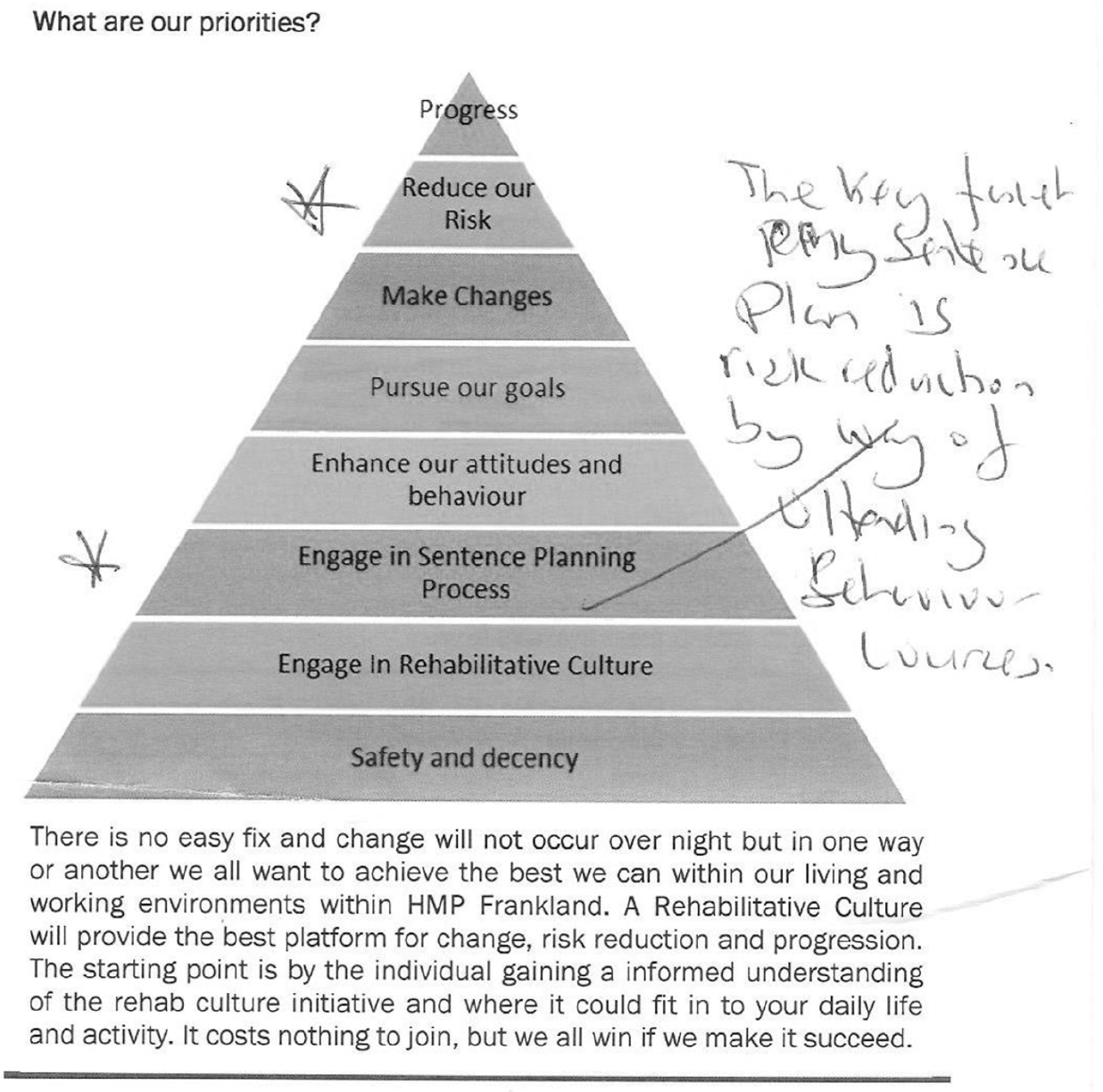
‘The key facet of my sentence plan is risk reduction by way of offending behaviour courses’ (Adam) (HMP Frankland, 2016a).
Furthermore, most participants considered these courses to be unnecessary. Offending behaviour programmes were aimed at addressing criminal behaviour and thinking that they did not believe they had; they were aimed at reducing a level of risk that participants felt had been overestimated. Participants did not regard themselves as offenders and so these courses had little to offer them, as Bradley makes clear: By doing a course a prisoner can demonstrate a reduction in risk. I argue that I never had any risk to reduce. They say that I must pose a risk because I’m convicted of murder. I say that a conviction in a British court isn’t worth a fart, I am wrongly convicted, and if I’m a murderer why don’t I present with risks consistent with being a murderer on the course assessments?
Nevertheless, all understood the importance of attending offending behaviour programmes for progression and parole, and as a result, most were keen to illustrate that they were engaging in risk reduction work, short of providing a confession. Some completed courses that did not require an admission of guilt. Certain programmes, such as Thinking Skills Programme, Enhanced Thinking Skills and courses that addressed drug and alcohol problems, were not offence-specific and did not require prisoners to discuss their offence. They could thus be completed by prisoners maintaining innocence. Such attendance served to demonstrate to the prison establishment that participants’ perceived risk of harm had been reduced.
27
Similarly, others attended courses which did require an admission of guilt, on the basis of a previous conviction. Some, such as Harry, who had served 8 years of a life sentence for murder (with a tariff of 30 years) but no previous offences to address, felt this was unfair: It’s even worse that I don’t have any previous convictions to work on, in effect, punishing me
Harry thought it a strange system that considered it better to have cognitive deficiencies which could be addressed through courses, than to not have the deficiency at all. A number of participants called for courses specifically designed for prisoners who maintained their innocence. They wanted tools that could assess and minimise their risk without reference to their offence, rather than trying to shoehorn themselves into the existing framework which did not adequately cater for their situation.
A small minority refused to undertake any programmes on grounds of principle and were highly critical of these programmes. Participants, such as Andrew, who had served 20 years for murder, further thought them to be exploitative: I refuse to do courses because they only seek to undermine the will to fight.
Andrew felt that the content of these courses and the people who ran them were trying to undermine his stance and manipulate him into accepting guilt. He claimed that the prison psychologists and course leaders refused to acknowledge that any prisoner may have been wrongfully convicted and instead labelled them as ‘in denial’. Indeed, the vast majority of participants stated that they had been told they were in denial or ‘minimising’ their offence at some point during their sentence (see Figure 3). They felt that their claims of wrongful conviction had automatically deemed them to be liars, manipulators, attention seekers or mentally ill.
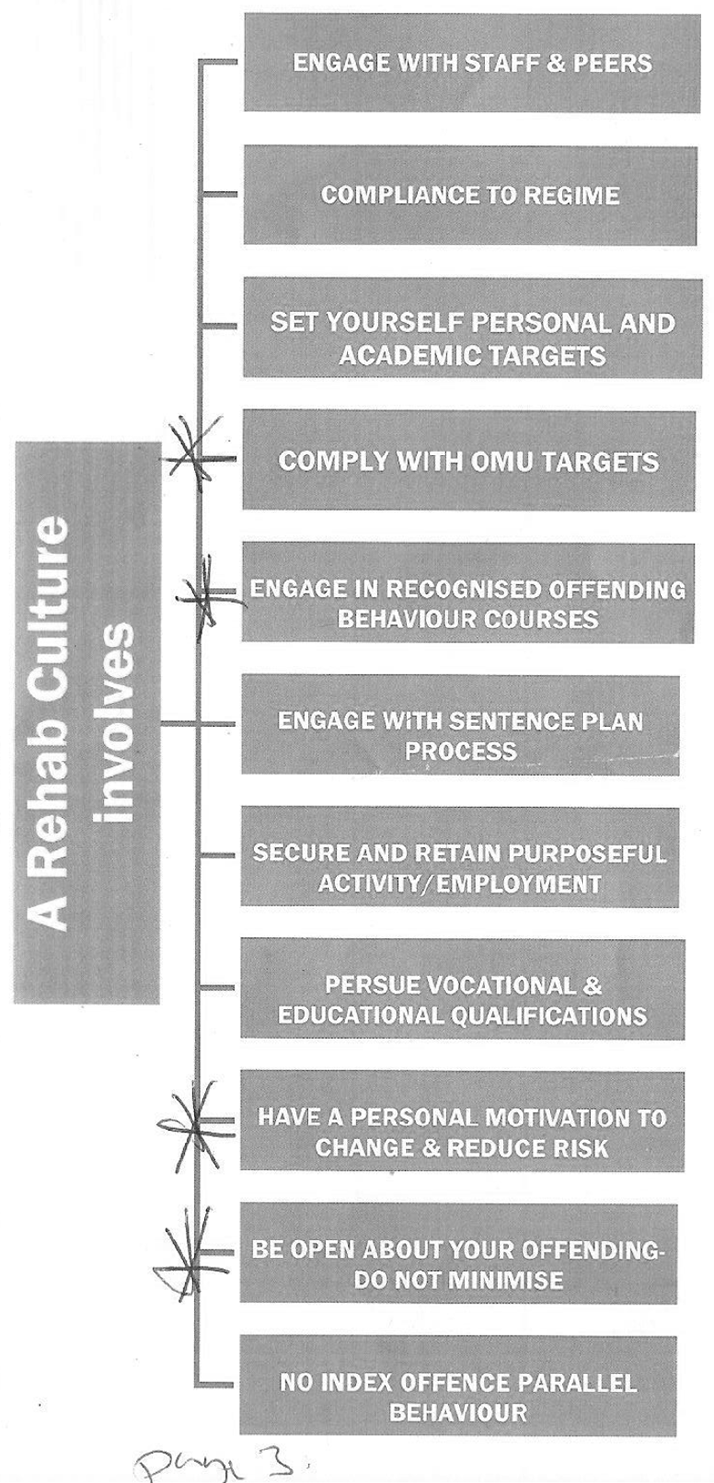
The requirements of the rehabilitative culture at HMP Frankland (2016b).
Conclusion
It is clear that prisoners believe that maintenance of innocence can have significant institutional consequences and that such claims weigh heavily against them in many ways. In the modern penal context, emphasis is placed on concepts of engagement, commitment, self-regulation and the individualisation of penal power (Crewe, 2011b). Prisoners are encouraged to take responsibility for their offence and official policies are designed to induce prisoners to publicly and formally modify their behaviour. By claiming wrongful conviction, by suggesting that they were not responsible for any offence nor had problematic behaviour that needed addressing, participants stood in direct contrast to the central aims of the system.
It is also apparent that there exists a substantial gap between official policy and the perceived reality facing prisoners. Official rhetoric is keen to emphasise that denial of guilt alone should not affect prison treatment, progression or parole. While such documents are understood to allay concerns that prisoners maintaining innocence cannot progress, they simultaneously make it very hard to do so – officially, claims of innocence are not a bar to release, the emphasis is instead on risk. However, it is very difficult to demonstrate a reduction in perceived risk without attendance at related offending behaviour courses, which often require an admission of guilt. It was evident from the accounts I received that not only was maintaining innocence a denied experience in the prison environment but that progression policies compelled these prisoners to deny their own experience.
The cause of these problems is that prison and penal policies are not designed for those who profess innocence and traditional processes of dealing with prisoners are not appropriate for this population. Rather than engaging with their claims and devising more adequate ways to deal with this population, the prison seems intent on shoehorning them into progression and risk assessment procedures that cannot accommodate their position.
However, as it was generally believed that the chances of obtaining exoneration through the appeal courts were slim, most found it necessary to engage at a basic level with prison procedure even if they attributed little legitimacy to the institutions or processes that they were obliged to interact with. They attempted to work within a system that not only worked slowly and inefficiently but that was also fundamentally at odds with their situation and requirements. This was perceived to be systematic disregard for their status as people claiming innocence and, coupled with the inherent frustration of being an ‘innocent’ prisoner in a system that largely denied their existence, led to significant resentment.
Footnotes
Acknowledgements
The author would like to thank Carolyn Hoyle and Mary Bosworth for their helpful comments on an earlier draft of this article.
Declaration of Conflicting Interests
The author(s) declared no potential conflicts of interest with respect to the research, authorship and/or publication of this article.
Funding
The author(s) received no financial support for the research, authorship and/or publication of this article.
