



Abstract
Recent reports have highlighted the discriminatory treatment endured by foreign national prisoners (FNPs) in particular Irish prisons, but one key voice has been relatively absent from the discourse to date – the perspectives of the prisoners themselves. This article aims to complement these “top-down” perspectives with a comprehensive “bottom-up” analysis rooted in the experiences of 82 FNPs and explore the extent to which they were subject to racism, discrimination and differential treatment by prison staff and fellow inmates across eight Irish prisons. The article begins by outlining the methodology of the qualitative study. It then presents our findings in two parts. The first part focuses on FNPs’ personal views of their relationships with staff in Irish prisons. The second part explores the extent to which these FNPs interact with Irish prisoners and prisoners from other jurisdictions. The article reveals that forming relationships with staff and fellow inmates is challenging for certain FNPs due to racial prejudice, language barriers and segregation based on nationality.
Introduction
The need for connectedness and a sense of belonging is a fundamental human motivation across ages, contexts, and cultures (Bronson, 2008; Sentse et al., 2019). Indeed, human contact is so vital that when one is deprived of it for long periods of time, it may cause mental health problems and lead to difficulty managing even the basics of daily life (Kamoyo et al., 2015). This is exacerbated for prisoners who experience inter alia what Sykes (1958) labels a “loss of liberty”. This comprises not only one's confinement, but also the removal of their social networks which results in lost emotional relationships, boredom, and loneliness. The creation and maintenance of interpersonal relationships is thus a vital part of life in prison (Liebling, 2011) and this is particularly the case for foreign national prisoners (FNPs) who are frequently imprisoned in a different country to where their family and support networks reside. In this context, staff–prisoner relationships (Beijersbergen et al., 2015, 2016; Liebling & Arnold, 2004) and inmate–peer relationships (Hart, 1995; van Ginneken, 2019) assume particular importance, but recent litigation (DEC-E2017-045), 1 newspaper articles (Deegan, 2022; Gallagher, 2021) and reports of the inspector of prisons (Office of the Inspector of Prisons [OIPs], 2021a, 2021b, 2021c) have alluded, en passant, to the fact that such relationships are undermined in specific Irish prisons by experiences of racism and discrimination. The “top-down” perspectives of the OIPs, the Workplace Relations Commission 2 and the national press have offered brief and preliminary insights in to the discriminatory treatment endured by FNPs in particular Irish prisons, but one key voice has been relatively absent from the limited discourse to date – the perspectives of the prisoners themselves. This article aims to complement these top-down perspectives with a comprehensive “bottom-up” analysis rooted in the experiences of 82 FNPs and explore the extent to which they were subject to racism, discrimination and differential treatment by prison staff and fellow inmates across eight Irish prisons. The article begins by outlining the methodology of the qualitative study. It then presents our findings in two parts. The first part focuses on FNPs’ personal views of their relationships with staff in Irish prisons. The second part explores the extent to which these FNPs interact with Irish prisoners and prisoners from other jurisdictions. The article reveals that forming relationships with staff and fellow inmates is challenging for certain FNPs due to racial prejudice, language barriers and segregation based on nationality.
Methodology
Our analysis draws on semi-structured interviews conducted with 82 FNPs – 69 male and 13 female – in eight Irish prisons from late 2021 until the summer of 2022. These interviewees were recruited by teachers in the respective institutions and the interviews were facilitated by the Irish Prison Service (IPS). Information sessions were held with all teachers in advance of recruitment to outline the aims and scope of the research. These sessions also afforded the research team the opportunity to explain the ethical and methodological implications of the study, and address any potential issues that might arise in the recruitment phase.
Establishing and maintaining an objective yet empathetic position was essential throughout the data collection process. As gatekeepers, IPS required reassurance that our agenda was not sensationalist or malicious, while teachers were specifically chosen to recruit participants due to the trust that they hold among the prisoner population. In other words, teachers provided reassurance to potential interviewees that the authors were genuinely supportive of ameliorating the conditions endured by FNPs in Irish prisons, while in the absence of direct recruitment, the support of teaching staff across the prison estate was crucial in laying the foundations for engaged interviews. Finally, the research information sheet (translated into high-frequency languages in advance) emphasised that the authors were not practising lawyers, and therefore not in a position to raise and/or assist with any legal matters.
The majority of these interviews were conducted in-person in the respective prisons, but a small number were carried out via the IPS online calling facilities with the assistance of professional interpreters. All the interviews were conducted by the authors and most of the participants were alone in either a classroom or a visitors’/professional box, for the duration of the interview. The only exceptions were a small number of interviewees who – wished to participate but were unable to speak English – were assisted at their request by fellow prisoners of a shared nationality and/or language who acted as informal interpreters. In total, three prisoners in two prisons (a male and female prison, respectively) acted as informal translators, and six participants required this assistance.
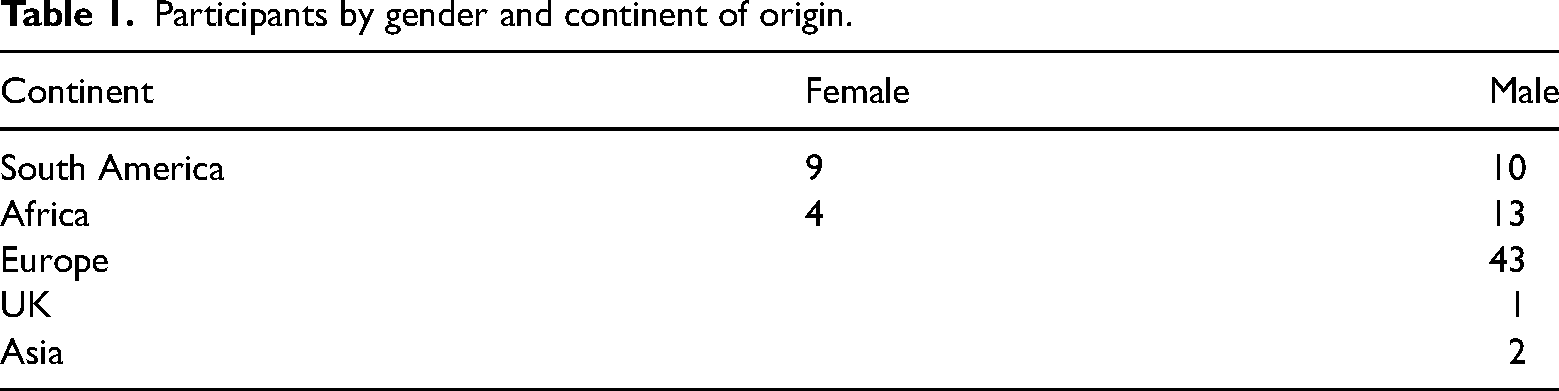
The vulnerability of the interviewees was of primary concern, and the interviews were conducted in line with international best practice and as sensitively as possible (van Liempt & Bilger, 2009). Confidentiality remained a key concern throughout due to the fluid and often imperfect nature of data collection in prison. Every effort was made to ensure suitable privacy including private rooms and secure video call locations, while peer translators were only accommodated at the request of individual participants. Ethical approval was granted by Maynooth University Social Research Ethics Subcommittee and research approval was secured through the IPS Research Committee's formal written submission application and ethics process. As per agreement with local management in the respective prisons, the authors were accompanied to the prison school by officers and participants were escorted on the premise of a professional visit. Due to the scale of Irish prisons and populations (see Table 2), the specific demographics (including nationalities) of the participants have not been included in tabular form to minimise the risk of breaching anonymity. Table 1, however, provides a breakdown of participants by continent of origin.
Participants by gender and continent of origin.
Non-Irish nationality group in custody on 30th September 2023.
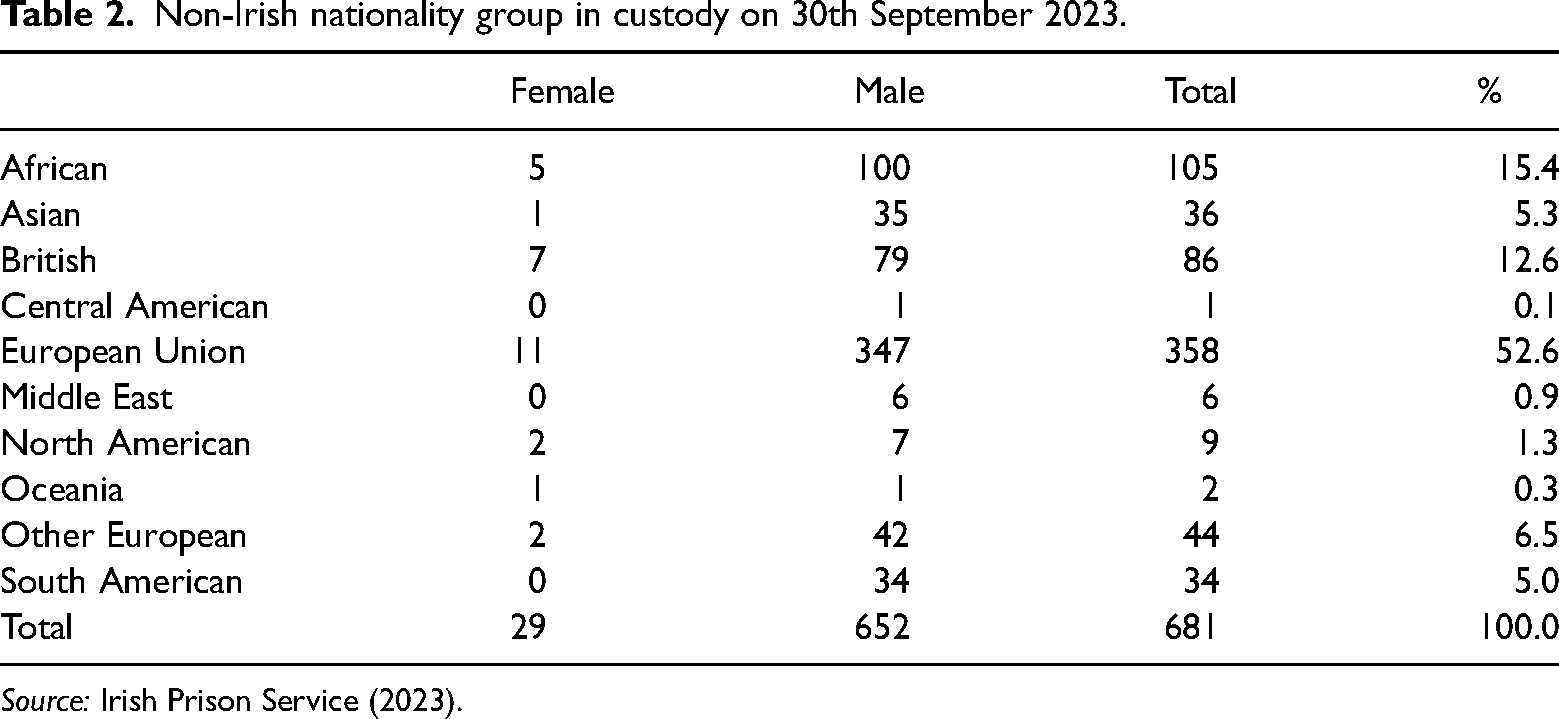
Source: Irish Prison Service (2023).
Prison systems in Europe, almost without exception, have very high proportions of non-national and foreign-born prisoners, and our interviews suggest that Ireland is not an exception in this regard. Although information pertaining to FNPs in Irish prisons is relatively limited (Rogan, 2014), the available data, as of 30 September 2023, reveals that 681 (652 male and 29 female) of the 4,581 persons in custody were FNPs (Irish Prison Service, 2023). Of this number, 52.6% were EU nationals, 23 were European citizens, 67 were British nationals and 62 were African nationals. The remaining nationalities comprised Asian, Central American, Middle Eastern, Oceanian, South American and Caribbean prisoners.
Till et al. (2019, p. 14) note that “broad variations in numbers of detained FNPs are observed between countries occupying traditional Western and Eastern territories” and similar findings emerged from this study. The participants in this study came from 24 different countries, with an age range of 22 to 61 years. The duration of the interviews varied between eight minutes and 75 minutes, with an average interview length of 35 minutes. 3 The interviews were transcribed and stored on institutional servers in encrypted format. Employing thematic analysis (Braun & Clarke, 2006), familiarity was gained with these transcripts before initial codes were identified, generated and reviewed. These codes were subsequently merged into sub-themes, followed by higher order themes, in preparation for the writing-up phase.
Having set out the methodology used in the study, the following sections engage in a thematic discussion of the qualitative findings with a particular focus on staff–prisoner and inmate–peer relationships. It also investigates the degree to which FNPs were subject to racism, discrimination, and differential treatment by fellow prisoners and prison staff in Irish prisons.
Staff–prisoner relationships
“Right” relationships
It has been well-rehearsed that the relationships which exist between prison officers and prisoners are at the heart of prison life (Crawley, 2004; Liebling, 2011; Sykes, 1958) and that these interactions are “crucial to life in prison and affect prison order and prisoners’ well-being” (Beijersbergen et al., 2016, p. 843). The spectrum of staff–prisoner relationships reported by the participants in this study varied from officer to officer and ranged from contemptuous “us and them” positions to more cordial and dynamic relations (Crewe, 2011; Doyle et al., 2022, p. 42; King & McDermott, 1988; Liebling et al., 2011). Reflecting on the nuanced perceptions and experiences of FNPs, and the reported inconsistencies in their treatment by prison staff, a large number of participants found that “some officers are alright, but some officers are not” (T11), that “some of them can be nice, you know, respectful towards you. Some of them can be, you know, rude” (T50) and that “it depends on the staff. Some officers are okay, some officers are not really okay” (T5). Similarly, one prisoner asserted that “when they like you, they treat you good. When they hate you, they make you suffer in prison” (T78). As will be discussed further below, some participants believed that their FNP status was a significant factor in influencing officers’ orientations towards them.
“Dynamic” relations are integral to progressive and humane relations in prison (Coyle & Fair, 2018) and the positive relationships that emerged from the experiences of these prisoners were based on mutual respect (T24, T25). A small number of participants echoed Iversen et al. (2013) in identifying respect as the foundation for good communication between officers and prisoners. A North African prisoner, for instance, reported that: “Officers are very nice, they look after us. They treat you nice, you treat them with respect and they treat you back with respect” (T13).
A common thread running through the testimonies in a recent study on the Irish penal system was positive interactions between prisoners and prison staff (Doyle et al., 2022) and certain participants in this study recounted similar experiences. These interviewees described officers as “very nice” (T37), “good and like they kind of help you with everything” (T35), that they “don’t mistreat us in any way” (T22) and that “they make the life better” (T21). Liebling (2011, p. 491) draws the distinction between “good” versus “right” relationships between staff and prisoners. Good relations are conceived as too close and lacking professional boundaries which do not lead to positive outcomes in prison environments. Right relationships, by contrast, are defined as in-between “formality and informality, closeness and distance, policing-by-consent and imposing order. They were respectful but incorporated a ‘quiet flow of power’”. The importance of right relations was encapsulated by a Lithuanian prisoner who stated that “personally I am happy with what I’m getting from staff, from prisoner staff, you know, like officers … they see you working hard, you always get any help you need” (T2). Analogously, one Nigerian prisoner asserted that there is “no better feeling than (staff) taking you seriously” (T46). Evidently, these officers excelled in what they perceived to be a “human services” orientated role (Hepburn & Knepper, 1993; Griffin, 2011; Liebling et al., 2011). Moreover, they illustrated the capacity of staff to play a central role in the inclusion and integration of marginalised populations (Phillips, 2012; Slade, 2015).
Discretion and differential treatment
Conversely, previous research has revealed negative relationships between FNPs and prison staff as well as an overwhelming lack of respect (Bhui, 2004a, 2004b; HMIP, 2006; Iversen et al., 2013). This was perfectly encapsulated by an individual in a recent OIP report who asserted that “[There's] discrimination against race in the place” (OIP, 2021a, p. 53). While a range of staff professional orientations are evident in the literature, establishing the prevailing, if any, patterns of treatment based on nationality (or ethnicity) remains challenging. However, perceptions such as these that place national identity at the centre of relationships are profound indicators of the lived experience of being an FNP in Irish prisons as distinct from the wider prison population. A Nigerian prisoner in this study – albeit mindful not to characterise all prison officers by the worst excesses of a minority – observed that: “Some staff, they are nice. Some of them are lovely people. But some, no matter what, they don’t care. They just see you as a foreigner in their country. That's all. But not everyone of them are like that” (T28).
Other participants reported that the “officers are not helpful, they treat people badly” (T52), while it was also clear to the participants that some staff simply “just don’t give a fuck” (T37). This theme – which mirrored the findings of studies conducted in other jurisdictions (HMIP, 2006; Iversen et al., 2013; Warr, 2016) – emerged from consistent accounts of differential treatment from prison staff compared to Irish prisoners. One Russian prisoner, for instance, observed “Because we are foreigners it's very difficult for us to get the stuff” (T15), while another Polish participant noted that “Sometimes by some officers, they won’t do something for you because they know you’re a foreigner” (T50). Relatedly, one Brazilian prisoner asserted that “they treat foreigner differently … foreigner they treat them very badly” (T81). While alternative causes may underpin such assertions, the perception of FNP status as a negative factor is revealing of their relationships with officers.
Discretion is a core feature of prison work (Crewe, 2011; Klofas, 1986; Liebling, 2008) spanning the gamut of positive and negative practices, and is inextricably linked to officers’ professionalism and the legitimacy of the prison regime (Carrabine, 2005; Liebling, 2011; Sparks & Bottom, 1995). However, discretion appears, at times, to be exercised in a subtle but deliberate way to deny or delay basic requests from FNPs (Doyle et al., 2022). A Romanian prisoner, to take just one example, observed that “Some Irish people, they go and ask for something and straight away, done. And I keep asking for a week and I can’t get it” (T30), while Nigerian and Polish participants observed respectively that “It takes longer for us to get anything sorted out in prison. Everything takes time for people from abroad” (T52) and that “The way the officers interact with the Irish, you know, it's different from the way they interact with foreigners, you know? Like Irish ask them for something, they will do it quicker than if I ask them” (T27). These perceptions frame the experiences of many of the participants in this study and are reminiscent of findings that emanated from studies conducted in other jurisdictions (Cheliotis & Liebling, 2006; Cox & Sacks-Jones, 2017; Edgar & Martin, 2004; HMIP, 2006; Iversen et al., 2013; Turnbull & Hasselberg, 2017). The aforementioned right relations based on communication and respect could arguably have led to different viewpoints, but such sentiments were unanimous and unaccompanied by alternative interpretations and/or causes for/of their perceived differential treatment. The frustration that such differential treatment provoked was also illustrated by a female prisoner who stated “why they do not treat all the same? Because we are prisoners why they treat differently like this? All of us at the same you have to treat all of us the same” (T81).
Racism and discrimination
At the extreme end of the spectrum, almost half of the participants reported that they had been subjected to racism and discrimination by staff. One Brazilian participant, for instance, revealed that the officers “call you ape, call you monkey, fucking foreigners” (T47), while a Nigerian prisoner revealed that prison staff “treat you like, you know, like something wrong with our skin” (T27). A similar sentiment was expressed by an African prisoner who claimed that “they’re calling me monkey, they’re calling me an ape, they’re calling me a black bastard and all that” (T23). The same participant reported that “the Irish prisoners don’t get treated like the way I get treated. I get treated like a piece of shit” (T23). These perspectives resonate with previous research in the United Kingdom (Bhui, 2004a, 2004b; Cox & Sacks-Jones, 2017; HMIP, 2006; Iversen et al., 2013) where FNPs reported a range of incidents varying from “Racism from officers, shouting ‘fucking foreigner’ and ‘linking all Muslims with bombings’” (HMIP, 2006, p. 10) to staff themselves observing that they “have heard managers and officers make racist comments about prisoners but not to them” (HMIP, 2006, p. 15). Recent reports and public disclosures regarding social media activity − in which racist sentiment and views were expressed − shed light on the attitudes of certain IPS staff to diversity and inclusion (Gallagher, 2021), but some of the personal recollections and experiences of racism documented were “more covert, less obvious, less said” (Phillips, 2012, p. 178). This was captured by a number of participants who noted that “you can feel the difference” (T6) and that racism in the Irish prison system is “hidden. I only can feel it in the talk” (T13). This could, of course, be a case of what Edgar and Martin (2004, p. 20) term “informal partiality”, but these sentiments coincide with previous research conducted on race relations in the UK prisons (Joly & Beckford, 2006, p. 13) where FNPs referred to what thay termed a “racedar”, or “an intuitive sense or belief about an individual's racism even if it was not articulated through the use of racist language” (Phillips, 2012, p. 177). Similar sentiments were expressed by the FNPs in this study who believed that they were treated “totally different” (T18) or who felt that “everybody else wasn’t treated the same” (T42).
Complaints
Gresham Sykes (1958, p. 41) argues that “the most striking fact about this bureaucracy of custodians is its unparalleled position of power – in formal terms, at least” and this power imbalance is particularly evident with respect to the complaints mechanism (Doyle et al., 2022, p. 43). All prisoners must be provided with information on how to make a complaint inter alia upon entry to prison (Doyle et al., 2022, p. 36), but the Council of Europe's Committee for the Prevention of Torture (CPT) reported that there are significant delays in investigating complaints regarding staff abuse, including racial abuse and discrimination, in several Irish prisons (CPT, 2014, 2020). Notably, only a minority of the FNPs interviewed for this study reported that they were informed on how to make a complaint. One Nigerian participant, in particular, highlighted the lack of knowledge that they had regarding the complaints system: “I’ve been in prison for six months before I found out about any complaints system or a complaint form” (T46).
The Prison Rules (2007) specify the duty imposed on prison staff with respect to prisoner complaints, but many of the participants in this study exhibited ambivalence towards the complaints’ procedure. The rationale underlying this ambivalence ranged from no need to make a complaint, distrust of what was perceived to be a flawed complaints process, a belief that the complaint would not be taken seriously or ignored, to a fear of repercussions from prison staff should a complaint be tendered. One Vietnamese prisoner, for example, stated “I don’t want to make any complaint, everybody is nice here” (T21), while other interviewees, similar to prisoners in other jurisdictions (see Cox & Sacks-Jones, 2017), indicated that they would not be prepared to lodge a complaint due to the fact that they “don’t believe it will be solved” (T34), “I don’t think I would be listened to, we’re only prisoners” (T45) and because “when you make a complaint, the complaint doesn’t go anywhere” (T37). More ominously, a Middle Eastern prisoner stated that he “didn’t want to put a complaint because I was worried and scared about how the complaint would work” (T13), while a Brazilian prisoner espoused the view that “In the jail you complain, and you start to get discrimination” (T47). Similarly, one female Brazilian asserted that “if you go against the prison system, you’re putting yourself in a very vulnerable position” (T71). One final challenge for prisoners in engaging with the complaints’ procedure was the lengthy waiting times, or lack of response following the lodgement of a complaint. Indeed, one Lithuanian prisoner stated that there was “still no answer for complaint” (T45). This procrastination tactic was also identified by a prisoner in an English study who observed “I haven’t had any response, you’re just told to ignore it, just get on with it” (Cox & Sacks-Jones, 2017, p. 13).
Recent Irish scholarship has identified longstanding problems with the complaint mechanisms for those confined in Irish prisons, including inter alia lacking independence, transparency, and timeliness (van der Valk & Rogan, 2021). Indeed, within wider discourses on the necessity of Optional Protocol to the Convention against Torture and other Cruel, Inhuman or Degrading Treatment or Punishment ratification in Ireland, the calls for a dedicated and independent Prison Ombudsman stem, at least in part, from the failures and illegitimacy of the complaints system in its current form (Houses of the Oireachtas, 2023). 4 It is notable that the complaint system is, at the time of writing, under review but a reformed system is yet to materialise. The distrust of the complaints system, evident among the general prison population, is thus compounded for the FNPs due to the perceived prejudice that they believed existed among prison staff based on national identity, or more specifically, lack of “Irishness”. These perceptions, and other discriminatory practices, exacerbated the sense of isolation and marginality experienced by the participants in this study.
Inmate–peer relationships
Racism and discrimination
Although the Nelson Mandela Rules (2016) explicitly state that “there shall be no discrimination on the grounds of race, colour, sex, language, religion, political or other opinion”, a large proportion of the FNPs interviewed in this study reported that they were subject to racism, discrimination, and differential treatment from fellow prisoners because they were not of Irish nationality. While one Polish participant observed that “I get along with lads on the landing very well, they actually stepped in and told the other Irish guy (who was being racist), you know, ‘that's unacceptable’” (T46), this appears to be the minority experience. Two Nigerian participants reported, for instance, that they were “suffering racism” (T54) and “discrimination everything in the jail” (T47), while four interviewees reported being called a “black bastard”. These findings are not peculiar to Irish prisons as previous research in the United Kingdom has highlighted instances of racism and discrimination between prisoners, and particularly emphasised the use of derogatory language towards foreign nationals (Cox & Sacks-Jones, 2017; HMIP, 2006). Moreover, there were instances in this study where Irish prisoners exacerbated the displacement experienced by FNPs by shouting remarks such as “oh you foreigner, you came to our country and stole our money. Go back to your fucking country” (T28) and “go back to your country, you foreigner” (T54). Research conducted in the United Kingdom has revealed that such racially abusive comments not only reflect negative prejudices about immigrants, but they also include explicit references to colour or ethnicity, being stereotyped as like everybody else of the same ethnic background or colour, and derogatory comments passed off as jokes (Burnett & Farrell, 1994, p. 14). Equally, an East African prisoner vividly illustrated the racist insults that he endures on a daily basis: Go out to the yard. And somebody is looking at you like “what do you want? You black bastard, get away from me”. You end up fighting because somebody calls you a black bastard. Yesterday, I was walking through the landing, a fella was standing opposite me, I was just walking beside him, and he said “ah, you look like a monkey”. I went into his cell, about halfway, the door was open, and I went into him, and I say “what you saying? Can you repeat what you're saying?” Because I was gonna end up smacking him and he changed it. He said “ah, I called you a donkey”. That's what you’re facing. (T23)
Notably, two prisoners in this study opined that skin colour and nationality are important factors in determining the amount of racism and discrimination that FNPs receive. White FNPs, for instance, were more likely to report that they had not experienced instances of racism or discrimination from staff or prisoners than black FNPs. As one prisoner put it, “when you are white, you don’t have too much racial comments towards you. They do call you foreign bastard, colour is important too though” (T48). This sentiment mirrored findings that emerged from a study conducted in England and Wales where prisoners stated that “you get treated better as white foreign national than a black person” and “black people, or who are more identifiably from a different country are treated much more poorly” (HMIP, 2006, pp. 10–11). This “less alien” idea was captured by a British foreign national who described his experience within an Irish prison: The Irish prisoners see me as one of them. We have a laugh and a joke and things like that. I know I’m a foreigner, they know I’m a foreigner, but we’re the same. It's not like I’m Polish or something like that. So I’ve not really had any problems. (T49)
The potential existence of a racial and/or ethnic hierarchy emerged in testimonies, although it appears that a hierarchy of “otherness” would be a more apt description. For example, some participants from “white” and culturally Christian jurisdictions indicated that access to integration was not always as easily afforded to black FNPs. However, the perceived variables of “sameness”, or shared cultural attributions, appeared to traverse other differentiating characteristics including skin colour. This point was documented in a recent study of ethnic minorities and FNPs in Ireland (Doyle et al., 2022), where a “black Irish” participant indicated that they were accepted within the prison population because they spoke in a recognisably “local” accent. Notably, this participant felt that this form of “cultural capital” (Bourdieu, 1977) stemmed from a realisation among the Irish prisoners that they were less “other” because they were reared in Ireland which carried value. Such cultural capital was not easily accessible to FNPs more broadly, especially among recent arrivals who were bereft of both the English language and local regional argot.
Interaction with Irish prisoners and other FNPs
Language barriers permeate various aspects of the prison experience for FNPs (Bhui, 2009; Iversen et al., 2013) and the extent to which language proficiency impeded the ability of some participants to form relationships with Irish prisoners and other FNPs became apparent throughout the study. As one Brazilian woman stated succinctly, “if she speak (English), she could have more friends, it's not about her, it's about language” (T79). Yet notwithstanding the issue of language, the majority of the FNPs interviewed stated that they were happy to mix with fellow prisoners from other nationalities. Prisoners from Africa, Eastern Europe and South America reported respectively that they “mix well with everybody” (T27), “we all mix” (T24) and “I mix with everybody” (T33), while a Portuguese interviewee asserted that “as long as they’re nice people, I have time for them” (T25). The benefit of mixing beyond an individual's own nationality or ethnicity was captured by a Lithuanian interviewee who pointed out that prisoners who “start to mix with other people learn English faster, their communication skills become better, you know, how they get on in prison becomes easier” (T11). Similarly, a Nigerian participant observed that mixing with prisoners from different countries meant that “they will teach me their language, I will teach them my language and we mix up well” (T27). That said, prisons are “inherently dangerous places” (Foster, 2005, p. 99) and an African participant – while observing that he is happy to “talk to anybody who wants to talk to me” – noted that “you have to watch your back in everything you do, in everything you say because it's prison, it's a different environment” (T71). Although many FNPs reported feeling safe in Irish prisons, another African interviewee observed that “you don’t feel safe when you’re a foreigner, you don’t wanna go to a landing when you’re the only one as a foreigner there, you are treated really bad” (T37). Relatedly, an English participant, perhaps mindful of anti-British sentiment, noted: I am on the landing where I am the only foreigner yeah? And there are 36 people on the landing and when you are the only foreigner and then you have everyone from Dublin, it's hard you know? You can’t really feel safe, you know? (T50)
Having FNP status, therefore, is not prescriptively isolating for many in Irish prisons. Despite the more pronounced “racial sorting” (Bloch & Olivares-Pelayo, 2021), and associated fault lines evident in the international literature, nationality per se did not necessarily dictate FNP experiences in Irish prisons. Rather, the data that emerged from the interviews presents nationality as an essential delineation to be navigated and negotiated. Yet while certain participants appeared to navigate social structures – such as the aforementioned hierarchy of otherness – with varying degrees of success, other interviewees identified “discernible cliques or groups” based on nationality (Tetrault et al., 2022). One Romanian participant asserted that “I never see any black prisoner in the yard. I can see, you know maybe Polish. Romanian you know? They will all be there with themselves” (T52), while another Romanian prisoner opined “Romanian Gypsies do stick sometimes because kind of the society. They feel a bit excluded by the society. Sometimes Polish too, especially at the beginning when they don’t speak English” (T67). Martynowicz (2018) has written that Polish prisoners in Northern Ireland actively sought to be placed with other Polish prisoners due to language difficulties, cultural differences and experiences of xenophobia, and it also appears that Polish prisoners in the Irish Republic prefer to solely mix together and “form their own little click” (T68). One Polish participant, albeit stating that he was happy to mix with everyone, indicated that his preference for mixing with prisoners of his own nationality. He observed “of course, I prefer to hang out with prisoners from Poland. But I hang out with everyone” (T35). On the other hand, it is not uncommon that “coming from a particular national or ethnic background can constitute grounds for discrimination” (Berket, 2015, p. 366) and a number of participants observed that they mixed with a “very small” number of Irish prisoners (T52), that the Irish “don’t want to stay with us” (T19), that “Irish people don’t like to mix with foreigners” (T40) and that “it's very difficult to go with Irish” (T81). A similar sentiment was expressed by a Romanian participant: If I walk onto a new landing and don’t know people like and they see that I’m foreign, they wouldn’t come up to me like, “where you from? What's up?” … but if some Irish fella just walked onto the landing, like everyone just goes “oh, how are you?” (T31)
Cell-sharing
It has been well documented that cell-sharing may have a profound effect on prisoners at an individual level, producing stress through inter alia unwanted noise, lack of privacy, and behavioural interference (Michalon, 2020; Molleman & van Ginneken, 2015; Schliehe & Crewe, 2022; Turner & Knight, 2020). Cell-sharing may also increase the risk of victimisation due to interpersonal tension, not to mention racial or cultural differences (Molleman & van Ginneken, 2015), but a number of the participants in this study reported that Irish prisoners were reluctant to share cells with FNPs. Comments on the landings were reported by a Lithuanian prisoner to include “awh no you’re getting a foreigner” (T46), while an Italian interviewee revealed that “most of the time when an Irish prisoner enters into the landing, they ask ‘is there any foreigners?’, that's their first question they wanna double up with the Irish” (T40). The positives of cell-sharing include its potential to reduce loneliness, boredom and isolation (Muirhead et al., 2023, p. 336), while other studies have shown that prisoners in shared-cells may experience more social interaction and emotional support, which can potentially alleviate feelings of distress (Molleman & van Ginneken, 2015, p. 1033). Put otherwise, an Irish cellmate could hypothetically provide a means of practical and emotional support to an FNP (van Ginneken, 2022, p. 45), but the abovementioned Italian participant stated that “when (Irish prisoners) see different nationalities, they don’t go to that cell” (T40). The reluctance of certain Irish prisoners to share cells with FNPs was also clearly captured by one Nigerian interviewee: They took me to another cell with another person and the Irish prisoner say “no, no, no I don’t want him” . … They took me to another cell and the fella said “no, no, no, no, no, not again. No. I don’t want him” … and they took me to the third one who said “no, no, no”. And the officer said “well, you don’t own the landing so you can’t tell me who to bring to you”, they said “I want somebody else, I don’t want him” … and the officer just force me into the cell. I sat down on the floor, I was crying maybe because I’m foreigner, that would be the best answer for it. (T27) For me, that's isolation. Because sometimes in your room, yeah you want space to yourself. But you still want to talk … if you guys can’t communicate and just sit there with your own thoughts. Mentally, that's no good for anybody. (T46)
The Council of Europe Recommendation CM/Rec (2012) 12 of the Committee of Ministers to member states concerning foreign prisoners sets out a range of measures that states can take to reduce the potential isolation faced by FNPs, for example, by grouping prisoners of the same national, cultural or religious background in the same area of the prison, where it is safe and secure to do so (CM/Rec (2012) 12, rule 16.3). A recent Irish study also provided evidence of the prison authorities transferring ethnic minority prisoners, from cells where they experienced racism, to cells with prisoners with a similar national or ethnic background (Doyle et al., 2022, p. 34). This, of course, is not a uniquely Irish solution to the issue of racism or to the communication problems that inevitably arise from cell-sharing between prisoners from different cultural backgrounds and who speak different languages. Staff in other jurisdictions are also encouraged to consider the suitability of cellmates in terms of cultural background and language proficiency (van Ginneken, 2022, p. 44), but this unavoidably results in FNP-only cells which certain participants opined causes further segregation and isolation through a form of “racial sorting” (Tetrault et al., 2022). This was illustrated by the statement of one interviewee who observed that “if I stay in the Polish cell, most of the time I speak with the Polish people” (T36). Another Eastern European prisoner also contended that this practice exacerbated segregation: that's literally the way in Ireland the non-Irish will end up in their corner, their circle there's your circle, there's our circle and that's that. Sometimes it's a preference as well for non-Irish to stay within their own circle. I think nowadays all are talking about mixing culture and improvement and all that, but you don’t see if like if everyone's still in their own circle. (T46)
Conclusion
The article responds to the pressing need for more in-depth research on whether racism is “exacerbated behind the prison walls” in Ireland (Doyle et al., 2022, p. 46) and demonstrates the importance that race and relationships play in the daily lives of 82 FNPs in Irish prisons. Drawing on these bottom-up perspectives, the findings reveal that many FNPs in this study were subject to racism, discrimination, and differential treatment from fellow prisoners and a minority of prison staff. This is not to suggest that all FNPs were subject to racist abuse, that foreign prisoner officers were immune from similar racial taunts and harassment (DEC-E2017-045), or indeed that all Irish prisoners or prison staff engaged in this type of racist or discriminatory behaviour. In fact, FNPs in certain prisons received no racist abuse whatsoever, while a number of participants reported positive and respectful interactions with prison staff who went beyond the call of duty to assist them. In one sense, these experiences, derived from the prisoners themselves, serve to remind us of both the racist proclivities of a cohort of serving prison officers in Ireland (Gallagher, 2021), but also of the dangers of characterising all prison officers by the worst excesses of a minority.
More fundamentally, the findings of discrimination and racism that emerged from this study are entirely incompatible with the principle of non-discrimination, enshrined in the Mandela Rules (Article 2) and completely undermine the relationships that are central to life in prison (Beijersbergen et al., 2016). On the one hand, inmate relationships are crucial as they can provide emotional support, assist inmates to forge an identity, learn about social relationships in prison and develop an understanding of a prison subculture (Bronson, 2008), while positive interactions and constructive relationships between staff and prisoners − characterised by mutual respect, fairness, and trust (Beijersbergen et al., 2016; Snacken, 2005; Sparks et al., 1996) − have been found to better mental health, lower misconduct, and even reduce recidivism (Beijersbergen et al., 2015, 2016). On the other hand, racism experienced by prisoners negatively impacts on mental and physical health, self-identity and self-esteem (Paradies et al., 2015; Wallace et al., 2016; Williams et al., 2019; Williams & Etkins, 2021), and produces “feelings of confusion, self-doubt, and alienation, further unsettling prisoners in their quest to survive and cope in prison” (Phillips, 2012, p. 185). In other words, positive inmate–peer and staff–prisoner relationships alleviate the “weight of imprisonment” (Crewe, 2011; King & McDermott, 1995), while “[t]he hurt and humiliation of discriminatory practices in prison, over which prisoners have little or no control, represents another layer of the diminution of the self” (Phillips, 2012, p. 185). The Irish prison system is, by no means, unique in that racism permeates inmate
Finally, the experiences of FNPs examined in this article may serve to prompt further investigation in to perceived hierarchies of otherness. The categorisations and adaptations required to negotiate and navigate such hierarchies are unavoidable for FNPs but may dictate their experiences, interactions and relationships with peers and prison staff. While it is reasonable to argue that Ireland's relatively recent history of immigration has spared it some of the entrenched racial or ethnic delineations evident in the international prisons literature, it seems likely that FNP status may increasingly become a determinate factor in the lived experiences within the Irish prison milieu.
Footnotes
Acknowledgements
We are grateful to the Irish Research Council New Foundations Scheme (2020) for funding this research and to Dr Diarmuid Griffin (University of Galway), Dr Roisin Mulgrew (University of Galway), Nuala Kelly (Pavee Point), Brian Hanley (Irish Council for Prisoners Overseas) and Catherine Kenny (Irish Council for Prisoners Overseas) for their advice and comments on previous drafts. Special thanks are also due to the Irish Prison Service for granting access and facilitating the research, and to the teachers in the respective prisons in which the fieldwork was conducted. Finally, we are especially obliged to all the interviewees who participated in this study.
Declaration of conflicting interests
The authors declared no potential conflicts of interest with respect to the research, authorship, and/or publication of this article.
Funding
The authors disclosed receipt of the following financial support for the research, authorship, and/or publication of this article: This work was supported by the Irish Research Council (grant number New Foundations Scheme, 2020).
