




Abstract
In recent years there has been growing attention for so-called crimmigration prisons: all-foreign prisons with immigration staff embedded where not rehabilitation, but deportation is the ultimate aim. Following Norway and the United Kingdom, since 2014 the Netherlands is another country with such a prison. This article analyses penal policies in the Netherlands vis-à-vis foreign national prisoners, including the establishment of the crimmigration prison. Drawing on extensive empirical fieldwork in the crimmigration prison, it subsequently examines how this is experienced and understood by both prison officers and foreign national officers. The results show that the limited opportunities to work on rehabilitation means that prison officers struggle to find meaning and satisfaction in their work. For prisoners, experiences in the crimmigration prison strongly depend on their subjective identity and attachment to the Netherlands. Whereas the lack of meaningful activities and remote location of the prison considerably add to the pains they experience, specific elements of the prison also help to mitigate some of the pains foreign national prisoners most commonly experience, especially isolation and uncertainty. The article finishes by a discussion about what this says about how the state should treat individuals it seeks to both punish and deport.
Keywords
In many European countries the growing merger between criminal justice and migration control – also referred to as crimmigration – has had drastic implications for both the nature of the prison population and the characteristics of punishment (Aas, 2014; Stumpf, 2006). First, as migration acts have increasingly been criminalised, and many states have lowered the threshold for terminating migrants’ legal right to stay following a criminal conviction, the number of foreign national prisoners in many – primarily western – European countries has considerably increased (Ugelvik, 2014). Second, states increasingly see deportation as a legitimate instrument of crime control and a way to protect public safety (Turnbull and Hasselberg, 2017). As a result, the punishment of foreign national prisoners has undergone drastic changes, being aimed primarily at deportation instead of deterrence and rehabilitation. This has serious consequences for how punishment is experienced (Bosworth et al., 2016).
It has been observed that penal interventions directed at foreign nationals without a legal right to stay in the country are no longer limited to defining society’s moral boundaries, but also about establishing the boundaries of belonging and membership (Bosworth et al., 2017). As various scholars have pointed out, the result of such developments is the emergence of a parallel criminal justice system for foreign nationals that takes on aims that are traditionally within the realm of migration control (Fekete and Webber, 2010; Kaufman, 2015). Aas (2014: 525–526) refers to this parallel penal system as ‘bordered penality’, observing that ‘when deprived of their freedom, foreign national prisoners are increasingly placed in separate institutions, or institutional arrangements, and afforded different procedural treatment and standard of rights than citizens.’ When the criminal justice system is directed at foreign nationals, it becomes more openly exclusionary: the aim is no longer to prepare prisoners for their return into society, but to permanently exclude them from the territory (Bosworth, 2011a). Citizenship has come to constitute a ‘legitimate sorting device’ between inclusive and exclusive sanctions (Turnbull and Hasselberg, 2017: 136).
The most direct expression of bordered penality is the creation of separate prisons specifically for foreign nationals. In several European countries such ‘crimmigration prisons’ have emerged that exclusively hold foreign national prisoners and ‘where immigration control purposes either are added to, or replace, such traditional aims of prisons as punishment, deterrence and rehabilitation’ (Ugelvik and Damsa, 2018: 1026). Although the concept of crimmigration has been criticised on multiple accounts, including for overemphasising the aspect of criminalisation (Kaufman, 2015; Moffette, 2018), it has always been intended to capture a bi-directional process, where crime control and migration control start to overlap. It not only entails deploying the criminal justice system to deal with unwanted migration, but equally the use of migration control in response to crime. It is for this reason this article uses the term crimmigration prisons for institutions where individuals are simultaneously subjected to crime control and migration control measures, and where both systems of social control are deployed to achieve the dual aim of punishment and deportation.
Two examples of crimmigration prisons in the European context have been well documented. Under the hubs-and-spokes policy in England & Wales, several prisons have been designated all-foreign prisons, with immigration staff embedded and prison officers working as quasi-immigration agents (Kaufman, 2015). Quite similarly, Kongsvinger prison in Norway has since several years been exclusively reserved for foreign national prisoners who are less than two years from their likely deportation (Ugelvik and Damsa, 2018). Although the practical implementation differs, these prisons have in common that prisoners are expected to be deported upon completion of their sentence, thus rendering rehabilitation activities aimed at return into society irrelevant (Pakes and Holt, 2017). As such, the prison has become an instrument of border control, playing a role in shaping national identity and the borders of citizenship (Kaufman, 2014).
In their comparative study of crimmigration prisons in England & Wales and Norway, Pakes and Holt (2017) claim these are the only countries in Europe with dedicated foreign national prisons. However, since 2014 the Netherlands also has such a specific prison, located in the small town of Ter Apel. So-called departure supervisors of the Repatriation and Departure Service (DT&V), a specialised organisation responsible for returning unauthorised migrants to their country of origin, are working inside this prison to ensure prisoners are deported at the end of their sentence. Despite these significant developments, empirical research into the punishment of foreign national prisoners in the Netherlands is virtually non-existent (Bolhuis et al., 2017; Boone and Kox, 2012). This article therefore analyses more in-depth these recent changes in the punishment of foreign national prisoners in the Netherlands and examines how this is understood and experienced by both prisoners and prison officers. The latter group has so far been somewhat neglected in the handful of empirical studies on crimmigration prisons.
As various scholars have argued, there is a need for combining macro-level, broad analyses of penal policies with more in-depth, empirical examinations of prisoner experiences (Bosworth et al., 2017; Crewe, 2015; Ugelvik and Damsa, 2018). On the one hand, analyses of macro-level penal policies can be significantly enriched by empirical assessment of prisoner experiences. On the other hand, understanding how imprisonment is experienced requires taking into account the wider context of macro-level penal policies. In other words, a comprehensive understanding of the why and how of prison requires studying penal policies, prison characteristics, and prisoner experiences in conjunction. To that end, the article first provides an examination of the Dutch penal policy framework vis-à-vis foreign nationals as well as the characteristics and regime of the all-foreign national prison in Ter Apel. This is followed by an exploration of the experiences of those working and imprisoned in Ter Apel prison, drawing on in-depth interviews with prisoners and prison officers. In doing so, the study contributes to a small but growing body of scholarship concerned with providing a more empirical understanding of how bordered penality policies are implemented and experienced ‘on the ground’ (cf. Turnbull and Hasselberg, 2017).
Foreign national prisoners in the Netherlands
It is important to realise that only a part of the population of foreign national prisoners also lacks the legal right to stay in the country and therefore faces deportation. Foreign national prisoners who do have a legal right to stay in the Netherlands are not subjected to bordered penality, but imprisoned with the regular prison population. All prisoners in Ter Apel have either never had a legal right to stay in the Netherlands or this has been revoked following a criminal conviction, In this article the term foreign national prisoners is therefore used to refer to prisoners without a legal right to stay in the Netherlands. The decision to revoke someone’s residence permit following a criminal conviction is made by the Immigration and Naturalisation Service (IND), taking into account the length of legal residence, the seriousness of the offense, and various human rights provisions, in particular the prohibition of torture and the right to private and family life. This decision can be contested in court, and many prisoners in Ter Apel still had their case pending for a final decision (Brouwer, 2020).
Table 1 shows the number of foreigners imprisoned in the Netherlands on 1 September of each year, based on data from the annual SPACE reports of the Council of Europe. Slightly more than 20% of the prisoners in the Netherlands are foreigners, roughly the same as the European average. Because of the growing use of alternative sanctions, in recent years the total number of prisoners, including foreigners, has considerably decreased.
Foreign national prisoners in the Netherlands.
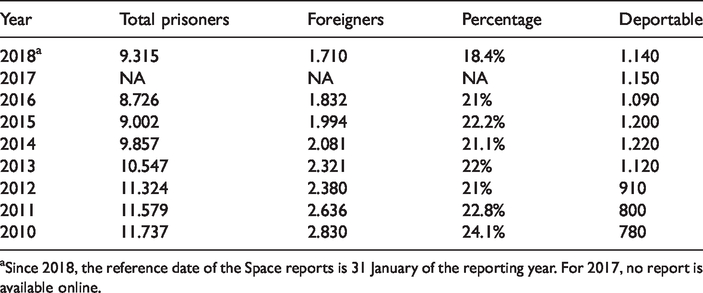
aSince 2018, the reference date of the Space reports is 31 January of the reporting year. For 2017, no report is available online.
The figures in the last column come from DT&V and show the number of deportable foreign national prisoners released from prison per year – they have either been deported or released in the Netherlands as unauthorised migrant. These numbers are therefore not directly comparable to the number of foreigners, which counts the number of foreign prisoners on 1 September instead of throughout the year. However, there is a clear trend discernible: whereas the number of foreigners has gradually decreased since 2010, the number of deportable foreign national prisoners has increased, especially since 2012. Besides the fact that foreign nationals are generally excluded from non-custodial sentences, two other factors are likely to have played a role in this. First, the rules on revoking someone’s residence permit following a criminal conviction have become much stricter, resulting in more foreigners holding legal membership losing their right to stay (see for a more in-depth examination of this, Brouwer, 2020). Second, the systems of crime control and migration control have become much more integrated in recent years. As a result, the detection of foreign nationals in the criminal justice system has become much more efficient.
During the same period, punishment of foreign nationals has drastically changed. Although resocialisation 1 is traditionally considered a crucial element of punishment in the Netherlands, in recent decades the development of a ‘Dutch culture of control’, similar to other European countries, has meant the principle seems to have lost some of its importance (Downes and Van Swaaningen, 2007; Pakes, 2004). Various authors have noted how a strong law and order discourse has emerged that combines a strong focus on protection of the public with growing concerns about immigration and (crime committed by) foreigners and ethnic minorities (Brouwer et al., 2017; Pakes, 2004; Van Swaaningen, 2005). Driven by discourses that fit within Feeley and Simon’s (1992) new penology, crime control policies increasingly focus on identifying and targeting specific offender groups that are considered particularly dangerous (Downes and Van Swaaningen, 2007). Moreover, the main aim of penal interventions has shifted to temporary or permanent exclusion of unwanted individuals, through practices described as ‘banishment modern style’ (Van Swaaningen, 2005: 296).
Nonetheless, resocialisation is still considered an important aim of punishment for most prisoners in the Netherlands. It has therefore been argued that the Dutch criminal justice system can best be characterised as a system of bifurcation, with inclusive sanctions for some groups of offenders and exclusive sanctions for others (Boone, 2012a; Cavadino and Dignan, 2006). Given the concerns about criminal immigrants, it is not surprising that the absence of citizenship serves as an important factor in drawing the line between inclusive and exclusive forms of punishment. Indeed, Boone (2012b: 1) states ‘that irregular migrants are almost totally excluded from the regular rehabilitation opportunities in the Netherlands.’ As such, the bifurcation of the Dutch criminal justice system is strongly reminiscent of Aas’ (2014) bordered penality. This is also illustrated by a 2009 letter from the Minister of Justice to the parliament about the policy regarding criminally convicted foreigners: Within the return policy, high priority is given to the return of criminal migrants and migrants demonstrating anti-social behaviour. This is why from the viewpoint of ‘deport or detain’, all efforts are focused on deporting criminal illegals. If this is not (yet) possible, efforts will be made to detain the criminal illegal as long as possible, with the aim of eliminating nuisance for society.
2
There were two main reasons for placing all deportable foreign national prisoners together. First, in the proposal for the creation of a separate prison regime for foreign nationals, the former Minister of Security and Justice explicitly stated that: This group differentiates itself from other prisoners in that resocialisation aimed at return in the Dutch society is not at stake and principles such as prison leave, regionalisation [placing offenders in a prison near their family members, JB] and detention phasing [placing detainees in more open regimes to prepare them for release, JB] are not applicable.
The second reason for placing foreign national prisoners together is that it offers better possibilities to work on their deportation during imprisonment. Departure supervisors of the DT&V have their offices located on the prison grounds and regularly meet with prisoners in order to organise their departure from the Netherlands. As such, migration control has become a firmly integrated part of the punishment of foreign nationals in the Netherlands.
The pains of crimmigration prisons
Building on Sykes’ (1958) famous pains of imprisonment, Crewe (2011a, 2015) argues that different prisons lead to different experiences and that even within a prison people might have very different experiences. In order to better understand these differences, he proposes a conceptual framework that comprises four elements that make up the pains of imprisonment. The first element is depth and refers to the feeling of being far away from society, of ‘being buried way beneath the surface of freedom’ (Crewe, 2015: 54). The second element – weight – refers to how imprisonment can be a psychological burden for prisoners, bearing down upon prisoners’ shoulders. This is often strongly related to the behaviour of, and relationships with frontline staff. As Ugelvik and Damsa (2018: 1029) write, ‘“weight” is not about prison conditions as such, but the way particular conditions can be seen to communicate something about prisoners’ moral status.’ Next, tightness is related to the increased ‘softness’ of penal power (Crewe, 2011b), which results in growing emphasis on the responsibility of prisoners to change for the better. Finally, breadth deals with the imposition of continuous disciplinary control after a custodial sentence.
When it comes to penal experiences, foreign national prisoners were long considered a forgotten group, but in recent years this has started to change. Several studies have shown how foreigners tend to feel particularly isolated in prison, as they face cultural and language barriers, struggle to stay in touch with family members, and have difficulties obtaining information about prison life and their immigration status (Bhui, 2007; Kaufman, 2015; Ugelvik and Damsa, 2018). Warr (2016) described three distinctive pains experienced by foreign nationals: the deprivation of certitude, legitimacy and hope. In a Dutch study conducted before the establishment of the all-foreign prison in Ter Apel, Kox et al. (2014) found that foreign national prisoners in the Netherlands experienced similar pains as other prisoners. However, there were three additional pains that were explicitly related to their status as unauthorised migrants. First, they struggled considerably more to stay in touch with the outside world. Second, a lack of possibilities to prepare for their release, uncertainty regarding their release date, and the threat of possible deportation created considerable emotional distress. Third, language barriers prevented effective communication with staff members and other prisoners. All these factors considerably aggravated the risk of social isolation for foreign nationals.
Both Kaufman (2014, 2015) and Ugelvik and Damsa (2018) have explored more directly the role of bordered penality policies and crimmigration prisons for the experiences of foreign national prisoners. Writing about England & Wales, Kaufman (2014) shows how under the hubs and spokes policy questions of belonging became part of everyday prison life. As a result, a stigma of being ‘foreign’ and concerns about deportation played a crucial role in daily experiences. She accordingly argues that ‘policies like hubs and spokes shape the “pains of imprisonment”’ (p. 139, emphasis added). Similarly, Ugelvik and Damsa (2018: 1040) write about experiences in Kongsvinger prison that ‘the crimmigration prison produces its own specific pains and frustrations.’ They find three pains specifically related to the crimmigration prison: the pain of discrimination, the pain of long-distance relationships, and the pain of deportability.
Whereas there is the beginning of a body of scholarship on the experiences of prisoners in crimmigration prisons, to date research with prison officers in these institutions is still very limited. The conduct of prison officers is considered to be central to the legitimacy of a prison, and therewith the existence of a safe and humane environment. Liebling (2011) argues that two factors are central to the work of prison officers. First, the importance of relationships between prisoners and prison officers. Second, the challenge of maintaining a balance between ‘welfare and discipline, or care and power’ (p. 485). Research with prison officers in the Netherlands found that besides maintaining order and safety, resocialisation was seen as an important aim of their work. Especially the feeling that they could contribute in a positive way to the future of prisoners was an important part of the satisfaction of the job (Molleman and Van Ginneken, 2013). Indeed, there is some research on prison officers in bordered prisons that found that they often felt uncomfortable with the differential treatment of foreign nationals and struggled with the lack of traditional justifications of punishment (Bosworth, 2011b).
Methodology
A total of 37 prisoners were interviewed in Ter Apel prison. Respondents were sampled with the aim of capturing as much diversity as possible, both in terms of national background, age, prison sentence, time spent in the Netherlands before being arrested, and remaining prison time left. Sampling was a combination of purposive sampling and convenience sampling (cf. De Ridder, 2016). Potential respondents were provided with an information letter distributed by the prison officers, asking whether they wanted to participate in an academic study. When they agreed, a time slot was agreed on the basis of their schedule and availability of rooms to conduct the interview.
The interviews were conducted by different researchers, in order to be able to include respondents who did not have a language in common with the lead researcher. This greatly increased the number of potential respondents and the diversity of the final sample. Speaking the same language also helped to build trust and create a sort of common understanding, something particularly apparent during interviews in French or Spanish. At the same time, factors such as age, gender, nationality, and personality of the interviewers are likely to have influenced the interview and therefore the nature of the data. Although there is no space here for a thorough reflection on reflexivity and researcher positionality (for this, see Brouwer, 2020), it is evident that the interviewer’s identities affected the relationship with respondents and interactions during the interview (Phillips and Earle, 2010). At the same time, recent research with foreign national prisoners in Norway by two completely different researchers suggests such differences do not necessarily have to lead to different findings (Damsa and Ugelvik, 2017).
Interviews lasted anywhere between 20 minutes and more than an hour. They took place in the offices of the DT&V, as this was one of the few places inside the prison where one can establish an acceptable level of privacy. Although this sometimes generated some issues of distrust, this could quickly be addressed when researchers explained who they were and what the interview was for. Every respondent signed an informed consent form before the interview started and was given the opportunity to ask questions about the interview, the research project or the researcher. Where possible, respondents were interviewed in their native language or another preferred language; translators were never used. All interviews were recorded and subsequently transcribed, except for two respondents who preferred not to be recorded. Transcripts of interviews in another language than English have been translated by the interviewer.
Following the interviews with prisoners, eight semi-structured interviewed were conducted with prison officers working in Ter Apel. All these interviews were conducted in Dutch by the author of this article. Prison officers differed strongly in their age and years of experience. These interviews lasted between 40 minutes and almost 2 hours and all of them have been recorded and subsequently transcribed. All interview transcripts have been analysed and coded according to relevant research themes using the qualitative software program NVivo. Throughout this article pseudonyms are used to ensure the anonymity of respondents.
Experiencing the crimmigration prison
One of the defining characteristics of Ter Apel prison is that it acts as a precursor for deportation, with migration control being implemented during imprisonment and little emphasis being placed on educational opportunities and meaningful activities. Many of the opportunities that are available in regular prisons are simply not available in Ter Apel prison. Prisoners normally spend the morning at work, while the afternoon is reserved for ‘recreation’, or vice versa. Whereas work is an important element of resocialisation, in Ter Apel prison this is not coupled to any skills development and prisoners frequently complained about the dullness of their jobs. In order to compensate for the lack of organised meaningful activities, and according to some officers reduce the risk of aggressive or disorderly behaviour, prisoners in Ter Apel have a comparatively large amount of time labelled as recreation, when they can move around the prison relatively freely. Although officers sometimes organised some activities to improve the quality of life in prison, such as a billiard tournament or sports activities, these were all ad-hoc projects organised by dedicated individuals and not part of any structural framework.
Diversity is high in Ter Apel prison. At the time of research, there were over 60 different nationalities, although there is a clear disproportionate representation of certain countries and regions. This includes former Dutch colony Suriname, Algeria, Morocco, Turkey, Eastern Europe – especially Albania, Poland and Romania – and Colombia. Some of them have lived in the Netherlands for more than 20 years, often with family members; others had been arrested upon arrival at the airport and had not spent a minute in the Netherlands as a free person. Some respondents wanted to leave the Netherlands as soon as possible; others wanted to stay at all costs. As will be further illustrated below, such differences had a direct influence on their penal experiences.
Prison officers in a crimmigration prison
Most of the interviewed prison officers already worked in Ter Apel prison before it became an all-foreign national prison and therefore had to adapt to these new circumstances. Officers normally largely rely on verbal communication to establish order and maintain safety in the prison, but the cultural and linguistic diversity of the population frequently made it challenging to establish a relationship with the prisoners. Moreover, the aim of their work was no longer the same, as resocialisation is not a part of the prison regime in Ter Apel. Despite these considerable changes, officers had not received any special training or other form of preparation.
Prison officers all indicated that the specific regime in Ter Apel meant they sometimes struggled to find meaning and satisfaction in their work. Besides maintaining order and safety in the prison, prison officers normally guide prisoners and prepare them for return into society. For many of them, helping prisoners get their life ‘back on track’ is an important part of the satisfaction of the job (Molleman and Van Ginneken, 2013). In Ter Apel prison, central budgetary and policy decisions mean they have very limited possibilities to do so. Formal education and training possibilities are notably absent, in spite of the provisions in the 2012 Recommendation. As one officer stated, imprisonment was now primarily about ‘getting them through the days as good as possible until they are deported.’ Another officer, who had been working in Ter Apel prison since 2008, explained: When we got the foreign national prisoners here, for a long time I was looking what my motivation was. Because these men, after serving two-third of their sentence, simply go back to their country of origin and there is no resocialisation programme or anything. So for a very long time I was trying to see: ‘what is my own motivation here?’ And I still struggle with that. I still find it difficult that these men are simply placed back without any perspective. That I think: what is the motivation here? Because I have no possibilities to do anything for these boys, nothing, nothing.
None of the officers challenged the bifurcated system in itself or the legality of taking away someone’s residence permit following a criminal conviction. However, almost all spoke of individual cases that made them struggle with the exclusionary logic of the migration control system. They especially problematised the lack of resocialisation activities for prisoners serving long-term sentences or the men they perceived as ‘Dutch’. Such cases seemed to collide with their belief in the ideals of second chances and resocialisation. As one officer argued: Well look, society wants them out of the country. And, at least partly, I agree with that. But, I do think in a number of cases, I have my doubts. (…) Those are boys who went to school here, they did everything here. They are Dutch, they are really Dutch. They speak the language, often better than most people here in the north. And those are being deported. And then I think: you’re taking the wrong one. If you put some energy in them, they’ll get to work, and will even be useful to society.
Isolation and uncertainty in the crimmigration prison
As described above, studies on foreign national prisoners have commonly found that they struggle with feelings of isolation and uncertainty about their migration status and release. Language barriers have also been found to severely complicate criminal justice proceedings and presents significant disadvantages to individuals (Aliverti, 2017). This was also apparent in Ter Apel prison, where prisoners who did not share a language with the prison officers found it more complicated to express their needs and exercise their rights. Often these prisoners relied on other prisoners who spoke the same language to communicate with prison officers and deal with paperwork and official forms.
Notwithstanding more fundamental criticism of the bifurcated logic of a crimmigration prison, the unique characteristics of the all-foreign prison in Ter Apel actually helped to mitigate these issues to a certain extent. By placing all foreign national prisoners in the same prison, it is more likely that prisoners encounter someone from the same country or who speaks the same language. Although the prison administration is careful not to place too many people of the same nationality in the same prison wing, ensuring at least a minimum number of prisoners who speak the same language seemed to prevent feelings of isolation. Most respondents primarily spent their time with fellow prisoners that come from the same country or region or speak the same language. For example, Zhang (China) explained that he mainly socialised with the few other Chinese prisoners in Ter Apel prison, who had been deliberately placed in the same prison wing by the prison administration: We have a little Chinese community here. We are five of us and we stay together mostly. I do not really speak with people from other cultural background anymore, because you know the scenario is different. There are so many people from different countries and with different backgrounds here, that I really feel that I need to stay with my own people because I feel more comfortable in this way.
Such language-based communities also provided important support to prisoners who did not speak any Dutch or English, as prisoners could act as unofficial translators in conversations with officers or in other situations. Another important aspect of preventing isolation in Ter Apel prison is the opportunity to buy food in the prison grocery store and make use of a communal kitchen facility. Many respondents were particularly pleased with the opportunity to cook and eat together with fellow prisoners with whom they shared the same cultural background, reflecting the importance of food in performing identity work in crimmigration prisons (Ugelvik, 2011). However, only prisoners with sufficient financial means could profit from this possibility – others had to eat the standard microwaved prison meals.
Whereas placing foreign nationals in one prison thus helped to reduce feelings of internal isolation, many respondents reported strong feelings of external isolation: they were far away from the people who were most important to them. The location of the prison plays an important role in this. Whereas prisoners are normally incarcerated in facilities close to their homes, this does not apply to foreign nationals. As there is only one designated foreign national prison in the Netherlands, any prisoner without the right to stay in the country is automatically sent there. Although the Netherlands is a relatively small country, Ter Apel prison is located in a rather remote area, far away from the major cities and the main international airports. This creates an extra obstacle for relatives living abroad who want to visit and seems to go against the 2012 Recommendation, which emphasises the need to address isolation by paying specific attention to the maintenance of relationships with the outside world. As Nick (Suriname) said: ‘We’ve been taken away the visits from family, it’s very hard.’ Although visiting rules are interpreted more flexible in Ter Apel prison than in regular prisons, foreign nationals still receive considerable less visitors than other prisoners. Attempts were made to address this issue, for example by allowing time on Skype, but this was still rather limited due to the few computers available, while international phone calls are extremely expensive.
There might appear to be a certain logic to the exclusion of foreign national prisoners from the right to be incarcerated close to their home. After all, they are foreigners who are perceived to be not living in the Netherlands. However, many prisoners in Ter Apel have been living in the Netherlands for a considerable amount of time, often with family members. In most cases, they live in one of the major cities in the western part of the country, far away from Ter Apel. This makes it complicated for their loved ones to regularly visit them. For example, Bajram’s (Kosovo) wife and child lived in the southwest of the Netherlands. He had previously been imprisoned near the town where they lived, but with the creation of a specific prison for ps, he had been relocated to Ter Apel prison. Since then, the number of times they visited him had considerably declined. You see, my family lives in [city], which is about 280 kilometres from here. And the little one goes to school and in the weekend there are never visits here. So they came once, one time in eight weeks, and that is it.
Besides isolation, another commonly reported pain of foreign national prisoners in existing studies is the uncertainty about how and when their detention will end (Turnbull and Hasselberg, 2017; Warr, 2016). Foreign national prisoners are often not sure whether they will be deported, released or get transferred to migration detention, and prison officers are generally not equipped or knowledgeable enough to deal with these issues. In Ter Apel prison, these issues are at least to a certain extent addressed by the presence of departure supervisors of the DT&V. While the constant presence of DT&V provides prisoners with a stark reminder of the ultimate aim of their imprisonment, departure supervisors are often able to provide valuable information about someone’s migration case. Especially for prisoners who actually want to return to their country of origin, collaboration with DT&V means they often know in an early stage the final date of their prison sentence and return to their country of origin. For example, Diego (Ecuador) had a Spanish residence permit and wanted to return to Spain as soon as possible. By cooperating with DT&V, his departure supervisor had been able to quickly organise his return and inform him about his release date: I have everything prepared. I was sentenced to four years, and I have to stay here for 22 months. They asked me where I wanted to go after my sentence was done, and I said to Spain, and now everything is ready.
Identity and belonging in the crimmigration prison
A key function of any carceral institution is stripping away prisoners’ identity and imposing on them a new ‘prisoner’ identity (Goffman, 1961). Crimmigration prisons, however, impose a specific kind of identity upon their prisoners. With only foreign nationals transferred to these institutions, and the absence of resocialisation activities, they play a role in shaping and enforcing the boundaries of membership: what is at stake is who belongs and who does not (Aas, 2014). Incarceration in Ter Apel accordingly no longer only communicates moral condemnation, but also that one does not belong (Kaufman, 2014). In the words of Bajram (Kosovo): ‘I have been in prison before, but here you are treated differently, they look at you differently. You are seen here as an alien.’
As Ugelvik and Damsa (2018: 1039) argue, ‘the experience of being singled out and consigned to a special prison for foreign nationals adds “weight” because it contributes to a perception of being unwanted and of being the victim of discrimination.’ Similar to their study, in Ter Apel prison references to discrimination and racism were common – this encompassed the wider penal policy and the Dutch criminal justice system. Opinions regarding prison officers in Ter Apel were rather mixed, ranging from accusations of discrimination and racism to positive assessments of their friendliness and professionalism. David (Serbia) explained: In a Dutch prison, whatever problem you have they suddenly fix it; you just have to talk with the prison staff. While here, nothing happens, they just make you lose time. But not all of them. There are some people in the prison staff that are very helpful and nice, but some of them are a bit racist I think. Or perhaps it is just the mentality here in the north, in this part of the Netherlands. When you commit a mistake, you have to pay for it, you have to deal with it. But they should help us to do so, but it is not the case: when you come out, you will do so with more rage and anger than before. That’s my summary: this prison is not doing what it should for helping us reintegrating into society after paying our debt. (Jose, Colombia) In Spain, foreigners are given the chance to go home and come back to the prison. In Spain they want to rehabilitate you; that you study, that you work. It would seem that they only want more delinquents here. I have been working my entire life, and when I came here, I said to myself: “Ok, I will fulfil my duty.” I am a prisoner here, but being so I would like to learn a job or study, but they won’t give me that option, that’s just for Dutch people. The only thing they do here is creating more criminals.
As with the respondents in Hasselberg’s (2014) study, most of these men accepted their time in prison as a punishment for their crimes. What they rejected was their categorisation as non-member, communicated through their imprisonment in Ter Apel (cf. Kaufman and Bosworth, 2013). Explaining his frustration about the way he was treated by the state, Hakim (Morocco) explained: ‘I didn’t have that before. Before, when I get locked up for something, I was like: ‘Hakim, you did it, done deal, shut up’. So you see, you just accept it.’
Foreign national prisoners who had grown up in the Netherlands or in exceptional cases where even born there, felt they did not belong in a prison for foreign nationals.
Conclusion and discussion
This article has analysed the penal regime for foreign national prisoners without a legal right to stay in the Netherlands and examined how this is experienced and understood by both prison officers and prisoners. I have argued that this penal regime is very similar to what has been observed in Norway and England & Wales and constitutes a prime example of bordered penality. The most obvious expression of this is the crimmigration prison in Ter Apel, which is clearly aimed at deportation instead of resocialisation. The lack of resocialisation activities, including education and vocational training, difficulties in maintaining contact with the outside world because of allocation decisions, and language barriers go against international and European guidance documents on foreign prisoners, including the 2012 Recommendation, raising questions about the legality of the current system. The empirical data subsequently illustrated how both the characteristics of this specific institution and the wider penal regime play a key role in shaping the experiences of both prison officers and prisoners.
Prison officers struggled with their occupational identity and job satisfaction, finding it often hard to find real meaning in their work. Moreover, at time the exclusionary logic of immigration control collided with their belief in resocialisation and second chances. For foreign national prisoners, the prison in Ter Apel hampers the ability to stay in touch with loved ones, while the regime itself lacks meaningful activities. They responded in different ways to the particularities of the crimmigration prison regime, reflecting the wide diversity within this group. Those who did not see themselves as legitimate residents of the Netherlands primarily contested the sober regime and lack of resocialisation activities available in Ter Apel, criticising the parallel penal system for foreign nationals. Respondents who perceived themselves as legitimate residents reacted in a different way to their imprisonment in a crimmigration prison. For these men, it challenged their very sense of identity and belonging.
The general absence of meaningful activities in Ter Apel prison and the lack of attention for resocialisation raise serious questions about the legitimacy of crimmigration prisons, especially because some foreign nationals in Ter Apel prison serve very long prison sentences. This is also a fundamental difference with the situation in Norway, where foreign national prisoners are transferred to Kongsvinger prison when they have one or two years left of their sentence. Whereas the logic behind the lack of focus on resocialisation is that foreign national prisoners do not return to Dutch society, they always do return to a society. As Boone and Kox (2012) note, the Dutch supreme court ruled already in 1987 that non-Dutch prisoners have the right to resocialisation, no matter which society they will return to. Moreover, a substantial number of foreign national prisoners are eventually released in the Netherlands again. More emphasis on resocialisation and preparing foreign national prisoners for their return to society would likely considerably improve the prison experiences of both prisoners and prison officers in Ter Apel prison. At the same time, this would raise important questions about the difference in treatment between foreign national prisoners and other unauthorised migrants without a criminal conviction, as the latter group is generally totally exempt from any form of state support and the conditions immigration detention centres are very sober.
Bordered penality, and crimmigration in general, has often been critiqued on a fundamental level, as the blurring of two distinct legal domains is seen as undesirable on the ground of legal principles (Stumpf, 2006). It is argued that crimmigration leads to a more punitive approach towards migrants, while procedural protections embedded in the criminal justice system are often absent in the administrative migration control system. This is clearly visible in the bordered penality constellation: foreign national prisoners enjoy fewer rights than regular prisoners, resulting in a more sober prison regime and therefore an objectively harsher form of punishment. At the same time, not all elements of the crimmigration prison negatively affect prisoners. For many respondents, being placed in prison together with other foreigners helped to address some of the commonly identified pains experienced by foreign national prisoners, especially social isolation. Moreover, foreign national prisoners who are not opposed to return to their country of origin benefit on some levels from the far-reaching integration of punishment and migration control in Ter Apel prison, as it prevents uncertainty and unnecessary time in immigration detention. This is a nuance that has so far remained unexplored in the literature on bordered penality and crimmigration (although see Ugelvik and Damsa, 2018).
In today’s globalising world, unless one entirely rejects the legitimacy of deporting foreign national prisoners, there will always be individuals falling simultaneously under the criminal justice system and the migration control system. This raises the question how foreign national prisoners should be treated by a state that seeks to both punish and deport them. While the bordered penality constellation in the Netherlands still exacerbates the pains of imprisonment for foreign national prisoners in several crucial ways, it might also offer some starting points for thinking about a better approach.
Footnotes
Acknowledgements
The author would like to thank Steven de Ridder, Eleonora Di Molfetta, Arturo Albertos Muños, Karola Kolomainen and Nadja Holfelder for their assistance with data collection. He would also like to thank prof. Joanne van der Leun and prof. Maartje van der Woude for their supervision and comments on earlier versions of this article. Finally, he would like to thank the two anonymous reviewers for their insightful and constructive comments.
