




Abstract
Intimate partner homicide (IPH) is a worldwide scourge and a topic of great interest in New Zealand, but its patterns and prevalence have not been quantified and compared to those in other comparable countries such as Australia, Canada, the United Kingdom, and the United States. Using a data set of the 187 IPH cases known to have occurred in New Zealand over 16 years, 174 of which involved current or former marriage (including de facto marriage) partners, we present analyses demonstrating the following. As in other comparable countries, a large majority of IPH victims are women, and the wife's youth, spousal age disparity, and de facto marriage are all associated with elevated risk. New Zealand is also unexceptional with respect to gross IPH rates, a very high incidence of recent marital separation as a trigger for male violence, a substantial incidence of offender suicide when the perpetrators are men but not when they are women and an overrepresentation of stepfamilies among the spousal cases. Despite frequent claims that New Zealand is exceptional in the magnitude of its intimate partner violence problem, the true picture is strikingly similar to that in other comparable countries.
Keywords
Introduction
Intimate partner homicide (IPH) is a major problem throughout the world. The United Nations (UN) (2019) estimates that more than 36,000 people were IPH victims in 2017, and this is surely an underestimate since only solved homicides reported to the UN were counted. The UN further reports that IPH constituted 7.8% of all known homicides (whether solved or not) in that year, and that whereas 81% of the world's 464,000 homicide victims were male, 82% of IPH victims were women.
For purposes of computing and comparing IPH rates, “intimate partners” (IPs) are customarily defined as including current and former partners in both registered and de facto marriages, as well as other non-marital relationships (e.g., Browne et al., 1999; Campbell et al., 2007; Fairbairn et al., 2017). Mere sexual contact is no one's definitional criterion of an IP relationship: cases involving a prostitute and her client are never included, for example, nor are cases of rape-murder except when there had been a prior consensual intimate relationship between killer and victim. Analyses of IPH do include “boyfriend/girlfriend” and “dating” couples as IPs where these relationships have been coded, but there is probably some inconsistency in the literature regarding the limits of an IP relationship with respect to such matters as whether partners in extra-marital affairs and very brief consensual relationships qualify. The impact of these definitional inconsistencies on estimates and comparisons has probably been relatively minor, however, since a large majority of IPHs in all studies have been cases in which the victim and offender were current or former marital partners. A more important threat to the comparability of cross-national evidence is that former partners whose relationship was never a registered marriage, and occasionally even partners in intact de facto marriages, have been omitted from some IPH tabulations, perhaps especially in the United States, for want of appropriate codes in police reporting forms (Campbell et al., 2007).
Graham et al. (2022) conducted a systematic review of purported “explanatory theories of IPH perpetration”. Some of the theories they discuss (e.g., “social disorganisation theory”) are not gendered and are arguably so general that they provide little insight into IPH as a specific subcategory of killings that is distinct from homicide in general. Others (e.g., “gender inequality theory”) are primarily focused on society-level attributes that influence rates of IP violence, with the result that the most appropriate empirical tests of their utility are comparisons across cultures, nations, or jurisdictions; examples are analyses of the relevance of female labour force participation (Avakame, 1999; Gartner, 1990) and of the sex ratio (D’Alessio & Stolzenberg, 2010). For our purposes, the most useful conceptual approach is that which Graham et al. have labelled “feminist evolutionary theory”, citing Johnson (2012). This genre of theory treats conflict between partners as an inevitable consequence of evolved sex differences whereby men are generally more concerned than women with sexual exclusivity and control of their partners’ social lives, notwithstanding the great cross-cultural variability in marital and sexual practices and norms. This is the only type of theory in Graham et al.'s taxonomy that has specifically addressed the demographic predictors and family-circumstance correlates of differential IPH risk among individuals within societies, and it provided the theoretical rationale for the first empirical assessments of the possible relevance of the risk indicators (age, age disparity, and stepchildren) that we further investigate here (Daly & Wilson, 1988; Wilson & Daly, 1993b, 1998).
Working from an evolutionary perspective on the sources of the commonalities and conflicts of interest in female–male relationships, Daly et al. (1982) reviewed all the exhaustive samples (i.e., those inclusive of every known case within a given jurisdiction and time period) of richly detailed IPH cases that they could find, representing a diversity of modern, peasant and tribal societies. Although cases were often attributed to uninformative “motive” categories such as “argument”, Daly et al. concluded that whenever a primary substantive issue was identified, it was “male sexual jealousy” in a majority of the cases in every sample; 40 years later (in which there have been over 1,300 citations of that 1982 article, according to Google Scholar), no counterexample has yet been put forward. Because this motive category subsumes both suspicions of infidelity and resentment of a female partner's efforts to abandon the relationship, Wilson and Daly (1992, 1993b, 1996) later substituted the term “proprietariness” for “jealousy” to better convey the fact that abusive men apparently regard their female partners as property over which they have entitlements that include, but are not limited to, sexual rights. This is essentially the same issue as that of men's inclinations to exert “coercive control” over female partners, which feminists coming from other perspectives were increasingly recognising as central to both lethal and nonlethal violence against wives (Dobash & Dobash, 1979; Johnson, 2012; Stark, 2009), and its centrality continues to be noted in the most recent IPH research (e.g., Boxall et al., 2022; Chopra et al., 2022).
One goal of the research reported here was to assess how New Zealand compares to other comparable countries with respect to IPH rates. Social service agencies and some academics in New Zealand (e.g., Hager, 2020) have asserted that their country's IP violence problem is “the worst in the OECD”, and the most widely circulated national newspaper has repeatedly put forward an even more extreme claim: “New Zealand has the worst rate of family and intimate-partner violence in the world” (e.g., Leask, 2020). According to the best available survey evidence, these sensationalistic claims are untrue with respect to nonlethal IP violence (Fanslow et al., 2021), and we here assess their validity with respect to IPH. If it were indeed the case that New Zealand is exceptional in its IPH rate, that fact would require explanation and, perhaps, novel theorising, as well. But is it true? Additional goals of the research reported here are to assess whether New Zealand resembles these other countries with respect to demographic patterns and certain other correlates of differential IPH and spousal homicide risk.
For these purposes, we have compiled and analysed a data set consisting of all known IPH cases (n = 187) in New Zealand over a 16-year period, and have conducted further analyses of the subset (n = 174) in which victim and killer were current or former marriage partners (including de facto spouses or “cohabitants”). Although non-spousal IPH cases in our data set are few (n = 13), it is worthwhile to distinguish between spousal and total IPH rates in order to compare their magnitudes, patterns, and trends with those that have been reported in other countries. For spousal relationships, population-at-large data are available on such matters as ages, age disparities, and marital type (registered or de facto), permitting analyses of differential homicide risk in relation to these variables. Such analyses cannot readily be conducted for IPH in toto because population data for generating rate denominators (e.g., age distributions of boyfriend/girlfriend relationships) are unavailable, and it is therefore customary to compute rates as if everyone, or at least all adults, were potential victims. Thus, temporal trends in IPH are often presented in terms of the number of deaths per 100,000 (or per million) women and men 15 years of age or older per annum (e.g., Dugan et al., 1999). Because IPH deaths are relatively rare, we prefer to use a million persons as our denominator: an IPH victimisation rate expressed as “1.5 per million married men per annum”, for example, is more memorable and more effortlessly compared to other rates than is the numerically equivalent “0.15 per 100,000”.
Using Canadian homicide data, Daly and Wilson (1988) conducted the first analyses of spousal homicide risk in relation to demographic variables, showing that rates were substantially higher in de facto unions than in registered marriages, that the risk of uxoricide (wife-killing) was a declining function of the woman's age in registered marriages but was maximal in middle age in de facto unions, and that increasing age disparity (in either direction) was associated with increasing rates of both husband- and wife-killing in both types of marital union. These patterns have subsequently been replicated in detail in the United States (Mercy & Saltzman, 1989; Shackelford, 2001) and Australia (Shackelford & Mouzos, 2005). Are these demographic patterns and other attributes of spousal homicide risk – high frequencies of marital separation, of children from prior partnerships, and of suicide by the killer – also to be seen in New Zealand?
We are aware of only three previous studies of IPH in New Zealand that provide evidence on its incidence. One was an unpublished analysis of “Homicide within families in New Zealand, 2002–2006”, purportedly based on “every family-relationship homicide” within those five years (Martin & Pritchard, 2010). These cases included 77 “couple-related” homicides, but this term was not limited to killings of partners: 10 of the 77 victims were new male partners of the killer's ex-partner, and in a few of the cases, the victims were either children or close kin of a woman fleeing an abusive partner. There were “60 cases where male perpetrators killed their female partners” (p. 31), of which 40 were de facto partners and 20 were married, and there appear to have been only three cases in which women killed male partners (all of which are also included in our data set beginning in 2004). An earlier unpublished study, which we know only from its citation by Martin & Pritchard, was by Fanslow et al. (1995), who reported that there were 101 killings of IPs in New Zealand in 1978–1987, consisting of 91 in which men killed female partners and 10 in which women killed male partners; these numbers indicate an overall IPH rate of about 4.33 cases per million adults (persons at least 15 years of age) per annum over that decade. Finally, Tolmie et al. (2017) reported that there were 63 “IPV-related” homicides in 2009–2012, but like Martin & Pritchard's couple-related category, Tolmie et al.'s IPV-related count includes cases in which the victims were male rivals of their killers, not IPs, and the precise number of actual IPHs was not explicitly stated.
The current data and findings
The homicide data
The analyses presented in this article are based on a data set of 187 IPHs which took place in New Zealand during the 16-year period 2004–2019. These include 147 cases in which a woman was slain by a man, 39 in which a man was slain by a woman, and a single case in which both IPs were women. The data set for these analyses was created by combining a publicly available data set of all homicides in New Zealand with additional data pulled from media reports.
IPHs were first identified from The Homicide Report (https://interactives.stuff.co.nz/the-homicide-report/), a victim-based, public-access archive created by the national news agency Stuff, which amalgamates information provided by the New Zealand Police (a unitary agency that is the country's only police force) with coronial and trial records plus some details from Stuff's own reporting. This publicly available data set provided the following information for each homicide: the date and locale of the homicidal event; the weapon/method of killing; the name, sex, age of both the victim and accused; and the victim's relationship to the accused perpetrator(s).
Next, media reports were used to add to the data set: These data were gathered by the authors through use of the variables provided in the original data set (such as victim's name and the date of the homicidal event). Because almost every homicide in New Zealand is the subject of news stories in the major print media, these few variables sufficed to locate news stories for all but a handful of the cases involving IPs, and from these reports (plus, in some cases, a fulsome case summary embedded in a publicly available judicial decision), we added the following additional variables: whether the couple were estranged, whether the killer committed suicide, the duration of the couple's relationship and of their separation if estranged, whether they had had children together and/or with other partners, and whether a protection order was, or formerly had been, in effect. Because not all details of interest can be assumed to have been included in news reports, we report that attributes such as the presence of a stepchild or the existence of a protection order characterised “at least” x % of cases. However, age, sex, and relationship type were universally available from the police data with just two exceptions, namely the ages of a single victim and a single offender. We confined our analyses to these and a few other variables (listed above) that could readily and reliably be coded. For noting, two of the three authors read all the assembled materials for each of the first 30 cases in our file, and independently coded them identically, that is, with no discrepancies.
The case numbers in our file are very similar to the numbers of “couple homicides” reported by the national police force in a summary report (New Zealand Police, 2020) on homicides occurring from 2007 to 2019. The “couple” homicide category is apparently unique to the New Zealand police, who define it as follows: “Couple” is defined as being where the victim and offender are or have been recognised by society or their associates, as a couple. It includes married, de facto, civil union, separated, divorced and boyfriend/girlfriend not living together relationships. This definition does not take into account age, gender or sexual relationship. It would include, for example young adolescents whose school classmates consider them to be boyfriend/girlfriend. It would exclude people who are not a couple, but have had sexual intercourse, such as in prostitution, a one-off sexual encounter, or one or more illicit sexual encounters. (New Zealand Police, 2020, p. 17)
The 148 female IPH victims over the full 16-year period consisted of 52 women slain by current or former registered marriage husbands, 87 by current or former de facto husbands, five by non-coresiding current or ex-boyfriends, two by male lovers in adulterous affairs, one by a previously unknown male during a consensual one-night stand, and one by a non-coresiding same-sex girlfriend. The 39 male IPH victims consisted of 12 slain by current or former registered marriage wives, 23 by current or former de facto wives, and four by non-coresiding girlfriends.
The population-at-large data
To compute homicide rates in subsets of the population such as age-sex groups, we use data from the 2013 census. During the relevant period, New Zealand's national statistical agency conducted a complete census in 2006, 2013, and 2018. (The census scheduled for 2011 was postponed to 2013 due to the Christchurch earthquakes.) The country's population grew by 21.8% over the study period, from an estimated 4,087,500 persons in June 2004 to 4,979,200 in June 2019 (Stats NZ, 2022), and the pace of growth increased after 2013, with the result that the mean annual population estimate over the 16 years (4,456,906) is close to the 2013 census resident population of 4,242,048 (Stats NZ, 2013). That census therefore provides a suitable basis for estimating the average distributions of age and other parameters over the 16-year period, and we used it to generate the denominators for estimating homicide rates in relation to the victim's age, victim-offender age disparity, and registered versus de facto marital status.
Intimate partner homicide
The average age-specific rates at which women and men were IPH victims over the 16-year period are portrayed in Figure 1.
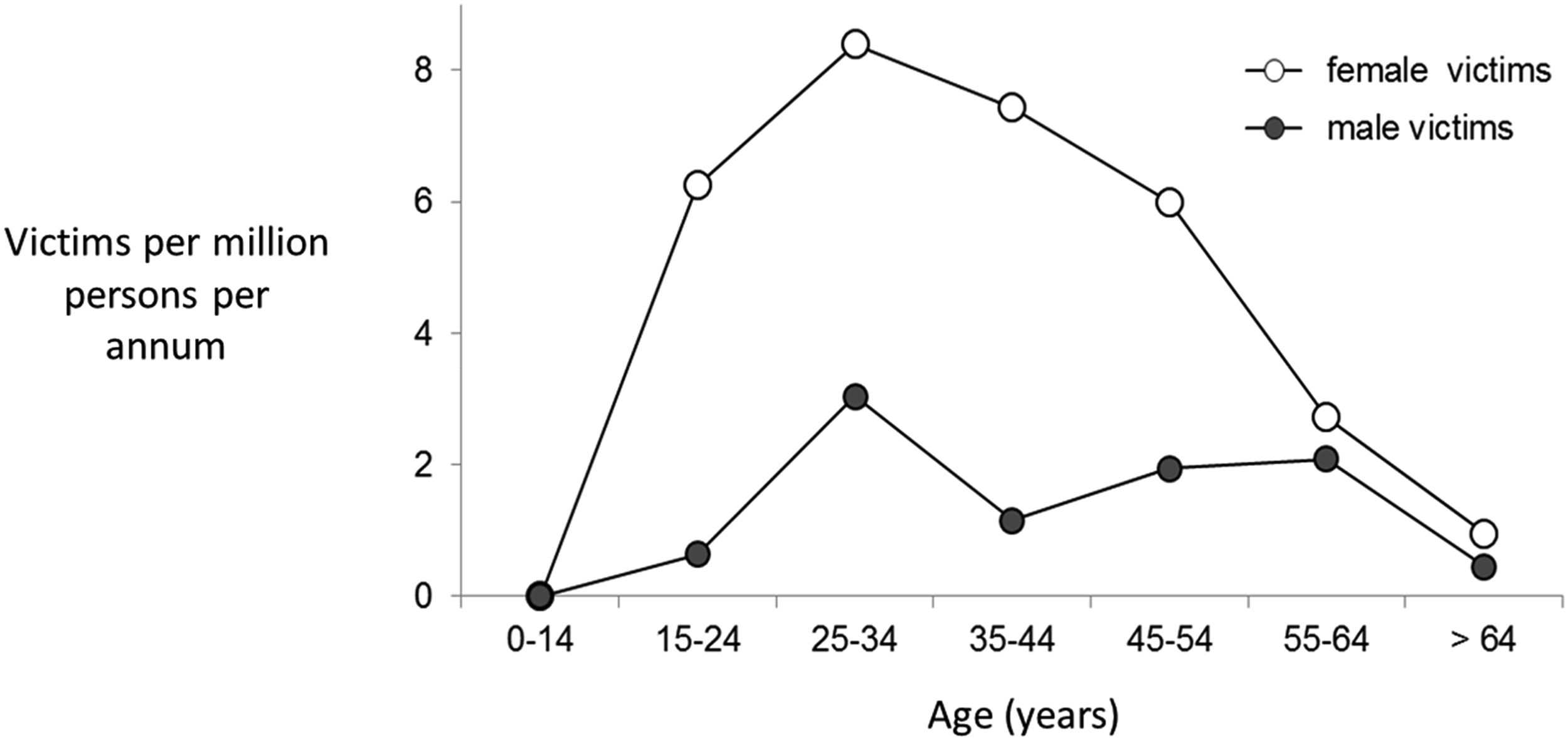
Intimate partner homicide rates in New Zealand, 2004–2019, in relation to the victim's age and sex.
The youngest IPH victims in our sample were two 17-year-olds, one of each sex. (Both were slain by older de facto partners with whom they had resided only briefly.) In international research, overall IPH rates are commonly computed with “adults” over 14 years of age as the denominator, and we followed this practice, yielding estimated average IPH victimisation rates over the 16-year period of 3.46 per million adults per annum, 5.27 per million women, and 1.50 per million men.
Spousal homicide rates in relation to age and age disparity
Rates of spousal homicide in registered marriages and in de facto marital unions are portrayed in Figures 2 and 3. The following facts are noteworthy.
Female victimisation rates were substantially higher than those of males, especially at the youngest ages. Homicide rates in de facto unions substantially exceeded those in registered marriages, except at the oldest ages. Female victimisation rates declined as a function of age, but high rates persisted into middle age in de facto unions.
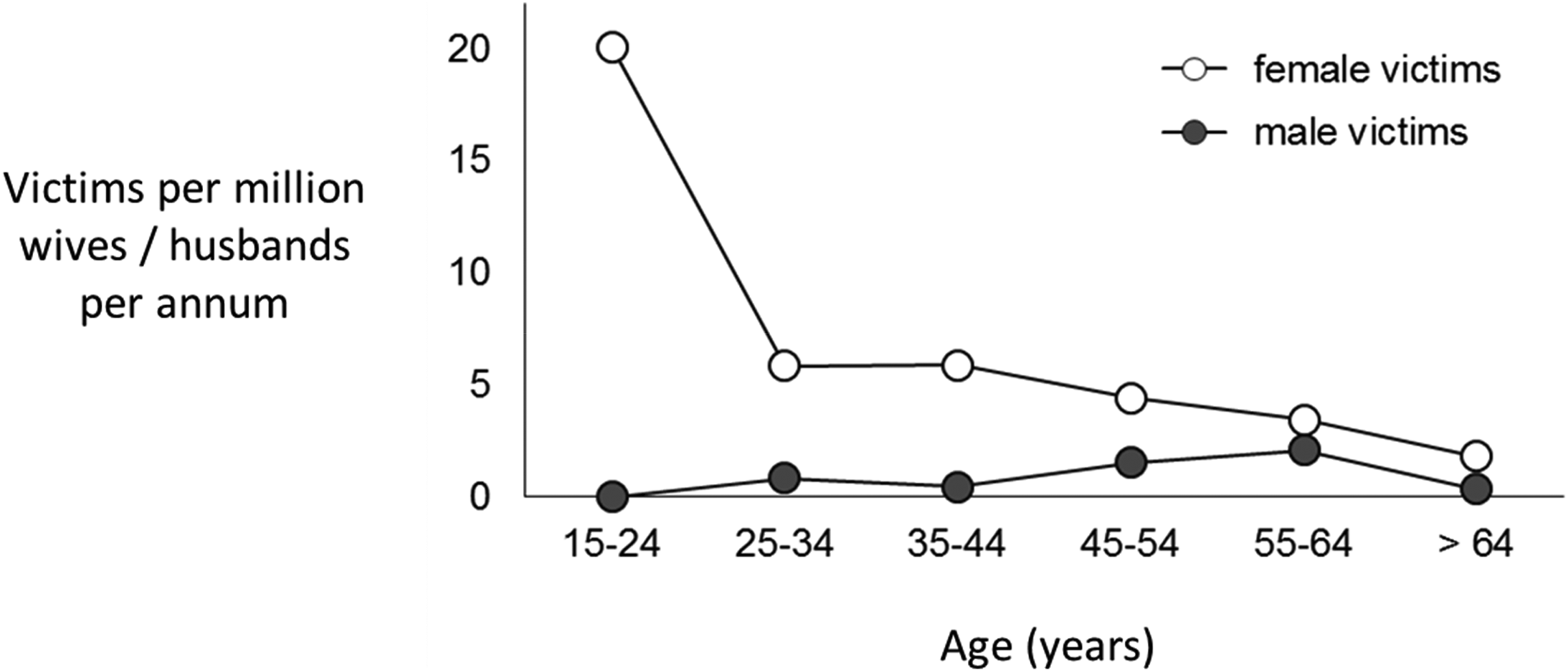
Spousal homicide rates in registered marriages in New Zealand, 2004–2019, in relation to the victim's age and sex.
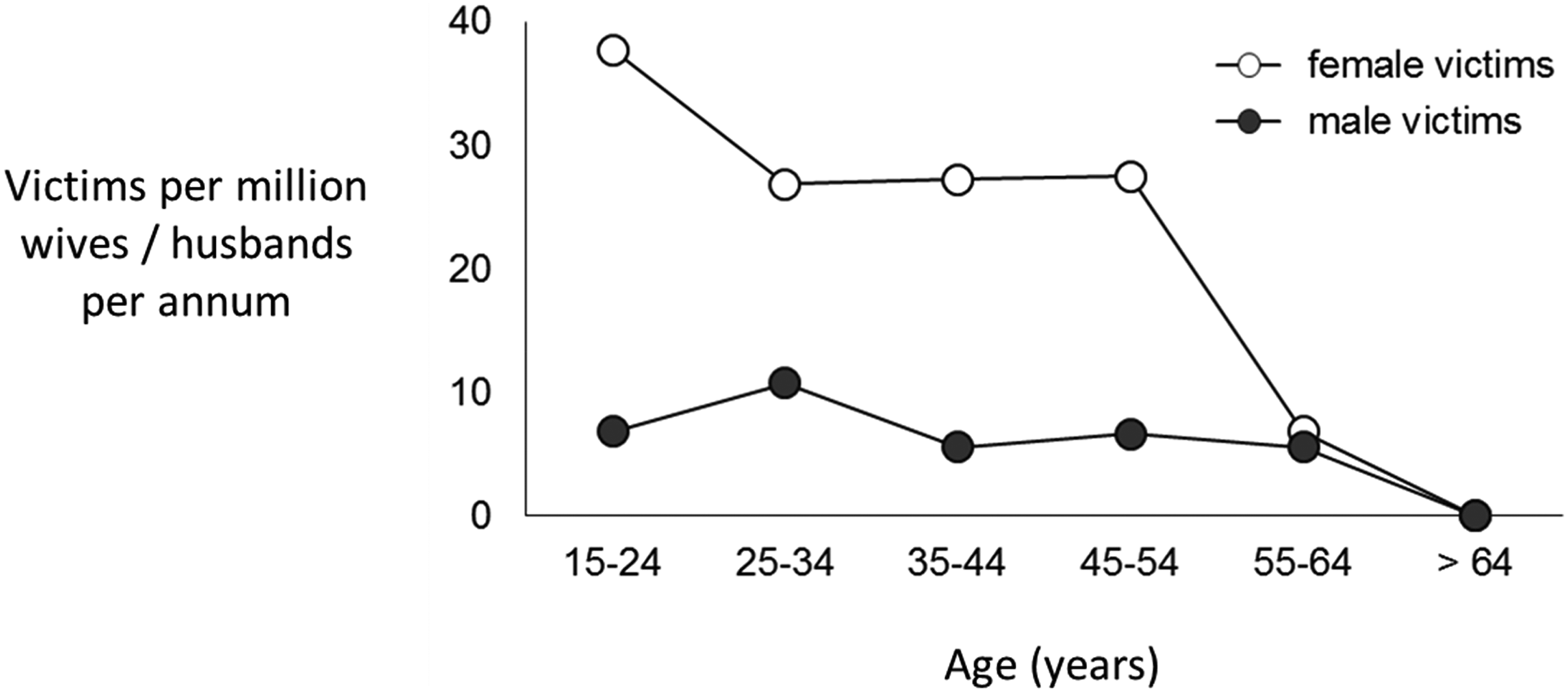
Spousal homicide rates in de facto marital unions in New Zealand, 2004–2019, in relation to the victim's age and sex.
These patterns are similar to ones reported in Canada (Daly & Wilson, 1988; Wilson et al., 1993; Wilson et al., 1995), the United States (Mercy & Saltzman, 1989; Shackelford, 2001), England and Wales (Wilson et al., 1997), and Australia (Shackelford & Mouzos, 2005), but the New Zealand data differ in the fact that the female victimisation rate in de facto unions exhibits no initial age-related increase. Furthermore, in both Canada and the United States, the difference between the overall spousal homicide rates in registered versus de facto marriages has shrunk over decades and had virtually vanished by 2005 (James & Daly, 2012), whereas a large difference persists in these New Zealand data, on the order of that which prevailed in North America in the 1990s. Whether there has also been change over decades in the age-related patterning of IPH has not been investigated.
Rates of female victimisation as a function of the age difference between partners are portrayed in Figure 4. Cases with male victims and cases in which women were more than a few years older than their partners were too few to permit a full portrayal of age disparity in both directions and for victims of both sexes, but the available data again replicate patterns previously reported in Canada (Daly & Wilson, 1988; Wilson et al., 1993), the United States (Mercy & Saltzman, 1989; Shackelford, 2001), and Australia (Shackelford & Mouzos, 2005).
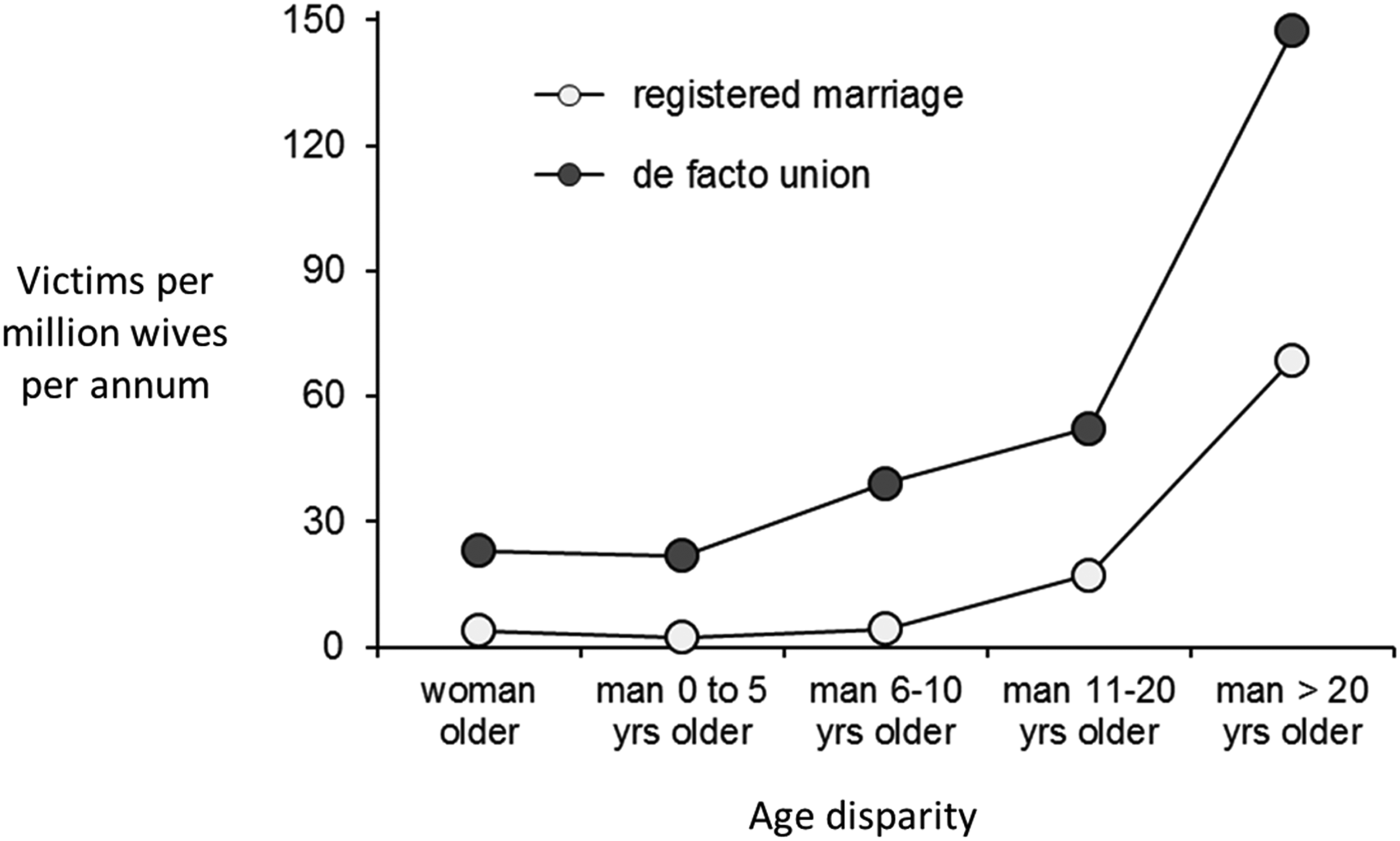
Uxoricide (wife-killing) rates in registered marriages and in de facto marital unions in New Zealand, 2004–2019, in relation to the age disparity between killer and victim.
Other attributes of spousal homicide cases
Separation and sexual proprietariness
Female-initiated separation is a frequent trigger of uxoricide. Wallace (1986) was perhaps the first researcher to provide quantitative evidence on this point when she reported that 98 of 217 slain wives (45%) in New South Wales, Australia, had either left their killers, mostly very recently, or were in the process of leaving; by contrast, only three of 79 slain husbands (4%) were similarly estranged from their killers. Wilson and Daly (1993a) provided the first estimates of the magnitude of this estrangement effect by showing that the uxoricide rate in registered marriages in Canada was 6.4 times higher among wives who were divorced or separated from their husbands than among those who were cohabiting with them, and that similar contrasts prevailed in samples from Australia and the United States. The proportion of the male-victim cases in which the couple was estranged was significantly and substantially lower than in the female-victim cases in all data sets.
We lack the requisite population-at-large data to compare rates in coresiding versus estranged marriage partners in New Zealand, but the raw numbers are clearly indicative of a situation similar to that which has been documented in these other countries. At least 27 (52%) of the 52 registered marriage uxoricide victims and 48 (55%) of the 87 who were slain by de facto husbands had left the men who killed them or were making arrangements, of which the husband was aware, to do so. Among slain husbands, estrangement was less frequent, but not rare (eight of 35 = 23%); however, in at least three of these eight cases, the husband was the initial assailant and the wife who slew him acted in self-defence. In 31 (63%) of 49 cases for which the duration of separation was reported, the couple had been separated for no more than a month, and in only seven cases had they dwelt apart for more than a year. Martin and Pritchard (2010) reported that separation or a threat thereof was a relevant motivational factor in 51 (81%) of the 63 spousal homicides in their 2002–2006 sample; this substantially higher incidence than in our 2004–2019 data may reflect the fact that Martin & Pritchard accessed coroners’ reports and police data that were not available to us, and may indicate that our “at least” estimates are indeed low.
Men's resentment of partners ending their relationship is one major manifestation of male sexual proprietariness (Campbell, 2012; Wilson & Daly, 1993b, 1996), which appears to be the dominant motivational factor in IPH around the world, as we noted in the introduction. Many spousal homicide researchers have made note of nearly identical declarations by men who have killed estranged wives, to the effect that “If I can’t have her, no one can!” (e.g., Campbell, 1992, 2012; Chimbos, 1978; Dobash & Dobash, 2015; Johnson, 2012; Polk, 1994; Wallace, 1986). In our New Zealand sample, newspaper accounts indicated that male sexual proprietariness (i.e., resentment of female-initiated separation and/or suspicion of infidelity) was at issue in at least 88 (63%) of the 139 uxoricide cases, as well as at least three cases in which women killed estranged partners in self-defence. Threats and harassment prior to these homicides were not rare, and at least 27 of the uxoricide victims (19%) had been granted protection orders, 26 of which were still in effect when they were killed, against the men who slew them. Again, the at least estimates in this paragraph are based on what was included in media reports and are likely to be underestimates.
Lethal female sexual proprietariness that resembles the possessiveness of men is infrequent, and many studies in other countries have found that even the male-victim cases are much more likely to have resulted from men's violent possessiveness and female self-defence than from women behaving like proprietary men (Browne, 1987; Dobash et al., 1992; Johnson, 1996). Nevertheless, some women do respond violently to their male partners committing adultery or “dumping” them, and in the 35 New Zealand husband-killings, there was evidence of such female sexual proprietariness in the newspaper accounts of three cases (9%). One male victim had taken out a protection order against a threatening “off and on” female partner who eventually pushed him fatally down a flight of stairs.
Suicide
A substantial incidence of suicides and suicide attempts is another recurrent feature of uxoricides, especially when the killing follows separation (e.g., Caman et al., 2017; Kristoffersen et al., 2014; Polk, 1994). Many men who kill estranged wives express suicidal thoughts, and some embark on a “project” in which killing one's ex-partner and then oneself is a consciously articulated goal that they apparently see as a way to redeem their lost honour (e.g., Campbell, 1992; Dawson, 2005). In the most frequent variety of homicide, by contrast, namely those in which a man kills an unrelated man, the offender hardly ever commits suicide. Daly and Wilson (1988) observed that in their own Canadian data and in several smaller studies elsewhere, there were just two categories of killings in which suicide had a substantial frequency: spousal homicides by men and killings of children beyond their infancy by parents of either sex. This generalisation has been widely upheld (Panczak et al., 2013; Rouchy et al., 2020; Zeppegno et al., 2019).
Suicide after uxoricide is a recurrent phenomenon in New Zealand, too. Among the 139 wife-killers in our sample, 28 (20%) were reported to have committed suicide, and an additional 17 (12%) attempted suicide at the scene of the murder but failed. By contrast, there was just one completed suicide (3%) among the 35 women who killed husbands, and there were no reports of failed suicide attempts. (The sole case of suicide by a homicidal wife was a highly unusual one involving an elderly couple, in which the wife and her adult daughter collaborated in the killing and committed suicide together while free on bail after both had been charged with murder.)
As regards a possible association between suicide and estrangement, 29 (39%) of 75 men who killed estranged wives committed or attempted suicide compared to 16 (25%) of 64 who slew their partners in relationships in which estrangement was not known to be at issue. This is directionally consistent with the international data, but the association is weak (ɸ = 0.146).
Stepchildren
Children of prior unions are well-documented sources of conflict in marriages (Daly & Wilson, 1996; White & Booth, 1985). A primary reason for this is that couples often differ in their views regarding how much of their joint resources should be invested in a stepchild (Daly & Perry, 2022; Hobart, 1991; Messinger, 1976). A secondary reason is that stepchildren are disproportionately abused, both sexually and otherwise (reviews by Daly & Wilson, 2008; Daly, 2022), in which case the birth parent is likely to try to intervene to thwart the abuse.
These considerations suggest the hypothesis that the presence of stepchildren is likely to be associated with marital violence, including lethal violence, and Daly et al. (1997) demonstrated that the mothers of children sired by previous partners in one Canadian city were much more likely to become uxoricide victims than mothers whose children were all sired by the present partner. This finding was soon replicated in the United States (Brewer & Paulsen, 1999). Perhaps most strikingly, Campbell et al. (2003) have shown that although the presence of stepchildren is associated with both nonlethal and lethal violence against wives in the United States, it is substantially more strongly associated with the latter, such that stepchild presence is one of a short list of significant predictors that wife abuse will escalate to lethality.
Unfortunately, good estimates of the prevalence of stepfamilies in the New Zealand population at large are elusive, but women with current partners plus children sired by previous partners are clearly in the minority, comprising no more than about 20% of women with current marital partners (see Gath et al., 2021). In our homicide file, by contrast, at least 64 (46%) of the 139 uxoricide victims were the mothers of children sired by previous partners, and one or more of those children apparently resided with the mother and stepfather in at least 57 of those 64 cases. Moreover, at least 12 (34%) of the 35 women who killed their husbands had children fathered by prior partners, too, and such children apparently dwelt with mother and stepfather in at least 10 of those 12 cases.
We especially stress the phrase “at least” with respect to this variable. Whereas news stories about marital homicides are highly likely to mention that an offender turned his weapon on himself or pursued his estranged wife in order to kill her, even relatively fulsome media accounts cannot be assumed to detail the reproductive careers of the protagonists, and the numbers of cases in which stepchildren existed are therefore likely to be undercounted. Nevertheless, and despite the lack of the population-at-large data that would be needed to compute and compare precise rates, it is clear that step relationships are substantially more prevalent in New Zealand spousal homicide cases than in marital unions in general.
Discussion
The analyses that we have presented indicate that New Zealand is very much like comparable economically developed nations with respect to those demographic patterns and risk markers of spousal and IPH which we were able to track. New Zealand is unexceptional in its patterned variation in relation to a wife's age and a couple's age disparity, in the relevance of female-initiated separation and male sexual proprietariness, in the noteworthy incidence of suicidality among wife-killers, and in the fact that having had children with former partners is associated with elevated risk.
Since young men are generally the most violent and homicidal of demographic groups (Daly & Wilson, 1990), and since the ages of marriage partners are highly correlated (e.g., Atkinson & Glass, 1985), one might hypothesise that the elevated risk of uxoricide associated with the victim's youth (Figure 1) is actually attributable to the youth of the killer. However, the fact that a young wife's risk of being slain by her husband increases as a function of age disparity and hence of his age (Figure 4) is evidence against this initially plausible hypothesis and supports the conclusion that it is her own age that is of the essence (Wilson et al., 1997). According to evolutionary feminist theories of IPH, this is because female youth is attractive to men, giving younger women more options in “mating markets”, and thus exacerbates their partners' inclinations to exert coercive control.
In addition to having familiar demographic risk patterns, New Zealand is again unexceptional with respect to IPH incidence. We estimated the average IPH victimisation rates in 2004–2019 to be 3.5 deaths per million adults per annum, 5.3 per million women, and 1.5 per million men. Average IPH rates in Australia over the same 16-year period are virtually identical: 3.5 per million adults, 5.1 per million women, and 1.8 per million men (Bricknell & Doherty, 2021, Table 10). Recent rates in Canada have been a little lower: in 2007–2017, there were about 2.9 IPH deaths per million adults per annum, 4.5 per million women, and 1.3 per million men (Burczycka et al., 2018); however, Canadian IPH rates were considerably higher in previous decades (Dawson et al., 2009). Rates in the United Kingdom are evidently somewhat lower still: a rough estimate based on the annual homicide reports published by the Home Office is 3.2 per million women per annum and 0.7 per million men in 2007–2017. In the United States, by contrast, despite decades of dramatic decline in the incidence of IPH (Dugan et al., 1999; Puzone et al., 2000), the rates have remained more than twice as high as those in New Zealand: IPH in the United States had reportedly dropped to about 7.4 deaths per million adults per annum in 2015 (Díez et al., 2017), and then began trending upward (Fridel & Fox, 2019).
The conservative UN estimate of 36,000 IPH victims in 2017 (United Nations, 2019), of whom 82% were women, implies that IPH rates for the world as a whole in that year were 10.6 per million women per annum and 2.3 per million men. Stöckl et al. (2013) have asserted that IPH constitutes a much larger percentage of the world's homicides than this UN estimate, implying still higher IPH rates. However, their literature review methodology apparently entailed extrapolating the proportionate share of homicides that are IPHs from predominantly rich, low-homicide-rate countries, in which that proportion tends to be higher than in poorer, more violent countries (see, e.g., Daly, 2016), to the entire world, and may thus have inflated the magnitude of the problem. In any case, it is clear that in a global context, New Zealand's IPH toll, albeit deplorable, is low, and that New Zealand's IPH rate is not particularly high among countries with developed economies, either. In addition to the examples cited above, Finland, like the United States, has had IPH rates in recent years that are over twice as high as New Zealand's (Kivivuori & Lehti, 2012). We stress these facts because, as we noted in our introduction, news media, social service agencies, and even some academics in New Zealand regularly assert that their country's IP violence problem is exceptionally bad (e.g., Hager, 2020), even “the worst in the world” (e.g., Leask, 2020). According to the best available survey evidence, this is untrue with respect to nonlethal IP violence (Fanslow et al., 2021), and our findings show that it is also untrue with respect to IPH.
Has the IPH rate declined in New Zealand in recent decades, as it has in the United States and several other developed countries? The data presented by Fanslow et al. (1995, as cited by Martin & Pritchard, 2010) indicate an overall IPH rate of about 4.33 cases per million adults per annum in 1978–1987, compared to our estimate of 3.46 per million in 2004–2019. This modest overall reduction decomposes into a near halving of the female victimisation rate and a doubling of the male rate. Splitting our IPH sample into two eight year periods yields estimated rates of about 3.72 per million adults in 2004–2011 and 3.14 in 2012–2019. In short, there are hints in the available data that the incidence of IPH has been declining in New Zealand over recent decades, but the evidence is weak and the matter deserves further scrutiny.
Footnotes
Acknowledgments
The authors thank Blair Ensor, Senior Crime Reporter with the news agency Stuff, for his leading role in the creation and maintenance of The Homicide Report and for helpful discussions of that database and its origins.
Declaration of conflicting interests
The authors declared no potential conflicts of interest with respect to the research, authorship, and/or publication of this article.
Funding
The authors received no financial support for the research, authorship, and/or publication of this article.
