




Abstract
Background:
Reproductive health technology has evolved significantly since the introduction of in vitro fertilization in 1978, enhancing the possibility of conceiving children at later stages in life. Despite these advancements, there remains a critical gap in fertility knowledge among young adults, as demonstrated by recent studies. This gap is compounded by the growing influence of social media on health information, where misinformation can distort public understanding of fertility-related issues. Addressing this knowledge deficit is essential for empowering individuals to make informed decisions about their reproductive futures.
Objectives:
With the increasing prevalence of older individuals becoming parents and the growing reliance on Assisted Reproductive Technologies for conception, our study aimed to assess fertility knowledge among young adults.
Design:
This study employed a survey-based approach using Amazon’s crowd-sourcing marketing platform, Mechanical Turk (MTurk). Participants were asked to complete a 17-question survey that included a section on demographic information. The questionnaire explored various aspects of knowledge and perceptions regarding male and female fertility.
Methods:
The survey was completed by 983 participants aged 18–30, recruited through MTurk. Individuals outside this age range were excluded from the study. Participants received a $0.50 incentive for their participation.
Results:
Notably, a high percentage of respondents correctly identified the age range at which female fertility (70.4% of participants) declines, while fewer (56.4% of participants) demonstrated awareness of the age range at which male fertility declines. Furthermore, an overwhelming majority exhibited appropriate knowledge regarding the impact of lifestyle factors, such as obesity and smoking, on fertility. The findings suggest an encouragingly high level of awareness among participants regarding fundamental fertility concepts. Approximately 63% of participants reported social media as a source of this information.
Conclusion:
This study yields promising insights into fertility knowledge among young adults. However, it underscores a notable deficiency in understanding male fertility, emphasizing the imperative for further educational initiatives in this domain. These results also highlight the crucial role of healthcare providers in maintaining an online presence to disseminate valuable, evidence-based knowledge. By doing so, healthcare professionals can empower individuals to make informed decisions regarding fertility.
Plain language summary
Age is an important consideration when discussing fertility, however with the advancement in technology within the reproductive health and fertility field, individuals are pursuing parenthood at later stages of life. While sexual health education is commonly discussed in many public schools in the United States, the extent to which reproductive health and fertility is addressed is uncertain. The objective of this study was to assess the knowledge of reproductive health and fertility among both men and women seeking to understand the current landscape and identify potential gaps in educational content. We found that a high number of individuals were able to accurately identify the age range at which fertility declines in both men and women. Additionally, a majority of participants correctly recognized key factors such as obesity and smoking that can adversely affect fertility. Notably, a significant percentage of respondents reported social media as a source of information on this topic. This study revealed encouraging insights into the knowledge levels of reproductive health among young adults, while also highlighting slight differences in responses and knowledge among individuals with varying education levels and income. Additionally, through this study we emphasize the significance of continuous initiatives focused on reproductive health and fertility, taking into account the growing trend of young individuals relying on social media as a source of this information.
Introduction
The United States has witnessed remarkable advancements in reproductive health technology since the landmark birth of the first baby through in vitro fertilization in 1978. 1 Over the past 45 years, the feasibility and effectiveness of conceiving children at advanced ages have significantly increased. 1 However, this promising avenue is not devoid of risks and notable financial implications, underscoring the importance of informed decision-making in the realm of family planning.1–3 In our ever-expanding digital era, online platforms like Instagram, X (formerly known as Twitter), and TikTok have emerged as prominent sources of health information for young adults. 4 Yet, the pervasive influence of “fake news” on the internet has left health information susceptible to misinformation across these platforms. 5 This ambiguity introduces a level of uncertainty about the extent to which reproductive health and fertility are comprehensively addressed in the digital realm. The intersection of social media influence and the emerging trend of public figures embracing parenthood at advanced ages have prompted a compelling inquiry into public awareness of age-related fertility dynamics. Moreover, the changing landscape of women’s roles in society, with many prioritizing their careers, has led to a significant trend of women and individuals, intentionally delaying parenthood. 6 This choice is often driven by career aspirations or the pursuit of personal goals. 6 While the prospect of having children at advanced ages has become increasingly popular, it is important to recognize that such decisions often involve heightened risks and potentially significant financial burdens associated with fertility treatments.7,8
Furthermore, as societal norms evolve, a growing recognition of individuals’ diverse paths in building their families is evident. The discussion around delayed parenthood due to career pursuits underscores the need for inclusive and nuanced conversations that consider the unique experiences of various communities. Recognizing and addressing the challenges faced by individuals in balancing career ambitions with family planning can lead to more comprehensive and tailored educational programs. It is noteworthy that sexual health and sexually transmitted infection (STI) prevention are actively taught in high schools, while comprehensive education on reproduction and fertility is notably absent. This disparity in educational emphasis highlights a critical gap that our study seeks to address.
There are limited data on knowledge of reproductive health and fertility among young adults. A systematic review assessed fertility awareness among individuals of reproductive age and found overall knowledge is low to moderate. 9 While the review noted a high level of understanding regarding fertility risk factors such as smoking and alcohol, many participants overestimated the age at which fertility declines and the likelihood of becoming pregnant through fertility treatments. Women generally had a higher understanding of these topics than men. In addition, a positive association was observed between the level of education and fertility awareness. A more recent study explored men’s understanding of fertility health and showed some improvement. 10 Utilizing a survey platform, this study involved students from several universities in the United States and found that men scored slightly higher than women on questions regarding male fertility. Overall, however, women slightly outperformed men, answering approximately 63% of all questions correctly compared to 61% for men. 10 Another study reported that young adults scored an average of 54% in overall fertility knowledge. 11 Interestingly, the same study found that young adults believed it is important to learn about these topics and that collaboration with healthcare professionals would be the most effective way to provide accurate and useful information. 11 These studies underscore the importance of enhancing fertility knowledge among individuals of reproductive age to empower them in making informed decisions about their fertility and family planning.
Study objectives
This study aimed to survey young adults to evaluate the current understanding of fertility knowledge in this population. This was evaluated by asking basic questions about male and female fertility. By examining the landscape of knowledge on fertility among young adults, we aimed to shed light on the need for a more balanced and inclusive educational approach that encompasses crucial aspects of family planning. This endeavor aligns with our broader intent to contribute insights that can inform enhancements in educational programs, ensuring that individuals are equipped with accurate knowledge to make informed decisions about their reproductive futures.
Methods and materials
A total of 983 individuals between the ages of 18 and 30 were surveyed during October 2023 using Amazon’s MTurk, a crowd-sourcing marketing platform. The inclusion criteria for this study required participants to be 18–30 years old and registered with Amazon’s MTurk platform. Those under 18 or over 30 were excluded from participation. The survey ended immediately for individuals who reported their age as above 30. Simple random sampling was utilized within the MTurk database. Participants had 24 h to complete the survey once it was started. To ensure single participation, respondents recorded their unique MTurk ID after the survey. There was no protected health information collected during the survey. Informed consent was obtained before beginning, with individuals who declined consent being directed away from the survey. Participants were awarded $0.50 for their participation. Approximately 70% of respondents were male and 30% female (Table 1). Participants completed a 17-question survey encompassing demographic information and general knowledge inquiries pertaining to age, and other fertility-related factors. Questions related to fertility that were asked are found in Table 2. Participants were not able to move back to a question once they answered and moved forward in the survey. In addition, all survey questions related to reproductive health and fertility required an answer prior to moving forward. Simple logistic regression analysis was performed using GraphPad Prism version 10.3.1. The consensus-based checklist for reporting of survey studies (CROSS) was utilized in this study. 12
Demographic information reported by participants.

Fertility and reproductive health-related questions participants were asked.

Results
The survey revealed enlightening insights regarding young adults’ perceptions of age-related fertility decline. The participant cohort predominantly consisted of males, accounting for 70.5% of the sample (n = 693), with additional demographic details presented in Table 1. Approximately 89% of participants identified as white. A significant majority (70.4%) correctly identified the age range of 30–44 years as the period when female fertility notably declined; however, 56.4% accurately pinpointed the age range of 30–44 years for male fertility decline (Figure 1). No statistically significant difference was seen when male and female responses were compared. When examining the impact of income and education levels on perceptions of age-related declines in egg and sperm quality, simple logistic regression analysis was conducted for variables including education and income. Higher education level was defined as a participant self-reporting a bachelor’s degree or higher. A higher income level was defined as greater than $75,000 in annual income (Figure 3). A statistically significant difference was observed when comparing education level, with higher education level associated with a lower likelihood of correctly identifying the age at which sperm quality declines (p < 0.0001) (Figure 2). No significant difference was seen between education and identifying age at which egg quality declines (Figure 4). However, individuals without a degree tended to report a later age for which egg quality declines (45–59 years old). When comparing income level, participants who reported a higher annual income were more likely to correctly identify the age range at which egg quality declines (p < 0.0001); however, no statistically significant difference was seen in identifying the age of sperm quality decline (Figure 4). In addition, when queried about the influence of lifestyle factors on fertility, the respondents showed high levels of awareness. Notably, 92.2% correctly identified smoking and 94.5% recognized stress as detrimental to fertility. Furthermore, 89.4% of participants acknowledged the negative impact of obesity on reproductive health. These findings suggest a higher level of awareness among young adults than anticipated. When asked where they received education on reproductive health and fertility, 62.8% reported social media as a source of information. These results suggest a commendable level of understanding among young adults regarding key factors affecting fertility.
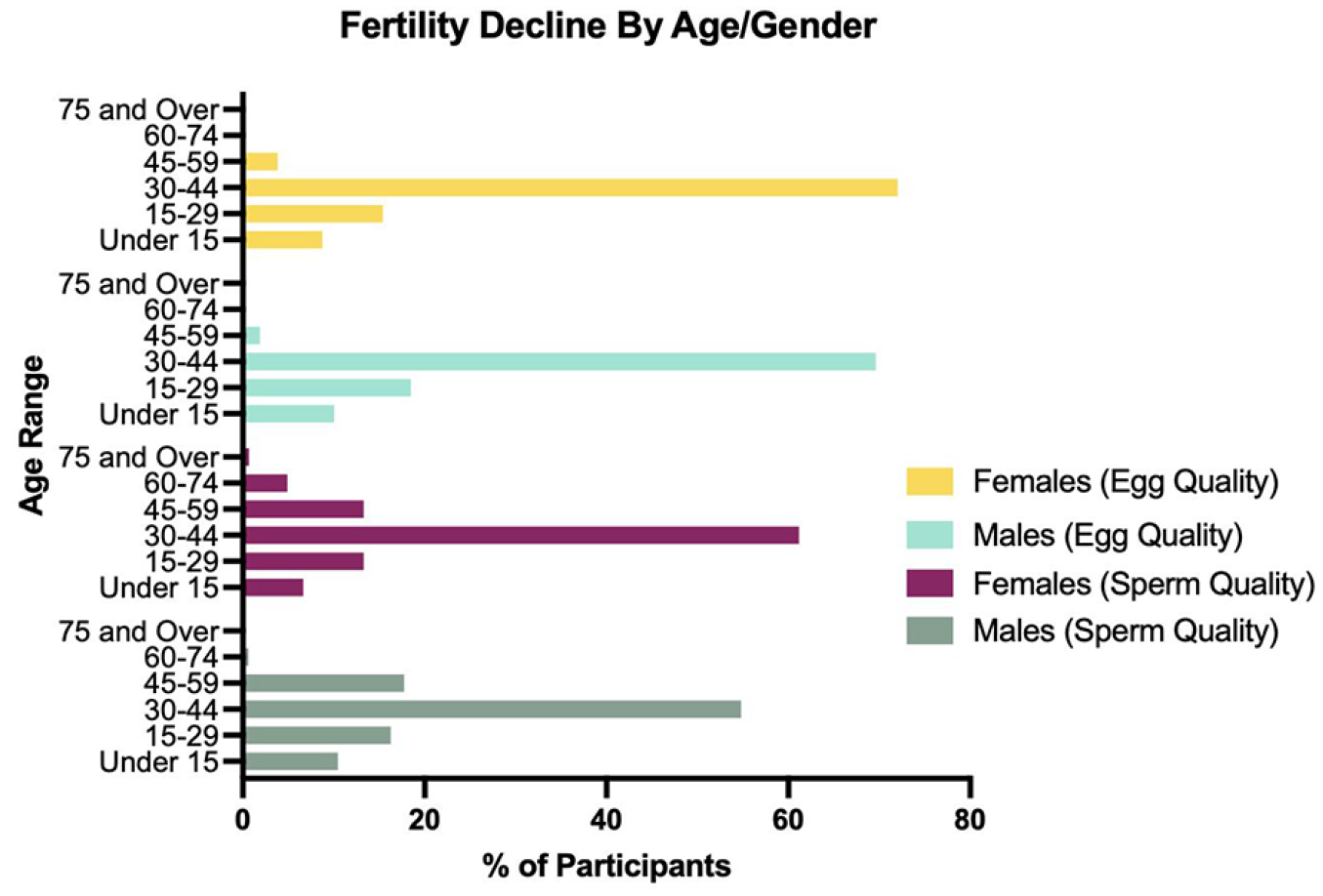
Age at which participants believe fertility declines in women and men.
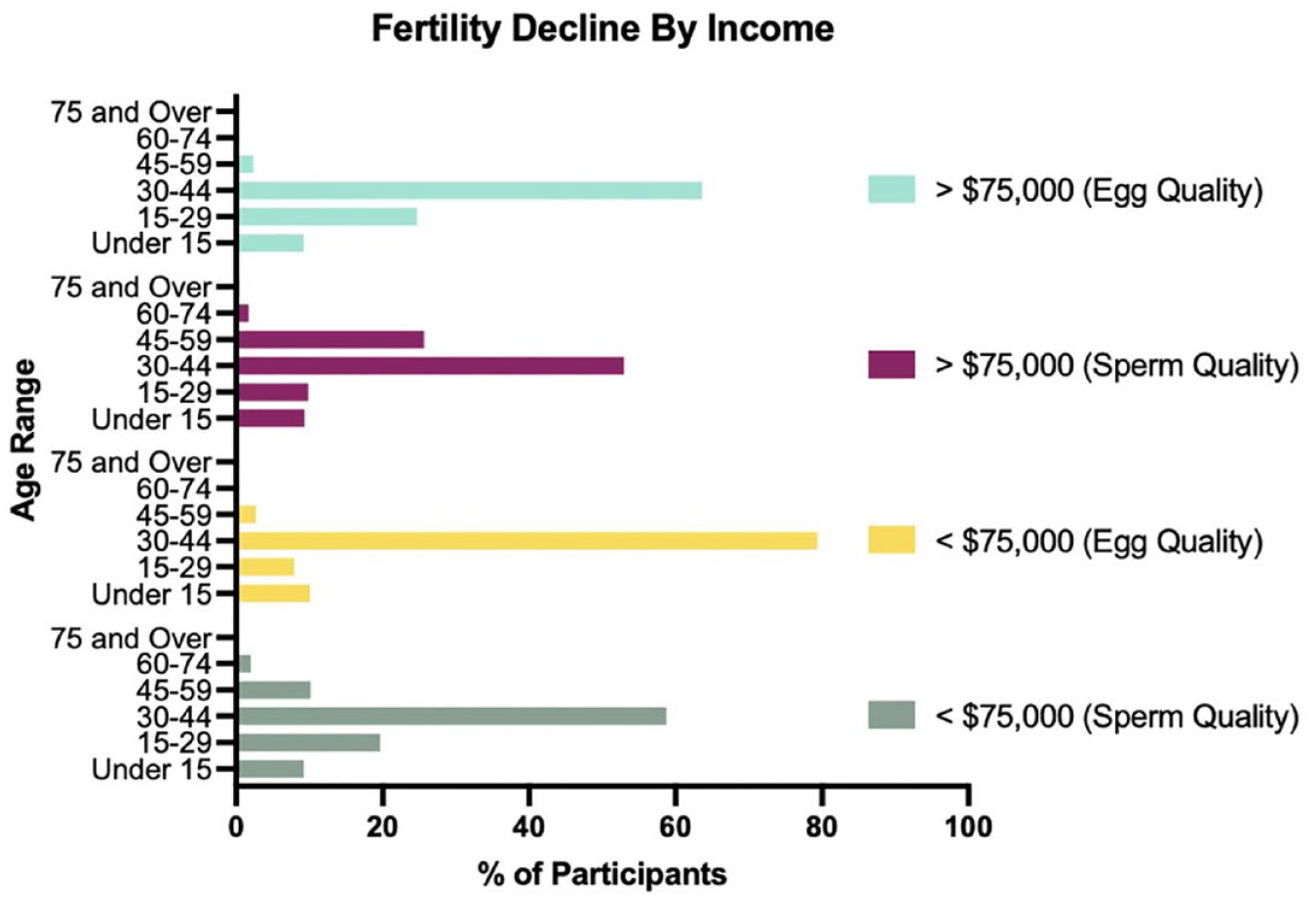
Age at which participants believe fertility declines based on income reported.
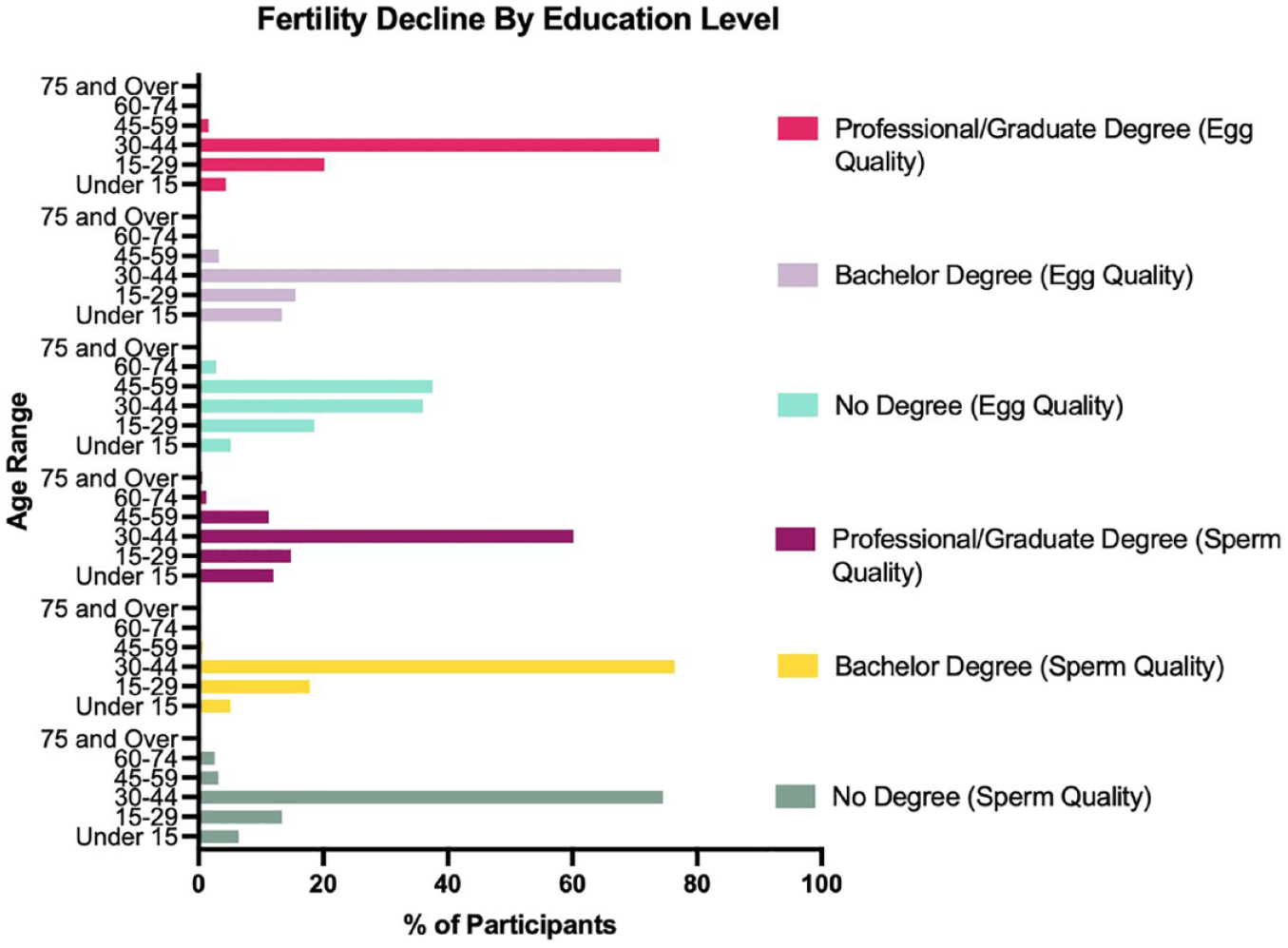
Age at which participants believe fertility declines based on education level reported.

Education and income analysis.
Discussion
Our study embarked on addressing the critical knowledge gap regarding young adults’ understanding of age-related fertility decline and the influence of lifestyle factors on reproductive health. Our primary hypothesis posited that young adults might overestimate the age at which fertility decreases, potentially underestimating the impact of age and lifestyle choices on reproductive capabilities. This gap in knowledge, if unaddressed, could lead to misconceptions affecting personal and public health decisions.9,13 Addressing this gap is pivotal, as fertility awareness is closely linked with family planning, health policy formulation, and individual health choices. 14 Understanding the extent of young adults’ knowledge of these aspects is crucial in an era where reproductive decisions are increasingly influenced by various social and media narratives, often overshadowing scientific facts and medical advice.
In our investigation, we employed a survey-based approach, engaging a diverse group of young adults using Amazon’s MTurk platform to gauge their understanding of reproductive health and fertility. This method allowed us to gather a broad spectrum of perspectives on age-related fertility decline and the impact of lifestyle factors on reproductive health. The most salient finding from our study was the high level of awareness among young adults regarding the age at which fertility declines, particularly in females, and the adverse effects of smoking, stress, and obesity on fertility. This result challenges the pre-existing notion that young adults might have a limited understanding of these critical reproductive health issues.
Comparing our findings with existing literature reveals a noteworthy alignment with recent trends in reproductive health education. 15 Previous studies have indicated low to moderate levels of fertility awareness among young adults, but our results suggest a more optimistic picture, potentially reflecting the impact of enhanced educational efforts and more accessible information through digital media. 16 However, the discrepancy in awareness between male and female fertility decline highlights an area that requires further attention in public health communication and education. This difference may be attributed to the generally greater focus on female reproductive health in public discourse and education, suggesting a need for more balanced coverage of both male and female fertility issues. Notably, a substantial number of respondents in this study reported obtaining such information from social media. This emphasizes the importance of healthcare providers maintaining a robust and credible presence online, given the expected trend of future generations increasingly relying on these platforms to access information about their health and fertility. 17 Although social media is extensively utilized for accessing health information, research indicates a deficiency in both the quality and accuracy of such information. 18 Our study contributes to a growing body of literature emphasizing the importance of comprehensive reproductive health education and provides a basis for targeted educational strategies.
In addition, our study uncovered intriguing insights into the perception of lifestyle factors and their impact on fertility. While the high awareness of factors like smoking, stress, and obesity is encouraging, it contrasts with certain findings in the literature that suggest a gap in knowledge regarding the specifics of how these factors affect reproductive health. 19 For instance, while obesity’s impact on fertility is well acknowledged, the understanding of its mechanisms, such as hormonal imbalances or ovulatory issues, remains less explored among young adults. 20 This gap highlights an opportunity for a more detailed education on the biological underpinnings of lifestyle effects on fertility. Moreover, the relatively lower accuracy in identifying the age of fertility decline in males compared to females points toward a potential gender bias in reproductive health awareness, echoing trends noted in existing studies.
A limitation of our study is its reliance on a self-selected, Mechanical Turk-based cohort, potentially not representative of the broader population. The higher male participation might have introduced gender-specific knowledge bias. In addition, the survey approach lacks depth in exploring participants’ reasoning or information sources. Caution is needed in generalizing these findings, highlighting the necessity for more diverse and in-depth methodologies. This study has several strengths, including a large sample size and the use of an online survey platform, which facilitated rapid data collection from a geographically diverse population across the United States.
Future research should investigate the sources of reproductive health knowledge and how they influence understanding. Addressing gaps in fertility awareness is crucial. Assessing the effectiveness of reproductive health education across various platforms will help tailor educational content to young adult needs.
Conclusion
Our study has revealed an encouraging result, as the level of awareness of fertility knowledge among young adults was higher than expected. As societal norms evolve, our study calls attention to the importance of inclusive and nuanced conversations, addressing the unique experiences of diverse communities in family planning. With a significant number of participants reporting social media as a source of this information, this underscores the significant role played by online sources and social media in disseminating this crucial information. It is important that young people have access to accurate, evidence-based information on topics such as fertility and reproductive health. While our results present an optimistic view of current awareness levels, they also highlight the necessity for ongoing efforts in comprehensive reproductive health education to ensure accurate knowledge and informed decision-making for young adults in the digital age. Our findings advocate for ongoing, comprehensive, and gender-balanced reproductive health education in combination with safe sex practices to support informed decisions among young adults.
Supplemental Material
sj-docx-1-reh-10.1177_26334941241309890 – Supplemental material for Assessment of reproductive knowledge among young adults utilizing Amazon mechanical Turk survey
Supplemental material, sj-docx-1-reh-10.1177_26334941241309890 for Assessment of reproductive knowledge among young adults utilizing Amazon mechanical Turk survey by Alexandra Aponte Varnum, David A. Velasquez, Jason Codrington, Aymara Evans, Justin M. Dubin and Ranjith Ramasamy in Therapeutic Advances in Reproductive Health
Supplemental Material
sj-docx-2-reh-10.1177_26334941241309890 – Supplemental material for Assessment of reproductive knowledge among young adults utilizing Amazon mechanical Turk survey
Supplemental material, sj-docx-2-reh-10.1177_26334941241309890 for Assessment of reproductive knowledge among young adults utilizing Amazon mechanical Turk survey by Alexandra Aponte Varnum, David A. Velasquez, Jason Codrington, Aymara Evans, Justin M. Dubin and Ranjith Ramasamy in Therapeutic Advances in Reproductive Health
Footnotes

References
Supplementary Material
Please find the following supplemental material available below.
For Open Access articles published under a Creative Commons License, all supplemental material carries the same license as the article it is associated with.
For non-Open Access articles published, all supplemental material carries a non-exclusive license, and permission requests for re-use of supplemental material or any part of supplemental material shall be sent directly to the copyright owner as specified in the copyright notice associated with the article.
