



Abstract
Background:
Endometriosis significantly affects women’s quality of life, yet remains underrepresented in public discourse. This study aimed to explore the lived experiences and challenges of women with endometriosis as expressed on Twitter/X.
Methods:
A total of 2000 tweets were collected between September 2023 to November 2023 using relevant hashtags. Tweets were thematically analyzed using NVivo to identify recurring patterns in women’s experiences with endometriosis.
Results:
Findings indicated that 35% of the tweets described chronic pain, difficulty completing daily tasks, and concerns about infertility. In 30% of the tweets, women also discussed various treatments, including surgery, medication, and dietary modifications, with a notable focus on weight loss and healthy eating. However, a problematic preoccupation with food and weight was observed in discussions about dietary changes. A recurring theme observed in the remaining tweets was the feeling of being dismissed by healthcare providers, with many addressing gender dynamics and bias in the medical field.
Conclusion:
This study highlights the power of Twitter/X as a platform for raising awareness about endometriosis. The findings underscore the need for improved healthcare services and the development of supportive communities for women with the condition.
Introduction
Endometriosis, characterized by uterine tissue growing outside the uterus, causes chronic pain and various symptoms such as dysmenorrhea, dyspareunia, and infertility.1,2 It affects approximately 10% of reproductive women, with treatments such as laparoscopy aiming to alleviate symptoms.3,4 However, while hormonal therapies and pain medications such as NSAIDs can help, treatment options are limited and may come with side effects.5,6 Non-conventional approaches such as dietary changes, physical activity, and acupuncture may also provide relief.7–9 Despite its severity, endometriosis diagnosis often takes 4–11 years due to normalized pain experiences.1,10 Diagnosis is challenging, requiring surgery and histological examination. 1 Surgery’s financial strain adds to the trauma experienced by many women, perpetuating endometriosis and delaying suitable management. 11
The pain endured by women with endometriosis is intricate, impacting all dimensions of their quality of life. Due to the intricacy of the pain, women have reported struggling with work, experiencing lost workdays, reduced productivity, and a lack of understanding from their employers. 8 Studies in Australia and New Zealand have confirmed that endometriosis patients reported experiencing job loss due to their condition and the ways it affected their performance.12,13 Due to the absence of standardized measurements to provide tangible evidence of their pain’s reality, women are subjected to doubt not only by their employers but also by healthcare providers, who may perceive them as exaggerating.14,15
Endometriosis doubles the risk of infertility in affected women. 16 They also face higher rates of mental health issues such as anxiety, depression, and suicidal thoughts,17,18 largely due to uncertainties about fertility status. This uncertainty can strain relationships and trigger feelings of guilt,18,19 particularly for those raised with strong beliefs about female reproductive roles. Socially, motherhood is often equated with complete womanhood,20,21 leading infertile women to compare themselves unfavorably with others. Social identity theory suggests that such comparisons influence self-perception during interactions.22,23 For women, infertility can impede the fulfillment of femininity, causing personal and social identity struggles. The public spotlight on infertility underscores the profound identity loss and perceived lack of control experienced by affected individuals. 24
Limited research has explored the online representations of endometriosis, which encompass portrayals across digital platforms like social media. Twitter/X, seen as a secure space for self-expression, 25 offers a supportive community and opportunities to raise awareness about health issues, including endometriosis. This study aims to explore endometriosis experiences shared on Twitter/X, providing insights into how women communicate their challenges with the condition. Understanding online discussions can inform healthcare providers and support organizations to offer more empathetic and effective care for those living with endometriosis.
Methods
Data collection
This study adopted a qualitative approach to analyze tweets related to endometriosis. To collect and locate relevant data, we utilized a list of six search keywords/hashtags: “endometriosis,” “endometriosis treatment,” “endo,” “endo warrior,” “endo community,” and “endo support.” These keywords/hashtags were selected through a comprehensive review of the literature, ensuring a representation of diverse perspectives within the endometriosis domain. Publicly accessible tweets associated with each keyword/hashtag were collected from Twitter/X during a specified data-collection period (September 2023 to November 2023), focusing solely on the tweet content to prioritize confidentiality. We excluded account names and paraphrased quotes from collected tweets to ensure anonymity. Only English-written tweets relevant to endometriosis were included, while posts from organizations or advertisements were excluded to maintain the authenticity of women’s voices in the data.
Data analysis
Over 3 months, we collected a total of 2000 tweets containing our specified keywords/hashtags, posted by 548 unique Twitter/X accounts. These accounts belonged to women diagnosed with endometriosis or mothers whose adolescent daughters were experiencing endometriosis symptoms. Thematic analysis was conducted using an inductive coding approach, following Braun and Clarke’s 26 methodological framework to organize, identify, and report themes within qualitative datasets. This allowed us to identify patterns and themes in the data, attributing meaning to the collected tweets.26,27 The first author thoroughly reviewed the tweets to familiarize herself with the data and detect themes. To enhance rigor, a second author independently coded a subset of the tweets (20%) to ensure reliability and engaged in discussions regarding codes and themes. If discrepancies in data interpretation arose, they were discussed until consensus was reached. This collaborative approach aimed to mitigate bias and enhance the study’s methodological rigor. Overlapping codes were grouped together, which allowed for the generation of preliminary themes. These themes were iteratively refined through group discussions, ensuring that each theme accurately represented the content and experiences expressed by participants. Specifically, themes were defined based on the frequency and significance of recurring topics across the tweets. Overarching themes were identified, with some tweets classified into more than one theme, reflecting the complex and multifaceted nature of the discussions. Preliminary themes were depicted in a thematic map, leading to the identification of the final themes.
Trustworthiness and rigor
We commenced by applying Braun and Clarke’s 26 methodological framework to maintain fidelity, meticulously conducting our data analysis. To ensure methodological rigor, we created a codebook to incorporate our notes, list and compare all the codes, and amalgamate our findings. Each author participated in memoing, documenting experiences, thoughts, and reactions, which were then discussed as a group. This process contributed to the trustworthiness of our findings.
Ethical considerations
The study received approval from the ethics committee of the University of Western Macedonia, Greece (ethics approval: 4485/2023), with data collection being confined exclusively to Twitter/X as the singular data source. Researchers maintained a non-interactive stance with users, relying solely on meticulous observation for data gathering. Only publicly accessible tweets were collected, and all user identifiers were removed to protect privacy. Finally, tweets were paraphrased to ensure de-identification, prioritizing user privacy and security measures.
Results
The analysis of the tweets resulted in four themes (Figure 1). Among the analyzed tweets, 35% addressed the diminished quality of life, 30% discussed the search for a cure, 25% conveyed feelings of being dismissed by healthcare providers, and 10% expressed concerns regarding the inadequacies of the healthcare system related to endometriosis.
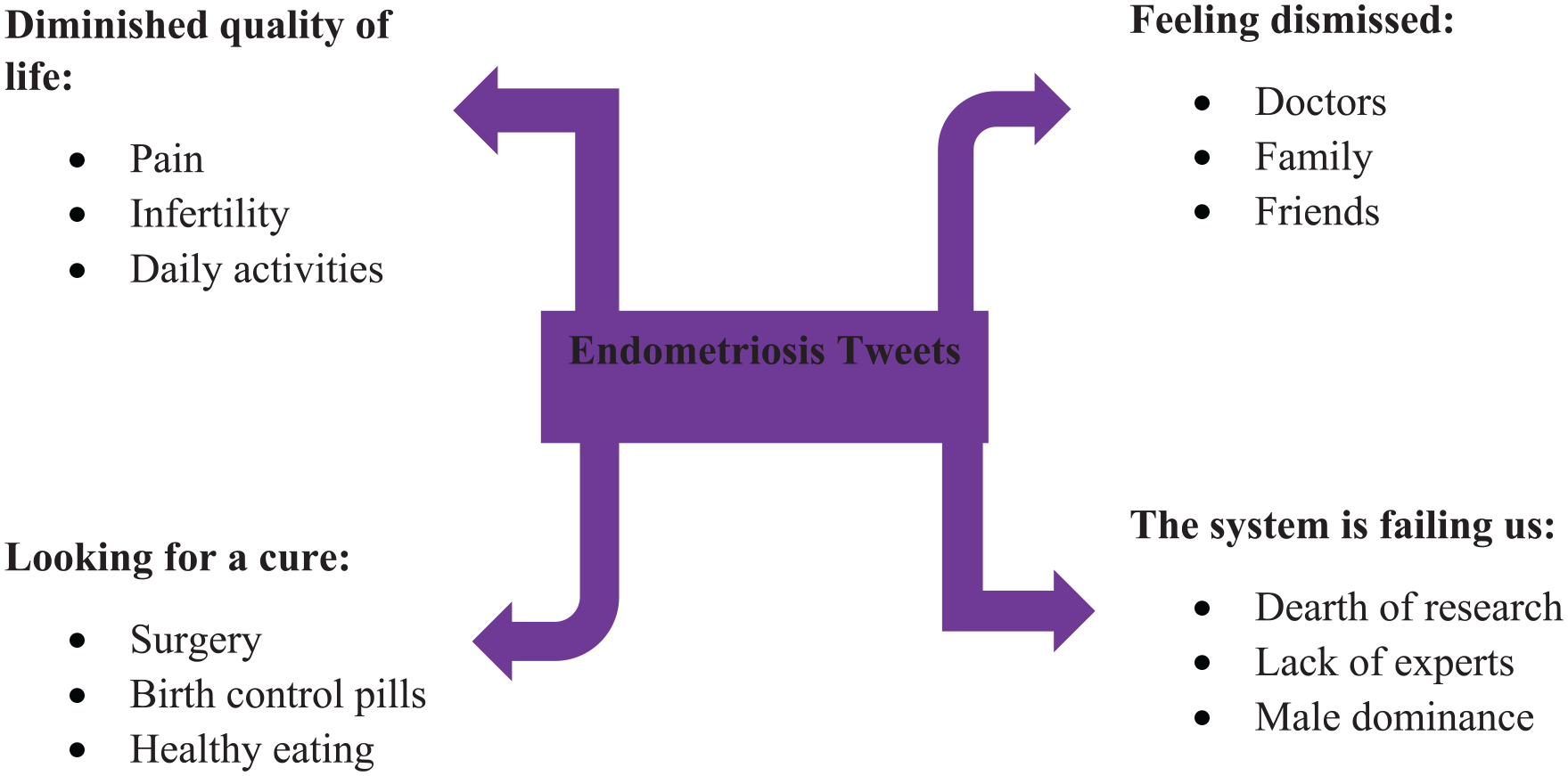
Identified themes.
Diminished quality of life
Many tweets highlighted the severe impact of endometriosis symptoms on women’s lives, describing excruciating pain in the pelvis, legs, back, and chest, along with heavy bleeding and exhaustion, leading to days confined to bed (e.g. “This pain has forced me to stay in bed for an entire week”). Some women reported losing jobs or delaying education due to the condition (e.g. “I have to delay my college application because my endometriosis is severe”). Heartbreaking personal stories underscored the constant pain experienced, with some women struggling to perform basic tasks and fainting in public places (e.g. “I fainted in the supermarket, scaring the other shoppers”). Emotional challenges, including infertility and miscarriages, were prominent, with women expressing self-blame and grappling with societal stigma (e.g. “It is my fault” and “It has deprived me of my feminine identity”). Finding solace in shared experiences, some expressed relief in knowing they were not alone (e.g. “It is relieving to know that I am not the only one”). Finally, some tweets proposed classifying endometriosis as a disability due to its profound impact on lives (e.g. “This is a disability. It has ruined my life, stolen my career, and deprived me of the ability to be a mother”).
Looking for a cure
Many women sought advice for managing endometriosis symptoms and exploring treatment options (e.g. “Any tips for pain management or treatment?”). Some shared their experiences with surgery, expressing hope for a solution (e.g. “I can’t wait to get this out of my body”), while others recounted multiple surgeries without lasting relief (e.g. “My endometriosis is back. This is my 6th surgery for this disease”). Birth control pills were discussed as a means of symptom management rather than a cure (e.g. “It will be catastrophic if birth control pills are outlawed”). Dietary modifications, including avoiding alcohol and processed foods and adopting a vegan diet, were recommended by some for symptom relief (e.g. “I have changed my diet and I feel so much better”). Queries regarding natural herbal remedies for treating endometriosis were prevalent (e.g. “Does anyone have any experience with natural herbs used to treat endometriosis?”), alongside discussions advocating food restriction and weight loss as approaches to manage flare-ups (e.g. “Ladies, limit your calories”; “Losing weight is the only way to deal with flare-up”). Some endometriosis patients encouraged other users to restrict their food intake and carefully select their food, citing expert recommendations as evidence of their credibility (e.g. “My doctor recommended weight loss and it has helped me”).
Feeling dismissed
Numerous tweets revealed feelings of loneliness and disregard among endometriosis patients in their interactions with healthcare providers, family, and friends. Women criticized medical consultations where symptoms were dismissed or pain normalized without proper investigation (e.g. “The doctor told me that I was being dramatic”; “For all these years, I have been told that pain is normal. It is not normal to be in pain”). Some attributed serious medical issues like infertility to delayed diagnoses and inadequate attention from healthcare providers (e.g. “For 15 years I was not hallucinating. My ‘fake’ chronic illness cost my fertility”). However, some expressed gratitude to supportive healthcare providers (e.g. “He is the only one that took me seriously and tried to understand my pain”). Family and friends were described as often lacking understanding, minimizing symptoms, or dismissing experiences (e.g. “But you don’t look sick,” said my family; “Even though I am in terrible pain, I have to go to school because my mother thinks that I am making it up”). Friends were also perceived as hesitating to discuss or acknowledge the impact of endometriosis, worsening feelings of isolation (e.g. “I guess my disease does not affect you”; “I have never felt lonelier”).
The system is failing us
This category of tweets highlighted the prominent issue of insufficient research pertaining to endometriosis. Women expressed a prevailing sense of the research gap and the persistence of unanswered questions (e.g. “Why do we still not know what causes endometriosis? I wish there were some answers”). Many tweets called for increased funding for research, with several women volunteering to participate in research projects (e.g. “I will gladly participate in any research”). The perceived lack of research was thought to have implications for the availability of information within the medical profession, leading to a scarcity of experts in the field of endometriosis (e.g. “There are only two excision experts in my country. We need more”). A recurring concern expressed in this category of tweets was the predominance of male researchers and gynecologists in the field. Women felt that due to the disease primarily affecting females, male researchers and healthcare providers displayed a lack of interest in finding a cure, therefore hindering research progress, and were not able to understand how pain might feel (e.g. “It doesn’t usually affect men, so they don’t care”). As a result, numerous tweets encouraged women to educate themselves and pursue careers as gynecologists and scientists, advocating for women’s health (e.g. “Women, use your brain and femininity to treat endometriosis”; “We need more female scientists and gynecologists”).
Discussion
We aimed to understand endometriosis experiences shared on Twitter/X to inform healthcare providers and deepen our understanding of the challenges. Our findings align with prior research, showing that endometriosis patients suffer from debilitating pain. 8 Tweets described pain affecting various body regions, leading to difficulties in daily tasks, job loss, and postponed studies, consistent with previous studies,8,12,13 emphasizing the need for supportive workplace policies. Despite this, the exact cause of endometriosis remains unknown, 28 with women expressing frustration over the lack of information and effective treatments. A novel finding was the concern and negative perception toward male professionals in endometriosis care, highlighting the importance of promoting female representation and gender equality in healthcare to ensure all voices are heard in advancing treatment options.
Our study highlights women’s treatment-seeking behaviors on social media regarding endometriosis. Some women demonstrated a strong interest in dietary modifications to alleviate symptoms, aligning with existing research.7,8 However, we uncovered a concerning trend of encouraging others to adopt restrictive eating behaviors, a tactic that has also been evident in online places, 29 linking weight loss to pain management. Users also compiled lists of foods to avoid, attributing both pain triggers and health benefits to specific dietary choices. This tendency to view food as medicine warrants scrutiny due to its potential contribution to heightened preoccupation with healthy eating, as documented in the literature.30-32 It’s important to note that this observation doesn’t universally characterize women with endometriosis but suggests some may resort to strict dietary measures to manage symptoms.
The importance of more supportive interpersonal communication between patients and healthcare providers, as well as a supportive family environment, was further underscored. This was evident as women shared their experiences of facing dismissal from healthcare providers, family members, and friends. Pain during menstruation is frequently normalized, 10 leading women in the current study to recount instances where they were accused of exaggerating their symptoms. The pervasive feelings of loneliness and being misunderstood by others were prominent in the tweets, especially as their ongoing efforts to conceive remained unsuccessful, resulting in self-blame and disappointment. These findings align with prior research that has indicated guilt as a prevalent emotion reported by endometriosis patients experiencing infertility.18,19 The sense of losing their womanhood and assuming responsibility for these challenges may underlie these feelings of self-blame and guilt.
Understanding infertility as a social discourse reveals entrenched societal narratives linking women’s worth to motherhood, often leaving those facing infertility feeling inadequate.33,34 Nonetheless, as discourses are embedded in our daily lives, women with endometriosis exist within the overarching discourse. However, collectively, their shared experiences can be interpreted as forming an alternative narrative that questions the more prevalent and authoritative, discourses. In this study, Twitter/X emerged as a platform facilitating women’s support-seeking endeavors and the negotiation of their feminine identity within the context of infertility. The establishment of a virtual community allowed women to engage in collective discussions, where shared experiences of struggling with infertility became evident. Twitter/X offered a unique avenue for these women to access the support that may be lacking in their immediate social and healthcare environments. The platform could serve as a refuge where their challenges and pain were acknowledged and believed, contrasting with the disbelief encountered in interactions with family members, partners, or healthcare professionals. As per a previous study, 35 by leveraging the platform, these women potentially engage in a subtle form of advocacy, seeking acknowledgment and understanding for their unique struggles, thereby challenging societal discourses and preconceptions surrounding infertility and endometriosis. In navigating fertility challenges, women may cultivate a sense of empowerment to counter the stigma associated with their struggles, 36 positioning themselves as agents capable of proactively reshaping their lives and asserting control beyond patriarchal influences and prevailing societal discourses. 37 However, this prompts reflection on whether emphasizing individual agency places undue burden on women, urging a nuanced understanding of systemic factors perpetuating fertility challenges.
Strengths and limitations
This is the first qualitative study, to our knowledge, that has explored the experiences of endometriosis, using Twitter/X as the source of our data. While our study did not specifically assess demographics or characteristics, the discussions spanned beyond specific countries, enabling a more expansive perspective. Twitter/X’s effectiveness in advocacy and public health awareness has been well-documented, 35 and this study further validates its potential in amplifying voices and raising awareness about health challenges.
A limitation of this study is that selecting tweets based on hashtags might solely capture a particular subset of Twitter/X interactions, given that not all users employ hashtags in their social media communications. 38 Finally, the sample was constrained to individuals with internet access and a Twitter/X account or the capability to tweet. Consequently, participants without internet access due to socioeconomic limitations might have been excluded, leading to a potential limitation in the representation of individuals from lower socioeconomic backgrounds. 39 Furthermore, we recognize that Twitter/X is restricted in several countries, which may further limit the generalizability of our findings. Regarding the generalizability of this study, it is essential to consider that the findings are derived from a specific online population. While our research provides valuable insights into the experiences of women with endometriosis, the reliance on social media data means that the results may not be universally applicable to all women affected by this condition.
Conclusion
This study aimed to explore the experiences of women with endometriosis through the analysis of tweets. Overall, our findings confirm existing evidence and contribute to the body of research by revealing the continued lack of support for women in various aspects, including healthcare, employment, family environments, and research. Despite its limitations, the study sheds light on the profound impact of endometriosis symptoms on women’s lives, highlighting their struggles with dominant discourses surrounding infertility and womanhood. Future research endeavors should prioritize involving patients in the research process to gain deeper insights into the experiences of women with endometriosis. Additionally, there is a need to enhance patient-centered care and support systems to better address the challenges faced by these individuals and improve their overall well-being.
Footnotes
Declaration of conflicting interests
The author(s) declared no potential conflicts of interest with respect to the research, authorship, and/or publication of this article.
Funding
The author(s) received no financial support for the research, authorship, and/or publication of this article.
Data availability statement
Data will be made available upon reasonable request.
