




Abstract
Rapid freezing and vitrification are becoming popular for sperm freezing in humans; however, basic and critical issues relevant to sperm cryopreservation remain to be resolved. The aims of the present study were to study the effects of osmolality of freezing medium, sperm concentrations, thawing methods, and sugars (sucrose and trehalose) on sperm motility and DNA integrity by rapid freezing using 0.5 ml standard straws loaded with 100 µl sperm each. The results showed that (1) the post-thaw recovery rates of total motility and progressive motility of sperm cryopreserved in freezing medium containing 0.25 M sucrose with 442 mOsm/kg osmolality were significantly higher (p < 0.05) than that of sperm cryopreserved in freezing medium containing 0.25 M sucrose with 536 mOsm/kg osmolality (36.5 ± 2.8% and 36.9 ± 1.7% versus 30.4 ± 1.9% and 30.3 ± 2.9%, respectively), (2) cryopreservation of both total and progressive motilities was not significantly affected (p > 0.05) by sperm concentrations in the range from 5 to 20 × 106 sperm/ml, (3) thawing method 37°C for 2 min was better than 42°C for 15 s in terms of post-thaw recovery rates of both total and progressive motilities (p < 0.05), (4) 0.25 M trehalose was better than 0.25 M sucrose in cryopreserving both total and progressive motilities (p < 0.05), and (5) sperm nuclear DNA is relatively resistant to the changes of the above factors compared with sperm motility. It was concluded that human sperm can be best cryopreserved by rapid freezing using 0.25 M sucrose or trehalose with osmolality 442 to 457 mOsm/kg at high sperm concentration followed by thawing at 37°C. Trehalose is a stronger cryoprotectant than sucrose for sperm cryopreservation.
Introduction
Sperm cryopreservation is essential to fertility preservation and assisted reproduction in humans. Although the conventional slow freezing method is still widely used for human sperm cryopreservation, 1 methods of rapid freezing and ultra-rapid freezing (also called vitrification) are becoming popular in recent years because of their efficiency, simplicity, and cost-effectiveness as well as its superiority to the slow freezing method in cryopreserving sperm motility and DNA integrity.2–7 In particular, rapid freezing and vitrification rely only on non-permeating cryoprotective agents (CPAs) including sucrose and trehalose for sperm cryopreservation to omit the harmful effects of permeating CPA such as glycerol on human sperm.4,6,8
Rapid freezing and vitrification are still new sperm cryopreservation technologies, and there are some basic and critical issues that remain to be resolved. First, although 0.25 M sucrose has been widely used as a CPA for rapid freezing and vitrification,5,6,9 the reported preparation methods of the freezing medium were different. In some reports, the freezing medium was prepared by mixing 0.5 M sucrose in water with sperm suspension at 1:1 ratio in volume to obtain the final 0.25 M sucrose concentration,2,6,9,10 but in other reports, the freezing medium was prepared by mixing 1 volume of 0.5 M sucrose in culture medium with 1 volume of sperm suspension.11,12 Given that the different methods were prepared with varying degrees of osmolality and the fact that sperm motility is particularly sensitive to the freezing medium osmolality,13–16 further research is needed to determine which preparation method is better for sperm cryopreservation. Second, most reported applications of rapid freezing and vitrification of human sperm described cryopreservation of samples with low sperm concentrations,10,11,17,18 and it is unclear whether samples with high sperm concentrations can be cryopreserved efficiently. In addition, although different thawing temperatures and lengths of time were reported,7,10–12,17–19 systematic comparisons of the methods have not been performed to determine the optimal thawing method. Finally, trehalose possesses higher glass transition temperature than that of sucrose, 20 and it has been reported that 0.1 mol/l trehalose was better than 0.25 mol/l sucrose in cryopreserving human sperm motility by vitrification in an open straw system, 8 but 0.25 M trehalose has not been compared with the same concentration of sucrose for human sperm rapid freezing.
The aims of the present study were to study the effects of osmolality of freezing medium, sperm concentrations, thawing methods, and sugars (sucrose and trehalose) at 0.25 M on sperm motility and DNA integrity by rapid freezing using 0.5 ml standard straws loaded with 100 µl sperm each for the purpose to optimize and standardize the sperm cryopreservation technology in humans.
Materials and methods
Materials
All chemicals and reagents were purchased from Sigma-Aldrich Co. (Shanghai, China) unless otherwise stated. Human tubal fluid (HTF) medium containing 5 mg/ml human serum albumin (HSA) was prepared according to the method of Quinn et al . 20
Experimental designs
Four experiments were performed, and each experiment was repeated at least 3 times using normozoospermic samples from different donors:
Experiment 1 was to compare the effects of two preparation methods of freezing medium on cryopreservation of sperm motility and DNA integrity at 20 × 106 sperm/ml. Freezing medium was prepared by mixing sperm suspension with the same volume (1:1) of 0.5 M sucrose in HTF medium to form FM1 (final 0.25 M sucrose, osmolality 536 mOsm/kg) or with the same volume of 0.5 M sucrose in water to form FM2 (final 0.25 M sucrose, osmolality 442 mOsm/kg). Sperm samples were thawed at 37°C for 2 min.
Experiment 2 was to study the effects of sperm concentrations on cryopreservation of sperm motility and DNA integrity using the optimal freezing medium determined in Experiment 1.
Experiment 3 was to study the effects of thawing methods (37°C for 2 min, 40°C for 20 s, and 42°C for 15 s) on cryopreservation of sperm motility and DNA integrity using the optimal freezing medium determined in Experiment 1.
Experiment 4 was to compare the cryoprotective effects of sucrose and trehalose at 0.25 M on the preservation of sperm motility and DNA integrity.
Semen preparation
Semen samples were obtained by masturbation from 18 healthy volunteer donors from the ages of 21 to 35 years old after 3 to 7 days of sexual abstinence. Written informed consent was obtained from all semen donors before the procedure. The study was approved by the Ethics Committee of Xinxiang Medical University. The semen collection, liquefaction and analysis for volume, sperm concentration, motility, and morphology were carried out according to the guidelines and protocols recommended by the World Health Organization. 21 Ejaculates with volume <2 ml, concentration <3.5 × 10⁷/ml, progressive motility <50%, and normal sperm morphology <30% were excluded from the study. Upon liquefaction at 37°C, semen was diluted with 5% CO2 pre-equilibrated warm HTF medium at 1:2 ratio and then the sperm were washed twice by centrifugation (400g for 10 min each) and resuspension. Washed sperm were incubated at 37°C in an atmosphere of >95% humidity and 5% carbon dioxide prior to cryopreservation.
Sperm cryopreservation
Washed sperm in HTF medium from each ejaculate were assessed immediately for sperm quality and then divided into aliquots according to the design of each experiment. Each sperm suspension aliquot was diluted 1:1 in volume with 0.5 M sucrose in HTF medium to form FM1 (osmolality 536 mOsm/kg), or with 0.5 M sucrose in water to form FM2 (osmolality 442 mOsm/kg), or with 0.5 M trehalose in water to form FM3 (osmolality 457 mOsm/kg). Next, the sperm samples were loaded into 0.5 ml standard cryostraws (IMV Technologies, Maple Grove, MN, USA, 100 µl per straw), and each straw was then heat-sealed at both ends. After equilibration at room temperature for 10 min, all loaded straws for comparison in the experiment were placed horizontally at 5 cm above the liquid nitrogen surface (–130°C) for 10 min followed by plunging into liquid nitrogen. Sperm samples are stored in liquid nitrogen at least overnight before being thawed. Thawing methods are described in the “Results” section of each experiment. After thaw, sperm were diluted in 2 ml of warm HEPES-buffered HTF medium for the assessments of post-thaw motility and DNA damage level.
Sperm concentration and motility assessments
Sperm concentration, total motility (% of motile sperm), and progressive motility (% of sperm with curvilinear velocity >25 µm/s and straightness ⩾0.8) at 37°C were measured immediately before vitrification and post-thaw using counting chambers with 20-µm depth and a WLJY-9000 computer-assisted sperm analyzer (Weili New Century Science & Tech, Beijing, China). At least 2000 sperm per sample from randomly selected fields were examined. Sperm motility recovery rates including total motility recovery rate and progressive motility recovery rate were calculated and used to evaluate the cryoprotective effects of different treatments during vitrification. Motility recovery rate = (post-thaw motility ÷ pre-freeze motility) × 100%.
Sperm DNA damage assessments
The nuclear DNA damage of post-thawed sperm was assessed by the sperm chromatin dispersion (SCD) test as described by Fernández et al . 22 with some modifications (see Figure 1). Briefly, a mixture of 30 µl of sperm suspension and low melting agarose at 37°C was added onto a slide and spread with a 22 × 22 mm2 cover glass. After solidification of the agarose at 4°C for 5 min, the cover glass was removed, and the slide was treated in 0.08 mol/l HCl for 7 min in the dark at room temperature. Then, the sperm on the slide were neutralized and lysed in 0.4 mol/l Tris-HCl, pH 7.5, containing 0.1 mol/l dithiothreitol (DTT), 0.5% sodium dodecyl sulfate (SDS), and 0.005 mol/l ethylenediaminetetraacetic acid (EDTA) disodium salt solution for 20 min at room temperature. Next, the slide was dehydrated in 70%, 90%, and 100% ethanol and air-dried. After being mounted with VECTASHIELD® containing DAPI (Vector Laboratories, Inc, Burlingame, CA, USA), the slide was scored under an epifluorescence microscope (Nikon Instruments, Japan) at 1000× magnification. At least 200 sperm were examined per sample, and the percentage of sperm with non-dispersed chromatin (with fragmented DNA; Figure 1), that is, the sperm DNA fragmentation index (DFI), was calculated.

Human sperm SCD test. Sperm pointed by arrows had small haloes indicating DNA fragmentation. Other sperm had a large halo indicating intact DNA integrity. Original magnification 1000×, scale bar = 20 µm. SCD, sperm chromatin dispersion.

Comparisons of RRs of post-thaw TM and PM as well as DFI of sperm cryopreserved using freezing medium FM1 versus FM2. Bars with the same symbols represent significant difference (p < 0.05). DFI, DNA fragmentation index; PM, progressive motility; RRs, recovery rates; TM, total motility.
Statistical analysis
GraphPad Prism 5 (GraphPad Software, Inc, San Diego, CA, USA) was used for statistical analysis. Sperm motility recovery rates and percentages of sperm with DNA fragmentation were arcsine-transformed, and group differences were then detected by one-way analysis of variance (ANOVA) followed by Tukey’s honestly significant difference (HSD) tests and t tests, where p < 0.05 was considered significant. Data are expressed as mean (M) ± standard deviation (SD).
Results
Effects of freezing media on cryopreservation of sperm motility and DNA integrity (Experiment 1)
To determine whether FM1 or FM2 is better for sperm cryopreservation, sperm samples from the same donors were cryopreserved in FM1 and FM2, respectively, and then thawed in a 37°C water bath for 2 min. The post-thaw recovery rates of sperm total motility and progressive motility as well as the sperm DFI are summarized in Figure 2. Both total motility recovery rate and progressive motility recovery rate of sperm cryopreserved in FM2 (36.5 ± 2.8% and 36.9 ± 1.7%, respectively) were significantly higher (p < 0.05) than that of sperm cryopreserved in FM1 (30.4 ± 1.9% and 30.3 ± 2.9%, respectively). However, the post-thaw sperm DNA damage level (DFI) of sperm cryopreserved in FM2 (5.9 ± 1.6%) was not significantly different from that of sperm samples cryopreserved in FM1 (7.9 ± 3.1%, p > 0.05).
Effects of sperm concentrations on cryopreservation of sperm motility and DNA integrity (Experiment 2)
To determine whether sperm concentration affects sperm cryopreservation, sperm samples from the same donors with three adjusted sperm concentrations (5, 10, and 20 × 106/ml) were cryopreserved using freezing medium FM2 and then thawed in a 37°C water bath for 2 min. As shown in Figure 3, there were no significant differences found in sperm DNA damage levels (DFI) and recovery rates of post-thaw sperm total motility and progressive motility (p > 0.05) among the sperm samples with three different sperm concentrations tested.

Effects of sperm concentration on post-thaw recovery rates of total motility (TM RR) and progressive motility (PM RR) as well as sperm DFI. No significant differences were found in the parameters of sperm samples with different sperm concentrations (p > 0.05). DFI, DNA fragmentation index; PM, progressive motility; RR, recovery rate; TM, total motility.
Effects of thawing methods on post-thaw sperm motility and DNA integrity (Experiment 3)
To compare three different thawing methods (37°C for 2 min, 40°C for 20 s, and 42°C for 15 s), sperm samples from the same donors were adjusted to 20 million sperm/ml and cryopreserved using freezing medium FM2 and then thawed using the three methods, respectively. The results summarized in Figure 4 indicate that there were no significant differences in post-thaw recovery rates of both total and progressive motilities between sperm samples thawed at 37°C for 2 min and of samples thawed at 40°C for 20 s (42.8 ± 8.8% and 45.2 ± 17.3% at 37°C versus 37.8 ± 7.9% and 36.3 ± 16.5% at 40°C, p > 0.05), but the recovery rates of both total and progressive motilities of the sperm samples thawed at 42°C for 15 s (27.5 ± 10.1% and 26.4 ± 12.8%) were significantly lower than of those thawed at 37°C for 2 min (p < 0.05). No significant difference was found in sperm DFI between the sperm samples thawed by the three different methods (8.9 ± 1.3%, 7.7 ± 3.4%, and 8.9 ± 4.5%, respectively, p > 0.05).
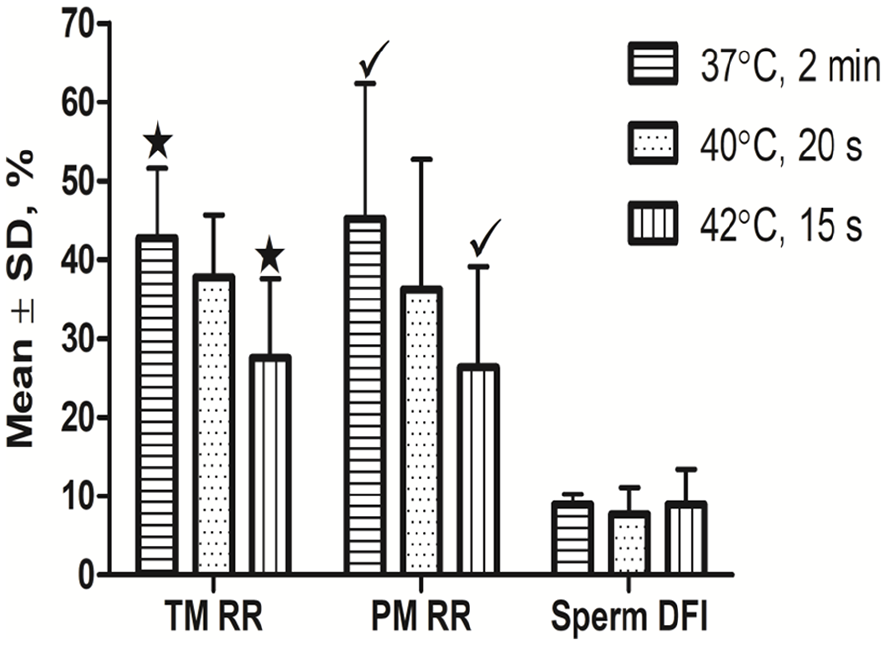
Effects of different thawing methods on recovery rates of total motility (TM RR) and progressive motility (PM RR) as well as sperm DFI. Bars with the same symbols represent significant difference (p < 0.05). DFI, DNA fragmentation index; PM, progressive motility; RR, recovery rate; TM, total motility.
Comparison of the cryoprotective effects of sucrose and trehalose (Experiment 4)
To compare the cryoprotective effects of 0.25 M sucrose and 0.25 M trehalose, sperm samples from the same donors were cryopreserved in freezing medium FM2 containing 0.25 M sucrose or 0.25 M trehalose, respectively, and then thawed in a 37°C water bath for 2 min. The results summarized in Figure 5 showed that the post-thaw recovery rates of both total and progressive motilities of the sperm samples cryopreserved using 0.25 M trehalose (27.3 ± 9.1% and 26.8 ± 8.7%, respectively) were significantly higher (p < 0.05) than that of sperm cryopreserved using 0.25 M sucrose (20.5 ± 6.3% and 23.1 ± 8.1%, respectively). No difference was found in sperm DFI between the sperm samples cryopreserved using 0.25 M sucrose and of samples cryopreserved using the same concentration of trehalose (p > 0.05).
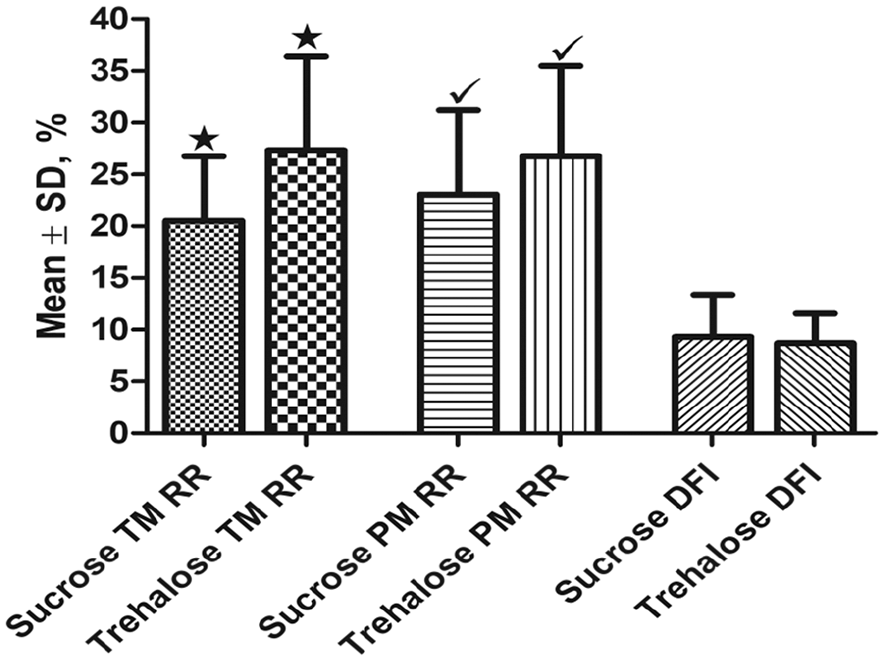
Effects of freezing media containing 0.25 M sucrose versus 0.25 M trehalose on post-thaw recovery rates of sperm total motility (TM RR) and progressive motility (PM RR) as well as sperm DFI. Bars with the same symbols represent significant difference (p < 0.05). DFI, DNA fragmentation index; PM, progressive motility; RR, recovery rate; TM, total motility.
Discussion
Human sperm cryopreservation by rapid freezing and vitrification using carbohydrates as cryoprotectants are still new technologies that remain to be optimized and standardized. In the present investigation, we focused on the influences of 4 basic and important factors, including osmolality of freezing medium, sperm concentration, thawing temperature, and carbohydrate type (sucrose and trehalose) on the cryopreservation of sperm motility and nuclear DNA integrity, and found that human sperm nuclear DNA is relatively resistant to the changes of these factors compared with sperm motility.
Different preparation methods of the freezing medium containing 0.25 M sucrose significantly affected the post-thaw recovery rates of both total and progressive motilities, and the cause was most likely due to the difference in osmolality of the freezing media. Freezing medium with lower osmolality (442 mOsm/kg, termed FM2 in this study) prepared by mixing equal volumes of sperm suspension in culture medium and 0.5 M sucrose in water was significantly better than freezing medium with higher osmolality (536 mOsm/kg, termed FM1 in this study) prepared by mixing equal volumes of sperm suspension in culture medium and 0.5 M sucrose in the same culture medium for cryopreservation of sperm motility. The mechanism behind this finding that 442 mOsm/kg was better than 536 mOsm/kg for preservation of sperm motility is likely due to the hyperosmotic stress that sperm cells experience during freezing and/or the osmotic imbalance encountered during thawing that causes sperm membrane cryodamage.13–15,23 Study in rhesus monkeys also found that hyperosmotic stress causes oxidative stress, which causes further sperm damage and reduction of sperm motility. 16
Another freezing medium tested in the present report was FM3, containing 0.25 M trehalose with osmolality of 457 mOsm/kg. We found that this freezing medium was significantly better than FM2, containing 0.25 M sucrose with osmolality of 442 mOsm/kg, in cryopreserving both total and progressive motilities. This result, combined with the findings mentioned above that freezing medium FM1 with osmolality of 536 mOsm/kg was less effective than that of FM2 in cryopreserving sperm motility, indicates that the optimal osmolality of freezing medium for human sperm rapid freezing is around 450 mOsm/kg. The stronger cryoprotective effect of trehalose than sucrose at the same molar concentration (0.25 M) can likely be explained by the higher glass transition temperature (Tg) of trehalose than sucrose.24,25 Schulz et al . 8 also reported that 0.1 mol/l trehalose was better than 0.25 mol/l sucrose in cryopreserving human sperm motility by vitrification in an open straw system, but 0.25 M trehalose was not tested in the study.
The clinical applications of sperm cryopreservation mainly include in vitro fertilization (IVF), intrauterine insemination (IUI), and intracytoplasmic sperm injection (ICSI). Excluding ICSI, both IUI and IVF procedures need a large number of progressively motile sperm, and therefore sperm concentration and sample volume are two important considerations of sperm cryopreservation. However, most reported applications of rapid freezing and vitrification of human sperm only described cryopreservation of samples with low sperm concentrations,10,11,17,18 and it is unclear whether samples with high sperm concentration can be cryopreserved efficiently. Our results indicate that sperm concentration is not an important factor affecting the efficiency of cryopreservation of sperm motility and DNA integrity in the range from 5 to 20 million/ml tested.
The thawing of sperm is an equally important step as freezing during which the sperm cell must be allowed to recover its normal biological activities while avoiding abrupt thermal changes. Generally, the published cryopreservation protocols use a thawing temperature of 37°C, although different combinations of thawing temperatures and lengths of time have been reported.7,10–12,17–19 Side-by-side comparisons of the thawing procedures are needed to determine the optimal thawing method. In this report, we found that 37°C for 2 min and 40°C for 20 s were significantly better than 42°C for 15 s for thawing a 100-µl sperm sample contained in a 0.5-ml standard freezing straw in terms of cryorecovery of both total and progressive sperm motilities, indicating that there is a risk of sperm damage with higher thawing temperatures. A previous study found that 42°C was better than 37°C for thawing a sperm sample cryopreserved in an open straw system. 19
In conclusion, we demonstrated that the optimal osmolality of freezing medium containing 0.25 M sucrose or trehalose for human sperm rapid freezing is 442 to 457 mOsm/kg, and sperm can be cryopreserved at a concentration from 5 to 20 million/ml followed by thawing at 37°C. In addition, we found that trehalose is a stronger CPA than sucrose for human sperm cryopreservation.
Footnotes
Author contributions
All authors have accepted responsibility for the entire content of this submitted manuscript and approved its submission.
Funding
The authors disclosed receipt of the following financial support for the research, authorship, and/or publication of this article: This work was supported by the National Natural Science Foundation of China (the Joint Funds of NSFC and Henan Province, Award No. U1604179).
Conflict of interest statement
The authors declared no potential conflicts of interest with respect to the research, authorship, and/or publication of this article.
