




Abstract
Unidirectional carbon fiber-reinforced plastic (CFRP) IMA/M21E polymer composite was manufactured by standard autoclave curing method. This is a new aircraft-grade CFRP composite presently used in the manufacture of aircraft wing parts. Test specimens as per ASTM standards for weight gain, tensile and compression tests were obtained from this composite laminates. Some of the test specimens were subjected to hygrothermal (hot–wet) aging in an environmental chamber under three different conditions, that is, (i) 45°C/85% relative humidity (RH), (ii) 70°C/85% RH and (iii) 55°C/100% RH until reaching moisture absorption saturation. Matrix-dominated mechanical properties, that is, transverse tensile and longitudinal compression were determined for dry and hygrothermally aged test specimens. During mechanical testing in a servo-hydraulic test machine, the respective hygrothermal conditions were maintained while testing. It was noted that the rate of moisture absorption increases progressively and reaches saturation around 0.76–1.24 wt% depending on the aging conditions. Moisture absorption followed Fickian diffusion behavior in all the conditions of the study. Also, a software program was developed to predict the moisture content and time of saturation. The predicted results from this software program correlated with experimental results. It was observed that the presence of moisture reduced the tensile strength significantly by about 9–31% and compression strength by about 2–8%. Microscopic observation of tested samples was carried out using scanning electron microscope to study the failure behavior.
Introduction
Use of carbon fiber-reinforced plastic (CFRP) composites is increasing nowadays due to reduced weight along with the increase in strength and stiffness. 1,2 These widespread applications are mainly in aerospace and automotive industries. In their service life, composite structures are usually subjected to a variety of environmental situations, such as hygrothermal, chemical environments, UV radiation, biological conditions, and so on, which produces degradation in material properties. The material degradation involves primarily chemical variations in the matrix material and debonding at the interface of fiber and matrix. At hygrothermal (hot–wet) environmental conditions, absorbed water in the matrix or fiber and at matrix interface of composite would act as a plasticizer causing gaps in the polymer chains. This results in a significant deterioration of the glass transition temperature in addition to relieving of internal stress built up during the moisture absorption process. These changes to fiber-reinforced polymer (FRP) composites affect their properties and overall performance parameters, such as strength, stiffness, and damage tolerance. 3 –9
It is observed that moisture absorption affects the matrix in FRP composites as a result of the variation in chemical and physical properties combined with the fiber/matrix interface. This aspect is the controlling factor in the reinforcement in these FRP composites. 10 –12 It becomes essential to understand the moisture absorption rate, which helps in predicting the long-term performance in hygrothermal environmental conditions for composite materials. One of the key evaluating parameters for these CFRP composites is knowing their mechanical properties and how they are affected by different environmental conditions. 13,14
Different types of CFRP composite materials are used in aircraft applications today. This includes different grades of carbon fibers/resin (matrix) systems. Some examples of CFRP composites used in aircraft are IM7/8552, C-160/epoxy, T800/3900-2B, carbon/BMI, T800/M21, carbon/977-2, and so on. There is an increasing demand for new composite materials with better stiffness, toughness, environmental resistance, lightning strike protection, and so on. The CFRP composite Intermediate Modulus Aerospace (IMA)/M21E is one such new material with higher toughness. HexPly® is the pre-preg obtained from Hexcel Corporation. HexPly is the name of pre-pregs supplied by Hexcel Corporation. The experiments are conducted to assess the absorption of the moisture and its effects on the IMA/M21E composite material. Epoxy (polymer) resin M21E is a high performance, high toughness matrix developed by Hexcel Composites for use in primary aircraft structures. At high energy impacts, it exhibits excellent damage tolerance. 15 Very limited research work is carried out on this CFRP material 15,16 and no reported research is available on moisture absorption behavior and hygrothermal environmental effects on mechanical properties of this CFRP composite. A software program is developed to predict the saturation moisture level and duration for saturation.
Experimental
Material and specimens
The composite system considered in this study is HexPly® M21E/34%/UD/194/IMA. IMA-grade carbon fiber with 194 g m−2 areal weight, UD and M21E resin with 34% by weight was used in the prepreg. M21E is a toughened epoxy resin system with 180°C curing temperature. Prepregs of IMA/M21E CFRP composite were from Hexcel Corporation (Duxford, UK). UD laminates with stacking sequence[0] were prepared from these prepregs with dimensions 600 mm wide by 600 mm long. Laminate fabricated with six layers of prepregs with thickness of about 1.12 mm was used for tensile test specimens and about 2.00-mm-thick laminate with 10 layers of prepregs was used for compression test specimens. The standard autoclave method was used for making these laminates. Curing was done under 7 bar pressure along with slow heating of 3°C min−1, kept at 180°C for 120 min followed by cooling at a rate of 5°C min−1.
Standard weight gain (traveler coupons) specimens with dimensions 25 × 25 × 1.12 mm3 were prepared from composite laminates according to ASTM D5529/D 5229M-92. 17 ASTM D3039 18 test method was followed for tensile test and ASTM D341019 test method was followed for compression test. Five test specimens for weight gain measurements and compression tests were used for each hygrothermal condition, whereas three test specimens were used for tensile test for each hygrothermal condition. All the test specimens were subjected to heating at 40°C for 1 h in an oven to eliminate any content of moisture before conditioning in various hygrothermal conditions. Schematic diagram of tensile and compression test specimens is shown in Figure 1.

Schematic diagram showing dimensions of test specimens.
Hygrothermal aging
The test specimen edges after cutting were coated with resin at edges before conditioning to ensure uniform moisture absorption from all the surfaces of the specimen and avoid exposure of cut fibers. Initial weights of traveler coupons were measured using a Sartorios balance with four decimals of accuracy for weight gain specimens. Aging was done by selecting following hygrothermal conditions in a temperature and humidity chambers and constant temperature water bath: 45°C/85% RH, 70°C/85% RH, 55°C/100% RH (water immersion).
Weight gain was measured on traveler coupons at regular intervals of time to find out the amount of moisture absorption. Percentage weight gain was calculated for each condition till saturation. Initially, weight measurements were done in short intervals of about 24–48 h and later measurement intervals were about 1–2 weeks.
To predict the maximum moisture absorption for a given hygrothermal condition, a software model was developed. This uses the initial slope of moisture absorption curve, diffusion coefficient, thickness, initial moisture content, and so on, for prediction.
Mechanical testing
Transverse tensile strength and longitudinal compression strength tests were considered mainly to find out the effect of moisture absorption on matrix. As absorbed moisture affects matrix and thereby properties, these two tests give good indication of the effect of absorbed moisture on the composite mechanical properties like tensile and compression strengths. Tests were carried out for both room temperature (unconditioned) and hot–wet conditioned specimens and in accordance with ASTM standard utilizing a 100 kN servo-hydraulic universal testing machine (UTM). Respective hygrothermal conditions were maintained during testing.
Specimens were analyzed for fracture morphology after testing using scanning electron microscope (SEM). Conductive coating (gold) layer using a sputtering unit was given to these specimens and fracture surfaces were examined using a ZEISS EVO/18 SEM at 20 kV.
Results and discussions
Moisture absorption behavior
Moisture absorption behavior results of IMA/M21E CFRP composite are shown with weight gain versus square root of time for various hygrothermal conditions in Figure 2. The maximum moisture absorption in three different hot–wet conditions are provided in Table 1.

Moisture absorption behavior determined for IMA/M21E at various aging conditions.
The maximum moisture absorption in various hygrothermal conditions.

RH: relative humidity.
Among the three conditions, water immersion at 55°C shows highest moisture absorption with less time of saturation, compared to other two conditions. Moisture absorption is lowest in condition 45°C/85% RH, whereas 70°C/85% RH exhibits intermediate behavior. Also, the amount of maximum moisture absorbed is 1.24% for water immersion at 55°C, 0.82% for 70°C/85% RH, and 0.76% for 45°C/85% RH, respectively. This trend is similar to studies conducted by other researchers on similar type of CFRP composite materials. 20 Compared to results reported by others on similar materials, IMA/M21E CFRP composite has exhibited less amount of saturation moisture. For example, carbon fiber (C-160)/epoxy (LY 5052) at 45°C/85% RH 21 has shown 0.82% saturation moisture (specimens in longitudinal tensile configurations) compared to 0.76% for the same condition in the CFRP studied here.
In UD orthotropic CFRP laminate, the diffusion coefficient is described using Fick’s diffusion law. The governing equation of Fick’s law describing UD diffusion 20,22 is represented as follows

where “D” is the diffusion coefficient, “h” is the thickness of the specimen in direction of diffusion, moisture contents “M 1” and “M 2” at a given time “t 1” and “t 2,” respectively, and “M s” is saturation absorption and slope of the water absorption curve initially is “k.”
The CFRP material under study here followed Fickian type of diffusion in moisture absorption behavior, indicated by initial linear increase in moisture level, thereby steadily tending saturation. The Fickian numerical fit is obtained using the following equation 22

where “M” is the % moisture content at a given time “t.”
From the experimental data shown in Figure 2, using slope “k,” “D” was calculated from equation (1). Using “D” from equation (2), “M” at different time interval was calculated. The moisture absorption curves, that is, Fickian behavior thus predicted for all the three hygrothermal aging conditions, as shown in Figure 2.
A software model developed in-house considering moisture absorption parameters like moisture content at a given time within the initial absorption curve, that is, linear portion, slope of linear portion, diffusion coefficient, and so on, to predict the maximum or saturation moisture content and also the time of saturation mainly using equations (1) and (2). It was observed that the predicted results and the experimental results were in close correlation for conditions 70°C/85% RH and 55°C/100% RH. Table 2 presents the comparison of predicted values and experimentally obtained values. The parameters considered in studies done by other researchers for directional diffusion in CFRP composites 23,24 fall in line with the parameters in the above software.
The maximum moisture absorption in various hygrothermal conditions predicted by software and obtained from experiments.

RH: relative humidity.
Mechanical tests
The tensile and compression test results obtained from IMA/M21E CFRP composite material under various aging conditions are presented in Table 3 and Figure 3. Table 2 also contains standard deviation in mechanical properties.
Mechanical properties of IMA/M21E CFRP composite.

CFRP: carbon fiber-reinforced plastic; RH: relative humidity.

Comparison of degradation in tensile and compression strength before and after conditioning.
From Table 3, it may be observed that both tensile and compression strength of this CFRP composite material were reduced due to moisture absorption. Aging carried out at 45°C/85% RH has shown less reduction compared to other two conditionings. Aging done at 55°C/100% RH (water immersion) has shown highest reduction in both tensile and compression strength. Maximum reduction in tensile strength in 55°C/85% RH condition is about 31%, whereas compression strength is by about 8% compared to control samples (samples with no hot–wet conditioning). It is noticed that as the absorbed moisture content rises, the deterioration in mechanical properties increases. The severity of deterioration depends on the amount of moisture absorbed by the composite material. The severity is in the order of 45°C/85% RH < 70°C/85% RH < 55°C/100% RH. When compared to similar class of composite materials, the present material studied here has shown less degradation in both tensile and compression properties due to hygrothermal effects. A maximum moisture absorption of 0.57 wt% in a given condition on carbon/977-2 composite has shown degraded 50% degradation in transverse tensile strength due to hygrothermal aging effects. 19 Similarly, IM7/8552 showed about 28% reduction in compression strength due to hygrothermal effects. 25
After testing, the failed specimens were subjected to microscopic studies in SEM to analyze the fracture/failure behavior. SEM micrographs of tensile tested specimens and compression tested specimens at different hygrothermal aging conditions are shown in Figures 4 and 5, respectively.
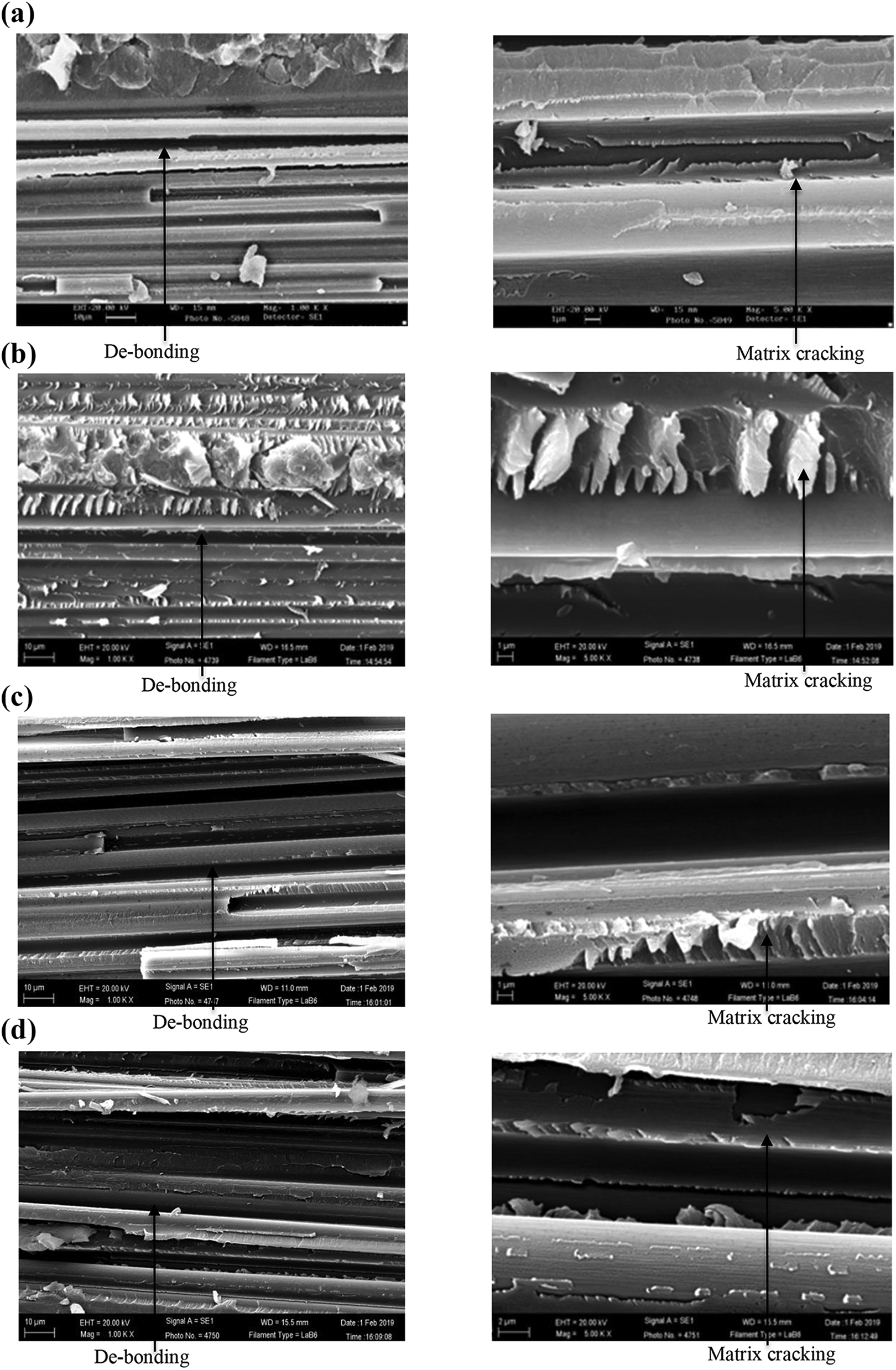
SEM micrographs showing tensile fracture surfaces in IMA/M21E CFRP composite tested under various hygrothermal conditions. (a) No conditioning—specimens kept at ambient condition, (b) condition: 45°C/85% RH, (c) condition: 70°C/85% RH, and (d) condition: 55°C/85% RH. SEM: scanning electron microscope; CFRP: carbon fiber-reinforced plastic; RH: relative humidity.
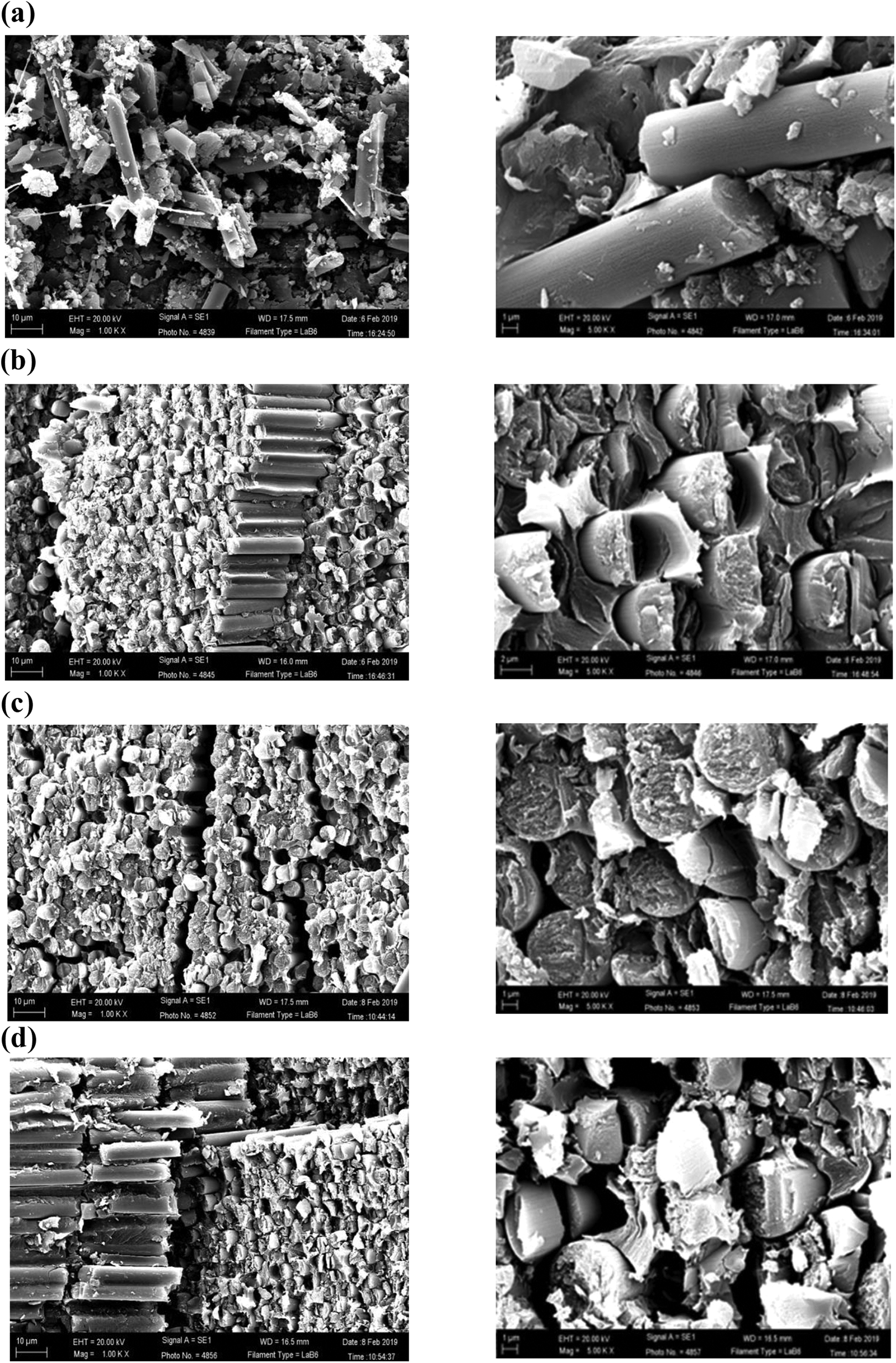
SEM micrographs showing compression fracture surfaces in IMA/M21E CFRP composite tested under various hygrothermal conditions. (a) Control (without conditioning)—specimens put in room temperature, (b) condition: 45°C/85% RH, (c) condition: 75°C/85% RH, and (d) condition: 55°C/100% RH. SEM: scanning electron microscope; CFRP: carbon fiber-reinforced plastic; RH: relative humidity.
As seen in SEM micrographs for all conditions, the failure of test specimens is mainly due to matrix cracking. In transverse tensile tests, as the loading was perpendicular to fiber direction, the load was mainly borne by matrix. Absorbed moisture enhanced the matrix cracking resulting in decreased tensile strength as compared to specimens not subjected to hot–wet conditions. SEM micrographs shown in Figure 4 shows delamination and matrix cracking caused by load applied in tensile testing. Debonding between fiber and matrix caused by load applied can be seen at higher magnification. Also, these high magnification images show clear evidence of delamination and matrix cracking. Under these four conditions of the study, it is observed that test specimens which are conditioned in hot–wet atmosphere exhibit increased debonding and matrix cracking, as compared to unaged specimens. It clearly states that the amount of moisture absorbed by CFRP composite results in enhancing matrix cracking and debonding leading to reduction in the tensile strength.
SEM micrographs of compression tested specimens of control (without hygrothermal conditioning) and of the three aging conditions, it can be seen that the compression test mainly resulted in failure due to both matrix cracking and fiber breakage. Here, compression loading was in the fiber direction, and the load was mainly borne by fiber. SEM micrographs show fiber breakage and debonding between fiber and matrix. Absorbed moisture enhanced debonding, resulting in decreased compression strength compared to specimens not subjected to hot–wet conditions. SEM micrographs in Figure 5 show delamination and fiber breakage as a result of load applied during compression testing. At higher magnifications, this is more evident. Clear evidence of debonding at fiber/matrix interface, fiber breakage, and matrix cracking can be seen. Thus, on comparison, test specimens subjected to hot–wet atmosphere conditions show increased debonding, matrix cracking, and fiber breakage, as related to specimens that are unconditioned (control). Thus, absorbed moisture content invariably leads to reduction in the compression strength.
Moisture absorption in a fiber/epoxy composite primarily happens by diffusion process driven by concentration gradient and temperature. Possible other mechanisms include transport through microcracks, capillary action at the interface of the fiber, and fiber/matrix boundary. 26,27 Moisture in composite has unfavorable effects as it often causes swelling and degradation. 28 Absorbed moisture in composite materials leads to polymer matrix pasticization and reduction in fiber/matrix interfacial strength. 29 –43 It is normally observed that absorption of moisture follows Fick’s law and the gradient in concentration of moisture between the composite material and operating environment and the temperature of the environment drives the diffusion, causing continuous absorption until saturation. 21 Moisture absorption rate and maximum moisture content in a CFRP composite are dependent on the layup sequence. It was observed that UD laminate absorbed moisture at a higher rate than that of quasi-isotropic. 25 The reinforcement chemistry and matrix, in addition to exposure time, determine the extent of degradation method. 40,42 Sensitivity to different environmental conditions differs by different kinds of composites. The present results clearly indicate that IMA/M21E CFRP composite absorbs moisture and degrades with respect to tensile and compression strengths. However, the reduction in properties appear to be lesser than other CFRP composites under similar conditions.
Conclusions
The behavior of moisture absorption at various hygrothermal (hot–wet) conditions under study and its degradation effects on tensile and compression strength of IMA/M21E CFRP composite were investigated in this study. From the results obtained, following findings are arrived: Both temperature and extent of relative humidity in the environment influence the amount of moisture being absorbed by the carbon/epoxy composite. Total maximum moisture absorption observed was 1.24% for most severe condition, that is, water immersion at 55°C. Moisture absorption follows Fickian behavior. Hot–wet conditioning degrades the transverse tensile and longitudinal compression strength. More severe is the hygrothermal aging condition, more is the degradation in mechanical properties. Transverse tensile strength reduced significantly by about 31% and longitudinal compression strength by about 8% due to absorbed moisture in severe condition of 55°C/100% RH among those under study. Moisture absorption at saturation and time of saturation predicted using software model shows close correlation to experimental results for conditions 70°C/85% RH and 55°C/100% RH. From SEM studies of fractured surfaces, it is clear that debonding at the interface of fiber and matrix, fiber breakage, and matrix cracking resulted in failure under applied load. It is observed that specimens conditioned at different hygrothermal environments show increased delamination, debonding, and matrix cracking in relation to those observed in unconditioned (without aging) specimens. Among the class of carbon/epoxy composites at present, this emerging new material IMA/M21E CFRP composite seems to be more promising in the latest aircraft manufacturing.
Footnotes
Declaration of conflicting interests
The authors declared no potential conflicts of interest with respect to the research, authorship, and/or publication of this article.
Funding
The author(s) received no financial support for the research, authorship, and/or publication of this article. The authors received no financial support for the research, authorship, and/or publication of this article.