




Abstract
The graphene oxide (GO)/yttria-stabilized tetragonal zirconia polycrystal (3Y-TZP) composites were fabricated by impregnating the GO dispersion into the zirconium oxide ceramic and sintered by microwave method. The wear and friction properties of the composites were tested by pan-on-disk method, and the results showed that the coefficient of friction and the wear rate decreased and the wear rate of silicon carbide ball was nearly similar with the increase of GO volume fraction. The microstructure of wear surface of the reduced graphene oxide (RGO)/3Y-TZP composite and the 3Y-TZP were investigated by using scanning electron microscopy, respectively. It was indicated that plastic deformation was occurred and the carbon-rich tribofilm was formed in the RGO/3Y-TZP composite, and the tribofilm of the RGO/3Y-TZP composite showed better wear performance than the 3Y-TZP.
Introduction
Yttria-stabilized tetragonal zirconia polycrystal (3Y-TZP) is an excellent material in fundamental studies because of its remarkable properties including good chemical stability, corrosion resistance, high hardness, and high wear resistance. 1 –3 3Y-TZP ceramic material has high wear resistance, which can be used in the manufacture of cutting tools, such as pump blades and computer support components. 4 –6 3Y-TZP ceramic has a good grinding effect and hardly contaminates the grinded products, so that it has been used in different fields. 7,8
To further expand its applications in cutting tools, a research hotspot is to improve the wear resistance of the zirconia ceramics. 9 –11 Under lubrication conditions, adding nanolubricant additives are the most effective way to form a tribofilm at the asperity contact locations to separate the sliding surfaces. So the selection of nanomaterials is very important to improve the tribological performance and enhance the properties of 3Y-TZP ceramic.
Graphene, a two-dimension sheet of single atomic thick layer of hexagonally arranged carbon atom, is a good candidate for self-lubricants due to its excellent lubricating properties. 12 When graphene oxide (GO) mixes with 3Y-TZP ceramics, it will be formed a large specific interfacial area that improves the efficiency of stress transfer between the matrix and the GO. 13,14 In addition, the mechanical properties of the ceramic composites such as the friction and wear properties will be improved since the wear process induces the formation of a carbon-rich tribofilm that can lubricate and protect the contact surfaces. Llorente et al. 15 report under dry sliding condition a 70% improvement in the wear and friction for 20 vol% graphene/silicon carbide (SiC) composites. Which are due to form an adhered lubricating tribofilm Belmonte et al. and Hvizdos et al. 16,17 observe that under isooctane lubricated conditions, adding 3 wt% of graphene nanoplatelets into a silicon nitride matrix reduces the friction and improves the wear resistance up to 56% ascribe to the exfoliation of the nanoplatelets and the creation of an adherent protective tribofilm. When compared to the monolithic alumina, graphene/Al2O3 composites 18,19 also show remarkable improvements on the wear resistance.
On the other hand, zirconia ceramics reinforced by carbon and carbon derivatives have improved wear resistance and reduced friction coefficients. Melk et al., 20 multiwalled carbon nanotubes (MWCNTs)-reinforced zirconia composites, show that both coefficient of friction (COF) and wear resistance decrease with the increase of MWCNT content. Hvizdos et al. 21 study the friction and wear behavior of 3Y-TZP with 1.07 wt% carbon nanofibers (CNFs) composite, and the results show that the main wear mechanisms are abrasion and the pullout of CNFs that act as a sort of lubricating media in the interface. Kasperski et al. 22 have reported that 3Y-TZP/CNT composites with a carbon content of 5.16 wt% have a lower COF, because the high shear stresses are generated during sliding process that induces the exfoliation of the MWCNTs and forms a lubricating film over the contact area.
However, few works study the wear behavior of zirconia-GO composites. 23 –25 In this article, the GO-reinforced 3Y-TZP ceramics were fabricated and the friction properties and the relevant mechanism of the reduced graphene oxide (RGO)/3Y-TZP composites were investigated. In addition, the influence of GO content on the friction properties was investigated based on the morphology examination and tribological analysis. This work provided mechanism to improve the friction and wear properties of RGO/3Y-TZP ceramic composites and increase its possibility.
Experimental procedure
Materials and sample preparation
3Y-TZP powder was purchased from Sulzer Metco, Switzerland (100–150 nm). Cyclohexane, Triton X-100, and N-methyl pyrrolidone (NMP) were purchased from Sinopharm Chemical Reagent Co., Ltd, Beijing, China. GO powder (1–2 µm) was purchased from Suzhou Tanfeng Graphene Technology Co., Ltd, Jiangsu, China (GO synthesis refers to article 26 ).
Firstly, a preform with density of 3.0 g cm−3 was fabricated by dry pressing 3Y-TZP powder (containing cyclohexane and Triton X-100) under the pressure of 200 MPa. The surface of 3Y-TZP powder was covered cyclohexane and Triton X-100 to avoid 3Y-TZP powder agglomerating. A preform containing cyclohexane and Triton X-100 can affect the impregnation process. Therefore, it is necessary to remove cyclohexane and Triton X-100 by sintering the preform at 800°C. Thereafter, different quantity of GO was dispersed in 40 mL NMP and sonicated for 10 min. The dispersion solutions were milled with ball-to-powder weight ratio of 16 and at a speed of 300 r min−1 for 4 h to get well-distributed solution. In the ball milling process, Reynolds shear stress can make the GO sheets getting thin and uniform by overcoming the Van der Waals forces between the GO sheets. 27,28 NMP can play the role of stabilizing agent, which prevents the GO sheets from agglomerating and overlapping. 28 The GO supernatant solution was collected after standing for 24 h. To prepare the GO/3Y-TZP composites, the preform of 3Y-TZP was placed in a self-made impregnating device under pressure of −0.09 MPa to −0.1 MPa for 30 min before the GO dispersion was injected into the impregnating device to submerge the samples. After the GO dispersion injection, the pressure was maintained at 20 MPa for 20 h. Finally, the GO/3Y-TZP ceramic preform was obtained. Figures 1 and 2 show the detailed impregnating device framework. The RGO/3Y-TZP perform was dried in an oven at 120°C for 30 min. Then RGO/3Y-TZP perform was sintered by microwave sintering at 1350°C with a vacuum for 3 h (heating rate of 30°C min−1 refers to article 29 ).

Ceramic preform was obtained.

Impregnating device framework.
Wear and friction tests
The wear and friction properties of the composites were measured by a pan-on-disk method. The wear test specimen was polished into a mirror surface with the surface roughness of 0.02 µm. A commercial SiC ball with higher hardness than zirconium oxide was used in the wear and friction tests with a sliding speed of 250, 500, and 750 r min−1 for 1800 s under the load of 10 N, 50 N, and 100 N, respectively. The friction torque was recorded by the friction sensor. The experiment was carried out at 25 ± 1°C with a relative humidity of 30–50% maintained by temperature and humidity controller. The pan-on-disk method was schematically shown in Figure 3.
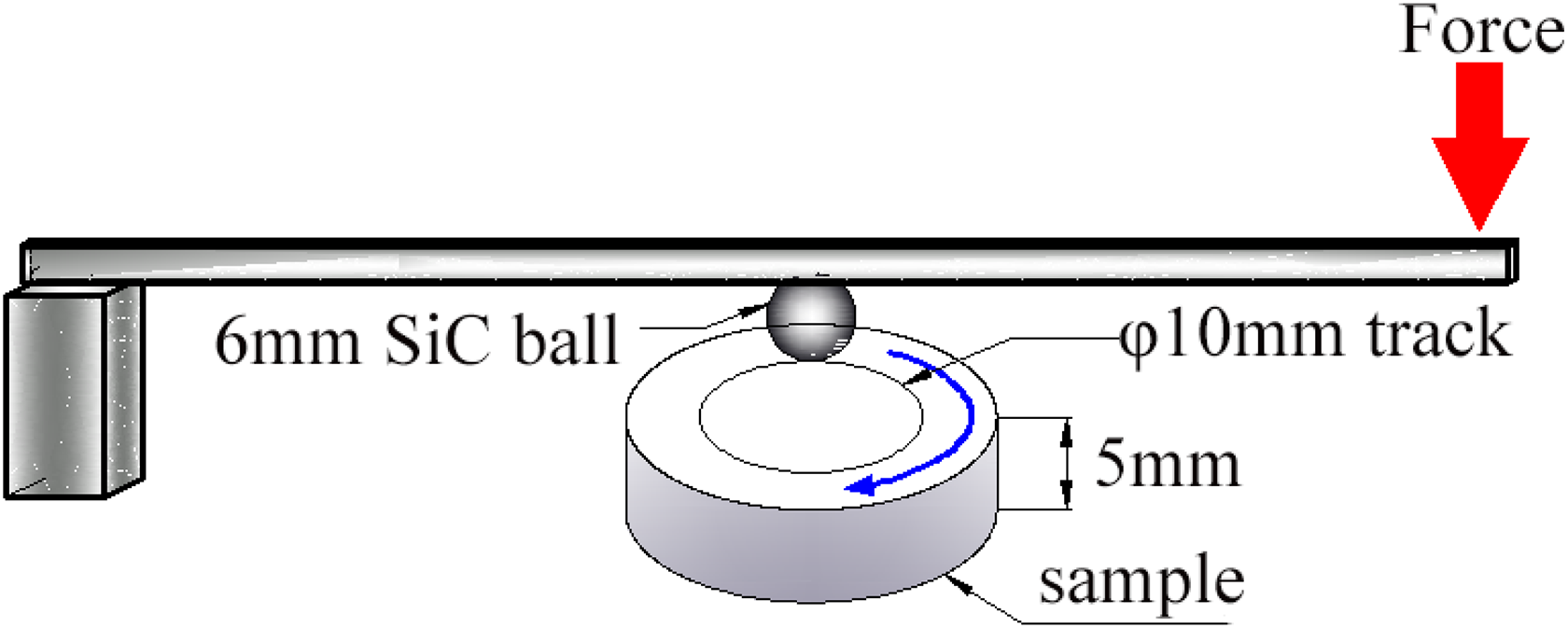
Schematic representation of the pan-on-disk method. SiC: silicon carbide.
The microstructures of wear surface of RGO/3Y-TZP composites were characterized by scanning electron microscopy (SEM, SU-1500; HITACHI, Japan). And then the crystal phases of RGO/3Y-TZP composite were characterized by X-ray diffraction (XRD, D/MAX; Rigaku Corporation, Tokyo, Japan). The specimens were analyzed by Raman (INVIA; Renishaw, England) with wavelength of 514 nm to confirm whether the graphene is present in the tribofilm. The apparent density of the sintered specimens was measured by the Archimedes method in distilled water. Grain size was determined by analyzing field emission SEM (JSM-7500F; JEOL Ltd, Tokyo, Japan) images by using the Image-J software. Subsequently, the main planar grain diameter was obtained measuring at least 200 grains from various images. The hardness and elastic module were measured by a nanoindenter (tribo indenter; supplied by Hysitron, Minneapolis, Minnesota, USA) with a Berkovich indenter tip under a 10 mN load with a dwelling time of 5 s. The value of hardness and elastic module were the average of the five experimental results.
The wear rate was calculated using the following equation:

where Δm is the weight loss, ρ is the density of the composites, S is the distance of sliding, and P is the load.
Results and discussion
Figure 4 shows the XRD patterns of the RGO/3Y-TZP composites, where circle represents tetragonal (t) and other diffraction peaks represent monoclinic (m) phase. It can be seen that the RGO/3Y-TZP composites specimens show the same diffraction patterns as 3Y-TZP. It indicates that there is no tetragonal (t) to monoclinic (m) phase transformation after microwave sintering. The content of carbon in the composites might be lower than 0.05 wt% since there is no appearance of carbon peaks. In conclusion, the original crystal structure of the 3Y-TZP is maintained after composites formed.

XRD pattern of the 3Y-TZP and RGO/3Y-TZP composites with different GO volume fraction. XRD: X-ray diffraction; RGO: reduced graphene oxide; 3Y-TZP: yttria-stabilized tetragonal zirconia polycrystal; GO: graphene oxide.
Table 1 presents the mechanical properties of the RGO/3Y-TZP composites with different GO volume fraction. It can be seen that the hardness and elastic module reach peak values of 17.81 GPa and 237.81 GPa, respectively, at a 1.02 vol% of GO. The relative density of RGO/3Y-TZP composites decreases with the volume fraction of GO increasing, and purity of those specimens is >99%. The addition of GO further helps to retain a finer grained structure in the composites and prevent grain growth during densification. The hardness and elasticity modulus of RGO/3Y-TZP composites fall down after initial increase, which is attributed to grain size refinement. 30 With the volume fraction of GO increased in the RGO/3Y-TZP composites, the matrix grain size decreased obviously and hardness fall as well. With the volume fraction of GO increased in the RGO/3Y-TZP composites, apparent density decreased causing the fell fail of hardness. 31 A small amount of RGO distributed in the matrix causing grain refinement, which pins the growth of the grain. The second reason is that graphene has high thermal conductivity. 32 A small amount of RGO in the matrix only cause the sintering temperature more uniform but also improve the cooling rate of zirconia grain from sintering temperature to surrounding temperature. The third reason is that GO changed into RGO during the sintering process due to graphene’s high thermal conductivity and the addition of GO can help to reach sintering temperature quickly. The factors above lead to the grain refinement of RGO/3Y-TZP composites during microwave sintering process. 33 With the increasing dosage of GO, the grain size changes slightly. The main reason is that the agglomeration of GO could lead to little influence on the grain size. 34 GO supernatant permeates into the matrix through pore, where agglomeration of GO might form when the amount of GO building up.
Mechanical properties of RGO/3Y-TZP composites.
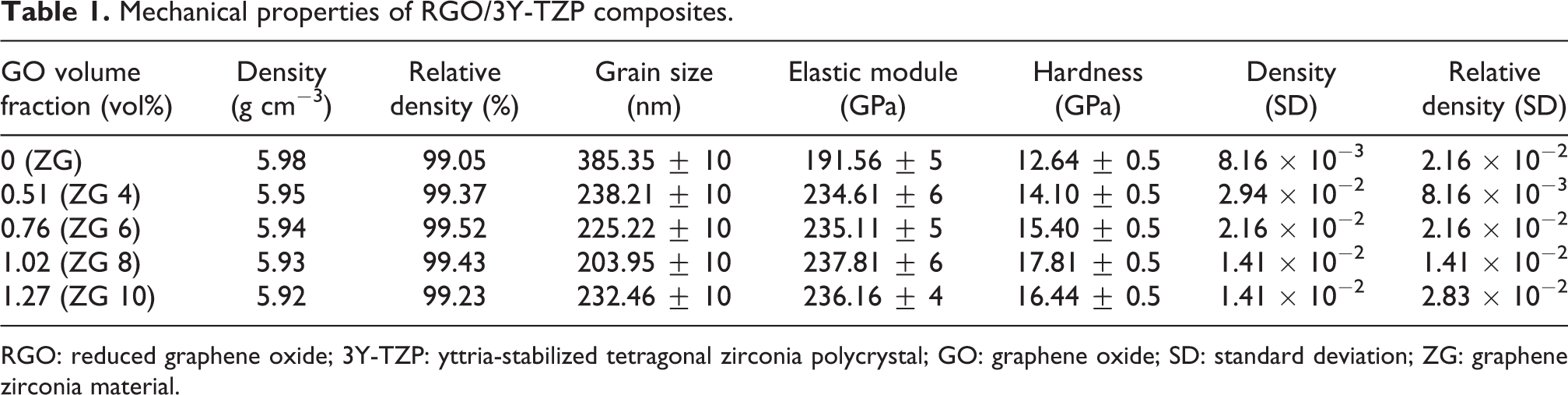
RGO: reduced graphene oxide; 3Y-TZP: yttria-stabilized tetragonal zirconia polycrystal; GO: graphene oxide; SD: standard deviation; ZG: graphene zirconia material.
The COF value is a vital factor to understand the tribological behavior of the materials. Figure 5 shows the COF of RGO/3Y-TZP composites with different speed rate and different GO dispersion at the load of 10 N. According to the results, with increasing the GO content, it can be seen that when the COFs of the composites decrease from 0.48 to 0.33 at 250 r min−1, the COF slippage is 31.25%; from 0.49 to 0.34 at 500 r min−1, the COF slippage is 30.61%; and from 0.51 to 0.36 at 750 r min−1, the COF slippage is 29.41%. And when increasing the speed rate from 250 r min−1 to 750 r min−1, the COF increased marginally. The results show that the COF slightly increases with the increase of the speed rate. Under the same load, similar tribofilm could be formed on the surface of the sample. However, the increase in rotational speed leads to more wear times and more severe wear in the same period of time. Furthermore, the increase of friction temperature will lead to lower wear resistance of materials. At high speed, a large amount of friction energy could convert into the accumulated friction heat at the friction interface. Therefore, it is not surprising that wear degree of materials increased slightly with the increase of the friction temperature at the interface. With the increase of GO content in materials, the lubrication of graphene lamellar structure causing COF decreases when it bears friction. 35,36 On the other hand, GO can form carbon-rich tribofilm and play a lubricating role in friction. 37

The COF of specimens under different speed rate with different GO volume fraction at 10 N. COF: coefficient of friction; GO: graphene oxide.
Figure 6 shows the COF value of the RGO/3Y-TZP composites with different GO volume fraction as a function of time with loading of 10 N and 100 N at 500 r min−1. According to these results, it can be seen that the COF values of all samples increase at first and then reach a plateau. The plateau COF values decrease with the increase of GO volume fraction and the COF value of the 3Y-TZP is higher than that of RGO/3Y-TZP composites. While increasing applied load from 10 N to 100 N, the COF increases from an average value of 0.34 at 10 N to a value of 0.42 at 100 N for the composite with 1.02 vol% GO. For the composite with 3Y-TZP, the COF increases from an average value of 0.49 at 10 N to 0.65 at 100 N. With the increase of load, the wear becomes larger and the wear track becomes deeper. With the increase of load, the friction force of RGO/3Y-TZP composites will increase and the wear resistance will reduce. The increase of shear strength and material temperature can make it easier for the zirconia grains to be peeled out of the matrix. 38 The tribofilm will split the surface of RGO/3Y-TZP composites, which could aggravate the friction and lead to the wear increase of the materials. With the increase of GO content, the wear of the material decreases. It can be seen that RGO present excellent lubrication, which might promote the combination of RGO and debris to form a protective film on the matrix.

COF of RGO/3Y-TZP composites with different GO volume fraction under the load of (a) 10 N and (b) 100 N with 500 r min−1. COF: coefficient of friction; RGO: reduced graphene oxide; 3Y-TZP: yttria-stabilized tetragonal zirconia polycrystal; GO: graphene oxide.
Figure 7(a) and (b) shows the wear rate of RGO/3Y-TZP composites with different GO volume fraction and the wear rate of SiC ball. According to the results, it can be seen that when the wear rate of the composites decreases from 5.34 × 10⁻⁶ mm3 Nm−1 to 1.34 × 10⁻⁶ mm3 Nm−1 at 10 N, the wear rate of RGO/3Y-TZP composites slippage is 74.90%; from 2.25 × 10⁻⁵ mm3 Nm−1 to 2.30 × 10⁻⁶ mm3 Nm−1 at 50 N, the wear rate of RGO/3Y-TZP composites slippage is 89.78%; and from 3.01 × 10⁻⁵ mm3 Nm−1 to 4.30 × 10⁻⁶ mm3 Nm−1 at 100 N, the wear rate of RGO/3Y-TZP composites slippage is 85.71%; with the increase of the GO content with increasing applied load, the wear rate increase from 1.34 × 10⁻⁶ mm3 Nm−1 to 4.30 × 10⁻⁶ mm3 Nm−1 in the case of composites with 1.02 vol% GO and from 5.34 × 10⁻⁶ mm3 Nm−1 to 3.01 × 10⁻⁵ mm3 Nm−1 in the case of the 3Y-TZP. The wear rates of SiC ball are around 3.33 × 10⁻⁷ mm3 Nm−1 at 10 N, 5.41 × 10⁻⁷ mm3 Nm−1 at 50 N and 7.63 × 10⁻⁷ mm3 Nm−1 at 100 N. The COF and wear rate of the composites and 3Y-TZP have the same trend with the increasing applied load and speed rate, which show that there is no significant difference in wear mechanisms of the studied materials. The main wear mechanism of TZP is microcrack, where exfoliation and microcrack debris in the relative sliding of friction pairs could lead to abrasive wear. 39,40

(a) The wear rate of RGO/3Y-TZP composites and (b) SiC ball wear rate with different GO volume fraction under different loading with 500 r min−1. RGO: reduced graphene oxide; 3Y-TZP: yttria-stabilized tetragonal zirconia polycrystal; SiC: silicon carbide; GO: graphene oxide.
To understand the friction and wear mechanism, SEM was used to characterize the microstructures of the 3Y-TZP and the RGO/3Y-TZP composites during the wear and friction tests. The wearing microstructures of the 3Y-TZP at different times (50, 100, 200, and 1000 s) with 500 r min−1 at 100 N are shown in Figure 8, where the white arrow represents pullout and the red arrow represents plastic deformation. There are grain detachments from the substrate at the beginning stage of wear (Figure 8(a)) and more grains are pulled out (Figure 8(b)). Further increasing time of the friction causes plastic deformation of the grains and the formation of a small area of tribofilm (Figure 8(c)). When the COF is steady, large area of the tribofilm can be seen on the surface of the 3Y-TZP (Figure 8(d)). It indicates that serious plastic deformation occurred, and the friction force between the wearing interface increases. The mechanism of friction can mainly be attributed to the pullout of grain and plastic deformation. 41

SEM of the 3Y-TZP during the wear experiment at different time (a) 50 s, (b) 100 s, (c) 200 s, and (d) 1000 s with 500 r min−1 at 100 N. SEM: scanning electron microscopy; 3Y-TZP: yttria-stabilized tetragonal zirconia polycrystal.
Figure 9 shows the microstructures of the RGO/3Y-TZP composites with 1.02 vol% GO at different times (50, 100, 200, and 1000 s) with 500 r min−1 at 100 N during the wear experiment. It can be seen that microcracks (white-dotted arrow) occurred and large amounts of particles are pulled out (white solid arrow) from the surface of the RGO/3Y-TZP composite at the first stage (Figure 9(a)). The presence of microcracks may lead to the shear stress and accelerate the pullout of the particles from the surface, which resulting in the generation of more composite debris and the occurrence of plastic deformation (red solid arrow) (Figure 9(b)). As the wearing process continues, smooth surface with fine straight grooves (red dotted arrow) and plastic deformation around the fine grooves could be observed on the specimen (Figure 9(c)). As the COF is steady, more plastic deformations occur and smooth surface (red double arrow) forms. The formed tribofilm could prevent further friction of the RGO/3Y-TZP composite (Figure 9(d)). This fine microstructure may result in lower friction coefficient of the RGO/3Y-TZP composite compared to that of 3Y-TZP.

SEM of the RGO/3Y-TZP composite with 1.02 vol% GO during the wear experiment at different time (a) 50 s, (b) 100 s, (c) 200 s, and (d) 1000 s with 500 r min−1 at 100 N. SEM: scanning electron microscopy; RGO: reduced graphene oxide; 3Y-TZP: yttria-stabilized tetragonal zirconia polycrystal; GO: graphene oxide.
Figure 10 shows the Raman spectra of section A, section B, raw GO powder, and the unworn region of the RGO/3Y-TZP composite. Section A represents pure 3Y-TZP sample and section B represents wear track of GO/3Y-TZP composite. Raman spectra show the typical D (1350 cm−1), G (1585 cm−1), and 2-D (2700 cm−1) characteristic bands of graphene. The G band is associated with stretching vibrations of C–C bond in graphene layers. The D band originates from atomic displacement and disorder-induced features caused by lattice defect. The 2-D band is an overtone mode of the D band. 42 As shown in Figure 10(a), there is no diffraction peaks in section A, while in section B, the D band is centered at around 1340 cm−1, the G band at around 1580 cm−1, and 2-D band around at 2680 cm−1. Figure 10(b) shows the Raman spectrum of RGO/3Y-TZP composite, where similar bands are located in the same regions as in the powder’s spectrum. The Raman spectrum for GO powders shows only the D and G bands, which are much narrower than those in the composite. This fact along with the presence of 2-D indicate a reduction of the GO. When comparing both spectra, the value of I D/I G slightly increases, which indicates only a subtle damage on the GO after the process of microwave sintering since a severe damage on the graphitic structure of the graphene would lead to a much higher value of I D/I G. 43 The value of I D/I G is almost constant before and after sintering, indicating the retention of the graphene structure within the ceramic matrix. In conclusion, the Raman spectra confirm that the graphene is present in the tribofilms and these tribofilms could reduce friction further.

(a) The Raman spectra of sections A and B and (b) raw GO powder and the unworn region of the RGO/3Y-TZP composite. RGO: reduced graphene oxide; 3Y-TZP: yttria-stabilized tetragonal zirconia polycrystal; GO: graphene oxide.
Conclusions
RGO/3Y-TZP composites were fabricated by impregnating the GO dispersion into ceramic and sintered by microwave. A series of experiments were conducted to characterize the friction and wear behavior of the 3Y-TZP and RGO/3Y-TZP composites. The influence of the addition of GO on their tribological behavior was investigated. The microstructures of wear surface of the composite were also analyzed. The main conclusions were as follows: The RGO/3Y-TZP composites showed the same microphase structure in comparison with the 3Y-TZP. With the increase of the GO volume fraction, the hardness of RGO/3Y-TZP composites increased and the relative density decreased. The graphene existed in the ceramic matrix. Adding GO into the ceramic matrix leads to the reduction of COF value and the wear rates of RGO/3Y-TZP composites. With different GO volume fraction, the wear rates of SiC ball are nearly similar. According to Figure 5, with increasing the GO content, it can be seen that when the COFs of the composites decrease from 0.48 to 0.33 at 250 r min−1, the COF slippage is 31.25%; from 0.49 to 0.34 at 500 r min−1, the COF slippage is 30.61%; and from 0.51 to 0.36 at 750 r min−1, the COF slippage is 29.41%. According to Figure 7, it can be seen that when the wear rate of the composites decreases from 5.34 × 10⁻⁶ mm3 Nm−1 to 1.34 × 10⁻⁶ mm3 Nm−1 at 10 N, the wear rate of RGO/3Y-TZP composites slippage is 74.90%; from 2.25 × 10⁻⁵ mm3 Nm−1 to 2.30 × 10⁻⁶ mm3 Nm−1 at 50 N, the wear rate of RGO/3Y-TZP composites slippage is 89.78%; and from 3.01 × 10⁻⁵ mm3 Nm−1 to 4.30 × 10⁻⁶ mm3 Nm−1 at 100 N, the wear rate of RGO/3Y-TZP composites slippage is 85.71%. The RGO/3Y-TZP composites show improved friction prevention compared to the 3Y-TZP in which much less tribofilm form after the wearing process. Due to the RGO, plastic deformation induced by wear occurs and carbon-rich tribofilm forms to lubricate and protect the contact surfaces.
Footnotes
Acknowledgement
We thank Mr Peng Chen for testing the coefficient of friction of the reduced graphene oxide /yttria-stabilized tetragonal zirconia polycrystal composites.
Declaration of conflicting interests
The author(s) declared no potential conflicts of interest with respect to the research, authorship, and/or publication of this article.
Funding
The author(s) disclosed receipt of the following financial support for the research, authorship, and/or publication of this article: This work was supported by the Natural Science Foundation of China (no. 61403245) and Shanghai Municipal Science and Technology Commission (no. 14500500400).
