




Abstract
Prospective memory (PM), the ability to plan and execute intentions in the future, plays a critical role in managing everyday tasks. A gap exists in our understanding of the neural mechanisms underlying PM retrieval based on semantic judgment, particularly when using picture-based stimuli. The current study tested 2 novel picture-based semantic-judgment PM tasks: Animal-cued Prospective Retrieval Task (Ac-PRT) and Object-cued Prospective Retrieval Task (Oc-PRT), designed to investigate PM processes involved in intention formation (Cue trials), intention retention (Ongoing trials), and intention retrieval (PM Retrieval trials). Twenty-three young adults, aged 18 to 30 years, completed the tasks while EEG data were recorded. Behavioral results showed that participants responded more slowly during Ongoing trials compared to Cue and PM Retrieval trials and were less accurate during PM Retrieval trials. Additionally, between the tasks, responses were faster and more accurate in Ac-PRT than in Oc-PRT during both Ongoing and PM Retrieval trials. ERP analyses revealed distinct neural signatures across trial types, particularly in P2, N2, N4, and Parietal Positivity (PP) components in both tasks. Additionally, task-specific differences were observed during the PM Retrieval trials in P2, N4, and PP amplitudes and in PP amplitude during the Ongoing trials. These findings demonstrate that the 2 tasks effectively dissociated core PM processes and showed category-specific differences in behavioral and neural mechanisms, offering a robust framework for future investigations of PM in aging and clinical populations.
Keywords
Introduction
Prospective memory (PM) refers to one’s ability to plan an action and perform it in the future. 1 Remembering to go to an appointment, taking medication, or picking up dry cleaning on the way back from work are examples of everyday tasks that are supported by PM. Prospective memory retrieval is a complex, multistage process that involves: (i) forming an intention, (ii) retaining the intention over an interval, (iii) initiating and executing the intended action, and (iv) evaluating the outcome. 2 For instance, after forming the intention to pick up dry cleaning after work, one must retain both the intention and the plan while continuing with daily activities, consider the best route based on evening traffic, execute the task after work, and ensure the correct piece of dry cleaning was picked up. The timing and manner of task execution depend on the cue that triggers it. PM retrieval is typically classified as either event-based or time-based, depending on the type of cue. 3 While event-based retrieval is triggered by external events, such as the end of one’s workday in the previous example, time-based retrieval is driven by internal cues linked to a specific time, such as picking up dry cleaning at 6 pm.
Theoretical postulations have explored PM through various lenses. While traditional models have viewed PM as a discrete event, either time- or event-based, 1 newer models suggest that it is more context-driven and dynamic.4 -6 The Multiprocess model suggests that PM retrieval can involve automatic processes for simpler tasks, or strategic processes for more complex tasks, and depends on cues. 4 The Preparatory Attention and Memory Model (PAM) suggests that PM retrieval involves 2 distinct stages: (i) preparatory attention stage, which involves focusing on the ongoing task while preparing for the upcoming cue, and (ii) cue-triggered retrieval stage that occurs when the cue is presented, and attention is maintained during the retention period to enhance retrieval success. 5 The Dynamic Process Model emphasizes that PM retrieval is a flexible, continuous process where cognitive control and attention are dynamically adjusted based on task complexity and changing cues. 6 Finally, the Attention to Delayed Intention (AtoDI) model explains the brain mechanisms underlying the processes outlined in the PAM and Multiprocess models. 7 The model highlights the dissociation between intention maintenance and retrieval phases in the context of top-down and bottom-up attentional processes. Overall, theoretical postulations and their supporting evidence suggest that PM retrieval engages several cognitive functions, including attention,8 -10 episodic memory, and cognitive control.10 -14 Attention is critical for forming and sustaining intention driven by internal and/or external goals. 7 It helps one to remain focused on cues that suggest it is time to act on the intentions. 15 Episodic memory, on the other hand, is essential for recalling the specific details of the intended action 16 (eg, what, when, and where). Cognitive control processes including inhibition, working memory, cognitive flexibility, and goal maintenance are essential for planning, prioritizing, and adapting behaviors to align with one’s goal.10 -14 Collectively, these cognitive functions work together, supporting retrieval and execution of intentions within the broader context of the ongoing task.
Growing neuroimaging research has unraveled the neural underpinnings of PM, emphasizing the role of frontal regions.7,17 -23 Activation of dorsal and ventral frontoparietal networks has been observed during successful PM retrieval, along with increased activation in the left rostral prefrontal cortex during time-based compared to event-based tasks.7,24 The rostral prefrontal cortex has been shown to play a role in directing attention to the stimulus, while medial and lateral prefrontal regions have been found to be important for balancing attention between ongoing stimuli and PM intentions.17,18,25 -29 More recently, evidence suggests that distinct neural networks are differentially engaged depending on whether attention or memory demands dominate a PM task. 30 While these neuroimaging studies have advanced our understanding of the neural substrates linked to PM, capturing the real-time dynamics of cognitive processes involved in PM remains a challenge. Electroencephalography (EEG), an affordable and widely accessible technique with high temporal resolution, provides valuable insights into the timing of cognitive processes and underlying neural mechanisms linked to PM.
West and Covell were the first group to explore PM in younger and older adults using an EEG paradigm consisting of ongoing, lure, and retrieval trials. 31 Ongoing trials involved word pairs written in lowercase letters, and participants were asked to judge whether the words were related to each other by pushing a button. PM retrieval trials consisted of uppercase word pairs, requiring participants to detect the cue (letter case) and press a different button than the relatedness judgment. The lure trials involved a mixed case word pair, requiring a relatedness judgment similar to ongoing trials, without needing to act on any stored intentions. Over the years, subsequent research has progressively deepened our understanding of the associated processes. Several studies have examined aspects of PM such as the encoding of intention,2,7,32,33 intention load, 34 intention retention by varying the time between formation of an intention and its execution 35 or by varying the storage demands that is, cognitive effort required to keep the intention in mind over time.7,36 -42 Additionally, studies have examined the effect of focality of cue5,6,43 -45and perceptual or conceptual distinctiveness of cue36,46 -50 on PM retrievals. The focality of a PM cue has been shown to significantly influence the attentional resources required for successful retrieval. 51 In focal PM tasks, both the cue and the ongoing task engage the same cognitive processes. This overlap allows the intended action to be retrieved more automatically, with minimal attentional demands. In contrast, non-focal PM tasks involve cues that engage cognitive processes different from ongoing task, requiring individuals to engage in more effortful, strategic monitoring to detect the cue and retrieve the intention. 4 However, recent perspectives suggest that the distinction between focal and non-focal PM tasks may not be strictly categorical. Instead, tasks can be conceptualized along a continuum, with varying degrees of overlap between cue and ongoing task processing. This continuum view reflects the nature of most everyday PM tasks, which often involve a combination of bottom-up (stimulus-driven) and top-down (goal-directed) processes. Rather than relying exclusively on one mechanism, individuals may flexibly engage both depending on task demands, cue salience, and contextual factors.7,45
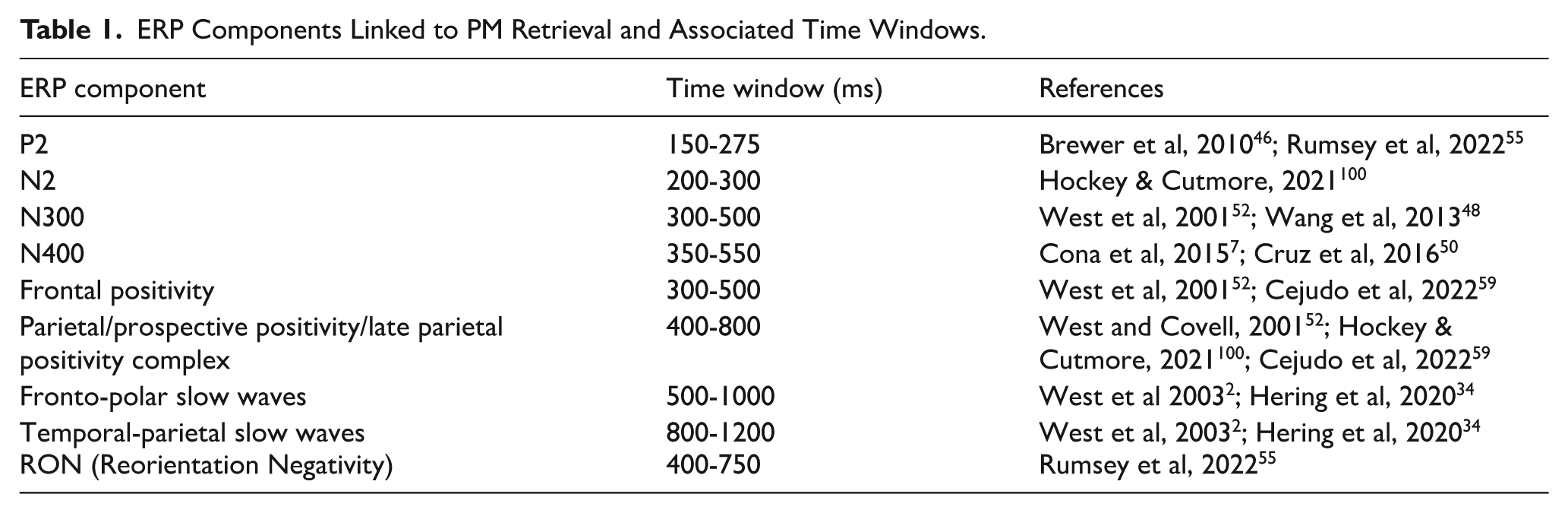
EEG studies have examined PM in the context of target detection, N-back working memory, continuous recognition, and semantic judgment.39,50,52 -55 Most of these studies have manipulated perceptual features of the stimuli, including letter case, color, letter identity, and word identity.7,42,48 Some have manipulated semantic categories of words.48 -50,56 EEG PM studies31,34,36,47,50,53,55,57 -59 have identified several ERP components (see Table 1), which vary based on the type of task and stimuli. For instance, perceptual manipulations (eg, letter case) have been associated with N300 and parietal positivity in young adults, while conceptual manipulation (eg, semantic judgment) has yielded a delayed 50 or absent 56 N300. Additionally, different versions of ongoing and PM retrieval tasks have yielded distinct findings for Late Parietal Positivity Complex (LPC). 60 For example, a task-switching version (participants switched between different tasks) yielded a late positivity, whereas a dual-task version (participants performed 2 tasks simultaneously) failed to yield this late positivity.
ERP Components Linked to PM Retrieval and Associated Time Windows.
Despite this growing body of work, EEG studies examining PM have not always considered the impact of certain factors such as (i) reading ability (since the classic PM paradigms require participants to read letters/words/word pairs), (ii) frequency of incongruent stimuli that make up the Lure and PM Retrieval trials, (iii) number of stimuli between intention-formation trials and PM retrieval trials, and (iv) presence/absence of Lure trials. Also, only a few PM EEG studies have used semantic categorization judgment (eg, animal vs object)39,50,52 -55 tasks and none have used picture stimuli while controlling for the variables mentioned above.
To address these gaps, we developed 2 novel PM tasks involving basic categorization judgments related to animals and objects using decontextualized line drawings, while carefully accounting for key design variables such as stimulus congruency, trial structure, and inclusion of lures. The primary aim of this study was to evaluate the feasibility of disentangling neural mechanisms underlying intention formation and PM retrieval, indexed by ERPs, for each of the 2 novel tasks. To achieve this, we incorporated different trial types: PM Retrieval (intention retrieval and execution phase), Ongoing (retention phase), Cue (intention encoding phase), and Lure trials (distractor during retention phase), within each task, to assess various aspects of intention formation and PM retrieval. This task falls between focal and non-focal PM paradigms, aiming to improve its ecological validity by better reflecting everyday PM tasks. We anticipated significant behavioral differences in accuracy and response times between different trial types, with slower or more error-prone responses in PM trials relative to all the other trial types. Additionally, we expected to observe neural differences in ERP components on measures of latency and amplitude.
Given substantial evidence that animal and object categories engage partially distinct cognitive and neural systems,61 -64 a secondary objective of the study was to investigate the extent to which the semantic characteristics of the ongoing task modulate PM retrieval, that is, to examine task effects. We anticipated differences in behavioral measures of reaction time and accuracy across trials, and neural differences in ERP components on measures of latency and amplitude between the 2 tasks.
Method
Participants
Twenty-three young adults (18 F; 20.5 ± 2.35 years, mean education = 14.17 ± 1.89 years) recruited from the University of Illinois campus and Champaign-Urbana community participated in the study (see Table 2). All participants were native speakers of English, right-handed, and had a minimum of high school education. They had normal global cognitive functioning on the Montreal Cognitive Assessment 65 (a score of 27 or higher), with no history of learning disabilities, neurological illnesses, head trauma, major psychiatric illnesses, alcohol or substance abuse, uncorrected hearing loss, or vision loss. Written informed consent was obtained from all participants in accordance with Institutional Review Board protocol approved by the University of Illinois Urbana-Champaign, and data collection was performed in accordance with the ethical standards of this institution and the Helsinki Declaration of 1975.
Participant Demographics.

Experimental Task
All participants completed two PM tasks that were developed in-house, Animal cued-Prospective Retrieval Task (Ac-PRT) and Object cued-Prospective Retrieval Task (Oc-PRT), during which EEG data were collected. Stimuli for both tasks consisted of black and white, line-drawn pictures of (i) animals and objects enclosed in 1 of 3 shapes: a square, a circle, or a triangle, and (ii) empty shapes: a triangle or a circle. All line drawings were selected and adapted from Snodgrass and Vanderwart 66 and the CRL-UCSD International Picture Naming Project (IPNP) Database, 67 which are large international repositories of standard picture stimuli. Both tasks included 90 line-drawings of animals and 90 line-drawings of objects, which were controlled for frequency (animals: M = 1.78, SD = 1.04; objects: M = 2.27, SD = 0.90) and syllable length (animals: M = 1.86, SD = 0.86; objects: M = 1.73, SD = 0.77). Both typical animals (eg, cat, cow, dog) and atypical animals (eg, whale, snake, worm) were included. Objects included clothing (eg, jacket, boot, scarf), household objects (eg, book, table, bowl), food (eg, cake, egg, cherry), musical instruments (eg, bell, drum, guitar), tools (eg, hammer, scissors, wrench), and vehicles (eg, bus, car, wheelchair).
All line drawings were resized to fit within 3 in × 3 in dimensions and were pilot tested to ensure accurate recognition. Participants responded using a 3-button response box (YES, NO, OTHER), which allowed for precise and consistent recording of response times while minimizing motor variability across trials. To account for individual differences in motor speed, all participants completed a baseline reaction time task involving the same response box. The average response times from this baseline were used to adjust final behavioral performance metrics.
Both tasks consisted of 4 types of trials: Ongoing Task Trials (referred to henceforth as Ongoing trials), Cue, Lure and PM Retrieval trials (see Figure 1).

Exemplars of trial types.

Sample sequence in Ac-PRT.

Sample sequence in Oc-PRT.
Four versions were created for both tasks, with each version being matched for frequency and syllable length of stimuli. These versions were assigned to participants in a pre-determined order to maintain balance across versions. For both tasks, the sequence of trials was pseudorandomized, such that each task began with Ongoing trials (2-3 trials), followed by a Cue trial, followed by Ongoing trials (0-5) that also included a Lure trial, and finally a PM Retrieval trial (see Figure 4). Sixty such trial sequences were used for each task. Each stimulus was presented for 1200 ms, with a 1200 ms interstimulus interval.

Example trials sequence.
For both tasks, participants were given verbal and written instructions, which were then again shown on the computer screen before each task. As an example, the following instructions were given for the Ac-PRT task:
“In this task, you will see pictures of animals and objects. When you see a picture of an animal enclosed in a square, press the ‘YES’ button, if you see an object press the ‘NO’ button. If you see an empty shape, press the ‘OTHER’ button. Continue pressing the ‘YES’ button for animals and ‘NO’ button for objects after seeing the empty shape. However, if you see an animal enclosed in the shape which was previously empty, press the ‘OTHER’ button again.”
All participants completed a practice session with a criterion of 75% performance to ensure understanding of the task before completing both the tasks during which EEG data were recorded. Reaction time and accuracy of judgments were recorded, and the order of the tasks were counterbalanced across participants.
EEG Data Acquisition and Preprocessing
Continuous EEG data were recorded from a 64-electrode Neuroscan Quikcap using a Neuroscan SynAmpsRT amplifier and Curry 7 software (sampling rate: 1 kHz, DC-200 Hz), with electrode impedances typically below 10 kΩ. The reference electrode was located at the vertex between Cz and CPz. Vertical electrooculogram (VEOG) was recorded at sites above and below the left eye. Data were processed off-line using ERPLAB plug-in on EEGLAB on MATLABR2023a platform.68,69 The continuous EEG data were high-pass filtered at 0.15 Hz and corrected for eye blinks using spatial filtering. The data were then epoched between 500 ms before stimulus onset to 1500 ms after stimulus onset. Epochs with peak signal amplitudes of ±75μ V were rejected. The EEG data were then re-referenced to the average potential over the entire scalp. Baseline correction was done by subtracting the mean amplitude of the pre-stimulus interval (–200 to 0 ms) from each time point. ERP data for each participant were averaged for the 3 trial types (Ongoing trials, which included animal trials for Ac-PRT and object trials for Oc-PRT, Cue trials, and PM Retrieval trials) separately for both tasks. Table 3 illustrates distribution of trials in both tasks along with the subset of trials considered for final analysis. Specifically, an equal number of epochs were analyzed from Ongoing trials (n = 30), Cue trials (n = 30), and PM Retrieval (n = 30) trials. Only trials with correct responses were included in the ERP averages, and trials with reaction times shorter than 200 ms or longer than 1000 ms were excluded from further analysis.
Trial Breakdown for Ac-PRT and Oc-PRT.

ERP Analysis
Informed by the ERP literature on PM,54,59,70 as well as visual inspection of the grand average ERPs, ERP components, specifically P2, N2, N4 at anterofrontal (AF3, AF4) and frontal (F1, Fz, F2) electrode clusters, and parietal positivity (PP) at central (C1, Cz, C2) and parietal (P1, Pz, P2) electrode clusters were examined. Electrode sites and time windows were estimated based on (i) previous studies reporting similar components54,59,71,72 and (ii) the consistency with which the ERP components were observed across all participants on visual inspection. The following time windows were used for both Ac-PRT and Oc-PRT to identify the ERP components: (i) P2, between 75 and 250 ms, (ii) N2, between 175 and 350 ms (iii) N4, between 350 and 550 ms, and (iv) PP, between 350 and 650 ms. Peak latencies and mean amplitudes were examined.
Statistical Analysis
Statistical analyses were conducted in R 4.3.0 (R Core Team, 2023 73 ) for the Ac-PRT and Oc-PRT tasks. For reaction time (RT), linear mixed-effects models (lmer function, lme4 package 74 ) were used to examine the effect of trial on log-transformed reaction times (rt_log), with trial as a fixed effect and random intercepts for participants. Analysis of Variance (ANOVA) was conducted to assess the significance of trial (formula: RT ~ Trial + [1|Participant]). Post hoc pairwise comparisons of estimated marginal means were performed using the emmeans package, with degrees of freedom calculated via the Satterthwaite method. For accuracy (correct/incorrect), generalized linear mixed-effects models (GLMMs) were fitted using the glmer() function (lme4 package), with a binomial family (formula: Accuracy ~ Trial + [1|Participant]). Pairwise comparisons of estimated marginal means were performed, with P-values adjusted using the Satterthwaite approximation. Post hoc contrasts for accuracy were performed on the log odds ratio scale and tested using a Z-test, with no degrees of freedom reported.
For ERP data, a linear mixed-effects model was fitted to examine the effects of trial and electrode cluster, as well as their interaction for latency and amplitude measures, accounting for random participant-level intercepts. The model was estimated using maximum likelihood (ML) with the formula: [ERP measure ~ Trial * Electrode + (1|Participant)]. An ANOVA was conducted to assess the significance of the fixed effects, followed by pairwise comparisons of trial levels within each electrode cluster with Bonferroni adjustment for multiple comparisons.
To explore task-specific effects, behavioral and ERP responses across the two PM tasks (Animal-cued vs Object-cued) were compared. For RT, 1-way ANOVAs were performed on log-transformed RT values (rt_log) to assess the effect of trial, with Task as a between-subjects factor. Separate ANOVAs were conducted for each trial type (PM Retrieval, Ongoing, and Cue), allowing for comparisons of RT across task conditions within each trial category. Log transformation was applied to RT data to normalize distributions and meet assumptions of parametric testing. Accuracy data were analyzed using 1-way ANOVAs with Task as a between-subjects factor for each trial type. All ANOVA models were fitted using the anova_test() function from the rstatix package, and results included F-values, degrees of freedom, and P-values.
To examine neural dynamics associated with task performance, linear mixed-effects models were fitted to ERP measures recorded during Ongoing and PM Retrieval trials. Separate models were constructed for each ERP component, N2, P2, N4, and LPC, evaluating both peak latency and mean amplitude. Each model included Task as a fixed factor and Electrode Cluster as a covariate to account for spatial variability across scalp sites. Random intercepts for participants were included to account for subject-level variability. Models were estimated using maximum likelihood (ML) with the formula: [ERP measure ~ Task + Electrode + (1|Participant)]. ANOVAs were conducted to assess the significance of the fixed effects. Post hoc pairwise comparisons of task conditions were performed using the emmeans package, with P-values adjusted via Bonferroni correction to control for multiple comparisons.
Results
Behavioral Data: Trial Type Effects Within Tasks
Reaction Time
Linear mixed-model analysis of log-transformed RT showed significant differences across trial type for both Ac-PRT (F [5, 11200) = 398.95, P < .001] and Oc-PRT [F (5, 10899) = 634.76, P < .001]. Post hoc comparisons showed significantly slower reaction time for Ongoing compared to PM Retrieval trials [Ac-PRT (P < .001), Oc-PRT (P < .001)]. Additionally, faster RTs were noted for Cue compared to PM Retrieval trials [Ac-PRT (P < .001), Oc-PRT (P < .001)] and Cue compared to Ongoing trials [Ac-PRT (P < .001), Oc-PRT (P < .001)] (see Table 4 for mean RT and accuracy across trial types for Ac-PRT and Oc-PRT Behavioral Data).
Mean Reaction Times and Accuracy Across Trial Types for Ac-PRT and Oc-PRT.

Abbreviations: RT, reaction time; SD, standard deviation.
Accuracy
For accuracy, significant differences among trials were observed for both Ac-PRT (z = −3.79, P < .001) and Oc-PRT (z = −9.63, P < .001). Post hoc comparisons showed that in Ac-PRT, accuracy of performance was higher for Ongoing compared to PM Retrieval trials (z = 3.813, P = .0019). Also, on both tasks, participants had higher accuracy for Cue compared to PM Retrieval trials (Ac-PRT [P < .001], Oc-PRT [P < .001]) and Cue compared to Ongoing trials (Ac-PRT [P < .001], Oc-PRT [P < .001]; see Table 4 mean RT and accuracy across trial types for Ac-PRT and Oc-PRT Behavioral Data).
Behavioral Data: Trial Type Effects Between Tasks
Reaction Time
Linear mixed-model analysis of log-transformed RT revealed significant main effects of Trial (F [1, 5942.7] = 106.10, P < .001), Task (F [1, 5942.3] = 218.51, P < .001), and a significant Trial × Task interaction (F [1, 5942.2] = 17.18, P < .001). Post hoc comparisons revealed significantly faster RT for both PM Retrieval and Ongoing trials in Ac-PRT compared to Oc-PRT (P < .0001). No significant difference was observed in reaction time for Cue trials across the 2 tasks (P = 1.000).
Accuracy
Significant main effects of Trial (F [1, 6782] = 18.31, P <.001]) and Task (F [1, 6782] = 24.73, P < .001) for accuracy were observed. Trial × Task interaction (F [1, 6782] = 0.44, P = .506) was not significant. Post hoc comparisons revealed higher accuracy for both PM Retrieval (P = .018) and Ongoing trials (P = .002) in Ac-PRT compared to Oc-PRT. No significant difference was observed in accuracy for cue trials across the 2 tasks (P = 1.000). Task Variability in behavioral performance across Ac-PRT and Oc-PRT, with focus on PM Retrieval trials, is illustrated in Figure 5. As reaction time increases in Ac-PRT, it also increases in Oc-PRT. Similarly, higher accuracy in Ac-PRT is associated with higher accuracy in Oc-PRT. This suggests that PM Retrieval processes are similarly engaged across both task formats.
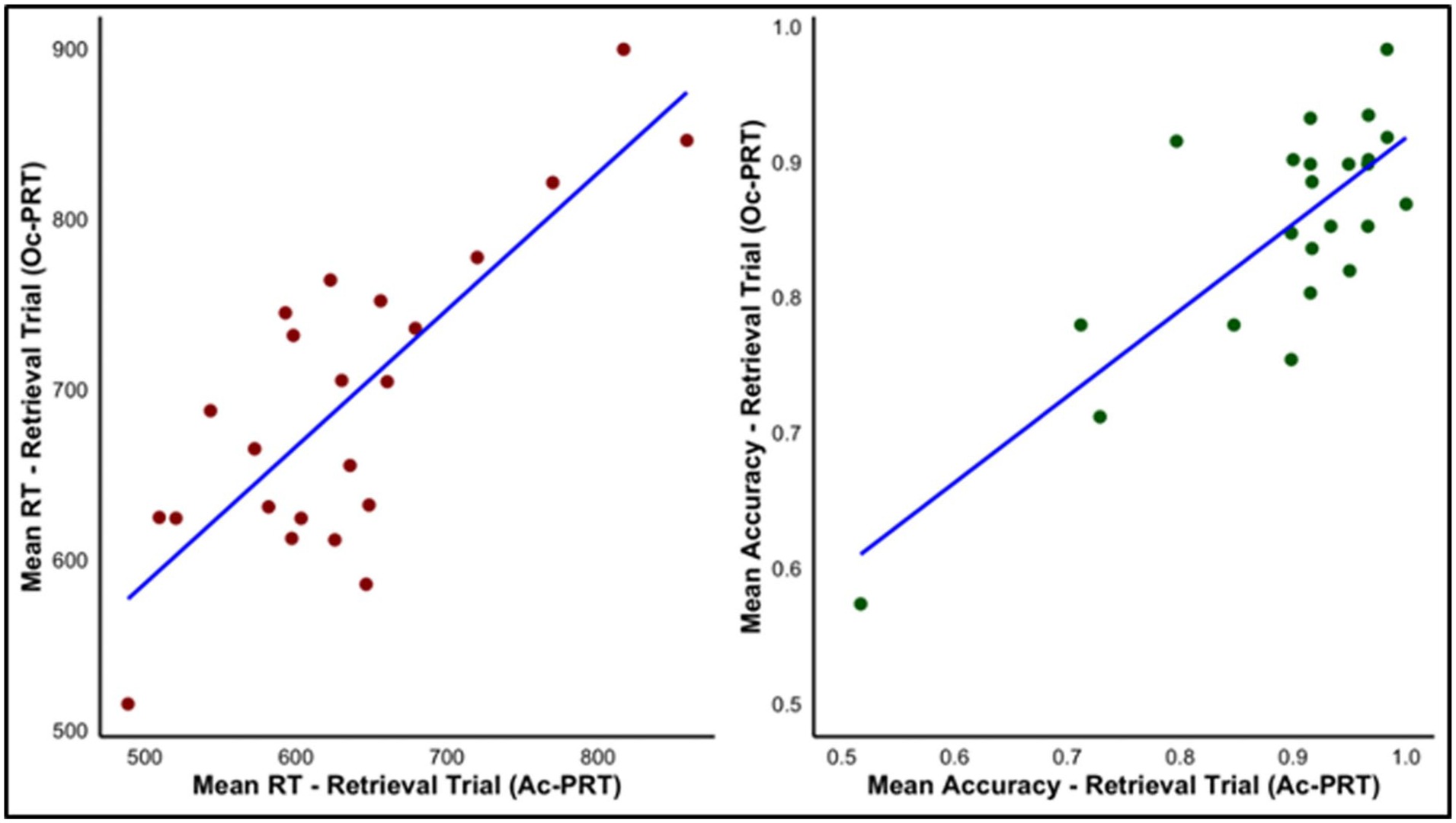
Task variability in reaction time and accuracy of PM Retrieval trials. (Reaction time in milliseconds; accuracy in %).
ERP Data: Trial Type Effects Within Tasks
Peak latency and mean amplitude measures across trial types for the ERP components (P2, N2, N4, and PP) for both Ac-PRT and Oc-PRT are reported in Table 5. Results related to ERP differences across trial types for latency and amplitude measures are reported in Tables 6 and 7, respectively. Grand average ERPs and scalp maps are illustrated in Figures 6 and 7.
Peak Latencies and Mean Amplitudes for the ERPs (P2, N2, N4, and PP).
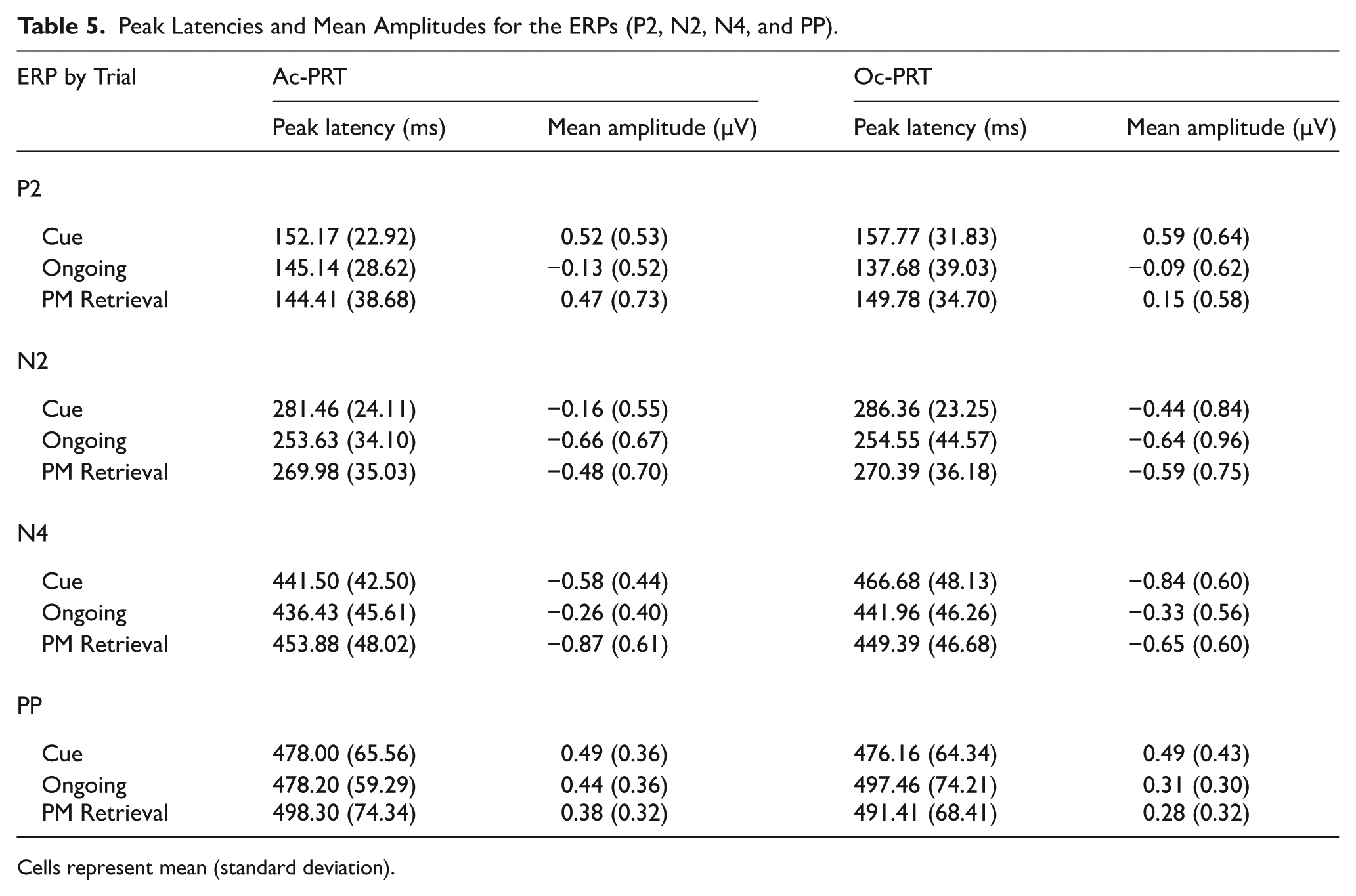
Cells represent mean (standard deviation).
Statistical Results for Peak Latency (P2, N2, N4, and PP).

Statistically significant.
Statistical Results for Mean Amplitude (P2, N2, N4, and PP).

Statistically significant.

Grand average ERPs for Ac-PRT (left panel) and Oc-PRT (right panel).
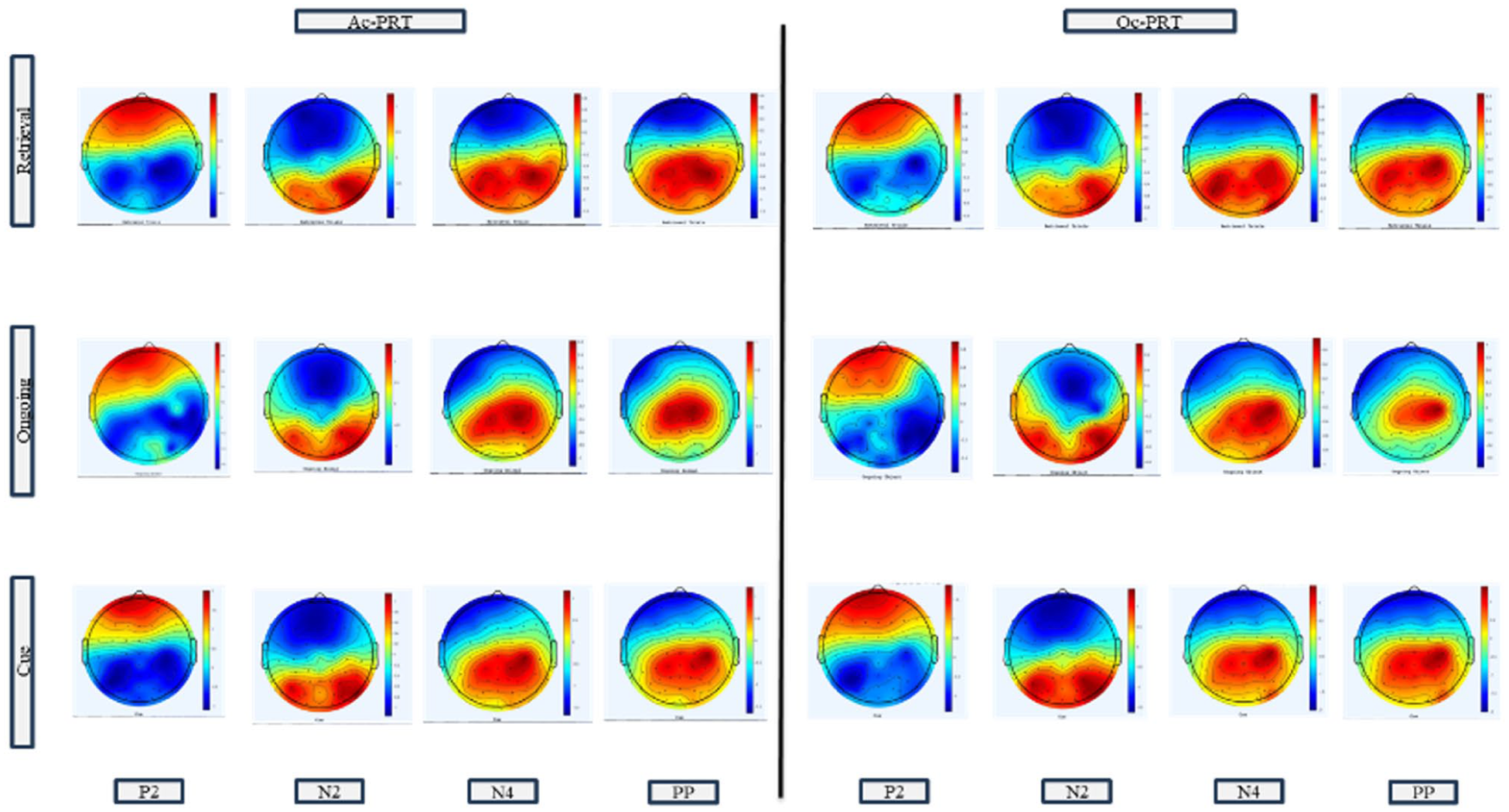
Group average scalp plots for trials (PM Retrieval, Ongoing, Cue) for ERPs (P2, N2, N4, and PP).
P2 Findings
P2 Peak Latency
A significant main effect of trial for P2 peak latency was observed in both tasks: Ac-PRT (F = 3.160, P = .04) and Oc-PRT (F = 7.55, P < .001). Post hoc tests showed that P2 peak latency was significantly longer for Cue trials compared to Ongoing trials in Oc-PRT (P < .001). No other results were statistically significant.
P2 Mean Amplitude
A significant main effect of trial for P2 mean amplitude was observed in both tasks [Ac-PRT (F = 34.36, P < .001) and Oc-PRT (F = 33.94, P < .001)], with larger P2 mean amplitude for PM Retrieval trials compared to Ongoing trials in Ac-PRT (P < .001) and Oc-PRT (P = .01). Larger P2 mean amplitude was also observed for Cue trials compared to Ongoing trials in both tasks [Ac-PRT (P < .001) and Oc-PRT (P < .001)]. Additionally, larger P2 mean amplitude was observed for Cue trials compared to PM Retrieval trials in Oc-PRT only (P < .001). A significant main effect of electrode cluster was observed in Oc-PRT (F = 4.63, P = .03), but the post hoc comparisons were not significant. No other results were statistically significant.
N2 Findings
N2 Peak Latency
A significant main effect of trial for N2 peak latency was observed in both tasks: Ac-PRT (F = 12.47, P < .001) and Oc-PRT (F = 14.19, P < .001). Post hoc tests for both tasks showed longer N2 peak latency for PM Retrieval trials compared to Ongoing trials in Ac-PRT (P = .01) and Oc-PRT (P = .02), and for Cue trials compared to Ongoing trials in Ac-PRT (P < .001) and Oc-PRT (P < .001). Longer N2 peak latency for Cue trials compared to PM Retrieval trials was observed for both tasks, but was significant only in Oc-PRT (P = .02). No other results were statistically significant.
N2 Mean Amplitude
A significant main effect of trial for N2 mean amplitude was observed in both tasks: Ac-PRT (F = 22.93, P < .001) and Oc-PRT (F = 3.96, P = .02), with larger N2 mean amplitude for Cue trials compared to Ongoing trials in both tasks: Ac-PRT (P < .001) and Oc-PRT (P = .02). Larger N2 mean amplitude was also observed for Cue trials compared to PM Retrieval trials in Ac-PRT only (P = .001). A significant main effect of electrode cluster was observed in Ac-PRT (F = 32.69, P < .001), with larger N2 mean amplitudes at anterofrontal electrodes compared to frontal electrodes (P < .001). The main effects were qualified by a significant trial by electrode cluster interaction in Ac-PRT (F = 4.28, P = .02). Post hoc tests revealed larger N2 mean amplitude for Cue trials compared to Ongoing trials (P < .001) and PM Retrieval trials (P < .001) at anterofrontal electrodes, and larger N2 mean amplitude for Cue (P < .001) and PM Retrieval (P < .001) trials compared to Ongoing trials at frontal electrodes. No other results were statistically significant.
N4 Findings
N4 Peak Latency
A significant main effect of trial for N4 peak latency was observed in Oc-PRT (F = 5.39, P = .01), but not in Ac-PRT (F = 2.52, P = .09). Post hoc tests revealed longer N4 peak latency for Cue trials compared to Ongoing trials in Oc-PRT (P = .007). A significant main effect of electrode cluster was observed in both tasks: Ac-PRT (F = 7.32, P = .01) and Oc-PRT (F = 6.46, P = .01), with longer N4 peak latencies for anterofrontal electrodes compared to frontal electrodes in both tasks: Ac-PRT (P = .001) and Oc-PRT (P = .01). No other results were statistically significant.
N4 Mean Amplitude
A significant main effect of trial for N4 mean amplitude was observed in both tasks: Ac-PRT (F = 36.89, P < .001) and Oc-PRT (F = 30.84, P < .001), with larger N4 mean amplitude for Ongoing trials compared to PM Retrieval trials in Ac-PRT (P < .001) and Oc-PRT (P < .001), and for Ongoing trials compared to Cue trials in both tasks: Ac-PRT (P < .001) and Oc-PRT (P < .001). Larger N4 mean amplitude was also observed for Cue trials compared to PM Retrieval trials in Ac-PRT (P < .001); however, a larger N4 mean amplitude for PM Retrieval trials compared to Cue trials was observed in Oc-PRT (P = .02). A significant main effect of electrode cluster was observed in Oc-PRT (F = 14.79, P < .001), with larger N4 mean amplitude at frontal electrodes compared to anterofrontal electrodes (P = .002). The main effects were qualified by a significant trial by electrode cluster interaction in Ac-PRT (F = 4.57, P = .01). Post hoc tests revealed larger N4 mean amplitude for Ongoing trials compared to PM Retrieval trials (P < .001) and Cue trials (P = .03) at anterofrontal electrodes. Similar patterns were also observed at frontal electrodes with larger N4 mean amplitude for Ongoing trials compared to PM Retrieval (P < .001) and Cue trials (P = .001). Larger N4 mean amplitude was also observed for Cue trials compared to PM Retrieval trials at anterofrontal electrodes (P < .0001). No other results were statistically significant.
PP Findings
PP Peak Latency
A significant main effect of electrode cluster was observed in both tasks: Ac-PRT (F = 36.62, P < .001) and Oc-PRT (F = 18.24, P < .001), with longer PP peak latency at central electrodes compared to parietal electrodes in Ac-PRT (P < .001) and Oc-PRT (P < .001). No other results were statistically significant.
PP Mean Amplitude
A significant main effect of trial for PP mean amplitude was observed in both tasks: Ac-PRT (F = 3.47, P = .04) and Oc-PRT (F = 9.26, P < .001), with larger PP mean amplitude for Cue trials compared to PM Retrieval trials in both tasks: Ac-PRT (P = .03) and Oc-PRT (P = .0005). Post hoc tests also revealed larger PP mean amplitude for Cue trials compared to Ongoing trials in Oc-PRT (P = .003). No other results were statistically significant.
ERP Data: Trial Type Effects Between Tasks
Between task differences in ERP data were analyzed for PM Retrieval and Ongoing trial types individually given the behavioral differences reported earlier between Ac-PRT and Oc-PRT.
PM Retrieval Trials
Analyses of ERP peak latencies during PM Retrieval trials, with electrode cluster as covariate, revealed no significant task-related effects across the P2, N2, N4, and PP components (P > .05). Analyses of ERP mean amplitudes during PM Retrieval, with electrode cluster as a covariate, revealed no significant task effects in N2 component. Only significant findings are discussed below.
P2 Mean Amplitude
A significant main effect of Task was observed (F[1, 69] = 16.52, P <.001) indicating that P2 amplitudes differed significantly between tasks. The covariate effect of electrode cluster was not significant F(1, 69) = 3.22, P = .077. Post hoc comparisons revealed significantly greater P2 amplitudes for Ac-PRT compared to Oc-PRT (P = .0002).
N4 Mean Amplitude
For N4 mean amplitude, significant main effects were found for both Task (F[1, 69] = 12.16, P <.001) and electrode cluster, F(1, 69) = 9.04, P = .004. Post hoc comparisons showed higher N4 amplitude for OC-PRT compared to Ac-PRT (P = .0010). The N4 amplitude variability was partially attributable to differences in electrode clusters.
PP Mean Amplitude
There was a significant main effect of Task (F[1, 69] = 4.74, P = .033), but the covariate effect was not significant (F[1, 69] = 0.62, P = .434). Post hoc comparisons showed significantly greater PP amplitude for Ac-PRT compared to Oc-PRT trials (P = .0354).
Ongoing Trials
Analysis of Ongoing trials with electrode cluster as covariate revealed no significant task effects in peak latency (P2, N2, N4, and PP; P > .05) or mean amplitude (N2, P2, N4; P > .05) except for PP mean amplitude difference.
PP Mean Amplitude
A significant main effect of Task was found (F[1, 69] = 11.07, P = .0014), but the effect of covariate was not significant (F[1, 69] = 2.17, P = .146). Post hoc comparisons showed significantly greater PP amplitudes for Ac-PRT compared to Oc-PRT (P = .0016).
Discussion
This study examined whether ERPs could distinguish neural mechanisms of PM intention retrieval and execution (assessed using PM Retrieval trials) from intention formation (assessed using Cue trials) and intention retention (assessed using Ongoing trials), across 2 novel tasks, Ac-PRT and Oc-PRT, in young adults. The results showed that both tasks effectively distinguished between trial types with 4 major findings: (i) reaction time was longest for the Ongoing trials followed by PM Retrieval trials and Cue trials; (ii) accuracy was highest for Cue trials, followed by Ongoing trials and PM Retrieval trials; (iii) P2, N2, and N4 components differentiated Ongoing and PM Retrieval trials; and (iv) P2, N2, N4, and PP components differentiated Cue from Ongoing and PM Retrieval trials. In addition, 3 task-specific differences emerged: (i) response time was shorter and accuracy was higher in Ac-PRT compared to Oc-PRT for Ongoing and PM Retrieval trials; (ii) P2, N4, and PP mean amplitudes differed across the tasks for PM Retrieval trials; and (iii) PP mean amplitude differed across the tasks for Ongoing trials. No behavioral differences were observed for Cue trials across the tasks.
Behavioral Findings Related to PM Retrieval, Ongoing, and Cue Trials
Within Task Differences
Participants took longer to respond to Ongoing trials compared to PM Retrieval trials in both tasks. Although both Ongoing and PM Retrieval trials required the same level of semantic processing, participants in the Ongoing task not only made semantic judgments but also had to simultaneously retain the PM intention and monitor for the Cue that signaled PM Retrieval trials. The need for additional monitoring during the Ongoing trials may have contributed to longer reaction times,5,75 -80 consistent with the idea of “PM cost.” 81
Participants responded fastest during Cue trials compared to both Ongoing and PM Retrieval trials, suggesting that encoding an intention was easier than retaining it during the Ongoing task or executing it during PM Retrieval. This was expected, as Cue trials involved empty standalone shapes that were distinct, and easily captured attention. Additionally, unlike the other trial types, Cue trials did not require semantic judgments simplifying processing demand.
As hypothesized, accuracy was lower on PM Retrieval trials compared to Ongoing trials, consistent with the existing literature.38,82 -84 This suggests that recalling and executing a pre-formed intention is more error-prone than retaining the intention while performing an Ongoing task. The faster reaction times observed during PM Retrieval trials, compared to Ongoing trials, may have contributed to the increased errors, consistent with the speed-accuracy tradeoff.85 -87 Accuracy for Cue trials was higher than that for Ongoing and PM Retrieval trials, which likely reflects more straightforward processing of Cues trials due to simplicity and distinctiveness compared to Ongoing and PM Retrieval trials.4,6,53,58,59
Between Task Differences
Participants responded more quickly and accurately in Ac-PRT compared to Oc-PRT for both PM Retrieval and Ongoing trials. Animals are typically more semantically salient, and their biological relevance facilitates faster recognition and decision-making.88,89 Research suggests some distinct cognitive and neural mechanisms tied to animal judgment compared to object judgment.90 -92 Alternately, these task-specific differences may be related to variability in the stimuli that constitute the object category compared to the animal category. Unlike the animal stimuli, object stimuli came from 5 subcategories, potentially introducing inherent stimulus variability and preventing the perception of a template-based judgment and thereby needing more prolonged processing leading to longer reaction times and poorer accuracy in Oc-PRT compared to Ac-PRT.93 -95
ERP Findings Related to PM Retrieval, Ongoing, and Cue Trials
Within Task Differences
Across both the Ac-PRT and Oc-PRT tasks, P2 amplitude was significantly larger for PM Retrieval trials compared to Ongoing trials, consistent with the PM literature.46,55 Increased P2 amplitude has been observed with maintenance of intentions over time96,97 and is linked to attentional control.98,99 We also observed longer N2 latencies for PM Retrieval trials compared to Ongoing trials in both tasks, further supporting a more involved neural processing during PM Retrieval trials compared to Ongoing trials. 100 Given the link between N2 and cognitive control, a longer N2 latency might also reflect a more cautious or deliberate approach to processing the PM Retrieval trials compared to the Ongoing trials.48,101,102
A larger N400 amplitude was observed during Ongoing trials compared to PM Retrieval trials in both tasks. The N400 component is linked to semantic processing, particularly the integration of meaning and context.50,103,104 The increased N400 amplitude in Ongoing trials likely reflects not only semantic processing for making a category-level judgment, but also a greater degree of contextual processing, given the demands for monitoring the occurrence of Cue trials or PM Retrieval trials.41,50
Within both tasks, P2 amplitude, N2 latency, and N2 amplitude differentiated Cue trials from Ongoing trials. The larger P2 and N2 amplitudes, along with the longer N2 latency, were observed for Cue trials compared to Ongoing trials. In early stages of processing, Cue trials appear to draw greater attention due to their simplicity and potentially distinctness, as indicated by the larger P2. Additionally, increased N2 amplitude and longer latency suggest enhanced resource allocation, likely due to higher relevance of these trials for intention encoding, consistent with the literature.105,106
In the later stages of processing, a larger N400 amplitude was observed for Ongoing trials compared to Cue trials in both tasks. Ongoing trials involve more advanced semantic and contextual processing, consistent with larger N400 amplitudes.2,107,108 When comparing Cue trials with PM Retrieval trials, a larger PP amplitude was observed for Cue trials, likely reflecting the enhanced resource allocation to prioritize and prepare for subsequent PM retrieval. This finding is consistent with previous PM studies showing that Cue trials are given higher relative importance, as individuals must anticipate and actively prepare for future PM retrieval.105,106 The Cue might serve as a preparatory signal, enhancing the allocation of cognitive resources to facilitate successful retrieval of the intention during the later PM retrieval phase. 50
Between Task Differences
Greater PP mean amplitude for ongoing trials was observed in Ac-PRT compared to Oc-PRT. These findings might be related to the fact that biologically relevant stimuli, such as animals, engage greater attentional resources for cognitive evaluation through template-based processing compared to objects.109,110 PM Retrieval trials in Ac-PRT were also associated with significantly greater P2 mean amplitude, reflecting enhanced early attentional processing. In contrast, PM Retrieval trials in Oc-PRT elicited greater N4 mean amplitude, suggesting increased semantic or contextual processing demands. A greater PP amplitude for PM Retrieval trials in Ac-PRT was also observed, consistent with more robust retrieval-related activity. These findings highlight the influence of task type on both early and late-stage neural processes involved in PM.
While this study provides valuable insights into the neural processes underlying PM retrievals, future research should aim to address the limitations in the current work. The absence of a pure baseline condition, such as a block consisting solely of Ongoing trials without PM demands, limits our ability to fully disentangle general task-related activity from intention-specific neural signatures. Including such a condition in future designs would strengthen interpretations of ERP effects related to intention maintenance and retrieval. A more diverse and representative participant sample estimated using power analysis, particularly with respect to sex distribution, would enhance the generalizability of the findings. In terms of experimental design, incorporating an equal number of Lure trials would enhance the complexity of the task. This would allow for a more robust comparison of ERP responses across trials that share partial properties with the PM Retrieval trials, helping to better differentiate brain activity related to true retrieval from activity associated with similar, but irrelevant, stimuli. While the design of the paradigm in the current study aimed to minimize emotional bias, we acknowledge that the inclusion of animal stimuli typically associated with negative emotional valence (eg, snake, bear, spider) in the ongoing task may have subtly influenced attentional dynamics and arousal. Although these stimuli were limited in frequency and excluded from retrieval trials, their presence could still affect participants’ cognitive processing, particularly in populations with heightened emotional sensitivity, such as older adults. Additionally, while tools (eg, axe, saw) were presented in a neutral, decontextualized format, we recognize that individual differences in emotional associations may still exist. Future studies may consider further controlling for emotional valence or systematically assessing its impact on PM performance. Furthermore, adopting data reduction approaches, such as Principal Component Analysis (PCA), could help identify and isolate electrode clusters that contribute most meaningfully to the observed ERP patterns, enhancing the precision of neural interpretations. While the present study focused on ERPs, exploring event-related spectral perturbations could offer additional insights into the neurophysiological mechanisms underlying PM.
Conclusion
In conclusion, this study established the feasibility of 2 novel PM tasks in examining neural mechanisms liked to PM within the context of semantic judgment. The use of a picture-based PM task embedded within a semantic categorization framework in the current study offers several advantages. Unlike traditional paradigms, such as the Lexical Decision Task (LDT), the current task minimizes the confounds related to literacy and can be used with a broader range of participants. Also, it mirrors real-world PM scenarios, where intentions are often triggered by meaningful visual cues rather than abstract letter strings used in many PM EEG studies. Embedding PM cues within a semantic judgment task which involves basic categorizations, adds to the ecological value, given that semantic categorization is a part of day-to-day functioning. Our findings demonstrate that both tasks effectively differentiated between the distinct phases of PM processing as reflected in ERP (P2, N2, N4, and PP) differences across Cue, Ongoing, and PM Retrieval trials. Additionally, task-specific differences in both behavioral and ERP data highlight the interplay between PM and semantic processing. Overall, this study provides promising evidence for the use of cue-based PM tasks in exploring the neurocognitive underpinnings of PM in aging and clinical populations in future studies.
Footnotes
Acknowledgements
The authors thank Elizabeth Lydon, Teresa Warren, Alexa Worthley, Alexandra Gonzalez, Sneha Nippani, Patricia Jurzyk, and Shansa Viswanathan for their invaluable assistance in data collection. The authors thank James Shim for their assistance in data analysis.

Ethical considerations
The study was reviewed and approved by the Office for Protection of Research Subjects University of Illinois Urbana-Champaign (Approval no. IRB24-1702).
Consent to participate
Written informed consent was obtained from all the participants in the study before any study procedures were carried out.
Author contributions
EB: Conceptualization, Formal analysis, Investigation, Methodology, Writing – original draft, Writing – review & editing. SS: Writing – review & editing. SGR: Investigation, Visualization. NR: Investigation, Visualization. RAM: Conceptualization, Methodology, Resources, Writing – original draft, Writing – review & editing, Supervision.
Funding
The authors received no financial support for the research, authorship, and/or publication of this article.
Declaration of conflicting interests
The authors declared no potential conflicts of interest with respect to the research, authorship, and/or publication of this article.
Data availability statement
The data that support the findings of this study are available upon request and completion of a reliance agreement. R code and output and stimuli will be made available upon reasonable request.