



Abstract
Music is an art form and cultural activity whose language, the sounds and silences, is organized in time with logic and sensitivity. Music as a whole is the result of an ancestral nonverbal and international mode of human expression and communication. The primitive and former mother-child bonding might be highly influenced and modulated by the music and singing with their babies. Musicality and music imply two different sides of the same coin, where the former is based on the human capacity to produce the latter. Some theories about evolution suggest music might have an adaptive advantage for humans in society. Historical examples of different styles in music point out that if any allusion or reminder about gender in music might happen most probably occurs in folk non always written pagan or secular music with lyrics or voice. This genre of music usually tells about traditional gender differences in jobs, habits, lifestyles, etc., and has a clear preference for male musicians, while on the contrary, classical music usually does not have a clear gender difference in meaning, and instruments are played by both. In this text, I explore and empirically describe, neuroanatomically or functionally, some examples of different genres of music and brain differences, related to music and dance. Three different genres of music (Classical music, Fado and Flamenco) are explored in an attempt to elucidate some reasons for possible gender differences.
Keywords
Introduction: Music and Hormones
As indicated in the definition of “music as an art form and cultural activity whose language, the sounds and silences, is organized in time with logic and sensitivity,” 1 there are two different and separated sources where music emerges: the art form and the cultural activity. The former involves the written classical style, the latter implies that the folk has not always written pagan or secular music with lyric or voice. A huge gap has always existed between these two musical activities, increased by religious arguments, different dancing styles, type of audience to which it is directed, percussion grade within the music, and musical intentionality (higher and pure communication vs fun and entertainment). Honorable exceptions happened for these two categories, such as the Gregorian chant, sacred written songs sung by choirs of religious men and boys, or the sung poems written by the dissenting young clerics the Goliards, some of them have been reinterpreted by Carl Orff of the manuscript poems written in 1230 Carmina Burana in 1936.
The difference between musicality and music has also to be distinguished. The first one implies a natural and inherent spontaneous human trait based upon the musical brain and its different functions in biology and cognition. The second one, music, is the result of that musicality developed within a social and cultural environment.2,3
According to Darwin, musical tones and rhythm were already used by our half-human ancestors during the season of courtship. 4 It is very noticeable that the social value of music has a social glue and it implies an evolutionary change advantage. Music and musicality might be considered as an embodied language that provides a manner to the brain for communication with the environment (ie, with what the ensemble is playing) without losing the own musical track. 5 Recent molecular-genetic and twin studies have reported familiar clusters of specific genes for amusia, absolute pitch, or pitch perception. 5 Recording under raw acoustic signals (wavelet transform signals) and brain signals (electroencephalographies, EEG) have also been used to study the synchrony between the sound of guitars playing in duets with the brain signals of their players. 6
Despite the fact many kinds of music have been done under the effects of drugs or alcohol, there is no proof or evidence that music had any psychedelic effects per se. Also aggressively might be a state of mind expressed through music, but not caused by its simple auditory action. While people are listening to or playing music, violence is far away from their minds. Under specific circumstances, music and its loudness have been used as a tool for torture and abuses in Guantanamo bay jails. In Western societies, there are well-established violent genres of music (eg, Hard Rock, Punk, Metallic, Hardcore, etc.) characterized by threatening lyrics, fast and heavy sounds, with intimidating and wild attitudes or outfits. Armies around the world have orchestras that stimulate the vital functions in the brainstem to make the soldiers ready to fight. 7 Even in non-Western societies, there is for example the Māori war dance (Haka) which might be considered violent despite its solemnity, synchrony and the emotional response from the audience. Haka dance has also a sportive meaning, while it is usually performed to welcome distinguished guests, and to acknowledge great occasions or events. 8
In an empirical study, testosterone samples were measured before and after listening to different types of music in male and female Japanese students. Curiously a decrease in testosterone occurred in the male group while the opposite was found in the female one (Figure 1). These results are in agreement with the adaptative meaning of music because humans needed a system to control competition for resources or reproduction, food and mates when they start to live in societies. 9

Graphs depicting the amount of salivary testosterone before (clear bars) and after (dark bars) listening to different kinds of music (from left to right, favorite, Gregorian, Popular, Jazz, Mozart or silence). It is noticeable how the male group showed a decrease in testosterone after listening to music (not in silence condition) while the opposite is true for the female group (From Fukui 9 with permission).
The ratio of the length between the second and fourth fingers in hands was measured in elite musicians and controls. Curiously they found that male musicians had significantly lower 2D:4D ratios in both hands (indicating high testosterone exposure in the womb, greater sensitivity or both). The mean 2D:4D of a female musician did not differ from controls However, this ratio did not affect the quality of instrument playing. 10
Music and the Brain
Musical practice and listening involve cerebral benefits for both genders. It protects the brain against the decline of certain cognitive domains which happens with aging (auditory perception).7,11 When music involves human voices together with instruments, the gender of the singing is more palpable, corporeal or tangible. The human voice is a feature that each person possesses and it gives information about his or her gender, mood, origin, etc. 12
The occipital temporal cortex (left fusiform gyrus) in professional dancers is significantly activated while watching male and female dancers, compared to nondancers. Remarkable is the fact that the expertise in body movements of professional dancers and athletes of both sexes carries an increase in symmetry or a reduction in the hemispherical asymmetry in the sensorimotor and visual areas compared with nonexperts (Figure 2). 13
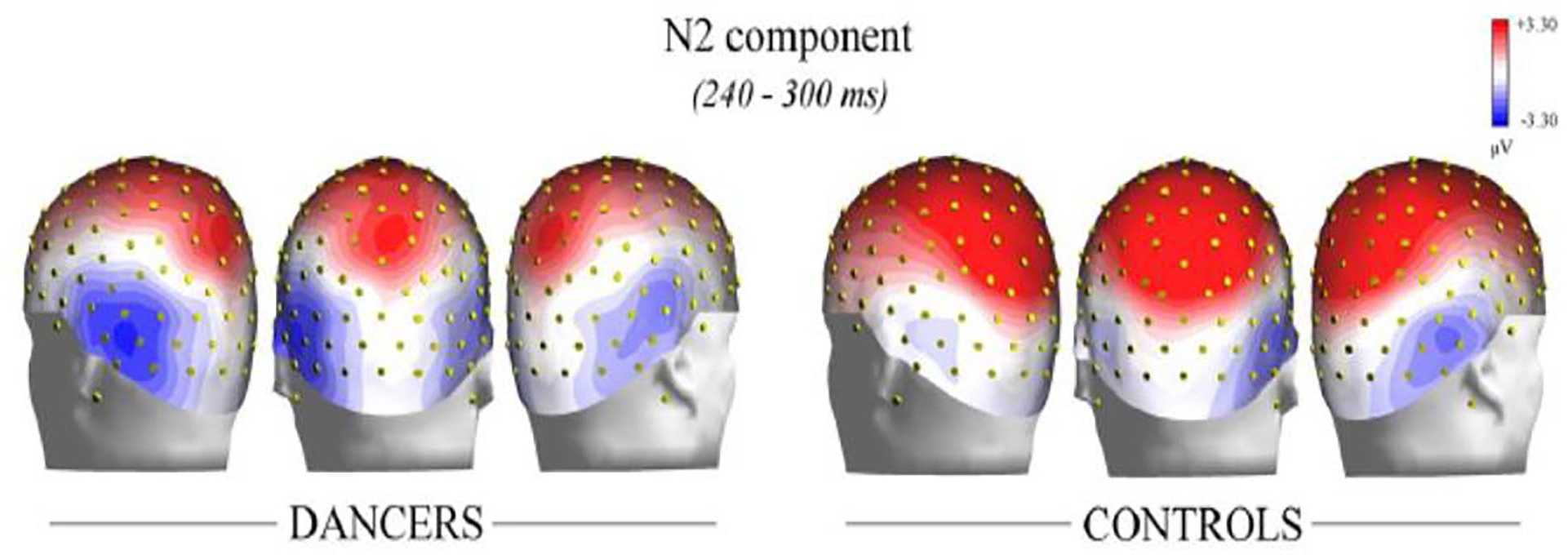
Topographic maps of the voltage distribution over the scalp while watching a dance performance. The Dancer group (left side of the picture) showed bilaterality negative values of voltage over the occipitotemporal area (blue areas), while non dancers (right side of the picture) only showed that negativity in the right hemisphere. With permission, Orlandi and Proverbio. 13
Related to body balance in professional dancers, a gender difference was described in the time of body stabilization after landing from a vertical jump: female dancers presented a higher rate of an ankle sprain. In the last few years. The speed and dynamics of dance performance have increased, raising the risk of injuries and accordingly to the performance level. 14 That might have an effect on the time to equilibrium, being the occurrence of stabilization higher in girls, in both body axis directions (anterior-posterior and medial-lateral axis) compared to male dancers.14,15
Music and language processing occurs across several discrete modules in the brain, some of them overlap while others remain distinct. During singing music and speach, the areas of the brain that are activated are located in the superior temporal sulcus (red, green and gray). These areas are considerably larger during musical listening (red color) compared to the activation that occurs during speech with no music (gray color) (Figure 3). 16

Visual representation of the clusters of activation while listening to instrumental music (green bar), singing songs (red bar) and language speech (gray bar). In (a) it is noticeable how the sulcus is activated, over the temporal love, during singing music (red) in a larger area compared to speach (grey). The green areas in picture (a) and green bars in picture (b) depicte both actions interrelated (listening music and speach). It is perceptible how those sounds which carry music in their spread (vocal and instrumental), are occupying a significantly larger area in the sulcus (green and red bars) than speech (grey bar). . Symbol * means significant difference (p < .001) between singing and instrumental music. In all cases, singing and instrumental music elicited significantly larger responses than speech (p < .001). And they share the sulcus area as a language processing. With permission Whitehead and Armony. 16
Some years ago a neuroanatomical study of the human auditory cortex showed that there is a gender difference in the number of neurons in this area, around the superior temporal gyrus, including the previously mentioned, superior temporal sulcus. 17 Analyzing Nissl stained sections with a mean thickness of 25 µm, women presented a higher amount of neurons in layers II and IV (not in layers III, V, or VI). Cell packing density in both hemispheres of the cortical temporal gyrus was 11% higher in female brains compared to male, suggesting that the number of granular cells was similar between genders, while the differences were based upon a different packed mechanism. The 11% difference was explained as one possible cause of a mechanical compression or geometric consequence of smaller volumes in the total brain of females. 17 A different result was found in rat brains: Reid and Juraska found only in layer IV a sex difference in the number of neurons, having male rats the bigger amount. 18
During active production and passive perception of musical rhythm, the cortical auditory and motor cortex are functionally connected and activated together with several different subcortical structures such as basal ganglia, cerebellum, supplementary motor areas, premotor cortex, and temporal and parietal cortices. However, the nature of the music and those songs with defined or non-defined clear beats (percussion) might have a different effect on this brain activation. 19 Metabolic gender differences have been described for biological rhythms, which are regulated via the hypothalamus. These differences might occur because of the gender differences in hypothalamus anatomy, physiology or pathophysiology which sustain circadian rhythms. 20 Circadian rhythms have been widely proven to be different among genders. That difference in metabolism is not necessarily involved in differences for health but might imply a relation to music, beats and sound interpretation, especially in folkloric nonclassical pieces of music.
Some neuroanatomical gender differences have been found in the cerebellum21,22 as well as in the temporoparietal region 23 and they may be involved in the rhythmical production and perception of the music.
Genres in Folk Music: Classic, Fado, and Flamenco
Music is generally more friendly than speech, like in Mozart’s compositions: he was unable to swear or curse through music. 7 Music as a mind game is mostly funny and smiley created to amuse as a reward.
Musical performance involves several complex and different acts (symmetry among hemispheres, motor coordination, concentration on the sounds), whether constructed for artistic-classical music or for cultural. In both cases, different specific brain areas are functionally related to the ear. 24 In nature, birds use sounds to communicate (in many songbirds species only the male sings) and the auditory cells in their brains are hormone sensitive and depend on the breeding season. Those auditory cortical neurons are shaped by learning. 25
Depending on specific qualities of the melody, such as its tender nature, flexibly rather than emphatically constructed, some listeners might consider specific melodies as typically constructed by feminine or masculine composers. The number of female composers or conductors is very few, probably due to a confidence matter, related to the different number of professional chances or the number of unreasonable obstacles for the female gender. 26
Some Dutch musicians such as Antonia Brico and Frieda Belinfante became conductors after passing many turbulent obstacles. Brico moved to the USA before becoming a conductor, while Belinfante did the same after she became a conductor. The knowledge of the written piece of music, the ability to give instructions to musicians about when to start, how to change intensity or tempo, the capacity of controlling emotions caused by music, leadership preparedness, etc., might not be different between man and woman. Some female classical music composers chose to give their pieces and merits to men, in order to let them be listened to by an audience, no matter copyrights or labels. That was the case of Josephine Lang who gave her songs to Robert Schumann or Maria Anna Mozart, who did the same with her well-known and reputed brother, or Felix Mendelssohn, who obtained his elder sister Fanny’s compositions, Opuses 8 and 9, as if they were his own pieces.26 -28 In these cases, the pieces did not occur under a pseudonym, but their whole identity was deleted from their works. And nobody noticed, proving the gender of the composer for classical music is not identifiable from the musical content of the composition itself.
That was also empirically proved after checking the opinion of 71 listeners of classical musical extracts: they did not find watermarks that significantly reveal the accurate sex of a composer. 29 Gender in classical music is thus difficult to perceive.
The same is true for the construed dimension of artistic music. After analyzing the performance of several interpreters, 69 well-trained musical listeners were not able to accurately distinguish the gender of the performing artist or interpreter. 30 Measuring some parameters during the playing by 54 pianists (10 women and 44 men) of the song “Arlequin” from Schumann’s “Carnaval,” op. 9, (tempo Vivo or Vivace, lively and fast, 156 to 176 beats per minute, bpm) they found a small but statistically significant difference in the speed interpretation of the tempo. While women performed at 165 beats, men performed at 180 bpm. 31 This funny piece of music by Schumann is made in three different structures: the first and third parts are very rhythmical with a clear beat. However, second part is more melodic and singing, with a clear ritardando written on the music sheet. Differences in genders could only be pointing out a different interpretation of that ritardando (more or less elongation in time) and have nothing to do with skills or abilities in performance, but that seems not to be clarified in the study.
Curiously different expressions of social gender social roles have been described among musicians: male classical musicians show a higher female-typical gender role behavior while the opposite is true for female classical musicians, compared both to non-musician people. 32 After checking steroid levels in voice musicians, Nieschlag et al., found androgens might shorten and estrogens might extend life expectancy in female singers, while in male singers, the opposite is true. 33 Differences in hormones are very present in classical musicians, 1 however, performances between genders are not remarkably different.
Fado
Fado is the best internationally known expression of Portuguese music. One of the best definitions of Fado was offered by the Fado singer Amália Rodrigues (1920-1999), who is considered the artistic ambassadress of Fados in Portugal: “Fado is a very mysterious thing, you have to feel it and you have to be born with the anguished side of the people, to feel like someone who has neither ambitions nor desires, a person. . . as if one did not exist. That person is me and that’s why I was born to sing fado. ” It is generally sung by a single person, accompanied by string instruments like the “viola,” the Portuguese guitar, mandolin, or rajäo although there are adaptations to other instruments such as piano or dulzaina (Figure 4). 34 Percussion is not used or very rarely. 35 Fado takes its name from the Portuguese word “fate,” which is synonymous with the Latin word “factum,” which means destiny). The main theme is romance, the myth and the cry of the homeless sailors who sail the seas are recurring themes. However, there are also cheerful and danceable fados such as the Fado Batido or the “A Rianxeira.”
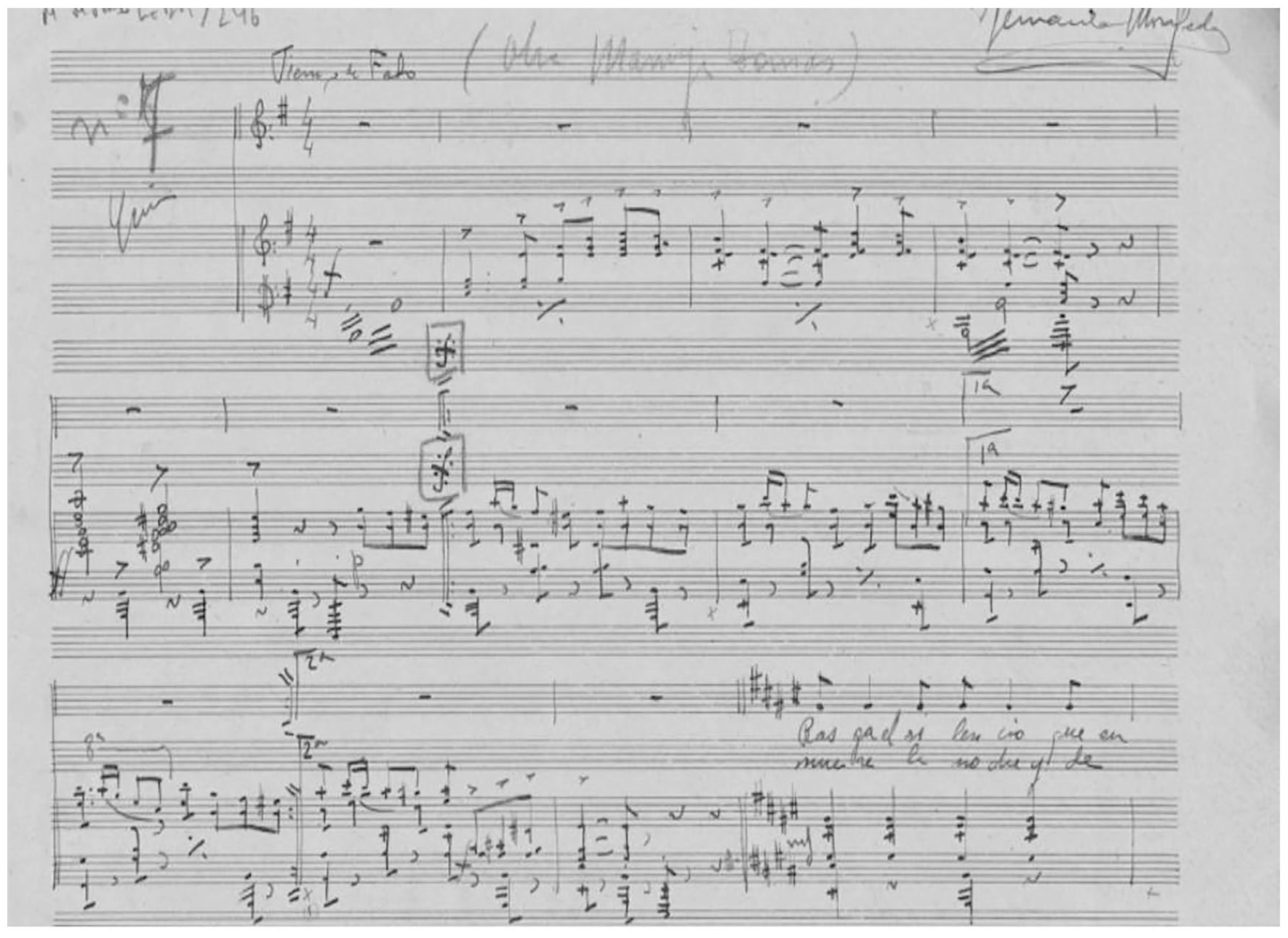
Representative example of a Fado handwritten sheet music for pìano and voice, by the Spanish composer and Professor in the Royal Conservatorium of Madrid, Fernando Moraleda Bellver. Tempo is similar to Fado (4/4) and rhythmically it also oscillates like waves of the sea.
Although the most notorious singers of this genre are and have been women, there are also quality male performers such as Alfredo Marceneiro and Fernando Farinha or the more recent fadistas Carlos do Carmo and Camané.36,38 On the other hand, the musicians (nearly always string musicians), are always men. The rhythm of Fados is rocking and pendulous, reminding the waves of the sea (Figure 4). It surrounds the listener and takes him/her on a shared mood trip.
These songs expressed in taverns (Figure 5), voiced the bad moments of life through singing, the tragic sense of life, the melancholy, the nostalgia (named “saudade” or “moriña”), and small stories of the daily life of the humble neighborhoods. But, especially and more traditionally, the fatalism and the frustration of sailors’ lives, the uncertainty of the sea and the danger of each crossing to earn sustenance (fado do marinheiro). 37 It is not known with certainty, but there is evidence that this nostalgic and deep music with guitars of the time, were originated 8 centuries ago, when the Arabs lived on the hill of the Saint George Castle of Lisbon (XIVth century). The existence of the Fado is verified since 1838 (19th century), although the mystery of its origins has not yet been unveiled. 38 Since 2011 the Fado, a popular urban singing of Portugal, was recognized by UNESCO as part of the Representative List of Intangible Cultural Heritage of Humanity (6.COM 13.39).

Painting of oil on canvas by Viktor Schivert in 1900, showing a typical scene in a tavern of early Fados, the lady singer and the musician playing a mandoline.
Within the genre of Fado sub-genres are distinguished such as the Coimbra Fado. The traditional Fado of Coimbra, is related to the academic traditions of the University of Coimbra. It is exclusively sung by men. Both the singers and the musicians wear black cloaks and cassocks. The themes refer to student loves of the city. The style emphasizes the instrumental component. The best known of the fados of Coimbra is “Coimbra é uma canção” (Coimbra is a song), which had remarkable success in all of Europe. Interpreted by students from the bourgeois or aristocratic classes of the 19th century, the Fado of Coimbra has always been characterized by a higher style, with a raised and more erudite character, but with the same romantic aura. An unrecorded interpreter of this genre is for example Hilário Costa Alves (a medical student at the University of Coimbra; 1864-1896), whose poems in songs referred to erudite themes related to the human condition itself.
Flamenco
Flamenco, on the other hand, is a musical genre traditionally from the South of Spain closely related to the Gypsy culture of Romani (Roma) ethnicity which tries to express the sorrow and pain of many centuries of marginalization, poverty and persecution but also the cheerful point of view to cope with miseries, centuries of marginalization, poverty and persecution but also the cheerful point of view to cope with miseries (Figure 6). In the academic line of purity, the poet Federico Garcia Lorca and the composer Manuel de Falla had the idea of a contempt of “Cante Jondo” (“deep flamenco singing”) in Granada, organized in 1921 and celebrated in 1922. The flamenco began to be rescued in that year 1922 when the “Cante Jondo” competition took place in Granada on June 13th and 14th. Some years later, in 1928, Falla started to suffer pain in his eyes which affected his compositions. 11 During those days of 1922 and the contempt, the origins of this music were explored and it was explained flamenco music was built over the Byzantine chants, the Spanish gypsy traditions and the Arab culture acquired by the invasion. But during its development, flamenco music also had a strong influence over other countries and their musicians such as Russia (Rimsky Korsakof, Borodín, Balakiref or the great Igor Strawinsky) or France (Claude Debussy or Maurice Ravel). Moreover, in Spain Manuel de Falla admitted that flamenco music inspired many of his compositions in different ways.39,40

Oil on canvas named “El Jaleo” by John Singer Sargent in 1882 shows a typical Spanish scene of a woman dancer, several guitar players (“tocaores”) and several singers (“cantaores”), at the end of XIX century, performing in a colmao or tabanco.
Transmission of flamenco takes place within dynasties, families, social groups and flamenco clubs, all of which are key players in its preservation and dissemination because flamenco music has traditionally not been written down. It is the product of cross-hybridization, which happened at the beginning of the XX century, between the agrarian culture, urban folklore and popular festivals. For Roma ethnicity communities and in certain regions of Spain flamenco music is acquired as a mother tongue. The music and songs are related to their experiences in family, labor, or social context. 41 This music usually took place in specific places (“colmao” or “tabanco”) and one of its peculiarities is its ability to sublimate the sorrow, pities, hardships, or sacrifices that are linked to traditional jobs in the South of Spain (fishing, hunting, harvesting, mining, salt flats) and only show with the music the happiness and joy of the active hard-working person in love. This music expression is able to transcend domestic difficulties to make common familiar and social troubles more bearable, unifying feelings inside entire communities. 41
On 16 November 2010, UNESCO declared flamenco as one of the Masterpieces of the Oral and Intangible Heritage of Humanity (5.COM 6.39). Like mostly all the vocabulary and words for definitions this genre uses, they are sui generis, that is, with very pronounced intra-cultural traits and sometimes very different between distinct but close regions. Sometimes they are incorrect in terms of Spanish grammar or vocabulary (“naide” instead of “nadie,” “dirme” instead of “dime,” “curpita” instead of “culpita,” “cormigo” or “colmigo” instead of “conmigo,” “muchachaco” instead of “muchacho”, “desigente” instead of “exigente”, no use of verbs, etc).
It is performed in three dimensions: dance, singing and Spanish guitar although in some cases contemporary flamenco expression is dispensing with Spanish guitar or any other stringed instruments. While the two forms (dancing and singing) can be successfully expressed both by men and women, the musicians and guitars are nearly only played by men. Voices in flamenco used to be located in high register or falsetto and in this way, gender vocalization in flamenco sometime is undistinguishable or very similar inside the soprano register (ie, that might be, on occasions, the case between the woman folklore singer Isabel Pantoja and her man cousin folklore singer Chiquetete).
One of the strongest and most original points of the flamenco is its original rhythm, not always inside the academic and orthodox canons established by the metronome. 42 Moreover, flamenco combines three different artistic expressions: voice, guitar and dance, each of them having its own rhythmical patterns and sometimes going in parallel but in different sequential times (very often the song accompanies the guitar, the voice walks over the instrument without a rhythmic schema). In some cases, improvisation might happen, as a spontaneous musical expression such as in Jazz. Although the most characteristic musical time for flamenco is 12 beats divided into 2 different times: 6/8 and 2/4 (3 + 3 + 2 + 2 + 2) and sometimes 12/8. Songs usually change the tonality at least once and the compass is also changeable according to the lyrics or the structures of the songs. There are usually three structures: (I) a preludio or instrumental introduction, (II) the core of the song, (III) the refrain, and (IV) the conclusion, which is repeated twice and twice again throughout the total song, except the conclusion.
Where on those pieces of time the emphasis is focused makes completely different songs and styles (palos). The rhythm of “Alegrías” (characteristically marked as “tiriti, tran, tran, tran . . . .”) is one of the most recognizable and well established and it combines this 12 beats with another 12 introductory beats (1, 2, 1, 2, 3, 4, 5, 6, 7, 8, 9, 10// 1, 2, 3, 1, 2, 3, 1, 2, 1, 2, 1, 2). That might be the reason why the flamenco singer Camarón de la Isla (1958-1992) used to say at the beginning of his performances “I am starting with singing Alegrías and, later on you, the audience, will let me know which songs they would like to hear” (Figures 7 and 8).

Representative examples of a fragment flamenco written music, a Tanguillo from Cádiz. It is noticeable the beat of this piece is changing from a binary rhythm (4/4) to a tertiary (6/8), finishing in a binary one (preludio or introductory instrumental and part of the melody in 4/4, while the rest song composition is made at 6/8 and the end at 4/4). Total of 12 hits subdivision (6/8 and 4/4). Adapted to piano by the author, Alicia Garcia-Falgueras.

Representative example of flamenco-written music. The top of the figure (#1) shows a fragment of the music sheet for guitar written by the Spanish composer Angel Barrios, whose father was a very good friend of Manuel de Falla. It is noticeable that the beat of this piece is made of 12 hits (6/8 and ¾). The down figure (#2) is a handwritten music score of popular Sevillanas, one of the best known flamenco songs, because they are played every year in ferias all around Andalusia.
The rhythm in flamenco music is very elastic, not always inside the conventional scheme of the rhythmical framework. 42 Elastic in the meaning of being able to change its shape but after a while, returns to its original. This surprising expression causes constant tension which resolves and relieves in a sense and provokes a reaction in the listeners who follow the cadence, expressing themselves sometimes by saying words such as “olé” or “arsa” at the end of a rhythm group. Those words were originally instructions coming from the dance incentives clapping, because “olé” comes from the word ola (wave of the sea), while “arsa” comes from alza (raise), meaning both to make body movements in dance. 40
Conclusions
When differences between genders occur in classical music it is usually due to empirical differences in the amplitude of records for sound waves (different voices in choirs). On the other hand, folk and cultural music such as fado or flamenco are more gender specific. When singing about love, labor, or daily troubles, references to gender differences are more often given. In these traditional paths of music (fado and flamenco) the string instruments are nearly always played by male musicians, but singing and dancing in flamenco might be performed by both men or women, being sometimes indistinguishable. The outfits of each gender during flamenco performances are usually very different. Accordingly to these differences, brain neuroanatomy might also have distinctions between female and male musicians, however, very little research has been done in the field.
The brain areas that are associated with each activity involved in folk music have been proven to be different accordingly to professionalism, but gender was not analyzed: those brain areas related to the superior temporal gyrus and the superior temporal sulcus activated to watch and understand the movement of dance are more activated symmetrically in professional dancers. Further research in this new area about gender differences in different genres of music would be recommended.
Footnotes
Acknowledgements
We would like to thank Prof. Swaab at the Netherlands Institute for Neuroscience for his counseling, supportive reading and ideas provision. Also to the Centro Andaluz del Flamenco in Xerez (Cadiz) and to the Biblioteca Nacional de España (Madrid) for providing the scores and music sheets to study. To the Museu do Fado in Lisboa, for its webpage which provides information and musical resources. We would also like to thank the editor and reviewers for their improvements.
Author Contributions
The author AG prepared the draft and the final version of the manuscript. Editors and reviewers heped in the correction of these versions. Theoretical frames and material to analyze and interpret were found in both affiliative institutions.
Funding:
The author received no financial support for the research, authorship, and/or publication of this article.
Declaration of Conflicting Interests:
The author declared no potential conflicts of interest with respect to the research, authorship, and/or publication of this article.
Credits of Images
Photographs presented in this work come from files with a free license in the public domain as Wikipedia Commons. In cases where pictures come with authorship from a published paper, that has been properly quoted and permission to the correspondence author was asked.
