



Abstract
Since the war in Ukraine has begun, Russia has used population transfers as one of its tactics of war with over 3.6 million Ukrainian citizens now in Russia. These are acts that both Ukrainian authorities and other governments including the United States have claimed are forced deportations. This pattern reflects a longer history—the Soviet Union frequently used similar population transfers as forms of collective punishment against potentially rebellious populations, and the Russian government used similar tactics in both Chechnya and Syria. But in this case, we have better evidence of these movements as they occur. Forced deportations and transfers are defined both as war crimes—under the Fourth Geneva Convention and Additional Protocol II and Article 8 of the Rome Statute—and as crimes against humanity—under Article 7 of the Rome Statute. Therefore, as forced deportations constitute both war crimes and crimes against humanity, there are a number of mechanisms by which individual Russian perpetrators of these acts can be held accountable. These include, with the Ukrainian government’s acceptance of its jurisdiction, the International Criminal Court. But such accountability mechanisms also exist at the individual state level through universal jurisdiction and Magnitsky sanctions legislation.
Keywords
Introduction
Since the invasion of Ukraine in February 2022, there have been widespread reports of Russian military forces engaging in violations of international law, including summary executions and torture (Human Rights Watch, 2022a). These crimes include a massive deportation and forcible transfer campaign by the Russian government which has seen an estimated 3.6 million people moved either into Russia-occupied Ukrainian territory or into Russia itself. This is a deliberate campaign, one that reflects a calculated military strategy which has been used historically by both the Soviet Union and in more recent Russian military campaigns. This campaign uses forced displacement of the Ukrainian civilian population to move them through some 27 filtration camps where they can be subject to intensive interrogation. Those who are deemed a threat are then detained indefinitely in Russia-occupied areas, while those deemed less threatening are deported into Russia.
This campaign has been subject to widespread condemnation by a plethora of international actors, including states, international organizations, and non-governmental organizations. But while these actors have been quick to condemn Russia’s actions as a violation of international law, the nature of this violation has been less clearly articulated. Different actors have called out Russia for either forced deportations, forcible transfers, or both actions, and have identified them as either solely constituting war crimes or, in some cases, also qualifying as crimes against humanity. This lack of clarity in these statements reflects a history of confusion attaching to crimes of forced displacement in international law. This results from the different bodies of law that cover these acts as crimes, including international humanitarian law, the Genocide Convention, and the Rome Statute. It also reflects the fact that forcible transfers and forced deportations have, since Nuremberg, only rarely been prosecuted at the international level, with the exception of the International Criminal Tribunal for the Former Yugoslavia (ICTY).
Nonetheless, in this article, we argue that, with the International Criminal Court (ICC), we now have a much clearer understanding of how these laws function. Based on the ICC’s existing case law as well as precedents from the ICTY, we argue that Russia’s deportation campaign in Ukraine reflects both unlawful deportation and transfers as war crimes (as recognized by the Rome Statute), and, given their widespread and systematic nature, also deportation and forcible transfer of population as a crime against humanity. The specific forced transfer of children may also constitute a violation of the Genocide Convention. With the ICC already investigating this situation, it provides one mechanism to hold Russian perpetrators of these crimes to account. A second mechanism also exists at the individual state level through so-called Magnitsky sanctions acts.
We begin by examining how Russia’s use of forced displacement can be understood as a deliberate strategy commonly used by combatants, but also one that reflects past historical use in both the Soviet Union and, more recently, in Russia. We then examine how deportations and forcible transfers are prohibited in international law and the role the ICC can play as a mechanism to prosecute perpetrators. In the final section, we examine in detail Russia’s deportation and forcible transfer campaign and conclude in violation of the Rome Statute and conclude with other accountability mechanisms which could be deployed by individual states in the short term to response to these crimes.
Russia’s use of forced movements as a strategy in conflict
Deliberate strategies of forced displacement are common in conflict. Combatants use forced displacement in three ways. The first is that it can be used as a form of indiscriminate violence for revenge or guilt by association (Balcells, 2010; Kalyvas, 2006: 142)—focused on ascriptive clues such as nationality ethnicity and language (Fisk, 2018: 534)—or for strategic reasons to separate rebel forces from supportive populations (Valentino et al., 2004: 384). The second is that forced displacement can be used as a way of gaining information; forcing the movement of populations sends “costly and visible signals of allegiance and affiliation based on whether, and to where, they flee” to combatants (Lichtenheld, 2020; Steele, 2019: 29; Author 2). Those who are a threat can be expelled, while those who are neutral or not a threat “may well be able to remain in their homes” (Hägerdal, 2019: 65). Finally, forced displacement can also be used to target specific groups that governments and state elites understand as “long-term security threats” (Bulutgil, 2018: 1139) to the state or other groups. There is a clear ideological element in such responses. Straus discussed how founding narratives, pre-existing ideological frameworks, can shape elite responses around challenger or rebels (Straus, 2015: 11). Mann notes crises also destabilize the state in ways that allow radicals to “emerge calling for tougher treatment of perceived ethnic enemies” (Mann, 2005: 7). And these dynamics, Bulutgil (2018: 1140) notes, can lead elites “to consider the whole group as a security threat without considering more selective policies.”
All three uses of forced displacement are at play in the Ukraine War. The Russian military is using displacement as a tactic of revenge. It is also using displacement as a filtering mechanism, using the filtration camps as a way to gain information about individual-level loyalty. And this campaign reflects longer term efforts by the Russian government and elites to downplay or even seek to eliminate the notion that Ukraine should have independence or that there is a distinct and independent Ukrainian identity.
But this campaign also reflects a pattern of behaviour long engrained in both Russian and Soviet approaches to questions of civilian “loyalty” within both Russian and conquered populations. Polian (2004: 2) estimates that internal forced transfers within the Soviet Union uprooted around 6 million people. The first major movement—the liquidation of the Kulaks—was class-based. Stalin personally noted that the Kulaks would be “liquidated as a class… to advance on the kulak means to get down to business and strike the kulak, yes, strike him, so he will never be able to get back on his feet again” (Shabad et al., 2008: 177). This movement resulted in the transfer of about 2 million Kulaks and the deaths of tens of thousands (Viola, 2007: 9).
This model was repeated time and time again during the Second World War as a means of disrupting those who were seen as supporting their independent governments in newly occupied areas including Latvia, Estonia, Lithuania, and Poland, and then those who were seen as potential collaborators with the Nazis (Snyder, 2010; Blum and Koustova, 2018). In Western Ukraine alone, such policies saw more than 266,000 civilians forcibly resettled to Siberia, the Far East, and Central Asia between 1944 and 1955 (Zhukov, 2015: 1165).
Forced transfers were also a hallmark of the political reconfiguration of Eastern Europe at the end of the war. Soviet forces engaged in widespread expulsions of ethnic Germans as their forces advanced on the Eastern Front in the waning years of the Second World War. They then supported the newly liberated governments of Poland and Czechoslovakia in their own expulsions efforts targeting all German populations, which led to over 12 million ethnic Germans being transferred back to Germany during this period (Schechtman, 1953: 152). At the same time, Soviet authorities deported two to three million Poles from areas of Poland that were then annexed to the Soviet Union (De Zayas, 2006: 82).
While such transfers in the Soviet Union ceased with Stalin’s death, aspects of them have been used more recently by the Russian government. In 1999, at the start of the Second Chechen War, Russian authorities ordered the evacuation of Grozny. Nikolai Koshman, a Russian deputy prime minister at the time, stated that “the city of Grozny cannot be restored… Grozny must be blocked from all sides and its civilians should leave” (Traynor, 1999). While a five day pause in aerial bombing was announced to allow for evacuations, it was violated the next day (Gilligan, 2009: 38). Civilians who fled the fighting or who were caught up in sweep operations by the military encountered “filtration points,” designed to filter out suspected fighters from within the wider civilian population in which allegations of torture and of cruel and inhumane treatment were rife. These filtration points were used until 2005 (Gilligan, 2009: 59-60).
In Syria, too, Russian military involvement between 2015 and 2018 supported the Syrian army first in capturing besieged areas, then using military escalation and coercion to displace the population. During the final and bloodiest stage of the sieges in late 2017 into 2018, the Russian military took full control of such operations, “coordinating the coercive surrender negotiations, scorched earth campaigns, and final forced populations transfers” (PAX-Siege Watch, 2019: 18). These transfers, James Denselow (2017) noted, became the final component of a strategy of “starve or surrender” by which the population signalled its loyalty to the Syrian regime by being transferred elsewhere within the country.
Deportations, and to a lesser extent forcible transfers, have long been recognized as violating international law (Author 1 and Author 2). The long history of Soviet and Russian conduct was, however, largely unaddressed by the international community. The lack of clear legal precedents before and during the Second World War, as well as reluctance to act against an allied power, meant that the Soviet Union faced few consequences. But even the Russian government’s more recent patterns of transfers face little international outcry. Their actions in Chechnya, for instance, triggered only a resolution by the United Nations Commission on Human Rights calling on the government to conduct an independent investigation into the alleged violations of human rights (UN Commission on Human Rights, 2000, para 4). This investigation was never undertaken (UN Office of the High Commissioner for Human Rights, 2011: para 6). The Independent International Commission of Inquiry on Syria concluded that evacuation agreements in Aleppo amounted “to the war crime of forced displacement” as they neither provided the civilians with the option to remain in their homes nor were they adopted for their security or reasons of imperative military necessity (UN Human Rights Council, 2017: para 93). Ensuing Human Rights Council and General Assembly resolutions, however, have failed to identify any Russian involvement in forced displacement in Syria. Despite the long history of this conduct by the Soviet Union and Russia, the international order’s mechanisms to address forcible transfers and deportations have been untested to address it, until now.
Given the history of Soviet and Russian engagement in mass transfers, it should not be surprising that the Russian military has resorted to similar tactics in Ukraine. We discuss these tactics in detail below. However, it is important to note that information on the transfers and deportation campaign became available almost in real time as it occurred. Within a month of the war beginning, the first allegations of deportations from the city of Mariupol were made by Ukraine’s then Commissioner for Human Rights, Lyudmyla Denisova. Denisova noted that the Ukrainian citizens who had been deported were being “issued papers that require them to be in a certain city. They have no right to leave it for at least 2 years with the obligation to work at the specified place of work” (Tondo et al., 2022). The Ukrainian government has continued to make high-level statements concerning the deportations, including by the Deputy Prime Minister in June 1 and by President Volodymyr Zelenskyy, most recently in early September (Pohorilov, 2022).
This has also led to a series of independent investigations. The Organization for Security and Cooperation appointed a Mission of Experts who concluded in July 2022 that serious violations of international law had occurred in Ukraine, and that “some of the most serious violations include […] large-scale deportations of Ukrainian civilians to Russia […].” (OSCE, 2022: 5). They also noted that some patterns of violent acts including the “massive deportations of civilians” do qualify “as a widespread or systematic attack against a civilian population” and hence a crime against humanity (OSCE, 2022: 8). And this has introduced a significant issue. While a number of states, international organizations, and non-governmental organizations have found that Russia is in violation of international law, they have used a range of language to refer to these crimes. Some have identified these violations, as with the OSCE, exclusively as deportations. The first report of the Independent International Commission of Inquiry on Ukraine similarly concluded only that violations, including forced deportations, which amount to war crimes, have occurred (UN General Assembly, 2022: 11). 2 Other organizations including Human Rights Watch have exclusively referred to these acts as forcible transfers to both “areas of Ukraine occupied by Russia or to the Russian Federation” but also add that this is “a serious violation of the laws of war amounting to a war crime and a potential crime against humanity” (Human Rights Watch, 2022b: 1).
In contrast, a September 2022 European Parliament resolution called on Russia to immediately cease both “the forced deportation and forcible transfer of Ukrainian civilians to Russia and the Russian-occupied territories, all forced transfers of children to the Russian-occupied territories and the Russian Federation…” (European Parliament, 2022). The UN General Assembly has used similar phrasing, noting in a February 2023 resolution that it “demands […] the release of all unlawfully detained persons and the return of all internees and of civilians forcibly transferred and deported, including children (UN General Assembly, 2023: para 6). Finally, the United States has taken the further step of determining that Russian forces have not only committed war crimes but also crimes against humanity in Ukraine, including the deportation of “hundreds of thousands of Ukrainian civilians to Russia, including children who have been forcibly separated from their families” (Blinken, 2023).
Finally, there are also specific claims that have been made with respect to the forcible transfer of Ukrainian children into Russia. A report by the Yale Humanitarian Research Lab found that the Russian government is operating “a large scale, systematic network of camps and other facilities that has held at least 6,000 children from Ukraine within Russia-occupied Crimea and mainland Russia during the past year” (Yale Humanitarian Research Lab, 2023: 4). The US State Department has identified this system as a “key element of the Kremlin’s systematic efforts to deny and suppress Ukraine’s identity, it’s history, and it’s culture [sic].” 3
Ukrainian President Volodymyr Zelenskyy has made the claim that “all this, including the deportation of our people and the mass killings of civilians, is an obvious policy of genocide pursued by Russia” (SBS News, 2022). However, while Ukraine has institute proceedings against Russia at the International Court of Justice over the Genocide Convention, it has not yet made these claims in that venue (International Court of Justice, 2022). This range of claims with respect to Russia’s conduct in Ukraine appears to demonstrate that the law is not clear on these points. Thus, before detailing Russia’s actions in Ukraine, we will first review applicable international law to demonstrate that, while there are issues, the ICC has made significant progress at clarifying the law.
Deportations and forcible transfers at the ICC
The role of the ICC is critical as it is the most important mechanism by which Russia could be held accountable for its actions through prosecution. While neither Russia nor Ukraine are signatories to the Rome Statute, Ukraine has lodged two declarations with the ICC, with the first accepting ICC jurisdiction over crimes committed in Ukrainian territory from 21 November 2013 to 22 February 2014, and the second extending this time period from 20 February 2014. 4 A total of 43 State Parties have now referred the situation in Ukraine to the ICC, and the Prosecutor opened an investigation on 2 March 2022.
Forcible transfers and deportations are clearly prohibited in international law. However, as crimes, understandings of them come from three distinct bodies of law: international humanitarian law, crimes against humanity, and the Genocide Convention. This reflects their historical treatment. At the Subsequent Nuremberg Proceedings, deportations were treated as encompassing both what we now call deportations and forcible transfers (Author 1 and Author 2) and this distinction emerged first with the Geneva Conventions with respect to international humanitarian law and then with the International Criminal Tribunal for the former Yugoslavia with respect to crimes against humanity. Let us briefly touch on each of these bodies of law before turning to the Rome Statute.
The most established prohibition against forcible transfers and deportation is in international humanitarian law. The war constitutes an international armed conflict, and consequently Geneva Convention IV applies (Droege, 2022). Article 49 of that Convention includes an explicit prohibition against both forced deportations outside of occupied territory as well as forced transfers within that territory. As it notes, “individual or mass forcible transfers, as well as deportations of protected persons from occupied territory to the territory of the Occupying Power or to that of any other country, occupied or not, are prohibited, regardless of their motive.” Article 147, in turn, defines “unlawful deportation or transfer” as a grave breach of the Convention and hence a war crime.
However, in spite of the Geneva Conventions being universal law, there are two significant issues with how forcible transfers and deportations are defined. The first is that the distinction between the two is not made clear either in Article 49 nor elsewhere within the Convention. Jean-Marie Henckaerts (1993: 472; see also Chetail, 2016: 920) notes, “presumably, a transfer is a relocation within the occupied territory, and a deportation is a relocation outside the occupied territory.” 5 This distinction was clarified by the ICTY, as discussed below.
The second issue is that the prohibition is not absolute—an Occupying Power may undertake total or partial evacuations “if the security of the population or imperative military reasons so demand” but there are clear stipulations around such evacuations. And, when read in conjunctions with Article 58(a) of Protocol I, there may be a duty for occupying forces to move civilians from the military vicinity. But, per Article 49, such evacuations “may not involve the displacement of protected persons outside the bounds of occupied territory” unless it is impossible to avoid such displacement. Further, anyone so evacuated “shall be transferred back to their homes as soon as hostilities in the area in question have ceased.” Thus, Pictet (1958: 280) notes, “evacuation is only permitted… when overriding military considerations make it imperative; if it is not imperative, evacuation ceases to be legitimate.” The 1987 Commentary on Article 17 in the Additional Protocol II, while applicable to non-international armed conflicts, adds that “clearly, imperative military reasons cannot be justified by political motives. For example, it would be prohibited to move a population in order to exercise more effective control over a dissident ethnic group” (Pilloud et al., 1987: 1473).
Forcible transfers and deportations as crimes against humanity, by contrast, were not clearly defined until the ICTY. Its statute included deportations only as an enumerated crime against humanity, but forcible transfers were prosecuted under the category of “other inhuman acts.” 6 Because of this, the ICTY had to clarify the distinction between deportations and forcible transfers as crimes against humanity. The Krstic trial judgement in 2001 found that “deportation presumes transfer beyond State borders, whereas forcible transfer relates to displacements within a State.” 7 And, in the Stakić appeal judgement, the Tribunal found that the actus reus of deportation as a crime against humanity is “the forced displacement of persons by expulsion or other forms of coercion from the area in which they are lawfully present, across a de jure state border or, in certain circumstances, a de facto border, without grounds permitted under international law.” 8 Finally, The Ðorđević trial judgement of 2011 established a clear and distinct list of elements for both crimes. It reflected the Stakić appeal judgement’s findings, adding only that deportation must be carried out intentionally and that there need not be an intent for deportation to be permanent, while forcible transfers take “place within national boundaries.” 9
The ICTY also made clear that the criminal behaviour was marked by forced displacement as opposed to the location where the victim ended up. The court in the Ðorđević trial judgement noted repeatedly that forced displacement itself constitutes by definition a traumatic experience which involves abandoning one’s home, losing property and being displaced to another location” 10 and, in the Krnojelac appeal judgement, the court said:
The prohibition against forcible displacements aims at safeguarding the right and aspiration of individuals to live in their communities and homes without outside interference. The forced character of displacement and the forced uprooting of the inhabitants of a territory entail the criminal responsibility of the perpetrator, not the destination to which these inhabitants are sent. 11
Thus, the ICTY found that deportations and forcible transfers as crimes against humanity are similar acts with the key difference being whether victims cross a national boundary.
Finally, as noted above, there may also be specifically claims made with respect to the forcible transfer of Ukrainian children into Russia. The 1948 Genocide Convention explicitly includes as forms of genocide the forcible transfer of children from one group to another.” 12 However, how expansive this clause may be is unclear. As Schabas notes, it “was added to the Convention almost as an afterthought, with little substantive debate or consideration” (Schabas, 2009: 201).
Forcible transfers and deportations in the Rome Statute and in ICC jurisprudence
The Rome Statute and subsequent ICC jurisprudence has helped to further clarify these issues. The Rome Statute treats deportations and transfers as synonymous crimes. In Article 7, it specifically includes either “deportation or forcible transfer of population” as crimes against humanity. 13 It defines deportation or forcible transfer as “forced displacement of the persons concerned by expulsion or other coercive acts from the area in which they are lawfully present, without grounds permitted under international law.” 14 In Article 8, it similarly includes as war crimes “unlawful deportation or transfer.” 15 It also includes as a specific crime in international armed conflict “the transfer, directly or indirectly, by the Occupying Power of parts of its own civilian population into the territory it occupies, or the deportation or transfer of all or parts of the population of the occupied territory within or outside this territory. 16 In Article 6, it also reproduces the definition of genocide included within the Genocide Convention, including “forcibly transferring children of the group to another group.” 17
The ICC’s Elements of Crimes then provides a single set of unified elements for forcible transfer or deportation as a crime against humanity, noting in particular that “the perpetrator deported or forcibly transferred, without grounds permitted under international law, one or more persons to another State or location, by expulsion or other coercive acts.”
18
The Elements also note that “forcibly” can reflect a range of actions beyond direct coercion: The term “forcibly” is not restricted to physical force, but may include threat of force or coercion, such as that caused by fear of violence, duress, detention, psychological oppression or abuse of power against such person or persons or another person, or by taking advantage of a coercive environment.
19
The ICC has also provided some guidance on how these crimes will be understood. While subsequently terminated, the Ruto confirmation of charges noted that it would need to be proven that the acts “that the perpetrator has performed produced the effect to deport or forcibly transfer the victim.” 20 The Pre-Trial Chamber also noted that “the factor of where they have been finally relocated as a result of these acts (i.e., within the State or outside the State) in order to draw the distinction between deportation and forcible transfer is thus to be decided by the Trial Chamber.” 21 This would seem to suggest that rather than the need for a deliberate intent to deport, as established by the ICTY in the Popović trial judgement, the two crimes will be determined based on the final location of the victims.
Further, with the Ntaganda trial judgement and appeal concluded, we have the first conviction by the Court under this conceptualization. The trial judgement makes it clear that to constitute either forcible transfer or displacement, a “genuine lack of choice on the part of the individuals transferred” must be demonstrated, but that this could result from both coercion as well as other factors “than intentional firing at civilians” and that this can also occur through efforts to hamper or prevent their return. 22 The judgement also differentiates between these acts as crimes against humanity and war crimes, noting that war crimes “in contrast to the crime against humanity of forcible transfer of population […] requires establishing the existence of an order to displace, and not of the resulting displacement as such.” 23
Russia’s deportation and forcible transfers campaign in Ukraine
From this context, the illegality of Russian mass transfers in the Ukraine become clear. We argue that the Russian actions are both war crimes and crimes against humanity. There is no real dispute that forcible movement of populations is clearly being carried out, on a massive scale. Further, Russian authorities have repeatedly admitted that these movements are occurring, but have framed them as “evacuations” rather than deportations. They have been—perhaps surprisingly—quite transparent with their figures, with TASS, the Russian News Agency, frequently reporting the figures. These reports have been used to document the below discussion, and checked against Ukrainian figures—for instance, then—Ukrainian Commissioner for Human Rights Lyudmyla Denisova’s statement on 13 May 2022 that 1.2 million Ukrainians had been deported matches to a TASS report the previous day that 1,237,156 Ukrainians had been evacuated (Reuters, 2022; TASS 2022g).
The first major movements were evacuations from the autonomous Donestsk and Lugansk People’s Republics (DPR/LPR). These movements began prior to the war on 18 February 2022. Denis Pushilin, the leader of the DPR, ordered the movements by video, claiming that “very soon, President of Ukraine Volodymyr Zelensky will order the military to go on an offensive, to implement a plan to invade the territory of Donetsk and Luhansk people’s republics… from today, Feb. 18, a mass organized transfer of the population is being organized…” (New York Times, 2022). 24 On 25 February, 5 days after the war began, TASS reported that 120,000 residents from the two republics had been evacuated and 3 weeks later, by 11 March, this figure had climbed to 193,000 residents (TASS, 2022a; TASS, 2022d). Other reports also documented evacuations from the area of “the special military operation in Ukraine” which show the during the earlier stages of the war almost all evacuees were from the two republics—for instance, two separate stories on 3 March document 142,400 evacuees from the DPR and LPR, and 142,500 from the total zone of the special military operation (TASS, 2022b; TASS, 2022c). The last article that reports a separate DPR/LPR figure (that of 193,000 on 11 March), reports a total of 222,000 people having been evacuated.
By 15 March, as allegations of deportations from Mariupol begin to be widely reported, TASS reports 258,791 people had been evacuated, 11,372 in the previous 24 h. Both the overall figures and the number of people being evacuated on a daily basis continue to climb throughout this period, hitting 18,700 people in 24 h on 1 April (and a total of 528,000 evacuees), and 20,000 in 24 h on 3 June (a total of 1,237,256) (TASS, 2022f; TASS, 2022h). The most recent story at the time of submission, from 26 August 2022, reported over 25,000 border crossings in a day and a total of 3,655,615 evacuees (see Figure 1 for further information) (TASS, 2022i). TASS reports of total “evacuees” from Ukraine, 25 February to 22 August 2022.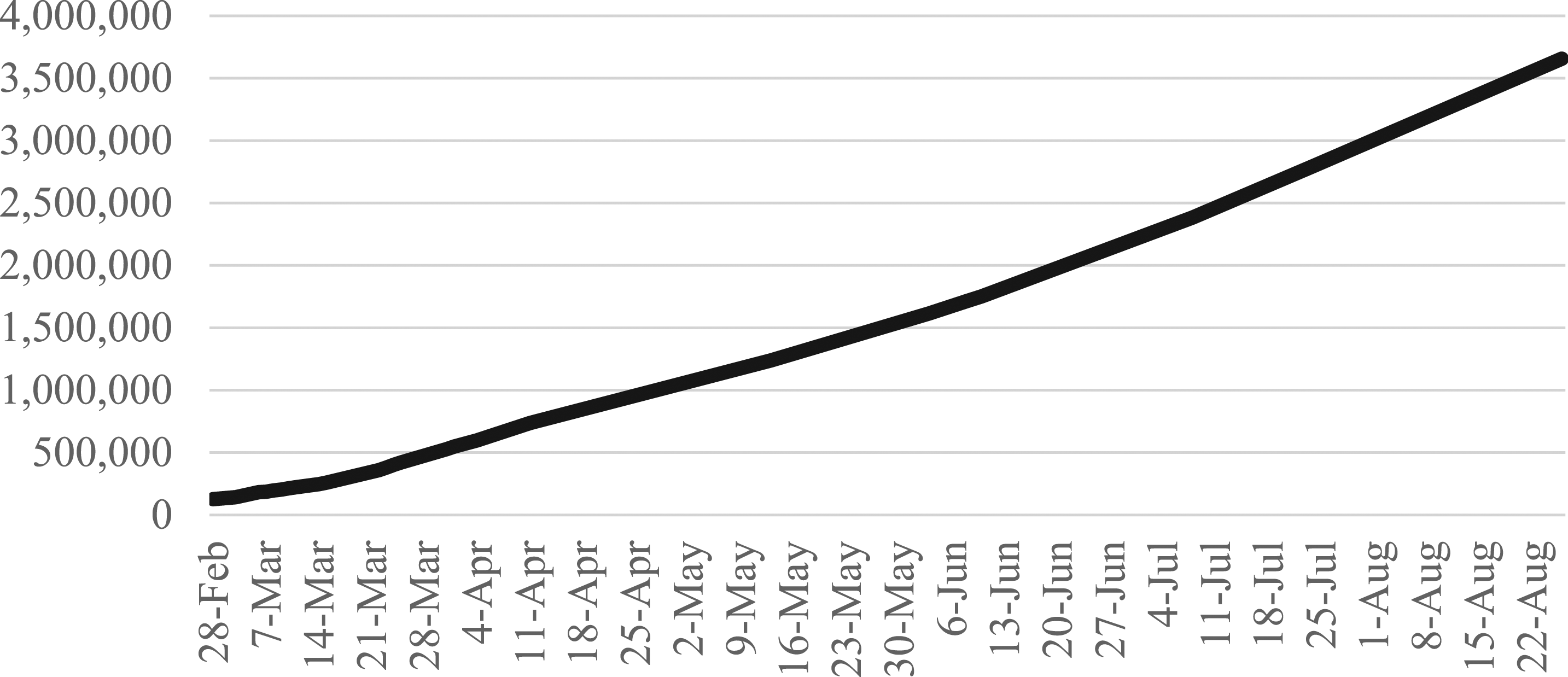
As a Human Rights Watch report notes, “Russian and Russian-affiliated officials organized transport to Russia and told some civilians that they had no choice but to stay in Russian-occupied areas or go to Russia and should “forget about” going to Ukrainian-controlled territory” (Human Rights Watch, 2022a: 2). Others were told by Russian soldiers that if they “didn’t leave they would die in the rubble… they said they had little choice” (Mackintosh et al., 2022). On 13 July, US Secretary of State Anthony Blinken alleged that “estimates from a variety of sources, including the Russian government, indicate that Russian authorities have interrogated, detained, and forcible deported between 900,000 and 1.6 million Ukrainian citizens, including 260,000 children, from their homes to Russia” (Blinken, 2022).
These figures, therefore, include two other groups transferred from or within Ukraine beyond the inhabitants of the DPR and LPR. One was those who choose to voluntary go to Russia, and whose members would not represent illegal transfers or deportations. The second are those who were coerced to move, either inside Ukraine or to Russia. The origins of the population and their destination does create separate groups depending on whether a de facto or de jure border has been crossed. If the Court were to pursue a similar logic as the Ruto confirmation of charges, this would be determined based on their final location either within or outside of Ukraine. If the Court were to instead use the ICTY Stakić Appeal Judgement’s logic, movements into the DPR/LPR, by having crossed a de facto border established since 2014, along with movements into Russia itself could constitute deportations. This has implications for charging the correct offence. However, it does not render the conduct lawful as both forms of movement constitute clear crimes under the Rome Statute.
The filtration process
A significant proportion of those who have been displaced are being subjected to Russian filtration camps set up in Russia-controlled parts of Ukraine or along the Ukrainian-Russian border. An examination of this filtration process demonstrates that the purpose underlying the movements is not for imperative military reasons or for the security of the population, which might constitute a defence regarding war crimes, and is widespread and systematic, a required element of crimes against humanity.
At least 21 filtration facilities have been identified (Yale Humanitarian Research Lab, 2022: 8-9). The DNR “Ministry of Internal Affairs” has claimed that filtration activities are carried out to prevent “persons affiliated with Ukraine’s military, law enforcement and security agencies, nationalist battalions, and sabotage and intelligence groups from penetrating the republic” (quoted in Human Rights Watch, 2022b: 22). A range of sources have reported the process within these facilities. All civilians are searched—one victim of the process reported that “soldiers checked everything: phones, tattoos, personal belongings.” Another victim described it as “very intrusive and painful” with the process in the filtration camps lasting for several days or even weeks (France24, 2022; Walker, 2022). In some cases, social media posts in favour of the Ukrainian government are sufficient to trigger beatings and instances of torture (Bachega, 2022).
Those who are released from the camps are then transported into Russia. In some cases, telling Russian officials of concrete plans to visit relatives or friends is enough to be released from the system, and it is from those people—after exiting Russia—that most media reports have been received. For others, they are transported into economically depressed areas of Russia where they are “offered” official employment and banned from leaving the region for 2 years according to the Ukrainian defence ministry.
The situation for those not released appears to be significantly worse. The US State Department notes that it appears thousands of civilians have been detained inside Russian-controlled Donetsk where many are reported tortured and there have also been allegations that some have been “apparently forcibly disappeared” (Human Rights Watch, 2022a: 22). 25 The British government has suggested that these deportations may also be “an attempt, forcibly, to change the demographic makeup of parts of Ukraine” (Woodford, 2022).
The evidence leads to three clear violations of international law by Russian authorities. First, in violation of international humanitarian law, actions by individual perpetrators acting for the Russian government have not only caused forcible transfer and deportation of Ukrainian civilians, but these movements were neither for imperative military reasons or for the security of the population. Instead, Russia has used the filtration process to not only screen large numbers of Ukrainian civilians but then to control their final destination. These acts have also taken many of the civilians outside the bounds of Ukrainian occupied territory.
Second, there also appears to be evidence that these actions constitute crimes against humanity. Here, following article 7, the conduct needs to have been committed as part of a widespread or systematic attack against a civilian population and pursuant to or in furtherance of a state or organization policy. Ruto assists here, with the Pre-Trial Chamber having noted that widespread would include the geographical scope of the attack as well as it being “massive, frequent, carried out collectively with considerable seriousness and directed against a large number of civilian victims.” 26 It also defines a systematic attack as one which implies the “organised nature of the acts of violence and the improbability of their random occurrence.” 27 It is clear that these transfers and deportations are in furtherance of a state policy as acknowledged by the Russian government and directed against a civilian population. It is also clear that, following the Ðorđević ICTY judgement, that both forcible transfers (within national boundaries) and deportation (across a de jure or, in certain circumstances, a de facto state border) have occurred. Third, and following the logic of the Ntaganda judgement, victims of these actions had a “genuine lack of choice” in terms of their movements and were subject to a range of behaviours as part of the forced displacement process, including not only physical force but also other threats, duress, detention, and psychological oppression.
Other mechanisms
While the ICC is likely to pursue individual cases over the coming years, there are also three other mechanisms individual countries could use now in response to Russia’s forced transfers and deportations. The first is to assist the Ukrainian government in its own prosecutions. Prior to her removal, Ukrainian Prosecutor General Iryna Venediktova had announced the government was already pursuing more than 20 cases dealing with the forced displacement of Ukrainians to Russia. 28 The second is that other states can also pursue individual prosecutions through universal jurisdiction, with a number of countries having domestic legislation allowing for the prosecution of crimes against humanity even when the offence was committed abroad, though, so far, only three cases have been launched specifically for deportation or forced transfers. 29
The third is through the so-called Magnitsky Acts, which have been introduced by a number of states and allow for the imposition of autonomous sanctions against individuals responsible for human rights violations. 30 The United States’ 2016 Global Magnitsky Human Rights Accountability Act allows sanctions to be imposed against any foreign person who “is responsible for extrajudicial killings, torture, or other gross violations of internationally recognized human rights committed against individuals in any foreign country who seek” either to expose illegal activity or exercise or defend internationally recognized human rights. 31 The US had used the Act against members of the Myanmar government responsible for the displacement of Rohingya refugees. In December 2022, the United States sanctioned four individuals for their direct involvement in Russia’s filtration operations. 32 While no other states have—as of yet—sanctioned Russian individuals for involvement in the filtration operations, a number of states have the capability in law to do so.
Conclusions
The Russian government is clearly engaging in forced transfers and deportations on a massive scale from occupied areas of Ukraine into both the two autonomous peoples’ republics and into Russia itself. This constitutes a deliberate strategy, one designed to break up resistance in occupied areas both through mass population movements and by filtering civilians in order to detain and in some cases disappear those who continue to support the Ukrainian state. With current evidence, we do not know the full outcomes of this filtering process, but even with the knowledge we have these acts clearly constitute both war crimes and crimes against humanity. Therefore, we have examined possible legal recourses including, most notably, through the International Criminal Court which would be the most appropriate international venue to respond to these crimes. But, there are also potential domestic options available, including supporting Ukraine’s own efforts to prosecute perpetrators and through universal jurisdiction and Magnitsky sanctions.
Footnotes
Declaration of conflicting interests
The author(s) declared no potential conflicts of interest with respect to the research, authorship, and/or publication of this article.
Funding
The author(s) disclosed receipt of the following financial support for the research, authorship, and/or publication of this article: This work was supported by Australian Research Council, grant id DP200100750.
