




Abstract
Correlational and bargaining failure approaches to the eruption of civil war have neglected the role of escalatory processes, whose analysis has to date been largely limited to sociology. Escalating violence involves mechanisms that are self-reinforcing and have a propensity to transform the political landscape by reshaping group boundaries and political identities, and prompting the formation of new actors. This article shows that such mechanisms should be considered as analytically distinct from structural causes and bargaining failures. Escalatory processes—that is, the combinations of these mechanisms—are often crucial to the eruption of full-scale civil war. But their causal significance in civil war onset varies with regard to two criteria: the speed of violent escalation and the extent to which it transforms the actor landscape. These two criteria form the basis for a typology of escalations into civil war that distinguishes civil wars erupting in revolutionary situations from deliberate escalation by organized belligerents and from gradual escalation through rebel group formation and counterinsurgency. I illustrate each ideal type with a case study that serves as a plausibility probe. Accounting for escalatory processes allows to distinguish between contrasting roads to civil war, each of which privileges its own explanatory variables.
Recent attempts to theorize the causes of civil war have fallen into two broad approaches: those seeking to identify structural conditions statistically associated with the onset of violent conflict, and those locating the causes in bargaining failures, while specifying circumstances particularly prone to such failures. Whereas the former approach searches for root causes of conflicts, the latter tends to reduce the reasons for fighting to informational asymmetries or commitment problems. Both approaches neglect a crucial aspect of the outbreak of civil conflict: the escalation itself, which entails endogenous causal processes.
This article argues that escalations into civil war involve two interlinked processes that alter social reality and thereby complicate explanations based on pre-conflict conditions or the strategic interaction between a set group of actors. First, acts of violence in escalatory processes often trigger what are commonly referred to as chain reactions and feedback loops—mechanisms whose causality is intrinsic to violent interaction, rather than directly attributable to structural conditions or strategic bargaining. Second, the use and threat of violence during an escalation transforms the political and military landscape, drawing new rifts or deepening old ones, and giving rise to the formation of new actors, or transforming existing ones. Frequently, the parties to a civil war only constitute themselves during the escalation, which makes explanations based on structural causes or bargaining failure unsatisfactory.
Endogenous dynamics of escalation and political transformation play a crucial role in the outbreak of war in cases where actors only form during the escalation. They are particularly important in revolutionary situations, which give wide scope to the mobilization and realignment of actors. In such circumstances, violence can both escalate rapidly, propelled by self-reinforcing dynamics, and dramatically reshape the political landscape within a short period of time. By contrast, a rapid escalation between fully formed camps, following protracted political struggles, means that the parties to civil war onset are largely in continuity with the pre-conflict landscape; this scenario more closely resembles strategic interaction as theorized by the bargaining failure school. Finally, a gradual escalation driven by the interaction between an initially small rebellion and the counterinsurgency response has the potential to significantly transform the political and military landscape over time, though the role of reflexive spirals of violent interaction is lesser and that of deliberate, strategic action greater in this scenario. In other words, I distinguish different types of descents into civil war based on diverging combinations of two variables: the speed of escalation and the extent to which it transforms the political and military landscape, creating the belligerents that enter into all-out conflict. Within-type comparison, I argue, may open up new approaches to an old puzzle.
While studying how civil war begins implies conceptually distinguishing it from other forms of violence, studying escalation can analytically link non-violent or low-intensity conflict to the eruption of civil war, thereby avoiding artificial distinctions between war and peace (Staniland, 2017). Although the debate over definitions of civil war continues, civil war can be distinguished from low-intensity conflict by the higher intensity and frequency of violence as well as a higher degree of organization among the conflicting parties (Sambanis, 2004; Trinn and Wencker, 2018; Vité, 2009).
After reviewing the debates on structural causes and bargaining failure in the eruption of civil war, I present the case for the causal significance of escalatory processes for civil war onset. To do so, I draw on sociological theory as well as on qualitative studies of violent conflict, including my own work on Libya’s civil wars. I then define the scope conditions in which such processes gain particular relevance, which form the basis of a typology of descents into civil war. I illustrate three ideal types with brief case studies from African civil wars: Libya, South Sudan, and Mali. I conclude by discussing the implications of the argument for the study of the causes of civil war and by sketching out a research agenda on civil war escalation.
Explanations for civil war: onset and bargaining failure
Beginning in the mid-1990s, a voluminous literature emerged that sought to identify factors making countries prone to civil war. Using large n-comparisons, these studies had their heyday during the 2000s and were rooted in the greed vs. grievance debate of the time, with the bulk following the influential contributions of Collier and Hoeffler (1998) and Fearon and Laitin (2003) in viewing insurgents as seizing opportunities for rebellion. Such studies highlighted dozens of variables as increasing the risk of civil conflict, the most common of which were large populations, poverty, income inequality, state weakness, natural resource wealth, and mountainous terrain. A 2009 review of the literature noted an “embryonic consensus on the effects of a small set of variables” (Dixon, 2009: 707) but cautioned that “most studies are still characterized by a laundry list of control variables unrelated to their central theory of civil war” (Ibid., 731).
Numerous methodological flaws detracted from the findings of these studies: There were serious doubts over whether indices actually and reliably measured the variable in question (Blattman and Miguel, 2010; Chandra and Wilkinson, 2008; Cramer, 2002, 2003; Sambanis, 2004); correlation was widely confounded with causation (Blattman and Miguel, 2010; Di John, 2007; Nathan, 2008); selection bias was widespread (Dixon, 2009; Florea, 2017). Equally serious were the theoretical shortcomings of the literature: influential proponents championed a crude methodological individualism that caricatured social behavior (Cramer, 2002; Nathan, 2008); variables such as terrain or income were constant over time but the outcome—war—was not (Davenport et al., 2006); the causal mechanisms linking salient variables to the outbreak of civil war were poorly developed; several different explanations often competed to account for the same statistical correlation; studies often could not test competing explanations; and the literature remained fundamentally unable to explain variations in conflict onset across countries with similar structural characteristics (Blattman and Miguel, 2010; Dixon, 2009; Florea, 2017; Walter, 2009). In other words, such studies did not adequately explain the processes linking pre-conflict conditions to war. Ultimately, the literature could not move beyond Eckstein’s (1965: 149) assessment that “an enormous variety of objective conditions can create internal-war potential.” Faced with such problems, econometric studies of civil war onset gradually declined in number from the late 2000s onwards.
Just as correlational approaches to civil war onset lost their appeal, bargaining models appeared as a promising alternative. The latter approach sees the eruption of civil war as a puzzle, assuming that actors should prefer a negotiated solution to a costly war. It advances three reasons why bargaining fails: informational asymmetries, such as distorted information on one’s own military capabilities vis-à-vis those of an adversary; commitment problems; and the indivisibility of the objects of the contest. While this approach did not generate as voluminous a body of work on civil war onset specifically, bargaining failure has become a popular explanation for a variety of phenomena in civil conflict, including its eruption (Malone, n.d; Webster, 2018), the difficulty of reaching a sustainable settlement (Cunningham, 2016; Walter, 1997), and its recurrence (Jarstad and Nilsson, 2008; Mattes and Savun, 2009). Some studies have located in this explanation the missing link between proneness to conflict and its actual outbreak and argued that certain structural conditions increase the risk of bargaining failure (Denny and Walter, 2014; Morelli and Rohner, 2015; Walter, 2009). The literature on fragmentation in protest movements and insurgencies has drawn extensively on the role of commitment problems and informational asymmetries to explain why fragmented actors are more likely to turn to violence and less likely to commit to negotiated settlements (Christia, 2012; Cunningham, 2013; Nygård and Weintraub, 2015; Pearlman and Cunningham, 2012).
Bargaining failure undoubtedly accounts for an important aspect of strategic action in civil war, including its eruption. Bargaining models also “better capture the dynamic character of internal conflict onset [and thereby] mark an important departure from the static correlational studies” (Florea, 2017). But to locate the causes for civil war only or even primarily in bargaining failure is to apply a unidimensional analytical lens. Reducing these causes to informational asymmetries, commitment problems and indivisibility takes many aspects of social relations out of the equation. The substantive issues at stake in a conflict, and their rootedness in historically constituted social structures, become irrelevant, unless they can be shown to be indivisible. At its core, bargaining failure relegates actors’ choices in the eruption of civil war to cost–benefit calculations, then explains why these calculations did not add up. This is an implausible approach to a phenomenon that, for all the cunning scheming it may involve, frequently occurs amid intense ideological mobilization and retaliatory spirals of violence that can provoke powerful feelings such as fear, anger, and vengefulness, at times against the background of decades of oppression or a sudden erosion of regime legitimacy. Close analyses of high-risk mobilization show that a focus on cost-benefit calculations often fails to capture individual decision-making, which can be strongly influenced by factors such as individuals’ social networks, historically constructed analytical frames, values, identities, and emotions (Parkinson, 2013; Pearlman, 2018; Shesterinina, 2021).
Most importantly for the purposes of this article, the assumption that a set group of actors engages in bargaining with each other prior to the eruption of civil war does not systematically hold across empirically observable cases of civil conflict. To varying degrees, the escalation of violence prior to full-blown civil war transforms the actors and lines of conflict. If the actors of a conflict only form as part of its escalation, the eruption of war can hardly be explained by a bargaining process between these actors.
Escalation and political transformation
Escalations into civil war involve mechanisms that possess causalities of their own and cannot be reduced to the effects of structural conditions and strategic action. The phenomenon of interest here is not deliberate escalation as a tactical or strategic choice (Duyvesteyn, 2012; Menninga and Prorok, 2021; Obayashi, 2014; Schwab, 2021). Rather, I conceptualize escalation as constituted by social mechanisms: “chains of interaction that filter structural conditions and produce effects” (Della Porta, 2014: 24). Following Elias (1939; Tilly, 2003), processes are combinations of mechanisms; I therefore distinguish specific mechanisms within broader processes of escalation. Research on civil war has long emphasized the role of violent interaction (Kalyvas, 2006), and a growing body of literature analyzes patterns of violence and trajectories of civil wars as social processes (Bosi et al., 2016; Shesterinina, 2022; Wood, 2008). I demonstrate how processes are key to understanding how civil war begins.
One set of escalatory mechanisms—self-reinforcing violent interaction—derive their potency from the inherently relational, emotional and unruly nature of violence. In tense conditions, the use of violence is often unintended, triggered by situational circumstances; and even where it is deployed intentionally, it often spirals out of control (Collins, 2009). Small incidents can escalate quickly by setting off reflexive anger spirals (Johnston, 2016). The arbitrary and excessive use of violence, such as against protesters, can trigger moral outrage that causes unrest to escalate (Pearlman, 2018). Whether actors resort to violence intentionally or spontaneously, this choice can have consequences that make turning back difficult: revenge is a powerful motivation (Balcells, 2017), and actors feel forced to arm themselves to guard against retaliation—which in turn impels their opponents to escalate (Schnell, 2015). Such mechanisms can also play out over a longer period of time: repeated clashes between security forces and protesters can encourage gradual radicalization and a thrift towards violent action that emerges from such interactions themselves, rather than pre-conflict conditions (Della Porta, 2014). Research on genocide, for example, suggests that the escalation into genocidal violence is often the outcome of contingent, radicalizing interactions, rather than longstanding planning (Pinaud, 2021; Straus, 2007; Verdeja, 2012).
Self-reinforcing violent interaction can expand particularly rapidly in situations of pervasive uncertainty—situations that can themselves come about through a sudden irruption of violence. In such unforeseen circumstances, actors are under intense pressure to position themselves, but habitual references for behavior are suspended (Ermakoff, 2015; Shesterinina, 2021). Each actor searches for cues in the behavior of others; as a result, contingency—in the form of individual agency—can play an outsized role in shaping the course of events, thereby provoking ruptures in structural conditions. This applies, for example, to situations in which members of the armed forces are made to choose between participating in large-scale violence against protesters and defecting (Gallopin, 2019). Similarly, the occurrence of major inter-communal conflict in some places and its containment in others frequently hinges on individual agency (Bergholz, 2016; Krause, 2018). And whether attempts to violently suppress protests and spontaneous revolts succeed, or on the contrary provoke an all-out uprising, is often difficult to foresee by those overseeing the clampdown; here, too, contingent circumstances can have far-reaching implications (Martin, 2014; Pearlman, 2017; Schnell, 2015). In sum, the rapid expansion of self-reinforcing violent interaction accords far greater weight to contingency and nonlinear causality than routine political interactions do (Bosi et al., 2016). They thereby diminish the role of both structural conditions and strategic choice.
Along with such causal dynamics endogenous to violent interaction, escalating violence or the growing threat thereof also drive another set of mechanisms that transform the political landscape by promoting the emergence of new identities, deepening societal rifts or drawing new ones, and bringing about the formation of new political actors. Escalating violence can deepen polarization along existing cleavages or even create new ones (Tilly, 2003). Threats of violence against members of a community frequently provoke appeals for solidarity that sharpen group boundaries and depending on whether such appeals succeed or fail, can strengthen group cohesion or cause its fragmentation (Gould, 1999). Collective risk-taking and the experience of collectivity in adversity create new bonds and solidarities, or strengthen existing ones (Baczko et al., 2013; Johnston, 2016; Pearlman, 2018). Involving others in acts of violence can create groups that then engage in more violence; key to the escalation of the Rwandan genocide was that “killing produced groups and groups produced killing” (Fujii, 2009: 154). Where violence and repression are perceived as indiscriminate, they can promote a turn to violent retaliation, fuel intense identification with a “community of fighters,” underpin the designation of external enemies, and create myths that are foundational to group formation (Combes and Fillieule, 2011; Della Porta, 2014: 183). This also applies to ethnic victimization by the state, which has been shown to increase the risk of escalation into civil war by provoking mobilization into insurgent groups (Cederman et al., 2020). Indeed, to the extent that communal—such as ethnic—grievances play a role in mobilization for conflict, such grievances often originate in early episodes of low-intensity violence (Lewis, 2020). Conversely, repression can also exacerbate internal divisions and competition, encouraging splinter factions of non-violent movements to adopt violence (Lawrence, 2010; McLauchlin and Pearlman, 2012). Group identity, cohesion, and solidarity therefore undergo change even in the initial stages of a conflict, before it reaches the threshold of civil war.
Self-reinforcing dynamics are also at play in such socially transformative mechanisms. The perception and labeling of adversaries can become self-fulfilling prophecies. Groups often become perceived as being aligned with one side in a conflict even though the majority of their members may initially be neutral or both sides may at first enjoy similar support. This may be because only one faction within a group is able to display its support openly (Kalyvas, 2006; Mazur, 2021), or because political actors stigmatize groups as being aligned with their political opponents, in order to stoke fear and hatred among their own constituencies. In such an atmosphere, small-scale acts of violence, even if they are of a common criminal nature, can easily be interpreted as targeting people because of their membership in a particular group, and thereby increase threat perceptions (Bergholz, 2016).
Awareness that one’s own group is perceived by others as adverse or even threatening then raises the need for this group’s protection against potential attacks. The perceived need for greater protection, in turn, frequently leads to a stronger alignment with one side in the conflict, thereby confirming the suspicions of the other side and raising its need for protection (Collins, 2012; Schnell, 2015). In sum, fears on both sides mutually reinforce each other (Bergholz, 2016). With the alignment with conflicting parties come deepening social cleavages, ruptures in social networks, and the emergence of a group leadership that champions community defense against perceived external threats. Ascriptive identities that were of limited significance prior to the escalation of violence can literally overnight come to decide over life or death, dramatically heightening a community’s sense of common interests. Within weeks or even days, a group that initially lacks a politically salient identity and is divided, non-aligned, as well as without clear leadership can thereby transform itself into a new political community irreversibly associated with one side in a conflict (Lacher, 2020; Schnell, 2015). The classic formulation of the security dilemma between opposing ethnic groups assumes that these groups remain constant even as they are drawn into an escalatory spiral (Kaufman 1996; Posen 1993). In the processual understanding proposed here, by contrast, mutually reinforcing fears are key to the very formation and transformation of groups.
All of these mechanisms can take effect during periods that precede the outbreak of full-scale civil war, coalescing into transformational processes of escalation. It is therefore not only the advent of war that “transforms individual preferences, choices, behavior, and identities” (Kalyvas, 2006: 389; Wood, 2003), but also the intensification of violence or the threat thereof before the threshold of civil war has been reached. All-out conflict is frequently unthinkable before such processes produce the groups, solidarities, and cleavages that make war possible.
As the literature cited above shows, much of what we know about such escalatory mechanisms comes from close analysis by sociologists and historians, who have not attempted to aggregate them into an etiology of civil war. While political scientists studying violent conflict have engaged with such mechanisms, they have, with rare exceptions (Florea, 2017), only selectively applied them to the causes of civil war. Much of their attention has focused on the impact of government repression (Davenport et al., 2006; Hafez, 2003; Lawrence, 2010; Nugent, 2020; Ryckman, 2020; Young, 2013). The wider transformative effects of escalatory mechanisms have to date largely escaped scrutiny.
A typology of civil war outbreak
The diversity of powerful self-reinforcing mechanisms outlined above implies that violent escalation and transformation are at least partially self-sustaining. Albeit to varying degrees, they are driven by violent interaction itself and escape the control of strategic action. Nevertheless, once unleashed, they do not inevitably run their full course. The circumstances in which they develop often accord much weight to contingent events. Structural conditions presumably act as constraints on escalatory processes, although we know little about how exactly both aspects relate to each other. Clearly, however, escalatory processes do not develop the same momentum and reach across all situations preceding the eruption of civil war.
It is beyond the scope of this article to systematically specify the causal and contextual factors influencing the potential for such processes to unfold. Here, I aim to provide a basis for future research on these factors by first distinguishing different types of descents into civil war according to the varying importance of such processes. We can measure their significance according to two criteria: first, the speed of escalation, and second, the extent of political transformation during escalation.Where violence escalates with extraordinary speed, this likely involves much reflexive, self-reinforcing interaction: chain reactions and retaliatory spirals with a momentum of their own. A sudden irruption of large-scale violence is bound to provoke powerful reactions driven by fear, anger or the desire for vengeance. It also leaves little time to weigh one’s choices, thereby limiting the leeway for deliberate action. In such a situation, whether or not actors have carefully considered their use of ruthless violence, their actions have a propensity to trigger responses that can easily escape belligerents’ control. By contrast, slow, gradual escalation allows actors greater latitude to ponder their moves, in an environment where references for political action remain largely constant.
The extent of political transformation during escalation can be assessed by comparing the actor landscape prior to the onset of escalatory dynamics with that of the civil war. Were the conflicting parties already politically or militarily organized prior to the escalation? Were the cleavages of the conflict already salient before violence escalated, or did they come to the fore only during the course of escalation?
Where rapid escalation combines with significant political transformation, we can expect self-reinforcing processes to play a major role in the outbreak of civil war. The ideal type of an escalation in a revolutionary situation embodies this combination. Revolutionary situations here refer to circumstances that include those of Tilly’s (1993) well-known definition, but also involve another crucial aspect: fast-moving processes of mobilization, defection, and realignment (Albrecht and Koehler, 2020; Bennani-Chraïbi, 2017). In Lenin’s (1966: 85) words, such situations see a “rapid, tenfold and even hundredfold increase” in those willing to join the challengers. This confronts actors with abruptly altered circumstances and fundamental uncertainty (Bennani-Chraïbi and Fillieule, 2012). Unforeseen events are often the trigger: an outburst of outrage over state action; a sudden blow to state authority, such as through defeat in war; an abrupt collapse of the wall of fear as spontaneous protests swell (McAdam et al., 2003). The unforeseen circumstances triggering rapid mobilization and pervasive uncertainty provide ample room for self-reinforcing escalatory mechanisms to unfold: uncertainty raises the potential for mutually reinforcing fears; the constraints on the use of violence shrink as state authority recedes dramatically. At the same time, sudden popular mobilization and political realignments eclipse the role of established political forces, offering great scope for political transformation. In such situations, the transformative mechanisms outlined above can provoke rapid group formation that breaks with past patterns. The lines of conflict, as well as its actors, therefore only partially predate the revolutionary situation, whose realignments and violent interactions thoroughly reshape the political and military landscape. Violence escalates into full-scale civil war within the space of a few months, weeks or even days. Examples close to this ideal type include the first Vendée war of 1793 (Martin, 2014); the Russian civil war (Figes, 2017: 555–649); the Mogadishu uprising of late 1990 and early 1991 (Bakonyi, 2009; Marchal, 2013); the Libyan civil war of 2011 (Lacher, 2020); and the war in Syria (Mazur, 2021). The specificities of violent conflicts erupting amid revolutionary situations have to date attracted little attention in theoretical debates on the causes of civil war.
By contrast, where organized political adversaries escalate, the lines of conflict are visible well before its outbreak. The actors and cleavages of the erupting civil war are in continuity with the pre-war political landscape; while the war itself may spawn new actors, their emergence only comes after the escalation into all-out war. The possibility of civil war looms perceptibly over political developments long before the advent of war, and actors use the threat of resorting to violence in their struggles with political adversaries. Actors’ organization during such struggles may be primarily political; they may militarize only as violence escalates, but their identities and opponents remain largely constant as they enter the civil war. Alternatively, they may retain military organizations and weapons from past conflicts, and remobilize as the struggles escalate. While escalation may be rapid, this is because actors are already organized and deliberately mobilize their military capabilities. Violence intensifies quickly—and this includes self-reinforcing violent interaction—but along lines that are largely predictable for everyone involved, since the key belligerents are clear from the outset. Examples for longstanding political struggles and deep cleavages becoming militarized include the Spanish and American civil wars (Preston, 2013; Varon, 2008) or, more recently, the war in Ethiopia’s Tigray (International Crisis Group, 2020b, 2021a; Tazebew, 2021). Cases where the lines of past conflicts continue to structure the political landscape, and reappear under new guises as settlements break down, include the 2012 rebellion in northern Mali (International Crisis Group, 2012); the South Sudanese civil war (Young, 2019); the second Ivorian civil war (International Crisis Group, 2011a); the second and third Libyan civil wars of 2014 and 2019 (Lacher, 2020); and many others. The scenario of organized political adversaries escalating most closely resembles how bargaining failure theorists view the eruption of civil war (Figure 1). Political transformation during escalation and speed of escalation.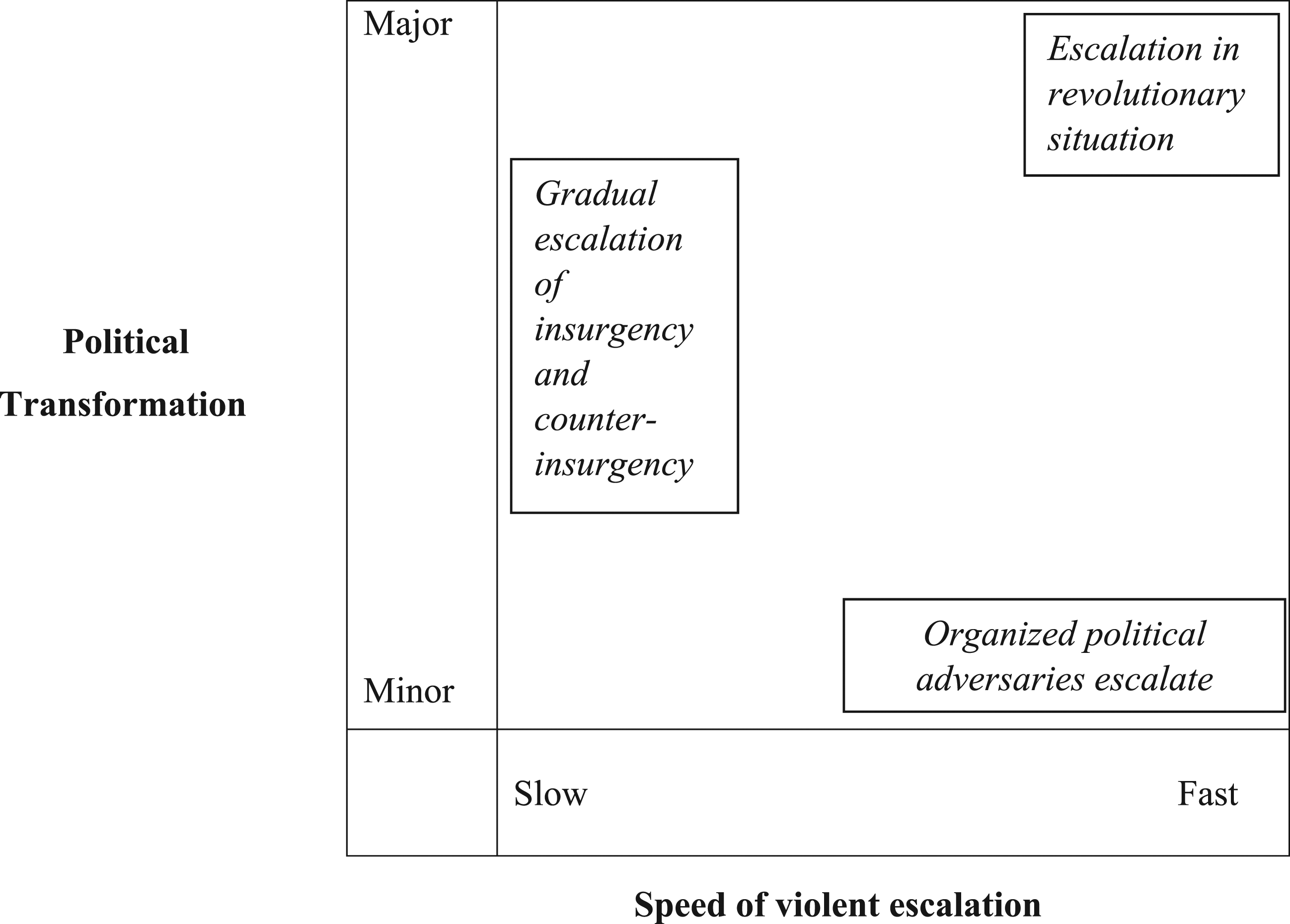
A third ideal type is that of the gradual escalation of insurgency and counterinsurgency. Here, a rebel group forms to mount an initially small insurgency, which gradually intensifies into civil war as counterinsurgency measures mobilize sections of society in support of the state and drive other sections into rebellion. The actors and divides of the conflict form during its escalation, but they do so gradually, over the space of several months or even years. On both sides of the divide, organization drives escalation rather than the other way around. The conflict does not erupt amid a revolutionary situation in which state authority suddenly threatens to crumble; it begins as a small rebellion whose prospects are uncertain against a state that may be in crisis but is not about to collapse. Political transformation, though more slow-moving, is significant: the mobilization and targeting of civilians by the belligerents progressively deepens social and political cleavages or creates new ones; identities associated with the parties to the conflict become more salient (Lewis, 2020; Lindemann and Wimmer, 2018; Petersen, 2006; Sambanis and Shayo, 2013). The mobilization of challengers does not occur as a sudden chain reaction, but as a gradual process, driven by accumulating grievances and the deliberate seizure of opportunities in a slowly evolving situation. The rifts, grievances, and ideologies produced by the conflict’s early stages are crucial to its further escalation into civil war. Examples that closely resemble this ideal type abound; recent cases include the conflict in central Mali (International Crisis Group, 2016, 2020a); the Boko Haram rebellion in northeastern Nigeria (Thurston, 2018); or the Cabo Delgado insurrection in Mozambique (International Crisis Group, 2021b). This ideal type is closest to how many studies of rebel groups view civil war, which in this literature is frequently equated with rebellion: as beginning small, often underground, and escalating where rebel leaders are able to recruit fighters (Eck, 2009; Fearon and Laitin, 2003; Gates, 2002; Lewis, 2020; Weinstein, 2007). Yet this is only one scenario among several for the eruption of civil war.
The above examples are close to the three ideal types, but few match them perfectly. Most escalations into civil war, though closer to one of the ideal types rather than the others, can be situated somewhere in between. Therefore, most roads to civil war involve escalatory mechanisms that escape the control of pre-existing actors, as well as some form of political transformation as part of the escalation—a transformation which is itself instrumental to the outbreak of war.
Theoretical debates on the causes of civil war have insufficiently considered the significance of escalatory and transformational mechanisms. Their assumptions are based either on the second or third ideal type; the literature has yet to systematically draw inferences from cases where such mechanisms are most prevalent: cases of civil war erupting in revolutionary situations.
Three near ideal-typical cases
To illustrate the typology above, this section offers three case studies to serve as plausibility probes (Levy, 2008). These cases demonstrate that where actors only form during the descent into violence, endogenous processes of escalation and transformation are crucial in the outbreak of war. The example of rapidly escalating violence in a revolutionary situation highlights a particularly significant role for endogeneity and transformation. By contrast, the example of an escalation between pre-existing belligerents reveals the much more limited scope of self-reinforcing and transformational processes.
The full importance of escalatory and transformational mechanisms only becomes apparent at the micro-level. The dominance of cross-national quantitative studies in political science over the past two decades helps explain why such mechanisms have to date received insufficient attention. Uncovering them requires an analytical approach that engages in careful, minute process-tracing, examining sequences of local events—sequences that play out over the space of weeks, days, or even hours (Bergholz, 2016; Collins, 2020; Krause, 2018; Lacher, 2020; Pearlman, 2017; Schnell, 2015). Methodologically, analyzing escalatory mechanisms therefore implies a greater emphasis on historical and ethnographic research. Detailed subnational event data could also help identify anomalies in patterns of escalation, thereby allowing researchers to delineate the role of contingency. Where available, the following vignettes draw on such analysis, but they can only give a tentative idea of the role of such mechanisms.
Libya’s revolutionary civil war
Libya’s 2011 revolution did not arise out of a struggle between pre-existing political camps. Instead, it erupted as a spontaneous uprising in several Libyan cities under the impact of the revolutions in Tunisia and Egypt. The role of the exiled opposition in organizing the uprising was negligible. More broadly, organized political forces did not play any meaningful role in the uprising and ensuing civil war: during the four decades of Mu’ammar al-Qadhafi’s rule, Libya had no political parties or civil society organizations (Vandewalle, 2012).
The first protest, in Benghazi on February 15, 2011, emerged out of a small sit-in by relatives of victims of a 1996 prison massacre, and was dispersed with tear gas. Over the next 3 days, protests erupted in several cities across western and eastern Libya. The protesters were mostly young men who turned out spontaneously, defying calls for calm by local officials. The protests were initially small, but the fall of autocratic rulers in neighboring countries after weeks of demonstrations shaped local perceptions of their significance and potential. Already in the first 3 days, protesters began chanting for the fall of the regime—echoing a slogan used in Tunisia and Egypt—and attacked facilities of the security services. The use of live ammunition in an attempt to suppress the protests caused casualties, which in turn provoked escalation. In several cities, funerals for those killed by the security forces in the first days were catalysts for anger and moral outrage, causing the protests to swell further and turn into a full-fledged uprising (Human Rights Watch, 2011; UN Human Rights Council, 2012).
The regime’s violent response to the protests of the first days provoked a spate of high-level defections among state officials. It also impelled protesters to arm themselves by seizing weapons depots, often helped by the defection of military officers. As local uprisings veered towards armed revolt, the likelihood of a militarized response by the regime increased further. Even those who initially favored peaceful protests had to acknowledge that preparing for armed confrontation was vital (Lacher, 2020).
The rapid spread of the uprising caught the regime by surprise, causing it to lose control over whole cities within days. This included the entire east, after two of the region’s airbases and the three bases of its principal regime protection units had fallen to the rebels between February 20 and 22. In western Libya, the uprising succeeded in several towns of the Nafusa mountains as well as in Misrata, while elsewhere regime forces gradually re-established control. Where the uprising prevailed locally, this was due to spontaneous acts by individuals and small minorities rather than organized leadership—acts that took place amid pervasive uncertainty over the prospects of the uprising. The local population had not necessarily been more strongly opposed to Qadhafi than elsewhere. But the regime rapidly began treating anyone from such cities as a potential rebel. Simultaneously, it mobilized auxiliaries among particular local constituencies—including western Libyan towns neighboring those that escaped regime control. Fears of indiscriminate violence perpetrated by members of one community against its neighbors mutually reinforced each other, locking in the affiliation of communities with either the revolutionary or the loyalist camps (Lacher, 2020; UN Human Rights Council, 2012).
By the time the regime’s counterinsurgency began in early March, the notion had spread that there were revolutionary towns and loyalist strongholds—even though in both cases only small minorities had actually taken sides. War crimes perpetrated by such local auxiliaries and revolutionary forces over the following months against members of other communities then cemented this pattern. When Qadhafi’s death in October ended the civil war, it had led to the emergence of victorious cities and vanquished tribes, causing lasting rifts and laying the basis for future conflicts (Amnesty International, 2011; International Crisis Group, 2013).
As the rebellion gained ground, its leadership materialized. With the creation of the National Transitional Council (NTC) in eastern Libya in late February, Libya entered a state of split sovereignty. In the NTC and its executive, defected ministers and high-ranking officers mixed with newly emerged activists and longstanding dissidents. Meanwhile, the rebel forces formed spontaneously at the local level, outside NTC control, from civilians and army officers. Commanders crystallized gradually, as individuals who showed particular charisma, organization skills or bravery on the battlefield. Over the 8 months of civil war, dozens if not hundreds of revolutionary battalions developed through their struggle with regime forces (Bartu, 2015; Lacher and Labnouj, 2015; McQuinn, 2015).
The conflict between revolutionaries and the regime had become militarized weeks before the UN Security Council authorized military intervention on March 17, and foreign airstrikes on regime forces began 2 days later. The rebels controlled substantial territory and boasted a leadership that claimed to represent the legitimate Libyan authorities. The regime used heavy weapons in its effort to take back cities such as Zawiya and Zuwara in early March (UN Human Rights Council, 2012).
A mere 3 weeks after the first protests, then, Libya was in a state of civil war. Self-reinforcing violent interaction had propelled a rapid escalation that forced actors to position themselves amid high uncertainty and moved by anger and fear. The cleavages and parties of the conflict had only begun to form during the escalation itself: in other words, they were endogenous to it (Lacher, 2020).
Southern Sudan’s ruling factions choose escalation
The origins of South Sudan’s 2013–2018 civil war lay in power struggles between rival factions of the Sudan People’s Liberation Movement/Army (SPLM/A) after it had obtained independence for the country in 2011, following a long insurgency against the government of Sudan (International Crisis Group, 2011b). With presidential elections planned for 2015, internal competition over the chairmanship and presidential nomination of the SPLM intensified over 2012 and early 2013. President Salva Kiir faced challenges from Vice President Riek Machar—the country’s most prominent Nuer politician—and SPLM Secretary General Pagan Amum. Kiir responded by first stripping Machar of his powers in April 2013, then dismissing Machar, Amum, and the entire government in July. Machar and his allies in opposition to Kiir sought to pursue their challenge through SPLM councils, but in November, Kiir declared those councils dissolved. On December 6, Machar and Amum held a press conference where they publicly accused Kiir of enabling the corruption of his Dinka entourage, collaborating with the Sudanese government, and building a private army. Nine days later, an attempt by Dinka members of the presidential guard to disarm their Nuer counterparts degenerated into fighting and a hunt for Nuer civilians in the capital Juba that provided the spark for the civil war (Vertin, 2019; Young, 2019).
While Kiir claimed a coup attempt by Machar had provoked the fighting, investigations by the African Union (AU) and the UN Mission in South Sudan (UNMISS) later established that Kiir’s entourage had planned the escalation. The indiscriminate targeting of Nuer civilians in Juba had been prepared and carried out by a militia recruited from Kiir’s tribal constituency, and formed at his compound. Meanwhile, the allegation of a coup attempt served to justify the arrest of 11 senior SPLM officials (African Union, 2014; International Crisis Group, 2014).
The targeting of Nuer civilians in Juba provoked a response that was predictable and clearly intended: the defection of Nuer officers and soldiers from the SPLA, as well as the mobilization of the Nuer white army, a collection of self-defense militias with a long record of conflict with the SPLA. Immediately prior to the outbreak of the war and on its first day, Kiir repeatedly invoked the memory of the Bor massacre of 1991, when white army fighters and an SPLA splinter faction led by Machar had killed an estimated 2000 Dinka civilians. Kiir had faced challenges from leading SPLM figures who came from all of South Sudan’s main ethnic groups, as the 11 detainees showed. His strategy to face down that challenge was to provoke a civil war along ethnic lines that would rally the Dinka around his leadership (International Crisis Group, 2014; Pinaud, 2021; Young, 2015).
The fault lines along which the war now unfolded were visible well in advance. Nuer components of the SPLA often originated in militias that had fought against the SPLA at various stages of its struggle against the government in Khartoum. They had been nominally integrated into the SPLA after the 2005 Comprehensive Peace Agreement, but retained their character as distinct forces. Their officers were often disgruntled over their marginalization by the army leadership. While the white army escaped the control of prominent Nuer politicians such as Machar, its fighters and Nuer constituencies more broadly had in recent years been alienated by forcible disarmament campaigns conducted by the SPLA. Many Nuer components of the SPLA as well as the white army spontaneously entered into rebellion after the events in Juba. They were joined by political heavyweights who had been in dissidence to Kiir since losing heavily contested elections for governorships in 2010. Machar, who escaped arrest in Juba, linked up with Nuer SPLA defectors and white army fighters 2 days after fighting had started, and claimed the leadership of the rebellion (Pinaud, 2021; Young, 2015, 2019).
Following months of political struggles that had portended a coming conflict, escalation was extraordinarily steep: civil war was the quasi instantaneous and predictable outcome of the killings that took place in Juba in the first 24 h of the conflict. Within days, thousands had been killed, dozens of thousands displaced, and the rebellion was amassing forces for an offensive on the capital. Such a rapid escalation was possible because the parties to the conflict were already fully organized, and quickly aligned themselves with one of the two opposing camps. While on one side, this was driven by centralized leadership, on the other side forces reacted to the escalation chosen by Kiir. Nuer solidarity and a yearning for revenge were powerful motivations for mobilization; opportunistic alignment by disgruntled politicians an additional aspect. The descent into war therefore did involve a chain reaction triggered by violence that escaped the control of political leaders. In this sense, it was not a fully ideal-typical case of organized political adversaries choosing escalation. But the ethnic divide along which this escalation occurred had been salient in the past; it had shaped the forces to the conflict over previous decades and was readily available for the warring camps to facilitate mobilization (Vertin, 2019; Young, 2019).
Insurgency and counterinsurgency in central Mali
Contrary to the neighboring north, central Mali had not experienced previous conflicts after the country’s independence in 1960. The 1990s conflict in northern Mali had promoted the spread of small weapons in the region, and the recruitment of some locals into militias deployed in the north. Tensions over land use gradually intensified in central Mali since the 1990s, both between elites and underprivileged groups within communities, as well as along ethnic lines between herding and farming communities. But most conflicts over land continued to be managed by peaceful means (International Crisis Group, 2016).
During the 2012 conflict in northern Mali, Tuareg fighters entered the northern parts of central Mali engaging in cattle theft, prompting Fulani men in the area to join the north-based Movement for Monotheism and Jihad in West Africa (MUJAO) in order to obtain weapons and protection against the intruders. When the Malian army retook control of the center in early 2013, several summary executions targeted Fulani men due to a nascent perception that the community was supportive of the jihadists, giving rise to a sentiment of victimization among the Fulani (Thiam, 2017).
In early 2015, a Fulani preacher named Amadou Kouffa, who had been active in the jihadist groups in the north in 2012, established a small insurgent group in central Mali called Katibat Macina. The group began carrying out sporadic small-scale attacks and assassinations targeting the army, state officials, and religious and community leaders. The army’s response was heavy-handed and further exacerbated feelings of injustice among the Fulani. At the same time, growing insecurity prompted the formation of self-defense militias by politicians and community leaders of other communities, particularly the Dogon and Bambara. State officials supported at least some of these militias, as well as Fulani militias mobilized to counterbalance the jihadists (International Crisis Group, 2016; Thiam, 2017).
The creation of militias on a communal basis fueled distrust between communities that were already at odds over land use. Some Dogon militias explicitly mobilized to confront the Fulani, equating them with jihadists. When a prominent leader of these militias was killed in October 2016, they banded together under the name Dan Na Ambassagou. Meanwhile, the threat from Dogon militias facilitated jihadist recruitment among the Fulani. From mid-2017 onwards, violent clashes along communal lines and linked to land disputes intensified in Koro district. Gradually, violence expanded to other areas of central Mali, driven by forced displacement and associated mobilization of armed groups. As soon as an armed group establishes itself in an area, members of the adverse community organize to protect themselves or react to possible attacks […]. The dynamics of fear and revenge force everyone to position oneself in favor of one’s own community. Fulani and Dogon communities retreat to their respective spheres of influence under the protection of their armed groups, thereby establishing a de facto separation between communities (International Crisis Group, 2020a: 4).
In 2018, clashes multiplied, as did their victims, with Dan Na Ambassagou engaging in increasingly indiscriminate attacks on Fulani communities (Human Rights Watch, 2018). The following 2 years saw a further dramatic uptick, with several instances of mass killings. By 2019, central Mali had become the epicenter of a new civil war in the country. The state had abandoned vast areas of the region, and abuses by its army fueled resentment that played into the hands of the jihadists (Amnesty International, 2020). Katibat Macina steadily gained in influence through intimidation, as well as due to its ability to protect communities from hostile forces, or to secure economic activity and enforce agreements between communities.
Civil war in central Mali was the outcome of a gradual escalation that occurred over several years. Organization drove escalation: the formation of Katibat Macina preceded the first attacks, while the coalescence of Dan Na Ambassagou presaged a major upsurge in violence. Yet, these actors were also transformed as the conflict escalated: in 2016, observers still considered Katibat Macina a nebulous entity (International Crisis Group, 2016), and Dan Na Ambassagou only formed towards the end of that year. By that time, analysts assessed that inter-communal relations had deteriorated and consciousness of a Fulani cause was forming. While they warned that these tensions had the potential for major conflict, they also argued that state policy could avert such a scenario if it changed track (Ibid.; Thiam, 2017). Escalation was in part self-reinforcing, driven by fear and revenge. But it was also predictable and owed much to deliberate action and mobilization by actors who had much time to ponder how to position themselves.
Conclusions
Escalatory processes play strongly varying roles in the outbreak of civil war. In revolutionary situations, amid sudden political mobilization, escalation has the potential to radically transform the actor landscape, driven by self-reinforcing violent interaction. In this case, actors provoke a descent into civil war through their mobilization and realignment rather than through bargaining; organizations capable of bargaining only emerge during the escalation or the conflict itself. Where changes in actors’ capacity for violence are slow, their engagement in violent conflict gradually hardens divides or creates new ones, with opposing camps forming progressively as violence expands. In this scenario, full-scale civil war is not thinkable without a long process of escalation in which deliberate action by armed organizations plays an important role. By contrast, where opposing actors of roughly equal power wield potential for violence in their political struggles, the descent into civil war is the result of conscious decisions that may or may not be miscalculations; escalation in this case is quasi instantaneous, but the warring camps are largely in continuity with pre-war political divides.
While examples close to each of these three ideal types are not hard to come by, most escalations into civil war contain elements from more than one of these types. This means that any etiology of civil war should account for the endogenous causal power of violent interaction and its potential for transforming the political landscape. But it also means according varying weight to escalatory processes in the causes of individual wars. There is not one but several roads to civil war, and how it erupts is crucial to explaining why it erupts.
If escalatory processes are key to the eruption of some civil wars and negligible in other cases, this could illuminate why past efforts to explain civil war outbreak have not been fully convincing: they may have been comparing cases that are better understood as different types of cases. Comparing how relevant causal factors differ between these contrasting types could be as fruitful as drawing in-type comparisons to specify the causal mechanisms at work. Differentiating between contrasting roads to civil war helps to avoid conflating rebellion with civil war and to remedy what has been an excessive focus in the literature on rebel groups, to the detriment of analyses examining escalation that occurs even before such organizations form. It can equally help to direct more attention to the specific circumstances associated with escalations into war occurring in revolutionary situations, which have to date been relatively neglected by theorists of civil war outbreak.
The typology proposed here adds to the nascent body of work on distinct paths into civil war (Shesterinina, 2022; Siberdt, 2022). While it is but one possible analytical grid among others, its chief advantage is that it underscores both the endogenous causality of escalatory processes and their varying importance in the outbreak of civil war. It could also help identify differing sets of causal factors for each ideal type. Where organized political adversaries escalate, factors such as the existence of previous conflicts, ideological polarization, or bargaining failures are likely to afford analytical leverage. Where insurgency and counterinsurgency gradually escalate into civil war, the now voluminous literature on rebel group formation, mobilization, and recruitment will offer guidance, as will arguments that center on the role of repression or structural factors such as state capacity. Analyzing the relationship between strategic action and endogenous processes spawned by violence could be a promising addition to such studies of gradual escalation.
By contrast, escalation into civil war in a revolutionary situation underscores the role of contingency, sequential realignments, and endogenous causality. The analytical task then is to delineate the weight of situationally contingent events and to specify under which conditions they can have disproportionate implications. Another research agenda would be to reframe old questions about structural causes to ask under which conditions self-reinforcing escalatory processes can gain momentum and which circumstances inhibit escalation. Ultimately, taking escalation in revolutionary situations seriously could also require political scientists to acknowledge the limits of their attempts to predict civil war. It may mean explaining just why a particular sequence of events that produced a rapid escalation of violence seemingly out of nowhere was unpredictable.
Footnotes
Acknowledgements
I thank Jean-Baptiste Gallopin for his helpful comments on an earlier version of this article. Anastasia Shesterinina and Denis Tull provided encouraging feedback. I would also like to thank the editors of Violence and four anonymous reviewers for their constructive comments.
Declaration of Conflicting Interests
The author(s) declared no potential conflicts of interest with respect to the research, authorship, and/or publication of this article.
Funding
The author(s) received no financial support for the research, authorship, and/or publication of this article.
