



Abstract
Why do some organized crime groups (OCGs) carry out face-to-face killings where perpetrators debase their victims and defile their bodies? Leading criminologists contend that OCGs carry out extreme killings deliberately to attain specific performance objectives. Conversely, psycho-sociological scholars argue that extreme killings only occur in situations that affect perpetrators’ reasoning and emotions. In their view, these situations are largely beyond OCGs’ control. I argue that analyzing extreme killings as organizational rituals can contribute to reconciling these seemingly conflicting views. More specifically, I contend that the OCG known as Los Zetas ritualizes executions to generate the conditions that make extreme violence possible. Through ritualization, Los Zetas influences executioners’ perceptions of extreme behavior from something abhorrent into something valued, desirable, and enjoyable. Once the conditions conducive to extreme violence emerge, Los Zetas exploits it to attain utilitarian objectives.
The puzzles of extreme executions
A teenager lies naked on the ground, bound, and visibly distraught. Three armed men donning military-style uniforms encircle him. After interrogating him, the youth’s captors fracture his joints with a club and sever his limbs with a machete. Then, one of the men decapitates him with a knife. Shortly after, another man grabs the severed head and places it on the victim’s buttocks. Finally, the executioners discharge their firearms on the maimed corpse. The perpetrators laugh and taunt their rivals throughout the spectacle, asking them to send more “mugrosos” (dirtbags) like the young victim to fight against Los Zetas. They also record the episode on video and share it on the internet (see Appendix A, video nº 13). In Mexico, ruthless executions, such as this one, are frequent among organized crime groups (OCGs). To date, however, social scientists have been unable to elucidate why they occur.
The puzzle of extreme executions, that is, face-to-face killings where perpetrators debase their victims and defile their bodies, lies in their excessive character (Fujii, 2013; Semelin, 2017). When an organization intends to kill someone, it can do so without brutalizing them. Therefore, the intention to kill, by itself, does not explain extreme violence. However, if researchers assume—following a precedent set by leading criminologists and political scientists—that most violent organizations are boundedly rational, strategic entities, then only two implications can ensue: either (1) extreme executions serve other pragmatic objectives or (2) OCGs that employ extreme violence are not “rational decision-makers.” To date, most explanations of extreme killings by OCGs align with one of these two premises.
Theories that consider OCGs as rational, strategic entities tend to analyze extreme executions from a purely utilitarian perspective and ignore aspects of such violence that seem disconnected from organizational objectives, such as the music, banter, insults, and displays of enjoyment that sometimes accompany these killings. Conversely, theories that view extreme executions as episodes resulting from psychological rather than utilitarian factors tend to neglect the features of such violence that appear to arise out of sheer organizational pragmatism. I posit that analyzing extreme executions as organizational rituals allows researchers to explain some of their practical functions without ignoring aspects that seem disconnected or at odds with organizational objectives.
Social scientists have studied rituals as central to social life. Notably, anthropologists have researched rituals’ meanings, structures, and productive capacity. Among these scholars, some have focused on rituals’ ability to structure social relationships and produce “communitas,” that is, the experience of fellowship which people share when immersed in certain collective activities (Turner, 2012). Others have explored how violence can become ritualized (Girard, 1972; Taussig, 2003) and the role of rituals in organizations (Schein, 2010; Smith and Stewart, 2011). However, despite notable contributions, the significance of rituals for OCGs and other violent non-state organizations remains undertheorized (Gambetta, 2009; Paoli, 2008; Uribe and Parrini, 2020; Velasco-Pufleau, 2021).
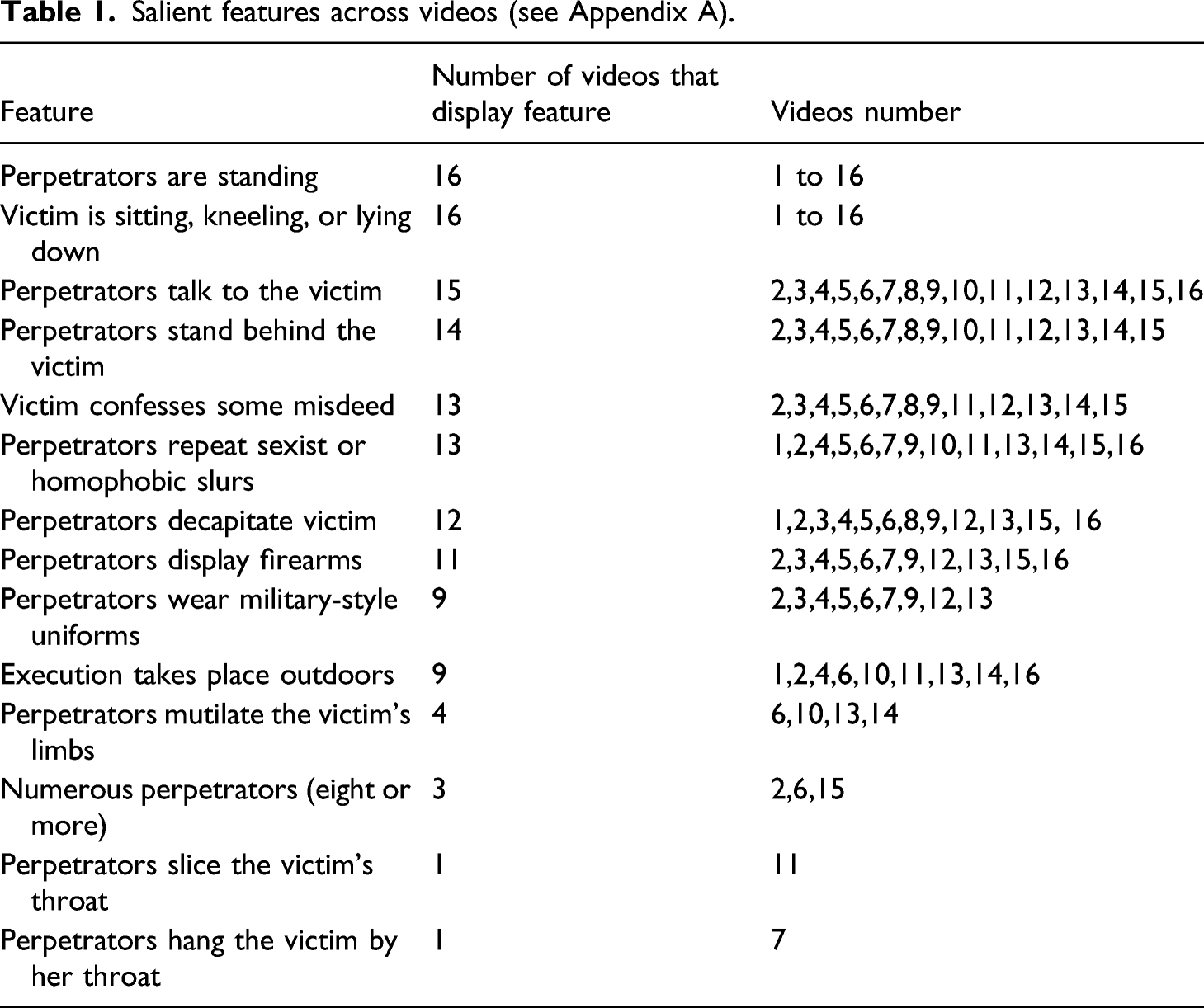
Salient features across videos (see Appendix A).
My approach is based primarily on current debates on violence within the criminological subfield of organized crime studies. However, my analysis also borrows key concepts from (and contributes to ongoing discussions in) the vast subfields of political violence and war studies. By examining extreme executions as rituals, I address a gap between theories that explore the utilitarian functions of these killings, often overlooking their symbolic aspects, and studies that focus exclusively on the psychological dimensions of extreme violence, thereby ignoring their practical functions. Likewise, examining how Los Zetas ritualizes extreme executions lays the groundwork for future research on the conditions that enable OCGs to produce and exploit violent rituals and comparative studies on the factors that make some OCGs more reliant than others on this type of behavior.
The article is structured as follows. The first section argues that leading scholars often overlook aspects of extreme violence that contradict their assumptions regarding perpetrators’ rationality. The second section contends that analyzing extreme executions as rituals enables researchers to resolve discrepancies between the functionalist and the psycho-sociological approaches to this type of violence. The third section provides an outline of the data and methods I employ. The fourth section analyzes extreme executions by Los Zetas and provides evidence that they are organizational rituals that promote group cohesion. The conclusion considers the generalizability of my findings and their implications for theory development.
Extreme violence: Functionalist and psycho-sociological approaches
Leading criminologists and political scientists contend that extreme executions fulfill organizational functions that help OCGs attain their performance objectives. They concur that a function of extreme killings is to terrorize specific audiences (Phillips, 2018). The purpose of such fear is to discourage rivals, deter disloyalty among partners and promote acquiescence from residents of the communities where OCGs operate (Catino, 2015; Kalyvas, 2015; Kaplan and Dubro, 2012; Uribe and Parrini, 2020). Others assert that extreme executions’ primary function is to infuriate audiences and provoke impulsive reactions (Koch, 2018). For some criminologists, extreme violence can also promote trust among members and serve as an instrument of upward mobility within OCGs (Campana and Varese, 2013; Gambetta, 2009).
Conversely, another group of researchers—which I designate as psycho-sociological—contends that treating extreme killings as practical means to achieve tangible organizational objectives is neither necessary nor sufficient to explain the occurrence of this type of violence. From their perspective, functionalist theories’ main weakness is that they overlook psychological aversion to violence and presume that killing is psychologically easy for most people, provided they have the willingness and technical skills required to do it (Bourke, 1999; Collins, 2008; Fujii, 2013).
Scholars of the psycho-sociological current argue that people only use lethal violence under specific mental states. Without the appropriate frame of mind, the willingness and technical means to kill are useless. A minority of individuals, whom Collins (2008) describes as the “violent elite,” can deliberately put themselves in a mental state conducive to violence. However, most ordinary people cannot purposefully harness the states of mind required to kill. For them, these states of mind emerge only under specific circumstances that influence their reasoning and emotions. Such circumstances, however, do not necessarily materialize at the whim of violence-wielding organizations. Therefore, researchers must figure out which processes or situations enable ordinary individuals to overcome aversion to killing and which features of these situations may induce extreme violence (Browning, 2017).
For Neitzel and Harald (2012: 5), individuals’ reasoning and emotions change depending on their frame of reference, that is, how they “interpret what they perceive, draw conclusions, make up their minds and decide what to do.” During total wars or other contexts where societies expect soldiers to kill, combatants’ frame of reference can change and transform violence against the enemy into a source of social recognition, a moral duty, or professional obligation. Such a transformation helps combatants overcome psychological aversion to killing. When warring factions dehumanize their rivals to encourage killings, combatants’ perception and interpretation of extreme violence can also vary. In these contexts, acts that would otherwise horrify perpetrators may appear inconsequential, necessary, or even enjoyable (Bourke, 1999). Similarly, other behaviors that would otherwise appear senseless, such as shooting corpses, may acquire symbolic meaning (Fujii, 2013). Intriguingly, such forms of extreme behavior are not connected to organizational objectives and can even hinder them—for example, by negatively affecting public opinion.
Transformations in frames of reference also occur outside of wars. Fujii (2013: 414) shows how extreme executions can occur in situations where such type of violence “confers instant status, power, or visibility [to perpetrators]. Manhunts and lynchings [for instance], make it possible for obscure and irresponsible people to play the roles of arresting officers, grand jurors, trial jurors, judges, and executioners.” Similarly, Collins (2008) identifies the abrupt collapse of rioters as a situation that confers a sudden and massive surge of power to opposing police officers, sometimes leading to frenetic violence against defenseless individuals. Again, such violence does not connect to—and is often counterproductive for—organizational objectives.
Authors of the psycho-sociological current disagree on which processes or situations generate the mental states conducive to extreme violence. However, they concur that organizations cannot easily induce frames of reference that override individuals’ aversion to violence. This perspective implies that most organizations cannot merely deploy extreme violence whenever and however they want—like a conventional instrument—to achieve their objectives.
Nonetheless, substantial evidence suggests that at least some organizations appear capable of deliberately orchestrating extreme executions. For example, the data I examine suggests that Los Zetas can deliberately organize acts of extreme violence that also appear to serve pragmatic organizational objectives. Does this evidence suggest that members of Los Zetas do not experience a psychological aversion to killing (i.e., that they belong to the violent elite) or, as I contend, that Los Zetas can create situations that affect its members’ reasoning and emotions, thereby changing how they perceive violence? I argue that analyzing extreme executions as organizational rituals allows researchers to explain some of their practical functions without ignoring aspects of such violence that seem disconnected from organizational objectives.
Extreme executions as organizational rituals
Rituals are essential to the operation of organizations. Some of the behaviors that take place during rituals are straightforward routines meant to achieve practical objectives. However, rituals also comprise symbolic actions and items that seem unnecessary to accomplish explicitly recognized organizational goals. These actions and objects, however, are essential to (1) reaffirming the values and purpose of organizations (Islam and Zyphur, 2009), (2) promoting a sense of belonging and solidarity among members (Durkheim, 1995), and (3) displaying a collective recognition of organizational membership and hierarchy (Schein, 2010).
Symbolic elements, namely objects or actions, employed figuratively to denote something else—for example, emotions, ideas, qualities, or values—are the defining features of organizational rituals. The importance of symbols in rituals lies in their power to transform the meaning of actions or objects and infuse them with a different significance shared collectively by ritual participants. Through symbols, rituals alter how participants perceive and interpret different objects or actions (Trice and Beyer, 1984).
Some OCGs rely heavily on organizational rituals. Their proscribed nature, which sometimes deprives them of overt forms of social recognition, increases the relevance of rituals as organizational maintenance instruments (Gambetta, 2009; Paoli, 2008). For this reason, numerous OCGs use rituals to mark important occasions (Catino, 2015), promote solidarity among members (Kaplan and Dubro, 2012), and emphasize the shared purpose and values of their members (Varese, 1998). Some of these rituals involve violent actions, such as voluntary mutilation of fingers, beatings, or even murder (Uribe and Parrini, 2020).
I contend that by transforming participants’ perceptions of torture and mutilation into something valued and desirable, organizational rituals generate the conditions that make extreme violence possible. Once such conditions emerge, OCGs can carry out extreme executions and use them to reinforce organizational cohesion. Below, I demonstrate my argument’s plausibility by showing that 1) Los Zetas seems to generate the conditions that make extreme violence possible by ritualizing executions. 2) Los Zetas appears to employ extreme executions to reinforce organizational cohesion by reaffirming organizational values, promoting solidarity among members, and consolidating organizational roles and hierarchies.
My argument is not incompatible with leading explanations of extreme violence but instead seeks to enrich them by reconciling functionalist and psycho-sociological approaches. Below, I provide an overview of my data and methodology.
Analyzing extreme violence by Los Zetas
This article examines extreme executions by Los Zetas, a paramilitary OCG that emerged in Mexico at the end of the 20th century. Los Zetas is infamous for its involvement in profitable illicit activities ranging from drugs, human, and firearms trafficking to oil theft, kidnapping, robbery, extortion, and counterfeiting. Until 2015 (when it disintegrated into numerous minor factions), the OCG relied on a paramilitary apparatus to fight against competing OCGs and Mexico’s law-enforcement and military institutions (Correa, 2017). Aside from its involvement in illicit markets, the group’s notoriety derives from its extensive use of spectacular, gruesome violence and from the fact that its earliest 50 members were deserters from the Mexican army (Valdes, 2013).
Some analysts attribute Los Zetas’ ability to produce and exploit extreme violence to the group’s military origins (Grayson, 2014). However, evidence has shown that out of the hundreds of individuals who—at one point—comprised the OCGs’ paramilitary backbone, most were ordinary men and women who did not initially belong to a “violent elite” (Garcia Reyes, 2018). Nevertheless, many of these ordinary individuals have participated in acts of extreme violence. Consequently, an analysis of Los Zetas’ executions is crucial to establish whether ritualization operates as a vehicle that enables (via symbolic transfiguration) the pragmatic exploitation of extreme violence.
I examine video footage from 16 executions by Los Zetas uploaded to Blog del Narco (see Appendix A), an internet site that documents violence by OCGs in Mexico (Wilkinson, 2010). The website contains a section called “Lista de Videos” (list of videos) that provides access to hundreds of videoclips depicting executions, torture, mutilation and shootings by purported members of different Mexican OCGs. For this study, I identified and examined all the website’s videos depicting alleged members of Los Zetas executing unarmed victims.
I also rely on 56 interviews I conducted with experts of organized crime in Mexico. Forty-four of my interviewees worked for the Mexican government, analyzing secret intelligence or planning and participating in anti-organized crime initiatives. Eight are scholars of organized crime in Mexico, and four are journalists who cover the country’s OCGs. 1 In addition, I examine academic (see Correa, 2017; Grayson, 2014) and journalistic accounts of executions by Los Zetas (see Grillo, 2012; Osorno, 2017). I analyze these data through the method of thematic analysis. The pattern-based examination identifies, reports, and interprets themes based on theoretical propositions and their corresponding observable implications (Braun and Clarke, 2006).
Observing and analyzing violent acts presents unique ethical and methodological challenges (Melenotte, 2020: p.44). First, “it is difficult [for researchers] to observe violence as it occurs […] because ethnographic immersion [is often] dangerous, if not impossible.” Technological innovations—for example, smartphones, the internet, and social media—have undoubtedly increased researchers’ ability to obtain and analyze audiovisual recordings of violence. However, these data present analytical limitations as they often provide fragmented and skewed representations of real-life events.
These limitations may prompt critics to argue that the data I employ are ill-suited for assessing whether extreme executions promote organizational cohesion. Undeniably, testimonies from the executioners themselves or data produced through ethnographic research would facilitate more robust inferences about my findings. Several scholars have successfully collected this kind of testimonies from torturers (Garland, 2005; Huggins, 2002), participants in genocides (Fujii, 2008; Hinton, 2016), and combatants in armed conflicts (Feldman, 1991; Nordstrom, 1997). Obtaining such data for this article was not feasible due to Mexico’s current context of pervasive violence. However, since I mainly aim to determine my argument’s plausibility, the evidence I provide is sufficient to produce appropriately tentative conclusions. Future studies using different data may enable researchers to evaluate my propositions more stringently.
Critics may also argue that video footage is not representative of executions by Los Zetas because the group does not film all its killings. Those which it video-records may exhibit characteristics that are not present in those it does not. Admittedly, videotaped executions may differ from executions that Los Zetas does not film because the former are spectacles orchestrated deliberately for recording and distribution. However, non-videotaped executions are also likely to contain elements present in those that Los Zetas films. First, like videotaped killings, they are spectacles that OCGs put on for an audience—that is, those present in the execution—albeit a smaller one. Second, when perpetrators do not film them, many extreme executions feature elements necessary for a ritual (e.g., capturing the victim, selecting the execution mode, and ensuring perpetrators’ participation).
My analysis also entails major ethical considerations. The videos I analyze are extraordinarily graphic and depict human beings who were physically and mentally tortured, sexually abused, mutilated, and killed on camera. I am mindful of their suffering and do not regard it as simple data that other researchers and I can use to evaluate theories without pausing to think about these persons’ experiences of terror, pain, and death. However, scientific research into this atrocious phenomenon is necessary to understand it and, thus, in due course, develop mechanisms to prevent it. Therefore, I include only those descriptions of violence that, from my perspective, are necessary for the study but exclude details that would merely serve to sensationalize this type of behavior.
Extreme executions as organizational rituals
This section first demonstrates that the extreme executions I examine meet the definitional criteria of organizational rituals. I then explain how Los Zetas can use extreme executions to promote its values, encourage solidarity among its members, and reinforce its organizational structure.
To establish whether extreme executions by Los Zetas are organizational rituals, I used Smith and Stewart (2011) enumeration of such rituals’ defining features. Namely, they are (1) standardized, (2) repetitive, (3) predictable, (4) rule-bound, and (5) symbol-imbued forms of organizational behavior. The data I examined shows that extreme executions by Los Zetas consistently display all or most of these features.
Standardized events
Most extreme executions by Los Zetas follow a strict pattern. According to a former Mexican intelligence official I interviewed (Interview no32, 2018): Usually, members of Los Zetas first identify, select, and kidnap their victims. The abductors transport their victims to a location where they interrogate them. During the interrogation, they (members of Los Zetas) torture their captives and determine their fate. Then, they decide whether and how they will kill them based on their leaders’ instructions.
The executions I examined are highly patterned and share several salient features. The table below summarizes them and identifies which videos contain them.
In nine out of the videos, perpetrators dress in military-style uniforms which occasionally display the letter Z (the most common emblem of Los Zetas). Also, in eight videos, participants carry assault rifles and other types of firearms—especially Kalashnikov and AR-15 models, which have become emblematic of Mexican OCGs. In all videoclips where the perpetrators’ heads are visible, their faces are covered with bandanas or face masks. In every video, the victims are bound, sitting, kneeling, or lying down facing the camera while the perpetrators are standing. In 11 videos, at least one perpetrator stands behind the victim. Additionally, in 15 videos, the perpetrators talk to their victim during the execution, ask her questions or insult her. Similarly, in 13 videos, the victim confesses different misdeeds, such as collaborating with a rival OCG.
While the predominant method of execution is beheading (in 12 videos), two videos show the perpetrators mutilating the victim’s limbs without beheading her. One video features the killers slicing the victims’ throats, and another depicts them hanging several victims. Although the videos never show what the perpetrators do in the hours following the executions, journalistic accounts have documented how perpetrators occasionally transport their victims’ corpses to pre-selected locations where they put them on display (Vulliamy, 2009).
Some of these features may occur exclusively in video-recorded executions—for example, wearing uniforms. However, available data suggests that non-filmed executions follow a similar pattern (Lavandera, 2013).
Repetitive ceremonies
Extreme executions by Los Zetas are repetitive, both across and within episodes. In most videos, perpetrators repeat similar threats and insults ad nauseam. While perpetrators systematically direct some of their insults to their victims, their slurs’ main object is the organization these victims purportedly represent. In the cases I examined, participants direct almost all insults against the OCG known as the Gulf Cartel. This repetition of slurs directed against a rival organization seems to provide perpetrators with a sense of shared commitment against their rivals.
During executions, the body movements of perpetrators and victims are also repetitive. Typically, most of the perpetrators behave as an observant congregation. They stand in the background and remain static, breaking their silence intermittently to utter cheers or insults in chorus. Conversely, one to three perpetrators play more active roles as “director” and executioners. The director, who usually remains off-camera or standing next to the victims, leads the execution’s pace and directs the executioners’ actions. In most instances, the executioners are the only perpetrators who move during the execution. They remain immobile until the director instructs them to begin the execution. Subsequently, they enter what would appear to be a state of “controlled frenzy,” during which they mutilate and ultimately kill their victims through a nervous succession of slashes and blows. This apparent state of controlled anger and elation seems to spread through all perpetrators, even if they are not partaking directly in the mutilation.
Other repetitive features are the sounds (and the absence thereof) that occur during executions. It is possible to consider most victims’ disquieting silence as a repetitive feature across executions. This silence seems to reinforce the ritualistic character of executions because—contrary to what observers could expect—victims rarely scream, cry, or plead during their executions. Instead, they usually maintain a stoical, resigned demeanor and only utter sporadic whimpers while the executioners mutilate them.
In his study of sound in jihadi propaganda videos, Velasco-Pufleau (2021) examined how Islamic “anashid” (recitations) operate as symbolic weapons meant to inspire the Mujahideen and terrify their enemies. It is reasonable to infer that the victims’ silence in Los Zetas’ executions also plays an essential role in the process of ritualization. By forcing their victims to remain silent, perpetrators dehumanize them and transform them into embodiments of the entities against whom they channel their violence. The victims’ silence effectively obliterates Los Zetas’ “enemy” from the audiences’ acoustic space while simultaneously imposing the perpetrators’ voices and messages.
Predictable episodes
The standardized and repetitive features of these videos make them highly predictable. After examining a few clips, it becomes possible to identify and predict invariable sequences of events where the victims acknowledge their transgressions, the perpetrators torture, insult, mutilate, and ultimately kill them. While each episode is slightly different, none deviates from this standard formula, which is consistent with the organizational ritual hypothesis.
As I mentioned earlier, another predictable feature of the videos is the state of “controlled frenzy” that perpetrators seem to experience while torturing and killing their victims. This state of mild euphoria is akin to a feature of rituals called liminality, that is, the state of excitement that participants in rites of passage experience in their transition from a pre-rite to a post-rite status (Turner, 2012; Van Gennep, 2011). Below, I consider how this apparent state of controlled frenzy may also indicate Los Zetas’ efforts to bolster organizational cohesion.
It is also essential to consider that, up until the moment of the execution, only the perpetrators know what will happen. While victims may suspect what awaits them, they cannot be entirely sure. According to Collins (2008: 102), this information asymmetry is common in rituals that involve torture as it contributes to generating the subjective conditions conducive to violence. By keeping victims in a state of uncertainty or entertaining a prospect (e.g., of death without pain), torturers repeatedly build up tension between them and their victims. Then, they deliberately collapse it, thereby triggering bouts of violence during which the torturer experiences emotional release by inflicting pain on his victim. 2 Collins (2008) documented how torturers often “solicit appeasement [from their victims] but then reject it as insufficient.” This practice is evident in video nº 5, where perpetrators compel a brutally disfigured victim to apologize several times for his misdeeds before decapitating him. The victim (with horrific signs of trauma) claims that he is no longer able to speak, implying that he can no longer keep apologizing, but this only appears to aggravate his torturers.
Rule-bound procedures
One critical feature of organizational rituals is that members of organizations expect their colleagues to participate in them (Smith and Stewart, 2011). For members of Los Zetas, participation in extreme executions is mandatory, and failure to partake results in sanctions, ranging from beatings to death. For example, in his testimony (Lavandera, 2013), a former member of Los Zetas recalled:
When I was recruited [into the OCG], my colleagues took me to a warehouse where people were being tortured, killed, and decapitated. The leader [of Los Zetas] gave me a pistol, stood over a man on the ground, and ordered me to shoot him. I had to do it. What other option did I have? If I don’t do it, I know what’s gonna happen to me.
Similarly, the unauthorized organization or participation in extreme killings can lead to significant sanctions—for example, death—for insubordinate members. Some of the officers I interviewed pointed out that when leaders of Los Zetas want to reduce the visibility of their operations, they sometimes forbid their subordinates from carrying out extreme executions. One of these officers (Interview no8, 2018) explained: When “la plaza está caliente” (i.e., when there is a strong law-enforcement presence in a turf), the boss will tell his guys to keep a low profile and stop kidnapping and beheading people. Of course, sometimes the guys disobey, either because they’re drugged or because they want to show they’re “muy cabrones” (real badasses). Things usually end badly [for the insubordinate killers].
Some interviewees also mentioned that Mexican OCGs, including Los Zetas, have attempted to establish rules regarding the application of extreme violence. Such rules specify punishments for different transgressions. For instance, in one testimony, a former OCG hitman explained: “cutting one of the victim’s fingers and putting it in her mouth or her anus, gouging her eyeballs, cutting her tongue, all these actions send specific messages” (Rosi, 2011). However, my interviewees coincide that in Mexico, OCG rules regarding methods of execution have become ambiguous due to the proliferation of groups with idiosyncratic values and norms. According to one Federal Police officer (Interview no18, 2018), “back in the day, you could often deduce what a victim had done based on how she was tortured and killed. Now you cannot always know. Sometimes “mañosos” (i.e., OCG members) do horrendous things to their victims just for fun.”
Evidence that Los Zetas tries to regulate extreme executions through specific norms contradicts the psycho-sociological claim that these killings only unfold in situations beyond the OCG’s control. However, the fact that transgressions to such rules occur suggests that extreme violence is, after all, difficult to control and apply for purely practical reasons. As one official explained, “when it comes to gruesome violence, Los Zetas is often unable to hold the reins of its members” (Interview no31, 2018).
Symbolic content
The data I examined suggests that most extreme executions contain significant symbolic elements. Some of these symbols are unmistakable, (e.g., logos and firearms, especially models emblematic of Mexican organized crime culture). Other symbols are subtler. For instance, the number of perpetrators, the number of victims, the positioning of perpetrators, and victims also appear to transmit ideas or values. Similarly, the actions of the perpetrators and the emotions they express can also act as symbols. By examining the videos, I interpreted some of the symbolic meanings of such objects and actions and the values they convey.
To summarize, my data confirms that extreme killings by Los Zetas exhibit the defining features of organizational rituals. Below, I assess how these rituals can reinforce cohesion within the OCG.
Extreme executions as channels to reaffirm the values and purpose of Los Zetas
Los Zetas appears to use extreme killings to reiterate its organizational values and objectives. Put colloquially, through participation in these killings, members of Los Zetas reaffirm “what they are all about.” One of the values that executions impart is control, specifically Los Zetas’ power to control people and territory. The executions I examined communicate control through objects and actions. For instance, perpetrators demonstrate control over their victims’ bodies, that are always bound and subdued. Perpetrators systematically place victims in ways that indicate submissiveness, kneeling or sitting down, never standing up or facing their executioners. Victims never plead with their captors. They only talk to answer questions.
Perhaps less patently, however, the killers also imply control over the territory where Los Zetas operates. For instance, nine of the executions take place outdoors. A logical explanation of this feature is that the perpetrators do not want to clean their victims’ blood. 3 However, carrying out executions in the open also conveys the notion that Los Zetas controls that space. 4 Another idea that Los Zetas represents symbolically during executions is power. By executing their victim, the perpetrators reaffirm their power to kill, and by mutilating her, they show their power to transgress and redefine norms about the proper treatment of humans. The fact that perpetrators decapitate most of their victims also denotes power in two different ways. As Urueña (2020) points out, by defiling a specific part of the victim’s body, that body part becomes a symbol that communicates a specific message or meaning. For example, the “Colombian necktie” (a mutilation in which the victim’s tongue is pulled through a cut underneath the chin and left hanging on the neck) transforms the tongue into a symbol of the victim’s ability to speak and then destroys this ability. Colombian OCGs, often reserved this punishment for informants.
In numerous societies, including Mexico, the head symbolizes the most relevant part of a living entity’s body, its capacity to see, hear, eat, think, communicate, and exist. Perpetrators symbolically display their ability to sever the “head,” that is, the core of rival OCGs, by turning their victims into incarnations of rival organizations and decapitating them. Moreover, since headless bodies are harder to identify, Los Zetas can turn them into symbols representing every potential victim. Put differently: a headless, unidentifiable corpse expresses power by symbolizing Los Zetas’ capacity to kill anyone.
The perpetrators also project their power through their display of military weaponry. For instance, in video nº 6, where members of Los Zetas decapitate four bound women, the perpetrators carry over a dozen assault rifles. Similarly, by wearing military uniforms, helmets, and bulletproof vests, participants convey their destructive power and purported invulnerability. Los Zetas sometimes reinforces this idea by congregating numerous perpetrators to execute only one or a few victims. In videos nº 2, 6, and 15, over eight killers participate in the execution of defenseless victims.
Another value that Los Zetas emphasizes during executions is a peculiar sense of work ethic or a representation of violence as work (Huggins, 2002; Siegel, 2018). Members of Mexican OCGs often refer to violence as work (trabajo) and framing it as such allows perpetrators to shape the way they approach it. In every video, perpetrators try to maintain a business-like demeanor even as they laugh or insult their victim. According to some of my interviewees, Los Zetas perceives efficiency in using extreme violence as a sign of professionalism. For instance, some OCG members consider their ability to mutilate—that is, their aptitude to smoothly cut through muscles, tendons, and bones—as a sign of professionalism (Interview no18, 2018). From this perspective, by orchestrating events where perpetrators get to make their victims suffer and die dramatically, Los Zetas offers its members an opportunity to engage in what they consider to be “real” OCG work, as opposed to, for instance, guarding a safe house. Therefore, executions provide members of Los Zetas an opportunity to see some form of purpose in their jobs.
Finally, extreme executions convey an inflated conception of masculinity as strength, assertiveness, and belligerence combined with misogyny and homophobia. Aside from the phallic obsession that perpetrators exhibit by repeatedly uttering the word “verga” (a slang word for penis) during executions, killers also endeavor to symbolically emasculate their victims through the repetition of sexist and homophobic slurs. This process sometimes culminates in genital mutilation. 5 Video nº 16 features OCG members cutting their victims’ penises and inserting them in their mouths.
Los Zetas’ executions of women also exhibit misogynistic sexual elements. In video nº 1, where members of Los Zetas decapitate a woman, the cameraman chuckles as he remarks that the victim is urinating. After severing the victim’s head, the executioner places it on her pubic area. In video nº 6, perpetrators force three females to kneel bare-chested before beheading them in front of the camera.
Executions to increase solidarity among participants
For Los Zetas, extreme executions represent an opportunity to promote mechanical solidarity—that is, unity based on shared identities and beliefs—(Durkheim, 1964). Aside from projecting power, insignia and military uniforms create a sense of homogeneity among participants. Perpetrators look almost identical, and their demeanor suggests that they subordinate their identities as individuals to a collective entity. As I mentioned earlier, killers do not necessarily wear military uniforms and masks when they do not film their executions. However, it is reasonable to infer (based on studies of organized crime culture in Mexico) that they still wear garments they collectively associate with their criminal milieu (Muehlmann, 2013).
Los Zetas sometimes imposes different punishments for specific transgressions to reinforce mechanical solidarity. The OCG often reserves the most draconian executions to “chapulines” (grasshoppers) and “sapos” (frogs), that is, deserters and informants. In video nº14, the cameraman exclaims, “this is what happens when you betray Los Zetas,” before his accomplices cut off the victim’s feet. Subsequently, they bash his right shoulder with a machete until they sever his arm. While they maim their victim, the perpetrators force him to shout, “Long live Los Zetas!” Conversely, according to one interviewee, members of Los Zetas who used to be soldiers occasionally accord less brutal executions (e.g., head gunshot) to former colleagues who had also served in the military and joined a rival OCG. This milder treatment may also convey a sense of shared identity, even among opponents (Interview, no19).
Organizational rituals also promote solidarity by reducing uncertainty among members. As Campana and Varese (2013) point out, co-participation in violence reduces uncertainty within OCGs by decreasing mistrust among members. Extreme executions reduce uncertainty by creating ceremonies where only trusted “insiders” can participate. In other words, in OCGs like Los Zetas, where mistrust among members is pervasive, the invitation to partake in executions allows members to feel that they have nothing to fear because they are not among those “on the barrel side of the gun.”
Similarly, executions offer members of Los Zetas opportunities to increase organizational cohesion by producing shared experiences and emotions. For Xygalatas et al. (2013), rituals that involve physical pain and high costs promote solidarity among participants by producing a sense of empathy and shared ordeals. During executions, it is the victims who experience extreme suffering. However, the perpetrators share the experience of causing such suffering and pay the psychological and social costs resulting from their participation in torture and killing.
Perpetrators also seem to share the emotional state of controlled frenzy that executioners appear to experience while mutilating their victims. Executions produce a sense of communion and fellowship that strengthens group solidarity by creating a situation where all participants can simultaneously share strong emotions (Turner, 2012). This sense of communion is visible in video nº 7, where perpetrators listen to music while watching their victims die, in video nº 10, where the killers mock their victim in chorus, and in video no 1, where perpetrators laugh after the cameraman remarks that the eyes of the woman they beheaded are still moving.
Other ordeals that participants share relate to sensory experiences. For example, an officer (Interview no51, 2018) I interviewed recalled:
I arrived at a crime scene where Los Zetas had placed mutilated corpses on display. The smell of the decomposing cadavers was unbearable. I could not understand how the perpetrators had managed to breathe that stench while transporting the corpses to the location where the bodies were displayed. The experience must have been awful. Then again, maybe they enjoyed it.
Hierarchy-reinforcing rituals
Finally, executions allow Los Zetas to reinforce its organizational structure and hierarchy. These ceremonies are events that starkly establish who belongs to the OCG. The victim embodies the “enemy,” while the perpetrators represent the group. Also, during the execution, participants physically reenact the OCGs’ hierarchy. For instance, according to one of my interviewees, leaders of Los Zetas often regulate but do not participate in the executions. In contrast, those who directly mutilate and kill the victims are lower-ranking members who have “something to prove” (Interview no39, 2018). However, for leaders of Los Zetas, occasional participation in extreme executions also represents an opportunity to reaffirm their hierarchical status by displaying their ruthlessness before their subordinates in a safe setting, where the recipients of violence are defenseless. Lastly, by creating a sense of communion, executions may temporarily overturn the OCG’s hierarchy and create a moment during which members are figuratively equal (Allison, 2009).
Conclusion
I examined extreme killings by Los Zetas and showed that they contain all the defining features of organizational rituals. Then, I interpreted the symbolic meaning that different objects and actions acquire during executions. Specifically, I argued that extreme killings create opportunities for members of Los Zetas to interpret torture and mutilation as acts that denote power, control, professionalism, and machismo. Likewise, I contended that extreme killings seem to promote mechanical solidarity among members of Los Zetas and allow them to reenact their position and role within their group.
In addition, I contributed to resolving discrepancies between scholars who consider extreme killings as deliberate and pragmatic actions and those who view them as episodes resulting from unpremeditated situations that influence perpetrators’ reasoning. Concretely, I showed how Los Zetas can create conditions conducive to extreme violence by organizing rituals that reframe participants’ perceptions. Los Zetas’ capacity to produce such conditions disproves the notion that extreme violence only occurs in situations beyond the OCG’s control. However, the fact that Los Zetas must often ritualize violence to enable acts of torture and mutilation reinforces the argument that violence is not “easy to produce,” that is, that having the means and the incentives to use violence is necessary but not sufficient to produce it (Collins, 2008). Without a ritualization process that transforms violence’s meaning and subjective value, OCGs may face substantial barriers to producing these killings and using them for practical goals.
Accounts of organized crime violence in countries such as Mexico and Colombia suggest that this study’s findings also hold across these countries’ OCGs (Uribe and Parrini, 2020). Conversely, while some OCGs in countries like Japan (see Kaplan and Dubro, 2012), Italy (see Catino, 2015), and Russia (see Stephenson, 2015) rely significantly on organizational rituals, they have not embraced extreme violence to the same extent as their Mexican counterparts. Therefore, further research is necessary to elucidate the conditions that enable the ritual use of executions and the reasons why some OCGs rely on them more than others.
Footnotes
Declaration of conflicting interests
The author(s) declared no potential conflicts of interest with respect to the research, authorship, and/or publication of this article.
Funding
The author(s) received no financial support for the research, authorship, and/or publication of this article.

Notes
Author biography
Video recorded executions by Los Zetas.
N°
Description
Date
URL
1
Beheading of a woman
2014
https://bit.ly/3gQbmng
2
Beheading of a man
2014
https://bit.ly/3aicw9U
3
Beheading of three men
2014
https://bit.ly/3oVgB7T
4
Beheading of a man
2014
https://bit.ly/3monYDI
5
Beheading of a man
2014
https://bit.ly/3nkbFJs
6
Beheading of four women
2014
https://bit.ly/38amB6c
7
Hanging of two men
2014
https://bit.ly/3msEH8u
8
Beheading of three men
2014
https://bit.ly/3ai3rxF
9
Execution of three men (one beheaded and two shot with a gun)
2015
https://bit.ly/3nv5Glm
10
Mutilation of a man’s legs
2015
https://bit.ly/3p0fmEq
11
A man is beaten and then his throat is silt
2016
https://bit.ly/37m0RF1
12
Beheading of a man
2017
https://bit.ly/3gR8UNn
13
Mutilation of a boy’s legs and arms followed beheading
2017
https://bit.ly/371F2FO
14
Mutilation of a man’s feet and arm
2018
https://bit.ly/3892HZd
15
Beheading of a man
2018
https://bit.ly/2WkijDD
16
Genital mutilation of two men, followed by beheading
2019
https://bit.ly/3gTdhaE