




Abstract
The threat of recurrence of violence remains a protracted concern in post-conflict contexts. This article contributes to the literature on post-conflict violence by analyzing a specific phenomenon that has characterized North Waziristan: the “Taliban target killing campaign” of civilians. The article argues that the targeted killings in (post-conflict) North Waziristan are a pre-mediated and calculated strategy employed by the militants to create space for their resurgence by silencing dissent through extortion, threats and killing of the locals. Exploring post-conflict violence, the article draws attention to the application of de-securitization in North Waziristan where “silent institutional” de-securitizations (i.e., state silence) are adopted to maintain the post-conflict fragile peace to prevent the risk of slippage into re-securitization. In explicating this, the article contributes by identifying three forms of silences: (i) silencing (by killing), (ii) state silence, and (iii) strategic silence. Doing so also helps to elaborate the function, meaning, and consequence of silence(s) in post-conflict contexts.
Introduction
On June 18, 2004, the first-ever United States (U.S.) drone strike in Pakistan executed the Taliban militant commander Nek Muhammad Wazir in South Waziristan. The death of Nek Muhammad was labeled as a “targeted killing.” In the decade that followed, numerous targeted killings through the counter-terrorism strategy of drone warfare executed top militant leadership across the Pakistan-Afghanistan border region and became the cornerstone of the U.S. War on Terror. Consequently, over time, the expression of “target killings” became synonymous with drones. Many years and counter-terrorism operations later, on August 27, 2021, Noor Islam Dawar, president of Youth of Waziristan, a local community organization demanding peace in post-conflict North Waziristan, was shot in Mirali, North Waziristan, by militants in the Mirali Bazaar (market). Targeted killings of social leaders, tribal elders, and notable locals amongst the tribesmen, such as Noor Islam Dawar’s, have been a recurring phenomenon labeled as the “Taliban target killing campaign” tracing its lineage back to the emergence of militancy in the northwestern tribal region in Pakistan. However, these killings (i.e., violence) and their implications have not been analyzed from a (post-conflict) security perspective.
The existing literature about targeted killings, with reference to the case of Pakistan, is overwhelmingly associated with debates on the U.S.-sanctioned drone warfare (Banka and Quinn, 2018; Boyle, 2013; Regan, 2022) which has been viewed critically over the years (Ahmad, 2014; Badalič, 2019b; Yousaf, 2020). While, on the other hand, academic and scholarly literature remains mostly silent on the issue of systematic targeted killing of locals by the militants (with the exception of the case of Bajaur—see Ullah, 2016). Nonetheless, the Pakistani news outlets and platforms have helped to elucidate the pressing nature of the issue, especially in the post-conflict (i.e., after Operation Zarb-e-Azb) case of North Waziristan. According to local and national news media, around four hundred and fifty people have been killed in targeted killings since 2018 (Khattak, 2022); however, the natives of North Waziristan report these figures to be around five hundred as they have been repeatedly echoed in numerous jirga (tribal council). 1
In the case of Afghanistan, the mirroring of the micro-dynamics of this particularized violence has been explained by Badalič (2019a), who has asserted that the Taliban targeted killing campaign was used as a tactic in Afghanistan to eliminate the civilians working for, or suspected of working for, the U.S. forces or the Afghan government. He identified two objectives of the targeted killing campaign in Afghanistan: firstly, they aim to undermine the Afghan people’s confidence in the post-Taliban regime by fear and violence through targeted assassinations which allowed the Taliban to introduce their system of governance. And, secondly, their goal is to regain control of areas governed by the Afghan government by challenging the monopoly on the use of force (217). Similarly, Johnson (2013) has elaborated on the Afghan Taliban’s assassination campaign targeting civil servants, security forces, tribal elders, religious leaders, and shura (consultative council) members. Johnson claims that targeted killing campaign of locals has been used as a tool of insurgency that aimed to discredit and challenge governance and authority. Elaborating on targeted (post-conflict) violence against social leaders in Colombia since the 2016 peace agreement, Albarracın et al. (2023) assert that forms of violence that do not simply reflect a continuation of the legacy of the armed conflict are often primarily contended as “criminal” violence (such as targeted killings/assassinations). Nevertheless, local political orders and power relations constitute a crucial dimension shaping the micro-dynamics of violence and repression in post-conflict contexts. In similar vein, the focus of this article is to discuss the micro-dynamics of the “Taliban target killing campaign” and to assess its significance for post-conflict security/peace in North Waziristan.
The underpinnings to focus on this particular type of (post-conflict) violence lies in the work by Kalyvas (1999) on the systematic killing of civilians and the rationality of violence. He emphasizes a reconsideration for violence, that it is not merely a degree of conflict, but a “form” of conflict. His assertions on targeted killings elaborate that, “to be efficient, terror needs to be selective” (251) and hence maximize civilian compliance. The case of targeted killings in North Waziristan necessitates reconsideration (for violence) along similar conceptualizations—in that, the targeted killings of civilians need to be assessed more broadly. They should not be considered simply as a degree of intensity of post-conflict violence in Waziristan; the killings have been methodological, systematic, and selective. With this in view, the article makes a twofold contribution: firstly, it establishes empirical evidence, supported by inputs from locals in North Waziristan, which helps to understand the micro-dynamics of this form of violence and its transformative nature in both the timeframes, that is, before and after the counter-terrorism operation (i.e., Operation Zarb-e-Azb in 2014). Secondly, the article lays greater emphasis on the assessment of the target killing campaign of locals in North Waziristan and how the issue has been placed and treated in post-conflict security and violence. To analyze this further, the article uses the framework of de-securitization to illuminate the “silence” over the subject of targeted killing of locals and the consequential impact of the aforesaid. Here, the article also adds further depth to the concept of the “construction of (post-conflict) silence(s)” as silence is relevant to the case of North Waziristan as a conceptual lens and practice. This study contributes by identifying three forms of silences which characterize post-conflict North Waziristan: (i) silencing (by killing), (ii) state silence, and (iii) strategic silence. Doing so also helps to elaborate the function, meaning, and consequence of silence(s) in post-conflict contexts.
The article starts with a synopsis of the context under focus and the details of the methodological approach, then follows an exposition of existing literature on de-securitization along with conceptualization over silence(s), followed by accounts of targeted killings in North Waziristan as the militancy grew in the region and after the counter-terrorism operation. Thereafter follows the discussion placing targeted killings within de-securitization elucidating the manifestations and impact of the violent construction of (post-conflict) silence(s).
Contextual and methodological overview
The socio-cultural and security settings in North Waziristan
North Waziristan is one of the seven tribal tehsils 2 (administrative unit) in the (former) FATA region. After the independence of Pakistan, FATA was treated as semi-autonomous, but in May 2018, it was merged with the Khyber Pakhtunkhwa (KP) province resulting in significant administrative and political changes for the whole region. Ethnic Pashtuns who have been regulating their socio-cultural distinctness through the unwritten code of Pashtunwali predominantly populate the FATA region. The malkaan (tribal leaders) and mashraan (tribal elders) govern their respective qoum/khel (villages and sub-tribes) through Pashtunwali to deliver justice and resolve disputes, reinstating their authority and establishing trust within communities.
Within this tribal setup, the role of the tribal leaders and elders holds an immense significance as they are considered to be the power centers of their communities. From a cultural perspective, the malakaan from within tribes hold remarkable personal attributes, including adherence to traditional values, leadership skills, eloquence in speech and conversation, preferably a greater number of male heirs and relatives, and family wealth and influence (Khan and Amin, 2015: 3). The tribal communities rely on the malakaan and mashraan to solve their disputes and address their problems through maraka/jirga (tribal council) (Khan and Amin, 2015: 10-12). It is also important to note that Pashtunwali is exercised through many expressions, most notably: nang (honor), badal (revenge), turah (bravery), and milmastiya (hospitality) (Aslam, 2020: 12). However, the identity of the tribal peoples is built around “badal” which loosely translates into “reciprocity,” and is commonly understood as “revenge.”
Keeping in view the cultural norms of badal, the northwestern Pashtun areas have been defined by their culture of weapons (or open carry) which in turn provided nourishing grounds for the rise of militancy and transnational terrorism (see Firdous, 2009). The year following 9/11 saw an increase in militancy and terrorism in North Waziristan—which even gained organizational momentum in the form of Tehreik-e-Taliban Pakistan (TTP) (Iqbal and Silva, 2013). And while the rise of militancy and its countering measures have received increasing attention over the years, the subject of targeted killings of locals—by other means than drones—has skipped academic scrutiny and analysis.
Note on methodology
Taking into account these contextual tribal dynamics, the case of targeted killings of locals in North Waziristan, before and after the counter-terrorism operation (i.e., Operation Zarb-e-Azb) becomes an engaging and untapped area of study. Given that North Waziristan reports the highest number of targeted killings, the case study research design has been adopted. It was constructed using primary data gathered from fieldwork in North Waziristan and secondary literature constituted of local, national, and international news reporting. For the purposes of data collection, a field visit to North Waziristan was made in August 2019 during a research project titled “Unravelling the Contextual Realities in Post-Conflict North Waziristan (2019–2020)” which largely focused on post-conflict security reconstruction and development. Visits were made to all three sub-divisions of the North Waziristan including Miranshah, Mirali, and Razmak. In order to further probe into the phenomenon of targeted killings, data collection was continued with natives of North Waziristan in Peshawar, Bannu, Islamabad, and Rawalpindi. Additional interviews were also conducted outside of Waziristan to ensure open conversations on the subject since the data collection within North Waziristan was strictly monitored by the Pakistan Army stationed there who was accompanying the research team to ensure their security in conflict-ridden Waziristan. The overall duration of data collection through unstructured interviews stretched from August 2019 till June 2021; however, some additional interviews were conducted especially with the Pakistan Army officials in May 2023 to (re)gauge their insights as the killings had persisted over the years.
The collection of primary data and insights relied on a total of 35 interviews and 5 focus group discussions with the informed consent of the research respondents while guaranteeing their anonymity. The research adopted purposive sampling technique to include relevant respondents for the study. All the focus group discussions had more than six respondents in attendance, and they were conducted with all categories of respondents, that is, Pakistan Army officers, tribal elders, tribal youth, and local journalists. The major themes for this study were post-conflict security reconstruction, targeted killings, de-weaponization, re-Talibanization, and “local” meanings of safety and security. It is also very important to mention that the primary respondents for the study were local journalists from North Waziristan. These locals had grown up during the War on Terror and had “lived experiences” of militancy and terrorism. And given their involvement in journalism, they had been at the forefront of reporting the attacks of targeted killings. Some of them had also retained their personal databases on the targeted killings that proved very useful in identifying patterns and victimology of particular trends of targeted killings and their impact on society. The following section lays out the blueprint for analyzing and placing the targeted killings of locals within the security discourse.
De-securitization and the construction of silence(s) in post-conflict contexts
The concept of de-securitization holds both analytical and critical influence and relevancy in studying post-conflict contexts. De-securitization refers to “the shifting of issues out of emergency mode and into the normal bargaining process of the political sphere” (Buzan et al., 1998: 4) and is the preferred “long-range option” (29) as compared to its conceptual twin, securitization. However, in contrast to securitization, de-securitization has received inconsistent empirical attention that has rendered the theorization on de-securitization quite implicit. In this view, critics have found that the preference for de-securitization is technical, managerial, and instrumental, rather than genuine political or ethical (Huysmans, 1998: 572-3) due to which “de-securitization has […] remained seriously underspecified” (Aradau, 2004: 389) and “under-theorized and open to interpretation” (Taureck, 2006: 59). As a response to redeem and crystallize coherent conceptualization on de-securitization, Hansen (2012) categorized four forms of de-securitization with each distinguished by a particular conception of politics. The aforementioned categorizations include détente (a slow move of an issue out of security discourse), replacement (of a security issue by another one), re-articulation (of a securitized issue in a non-security frame), and silencing (which occurs when an issue disappears from the security discourse). The article uses the fourth form of desecuritizaiton identified by Hansen—silencing—to build the case of “state silence” (explained in the later sections).
Some studies have also argued that de-securitization should not be considered morally better than securitization (Floyd, 2011), rather it is akin to securitization. Similarly, Hansen (2012) has also argued that de-securitization has been conferred an inferior role compared to securitization by framing it as a necessary supplement to securitization. Linked to this assertion is another significant issue of debate concerning de-securitization where ambiguity remains if de-securitization can be considered an active political process or if it can only be considered in light of the fading away of the issue (Behnke, 2006: 65). Meaning, for how long does an issue retain the status of a security issue? In response, many empirical studies on securitization and de-securitization (Donnelly, 2015; Salter and Mutlu, 2013) have indicated that since political and social situations are constantly evolving—especially in post-conflict and transitioning contexts—it is difficult to identify a definitive end point for either of the processes.
In view of these aforementioned conceptualizations, what can be made of issues or instances where insecurity persists, as experienced by the audience (i.e., here, the locals of North Waziristan), but the securitizing actors (i.e., state/Pakistan Army) characterize the issues as “non-security?” This also raises questions about the identity of the de-securitization actors. Focusing over this, Oelsner (2005) has suggested that in the de-securitization process, the policymakers and other political, economic, and intellectual elites can be characterized as the actors as they would convey the “re-interpreted” perceptions of security to the audience (15). This simply means that the same actors encourage the process of de-securitization by renegotiating appropriate responses. In contrast to this, Aradau (2003) argues that de-securitization agents/actors should not be the self-same agents of securitization. In her view, the de-securitizing actors should be from within the previously silenced “other.” This contention holds as in most of the cases, the securitization agents are incapable of de-securitization (Coskun, 2008). In the succeeding section, the debate on desecuritizaiton is further narrowed on the process and phenomenon of silence.
The construction of post-conflict silence
Silences are highly complex. In a de-securitization context, silences signify the unexplored yet normalized space between politicized (i.e., active involvement of an issue in the political discourse) and depoliticized (i.e., the issue disappears or is not part of the mainstream political discourse) (Hirschauer, 2019). As illustrated by literature, de-securitization as a discourse or practice can be adopted in a pre-emptive manner before the threshold of securitization is reached. So, in this context particularly, silencing can be strategized to “pre-empt or forestall securitization” (Wæver, 2000: 254), thereby active de-securitization can prevent escalation of a contention. Hence, de-securitization might even be desirable. However, Hansen (2012) has also pointed out that de-securitizations take place around threats that have been explicitly articulated, so the chances that such threats disappear from the security discourse, that is, shift from securitized to “depoliticized” are quite low. But it can be argued that in order to increase political bargaining sphere, issues that have been long securitized and politicized and which risk slippage into re-securitization, might opt for de-politicization as a “strategic time-out” (535).
Speaking on silence, Hirschauer (2019) has contended that de-securitization moves through maintaining active practice of silence should not be characterized as passive inactivity but rather as a process of enduring productivity (of silence). Similar connotations attached to silence(-ing) have been voiced, especially in post-conflict context(s), along with the discourse on gender-related violence where strategic silencing had been employed to evade attention and avoid further potential for violence (McAlister et al., 2021). George and Kent (2017) also present arguments on the same lines and assert that women’s silences are a pre-condition for post-conflict fragile peace to be maintained and to prevent retaliatory violence towards perpetrators. They thus reaffirm that silences are maneuvered and constructed in post-conflict contexts to ascertain peace under particular circumstances. Donnan and Simpson (2007) have also elaborated on the subjective experiences of the victims of violence and the aspect of silent suffering. They used the example of the Irish Protestants living in the periphery areas (i.e., borders) to elucidate how silence can become a strategic necessity to avoid threats and attacks during a conflict situation. They further comment on the political dimension of silencing in post-conflict Northern Ireland that how unending silence(s) resultantly intensifies the increasing demands for social justice and post-conflict victimhood. Whereas McSherry (2019) has discussed the use of silence as a weapon in South American societies to instill social control and as a strategy of counterinsurgency to secure political, military, and economic interests.
Similarly, Russell (2019) has highlighted a conceptualization over the regimes of silence by exploring the dimensions of creation, enforcement, and transformation (of silences). Based on this, Russel has designated the regimes of silence as a “matter of social reality as well as a political creation” (10) where the power manifests between these intersecting fields. His contention appropriates that silence is entangled with truth, as silencing denotes that a truth (voice, experience, or opinion) has been kept from open expression. This is interesting because, conversely, the imposition of truth demands the silence of oppositional claims. Based on the preceding abstractions on silence(-ing), especially in post-conflict contexts, silence in the case of North Waziristan finds added depth; through targeted killings, silence explores the truths that are known (the targeted killings) but have become increasingly “unspoken” (strategic silence of civilians in order to survive, and not to be targeted, in a highly insecure post-conflict context). Further, scholars such as Kang (2022) argue that the silence of victims (of violence) is a result of fear of violence and continued suppression, and thereby they opt to live in silence, as a justification, in post-conflict environments. The sections that follow elucidate the micro-dynamics of violence behind the targeted killing campaign of locals in North Waziristan.
Rise of militancy in North Waziristan and targeted killings before operation Zarb-e-Azb
The targeted killings in the time before Operation Zarb-e-Azb (i.e., from 2004 to 2014) were principally focused on the tribal leadership due to the social organization of the tribal communities. Some records by non-governmental organizations place the figures of targeted killings of tribal leaders around two thousand in all of (former) FATA (Khan, 2019). This basically means that the tribal leaders were the power centers in the Pashtun tribal areas; therefore, the militants systematically targeted and killed tribal chiefs and elders who resisted the militant insurgency. Describing the targeted killings of tribal leaders and elders, a malik (tribal leader) from Razmak, whose father had also been assassinated, lamented that the most detrimental loss from the militancy had been the targeting of the tribal leadership. He went on to share that as the militancy progressed, some of the tribal leaders confined themselves to their homes while others moved to distant areas to save their lives (August 29, 2019, personal communication).
Other accounts on the subject suggest that the targeted killing campaign against the tribal leadership was aimed at “remodeling the tribal society so they would not resist an aggressor collectively and would not be able to defend their homeland” (Shah, 2014). It is also important to note that the targeted killings of tribal leaders did not go completely unreported. Many international news outlets and certain national channels emphasized the increasing assassinations of the tribal leaders in the former FATA and its damaging consequences in destabilizing the social fabric of the tribal communities. However, this aspect of violence escaped keen academic attention and policy deliberation within Pakistan since this was characterized simply as an increase in violence instead of a genuine “form” of violence.
The locals informed that during the height of the U.S. drone campaign, particularly targeting militant hubs in North and South Waziristan, the militants evolved their targeted killing and shifted their focus from tribal leadership, which was also decimated by that point, towards the “informers.” The informers included locals who had helped the CIA and Pakistani intelligence agencies by providing information against the militants and their hideouts: the “human intelligence” network on ground for the security agencies. The process of targeted killings of informers was more detail oriented. The accused tribesmen were often abducted and tortured and tried in the militants’ courts that declared them guilty for helping the “infidels” (i.e., CIA and the anti-Islam Pakistani establishment that was supporting the U.S.). These tribesmen were often forced to record confessions on video cameras admitting that they had helped the U.S. or Pakistani security establishment, especially in identifying targets for the drone strikes. These videos were sold in the local markets for very little money (December 12, 2019, personal communication). Regardless of the variation in the content, the accused tribesmen received the same fate in these video confessionals, which was death by “hanging, beheading or a firing squad” (Tampa Bay Times, 2012; also, interview notes).
It is also important to note that the militants also employed organizational sophistication to conduct such attacks. Special militant units, namely, Ittehad-e-Mujahideen Khorasan (Geo News, 2013), Lashkar-e-Zil (“Shadow Army”), or 055 Brigade, were formed to conduct targeted killings. The unit called Ittehad-e-Mujahideen Khorasan became most closely associated with targeted killings of locals suspected of spying and for leaving the mutilated and beheaded bodies on the roadsides with notes pinned to their chests branding them as “U.S. spies” and traitors (Rehman, 2011). The composition of Lashkar-e-Zil and 055 Brigade was drawn on similar lines; it included hard core jihadists from many places around the world, including Chechnya, Uzbekistan, China, Pakistan, Europe, North America, and Algeria (Zahid, 2014).
With these details in view, it is important to acknowledge that the pre-operation era of targeted killings was marked by thorough premeditation and planning, especially concerning the “target.” This can be corroborated by the fact that these militant units also dropped messages in the form of “warning letters” or “night letters” (see Keller, 2008) and pamphlets to individuals and families who were vocal against militancy in North Waziristan (Rehman, 2011). And it can be argued that organized violence in the form of the “Taliban target killing campaign” decreased deaths of militant commanders through drone attacks post-2011 because of the hunting and execution of spies and informers by these special militant units (Bauer et al., 2021). Nevertheless, it is undeniable that the militants sought absolute control and power, and targeted killings became their most lucrative strategy to instill fear amongst the locals and reign unopposed in North Waziristan by silencing the locals/natives—literally, by killing them.
Post-conflict security reconstruction and the return of targeted killings in North Waziristan
Within days of launching Operation Zarb-e-Azb in North Waziristan in June 2014, the Pakistan Army was able to secure certain milestones, which included thwarting militants’ sanctuaries, command units/compounds, dismantling bomb manufacturing facilities, seizure of arms and ammunition, and arrests of militants in Miranshah, Mirali, Datta Khel, and Shawal (Sherazi, 2017). The process of post-conflict security reconstruction in North Waziristan expanded to include the following processes: (i) the re-regulation of border management to check cross-border movement; (ii) Pakistan Army-led de-weaponization of the tribes; (iii) de-radicalization efforts through “Sehar De-Radicalization Center” in Miranshah; and (iv) justice and police reforms through the FATA-KP merger (Makki et al., 2021: 6-7).
According to a local journalist, the targeted attacks began in February 2018 after a brief period of peace following the counter-terrorism operation in 2014. Initially, the reported deaths comprised of tribal maliks who were shot dead by militants. The leaders of various political parties, social activists, traders, elders, and youth were all united in their demands from the Pakistan Armed forces and government about putting a stop to the attacks of targeted killings in the area (Gul, 2020). The increasing re-weaponization in post-conflict North Waziristan also made national news headlines because of the disputes and fighting between tribes where heavy arsenal and machinery was used. But this has led to more criticism from locals, especially local educated youth, who has been asking: “[…] where do these people get weapons from, when the locals are not allowed to keep a single pistol? Where do these masked men come from and enter the homes of people and kill them? What is the reliability of the security check-posts then? And how are we supposed to keep ourselves secure against targeted killings?” (December 24, 2019, personal communication)
Prominent victims of targeted killings in North Waziristan.
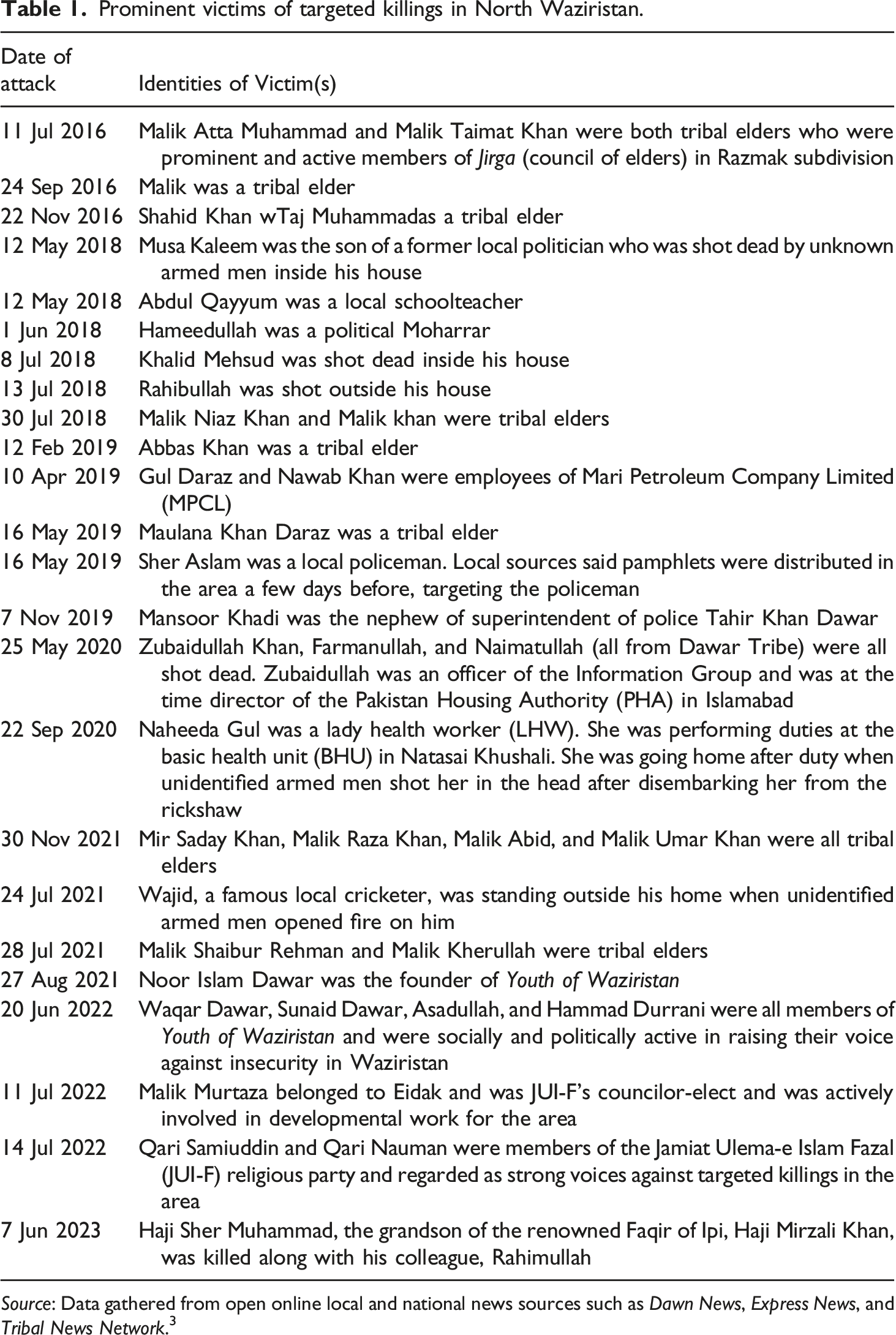
Source: Data gathered from open online local and national news sources such as Dawn News, Express News, and Tribal News Network. 3
Another local journalist further explained that the victimology of targeted killings after the Operation Zarb-e-Azb had been rather diverse, focusing more on the educated youth that demanded a radical change and openly denounced militancy (May 5, 2021, personal communication). The fieldwork in North Waziristan informed that the educated youth in North Waziristan had created “mediums” in the form of local community youth organizations to unite likeminded people and raise awareness against issues such as increasing targeted killings, lack of education and health facilities, absence of employment opportunities for tribal youth, etc. While most of these community youth organizations focused on their respective tribes and villages, some of them were present all over North Waziristan and were quite successful in rallying the locals behind them. These included Youth of Waziristan, Waziristan Student Alliance, Eidak Biedar Zwanan, Peaceful Mashaal North Waziristan, etc. (Makki et al., 2021: 9). However, in the interviews with the local youth, who preside over these organizations, it was shared that they often received threats and “warning letters” deterring them from introducing western ideas of education or against promoting female education in the area. In order to explain this particularization (i.e., form) of (post-conflict) violence, some of the targeted killings in post-conflict North Waziristan are listed in Table 1. These prominent cases give insights into the locals who were targeted. Moreover, none of these individuals were embroiled in tribal conflicts or enmities to such an extent that their deaths can be characterized as revenge—as corroborated by information provided by the locals.
The reason(s) behind the surge in targeted killings after the counter-terrorism operation indicated that while the locals had grown to loathe militancy, conflict, extremism, and warfare, they have not been able to openly express these views, as one local youth remarked: “you are not free to speak!” (June 19, 2021, personal communication). Secondly, it was also said during interviews that the militants were trying to gain ground in North Waziristan by forcing the locals to help them again and, if they refused, they were killed. The said “help” mainly took the form of extortion, with militants threatening the locals for money, refugees, and even food at times. Many locals shared that “Bhatta Khori” (extortion) had become the norm in the last couple of years and was the primary source of sustenance for the local militants in Waziristan. And lastly, the increase in targeted attacks suggested that the militants wished to revive not just militancy but their ideological stance over fundamental interpretations of Islam. Summarizing the post-conflict (in)security conditions in North Waziristan, Noor Islam Dawar shared that the only people safe there were the ones who lived a silent, deaf, and mute life—divorcing all their senses from their consciousness. He stated, “the people have to be completely disengaged and turn a blind eye to everything happening around them in order to continue to live in Waziristan” (June 18, 2021, personal communication). This explication helps to elucidate another form of post-conflict silence practiced in Waziristan, that is, strategic silence, where natives/ locals have embraced silence—meaning not raising their voice against the rising militancy and insecurity in Waziristan—in order to ensure their survival. The following section engages de-securitization with the layers and forms of silence(-ing).
(In)security, de-securitization, and manifestations of silence(s)
Along with targeted killings, the cases of suicide attacks in post-conflict North Waziristan also reflect increasing resurgence of violence. The data collected from independent national news outlets reported fourteen suicide attacks in North Waziristan between June and August 2014. It is also important to note that suicide attacks resumed in post-conflict North Waziristan after May 2022, mainly with 12 attacks carried out between May 2020 and August 2023. In addition to this, the attack on the Counter-Terrorism Department’s (CTD) compound in Bannu—which is responsible for countering terrorism in North Waziristan—the taking of hostages, as well as the attack on the Wana Police Station by 50 militants armed with rocket launchers and heavy weapons—both in December 2022—have signaled the return of the Taliban in Pakistan. In short, as the anti-Taliban local voices were silenced, the Taliban gained space in Waziristan. However, the state/security forces are reluctant to re-securitize post-conflict North Waziristan since it would call into question the effectiveness of the security reconstruction they implemented. The lack of recognition of targeted killings as a recurring phenomenon in Waziristan, used strategically by the militants to facilitate the resurrection of their organizational setup, denotes state silence. Characterizing these (targeted) deaths as “routine” killings amongst the tribes due to their rivalries shows that the security forces refuse to incorporate this particular form of violence to their discourse regarding security.
As a response to the protests by locals on targeted killings, the police and district administration released joint statements in press conferences denying the increase in cases of targeted killings and lamenting instead that the locals were not cooperative during investigations and did not disclose names. They also maintained that these attacks were the result of rivalries between tribesmen and their personal enmities (Dawn News, 2021). Moreover, the security forces have conducted intelligence-based operations and recovered weapons and ammunition in North Waziristan, especially in the beginning of 2023, but the mention—and seriousness—of the targeted killings of locals by militants in North Waziristan has been purposefully neglected in the post-conflict context. Despite the police records, the local residents were joined in their consensus that the targeted killings were not the result of personal feuds or enmity: according to the tribal culture, such attacks were acknowledged by the tribesmen involved and the entire local community was always aware of it (Sahill, 2021). Speaking on the relevance of inter- and intra-tribal conflicts in North Waziristan, another local youth shared that the tribal mind-set had not evolved completely in North Waziristan and the tribesmen did not forgo of revenge (badal) and it could not be said that locals were not involved in targeted killings (June 17, 2021, personal communication).
The assessment of the targeted killings in North Waziristan, before and after the counter-terrorism operation, then draws attention to the following question: while such an “insecurity situation” remains, why has the issue of the Taliban targeted killing campaign not been addressed in the dominant (post-conflict) security discourse? Here, two aspects need to be taken into consideration to explain the use of de-securitization, that is, state silence. Firstly, post-conflict environments are marked by the normalization of the political order, even going so far as to secure development to avoid slipping into a new securitization. This brings forth the second aspect, focusing on the assertions by Hansen (2012) who contends that in order to avoid the above, desecuritizaiton can be opted for as a “strategic time-out.” This does not support that de-securitizations are normatively or politically unproblematic or morally superior (than securitization), but rather draws attention to the depth of de-securitization where “silent institutional” de-securitizations (i.e., state silence) are adopted to maintain the post-conflict fragile peace. For instance, the post-conflict security reconstruction process by the Pakistan Armed forces (for details, see Makki et al., 2021) does not address or acknowledge the issue of targeted killings of locals by militants. In this case, being the de-securitization actors—as Aradau (2003) argues—the Pakistan army/state cannot be the agents of securitization; de-securitizing actors should come from the previously silenced “other,” that is, locals/natives of Waziristan, who have had to adopt strategic silence to ensure their survival. The aim of this article is to provide a more conceptual nuance to the statuses of security/violence while illuminating de-securitization processes in post-conflict contexts. With this in mind, this article has attempted to provide further guidance to those involved in the debates on de-securitization, as well as to those who wish to use it empirically.
Conclusions
Given that consistent reporting or reliable datasets covering the targeted killings of locals in the tribal area of North Waziristan have remained unattended since the War on Terror began in Pakistan, this study makes pertinent contributions by providing subjective accounts and details on the dynamics of targeted killings, before and after the counter-terrorism operation. It is necessary to present an overall picture of this particular form of pervasive violence by delineating the forms of the post-conflict (i.e., conflict) silence(s) it has engendered. This study helps to identify three forms of silences: (i) silencing (by killing), (ii) state silence, and (iii) strategic silence. As denoted by the name, silencing refers to literal silencing which has been brought about by eliminating individuals who particularly maintained a hard stance against militants. The state silence is reflected in the absence of any mention, recognition, or attention to the targeted killing of locals by militants by the state/security forces as it calls into question the post-conflict security reconstruction(s) they have put in place. And the last category—which can be characterized as the outcome of the first two forms of silences—is the strategic silence for survival which has been enforced by fear and the need for protection.
The desire to eliminate tribal leaders and elders indicates that the militants understood the socio-cultural organization of the tribal communities where the tribes or sub-tribes were dependent on their leaders and elders to guide and protect them. Furthermore, the local “informers” of the state security forces were also particularly targeted because they helped in identifying locations for drone strikes. However, the way they were killed (warning letters, confessional videos, beheadings) by the militants brought forth the strategic use of “fear” against the local tribal communities. The sources of human intelligence (i.e., “informers”) also symbolized local resistance, but their brutal targeting spread fear and silence in the local tribes. The organizational sophistication displayed by the militants in the form of Ittehad-e-Mujahideen Khorasan, Lashkar-e-Zil, or 055 Brigade to conduct the targeted killings also reinforces and elucidates the premeditated and calculated aspect of militancy in North Waziristan. Here, the empirical accounts on targeted killing also illuminate that militancy and violence in the tribal areas should be viewed outside ideological fanaticism and rather be used to decode the broader strategic and political objectives in the tribal areas.
Similarly, in the post-conflict North Waziristan, by targeting the tribal leaders and elders, the militants were successful in isolating communities and increasing the trust deficit between the tribal communities and the state security forces. Moreover, the shift in focus towards locals, especially educated youth, or informants of security forces, indicates the militant hostility towards modernization being instituted by the security forces (FATA-KP merger), and conscious, educated locals openly denouncing militancy and preaching social boycott of militants. Here, it is important to highlight that the shift in targeted killing attacks towards ordinary locals in post-conflict North Waziristan has decimated everyday sense of security; hence, bringing strategic silence to ensure survival. And as an added challenge, the post-conflict de-weaponization has left no measures for self-security in the tribes. The pervasive continuation of violence also underlines the fact that the conflict in North Waziristan is not binary; it is more complex than assumed. And the legacy of the conflict—in the form of targeted killings—has translated into post-conflict violence.
The fragile peace in post-conflict North Waziristan shows that targeted killings of locals by militants have had clear consequences. The killings signal that the militants are trying to (re)gain ground in North Waziristan, thereby marking the “return of Talibanization.” It is undeniable that the modus operandi of targeted killings carried out by the militants has relied on the use of fear to stage violence locally; violence that is punctuated by silence(s). In the case of North Waziristan, silence is an act of protection; it provides refuge for locals against the rising insecurity in North Waziristan. Hence, the silence in North Waziristan is multi-layered; it is produced and reproduced. In conclusion, this marked the beginning of a profoundly defining moment in the tribal Pashtun communities of North Waziristan: to remain silent (strategic silence) or to be silenced (silencing).
Footnotes
Acknowledgments
I am thankful to the peer reviewers for their helpful feedback, and in particular to Thomas Coppey, Managing Editor of Violence: An international journal, for his continued cooperation and understanding throughout the review and publication process. I am most indebted to the people of North Waziristan who shared their experiences and enlightened my understanding over the depth and manifestations of violence.
Declaration of conflicting interests
The author(s) declared no potential conflicts of interest with respect to the research, authorship, and/or publication of this article.
Funding
The author(s) disclosed receipt of the following financial support for the research, authorship, and/or publication of this article: The financial support for the fieldwork and research was provided by the Hanns Seidel Foundation Pakistan provided funding for the research project titled, “Unravelling the contextual realities in post-conflict North Waziristan: Understanding displacement, resettlement, and post-conflict development” from July 2019 to June 2020 in which post-conflict security reconstruction was an important focus of research. After the completion of the project, the author pursued the subject of post-conflict violence, with emphasis on targeted killings, independently, without any financial support.
