




Abstract
Coronary artery disease (CAD) stands as the prevailing global cause of death, and coronary artery bypass grafting (CABG) remains the optimal revascularization method for severe CAD. While surgical management has progressed significantly, the implementation of these advancements requires acceleration. The impetus for this acceleration can be bolstered through specialized coronary surgery societies, which can concentrate research efforts, synthesize evidence, and contribute to the formulation of practice guidelines. Cross-continental collaborations among national and international societies, such as the International Society for Coronary Artery Surgery, Japanese Association for Coronary Artery Surgery, and Society of Coronary Surgeons (India), can address knowledge gaps, drive innovation, standardize training, and improve adherence to practice guidelines. Dedicated coronary societies have the potential to revolutionize coronary surgery and enhance patient outcomes.
Introduction
Coronary artery disease (CAD) ranks as the foremost global cause of death and disability, with recent 2020 statistics attributing an estimated 15.5% of the global mortality burden1, 2 to it. Coronary artery bypass grafting (CABG) remains the most effective revascularization method for severe and extensive CAD, constituting 54% of surgical volume in the STS Adult Cardiac Surgery Database.3–6 Specialist societies play a pivotal role in concentrated research efforts, generating evidence, and contributing to guideline development. CABG has evolved into a safe and effective procedure. 7 Sub-specialization/super-specialization of surgical coronary revascularization, facilitated by dedicated societies, can accelerate growth by identifying knowledge gaps, promoting research and innovation, ensuring adequate training, and developing practice guidelines8, 9 (Figure 1).
Objectives of National/Regional Societies of Coronary Surgeons.
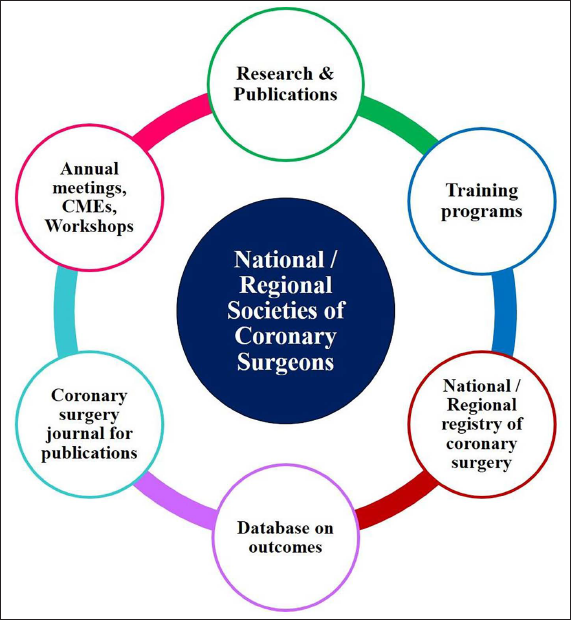
Bridging the Gap Between Evidence and Practice Through Research and Innovation
Despite decades of research and demonstrable benefits of techniques like multi-arterial grafting (MAG) and an aortic touch-off-pump CABG (OPCAB), there is a need for accelerated growth in standardization and adoption of these techniques.10–13 With the increasing complexity of CAD patterns, including diffuse disease, aortic atherosclerosis, and higher comorbidities, there is a growing need for wider adoption of MAG and/or off-pump techniques.
Bridging the Gap Between Training and Practice Through Subspecialty Designation
In addition to ongoing research, the adoption of appropriate techniques to address the complexities of coronary surgery must be incorporated into the curriculum during coronary training. The growing complexity of CAD, coupled with a higher comorbidity burden, necessitates the adoption of appropriate techniques during both training and practice. Coronary societies serve as platforms for knowledge exchange, mentorship, and engagement between experts and trainee surgeons, fostering a passion for coronary surgery. Specialized courses and workshops offered by these societies focus on the latest advances in CABG, providing valuable training opportunities for aspiring surgeons.
The Impact of Sub-specialization on Patient Care
Establishing societies focused on subspecialties has proven beneficial in various surgical fields, fostering growth and providing opportunities for generalist surgeons. In cardiothoracic surgery, societies like the Ross Society, Mitral Valve Society, and Aortic Society have similarly developed, advocating for the development of their respective subspecialties. A dedicated coronary society can facilitate evidence-based guidelines and raise awareness among surgeons.
Conclusion
Dedicated coronary societies globally can amalgamate regional advantages and propel advancements in research, innovation, education, training, adherence to practice guidelines, ultimately leading to improved outcomes.
Footnotes
Declaration of Conflicting Interests
The authors declared no potential conflicts of interest with respect to the research, authorship and/or publication of this article.
Ethical Approval
Not applicable.
Funding
The authors received no financial support for the research, authorship and/or publication of this article.
Informed Consent
The need for informed consent from the patient was waived as no patients were involved in this review.
