




Abstract
A 35-year-old patient found to have tuberous xanthomas was diagnosed to have familial hypercholesterolemia (FH). Dermatological manifestations can trigger the diagnosis of FH.
Keywords
The lesions in Figure 1 were seen in a 35-year-old patient diagnosed with familial hypercholesterolemia (FH). His total cholesterol was 465.3 mg dL−1, LDL 414.42 mg dL−1, TG 92.4 mg dL−1, and HDL 32.4 mg dL−1. His father had a myocardial infarction at 35 years and had undergone coronary artery bypass grafting. His Dutch lipid clinic network (DLCN) score was 16. This patient underwent a coronary angiogram and was found to have single-vessel disease. He is presently being managed with statins and ezetimibe.
Tuberous Xanthoma: A Clue to the Diagnosis of Familial Hypercholesterolemia.
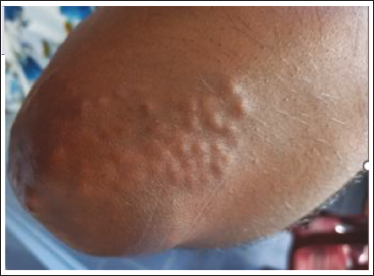
Tuberous xanthomas are painless papules or nodules. They are commonly found on the elbows, knees, and buttocks. The term “xanthoma” is derived from the Greek “xanthos,” meaning yellow. Xanthomas are localized lipid deposits. Physical signs of FH comprise tendon xanthomas (TXs), tuberous xanthomas xanthelasmata, and ocular signs, such as corneal arcus, when it occurs under the age of 45 years. When one has both clinical signs of FH and mutations, they are at a higher risk of developing coronary artery disease. Recognizing these clinical signs raises suspicion of FH, and this should generally be followed by carrying out a lipid profile and a comprehensive clinical assessment. Although genetic testing for FH should be carried out for patients with FH, it is largely underused in low- and middle-income countries due to a lack of resources. Therefore, FH diagnosis in these countries is done using cholesterol levels and clinical signs. Dermatological manifestations can raise the suspicion of FH and trigger the diagnosis, thereby helping to screen these individuals for FH.
Compliance with Ethical Standards
Approval was obtained from the ethics committee of the University of Sri Jayewardenepura for the Familial Hypercholesterolemia Registry. The procedures used in this study adhere to the tenets of the Declaration of Helsinki. Written consent was obtained, and the data was analyzed anonymously. Approval number: 878/2020
Availability of Data and Materials
The data sets used during the current study are available from the corresponding author on reasonable request.
Footnotes
Declaration of Conflict of Interests
The authors declared no potential conflicts of interest with respect to the research, authorship and/or publication of this article.
Funding
The authors received no financial support for the research, authorship and/or publication of this article.
Informed Consent
The authors affirm that the patient provided informed consent for the publication of the images.
Authors’ Contribution
Anne Thushara Matthias and Anthony Nilesh Ranjeev Fernandopulle were involved in conceptualization, methodology, data collection, validation, writing, reviewing, and editing.
