




Abstract
Introduction
Oxidative stress plays an indispensable role in the pathogenesis of coronary artery disease (CAD). Several studies suggest that meditation can reduce oxidative stress and improve antioxidant status. This study was designed to evaluate the impact of heartfulness meditation on antioxidant status and lipid profile in patients with coronary artery disease.
Methods
Fifty-nine angiographically diagnosed CAD patients were included in the study. Patients who were enrolled practiced heartfulness meditation for a period of six months. Protein thiol (an antioxidant marker), serum total cholesterol (TC), triglycerides (TG), high-density lipoproteins (HDL-C), low-density lipoproteins (LDL-C), and very low-density lipoproteins (VLDL-C) were measured under fasting conditions before and after six months of meditation practice.
Results
After six months of practice of heartfulness meditation, there was a statistically significant increase in HDL-C (39.10 ± 8.30 vs. 42.85 ± 8.16, p < .01) and an antioxidant marker protein thiol (257.34 ± 39.68 vs. 345.31 ± 57.53, p < .0001). The mean levels of triglycerides (205.81 ± 88.31 vs. 182.53 ± 93.57 mg dl−1), VLDL-C (41.18 ± 17.64 vs. 36.51 ± 18.71 mg dl−1), and total cholesterol (170.02 ± 40.10 vs. 164.46 ± 42.20 mg dl−1) decreased following the intervention, although the differences were not statistically significant.
Conclusion
Heartfulness meditation is an effective means to decrease free radical formation and improve antioxidant status and lipid profile in CAD patients. As a result of this study, regular meditation practice has the potential to be one of the most effective non-pharmacological strategies for CAD prevention.
Introduction
Globally, cardiovascular diseases (CVDs) are the leading cause of premature mortality. Compared to all other causes, CVDs account for a greater number of deaths each year. Every year, about 17.5 million people worldwide die from CVDs, accounting for 31% of all deaths. With over 17.3 million deaths annually, CVDs—especially coronary artery disease (CAD)—is the leading cause of morbidity and mortality worldwide. Coronary artery disease accounts for approximately 15% of all deaths in the world.1, 2 Cigarette smoking, diabetes, hypertension, and hyperlipidemia are risk factors for CAD. 3 Obesity accelerates the development of atherosclerosis and endothelial damage, both of which lead to CAD. 4 The most significant risk factor for CAD is considered to be low-density lipoprotein cholesterol (LDL-C). Lipoprotein is thought to play a key role in atherogenesis. 5 A significant independent protective factor against atherosclerosis and CAD is high-density lipoprotein (HDL). 6
Oxidative stress is now considered a novel risk factor for CAD. 7 Reactive oxygen species (ROS)-induced oxidative stress is linked to the pathophysiology of various vascular diseases, such as CAD, hypertension, and atherosclerosis. Through the expression of antioxidant enzymes and control of oxidants, the redox state is finely tuned to maintain cellular homeostasis. A complex network of antioxidants, including reduced glutathione (GSH), protein thiol, catalase, superoxide dismutase (SOD), etc., is present in human cells to scavenge ROS. 8
In the healthcare setting, during the past few decades, awareness about meditation and other forms of mind–body practices has increased. Meditation shows positive benefits in the management of CAD and its risk factors, which have been shown in a number of studies.9, 10 A form of Raja Yoga, 11 heartfulness meditation is one of the simplest non-pharmacological methods that has been shown to positively impact changes in brain chemistry and body metabolism; 12 lower blood pressure, heart rate, and respiratory rate; 13 and alleviate stress. 14 It has an effect on heart rate variability, 15 modulation of cardiovascular response to stress, 16 burnout, emotional wellness, and telomere length. 17 Heartfulness meditation practices lead to mind–body relaxation by decreasing sympathetic drive and increasing parasympathetic activity.13, 15
Meditation has been found to have a positive effect on antioxidant status, according to growing evidence. However, research on the effect of meditation on protein thiol (a major antioxidant) levels in reducing oxidative stress is limited. As a result, the current study aimed to assess the impact of heartfulness meditation on antioxidant status and lipid profile in patients with CAD.
Materials and Methods
This prospective self-control study involved known CAD patients who visited the Department of Cardiology in an outpatient unit. The Institutional Ethical Committee granted approval for this study. All participants provided a written informed consent. The study was carried out in the Department of Physiology at the Sri Venkateswara Institute of Medical Sciences (SVIMS), Tirupati, Andhra Pradesh, India, in collaboration with the Departments of Cardiology and Biochemistry.
The sample size was calculated by using Cohen’s effect size method for paired comparisons. Fifty-nine angiographically diagnosed CAD patients with normal left ventricular (LV) function of either sex aged between 40 and 60 years were included in the study. Coronary artery disease patients presenting with other comorbid conditions, including structural heart disease, LV dysfunction, renal failure, and epilepsy, and patients practicing any form of meditation were excluded.
Biochemical Parameter Studied
Fasting blood samples were collected from the participants before and after the completion of six months of heartfulness meditation practice. Blood sample was collected in a plain bulb and was centrifuged to separate serum for the estimation of total cholesterol, triglycerides, and HDL-C. LDL-C and VLDL-C were measured using the indirect method (Friedewald equation). 18
The protein thiol content was determined using Ellman’s method, which involves reacting total sulfhydryl groups and 5–5 dithiobis-2-nitrobenzoic acid to form a chromogen whose extinction is measured at 420 nm. 19 Samples were assayed for the estimation of protein thiol stored at −80 °C for a period of six months.
Heartfulness Meditation Intervention
Under the guidance of a heartfulness meditation trainer, all patients were asked to practice the key elements of meditation for 40 minutes on each of the first three days. These practices included cleaning, prayer, and relaxation. For six months, patients were advised to practice heartfulness meditation every day and note their observations in a personal diary. Weekly follow-ups and one-to-one meditation sessions were conducted with all the patients to ensure compliance with meditation practice.
Statistical Analysis
All statistical analyses were performed using SPSS version 25.0 (IBM Corp., Armonk, NY, USA). The mean and standard deviation were used to present all the continuous variables. Using the paired Student’s t-test, the pre- and post-meditation values of all parameters were compared. A p value of ≤.05 was taken as significant.
Results
The mean age of the study participants was 53.2 ± 7.25, and most of the patients were in the age group of 51 to 60 years (42%). Males (69%) were more than females (31%). Among the study patients, the protein thiol level (an antioxidant marker) increased significantly from the baseline value of 257.34 ± 39.68 to 345.31 ± 57 µmol L−1 (p < .0001), as shown in Table 1.
Comparison of Antioxidant Markers in the Pre- and Post-intervention Groups.

Table 2 compares the lipid profile parameters at the beginning and end of the study. After six months of practicing heartfulness meditation, the HDL-C increased significantly from the baseline value of 39.10 ± 8.30 to 42.85 ± 8.16 mg dl−1 (p < .01). No statistically significant decreases were reported in the mean values of triglycerides (TG), LDL-C, VLDL-C, HDL-C, and total cholesterol (TC). However, the values improved after six months of practicing heartfulness meditation.
Comparison of Lipid Profiles in the Pre- and Post-intervention Groups.

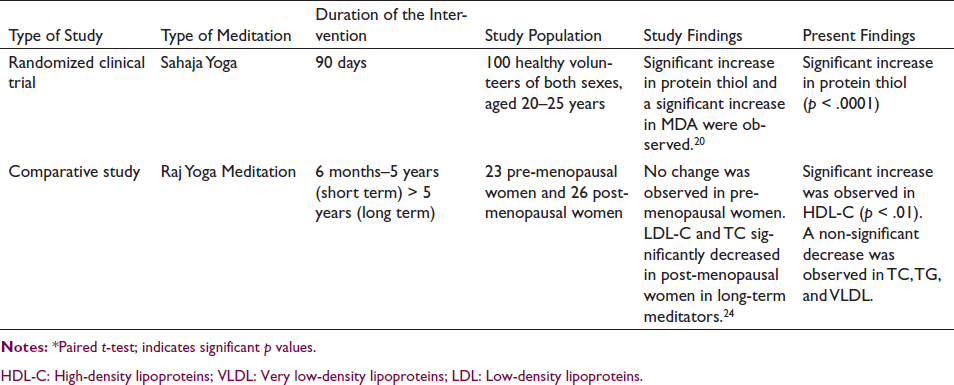
HDL-C: High-density lipoproteins; VLDL: Very low-density lipoproteins; LDL: Low-density lipoproteins.
Discussion
Antioxidant enzymes and endogenous non-enzyme antioxidants constitute the antioxidant system. Whole-blood total thiols (sulfhydryls), which include glutathione, homocysteine, cysteine, and cysteinyl-glycine, are the most significant endogenous antioxidants (non-enzymes). These are powerful reducing agents that have the ability to function as antioxidants in vivo. An antioxidant defense mechanism that reduces oxidative stress benefits greatly from an increased level of protein thiol.
In the present study, patients practicing heartfulness meditation have shown a significant increase in serum protein thiol levels. Similar findings were found in the study of Chanda et al, 20 who reported that 90 days of yoga practice showed a significant increase in protein thiol levels. A study by Pujitha et al 21 reported that six months of practice of heartfulness meditation has shown a significant improvement in antioxidant status. Antioxidant levels increase and ROS production is reduced during meditation. So there will be a decrease in oxidative stress, shifting the oxidant–antioxidant balance equilibrium in favor of antioxidants. 22 This illustrates that meditation practice can change redox status to a reduced state, which is a beneficial adaptive strategy for reducing oxidative stress and enhancing antioxidant defense mechanisms. 23
The improvement in lipid profile observed in the present study is consistent with studies done by Vyas et al. 24 Stress is reduced by meditation through its effects on the hypothalamus. This, in turn, results in a decrease in the release of the stress hormone cortisol and the corticotrophin-releasing factor (ACTH). A decrease in cortisol levels leads to reductions in gluconeogenesis and fat mobilization.25, 26 This may be the probable mechanism for improving the lipid profile. The participants in the present study had CAD and were using cardiovascular medication. During the study period, no changes were made to the regular medication. Cardiovascular drugs can induce antioxidant activity, but they have no effect on thiol levels.
Therefore, the present study indicates heartfulness meditation has a positive effect on antioxidant status and lipid profile. Heartfulness meditation practice is simple, easy, and effective.
Limitation
A small sample size was used, and no randomization was carried out.
It was an open-label study (non-blind).
Albumin levels were not studied specifically.
Conclusion
Heartfulness meditation is an effective means to decrease free radical formation and improve antioxidant status and lipid profile in CAD patients. It can be proposed that heartfulness meditation can be used as a non-pharmacological adjuvant in the management of CAD. The findings of this study put forward that regular meditation practice can emerge as one of the most important non-pharmacological methods of preventing CAD.
Footnotes
Declaration of Conflicting Interests
The authors declared no potential conflicts of interest with respect to the research, authorship, and/or publication of this article.
Ethical Approval and Informed Consent
The Institutional Ethical Committee of Sri Venkateswara Institute of Medical Sciences (SVIMS), Tirupati granted approval for this study. All participants provided a written informed consent.
Funding
The authors received no financial support for the research, authorship and/or publication of this article.