




Abstract

Case Report
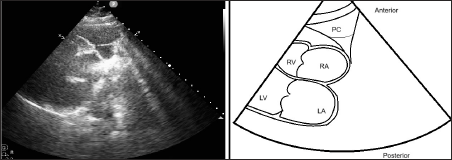
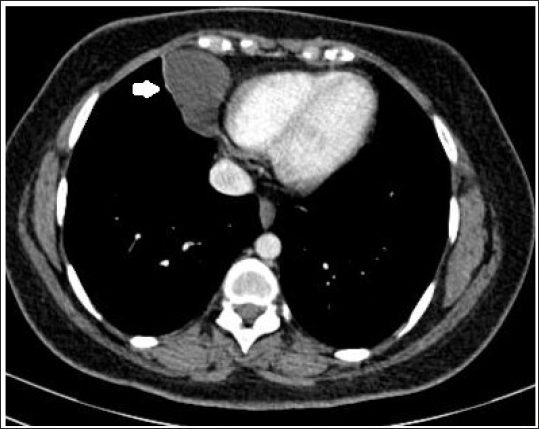
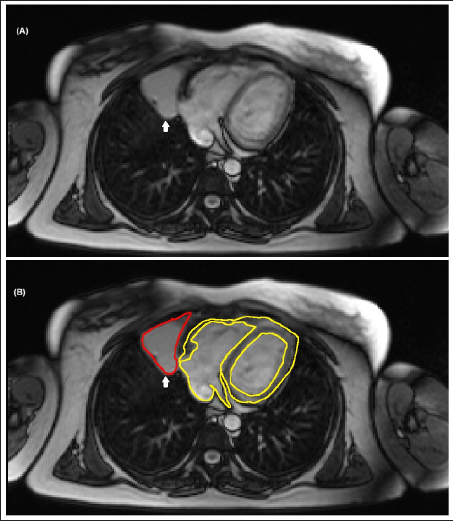
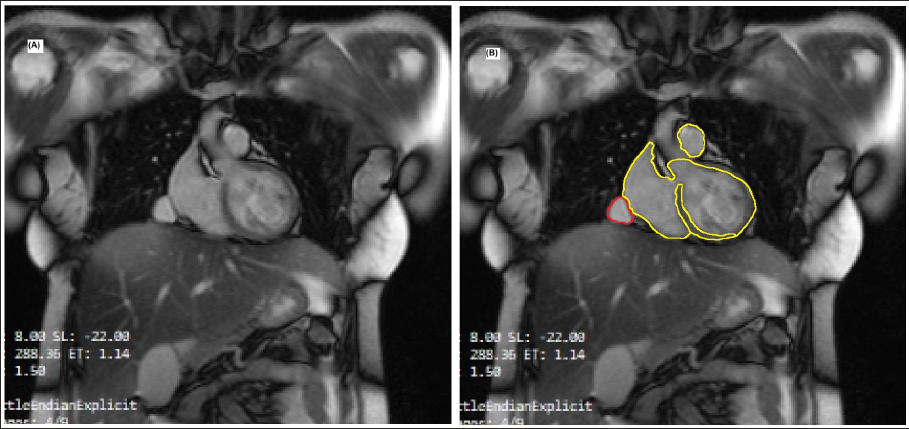
A 38-year-old healthy female came for a yearly checkup at the outpatient department in which she underwent multiple blood tests, electrocardiogram, and echocardiography. All the blood tests were normal including electrocardiogram. But 2D echocardiogram showed a structurally normal heart with good left and right ventricular function; there was a pyramidal-shaped structure noticed just adjacent to the right atrium and right ventricle extending from the right border of the heart to midclavicular line in the 5th intercostal space in width, The depth extending from immediate retrosternal to 8 cm deep lying adjacent to right heart border. And vertically extending below from the diaphragm to 10 cm above the diaphragm (Figure 1). This cystic structure was avascular, confirmed with a CT scan (Figure 2). There was no diverticulum with the pericardium, which was confirmed with MRI (Figures 3 and 4). The female patient was reassured and advised to follow up on a regular basis.
Discussion
The cystic lesion adjacent to the heart is called a pericardial cyst. 1 It is a rare entity with an incidence of 1 in 100,000 populations. 2 Usually detected incidentally in the 3rd and 4th decade of life in asymptomatic patients (50%−70%). In 70% of cases, the cyst is found in the right cardiophrenic angle, 22% in the left, and 8% in the posterior or anterosuperior part of the mediastinum. 3 These cysts are usually harmless unless; they become so big as to compress structures such as the heart oesophagus, great vessels, and tracheal tree; 4 or rupture into pericardial sac causing tamponade; 5 or can cause pericarditis by infection of the cyst; 6 or sudden cardiac death.
The management of pericardial cysts depends on whether the patient is symptomatic or asymptomatic. All patients with symptoms should undergo surgery unless the patient is not fit for surgery. If some of the symptomatic patients have relief of symptoms then they can undergo percutaneous aspiration or ethanol sclerosis. If aspiration fails or there is a recurrence of cysts then they can undergo open heart surgery with cystectomy. The majority of the asymptomatic patients require conservative management.
Footnotes
Declaration of Conflicting Interests
The author declared no potential conflicts of interest with respect to the research, authorship and/or publication of this article.
Ethical Committee Clearance
None was required as the case was only evaluated and findings were submitted for publication. No trial of medicine or trial of therapy was performed.
Funding
The author received no financial support for the research, authorship and/or publication of this article.
Informed Consent
Consent and permission to publish the images were taken from the patient.
